Showing posts with label Jimmy Forrest. Show all posts

Thursday, April 08, 2021

Listening to Prestige 557: Jimmy Forrest


LISTEN TO ONE: Experiment in Terror
Soft Summer Breeze

 An abbreviated session for Jimmy Forrest: three tracks to be added to some leftovers from earlier sessions and released in 1962 as Soul Street. You wouldn't think they'd bring in Oliver Nelson and a nine-piece band for a few add-ons to an album by a less than A-list musician (in marquee recognition, not in quality), but they did, and we are the richer for it.

Maybe Weinstock and Edwards decided, "Hey, look what we did with Oliver Nelson and those songs from All American! Let's see what he can do with some even less promising material."

Maybe, and maybe not. There's only one really unlikely tune. Eddie Heywood's "Soft Summer Breeze" never became the jazz standard it might have, but it's a pretty tune, and quickly recognizable. Duke Ellington is always a good choice, and "Just a-Sittin' and a-Rockin'" is good solid Ellington.


Henry Mancini's "Experiment in Terror" is the odd choice, and liner notesmith Dan Morgenstern seems a little embarrassed by it:

Jimmy gives the rather slight melody more breadth and depth than this Mancini-made slickie really deserves.

"Experiment in Terror" hasn't made the cut as one of Mancini's major works, certainly, but it's an interesting tune, and it's had an interesting, if slight, history. Its 12 interpretations (per Secondhandsongs) suggest that this little ditty had something for everyone, or else that no one could quite decide what to make of it.

Experiment in Terror was a Hollywood thriller, and Mancini's orchestral version for the soundtrack came out as an album of music from the movie. Every cut on the album is jukebox-lengthed two to three minutes, though none of them took the jukeboxes by storm. The melody has a spooky quality, befitting the title, and it also also has a walking bass line, befitting Mancini. Subsequent renditions took it one


way or another, but Mancini had it both ways, a walking bass under swelling strings, at a stately, spooky pace.

It was next taken up by rock and roll instrumentalists the Champs, still looking for a followup to their big hit "Tequila," and in 1962 having added two young musicians named Seals and Crofts, who would go on to make their own name. The Champs went all out Peter Gunn, walking it hard and picking up the tempo.

And still in 1962, Oliver Nelson and Jimmy Forrest. Here the walking bass part is assigned to guitarist Mundell Lowe, and the rhythm starts to swing, and it's very easy to forget that one started out to do a survey of curious versions of this song, and simply get caught up in what these wonderful musicians do with it. The swelling strings are replaced by brass and reeds, and Jimmy Forrest's saxophone gives the rather slight slickie a reading that reminds you that this is Henry Mancini, and he did know how to write a melody. This is a very satisfying outing.


1963 saw terror move to the elevator with versions by Spanish orchestra leader Fernando Orteu and the Living Strings. Then dormant until the 1990s. when it was taken up by La Muerta, a Belgian band who specialized in music for "those abandoned by love or devoid of hope," unsurprisingly a version that emphasized the spooky elements. It was then taken up by surf rockers and pop rockers who also chose spooky over rhythmic. Most recently, contemporary jazzer Ted Nash gave it the Earl Bostic "Harlem Nocturne" treatment. Eclectic instrumentalists Reverend Organdrum returned it to the Peter Gunn sound (with organ and drum doing the walking part), and so did eclectic guitarist Al Caiola.

Maybe if more people had listened to the Jimmy Forrest version, the tune would have become more widely recorded. For one thing, it's the only collaboration I know of between the talents of Henry Mancini and Oliver Nelson. 

And it has the guitar work of Mundell Lowe, in his only Prestige session. Lowe is associated more with the West Coast, but actually he was an Easterner until 1965, and recorded frequently for Riverside. Before that, interestingly for such a sophisticated stylist, he was a 16-year-old member of the Grand Ole Opry house band (not an easy gig to get in the city known as Guitar Town). A tour of duty in the army during WWII led to a friendship with John Hammond, who steered him toward jazz.


"Experiment in Terror" was the B side of a 45 RPM Prestige release, the popular "Soft Summer Breeze" on top. And all three tunes became part of Soul Street, a 1962 release on New Jazz.


Wednesday, July 29, 2020

Listening to Prestige 506: Jimmy Forrest


LISTEN TO ONE: Matilda

Jimmy Forrest is back in Englewood Cliffs again after only six weeks, with mostly the same group--minus the guitar, plus Ray Barretto on congas, and with a similar mix of good tunes, not necessarily the tunes you'd hear on every modern jazz musician's set list.

The tenor saxophone is and is not a modernist instrument. It's not associated with the traditional jazz era, and not really so much with the swing era, when the clarinets of Benny Goodman and Artie Shaw reigned supreme. Yet so many of the titans of the tenor - Coleman Hawkins, Lester Young, Ben Webster, Stan Getz, Sonny Rollins -- are virtually unclassifiable. Not swing, though they can swing. Not bop, though they can bop. Not cool, though they can play it cool. 

And the same is true of the not-quite-titans, the demi-gods like Gene Ammons and Illinois Jacquet and, yes, Jimmy Forrest. The tenor sax has that human voice-like quality, and the voice is the most flexible instrument of them all. And all these cats can play the blues.

Forrest is back, as in his September session, with some familiar tunes, just not necessarily familiar in this context. And as with the tunes in the September session, he makes them work. Forrest has a great warmth to his tone, particularly in the lower registers. 

Of particular enjoyment to me in this session is "Matilda," the 1930s calypso tune brought up to date in the 1950s by Harry Belafonte. Sonny Rollins also brought calypso into modern jazz at around the same time, possibly a little later. Ray Barretto drums up a storm.

Esmond Edwards produced, and the session was released on Prestige as Most Much!, except for tunes, "I Love You" and "Sonny Boy," both of which were added to a New Jazz release, Soul Street, which gathered bits and pieces from other sessions. The traditional Scottish melody "Annie Laurie," which had been part of a brief swing era vogue for Scottish folk songs, became a two-sided 45.

Wednesday, June 24, 2020

Listening to Prestige 496: Jimmy Forrest


LISTEN TO ONE

One of the interesting things about this album is Forrest's choice of tunes--all of them good, all of them  open for improvisation and development, and most of them not on the set list of any other modern jazzman.

"Tuxedo Junction" was written and premiered by Erskine Hawkins in 1939; then, after a 1940 cover by the Andrews Sisters, it became a favorite of white dance bands--Glenn Miller, Harry James, Ray Anthony. From that time to this, you could count on the fingers of one hand the number of modern jazz musicians who've covered it, and you'd have fingers left over if you left out the white musicians. Why? because it's strictly from
Squaresville? Glenn Miller? You might not think that if you listened to Erskine Hawkins's original, and you would certainly start doing some serious rethinking after listening to what Jimmy Forrest and his crew do to it.

And that's the key to this session--Forrest and his band having a good time and making some good music with some tunes that might well be regarded as guilty pleasures--like "Moonglow," the old Benny Goodman warhorse, which has been recorded by pretty nearly everyone, with the exception of most modern jazz artists (Dizzy Gillespie was one exception), or "Organ Grinder's Swing," composed by Will Hudson, who also wrote "Moonglow."

Detroiter Hugh Lawson worked often with Yusef Lateef, so he was used to doing unusual things with unexpected material.

Calvin Newborn never achieved the recognition that his brother Phineas did, but he had an interesting career. He and Phineas started out in a family band organized by their father, Phineas Sr., and the Newborns became B.B. King's backup band on his first recordings. They went on to become staples of the Memphis music scene, where they were the house hand for Sun Records, and Calvin gave Chester Burnett his first guitar lessons--lessons that would serve young Burnett well when he became Howlin' Wolf. They also befriended a young white kid who used to come and listen to them play in a local club, and was a frequent dinner guest at their home. He also followed their lead to Sun Records, at a time when label owner Sam Phillips was saying "If I could find a white man who had the Negro sound and the Negro feel, I could make a billion dollars." The Newborns' protégé, Elvis Presley, was that white man.

Tommy Potter, one of the original bebop bassists, was near the end of his recording career, and his sessions with Forrest were among his last.

Clarence Johnston often worked with Forrest. His association with Prestige goes back to the mid-1950s, and two albus with James Moody, at which point I wrote about him extensively.

Esmond Edwards produced. Six of these tracks appeared on the Prestige album Sit Down And Relax With Jimmy Forrest. The seventh, "That's All," was included on a later New Jazz album,  Soul Street.


Monday, February 10, 2020

Listening to Prestige 454: Jimmy Forrest

I've spoken before about how the rhythm and blues tenor honkers were often also the most soulful, sensitive balladeers. We heard that just recently, with Willis "Gator Tail" Jackson, and we hear it again here with Jimmy Forrest, although that's not the only note struck by this versatile tenorman. Unlike Jackson, Forrest isn't doing a Moodsville session, so the ballads are only a part of it.

Forrest's big hit, and one of the greatest rhythm and
blues records of all time, was "Night Train," his reworking of a Duke Ellington riff. He also had an instrumental hit with "Bolo Blues," back in 1953, which he reprises here. Listening to both versions, the most striking difference is in the tone. The earlier version cuts like the bolo it was named for; the Prestige version is warmer, but it also ventures into an area we've seen before with other rhythm and blues veterans, a sort of mellow honk. Forrest gives a hint of the Dionysian excitement--more than a hint, really--but keeps it within the subtler context of bebop ballad improvisation.

"Bolo Blues" is one of only two Forrest originals on the album. He comes back (going with the album order here) with "I Cried for You," a tune which has equally been recorded as a ballad or an uptempo swinger, and Forrest ratchets up the energy for it. And he does seem to have his own ideas about tempo in general. Joe Liggins's original recording of his tune, "I've Got a Right to Cry," takes it in brisk swing time (as does Mose Allison, on a recording contemporaneous to Forrest), but Forrest makes takes tongue out of cheek and makes it a romantic ballad, which certainly fits the title.

Forrest's 1961 "Bolo Blues," at just over four minutes, is about a minute longer than his original hit version, made in the days when 45 RPM was coming into its glory, and 78 RPM records were still hanging on for a last hurrah. The new version was also released on 45, and though Forrest had the benefit of LP production values, most of these album cuts are under five minutes long, with "By the River Sainte Marie" the longest at 5:13. The format for all of these is essentially the rhythm and blues juke box format, with the emphasis on the primary soloist and very little solo space for the other musicians.

"By the River Sainte Marie," with a melody by Harry Warren, does have an extended solo by Tommy Potter, which is unusual for the session, and also unusual for Potter, who rarely soloed. Potter, best known for his work with Charlie Parker, was near the end of his career, although he did continue to work with Forrest on all his Prestige albums.

Right at the beginning of his career, and getting solo space on "I Cried For You," is Joe Zawinul. Zawinul would break out as a star with Cannonball Adderley and his electric piano playing on the Zawinul-composed "Mercy, Mercy, Mercy" (on a Wurlitzer, although he would soon switch to the Fender Rhodes which he helped to popularize, and on which he achieved his greatest fame). Zawinul's career trajectory was swift. He had emigrated from Austria in 1959 with a scholarship to the Berklee College of Music, but left Berklee after a month to go on the road with Maynard Ferguson. After that came a gig with Dinah Washington (he played on her hit record, "What a Difference a Day Makes"). Then this album with Jimmy Forrest, and by June of 1961 he was in the studio with Adderley for the first time, for a recording session with Nancy Wilson.

Esmond Edwards produced the session. The Prestige release was called Out of the Forrest. "Bolo Blues" was the single, with "Remember," from the earlier Forrest Fire album (Larry Young on organ) on the flip side.


Friday, December 06, 2019

Listening to Prestige 434: Jack McDuff

Jack McDuff's second session as leader for Prestige, in July of 1960, put him with veteran tenor man Jimmy Forrest and young Lem Winchester, who had died in a freak gunshot accident just a couple of weeks before this session. Whether they had intended to keep the McDuff-Winchester pairing, it's impossible to say. But as it was, the went back to a lineup which had been hugely successful in the past. McDuff had come to Prestige as part of a quartet led by Willis "Gator Tail" Jackson, with Bill Jennings on guitar. They were putting McDuff forward for stardom now, but the sound was still a good one. Forrest, like Jackson, was a veteran tenor player with roots in rhythm and blues. For a guitarist, they
chose a young man whose career had just begun but who already had the promise of stardom--a promise on which he would richly deliver, though mostly not for Prestige.

Grant Green was 25 when this album was made. His earliest musical models were saxophonists -- Charlie Parker, Lester Young -- along with the seminal jazz guitarist Charlie Christian; as a result, he favored a single-string approach to playing. A St. Louis native, he started playing in that city with Jimmy Forrest. Lou Donaldson discovered him there, brought him to New York, and introduced him to Alfred Lion, who immediately set him up to record as a leader with Wynton Kelly, Paul Chambers and Philly Joe Jones. The album went on the shelf, not to be released until the new millenium, but Green stayed with Blue Note, where he would quickly achieve stardom. He had made his second Blue Note album (guitar, organ, drums) just the week before this Prestige session. It would become Grant's First Stand, his first album released, and he would cut five more before the year was out.

McDuff and Forrest are the central figures for this session, but Green and Ben Dixon contribute too. Dixon had recorded once before for Prestige, on the 1957 Ray Draper album  that marked the debut of trumpeter Webster Young. Young and Dixon had moved to New York from South Carolina together, and Young insisted that Dixon be included on the gig. Perhaps much the same thing happened here, since he had played with Green the week before on the Grant's First Session album. He would continue to work with Green throughout the 1960s.

We are starting to hear, more and more, the development of  the soul jazz sound, and we're learning a couple of things. First, it really is a new sound. It comes from bebop and hard bop and rhythm and blues, but it's not any of them. And although it would, in time, wear out its welcome and its capacity for originality,  that certainly had not happened yet in 1961. And although everyone wanted that organ sound for their soul jazz recordings, that wasn't falling into a rut, either. A lot of very talented musicians were playing soul organ, and each was carving out her or his own stylistic niche.

McDuff also draws his music from some interesting sources. Three of the tunes on the album ("Dink's Blues" (a traditional blues here credited to McDuff),  "Blues and Tonic," "Whap!") are McDuff originals. Of the other three:

  • Henry Mancini was becoming one of the hottest composers around, having brought jazz to network TV with Peter Gunn. His theme for another TV show featuring a suave crime-solver, Mr. Lucky, never quite achieved the ubiquity of the Peter Gunn theme, but it was Mancini, and it got its share of interpretations, from the Dixieland of Jimmy and Marian McPartland, to the Latin rhythms of Jack Costanzo (mambo) and Laurindo Almeida and Mancini himself (Mr. Lucky Goes Latin), to the hard bop of Donald Byrd and Pepper Adams (with a young Herbie Hancock). It fits nicely into the soul jazz idiom too, though with the typical organ combo lineup of no bass it's hard to exactly duplicate the Mancini walking bass.
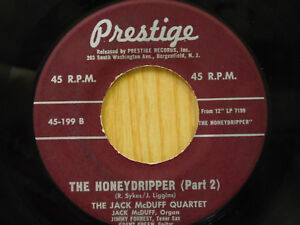
  • "The Honeydripper" was written and performed by rhythm and blues pioneer Joe Liggins. It
    was a huge hit for him on the race charts in 1945-46,  and it spawned a number of first-rate covers, mostly by blues and rhythm and blues artists. Not so much in the jazz field, although you'd think it would have been a natural for soul jazz artists. But Cab Calloway did record it in 1946, and Oscar Peterson in 1963. On this one, McDuff really does carry the walking bass part on his organ.
  • "I Want a Little Girl" was first recorded in 1930 by McKinney's Cotton Pickers. It was written by Murray Mencher and Billy Moll, two gentlemen with whom you really would not associate the authorship of a blues standard. Mencher is best known for "Merrily We Roll Along," the theme music for the Merrie Melodies cartoons, and Moll for "I Scream, You Scream, We All Scream for Ice Cream."  The song lay dormant for a decade, had a couple of covers in the 1940s, including one by Jay McShann. In 1955 it was picked up as "I Want a Little Boy" by Kay Starr, a big band singer trying her best to stay relevant in the rock and roll era.  That wouldn't seem to be an auspicious comeback for a song with ambitions to be a blues classic, but then in 1956 and 1957 it was recorded by two of Atlantic's greatest blues singers, Joe Turner and Ray Charles, and those gave it thoroughly hip credentials. McDuff's was actually not the first jazz organ version of the tune: rhythm and blues bandleader Doc Bagby had done it in 1955.  McDuff, Forrest, Green and Dixon do a great rendition, probably my favorite cut on the album.
Esmond Edwards produced. The Honeydripper was the title of the album, and given how huge a hit the title song had once been on 78 RPM, it was chosen as a two-sided 45 RPM single.

Thursday, April 25, 2019

Listening to Prestige 392: Oliver Nelson - King Curtis - Jimmy Forrest

On the YouTube page for "Soul Street," the person who uses the nom de tube NAFTALI2 says:
Those who heard Jimmy Forrest in person said the most dreaded position on stage is being another tenor player along side of him. 
 NAFTALI2 may be a little biased in favor of Forrest:
In this cut, standing with jazz stalwarts, not amateurs by any means, guys who are more critically acclaimed, guys who got more studio time, guys you've heard of--from Jimmy's first flourish, you can sense they just want to go home.  He continues his solo showing his harmonic complexity, incredible sense of rhythm and groove, the ability to move effortlessly from the beautiful to the honking blues, and the ability to build his solo.
That's going a little overboard. Nelson and Curtis contribute wonderfully to this session too, but he's not wrong about Forrest, an unjustly overlooked jazzman. I've checked a few internet lists of greatest jazz saxophonists, and he doesn't make any of them (well, he makes the Ranker.com list now, because I added him). And this is a real oversight.

Forrest is probably best known for "Night Train," one of the best-known rhythm and blues instrumentals. Forrest takes composer credit for the tune, developed from a Duke Ellington riff, and all in all he probably deserves it. He made the first recording of "Night Train," and it's been recorded over 120 times since, mostly but not always as an instrumental, including a 1982 version by Forrest with Shirley Scott.

Forrest's first appearance on Prestige was a 1952 session recorded live in a nightclub in his native St, Louis, with Miles Davis sitting in on trumpet. I wrote about it:
A few online reviews of this session tend to give it short shrift -- recording quality not all that great, playing competent but uninspired.
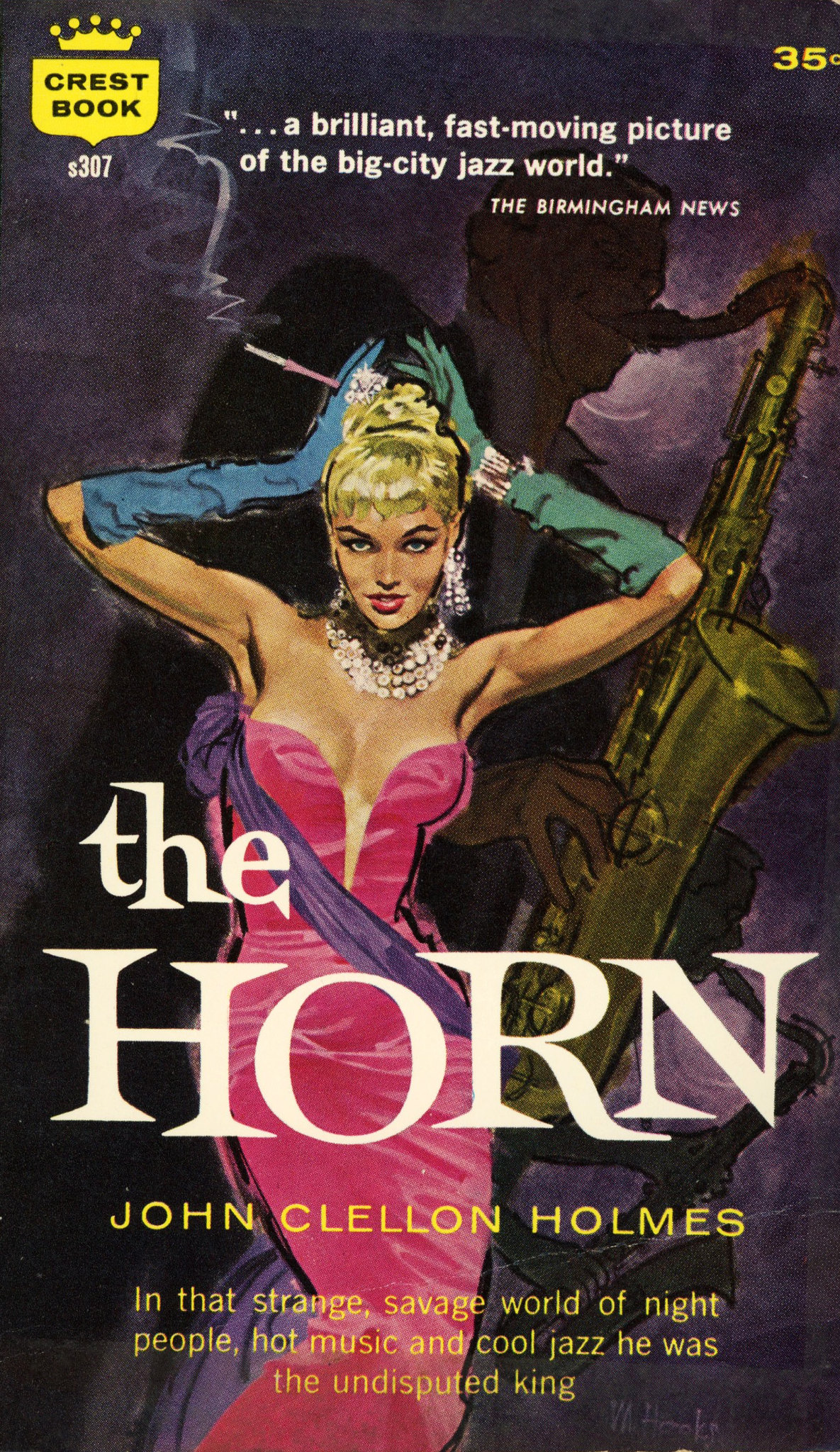
They couldn't be more wrong...this session, recorded live in a St. Louis nightclub, is the real thing. This is jazz in 1952, a piece of living history, jazz as it was, and played by working musicians in small clubs in the Midwest, music that came out of the legacy of the territorial bands of the 20s and 30s, the nighttime wail of America that John Clellon Holmes captured so vividly in The Horn, still the greatest jazz novel.
 He returned to the label in 1958, with the Prestige Blues-Swingers ensemble, then joined with fellow Midwesterners Jack McDuff and Bill Jennings to back up singer Betty Roché, made an album with McDuff and Lem Winchester, and just a month before this session, an album as leader with young organ phenom Larry Young. He would continue to record for Prestige through 1962.

This is mostly an Oliver Nelson album, and I'll get on to him, but NAFTALI2's praise of Forrest's contribution to "Soul Street" is not misplaced. His solo is lyrical and raunchy, inventive and deeply satisfying.

NAFTALI2 finishes his encomium to Forrest with these words:
For years there were alto players in St. Louis who were disciples of Nelson, all the while never having heard Jimmy Forrest, who lived just around the corner.  Upon hearing Forrest for the first time, they always asked why they hadn't heard of him before, shaking their heads in awe.
Forrest wrote "Soul Battle," and it was left off the original release of the album, only added as a bonus track for the CD release, perhaps another nail in the coffin of Forrest's legacy.

Nelson wrote all the rest of the tunes on the album except for Juan Tizol's "Perdido." He was rightly becoming recognized as a rising star and a brilliant composer. As I said in my notes to his previous Prestige session, it's amazing that his compositions really haven't broken through to become jazz standards. There are some terrific ones here.

"Blues at the Five Spot" opens with an evocative interplay between Gene Casey and George Duvivier, then introduces a repeated riff that morphs into some blues figures that are just right for three saxophone players who each have a feeling for the blues.

Nelson stays with the blues, and stays in New York, moving from the legendary downtown jazz club to the radio, with "Blues for M. F. (Mort Fega). Fega was one of New York's early champions of jazz on the radio, with a show that ran opposite the better-known Symphony Sid Torin on radio station WEVD. Nelson's tribute is a real atmospheric blues, with plenty of room, at nearly ten minutes, for soloists to explore all its possibilities.

"Anacruses" are the series of unstressed notes that come before the first complete measure of a composition, which makes an interesting title for this composition, because there aren't any. After a complex but driving drum roll by Roy Haynes, Nelson and cohorts hit the ground running in this very different take on the blues, powerful and aggressive.

"In Passing" begins as an almost nostalgic blues, and then becomes very modern--a striking and powerful transition.

Esmond Edwards produced the session. Except for "Soul Street," the tunes comprised the Prestige album Soul Battle, credited to the three tenormen. "Soul Street" appeared as the title track on a New Jazz album,  a 1964 release joining numbers from different sessions.


Listening to Prestige Vol. 2, 1955-56, and Vol. 3, 1957-58 now include, in the Kindle editions, links to all the "Listen to One" selections. All three volumes available from Amazon.


"The most interesting book of its kind that I have ever seen. If any of you real jazz lovers want to know about some of the classic records made by some of the legends of jazz, get this book. LOVED IT."
– Terry Gibbs


Monday, March 04, 2019

Listening to Prestige 382: Jimmy Forrest


The two Newark youngsters, Larry Young (19) and Jimmie Smith (22), are teamed up here with a seasoned professional for their second record date, a week after their debut under Young's name. Hard to say why. They'd given a veteran journeyman (Joe Holiday) for two cuts in his initial outing, and very good cuts they were, but he had surely shown he didn't need guidance. But whatever the reason, it's hard to complain about the results.

Jimmy Forrest was the veteran. He had started with Fate Marable, the riverboat bandleader who discovered the young Louis Armstrong, and around the time that Larry Young was born, he was joining Jay McShann's orchestra in Kansas City.


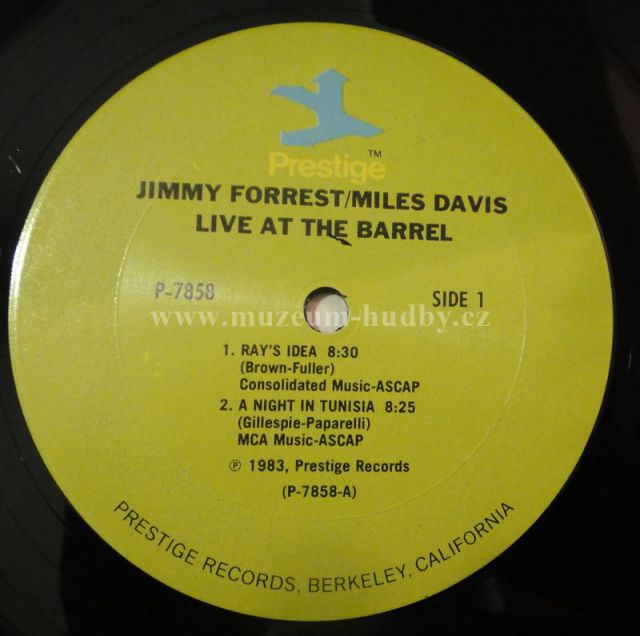
Forrest was a midwesterner. Born in St. Louis, he spent a good deal of his professional life in the heartland, including a 1952(?) live session at a small club in St. Louis, The Barrel, with Miles Davis. This was during the period of Miles's self-imposed exile, after the nonet's non-acceptance and before the Prestige years. I wrote about the session:
A few online reviews of this session tend to give it short shrift -- recording quality not all that great, playing competent but uninspired.
They couldn't be more wrong...this session, recorded live in a St. Louis nightclub, is the real thing. This is jazz in 1952, a piece of living history, jazz as it was, and played by working musicians with (essentially the same guys with whom he would record "Night Train") in small clubs in the Midwest, music that came out of the legacy of the territorial bands of the 20s and 30s, the nighttime wail of America that John Clellon Holmes captured so vividly in The Horn, still the greatest jazz novel.
Forrest was in New York by the late 1950s, and had been working his way into the Prestige family, starting with a 1958 session with the Prestige Blues Swingers (Art Farmer, Pepper Adams, Tiny Grimes, etc.) He did two dates with Jack McDuff, one backing up vocalist Betty Roche, the other a McDuff session, while also going back to the Midwest to make a couple of albums with the Delmark label of Chicago (like Forrest, originally from St. Louis). This would be the beginning of a productive three-year, five-album association with the label, during which time he would also back up Jack McDuff (again) and Oliver Nelson.

This is a fantastic session, with the range of bebop, the guts of rhythm and blues, the soul of soul jazz. It's the kind of album you immediately want to listen to again--first just to groove with the soloists, and second to catch all the other stuff you were aware was happening but weren't focusing on: what Young is doing behind Forrest's solos, what Schwartz is doing behind Young's solos. By an odd coincidence, Forrest's perhaps-1952 session with Miles lists an unknown conga player among the personnel, and so does this session. Very odd--Prestige didn't generally forget to add names to its session notes. Ray Barretto? Maybe. Very good whoever he is.

The session starts out with Einar Aron Swan's "When Your Lover Has Gone," written in 1931 for a Jimmy Cagney musical, an unlikely source for a jazz standard, but it entered the jazz repertoire almost immediately, when Louis Armstrong and his orchestra recorded it in an oddly sweet arrangement, until he starts singing, and it starts to take off, and then his trumpet solo is as hot and brilliant as anything you could imagine. But Armstrong or no, the tune went back into the hands of pop singers until 1955, when there were suddenly versions by Earl Bostic, Bud Shank/Bob Brookmeyer, Urbie Green and Coleman Hawkins, and since then it seems to have gone to the front of every jazz musician's fake book. Forrest's recording starts out with the mystery conga player setting the beat, and is mostly Forrest, with a nice solo break by Young,

Then they get down to some hardcore swing-to-bop to soul, in other words some serious blowing with tunes from Dexter Gordon ("Dexter's Deck"), Milt Jackson ("Bags' Groove"), Doug Watkins ("Help," the only non-self-referential title) and Forrest ("Jim's Jam"). These are all hot, but the hottest is "Dexter's Deck," with smoking solos by both of the lead instruments, plus some continued hot work from the conga player.

The session winds up with Irving Berlin's "Remember," like "When Your Lover Has Gone" a favorite among ballad singers. Hank Mobley recorded this same tune right around the same time, for Blue Note. His album. Soul Station, is considered the pinnacle of his career, and his version of "Remember" a sort of gold standard for the tune, but Forrest, Young and Schwartz do a version that should not be forgotten. Album title notwithstanding, Mobley's version is more bop than soul, whereas Forrest's group sets the soul standard. It was the last number they cut that day, and the firsttrack on the album. It was also the track chosen for 45 RPM release, and here YouTube gives us a nice little demonstration of what happens when a jazz track is edited for single release. As I've mentioned before, in discussing King Curtis:
The big difference between jazz and rhythm and blues of this era? Length. Jazz was an LP music, R&B was tailored to 45s, the jukeboxes, the radio DJs whose audiences were used to that three-minute format. That meant that an R&B instrumental number was built almost entirely around the main solo instrument, be it saxophone, guitar, piano or even harmonica. A jazz tune can easily, with extended improvisation and with solo space given to every member of the ensemble, go eight to ten minutes or longer. Obviously, this creates a whole different dynamic.
And you can hear that perfectly illustrated here. The album version, at 5:27, has solos by not only Forrest and Young but also Schwartz (and a very tasty one); the 45 is 2:48 and all Forrest.

Forrest Fire is the name of the album. Esmond Edwards produced the New Jazz release.

Thursday, February 14, 2019

Listening to Prestige 379: Jack McDuff

Jack McDuff's second outing as a leader for Prestige takes him out of the Willis Jackson-Bill Jennings orbit, and playing with an ad hoc group featuring veteran Jimmy Forrest and relative newcomer Lem Winchester (who has done an organ-sax-vibes session before, with Oliver Nelson and Johnny "Hammond" Smith), with a youngater, Bill Elliott, rounding out the quartet on drums. It's a good amalgam. The solosists are able to find common ground--a couple of common grounds,in fact. On the standards--"Mean to Me" and "Autumn Leaves," they're melodic. On a McDuff original like "Yeah Baby," they know how to let loose and blow.

Both "Mean to Me" and "Autumn Leaves" are taken at sprightlier tempos than one is used to hearing, and why not? The falling leaves of autumn don't always have to be an occasion for wistful sighing. You can play in them too, rake them up into a big pile and jump into them. Forrest takes the main job of the melody in this one, and does some very nice things with it, particularly at the end, where brings some wonderful smeary bluesy sounds to a melody not previously known for its affinity to the blues. "Mean to Me" is slyly playful, and again, why not? "You're so mean to me" can be a tease as well as a plaint. Winchester does some particularly strong solo work on this one.

"Yeah Baby" is nine minutes long, and gives each of them, including drummer Bill Elliott, a chance to shine. This is Elliott's recording debut, the start of a career that was always interesting, but only rarely in the field of jazz  drumming. For a while he led a soul group, which is remembered chiefly as the
launching pad for one of its backup singers, Dionne Warwick. During the 1970s, she and Elliott were married, divorced, married again, and finally divorced again. Elliott also had some success as an actor, debuting on TV with a featured role in Dragnet,  and then appearing as a recurring character in Bridget Loves Bernie. He also made a few movies, including Elvis Presley's Change of Habit.

The quartet is unusual in that it doesn't include a bass. The line that would normally be played by the bass is handled by McDuff himself on the Hammond,

The album, a 1960 release, was called Tough 'Duff. "Yeah Baby" was a two-sided single.


Listening to Prestige Vol. 3, 1957-58 is now available!


and also:

Listening to Prestige, Vol. 2, 1954-56


Listening to Prestige, Vol. 1 1949-53

Sunday, January 06, 2019

Listening to Prestige 369: Betty Roché

Betty Roché didn't do a lot of recording, but some of that wasn't her fault. Of her two most famous recordings, one was never issued, and the other not for forty years. Both of them came during her first sojourn with the Ellington orchestra, which she joined in 1942, replacing Ivie Anderson. Her first big gig with Ellington was a movie, Reveille with Beverly, which also featured the Count Basie Orchestra, Frank Sinatra, the Mills Brothers, and the *** with Ella Mae Morse.  Her rendition of "Take the A Train" from the movie is considered by many to be the definitive vocal treatment of the song.

It's actually sort of hard to find on YouTube--it won't come up in a search for "Betty Roché Take the A Train," although you will get an excellent later recording. You have to search under "Reveille with Beverly."

It's worth the search. Ellington and the boys are pictured jamming on a train that seems more likely to be headed for Acheson, Topeka and Santa Fe than Harlem, but they sound great, and young Betty is at the top of her form. I certainly wouldn't argue too vociferously against those who see this as the definitive version.

So why wasn't it released? Roché had the misfortune to join the Ellington band in 1942, just in time for the Petrillo strike. The labor action, organized by union president James C. Petrillo, only covered phonograph recordings, not motion pictures. So they could record it for the movie soundtrack, but they couldn't release it separately. The same was true of her next triumph: the historic 1953 Ellington concert at Carnegie Hall. It was historic because they were the African American ensemble to play Carnegie Hall (in those days it took more than practice), and it was the world premiere of Ellington's ambitious Black, Brown and Beige, for which Roché was tabbed to sing the "Blues" section. In 1952, after some time off from the band, she did record "Take the A Train," and that version was so good that when she left the band again, Ray Nance would essentially sing her "A Train."

Early in her career, Roché was primarily known as a blues singer, although "A Train" certainly shows her versatility. She had won amateur night at the Apollo as a blues singer, and gone from there to her first professional gig. with the Savoy Sultans.  But over the course of her career, she would reposition herself as a jazz singer.

What makes a jazz singer/ My definition is someone who can sing with jazz musicians and not get lost, and by that measurement, Betty Roché is a solid sender. She sang with Lester Young, with Hot Lips Page, with Earl Hines and Clark Terry and Charles Brown. What she did not sing with was any degree of consistency. She was known for having a somewhat desultory commitment to her career, and an even more desultory approach to showing up on time; and as a result, her recorded output is sparser than it should have been, She only made three solo albums, the first for Bethlehem in 1956 (with Conte Candoli and Eddie Costa), then this one and one more for Prestige, before apparently losing interest in the music business once again.

There's not much blues on this album. The singin' and swingin' of the title announces torchy ballads alternating with uptempo swinging and scatting. "September Song," a little surprisingly, is one of the latter.

Jack McDuff is the primary guiding instrumental force on the ballads, smoky and enveloping; Forrest and Jennings provide swinging breaks for the uptempo material.

Singin' and Swingin' was a Prestige release, Esmond Edwards producing. "A Foggy Day" and "Come Rain or Come Shine" comprised the single, one swingin' and the other singin'.

Duke Ellington said this, describing Betty:
She had a soul inflection in a bop state of intrigue and every word was understandable despite the sophisticated hip and jive connotations.
Which says it all. Or says something, Or maybe nothing. Anyway, it was the Duke.


Listening to Prestige Vol. 3, 1957-58 is now available!


and also:

Listening to Prestige, Vol. 2, 1954-56


Listening to Prestige, Vol. 1 1949-53

Monday, November 13, 2017

Listening to Prestige 283: The Prestige Blues-Swingers

It's those lazy hazy crazy days of summer in 1958, and we're coming close to wrapping up our first decade of recording music for a new label that's come along at the right time, and made its mark in jazz. Look at the musicians who've passed through our door. We brought Miles back to New York and restarted his career. We were the first to record the Modern Jazz Quartet (well, after one tentative start on Savoy). Sonny Rollins and Stan Getz and Lenny Tristano and Thelonious Monk have all made significant recordings with us. John Coltrane is soon to move on--he'll be gone as we start our tenth anniversary--but he's still doing some great stuff for us. We've been an important part of the jazz of the fifties, and that's an era that's giving way to change. What will the new jazz of the sixties be? How are we going to prepare for it, to position ourselves in it?

Meanwhile, who cares? Let's have some fun!

Let's get a bunch of the finest modernists around, and let them loose on some classic trad jazz tunes, and just blow, blow, blow. In fact, that's a good idea for a tune.

Of course, when the dust has settled, and you have six horns, plus a guitar and a rhythm section, you've got a pretty good sized aggregation, and you can't just blow, blow, blow. You're going to need an arranger.

Bob Weinstock brought in a new addition to the Prestige catalog, Jerry Valentine, who had been a trombonist in the Billy Eckstine band, and had arranged for Earl Hines. Valentine's credentials were a bit scattered, but he turned out to be the right man for the job, writing several of the tunes for the session, and finding a sound that was trad and modern at the same time.

The classic tunes were by Andy Razaf (Fats Waller's longtime collaborator) and Will Weston ("I'm Gonna Move to the Outskirts of Town"). Billy Eckstine and Earl Hines ("Jelly, Jelly") and Count Basie with Eddie Durham and Jimmy Rushing ("Sent for You Yesterday"). The ensemble has a Basie feel, except that it doesn't. The musicians are virtuoso modern jazz players, and Valentine has given them a solid ensemble footing and room to wail.

The other newcomer is trombonist George "Buster" Cooper, who generally went just by "Buster,," who knew how to entertain and knew how to swim with the big fish. He had been in the house band at the Apollo Theater, had accompanied Josephine Baker in Paris, and had played with Lionel Hampton (he was with him for the legendary 1953 European tour) and Benny Goodman. He also contributed to jazz history when a friend from the younger days in Florida  arrived in New York, and Cooper took him down to sit in with the house band at the Café Bohemia. The friend was Julian "Cannonball" Adderley.

Later, in the 1960s, he would join the Duke Ellington orchestra, where he would be a featured soloist.

Jimmy Forrest was another one of those guys who played the style of jazz known as bebop and the
style of jazz known as rhythm and blues. He brought the two together when he turned a Duke Ellington riff into "Night Train." He was also the leader of a group which was recorded live in a small club in 1952, with Miles Davis sitting in: to my mind, a significant recording, He gets some solo space on "I'm Gonna Move to the Outskirts of Town," and shows that he knows what to do with it.

Outskirts of Town was the name of the album, and the tune also became the A side of a 45 RPM release, b/w a Valentine original, "Blue Flute."


Order Listening to Prestige Vol 2


Listening to Prestige Vol. 2, 1954-1956 is here! You can order your signed copy or copies through the link above.


Tad Richards will strike a nerve with all of us who were privileged to have lived thru the beginnings of bebop, and with those who have since fallen under the spell of this American phenomenon…a one-of-a-kind reference book, that will surely take its place in the history of this music.

                                                                                                                                                --Dave Grusin

An important reference book of all the Prestige recordings during the time period. Furthermore, Each song chosen is a brilliant representation of the artist which leaves the listener free to explore further. The stories behind the making of each track are incredibly informative and give a glimpse deeper into the artists at work.
                                                                                                                --Murali Coryell

Sunday, December 28, 2014

Listening to Prestige Records Part 63: Jimmy Forrest and Miles Davis

A few online reviews of this session tend to give it short shrift -- recording quality not all that great, playing competent but uninspired.

They couldn't be more wrong.

 Not every album is Kind of Blue, nor would you expect that. Actually, Kind of Blue couldn't have been made at Prestige, with its unrehearsed, jam session philosophy. But Prestige gave us real candid snapshots of the time, and this session, recorded live in a St. Louis nightclub, is the real thing. This is jazz in 1952, a piece of living history, jazz as it was, and played by working musicians in small clubs in the Midwest, music that came out of the legacy of the territorial bands of the 20s and 30s, the nighttime wail of America that John Clellon Holmes captured so vividly in The Horn, still the greatest jazz novel.

Jimmy Forrest had played with Ellington and would later play with Basie, but here he is on his home turf, in a little club called The Barrel in St. Louis, with home town musicians. And Miles Davis, but we'll get to that. Later that year he would write and record his one huge hit, to become an enduring rhythm and blues classic -- "Night Train," based on a riff by Duke
Ellington. Here he's playing bebop, and with essentially the same guys with whom he would record "Night Train" -- again, the worlds of bebop and rhythm and blues crossing in the American night.

Trying to figure out what Miles was doing here. Not so strange, considering that he was from St. Louis, but by February of 1952 his self-imposed exile in the Midwest was over, and he was back in New York. Maybe the date given for Miles sitting in with Jimmy Forest at The Barrel is off? Or perhaps Miles's full-time recommitment to New York was a gradual process.

Anyway, here they are, in a club in St. Louis, playing for the people. Playing easily, but intensely, Jimmy Forrest's gutbucket blues balanced by Miles's lyricism and originality, not unlike Gene Ammons and Sonny Stitt. And sometimes they switch over, Forrest getting lyrical and
Miles getting down. Bebop and ballads. A honking rhythm and blues break by Forrest in the middle of J. J. Johnson's supercharged bebop composition "Wee Dot."

They're playing in a club, for a club audience, not for a 78 RPM record for the jukeboxes, so they can trench out -- the songs run over five minutes, and up to ten minutes or so.

The first release of this session was on a 7800-series LP, which means a lot later, like around 1960, which means the date listed for the gig could be wrong.

Nothing on YouTube, but it's all on Spotify. Check it out. This is our music, from the heart of our America.

And check out this reminiscence of writing an arrangement for Jimmy Forrest, from the JazzWax blog.