Showing posts with label Wynton Kelly. Show all posts

Wednesday, May 29, 2019

Listening to Prestige 396: King Curtis

I always had this fascination with jazz and with rhythm and blues. I grew up in a time and place where the adults I knew, at least the ones I was trying to emulate, were artists and intellectuals, who listened to classical music if they were old guard, jazz if they were on the cutting edge, rock and roll not at all. And if you were part of that world, or on the fringes of that world, and you loved rock and roll, you had a bit of an inferiority complex. You probably had it anyway.

I was never going to do what I really wanted to do, which was drop out of school, go to New York, find the Brill Building, camp out in front of Jerry Leiber and Mike Stoller's office, and pester them until they took me in as an apprentice. Other teenagers like Carole King and Neil Sedaka were actually doing it, but I was so locked in to a certain world view that it not only never occurred to me to do it, it never occurred to me until much, much later that I had really wanted to do it.

So the part of me that was turning to jazz was looking for approval, the part that still loved rock and roll was still defensive. And the part that loved rhythm and blues...well, no one much noticed of cared about that part. Norman Mailer, in "The White Negro," described, in Nelson George's summary, 
a new white outlaw...wandering the landscape, a "hipster," a "philosophical psychopath," whose primary inspiration was the music and sexuality of Afro-Americans...Yet in perpetuating the romance of blackness, supporting the notion that black juazzmen, for example, were in touch with some primal sexual energy, Mailer was as guilty of stereotyping blacks as the rednecks and social mainstreamers his white Negro opposed. While liberals hailed and debated Mailer's provocative rhetoric, many working class white teens were already living out the ideas Mailer articulated, infatuated as they were with black style and culture. But Mailer saw jazz as the crucial element in this new modern white personality; he had no idea of what most Negroes, or their white teenage fans, were really recording or buying.
I had a foot in both worlds. I read Norman Mailer, and I read Jack Kerouac's "Jazz of the Beat Generation" -- and I realize now, in hindsight, what Sal Paradise and Dean Moriarty must have been really listening to in Oakland on that sweaty summer night in 1947.  Charlie Parker's jazz revolution had not made it as far as Oakland; his 1946 gigs in Los Angeles had been pretty much of a fiasco, and had let to a six-month relaxation at Camarillo State Mental Hospital. Sal and Dean were most likely listening to rhythm and blues--someone like Big Jay McNeely. And they thought it was jazz because, dammit, they were right. It was jazz.

I didn't have Nelson George and his great book, The Death of Rhythm and Blues, as a guide then. My other foot was with the white teenagers listening to Fats Domino and Little Richard (a music that in 1960, post-payola, was running very thin) and a ways deeper, with the Negroes that George describes, listening to Muddy Waters and Willis "Gator Tail" Jackson and Amos Milburn. And with no brilliant theoretician like George to give me intellectual support, I remember how thrilled I was to buy this album when it came out: one of my rhythm and blues heroes, King Curtis, playing real jazz along with card-carrying modern jazzmen like Nat Adderley. Playing Ellington!

Soul Meeting is the name of the album (on a re-release intensified to Soul Meeting!), and it precedes the other, somewhat better known Soul Meeting between Ray Charles and Milt Jackson by a year. And certainly, soul is the meeting ground for these diverse and considerable talents. They do take on Ellington: "Jeep's Blues." written with Johnny Hodges and originally recorded in 1938 under his name, later and most famously on the 1956  Ellington at Newport album. Ellington knew his way around the blues, and so do these guys. They also show their skill with standards and pop ballads (Cole Porter's "What Is This Thing Called Love?" and the Sammy Cahn/Jimmy Van Heusen hit for Frank Sinatra, "All the Way"). But they really find their groove, and their bliss, in the three Curtis originals, which bring out the best in both lead instruments and in Wynton Kelly, who contributes solid accompaniment and some smashing solos.

Production credit is shared by Esmond Edwards and Ozzie Cadena, who would take over as chief of A&R for the label when Edwards left a couple of years later. The album was something of a Prestige producers' convention, as Don Schlitten, who produced two sessions for the label in 1957 and would do a bunch more later on, provided the art direction and album cover design to go with Edwards' photo of Curtis.

"Soul Meeting" and "All the Way" were released as a 45 RPM single on New Jazz.

Listening to Prestige Vol. 2, 1955-56, and Vol. 3, 1957-58 now include, in the Kindle editions, links to all the "Listen to One" selections. All three volumes available from Amazon.

The most interesting book of its kind that I have ever seen. If any of you real jazz lovers want to know about some of the classic records made by some of the legends of jazz, get this book. LOVED IT.
– Terry Gibbs


Saturday, November 10, 2018

Listening to Prestige 356 - King Curtis

Prestige has welcomed several of the rhythm and blues stars of the 1940a into the jazz mainstream (where they always belonged), and now the king of the rhythm and blues saxophone. If you were a rhythm and blues fan become jazz fan in the 1950s, you couldn't help but love King Curtis. His 45 RPM single of "Birth of the Blues" was one of my all time favorites, and it probably paved the way for me to fall under the spell of John Coltrane.

King Curtis is given the Prestige treatment, with Esmond Edwards producing and some major jazz figures making up an all star quintet, including Nat Adderley making his Prestige debut and Paul Chambers making and increasingly infrequent return to the label of many of his early triumphs.

But he brings the King Curtis sound with him. The other rhythm and blues veterans, like Hal Singer and Willis Jackson, bring a little nostalgia with them, remembering the R&B of the classic 1940s era. Newer players like Eddie Davis and Shirley Scott, are looking forward to the new soul era of the 1960s. Curtis, though he did begin his career with Lionel Hampton (and though he did play with Ornette Coleman in high school) is solidly right now. And why not? His sound, on countless records for Atlantic and other labels, defined the R&B saxophone of the 1950s. He explores a lot more possibilities here, but it's still the King Curtis sound.

The big difference between jazz and rhythm and blues of this era? Length. Jazz was an LP music, R&B was tailored to 45s, the jukeboxes, the radio DJs whose audiences were used to that three-minute format. That meant that an R&B instrumental number was built almost entirely around the main solo instrument, be it saxophone, guitar, piano or even harmonica. A jazz tune can easily, with extended improvisation and with solo space given to every member of the ensemble, go eight to ten minutes or longer. Obviously, this creates a whole different dynamic.

The other players here are a mixed lot. Nat Adderley pulled a stint with Lionel Hampton, but his career was almost entirely within the modern jazz idiom, In that, he finds plenty of common ground with Curtis. He turns out to have been a good choice. Wynton Kelly has a wide-ranging musical vocabulary, and he works well here.
The most interesting work on the session is turned in by Chambers and Oliver Jackson, who seem to have come prepared to have a good time. Chambers does some of his signature virtuoso solos, including a very strange and haunting bowed bass at the end of "In a Funky Groove," but he also does some unusual stuff, particularly on "Da Du Dah," and Jackson just doesn't hold anything back.

I'm guessing "Little Brother Soul" is Nat Adderley composition, but it may be a Curtis original paying tribute to Cannonball's little brother. Aside from "Willow Weep For Me," the others are all Curtis originals, and he shows some nice range.

The album was called The New Scene of King Curtis. It was released on New Jazz.

Sunday, May 07, 2017

Listening to Prestige 257: Steve Lacy

In my last post, Paul Quinichette's Basie tribute, I talked about the 1950s in jazz as an era where the entire history of jazz coexisted, styles and eras side by side: New Orleans traditional, Kansas City blues, swing (both white and black), bebop, rhythm and blues, hard bop, cool, avant garde. And these styles overlapped and fed off each other. The break that begat bebop came from a Kansas City jump blues number: Charlie Parker's solo on Jay McShann's "Sepia Bounce." Rhythm and blues jumped out of the horn of Illinois Jacquet on Lionel Hampton's "Flying Home." Pop balladeer Billy Eckstine put together a big band that jumpstarted the careers of Charlie Parker and Dizzy Gillespie.

Benny Goodman integrated jazz first behind the scenes by hiring Fletcher Henderson as arranger, then out front with Teddy Wilson and Lionel Hampton. Gerry Mulligan took the ideas he had been working out with Miles Davis out to the West Coast and sparked a whole new geographically eponymous school. Veterans like Lennie Tristano and Lee Konitz were developing an avant garde that would soon be taken over and pushed beyond boundaries by younger musicians like Ornette Coleman, Eric Dolphy, Albert Ayler.

The original beboppers came out of the swing era. Most of them had played in swing bands, and many, like Zoot Sims and Wardell Gray, carried a lot of the swing sensibility into their modern playing. That sort of progression was radical, but it was also incremental.

Steve Lacy was another story. Born in 1934, he had his first professional gig at age 16. That's 1950, when bebop had already passed its infancy and entered its mature phase, but Lacy didn't start with bebop, or even with swing. He went back to an earlier era, playing traditional New Orleans jazz with musicians like Henry "Red" Allen and Zutty Singleton. And then, in a quantum bounce, he leapfrogged over the dominant sounds of his generation and the previous generation, and landed foursquare (well, hardly square) in the avant garde, playing on Cecil Taylor's debut album, Jazz Advance, in 1956.

This Prestige session was Lacy's own debut as a leader, and it finds him somewhat more in tune with the times than the visionary work with Taylor would have suggested.  But he was playing his instrument of choice, the soprano saxophone, and that in itself set him apart. After John Coltrane took up the soprano sax, others started experimenting with it, but in 1957, it was pretty much Steve Lacy alone. So that sets him apart. He is working with the general structure of improvisation from a melody, but he's already heard the call of a muse in a different room.

If it's 1957, and you're going to be looking for new directions...well, of course, bebop was a new direction, which is why Charlie Parker was so important, and continues to be important today. In 1957, his innovations were still fresh, and people were still finding important things to say under the bebop umbrella, but there were other new directions too. And if you were searching for your own way, the path was likely to lead through Thelonious Monk, who had always been in bebop but not of it. Cecil Taylor had included a Monk tune, "Bemsha Swing," on Jazz Advance. Lacy included Monk's "Work," and it was the beginning of a long fascination with one of jazz's most original composers. He would later become the first jazz artist to record a whole album devoted to Monk's music, and would play briefly in Monk's band.

Wynton Kelly had made his Prestige debut with Eddie "Lockjaw" Davis on a couple of 78s in 1950, and had appeared on an Art Farmer album in 1954. By 1957 he was seriously in demand, appearing on a couple of dozen albums in that year alone, on virtually every significant jazz label. He would appear on a handful more Prestige albums in the ensuing years, but never a session as leader. Red Garland and Mal Waldron were the label's go-to piano guys.

Kelly was the straight-ahead side of Lacy's debut sound; Buell Neidlinger and Dennis Charles were the avant garde. Both had been on Jazz Advance, and both would have long-time associations with Taylor. Niedlinger would go deeper into the avant garde later, working with composers like John Cage and George Crumb.

Reflecting the uniqueness of Lacy's instrument, the album would be called Soprano Sax.


Saturday, June 27, 2015

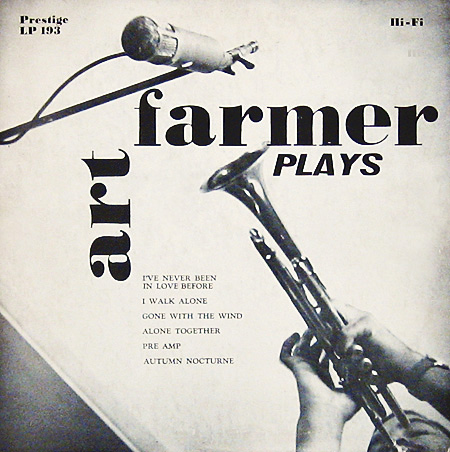
Listening to Prestige Part 124: Art Farmer

Art Farmer had a long, distinguished and varied career -- so much so that these sessions on Prestige have recently been reissued under the quasi-dismissive title Early Art. And it's certain that a great career was still ahead of Art. He would co-lead the legendary Jazztet with Benny Golson from 1959-62. He would be the first to popularize the flugelhorn as a jazz instrument, and introduce a new instrument: the flumpet, about which he has said:

 I hate that name, but I’m stuck with it. That was made by a trumpet-maker named David Monette, who makes trumpets for a lot of very fine trumpet players, such as Wynton Marsalis, for instance, and the principal players for the Boston Symphony and the Chicago Symphony and the Chicago Symphony, etcetera.  I asked him to make me a trumpet, and he made it, it was very fine, and I started really working on the trumpet.  Then he got the idea that it didn’t really sound like me, but he wanted to make a flugelhorn for me — so I told him to go ahead and do it.  Then he called up one day, and he said, “Well, I made it very carefully and put every part in order, made it by hand [because everything is made by hand], but it sounds like hell, and I really don’t like it.  But I have another idea.”  So I told him to go ahead and make it.  Then a couple of months later, he called  and said, “it’s ready.”  I went to Chicago, where I was booked, and he brought it on the gig — and right from the start, it sounded like the  answer to my prayers...you could go one way or the other on it.  You could approximate the warmth of the flugelhorn or you could approximate the projection of the trumpet.  If you really wanted to put a note out there, you could do it, and if you wanted to be more intimate, you could do that also.  So it seemed like what I was looking for.
He would play in a wide variety of settings, from Charles Mingus to Horace Silver to Gerry Mulligan, from the big bands of Quincy Jones, Oliver Nelson and George Russell, to sessions with the French composer Edgar Varèse, because of his reputation as a guy who could play anything.

But he was already that guy when he was still Early Art, in 1954. He had started out in high school in LA with schoolmates Hampton Hawes, Sonny Criss, Ernie Andrews, Big Jay McNeely, and Ed Thigpen.* He had played rhythm and blues with Johnny Otis, Kansas City swing with Jay McShann and blues with Big Joe Turner and Pete Johnson (his first recording session), and the intergenerational, genre-defying jazz of Benny Carter, before his breakthrough 1952 session with Wardell Gray, the one that introduced "Farmer's Market." He had been part of the Lionel Hampton European tour that brought so many young musicians together.

And the same is true of Wynton Kelly. He's probably best known for his work with Miles Davis (including one track on Kind of Blue) during the same time period that Farmer was with the Jazztet. But Kelly had been playing since his early teens, and had actually been part of a Number One rhythm and blues hit in 1948 -- Hal Singer's "Cornbread."

Addison Farmer, Art's twin, also started young out on the West Coast, playing the house band of the R&B label Modern, and recording a bebop session with Teddy Edwards. When he and Art hooked up for this session, he had taken up residence in New York and studied at Juilliard and the Manhattan School of Music, as well as taking private lessons from New York Philharmonic double bassist Fred Zimmerman.

This session features a lot of standards, though if the definition of a standard is one where everyone knows the melody and can sing along at least a couple of choruses, most of these barely qualify. The one solid classic is Frank Loesser's "I've Never Been in Love Before," from Guys and Dolls, to my mind the greatest musical score ever. Farmer and Kelly take it at a brisker tempo than the many ballad singers who've done it, but they still keep it a ballad, and beautiful.

But the others have attracted jazz musicians before and since -- Charlie Parker recorded "I'll Walk
Alone," Chet Baker and Paul Desmond have each done "Alone Together," and "Autumn Nocturne," by film score composer, has become something of a jazz standard.

All of them, and the one original, "Preamp," give much to love, and give plenty of reasons why this is more than "early Art," or early Wynton, for that matter.

"I'll Walk Alone"/"Autumn Nocturne" were released on 78. The session came out on a 10-inch LP in 1955, and then not again ill the reissue days many years later.


* Funny, that's two straight blog entries, two opposite coasts, two guys right around the same time hanging out with a bunch of kids who would go on to become giants of jazz. In the Monk/Rollins entry we saw the young Art Taylor with Sonny Rollins, Jackie McLean, Kenny Drew and Andy Kirk Jr.

Thursday, April 02, 2015

Listening to Prestige Part 20a: Eddie "Lockjaw" Davis

(Going back, from time to time, and finding sessions I had not been able to listen to before.)

If there's a missing link, this is it. This is bebop, and this is rhythm and blues, with Eddie "Lockjaw" Davis, a cat who could play both, and who didn't appear to see the need to make any distinction between the two. And I'm not sure anyone else much cared about the distinction, either. Bob Weinstock did make a few half-hearted attempts to establish a rhythm and blues label (half-hearted in the marketing: there was never anything half-hearted about the music). The thing was, in the 40s, everyone who played an instrument was influenced by Charlie Parker. You couldn't not be. He had changed music. And everyone who played the tenor sax was influenced by Lester Young. If you put a little more honk in the tenor and little more back in the beat, you called it rhythm and blues, and people got up to dance to it. If you took your solos a little farther off the beaten track, if as an improvisational soloist you were more than halfway to being a composer, you called it bebop and people sat and listened to it. Or maybe you didn't call it anything. You just showed up and played it, because it was your vocation and your life.

It was the intersection of some different musical lives on this session. Eddie "Lockjaw" Davis was 28 years old when he made these records. He had come to bebop as musicians of his generation did, through swing as it was played by African American bands on the chitlin circuit, the touring bands booked by TOBA, the Theater Owners' Booking Association, better known as Tough On Black Asses, best remembered by performers as low wages and flea-ridden dressing rooms, by lovers of American music as the breeding ground for some of the best. He'd played with Cootie Williams, Lucky Millinder, Andy Kirk. He would go on, in the 50s, to stints in both Louis Armstrong's and Count Basie's bands. But the first group he put together under his own name, in 1946, had a strong bebop tilt, with Fats Navarro, Gene Ramey, Al Haig and Denzil Best.

This 1950 group cut two sides with rhythm and blues shouter "Chicago" Carl Davis, not to be confused with another Chicagoan named Carl Davis, who became one of the great producers of the soul era. Davis was a rough, forceful singer, and on "If  the Motif is Right" he starts out with a mock gospel sermon on which he sounds like a cross between Screamin' Jay Hawkins and Lord Buckley.

But this group wasn't just gotten together to back up a singer. The two instrumental tracks are the strongest, with Lockjaw bringing his honker and bopper sides together, with a remarkable ensemble behind him. Covering a lot of jazz history.

Representing the future, 19-year-old Wynton Kelly. I'd wondered if this was Kelly's first session, but in fact he had recorded at 16, with tenor sax star Hal Singer, on Singer's chart-topping "Cornbread." So these were his formative years, the years of small-group jazz developing from the influences of Charlie Parker and Lester Young, branching into rhythm and blues and bebop, but cross-pollinating, with the mongrel strength and innovation and intensity that makes American music what it is.

Representing a previous generation, Al Casey. 35 years old when this record was made, he had started as young as Wynton Kelly, but his beginnings were with Fats Waller, and this session was a rare foray into bebop for him. He accompanied Billie Holiday and Chuck Berry, and played into his 80s with the Harlem Blues and Jazz Band.

Drummer Lee Abrams was either 25 or 30 when he made this date, depending on which birth certificate you believe, so he fit somewhere along this timeline, and he made a lot of gigs, including some important ones later on with Wynton Kelly, after he had graduated -- and this came pretty quickly -- to leading his own groups.

These were released on 78 on the short-lived Birdland label -- the collaboration between Bob Weinstock and Mo Levy -- with the two vocals on one disc, the two instrumentals on the other. The instrumental cuts were also released, under their alternate titles, on a Prestige 78.