Showing posts with label James Moody. Show all posts

Sunday, December 27, 2015

Listening to Prestige Part 160: James Moody

Steve Allen used to a bit on his TV show where he would invite four people up from the audience, have each of them play one note on the piano, and then do a jazz improvisation based on the resulting 4-note melody. The results weren't bad, but they were sort of like Dr. Samuel Johnson's description of "a dog walking on its hind legs: it is not done well; but you are surprised to see it done at all." Allen wasn't a gifted improviser, and obviously, the 4-note melodies weren't very good to start with.

The routine served Allen's purposes: to show off, which he had every right to do, it being his show and all; and to draw some of his vast TV audience into jazz, which was a good thing to do. And this anecdote has almost nothing to do with a rumination on James Moody and his septet and their Decmber session, which closed out 1955.

But it does say something about melody, and its importance. You can maybe make a jazz improvisation out of anything, but you're a lot better off starting with a good melody, and better yet, with a great melody.

But can you make effective and inspired jazz out of just any melody. Jazz musicians certainly seemed to think so,,and time and again, they proved their point. Kai Winding, on an early Prestige waxing, turned Mussorgsky's most famous composition into "A Night on Bop Mountain." John Lewis and the MJQ, with an assist from Laurindo Alameida, on Bach's "Fugue in A Minor." Wayne Shorter took on Sibelius; Eddie Daniels gave us his version of Satie. And Moody himself, in his Swedish days, gave us "Flight of the Bopple Bee."

A Swedish folk song became "Dear Old Stockholm." Sonny Rollins made jazz classics out of Jamaican calypso melodies. The beboppers even swung nursery rhymes (not always with satisfying results).

And more than once, the beboppers turned to operetta for imspiration: the ultimate Hip City meets the ultimate Squaresville. And more than once they made it work.

In this case, the operetta composer was Rudolf Friml, and the operetta was The Firefly, which was
supposed to have been composed by Victor Herbert, but he got furious with the diva around whom the show was being written, and stormed off the project, so the producers, in desperation, tapped the unknown Friml, and a star was born. Friml, that was, not the diva, Emma Trentini, who was already a star (and who seems to have gotten along better with Friml than with Herbert -- she was named as co-respondent in his first divorce).

When the 1912 operetta became a 1937 all-talking, all-singing vehicle for Jeanette MacDonald, the producers decided they needed one more boffo number, so they took a Friml orchestral piece, Chanson, added lyrics to it, and came up with one of Friml's biggest hits, if an unlikely source for bebop: "The Donkey Serenade."

Which brings us back to James Moody, and this recording session, with this particular bit of boperetta. Friml's music was a bit of a joke by the 1950s. Tom Lehrer, in his send-up of old Vienna, wrote "Your lips were like wine, if you'll pardon the simile / The music was lovely, and quite Rudolf Friml-y." But you don't choose to play a piece of music just to make fun of it, unless you're Weird Al Yankovic or Spike Jones (and even he was hip to the musical value of the songs he murdered). Moody starts out with a raucous approach to "The Donkey Serenade," including some nice braying by baritone sax player PeeWee Moore. But then Moody gets down to it, and what he gets down to is some incredible bebop improvisation on the alto, gutsy and adventurous, and you don't do that without some good, gutsy music to improvise from.

The rest  of the session is great, too. "The Nearness of You" is beautiful, with Moody at his ballad best.

The days of the four-song session, yielding two 78s, are behind us now. The goal of a session, whether it took one or two days to complete, was a full 12-inch LP, although it didn't always work out that way. Like a hostile takeover by Gordon Gekko, this session was broken up and sold for parts, appearing on a couple of different albums. In any event, the new philosophy meant longer sessions, and Mark Feldman, owner of the admirable jazz label Reservoir Records, passed on to me this story from Rudy Van Gelder, about those sessions. Often, Van Gelder remembered, when five o'clock came around, and they still needed material to fill out the album, they'd swing into what Van Gelder came to call "The Five O'Clock Blues." an improvised jam on a blues riff. Generic blues? Well, maybe. But maybe not. The blues, in the hands of the musicians who made the trek to Hackensack, was rarely generic. Certainly not with this bunch, although happy hour may have come early and lasted late. There are two extended blues jams, "Wail, Moody, Wail," and "Moody's Blue Again." There are three, if you count "The Strut," a Benny Golson tune. Golson composed "Blues March,"
and this one is in the same vein.,

Too much blues? Decidedly not. Each number is different, and each is satisfying. I think my favorite is "Moody's Blue Again," which opens with the sort of riff one heard in the great rhythm and blues instrumentals of the era, and then becomes a vehicle for two guys, Moody and Burns, who know something about the blues, and know more than a little about bopping the blues.

"Wail, Moody, Wail," became the title cut of the album, and at 14-plus minutes, became most of the album. "The Strut" and "A Sinner Kissed an Angel" were pushed over to a later album, James Moody's Moods, and ultimately all were reunited on a CD reissue.


Friday, November 20, 2015

Listening to Prestige part 152: James Moody

I had not known that James Moody was partially deaf--and that as a child, he was put in a school for retarded children because school administrators didn't believe he was deaf. Fortunately, his mother moved him to a different school district, and fortunately, he didn't let hearing loss stand in the way of his love for music, or his desire to play it. It also wasn't enough to keep him out of the Air Force, in which he served during World War II. The Air Force had a band, but it was whites only. Moody has spoken in a video interview of his experiences in the segregated Air Force.

He found the unauthorized "Negro Air Force Band" led by trumpeter Dave Burns, with whom he remained close, first in the postwar Dizzy Gillespie band and then in the septet he organized, which played these Prestige dates among others. Burns is heard to good effect in these two sessions.

I've written a lot about James Moody, first in relation to his Swedish sessions for Metronome/Prestige, then in these septet sessions in Hackensack at the Van Gelder studio, and I'm not sure I have much more to say, which is one of the reasons I've held off writing a blog entry for a couple of weeks--the other being that I've gotten caught up gathering my first five years' worth of entries into book form, and that's almost ready.

But I was struck by this quote from Jimmy Heath, about a somewhat older Moody:

Over the years, Moody has become so free--not in a random fashion, but a scientific freedom--that he can do anything he wants with the saxophone.... He has true knowledge. He is in complete control.
I think this is a great distinction...scientific freedom vs. random freedom. I remember hearing Steve
Allen introducing Miles Davis on his tv show, and saying that Miles was not, as your grandmother might say, "just blowin' a lot of notes." Steve's grandmother must have had a somewhat different vocabulary than mine did, but we'll pass over that. Steve went on to say that "every note has a precise musical meaning and, uh, you could prove it with mathematics if need be." Well, I suppose you could, although mathematics might not be the best proof. But for sure, there's freedom and there's freedom. The scientific freedom, the kind that you could prove with mathematics if you needed to, is the kind of freedom that allowed Shakespeare to probe every shading and subtlety of human emotion, within the confines of iambic pentameter. The geniuses of free jazz, like Coleman and Coltrane and Dolphy, found their own kind of scientific freedom, even though Allen's mother might have said they were just blowin' a lot of notes. But as for random freedom...

There's a story abut Buck Clayton playing a Jazzmobile concert in New York. A young guy hopped up on the stage next to him, said he'd like to jam with him. Clayton said OK, let's play a little blues in B-flat. He started playing, the kid started screeching and caterwauling, blowin' a bunch of notes all over the map, never mind the scale.

"What's that?" Clayton demanded.

"Man, I'm just playing what I feel."

"Well, feel something in B-flat, motherfucker."

In 1955, Moody is already a master of scientific freedom, and he and his septet of Gillespie alumni feel plenty, and they feel it all in the same key. Eddie Jefferson joins them again for one number -- "Disappointed" -- and he meshes brilliantly. He doesn't make it a band backing up a vocalist, he adds one more instrument to a brilliant ensemble.

Saturday, August 08, 2015

Listening to Prestige Part 136: James Moody

Seeing James Moody later in his career, after his seven-year stint in Vegas, was a show and a half. He was slick, his patter was hip and glib, he told jokes, he would have fit right in with Frank and Dean and Sammy. And did his musicianship suffer? You had better believe it did not.

What's the place of showmanship in art? In jazz? In modern jazz? The greatest showman (perhaps) in American show business history was also the greatest artist (beyond debate) in the history of American culture. By the time the beboppers came along, no one questioned the greatness of Armstrong, although they thought it was time for further explorations of the possibilities of jazz, but they did question his showmanship. Black entertainers in the first part of the last century played to cultural stereotypes. That doesn't mean they weren't good, or very good. Tim ("Kingfish") Moore was a comic genius, Eddie "Rochester" Anderson a gifted comic, but they're known for their iconic--and stereotypic--roles as a grifter and a butler. Tim Moore, in 1908, did a one-man show adaptation of Uncle Tom's Cabin, for which he
painted one side of his face white and the other black, and turned one profile or the other to the audience depending on whether he was portraying Uncle Tom or Simon Legree. I would have paid to see that--certainly I would have paid the nickel that it probably cost then, especially because the bill would probably also have included Bill "Bojangles" Robinson or Eubie Blake or Bert Williams or even Bessie Smith.

Bill Robinson, still a legend among dancers, played a shuffling butler in Shirley Temple movies. Ethel Waters always played a maid. And Louis Armstrong, to some extent, played the smiling, always ingratiating stage Negro.

And by itself, there's nothing wrong with being ingratiating, or making people feel good. Billie Holiday recognized this, when she said of Armstrong, "Sure Pops Toms, but he Toms from the heart."

But it wasn't what the be boppers were about. They were intellectuals, they were serious artists, and they wanted their music to be recognized for the important art form that it was. 

They succeeded. Jazz is taught and studied at conservatories and universities, theory, appreciation and practice.

And they succeeded in another way. Serious artists are never going to be as entertaining as popular artists, on as broad a stage. Jazz has, by this juncture in the 21st century, taken its place alongside grand opera as the least listened-to music in America. 

But grand opera is not bad company.

Through all of this, showmanship never completely disappeared. Dizzy Gillespie knew its value. He created the stereotypical image of the 1940s hipster, with the bop beret, goatee and shades, which raised the visibility, and therefore the audience, of jazz. And it didn't hurt that he was one of the greatest artists of his or any other generation.

Showmanship in jazz takes many forms. Monk getting up and dancing around his piano bench was a great show, but it wasn't showmanship, it wasn't consciously playing to the audience. It was just Monk being Monk. Miles Davis, playing the role of the anti-showman, displaying his contempt for the audience by turning his back to them when he soloed...that was showmanship. And you can bet that Miles knew it.

And one went to see James Moody for the music, because he was one of the all time jazz greats, and one went away loving the Rat Pack stage patter, as well. And it was equally easy to love his vocal interpretation of King Pleasure/Blossom Dearie's interpretation of his "Moody's Mood for Love," in which he sang both parts ("and then the chick say..."). Or "Bennie's from Heaven."

Moody caught on quickly to the entertainment value of really good vocalese. He might have resented this messing around with his improvisation, but he was too musically hip and too show-biz savvy to do that. I'm reminded of the story Tito Puente told about how for a while he used to get irritated when people requested "Oye Como Va" by saying, "Hey, can you play that Santana tune?" His irritation, he said, lasted until the day he walked down to his mailbox and found his first royalty check for Santana's version. After that, it was "Hey, can you play 'Oye Como Va'?" "Oh, you mean that Santana tune!"

Which is why Moody has Eddie Jefferson singing on this early session. And why it sounds so good, as does the rest of the session.

Tuesday, June 23, 2015

Listening to Prestige Part 122 - James Moody

James Moody is back in the studio with essentially the same band he used in his January and February sessions for Prestige, the first named having particular significance as the first session engineered by Rudy Van Gelder in his parents' newly remodeled living room in Hackensack. The only new face in this session is drummer Clarence Johnston.

This is a band of musicians, who, like Moody, were Dizzy Gillespie big band alumni. They didn't all go on to record as leaders, or even appear on many small group recordings, but as Rudyard Kipling said, referring to the schoolmasters who are often the butt of pranks in his semi-autobiographical Stalky and Co., 
"Let us now praise famous men"--
     Men of little showing--
For their work continueth,
And their work continueth, 
Broad and deep continues,
    Greater then their knowing!
These guys played in big bands, and in small clubs, and they taught, and their legacy runs deep, and deserves to be remembered.

When trumpeter Dave Burns passed away in 2003, other trumpeters whose lives he had touched remembered him on a website.
I studied jazz improv with Dave for a couple of years. He was a real gentleman and a great, if underrated, player. I used to listen to him years ago at Sonny's Place out on Long Island. Classic bop style player. I'm glad to have known him.

I'm a drummer who had the honor of working with Dave in LI clubs in the late 80's early 90's. I was a youngster and he treated me with the respect you would give to other old timers. Peck Morrison often was the bass player and so the breaks were as much fun as the sets. I only wish I could remember all the stories they told. Rest in peace Dave, you gave me some of the greatest experience and memories of my life. I brought my Dad Ted Brown (tenor) to sit in one night and Dave hired him as a regular too. Now I will go look for the recordings we sometimes made.

I was Dave's 2nd student, back in 1970 when he was living in Malverne with his wife Judy. His first Student was Randy Andersen. To say that Dave was a phenomenal player is an understatement. I studied with him on and off for 20 years,and I have never heard incredible playing like his in my life. He was also the same way on the piano and taught you from the piano. He was also the kindest , warmest man you'd ever want to meet. His students always came first. I miss him greatly.

This just breaks my heart- I was a student of Dave's in the '90s and he was one of the finest people/ teachers/ trumpeters I have ever been around. So many good memories of him at the fender rhodes teaching me tunes and phrases. He wasn't playing at all by the time I took lessons from him but one day I finally convinced him to play for me....YIKES! WOW! I still have the recording- it is 16 bars of bebop heaven.
Clarence Johnston is still with us, as of this writing, as far as I can tell.This is from a 2011 interview:
At the age of 86, Clarence Johnston is too busy living in the present to talk much about
his past.  As a world-renowned jazz drummer he has played over 50 years, traveling and performing with jazz artists Miles Davis, John Coltrane and Dinah Washington among many others.  As an Army and Air Force veteran of WWII and growing up in an era where jazz was burgeoning, Mr. Johnston has some colorful stories to share.  But because he remains an active professional musician, teacher, storyteller and intergenerational drum circle facilitator, our conversation focused instead on his current enterprises.

Laura Swett: Given all of your current projects, does your age affect you?
Clarence Johnston: I’ll be a bit frank with you.  Age is not in my mind at all.  I’m a professional musician.  All I think of is the next day.  I don’t think of age.  All I do is work to keep up with what’s going on!  I like going from one thing to the next. I still teach, and I still play.  And some weeks are better than others.

LS: What do the drums mean to you?
CJ: What I get out of it is a world of happiness.  How many people can go through life and do exactly what they feel like doing? You [do] have to discipline yourself for that.  Jazz is the hardest music in the world to play; it takes a lot of time and patience.  It takes years before you learn it.  It’s a particular art, a particular sound and feeling.  It took me about 10 or 11 years before I even got that sound right.  I was playing but I knew the sound I wanted, and it took time.  If you want the instrument to sound the way you want it to, you have to practice.  [When you do] it makes you feel good and is a real accomplishment.  When you don’t practice you can still play, but you get real slow.

...

LS: How long do you practice?
CJ: I have a studio where I practice. I go four hours a day. Sometimes I work a particular piece and need more time and feel I should be doing this for 8 hours.`
This session begins with a lovely version of a particularly lovely ballad, "It Might as Well Be Spring." Two takes were preserved. I've only been able to listen to the first, which is Moody at his romantic best.

"Blues in the Closet" is particularly interesting. It opens with a lengthy, bluesy, boppy duet between Johnston and bassist John Latham. Maybe they were the only ones who could fit in the closet. Then the closet door opens to let in a blast from the ensemble, then back to the duet, then another ensemble fanfare, and Moody doesn't start soloing until past the two minute mark of a four minute song. The second half is Moody and the ensemble, taking off from the groove Latham and Johnston have laid down for them.

The jazzdisco website lists the final cut as "Moody's Mood for Love," but Moody was moody, and had lots of moods, and this is Moody's Mood for Blues, and yes, this cat, and this group, can play the blues. Oh, my, yes. This one also begins with a great walking bass line.

Quincy Jones did the arrangement for the septet, and composed this Moody's Mood.

"Moody's Mood for Blues" was issued on both sides of a 78, and so was "It Might As Well Be Spring." "Blues in the Closet" and "Moody's Mood" were part of an EP entitled James Moody/Eddie Jefferson: James Moody and the Blues. The whole session was on a 10-inch LP, and it was part of a 7000-series LP called Moody, released in 1956 -- and rereleased in 1959 as a 7100-series LP called Workshop. "It Might as Well Be Spring" was included on a 7000-series LP called James Moody's Moods, rereleased as 7100-series Moody's Workshop.


Sunday, May 10, 2015

Listening to Prestige Part 108: James Moody

This is James Moody's second stateside session for Prestige, and again he's surrounded himself with the same group of fellow Dizzy Gillespie big band alumni, including trombonist William "Shep" Shepherd, not to be confused with trombonist Shep Shepherd, one of the composers of "Honky Tonk," and not to be confused with trombonist William Shepherd, contemporary musician and music educator. And while we're at it, not to be confused with "Shep" Sheppard, doowopper of "You're a Thousand Miles Away" and "Daddy's Home." Moody's band also includes sax player and Gillespie alumnus PeeWee Moore, but he's an easy one. He only has to not be confused with the PeeWee Moore who was a sax player and a Dizzy Gillespie alumnus.

The only thing I can say for certain about Jimmy Boyd is that he's not to be confused with the Jimmy Boyd who sang "I Saw Mommy Kissing Santa Claus." Google references a 2006 club date in Phoenix by Jimmy Boyd, "one of the best jazz pianists around," and I hope it's the same guy. Maybe not. Vocalist George Townes recalls playing with Coltrane in the early days in Philly, and a bass player named Jimmy Boyd, who he says is now out of music and selling real estate in California. And Grant Green died on the way to a 1979 gig at Jimmy Boyd's Breezin' Lounge in Harlem.

I know I have a penchant for obscure digressions, but this is a stretch even for me. But it's all part of the great warp and woof of American music.

1954 is a little late for the golden era of bebop-rhythm and blues crossover, but Moody has spent a few years in Sweden, so maybe no one told him. Or maybe he didn't care. Moody always had the rare ability to satisfy the purists and entertain the young 'uns. So the first cut here features an R&B vocalist, Iona Wade, who cut several sides for fairly obscure R&B labels, but never really broke through. She has a Dinah Washingtonesque style, and she's good.

Moody's also catching the latter part of the bebop meets mambo era, and again he's a welcome addition, playing a Quincy Jones composition.. Drummer Joe Harris, Dizzy alum and house drummer at the Apollo Theater, carries the responsibility of an entire Latin percussion section, and pulls it off.
These tunes were released on two 78s, on an EP, a 10-inch LP, and later as part of a 7000-series LP, Moody's Workshop.


Wednesday, April 22, 2015

Listening to Prestige Part 103: James Moody - Rudy Van Gelder

An important Prestige date. James Moody is back in America, ready to begin to make his mark as a leader, to begin a career that would last six decades and establish him as one of the giants of American music. He entered the studio with a septet composed mostly of bandmates from the Dizzy Gillespie big band, and joined on one cut by Eddie Jefferson, who had written the vocalese interpretation of his solo on "I'm in the Mood for Love" that was to bring fame to both Moody and King Pleasure.

But more than anything that happened in front of the mike, this session is notable, even historic, for what was happening on the other side of the mike. This was the first Prestige recording session to be engineered by Rudy Van Gelder.

Rudy Van Gelder can be said to be the first person to take the craft of recording modern jazz seriously. He made it clear from the start that he was not a producer, he was a recording engineer. He didn't choose the musicians or select the tunes or run the rehearsals (well, this was Prestige, so there were no rehearsals). His job -- the job he invented for himself -- was to make musicians sound on record the way they sounded in the studio. He worked with the musicians, to get the sound that they wanted.

Van Gelder had begun engineering sessions for Blue Note the year before. By the end of the decade, he would be the go-to guy for every jazz label.

Rudy Van Gelder first became interested in sound recording at the age of 7, when he acquired a $2.98 home recording machine, and from there, he began tinkering, improving, making his own recording devices. He went to school for optometry, and began his practice in 1942, at the age of 18. All through the fifties, as he was becoming the most acclaimed sound engineer in the business, he continued to support himself as an optometrist. But his heart was always with sound recording. By 1946, he was already recording local musicians, and when his parents were building a new house in Hackensack, New Jersey, he asked his father if they would include a living room that would double as a recording studio.

I'm trying to picture asking my father to do something like that. In the first place, I can hear him saying "Look, you're finally making something of yourself as an optometrist. It's a living. Stick to that." In the second place, a living room is a fairly important part of most people's houses, and it's generally built around entertaining, displaying tchotchkes, and generally being a space that the neighbors would admire. But as Van Gelder remembers it, in an interview with Marc Myers of JazzWax,
When my father was having the blueprints done, I asked him if I could have a control room with a double glass window next to the living room. I wanted to perfect the techniques of contemporary music recording.

JW: How many months of begging did it take?
RVG: None. My father agreed immediately. He knew how passionate I was about the music and the process of recording. Passion mattered to both my father and mother.

JW: What did you tell your father—or the architect?
RVG: I asked that the living room be as large a space as possible, within the footprint of the house. My father’s architect decided to accomplish this by making the living room ceiling higher than the rest of the house, which made for great acoustics. 
Exactly what Van Gelder did to capture the essence of a musician's sound was his secret, and pretty much remains his secret today. It's said that he would put dummy mikes up around his studio, so that no one ever knew exactly which mikes were live for a recording. He was the first to use a German-made Neumann condenser microphone, which had a sensitivity that enabled the capturing of subtleties of sound.

In March of 1952, Van Gelder recorded saxophonist Gil Mellé for an independent label that never got off the ground. But the masters of the session were brought to Alfred Lion at Blue Note. He liked Mellé's sound and decided to record him, but none of his attempts sounded anywhere near as good. So Lion decided he needed to meet the engineer who had done the original session.

And the rest is history. Van Gelder recorded Mellé for Blue Note in January of 1953, and everyone in the industry listened to that record the way they had listened, in 1942, to Charlie Parker's solo on the Jay McShann orchestra's recording of "Sepian Bounce" -- with the knowledge that a door had been opened that would never be closed again.

These were released on two 78s, on a 45 RPM EP, and on a 10-inch LP. Later, they were included on a couple of 7000-series LPs, Moody and Moody's Workshop.

A complete index to musicians covered in this blog here.


Friday, April 17, 2015

Listening to Prestige extra: James Moody in Sweden

As I go back over my earlier entries, thinking about preparing them for a book, I run across a few sessions that I wasn't able to find and listen to at the time, but have since been able to rectify that problem. Moody worked with a lot of Swedish musicians during this period, and most of them were pretty good -- certainly all must have benefitted from playing with him, and the other Americans who made Sweden a second home during this period. Dave Liebman, in an article on European jazz, says "the typical Swedish jazz musician is the best overall equipped craftsman around." By 1953 Prestige would have released 11 albums made in Sweden and featuring Swedish musicians, either with or without an American star such as Moody or Stan Getz or Lee Konitz, and in 1954 Lars Gullin, who I don't believe ever toured the US, won the Down Beat award as best new talent. And the Swedish musicians brought a lot of Swedish folk music into jazz, most notably the tune originally known as "Ack Värmeland, du sköna"/"Värmlandsvisan," perhaps better known by the title Stan Getz, Miles Davis, John Coltrane and others recorded it under: "Dear Old Stockholm."

James Moody, after a three-year apprenticeship in Dizzy Gillespie's big band, went to Europe in 1949. New York, the road, and the jazz life of the late 40s had put him in harm's way, and his mother was worried about his drug use. She had an uncle in Paris, and she asked him if he would take young James in and get him away from bad influences. He stayed in Paris until September of 1949, then decamped for Sweden, then Switzerland, then Paris again, and then Sweden again in the fall of 1951 before returning to the United States. He did a lot of recording in Europe. These were his first sessions as a leader, and a powerful period of growth and maturity for him, from age 23 to 25. Sweden wasn't necessarily the best place to escape drugs -- Lars Gullin had a lifetime heroin, and then methadone, addiction, which ultimately led to his death from a heart attack at age 48.

But people find different ways to their creative voices, and Moody found his among blond-haired Vikings. His most famous recording, the one that came to be known as "Moody's Mood for Love," was cut on his first visit to dear old Stockholm.

This session, or rapid-fire series of sessions, came in January of 1951, shortly  before he returned to the States. He was into the studio for three days, with a virtual revolving door of Swedish musicians (well, what else was there to do in Sweden in January?) , including a string section. Charlie Parker With Strings had first been released in 1950, and records didn't travel as easily back then as mp3s do today, but the idea of playing modern jazz with a classical string section certainly started with Bird, and if Moody hadn't heard the records, certainly he must at least have heard of them. There are some who question Parker's decision to record with strings, though not too many by now. And if there were more people to hear Moody's two cuts (they're pretty hard to find), there might be those who'd question them too, but actually it's hard to see how. He does some of his strongest soloing and improvising on "Cherokee." And the interplay between Moody and the string section on "Pennies From Heaven" is inspired -- witty, imaginative, musical. There's also a wonderful piano solo from Rolf Larsson, a musician whose reputation never traveled far beyond Sweden.

All of these were originally released on Sweden's Metronome label, but all of them were picked up pretty quickly by Prestige and issued on 78 and 10-inch LP -- a plucky call on a young and relatively unknown expatriate. Although by 1951, he wasn't quite so unknown, was he? Not after the jukebox success of "I'm in  the Mood for Love."


Sunday, August 03, 2014

Listening to Prestige Records - Part 15: James Moody

 Well, it seems that for the nonce, we can't get away from Scandinavia. I'm moving on today from a Danish expat in New York to a New York expat in Sweden: James Moody.

But we're not leaving behind the bad bop puns -- or, for that matter, the boppified classics. One of Moody's cuts here is "Flight of the Bopple Bee."

Stan Getz is forever linked with "Desafinado" and "Girl From Ipanema." Louis Armstrong? If you don't know anything else, you know "Hello Dolly" and "Wonderful World." Kai Winding may be most often remembered for his minor hit recording of "More (Theme from Mondo Cane)."

But possibly no other jazz musician, at least no other jazz musician with a lengthy and distinguished career, is as inextricably linked with one recording as James Moody and his classic  "Moody's Mood for Love."

And that's interesting for a couple of reasons. First, his inextricable linkedness is not even due to his own recording, as good as it is -- it comes from the vocalese version by King Pleasure and Blossom Dearie (also on Prestige, so we'll get to that later). And for that matter, Moody passed up the pun on his name that would become iconic.

Second, and I hadn't realized this, the recording was made with an all-Swedish band of sidemen.

James Moody entered the studio in Stockholm on October 7, with a group he called James Moody's Swedish Crowns: Leppe Sundevall (tpt), Arne Domnerus (as), James Moody (ts), Per-Arne Croona (bar), Gosta Theselius (p), Yngve Akerberg (b), Anders Burman (d). They cut two songs -- "These Foolish Things" and "Out of Nowhere." "These Foolish Things" is a ballad, showcasing Moody's lyricism, and trying out a lot of ideas that would be developed and used again in "I'm in the Mood for Love."

On October 12, jazzdisco.com credits him with three different recording sessions, so either someone got the dates wrong, or quite possibly, it was a heavy work day for Mr. Moody. The first session is the James Moody Quintet, with Sundevall, Thore Swanerud (p). Yngve Akerberg (b), Jack Noren (d), and the numbers are "Flight of the Bopple Bee" and "I'm in the Mood for Bop" -- not the pun you were expecting, and not the song you were expecting, either. That comes later. "I'm in the Mood For Bop" is bebop, uptempo and bracing.

Then, still October 12, another session with the Swedish Crowns - same front line, Swanerud, Akerberg and Berman as rhythm section, and one with the James Moody Sextet (same without Theselius on tenor), and the songs are "Body and Soul," "I'm in the Mood for Love" (yes, that version), and "Lester Leaps In." All of this is a listening delight, but on "Lester Leaps In" you can hear the Swedes trying to be the Basie horn section and falling a little short.

A word on improvisation. It's not "just making it up as you go along," unless maybe you're Keith Jarrett. and it's not going to be entirely new every time. If Lester Young is playing a series of one-nighters with Count Basie, and he gets to the point where he stands up to play his solo on "Lester Leaps In," it's going to be more or less the same solo, with variations. So it's interesting to compare two totally different versions of the same song, done in the same recording session. "These Foolish Things" is closer to "I'm in the Mood for Love" than is "I'm in the Mood for Bop." Check it out. All are available on Spotify, as is yet another version from the same time period, "Moody's Mode."

"I'm in the Mood" became "Moody's Mood" when Eddie Jefferson wrote lyrics to it, and most famously when King Pleasure recorded it.

In an essay on rhyme, the poet Donald Justice points out that while rhyme is a great mnemonic, it's not enough to make something rhyme to make it memorable. It has to be true, too. "Red sky at night / Sailor's delight / Red sky at morning / Sailors take warning" has a catchy rhyme, but no one would remember it if it weren't also useful meteorological advice to sailors.

And such is also true for "Moody's Mood." Just setting lyrics to a jazz improvisation is no guarantee of immortality, It has to be the right tune, and "Moody's Mood" is. It is so lyrical, so melodic, so inventive. More about it later, since King Pleasure's version was also recorded for Prestige, but I will add that Moody himself did the vocal version many times later, including this -- one of my favorites -- with Tito Puente:


Here's James Moody talking about the famous "There I go, there I go, there I go..." opening -- just trying to learn how to find the notes on an unfamiliar alto sax.


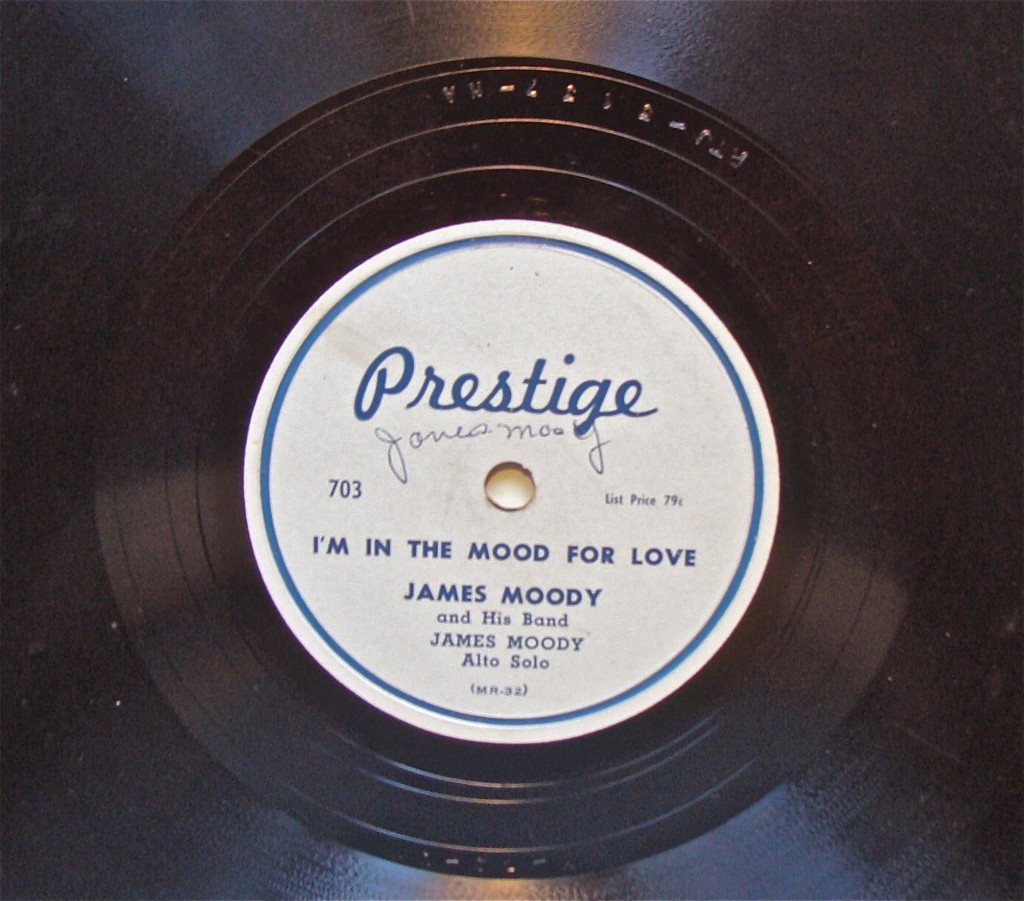
And finally, just because it's so cool: From jazzcollector's website, an autographed copy of the original 78, which jazzcollector has no recollection of actually collecting, but there it is:


A week later, Moody came back and recorded two more sides with a quartet billed as James Moody and his Cool Cats: "Over the Rainbow" and "Blue and Moody."


Originally issued on the Swedish Metronome label, these sides were brought out by Prestige on 78 RPM, 45 RPM EP, and in various LP collections.

Thursday, July 17, 2014

Listening to Prestige Records project - Part 7

We're still early in 1949, but at least we're in Paris in the Spring. Well, almost. There have always been expatriate jazz musicians. One of the first was Sidney Bechet, who originally came over to France as part of a revue with Josephine Baker. Baker stayed on to become one of France's mist celebrated entertainers, while Bechet went back and forth, and did not permanently settle in France until 1951. By that time, a postwar community of jazz expatriates was developing, and a French jazz label, Vogue, was formed.

Jazz musicians went to Europe for a variety of reasons. Jazz was waning as a popular music in the USA in the 1940s and 50s, while not yet being accepted as a serious art form. Europe offered both popular and artistic recognition. Stan Getz moved to Denmark to try to kick a drug habit. But a lot of black musicians chose Europe to get away from the racism which had not ameliorated after World War II.

James Moody was one of those. He lived in Europe for three years, and recorded there. His two
sessions in the spring of 1949 were April 30 in Lausanne, Switzerland, with a group of expatriates, and two weeks later on May 15 in Paris with an all-star group of beboppers led by Max Roach.

I can't find any tunes from the Roach session, either on YouTube or Spotify. Amazon has an album called Pleyel Jazz Concert 1948/Quintet 1949, the second part of which is the Roach session, but the tracks on it aren't available for download. The group, in addition to Roach and Moody, was Kenny Dorham (trumpet), Al Haig (piano), Tommy Potter (bass). Recorded for French Vogue, various cuts of it made their way to both Blue Note and Prestige. Prestige included one number on one of their first LPs,  PRLP 113, under Kenny Dorham's name.

The Lausanne session is easier to find, on Spotify as part of a collection called "James Moody 1948-49," and I found one cut on YouTub, but when I came back to link to it, couldn't find it again. His all-expatriate combo consisted of Art Simmons (piano) Alvin "Buddy" Banks (bass) Clarence Terry (drums) Al Edwards (vocals). None of them familiar names to me, probably because their careers were almost entirely expatriate. Art Simmons (who contributes some superb piano here, solo and comp), however, belongs to yet another thread on this blog. A few years ago Peter Jones and I decided to try to make a list of every living musician who had played with Charlie Parker. Many of them are gone now, of course, but here are the names we came up with.

One we missed was Art Simmons. Here, from Wikipedia:
Simmons played in a band while serving in the U.S. military in 1946. He remained in Germany after the war, studying music, and moved to Paris in 1949. There he studied at the Paris Conservatory and the Ecole Normale de Musique, playing with Charlie Parker and Kenny Clarke at the Paris Jazz Festival; he also played with Aaron Bridgers, Don Byas, Robert Mavounzy, and Nelson Williams. He led his own group at the Ringside Club in 1951. In the early 1950s he played with Dizzy Gillespie and Quincy Jones, and toured London with singers such as Bertice Reading. As resident pianist at the Mars Club, he worked with Michel Gaudry, Pierre Cullaz, and Elek Bacsik, and accompanied touring singers such as Carmen McRae and Billie Holiday (1958). In the early 1960s he played in a duo with Art Taylor.

Simmons also did arranging work for Barclay Records. In 1971 he played in Spain; following this he returned to the United States and retired.
So unless someone has newer information, Art Simmons is still alive. Is no one interviewing him, getting his life story?


Moody is solid on the session, and the trio of expatriates (Banks played regularly with Smmons; I couldn't find anything on Terry) provide solid backup, with Simmons (and Banks to a lesser extent) taking some nice solos. Moody does that bebopper's trick of interpolating well-known phrases ("Yankee Doodle") into the middle of a solo, and he plays a couple of figures that suggest ideas he'll develop later in the year, in "Moody's Mood."