Showing posts with label Tony Aless. Show all posts

Friday, August 29, 2014

Listening to Prestige Records, part 26: Stan Getz


You know how when you hear a word you've never heard before, suddenly everyone seems to be using it -- seems like everyone else except you knew it all the time? Jimmy Hatlo even devoted one of his "They'll Do It Every Time" cartoons to this theme, so thanx and a tip of the Hatlo hat, Jimmy, and it's happening to me with musicians instead of words. No sooner do I mention never having heard of Tony Aless than he shows up again, this time as part of a Stan Getz Quartet.

Perhaps  there's something to be said for the theory that a jazz recording session is quite likely to involve a group made up of whoever's around. Tony Aless and Don Lamond had both played on the Chubby Jackson session a month earlier and so were quite likely still kicking around 52nd Street. And Getz would have known them because they were both -- as were so many early Prestige artists -- Woody Herman veterans.

Percy Heath has a credit that I'd venture to guess no other jazzman has: he was a member of the Tuskegee Airmen, the famed African-American military aviators of World War II. He has impressive jazz credits, too, including being a member, with his brothers, of one of the first families of jazz.

One of the joys that the great balladeers like Stan Getz bring to jazz is their way with classic songs from what has come to be known as the Great American Songbook. These are vivid and memorable melodies, with chord changes and melodic structures that lend themselves to jazz interpretation and improvisation.

But they're more than that. They're songs, with the emotional and thematic power that only a song can deliver. Lester Young said that he always heard the words to a song in his head as he played it. The fictional Dale Turner, played by Dexter Gordon in the movie "Round Midnight," has a moment when he realizes he's losing his ability to produce the music he wants to, and says, "I forgot the words." I don't know if Stan Getz played the words in his head when he recorded a ballad, but he captures the feeling of each of these.

Of course, music is abstract. If you didn't know the story of Peter and the Wolf, you wouldn't just be able to conjure up ducks and wolves and hunters from the music itself. But if you know the songs, Getz brings something palpable to them.

In "You Stepped Out of a Dream," that rapt wonder that only the person you've suddenly, unreservedly fallen in love with can evoke. Written by Nacio Herb Brown and Gus Kahn, it was  originally sung by Tony Martin for the 1941 musical Ziegfeld Girl, to the visual of Lana Turner descending a staircase. Brown isn't quite on the Olympus of American songwriters, but he was good enough to dream, and good enough to write some melodies that are remembered.
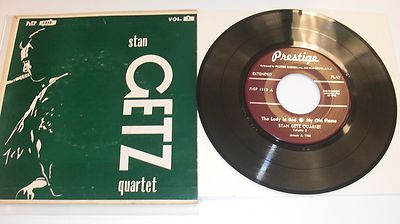

"My Old Flame" is a song that was brilliantly subverted and destroyed by Spike Jones. It was written by Arthur Johnston and Sam Coslow, who also saw their other hit, "Cocktails for Two," similarly demolished by Spike Jones. So Getz is not going her for the A-list of American composers, but he's finding some fine melodies, and in this case, restoring the feeling that Johnston and Coslow must have meant it to have: sweet nostalgia, regret.

I didn't know "The Lady in Red," so I listened to the Mark Murphy version and the Louis Prima version. I missed the Bugs Bunny version, "The Rabbit in Red," so I guess this was an eminently wreckable song too -- and again by a good, but B-list composer, Allie Wrubel. And this one bright, vivacious, sparkling. All these not-quite-great songwriters taken over the top, into immortality, by a true great, Stan Getz.

"Wrap Your Troubles in Dreams," by songwriters I really hadn't heard of -  Harry Barris, Ted Koehler, Billy Moll. Getz captures the dreamy optimism that comes out sadness. You wouldn't have to wrap your troubles in dreams and dream your troubles away if you didn't have troubles.

All these songs are about loss, and about an at best evanescent reality. Losses that you have to dream away, but you never really can. The fading memory of an old flame. The girl who steps out of a dream -- she's Lana Turner, and you'll never have her. She'll never really detach from that dream. Even the vivacious, snazzy lady in red -- you'll never have her either.

Stan Getz was a poet of loss, right up to that girl walking across the beach, looking straight ahead, not at you.

Released on Prestige and New Jazz 78s and 10-inchers, Prestige EP, even a 45 (My Old Flame/The Lady in Red), and later on a 7000-series reissue, a 24000-series double LP, even on an New Jazz LP when that line was briefly restarted.


Monday, August 25, 2014

Listening to Prestige Records, part 24: Chubby Jackson

The most recent rerelease of this 1950 Prestige session is on an Original Jazz Classics CD (Concord's reissue label - they currently own the Prestige catalog) along with some of the classic Gerry Mulligan/Chet Baker quartet recordings. Most of the consumer reviews on Amazon praise the quartet sessions, understandably, but then they tend to say some variation of "oh, and there's also some stuff by a big band."

I wonder if it had been called the Gerry Mulligan Big Band, would that have earned it more respect? But this is a terrific band, a terrific group of songs.
Arranged by Mulligan? Probably. Maybe. There's no arranger credit for the session, but at this stage of his career Mulligan was better known as an arranger than as a saxophone player, and it's likely that if he was on the session, he'd also have been hired to arrange. Some of the tunes certainly sound like Mulligan arrangements, some not so much. We know that Al Cohn did some arranging for the 1949 version of the Chubby Jackson Big Band, and Tiny Kahn was its chief arranger, so one or both of them may have had a hand, although neither played on this date.
Big band bebop is almost an oxymoron. Bebop was a product of the breakup of the big bands, a style that favored listening over dancing, extended virtuoso solos over ensemble section play. But it was always part of the scene. The Billy Eckstine band hired Dizzy Gillespie and Charlie Parker; also a Miles Davis, Fats Navarro and Dexter Gordon. Gillespie had his own big band. The Woody Herman Herd, where Chubby Jackson got his start, wasn't exactly bebop, but it wasn't exactly the swing of the Thirties, either.
And this band of Jackson's is as good as a bebop big band gets. It has swinging but ambitious ensemble parts, lots of room for experimental solos.
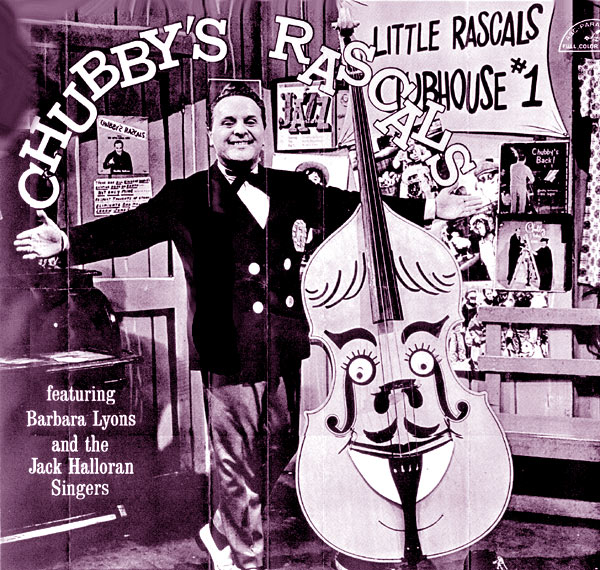
Chubby Jackson himself had a checkered career (note to self: when you make an accidental bad pun, for God's sake take it out in the second draft! Reply from self: What second draft?) -- anyone who has performed with both Louis Armstong and Lennie Tristano has run a fairly complete gamut, and let's not forget his twist album. And he's probably the only serious jazz musician who was also a TV kiddie show host (Chubby Jackson's Little Rascals).  
I listened to these sides a couple of times before I really looked at the lineup of musicians. I'd noticed that Mulligan and Zoot Sims were included, hadn't paid close attention to the others. So when I found myself particularly taken by the piano solos, I went back to see which of the bebop legends Jackson had recruited for this date, I was surprised to find a name I'd never heard: Tony Aless. But Aless did some impressive work, going back to Bunny Berrigan in the Thirties, and including sessions with Woody Herman, Stan Getz and Charlie Parker.
Peter Jones, who knows more about jazz than I do, was familiar with Aless, but asked, "who is Charlie Kennedy on alto-- he sounds a lot like Lee Konitz?"
So many great jazzmen who didn't break through to create major names for themselves. Charlie Kennedy started with Louis Prima, went on to become a soloist with Gene Krupa's big band. His last major gig was with Terry Gibbs' Dream Band, before he retired from music in the early 60s.

The rest of the band is a dream band, and they play like it.

"I May Be Wrong," which Mulligan was later to recreate as a cool, wryly romantic ballad with his quartet, is given as a joyous romp here - with Mulligan's fingerprints on it. "Sax Appeal" has some particularly appealing work between ensemble and soloists.

And what's this number called "So What"? It appears to be a Mulligan composition. Surely it's a Mulligan arrangement. The notes say it is not the composition of the same name by Miles Davis for the "Kind of Blue" album, and certainly there's a world of difference between the hip, cool modality of the Miles Davis number and this piece of beboppery. You could say that the Davis piece makes the Jackson band's piece sound old-fashioned, except it doesn't -- bebop still has the freshness and power to excite, and so does Mulligan at every phase of his career.

Here's "So What," from a new site to me, but it looks like a good one, called Jukebo. I can't seem to get their embed code to work, so I'm just providing a link. In this version, the song has a subtitle, "Hoo Hah," which I suspect is to differentiate it from the Davis number.

Prestige issued these as 78s on both Prestige and New Jazz, with records credited variously to Jackson, Mulligan and Zoot Sims, then on 45 RPM EPs and a 10-inch LP, and finally as part of a 7000-series LP called Chubby Jackson Sextet and Big Band -- nice of them to give the credit to Jackson, as Mulligan by then was by far the bigger star.