Showing posts with label Brownie McGhee. Show all posts

Wednesday, May 19, 2021

Listening to Prestige 569: Sonny Terry


LISTEN TO ONE: Callin' Mama

 This session, half of  a Bluesville LP that has a 1960 session with Lightnin' Hopkins on the other side, is vintage Sonny Terry. Brownie McGhee backing him up on guitar, Sonny handling harmonica and vocals. Vocals on three of the cuts, the other two Sonny's trademarked harmonica-and-whoop. It's Sonny in his prime, but his prime lasted a very long time. From his 1938 appearance in John Hammond's Carnegie Hall "Spirituals to Swing" concert to his featured solo in the 1986 movie Crossroads, recorded not long before he died, he did what he did, and he was a master.


This would be his last Bluesville session, and it's a good one

Of tangential interest -- the liner notes were written for Bluesville by Leroi Jones. whose book Blues People would be released at around the same time as the album, the first major study of American musi by an African-American author. Jones, who would become Amiri Baraka, had this to say of Terry:

Sonny wheels and deals, just as he always does, coming quite close, sometimes, to convincing any interested listener that his blues is really a new kind of expression, unheard of before this album.

"Callin' Mama" has one of Sonny's virtuoso touches, hardly unheard of before this album but always a crowd pleaser. At Brownie's urging, the harmonica plaintively pleads: "I want my mama."


Kenneth S. Goldstein is credited as producer on the album cover, Goldstein and Ozzie Cadena on Wikipedia's page. The Bluesville LP, Sonny is King, has this session on one side and a 1960 session with Lightnin' Hopkins on the other side. The Brownie side was recorded at an unnamed New York City location, the Lightnin' side, also featuring a jazz bassist and drummer, at Van Gelder Studio. So if I had to guess, I'd put Lightnin' with Ozzie and Brownie with Kenny.


Saturday, March 20, 2021

Listening to Prestige 552: Sonny Terry and Brownie McGhee


LISTEN TO ONE: Backwater Blues

 People tend to remember how the British invasion of the mid-1960s, starting with the Beatles in 1964, changed the face of popular music and put an end to the careers of a lot of American performers. But it's worth noting how it changed the perception of blues. Blues performers had been a part of the acoustic folk music revival that had put down roots in the 1940s with folk singers like Woody Guthrie and Cisco Houston, and had begun to blossom in the 1950s, with folk music coffee houses in northern cities and college towns, and folk festivals, the most significant of which was the 1959 debut of the Newport Folk Festival in Newport, RI, site of the already well-established Newport Jazz Festival. Amplified blues performers like


Muddy Waters or B. B. King were relegated to the "chitlin' circuit" of rhythm and blues and jazz acts whose audiences were primarily, often exclusively Black. 

But if white audiences in America weren't listening to Black electric blues people, young British audiences, and especially young British musicians, certainly were, starting with Muddy Waters' first trip to England in 1958. When those electric blues-influenced British musicians started touring America, they were bringing it all back home, to borrow a phrase from another American folk musician turned electric. By the time of the first all-blues festival, in Ann Arbor, MI. in 1969, the electric acts were in the ascendant.

So performers like Sonny Terry and Brownie McGhee, who had once been supporting acts to performers like Pete Seeger, the Kingston Trio, Joan Baez and Bob Dylan (Sonny and Brownie were part of the 1959 Newport Folk Festival), became supporting acts to performers like Howlin' Wolf, B. B. King and the Paul Butterfield Blues Band.

But they always had their audience, and there are many recordings made by the duo over the years to


prove it. They also had the good sense, borne of hardship and working class values, to know not to break up a successful act, so they remained working together for many years, although they famously did not particularly get along with each other. They worked the folk festivals, and the blues festivals, and the college gigs, and...as in the case of this live recording...the coffee houses. The Second Fret was a fond favorite of Philadelphia folk music fans up through the early 1970s, and Sonny and Brownie were always welcome there.

The two singers' repertoire was extensive, with blues written themselves (Sonny's "Me and Huddie Ledbetter") or reworked to fit them ("Brownie's "Me and Sonny," reworked from Sonny's song), or remembered from childhood, or picked up along the way. Or learned from other recordings, as with Bessie Smith's "Backwater Blues," a song about refugees from a devastating flood. It has become associated with the great flood of the Mississippi Delta in 1927, and has been by blues singers who witnessed that flood, and blues singers who didn't--Terry was born in Georgia, McGhee in Tennessee. However, it was written and recorded by Bessie Smith two months before that disaster happened. It's believed to be describing an earlier flood of the Cumberland River near Nashville. Regardless, it is a devastating account of a natural disaster.

Brownie McGhee and Sonny Terry at the 2nd Fret was recorded live, Kenneth S. Goldstein producing the record. It was released on Bluesville.

Wednesday, June 19, 2019

Listening to Prestige 401: Brownie McGhee

This is listed in Prestige's Bluesville catalog as a Brownie McGhee session, although longtime partner Sonny Terry is omnipresent, at least omnipresent on harmonica--all the vocals are Brownie's.

Prestige's Bluesville presentations of traditional blues performers are generally given that Prestige touch by the addition of jazz musicians. Shirley Scott accompanied Al Smith, and she was joined by Eddie "Lockjaw" Davis for Mildred Anderson's first album. King Curtis accompanied Smith on his second album, and Al Sears and Robert Banks on her second. They brought in Harold Ashby to play with Memphis Slim and Willie Dixon, Hal Singer to play with Lonnie Johnson (who already was as much jazzman as bluesman), and Jack McDuff and Bill Jennings to back up Shakey Jake,

Although Brownie McGhee had tried his hand at rhythm and blues in younger days,  he was solidly established in the folk blues tradition, and producer Ozzie Cadena chose not to mess with that. He does bring aboard a third musician, but it's guitarist Bennie Foster, who appears to be from the same Piedmont school of blues as McGhee and Terry, and may just have  an old friend Brownie brought along to the session. He's good, and he adds some fullness to the sound, but doesn't take it in a new direction. And I can find out no further information about him.

So this is a Brownie McGhee-Sonny Terry session, of which there were many, mostly for Folkways but a surprising number for Prestige Bluesville--and more surprisingly, one each for Roulette and World Pacific. You probably wouldn't need to own all of them, even if you were a hard core blues fan, but it's nice to know they're all there, and each one delivers satisfaction with solid professionalism and blues feeling.

Professionalism? Hell, yes. These were working class guys who depended on music to make a living and put food on the table. In fact, like many blues singers of their generation, they got into music because physical disabilities made it impossible for them to work in the fields. They were going to rehearse, to show up on time, to earn their paychecks.

This Bluesville release was entitled Brownie's Blues.

                                   *                        *                                   *

I wrote a lot about the Blue Bird Inn in Detroit when I was covering the mid-1950s, and the arrival in New York--and Prestige--of one Detroit jazz great after another. Nearly all of them had gotten their start at the Blue Bird. So it was wonderful to see, in a news story today, that the Blue Bird Inn, at 5021 Tireman Street in Detroit, abandoned since the bar's last owner passed away in 2003 (it had stopped presenting jazz much earlier), is being restored.

The Detroit Sound Conservancy, a nonprofit f ocused on music preservation in the city of Detroit, is restoring the building,which will eventually serve as a home to the nonprofit, a depository for its archives of Detroit music history, as well as a live music venue. This is a major piece of America's history, a cultural treasure, and it's great to see it being recognized.

This is part of an urban renaissance in this once-desolate city.  As so often happens, artists paved the way. The city set up special low-cost housing for artists. Once they moved in and started creating, and galleries and cafes sprang up, the yuppies and hipsters followed. Now, of course, the artists can no longer afford to live there and they are being evicted.


Listening to Prestige Vol. 2, 1955-56, and Vol. 3, 1957-58 now include, in the Kindle editions, links to all the "Listen to One" selections. All three volumes available from Amazon.
The most interesting book of its kind that I have ever seen. If any of you real jazz lovers want to know about some of the classic records made by some of the legends of jazz, get this book. LOVED IT.
– Terry Gibbs

Saturday, April 06, 2019

Listening to Prestige 387: Sonny Terry and Brownie McGhee

Brownie McGhee had recorded for Prestige once before, in 1951, predating the Bluesville label by nearly a decade, during an earlier and shorter-lived flirtation with folk blues by Bob Weinstock. I've pointed out that Weinstock's Bluesville anticipated the full-out blues craze that would come later in the 1960s, generally credited with dating from the 1961 Columbia release on LP of Robert Johnson: King of the Delta Blues Singers, which gathered together some of the recordings Johnson had made in the 1930s.

Terry and McGhee were contemporaries of Johnson's, but from a different region. Johnson was from the Mississippi Delta, as were the blues singers like Muddy Waters, Howlin' Wolf and Sonny Boy Williamson who migrated to the Midwest, mostly Chicago. Terry and McGhee were from the East Coast, the Piedmont plateau, which runs more or less parallel to the Appalachian mountain range across several southern states, and which gave its name to the Piedmont style of blues.

The most important progenitor of the Piedmont blues style was Blind Boy Fuller, both McGhee and Terry worked with him, Terry as his harmonica-playing sidekick, McGhee leading him and absorbing his guitar style. All three of them had become full time musicians, playing on the street or for local dances, because physical disabilities left them with no other career choices. Fuller and Terry were both blind; McGhee's legs were crippled by polio.

Fuller was, among other things, a master of the double entendre dirty blues, the composer of such classics as "Keep on Truckin', Mama" and "What's that Smells Like Fish?" Like Robert Johnson, he had been sought out by John Hammond to appear in his 1938 "From Spirituals to Swing" concert at Carnegie Hall (presumably to do cleaner material), and like Johnson, he didn't make it. In both cases, in true blues fashion, there was a woman involved. Johnson was dead, poisoned by a jealous husband; Fuller was in prison for shooting his wife in the leg. Terry took his place, and stayed in New York.

The two of them began their guitar-harmonica partnership in New York in the early 1940s. Later in the decade, they drifted apart. McGhee tried his hand at rhythm and blues, following the lead of his brother, Stick McGhee, who had a substantial R&B hit with "Drinkin' Wine Spo-Dee-O-Dee." Terry found himself on Broadway, in the cast of the musical Finian's Rainbow, about an Irish family (and leprechaun) in the segregated South.

In the 1950s, they resumed their professional partnership, which was to last over the next several decades. Like Lead Belly before them, they learned quickly that the audience for folk blues in New York was white leftists, and they adapted their style to that audience. Terry frequently collaborated with Woody Guthrie. They developed a repertoire of old songs adapted to their style, and songs of their own composing, that--unlike the electric blues that Southern transplants to Chicago and Detroit were developing--remained acoustic and fit in well with the folk music scene that was developing around Woody Guthrie, Pete Seeger and their ilk.

Terry wrote a song about Lead Belly -- "Me and Huddie Ledbetter, Huddie Ledbetter was my friend," which McGee adapted to "Me and old Sonny, Sonny Terry was my friend," but from many accounts, that was not strictly true.  They did not get along. But unlike the rock groups that came
along in the late 20th century, that let personality and ego clashes break them up just when they were reaching their pinnacle of success, Terry and McGhee kept a successful business relationship going, and McGhee kept singing about how old Sonny was his best friend.

Their sessions for Bluesville mostly featured the same songs, and the same arrangements, that they recorded for Folkways and Stinson and whatever other folk-oriented labels wanted to pick them up. Roy Haynes joins them on a few tracks, but essentially they resisted the Prestige Bluesville treatment. And that's mostly good. I love the Bluesville albums that put traditional bluesmen together with jazz musicians from the Prestige orbit, but McGhee and Terry had a formula that worked, and went on entertaining people for a great many years, so why mess with it?

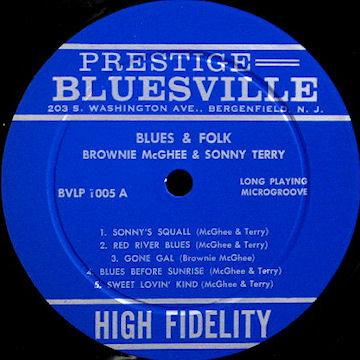
These sessions were released on a series of Bluesville albums: Down Home Blues (also on Prestige Folklore, a short-lived Prestige venture that did mostly re-releases in 1963-64), Blues And FolkBlues All Round My Head, Blues In My Soul. There were some 45 RPM releases: "Let Me Be Your Little Dog" / "Stranger Here," "Too Nicey Mama" / "Pawn Shop," and "Beggin' And Cryin'" / "Freight Train."

Listening to Prestige Vol. 3, 1957-58 now includes, in its Kindle edition, links to all the "Listen to One" selections. Available from Amazon.

Monday, December 08, 2014

Listening to Prestige Records Part 57: Blues


Sometime in late 1951 (no exact dates are given)  Prestige recorded a few blues singers. Much, much later, in 1959, Bob Weinstock would launch a separate Bluesville imprint, but in this early postwar era there wasn't much of a blues scene in New York. The Great Migration, which started after World War I, brought many blues singers north, but mostly not to New York. Bluesmen from the Delta tended to go straight north, to Chicago and Detroit; from Texas and Oklahoma, they mostly gravitated toward the West Coast, most often to Los Angeles. Many New Orleans jazzmen, inspired by King Oliver, went to Chicago, and from there some -- most notably Louis Armstrong -- came to New York. But jazz was a different species. 
The postwar blues scene in Chicago coalesced around Chess Records, mostly. In California a lot of blues singers recorded for the Bihari brothers' Modern/RPM labels. In New York, in 1948, the Ertegun brothers and Jerry Wexler went to Washington, DC, to try to sign Ruth Brown to a new blues label they were starting. Brown was a jazz singer, whose repertoire was mostly standards. "Why me?" She is said to have asked. "I don't sing the blues. I hate the blues."
"Don't worry," they said. "We're going to be doing a whole new kind of blues."

And they did sign her, and they did create a new kind of blues, and she was as good as they thought she'd be, and Atlantic became known as "the House that Ruth built."
Wexler and the Erteguns and Cliffie Stone and the other folks who crafted the Atlantic sound had to create a new kind of blues, because they didn't have a native sound to build on, the way the Chess brothers did in Chicago, bringing the music of the streets and the small clubs into their studio. New York was a jazz town. It became a doowop town, as that style came up from the streets. But blues, not so much.
The blues singers who came to New York, like Brownie McGhee and Sonny Terry, like Lead Belly, were mostly presented as folk singers, not blues singers, which meant that their main audiences were white leftists, and also that they were frequently recorded with white folk singers like Woody Guthrie. One of Sonny Terry's first gigs in New York was in the Broadway musical "Finian's Rainbow." When Leadbelly appeared at the Apollo, audiences didn't like him much. This made for an interesting dynamic. The blues is a music of hard realism -- its message is essentially that life is tough and it's going to stay that way. Urban white leftists tended to believe, and wanted their music to reflect it, that the world could be made a better place. The job of a professional musician is basically to give the public what it wants, so blues singers started writing songs --and they were great songs -- about Washington being a bourgeois town, and how we need to get together and break up the old Jim Crow.

So when Bob Weinstock ventured outside of the jazz realm he knew best to record blues and R&B, it was a little bit of a hit-or-miss proposition. In jazz he had the finest musicians in the world to choose from; in blues, things were a little less clear-cut. Which is not to say the choices weren't good ones, because they were very good.
H-Bomb Ferguson came out of a tradition that was essentially Midwestern, urban blues but not the Chicago urban blues of electric guitars and harmonicas. This was the jazz-based urban blues that was built on piano and horns, preeminently the tenor sax, and went back to Bessie Smith and the so-called classic blues singers. More specifically, it had its roots in the Kansas City of Big Joe Turner (who was soon to record for Atlantic) and Jimmy Rushing, and was carried on into the rhythm and blues era by performers like Wynonie Harris and Amos Miburn. 
Ferguson came to New York with Joe Liggins' Honeydrippers (West Coast R&B). He stayed for a while, was a protege of Nipsey Russell, then the MC at the Baby Grand, a legendary Harlem jazz club. He stayed long enough to make this one record for Prestige, and a few for Savoy, another jazz label that was dipping a toe into rhythm and blues, though Savoy would dip much more than a toe, becoming one of the important R&B labels. He didn't stay in New York, building most of his career in the Midwest. He never had the career of Harris or Milburn, but he made some good records, and this is one of them.
They generally didn't give a complete band list for blues and R&B records, and this one is no exception. The band was led by Jack "the Bear" Parker, a jazz drummer and R& bandleader, about whom I couldn't get much in the way of biographical info, although he was a solid player and got a lot of work.
They recorded ten tunes for Prestige that day, but only released two of them -- too bad, but I guess they'd decided they were t going to get behind Ferguson - and in fact in the same week that Prestige released its H-Bomb Ferguson single, Billboard's R&B page had another Ferguson release, on Atlas, as one of its picks.
The other Prestige blues sessions of December 1951 featured Brownie McGhee and Ralph Willis.
Eleven songs were recorded, of which four were released under McGhee's name, four under Willis's name, and three never released. Today on Spotify, all can be found by searching under Ralph Willis.
These are the folk blues of acoustic instruments--guitar and harmonica, like the Chess bluesmen, but we know, from the famous reception given to Bob Dylan at Newport, what East Coast folkies thought of electric amplification.

Brownie McGhee and Ralph Willis both were practitioners of what came to be known as Piedmont
blues, a style pioneered by Blind Boy Fuller. McGhee and Sonny Terry actually tried their hand at rhythm and blues when they first came to New York -- and McGhee's brother, Stick, made an R&B classic for Atlantic, "Drinkin' Wine Spo-de-o-dee"-- but the folk blues were where the market was. Later, in the 60s, when rural blues were rediscovered, it was the Delta blues of Charley Patton, Robert Johnson and Son House that drew the attention, and except for McGhee and Terry, who had attained legendary status, other Piedmont blues singers like Willis and Alec Seward (Stewart) saw their reputations eclipsed.

All four of the Willis sides were released on two 78s. McGhee cut seven altogether, three of which went unreleased. Of the others, "Cold Chills" and "Amen" came out on Prestige, "It's Too Late" and "I'll Never Love Again" on the short-lived Par Presentation label.