Tad Richards' odyssey through the catalog of Prestige Records:an unofficial and idiosyncratic history of jazz in the 50s and 60s. With occasional digressions.
Showing posts with label Wendell Marshall. Show all posts
Showing posts with label Wendell Marshall. Show all posts
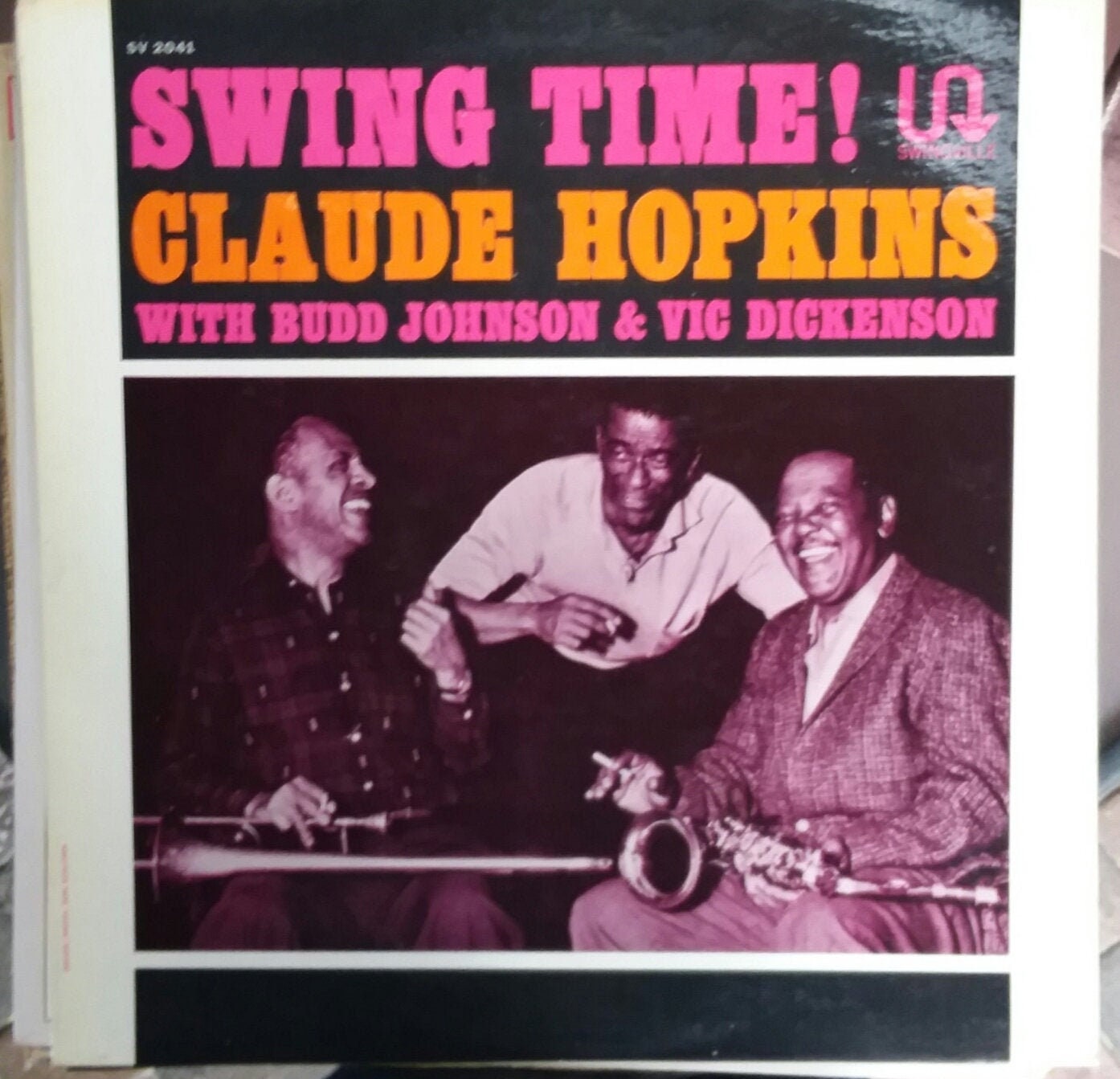
Claude Hopkins had a long and distinguished career as pianist and bandleader, but live music is evanescent, and so are the reputations based on it. Lasting reputations are built on recorded music, so it'sm thanks to Prestige and Swingville that Hopkins is chiefly remembered today -- with the Swingville All Stars, backing up Bud Freeman and Lonnie Johnson, and most indelibly for the three albums he recorded as leader: Yes Indeed!, Let's Jam, and this final one, Swing Time! Esmond Edwards gave him great support for the first two (Buddy Tate, augmented by Chu Berry on Yes Indeed! and Joe Thomas on Let's Jam), and Don
Schlitten, not to be undone, gives him a masterful group here, led by Vic Dickenson and Budd Johnson.
Hopkins had the kind of career that jazz fans and jazz historians can dream about, and conjure up a mythos around -- musical director of Josephine Baker's ensemble in Paris (which included Sidney Bechet), leader of a 1930s band which included Vic Dickenson and which had long residencies at the Cotton Club and Roseland. But to actually hear him, these recordings are the place to go. Swing Time! includes two Hopkins originals plus the kind of old chestnuts that, when they're in the hands of masters, you never get tired of hearing.
New to Prestige are trumpeter Bobby Johnson and drummer
Ferdinand Everett. Johnson was a much-in-demand section man who played with Duke Ellington, Billie Holiday and Erskine Hawkins, among others. Everett's only record date appears to have been this one, but he carries his weight.
Lucky Thompson was associated with an earlier era of jazz (although he was only 39 at the time of this recording): he'd played with Lionel Hampton, Don Redman, Billy Eckstine, Lucky Millinder and Count Basie. His time with Eckstine coincided with that of Charlie Parker and Dizzy Gillespie, and like so many of that era and that influence, he moved into bebop. He had recorded once for Prestige, a 1954 session with Miles Davis.
Also like many of that era, who grew increasingly frustrated with the racism of American society and the avarice of the music industry, and moved to Paris in the mid-1950s. His debut with Prestige (he would record three albums altogether) came shortly after his return to the States.
His association with the jazz of earlier times (just a few years earlier was already being thought of as earlier times) may have been what prompted Prestige to suggest an album of Jerome Kern, and to release it on Moodsville.
There's nothing wrong with devoting an album to Jerome Kern, one of our greatest and most subtle composers. And nothing wrong with a Moodsville release, either--the subsidiary label was home to some great albums by major artists. But I'm not sure that this really a Moodsville album. Thompson was a true bebopper, and this album is in the tradition--fast tempi, bravura solos. Somewhat outside of the bebop mainstream was his choice of the soprano saxophone as a lead instrument -- perhaps the Paris influence of Sidney Bechet.
Anyway, Moodsville or no, it's great that Thompson is back in the States (he would leave again in a few years), playing with some wonderful musicians.These years of Moodsville and Swingville led to the recording of musicians who might not otherwise have been recorded in this era, by an important independent label with good distribution. Dave Bailey is the new face here, and this was to be his only Prestige session. Best known for his work with Gerry Mulligan, Bailey is another of those jazzers with an interesting day job. In 1969 he retired from music to become a flight instructor.
The album is called Lucky Thompson Plays Jerome Kern and No More because, in fact, there was one more -- a Thompson original entitled "No More." "Who?" and "Lovely to Look At" became a 45 RPM single on Prestige. Don Schlitten produced.
This is Red Garland's 39th album for Prestige, either as leader or sideman, and no, that's not too many. Garland always delivered, either as part of an ensemble, leader of a trio, or solo. He began as a member of the original Miles Davis quintet, and in 1956, on one of the Contractual Marathon sessions, Miles and John Coltrane sat out and let the trio play a number, as sort of an audition for Bob Weinstock. It worked: after Miles left for Columbia, Weinstock signed Garland, Paul Chambers and Art Taylor to continue to record for Prestige.
Garland returned to Prestige after making four albums for Riverside subsidiary Jazzland, for what would be not only his last Prestige session, but his last recording for the next decade. When the Beatles invaded America, he saw the handwriting on the wall for jazz, and went back to Texas to take care of his invalid mother. He would make a comeback in the 1970s, recording a number of albums -- some for Galaxy, a subsidiary of Fantasy, which by this time owned Prestige, and some for Muse, a label started by one-time Prestige executive Joe Fields.
Garland's albums were always distinguished by his eclectic choice of tunes, and this one was no exception, as here he gives us a cross section of familiar tunes that have hardly been touched by musicians from the progressive jazz fraternity. Too familiar? Too corny? Not the way Garland, Wendell Marshall and Charlie Persip play them.
He starts out with the Al Jolson standard "Sonny Boy," written by DeSylva, Brown and Henderson, giving the tune rather more subtlety and thoughtfulness than Jolson ever gave it.
"My Honey's Lovin' Arms," composed by Joseph Meyer, also dates back to the Jolson era. Originally recorded by Isham Jones in 1922, it's become a staple over the years, but a staple of traditional and Dixieland groups. I can't find a record of any other modern jazz artist recording it. Garland relishes the corny but catchy melody, hits that downbeat, and still turns it into something altogether different, with the powerful collaboration of Persip.
"St. James Infirmary" is the old familiar blues ballad, and it's been recorded by everyone from jazz musicians to blues singers to folkies to rock and rollers to country singers, and even a Latin band (Perez Prado). But again, Garland stands out as one of the rare -- and probably the first -- modern jazz musicians to give it a whirl. As with "My Honey's Lovin' Arms," he starts out in a traditional style, nudged on by Wendell Marshall, and then proceeds--with Marshall and Persip--to make something new.
"I Ain't Got Nobody" goes back even further, to 1915, composed by Spencer Williams. New Orleans born, New York bred, ultimately European expatriate. The song became a huge hit in 1956 when Louis Prima recorded it as part of a medley with "Just a Gigolo." Prima and Sam Butera put it on an album called The Wildest; Garland, Marshall and Persip make it just as wild, in their own way.
"Baby Won't You Please Come Home" is another Spencer Williams tune, and a hugely popular one over the years. This one has had at least one other modern jazz version--by Garland's old boss, Miles Davis. Davis's version is dark and moody. Garland's isn't quite an uptempo romp, but the comparison of the two really brings home how much Garland likes these old chestnuts, and how much he enjoys playing them and making something new out of them.
The traditional spiritual "Nobody Knows the Trouble I've Seen" (first published in 1867 but much older than that) rounded out the album. One more song -- and one more old chestnut -- was 1927's "My Blue Heaven," which did not make the LP, which was titled When There Are Grey Skies, but was included on a later CD re-release. "Sonny Boy" and "Baby, Won't You Please Come Home?" were two sides of a 45 RPM single. Ozzie Cadena produced.
One of the many sessions Gene Ammons crammed into this period between incarcerations, this one is notable for having Mal Waldron on piano, which also meant the inclusion of some Waldron compositions, which are always welcome. Waldron wasn't playing much in 1962. Like Ammons, he was deep in thrall to heroin, leading to a complete breakdown in 1963. Fortunately, he recovered,and then opted for the expatriate life in Paris, where he was able to recover his health and his career.
Waldron could and did write for anyone, and here he is right up Ammons' alley, with compositions
tailored to his rhythm-and-bluesy accessibility, his ability to make the most of a groove, and his musical inventiveness. The tunes he brought to this session are "Light'n Up," "Short Stop," "Salome's Tune" and "Blue Coolade." There was good reason for Ammons' popularity. He played real jazz, and he played for the people. And Waldron caught all of that.
This session was broken up and parceled out to two albums: Velvet Soul ("Light'n Up," "Salome's Tune," "A Stranger in Town), and Sock! ("Short Stop," "They Say You're Laughing at Me," "Blue Coolade"). Both albums were released in 1964, after Ammons had begun his second prison sentence. "You Go to My Head" and "It's the Talk of the Town" were on a third album, 1965's Angel Eyes, as Bob Weinstock parceled out Ammons' releases over his incarceration period to keep his reputation alive with the jazz public. "A Stranger in Town" came out as one side of a 45 RPM single, with "Velvet Soul" on the flip side. Esmond Edwards produced the session.
Jimmy Grissom is not the first name that springs to mind when one thinks of jazz vocalists, but he had an active career that spanned a good decade and a half from the late 1940s to the early 1960s, and even included -- sort of -- one of the most important live performances of the era to be captured on record -- Duke Ellington's 1956 performance at the Newport Jazz Festival.
Sort of, because of course Grissom is not on the famous Ellington at Newport LP. But, as we now know, that LP wasn't exactly Ellington at Newport. The Duke was not completely satisfied with the Festival suite, and elected to redo it in the studio. The actual live concert was pieced together from various tapes and issued as a 1999 CD release, and Grissom is on that version, singing the Rube Bloom / Johnny Mercer standard, "Day In, Day Out."
Duke Ellington was not known for working with the A-list vocalists of his day. Although he wrote some of the greatest songs in the Great American Songbook, his focus was always on his orchestra and its extraordinary soloists, and the singers were secondary. Nonetheless, you didn't get hired by Ellington without being very good.
Grissom, the nephew of Jimmie Lunceford vocalist Dan Grissom, performed and recorded around the Los Angeles area starting in the late 1940s, appearing on various independent rhythm and blues labels. He had a minor hit with "Once There Lived a Fool," written by Jessie Mae Robinson, an underappreciated (but widely recorded) songwriter. "Once There Lived a Fool" was covered by Jimmy Witherspoon, Charles Brown, Savannah Churchill, and later Tony Bennett and Dakota Staton.
He joined Ellington in 1953, and was with him through the Newport concert. He only made a few recordings after that, and his Prestige association was a brief one. It would seem that Bob Weinstock and Co. had initial high hopes for him, putting him together with Oliver Nelson, and it would also seem that they changed their minds rather quickly. They only cut four songs on this date. Two of them were released as a 45 RPM single, the other two were shelved, which seems a shame. One of the shelved songs, "Get Yourself Another Fool." is a lovely blues ballad, recorded by a number of first rate performers, including Charles Brown, Sam Cooke, and even Paul McCartney.
Nelson brought along Hank Jones, Wendell Marshall and Ed Shaughnessy, all of whom he had worked with often, and a string section, and organist Dick Hyman, an unusual choice. Hyman was a keyboard wizard who could play in nearly any style, but one that he was rarely accustomed to was the trendy soul jazz style of the moment, and in fact he stays away from that genre here, working in a more mainstream style, providing fills and swirls around the complex rhythmic patterns laid down by Marshall and Shaughnessy. All of this takes just over two minutes, backing up Grissom's rhythm and bluesy ballad vocal. It's on the short side even for a pop single, and it's hard not to wonder if there wasn't a more extended LP-intended version somewhere, edited down for 45 RPM release. Why else call in Oliver Nelson and a rhythm section as gifted as Jones, Marshall and Shaughnessy, and strings, and especially why else bring in Dick Hyman? Weinstock and Esmond Edwards (I'm guessing -- no producer credit here) must have had something different in mind, and maybe they decided it was too different (why put an organ on a record in 1962 if you're not going for the soul sound?) or not different enough. Grissom's delivery is excellent, but maybe they decided it was too 1950s, and it wasn't going to make a dent in the new market of the Kennedy era. If only they had known. Within a year, the Kennedy era was over, and a group of rock and rollers from England were going to change everything about what music was listened to, and how it was listened to.
So there's just this one single. And it's good. And worth a listen.
This was John Wright's last album for Prestige, before retreating back to Chicago and the inside of a bottle, finally emerging from that trap to become a legendary figure in that neighborhood which he had apotheosized with his first album, South Side Soul, and in doing so he had created a persona that would remain with him for the rest of his life. He was Mr. South Side Soul, and a beloved figure on the South Side of Chicago.
Musical Chicago is probably most associated in the public mind with the guitar and harmonica-based blues of Muddy Waters, Howlin' Wolf, Little Walter, Junior Wells and Buddy Guy, But the piano had its place in Chicago blues, too, with performers
like Memphis Slim, Champion Jack Dupree, Big Maceo Meriwether, and Otis Spann. One of the chief architects of the Chicago blues sound was Willie Dixon, and he got his start playing the bass in a jazz trio led by Leonard "Baby Doo" Caston, a pianist in the Nat "King" Cole style that was so popular in the early 1940s.
The piano jazz faces of Chicago in the modern era were Ahmad Jamal and Ramsey Lewis, and John Wright could well have made them a triumvirate, but for the alcoholism that took so many years from him. Even so, though he never broke out to national recognition like the other two, Chicago knew him, and his Wright Gatherings became a local musical tradition.
Like Jamal and Lewis and Caston, the piano trio was his favored lineup, and for this album, in addition to Prestige regular Wendell Marshall, who had worked with before, he used drummer Walter "Baby Sweets" Perkins, a Chicagoan who had gotten his start with Jamal.
The album features four Wright compositions and one by Esmond Edwards, whose compositional
contributions were extremely rare on the many records he produced, for Prestige and elsewhere. The other three are by composers not close to the center of modern jazz, although "What's New?" by trad jazz stalwart Bob Haggart has become a much-loved standard for a wide range of jazz performers down to the present day. "Our Waltz" is by David Rose and "Blue Prelude" is by Gordon Jenkins, both pop music orchestra leaders. "Our Waltz" is not completely unknown to the world of jazz musicians always with open ears to a good melody with improvisational possibilities: both Gary Burton and Rahsaan Roland Kirk recorded it in the early 1960s. "Blue Prelude" has a little something for everyone. In addition to the many pop singers and
orchestras that have recorded it, it's been country (Bob Wills, David Houston), rhythm and blues (Sam "the Man" Taylor), and Latin (Candido, Jack Costanzo). Outside of Wright, the closest it's come to a modern jazz interpretation is George Shearing, who recorded it twice, once as an instrumental and once with Peggy Lee. Wright finds good things to explore in it, taking it somewhat more percussively and explosively than it's used to being taken--and, in fact, it became the 45 RPM single release from the session, along with his own composition "Strut."
Edwards produced, and the Prestige release was entitled Mr. Soul.
Question: What's the difference between classic rhythm and blues and soul jazz?
Answer: About three minutes.
That's the difference between the Lester Young-influenced, Illinois Jacquet-influenced, Texas roadhouse-bred, Apollo-developed, blues-based sound tenor saxophone wailing and improvising over a rock-solid groove in the 78-45 RPM era, and the LP era. Jazz With a Beat, jazz with a funky beat. And with, in the soul jazz era, a little more room to open up and try different improvisational attacks over that groove.
What about the organ, that distinctive signature sound for soul jazz? Doesn't that make it different?
Not entirely. Bill Doggett, Sil Austin, Doc Bagby and others had had rhythm and blues hits. Jack McDuff had joined the Gator to play rhythm and blues, and when the group signed with Prestige, they brought their saxophone-organ-guitar sound with them, and used it to play the longer form jams--in other words, the ones they had always played on the chitlin' circuit, but had had not been able to bring to the recording studio.
Willis Jackson had brought McDuff into his group as a bass player, and had made the inspired choice to convert him to an organist, so he knew something about nurturing organ talent. That means it's no surprise to find Freddie Roach, on the cusp of a breakout career, joining Jackson's band for this session. Roach had recorded two albums with Ike Quebec for Blue Note, and by midsummer of 1962 he was back at Blue Note to record four albums as leader. He would return to Prestige for a couple more sessions in the late 1960s, after which he stopped recording. He lived in France for a while, then California, by which time his interest had switched from jazz to the theater, where he gained something of a reputation--apparently under another name--as a playwright. He died in 1980.
Roach, along with frequent Jackson collaborators Bill Jennings, Wendell Marshall and Frank Shea, create the groove. Ray Barretto, in his second sax-organ soul jazz gig, adds the extra touch that he always does. And Jackson provided the rest. All of this comes together most emphatically on the Jackson composition "Thunderbird." When you put "Bird" in the title of a jazz composition, it's always going to suggest one thing. Bird With a Beat certainly became a rhythm and blues staple, with "Now's the Time" becoming the basis for Paul Williams's hit instrumental "The Hucklebuck." Here, there's no one Parker tune that "Thunderbird" takes off from, but Bird's improvisations on the blues are a strong inspiration.
Willis Jackson had become a mainstay of Prestige records and would remain so throughout the 1960s. This, produced once again by Esmond Edwards, was his seventh album for the label. It was released on Prestige, as was the 45 from the session, "Thunderbird," also the title of the album, "Thunderbird" was the flip side of Jackson's version of "Jambalaya."
During the late 1960s, when rock started to take itself seriously, supergroups suddenly became the rage. But in jazz, they were old news. And they were done without thinking twice. Let's get Gene Ammons back into the studio. --Yeah, and let's put him with a couple of different guys. -- Who's in town? And presto, you have Joe Newman and Jack McDuff showing up to jam with Gene on some tunes. Supergroup? Oh, my, yes.
And jamming? I'd say so. They're relaxed, they're trying each other out on a variety of material, they're finding some good grooves, and they're playing jazz. What's not to like?
There's nothing not to like. Unlike the world of cartoons, or all too often the world of other collaborative arts, in jazz when you put a group of musicians like this together and say "What could possibly go wrong?" nothing does. These guys are seasoned pros, they're entertainers, and they're artists. And they've got some good tunes to work with.
It's hard to pick a favorite here for a Listen to One, but they do an awfully nice job on "Born to Be Blue," the ballad written by Mel Tormé and his frequent writing partner Robert Wells (they also collaborated on "The Christmas Song"). It's sensitive and lyrical, with great individual work by all the participants.
I also love the variety of material here. Ellington and Strayhorn's "Satin Doll" gets covered a lot (397 versions, according to the SecondHandSongs website), but with top notch improvisers, it's always worth one more. "Stormy Monday Blues" is the Bob Crowder/Billy Eckstine/Earl Hines version, not T-Bone Walker's, though both are 12-bar blues. Bennie Moten's "Moten Swing" comes out of that Kansas City cauldron of swing. And the two Ammons compositions are up against some pretty tough competition, but they hold up.
The newcomer on this session is Chicagoan Walter "Baby Sweets" Perkins, who got his start playing with Ahmad Jamal, recorded with Sonny Criss for the Texas-based Peacock label, then did a few sessions as leader for the Chicago labels Argo and Vee-Jay. He would move to New York full time not long after this session, where he would do three more albums with Ammons and find plenty of other work, recording with Rahsaan Roland Kirk, George Shearing, Charles Mingus, Billy Taylor, Booker Ervin, Jaki Byard, Lucky Thompson, Pat Martino, Sonny Stitt, and Charles Earland, among others.
As you may recall, part of the reason why I started this project was the conversations Peter Jones and I had about recorded jazz in the 1950s, and our recollection that it was all good. I've been putting that to the test for 510 entries now, and I'm into the 1960s, and it's still holding up. How many different ways are there to say this is good stuff, this is a deeply satisfying listening experience? I guess we'll find out, or else I'll start showing my age, and repeating myself.
The album was called Twisting the Jug, although it was hardly a twist album (but you could dance to it). It was released on Prestige, with the title cut a two-sided 45 RPM single.
John "South Side Soul" Wright adds some uptown soul to the mix for his third Prestige album, in the person of Eddy "Cat-Eye" Williams, and some Detroit soul with drummer Roy Brooks, and they mesh to find a universal language.
I'm guessing that the new quartet was more Esmond Edwards' idea than Wright's, because according to Wright, he had never played with a horn before, and wasn't quite sure what to do. "I didn't know how to really play with horns then," he said later, "so I just started to comp behind Eddy Williams."
Wright may have been exaggerating a bit about his inexperience with horns. In an interview with Rebecca Zorach for the blog Never The Same: Conversations About Art Transforming Politics and Community in Chicago and Beyond, Wright recalled his first gig upon returning from the army after the Korean War, back when he could expect to get paid $7.50 a night:
When I came home from the military, my first job was on the West Side of Chicago at a place called, Fifth Jack, it was located at Fifth Ave. and Jackson Blvd. and it was operated by two prominent gangsters, they’re deceased now, I guess I can use their names: Butch English [this must be Charles Carmen "Chuckie English" Inglesia--TR] and Tony Accardo. I played there for one month. They told me to bring in a couple of horn players on the weekends! Well, I had met a couple of good horn players and I had invited them to play with me one weekend, they were the famous Gene Ammons, and Dexter Gordon, both tenor saxophonists.
Listening to Wright and Williams together, you'd find it hard to believe that Wright didn't know how to play with a horn player, particularly this horn player. Wright's percussive attack and Williams' hard-edged tone complement each other nicely. And they must have worked out a few ideas for the session together, because two of the best tracks on the album, "Makin' Out" and "Back in Jersey," have the two of them listed as co-composers. Two more ("Sparkle" and "Soul Search" are credited to Williams alone, and two ("Street" and "Kitty") are Wright alone.
Eddy "Cat-Eye" Williams was one of those unsung heroes, one of those guys who could play, and who could always get a job because everyone knew he could play. We know that in the 1930s and 1940s he played with Claude Williams, Tiny Bradshaw, Billy Kyle, Don Redman, Jelly Roll Morton, Lucky Millinder, Ella Fitzgerald, Wilbur De Paris, and James P. Johnson. \
Then nothing until 1958-59, when he recorded a couple of albums on Blue Note with Bennie Green. Marc Myers of the Jazzwax blog, who can track down pretty much anybody and anything, can only say
Puzzlingly, there are huge gaps of time in Williams' discography in the '50s—perhaps a result of a prolific R&B sideman career or some other reason.
The sides with Green were memorable, and were followed up by this session with John Wright. Later in the decade, a record with Pee Wee Russell and Oliver Nelson, and one with Earl Coleman.
And then? A couple of different internet bios say he "disappeared without a trace."
So this small window between 1958 and 1961, two albums with Bennie Green and one with John Wright, may be the apex of Williams's career, and if so, they give us more than a glimpse--a really good look into a really solid jazz performer, one who deserves to be remembered. We talked a lot about the swing-to-bop musicians like Zoot Sims and Coleman Hawkins, and what they gave to jazz, but the rhythm-and-blues-to-bop musicians, like Gene Ammons, King Curtis, and David "Fathead" Newman, were important too, and surely Williams was one of those.
You can hear it all on "Makin' Out," one of the Wright/Williams collaborations. Williams as a soloist, Wright as a soloist, and Wright as an inventive, intelligent and sympathetic musical collaborator with the right horn player. One of the few things we do know about Williams is that he was from Chicago, so maybe he and Wright had more of a history of playing together.
In "Makin' Out" you can also hear what a difference Roy Brooks makes. Brooks, from the jazz-intensive workshop that was Detroit, got his start with Yusef Lateef and Barry Harris. One of the more innovative drummers of his generation, he suffered from crippling bouts of mental illness that finally got the best of him. But he is certainly one of the reasons this whole session is as good as it is.
Esmond Edwards produced. The album was called Makin' Out, and it was released on Prestige. The title track, at a little less than five minutes long, could almost have made one side of a 45, but it was split and spaced over two.
Listening to Prestige Vol 4, 1959-60, now available from Amazon! Also on Kindle! Volumes 1-3 are also available from Amazon. The most interesting book of its kind that I have ever seen. If any of you real jazz lovers want to know about some of the classic records made by some of the legends of jazz, get this book. LOVED IT. – Terry Gibbs
As with Miles Davis and John Coltrane, Bob Weinstock seemed, as 1961 wound on, to be trying to get as much as possible out of Oliver Nelson before he moved on, and in as many combinations as possible. Here, four days apart, he goes from arranging strings and French horns for Etta Jones, to arranging a full jazz orchestra to support headliner Gene Ammons, Prestige's most prolific performer--this is his third session in 1961 alone. Ammons was a victim of the heroin plague, and this activity in 1961 was sandwiched between two prison sentences, one from 1958-60 and one from 1962-69.
We're hearing some musicians for the first time. Nelson was looking for a sound, not soloists, so he picked experienced section men: guys who could read music, who could follow a conductor's lead and get it right the first time, who would show up on time and ready to play.
Trumpeter Hobart Dotson had a lot of experience in big bands. He was in the dance bands of Gerald Wilson and Dan Belloc--and not all dance bands are alike. Wilson, who came up with Jimmy Lunceford (he replaced Sy Oliver), and played in the ensembles of Basie, Ellington, Dizzy Gillespie and Benny Carter, was in the tradition of black dance bands; Belloc, who owned and operated a ballroom in Chicago, and worked with some rock and roll groups (including the Buckinghams, later), catered essentially to white audiences. Dotson also worked with edgier jazz orchestras, including Charles Mingus, Slide Hampton, and (edgier still) Sun Ra.
Red Holloway would also find plenty of work for Prestige in the 1960s, particularly with Jack McDuff. Chicago was his home base for most of his career, where he worked with blues, rhythm and blues, rock and roll and jazz artists, recording with them and backing up touring artists.
Bob Ashton (baritone sax here; he also played tenor) made his Prestige debut in a 1960 recording of a big band led by Eddie "Lockjaw" Davis, which also marked Oliver Nelson's debut as an arranger. He would also find his way onto a number of Prestige sessions during the 1960s.
George Barrow is in the tenor sax section for this session, but he was better known for his work on the baritone sax, which he played on Nelson's arranging debut with Davis, and on The Blues and the Abstract Truth. With the ensemble of jazz superstars (Eric Dolphy, Freddie Hubbard, Bill Evans) that Nelson put together for that recording, he was to single out Barrow for praise: "His baritone parts were executed with such precision and devotion that I find it necessary to make special mention of his fine work." Barrow would become a fixture on a number of Prestige recordings over the next few years.
Ammons has always liked the well-loved standards, and he does his share of them here, in front of Nelson's arrangements, along with some surprises from outside of the Great American Songbook catalog, like Savannah Churchill's rhythm and blues hit, "I Want to Be Loved." It's always worthwhile to hear a good song get the Ammons treatment, and even more so in this context,
"Too Marvelous for Words" is a good example. Written by Richard A. Whiting and Johnny Mercer in the 1930s, it was always popular with both vocalists and instrumentalists, but reached a zenith in the late 1950s with Frank Sinatra's vocal and Nelson Riddle's arrangement. Ammons sings this one on his saxophone, with a lovely brief solo from Richard Wyands. Nelson's arrangement satisfies--it does all the things one wants from a big band supporting a soloist--and it also surprises.
Esmond Edwards produced. As with Coltrane, Prestige did not release all its Oliver Nelson product all at once, and this session in particular was sliced and diced, as they also had to parcel out Gene Ammons's recordings after he was sent back to prison.
"Love, I've Found You" (another rhythm and blues ballad written by Gwen and Harvey Fuqua) and "Too Marvelous for Words" were first to appear, on a 1963 compilation album, Soul Summit, Vol. 2, which also included tracks from an Etta Jones session with Ammons and two Jack McDuff sessions, one with Ammons and one without.
"Things Ain't What They Used to Be," "I Want to Be Loved," "Makin' Whoopee" and "Lullabye of the Leaves" were all on 1964's Late Hour Special.
Jerome Kern's "The Song is You" waited until later in 1964, and was released on Velvet Soul.
"I Want to Be Loved" and "Love, I've Found You" were released on 45 RPM, though it would be a stretch to think that the Ammons-Nelson versions could be aimed at the rhythm and blues market, especially since by 1964 there was no rhythm and blues market.
Listening to Prestige Vol 4, 1959-60, now available from Amazon! Also on Kindle! Volumes 1-3 are also available from Amazon. The most interesting book of its kind that I have ever seen. If any of you real jazz lovers want to know about some of the classic records made by some of the legends of jazz, get this book. LOVED IT. – Terry Gibbs
If Don Ellis gave us an album in which virtually everything was unexpected, Prestige brings us back to familiar ground with Johnny "Hammond" Smith. In those days, it seemed that people couldn't get enough of that soul jazz organ sound, and Smith was one of the most reliable of the bunch, solid for listening or dancing. He used the same Philadelphia cohorts he'd been using, came up once again with a nicely chosen mixture of originals and standards--and, in point of fact, distributed the results of this session over the same two albums as the last session, Stimulation, which was released right away, and Opus de Funk, which waited until 1966.
So I don't have a lot to add to my commentary on the February 14th session. This is an extension of that one, and it's still good music.
Esmond Edwards produced both dates. "Sticks and Stones" became the flip side of "The End of a Love Affair." from the February session, as the first 45 RPM single off the album. "Sad Eyes" was the A side of a 45 with "Opus de Funk," released in tandem with the 1966 release of the second album.
There comes a time in every long book, novel or nonfiction, when you're trapped in the middle. You can barely remember starting it, you can't imagine ever finishing it, you can no longer imagine why anyone would want to read it. I guess I'm pretty much at that stage now. It's been five years of my life, twelve years in the history of Prestige. And yet my enthusiasm hasn't flagged. I can thank the music for that, and the incredible musicians who made it. I still look forward to every session, and I still find myself spurred to write about it by the freshness of the music, the stories of the unique individuals who made the music, my own memories of who I was when I first heard it or the excitement of hearing it and discovering it for the first time.
The 1960s, which we are just nosing into here, were a time of great social change, and a time when a number of musicians chafed at calling the music they were playing "jazz." It was a name that grew out of a music that was disrespected, a name associated with back-alley sexual encounters, a name that does not reflect on the importance of what many have called "America's classical music." But to me, whatever its origins, the name has been hallowed by Louis Armstrong and Sidney Bechet, consecrated by Charlie Parker and Dizzy Gillespie, immortalized by Miles Davis and Sonny Rollins and Stan Getz...and Don Ellis and Johnny "Hammond" Smith and Shirley Scott and Willis "Gator Tail" Jackson and Walt Dickerson and people like Al Francis or Eddie McFadden who made brief contributions and disappeared, and the name of "jazz" is ennobled by their presence.
It's unusual for a horn man who's used to the format of a big band to make an album in a quartet setting. Basie-ites, when stepping out (as they often did) tend to gather a few other instruments around them. often other Basie-ites. Newman had recorded a lot with his own groups, during his Basie years, always following that pattern, with an ensemble or at least a quintet. His two previous Swingville albums featured Frank Wess on one, Frank Foster on the other.
But 1961 was a year of changes for Newman, He left the Basie band to strike out on his own. And he got involved in another project that was larger than himself, albeit of a very different sort than playing in a band. He was one of the founders of Jazz Interactions, a nonprofit group dedicated to jazz education and the promoting of jazz. Newman's wife Rigmor was the first president of the organization, and Newman the first vice president. As he explained in an interview for the National Jazz Archive:
We founded the organisation to promote jazz, because it was in such a serious plight at the time. Everybody talked about it, but nobody did anything to alleviate the problem...[we] formed Jazz Interactions with the idea of promoting jazz on an educational basis. We thought we could do that best by going into the schools, getting with the young people, and acquainting them with jazz.
Many of the kids carried pocket radios around, listening only to the rock’n’roll; there was a part of their heritage they knew nothing about. We did a pilot programme, and invited the New York State Council of the Arts, the Musicians’ Union and some people from the School Board. Finally we got a grant—the first jazz organisation to be funded. With our in–school programmes, we didn’t go there just to play for them; we went to give them some knowledge, but in a way that it didn’t bore them, listening to us talk all the time. We played, and we mixed it up.
...We have chosen to go and help the young people. In my day, musicians coming up got no help at all.
For much of the rest of his life he was deeply involved with Jazz Interactions.
Playing on his own with just a rhythm section, he still manages to stir up the rousing fervor that comes with striking up a band--as, for example, on the Gershwin tune, "Strike Up the Band." This near-anthemic celebration of music and of celebrations was written by George and Ira for a musical of the same name that flopped. Generally a great tune from that golden age would emerge like a phoenix from the ashes of an unsuccessful show, but "Strike up the Band" went virtually unrecorded from its debut in 1927 until Sonny Stitt and Bud Powell recorded it in 1951--once again, the dreaded beboppers keeping the Great American Songbook alive when very few else were. Chris Connor recorded it in 1957, and since then, it has taken its place among the standards.
Newman's soft and romantic side comes out with "The Very Thought of You," a tune written by British émigré and radio bandleader Ray Noble. It's a dreamy beautiful melody that's never lacked for interpreters, and with good reason. It's always nice to hear, and it's particularly nice to hear Newman and Tommy Flanagan giving it equal portions of nostalgia and innovation.
So yes, Newman can carry a quartet album, and deliver a rewarding experience. Flanagan is splendid throughout; Wendell Marshall and Billy English do fine jobs. Esmond Edwards produced for Swingville, and the album was entitled Joe's Hap'nin's.
This is the first part of a two-session, double-album extravaganza released by Prestige as The First Annual Prestige Swing Festival, Spring 1961. The festival appears to have taken place entirely in the Van Gelder Studio in Englewood Cliffs--I can find no record of an actual festival. And it appears to have been the only annual Swing Festival.
Nevertheless, a cause for celebration. Prestige had put together various collections of All Stars over the past few years, including one other set of Swingville All Stars (in March of 1960, with Taft Jordan, Hilton
Jefferson, and Al Sears as the front line), and all of their all star sessions were worthy of the name, but this one has some solidly heavy hitters, and a bunch of them. The heyday of swing was also the heyday of the 78 RPM record, so your typical swing session recording was three and a half minutes or less--maybe a little more if they decided to split a song over two sides. And the typical swing recording was section players with one soloist.
But bebop changed some of that, and the long playing record changed the rest of it, and this aggregation includes a number of all stars who deserve solo space, and who get it, and the length of the selections reflects that. "Jammin' in Swingville" is nine and a half minutes, "Spring's Swing" eight minutes, "Love Me or Leave Me" a little over seven. "Cool Sunrise" nearly eleven.
"Love Me or Leave Me" is the standard by Gus Kahn and Walter Donaldson, first recorded by torch singer Ruth Etting in 1928, picked up by Billie Holiday in 1941, then covered a few scattered times in the late 1940s and early 1950s. It was Etting's signature song, and Etting was basically a forgotten star by the 1950s, but it turned out her life, including a disastrous marriage to a brutal gangster, was more interesting than her career. It became a movie with Doris Day and James Cagney, and "Love Me or Leave Me" became the movie's title song, and jazz musicians as well as pop singers started recognizing its potential.
"Jammin' in Swingville" and "Swing's Spring" are both credited to Vivian Hamilton, who I'm guessing was the wife of Jimmy. Her only credited compositions are on albums by Jimmy (although "Spring's Swing" was recorded in 2005 by Swiss-born, Chicago-based tenor saxophonist Sam Burckhardt), and Jimmy was the arranger for this session. "Cool Sunrise" is credited to Esmond Edwards, so important as a producer for Prestige during these years, but rarely listed as a composer. All of them provide an ample basis for joyous interpretation.
Swing, as its name suggests, is a joyful music, and extended jams like these sound like a lot of fun, like good friends getting together and producing something delightful. Let's hope this was the case, and why not? These guys were old enough, and far enough past their years of stardom, to have been able to simply enjoy getting together and making music. We continue to owe Prestige big time for recording these Swingville sessions.
Edwards produced. The title of the double album was Things Ain't What They Used to Be. When they were rereleased separately, that became the title of the record that had "Spring's Swing" and "Love Me or Leave Me" on it. The other separated LP was called Years Ago. A later rerelease as double album and CD was called Jam Session in Swingville.
Jimmy Hamilton spent 25 years with Duke Ellington, which should tell you something about how good he was. He replaced Barney Bigard in 1943, and was an important part of the Ellington orchestra for many of its greatest recordings, as well as a bunch more with groups of Ellingtonians led by Johnny Hodges. He released a handful of albums as leader during the 1950s on extremely obscure labels, and then this and one more on Prestige, but neither of his Prestige albums were ever reissued by Fantasy or Concord as part of their Original Jazz Classics series. You can't call him a forgotten man of jazz, because 25
years with the Duke gave him a certain recognition, but on the other hand, you sorta can. Jazz fans--certainly Ellington fans--know Hamilton as a section man par excellence. Not many know him as a soloist, improviser, leader.
This would be a good introduction, with Ellingtonians Britt Woodman and Clark Terry joining a solid rhythm section, playing all originals by Hamilton. It seems that when Jimmy breaks loose from the Duke, he gravitates toward the blues, reflecting his early days with Lucky Millinder and Bill Doggett. There's nothing like hearing a bunch of disciplined Duke's men letting their hair down and jamming on the blues, and I could listen to this all day.
A sextet is enough to get a full, almost big band sound if you know what you're doing, and these guys certainly do. They're all great section men as
well as being great soloists, so they can play together when called for, improvise when it's their turn.
Not known as a composer, although he does have one co-composer credit with Ellington ("Sunswept Sunday," from the Anatomy of a Murder soundtrack), Hamilton does not make a mistake in assigning the tunemaking chores for this session to himself. He has a good feeling for blues riffs that will sustain a whole song.
This was the first of two Prestige sessions for Hamilton, and it was released on Swingville. After this, no more recording on his own for a long time. In 1968, he left Ellington and retired to the Virgin Islands, if you call teaching and playing music retirement. In the 1980s, a couple of live sessions were captured and released. He died in 1994.
Esmond Edwards produced.
Listening to Prestige Vol. 2, 1955-56, and Vol. 3, 1957-58 now include, in the Kindle editions, links to all the "Listen to One" selections. All three volumes available from Amazon. And Volume 4 in preparation! The most interesting book of its kind that I have ever seen. If any of you real jazz lovers want to know about some of the classic records made by some of the legends of jazz, get this book. LOVED IT. – Terry Gibbs
I haven't been able to find the February 17 Buddy Tate session that yielded the Swingville album, Groovin' with Buddy Tate.
Claude Hopkins had a real career revival with Prestige. Since his heyday as a bandleader in the 1930s he had worked steadily but anonymously until tapped by Chris Albertson to appear on the rediscovery session for jazzman/bluesman Lonnie Johnson in March of 1960. Just a couple of weeks later, he was called back into Rudy Van Gelder's studio to make his debut album for Swingville.
There would be three Swingville sessions in all, and he would go on leading groups and recording for smaller labels well into the 1970s.
He was back in the studio 11 months after his first Swingville session with essentially the same group, Joe Thomas replacing Chu Berry. Thomas had done a Swingville session once before, with Coleman Hawkins. With Esmond Edwards producing, the selections here play to the strengths of Hopkins and his group, ballads and foot-stomping blues, with an emphasis on rhythm and a strong bass line. The material is familiar to Hopkins--just how familiar can be deduced from one of his originals. "I Would Do Anything For You," his mot successful composition, was co-written with pianist Alex Hill, who died in 1937. "Safari Stomp" is, for me, the catchiest, with a solid groove and hot solos by Tate and Thomas.
The Swingville album was called, fittingly, Let's Jam. A Prestige reissue on CD was retitled Swing Time.
Listening to Prestige Vol. 2, 1955-56, and Vol. 3, 1957-58 now include, in the Kindle editions, links to all the "Listen to One" selections. All three volumes available from Amazon. And Volume 4 in preparation! The most interesting book of its kind that I have ever seen. If any of you real jazz lovers want to know about some of the classic records made by some of the legends of jazz, get this book. LOVED IT. – Terry Gibbs
Organ, vibes, guitar. This time the organist is Johnny "Hammond" Smith, and except for bassist Wendell Marshall, all the other musicians are new to Prestige.
And pretty new all around. Freddie McCoy, 28 years old at the time of this session, was making his recording debut. Were the vibes a good fit for the soul jazz sound? Prestige had begun to explore the possibility with Lem Winchester, but his untimely death brought an end to that. Was organ-vibes the way
to go, and was McCoy the answer? Bob Weinstock had always had a thing for vibes, according to Bob Porter, Prestige soul jazz producer and author of Soul Jazz: Jazz in the Black Community, 1945-1975. And McCoy? Perhaps the answer, but not right away. He was used on this and one other Smith session, then did no further recording until 1965, when he became one of the label's hot acts for remainder of the decade, after which he left the music scene.
Eddie McFadden, like Thornel Schwartz (with whom Smith also recorded), was a Philadelphia soul jazz guitarist who mainly worked with organ combos. He was actually one of the pioneers of the sound, having worked with Jimmy Smith and recorded 12 albums with him between 1957-58. As with McCoy, his career rose and set with the soul jazz organ combo. After his work with Johnny Smith ended in 1966, he would work some more with Jimmy Smith but not record again with him. He returned to Philadelphia, where he lived with his mother, a former jazz singer, played local clubs, and was a fixture on the Philadepphia scene. He made two small label albums in 1977 and 1978 with two other organists.
Leo Stevens came up with Johnny Smith and worked as his drummer on nearly all of his albums, and those albums are the full extent of his discography.
This was the first of two sessions that Smith and this same group recorded for Prestige in early 1961 (the second would come on on May 12), and the two sessions were combined and released on two different albums, Stimulation, which came out in 1961, and Opus de Funk, which was held back unti 1966.
During this turn-of-the-decade period, Prestige seems to not have been entirely sure what they had with Smith, in terms of packaging and marketing. Bob Porter recalls that he was considered the best ballad player among jazz organists. If the organ wasn't taken seriously as a jazz instrument until Jimmy Smith shined a spotlight on it, it had certainly developed a niche in the pop world of the 1950s, with balladeers like Lenny Dee, but that wasn't the way Weinstock and Esmond Edwards saw Johnny Smith, either. If they had, his records would have been released on Moodsville.
Instead, they were released on New Jazz, which had a very different cachet in these years: described as specializing in emerging artists, they tended toward the more experimental. less commercial. And putting him with the likes of Oliver Nelson certainly suggested that direction.
Gettin' the Message, the album pairing Smith and Lem Winchester, was the first of Smith's recording sessions to get the Prestige label, but Stimulation was actually the first to be released on Prestige, so it can be said to be the beginning of Smith's soul jazz career.
Of the four songs on this session that made it to Stimulation, three of them are ballads not normally associated with soul jazz. "Cry Me a River" is the torchiest of torch songs. "Spring is Here," by Rodgers and Hart, and "Invitation," by Bronislaw Kaper (best known in jazz circles for "On Green Dolphin Street") both became jazz standards when recorded by John Coltrane in a 1958 session for Prestige. The one Smith original is "Ribs an' Chips," and it's interesting how often food, especially soul food, gets into the titles of funky music, from early rhythm and blues instrumentals like "Cornbread" to Eddie "Lockjaw" Davis's forays into the kitchen, and "Ribs an' Chips" has all the ingredients that went into those earlier recipes, the catchy riff, the rhythmic propulsion, the funky blues notes. It's mostly Mr. Hammond on the Hammond, as is the whole session, but Freddie McCoy really starts to get into the possibilities of soul jazz vibes.
"Autumn Leaves" and "Almost Like Being in Love," which were held back for the second album, are also ballads, so it definitely would appear that Johnny "Hammond" Smith as funkster was an idea that was slow developing.
The other funky track from this session, which became the title track of the later-released album and also a 45 RPM single, is Horace Silver's "Opus de Funk," first recorded by Silver in 1953, then by Milt Jackson for Prestige in 1954. It was widely recorded throughout the 1950s, though mostly not by groups that you'd immediately associate with funk: several Swedish combos, and a group of Nashville session musicians.
Esmond Edwards produced this and the May session. The album was released on Prestige. Later, both sessions would be conjoined in a CD reissue.
This is another from the Swingville catalog. and every one of them has been an invaluable contribution to the story of American music. This is partly because they gave a voice to important American musicians who were being passed over in the rush to modernism that was mainstream jazz. This was a rush that could not be stopped or slowed down, and should not have been. Jazz in the mid-twentieth century was an unparalleled cultural phenomenon. But it's progenitors were not gone, and should not have been forgotten.
All right, so partly because Swingville gave a voice to these almost-forgotten musicians. What was the other part? The other part was the voice itself. As I've noted before, these were not re-creations of 1930s swing. The older musicians were making their music, not Charlie Parker's or Dave Brubeck's or John Coltrane's, but they were making it for a new age, and with full awareness that it was a new age.
I suspect producer Esmond Edwards had a good deal to do with that. But give full credit to the musicians themselves. They had ears, and they knew what was going on around them.
Ten years separate Shorty Baker and Doc Cheatham. Baker was born in 1914, and at the time of this recording, had been a semi-regular in Duke Ellington's orchestra for twenty years. He had also spent some time with Johnny Hodges during the early 1950s, when Hodges had his own band. He had participated in an earlier Swingville session with Bud Freeman. Prior to that, he had worked with Don Redman, Andy Kirk and Teddy Wilson.
Cheatham was born in 1905 in Nashville, and was not really exposed to a lot of jazz until he moved to Chicago in 1924 and met King Oliver. Before that, he had played in a pit band in a Nashville theater, where he had plenty of experience with the blues, accompanying both Ma Rainey and Bessie Smith among others. Meeting Oliver was a life-changing experience for him, but the real life-changer came a couple of years later, when Louis Armstrong joined Oliver. Armstrong became his mentor, and even asked Cheatham to fill in for him at a few performances. "It was hard to do," Cheatham said in an interview with National Public Radio, "because he was such a great player. I knew I wasn't capable, but I was young and I listened to what he was doing, and I learned what he was playing."
Cheatham went on to play with Chick Webb and McKinney's Cotton Pickers, among others, before landing a long-term gig with Cab Calloway. After that, he played with a number of Latin orchestras, including Perez Prado's and Machito's.
Some critics, while praising this album, have commented that Cheatham sounds a little old-fashioned compared to Baker. If that was so in 1961, it was not to remain that way. Baker died in 1966, and so did not live to witness the late-life renascence of his bandmate. In his sixties, Cheatham decided to completely rethink his music and reshape his career. He had always been a section man (Shorty and Doc was the exception), and he decided to work at developing not only the chops, but the whole mental approach to music necessary to become an effective soloist.
How well he succeeded is best described by a younger trumpeter, Jon Faddis:
One of the prime motivations in improvised music for jazz musicians is to be able to tell a story when we play a solo. Doc is a master at that, because you can hear all of his background and influences.
And the ability of Cheatham to stay relevant through seven decades of music was shown in his final album, a two-trumpet reprise of Shorty and Doc that paired the 91-year-old with 22-year-old Nicholas Payton. Cheatham died in 1997, on tour.
I'm guessing that Esmond Edwards may have had a good deal of input into choosing the songs for this session. One of them, "Chtlin's," is credited to him as composer, which is a rarity. But it's dead center for these two guys, starting with some blues wailing by Doc and moving into some lyrical playing by Shorty. It was the first tune on the album, and at nearly eleven minutes, the longest, giving the listener plenty of time to warm up to these old pros.
The first tune they actually recorded that day, the one where they got to warm up to each other, was "Baker's Dozen." the only original by either of the two leads. So we can pretty safely assume that Baker knew the tune pretty well, and probably Cheatham did too. The first sound we here is the intro by Walter Bishop Jr., and his contribution to this session is incalculable. A first-generation bebopper, Bishop's comps, lead-ins and solos sound nothing like the piano stylings of Teddy Wilson, Jess Stacy or any of the other great swing era piano players. They give the music a very different edge, and then they fit right in. The two trumpeters contribute in much the same way they would in "Chitlin's," one wailing, the other lyrical, and they set a tone for the session.
Most likely Edwards brought in the next tune, the Jimmy Forrest take on a Duke Ellington riff that became a rhythm and blues classic: "Night Train." Bishop and J. C. Heard sets a syncopated but solid beat, and Bishop does some of his most boppish playing, while still making it worth with the Ellingtonian/rhythm and bluesian demands of this irresistible riff-driven melody. Both trumpeters hit all the right notes in their solos, and "Night Train" does its job.
Next they take on two standards. "Lullaby in Rhythm" is credited to Benny Goodman, Edgar Sampson ("Stompin' at the Savoy"), Clarence Profit and Walter Hirsch (lyrics). They pick up the tempo on this one. Again, Irresistible.
For the beautiful Rodgers and Hart tune, "I Didn't Know What Time It Was," the trumpets start it right off, and they set up two contrasting tones of sweetness, both of them loving the melody Bishop comes in later with an extended solo. Beautiful, all of it.
After "Chitlin's," they finish up with a tune from Baker's Johnny Hodges days. "Good Queen Bess," which brings everyone into the mix, but spotlights the two trumpets.
There is absolutely nothing not to like about this Swingville session.
Listening to Prestige Vol. 2, 1955-56, and Vol. 3, 1957-58 now include, in the Kindle editions, links to all the "Listen to One" selections. All three volumes available from Amazon. The most interesting book of its kind that I have ever seen. If any of you real jazz lovers want to know about some of the classic records made by some of the legends of jazz, get this book. LOVED IT. – Terry Gibbs
Willis Jackson came to Prestige in 1959 with his longtime bandmates Jack McDuff and Bill Jennings. They had been playing the genre of jazz often dismissed as rhythm and blues, but with the cachet of the Prestige label, their music was now called mainstream jazz, and soon, soul jazz. By 1961, McDuff had gone out on his own, and was on his way to becoming one of the biggest stars on the Prestige label, forming a one-two organ punch with Shirley Scott. Bill Jennings would continue to play off and on with Jackson, creating a guitar sound that would deeply influence a future generation of guitarists, but would never win him stardom in his own career.
This was Jackson's first session with neither of his old cohorts, but he's still the same Gator, playing pretty for the people, and absorbing some lessons from his rhythm and blues years, when you played tunes that could fit on a 78, later 45, RPM record, and would get play on jukeboxes. The tunes could be long enough to fit on both sides of 45, like Bill Doggett's "Honky Tonk" or Cozy Cole's "Topsy," but mostly they weighed in at under three and a half minutes. He does have a couple of six-minute songs here (by the album standards of the day, still short), but most of the cuts come in around four minutes. The other lesson was pay attention to tunes and hooks. Give people something to respond to quickly.
These aren't the only criteria for making good music. In the age of Ornette Coleman, they might even have seemed a little quaint. But Jackson used them wisely and skillfully, and if he didn't make Down Beat's polls, nor is he remembered widely by today's jazz aficionados (did not make ranker.com's list of 200 greatest saxophonists of all time; by contrast, Jack McDuff is #16 on their organist list), he nevertheless made music that is beautiful, soulful, earthy, danceable, and well worth your nickel in the jukebox.
This session featured Jimmy Neeley on piano. Neeley, whose name was also spelled Neely from time to time, had visited Englewood Cliffs before at Prestige's behest: the previous December, he had led a
trio in a session that was released on Prestige's short-lived budget label Tru-Sound. And he might have had a longer history with the label; he worked with blues singer H-Bomb Ferguson, who recorded for Prestige in the early days, but as with a lot of vocalist recordings, the session musicians weren't noted. He played with rhythm and blues/jazz artists Mickey Baker and Red Prysock, and wit Roy Eldridge.
Gus Johnson had recorded for Prestige with Coleman Hawkins, Lem Winchester, Taft Jordan and Willie Dixon. Wendell Marshall was one of their most often-used bassists of the era, and Juan Amalbert was the leader of the Latin Jazz Quintet.
Benny Golson's "I Remember Clifford" had already become a standard since its first appearance on record, performed by Donald Byrd and Gigi Gryce. Jackson treats it with the love you'd appropriately give to a classic. He does the same with "Careless Love," here credited to W. C. Handy, although it's an old folk blues which predates Handy. He has a few of his own tunes, a couple from other sources. "Again," by Lionel Newman, was introduced by Ida Lupino in the film noir cult favorite, Road House. "Girl of My Dreams" was the only hit for Charles "Sunny" Clapp, who led a territorial band, mostly in Texas, in the 1930s. And I think my favorite tunes on the album are the two composed by Johnny Griffin: "Oatmeal" and "Sweet Peter Charleston," featuring some hot blowing by the Gator, and some tasty work by Amalbert and Neeley.
The album was Really Groovin', which also featured one track from a different session and with a different band. "Careless Love" and the Jackson composition "He Said, She Said, I Said" (two more favorites) were the 45 pm single. One tune from session, "Estrellita," was held back for a later Moodsville album, In My Solitude. Esmond Edwards produced.
Listening to Prestige Vol. 2, 1955-56, and Vol. 3, 1957-58 now include, in the Kindle editions, links to all the "Listen to One" selections. All three volumes available from Amazon. Volume 4 is in preparation now! The most interesting book of its kind that I have ever seen. If any of you real jazz lovers want to know about some of the classic records made by some of the legends of jazz, get this book. LOVED IT. – Terry Gibbs
Far too few people remember John Wright, unless they live in Chicago, where he was a local legend of the jazz scene, up until his death in 2017. But he made a series of very fine albums for Prestige, starting with South Side Soul. Bob Weinstock brought him back to do the second of what would be five albums for the label, and since he was on hand, had him contribute to the previous day's blues debut by Arbee Stidham. He played an important role in the artistic, if not commercial success of that album.
For the rest of his life, Wright would be known as "South Side Soul." He plays plenty of soul jazz on this album, and adds some of that South Side soul to everything he plays, but here he opens up his repertoire to show what else he can do. He plays four soulful originals from the South Side, one by Cannonball Adderley with a little New York soul, and three standards.
Bop-loving Joe Goldberg (author of the essential Jazz Masters of the Fifties), fighting a rearguard action against soul jazz, wrote the liner notes for this release, while he dismisses most new soul jazz pianists as hacks playing soul-by-the-numbers (he particularly hates Les McCann and has nothing good to say about Victor Feldman), he has nothing but respect for Wright, who, he says.
has played church music, and has accompanied blues singers [emphasis his]. Living on Chicago's South Side, he has been acquainted with the origins of this style all his life. He does not play soul music because it is currently fashionable, but because he was brought up hearing piano played that way. Never having had much formal training, he naturally turned to the kind of music he was familiar with when he began to play himself.
Goldberg was right about Wright not having had much formal training, but not because it wasn't available. According to a story on him in the Chicago Reader on the occasion of his 80th birthday (most of the rest of the biographical material is also from the Reader):
His siblings studied piano formally, but as Wright remembers it, their instructor refused to give him lessons, telling the family they'd be wasting their money. "Whatever we play, he plays equally as well," the teacher said. "He's not reading music, he's not using the right fingers, but he has God's gift . . . he can play everything he hears."
Wright grew up in the Pentecostal church, but at age 12 he moved over to begin playing for the Baptist church, which had livelier hymns. At 15, he heard jazz for the first time, and was won over to it. The more he learned about jazz, the more he liked it--and not just the music:
I made a vow: I was going to play jazz, drink plenty of whiskey, and chase pretty women. I kept that vow, and it almost killed me.
In 1952, he and a group of friends decided to join the Army to fight in Korea. Korea made a mark on the blues world. It was the first war after Truman integrated the armed forces, and a number of blues songs from the early 1950s contain lines like "My brother's in Korea."
When it was discovered that Wright was a musician, he was put into Special Services and sent to Europe. All his friends went to Korea, and all of them were killed.
Wright played with some top-flight jazz musicians in Europe, became a star in Chicago's jazz firmament, where he played well enough to get invited back by Prestige for five albums, and drank whiskey well enough to knock himself out of contention and back to Chicago, where he eventually pulled himself together.
Of the three standards on the album one ("Witchcraft") was more of a current hit at the time (1957 for Frank Sinatra), but has endured to achieve standard status. It's an endearing number on this album, perky and musical (Goldberg points out that "the introduction to 'Witchcraft' is one that Red Garland has used," and there's certainly a Garland influence on Wright, but overall, this version of the song is his own). "Things Are Getting Better" is the Adderley tune, and its a good funky number that never quite became a jazz standard in spite of a vocal interpretation by Eddie Jefferson.
\
But it's soulful originals that are still the best of Wright. They fit him like an old shoe, and they satisfy like the whiskey and women that ultimately (for a while) got the best of him.
The album was called Nice 'n Tasty, a soul-suggestive title. "You Do It" and "Yes I Know" were the 45. Esmond Edwards produced.
Listening to Prestige Vol. 2, 1955-56, and Vol. 3, 1957-58 now include, in the Kindle editions, links to all the "Listen to One" selections. All three volumes available from Amazon.
The most interesting book of its kind that I have ever seen. If any of you real jazz lovers want to know about some of the classic records made by some of the legends of jazz, get this book. LOVED IT.



:format(jpeg):mode_rgb():quality(90)/discogs-images/R-7814698-1460576211-9729.jpeg.jpg)


.jpg)


