Showing posts with label Doug Watkins. Show all posts

Tuesday, December 03, 2019

Listening to Prestige 433: Gene Ammons


A busy couple of days for Gene Ammons, recording eight ballads on Thursday for Moodsville, and eight with soul jazz overtones for Prestige on Friday. He had a stellar crew of musicians with him--Richard Wyands, Doug Watkins and J. C. Heard, with organist Clarence "SLeepy" Anderson replacing Wyands for a couple of tunes on the second day.

If you wanted a musician who could cover both bases for you, give you two genres of music that have commercial appeal without letting down hard core jazz fans, Gene Ammons would be your guy. Starting with the first song on the Moodsville album, he shows why.

That's "Till There Was You." by Meredith Willson, from his hit 1957 musical, The Music Man, a celebration of middle America and its square, square, county fair musical tastes. Well, Miles Davis brought some spice to white bread with his versions of "Someday My Prince Will Come" and "Surrey with the Fringe on Top." "Till There Was You" had had an interesting history by the time Ammons got hold of it. Its first jazz rendition was by Jimmy McPartland for an album called"The Music Man" Goes Dixieland. Jimmy McPartland was a fine musician, but by the late 1950s, Dixieland had long since lost its creative drive, and become a music of Rotarian luncheons and county fairs. It was next picked up Jonah Jones for his album Swinging on Broadway, more jazz for the tired businessman. But at the same time, Jimmy Giuffre and and Sonny Rollins were recording it, so serious jazzmen were liking its possibilities. But mostly, it was fodder for the likes of anti-gay activist Anita Bryant, Liberace, Mantovani, Ferrante and Teicher. And still later, it became the only show tune the Beatles ever recorded. So how did Ammons and Co. handle it?

Well, Gene Ammons bowed to none in his ability to capture the lyricism of a ballad, and he does that here. But that's just where he starts. If you're a jazz fan, you want more than sensitive lyricism. You want some creativity,, and Ammons delivers, as does the underrated but always hip Richard Wyands.

The difference between the two albums can be seen in the marketing. The Moodsville session you can sit down and listen to, appreciate the artistry of all four musicians, especially Ammons and Wyands. Or you can put it on your turntable as you serve a romantic dinner to your girl friend. You want to set a mood; this will do it. Moodsville, an LP.

The Friday session was released on LP under the Prestige banner and under the earthy title Jug (the Moodsville session had been Nice 'N Cool). But six of the eight tunes were also released on 45 RPM singles, and that should tell you something. They were aimed toward the jukeboxes, they were aimed toward the record hops.

This is the little secret of modern jazz, the one that everyone forgets: You could dance to it.  Yes, the image it left behind in the public perception was an audience of beatniks in berets sitting at tables in smoky boites, snapping their fingers instead of clapping to show appreciation. And in New York, on 52nd Street, there wasn't much dancing (except for the strippers) because New York City had begun levying an "cabaret tax" of 30 percent of revenues on establishments where food and drink was served and dancing was permitted. But elsewhere in the country, going out to a night club meant
going out dancing, and if the night club featured cats playing the modern stuff, well, you were young, you were hep, you danced to that. Charlie Parker once played a gig in Detroit at a club that featured a chorus line of dancing girls, and they danced to Parker. The trick was to listen to the bass for the beat.

Jug had tremendous cooking interplay between all four players. On two cuts. "Namely You" and "Let It Be You." Ammons joined the current trend, and an organist, Clarence "Sleepy" Anderson, replace Wyands. The organ was a nice touch. But Wyands was providing all the necessary propulsion, plus some great solos.

These would be Doug Watkins' last sessions for Prestige. He made his debut with the label in 1956 with Jackie McLean (he had recorded the previous year with Art Blakey's Jazz Messengers for Blue Note), and later that year joined Sonny Rollins for the Saxophone Colossus album. These two Ammons sessions were his 30th and 31st for the label. He would do a session in the spring with Donald Byrd for Blue Note. and in the fall with Bill Hardman for Savoy. He would be Charles Mingus's choice for bass player on the Oh Yeah and Tonight at Noon sessions for Atlantic, where Mingus played piano, in November. And then there would be no more. He was killed in an auto accident early in 1962. A recording career of six short years, with a lot of music poured into that time.

Esmond Edwards produced both albums.

Listening to Prestige Vol. 2, 1955-56, and Vol. 3, 1957-58 now include, in the Kindle editions, links to all the "Listen to One" selections. All three volumes available from Amazon. 

And Volume 4 in preparation!

The most interesting book of its kind that I have ever seen. If any of you real jazz lovers want to know about some of the classic records made by some of the legends of jazz, get this book. LOVED IT.
– Terry Gibbs


Sunday, November 03, 2019

Listening to Prestige 426: Billy Taylor

Billy Taylor's piano trio albums, one of them augmented by the great percussionist Candido,  were a staple of Prestige's first half decade. He stopped back in Englewood Cliffs for a brief interlude to usher in the 1960s, and he would be back once more to bookend the decade.

The 1960s would be a busy time for Dr. Billy Taylor, who would start getting the multiple honorary degrees that earned him his honorific (he would also earn an academic PhD. from the University if Massachusetts. He would keep on making music, most often in the trio setting, but his commitment to jazz found other avenues as well. In 1958, he became music director of NBC'sThe Subject Is Jazz, the first network TV show to be devoted to America's music, and in 1964, he founded what became one of New York's cultural treasures, the Jazzmobile that brought some of America's greatest musicians to underserved neighborhoods.


He had worked for many years with a regular trio of Earl May on bass and Percy Brice (later Charlie Smith) on drums, but here is tries on a different configuration. Doug Watkins was a frequent
contributor to Prestige recordings, and one of the best (and most underappreciated) bassists of his day. Ray Mosca was a New York-born drummer who worked regularly in those years, with singers and with a wide range of jazz groups.

Taylor and his partners focus on ballads for this Moodsville session, released as Interlude. The compositions are all Taylor's except for "You're Mine." The titles sound like titles of songs with lyrics, but I haven't been able to find vocal versions of any (the often recorded "Remembering all those little things / All of a sudden my heart sings" is a different song, as is the gospel tune with the same title).


Listening to Prestige Vol. 2, 1955-56, and Vol. 3, 1957-58 now include, in the Kindle editions, links to all the "Listen to One" selections. All three volumes available from Amazon.


The most interesting book of its kind that I have ever seen. If any of you real jazz lovers want to know about some of the classic records made by some of the legends of jazz, get this book. LOVED IT.
– Terry Gibbs


Saturday, January 12, 2019

Listening to Prestige 372: Gene Ammons

A pleasure to have Gene Ammons back, but he's never far away. One of Prestige's most prolifically recorded artists is back after a hiatus of a couple of years (sadly due to drug bust and prison term) to host back-to-back sessions on consecutive days. One might have thought putting Ammons together with an organ would be a no-brainer, and Bob Weinstock and Esmond Edwards seem to have thought so too, because Johnny "Hammond" Smith shows up on the second day (he would also record, later, with Richard "Groove" Holmes).  Putting anyone together with Ray Barretto
is clearly a good idea, and that happens on the first day, along with an all star rhythm section of Tommy Flanagan, Doug Watkins and Art Taylor.

I'm always drawn to Barretto and his unique ability to bring conga rhythms to straight-ahead, and he's heard to good advantage here in every track, starting with "Close Your Eyes," the tune by "Queen of Tin Pan Alley" Bernice Petkere that's a favorite of pop singers and jazzers alike, and had an especial period of popularity after Tony Bennett's swinging 1955 hit version. We've heard in on one other remarkable Prestige album, the two guitars of Jimmy Raney and Kenny Burrell, assisted by Donald Byrd and Jackie McLean.

Ammons favors standards on this session, and he knows how to play them. Next up "Stompin' at the Savoy," another swing era classic that's had some great bebop interpretations, and this is one of them, starting out with an arresting vamp by Doug Watkins. Since Ammons is--unusually for him--the only horn on the session, he has to carry the weight of improvisation, and he does some lovely stuff, always swinging, always melodic, always interesting. Flanagan is strong with his solo, Watkins shines throughout, and both Taylor and Barretto contribute strongly.

The two Ammons originals, "Blue Ammons" and "Hittin' the Jug," deliver the down home blues that he does so well. As much as I'm drawn to Barretto, it's not at the expense of Art Taylor, who delivers throughout, and who delivers a short but wonderful solo on "Blue Ammons." Tommy Flanagan is at his bluesy best on "Hittin' the Jug," which is a particularly strong composition that's had a few other versions in spite of being so closely associated with Ammons.

"Confirmation" is the Charlie Parker tune, taking Ammons and company more to the bebop side of Jug's swing-to-bop, and all of these guys know how to do that. Watkins shines, and so does Taylor. Rodgers and Hart's "My Romance" is pure ballad, and "Canadian Sunset" a chestnut that's given new sparkle by Barretto. It's most familiar in the original version by Eddie Heywood with Hugo Winterhalter's orchestra, and Ammons turns it nicely into a saxophone piece.

The album was entitled Boss Tenor. The session produced two singles. "Hittin' the Jug" was backed with "Canadian Sunset," and a later 45 RPM release saw "Canadian Sunset" become the A side, joined by "Seed Shack" from a later session. Bob Weinstock produced this one, Esmond Edwards was in the studio the next day.

The session with Smith, also featuring Frank Wess, is definitely a meeting of like minds, despite a bit of a generation gap (Ammons was 36, Smith 28 at the time
of this session, but that was enough to put them in different eras--that's how fast jazz evolved). Ammons may not have been the first tenor man to record with an organ, but he certainly knew how to do it, and Wess's flute fits in perfectly too. They draw on a variety of
composers (including originals by Ammons and Wess) and play some first rate jazz, wild and soft, pensive and gutsy.

This session was split over two discs, both released later, when Ammons was serving a second, and longer, prison term. Velvet Soul was the title track of a 1964 release that also featured "In Sid's Thing," and the other tunes came out on Angel Eyes in 1965. "Angel Eyes" as a two-parter saw two different 45 RPM releases, some years apart, and "Velvet Soul" came out on 45 along with "A Stranger in Town" from a later session.


Listening to Prestige Vol. 3, 1957-58 is now available!


and also:

Listening to Prestige, Vol. 2, 1954-56


Listening to Prestige, Vol. 1 1949-53


Tuesday, December 25, 2018

Listening to Prestige 364: Doug Watkins

Doug Watkins was one of the most prolific sidemen of the 1950s. He's been on 26 Prestige albums so far (including Sonny Rollins' Saxophone Colossus) and countless more sessions on other labels. He was so respected as a bassist that when Charles Mingus took to the piano for 1961's Oh Yeah (Atlantic), he picked Watkins as his bassist.  But he almost never stepped out as a leader. He had done one album for a small label in 1956, and nothing more until this session.

What made him decide to put himself out in front?

A newfound passion. One of the most respected bassists in jazz, Watkins, like Mingus before him, turns the bass duties over to someone else, and takes on another instrument: his newfound passion, the cello.

How newfound was this passion? It's said that he picked it up three days before the recording date.

Which you can get away with if you're from Detroit, because that means you have a crew of homeboys who understand jazz, and who understand you, and who understand experimenting with different sounds, especially if one of them is Yusef Lateef, and the others are guys who've played with Lateef.

It's a shame that Detroit has come to be known as a blighted, crime-ridden city, because it has been a cultural capital.  It was a cauldron of jazz before jazz came to be recognized as America's seminal art form. And it produced the man who was arguably the greatest poet of his generation, Philip Levine.

Levine nurtured his art on the assembly lines of Detroit, just as Yusef Lateef did, and also in the jazz clubs of Detroit, where he heard the greats who made it their home. Poet T. R. Hummer, in an essay in the literary journal Blackbird, says that:

Some were classmates of his at Wayne University as it was called then: the guitarist Kenny Burrell was there, as were the pianists Tommy Flanagan and Bess Bonnier; they were close friends and peers of Levine’s then, as was the great and inimitable baritone saxophonist Pepper Adams, and the drummer Elvin Jones.

And he heard the greats who passed through, like Clifford Brown, whom he remembered as Benny Golson did:
I Remember Clifford

Wakening in a small room,
the walls high and blue, one high window
through which the morning enters,
I turn to the table beside me painted a thick white. There instead
of a clock is a tumbler of water,
clear and cold, that wasn't there
last night. Someone quietly entered, and now I see the white door
slightly ajar and around three sides
the light on fire. I remember once
twenty-seven years ago walking
the darkened streets
of my home town when up ahead
on Joy Road at the Bluebird of Happiness
I heard over the rumble of my own head
for the first time the high clear trumpet
of Clifford Brown calling us all
to the dance he shared with us
such a short time. My heart quickened
and in my long coat, breathless
and stumbling, I ran
through the swirling snow
to the familiar sequined door
knowing it would open on something new.
Shortly before he died in 2015, Levine collaborated with jazz saxophonist Benjamin Boone for a unique album of poetry and jazz. Hummer writes:


Boone said that he had suggested to Levine that it would be more efficient (as well as less taxing: it must not be forgotten that Levine was in his 80s
when this work was done) to record the music, at least the basic rhythm tracks, first and let him record his tracks after.
Levine’s response? “Why would I want to do that, Ben? I’ve sat in recording studios reading my stuff to myself plenty of times. I want to work with the musicians! That will be fun!”
And so the poet and the players convened session after session in a studio in Fresno, California, making the recordings. Another poet—especially one Levine’s age, who was also, by a certain point in the extended recording process, not in good health—might have found the lengthy, nitpicky process onerous. Levine loved it. He spent hours doing what is done in studios: sitting in a booth on a stool wearing headphones and staring at a microphone, recording take after take until everyone is satisfied, and then moving on to the next track. He stayed at it faithfully for the requisite long stretches.
The mixing of the album was not completed till after Levine died. When it came to mixing "I Remember Clifford," Boone was faced with a dilemma, according to Hummer:
For this poem, Boone composed a melody that is strongly reminiscent of, but not repetitious of, Golson’s composition. Anyone who knows Brown’s music is likely to know Golson’s composition, and so will be struck, as I was, by the extraordinarily tactful, effective work Boone did as a composer here.

But he did another excellent thing as well. Levine was always in the Fresno studio with basically the same core group of musicians. Boone is a saxophonist specializing in soprano and alto, each of which he plays wonderfully on most of these recordings (seriously, the man has deep and abiding chops; do yourself a favor and give him a listen) and he did the solo work on the original track. But as he listened to the playback of “I Remember Clifford” in the studio, and again and again at home, he found himself wondering, “Why is there a saxophone soloing in this? Clifford Brown played trumpet!”

“It was a tough decision, in terms of my own ego,” Boone told me. But in the end he contacted, through a friend of a friend, the trumpeter Tom Harrell. Harrell, now seventy-one, is a master musician who has played with just about everyone, from Stan Kenton and Woody Herman to Horace Silver on down. Who better to channel Clifford Brown?
So that's another part of Detroit. But here, for this session, the Motor City is represented by Lawson
on cello and Lateef on oboe as well as flute, so they're stepping outside of the jazz box. Detroiter Hugh Lawson is the pianist. a cat who came from Detroit with Lateef and spent many years with him before moving on to Sun Ra and others.  Detroiter Herman Wright takes the bass duties, and New Yorker Lex Humphries is the drummer, in his first session for Prestige.

They play three standards, two originals by Lateef and one ("Andre's Bag") by Watkins. The album, on New Jazz, would take its title, Soulnik, from a Lateef composition. Prestige would later rerelease it under Lateef's name as Imagination, but it's very much Watkins' session, but the creativity and versatility on display here in Watkins' pizzicato cello would get little chance to grow and blossom. This would be his second and last album as leader; in 1962 he died in an automobile accident.

Esmond Edwards produced.


It' not too late to give Listening to Prestige Vol. 3 as a Christmas gift for the jazz fan who has Volumes 1 and 2! 

And for those who haven't, the complete set makes a fabulous gift!
i


Friday, May 04, 2018

Listening to Prestige 332: Benny Golson

"April in Paris" was written in 1932 by Vernon Duke and E. Y. Harburg for a Broadway show called Walk a Little Faster. The show was not exactly a flop, not exactly a hit (118) performances, but the song was an instant classic, and it's never wanted for performers eager to take it on. It's had vocal interpretations from Sinatra to Ella and Louis to Shirley Basey, but the most successful, and still the definitive version was, amazingly enough, a jazz instrumental. Count Basie recorded it in 1955: bold, brassy, and so exuberant that it demanded not just "one more time" but "one more once" after that.

But a great tune is always going to find great artists with new approaches. In 1956 alone there were ten new jazz recordings, including piano versions by Errol Garner, Thelonious Monk and Nat "King" Cole, and a treatment by Thad Jones, who had contributed a memorable solo to the Basie recording.

In 1959, Benny Golson was ready to add his voice to the "April in Paris" story, and his was a very different approach from Basie's: moody and subdued. Paris in the springtime may be a time for lovers, but for every lover there's a broken heart, and a sad story to tell in a late night bistro. Golson has the thoughtful commiseration of Tommy Flanagan, but for the most part this is is his tone poem, and he plays it with deep understanding.

But he snaps out of the meditative mood with "Tippin' on Through." This is the composer of "Blues March," a hit for Art Blakey's Jazz Messengers, and "Tippin'" has some of that march feeling to it. It seems like an odd fit, but Golson has proved it can work, and in a way, jazz and march compositions have certain commonalities, They both have a predilection for riff-based melodies, at least as funneled through the musical imagination of Benny Golson.

Tommy Flanagan takes a world-weary approach to intro to the next number, as though baubles, bangles and beads, no matter how they jing-jing-aling, are still the stuff of vanity. Golson and Curtis Fuller soon set him straight, kicking off a celebration.

The blues take center stage for the rest of the session, with two Golson compositions, "Tom Hurd's Blues" and "Blue Streak." The blues really never do grow old.

Doug Watkins and Art Taylor rounded out the quintet. Watkins had spent much of the previous year in Europe with Donald Byrd. He would continue to be a mainstay sessions for Prestige and other labels until his untimely death in 1962, the result of an auto accident. Gettin' With It was produced by Esmond Edwards, released on New Jazz. We have two thirds of the Jazztet-to-be here, as on Golson's previous New Jazz recording--and as on a Savoy album cut during the fall, under Fuller's leadership, as the Curtis Fuller Jazztet: the first time that name was used, with Lee Morgan as the third Tet. The next time it would be used would be just six weeks away, in early February, on the Argo release Meet the Jazztet, with Art Farmer. Farmer, Golson and Fuller had first united as the Jazztet for club dates in November.


Order Listening to Prestige Vol 2 

  (and expect Volume 3 very soon!)
 

Listening to Prestige Vol. 2, 1954-1956 is here! You can order your signed copy or copies through the link above.


Tad Richards will strike a nerve with all of us who were privileged to have lived thru the beginnings of bebop, and with those who have since fallen under the spell of this American phenomenon…a one-of-a-kind reference book, that will surely take its place in the history of this music.

                                                                                                                                                --Dave Grusin

An important reference book of all the Prestige recordings during the time period. Furthermore, Each song chosen is a brilliant representation of the artist which leaves the listener free to explore further. The stories behind the making of each track are incredibly informative and give a glimpse deeper into the artists at work.
                                                                                                                --Murali Coryell

Monday, February 12, 2018

Listening to Prestige 313: Coleman Hawkins and Red Garland


There's never a time when you're not going to enjoy listening to Coleman Hawkins. The rich tone, thr the beautiful phrasing, the easy swing, the improvisational flights, the sheer beauty. And this session with Red Garland and a new trio is more to enjoy, more to sit back, listen, and not think of anything but how good it sounds.

So let's look in a different direction. Although we've had sessions with Coleman Hawkins before, and other sessions with musicians from that era that would come out on Prestige or New Jazz rereleased on Prestige's Swingville subsidiary, this is the first session specifically recorded for the new label, and it would be the first Swingville release.


I've often wondered what it must have been like to be the 19-year-old Bob Weinstock, suddenly finding yourself the guy who is recording some of the greatest musicians in the world, suddenly the guy who has to get records pressed and distributed, get them noticed in Down Beat and Billboard, get them shelf space in record stores and space on jukeboxes (which were largely mob controlled, as were many of the record pressing plants), get air play with the tiny handful of radio stations that programmed modern jazz (probably not much payola, because there wasn't enough money in jazz).
He had come along at the right time--social and technological changes made the 1940s and 1950s a fertile time for independent record labels. It was still a business, with all the headaches of starting and running a small business...but the business was that you got to make records with these great musicians.

Weinstock started Prestige because he had fallen under the spell of bebop, but before that he had been a traditional jazz lover and record collector, and now here he was, able to make records with pretty nearly anyone he wanted to. So there were the occasional swing musicians--even Dixieland, with Jimmy McPartland--and some rhythm and blues, and even some folk blues.

Those had been hit-or-miss, and probably not as well promoted or distributed as the modern jazz recordings on which he was building his label's image. But they showed that he still had eclectic tastes.
Now, Prestige was celebrating its tenth anniversary, and Weinstock wasn't a kid any more. He had the experience, and apparently the talent, for making smart business decisions, and he still had the passion for music.

The new labels may have been born out of a little of both. Some have commented that it was probably a smart bookkeeping and tax strategy to have diversified record labels. And probably the older musicians didn't have record companies clamoring around their doors, so they came relatively cheap. But also, there must have been a sincere desire to present these older guys who were not only still around but still healthy and creative and productive, to an audience that remembered them, and to a new audience.

I've described this music as "post-swing." Weinstock wasn't trying to recreate what had been done in the 1920s and 1930s, and with a musician like Coleman Hawkins, who never stood still, it would have been impossible anyway. Here, he puts Hawkins together with Red Garland, a musician probably best known for his work with Miles Davis and John Coltrane, certainly a modern.
The Red Garland trio assembled for this session is not quite the group one thinks of as "Red Garland Trio"--Paul Chambers and Art Taylor. That classic trio would not record together again. Here it's Doug Watkins, the bass mainstay of many a Prestige session, and Charles "Specs" Wright, who often played with Ray Bryant, and had made one Prestige recording with him. For material, they gathered together originals by Hawkins, Garland and Watkins, a song that was a hit for rhythm and blues star Savannah Churchill, and a number called "It's a Blue World," that could hardly have less to do with the blues. It was written by George Forrest and Robert Wright, best known for Kismet, the Broadway musical borrowed from Russian composer Alexander Borodin, originally performed by Glenn Miller, and sung by Tony Martin in a movie musical.  When Hawkins and Garland get through with it, it's bluesy enough.

Hawkins' alternate nickname was "Bean," supposedly in reference to either the shape of his head or the considerable quality of what was inside it, and it's a nickname that features prominently in tunes of his own composition or tunes dedicated to him. So it is here, and there's an interesting contrast between his "Bean's Blues" and Garland's "Red Beans."

"Bean's Blues" begins with 30 seconds of unaccompanied traditionalist tenor sax, at which point Red Garland enters with some block chords, and finds his place. "Red Beans" begins with about two and a half minutes of modernist piano solo before Hawkins steps up. Basically, what this shows is that there are more ways to the woods than one, and if Coleman Hawkins and Red Garland are setting out the paths, they're all good.

Garland, Watkins and Wright stuck around for a few more after Hawkins packed up his horn, playing some originals and some standards, although “Mr. Wonderful” had a short shelf life for a standard. It was recorded often while Sammy Davis Jr. was still wowing them on the Broadway stage, but rarely after that. The trio played enough of a session to fill out an album, but it didn’t end up that way. “Satin Doll,” “The Man I Love” and “A Little Bit of Basie,” along with a few cuts from a live recording a couple of months later, were on the album titled Satin Doll, which was not released until 1971, when Bob Weinstock was winding up his association with Prestige. The others would have to wait to become bonus cuts on later CDs.

Coleman Hawkins with the Red Garland Trio became the first Swingville album, and Swingville almost could have been the album’s title. Weinstock announced the name of his new label in huge type, which took up more than half the cover.

Orrin Keepnews made a guest appearance producing these two sessions for Prestige. Keepnews was the man at the helm of another of New York’s great independent jazz labels, Riverside.


Listening to Prestige Vol. 2, 1954-1956 is here! You can order your signed copy or copies through the link above.

Tad Richards will strike a nerve with all of us who were privileged to have
lived thru the beginnings of bebop, and with those who have since
fallen under the spell of this American phenomenon…a one-of-a-kind
reference book, that will surely take its place in the history of this
music.
                                                                                                                              
--Dave Grusin

An important reference book of all the Prestige recordings during the time
period. Furthermore, Each song chosen is a brilliant representation of
the artist which leaves the listener free to explore further. The
stories behind the making of each track are incredibly informative and
give a glimpse deeper into the artists at work.
                                                                                                                --Murali Coryell

Wednesday, September 27, 2017

Listening to Prestige 274: Gene Ammons

"Mal, you're playing a gig with Gene Ammons this Friday. Come up with some tunes that'll suit him."

"On it."

By 1958, jazz and rhythm and blues had gotten a divorce, and rock 'n roll was the co-respondent. Jazz had won custody of Gene Ammons, but that gritty rhythm and blues consciousness was still a part of him, a different consciousness from that which informed the newer hard-bop, jazz-funk style that was coming to be associated with Blue Note.

So Mal Waldron did contribute all four tunes to this session, and they couldn't be righter for Ammons: funky, rhythmic, great ensemble sections, loose enough to provide plenty of space for improvisation. A lot of jazz tunes are simple riffs brought in for the session, based on the changes or even the melodic hooks of other tunes, serviceable for some great blowing but not likely to enter the jazz library.

And so it is with these, but Waldron always gave you a little more, and any of these could have blossomed into a standard. "Hip Tip," smeary and bluesy and atmospheric as a smoky alleyway, could have been another "Harlem Nocturne," and maybe would have been, if it had had a more anthemic title. It has been covered, with a very different sensibility, by a Latin-jazz-funk star of the 1980s, Bobby Rodriguez.  David "Fathead" Newman made "Blue Greens and Beans" the title cut of a 1990 album, and Newman of course came from the most prestigious of rhythm and blues pedigrees: the Ray Charles orchestra of the Atlantic years. Ammons pays tribute to the blues and bebop both on this cut, throwing in one of those little unexpected quotes from an odd source, in this case "Isle of Capri."

Idrees Suleiman, Ammons, and Pepper Adams know their way around the blues, know how to construct killer jazz solos, and know how to play together. Ammons would go to a sparer sound in later albums, but this period, with his sextets and septets, produced some richly satisfying music.

Bobby Rodriguez may have come to this album, and "Hip Tip," through admiration for Ray Barretto, but it's "Scamperin'" that really showcases the conguero. It could have been a hit too, with its Latin rhythm and the all-out wildness of the horn players. "Blue Greens and Beans" was the two-sided 45 from this session, and no complaints...it deserved it. But I might have gone with "Scamperin'."

"Blue Gene" was the title track for the album, and it has some lovely soulful playing on it, and it's the time that was also included on a compilation album later on, called Gene Ammons - Biggest Soul Hits.

So in other words, you couldn't go wrong with any one of these Mal Waldron compositions, or any one of these septet treatments of them. This album is pure pleasure.


Order Listening to Prestige Vol 2

Listening to Prestige Vol. 2, 1954-1956 is here! You can order your signed copy or copies through the link above.


Tad Richards will strike a nerve with all of us who were privileged to have lived thru the beginnings of bebop, and with those who have since fallen under the spell of this American phenomenon…a one-of-a-kind reference book, that will surely take its place in the history of this music.

                                                                                                                                                --Dave Grusin

An important reference book of all the Prestige recordings during the time period. Furthermore, Each song chosen is a brilliant representation of the artist which leaves the listener free to explore further. The stories behind the making of each track are incredibly informative and give a glimpse deeper into the artists at work.
                                                                                                                --Murali Coryell


Monday, April 17, 2017

Listening to Prestige 254: Prestige All Stars - John Coltrane

What to say about this session? I've already talked about the pleasures of a Coltrane-Quinichette collaboration, and they're here again in abundance, all the more pleasurable when Frank Wess is added to the mix. Wess, like Quinichette, was a Basie guy and a Lester Young guy on tenor. He also played the flute, an instrument that is finding its way more and more into Prestige sessions. The tenor saxophone is never going to go away. It's the beating heart of jazz and its rambunctious cousin rhythm and blues. But new colorations are finding their way into the music, and both the solid groove and the newer sound are featured here, as Wess plays both flute and tenor. The Basie swing of Quinichette and Wess is a part of the jazz vocabulary that Coltrane is internalizing, ready to burst forth.


And I've talked more than once about the brilliance of Mal Waldron as a composer, and as an interpreter of his own compositions. Very often, when a group is playing a Waldron tune, he'll take a late solo, or the last solo, and he'll add something that the other brilliant musicians on the take have missed -- something that goes to the heart of the song.

So what to talk about here? Well, one thing that you very rarely find on a Bob Weinstock recording, the existence of alternate takes. Weinstock, as we know, valued spontaneity and didn't encourage a lot of second and third tries on a tune. Also, as we know, he valued recording tape and didn't like to waste it, so most unused takes were taped over.

Alternate takes are often a treasure to the jazz scholar, just as often a pain in the neck to the jazz lover who just wants to hear music, not study it, and whose enjoyment of the CD version of an album he once loved is marred by having to listen to five different takes of some group's version of "Ornithology." But because they are so infrequent on Prestige, and because I am sort of pretending to be a jazz scholar in this project, they're a rare treat.

I listened to the final take of "Wheelin'" first, the alternate take second, wondering if I'd hear the difference, or get why they were dissatisfied with the first. And maybe I did. This is a very swinging group, with two Lester Young acolyte Basie-ites, and a piano player who would be tapped by Pres's soulmate Billie Holiday as her accompanist, and as great as the first version is, maybe they thought that they could swing harder.

Especially Mal Waldron. On the final take, I was blown away by his piano solo, hard as nails, played almost entirely on the topmost end of the piano. The earlier version is mellower, and it seems as though Waldron decided to trade sonority for percussiveness, not unlike what Illinois Jacquet did in his classic recording of "Flying Home" with the Lionel Hampton band, when he created the honking tenor sound, with all its emotional immediacy. Waldron is doing something a lot more complex, but no less immediate.

Other thoughts about this session: I was drawn in by the inescapable beat of the rhythm section on Mercer Ellington's "Things Ain't What They Used to Be," one of the numbers that features Wess on flute. And speaking of Illinois Jacquet, his "Robbins Nest" is one of the great jazz standards, with an irresistible melody and ample room for improvisation, done proud by this ensemble. Jacquet's collaborators on "Robbins Nest" were Sir Charles Thompson and Bob Russell, a fine lyricist (Songwriters Hall of Fame) who seemed to have a penchant for writing lyrics that were rarely used, although there is a version of "Robbins Nest" by Ella Fitzgerald.

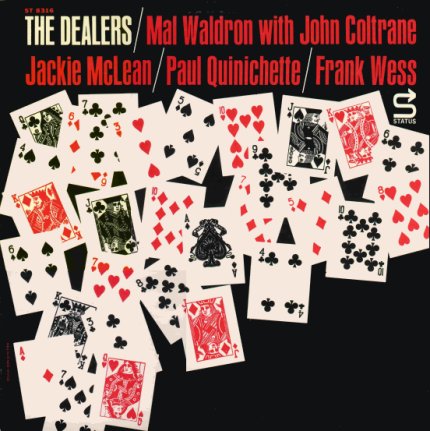
All of the final takes m this session were on the Prestige album Wheelin' and Dealin', credited to the All Stars. The two alternate takes made it to a budget Status album, The Dealers, credited to Waldron and also featuring two cuts from his April 19 session. The alternate takes inevitably made their way onto the CD reissue of Wheelin' and Dealin'. Weinstock must have been moved as I was by the irresistible beat of "Things Ain't What They Used to Be," because it was released as a two-sided 45, under Coltrane's name.

Tuesday, January 24, 2017

Listening to Prestige 235: Curtis Fuller

In an interview in later years (from an article published in 2010), Curtis Fuller describes John Coltrane's seminal Blue Train recording for Blue Note as his first recording. And Lord knows it was important. Trane has described it as his favorite album. And it's impossible to overstate the importance of John Coltrane to the young Fuller In the same interview, he says "meeting Trane was the greatest thing that ever happened to me. It was Miles Davis who took me to New York, and Coltrane was in the band, as well as Paul Chambers, Philly Jo Jones. Trane took me aside...he had confidence that I didn’t have; he saw something that I didn’t see. A great man."

But actually, Blue Train wasn't recorded until September of 1957-- well after the Paul Quinichette session, and after this session, a day later.

As important as Blue Train was in young Fuller's development, this early couple of days in May, a Fridays with Rudy session that spilled over into Saturday, with Fuller as sideman and then leader, should not be overlooked.

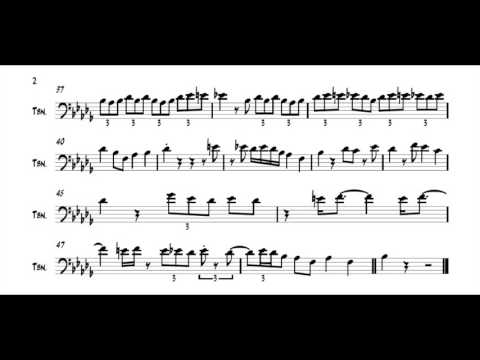
So, about Curtis Fuller...but it's so easy to get sidetracked, isn't it? Hank Jones is on this session, too, and he did a number of sessions for Prestige over the years, but wasn't really one of their regulars. Before this session, he had only been on board for two dates supporting vocalist Earl Coleman. And just listen to him on "Blue Lawson." His vamp leading into the head is enough to draw you in, and his solo coming out of it would melt the resistance of Doris Day on a blind date with Rock Hudson. Oh, heck, just keep on listening to "Blue Lawson," and you'll come right back to thinking about Curtis Fuller again, whose trombone solo has been studied by succeeding generations of trombone players. And Sonny Red. And Doug Watkins.
Transcription of Curtis Fuller's solo on "Blue Lawg.


Fuller is yet another musician to have had his initial training in the jazz cauldron of Detroit. His Jamaican-born parents died when he was very young, and he was raised in an orphanage, but went to school with Paul Chambers and Donald Byrd, and later, at Wayne State University, roomed with Joe Henderson. Everyone in Detroit in those days must have fallen under the jazz spell, because young Curtis had his life turned around when a nun at the orphanage took him to hear J. J. Johnson (in a theater--it's too much to ask, to imagine a nun at the Blue Bird). Fuller told interviewer Jon Solomon,
He was coming out the side of the theater. He stopped and squeezed my hand, and he gave me that look — the J.J. Johnson look. And throughout the years, he never forgot me. And as I got older and went to school, and then went to the service and came out, I saw him again with Kai Winding, and he remembered me. When I got to New York, he told Miles [Davis] about me and about my progress.
Fuller would study with both Johnson and Frank Rosolino, and many years later (1980), he would team up with Kai Winding in a reprise of the famous J. J. and Kai pairing. Now a jazz legend himself (and still with us), Fuller has some serious legends as mileposts in his career. Coltrane and Winding are two, but just as important was Lester Young. "I remember talking to Billie Holiday about being surprised that Lester wanted me," Fuller told Solomon. "She said, 'Well, he asked for you. He must've wanted you.'"

And then there was the legend that got away. He auditioned to replace Trummy Young in Louis Armstrong's All Stars, and he really wanted this gig -- for one thing, Young was getting $1500 a week, which was about three times what he had ever earned. But his sound was too modern for Armstrong.

Hank Jones was another Michigan native, but not so much a part of that Detroit scene. He played in territorial bands around Michigan and Ohio, and he left for New York in 1944, before the Blue Bird Inn had really become a bebop mecca.

Sonny Red was known by that name pretty much throughout his career, starting with Two Altos, released in 1959 but recorded in 1957, and his 1960 debut as leader on Blue Note, but on these early Prestige albums he's billed as Red Kyner, and although most of his composer credits are as Sonny Red, there's at least one tune credited to Sylvester Kyner. He was another Detroiter, whose early work in the Motor City included gigs with Barry Harris and Doug Watkins. He came to New York with Fuller, and they started out together, sharing digs and gigs. Before Motown: A History of Jazz in Detroit 1920-60, by Lars Bjorn, includes a reminiscence about Sonny from a fellow musician*:
So me and my friends, we go down to the Craftsman's Club one night and there is Sonny Red playing alto and it floored me because I didn't know he had that kind of talent. I said "Wow!" because he sounded like Charlie Parker to me. And I went up to him and said, "Red, I didn't know that you could do this." He said, "Yeah, man." I said, "How long have you been playing? Tell me!" He said, "You just do it!" So he became a motivator to me. I said if he can do it, I can do it. You know, he was with Barry Harris, Doug Watkins on bass, Sid Roman on drums and Claire Roquemore on trumpet. Man, you can hardly believe what these guys were blowing. And the thing about it, no matter how much they played, we could still dance.
Swing-to-bop. Like Paul Quinichette. In New York, the virtuoso soloist became king because dancing was not allowed in the small clubs. In Detroit, a guy could be playing like Charlie Parker and they were still dancing.

Louis Hayes also came out of Detroit, where he was leading groups in  clubs before he was 16, and where he first played with Yusef Lateef.

Completing the all-Detroit tenor of this session, "Blue Lawson" is a tribute to Detroit piano man Hugh Lawson, who came to New York with Lateef and worked in his group.

When people talk about "if you could go back in time, where would you go?" The Globe Theater in Shakespeare's day? The Renaissance? Conservative political theorists want to go back to McKinley's presidency. Woody Allen, in Midnight in Paris, wanted to go back to Paris in the Twenties, and one of the characters in that movie thought the Twenties were boring, and wanted to go back to La Belle Epoque. I've always said I want to go back to New York in the 1940s, to 52nd Street and Minton's and Monroe's. Now I think I'd like to make a side trip in that time travel, and go to Detroit as well. I would have heard some bad cats I could never hear anywhere else. Who was Claire Roquemore? Again from Lars Bjorn's book (no Google references to Roquemore anywhere else):
Claire Roquemore was by many accounts a very promising young trumpeter who never fulfilled his promise. Frank Gant's assessment: "Claire had technical fluidity: I saw him wipe Miles out many a time. He seemed like he had that breath control where he can play forever.
All of the cuts from this session except "Alicia" were included on the album Curtis Fuller - New Trombone. "Alicia" was ultimately put into a Status budget album called Body and Soul.


 Order Listening to Prestige, Vol. 1 here.


* This is taken from the excerpt in Google Books, and the name of the musician who provided this oral history is cut out. You can get a hardcover copy of Before Motown from Amazon for $350, but I also found a used paperback for ten bucks, including shipping, so I've ordered it and will be able to fill in this information later.


Monday, January 23, 2017

Listening to Prestige 234: Paul Quinichette

The name of the group, on the session list, is Paul Quinichette's New Stars, and it lives up to its billing. Even Quinichette, while not altogether a new star, is new to Prestige, and pretty much new to recording in a bebop context. He's not new to recording, having led his first session in 1951, and even when he was new in that context he wasn't altogether new, being 35 years old and with a fairly impressive career behind him, from Jay McShann to Johnny Otis, Louis Jordan, Lucky Millinder, Hot Lips Page, and most notably with Count Basie, where he became known as the Vice President, because of his stylistic similarities to Lester Young, and of course because of taking the lead tenor sax chair in the Basie band. And his debut album with Prestige, with a new label and really a new approach, came when he was 41.

You don't play with bandleaders like McShann, Otis and Jordan without learning something about the importance of entertaining people, and as Quinichette began his association with boppish Prestige, he brought that background with him. Prestige had been started by 21-year-old Bob Weinstock after he had been jolted out of his trad jazz fandom by a Thelonious Monk 78, and his first recording session featured Lenny Tristano, so he was no stranger to the cutting edge of jazz experimentation. But he wasn't afraid of feel-good music either, and both of these tastes are what gave Prestige its vitality and importance for so many years.

Quinichette, on this and subsequent sessions with Prestige, worked in that genre that I've called, writing about artists like Zoot Sims, swing-to-bop (which was also the title of a classic cut by perhaps the original swing-to-bopper, Charlie Christian). The early boppers, of course, came out of the swing bands, but by this time, the young modern players had grown up on bebop. So it's interesting, instructional, and basically just plain delightful to hear a veteran like Quinichette with this group of New Stars.

Of the new stars, the rhythm section isn't entirely new, but is of the bebop-bred generation.

Mal Waldron was the oldest at this point, at 32, but his whole career had been with the moderns. He did begin with Ike Quebec in 1952, but soon moved to Charles Mingus, and aside from a very important stint with Billie Holiday (1957-59) always worked in a modern and even free jazz idiom.

Ed Thigpen was five years younger than Waldron, but came from a traditional background--his father was the longtime drummer for Andy Kirk's Clouds of Joy, and he was perhaps best known for his work with Oscar Peterson, Billy Taylor and Ella Fitzgerald.

Doug Watkins was still only 23, and had made his Prestige recording debut just a year earlier, with Jackie McLean (and in 1955 on a live album with Art Blakey), but he was already a veteran of some 20 sessions on Prestige alone.

John Jenkins had played on a couple of recent sessions (and was also brought up modern, starting out with Art Farmer and Charles Mingus), but he was still a pretty New Star, and Curtis Fuller and Sonny Red were the newest of the New.

Sonny Red was 25, and this seems to have been his debut on record. He was active through the 50s and 60s, never really breaking through as a major figure, but doing some good work. Curtis Fuller was two years younger, one of the Detroit guys, and did go on to make a significant name for himself. They would both come back the day after this session to record under Fuller's name, so I'll hold off saying much more about them, except to note that each of them were at one point caught up in the twin-instruments thing I got into in my last post. Well, not really. Sonny Red is featured on an album called Two Altos, and it has a picture of two altos on the cover, and the names Art Pepper and Sonny Red, but it's actually two completely different sessions, done at different times on different sides of the country. Curtis Fuller...another J.J. and Kai? Blue Note apparently thought so. They recorded him and Slide Hampton as the co-leaders of a quintet in 1958. And then apparently thought better of it, as the session went unreleased until 1980 in Japan, and 1996 in the USA.

So here we have veteran Paul Quinichette with the young cats, and with a young composer - three tunes by Mal Waldron, along with two standards, and the results are uplifiting. Someone calling himself GastonBulbous has posted "Blue Dots" on YouTube, and describes it as "a head by Mal Waldron that cleverly bridges Quinichette's origins as a Basie-ite with the more beboppish ambitions of his sidemen." It's that and more. The head is Waldron's modern-style take on a McShann or Otis-type head, and solo work, taking Quinichette's cue, is joyous swing-to-bop. All of it wonderful, but you can't help but be particularly caught up in Quinichette's solo, and Waldron's brief one at the end.

Bob Weinstock must have been as struck as I was by the infectiousness of "Blue Dots," because he released it as a 45. The album was called Paul Quinichette on the Sunny Side. The British Esquire release has the same title and the same frying pan, but adds "the Vice Pres" to Quinichette's name. The 45 changes the listing of New Stars to the familiar Prestige All Stars. It was released later, so presumably the stars weren't quite so new any more.


 Order Listening to Prestige, Vol. 1 here.