Showing posts with label Bobby Jaspar. Show all posts

Tuesday, December 06, 2016

Listening to Prestige 218: Prestige All Stars

All of the Prestige All Stars sessions lived up to their all star billling, but this one really does, and not just because it has John Coltrane on it. Coltrane was to become a jazz deity, but he was already jazz royalty. But the rest of the group is extraordinary, and their playing on this date lives up to their name recognition.  Webster Young, the new kid on the block, was invited to play on this date shortly after his debut album with Ray Draper. He talks about it in Benjamin Franklin V's Jazz and Blues Musicians of South Carolina:
About two weeks later, Mal Waldron called me and said, "I have a record date. I asked him who was on it and he said himself, John Coltrane--my knees began to sink--Idrees Sulieman, Kenny Burrell, Paul Chambers and Arthur Taylor. These were heavyweights. Bobby Jaspar was there on tenor. I said, "OK."
On the morning of the date, I went over to see Miles, and he convinced me that I could do it...He showed me a few licks. He was living on Tenth Avenue, and I had to get to Prestige on 50th Street...
Me, Bobby Jaspar and Idrees Suleiman went out together. The other cats were already there...a Coltrane date had [already] been held there. Red Garland was there with his
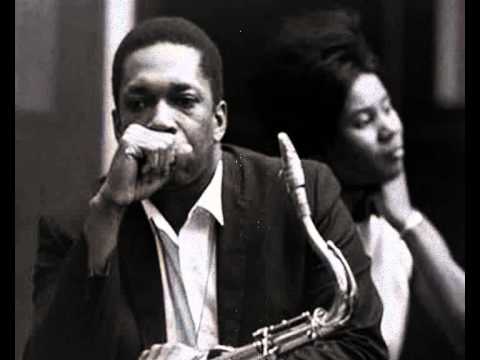
John and Naima Coltrane
wife. Trane was there with his wife, Naima. It was Mal's date. He had written four tunes: "Interplay," which was "I Got Rhythm;" "Anatomy," which was "All the Things That You Are;" "Light Blue," which was a blues, and the tune that made the album, "Soul Eyes." I was nervous as hell, but I was determined. Everything that we did was one take. Between Coltrane and Bobby Jaspar, that was something. Bobby Jaspar was a good player, very good. He was tight with Idrees; he was a nice cat. I liked him and Trane. It was a hell of a date.

A hell of a date is right.  Young was focused on the horn players, and so left out Kenny Burrell, but he was another one of Prestige's rising all stars, and he contributes mightily as well. "Anatomy" goes straight from the head (which is a lot more than a riff: Waldron was a talented composer, and even if this is based on the ubiquitous chord changes, in this case "All the Things That You Are") to a guitar solo, to a bowed bass solo by Chambers, to a piano solo by Waldron, and they're all a lot more than interludes between the two trumpets and two saxophones.

The centerpiece here, Webster Young's "tune that made the album," is Waldron's classic "Soul Eyes." It's best known for the 1962 recording by Coltrane on Impulse, but it's become a standard, recorded by Stan Getz among others (and check out the recent vocal version by Kandace Springs). Coltrane's 1962 recording features his great quartet with McCoy Tyner, Jimmy Garrison and Elvin Jones, and distills the beauty of the composition into 5:27. This version lasts 17:29, one whole side of the LP, and gives ample opportunity for interplay between two trumpets, two tenors, a guitar and a rhythm section. If you know and love the Coltrane quartet version, listen to this one, too.

This is an amazing feat, when you think about it. Bob Weinstock, as we know, liked the impromptu feeling of a jam session. He's talked about the way he worked with Miles Davis--no regular group, just sit down and kick around ideas for a session. Who was in town, who Miles would like to play with. That resulted in some perspectives on Miles that we would not have had otherwise, and it's the same thing here with Coltrane, as you can tell if you listen to "Soul Eyes" with Coltrane's regular group, and with this pickup group, probably put together by Weinstock and Mal Waldron. Coltrane and Sulieman were veterans and most likely knew each other, but they had never recorded together. Nor had Coltrane and Waldron, although Waldron and Sulieman had done one previous session. Kenny Burrell was new in town. He'd worked with Paul Chambers, but that was about it. Bobby Jaspar was not only new in town, he was new to the country. Webster Young was still a kid whose knees started shaking when he heard he was to record with John Coltrane.

So you have these guys new to each other, playing charts they had almost certainly just received that day. Two of the melodies were based on chord changes they were familiar with, one was a blues. But the last one, the big one, was a new and subtle melody, and as they started playing the head, they must have known it was not going to be a three minute number for jukebox release (which it is, in the Kandace Springs recording), but they didn't necessarily know that it was going to go on for the better part of 20 minutes, and they'd have to keep improvising and keep on keeping it fresh. And, as we know from Webster Young's reminiscence, you were going to have to do it in one take.

And I don't know, but I'd guess if you were getting together with strangers on a 17 minute jam, it would be easier to sustain if you were playing something bouncy than a dreamy, subtle ballad. But that's what they do, and they do sustain it. I wouldn't subtract a minute.

If you're going to pull something like this off, it helps to have a musician of the caliber of John Coltrane at the center of it. And it helps to have the composer anchoring it, if that composer is Mal Waldron. It's always a special experience to hear Waldron soloing on one of this own compositions.

Listen to the way the musicians come in as the head gets restated at the end of the piece. It's unusual, maybe even haphazard. It wouldn't be that way if it had been rehearsed. And it's just about perfect. It's Prestige jazz.

The title of the album is Interplay for 2 Trumpets and 2 Tenors.


 Order Listening to Prestige, Vol. 1 here.

Friday, December 02, 2016

Listening to Prestige 216: Herbie Mann - Bobby Jaspar

The two March Bobby Jaspar sessions, the first a quintet with Eddie Costa on vibes, the second a partnership, the second a partnership with Herbie Mann (guitarist Joe Puma making it a sextet), were mixed and matched and released on two albums, Flute Flight and Flute Soufflé.

Of the two, Flute Flight is the one I remember as an iconic album of the era, Flute Soufflé less well known. The cover art from Flight triggers a memory, but I'm fairly certain I'm seeing the cover art from Soufflé for the first time.

And that recollection gets support from the accounting of the modern world. Amazon lists Flight as number 9000-something on its sales chart, Soufflé down in the mid-13000s.

Herbie Mann was the marquee performer. He would go on to have one of the most commercially successful careers in modern jazz (his Memphis Underground is one of the top selling jazz albums of all time, and a single, "Hijack," spent three weeks at Number One on the Billboard dance chart in 1975), while retaining his artistic cred (a website devoted to the 100 greatest jazz flutists rates him at #2 behind Eric Dolphy (Bobby Jaspar is #36, which is probably a little low. If he'd lived longer, and recorded more, this would be a different story).

So Flute Flight is the album on which Bobby Jaspar's American reputation mostly rests, and it is actually mostly his album, with all of the quintet numbers plus two from this session.

This may partly reflect the fact that the quintet session was a little short for a full album (20 miinutes of music, and they weren't doing 10-inchers then), but I'm guessing it was mostly a marketing decision. Move a couple of tracks from the Herbie Mann session over, and you can put his name on both albums. Not really a bait and switch. Jazz fans are notoriously well-informed consumers, and they'd rarely buy an album without checking all the players on every cut. And in any case, no need to feel shortchanged by the music. It's all good.

It's also all flute, at least from the two leaders, which further cemented Jaspar's reputation as a flutist, although in Europe he was known more for his work on the tenor sax. Soufflé, on the other hand, mixes up the instruments more. Which I'll get to, as we actually start to focus on this session.

They say that Chuck Berry never had to tour with a band, because there was no city he could go to,
anywhere in the world, where he couldn't find musicians who knew all his songs. For two jazz musicians in the Fifties, the same could be said for Charlie Parker tunes, so what better way for a Belgian and a Brooklyn hipster (a real Brooklyn hipster, not the kind who make fake gourmet chocolate) to get to know each other? The first cut on this session is Parker's "Chasin' the Bird," and it's a great ice-breaker. They make their mutual introductions on the flute, and Bird provides a rich source for interpretation, so the two flute voices are distinctive and complementary. And so are the other voices on the session.

"Bo-Do" is two flutes again, but perhaps the star turn on this Joe Puma composition is Puma himself, on guitar--and as a composer. The tune is riff-driven but very substantial, and there are great solos by Tommy Flanagan and Wendell Marshall. Puma only did one other session for Prestige, but he had a long and distinguished career in jazz, still active until shortly before his death in 2000. During the mid-50s, he and Herbie Mann worked together often.

"Somewhere Else" is a Puma composition again, another good one, this time a showcase for four solo instruments, played by two guys. First Mann on tenor, then Jaspar on flute, and after an interval in the middle by Puma, back to Mann on flute and finally a strong Jaspar on tenor.

Back to the flutes for "Let's March," a Mann composition that starts out with Bobby Donaldson demonstrating that the march has come a long way since Sousa, followed by Mann showing that it's come even farther than you might think, when it's overlaid with the intricate runs and rhythms of bebop. This is a cool piece for both flutes, but maybe even better for Puma, who burns through his solo, and then we close with the two flutes and the drummer marching out.

"Tel Aviv" is the centerpiece of the session, a beautiful pensive melody by Herbie Mann showcasing Jaspar on tenor sax. It's 15 minutes long, and gives everyone a place in the limelight, but it's Jaspar you really carry away.

They finish up the session with another Mann composition, "Tutti Flutie," which may well have been thrown together on the spot, one of Rudy Van Gelder's "five o'clock blues." It stretches out for ten minutes, which makes enough music to fill out two albums, it's fun and tuneful and bluesy and gives everyone room for some great solos. I was especially taken by Tommy Flanagan and Wendell Marshall. And the fluties are tutti -- no saxes here.

This meant it could go on the all-flute album, Flute Flight, along with "Bo-Do." The others are all on Flute Soufflé. 

"Let's March" was also released on a two-sided 45, which suggests that Weinstock may have sensed Mann's hitmaking potential early. "Tutti Flutie" also became a 45 later on -- much later on, I would guess. "Let's March" is in the 100 series, "Tutti Flutie" in the 400 series. I can't exactly figure out Prestige's 400 series of 45s. They're not in any chronological sequence -- the MJQ's "Django" and "Moody's Mood for Love" come next. So these maybe come late in the game, when Prestige was moving toward mosty repackaging and reissuing, or even after the sale to Fantasy.


 Order Listening to Prestige, Vol. 1 here.

Monday, November 14, 2016

Listening to Prestige 215: Bobby Jaspar

A star-crossed session, with two wonderful players destined to die far too young. Vibraphonist Eddie Costa would die in an auto accident in 1962, leader Bobby Jaspar of a heart attack in 1963.

This was Jaspar's recording debut, and the American debut for the Belgian-born musician. He was probably better known as a saxophonist in Europe, but most of his American recording, and therefore most of his reputation, was on the flute.

Jaspar came to the US in 1956. The Swedes like Lars Gullin and Bengt Hallberg had paved the way for acceptance of European jazz musicians, and Jaspar arrived with a reputation as a cat who could play.

He also arrived with an American wife. He had married semi-expatriate Blosssom Dearie in Paris in 1955 (they would divorce in 1957, around the time he was making these Prestige sides).

Eddie Costa, also making his Prestige debut with this session, was really hitting his stride in 1957, the year that he was named the Down Beat new star of the year on both piano and vibes, the first time a musician had ever won two categories in the same year. He first hit New York in 1949, with his older brother Bill. It wasn't a long drive from his home town in central Pennsylvania--only 150 miles--but culturally, it might as well have been a moon shot. Atlas, PA, was a coal mining town, and not much modern jazz made it there. But brother Bill played piano, and had a taste for swing, which he passed on to Eddie. The two of them hit the big city together, where Eddie first heard Bud Powell, and found his true musical love. He recorded with Sal Salvador in 1954, and made his first recording as a leader in 1956, a trio session with Vinnie Burke and Nick Stabulas that was released by two primarily rhythm and blues labels, Jubilee and its subsidiary Josie.

Bobby Donaldson was also new to Prestige, but hardly new to the music business. He went back to the swing and jump blues days in the 1940s, but by this time he was a sought-after session drummer in virtually any genre you'd care to name.

If you were going to assign signs of the zodiac to musical instruments, flute would be an air sign, vibes and piano water signs. Bass and drums, of course, would be earth signs. So minus the fire sign of a saxophone, this session is earth, wind and water, and a very cool combination it is. I was particularly struck by the compositions, which I guessed might be all Bobby Jaspar tunes, but I was wrong. "Flute Bob" is Jaspar's, but "Flute Bass Blues" is by Doug Watkins and "Solacium" by Tommy Flanagan. Which says something about how many talented composers there were in the jazz world of the 1950s, even though many of these compositions were caught in flight at the one session they were brought to, and then soared on into the jazz ionosphere. "Flute Bass Blues" was recorded in a very different era as a duet for Jeremy Steig and Eddie Gomez, where it becomes much more a vehicle for bass virtuosity, although Watkins does have a short and effective solo on this cut; and "Solacium" became best known as a vehicle for John Coltrane, on album that showcased Tommy Flanagan's compositions.

Interestingly, "Solacium" is the cut that has the least of Flanagan for this session. It's very much a flute-vibes duet. It's the first cut of the session (although the last of the subsequent album) and establishes the chemistry between the two soloists.

These three tunes became part of an album called Flute Flight, with a second session that featured Herbie Mann and Joe Puma taking Costa's place, and Mann and Jaspar sharing leader billing.