Tad Richards' odyssey through the catalog of Prestige Records:an unofficial and idiosyncratic history of jazz in the 50s and 60s. With occasional digressions.
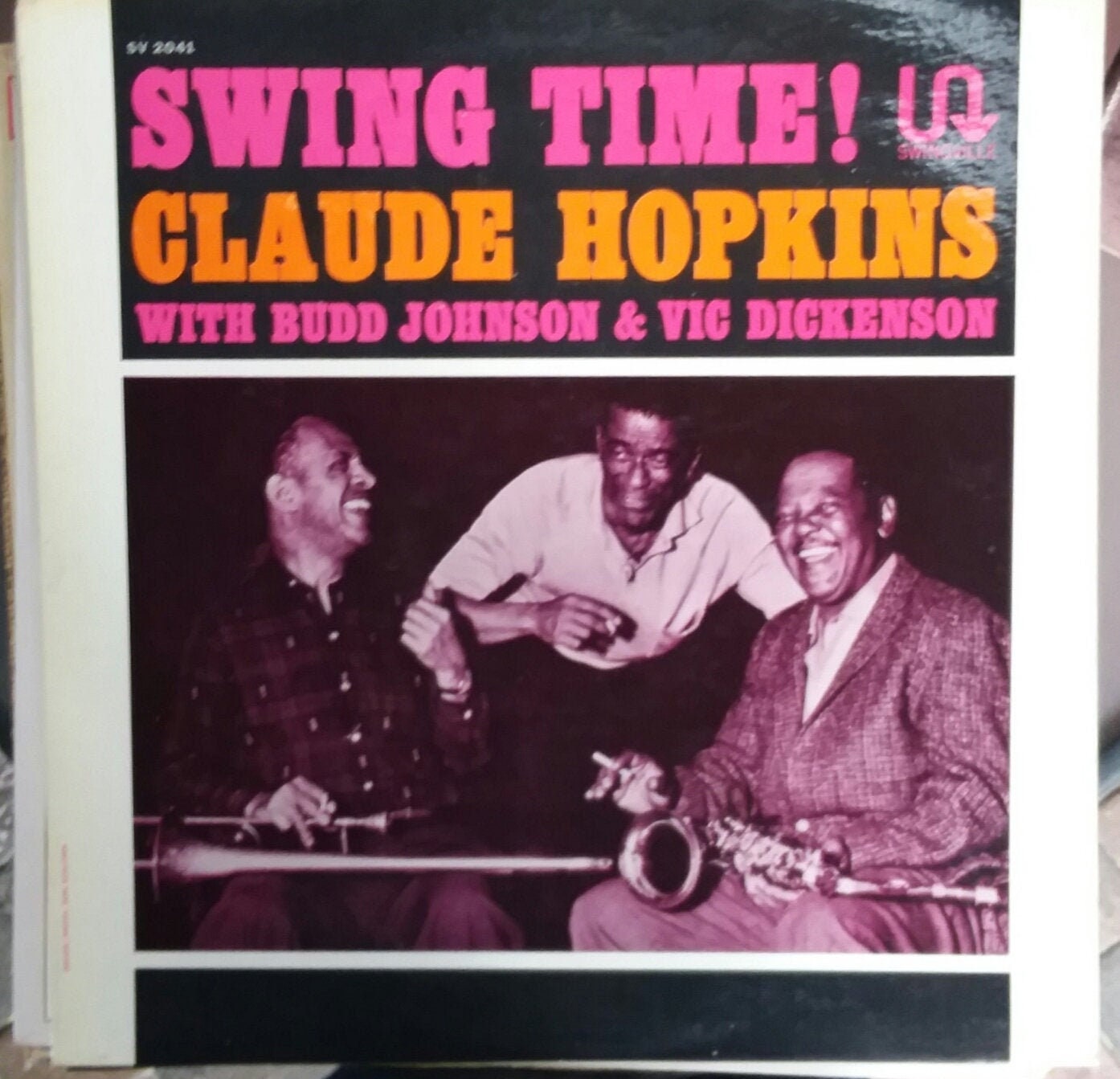
Claude Hopkins had a long and distinguished career as pianist and bandleader, but live music is evanescent, and so are the reputations based on it. Lasting reputations are built on recorded music, so it'sm thanks to Prestige and Swingville that Hopkins is chiefly remembered today -- with the Swingville All Stars, backing up Bud Freeman and Lonnie Johnson, and most indelibly for the three albums he recorded as leader: Yes Indeed!, Let's Jam, and this final one, Swing Time! Esmond Edwards gave him great support for the first two (Buddy Tate, augmented by Chu Berry on Yes Indeed! and Joe Thomas on Let's Jam), and Don
Schlitten, not to be undone, gives him a masterful group here, led by Vic Dickenson and Budd Johnson.
Hopkins had the kind of career that jazz fans and jazz historians can dream about, and conjure up a mythos around -- musical director of Josephine Baker's ensemble in Paris (which included Sidney Bechet), leader of a 1930s band which included Vic Dickenson and which had long residencies at the Cotton Club and Roseland. But to actually hear him, these recordings are the place to go. Swing Time! includes two Hopkins originals plus the kind of old chestnuts that, when they're in the hands of masters, you never get tired of hearing.
New to Prestige are trumpeter Bobby Johnson and drummer
Ferdinand Everett. Johnson was a much-in-demand section man who played with Duke Ellington, Billie Holiday and Erskine Hawkins, among others. Everett's only record date appears to have been this one, but he carries his weight.
Leonard Gaskin, New York City born and bred, found his way to Minton's and Monroe's early in the bebop era, and at age 24 followed Oscar Pettiford as bassist in Dizzy Gillespie's quintet. He played on some of Miles Davis's first recordings as a leader, recorded with Charlie Parker and Stan Getz. But as time went on he seemed to gravitate toward an earlier form of jazz, and his only two recordings as leader, both for Swingville, reflect that.
Jazz and its different forms have been known by a variety of names, not all of which caught on, not all of which are particularly endorsed by their practitioners. "Jazz" itself is rejected by many of the finest players of
this American music, while others guard the name against presumed barbarians at the gate, like Louis Armstrong castigating bebop as "Chinese music," or Eddie Condon, dismissing the beboppers with "We don't flat our fifths, we drink 'em." One well-known and well-esteemed jazz musician said of Ornette Coleman, "Whatever it is, that ain't jazz."
Or sometimes maybe it isn't used at all. In The Benny Goodman Story, the word "jazz" is never used once. Nor is the word "swing," for that matter. Steve Allen, as Benny, talks about wanting to play "hot music" and have his "hot music accepted.
Other apellations just didn't stick. For a time, the music that came to be known as bebop was called "New York music," and I've always thought it was kind of a shame that that didn't catch on. Afro-Cuban jazz was also called Cu-bop, and maybe that was too cute by half.
And then there's Dixieland, a name used by the white ensemble who cut the first jazz record, back in 1917. A number of Black musicians from New Orleans had joined the Great Migration northward to Chicago, the most famous among them being King Oliver and Louis Armstrong. A number of white musicians were to make that same trek, because there was an audience for the music. They played on their New Orleans roots by calling their ensembles Brown's Band from Dixieland, or Stein's Dixie Jass Band, or -- the group that traveled from Chicago to New York, and ended up making that first record--the Original Dixieland Jass Band, later to become the Original Dixieland Jazz Band.
So it was this group that first popularized jazz beyond the nightclub audience in a few major cities, and who really brought the name into common parlance--and who also struck the first salvo in the ongoing culture war over the proposition that American music -- blues, jazz, and all their descendants -- are an African American art that has been stolen by whites.
And this is mostly true. I don't know how true it is on the musician level. Real musicians play music, and jazz musicians are consummate crafters who devote their lives to getting good enough, and remaining good enough, to be allowed into the colloquy that is jazz music. Louis Armstrong cited cornetist Nick LaRocca of the ODJB as one of his inspirations. But it is absolutely true on the business end. It's no accident that the ODJB, and not King Oliver or Fate Marable, was signed to make the first commercial jazz recording.
But if the white musicians who named their bands after a term which glorified the old South of slavery were not being consciously racist, they didn't have to be. Racism was such a part of their era that it was accepted without much conscious thought. In any event, the term, like the music it described, declined until the 1940s, and the revival of traditional jazz which began when journalist and music lover Heywood Hale Broun went down to New Orleans to record the still-active keepers of that tradition, and New Orleans musicians such as Bunk Johnson came to New York and recorded. This neo-traditional music, based on New Orleans and Chicago styles of the early decades of the 20th century, took the name of the ODJB and began to coalesce under the name Dixieland jazz. By then, there was at least somewhat more social awareness, and there were some who found the name offensive (and the music bland and uninteresting), but the most popular purveyors of this faux-nostalgic music called themselves the Dukes of Dixieland.
The Dukes were never very highly regarded in jazz circles, although Pete Fountain, Jim Hall and Herb Ellis played with them at one time or another. And they were pretty solidly white, although Louis Armstrong did sit in with them on a couple of occasions. And their musical imitators, who wore straw hats and striped blazers and conjured up images of a mythic and genteel Old South, were also all white.
But the musical tradition of New Orleans and Chicago was real, and though "Dixieland" had pretty much been relegated to football halftime shows, county fairs and Kentucky Derby festivities, there were real musicians, both black and white, who still honored those traditions, and it was just such a group of musicians that were gathered by Leonard Gaskin for this session.
It was very much Gaskin's session, and he is listed as "leader" in the session log, although that's not normally noted. Immersion in the tradition is emphasized by the selection of material, even including one tune ("At the Jazz Band Ball") from the ODJB's original sessions.
As the free jazz revolution started to take hold, it was good to be reminded of where jazz had come from--and to be reminded that jazz's evolution had been so rapid, that these still-vital, still-creative oldtimers were playing side by side with the Cecil Taylors and Albert Aylers. Sometimes literally side by side--Garvin Bushell, who had played with Bunk Johnson and Fletcher Henderson, would also play with Eric Dolphy,
Doc Cheatham, Vic Dickenson, Buster Bailey,Dick Wellstood, Herbie Lovelle and Gaskin have all appeared on Prestige sessions before, the first four on earlier Swingville releases. Lovelle backed up King Pleasure on a 1952 session. Gaskin was very active for Bluesville, working with a wide variety of blues singers, but he had also played on two of Prestige's earliest bebop sessions, one with J. J. Johnson and the other with Miles Davis.
Trumpeter Yank Lawson was one of those who continued to embrace the Dixieland moniker, and created, with bassist Bob Haggart, an ensemble that managed to achieve popularity on the Dixieland/nostalgia circuit while still playing music a jazz fan could take pleasure in. He began his career with Ben Pollack's orchestra in 1933, then worked with Bob Crosby, Benny Goodman, and Tommy Dorsey. He and Haggart formed the Lawson-Haggart band in the 1950s, disbanded, and then rejoined forces in 1968 to create the modestly named World's Greatest Jazz Band, which had a solid decade's run of popularity, and included Cutshall, Dickenson and Wellstood at various times.
Trombonist Cutty Cutshall played with Benny Goodman, Billy Butterfield and Louis Armstrong, but his longest association was with Eddie Condon, with whom he was still touring when he died in 1968.
Clarinetist Edmond Hall came by the tradition naturally, being from a family of New Orleans musicians. His most important association was with Louis Armstrong, but he had a pretty strong pedigree before joining Armstrong, starting with his first recording session, in 1937, with Billie Holiday and Lester Young. He played with Claude Hopkins, Lucky Millinder, Zutty Singleton, Joe Sullivan, Henry "Red" Allen, Teddy Wilson, and Eddie Condon, among others, and was co-leader of the house band at the original Cafe Society in New York.
The recording date began with Lawson,Cheatham, Cutshall and Hall joining the rhythm section for "Tin Roof Blues," a tune that goes back to 1923 and the New Orleans Rhythm Kings, a white group of New Orleans-to-Chicago musicians, and "Muskrat Ramble," written in 1926 and first performed by Louis Armstrong.
"At the Jazz Band Ball" is the ODJB tune, written by Nick LaRocca and other members of the group in 1917, and featuring the entire nine-piece band. The whole album is a pleasure to listen to, but on this tune in particular they really let rip, its 6:19 length giving everyone a chance to shine.
After that, Lawson, Cheatham, Cutshall and Hall pack it in, and Dickenson and Bailey take over for "Mack the Knife," the one modern tune, but it fits right in with the mood; "Hindustan," written in 1918 by Oliver Wallace, who a quarter century later would win an Academy Award for Dumbo; and "Keepin' Out of Mischief Now," a Fats Waller tune that's almost modern, having been first performed by Louis Armstrong in 1932. It really does sound from a different era and mind set than the other tunes on the album, even "Mack the Knife."
Swingville released the album as At the Jazz Band Ball by the Leonard Gaskin All Stars, but actually all it says on the front cover is the title and subtitle: A Dixieland Sound Spectacular, so Dixieland as a label was not dead yet. A later CD rerelease on a different label kept the title but named the group the Swingville All Stars.
This is the third album to be released under the Swingville All Stars banner, and the second in a little over a month. The April lineup is completely replaced, although there's a fairly close consistency as to the structure of the group. Joe Thomas replaces Joe Newman on trumpet; Vic Dickenson for J. C Higginbotham on trombone; Pee Wee Russell for Jimmy Hamilton on clarinet. The first go-round had an alto (Hilton Jefferson) and tenor sax (Coleman Hawkins); this one has two tenors (Buddy Tate and Al Sears). Both sessions had a guitar (Tiny Grimes then, Danny Barker now). Claude Hopkins, Wendell Marshall and Billy English rounded out the first
rhythm section; Cliff Jackson, Joe Benjamin and J. C. Heard were the second. In other words, heads you win, tails you can't lose.
I've commented that none of the Swingville groups are playing the music of the 1920s and 1930s. They're not playing bebop, postbop or hard bop, but they're not stuck in the past either. That's somewhat less true of this group, maybe because more of their repertoire is swing era standards. But they're still making music that sounded good in 1961, and still sounds good in the 21st century.
There are identifiable differences. The Swingville All Stars are making music in the LP era, which means that they can stretch out in ways that the cats making 78 RPM records couldn't, "Years Ago" is ten minutes long, with room for extended solos for everyone. "Phoenix" is over seven minutes. Even super-traditional swing melodies like "I May Be Wrong" go over six. And that does make a difference.
Better recording equipment and techniques make a difference. In the late 1940s, Baby Dodds made a series of videos demonstrating his phenomenal technique on a drum kit. But recording with Johnny Dodds and with King Oliver, he had to use just a block of wood, because real drums would make the needle on the primitive recording machine jump.
And as I've noted before, these are some of the greatest musicians the world has ever seen. They may not have chosen the paths blazed by Charlie Parker, but they didn't stand still, either.
Nevertheless, there's more nostalgia here than we've heard on some of the other sessions, and the only explanation I can give for that is that's how they felt like playing on this particular day. The first session is wonderful music, lifted to another level by Coleman Hawkins. This session is wonderful music, lifted to another level by Pee Wee Russell -- who, if anything, was more progressive than Hawkins. So go figure.
New to Prestige on this session were Cliff Jackson and Danny Barker. Jackson was close to 60 when this recording was made, and had built his reputation as a stride piano player. He had been well known in New York for four decades, doing some recording, but mostly known as a fixture on the
night club circuit. He did not have a lot of experience playing with the younger cats, and he may have been partly responsible for the more traditional sound on this date. But he was very good at what he did, and Prestige would use him on several more Bluesville and Swingville sessions. He died in 1970.
New Orleans-born Danny Barker lived until 1994, long enough to be revered as both a musician and a seminal figure in the revival of jazz in New Orleans. The Fairview Baptist Church Marching Band, which he founded, gave a number of young New Orleans musicians their start, including Wynton and Branford Marsalis, Nicholas Payton, Lucien Barbarin and many others. Wynton Marsalis has credited him with being one of his most important teachers. He would continue to play, both guitar and banjo, until shortly before his death.
The Hawkins All Stars and the Russell All Stars were mixed and matched for marketing. Swingville released the material on two albums. The first, Things Ain't What They Used to Be, contained the title song, "I May Be Wrong," and "Vic's Spot," along with two numbers from the Hawkins session. The others joined the remaining two Hawkins numbers on Years Ago. Both sessions were reunited on a Prestige double album (and later CD) called Jam Session in Swingville.
Not much new to say about Coleman Hawkins by this time. It seems almost beside the point to write anything. Better to turn the volume to just the right level (not all the way up to eleven), sit back, and enjoy sound that is so smooth you could spread it on Wonder Bread without ripping up big hunks.
Except you would never spread it on Wonder Bread. This is the real thing, the blues, the real America, three-dimensional and full-toned and flavored like Huck Finn's stew. Unlike the Widow Douglas's white-bread cuisine where "everything was cooked by itself," you have "a barrel of odds and ends," where "things get mixed up, and the juice kind of swaps around, and the things go better."
So this is music for pure enjoyment, but isn't that what it's all for? As Hawkins and his group were in Englewood Cliffs cutting this session, Ornette Coleman was at the Five Spot making music that hurt the ears of many, but to my 19-year-old ears it was pure bliss, thrilling new, complex and simple, challenging and direct. And that's what you look for from art. The doors open where you find them, sometimes where you were looking, sometimes where you least expected, and each door that you go through broadens your range of appreciation, so that your capacity for enjoyment keeps expanding.
Hawkins has brought some old friends to this session, Osie Johnson has some swing credentials, having spent three years with Earl Hines, Tommy Flanagan and Wendell Marshall have young hands and timeless ears. But his horn players have the kind of time-tested chops that the Hawk himself brings.
Vic Dickenson kept a fairly high profile for a traditional player during the modern jazz era. A Down Beat International Critics Poll in 1963 placed him third among trombonists, tied with Lawrence Brown. And there were still plenty of great trombonists around. J. J. Johnson was still leader of the pack, Curtis Fuller and Slide Hampton were at the peak of their careers, Kai Winding was making hit records, Urbie Green and Bennie Green were still active, and Dickenson was pushing 60. But he kept busy throughout the 1950s and 1960s, recording with Hawkins, Johnny Hodges, Dicky Wells, Buster Bailey, Budd Johnson and, interestingly, Langston Hughes. He was a member of the outfit called The World's Greatest Jazz Band, which played the style of traditional jazz somewhat uncomfortably referred to as Dixieland, and which had a good enough lineup to justify the name.
Much less well-known, but regarded with reverence by those familiar with him, was trumpeter Joe Thomas. One such is Michael Steinman of the Jazz Lives blog, who has said of Thomas:
Joe knew how to structure a solo through space, to make his phrases ring by leaving breathing room between them. Like Bix or Basie, Joe embodied restraint while everyone around him was being urgent. His pure dark sound is as important as the notes he plays — or chooses to omit...
A simple phrase, in Thomas’s world, is a beautifully burnished object. And one phrase flows into another, so at the end of the solo, one has embraced a new melody, resonant in three dimensions, that wasn’t there before, full of shadings, deep and logically constructed.
And more:
Joe’s tone, dark and shining, makes the simple playing of a written line something to marvel at, and each of his notes seems a careful choice yet all is fresh, never by rote: someone speaking words that have become true because he has just discovered they are the right ones for the moment.
I've commented on this before, but it's worth repeating: What Coleman Hawkins, and other artists who recorded for Bob Weinstock's Swingville label, played was not traditional swing (as opposed, for example to The World's Greatest Jazz Band, which essentially did play traditional Dixieland). Swing was big band jazz, essentially an arranger's art form, and what followed it was a small group music with emphasis on the soloist. Of course, there had always been small groups. Louis Armstrong's Hot Five was one of the most important, and they preceded swing.
Hawkins played his own kind of music. He had virtually invented the modern improvised solo with his 1939 recording of "Body and Soul," and though his music at this stage of his career had a mellow nostalgic feeling to it, it was definitely the music of the guy who had recorded "Body and Soul" and had played on the first bebop recording.
And his traditionalist partners, Thomas and Dickenson, were right there with him. They could play traditional Dixieland when it was called for, but they could play with Hawkins, doing what Hawkins did, as well. As Dickenson once said:
I like to play the melody, and I want it still to be heard, but I like to rephrase it and bring out something fresh in it, as though I were talking or singing to someone. I don't want to play it as written, because there's usually something square in it.
Of course, the center of the Kansas City swing that Hawkins grew up with, and the center of bebop as well, is the blues, and all of these cats know how to play the blues, and it infuses even their Tin Pan Alley pop standards like "I'm Beginning to See the Light." It's part of what knits them together. The rest is a shared musical understanding that allows for solo to build on solo, in a most satisfying way.
The Swingville release was entitled Coleman Hawkins All Stars .
Didn’t know Prestige had a Dixieland line? They did. Their
entire 300 series of 78 RPM records was devoted to Dixieland. Of course, their
entire 300 series was Prestige 301-304, and it consisted of four records by
Jimmy McPartland, this session from March, 1949, and a second session September
21,1950. Both of them, appropriately, in Chicago, where Jimmy had cut his
teeth as a musician, one of the
Austin High Gang of young white cats who got together to play in high school, discovered New Orleans jazz and Bix Beiderbecke, and never looked back.
Spotify doesn't have any of these sessions; YouTube has the first one, with Jmmy McPartland (cornet) Harry Lepp (trombone) Jack O'Connel (clarinet, alto saxophone) Marian Page (piano) Ben Carlton (bass) Mousie Alexander (drums). By the 1950 session, young Marian Turner, who had used the name Marian Page when she played jazz in Europe, so as not to disgrace her classical music-loving family, had taken the name of the dashing young hero of Normandy whom she had met and married in Europe when they were both playing USO shows.
"Royal Garden Blues" is a New Orleans standard written by Spencer Williams, and if traditional Dixieland was getting a little tired in 1949 (certainly Bob Weinstock must have thought so, as fast as he shut down this Dixieland line, you can't tell it from these cats. "In a Mist" is a Bix Beiderbecke composition, so one would think a natural to feature Jimmy, but Bix composed it for piano and played it on piano, so it becomes a very early showcase for Marian, and a lovely one.
Prestige 303 and 304 has an entirely different lineup, including Vic Dickenson. Well, entirely different if you count replacing Marian Page with Marian McPartland, the name she would use for the rest of her life, and make famous and beloved.



:format(jpeg):mode_rgb():quality(40)/discogs-images/R-8969957-1478838084-9370.jpeg.jpg)


:format(jpeg):mode_rgb():quality(90)/discogs-images/R-3510421-1367880767-7458.jpeg.jpg)

