Showing posts with label Specs Wright. Show all posts

Monday, March 19, 2018

Listening to Prestige 321: Red Garland

This was the first occasion of Prestige venturing out of the friendly confines of Rudy Van Gelder's studio to record a live album, and it proved to be an adventure worth daring. The sound is fine, and Red Garland and his club band -- Paul Chambers and Art Taylor had their own things going on -- put on a fine evening of entertainment.

Garland, Jimmy Rowser and "Specs" Wright gave Prestige enough material for three albums of Garland at his best, which were not exactly hurried into distribution or given enough fanfare, but are as good as it gets when it comes to piano jazz from this master, but even better yet would have been to have been at the Prelude that night and to have experienced the real thing.

And I could have been. 1959 was a year of living in New York, and discovering jazz in clubs, discovering that these were real people, on a bandstand so close you could almost reach out and touch them, listening to the music, and the music was jazz, it was improvised music, being created right in front of you. You held your breath at that moment when the soloist finished playing the head, the melody to "The Way You Look Tonight" or "There's a Small Hotel" or "Satin Doll" and started off into the unknown, with notes suggested by the original tune -- based on the chord changes, they said, but recognizing the chord changes was too sophisiticated for me, and it still is too sophisticated for me. The places they went were melodic and anti-melodic, insistent and suggestive, playing for each other, playing for the audience, making little inside musical jokes that you weren't going to get but you didn't have to, it was enough to feel that it was happening, right then and there.

My first time was Small's Paradise, 135th Street and 7th Avenue, Donald Byrd and Pepper Adams. No minimum and no cover. You could sit at the bar, order a bottle of beer for 75 cents, and nurse it for a long time. Drinking age was 18, so I was legal. Bandstand was over my right shoulder. Some of America's greatest musicians were up on it, playing the music I'd dreamed of hearing.

Later that night I walked down 7th Avenue and went into Count Basie's. A house band was playing -- not the Count, obviously. They were good. I wish I knew now what their names were. I didn't stay long. A white country boy in Harlem can only handle so much sensory input in one night.

I did hear the Count Basie band, though, at Birdland, Broadway and 52nd St. This was the summer that Miles Davis was beaten by the cops just outside Birdland when he was on break from playing a set. If I remember right it had happened just a couple of weeks earlier, and the jazz community was scandalized and outraged. Was I part of the jazz community. Well, not hardly. But I was scandalized and outraged.

And, that night, I was hearing one of the world's legendary bands, in one of its legendary clubs. I remember white tablecloths. Whether or not that's an imagined memory I don't know, but the place seemed opulent to me, a palace of jazz. And the full-bodied music of the Basie band.

I seemed always to have been alone in my jazz forays that year, except for the Half Note, way downtown on Hudson Street, with my best friend Lenny (now Leonardo) Rosen. Al Cohn and Zoot Sims led a quintet, and we were particularly excited to discover that Mose Allison, the composer-singer-songwriter we loved from Back Country Suite and Local Color, was Al and Zoot's piano player.. The paths that cross in jazz have always been a part of the music's fascination, and the scene't fascination, and here it was happening as Lenny and I sat at a table and let the music thrill us.

Sometime in the 1990s, I was in the city, downtown around NYU, and I ran into an old friend who was getting his PhD, just coming from a seminar. We decided to go get a beer, and he said he knew of a place on Cooper Square. It was a thrash punk club, but it was way too early for the music, and it would be quiet.

The decor was thrashy and punky, with black painted cobwebs everywhere, but the layout was as familiar as if forty years had not passed. "I've been here before," I said. "The last time I was here, Ornette Coleman was on that bandstand."

The Five Spot was the last of my 1959 jazz clubs, and certainly not the least. I was under Ornette's spell, and I went back again and again to hear the music the New Yorker described as "the buzzing of angry bees."

But I didn't know about the Prelude, and I have to conjure up that evening from the music as captured and converted to vinyl by Prestige.

Well, the music is the thing, and this is Garland at his best, playing mostly standards with some originals--one of them. "Prelude Blues," probably composed on the spot. He starts out with a nod to Basie, the theme from M Squad, and salutes Basie again with "Li'l Darlin,'" Let Me See" and "One O'Clock Jump." A late (1971) release from the Prelude  tapes also includes a studio cut from the previous August, a Garland composition called "Little Bit of Basie."  Garland tips a hat to Duke Ellington, too, with "Satin Doll," "Just Squeeze Me" and Ellingtonian Juan Tizol's "Perdido."

Rowser and Wright know how to work with Garland, and know how to solo when called to step up. Wish I'd been there.

Red Garland Live!, on New Jazz, was the first release from this session, and that not until 1965. Edmond Edwards produced the recording, and he chose Irving Berlin's "Marie," Garland's "Bohemian Blues," "One O'Clock Jump," Gershwin's "A Foggy Day" and "Mr..Wonderful."

A budget release on Status was called Li'l Darlin' and had the title cut, "We Kiss in a Shadow" and "Blues in the Closet." It's hard to find release dates for Status product.

Red Garland at the Prelude was released on Prestige in 1971, with  "Satin Doll," "Perdido," "There Will Never Be Another You," "Bye Bye Blackbird,"  "Let Me See," "Prelude Blues," "Just Squeeze Me" and "One O'Clock Jump.""_Perdido" and "Just Squeeze Me" were also released on 45, with a catalog number low enough to suggest a release well before 1971, though that seems odd. Also in 1971 and also on the Prestige label, Satin Doll, with the alternate take of the title cut, the aforementioned Basie tribute, "The Man I Love," "It's a Blue World" and "M-Squad Theme." Orrin Keepnews produced this one.


Listening to Prestige Vol. 2, 1954-1956 is here! You can order your signed copy or copies through the link above.

Tad Richards will strike a nerve with all of us who were privileged to have
lived thru the beginnings of bebop, and with those who have since
fallen under the spell of this American phenomenon…a one-of-a-kind
reference book, that will surely take its place in the history of this
music.
                                                                                                                        
--Dave Grusin

An important reference book of all the Prestige recordings during the time
period. Furthermore, Each song chosen is a brilliant representation of
the artist which leaves the listener free to explore further. The
stories behind the making of each track are incredibly informative and
give a glimpse deeper into the artists at work.
                                                                                                                --Murali Coryell


Monday, February 12, 2018

Listening to Prestige 313: Coleman Hawkins and Red Garland


There's never a time when you're not going to enjoy listening to Coleman Hawkins. The rich tone, thr the beautiful phrasing, the easy swing, the improvisational flights, the sheer beauty. And this session with Red Garland and a new trio is more to enjoy, more to sit back, listen, and not think of anything but how good it sounds.

So let's look in a different direction. Although we've had sessions with Coleman Hawkins before, and other sessions with musicians from that era that would come out on Prestige or New Jazz rereleased on Prestige's Swingville subsidiary, this is the first session specifically recorded for the new label, and it would be the first Swingville release.


I've often wondered what it must have been like to be the 19-year-old Bob Weinstock, suddenly finding yourself the guy who is recording some of the greatest musicians in the world, suddenly the guy who has to get records pressed and distributed, get them noticed in Down Beat and Billboard, get them shelf space in record stores and space on jukeboxes (which were largely mob controlled, as were many of the record pressing plants), get air play with the tiny handful of radio stations that programmed modern jazz (probably not much payola, because there wasn't enough money in jazz).
He had come along at the right time--social and technological changes made the 1940s and 1950s a fertile time for independent record labels. It was still a business, with all the headaches of starting and running a small business...but the business was that you got to make records with these great musicians.

Weinstock started Prestige because he had fallen under the spell of bebop, but before that he had been a traditional jazz lover and record collector, and now here he was, able to make records with pretty nearly anyone he wanted to. So there were the occasional swing musicians--even Dixieland, with Jimmy McPartland--and some rhythm and blues, and even some folk blues.

Those had been hit-or-miss, and probably not as well promoted or distributed as the modern jazz recordings on which he was building his label's image. But they showed that he still had eclectic tastes.
Now, Prestige was celebrating its tenth anniversary, and Weinstock wasn't a kid any more. He had the experience, and apparently the talent, for making smart business decisions, and he still had the passion for music.

The new labels may have been born out of a little of both. Some have commented that it was probably a smart bookkeeping and tax strategy to have diversified record labels. And probably the older musicians didn't have record companies clamoring around their doors, so they came relatively cheap. But also, there must have been a sincere desire to present these older guys who were not only still around but still healthy and creative and productive, to an audience that remembered them, and to a new audience.

I've described this music as "post-swing." Weinstock wasn't trying to recreate what had been done in the 1920s and 1930s, and with a musician like Coleman Hawkins, who never stood still, it would have been impossible anyway. Here, he puts Hawkins together with Red Garland, a musician probably best known for his work with Miles Davis and John Coltrane, certainly a modern.
The Red Garland trio assembled for this session is not quite the group one thinks of as "Red Garland Trio"--Paul Chambers and Art Taylor. That classic trio would not record together again. Here it's Doug Watkins, the bass mainstay of many a Prestige session, and Charles "Specs" Wright, who often played with Ray Bryant, and had made one Prestige recording with him. For material, they gathered together originals by Hawkins, Garland and Watkins, a song that was a hit for rhythm and blues star Savannah Churchill, and a number called "It's a Blue World," that could hardly have less to do with the blues. It was written by George Forrest and Robert Wright, best known for Kismet, the Broadway musical borrowed from Russian composer Alexander Borodin, originally performed by Glenn Miller, and sung by Tony Martin in a movie musical.  When Hawkins and Garland get through with it, it's bluesy enough.

Hawkins' alternate nickname was "Bean," supposedly in reference to either the shape of his head or the considerable quality of what was inside it, and it's a nickname that features prominently in tunes of his own composition or tunes dedicated to him. So it is here, and there's an interesting contrast between his "Bean's Blues" and Garland's "Red Beans."

"Bean's Blues" begins with 30 seconds of unaccompanied traditionalist tenor sax, at which point Red Garland enters with some block chords, and finds his place. "Red Beans" begins with about two and a half minutes of modernist piano solo before Hawkins steps up. Basically, what this shows is that there are more ways to the woods than one, and if Coleman Hawkins and Red Garland are setting out the paths, they're all good.

Garland, Watkins and Wright stuck around for a few more after Hawkins packed up his horn, playing some originals and some standards, although “Mr. Wonderful” had a short shelf life for a standard. It was recorded often while Sammy Davis Jr. was still wowing them on the Broadway stage, but rarely after that. The trio played enough of a session to fill out an album, but it didn’t end up that way. “Satin Doll,” “The Man I Love” and “A Little Bit of Basie,” along with a few cuts from a live recording a couple of months later, were on the album titled Satin Doll, which was not released until 1971, when Bob Weinstock was winding up his association with Prestige. The others would have to wait to become bonus cuts on later CDs.

Coleman Hawkins with the Red Garland Trio became the first Swingville album, and Swingville almost could have been the album’s title. Weinstock announced the name of his new label in huge type, which took up more than half the cover.

Orrin Keepnews made a guest appearance producing these two sessions for Prestige. Keepnews was the man at the helm of another of New York’s great independent jazz labels, Riverside.


Listening to Prestige Vol. 2, 1954-1956 is here! You can order your signed copy or copies through the link above.

Tad Richards will strike a nerve with all of us who were privileged to have
lived thru the beginnings of bebop, and with those who have since
fallen under the spell of this American phenomenon…a one-of-a-kind
reference book, that will surely take its place in the history of this
music.
                                                                                                                              
--Dave Grusin

An important reference book of all the Prestige recordings during the time
period. Furthermore, Each song chosen is a brilliant representation of
the artist which leaves the listener free to explore further. The
stories behind the making of each track are incredibly informative and
give a glimpse deeper into the artists at work.
                                                                                                                --Murali Coryell

Sunday, December 18, 2016

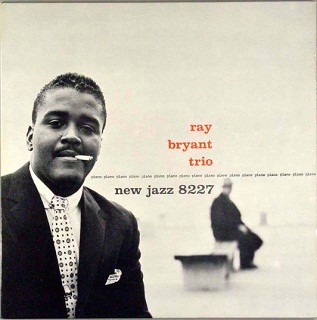
Listening to Prestige 221: Ray Bryant

(New format. At the request of a reader--all right, my brother--I'm putting the YouTube link up near the top, to make it easier for those who want to listen while reading.)

This was a hot time for Ray Bryant. And actually, come to think of it, he never cooled off over a long and productive career: over 60 albums as leader, including a few solo piano albums, and a Music Minus One, which is something I'd quite forgotten about. Music Minus One was a series of albums of classic jazz tunes with the part for the main soloist left out, as a practice tool for musicians. So I remembered. It turns out that (a) Music Minus One was really started for classical musicians, although they did jazz too, and (b) they're still around, with close to 900 titles in print, and with the kid who founded it, now nearly 90, still running the company. Good for Irv Kratka, and good for Music Minus One. Good for anything that encourages people to play music, and helps them to play music.

But I digress. Ray Bryant gave us over 60 albums as leader, gigs as sideman numbering in the hundreds. He had a huge pop hit in 1959 with "Madison Time," which became even huger in 1988 when it was used for a key scene in John Waters' Hairspray. He composed several other tunes that have become jazz standards.

 He had burst onto the New York recording scene in 1954, with an album for Columbia entitled Meet Betty Carter and Ray Bryant. It was the debut album for both of them, but when a vocalist is one of the people you're meeting on vinyl, it's really the vocalist's session.

He was still living in Philadelphia until well into the 1950s, playing regularly at a club there, and commuting to New York for recording sessions with various artists, including three on Prestige. He cut his first album as a leader (also a trio session) for Epic in 1956, and this was his second. He would shortly make the move that a serious jazz musician had to make, to the Big Apple.

Backing him up this session were Ike Isaacs on bass and Charles "Specs" Wright on drums, both new to Prestige but not new to Bryant. Earlier in the year he had worked with Wright on an Art Blakey date, and then with both of them on two sessions with Carmen McRae (Isaacs was then Mr. Carmen McRae), so they had a good groove going.

As talented a composer as Bryant came to be, for this early session he relied mostly on tunes from an eclectic assortment of composers.

The session leads off with John Lewis's almost painfully beautiful "Django," and the song leads off with a slow, stately reading of the melody, with a lot of sustain, that leaves you holding your breath, wanting to hold onto the moment, and waiting to see what will come next. When he picks up the tempo and loses the sustain, the haunting quality of the head stays with you.

As is often the case, the order of the session is changed on the album, which leads off with "Golden Earrings," by Victor Young one of those enduring tunes from a forgotten movie (like "Unchained Melody"). He also covers Tin Pan Alley journeymen Ray Henderson and Matt Dennis, and jazz greats Clifford Brown ("Daahoud") and Kenny Clarke/Gerald Wiggins ("Sonar"). The two originals are "Blues Changes" -- and there's some blues in everything Bryant plays -- and "Splittn'," in which the tempo burns and the lead is split between Bryant's piano and Wright's drums

The album was released on both Prestige and New Jazz, same cover art for each release, and although it's called Piano Piano Piano Piano in some catalogs, on the record the title is just Ray Bryant Trio,


 Order Listening to Prestige, Vol. 1 here.