Thursday, June 15, 2017

Wrapping up 1957, just one more once


I can’t quite seem to let 1957 go, so here, thanks to the music division of the New York Public Library, still the researcher’s best friend ever, is the Down Beat reader’s poll for 1957, with some thoughts.


Personalities

1 Duke Ellington

2 Modern Jazz Quartet

3 Dizzy Gillespie

4 Erroll Garner

5 Count Basie

6 Dave Brubeck

7 Jimmy Giuffre

8 Shelly Manne

9 Louis Armstrong

10 Gerry Mulligan


If you were going to take Paul Ackerman’s advice about jazz needing better marketing, what better place to start than with personalities? Whatever that means. I actually like the idea of a poll based on a really amorphous topic, because the respondents have to figure out for themselves what it means.

Whatever it means, it can’t be any surprise that Duke Ellington, he of the outsized personality and musical genius, is at the top of the list.  But interesting that the MJQ is second when, except for Milt Jackson, none of them placed especially high in the polls for individual instruments. I guess the whole was greater than the sum of its parts.

It surprises me that Louis Armstrong isn’t higher. He may not have been in an ascendant point in his career just then, but he’d recently appeared in a hit movie, and if jazz fans had a criticism of him, it was generally too much personality.

And the real surprise for me is Jimmy Giuffre. Was he really considered an outsize personality in 1957?


Jazz Band - Count Basie

Dance Band - Les Brown


Flute

1.       Herbie Mann

2.       Bud Shank

3.       Frank Wess

4.       Buddy Collette

5.       Sam Most

6.       Jerome Richardson

7.       Bobby Jaspar

8.       Paul Horn

9.       James Moody

10.   Dick Healey

11.   Yusef Lateef

12.   Billy Slapin

13.   Moe Koffman


Down Beat listed all the vote getters in its readers' poll, which was kinda nice for some hard working musicians who otherwise would not have seen their names in the Bible of jazz. Herbie Mann (1344 votes) and Bud Shank (1199) were the big vote getters, with Jerome Richardson the last one to get at least 100. The lower rungs of the ladder represented votes in the low two figures, so while some of them, like Yusef Lateef, represented the vision of a tiny handful of forward-thinking jazz fans, others could conceivably have made the list if they had large families. In any case, these are all folks who’ve given something to jazz, and deserve some recognition back.

Canadian Moe Koffman will probably show up better in next year’s poll. He released an album on Jubilee in ’57, but it didn’t gain much attention until the label took one of his compositions, “Blues a la Canadiana,” changed its name to “Swingin’ Shepherd Blues,” and released it as a single in 1958, where it became a hit, rising to #23 on the Billboard charts, and inspiring over 300 covers, including Count Basie, Herbie Mann, and Mantovani, so there was room for a range of interpretation there. Ella Fitzgerald and Natalie Cole recorded vocal versions. I hope Moe kept the publishing.

Dick Healey was the American member of the Australian Jazz Quartet/Quintet, which had achieved some popularity in the mid-fifties. I can find little about Billy Slapin, except that he did make one recording in 1959 with Billy Taylor.


Composer

1.       Duke Ellington    

2.       John Lewis          

3.       Jimmy Giuffre

4.       Bill Holman

5.       Quincy Jones

6.       Shorty Rogers

7.       Pete Rugolo

8.       Horace Silver

9.       Johnny Richards

10.   Stan Kenton

11.   Gerry Mulligan

12.   Bill Russo

13.   Thelonious Monk

14.   Dave Brubeck

15.   Benny Golson

16.   Ernie Wilkins

17.   Andre Previn

18.   Johnny Mandel

19.   Jack Montrose

20.   Billy Strayhorn

21.   Ralph Burns

22.   Manny Albam

23.   Charlie Mingus

24.   John Graaf

25.   George Wallington

26.   George Russell

27.   Gigi Gryce

28.   Marty Paich

29.   Al Cohn

30.   Gil Evans


As long as this list is, it has some surprising omissions, and it says something about what jazz fans of the 50s thought of when they thought of composers. It goes without saying that Ellington should lead the list, or maybe it doesn’t. He got 876 votes (most poll winners got at least 1000) and was closely challenged by John Lewis with 789, and 28 more composers were thought of more highly than the Duke by at least a few people. Johnny Richards was the end of the 100+ list, which means that Stan Kenton came up just short, but being associated with Kenton made the reputation of several composers: Richards, Pete Rugolo, Bill Holman, Bill Russo.

If people were voting today, Quincy Jones might well be right behind Ellington, but even then, his reputation was solid. Or Thelonious Monk, and what’s he doing down at #13? It took a while for jazz fans to catch up to Monk, but 1957 was already a while. George Russell, Gigi Gryce and Gil Evans are shockingly low, but where’s Mal Waldron? He was writing some great tunes at this time.

With jazz making its presence felt in the movies, and movies being the epicenter of American popular culture, I’m a little surprised that Elmer Bernstein didn’t catch the attention of the jazz public. The Man with the Golden Arm had come out just two years ago, and Sweet Smell of Success, with the Chico Hamilton Quintet playing Bernstein’s score, was hot in 1957. Gil MellĂ© would play an important role in movie scoring, but that was yet to come.

Chico O’Farrill was doing very important work in the fifties, and he’s completely overlooked, but I’ll have more to say about that later.


Vibes

1.       Milt Jackson   

2.       Terry Gibbs    

3.       Lionel Hampton  

4.       Red Norvo

5.       Don Elliott

6.       Cal Tjader

7.       Eddie Costa

8.       Teddy Charles

9.       Larry Bunker

10.   Vic Feldman

11.   Terry Pollard

12.   Joe Roland

13.   Johnny Rae

14.   Emil Richards


One of the big landslides. The MJQ gave Milt Jackson visibility, and his star power within the MJQ translated into 2344 votes, more than triple those of Terry Gibbs. Terry Pollard was one of the very few women in instrumental jazz of that era, and it’s good to see her getting some recognition. Johnny Rae and Emil Richards might not have gone on to headline careers, but they both were in demand during this era. Richards went on to a career as one of the most sought-after percussionists in Hollywood, and both are still with us.


Miscellaneous Instrument

1.       Don Elliot (Mellophone)  1105

2.       Fred Katz (Cello)

3.       Bob Cooper (oboe)

4.       John Graas (French horn)

5.       Julius Watkins (French horn)

6.       Shorty Rogers (fluegelhorn)

7.       Jimmy Smith (organ)

8.       Candido (conga drums)

9.       Cy Touff (bass trumpet)

10.   Sidney Bechet (soprano sax)

11.   Oscar Pettiford (cello)

12.   Toots Thielemans (harmonica)

13.   Stuff Smith (violin)

14.   Ray Draper (tuba)

15.   Steve Lacy (soprano sax)

16.   Lee Strand (organ)

17.   Dick Cary (alto horn)

18.   Joe Venuti (violin)

19.   Dorothy Ashby (harp)

20.   Dave Amram (French horn)

21.   Erroll Buddle (bassoon)

22.   Ray Nance (violin)

23.   Eddie South (violin)

24.   Cal Tjader (bongos)

25.   Bill Doggett (organ)

26.   Jack Costanzo (bongos)

27.   Count Basie (organ)


Today, many of these instruments are no longer miscellaneous: soprano sax, organ, violin, percussion. And one instrument that had a category of its own, accordion, has been downgraded to miscellaneous. It’s hard to see why it had its own category even then. Art Van Damme was the landslide winner, but after that the field was so slim that Lawrence Welk, Dick Contino and Myron Floren all got votes.

Women have always found it hard to break into jazz, but even more so back then. The harp was one of the few instruments they were allowed to claim, and while Dorothy Ashby makes this list, other jazz harpists like Adele Girard and Corky Hale get short shrift. Alice McLeod was not yet on the scene—she had just moved from Detroit to Paris, to study with Bud Powell. She would make a name for herself in the 60s, but it would be her married name: Alice Coltrane.

Women don’t make much of a dent in this list, partly because there weren’t very many of them. But there’s another group of musicians who were plentiful, who were great, and are completely overlooked: the Latin jazz musicians.

I’ve already cited Chico O’Farrill as an overlooked composer. Percussionists are relegated to miscellaneous, and even so, Candido is the only Latin percussionist to be named at all. Where is Sabu Martinez? Ray Barretto? Mongo Santamaria? Chino Pozo? Where are two of the greatest jazz musicians of all time, Machito and especially Tito Puente? The only other percussionists on this list are Swedish-American Cal Tjader, and Chicagoan Jack Costanzo, who at least studied in Cuba.


Bass

1.       Ray Brown   

2.       Oscar Pettiford  

3.       Leroy Vinnegar

4.       Paul Chambers

5.       Red Mitchell

6.       Charlie Mingus

7.       Percy Heath

8.       Milt Hinton

9.       Chubby Jackson

10.   Eddie Safranski

11.   Carson Smith

12.   Teddy Kotick

13.   Ralph Pena

14.   George Duvivier

15.   Norman Bates

16.   Arvell Shaw

17.   Slam Stewart

18.   Wendell Marshall

19.   Johnnie Pate

20.   Max Bennett

21.   Walter Page

22.   Don Bagley

23.   Bill Crow

24.   Wilbur Ware

25.   Curtis Counce

26.   Bob Haggart

27.   Red Kelly

28.   Al Hall

29.   Doug Watkins

30.   Ed Jones

Ray Brown (752 votes) and Oscar Pettiford (734) virtually neck and neck. As a Prestige fan, I would have rated Doug Watkins higher. And two interesting omissions. While older, swing era players like George Duvivier, Slam Stewart, Arvell Shaw and Bob Haggart got votes, two of the bassists most associated with bebop -- Tommy Potter and Curly Russell—are completely overlooked.


Drums

1.       Shelly Manne

2.       Max Roach

3.       Joe Morello

4.       Jo Jones

5.       Chico Hamilton

6.       Gene Krupa

7.       Art Blakey

8.       Buddy Rich

9.       Philly Joe Jones

10.   Louie Bellson

11.   Roy Harte

12.   Osie Johnson

13.   Don Lamond

14.   Kenny Clarke

15.   Mel Lewis

16.   Stan Levey

17.   Sam Woodyard

18.   Connie Kay

19.   Cozy Cole

20.   Sonny Payne

21.   Art Taylor

22.   Zutty Singleton

23.   George Wettling

24.   Frank Isola

25.   Chuck Flores

26.   Gene McCarthy

27.   Larry Bunker

28.   Ray Bauduc

29.   Joe Dodge

30.   Ed Thigpen


Lots of good drummers.


Clarinet

1.       Jimmy Giuffre     

2.       Tony Scott   

3.       Benny Goodman   

4.       Buddy deFranco

5.       PeeWee Russell

6.       Woody Herman

7.       Jimmy Hamilton

8.       Buddy Collette

9.       Edmond Hall

10.   Pete Fountain

11.   Sam Most

12.   Artie Shaw

13.   Peanuts Hucko

14.   Rolf Kuhn

15.   Barney Bigard

16.   Buster Bailey

17.   Bobby Jones

18.   John LaPorta

19.   George Lewis

20.   Sol Yaged

21.   Gene Quill

22.   Bob Wilber

23.   Lester Young


For all of Jimmy Giuffre showing up as one of jazz’s top personalities of the year and one of the top composers of the year, he doesn’t win his instrument by all that much, 1522 votes to Tony Scott’s 1391. Benny Goodman is almost an afterthought with 454 votes. I never knew that Lester Young had played the clarinet. He did, although not in 1957.


Alto Sax


1.       Paul Desmond   1414

2.       Art Pepper   726

3.       Sonny Stitt

4.       Lee Konitz

5.       Johnny Hodges

6.       Bud Shank

7.       Julian Adderley

8.       Phil Woods

9.       Jacki McLean

10.   Zoot Sims

11.   Benny Carter 

12.   Lennie Niehaus

13.   Gene Quill

14.   Charlie Mariano

15.   Gigi Gryce

16.   Willie Smith

17.   Lou Donaldson

18.   Herb Geller

19.   Hal McKusick

20.   Ernie Henry

21.   Buddy Collette

22.   Ronnie Lang

23.   Al Belletto

24.   Earl Bostic

25.   Al Cohn

26.   Pete Brown

27.   Charlie Ventura

28.   Dick Johnson

29.   Lennie Hambro

30.   Frank Morgan


These polls, especially the readers’ polls, whether the more musically sophisticated Down Beat or the Hefner-philosophizing Playboy voters, tend to skew a little white. And nowhere is that more apparent than in the alto sax category. Yes, after the death of Charlie Parker, a clear consensus choice for king of the alto saxophone would be Paul Desmond. And all the other white guys are good and deserving, too. But lists are lists, voters are voters, and bias is bias. In 1943, Esquire magazine brought some African-American music critics on board for its critics’ poll, and for the first time, Louis Armstrong, Coleman Hawkins, Art Tatum, Billie Holiday and Cootie Williams were poll winners. And there was a backlash, led by Stan Kenton, crying “reverse racism,” as though it would take reverse racism to elevate Armstrong, Hawkins or Lady Day.

Who’s completely missing from the poll? And don’t forget the poll goes down to about 15 votes.

Sahib Shihab (he does make the baritone list), Sonny Red (was no one in Detroit voting?), John Jenkins, Curtis Porter (Shafi Hadi), Romeo Penque, David Newman, and for that matter, Ray Charles, who was playing some alto in those days.


Piano

1.       Errol Garner   

2.       Oscar Peterson   

3.       Dave Brubeck 

4.       Horace Silver

5.       Andre Previn

6.       Thelonious Monk

7.       John Lewis

8.       Bud Powell

9.       Billy Taylor

10.   Hampton Hawes

11.   Teddy Wilson

12.   George Shearing

13.   Russ Freeman

14.   Hank Jones

15.   Count Basie

16.   Lou Levy

17.   Phineas Newborn

18.   Duke Ellington

19.   Lennie Tristano

20.   Pete Jolly

21.   Eddie Costa

22.   George Wallington

23.   Red Garland

24.   Dave McKenna

25.   Mary Lou Williams

26.   Claude Williamson

27.   Stan Kenton

28.   Marian McPartland

29.   Toshiko Akiyoshi

30.   Earl Hines


Among the missing, just from the Prestige catalog, Mal Waldron and Freddie Redd,  and I don’t really understand the omission of either of them. And, most astounding, Mose Allison.


Guitar

1.       Barney Kessel    

2.       Tal Farlow  

3.       Jim Hall

4.       Johnny Smith

5.       Herb Ellis

6.       Kenny Burrell

7.       Jimmy Raney

8.       Sal Salvador

9.       Laurindo Almeida

10.   Les Paul 

11.   Howard Roberts

12.   Mundell Lowe

13.   Eddie Condon

14.   George Van Eps

15.   Billy Bauer

16.   Joe Puma

17.   Chuck Wayne

18.   Don Hund

19.   Barry Galbraith

20.   Bill Harris

21.   George Barnes

22.   Dick Garcia

23.   Jean Thielemans

24.   Steve Jordan

25.   Tony Rizzi

26.   Wilbur Wynne


Barney Kessel was ubiquitous in those days, and very good, and got double the votes of Tal Farlow.


Baritone Sax

1.       Gerry Mulligan  

2.       Harry Carney   

3.       Pepper Adams

4.       Cecil Payne

5.       Jimmy Giuffre 

6.       Ernie Caceres

7.       Gil Melle

8.       Bud Shank

9.       Charlie Ventura

10.   Al Cohn

11.   Lars Gullin

12.   Danny Bank

13.   Sahib Shihab

14.   Charlie Fowkes

15.   Virgil Gonsalves

16.   Jack Nimitz


Gerry Mulligan basically was the baritone sax in 1957, and he dominated the poll even more than Milt Jackson on vibes, 2960 to Harry Carney’s 495.


Tenor Sax

1.       Stan Getz     

2.       Sonny Rollins  

3.       Zoot Sims

4.       Bill Perkins

5.       Coleman Hawkins

6.       Lester Young

7.       Lucky Thompson

8.       Al Cohn

9.       Bob Cooper

10.   Bud Freeman

11.   John Coltrane

12.   Ben Webster

13.   Jimmy Giuffre

14.   Charlie Ventura

15.   Flip Phillips

16.   Paul Gonsalves

17.   Hank Mobley

18.   Sonny Stitt

19.   Dave Pell

20.   Bobby Jones

21.   Georgie Auld

22.   Richie Kamuca,

23.   Illinois Jacquet

24.   J.R. Monterose

25.   Johnny Griffin

26.   Paul Quinichette

27.   Sandy Mosse

28.   Warne Marsh

29.   Freddy Martin

30.   Erroll Buddle


You can’t argue with the choice of Stan Getz as tenor sax man of the year. You couldn’t have argued with Sonny Rollins, either. What you might argue with, if you were wondering about a racial bias, is whether Getz (1903 votes) was more than three times better than Rollins (652). Jazz fans were a little snobbish in the 50s, and rock and roll got more and more of the record sales and the airplay, and they snubbed some very good players like Red Prysock, Sam (The Man) Taylor, Al Sears, David “Fathead” Newman.


Trumpet

1.       Miles Davis    989

2.       Dizzy Gillespie   950

3.       Chet Baker

4.       Louis Armstrong

5.       Shorty Rogers

6.       Maynard Ferguson

7.       Harry James

8.       Roy Eldridge

9.       Donald Byrd

10.   Art Farmer

11.   Conte Candoli

12.   Ruby Braff

13.   Kenny Dorham

14.   Harry Edison

15.   Don Fagerquist

16.   Joe Newman

17.   Don Elliott

18.   Clark Terry

19.   Charlie Shavers

20.   Thad Jones

21.   Wild Bill Davison

22.   Buck Clayton

23.   Ray Anthony

24.   Lee Morgan

25.   Jack Sheldon

26.   Cat Anderson

27.   Billy Butterfield

28.   Johnny Windhurst

29.   Stu Williamson


Miles was on the ascendant, Dizzy definitely not on the descendent, and they were still neck (989 votes) and neck (950) in 1957.

Percussionists weren't the only great Latin jazz musicians overlooked in the fifties. Mario Bauza played in Machito's band throughout this era, and he was one of the greatest jazz trumpeters who ever lived.


Trombone

1.       J. J. Johnson    

2.       Bob Brookmeyer  

3.       Kai Winding

4.       Bill Harris

5.       Frank Rosolino

6.       Jack Teagarden

7.       Jimmy Cleveland

8.       Carl Fontana

9.       Urbie Green

10.   Buddy Morrow

11.   Milt Bernhardt

12.   Vic Dickenson

13.   Frank Rehak

14.   Trummy Young

15.   Eddie Bert

16.   Ray Sims

17.   Benny Green

18.   Kid Ory

19.   Willie Dennis

20.   Melba Liston

21.   Tyree Glenn

22.   Wilbur de Paris

23.   Eddie Hubble

24.   Lawrence Brown

25.   Abe Lincoln

26.   Tommy Turk

27.   Britt Woodman

28.   Bob Enevoldsen

29.   Herbie Harper

30.   Lou McGarrity


Melba Liston and Terry Pollard are the only women to make a list on an instrument other than the harp or piano, and Pollard was a pianist first. They weren’t the only deserving ones, but most women instrumentalists in that era were relegated to all-girl orchestras. Terry Pollard led a group that took on Clark Terry in a 1953 blowing session, Cats vs. Chicks, and the chicks held their own.


Wednesday, June 14, 2017

Wrapping up 1957, continued

How popular was jazz in 1957? By some standards, very. Norman Granz announced that Verve had grossed $7 million in sales for the first time, and probably the compilation issues of early 78s had something to do with that. So did his more than 100 releases including 14 live albums from the Newport Jazz Festival. He also credited his decision to start releasing singles and EPs on 45, which is interesting. Jazz records, even modern jazz records, were first released on 78 RPM, throughout the 1940 and even into the early 1950s, but when the long playing format came along, it seemed a natural for jazz. Improvisers could stretch out beyond the narrow confines of a 78 RPM disc. By the mid-1950s, jazz was almost exclusively packaged for album release. But the 45 RPM record was becoming the ubiquitous vehicle for popular music, rock and roll, rhythm and blues, and country, and jazz labels found themselves dipping a toe into that market. Prestige issued 45s from 1957 sessions (not all of them actually released in 1957) by Eddie "Lockjaw" Davis, Ray Bryant, Kenny Burrell, Mose Allison, Herbie Mann, Red Garland, John Coltrane, Barbara Lea, Paul Quinichette and Yusef Lateef.

By international standards, very. In Billboard's August jazz issue, Burt Korall, best known as a chronicler of jazz drumming, writes that the year has seen "more jazz books, more jazz clubs, more jazz concerts, more jazz records and more jazz on TV, radio and the movies."

But the biggest jazz advance, Korall argues, is in the international sphere. Pointing to Radio Free Europe, the Armed Forces Radio Network and particularly the Voice of America, he says that "jazz has succeeded where American diplomats have floundered. It has created a meeting ground, been something that made for a deeper understanding of the American way of life, for to be interested in jazz is to be interested in things American."

This was an era in which American politics and American culture were diverging, not without hostility. Conservative politicians vehemently attacked rock and roll, which was getting white teenagers to listen to black music, and breaking down racial barriers. Abstract expressionism came in for its share of public disapproval, starting with Harry Truman, who called it "ham and eggs" art. Writers, directors, actors and folksingers were regularly investigated by the House UnAmerican Activities Committee.

And at the same time, one secret branch of the government was doing its best to undermine the work of HUAC and its kin. That was the CIA. The politicians who trashed abstract art on the one hand, and demonized Arthur Miller and the Hollywood Ten on the other, were unwittingly aligning themselves with the Communists they hated, and their social realist art. The spooks at the CIA realized that they could use the narrative of American artistic freedom to undermine Soviet propaganda and Soviet authoritarianism. You can get something of a sense of the CIA's influence on American culture by reading the 2014 novel by myself and Jonathan Richards, Nick and Jake.

The incredible worldwide popularity of the Voice of American's jazz disc jockey Willis Conover was to play a big part in this campaign, as were the touring jazz groups who came to be seen as America's unofficial ambassadors. in the 1956 movie High Society, Bing Crosby joshes Louis Armstrong about his international popularity. And in Billboard, Burt Korall quotes Quincy Jones,

A lot of the people we played for in Europe and the East thought that Negro musicians had no opportunities, and never mingled with white musicians. When they saw the Gillespie banc was mixed and quite happy about it, they realized that what they had been hearing was a little off the track."
I've written before about the 1953 Lionel Hampton tour, and the expatriation of jazz artists such as Sidney Bechet or Kenny Clarke, but by 1957 jazz groups had really discovered the international market, and there were tours by Dizzy Gillespie, CLaude Thornhill, Les Brown, Stan Kenton, Ray McKinley, Count Basie, Benny Goodman, Jazz at the Philharmonic, Chet Baker, Tony Scott, Lee Konitz, Bud Shank, Gerry Mullign, J.J. Johnson -- Korall's list, and he ends it with "to name only a few."

But others suggested that the appeal of jazz was more limited than it might be. Billboard's music editor Paul Ackerman, while acknowledging that jazz is "perhaps the most important of the truly American musical forms," says that nonetheless it "has failed to achieve a broad mass appeal in the United States." And he suggests that this could be remedied. The standard arguments -- "jazz has an intellectual appeal that is beyond the teenager; [it] appeals to musicians and listeners who have progressed beyond the simple and primitive...do not tell the whole story. Where properly exposed, as at the various festivals, jazz has been shown to have a surprisingly broad appeal."

Ackerman suggested that the disk jockey, so important in the marketing of rock and roll, needed to become a stronger presence in jazz. "The teenager," he said, "is only part of this total radio audience. WHy should not disk [jockeys] tap the total audience?...[But] thus far, relatively few DJs have jumped aboard the jazz bandwagon. In the New York area, for example, only one jockey programs jazz. Throughout the country, a similar paucity exists."

That one DJ would have been Symphony Sid Torin, who had worked for a number of radio stations, most famously WJZ, because of King Pleasure's lyric to Lester Young's "Jumpin' with Symphony Sid" ("Make everything go real crazy over JZ"). In 1957 he was with WEVD, and Ackerman is probably right about his being the only jazz DJ in New York (well, he was certainly right. This was his beat).

What WEVD, WJZ and WADO, which also hired Sid for a while, had in common was that they were all AM stations. So was CKLW in Detroit and Windsor, Ontario, where I first heard jazz in 1957. So was virtually every other station in the country. FM had few listeners, and not much programming. That really didn't change until the 60s, with freeform progressive rock stations, and even some jazz stations, like WRVR-FM in New York and its jazz DJs Ed Beach and Les Davis.

Ackerman, for several decades the music editor of Billboard, was a pretty smart guy, and since Billboard was focused on the marketing end of the business, he would have been one to listen to. And some were. The same issue profiles a Minneapolis station (in the fledgling FM market) which had failed with jazz programmimng, but then tried again with a more focused marketing strategy, and was starting to do well.

Still, jazz is an indiosyncratic business, full of idiosyncratic artists, and it's hard to imagine Thelonious Monk, for example, getting too caught up in a marketing campaign. It's equally hard to imagine Miles Davis not caring about it. In Castles Made of Sound, Gil Evans's biographer Larry Hicock talks about Evans's wife getting a little irked that Miles was getting all the money and credit for music they had worked on together, and Evans explaining that it was OK--money and acclaim were important to Miles.

And more power to him. There's nothing wrong with money and acclaim. Miles earned it, and he brought a wider audience to jazz in the process.

And once again, on to 1958.

Friday, June 09, 2017

Wrapping up 1957

It can be said that the seed for this whole project was planted in 1957, when I heard John Coltrane with the Red Garland trio through the AM radio in my dorm room at Bard College at 2 a.m. So that's why 1957 is particularly important for me. I could finally write about the albums that drew me into jazz. Trane, and Mose Allison. King Pleasure Sings/Annie Ross Sings also came out in 1957, although the recordings had been first issued in the early fifties.

Probably none of these would appear on most lists of the greatest jazz albums of all time. I would never make such a list, myself, but these remain touchstones for me, as I began my journey into the realms of gold, my first exposure to jazz as important to me as looking into Chapman's Homer was to John Keats.

Another of my first purchases, another 1957 release, is or ought to be on anyone's list of the most significant jazz albums of all time, and it goes back to 1949-1950, when 18-year-old Bob Weinstock discovered modern jazz, and went into the studio with Lennie Tristano to record the first release on what would become Prestige Records. Tristano was making some of the most advanced music of that time, and one of his close associates, Lee Konitz, was also in Capitol Records' studio, working with Miles Davis on another set of recordings that may have been too advanced for the time. But the world was certainly ready for Birth of the Cool when 78s were finally gathered into LP form in 1957.

It was a big year for Prestige. Seventy studio sessions were booked, all but three of them in the Van Gelders' living room in Hackensack, NJ. One of the albums that came out of that activity was voted the best album of the year by the idiosyncratic but always interesting voters of rateyourmusic: Saxophone Colossus, by Sonny Rollins.

Here are the jazz albums from rateyourmusic's top forty:

1 Sonny Rollins, Saxophone Colossus
Prestige
Hard Bop

2 Thelonious Monk, Brilliant Corners
Riverside
Hard Bop

3 Thelonious Monk Septet, Monk's Music
Riverside
Hard Bop

4 Miles Davis, 'Round About Midnight
Columbia
Hard Bop

5 The Miles Davis Quintet, Cookin'
Prestige
Hard Bop

7 Ella Fitzgerald with Duke Ellington and His Orchestra, Ella Fitzgerald Sings the Duke Ellington Song Book
Verve
Vocal Jazz, Big Band

8 Charles Mingus, The Clown
Atlantic
Post-Bop

9 Duke Ellington and His Orchestra, Such Sweet Thunder
Columbia
Big Band

11 Art Pepper Meets the Rhythm Section
Contemporary
Cool Jazz

12 Sonny Rollins, Vol. 2
Blue Note
Hard Bop

13 Dizzy Gillespie At Newport
Verve
Bebop, Big Band

14 Cliff Jordan and John Gilmore, Blowing In From Chicago
Blue Note
Hard Bop

15 Billie Holiday, Body and Soul
Verve
Vocal Jazz, Standards

18 Ella Fitzgerald & Louis Armstrong, Ella and Louis Again
Verve
Vocal Jazz, Standards

19 Sonny Rollins, Way Out West
Contemporary
Hard Bop

21 Coleman Hawkins, The Hawk Flies High
Riverside
Hard Bop, Jazz

22 Miles Davis + 19, Miles Ahead
Columbia
Cool Jazz

24 Count Basie and His Orchestra, April in Paris
Verve
Big Band, Swing

25 Count Basie At Newport
Verve
Big Band, Jazz, Swing

27 Sonny Rollins
Blue Note
Hard Bop

29 Horace Silver Quintet, 6 Pieces of Silver
Blue Note
Hard Bop

30 Art Pepper Quartet, Modern Art
Intro
Cool Jazz, Hard Bop

31 Thelonious Monk, Thelonious Himself
Riverside
Hard Bop

32 Anita O'Day, Anita Sings the Most
Verve
Vocal Jazz, Standards

33 Johnny Griffin, A Blowin' Session
Blue Note
Hard Bop

34 Introducing Johnny Griffin
Blue Note
Hard Bop

35 Sonny Rollins, Rollins Plays for Bird
Prestige
Hard Bop

37 Barney Kessel with Shelly Manne and Ray Brown, The Poll Winners
Contemporary
Jazz

40 Lee Morgan, Vol. 3
Blue Note
Hard Bop, Jazz


Hard Bop is definitely the word du jour for 1957's output, sometimes used curiously. Miles Davis is labeled Hard Bop for 'Round About Midnight, Cool Jazz for Miles Ahead. So a musician can do both, but can he do both on the same album? Maybe yes, maybe no. Art Pepper is labeled as Cool Jazz for Art Pepper Meets the Rhythm Section , which is actually a little odd in that the rhythm section he met were East Coast Hard Boppers Red Garland, Paul Chambers and Philly Joe Jones. But on Modern Art he is credited with the bi-coastal, bi-label quinella.

Cool Jazz for Miles Ahead is a bit of a stretch. Perhaps because it was a collaboration with Gil Evans, who was also on the Birth of the Cool album. Other critics have called it Third Stream, which is at least as vague a term as most of the others, so why not? Why not, for that matter, since it involves a 19-piece orchestra, call it Big Band? It's certainly big enough. But that label seems to only apply to bands of the swing era, unless they're led by Dizzy Gillespie.

Speaking of Birth of the Cool, 1957 was the year it finally came out in an LP format, nearly a decade after it had taken the jazz world by storm but had mostly been ignored by critics, the listening public, and executives at Capitol Records. By 1957, Cool Jazz was a thing. Gerry Mulligan had taken his arrangements and concept out to California, where it had been embraced by many, belittled by others. I'm not sure how excited Capitol was about releasing it even in 1957, or exactly how they should market it. "Hey, we were here first!" is not a great marketing strategy, but that's probably what was behind the name of the album. But it wasn't just another Cool Jazz album. It was exciting and groundbreaking, even if it was late to the party. I'd rank it as one of the most important albums of the decade, even more important than Miles' mega-bestseller Kind of Blue.

If a belated realization that were sitting on a masterpiece wasn't what spurred Capitol, what was? What else? Money. By 1957, the LP revolution was complete. Kids still bought 45s, but grownups -- classical music fans, jazz fans, Broadway show fans -- bought LPs to play on their new hi-fi, or even newer stereo equipment. And where there's new technology, there's a buck to be made in reissues, as record companies of the 80s and 90s discovered, when they began reissuing their entire catalogs on compact disc, at premium prices even though CDs cost less to produce than LPs.

Reissues in those days were called "compilation albums." Today, a compilation album is some artist's greatest hits, or the greatest hits of a year, or a genre, or what have you. Back then, it was bunches of old 78s that were being compiled, and this was a heck of a year for vintage jazz collectors to put their precious wax discs away and replace them with LPs, or for new fans to catch up on what they'd missed. Birth of the Cool is actually number three on the rateyourmusic compilation list, behind Muddy Waters and Ray Charles, but the Prestige reissues alone make up a set that could be the cornerstone of any collection: Thelonious Monk/Sonny Rollins; Miles Davis and the Modern Jazz Giants (this actually was originally released on LP, but it was a 10-inch LP, and the 12-inch version added a couple of numbers, so I guess that makes it compilation); Walkin', from the Miles Davis Contractual Marathon sessions, and the first Prestige singles to be released only on 45 RPM; the Modern Jazz Quartet/Milt Jackson Quartet ; Evolution by Teddy Charles, compiling a 1955 session with Charles Mingus and J.R. Monterose that first saw life as a New Jazz 10-incher with two tunes from a 1953 West Coast date featuring Shorty Rogers and Shelley Manne, which had appeared on a 10-inch LP but had been left off the 1956 compilation of two West Coast sessions by Charles; Kaleidoscope, by Sonny Stitt, which goes back to early 78s from 1951 and 1952, including a couple from the mambo craze, When Farmer Met Gryce, compiling sessions from 1954 and 1955.

The 1957 Newport Jazz Festival was surprisingly heavy on traditional jazzers, considering how one thinks of it as a tine when the moderns dominated. But along with the moderns -- Brubeck, Silver, Mulligan, Gillespie, et al -- was one decidedly postmodern name: Cecil Taylor, who may have left some festival-goers scratching their heads a little.

In New York, the big news was Thelonious Monk finally getting a cabaret card, so that he could play in clubs again. John Coltrane did cold turkey in Philadelphia and, in addition to recording with Prestige, joined Monk in a quartet that played a memorable six month engagement at the Five Spot, and perhaps an even more memorable date at Carnegie Hall. The concert, which also featured  Billie Holiday, Dizzy Gillespie, Ray Charles, Sonny Rollins, and Chet Baker with Zoot Sims, was recorded, but the Monk/Coltrane sets were not released until their rediscovery in 2005.

If Monk, Trane and the Five Spot were the big news in New York jazz circles, it was news to The New Yorker, which continued to see jazz in terms of Eddie Condon's, Jimmy Ryan's, and the Metropole. They did list the Half Note, with Charlie (sic) Mingus, and the Café Bohemia, with Mose Allison and Horace Silver leading separate trios. And once again, my annual appeal for someone to digitize all of Down Beat.

Jazz deaths included Dean Benedetti, best known for his recordings of Charlie Parker in clubs in 1945 and 1946, which had attained the status of jazz legend by the time they were finally collected and released by Mosaic records in 1990.

Another posthumously released 1957 recording was Jimmy Dorsey's biggest hit, "So Rare." Dorsey died shortly after making the recording, and never saw it go to number 2 on the Billboard charts/

Friday, May 26, 2017

Listening to Prestige 261: Hal McKusick

Hal McKusick wasn't ignored by the jazz record labels during the fifties. He recorded as a leader on Bethlehem and Jubilee, two labels on the periphery, but doing good stuff. He even led a few sessions on majors -- RCA Victor and Decca. And he played with Gil MellĂ© and Art Farmer for Prestige, and he played with Al Cohn, Benny Golson, Lee Konitz and Jimmy Giuffre, even with Charlie Parker. Most notably, he worked with pianist-composer-theorist George Russell, recording twice with him. If he's not remembered as vividly as he should be, it's certainly not due to any deficiencies in his music,

McKusick's recording career is mostly bounded by the fifties, although he did appear as a sideman on a few sessions in the early sixties. This album for Prestige was his second to last, and perhaps his most atypical. His music is known for theory and advanced arrangement. He worked closely with George Russell when Russell was developing his Lydian Chromatic Concept of Tonal Organization, an important precursor to the modal jazz of Miles Davis and John Coltrane. Probably more typical of his approach to jazz was the album he made the following year for Decca, featuring five, six and seven-piece ensembles and the work of four very different arrangers: Russell, George Handy, Jimmy Giuffre and Ernie Wilkins, each of whom was asked, McKusick said in a later interview, for "their most advanced thinking."

So how did Bob Weinstock's casual, unrehearsed jam session approach fit with McKusick's talents? Very well indeed, and we're lucky to have this album, and this side of McKusick, just as we're lucky to have the Decca Cross Section--Saxes. Everyone likes to just cut loose and blow every now and then, and the bebop improv approach of head-solo-solo-solo-head, with some casual but intricate duets and dialogs thrown in, can yield some wonderful music, especially with musicians like these.

Billy Byers, like McKusick, came out of the swing era, and worked as a section man in bands featuring the best arrangers. He later would become Quincy Jones's assistant at Mercury Records. So he wasn't exactly the typical Prestige guy either--this was his first session for the label, and he would only do one other, in 1963--but like McKusick, he finds that sweet spot, and the stuff they do together is especially rewarding.

Charlie Persip had done only one previous session for Prestige, but he'd been in the studio on at least one other memorable occasion, as a witness to the strange and thorny afternoon with Miles Davis and Thelonious Monk. He would be back several more times, in the course of a long and distinguished career. Eddie Costa was also making his second appearance on Prestige. The first had been on the vibes, accompanying Bobby Jaspar and Tommy Flanagan. He looked to be at the dawn of a major career. In 1957, he would be named Down Beat's new star on both piano and vibes, the first time a musician had gained that honor on two different instruments. But an auto accident would take his life a few years later.

Paul Chambers was, by this time, one of Prestige's stars, and with good reason. His solos, both plucked and bowed (on "The Settlers and the Indians") are musical gems, and that's not by chance. Chambers, as we know, hit New York as a 19-year-old wunderkind, already a master of his instrument. After all, he had started in the jazz cauldron of Detroit, where musicians matured early. His friend, drummer Hindal Butts, remembers (again from Lars Bjorn and Jim Gallert's indispensable Before Motown: A History of Jazz in Detroit 1920-1960):
Paul was determined to make the bass a solo instrument and he practiced, hour upon hour. I waited on Paul to take a couple of girls out, and he wouldn't stop practicing! He loved to bow and he mastered the bow.
Butts was a member of a quartet led by Kenny Burrell and Chambers, called the Four Sharps. And, given that this is the early 50s, that would almost sound like a doo-wop group, wouldn't it?

Well, yeah. This was Detroit, where music was music. The group played modern jazz, and they also sang four-part harmonies. We can't exactly know how good the Four Sharps (who also, at various times, included Tommy Flanagan, Frank Foster, Yusef Lateef and Pepper Adams) were as a vocal group, because no records of their music have survived, but we sort of can. Again, from Hindal Butts:
We recorded "The Nearness of You" ... Kenny sang the lead, we sang the backup and we did the bridge in unison ... Kenny called me one day and said, "Turn the radio on." He was mad ... I turned the radio on and the Four Freshmen were singing [our arrangement of] "The Nearness of You" almost note for note.
Butts recalled that the Four Freshmen, when they were playing Detroit, used to stop in at Klein's Show Bar when the Sharps were playing there, and request the number over and over.

McKusick composed three of the tunes for this session. He turned to some top composers for a couple of others: Dizzy Gillespie's much-recorded "Con Alma" and Jimmy Dorsey's "I'm Glad There is You."

And some more surprising choices. "The Settlers and the Indians" was written by Bobby Scott, who was, at just about the same time, climbing the Top Forty charts with a rock 'n roll song called "Chain Gang." He would later write "He Ain't Heavy, He's My Brother" for British rockers The Hollies, and win a Grammy for "A Taste of Honey." Incidentally, I've lauded Wikipedia for their excellent entries on jazz albums, but that doesn't mean you can count on the Internet across the board. There are a whole bunch of sites devoted to lyrics, and I don't know who's ripping off who, but if there's a mistake in one, the same mistake will be in all of them. Take, for instance, the lyrics to "The Settlers and the Indians." Every one of these sites features lyrics to "The Settlers and the Indians," and every one of gives what are actually the lyrics to "Don't Worry 'bout Me." Maybe someone was listening to this album, because McKusick also does "Don't Worry 'bout Me," a song by Rube Bloom and Ted Koehler that's a standard for jazz vocalists, my favorite version being King Pleasure's.

"Something New" is credited to Albert Gamse and Ricardo Lopez Mendes, both of whom were lyricists, but someone must have chipped in a melody. And "Saturday Night" is the really interesting one. It was the title song for a musical with a book by Julius and Philip Epstein, who had co-written the screenplay for Casablanca, and had turned the composer job over to an unknown, who remained unknown, as Saturday Night never made it to Broadway, and lord knows where McKusick found it, especially since the young unknown was being told at that point to stick to lyrics, because his melodies weren't quite good enough. And in fact, while McKusick was recording "Saturday Night,"  Steven Sondheim's lyrics were making their mark on Broadway to Leonard Bernstein's music for West Side Story.

The album was called Triple Exposure. McKusick's "Interim" and "Don't Worry 'bout Me" didn't make the cut, but were later included in the New Jazz compilation album, Bird Feathers.

McKusick lived a long and productive life, dying in 2012 at the age of 87. He composed music for two plays by his friend Edward Albee, "The Sandbox" and "The Death of Bessie Smith." He taught for a number of years at the exclusive Ross School on Long Island, where he moved in the early 1970s. Of his years on the jazz scene of the 1950s, he said this, in an interview with the AllAboutJazz website. He was talking about Cross Section--Saxes, but he could have been talking about Triple Exposure, or indeed, any album by any of the New York jazz musicians:
The sound was a reflection of our lives in New York--the intensity, the art, the optimism all squeezed together.


Order Listening to Prestige, Vol. 1 here.


Friday, May 19, 2017

Listening to Prestige 260: Ray Draper - John Coltrane

Bob Weinstock must have had a lot of confidence in his barely 17-year-old prodigy Ray Draper, giving him John Coltrane as a bandmate. It's tough enough playing bebop on a tuba, without being asked to play it off against one of the most advanced improvisers of the era. And to up the stakes a little more, either Weinstock or Draper decided not to go with their tried and true reliables in the rhythm section. Each of them had played on only one other Prestige session. Gil Coggins had played on a Jackie McLean session in August.  Spanky DeBrest had appeared on Draper's debut as leader, though he was already an established figure with Art Blakey's Jazz Messengers. Larry Ritchie had also worked with Draper, on the July 12 Jackie McLean session.

All of this works. Coggins is a jagged, percussive piano player, and sets the tone that this is going to be a different kind of session. Draper and Coltrane work well together in the ensemble passages. Draper proves that he's a first rate composer on his originals, particularly "Clifford's Kappa," and he shines as a soloist.

And that's saying a lot, considering what he was up against. Everything from this session is good, better than good. But Coltrane was on fire. When he solos, everything else melts away. I've been following Coltrane's progression here, from the Miles sessions through the wide-ranging array of sideman gigs that Weinstock used him for, through his sessions as leader, looking for clues as to what he would burst forth into come the 1960s, and not really finding them. In each of his Prestige sessions, including this one, he is right there in the present moment, making the music he's brought in to make. And making all the right choices. And listening to his recording sessions in chronological order, all I can say is that he keeps getting better and better.

His solos here virtually stop time and space, and exist in their own dimension. But that doesn't mean he's ignoring what's around him. He's working with Draper and Coggins, building on what they're doing, and they're doing some very, very good stuff.

In spite of all that, it's hard to know what to do with a tuba player, and Weinstock was not going to do more. This is Draper's last session for Prestige, and it was released on New Jazz, which generally meant it was not going to get the promotional push that went behind a Prestige release. Draper would record only sporadically after that, succumbing to heroin addiction and drug-related prison time. He died in 1982, meeting an ironically grisly end for a musical prodigy: he was shot and killed by a hold-up gang led by a 13-year-old.

The original New Jazz release was called The Ray Draper Quintet featuring John Coltrane. A much later Prestige reissue was title The John Coltrane/Ray Draper Quintet.


Order Listening to Prestige, Vol. 1 here.

Thursday, May 11, 2017

Listening to Prestige 259: Red Garland

Not much more to say about this amazing collection of musicians, except to wonder if this is Donald Byrd's first pairing with John Coltrane.

Well, not quite. And once again the story goes back to Detroit, and Cass Technical High School. As Byrd remembered it in a 1998 lecture at Cornell University, one of the many institutions at which he taught,

I met him in the 11th grade in Detroit. I skipped school one day to see Dizzy Gillespie, and that’s where I met Coltrane. Coltrane and Jimmy Heath just joined the band, and I brought my trumpet, and he was sitting at the piano downstairs waiting to join Dizzy’s band. He had his saxophone across his lap, and he looked at me and he said, ‘You want to play?’
So he played piano, and I soloed. I never thought that six years later we would be recording together, and that we would be doing all of this stuff.
 And in fact, not even close. Byrd and Coltrane recorded together more than I would have guessed. Here's the best I can do for a complete list, relying on information from the amazing New York Public Library Research Desk, Wikipedia, jazzdisco.org, and Amazon:

Elmo Hope All Star Sextet, Informal Jazz (Prestige, May 1956) With Hank Mobley, Paul Chambers, Philly Joe Jones

Paul Chambers Sextet, Whims of Chambers (Blue Note, September 1956). With Kenny Burrell, Horace Silver and Philly Joe Jones.

Art Blakey Big Band  (Bethlehem, December 1957). They were featured on two tracks as the Art Blakey Quintet, playihg a composition by Byrd and one by Trane.

Sonny Clark Sextet, Sonny's Crib (Blue Note, October 1957). With Curtis Fuller, Paul Chambers and Art Taylor

John Coltrane Quintet, Lush Life, Black Pearls (Prestige). These were both from the Coltrane compilations issued after Trane had left Prestige. Lush Life included one cut from a January 1958 session with Red Garland, Paul Chambers and Louis Hayes. Black Pearls was a May session with Garland, Chambers and Art Taylor.

Oscar Pettiford All-Stars, Winners Circle - Down Beat Poll Winners from 1956 (Bethlehem, October 1957). With Gene Quill, Al Cohn, Freddie Green, Eddie Costa, Philly Joe Jones and Ed Thigpen in various mix-and-match combinations.

And, since we were just talking, in the context of Mose Allison, about musicians getting duped out of publishing rights, here's another Donald Byrd story, this time with Byrd as the voice of experience, and Herbie Hancock as the callow youth. When Byrd gave Hancock his recording debut on a Blue Note session, Blue Note wanted to sign the young pianist to a recording contract, and Byrd warned him that under no account should he surrender the publishing rights to his music. So of course, that was the first condition Blue Note made.

A recording contract isn't  just a temptation to a young musician, it's the temptation. That's why so many young musicians give away so many rights. And it seemed inconceivable to Hancock that he could walk away from it, but he did. Blue Note caved. Hancock kept the publishing rights, and when Mongo Santamaria had a hit with "Watermelon Man"...well, the rest of the story comes not from a music publication, but from Road and Track (by way of Wikipedia). Hancock took the royalties from "Watermelon Man" and bought a Shelby Cobra, which is now renowned as the oldest production Cobra still in the hands of its original owner.

Of course, the real story here is the music. There's one new name, George Joyner, who would not have that name for long. He had come to New York after a stint playing the blues with B. B. King, and recorded first with Phineas Newborn. After converting to Islam, he became first Jamil Sulieman and then Jamil Nasser, and had a long association with Ahmad Jamal, and a career that went well into the 90s;

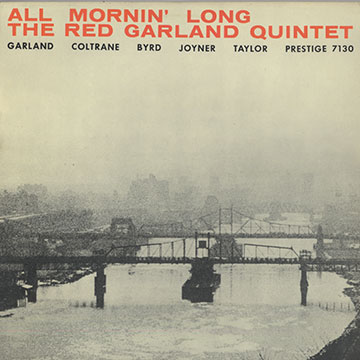
This was a long day in the studio, which would have come as no novelty to Garland and Coltrane, who were both on board for the Miles Davis Contractual Marathon. Ten songs, and one of them, "All Mornin' Long," went on pretty much all evening long, clocked in at 20 minutes, and made up a whole side of one of the LPs to come out of the session. And even after that, they weren't quite willing to call it a day, as they came back the next month to do five more.

"All Mornin' Long" was a Garland composition, and although it was the last piece recorded that day,
it was the first side of the eponymous first album released from the session. It holds attention all the way through, particularly the long piano solo by Garland that features some beautiful dialogue with Joyner/Nasser, leading into a bass solo that makes you understand why this guy was welcomed into the fold. Two other pretty fair composers took up the second half, George Gershwin ("They Can't Take That Away From Me") and Tadd Dameron ("Our Delight").

All Mornin' Long was a pretty quick release, in the spring of 1958. The others were a little longer in coming. Soul Junction saw the light of day in 1960, again with the Garland composition giving the album its title. Garland shared composing space with jazz giants: two by Dizzy Gillespie ("Woody'n You" and "Birks Works") and one by Duke Ellington (I've Got it
Bad"). The final composer honors for the album went in a different direction, to 1920s Broadway composer Vincent Youmans, but Youmans might not have recognized their bopped-out, uptempo, nonstop version of his "Hallelujah." It's a rousing enough tune, as performed by Glenn Miller and others, but not always this rousing.

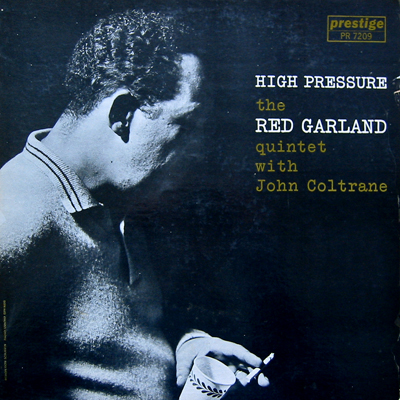
The rest of the November session--"Undecided" (Charlie Shavers) and "What Is There to Say?" (Vernon Duke)--had to wait until High Pressure in 1962, along with three songs from the December session: "Soft Winds" (Benny Goodman / Fletcher Henderson), "Solitude" (Duke Ellington) and "Two Bass Hit" (Dizzy Gillespie/John Lewis).  When you're getting together to play that much music, without much rehearsal, it's probably a good idea to mostly choose tunes that everyone knows. Bird's "Billie's Bounce" and Garland's "Lazy Mae" were on a later 1962 LP called Dig It!, which put together numbers from three different sessions.