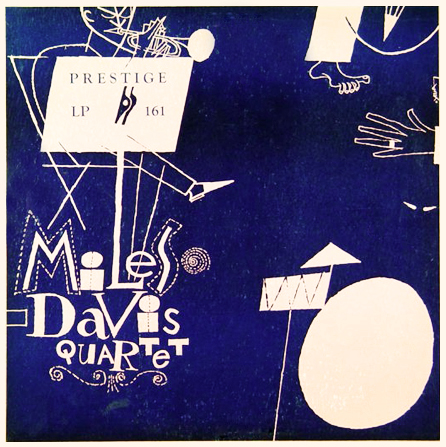
Tad Richards' odyssey through the catalog of Prestige Records:an unofficial and idiosyncratic history of jazz in the 50s and 60s. With occasional digressions.
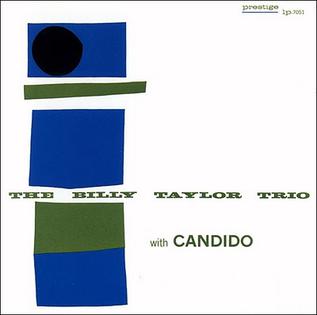
Billy Taylor wrote the liner notes for this album, and he made its purpose clear:
The purpose of this album is to present a great new jazz artist. His name is Candido, and we think that he is the most exciting jazz conga and bongo player in the business.
There are, of course, many Latin American drummers who play well with jazz groups, but I have not heard anyone who even approaches the wonderful balance between the jazz and Cuban rhythmic elements that Candido so vividly demonstrates, and his technical facility is, to say the least, astounding.
Dizzy Gillespie, of course, is one of the most important figures involved in the integration of Latin rhythms into jazz, starting with bringing Chano Pozo into his band. Even before that, Machito had one of the great jazz trumpeters, Mario Bauza, who never gets the credit he deserves--well, Latin jazz has never really gotten the acclaim it deserves. Candido played with both Machito and Gillespie before joining Billy Taylor for these sessions. Taylor, who would become one of the great educators in the jazz field, seems to have already had that mind set, as he sets out to prove that Latin jazz is real jazz, and Candido Camero is a real jazz musician.
Taylor gives Candido a lot of solo space here, and the conguero makes full use of it. He's a powerful presence throughout, soloing and trading with Taylor. And I could say accompanying, but that's not really it. He makes Taylor's solos into duets, and this is in no small part due to Rudy Van Gelder's engineering, keeping the levels of both instruments perfectly complementary.
The tracks are Taylor originals, plus a version of Cole Porter's "Love For Sale" which is breathtaking. Over nearly 8 minutes, Porter's melody becomes Latinized, boppified, turned into a vehicle for some adventurous Taylor improvisation and hot percussion by Candido.
Candido, who is still with us, was named an NEA Jazz Master in 2008, and his brief bio on the NEA's website describes some of his innovative drumming techniques:
...playing three congas (at a time when other congueros were playing only one) in addition to a cowbell and guiro (a fluted gourd played with strokes from a stick). He created another unique playing style by tuning his congas to specific pitches so that he could play melodies like a pianist.
Sanabria (Originally Published in the Autumn 2007 issue of TRAPS) which includes the mention of a group the young Candido played with in Havana, led by Chano Pozo on congas, and including Candido on tres (a Cuban three-stringed instrument designed like either a mandolin or a guitar) and Mongo Santamaria on bongos. He also describes how he came to develop his three-drum technique:
I had seen the New York Philharmonic perform and paid attention to the timpanist. I thought to myself, ’I can do the same thing with the congas.’ I began to tune the drums to specific pitches, mostly a dominant chord, so I could play melodies in my tumbaos and solos.
"A Live One" and "Mambo Inn" were released on an EP, and, with "Love For Sale," as part of a 10-inch LP. Both of these were just credited to Billy Taylor. The 12-inch LP, with the liner notes I quoted above, had the whole session, and was titled The Billy Taylor Trio with Candido.
Joe Holiday is one of my new favorite musicians--a guy I had never heard of when I started this project, but who I've grown to love over the four previous sessions he recorded for Prestige, establishing himself as the king of mambo jazz.
That being said, listening to this session on the heels of the Sonny Rollins/Kenny Dorham/Elmo Hope session, Holiday is not in their league as an improviser. Where they were Movin' Out, Holiday is more like Stayin' Home. But I tell you, there's nothing wrong with stayin' home if you can roll back the rug, have a couple of rum and cokes, take a cute girl in your arms and do the mambo all night.
If Holiday's improvisations don't break any new ground, he can surely play the bejeezus out of a
melody, he can swing, he can bring Latin to bebop and vice versa.
Billy Taylor's improvisations are a lot more adventurous, but he and Holiday make a good fit. There are all sorts of different ways of being on the same page musically.
But if I were going to give an MVP for this session, I think it would be Charlie Smith. On the earlier Holiday/Taylor collaboration, they had the benefit of Machito's rhythm section. Here Smith handles it all, on traps and congas, and he keeps it going.
The cuts from this session were released as singles. The mambo was still a hot dance craze in 1954. Apparently, they only came out on 78. Perhaps the market for Latin music was still mostly 78 RPM. In the introductory chapter to Oscar Hijuelos' magnificent novel The Mambo Kings Play Songs of Love, as Cesar Castillo is dying, he stumbles and knocks over a credenza in his apartment, and dozens of 78s fall to the floor and shatter. "I Love You Much" had what seems to be a variously titled song on its flip side. The session list has it as "Chasin' the Bongo," but every 78 RPM catalog I've found lists it as "Chasin' the Boogie." Also, every catalog has an unknown flip side to "It Might As Well Be Spring," but the song was over five minutes long, so it has to have been Part 1 and Part 2. It looks as though no one in recent memory has actually seen a copy of either of these discs. Maybe they were part of Cesar Castillo's record collection.
They were included on the Holiday/Taylor Mambo Jazz 10-inch, then had to wait for years-later reissues.
When it comes to ballads as a vehicle for modern jazz, it's hard to beat the standards from the Great American Songbook, and maybe not advisable to try. That's why Sonny Rollins's original composition, "Silk 'n' Satin," on this session, is so stirring. It has the passion and the melodic beauty to stand comparison to Kern or Porter or Gershwin, and given that it's the work of one of our great improvisers, it leaves room for some beautiful improvisation by Rollins, Kenny Dorham, and Elmo Hope.
All of the cuts from this session are Rollins originals, and they cover a lot of territory. "Movin' Out" and "Swinging for Bumsy" are blistering bebop excursions, then the beautiful ballad, and finally the midtempo "Solid."
Dorham and Hope are right with Rollins all the way through, and that takes some doing, because all of the solos are seriously inventive throughout. "Movin' Out" is a succession of rapid-tempo solos, starting with Sonny, and these guys aren't just answering each other, they're answering themselves, playing off their own ideas and finding new directions within each solo. Elmo Hope is the perfect piano player to keep pace and create his own complex improvisations.
In "Swinging for Bumsy," they keep the fire going, ratcheting up the tempo another notch, and this time using short unison bursts to transition from one solo to the next. Art Blakey, due to an equipment malfunction, was playing without his
high-hat cymbals that day, which for a bebop drummer is like a spitball
pitcher being cut off from his slippery elm, but it doesn't slow him down, and he contributes a powerful solo on "Swinging for Bumsy."
Hope is deep and expressive on his ballad solo, and it's one of the emotional highlights of the session.
Rollins and Dorham only play one extended unison part, on the "Solid" head, but they're never far apart. They would come together again two years later as part of the revamped Max Roach Quintet, after the death of Clifford Brown.
Dorham and Hope both died young. Hope, one of the most adventurous and experimental players and composers of the bebop era, survived (particularly worthy of mention with today's headlines being what they are) being shot by a cop as a teenager. Throughout much of his life he battled heroin addiction, and it finally beat him. Dorham died of a kidney disease.
I had thought of both Dorham and Hope as sort of second generation beboppers, coming along in the 50s and 60s, but in fact they were both there from the beginning. Dorham joined Mercer Ellington's band in 1945, at age 21, then followed Dizzy Gillespie as the lead trumpeter in Billy Eckstine's famous band, and from there moved on to Gillespie's band. By the time he made these recordings with Sonny Rollins, he had played with Sonny Stitt, Fats Navarro, Lionel Hampton, Mary Lou Williams and J. J.
Johnson, and had had an extended stint with Charlie Parker.
J. R. Monterose, who played with Dorham on his classic 'Round about Midnight at the Cafe Bohemia album, told me that Dorham was the best leader he had ever played with.
These were released on a 10-inch LP titled Sonny Rollins Quintet featuring Kenny Dorham, and on a 12-inch titled Moving Out, which added the "g" to the first word, and added an extended jam featuring Thelonious Monk.
Jimmy Raney was last seen in Hackensack with Hall Overton, his Juilliard professor who was also Teddy Charles's mentor. Charles and Overton, to me, represent a school of musical experimentation in the early '50s that falls more or less on the same side of the street as Lennie Tristano, though Raney might not agree with me. Here he is reminiscing about his early days in Chicago:
There were a lot of talented young musicians, and they all played bebop. They didn’t get paid for it though. Nobody liked bebop. Not the jazz fans, not the older musicians, not even the Downbeat writers. We mostly played for free in a B-Girl joint on South State Street called the “Say When.” They didn’t like bebop either, but they let us play there to make the place look like a real club, instead of a clip-joint that rolled drunks who were looking for some action...There was another style going on at the time in Chicago. This was the Lenny Tristano style. We boppers didn’t think much of Lenny, and viceversa. As far as I could figure out, nobody liked Lenny’s music except Lee Konitz and his mother. (Lenny’s mother, not Lee’s.) He hated our music and we hated his, and everyone else hated all of us. Lee and Lenny left for New York City soon afterward, so we had the unpopular music scene all to ourselves.
It would be nice to think that Lee's mother liked it, too. And I suspect that Raney did, as well. In any event, his style is often compared to that of Tristano acolyte Billy Bauer, and he recorded with another Tristano student, Ted Brown.
But here, he's slipping away from those Juilliard/Tristano moorings, and recording a straight-ahead bebop session with Phil Woods, who...uh oh...graduated from Juilliard and studied with Tristano.
But his apprenticeship with Tristano was only six lessons in the summer of 1946, when he was 15, and he learned "that I didn’t know anything and that I had a lot of work to do." And by 1954, he thrown off the mantle of Juilliard, but that's another story, for another blog entry.
This quintet starts its session with a standard, probably a good idea given Weinstock's "no rehearsal" practice, to get their legs under them, and then goes off into three originals, which do get a little farther out, but I loved all of it. It's a session clearly aimed at the album market -- all the tunes are from four to six minutes.
It's the only time Raney ever recorded with Woods, Bill Crow or Joe Morello, although he did do a couple of other sessions with John Wilson. But Morello and Crow were certainly familiar with each other: they were two thirds of the Marian McPartland trio that played at the Hickory House on 52nd Street during the waning years of Swing Street, and they mesh tightly here. In fact, it's hard to say enough about any of the musicians on this gig, but Crow and Morello are always there, the central nervous system.
Something of a surprise here for me is Joe Morello, whom I had always though of as a West Coast musician, but actually, he was mostly an Easterner, born in Springfield, MA, died in Irvington, NJ, 82 years later.
His first major exposure as a musician came at age 9, when he was a featured violinist with the Boston Symphony Orchestra, but after meeting Jascha Heifetz, he threw in the towel on the violin and switched to drums. When he signed on with McPartland, he was only 25, but already a veteran of the New York scene, having played with Johnny Smith, Gil Melle and Stan Kenton, Sal Salvador. He would leave New York and McPartland in the year after this session to play a short gig on the West Coast -- a scheduled two-month series of dates with a California piano player named Dave Brubeck. Morello accepted Brubeck's offer on a sort of tentative basis. As Brubeck recalled it, Morello said “I’m interested in your group, but your drummer’s out to lunch. I want to be featured.” The New York Times obituary writer adds that "by this, Mr. Brubeck said, Mr. Morello meant that he wanted to be allowed to play solos and experiment." It's safe to say that he got that chance over the next dozen years and some of the most famous drum solos in jazz.
In later years, back on the East Coast, Morello became a noted teacher.
There were no singles, as I've said before, but "Stella by Starlight" and "Back and Blow" were issued as an EP. All four songs were on a ten-inch issued by both New Jazz and Prestige. Later reissues gave leader credit on the session to Phil Woods.
Billy Taylor meshed well with his longtime trio (there seems to be some disagreement as to whether Charlie Smith or Percy Brice was the drummer, but either knew how to play with Taylor), and knew the material he was working with, so it's not surprising that he was able to get about twice as much recording into a single session as the average leader. He did eight tunes here, three standards, a sem-standard (Gordon Jenkins' "Goodbye'), and four originals, all of which were dedicated to disc jockeys and became the theme music for their shows -- Taylor estimated that by the end of the 1950s, he had written themes for at least 15 DJs. Joseph "Tex" Gathings was on WOOK in Washington, DC--primarily a rhythm and blues station, but Tex was strictly a jazz man, although later, in the early 60s, he hosted an all-black teenage dance party on a Washington TV station. Biddy Wood was DJing a jazz show in Philadelphia when Taylor dedicated this song to him, but he was mostly known as a music promoter in Baltimore, and the husband of jazz singer Damita Jo. Eddie Newman was another Philadelphia DJ who also opened his own jazz club. Jim Mendes was perhaps the first black DJ in the Providence-Hartford area, and also hosted a public affairs show for emigres from his native Cape Verde.
As with most of Taylor's early Prestige sessions, these are hard to find. Nothing on Spotify. "Goodbye." "Lullabye of Birdland" and "Moonlight in Vermont" are all on YouTube. Each features a lush, measured head embellished with plenty of sustain, then moving into bright and increasingly complex right-hand work on the solos.
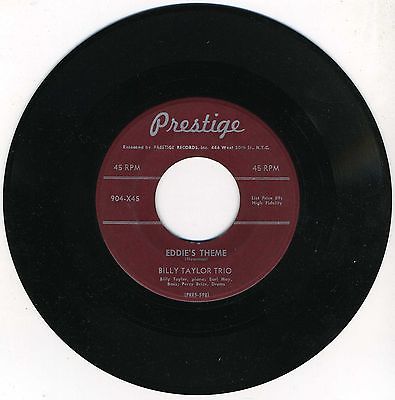
"Eddie's Tune" and "Goodbye" were the only single release, on both 78 and 45. You'd think they would have released the others, at least regionally, for fans of the DJs. There was a 10-inch LP called Billy Taylor Plays for DJs (the standards were all used as themes by jazz DJs, as well), and the tunes were included on a 12-inch called Cross Section.
Zoot Sims was pretty successfully bicoastal, leading his famous quintet with Al Cohn in New York, playing with Gerry Mulligan on the West Coast, but this trip to LA, released on a New Jazz LP as Zoot Sims in Hollywood, seems to have gone mostly unremarked. It's not mentioned in any of his online bios, nor in the bios or discographies for West Coast trumpeter Stu Williamson, who rounded out this quintet. It's not easy to find online, and it seems to have faded into much the same obscurity that Williamson has, and for both the session and the trumpeter, the obscurity is undeserved.
Williamson was a Vermont native whose family moved to the West Coast, where both he and his older brother Claude, a pianist, carved out very decent careers. Stu was best known for his years with Shelly Manne, which began right about this time. He did make two albums as a leader for Bethlehem, but they're hard to find, too.
He meshed beautifully with Zoot, who was a solidly mainstream player. There's nothing in this session that particularly screams out "West Coast" (New Yorker Kenny Drew, in the middle of a brief West Coast sojourn, is also there to keep it anchored). But although Williamson made his career in California, he was more regarded as a musician's musician than an advocate of a particular style. Here's what Marc Myers of the JazzWax blog has to say about him:
Though he wasn't a blaster or upper-register torcher, Williamson's notes were always in perfect pitch while his lines were consistently romantic.
And Steven A. Cerra of Jazz Profiles:
This [is] a guy whom Shelly Manne was described as: “A wonderful trumpeter and valve trombonist and an excellent all-round musician. He reads well; he has good time; and a good sound.”
...Stu never “mails it in” [i.e.: gets lazy]. He’s always working; always playing with a ringing clear tone; always getting the dynamics, just right. Like the true professional that he was, Williamson paid attention to the smallest detail when playing a composition and does justice to all of them. His consistency of interpretation was remarkable as were his solos with their masterful phrasing and interesting ideas.
Sims himself is generally thought of, and with good reason, as coming out of the Lester Young tradition, but his first and deepest saxophone influence was Ben Webster. You can hear both traditions in his playing: the love of melody, the sure sense of swing.
Joining Drew in the rhythm section are Ralph Pena on bass and Jimmy Pratt drums. Pena played with pretty nearly everyone on the West Coast, was universally admired, and died young. I can't find much about Pratt as a musician, but he made his mark as an technical innovator, inventing a bass drum muffler for the Gretsch company that allowed the drummer to control its tone.
The session is two Zoot originals and two standards. "Indian Summer" is a Victor Herbert composition from 1919, and you wouldn't expect a song from this early in the Great American Songbook catalog to have become such a jazz standard, but it has. We've heard it before from Stan Getz in 1949 and Lee Konitz and Billy Bauer in 1951
None of them are anywhere to be found on Spotify or YouTube, but they're worth rooting around for. A month later, Williamson (on valve trombone) and Sims reunited for a recording session with Clifford Brown, which is findable.
In addition to the New Jazz release, there appears to have been a Prestige 10-inch scheduled but never released.
Oh, yes, and how did Zoot get his nickname? On his first professional gig, he played in the saxophone section of Kenny Baker's band. Baker had hipster-sounding nonsense words in front of every player on the bandstand. Somehow, his was the only one that stuck.
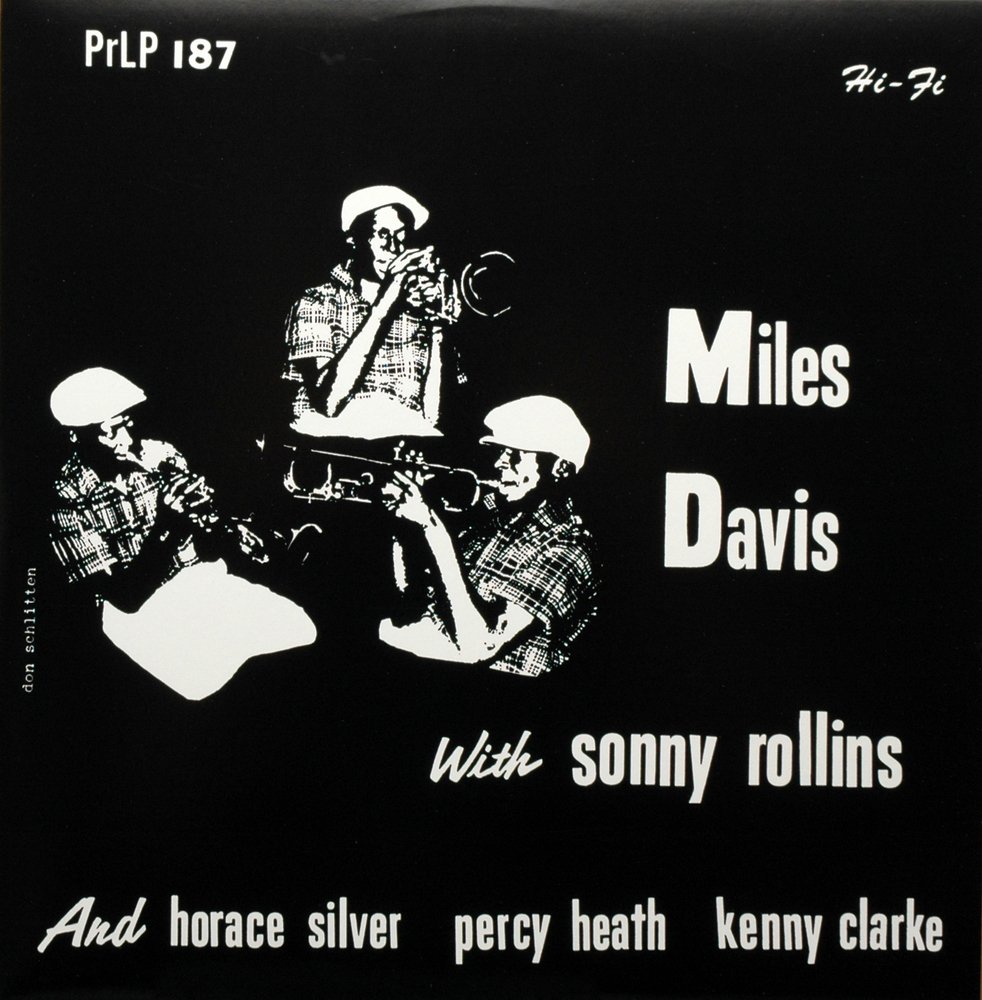
The most interesting thing about this session from a listener's standpoint is easy: the music. Miles Davis, Sonny Rollins. Horace Silver, Percy Heath, Kenny Clarke (after the confusion as to who was drumming on the June 4 Art Farmer, date, I triple-checked, and it is Kenny Clarke). Three originals and a Gershwin standard. Great tunes, great playing. Rollins is back in the studio for a third Prestige session with Miles, and it's always a welcome pairing. And it was a busy month in Rudy Van Gelder's parents' living room. This will have been the third time they've had to have dinner out, or stay in the kitchen.
From a blogger's standpoint, there are a couple of things of note. First, all three of the originals are Rollins compositions, and they've become jazz standards.
"Airegin" falls into the category of backwards-spelled words as titles, which was becoming nearly as popular as puns on "bop" had been a few years earlier. Miles would record it again with John Coltrane, and it's been waxed by Tito Puente, Stan Getz and Chet Baker, Wes Montgomery, Maynard Ferguson, among others. The jazz greats who've recorded "Oleo" include George Benson, Grant Green and Lee Konitz. Dexter Gordon, John Coltrane, Shelly Manne, Cal Tjader, Branford Marsalis and John McLaughlin have all done "Doxy." Phil Woods used it as his theme.
Second, this session is of historical interest in that it's the first time Miles recorded with a Harmon mute (on "Oleo"). This isn't as earth-shaking as it might seem. Miles had already found his mature tone, and the Harmon mute may have refined it, but didn't fundamentally change it. If you listened to all five of the cuts from this session (including the two takes of "But Not For Me"), and you were a trumpet player, you'd be able to pick out the Harmon mute instantly. The less sophisticated listener (like me), maybe not.
"But Not For Me" was released as a two-sider on both 78 and 45. Prestige was nearing the end of its 78 RPM days, but not quite ready
to pull the plug yet. The whole session (only one version of "But Not For Me" was on a 10-inch, and all five tunes were on the Bags Groove 7000-series LP.
There was an MJQ before there was a Modern Jazz Quartet, and it had essentially the same lineup, with Milt Jackson and John Lewis and Kenny Clarke (Percy Heath hadn't joined yet). That MJQ was the Milt Jackson Quartet.
So here's another MJQ, this time a quintet, with Horace Silver filling the piano spot.
The Modern Jazz Quartet is one of the most justly revered of all jazz groups, but it wasn't always so. The MJQ were going their own way as bebop was turning into hard bop, and a lot of devotees of the harder sound professed to find the MJQ too safe, too genteel. They weren't, of course, but that was what their detractors said.
But nobody didn't like Milt Jackson, and it was an article of faith among the detractors that the MJQ was holding Jackson back, not letting him play the funky, bluesy, hard-boppy music he was capable of, and secretly wanted to play.
That way of thinking is long behind us, along with the wars between the beboppers and the moldy figs, but we still do have the recordings that Jackson made apart from the Modern Jazz Quartet, and yes, with Horace Silver on board, it is a different sound.
The fifth musician here is trumpeter Henry Boozier, and his inclusion certainly suggests that Jackson was going for a funkier sound. Boozier is probably better known for his work in blues and rhythm and blues, which is an odd way of putting it, since blues bands didn't generally list all their personnel on their recordings. So not better known to the general public, but better known in the sense that he'd more likely be called to work on a blues date. He recorded with B. B. King, Bobby "Blue" Bland, Clarence "Gatemouth" Brown, Paul "Hucklebuck" Williams. His song, "Ask Me 'Bout Nothin' but the Blues," was recorded by Bland, Boz Skaggs, and others. He doesn't seem to have any other jazz recording credits, but Jackson brought him back in 1960 to record with his octet.
"Funky" has been around as long as jazz has been around:
I thought I heard Buddy Bolden say
Funky-butt, funky-butt, take it away.
And according to at least one authority, it has an African etymology. According to Yale art historian Robert Farris Thompson in his 1984 work, Flash of the Spirit: African and Afro-American Art and Philosophy:
The slang term 'funky' in black communities originally referred to strong body odor, and not to 'funk,' meaning fear or panic. The black nuance seems to derive from the Ki-Kongo lu-fuki, 'bad body odor,' and is perhaps reinforced by contact with fumet, 'aroma of food and wine,' in French Louisiana. But the Ki-Kongo word is closer to the jazz word 'funky' in form and meaning, as both jazzmen and Bakongo use 'funky' and lu-fuki to praise persons for the integrity of their art, for having 'worked out' to achieve their aims. In Kongo today it is possible to hear an elder lauded in this way: 'like, there is a really funky person!--my soul advances toward him to receive his blessing (yati, nkwa lu-fuki! Ve miela miami ikwenda baki) Fu-Kiau Bunseki, a leading native authority on Kongo culture, explains: 'Someone who is very old, I go sit with him, in order to feel his lu-fuki, meaning, I would like to be blessed by him.' For in Kongo the smell of a hardworking elder carries luck. This Kongo sign of exertion is identified with the positive energy of a person. Hence, 'funk' in black American jazz parlance can mean earthiness, a return to fundamentals.
However, I wouldn't have thought of "funk," as a noun referring to a genre of music, to have been commonly used much before the 60s, but we have it here, in a Horace Silver composition, and an opus de funk it is, with some great interplay between Silver and Jackson, and a solo by Boozier that shows solidly why Milt Jackson called on him for this gig.
Silver also composed "Buhaina," presumably a tribute to Art Blakey, who had taken the Muslim name Abdullah ibn Buhaina, though he continued to use what many black Muslim converts would come to call his slave name. This one has some striking interplay between Jackson and Boozier, and later between Silver and Percy Heath--and, a little surprisingly, no extended drum solo for Kenny Clarke.
Jackson composed the other two. "I've Lost Your Love" is sort of an unusual title for a modern jazz instrumental, and I'd love to hear the story behind it. It's a ballad, and it features a knockout trumpet solo by Henry Boozier.
"Soma" is another Jackson composition, and maybe what I love most about it is the ensemble work on the head. You don't every day hear a trumpet, vibes and piano working as an ensemble front line. Jazz surpasses expectations so often, and in so many ways.
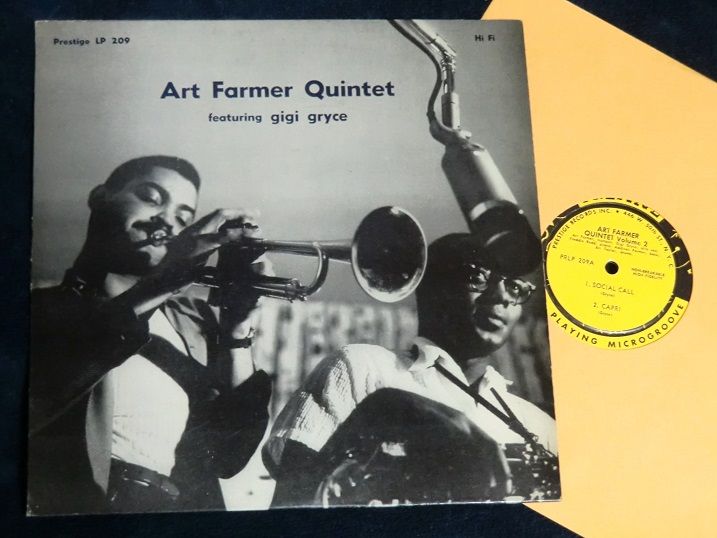
Art Farmer seemed to do very well with the mid-sized group, six to eight pieces. He was perhaps best known for the six-man Jazztet with Benny Golson in the late 50s - early 60s, and his work in the early 50s also tended toward that format. His early Wardell Gray session for Prestige in 1952 was a sextet, although only two of the group were front line players (the sixth was a percussionist). He led a septet in 1953 before joining the Lionel Hampton tour, and played with various mid-sized ensembles during the Hampton tour in Europe. His first two 1954 sessions were quintets - Sonny Rollins and Gigi Gryce -- but he returned to the studio again with seven pieces for this one. The group included Horace Silver and Percy Heath, and maybe Kenny Clarke, according to the jazzdisco.com website, which has the set lists for every Prestige session. But they may be wrong. The label on the 45 says the drummer was Art Taylor, and the Art Taylor Wikipedia page credits him with both this and the quintet session with Gigi Gryce (Art Blakey was the drummer on the Rollins session). Scott Yanow's bio on Allmusic.com puts Taylor in the Prestige studios for the second half of the decade, so 1954 would be on the cusp. Taylor's obituary in the New York Times gives a list of musicians he played with, and does not include Farmer. Your guess is as good as mine. My ear isn't good enough to choose between the drumming techniques of two modern masters (and two eventual expatriates).
Jimmy Cleveland, who had played in the earlier septet, returned for this one. The other two were
Danny Bank and Charlie Rouse, and all of these guys were veterans, with extensive experience in swing and bebop...and rhythm and blues. Jimmy Cleveland's resume would include soul jazz with Gene Ammons and funk with James Brown. Charlie Rouse, whose chief fame would come later as Thelonious Monk's right hand man, began his career with the classic Billy Eckstine band that included Charlie Parker and Dizzy Gillespie, but he also played with Bull Moose Jackson. He played big band swing with Basie and Ellington, bebop with Dizzy and Tadd Dameron. Danny Bank had a similarly varied career, playing with virtually every major swing band, with Charlie Parker, with Clifford Brown, with Ray Charles. He's probably best known, though, for his work with Miles Davis and Gil Evans on their classic collaborative albums.
And this versatility is put to use here. On "Evening in Paris," a Quincy Jones ballad, they lend support to a piece that mostly features Farmer and Silver, who also dominate "Elephant Walk," a piece which demonstrates that even elephants get the blues. "Wildwood" is a Gigi Gryce composition, as Farmer continued his close association with the two young composer/arranger stars of the Hampton tour, and it gives a wild, full romp to the whole ensemble. They give the same treatment to "Tiajuana," again a Gryce composition, which is complex and straight-ahead at the same time.
I don't want to lose the real thrust of this blog, which is the experience of listening to this music. Secondarily, it's exploring the history of jazz in this period. Finding out who Charlie Rouse was and what he did before his years with Monk. Learning about the work done by professionals like Danny Bank who didn't make a mark as leader, but contributed so much. Thinking about what an ear Art Farmer had for the great jazz composers of his era: Quincy Jones and Gigi Gryce here, Benny Golson later.
But listening to this session, it's the bluesy chording and rhythmic virtuosity of Horace Silver, and the warm, pure tone of Art Farmer. It's the ensemble work of a septet, and how if Art Farmer worked in the shadow of arrangers like Jones, Gryce and Golson, he was one hell of an arranger himself. It's the
music I love.
These were released on 45 and 78, and on a 12-inch, 7000-series LP, The Art Farmer Septet. It's the first Prestige session I've seen that didn't come out on a 10-inch LP first.
Jimmy Raney double-tracks his guitar on these tracks, using a technique that Les Paul had started to experiment with in the 30s, but had not been able to convince a record label to release a record using the technique until 1949. Interestingly, that meant that Paul was not the first artist to put out a record with multi-tracked instruments--Sidney Bechet did it in 1941.
Outside of the studio pyrotechnics, there doesn't seem to be much to connect the progressive ideas of Jimmy Raney with the more trad-focused licks of Les Paul, but it's not hard to think of them together, if one puts one's mind to it. There's a joy and a brightness in the playing of both guitarists. And, of course, wizard-like technique combined with technical wizardry.
Here again, Raney is joined by Hall Overton, and as with the Teddy Charles sessions, it's a case of the student overtaking the professor (Raney and Charles had both studied with Overton and Juilliard). But not really. Overton was an enigmatic and adventurous musician, and he prods Raney into some very cool things here.
Art Mardigan may be best known as a mainstay of the red hot Detroit jazz scene, working as the
house drummer at the Blue Bird Inn, but he did a lot of work in New York, too, with some major musicians.
I knew Teddy Kotick at the end of his career, when he was working a day job as a mailman in his native Massachusetts, and playing some great jazz with J. R. Monterose in Albany. He had been one
of Charlie Parker's favorite bassists, and was always reliable. He didn't solo much, but he has some moments here, on "Some Other Spring" and "On the Square," and he shines.
Gigi Gryce had a short but influential career. Besides his groups co-led with Art Farmer, he worked with Thelonious Monk, Oscar Pettiford and Donald Byrd. He was conservatory-trained, and as good an alto player as he was. he was perhaps even more highly regarded as a composer than as an instrumentalist, in the classical as well as the jazz world.
He had started to make his reputation on the 1953 tour with the Lionel Hampton band, which contained a number of rising young moderns who made several recordings on their own in Sweden, Switzerland and France (Hamp was not pleased, but they weren't entirely pleased with the wages he was paying, so that balanced out). Gryce and Quincy Jones were the two hot new composer/arrangers to come out of that tour, and in fact Gryce paid tribute to the competition with one of his originals, "Keepin' Up With Jonesy."
Art Farmer was one of the other young guns on the Hampton tour, and he and Gryce stayed close after the tour ended.
This session showcases Gryce as a composer. "A Night at Tony's," "Deltitnu" and "Blue Concept" are all Gryce originals. "Stupendous-Lee" is variously credited, depending on which site you look at, to either Gryce or Farmer. Allmusic has it variously credited to each of them on different pages of its site. But I'd say the evidence points to Gryce. Most jazz titles ending in "-Lee" are either written by or tributes to Lee Konitz, but this one was written for Gryce's wife, Eleanor "Lee" Sears.
These are all terrific tunes, and they've had some traction. Dizzy Gillespie recorded "A Night at Tony's"; so did Art Blakey and the Jazz Messengers, and Art Farmer and Horace Silver have recorded it with their own groups. "Blue Concept" was also recorded by Horace Silver, and the song itself can boast of an all-star section of trumpeters, each of whom has recorded it with his own group: Art Farmer, Donald Byrd, Nat Adderley, Clifford Brown. "Deltitnu" has become a favorite of Postmodern jazz-rock bands, as well as a go-to tune for a number of the musicians who played on its premier recording, with Gigi Gryce et son Orchestre.
Speaking of jazz compositions, there is one thing that drives me a little nuts, and generally ends up making me feel really ignorant, and that is the genealogy of songs. Why is "based on the chord changes" so important to jazz writers? Here's from the Jazz Lead Sheets website, and I don't mean to single them out, because everyone does it:
Like many other jazz composers, Gigi often liked to borrow a "standard" chord progression, then create his own melody. That often led him to adjust the original chord progression, in places, to fit his new melody. The bridge of A Night At Tony's is a good example of this, since Gigi's bridge melody alters the original chord progression of Charlie Parker's Yardbird Suite. However, on the recording the musicians play solos on the original Yardbird Suite 'changes.'"
OK, so it's a different melody AND different chord changes, so why is it still "Yardbird Suite?" Why is it even based on "Yardbird Suite"? I'm just a simple lyricist, but if I write a song based on the chord changes to Heartbreak Hotel, I'm also writing a song based on the chord changes to "You Are My Sunshine" or "Sink the Bismarck" or "Hoochie Coochie Man" or about a million other I-IV-V songs. And if the soloists play solos based on different chord changes than the changes Gryce wrote the melody to -- and obviously they're playing a different melody, or it wouldn't be an improvisation...in other words, why does everyone who writes about jazz make such a big deal out of this "based on the chord changes" thing? And "Yardbird Suite" may or may not be based on the chord changes to Earl Hines's "Rosetta," which has the same chords, only different.
If I write a sonnet, am I basing it on Petrarch's chord changes?
Anyway, if I were going to write a song called "A Night at Tony's," and base it on the chord changes to a jazz classic, I'd base it on "A Night in Tunisia."
This one only came out in LP format, first on a 10-inch under Farmer's name, then as the 12-inch LP When Farmer Met Gryce.
Perhaps the only thing better than listening to Thelonious Monk is listening to Monk play with someone who really gets him, who is in perfect harmony with Monk's moods and Monk's ideas and Monk's tempi. That's why it's such a moment of pure satisfaction to hear the tenor sax take his solo at around 2:20 of "We See," and realize that yes, yes, he's got it, and he gets Monk.
And sometimes -- as was the case this time -- you listen to the music before you read the set notes, and then you go back to check the personnel, and the identity of Monk's soulmate both surprises and delights you.
If there's any musician who is inextricably connected with one bandleader, it would be Frank Foster and Count Basie. Foster played with a variety of musicians who encompassed a variety of styles, but it's hard to think of him without thinking of Basie. He joined the Count in 1953, the year before this session with Monk, and his final bow as leader of the Count Basie Orchestra came in 1995.
But listen to him here, especially on "We See," which may be my favorite, by a close margin, of four great cuts. Foster and Ray Copeland play the head in a jaunty fashion -- swing filtered through Monk. Monk takes an extended solo, with some powerful assistance by Art Blakey and Curly Russell, and then close to two and a half minutes in, Foster hits with his solo, and there's no way to miss being struck by how right it is. Ray Copeland follows -- and he's right too -- and then Foster again.
I should say something about Copeland, too. He was one of the unsung but in-demand sidemen of this era, and later a valued jazz educator before his early death in 1984. He had played with Monk before, and was supposed to be on the earlier Prestige date with Sonny Rollins and Julius Watkins.
I love to hear Monk's originals -- he's one of the greatest jazz composers -- and I love to hear him play standards. "Smoke Gets in Your Eyes" has it all. Great work with the melody, great ensemble work, completely unexpected and always appropriate piano work from Monk, beautiful solos by the others.
"Locomotive" builds of a "Now's the Time"-reminiscent riff. "Hackensack" is a tribute to Rudy Van Gelder's hometown, and Van Gelder comes through on this entire session, making every instrument clear and vivid (you really get a sense of how good Curly Russell is). "Hackensack" has a blistering solo by Copeland, and a wonderfully creative solo by Blakey.
But finally, the lasting impression from these four tunes is: for all Monk's deserved reputation as an eccentric genius and iconoclast, he was one hell of a bandleader. These arrangements, the unison parts, the way Monk counterpoints the unison parts, the way he sets up the others for their solos...just listen.
These were released on a 10-inch and a couple of 12-inch LPs, Monk and We See.
This is James Moody's second stateside session for Prestige, and again he's surrounded himself with the same group of fellow Dizzy Gillespie big band alumni, including trombonist William "Shep" Shepherd, not to be confused with trombonist Shep Shepherd, one of the composers of "Honky Tonk," and not to be confused with trombonist William Shepherd, contemporary musician and music educator. And while we're at it, not to be confused with "Shep" Sheppard, doowopper of "You're a Thousand Miles Away" and "Daddy's Home." Moody's band also includes sax player and Gillespie alumnus PeeWee Moore, but he's an easy one. He only has to not be confused with the PeeWee Moore who was a sax player and a Dizzy Gillespie alumnus.
The only thing I can say for certain about Jimmy Boyd is that he's not to be confused with the Jimmy Boyd who sang "I Saw Mommy Kissing Santa Claus." Google references a 2006 club date in Phoenix by Jimmy Boyd, "one of the best jazz pianists around," and I hope it's the same guy. Maybe not. Vocalist George Townes recalls playing with Coltrane in the early days in Philly, and a bass player named Jimmy Boyd, who he says is now out of music and selling real estate in California. And Grant Green died on the way to a 1979 gig at Jimmy Boyd's Breezin' Lounge in Harlem.
I know I have a penchant for obscure digressions, but this is a stretch even for me. But it's all part of the great warp and woof of American music.
1954 is a little late for the golden era of bebop-rhythm and blues crossover, but Moody has spent a few years in Sweden, so maybe no one told him. Or maybe he didn't care. Moody always had the rare ability to satisfy the purists and entertain the young 'uns. So the first cut here features an R&B vocalist, Iona Wade, who cut several sides for fairly obscure R&B labels, but never really broke through. She has a Dinah Washingtonesque style, and she's good.
Moody's also catching the latter part of the bebop meets mambo era, and
again he's a welcome addition, playing a Quincy Jones composition..
Drummer Joe Harris, Dizzy alum and house drummer at the Apollo Theater,
carries the responsibility of an entire Latin percussion section, and
pulls it off.
These tunes were released on two 78s, on an EP, a 10-inch LP, and later as part of a 7000-series LP, Moody's Workshop.
1956 was the big Miles Davis marathon, in which Miles finished up his obligation to Prestige in a blaze of glory, one session after another, so that he could move on to Columbia. But he was almost as busy in 1954. His March quartet session at Beltone was followed by two in April at the Van Gelder studios, and there'd be more before the end of the year.
Each of these sessions featured a different front line (well, the first one was just Miles, which may not exactly make a line), but mostly the same rhythm section. Horace Silver, Percy Heath and Kenny Clarke had come together for the Art Farmer session. Miles had used Art Blakey for the March quartet session, but Clarke was on drums for these two.
The quintet for the April 3 session included Davey Schildkraut on alto. Schildkraut was a veteran at
29, having gotten his first major professional gig at 16, with Louis Prima. He had early on heard the siren song of bebop, and mastered it to the point that when Charles Mingus was given "I'll remember April" on a Leonard Feather blindfold test, he identified the alto player as Charlie Parker.
Actually, Parker and Schildkraut overlapped a few times in the early 50s. There's a live recording of Bird with Stan Kenton -- I had never known they played together -- from a couple of months before the Miles session, with a Kenton reed section that includes Schildkraut. And there's a session from 1953, released on the Roost Jazz label in 1990 as More Unissued, Vol 2. That is, more unissued Charlie Parker sessions. But the alto player on that date has since been authoritatively confirmed as Davey Schildkraut.
Bill Holman, who was Kenton's arranger while Schildkraut was with the band, sees no similarity between the two. In an interview with Schildkraut student Rob Derke, Holman said:
Dave had a completely introspective way of playing...and played according to how he felt at any particular time. A lot of guys take the easy way out and say ‘Oh, another bebop alto player so we’ll compare him to Bird.’ I never heard [Schildkraut] using Bird’s or anyone else’s licks, it was all completely original and I really enjoyed hearing his playing for that reason.
"Solar" is based on the chord changes for "How High the Moon," and as I've stated before, I never know quite what to make of "based on the chord changes." Pretty much every blues, country and rock and roll song is based on the same three chords. I looked up "How High the Moon chords" on Google, and the chords to the Les Paul version, which is the most familiar one, are a little different from the chords in another jazz standards fake book. Anyway, I don't always hear the melody in a bebop "based on the chords" version of a standard, but I can hear "How High the Moon" in "Solar." The same chord changes were used by Chuck Wayne in a composition called "Sonny," recorded in 1946 and unissued (and uncopyrighted). Wayne claimed that Miles had ripped off his melody, and maybe he did. The general consensus is yes. I don't know the difference between ripping off a melody and basing a melody on chord changes. Anyway, here's a bit of the Chuck Wayne tune on a scratchy acetate, if you're interested. "Solar" became a jazz standard, although Miles never recorded it again.
"Love Me or Leave Me," based on the chord changes to "Love Me or Leave Me," is so firmly ensconced in the public consciousness as a pop song, thanks to great pop renditions by Doris Day and Sammy Davis, Jr. (I'm too young to remember Ruth Etting), that I had never really thought of it as a jazz standard until I heard the Miles Davis version. After that, I spent a little time seeking it out, and found jazz vocal versions by Nina Simone, Billie Holiday, Anita O'Day and others; instrumental versions by Benny Goodman, Lester Young, Gerry Mulligan--and, in a more modern setting, Tuba Skinny. I've always loved the Sammy Davis, Jr., version, with its rapid-fire faux scatting, ending with the exhortation, "Blow, Sam!" I always thought he was cheering himself on, but recently it's occurred to me that it must be Sam Butera coming in with the sax solo.
But ever since I first heard the Miles recording, it's been the definitive version for me, and I was glad to spend some serious time listening to it and absorbing it in preparing this blog entry.
Miles is best known, for most of his career, for playing with a Harmon mute, but he experimented with different mutes before settling on the Harmon. On this session he used a cup mute, and it suits "Love Me or Leave Me" perfectly. The tune is taken at an uptempo bebop pace, and yet it still maintains a plaintive, bluesy tone. There are two ways of approaching "Love Me or Leave Me."
There's the torchy, moody Doris Day/Billie Holiday way, the lost lover who'd rather be lonely than happy with someone else, or the slap-happy Sammy way, you can love me, you can leave me, what do I care? I'm here for the rhythm and the chord changes and the chance to wail out, and "blow, Sam!" Miles manages to do both.
The sextet session came at the end of the month, with the same rhythm section and a new front line.It became immediately, and remains, one of the most potent sessions in the Davis canon. New Yorker jazz critic Whitney Balliett called it "some of the best jazz improvisations set down in the past decade." Both cuts are amazing, but "Walkin'" will send nonstop chills up and down your spine.
Davis bolted Prestige for Columbia for a number of reasons. One of them was money. One was that Columbia had...well, more prestige than Prestige. But one was that Columbia wanted him to put together a regular group, while Bob Weinstock had wanted him to play with a variety of musicians:
So our basic idea was just to make records with different people, to record
with the best people around. That's what we did until the end, when he
had the quintet with John Coltrane, Red Garland, Paul Chambers, and
Philly Joe Jones. But everything up to that point developed from where
we would sit down and talk about it. Miles would mention who was in
town, who he would like to record with. I'd say who I'd like to hear him
record with. We'd kick ideas around.
If I sound like a cheerleader for this entire era of music, and for everything that Bob Weinstock, Ira Gitler, Rudy Van Gelder and the Prestige record company did, I'm OK with that. These are a fan's notes, and this era, this label, stands as one of the great gifts to American culture and the American Century in music. So I'll say it. The Miles Davis quintets and sextets were inspired, and the source of great art. But we are just as lucky to have these records with different people, with the best people around, with the ideas that were kicked around. One suspects, from what one knows about Miles, that after a while he didn't want to kick ideas around with anyone, except maybe Gil Evans.
But we have these records. This rhythm section, with Horace Silver really starting to come into his own. And different front lines for Miles to jam with--and jamming was what it was. Jamming was the Bob Weinstock philosophy,
J. J. Johnson was one of the true beboppers, there from the beginning.
I knew very little about Lucky Thompson. I have his Tricotism album, so I knew he was good. I knew that he'd played the expatriate game for a spell. Allmusic.com has an excellent bio by Jason Ankeny, which I recommend.
I discovered that Thompson was called "Lucky" because "of a jersey, given him by his father, with the word "lucky" stitched across the chest," not because he ever had any luck in his life. His mother died when he was five, and from that early age, he became responsible for taking care of his younger siblings. He always loved music, and always wanted a saxophone, with such passion and dedication that he "carved imitation lines and keys into a broom handle, teaching himself
to read music years before he ever played an actual sax. According to
legend, Thompson finally received his own saxophone by accident -- a delivery company
mistakenly dropped one off at his home along with some furniture."
Thompson was one of those guys who moved from swing to bop -- he played with Erskine Hawkins and Lionel Hampton before arriving on 52nd Street, where he was asked to fill in for Ben Webster at the Three Deuces, and "Webster, Coleman Hawkins, Lester Young, and Art Tatum were all in attendance at Thompson's debut gig, and while he deemed the performance a disaster (a notorious perfectionist, he was rarely if ever pleased with his work), he nevertheless quickly earned the respect of his peers and became a club fixture."
Ankeny describes Thompson's sound as "never fit[ting] squarely within the movement's paradigm -- his playing boasted an elegance and formal power all his own, with an emotional depth rare among the tenor greats of his generation."
It was battles with the jazz establishment, particularly record label owners, more than racism that drove Thompson to Paris, and that would drive him in and out of the music business.
"You Don't Know What Love Is" was the flip side of "Old Devil Moon" on a 45, and "Walkin'," split in two, made both sides of a 45. These would be the first Prestige singles to come out on 45 and not 78. The sextet sessions were also released on 45 RPM EPs and a 10-inch LP. The quintet sessions also had a 10-inch, and the two sessions were combined on the 12-inch Walkin'.
Horace Silver and Percy Heath packed up from their session with one of the noblest peers of the trumpet realm and moved on to the Dark Prince himself, this time with Art Blakey on drums.
You look back at these years and you can see how often a small label like Pre stige or Blue Note, or Dial or Roost, was able to get Art Blakey or Kenny Clarke or Max Roach to anchor a session. No wonder jazz was so great back then.
Miles didn't seem to care for the Prestige studio. His early recordings tended to be somewhere else, often the WOR radio studios, but he had used Beltone, located at 1650 Broadway, across the street from the Brill Building and nearly as legendary in the music business, before. No Rudy Van Gelder, and I had imagined this whole scenario when Silver and Heath showed up for the gig.
"Say, man, you gotta check out this cat's pad in Hackensack."
"Oh, yeah? What's in Hackensack?"
"This cat. He built a recording studio in his folks' living room."
"Huh."
"No shit, Miles, this dude got a sweet little setup. He made Art Farmer sound better than you."
"No motherfucker sounds better than me. What'd you say this cat's name was?"
Nice bit of fancy. And it could have happened that way, except for one thing. Miles had recorded at the Van Gelder studio the previous week. So why not for this session? Who knows? Maybe Blue Note had already booked the space, or maybe the senior Van Gelders were having folks over for dinner, or maybe Rudy had optometry patients scheduled for that day (he still made his living as an optometrist, getting amazing quality of sound for the legends of jazz not exactly paying the bills).
This is an important session because of course it's an important session. It's Miles Davis. It's still the period of experimentation -- Bob Weinstock recording Miles in different settings, before the quintet. It's the first recording of "Four," which was to become a staple of the Davis repertoire.
"Old Devil Moon" is a lovely, moody ballad by Burton Lane and E. Y. Harburg which has been recorded by nearly every jazz singer (including, a little surprisingly, Mose Allison), and by some of the best ballad interpreters in jazz, including Sonny Rollins, Stan Getz and Chet Baker. Miles, working in a quartet setting, has ample space to explore its smoky beauty.
"Blue Haze" is another Miles composition, and while it didn't become the staple that "Four" did, it's an equally beautiful tune, and it's a showcase for the other members of the quarter, particularly Percy Heath, who opens the piece with an extended solo.
Prestige, in 1954, was still wedded to the 78 for single release. "Blue Haze" came out on one 78 as parts I and II. The 78 of "Four" was b/w "Old Devil Moon," unaccountably retitled "That Old Devil Called Love." "Old Devil Moon" also made it to 45 RPM, under its real name, b/w "You Don't Know What Love Is" from a later session. The EP continues to be the 45 format of choice, though, and the whole session did come out on an EP, and on a 10-inch LP, as well as various reissues, including Miles Davis Plays for Lovers.
There are the trumpet players who one listens to with reverence. The ones who changed the face of American music with their vision and their talent. Louis Armstrong, Dizzy Gillespie, Miles Davis. They would be pretty much everyone's list. Then there are the trumpet players who seem to capture the essence of jazz music: the ones you listen to and say "yes, that's what I love about jazz." A jazz fan will have her/his own list here, but a whole lot of those lists would include Bix Beiderbecke. And Roy Eldridge. And Clifford Brown.
And Art Farmer.
And all I can think, listening to this oddly forgotten session (released on a 10-inch and then buried, not included on any of the 7000-series Prestige releases of the 50 sort of brought out on the less-distributed New Jazz label in 1961, then not again until the 7600 reissue series in 1969, pretty much the end cycle for Prestige) is what a wonderful session this is. It's everything that makes me love jazz.
Art Farmer broke in with Wardell Gray on the session that introduced "Farmer's Market." He did the septet session with Quincy Jones arrangements for Prestige in the summer of 1953, then headed for Europe on the Lionel Hampton tour that produced a series of recordings. This was his first session back in the States, as a leader, and it should have been his breakthrough to jazz stardom, and maybe it was. He certainly was back in the studio a number of times in 1954.
Sonny Rollins was with him on this date, and Rollins is another of those everything that makes me love jazz guys.
If there's ever an artist whose name is synonymous with a jazz label, it's Horace Silver and Blue Note.
He had actually started with Blue Note in 1952, first with Lou Donaldson and then as leader, and Blue Note kept him pretty busy, but during 1953-54 he also found time to record with Lester Young (released on the Italian Philology label and on Ambrosia), Sonny Stitt (Roost), Al Cohn (Savoy), both Art Farmer and Miles Davis on Prestige, and a few others. He had already started what became one of Blue Note's most famous groups, the Jazz Messengers, with Art Blakey. Blakey was to lead the group for years, but originally it was Horace Silver and the Jazz Messengers.
The session kicks off with "Wisteria," an achingly beautiful ballad (I believe an Art Farmer original) that has wonderful work by everyone, but perhaps especially Horace Silver. "Soft Shoe," again by Farmer (there's a Gerry Mulligan composition called "Soft Shoe," but it's different) picks up the tempo, with the boppish ensemble riffing and inspired soloing that presages Farmer's work with Benny Golson in the Jazztet.
"Confab in Tempo" confabs in a blistering set by Kenny Clark, followed by some great high-octane bebop, with Clarke pushing it all the way and coming back for a wild drum solo.
"I'll Take Romance" was written by Ben Oakland (also known for the Ink Spots' great novelty "Java Jive"), with lyrics by Oscar Hammerstein. It's probably best known in the pop rendition by Eydie Gorme. There's a hipper version by June Christy, but Eydie did right by the song. Its cool passion and flowing lyricism make it a great choice for jazz improvisation, and it's been recorded by Max Roach, Bud Shank, Kenny Dorham, McCoy Tyner and others. It's a good way to end the set.
This is the second session to be recorded in Rudy Van Gelder's studio. I wonder if it was difficult to cajole musicians into trekking out to Hackensack in the middle of January. It certainly wouldn't have been difficult to get them to go a second time, once they'd heard the results.





:format(jpeg):mode_rgb()/discogs-images/R-6282055-1415517130-2409.jpeg.jpg)





:format(jpeg):mode_rgb()/discogs-images/R-4019673-1352565949-5870.jpeg.jpg)


:format(jpeg):mode_rgb()/discogs-images/R-2767758-1367732211-9779.jpeg.jpg)


.jpg)

:format(jpeg):mode_rgb():quality(96)/discogs-images/R-5030038-1391033468-9319.jpeg.jpg)


:format(jpeg):mode_rgb()/discogs-images/R-3845422-1346750128-1039.jpeg.jpg)


:format(jpeg):mode_rgb()/discogs-images/R-3556904-1340579941-5969.jpeg.jpg)