Showing posts with label Belton Evans. Show all posts

Thursday, July 02, 2020

Listening to Prestige 498: Jesse Powell


LISTEN TO ONE: From the Soul

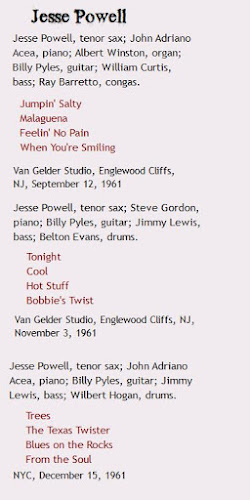
Jesse Powell recorded three sessions for Prestige's Tru-Sound rhythm and blues subsidiary in the fall and winter of 1961. These were the old-fashioned, 1949-50-era sessions, four songs, enough for two 78 RPM singles. Of course, this being 1961, they were all gathered together on one LP, and we'll consider them all together here, although he worked with two different groups of musicians.

Tru-Sound was not really a success. Bob Weinstock started it as a showcase for "contemporary rhythm and blues," but there really was no contemporary rhythm and blues in the early 1960s. It was being displaced by funk and soul. Tru-Sound's most successful artist was King Curtis. Juan Amalbert and the Latin Jazz Quintet made a couple of albums for the label. Altogether, Prestige released 14 albums on Tru-Sound
between 1961 and 1963, after which it was closed down. Although most of the label's releases fell victim to what appeared to be Weinstock's difficulty in promoting to the rhythm and blues market, they also lived up to his standards for quality, and Jesse Powell was no exception.

Born in Texas in 1924, Powell, after playing some gigs with Louis Armstrong and Luis Russell among others, joined the Count Basie Orchestra in 1946, replacing another Texas tenor man, Illinois Jacquet. He also backed various blues singers, including Champion Jack Dupree and Brownie McGhee, and he played with Dizzy Gillespie. A photo of the Gillespie orchestra at the Apollo in 1949 shows both Powell and John Coltrane in the saxophone section.

In the early 1950s, Powell led his own groups for Federal and Josie, both rhythm and blues labels, and these sessions should settle once and for all whether rhythm and blues is jazz. Backing up singer Fluffy Hunter for Federal in 1951, Powell's band was composed of Buck Clayton (trumpet); J.J. Johnson (trombone); Jesse Powell (tenor sax); Cecil Payne (baritone sax); Bill Doggett (piano); Johnny Jones (guitar); James Smith (bass); Herb Lovelle (drums). And recording a couple of instrumental side for Josie in 1954, he used Sir Charles Thompson (piano / organ); Mickey Baker (guitar); Lloyd Trotman (bass); Osie Johnson (drums). He was in demand as a session man in those years, appearing on such hits as "Speedoo" by the Cadillacs for Josie, "Mr. Lee" by the Bobettes for Atlantic, and several of Bobby Darin's hits for Atlantic subsidiary Atco.

John Adriano Acea (listed on the session notes as Adiano Acea) played on the September 12 and December 15 sessions. He had started out playing trumpet and saxophone, and he was said to have been proficient on any instrument there was, but he concentrated on piano after getting out of the army in 1946. Like Powell, he got a lot of work as a session man in New York, often recording as Johnny Acea or John Acea. He was featured on albums by Grant Green, Joe Newman, Illinois Jacquet, Eddie "Lockjaw" Davis. Don Wilkerson and others, played with Dizzy Gillespie, and accompanied Gloria Lynne, Diana Washington, Ruth Brown and Patti Page. He worked rhythm and blues and doowop sessions for independent labels in New York and Philadelphia. Never in good health (doctors told his parents he would not survive his childhood), he died not long after these sessions, in 1963.

Albert Winston, playing organ on the September session, was primarily known as a bass player. He recorded with Archie Shepp and George Benson among others, and was active in the rhythm and blues scene, including work with pre-Specialty Little Richard and Johnny Ace.

Billy Pyles played on all three sessions. I couldn't find much about him, but he had some solid rhythm and blues sessions for Specialty artists, including Little Richard.

Bassist William Curtis only played on the September session, and I was unable to find any information on him. Equally elusive was Steve Gordon, who played piano on the November session, a particularly tricky search in that there seem to be a plethora of pianists named Steve Gordon.

Jimmy Lewis (November and December) and Belton Evans (December), are familiar names on Prestige recordings.

Wilbert Hogan (December) played on a 1956 Prestige session with Earl Coleman, as Wilbur Hogan. But that only scratches the surface of his name variations. Born Wilbert Granville Thodore Hogan Jr., he sometimes recorded as Granville Hogan, and sometimes used the initials G. T. He was active from the early 1950s (originally with Earl Bostic) through tzhe 1960s, and played with Randy Weston, Kenny Drew, Kenny Dorham, Ray Charles, Elmo Hope, Bud Powell and Walter Bishop Jr.

Unusually for  a rhythm and blues combo, the September session did not use a drummer. They had Ray Barretto on congas. although it wasn't a Latin session. They did one Latin tune, "Malaguena," but not with an especially Latin rendition.

All three sessions were included on a single album, It's Party Time. Three 45 RPM singles were released, all on Tru-Sound: "Jumpin' Salty/Malaguena," "When You're Smiling/Hot Stuff," and "Cool/Tonight." 

Maybe between November and December the Prestige brain trust had cooled on Powell. The December session wasn't recorded at Rudy Van Gelder's, and no singles were released from it. It's also interesting that in 1962, with the twist craze in full bloom, neither of the "twist" titles were released on 45;

A lot of the information on Jesse Powell comes from an invaluable resource: A History of Tenor Saxophone Solos 1955-2015, by John Laughter.


Friday, March 20, 2020

Listening to Prestige 464: Anisteen (Ernestine) Allen

Annisteen Allen, as she was known through most of her career, had a good run in the 1940s and early 1950s, singing with Lucky Millinder and other top rhythm and blues ensembles. She was discovered singing in a club in San Antonio one night when Duke Ellington and Louis Jordan went out clubbing, and wouldn't you like to have been along for that ride? They both dug her singing, but as neither was in the market for a girl singer, they recommended her to Lucky Millinder, who hired her without even hearing her on the strength of their recommendations. Wouldn't you?

Her recording career with Federal/King ended on an odd note, when King Records was sued by another rhythm and blues label, Apollo, for copyright infringement over one of Allen's recordings. She did have a minor hit for Capitol in 1955 with "Fujiyama Mama," outsold, as many songs were in those days, by white pop singer Eileen Barton, later covered most successfully by Wanda Jackson. Still later, the Clash would perform it live in Tokyo with a vocal by bassist Paul Simonon's wife, Pearl Harbour.

She would continue to record, for Capitol and Decca and a couple of very small independents, but in 1958 she gave up touring and performing, taking a job in a hospital office.

The session for Prestige was her first full length album session, and the first under her real name. Perhaps her career over the previous five years had been obscure enough that Prestige felt "Annisteen" no longer had any drawing power, or perhaps she simply convinced Bob Weinstock not to use a name which she had acquired from a typographical error on an early press release, and which she had never liked. In any event, this resurrection, and this album, is one more thing we can thank Prestige for.

Allen had always played with first rate musicians, so this is not a rarity for her, but her producer--perhaps Ozzie Cadena, who worked most of the Tru-Sound sessions--surrounds her with an excellent supporting cast here, starting with King Curtis, and musicians who played with him regularly: Paul Griffin on piano, guitarists Al Casey and Chauncey "Lord" Westbrook, bassist Jimmy Lewis and drummer Belton Evans.

The session was released on Tru-Sound rather than Bluesville, and that makes sense. Tru-Sound was variously described as modern R&B or Prestige's pop label. The King Curtis combo gives it rhythm and blues credentials, and while there are some blues in the mix -- her Lucky Millinder hit, "Let it Roll," the R&B standard "I Want a Little Boy" (or girl, as in the best-known versions by Big Joe Turner and Ray Charles) and an original, "Miss Allen's Blues" -- most of the selections come from Broadway and Tin Pan Alley.

We have a lot to thank Prestige Records for--being in the center of some of the most important jazz movements of the American Century in music, creating a record of the creative growth of older musicians who were not part of the bebop revolution...and mixing it up. In so many ways. Weinstock's decision to record Miles Davis with different musicians, rather than having form a regular group as he was to do later, gives us a different and important context for this giant of 20th Century music. Bringing in contemporary jazz musicians
to record with blues singers. And sessions like this one. King Curtis's band brings a new bite to some old standards. With their kicking tempo and Allen's exuberant vocal, they give a new twist to the Gershwin brothers' "The Man I Love." In the classic versions by Billie Holiday and Ella Fitzgerald, there's such yearning for an unrealizable ideal. Both of these great singers give us hope against hope--that big and strong man is never going to come along, and they know it. Allen, with Curtis and the boys, are out for a good time. She kinda likes the idea of the man she'll love coming along, but she's having a good time now, and she doesn't really care all that much if he never does.

But the remake of "Let it Roll" is where they really let it roll. And rock. And they throw in some scat. And they stretch it out to nearly seven minutes, so while this is clearly the jukebox pick from the session, they have to put it on both sides of a 45.

Let it Roll is also the title of the Tru-Sound album. It was to be her last recording,  In 1986, after she retired from her hospital job, she did play a few dates with Bull Moose Jackson (as Annisteen Allen). She died in 1992.


Listening to Prestige Vol 4, 1959-60, now available from Amazon! Also on Kindle!
Volumes 1-3 are also available from Amazon.
The most interesting book of its kind that I have ever seen. If any of you real jazz lovers want to know about some of the classic records made by some of the legends of jazz, get this book. LOVED IT.
– Terry Gibbs

Wednesday, February 12, 2020

Listening to Prestige 455: King Curtis

This is an extremely unusual addition to the King Curtis canon, and perhaps not the one you'd reach for first, in that it features Curtis as a singer. There's some saxophone playing, and it's good, but it definitely takes a back seat to the singing.

Which raises an interesting point. Curtis is a wonderful saxophone player, and it's great that he had the opportunity to show what he could do as a jazz musician on a number of recordings, many of them on Prestige. It's great that Prestige the 1950s-60s interregnum opened the door to an expansive definition
of jazz. Their Swingville label reminded people that there were plenty of great musicians around who had been passed over as the winds of innovation kept sweeping jazz forward. Producers led by Esmond Edwards made a particularly wise decision to let these people play creatively, not simply reproducing the sounds of the swing era. And as the soul jazz era began, Prestige had the insight to realize that there had been a previous soul jazz era, the one called rhythm and blues, and to record and release some of the musicians like Willis Jackson who had been overlooked by the jazz public.

In the late 1950s, as my passion for rhythm and blues developed, I bought a lot of records without ever having heard them first. You pretty much had to, if you lived in the country. I'd pick up records by Muddy Waters or Amos Milburn or Roy Brown. I'd pick up records because they were on Aladdin, or Checker. And I picked up a 45 by King Curtis on Atlantic -- "Just Smoochin'" b/w "Birth of the Blues." I think "Birth of the Blues" was the B side, but it was the side I wore out. I bought his first jazz album, Soul Meeting, when it came out.

But probably Curtis's most lasting impression came as the bandleader and saxophone soloist on a number of Atlantic rhythm and blues records. You listened to a record like "Saved" by LaVern Baker, you looked forward to every new release by the Coasters, partly for the outstanding vocal performances, partly for the innovative songwriting by Jerry Leiber and Mike Stoller, but also--and this was very much a part of it--because you knew there was going to be a killer solo by King Curtis.

So why isn't this the same? A vocal recording with some hot instrumentals? Well, on the Atlantic recordings, the saxophone solos were always a highlight of the record -- you knew they were coming you waited for them, and they never disappointed. They had their own identity, a song within a song.

There's nothing like that here, and though Curtis is a good singer, his vocals don't strike to the gut the way his sax solos do.

But once you accept that, and listen to the album again, there's a lot to like.

For one thing, there's a fine eclecticism to Curtis's blues choices. "Nobody Wants You When You're Down and Out" is a depression-era classic, but actually it may have been prescient. Written in 1927, it preceded the stock market crash by two years. Bessie Smith's 1929 version captured the mood of the country, but, improbably, no one else touched until the 1950s, when it became a late-blooming standard. "Ain't Nobody's Business" is even older, dating back to 1922, and it's always been a standard for blues and torch vocalists, even though modern mores would disagree with Bessie Smith's and Billie Holiday's assertion that spousal abuse is nobody's business. "Trouble in Mind" also dates back to the 1920s, and is credited to composer Richard M. Jones, but its folk roots go back much farther. It is even more ubiquitous than "Ain't Nobody's Business."

"Bad, Bad Whiskey" was a 1950 hit for Amos Milburn, and Curtis was actually the first to cover it.

"Deep Fry" and "Jivin' Time" are the album's two instrumentals, and they were recorded at the end if the day. "Deep Fry" has the tenor sax spotlight. It's eight minutes long, with solo space for all the principals, and it does leave you wishing there were more tracks like it, but this is far from Curtis's only album, and he has a right to try something different. There's some nice tenor on "Jivin' Time" too, but even more nice work by the guitars. In general, Curtis leaves most of the instrumental turns to his bandmates, and they come through. Curtis does some guitar work, but mostly it's Al Casey, formerly with Fats Waller, is his regular guitarist, but on this session he's joined by Hugh McCracken, for contractual reasons using the pseudonym of Mac Pierce for this session, although it's hard to say why, because McCracken worked with pretty nearly everyone on every label. More likely, because this is a youthful McCracken at the outset of his career, it has to do with union status.

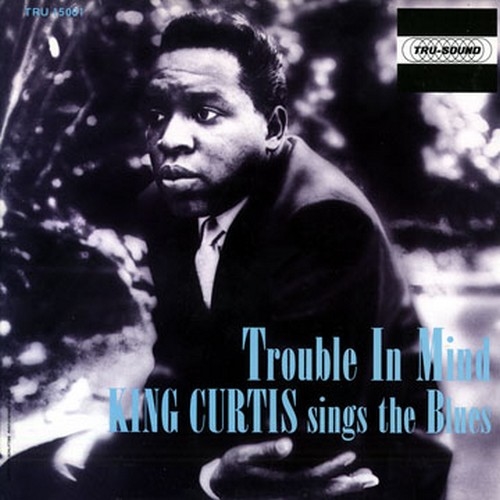
Trouble in Mind, recorded when he was 19, was one of his first gigs. He had dropped out of school at age 16 to make music and help support his family, His mother was working as a hat check girl in a New Jersey club where Curtis had an engagement. She convinced him to listen to her son, and he hired him for the session.

He once did sessions for Aretha Franklin and Paul McCartney in different studios for different labels on the same day, and he was McCartney's first choice as guitarist for Wings, but he elected to stay home with his young children and keep doing studio work. He had an approach to studio sessions that I suspect might not go over so well today, According to his obituary in the New York Times,
He would improvise his part once he apprehended the drift of a producer’s intention, his wife said. He arrived early the day Roberta Flack was recording “Killing Me Softly With His Song” and began fooling around on his classical guitar as he waited for the session to begin. Joel Dorn, the producer, asked him to play his riff again, and it became the song’s introduction.
Jimmy Lewis is a powerful presence on the electric bass throughout the session, and it was a relatively new instrument for him, He had played a standup bass with both Count Basie and Duke Ellington, among others, but switched to the electric bass when he joined Curtis. He would go on to make a record with a group that no one would expect to use an electric bass--the Modern Jazz Quartet. It was for a 1965 album, Jazz Dialogue, which featured the MJQ with a big band.

The King Curtis combo was pianist Paul Griffin's first major engagement, but hardly his last. He's probably best remembered for his work with Bob Dylan on Highway 61 Revisited, Blonde on Blonde, and Aja; he also played piano on Don McLean's mega-hit, American Pie.

Belton Evans  played with almost everyone in the blues and traditional jazz field, and with almost as many different first names, although he always stuck with Evans.

"But That's All Right" has backing vocals by the Cookies. The Cookies had a substantial career as a backup group, and had a couple of hits in their own right ("Don't Say Nothin' Bad About My Baby"). At this time, their most important credit had been as Ray Charles's backup singers, and Charles's own group, the Raelettes, was formed around Margie Hendricks, an original Cookie. They give "But That's All Right" a real Ray Charles sound.

Trouble in Mind was released on Tru-Sound, a short-lived Prestige subsidiary. Tru-Sound had two different catalogs. One was all gospel, and the other was more varied, but albums by King Curtis made up the lion's share of their list. Two 45s came from the session, both released on Tru-Sound: "Trouble in Mind" b/w "But That's All Right" and "I Have to Worry" b/w "Jivin' Time."

Thursday, September 05, 2019

Listening to Prestige 415: St. Louis Jimmy

Jimmy Oden wasn't St. Louis's most famous blues export to Chicago--that would be Chuck Berry--but he was the one whose name identified him with the city, although he had actually been born in Nashville. Moving to the Gateway City in the 1920s, he entered a musical partnership with Roosevelt Sykes, and they dominated the St, Louis blues scene for a decade, sufficiently that when the two of them moved to Chicago, he brought the city's name with him, and kept it for the rest of his career. He had begun as a piano player, but perhaps because of his association with the piano virtuoso Sykes, he came to concentrate on vocal performance and songwriting. He
wrote a couple for Muddy Waters, and Waters and Sunnyland Slim backed him up on some of his early recordings.

Like another songwriter/vocalist, Percy Mayfield, he is mostly remembered for his songs, especially "Goin' Down Slow," a hit for him on the race records charts in 1941 which went on to become one of the most widely recorded of blues standards. It has been recorded by Chicago blues royalty--Little Walter, Howlin' Wolf, James Cotton, and by acoustic folk blues singers like Mance Lipscomb , Sonny Terry/Brownie McGhee, and Memphis Slim. Ray Charles recorded it twice, once in his early West Coast days and once in the 1960s on a blues album for ABC-Paramount. Jazz versions included Jimmy Witherspoon with Ben Webster. Rhythm and blues stars like Little Junior Parker, Bobby "Blue" Bland and B. B. King recorded. Across the Atlantic, it was picked up by Alexis Korner, the Animals,  ex-Animal Alan Price, Procol Harum and others. Movie stars have recorded it (Danny Glover). And new versions are still being recorded, most recently by Dee Dee Bridgewater (jazz) and Peter Frampton (rock).

Also like Percy Mayfield, his career had been spiked by a serious auto accident, in 1957. So this, his first album session, was also his first since recuperating from the accident.

Oden's voice had the rawness we associate with Chicago blues, but it also had a bit of a silken quality--again like Percy Mayfield, but still more Chicago raw than West Coast smooth. And he was used to working with the aggressive, take no prisoners style of the best Chicago bluesmen.

He had one of them on this session--Jimmie Lee Robinson, who had worked the Shakey Jake Harris date for Ozzie Cadena and Prestige just two days earlier. Pianist Robert Banks also comes over from the Shakey Jake session, and plays a much more featured role than he did with Harris. That had been full steam ahead electric guitar and mouth harp blues, this features a more sophisticated
 arrangement, built mostly around Banks's piano--similar to the original 1941 version on Bluebird, although Oden's voice has also developed in sophistication over the years.

Listening to Prestige Vol. 2, 1955-56, and Vol. 3, 1957-58 now include, in the Kindle editions, links to all the "Listen to One" selections. All three volumes available from Amazon.

The most interesting book of its kind that I have ever seen. If any of you real jazz lovers want to know about some of the classic records made by some of the legends of jazz, get this book. LOVED IT.
– Terry Gibbs

And Listening to Prestige Vol. 4 is not far off!  


Friday, August 16, 2019

Listening to Prestige 411: Al Casey

Al Casey's second album for the Prestige family of labels has hum shifted from Swingville to Moodsville, but he's playing the same smart, snappy swing that he learned as a teenager in Fats Waller's band, and brought up to date in a regular gig with King Curtis that began in 1957.

Necessarily in the shadow of the flamboyant Waller, Casey stepped out on his own after the Fat Man's death in 1943, switching from acoustic to electric guitar, playing with Louis Armstrong, and winning the Esquire Magazine jazz critics poll for best traditional guitarist in both 1944 and 1945. He
remained in demand, playing with a wide variety of jazz greats who were looking for a traditional guitar sound (and some who weren't--he played with Charlie Parker). He made his debut for Prestige in 1950 in a group led by Eddie "Lockjaw" Davis, and his debut as leader ten years later.

The rest of the quartet is Belton Evans, who was playing a lot of drums for Prestige's blues and swing sessions in those days; and Jimmy Lewis, who would go on to make a name for himself in soul music. Both of them had played on his first Prestige album, and knew him from the King Curtis days. It's possible that Lee Anderson is from the same pool, but there's little to be discovered about him.

The Los Angeles Times obituary for Casey says that his job with the Fats Waller band was to  "keep
the band tight during Waller’s fun yelps and scats," and it's training he didn't lose when allowed to stretch out and take center stage as leader. On this session, comprising standards and one short blues number by Jimmy Lewis, he steps out and plays inventively in a style of his own, but still runs a tight ship.

The album was simply called Al Casey Quartet. It came out on Moodsville, and strangely has never been rereleased on CD as part of Concord's Original Jazz Classics.


Thursday, August 15, 2019

Listening to Prestige 410: Curtis Jones

Curtis Jones was another blues veteran who had a career in the 1930s, recording for Bluebird, Vocalion and Okeh, all of them budget labels (cheaply pressed, cheaply sold) specializing in race record, then faded from the recording scene sometime in the early 1940s, then resurrected a career in the Chicago folk music coffee houses in the 1950s. He was a little unusual for the folkie coffee house scene in that the tended to favor guys who played portable instruments like guitars, and Jones was a piano man, although he had started out on guitar, and could certainly have returned to it if that was where his bread and butter lay. A working musician does what he has to.

But Chicago had always had a blues piano scene, starting with Leroy Carr and including the likes of Memphis Slim and Champion Jack Dupree. And it was a good town for finding the kind of bluesmen that Bob Weinstock wanted to bring to New York--traditional blues with a touch of jazz thrown in--although Jones didn't stay long. He recorded the one album for Prestige Bluesville, then one back in Chicago in 1962 for Delmark, a latecomer to the jazz and blues independent label scene. Then he headed east again, but didn't stop until he got to Europe, where he would spend the rest of his life, dividing his time between the continent and Morocco.

Bluesville's producer Ozzie Cadena put Jones together with organist Robert Banks, veteran of several Prestige blues sessions, and Johnny "Moose" Walker, a Chicagoan and another fine blues piano player/organist. Organ and piano are pretty well covered for this session, though, so Walker, who also played bass for Muddy Waters. is heard on guitar. The primary instrumental voice, however, belongs to Jones's piano, and he really is one of the top notch blues stylists on the instrument.

Jones's biggest hit in the 1930s was "Lonesome Bedroom Blues," a 1937 recording for Vocalion. He reprises it here, and it would become the title cut for his Delmark album. The title cut for this one is "Trouble Blues," co-writing credit given to Jones and Cadena. Cadena is credited as sole composer for "Please Say Yes," which breaks away from the traditional 12-bar-blues structure often favored by Jones, and uses verse-chorus in a manner reminiscent of Ray Charles. He goes to Armand "Jump" Jackson for two songs, and to Pinetop Smith for "Pinetop's Boogie" (left off the original album, included on the CD reissue). The rest are all his own. Jazzdisco only has "NYC" as the location of the recording studio, while Wikipedia puts it at the Van Gelder studio in Englewood Cliffs.


Listening to Prestige Vol. 2, 1955-56, and Vol. 3, 1957-58 now include, in the Kindle editions, links to all the "Listen to One" selections. All three volumes available from Amazon.

The most interesting book of its kind that I have ever seen. If any of you real jazz lovers want to know about some of the classic records made by some of the legends of jazz, get this book. LOVED IT.
– Terry Gibbs


Wednesday, July 31, 2019

Listening to Prestige 409: Lightnin' Hopkins

Lightnin' Hopkins is back, this time without Sonny Terry, although again with the rhythm section of Leonard Gaskin and Belton Evans is still there;

With Ozzie Cadena producing the session and Rudy Van Gelder at the controls, this is one of the best of the myriad recordings Hopkins produced in his lifetime. The material is familiar--songs by Hopkins, and three blues standards by others which Hopkins had performed often and recorded not infrequently--but here they're heard to their best advantage, and the reason why Hopkins lasted so long, and recorded so often, is that he was very good. This is the blues the way you want to hear it.

The originals are all good. The covers are songs that have become blues standards. "Mean Old Frisco" was written by Arthur "Big Boy" Crudup, and first recorded by him in 1942. It was covered in the 1940s by Brownie McGhee and Champion Jack Dupree, in the 1950s by Snooks Eaglin and B. B. King (both in 1959). Since then, it's become not only a blues standard, but a jazz tune, recorded by both Richard "Groove" Holmes and Junior Mance.

The others have more confused provenances. "Come Back Baby" was written and first performed in 1940 by Walter Davis. It was hit for him on the race records charts, and then became a hit again in 1950 with Lowell Fulson's version. That began its ascent to standard status, but it was really locked into the consciousness of the blues audience and blues performers with the Ray Charles version in 1954, the flip side of his big hit "I Got a Woman." Charles' version was brilliant, inspired, and...with composer credit somehow slid over to Charles.

Since then it's had a double life. It's been recorded by B. B. King, Mance Lipscomb, Snooks Eaglin, James Cotton and others as a straight ahead blues. By white blues revivalists like Dave Van Ronk, Danny Kalb and Charlie Musselwhite. By folkies like Carolyn Hester (with Bob Dylan on
Harmonica), Bert Jansch and Fred Neil. By rockers like Hot Tuna and Jefferson Airplane. Even by present-day rockers like the Lords of Altamont and the Black Sorrows...all as "Come Back Baby" by Walter Davis. It has also been recorded by Stevie Wonder, Junior Parker, Aretha Franklin, Eric Clapton, Etta James,and many others, with jazz versions by Les McCann and George Benson...all as "Come Back" by Ray Charles.

"Back to New Orleans" is credited on Hopkins' Bluesville disc to Sonny Terry and Brownie McGhee, who were Bluesville artists at the time, but where it comes from is anyone's guess. It's more often called "Baby Please Don't Go," and was probably first recorded in 1934 by Big Joe Williams. Hiw often it's been recorded since, and under what titles...pretty close to impossible to guess. French blues historian Gérard Herzhaft (quoted in Wikipedia) reckons that it is "one of the most played, arranged, and rearranged pieces in blues history." It's essentially a traditional blues with origins lost in the past. Williams gets composer credit on his original Bluebird release.

Taken all together, this is a seriously satisfying immersion in the blues. The Bluesville release was called Lightnin', and a Prestige re-release was The Blues of Lightnin' Hopkins.One 45 was released on Prestige -- Mojo Hand" / "Automobile Blues," and three more on Bluesville:
The Walkin' Blues / Last Night Blues
Hard To Love A Woman / Back To New Orleans
My Baby Don't Stand No Cheating / Katie Mae

Tuesday, July 16, 2019

Listening to Prestige 405: Sonny Terry and Lightning Hopkins

Sonny Terry is sprung loose from his usual partnership with Brownie McGhee, and paired with a different blues guitar man. Lightnin' Hopkins was an altogether different proposition. From Texas, he was not at all of the Piedmont school of Blind Boy Fuller-influenced finger picking. He got something from serving as an on-and-off lead boy for Blind Lemon Jefferson on the streets of Houston, and by playing on the streets. He bounced back and forth between playing music, picking cotton, and working on the railroad, until in 1946 he was offered a recording contract by Aladdin Records in Los Angeles (one of his songs on that session was "Rocky Mountain Blues," which he would record again for Prestige). That began a long, strange recording Odyssey for
Hopkins, which made him, by the time he was finished, the most recorded blues musician of all time. Nobody knows how many records he made, or for how many labels? Eight hundred? A thousand? More? You pays your money and you takes your choice.

The first heyday of his recording career lasted from 1946 to 1956, the rhythm and blues years, and the small independent record label years. with a style that was loose, rough, not too overly concerned with time signatures or even staying in tune, but always powerful and authoritative. He was limited in developing a name for himself in that he didn't much like to travel and he didn't much like to leave Houston, but he left a remarkable legacy of recorded music. And he wasn't through yet.

In 1959, he was discovered by Samuel Charters, the first of the
white scholars to take a serious interest in the blues. Charters, who was married to literature professor and Beat Generation scholar Ann Charters, was particularly interested in the richness of blues lyrics. As he put it, "I really got bored with all those damn guitar solos. To me, they all sounded like B.B. King, and what I really wanted to hear was great text."

Hopkins was a perfect choice for Charters. At a time when the blues was going electric, and guitar solos were starting to dominate, Hopkins still played acoustic, and with all those recordings he made, often of the same songs over and over, he would find subtle and improvised variations on the lyrics. Filmmaker Les Blank recalls one such improvised lyric:
You make your bed hard, baby,
and calls it ease.
The blues is just a funny feelin’,
yet some folks calls it a mighty bad disease.
This line was composed late one night while I was filming what started out to be an ordinary interview. I had asked him to tell me what the blues meant to him. He picked up his guitar and started to sing about a woman named Mary who had left him. Earlier that evening his wife had left him after a nasty argument that caused her cousin to attempt to shoot Lightnin’. While the song was being sung, the cousin was lurking outside the apartment door with a loaded pistol. Lightnin’ also had a large loaded gun stuck down the front of his pants. Hardly a situation in which to delve into an academic and linear exploration of the nature of truth and the blues, but I came away feeling I knew a lot more about it than before, but I couldn’t exactly put it in words. 
Charters was one of the first to ignite the new interest in the blues that would grow into the blues
explosion of the 1960s, with blues festivals and new recordings. His interest in Hopkins led to a second career for the old bluesman, one that Hopkins himself was reluctant to enter. He had played all his life for black audiences, and was almost completely unknown to whites (not completely--I had his 45 RPM recording of "Good Old Woman" on the Harlem label). But this was suddenly to change. His first appearance, on a bill with young white urban folkies to the Houston Folklore and Folk Music Society, was a huge success, and before long he was appearing in New York on a bill with Pete Seeger and Joan Baez. and recording for new record companies that made LPs and marketed them to white audiences.

Like Bluesville, where he was teamed up with Sonny Terry, a bluesman who had thrived for some years in New York, playing for whites, and put under the supervision of a white producer, Ozzie
Cadena. It was an odd pairing. Terry, no less authentic a bluesman, was technically more organized, and was used to playing with musicians like Brownie McGhee who were similarly more structured. An odd pairing, but not a bad one. Each knew enough to let the other do his thing, so although the same musicians--Terry, Hopkins, bassist Leonard Gaskin and drummer Belton Evans--were there for the whole date, it was really two separate sessions, with Terry front and center for the first one, and Hopkins taking center stage for the second.

There were similarities between the two, beyond a deep familiarity with the blues. While it's probable that no bluesman has ever been as prolifically recorded as Hopkins, Terry was no stranger to the recording studio. And he, too, had often recorded variations on the same material.

Terry begins his session with "One Monkey Don't Stop the Show," one of many songs to have been written under that title. The first recorded version was by Brownie's brother Sticks McGhee, with whom Terry had also recorded, including a Prestige session just two weeks previous. McGhee's "One Monkey Don't Stop No Show" bears no relation to Terry's. His is actually a reworking of a song he and Brownie McGhee performed regularly, and recorded more than once, called "Better Day." Both songs had the same verse-chorus structure, the same melody, and the same theme--things are bad, but that's all right, because they'll get better.

To the early blues musicians, authorship of lyrics was not that important, which is why there are so many "traveling lyrics," verses that pop up in one blues after another -- and part of the reason why their descendants in the 1950s were often a little too casual about nailing down lyricist credit for a song, leading to later lawsuits over the ownership of hits like "Earth Angel" and "Why Do Fools Fall in Love." Guitar styles were a different story. Charley Patton was way ahead of Jimi Hendrix with flamboyant tricks like tossing his guitar in the air, playing with his teeth, playing behind his back. Partly it was showmanship, partly it was so that no would would quite be able to figure out what he was doing. Something not dissimilar was done with Fats Domino's recordings, which were ever so slightly speeded up -- partly to make them faster and livelier for the rock 'n roll crowd, but also so that they were not quite in any key, and couldn't exactly be duplicated.

So both of these blues masters knew a million songs, which were inexhaustible variations on a hundred or so songs, and both of them bring their mastery to this session. And if they weren't exactly made for each other, it would be hard to prove it by either Sonny is King or Last Night Blues. They are two very different sessions, each of them rewarding in its own way.

One unusual cut that showcases both of them is "Lightnin's Stroke," from the Hopkins album, a mostly instrumental number that features guitar, harmonica, and a little lick from "When the Saints Go Marching In."

Sonny is King featured songs from this session and a later one, produced by folklorist Kenneth S. Goldstein. Last Night Blues had a couple of rereleases, as Gotta Move Your Baby on Bluesville and Got to Move Your Baby on Prestige. The Prestige 45, b/w "Sinner's Prayer" (not the Lowell Fulson song also covered by Ray Charles), was "Got to Move Your Baby," Other 45 RPM releases from this session, also combined with tracks from other sessions and released on Bluesville, were "The Walkin' Blues" / "Last Night Blues" and "Hard To Love A Woman" / "Back To New Orleans."


Listening to Prestige Vol. 2, 1955-56, and Vol. 3, 1957-58 now include, in the Kindle editions, links to all the "Listen to One" selections. All three volumes available from Amazon.

The most interesting book of its kind that I have ever seen. If any of you real jazz lovers want to know about some of the classic records made by some of the legends of jazz, get this book. LOVED IT.
– Terry Gibbs


Monday, July 01, 2019

Listening to Prestige 402: Sonny Terry

Prestige Bluesville gave Sonny Terry solo billing on an album one week after they had done the same for his partner Brownie McGhee. Brownie is not present at all on this album, but his brother "Stick," best known for the 1947 Atlantic hit "Drinkin' Wine Spo-dee-o-dee," plays on a few tracks, as does Sonny's nephew, J. C. Burris. Burris is also a harmonica player, but augments the mouth harp with a percussion instrument, the African rhythm bones. The bones are two smooth sticks played like castanets. Percussion is also provided by Belton Evans. heard previously on Bluesville sessions with Sunnyland Slim and Roosevelt Sykes, and on jazz sessions with King Curtis and Al Casey.

The Piedmont blues of Sonny Terry and Brownie McGhee was an interesting phenomenon. The Great Migration of early and mid-20th Century had its own blues migration subdivisions. Bluesmen from Texas like T-Bone Walker tended to migrate to the West Coast. The Delta blues singers like Muddy Waters came north to Chicago and Detroit, where they created the urban blues style which was most widely disseminated by Chicago's Chess records, and which strongly influenced the British blues rockers. The east coast blues musicians tended to find their way to New York, which had its own music traditions, and they weren't necessarily about the blues. New York was a jazz town--it became the jazz town. For a while, when the entertainment world had not yet settled on a name for the kind of music that Charlie Parker and Dizzy Gillespie were making, that was being developed in the cauldrons of Harlem and the firepits of 52nd Street, it was called New York Music, and I half wish that name had stuck. It became a doo wop town. And was certainly a Latin music town, with Machito and Tito Puente and others making great music that is still undervalued by jazz audiences and jazz historians. But it never developed the kind of blues sound and blues audience that a town like Chicago did. Atlantic stepped into the void in its own way. When Jerry Wexler and Ahmet Ertegun scouted Ruth Brown singing in a jazz
club, and they went to talk to her afterwards, they told her they wanted her to sign with a new blues label they were starting. She said. "What do you want with me? I don't sing the blues. I hate the blues!" They assured her, this would be a new kind of blues. And it was. Ahmed and Nesuhi Ertegun, jazz lovers anxious to start a label that would be commercially viable, were among the pioneers of jazz with a beat--rhythm and blues.

So where did this leave the traditional blues players from what came to be known, for no discernible reason, as the Piedmont area-- the southern Atlantic coastal states?  Their music was Finian's Rainbow.
finding a limited market, at best, with the sophisticated black audiences of New York, and blues-based music was as yet of not much interest to mainstream white audiences.  Stick McGhee signed with Atlantic and had one big rhythm and blues hit (Brownie McGhee played on the recording, as did jazz bassist Gene Ramey). Other Piedmont musicians took different paths. Josh White smoothed his style, adjusted his diction to fit white audiences, and played supper clubs. Sonny Terry made his mark as a featured performer in a long-running Broadway musical that had race relations as a sub-theme,

Lead Belly had made a path for "old-fashioned" blues singers in New York. It wasn't a music that sophisticated black audiences were interested in, so Lead Belly and Alan Lomax created a new audience of white leftists who wanted to hear "the people's music."  Terry often played and recorded with Lead Belly and Woody Guthrie for Folkways, a label that combined the field recordings of musicologists with the urban folk revivalists, and for Stinson, a label founded by American Communists originally to release recordings by the Red Army Chorus.

Lead Belly was a mentor to Terry. Brownie McGhee's song "Me and old Sonny....Sonny Terry is my best friend" (he wasn't) is taken from Terry's "Me and Huddie Ledbetter...." Terry's other mentor was Piedmont blues pioneer Blind Boy Fuller, who died in 1941. Those two mentorships come together on this album in the song "High Powered Women."  The melody and the structure come from Fuller's "Step it Up and Go," which later, as essentially the same song, was Lead Belly's "Borrow Love and Go" (sometimes "Bottle Up and Go"). Lead Belly framed his song as a tribute to "the high powered women of today. You got women who can fly airplanes...you got radio women...they can do anything a man can do." Terry takes some of both for his version.

The 1960s blues revival may have centered around the Chicago blues musicians and their Delta forebears, but the Piedmont bluesmen, especially Sonny Terry and Brownie McGhee, did all right by themselves. They continued to work as a duo, playing blues festivals and college dates and European tours, until 1980, and Sonny kept on working until he died in 1986, one of his last gigs being a recording of his version of Robert Johnson's "Crossroads Blues" for the movie Crossroads.

Listening to Prestige Vol. 2, 1955-56, and Vol. 3, 1957-58 now include, in the Kindle editions, links to all the "Listen to One" selections. All three volumes available from Amazon.
The most interesting book of its kind that I have ever seen. If any of you real jazz lovers want to know about some of the classic records made by some of the legends of jazz, get this book. LOVED IT.– Terry Gibbs


Wednesday, May 29, 2019

Listening to Prestige 396: King Curtis

I always had this fascination with jazz and with rhythm and blues. I grew up in a time and place where the adults I knew, at least the ones I was trying to emulate, were artists and intellectuals, who listened to classical music if they were old guard, jazz if they were on the cutting edge, rock and roll not at all. And if you were part of that world, or on the fringes of that world, and you loved rock and roll, you had a bit of an inferiority complex. You probably had it anyway.

I was never going to do what I really wanted to do, which was drop out of school, go to New York, find the Brill Building, camp out in front of Jerry Leiber and Mike Stoller's office, and pester them until they took me in as an apprentice. Other teenagers like Carole King and Neil Sedaka were actually doing it, but I was so locked in to a certain world view that it not only never occurred to me to do it, it never occurred to me until much, much later that I had really wanted to do it.

So the part of me that was turning to jazz was looking for approval, the part that still loved rock and roll was still defensive. And the part that loved rhythm and blues...well, no one much noticed of cared about that part. Norman Mailer, in "The White Negro," described, in Nelson George's summary, 
a new white outlaw...wandering the landscape, a "hipster," a "philosophical psychopath," whose primary inspiration was the music and sexuality of Afro-Americans...Yet in perpetuating the romance of blackness, supporting the notion that black juazzmen, for example, were in touch with some primal sexual energy, Mailer was as guilty of stereotyping blacks as the rednecks and social mainstreamers his white Negro opposed. While liberals hailed and debated Mailer's provocative rhetoric, many working class white teens were already living out the ideas Mailer articulated, infatuated as they were with black style and culture. But Mailer saw jazz as the crucial element in this new modern white personality; he had no idea of what most Negroes, or their white teenage fans, were really recording or buying.
I had a foot in both worlds. I read Norman Mailer, and I read Jack Kerouac's "Jazz of the Beat Generation" -- and I realize now, in hindsight, what Sal Paradise and Dean Moriarty must have been really listening to in Oakland on that sweaty summer night in 1947.  Charlie Parker's jazz revolution had not made it as far as Oakland; his 1946 gigs in Los Angeles had been pretty much of a fiasco, and had let to a six-month relaxation at Camarillo State Mental Hospital. Sal and Dean were most likely listening to rhythm and blues--someone like Big Jay McNeely. And they thought it was jazz because, dammit, they were right. It was jazz.

I didn't have Nelson George and his great book, The Death of Rhythm and Blues, as a guide then. My other foot was with the white teenagers listening to Fats Domino and Little Richard (a music that in 1960, post-payola, was running very thin) and a ways deeper, with the Negroes that George describes, listening to Muddy Waters and Willis "Gator Tail" Jackson and Amos Milburn. And with no brilliant theoretician like George to give me intellectual support, I remember how thrilled I was to buy this album when it came out: one of my rhythm and blues heroes, King Curtis, playing real jazz along with card-carrying modern jazzmen like Nat Adderley. Playing Ellington!

Soul Meeting is the name of the album (on a re-release intensified to Soul Meeting!), and it precedes the other, somewhat better known Soul Meeting between Ray Charles and Milt Jackson by a year. And certainly, soul is the meeting ground for these diverse and considerable talents. They do take on Ellington: "Jeep's Blues." written with Johnny Hodges and originally recorded in 1938 under his name, later and most famously on the 1956  Ellington at Newport album. Ellington knew his way around the blues, and so do these guys. They also show their skill with standards and pop ballads (Cole Porter's "What Is This Thing Called Love?" and the Sammy Cahn/Jimmy Van Heusen hit for Frank Sinatra, "All the Way"). But they really find their groove, and their bliss, in the three Curtis originals, which bring out the best in both lead instruments and in Wynton Kelly, who contributes solid accompaniment and some smashing solos.

Production credit is shared by Esmond Edwards and Ozzie Cadena, who would take over as chief of A&R for the label when Edwards left a couple of years later. The album was something of a Prestige producers' convention, as Don Schlitten, who produced two sessions for the label in 1957 and would do a bunch more later on, provided the art direction and album cover design to go with Edwards' photo of Curtis.

"Soul Meeting" and "All the Way" were released as a 45 RPM single on New Jazz.

Listening to Prestige Vol. 2, 1955-56, and Vol. 3, 1957-58 now include, in the Kindle editions, links to all the "Listen to One" selections. All three volumes available from Amazon.

The most interesting book of its kind that I have ever seen. If any of you real jazz lovers want to know about some of the classic records made by some of the legends of jazz, get this book. LOVED IT.
– Terry Gibbs


Sunday, April 28, 2019

Listening to Prestige 394: Sunnyland Slim

The day after backing Roosevelt Sykes, King Curtis and his group were back in the studio with another blues piano man, Sunnyland Slim.

It was a contrast in styles Both were from the Delta area--Sykes from Elmar, Arkansas, and Slim (Albert Luandrew) from Vance, Mississippi. They were they same age--54 at the time these recordings were made. Both called Chicago home, and were part of that Chicago blues scene, Slim even more than Sykes. He played, over the years, in the bands of Muddy Waters (Muddy was his guitar player for his first recording session), Sonny Boy Williamson, Little Walter, Howlin' Wolf, and Robert Jr. Lockwood, whereas Sykes eschewed the electric blues sound,
decamping from Chicago to New Orleans in the early 1950s, as that style gained the ascendancy on the South Side.

But Sykes, who first came north in 1929 to record for Okeh Records in New York, adopted a more urban style. Slim's journey to Chicago led through Memphis in the 1920s, where he worked with Ma Rainey among others, and while his piano style reflected the modernity of his associations, his voice stayed in the Delta, with that rich rawness we associate with the Delta blues singers. 

This makes for a different kind of collaboration with Curtis and his urban jazz/rhythm and blues musicians. On two cuts, "I'm Prison Bound" (by Brownie McGhee) and "Harlem Can't Be Heaven," Curtis sits out, leaving the field to Slim and Robert Banks, whose organ brings the arrangement up to 1960, while at the same time carrying that Delta feeling. By contrast, on "Shake It," a Big Joe Turner composition but a standard part of Slim's repertoire, he brings a lot more Chicago into his vocal, and Curtis provides a foot-stomping solo.

This admixture of styles makes for a fascinating album, where you never quite know what mixture you're going to get net. "Decoration Day" starts out with a moody blue intro from Curtis, and then Slim enters with his Delta voice and a real down home twelve-bar blues that nonetheless fits with what Curtis had started. Curtis returns with another sax solo, followed by Banks pulling out all the stops (or the equivalent on an electric organ). In other words, this is a session that gives the participants a chance to explore every possible way of playing together.

Of particular interest, the Leroy Carr classic "How Long Blues." just because it's such a great tune and it's interesting to hear anyone play it. And the two instrumental numbers, "Slim's Shout" (co-composer credit, Ozzie Cadena) and "Sunnyland Special," both of which feature just some great blowing. Chicagoan Slim pays an affectionate tribute to the Big Apple with "Harlem Can't Be Heaven."

Robert Banks should have had more of a prominent career than he did.

This is a great album.

A curiosity: Most of Slim's originals are credited to Sunnyland Slim, but one ("Sunnyland Special") is under his birth name, Albert Luandrew. And even odder. on "Every Time I Get to Drinking," co-composer credit is given to Luandrew and Slim.

Two Bluesville 45s came from the session: "Baby How Long" / "It's You Baby" and "I'm Prison Bound" / "Slim's Shout." Slim's Shout was also the name of the Bluesville album. "Every Time I Get to Drinking" and "Tired of You Clowning" were left off the LP, but added to the CD reissue.

Listening to Prestige Vol. 2, 1955-56, and Vol. 3, 1957-58 now include, in the Kindle editions, links to all the "Listen to One" selections. All three volumes available from Amazon.

The most interesting book of its kind that I have ever seen. If any of you real jazz lovers want to know about some of the classic records made by some of the legends of jazz, get this book. LOVED IT.
                       – Terry Gibbs


Thursday, April 25, 2019

Listening to Prestige 393: Roosevelt Sykes

This is Roosevelt Sykes' second album for Prestige. The first used a rhythm and blues lineup of tenor sax and rhythm section such as Sykes had used on his biggest hit, "The Honeydripper." That seemed to work well, so they've returned for it with this outing, but this time the Chicago session men from the first outing are replaced by King Curtis and a crew  of some of New York's finest musicians from the rhythm and blues side of the jazz spectrum. Curtis regular Robert Banks, who joined the King or an Al Smith session on Prestige, is here on the organ, and Belton Evans, previously used by Prestige on a Swingville session with Al Casey, plays drums. The bassist is bebop veteran Leonard Gaskin, who
appeared on one of Prestige's first recording sessions with J. J. Johnson and Kenny Dorham, and more recently joined Curtis and Banks to back up Al Smith.

He's still in good form here, playing and singing the blues with a flair for double entendre, a powerful voice and a steady rolling piano that sets the tone.

What's really new here comes on the fourth cut of the day (and the third on the album), "Yes Lawd." It's the only song not written by Sykes--it was supplied by Ozzie Cadena, who would in a couple of years become a producer and head of Artists and Repertoire for Prestige. I've remarked before that the main practical difference between jazz and rhythm and blues in the 1950s was that jazz became an LP art form, while rhythm and blues was still essentially a singles art form. Jazz recordings opened up to take advantage of the greater length of the LP record, and so it is here with "Yes, Lawd." Every other track on the album is short -- "Miss Ida B.," at 4:57, is the only one that pushes the limits of the 45 RPM
single. "Yes, Lawd," is over 9 minutes, and allows for extended solos by Banks and Curtis, and one by Sykes as well.

Esmond Edwards produced. The album came out on Bluesville, and was titled The Honeydripper, although Sykes's signature song was not on it. A Bluesville 45 had "Miss Ida B." as the A side, "Satellite Baby" as the flip side.


Listening to Prestige Vol. 2, 1955-56, and Vol. 3, 1957-58 now include, in the Kindle editions, links to all the "Listen to One" selections. All three volumes available from Amazon.
The most interesting book of its kind that I have ever seen. If any of you real jazz lovers want to know about some of the classic records made by some of the legends of jazz, get this book. LOVED IT.
– Terry Gibbs

Tuesday, October 30, 2018

Listening to Prestige 352: Al Casey


This is Al Casey's first recording as a leader, but a long way from being his first rodeo. He started his career working with Fats Waller in 1933.

It was also a long way from being his last rodeo. In 1981 he would embark on what may have been his biggest success when he joined the Harlem Blues and Jazz Band. This was the opposite end of the spectrum from Puerto Rican boy band Menudo, whose members had to retire when they reached 16. To join the Harlem Blues and Jazz Band, you had to be at least 80. Founded in t973, it is still going--needless to say, with none of its original members. At various times, it has been graced with the presence of Doc
Cheatham, Eddie Durham, Eddie Chamblee, Peck Morrison, Jay McShann, Claude Hopkins, Cozy Cole,  and many other working jazzmen and women who'd lived long enough and could still play strong enough.

Casey, in 1960, had a regular gig with King Curtis. For this session, he drew on the Curtis band for sidemen, but went back to his Fats Waller days for musical inspiration, and even for musical talent, with reed man Rudy Powell.

When Casey joined the Waller band as a wet-behind-the-ears 18-year-old, Powell was 26 and a veteran of a number of regional bands including Rex Stewart's. He would hook up with Waller and Casey in 1935. He was still in demand in the 1960s, working with Jimmy Rushing, Buddy Tate and Ray Charles. He would eventually join the Duke Ellington Orchestra.

Belton Evans was no newcomer to recording, but he may have been new to recording under the name of Belton. Previously, he had recorded as Sammy "Sticks" Evans, and every possible variation of that name: Sammy Evans, Sammie Evans, Sticks Evans, Stick Evans. So it seems that he finally decided to settle in, and use his real name?

Not exactly. Samuel Evans does appear to have been his real name; Lord knows where he came up with Belton. And his range as a drummer was as varied as his choice in names, from King Curtis and Wynonie Harris through LaVern Baker and Aretha Franklin through John Lewis, Bill Evans, Eric Dolphy and Ornette Coleman.

Jimmy Lewis was a guy who knew how to change with the times, moving from double bass with Count Basie to electric bass as that instrument became popular. Like Evans, he was on call for a wide range of recording sessions, from Wilson Pickett to the Modern Jazz

Quartet (he didn't replace Percy Heath, but added an electric bass to a session that featured the MJQ with a big band). He was a first call for gigs, too, as evidenced by some of the live albums he can be heard on: Sam Cooke Live at the Harlem Square Club, Alberta Hunter's Downhearted Blues: Live at the Cookery, and some live recordings of Otis Redding at the Apollo. This was his first Prestige session, but he would become a familiar face during the 1960s.

Herman Foster is mostly known for his work with Lou Donaldson, but he was with Casey in King Curtis ensemble at the time of this recording.

The music is just flat-out rewarding. It's always great to hear the Fats Waller classics, and of pariculat interest is "Buck Jumpin'," a tune originally written by Casey for the Fats Waller Orchestra, and here revived by the composer..

Buck Jumpin', appropriately, is the title of the album, and it was a Swingville release.