Tad Richards' odyssey through the catalog of Prestige Records:an unofficial and idiosyncratic history of jazz in the 50s and 60s. With occasional digressions.
Jack McDuff welcomed in the new year with a January 2nd session in Englewood Cliffs featuring an eight piece band, which apparently didn't go so well. Only two tunes were recorded, one of which was unissued, the other of which eventually made it onto a compilation album called The Soul Giants. It was one of Prestige's PRST releases of the late 1960s and early 1970s--tracks re-engineered for stereo release, not always successfully.
He was back again a week later, on January 8, with a different lineup, only tenorman Harold Vick and his regular drummer Joe Dukes. McDuff was by this time solidly into the soul jazz groove that would make him one of the most popular jazz artists of the decade.
It's hard to say what could have gone wrong with the January 2 octet session, with some first rate musicians aboard, but by the time the following Tuesday had rolled around, he had a tight group of players who knew just what to do. Joe Dukes was steadily building a reputation as one of the premier soul jazz drummers. He would make a career, and a good one, as Brother Jack's drummer, and pretty much fade out of sight as the the soul jazz decade of the 1960s came to an end.
Harold Vick was to make his first recording as leader later in the year with Blue Note, and would go on to make several albums with as many different labels, never quite seizing the brass ring, but making some solidly good music. He would continue to work with McDuff through 1964.
Eric Dixon only climbed aboard the McDuff cavalcade for this one session, but he knew how to swing to a solid groove, as his years with Count Basie demonstrate. And Kenny Burrell and Ray Barretto make any session better.
Sometimes it's hard to understand the vagaries of contractual obligations in the recording industry, especially the jazz end of it. Burrell is credited as K. B. Groovington on one track, "Shaky," which was buried until 1969 and finally released on a PRST compilation of McDuff sides from various Prestige sessions, Steppin' Out. . A track from a February McDuff session also ended up on Steppin' Out, so maybe by 1960 Burrell was under contract with a label that precluded the use of his name on compilations? Hard to believe. But I'm not an entertainment contract lawyer.
Five of these tunes--the title tune, "How High the Moon," It's a Wonderful World," "Smut" and "Our Miss Brooks" comprised McDuff's next LP, Somethin' Slick. "Love Walked In" was held over for a subsequent album with Burrell, "Shaky" got shaken down to the stereo compilation, and "Easy Livin' didn't make the cut at all, or at least hasn't yet. It may still end up on some streaming service.
"Somethin' Slick" was released on 45 RPM, at about half the length of the album cut (6:34 to 3:01), and I've included both versions as a sort of Listen to One and Listen to One (a), to demonstrate how a tune was edited down to fit the demands of jukeboxes. There's actually a third version available on YouTunes, a promotional copy sent to DJs, whittled down to 2:53
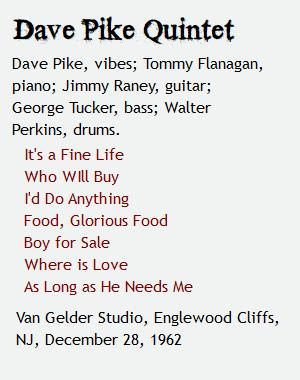
As promised, a new Dave Pike with this, his third and last album for Prestige. Pike would re-invent himself often, like so many jazz musicians in this swiftly moving art form, from Miles Davis on. This, however, is not so much a reinvention as a shift in emphasis, away from the Latin rhythms, on to a more mainstream sound. How much of this was the result of commercial considerations, I can't say. If commercial considerations were the whole story, nobody would be playing jazz, but sometimes a thematic approach -- less tactfully, a gimmick -- may be a way to draw a little more attention to an artist, and sell a few more records.
Nothing wrong with that if, when you get down to making the music, you're there to play and nothing else. Which certainly seems to have been the case with Dave Pike. If you sign a recording contract at height of the bossa nova craze, and management says "Hey, how about a bossa nova album," you might do it just for the contract. That was the case when Bob Weinstock asked Annie Ross if she could write some songs to jazz solos--"I was desperate, so I said 'Sure.' If he'd asked me to learn how to fly, I would have said 'Sure.'" And the rest is history. Two of the greatests jazz vocalese pieces ever -- "Twisted" and "Farmer's Market." And Lambert, Hendricks and Ross. But it seems clear that Pike didn't do it just for the contract. Had that been the case, he wouldn't have chosen to feature the works of obscure (in the United States) composer Joao Donato.
Jazz interpretations of Broadway shows had shown some commercial appeal. Oliver! had been a hit in London, had been on tour in the United States, and was about to open on Broadway, where it would be a success, but would not really spawn any hit songs. "As Long as He Needs Me" had been a British hit for Shirley Bassey, and would later become a minor hit for Sammy Davis Jr. I'm not convinced that a jazz version of Oliver! was a surefire commercial bet in 1963, and I suspect one might not find all that many people today who could hum "As Long as He Needs Me," let alone the rest of the show. So I hope it was a project that really appealed to Pike.
A confluence of reasons--not a huge Oliver! fan base among the jazz crowd, the association of Pike with more out-there genres of music--have converged to make this a not widely remembered album. Also, when one thinks of the vibes in the context of the history of jazz, there's a bit of a temptation to enumerate Lionel Hampton and Milt Jackson and then stop. But there were a lot of very good players, and a lot of individual stylists, and several of them were on Prestige. Teddy Charles, back in the label's early days, who would give it all up to become a charter boat skipper. Lem Winchester, the jazz-playing cop, dead before his time. Walt Dickerson. And Dave Pike. Here, his work with Jimmy Raney and with Tommy Flanagan, two veterans who know how to challenge and support a young player, is well worth a listen.
Dave Pike Plays the Jazz Version of Oliver! is not represented on YouTube by any individual cuts, so I can't give a Listen to One, but the whole album is there, and worth checking out.
Don Schlitten, new to Prestige, produced. Schlitten had started an independent label, Signal, in 1955, then moved on to freelance producing after he and his partners sold the label to Savoy.
Dave Pike played the jazz version of "As Long as He Needs Me" for a 45 RPM single, with "Where is Love?" as the B side. The album was released on Moodsville.
Pike's next two albums, for Decca and Atlantic, are notable for introducing Chick Corea on the first, and employing the still-new Herbie Hancock on the second.
During the pre-rock and roll era of American pop music, there were, very generally, two types of singers: the jazz-influenced singers like Bing Crosby and Nat "King" Cole, who were, more or less, popularizers of Louis Armstrong, and the bel canto-influenced singers like Tony Martin and Jerry Vale, who were, more or less, popularizers of Mario Lanza. And there was a deep divide between them, bridged by no one except possibly Dean Martin (Frank Sinatra and Tony Bennett were Italian, but they were definitely in the jazz-influenced camp).
So, could the divide be crossed by a tenor saxophone player with a jazzman's touch and rhythm and blues in his soul? Willis (Coda di Alligatore) Jackson seemed to think so, as he devoted virtually a whole album to jazz renditions of Italian pop songs.
LISTEN TO ONE: Al di La
It worked better than you might think. The rhythm and blues honkers tended to have a sweet sentimental side, perhaps modeled on Earl Bostic, and the Italian ballads fit into that. Most of this album is unavailable online, so I wasn't able to hear how Jackson handled "Volare," for example, but I did listen to his "Arrivederci Roma." That's a melody that's hard to listen to without hearing Eddie Fisher crooning it or Mario Lanza giving it the full melodramatic treatment, even though it does start out with a Latin rhythm from Montego Joe, but once Jackson begins improvising on it -- no, make that once he really gets into improvising
on it -- its jazz possibilities open up. "Arrivederci Roma" on the album is 5:43 in length; the 45 RPM single version is edited down to 2:28, and that's the version which is currently available on YouTube.
Technology had certainly advanced to the point where you could have fit 5:43 onto a 45 RPM record, so why shorten it it into what in those days would have been called the Readers' Digest condensed version? My guess...that's what the market wanted. The market in those days was radio play, which meant the pop music stations or the Black-oriented stations on your AM dial. FM radio, and songs like "Like a Rolling Stone" or "MacArthur Park" or "Alice's Restaurant" were still in the future, and your radio stations wanted manageable chunks of music between the disc jockey patter and the commercials. Jukeboxes wanted something you could dance to for three minutes or less before putting another nickel in. And presumably it was assumed that the customer putting that nickel in the slot to hear Willis Jackson wanted to hear Willis Jackson, because the 45 RPM condensed versions of jazz album cuts tended to excise everything except the featured soloist. So no Bucky Pizzarelli, authentic Italian-American though he was, no Gildo Mahomes.
The other cut I was able to listen to is "Al di là," which had been that year's Italian entry in the
Eurovision Song Contest (it finished 5th). Eurovision was still relatively new in 1962, and its entries are, even to this day, not guaranteed much stateside audience (unless they're by Abba), but "Al di là" hd gotten some attention when Connie Francis recorded it as the B side of a minor hit, and it worked for the theme of the album, and was the occasion for some very nice guitar-saxophone interplay. Jackson, with Jack McDuff and Bill Jennings, was one of the originators of the saxophone-guitar-organ soul jazz sound, but this is an altogether different way of blending these two instruments.
Bucky Pizzarelli and Gildo Mahones had both recently made their Prestige debuts, Pizzarelli accompanying Etta Jones and Mahones with Ted Curson. Pizzarelli would have a couple more sessions over the next few years accompanying singers, but most of his acclaimed career would be elsewhere. Mahones would stay longer in the Prestige orbit, including three albums as leader.
Neapolitan Nights was released on Prestige--not Moodsville. "Arrivederci Roma" was the A side of a single which had "Y'All," from a very different session, on the B side. More thematically paired was another single, "Mama" (which had been a 1959 hit for Connie Francis) and "Neapolitan Nights."
Ozzie Cadena produced.
The one Jackson original title on the album was "Verdi's Vonce," Jackson's blues tribute (according to the liner notes) to Verdi. I would love to hear it. It was also included on a compilation album called Soul Stompin': The Best of Willis Jackson.
Dave Pike continues his south of the border explorations, this time moving to the Caribbean. The calypso craze of Harry Belafonte and the Tarriers and even Robert Mitchum, who recorded a calypso album in 1957, had passed its zenith, but Latin dances were still enough of a thing that everyone was looking for a new one to follow the mambo and the conga line and the cha cha and the bossa nova, and even though Trinidadian calypso wasn't exactly Latin, it was close enough for pop culture (there had even been a "cha-lypso" -"When the records start a spinnin', do cha-lypso while you chicken at the hop"), so 1962 saw Chubby Checker, who had ridden the crest of the most popular dance craze of all, hitting the charts with "Limbo Rock."
Dave Pike had captured some attention with his Bossa Nova Carnival album, so why not go after the same lightning again--and again with fledgling producer Eliot Mazer? There was certainly some commercial consideration here. Chubby
LISTEN TO ONE: My Little Suede Shoes
Checker's "Limbo Rock" is covered, as are "Matilda" and "Jamaica Farewell," two of the most popular songs from Harry Belafonte's Calypso album, then regarded as the most popular LP record of all time, and still up among the contenders. Mexican-American Richie Valens's hit "La Bamba" is included, as is Nat "King" Cole's semi-hit "Calypso Blues." Sonny Rollins is represented by "St. Thomas," one of the calypso melodies he would make his own, and "Mambo Bounce," which had been a 78 RPM single for Rollins off an early Prestige session. And four songs from Pike's session became 45 RPM singles.
But "commercial consideration" just means choosing and playing songs that people like, and there's nothing wrong with that, if the musicians come to play, and put their full virtuosic dexterity and creative energy into the project, which is what happens here.
"Limbo Rock" isn't the most subtle of melodies, but with Willie Bobo and Ray Barretto handling the percussion, it's lively and fun to listen to. Throughout the session, Pike alternates between vibes and marimbas -- he chose the marimbas, he explained to Juliet Lorca, who wrote the liner notes for the album, because they have a sound that's close to Trinidad's steel drums.
On the other extreme, there's Charlie Parker's "My Little Suede Shoes." Some have theorized that Parker adapted the melody from a Caribbean folk tune--Juliet Lorca suggests as much in the liner notes--but it's more likely a mashup of two French pop songs which Bird heard on a 1950 trip to Paris. One of the songs, ""Le Petit Cireur Noir," has a lyric about shoeshine man who hates suede shoes because everyone is wearing them and he's being put out of business. But then he finds a wallet stuffed with cash, buys his own shoe store, and gets rich selling suede shoes. There's no mention as to whether any of them are blue. Parker's melody--recorded with Luis Miranda on bongos and Jose Mangual on congas--is wonderfully catchy, and full of island spirit. It's a perfect choice for Dave Pike and his group, and it's a can't miss recording.
If "Limbo Rock" and "My Little Suede Shoes" are miles apart musically, they're also some distance apart in terms of orchestration. The percussionists remain, but the rest of the band -- Leo Wright on reeds and Jimmy Raney on guitar--are gone. Tommy Flanagan moves in on piano, and Ahmed Abdul-Malik replaces George Duvivier on bass.
Dave Pike was, of course, not Latin himself, and he would not remain on a Latin kick. His next album (and the last for Prestige) would go in a markedly different direction, and the rest of his career, lasting throughout the rest of the century, would take some remarkable twists and turns, through free jazz, acid jazz, funk and psychedelia. So is this cultural appropriation? That was, of course, a concept that would not be named or defined for many decades to come. Dave Pike isn't Machito or Tito Puente, but nobody is. He did turn the spotlight on a wonderful and little-known (in the States) Brazilian composer on the first album, and he has a lot of fun with some pop songs and a great Charlie Parker composition, and to quote Paul McCartney, "What's wrong with that, I'd like to know?"
"Jamaica Farewell" / "Limbo Rock" was the first single, and "La Bamba" / "My Little Suede Shoes" was the second. The album, on New Jazz (a little surprisingly--I'd thought of New Jazz as primarily a home for the less commercial fare) was called Limbo Carnival.
He would spend much of his career in Europe, not so unusual for a jazz musician, a little more unusual for a white jazz musician.
Ted Curson is one of that generation that made Philadelphia such a cauldron of jazz in the 1950s. The Heath family lived around the corner from and Albert "Tootie" Heath was a classmate. "On Sundays," Curson recalled (in an AllAboutJazz.com interview with Clifford Allen, "Mrs. Heath would make dinner for any musicians who were coming to Philadelphia. You could see anyone from Miles to Duke Ellington to Sonny Rollins."
But it wasn't these greats who first lured young Ted into music. It was a neighborhood guy who wandered the streets selling newspapers, and carrying a silver trumpet. When he told his father he
wanted a trumpet, the old man, a Louis Jordan fan, tried to talk him into an alto saxophone, but Ted held firm. He got his first trumpet at age ten, started playing professionally at age 16 and not long after that, met Miles Davis. In those days, Curson told Allen, he worshipped Davis:
[I was] wearing my hair like Miles, I had a tie around my waist, I even made the mistakes that he made. I liked his approach to everything and I still do. He heard me play when I was around 15 or 16 and he gave me his card and he said 'if you ever come to New York, give me a call.' There was no conversation - he said that and left - and I kept that thing in my pocket for years. After I graduated, it was about three years before I finally moved there [at age 21] and I called up Miles. Miles said 'Ted Curson, that little guy from Philadelphia? We've been waiting for you for three years! Where the hell have you been?'
This was, of course, in the Prestige days, when Miles was still allowing himself to make mistakes.
Curson drew the interest of the Levy brothers, owners of the Birdland jazz club and Roulette records. He was to make his debut at Birdland, and his audition for Roulette, on the night that Mo Levy's brother Irving was shot and killed right outside the club.
Instead, Curson served an apprenticeship in New York's avant garde. He played with Cecil Taylor, and appeared on one Taylor record for United Artists. He drew the attention of Charles Mingus, or more accurately was brought to Mingus's attention:
I got a phone call from a friend of mine and he said "I got a call from Mingus and I don't want to play with that crazy motherfucker. You want to take my place?" It was in Teddy Charles' loft, and there were a 1,000 or something musicians in there jamming, and I met Mingus and we played and everybody dropped out and that was it. He said "maybe one day I'll call you" and about two or three months later I get a call at about midnight and it's Mingus. "Ted Curson? Charlie Mingus here. You start right now. I'm at the Showplace in the Village and as soon as you get here, you go to work." I got there and he said "Okay ladies and gentleman, here's your new band - Ted Curson and Eric Dolphy - and you other cats are fired!"
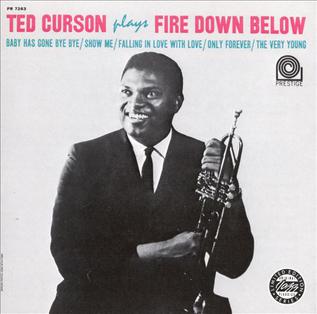
He made his debut as a leader in 1961, fronting an all-star group comprised of Eric Dolphy (on two tracks), tenor saxophonist Bill Barron (who would have a long association with Curson), Kenny Drew and Jimmy Garrison. Drumming, on different tracks, were Pete La Roca, Dannie Richmond and Roy Haynes. The album came out on Old Town, a New York rhythm and blues and doowop label that had no jazz presence at all (Arthur Prysock was one of their featured artists, but he as being pitched to the rhythm and blues market in those days) and almost no LP presence, so it was heard by very few (although you can hear it now on YouTube). So for all practical purposes, this Prestige album was his real breakthrough.
The Prestige album is called Ted Curson Plays Fire Down Below, which seems to suggest that there was an audience out there just waiting to hear the latest version of "Fire Down Below," which is even less likely than the possibility than a legion of jazz fans waiting to hear the latest Old Town release. "Fire Down Below" was composed by Lester Lee, a Hollywood journeyman with a raft of movie soundtrack songs to his credit (including a bunch of polkas), but very little of interest to jazz performers.
Curson makes something eminently listenable out of the Caribbean-tinged melody, originally written for a Robert Mitchum / Jack Lemmon thriller with a Caribbean setting, and maybe part of his youthful hubris in introducing himself to the jazz public involved showing what he could do with tunes no one else had looked twice at.
If so, he did a hell of a job. Two of the tunes are recognizable standards, Lerner and Loewe's "Show Me" from My Fair Lady, and Rodgers and Hart's "Falling in Love With Love." Well, standards. I'm not sure Henry Higgins would have recognized what Curson and Co. do with "Show Me," although Eliza Doolittle, sick to death of the genteel reserve of the society she has been elevated into, might have appreciated the propulsive drumming and all-out solos of Roy Haynes and Montego Joe.
The rest are a curious lot. Harold Little ("The Very Young") is a trumpeter and composer about whom I could find very little. Robert Allen ("Baby Has Gone Bye Bye") carved out a career as an accompanist for Perry Como, Peter Lind Hayes and Arthur Godfrey, so he can't be counted among the hippest of the hip. "Only Forever," composed by James V. Monaco, was a modest hit in 1940, from a Bing Crosby film, and Monaco does have one sublime song to his credit, "You Made Me Love You," made famous by Judy Garland. So it's not the material, it's what Curson does with it, and what he did with it announced his presence as a new major talent on the jazz scene.
Roy Haynes and Montego Joe added a lot to this session. George Tucker was a reliable bassist. Gildo Mahones would go on to do more work for Prestige in the decade, including a couple of albums as leader, so I'll save a fuller discussion of him for later. At the time of this session, he was working with Lambert, Hendricks and Ross.
"Fire Down Below" was the title song for the Prestige album, and it was also the 45 RPM single, with "The Very Young" on the flip side. Ozzie Cadena produced.
Shirley Scott would continue to be a cornerstone of the Prestige franchise throughout the 1960s, and Prestige would continue to showcase her in various settings, so as to get as much product as possible out under her name, during this fertile period of her career. So there would be trio recordings, organ-saxophone recordings, and recordings with other combinations.
The organ-saxophone recordings, which had been so popular when she was teamed with Eddie "Lockjaw" Davis, would now continue with new husband Stanley Turrentine, and these too would be double-dipped. Turrentine was a Blue Note artist, so the two would record for Prestige as the Shirley Scott Quintet and for Blue Note as the Stanley Turrentine Quintet.
For her trio recordings, Scott did not stay with the same trio. Her compatriots on this session, Earl May and Roy Brooks, were working with her for the first time, and in the case of May, the only time. Brooks did join her for one more session.
Also worth mentioning is the makeup of her trios. Many organists did not work with a bass player, preferring to let the organ handle the bass line. Jimmy Smith, who is primarily responsible for making the jazz organ a prominent part of the era's jazz presence, always worked with a guitar and drums, and many others followed his example. Scott nearly always worked with a bass.
Earl May is probably most remembered for his work with Billy Taylor throughout the 1950s, including six albums for Prestige. He also did Prestige sessions with John Coltrane and Sonny Stitt, and worked widely with a broad spectrum of jazz groups, Broadway show bands, and other venues into the 21st Century.
Roy Brooks, a Detroiter who began his career with Yusef Lateef and also worked with Motor City stalwarts Barry Harris and the Four Tops, saw a career of prodigious accomplishment interrupted more than once by battles with mental illness, but out of his instability came some inventive musicianship, such as "an apparatus." described by Jason Ankeny at allmusic.com, "with tubes that vacuumed air in and out of a drum to vary its pitch."
No drum innovations here, but some solid drumming. Scott is always inventive, always looking for different organ sounds, which may be why she works with a bass player, to give her that freedom to experiment, and to keep a light, swinging touch along with her experiments. This is a good outing for Scott, with some familiar tunes, including the Fats Waller classic "Jitterbug Waltz," which is my Listen to One, but you'll have to find it yourself, as it's not up on YouTube. Also three from Richard Rodgers, one the optimistic "Happy Talk," from South Pacific and the Oscar Hammerstein collaboration, the other two from his earlier days with the wry and bittersweet Lorenz Hart.
Happy Talk was the name of the Prestige release. A rerelease a couple of years later was called Sweet Soul. There were two 45 RPM singles -- the lighthearted "Happy Talk" / "Jitterbug Waltz" and the bittersweet "My Romance" / "Where or When." Ozzie Cadena produced.
A short session for Miss Jones--one song to fill out Hollar!, being readied for release, and three for a future project. She would be back in the studio in early 1963, and the three sessions together would make her last recording sessions for Prestige, to be issued as Love Shout, which was actually released before Hollar! Why these titles for these two albums is anyone's guess, as Jones was a singer, not a shouter. But then, a lot of the marketing decisions over the course of her long career may not have been the best ones, as her reputation has always seemed to lag behind her talent.
This is an interesting session in terms of song selection, leaning toward songs on the sweet end of the spectrum, not necessarily the first choices for most jazz singers--although other songs from not exactly hipster sources, like Sigmund Romberg and Rudolf Friml, have become jazz standards.
The session begins with Rodgers and Hammerstein's "If I Loved You," from Carousel, a much-loved standard for pop singers, bel canto and even operatic voices, not so many jazz singers. Doo wop singers of the 1950s breathed new life into a lot of standards and show tunes, but not this one--perhaps it was too resistant to a rhythm and blues spin. Dinah Washington recorded it twice, and Sarah Vaughan once. Dinah's first in 1950 with an orchestra led by drummer Teddy Stewart, and some melodramatic, almost coloratura, belting. the second a decade later with Quincy Jones. Both featured lush strings and an orchestral mood, as did Sarah's--I don't know the arranger or orchestra leader.
It goes without saying that both Dinah and Sarah can do no wrong with a song. Etta may not quite have the vocal chops of those two ladies, because no one has (except Ella, of course), but I do believe that Etta has the definitive jazz interpretation. She swings it, with a killer assist from Jerome Richardson on flute. Etta has always had the unique ability to channel other jazz singers without sacrificing her own individuality, and she does that here, starting out the way Dinah might have if she'd had Richardson, Kenny Burrell and Bucky Pizzarelli swinging her along, but then taking it to places that are pure Jones. For jazz, she owns this tune.
"Hi Lili, Hi Lo" was written for the Leslie Caron / Mel Ferrer movie Lili by composer Bronislau Kaper and Helen Deutsch, the film's screenwriter and not otherwise a lyricist. It was a 1952 hit for Dinah Shore before the movie came out, then everlastingly associated with the character of the sweet, innocent orphan who talked to puppets. It became a standard, mostly for girl singers with sweet, innocent voices, like the Lennon Sisters, the Chordettes, or Teresa Brewer--although Jimmy Durante also sang it (a weird masterpiece), as did the Everly Brothers (mistake), Manfred Mann (mistake), and Gene Vincent (oddly enough, not so bad). But jazz singing is mostly not about sweetness and innocence, although one of the great jazz vocals of all time is pure sweetness and innocence--Ella's "A-Tisket, a-Tasket," which works so well because there's no knowing wink behind it.
Jones respects the sweetness of "Hi Lili, Hi Lo." There's no knowing wink behind her rendition. But there's musical sophistication in the guitar parts especially, and if she doesn't swing it the way she does "If I Loved You," she gives it a nice bluesy touch.
Nat "King" Cole was never an innocent orphan who talked to puppets, for all his silky voice, and his
"Nature Boy" was a song about an innocent, not a song of innocence. It's a prodigiously recorded song -- nearly 600 versions, with lyrics translated into a bunch of languages including French, Italian, Portuguese, and three different Finnish translations, and yet it remains always Nat "King" Cole's. Etta Jones won't change your mind about that, but her knowing, smoky version, shorter than any of the other songs on this session, has its own very real words, not the least of them being Jerome Richardson's sax solo.
There's no question about the jazz credentials of "A Gal From Joe's" -- it was written by Duke Ellington, and his original 1938 recording features a memorable Johnny Hodges solo. And it's a good tune, but one that never caught on the way so many Ellington songs have -- in fact, Jones's 1962 recording was the first to feature a vocal. Nina Simone would record it a couple of years later, and her version is the best known. Contemporary singer Deborah J. Carter has recorded it, and that's about it. The lyric, credited to Ellington's manager Irving Mills, is odd -- is the gal leaving Joe's because she's dying? Because she's been arrested for murder? Or just because she's tired of Joe? Anyway, Jones does a fine version of a tune that deserves more attention than it's gotten, with wonderful solo and ensemble work from the musicians.
Also on this gig -- Sam Bruno, playing both organ and piano, although he's probably better known as a bassist; Ernest Hayes on bass (can't find any other credits for him, unless he's Ernie Hayes the piano player--he's certainly not Ernest Hayes the bass fisherman); and Bobby Donaldson, who's made several Prestige sessions, including a few backing up vocalists, and who brings a lot to this date.
Three of the four songs made it onto 45 RPM releases. "Nature Boy" and "Hi Lili, Hi Lo" were one entry. "A Gal from Joe's" was paired with "Some Day My Prince Will Come," from one of the later sessions. Esmond Edwards had brought Jones to Prestige, but Ozzie Cadena produced this and the later Love Shout sessions.
Eddie "Lockjaw" Davis's partnership with Shirley Scott was a key milestone in the development of the tenor sax/organ sound that came to play such a dominant role in 1960s jazz. Scott moved on to another partnership, this one involving marriage, with Stanley Turrentine.
Davis would mostly move in other directions, but he did return to the organ combo mode for this lengthy session, picking up a trio that had worked together extensively in the past. Don Patterson, Paul Weeden and Billy James had even made a record together in Chicago, for Cadet. Patterson and James would go on working together throughout the decade, as Patterson became one of Prestige's most prolific recording artists.
Paul Weeden was an Indianapolis native who was friends with another young homeboy, Wes Montgomery, and together they developed the thumb-plucking style of jazz guitar that Montgomery was to take to such heights. Moving on from Indiana to Philadelphia and New York, he joined up with Patterson and James, and the three of them, in addition to playing as a trio, started working with horn players. They are on the Sonny Stitt/Gene Ammons Verve album, Boss Tenors in Orbit, and also worked with Stitt on albums for Roost and Riverside's Jazzland subsidiary.
Weeden would choose the expatriate route, moving first to Sweden, where he taught at the University of Stockholm, and then to Norway, where he would spend the rest of his life, recording over 20 albums. He did spend some time with the Count Basie orchestra, stepping in when Freddie Green died in 1988.
The group had started out as the Paul Weeden Trio, but when he left it became Don Patterson's group,
with Billy James his partner on drums, and they would record 16 albums for Prestige during the 1960s, featuring such horn players as Booker Ervin, David "Fathead" Newman, Blue Mitchell and Sonny Stitt. Pat Martino became a frequent collaborator on guitar, and Grant Green worked with them later in the decade. They also -- with Martino -- made Prestige albums with Sonny Stitt and Eric Kloss.
Patterson, Weeden and James certainly knew how to play together, and they knew how to play with a saxophone. Davis knew how to play with this lineup, and he knew how to jam. And as Paul Weeden's son Ronald told an interviewer, about his father's recordings:
The greatest ones in his opinion he ever played in were the jam sessions where the artist would just come in and play. They may have done a gig all night long and they would come in play into the wee hours of the morning.
That was Prestige. And that was this group of musicians. The tunes were almost all familiar standards, and once they found a groove for a tune, they could work it. And once they found a groove for a session, they could go all day and all night--which they very nearly did, recording 13 tunes -- 14 if you count an early-in-the-session unissued version of "Beano," discarded after they did a presumably more satisfying version of the Davis original later on.
The grooves were set by James and veteran bassist George Duvivier. Often, organ combos don't bother with a bassist. Rhoda Scott recalled that the leader of the first group she played in as a teenager was glad to get her an organ, rather than a piano, because the organ could carry the bass part and he didn't need to pay another musician. But in this case, Duvivier is an invaluable asset.
He and James drive the group, and they drive 'em hard. There's no wistful romanticism in a tune like "I Only Have Eyes for You" or "The Way You Look Tonight," one of my favorite wistful romantic tunes, but in this case I'm happy to let these guys rock out, and ride along with them.
There's not much subtlety here, but you wouldn't want it. There's great virtuosity, and above all, there's great communication. The solos all find new and satisfying avenues of inventiveness and expressiveness, without ever losing that drive and coherence.
Ozzie Cadena produced, and my guess is that his main job was to say "Don't stop...keep going...let's do one more!" until they had enough for two albums. The first was called I Only Have Eyes for You, and was credited to Eddie "Lockjaw" Davis with the Paul Weeden Trio. The second, Trackin' (Prestige continued to love those gerunds with the "g" cut off for titles), was Davis alone.
"I Only Have Eyes for You" had been a huge pop hit for the Flamingoes in a doo-wop version that quickly became the definitive version of the song, and Davis's group doesn't try to compete, swinging it hard instead, but that was reason enough to make it the first 45 RPM release from the session, along with "Sweet and Lovely." it was followed by "Robbins Nest" / "A Foggy Day," and then "Beano," Parts 1 and 2.
Willis Jackson becomes the latest Prestige artist to hop on the bossa nova bandwagon...sort of. The album is three tunes by Latino composers, two popular songs of the day, and one Jackson original. But I wonder if Prestige's marketing department was paying much attention to the product in this case. The three Latin tunes -- "Cachita," "Amor" and "Mama Inez" -- are all by Cubans. "Mama Inez," in fact, as "Ay, Mama Ines," composed by Eliseo Grenet, is a Cuban archetype. A 1933 article in Vanity Fair describes it thus:
The song of Cuba—a hundred dark throats have sung it; a thousand brown feet have danced it. O Mother Inés . . . all the Negroes drink coffee, drink thick black coffee. 0 Mother Inés, where are you hiding? We have searched for you everywhere and we have not found you. We have searched for you in the tough districts of Jesu-Maria—and we have not found you. Oh Cuba, my mother, my sister, my beloved!
English language lyrics by L. Wolfe Gilbert are credited by many with popularizing the rhumba in North America. Here are some of them:
Oh, Mama Inez,
Oh, Mama Inez,
They hum and strum,
That's the rhumba for you.
Oh, Mama Inez,
Oh, Mama Inez,
Though others come,
Their "The Rhumba" won't do.
When I first saw the shebango,
I fell so hard for the tango,
But now this brand new fandango's got me
Like nothing's got me before!
Oh, Mama Inez,
Oh, Mama Inez,
No Cuban rum's
Like the rhumba for me.
Grenet fled Cuba after some of his song lyrics were seen as subversive by the Machado regime. He went to Europe and then to the United States, where he opened his own nightclub on 52nd Street, El Yumuri, where he is credited with introducing the conga to the US.
Montego Joe and Juan Amalbert were both native New Yorkers, Joe (Roger Sanders) African American, and Amalbert, later Emmanuel Abdul-Rahim, with a Puerto Rican father.
So, adding that all up: bossa nova? Not hardly. Kenny Burrell adds a couple of nice samba licks, but that's about it.
Do we care? We do not. This is wonderful music, a mixture of the mainstream jazz of Willis Jackson
who, like so many of the musicians who came out of the rhythm and blues subset of jazz, is unfairly overlooked, and Latin jazz, generally disgracefully overlooked by mainstream audiences. Ranker.com, a website where contemporary participants vote for the greatest this or that, lists Jackson at number 151 on their list of greatest saxophone players, and that's only because I added him. DownBeat's reader polls of this era, the era of the mambo and the cha-cha and the bossa nova, completely overlook Machito and Puente, Prado and Cugat, even in their dance band category. Allmusic.com's reviewer Ron Wynn gives the album four stars, with the note, "His second great album that year," so somebody is listening,
And for all the sales that Willis Jackson generated for Prestige in this era, somebody wasn't taking him seriously enough. Hence the marketing division's decision to market this as a bossa nova album, with bargain bin graphics on the front cover, and liner notes that must have been written by someone from the mailroom. Jose Paulo is listed in the session logs from jazzdisco.org as playing congas and timbales, on the back sleeve of the album as playing guitar. Jazzdisco isn't always right, but they're probably around 98 percent right, and since all of Paulo's other credits are percussion, I'm going to go with them. Allmusic.com credits him on bongos, congas, guitar and timbales, but they're not always right either.
"I Left My Heart in San Francisco" is given the full-on Latin treatment. "What Kind of Fool Am I?" is more a straight-on ballad, and "Shuckin'" is Jackson playing Jackson, with Eddie Calhoun and Roy Haynes doing the rhythmic work. Calhoun was Errol Garner's regular bassist from 1955 through 1966 (he's on Concert by the Sea), and did very little other recording. Shuckin' became the title of a rerelease of the album, this time with liner notes by Philadelphia disc jockey Del Shields, mostly griping about how Willis Jackson doesn't get the respect he deserves from jazz snobs. Unfortunately, he was right.
"What Kind of Fool Am I?" and "I Left My Heart in San Francisco" were the 45. The album was a Prestige release, Ozzie Cadena producing.
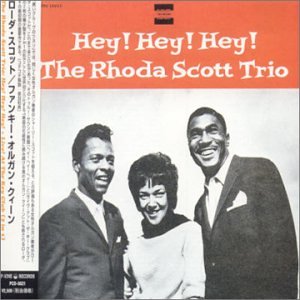
This is the continuation of Rhoda Scott's June 29th session, filling out her first Prestige album. We don't know if she kicked off her shoes when she sat down at the Hammond B3 in Rudy Van Gelder's Englewood Cliffs cathedral of recorded sound, but we can assume that she did, as that was the only way she felt comfortable at the organ. That was true when she was a barefoot kid first sitting down at the organ in her father's church--or any one of several churches, as the African Methodist Episcopal Church sent him where he was needed. It may have been true when she was getting her Master of Music degree from Manhattan School of Music, although they may have cracked down harder on the formality. It was certainly true in Europe, where she built a career of international stardom,
and where she continues to play to acclaim at festivals, theaters and arts venues, as "l'organiste aux pieds nus."
She started playing professionally when, as she told Marc Myers of JazzWax,
a guy in my church choir asked me to fill in for the piano player in his band. I told him that I didn’t know how to play that kind of music. He said it didn’t matter, he just needed someone...It turned out I knew all of the songs in their book from listening to the radio, so I had no problem.
When she started her own group in Newark, it was with Joe Thomas and Bill Elliott. The trio quickly caught on, and caught the ear of Ozzie Cadena. She also caught the ear of Count Basie, who hired to play at his Harlem night club. Stardom was beckoning, but so were her studies at the Manhattan School of Music, and the Masters degree won out. Stardom would have to wait until she arrived in Europe--at first also to study, with Nadia Boulanger.
Leonard Gaskin, usually a bassist, takes over on guitar for this session, but otherwise her group is the same Joe Thomas on tenor sax, Bill Elliott on drums. Scott favors a more straight-ahead style than the all-out funk of Brother Jack McDuff, and the contrast is enjoyable.
Hey! Hey! Hey! was released on Tru-Sound, as were the two 45 RPM singles, "Fly Me to the Moon" / "In My Little Corner of the World," and "Sha-Bazz," parts 1 and 2. Ozzie Cadena produced.
This is the first time that Jack McDuff is identified on the record label and sleeve with the sobriquet he was to use for the rest of his career. He's Brother Jack McDuff, and he's pulling out all the stops on that powerful church organ sound to make music that is pure funkadelic--screamin' that funky music, as the album's title suggests.
This time he has Kenny Burrell as the other half of that now-popular guitar-organ sound. Joe Dukes, his regular drummer, is on board, and they are joined by Leo Wright, a Texas-born player who had begun making a name for himself in the orchestras of Charles Mingus and Dizzy Gillespie, and who had also recorded with Burrell. Wright would do some
good work in the early 1960s, including a few more sessions with Prestige. He also made records on Impulse!, Verve and Blue Note, before decamping for Europe, where he took the expatriate route. It meant that he's now not much remembered except by the most encyclopedic jazz fans, but who's to say he was wrong? Red Garland went back home to Texas out of a feeling that rock had taken over the American consciousness, but he had already established a major reputation. Wright probably made a living in Europe that he would not have been able to equal here, unless he did what a number of musicians did, playing with Dixieland bands at Disney World, or got regular Broadway show pit work like Wendell Marshall.
There were a number of guitarists, like Thornel Schwartz, who made a specialty out of playing in organ-guitar combos, and Burrell certainly isn't one of them. He plays Kenny Burrell guitar alongside the screamin' funk of McDuff and Wright, and makes it work--jazz is probably unparalleled in its
hospitability to unlikely combinations of musicians.
McDuff plays two originals and four standards: Count Basie's "One O'Clock Jump," Avery Parrish's "After Hours," and two songs most vividly associated with singers. Lots and lots of people of singers have covered "I Cover the Waterfront," but no one quite like Billie Holiday. Nellie Lutcher wrote and performed "He's a Real Gone Guy," and while hardly any singers have covered Lutcher's original, the tune has had some popularity with jazz instrumentalists.
McDuff and his group cover a lot of stylistic ground here, but they really nail it with the flat-out screamin' of the title, and the best screamin' numbers are "One O'Clock Jump" and "He's a Real Gone Guy."
Screamin' was a Prestige release, Ozzie Cadena producing. "He's a Real Gone Guy," parts 1 and 2, was the first 45 RPM single, followed by "Screamin'" b/w "Somethin' Slick," from McDuff's next session.
This is Red Garland's 39th album for Prestige, either as leader or sideman, and no, that's not too many. Garland always delivered, either as part of an ensemble, leader of a trio, or solo. He began as a member of the original Miles Davis quintet, and in 1956, on one of the Contractual Marathon sessions, Miles and John Coltrane sat out and let the trio play a number, as sort of an audition for Bob Weinstock. It worked: after Miles left for Columbia, Weinstock signed Garland, Paul Chambers and Art Taylor to continue to record for Prestige.
Garland returned to Prestige after making four albums for Riverside subsidiary Jazzland, for what would be not only his last Prestige session, but his last recording for the next decade. When the Beatles invaded America, he saw the handwriting on the wall for jazz, and went back to Texas to take care of his invalid mother. He would make a comeback in the 1970s, recording a number of albums -- some for Galaxy, a subsidiary of Fantasy, which by this time owned Prestige, and some for Muse, a label started by one-time Prestige executive Joe Fields.
Garland's albums were always distinguished by his eclectic choice of tunes, and this one was no exception, as here he gives us a cross section of familiar tunes that have hardly been touched by musicians from the progressive jazz fraternity. Too familiar? Too corny? Not the way Garland, Wendell Marshall and Charlie Persip play them.
He starts out with the Al Jolson standard "Sonny Boy," written by DeSylva, Brown and Henderson, giving the tune rather more subtlety and thoughtfulness than Jolson ever gave it.
"My Honey's Lovin' Arms," composed by Joseph Meyer, also dates back to the Jolson era. Originally recorded by Isham Jones in 1922, it's become a staple over the years, but a staple of traditional and Dixieland groups. I can't find a record of any other modern jazz artist recording it. Garland relishes the corny but catchy melody, hits that downbeat, and still turns it into something altogether different, with the powerful collaboration of Persip.
"St. James Infirmary" is the old familiar blues ballad, and it's been recorded by everyone from jazz musicians to blues singers to folkies to rock and rollers to country singers, and even a Latin band (Perez Prado). But again, Garland stands out as one of the rare -- and probably the first -- modern jazz musicians to give it a whirl. As with "My Honey's Lovin' Arms," he starts out in a traditional style, nudged on by Wendell Marshall, and then proceeds--with Marshall and Persip--to make something new.
"I Ain't Got Nobody" goes back even further, to 1915, composed by Spencer Williams. New Orleans born, New York bred, ultimately European expatriate. The song became a huge hit in 1956 when Louis Prima recorded it as part of a medley with "Just a Gigolo." Prima and Sam Butera put it on an album called The Wildest; Garland, Marshall and Persip make it just as wild, in their own way.
"Baby Won't You Please Come Home" is another Spencer Williams tune, and a hugely popular one over the years. This one has had at least one other modern jazz version--by Garland's old boss, Miles Davis. Davis's version is dark and moody. Garland's isn't quite an uptempo romp, but the comparison of the two really brings home how much Garland likes these old chestnuts, and how much he enjoys playing them and making something new out of them.
The traditional spiritual "Nobody Knows the Trouble I've Seen" (first published in 1867 but much older than that) rounded out the album. One more song -- and one more old chestnut -- was 1927's "My Blue Heaven," which did not make the LP, which was titled When There Are Grey Skies, but was included on a later CD re-release. "Sonny Boy" and "Baby, Won't You Please Come Home?" were two sides of a 45 RPM single. Ozzie Cadena produced.
This session, half of a Bluesville LP that has a 1960 session with Lightnin' Hopkins on the other side, is vintage Sonny Terry. Brownie McGhee backing him up on guitar, Sonny handling harmonica and vocals. Vocals on three of the cuts, the other two Sonny's trademarked harmonica-and-whoop. It's Sonny in his prime, but his prime lasted a very long time. From his 1938 appearance in John Hammond's Carnegie Hall "Spirituals to Swing" concert to his featured solo in the 1986 movie Crossroads, recorded not long before he died, he did what he did, and he was a master.
This would be his last Bluesville session, and it's a good one
Of tangential interest -- the liner notes were written for Bluesville by Leroi Jones. whose book Blues People would be released at around the same time as the album, the first major study of American musi by an African-American author. Jones, who would become Amiri Baraka, had this to say of Terry:
Sonny wheels and deals, just as he always does, coming quite close, sometimes, to convincing any interested listener that his blues is really a new kind of expression, unheard of before this album.
"Callin' Mama" has one of Sonny's virtuoso touches, hardly unheard of before this album but always a crowd pleaser. At Brownie's urging, the harmonica plaintively pleads: "I want my mama."
Kenneth S. Goldstein is credited as producer on the album cover, Goldstein and Ozzie Cadena on Wikipedia's page. The Bluesville LP, Sonny is King, has this session on one side and a 1960 session with Lightnin' Hopkins on the other side. The Brownie side was recorded at an unnamed New York City location, the Lightnin' side, also featuring a jazz bassist and drummer, at Van Gelder Studio. So if I had to guess, I'd put Lightnin' with Ozzie and Brownie with Kenny.
This is Walt Dickerson's fourth and final album for Prestige. This is the work for which he remains best known. He would take a ten-year break from jazz starting in 1965, then return in 1975 to active playing and recording, a second act to his career that would last another decade. Most of these later recordings were for the Danish label Steeplechase.
Of his four Prestige sessions, this one is in many ways the iconic achievement of his career, partly because of its musical direction and partly because of its theme. Dickerson was always considered one of the most individual stylists on the vibes (his unique sound is discussed here), but in this album, abetted by long-time collaborator Andrew Cyrille, he strays farther from his bebop-oriented roots to create a freer and more distinctive personal style.
The album, entitled To My Queen, is also a deeply personal statement. The title track, which takes up one full side of the LP, is dedicated to his wife Liz, and the emotional resonance continues to move listeners. Dickerson talked about it in a 2003 interview with Hank Shteamer:
Well, there is a way to talk about a person that you find ineffable through music, and my queen [Dickerson’s wife, Liz], being that ineffable person, music was the way that I could express those very beautiful, poignant, intellectual, brilliant, beautiful sides of her. So therefore it couldn’t fall in the realm of most songs or most compositions in the genre but had to escape those restrictions in order to exemplify her. And it doing so, it did open up a new vista of explorations, followed later by several not-to-be-mentioned musicians. It was a very, very happy experience, and I go back to that periodically. I return to that periodically, restating that which is ongoing in our relationship, which is forever.
The individuals that I chose for that outing knew my queen, and their artistic projections spoke of that. Andrew Hill: beautiful projections. George Tucker [sighs]: a rock, sensitive. And of course Andrew [Cyrille]: flourishings, nuances, bracketing the different motifs; he was awesome, and remains to this day, as does Andrew Hill. Two awesome, creative musicians. I don’t consider them musicians; I consider them artists in the highest sense. They’ve surpassed that category, “musicians.” Periodically those are the individuals I miss because now I do more, just about exclusively, solo performances.
This was Andrew Hill's only appearance on Prestige. He's best known for his work on Blue Note in the
1960s, although he continued to play and record until shortly before his death in 2007. He was equally highly regarded as a composer, which gave him the ear and the "artistic projections" that Dickerson valued.
George Tucker was an interesting choice for this session. Much of his previous work on Prestige had been funky, with organists Shirley Scott and Johnny (Hammond) Smith, but he was also on call for avant-gardists like Eric Dolphy.
To My Queen was a New Jazz release. Esmond Edwards, who was getting ready to move on after a stunning career as a producer for Prestige, produced.
Richard Brody, summing up Dickerson's career in an obituary in The New Yorker, wrote:
Dickerson is, simply, the most innovative vibes player after Lionel Hampton and Milt Jackson; his rapid-fire barrage of short, metallic notes, reminiscent of John Coltrane’s “sheets of sound” and Eric Dolphy’s frenetic flurries (Dickerson and Dolphy were close friends), extracted surprising harmonic riches from familiar tunes, and often did so with a puckish humor that belied the tenderness with which he could caress a melody.
Finally, here's something Dickerson was never quite able to achieve, more's the pity. From a 1995 interview with Mike Johnston:
I have asked a couple of the individuals that make the instruments to make a set of vibes in only one or two octaves, and to break it down it down into quarter tones. So you would augment the instrument so the instrument would be twice the size. But, it would only be one or two octaves. And of course they looked at me like I was a bit crazy and said we’ll get back to you. But of course they never got back to me.
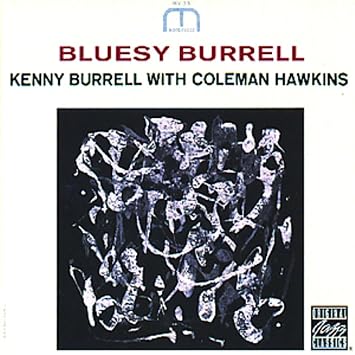
This is Coleman Hawkins' swan song to Prestige, and it's hard to imagine a better way to go than with Kenny Burrell. I've written extensively about both of them, and there's not much more to add, except that they mesh, and make beautiful musical together.
Hawkins comes in about halfway through the session, and is featured on"Montono Blues," "I Thought About You," "Las Palabras," and "It's Getting Dark."
The album is about evenly divided between standards and Burrell compositions, with one interesting choice--a tune that would become a standard of the jazz repertoire, but was only just being introduced. "Tres Palabras," by Cuban composer Osvaldo Farrés, had first been recorded in Cuba in 1943, but had never had a norteamericano rendition until 1962, when two things happened, probably unrelated.
First, Farrés and his wife left what had become Fidel Castro's island, never to return. They settled in New York, where they became known to the New York music community--Cuban-born Chico O'Farrill, long a part of the New York music scene, was already an admirer, having record "Las Palabras" in 1958. But also in 1962, on the West Coast, Nat "King" Cole was making his third album of Spanish-language songs. More Cole Español. Cole was already an admirer of Farrés--two of his songs had been featured on 1958's Cole Español.
Cole's vocal version (followed not long after by Johnny Mathis) and Burrell/Hawkins' jazz take brought "Las Palabras" to the attention of mainland artists, and it became a standard, recorded by many--Bill Perkins, Tete Montoliu, Joe Henderson and Bobby Hutcherson, to name a few. Whatever Burrell's reason for recording it. the promotions depart of Prestige knew how to promote it--if not to spell it. The album cover heralds "a new BOSSA NOVA - Tres Talbras." The liner notes on the back also give the tune as "Tres Talbas," but the label on the disc itself has the name correct.
The liner notes, by Robert Levin, also give a little plug to the Prestige philosophy of recording. After recounting how, on "Montono Blues, Hawkins
padded over to his recording position in a deceptively disinclined manner after the take was already underway, seated himself next to Burrell and, after Holley's bowed solo, got a nod from Burrell to begin his own...
Levin offers this observation:
Casual jazz sessions such as this frequently produce music of greater and more durable quality than do sessions of extensive preparation and lofty design.
Tommy Flanagan, Major Holley and Eddie Locke were Hawkins' regular group in these days. Flanagan had also been a member of teenager Burrell's first group, back in Detroit. Ray Barretto, perhaps added for the Latin numbers, is always an asset in any context.
Bluesy Burrell was a Moodsville release. "Out Of This World / Montono Blues" and "I Thought About You / It's Getting Dark" were the two 45 RPM singles. The album was re-released on Prestige in 1968 Ozzie Cadena produced.
Gene Ammons jumps on the bossa nova bandwagon, which may sound like a putdown but is not, because any wagon Ammons jumps on is a cause for celebration, especially if you're following the progression of Prestige recordings and putting yourself back into 1962, in which case, you've been listening with the dark foreboding awareness that each session is drawing him closer to cruel incarceration for drug possession, and seven years in prison for a sickness, not a crime. And we have now reached that point. This would be his final recording session for seven years.
And if you're starting to feel that Ammons' swan song was a gimmicky commercial album, don't. The bossa nova is not a bad bandwagon to be on. The Brazilian samba provides a great framework for jazz improvisation, and no one went into Rudy Van Gelder's studio, with one of Prestige's producers, to make anything less than a real jazz album.
Don't forget, also, that secret to Ammons' enduring critical and popular success was twofold: the serious jazz community loved him because he was a real musician's musician, and the public loved him because he played music that people loved to listen to. So if the public wanted the bossa nova, Ammons would have had no problem giving them--in the company of some stellar musicians--the bossa nova.
This is pretty much a new crowd. Hank Jones and Oliver Jackson, no strangers to Prestige, are matched with Ammons for the first time. Kenny Burrell, even less of a stranger, made one Ammons session back in 1957.
Bucky Pizzarelli is new to Prestige with this session, and he would hang around for a few more during the decade. At the time of this recording he was a still relatively obscure, though respected, session guitarist, often called upon for recordings across a range of genres. When you move away from jazz, musicians on a session are frequently uncredited, so it's impossible to even come close to listing his credits. He worked with Benny Goodman, and was part of Johnny Carson's Tonight show orchestra. In 1972, when Carson left for the west coast, Pizzarelli elected to stay behind, and his reputation blossomed. Performing solo or duet in New York clubs, he started garnering rave reviews, and began to be in even more demand. Around 1980, he started playing regular duets with his son John.
The session was produced by Ozzie Cadena, who had just taken over for the departing Esmond Edwards as head of A&R for Prestige, having filled the same role at Savoy. Between Cadena and Ammons, they came up with an interesting selection of tunes for the bossa nova treatment--I'd guess mostly Cadena, because Ammons, severely heroin-addicted, overworked to pay for his habit, and headed for a lengthy prison sentence, was not likely to be reaching so far out of the jazzman's standard repertoire.
The result is a very different route from Dave Pike's exploration of the work of one contemporary composer. There's one Ammons original ("Molto Mato Grosso"), but the rest are a curious and
fascinating collection--and with the Ammons touch, they all fit together.
"Pagan Love Song" was written in 1929 by Hollywood tunesmiths Nacio Herb Brown and Arthur Freed for a silent film, The Pagan, starring Ramon Navarro. It later became the title song for a 1950 film with Esther Williams and Howard Keel. It became something of a staple for pop singers and exotic ethnic bands (The Hawaiian Islanders), but did not much make it over to the jazz repertoire.
Anna was a 1951 Italian film starring Silvana Mangano. Its title song, also known as "El Negro Zumbon," was written by Armando Trovajoli, a well-known composer, under the pseudonym R. Vatro. The movie was released in the US in 1953, and the song--although written by an Italian, with lyrics in Spanish by another Italian, Francisco Giordano-- is credited by some as igniting the first spark of interest in Brazilian rhythms. It was covered by Tito Puente with Abbe Lane, and by Xavier Cugat. It may have been brought to this session by Pizzarelli, as it had been recorded a year earlier by his frequent guitar partner George Barnes.
"Ca' Purange (Jungle Soul)" was composed by Natalicio Moreira Lima. He and his brother, performing as a duo, had been popular in Latin America since the early 1940s. As Los Indios Tabarajos, they would finally find success in the US and worldwide in the mid-1960s, with a gold record for 1963's "Maria Elena."
"Cae, Cae" was probably known to Cadena from Carmen Miranda's rendition of it in 1941's That Night in Rio, but the song had already been a hit in Brazil. Its composer, Roberto Martins, was (according to biographer Alvaro Neder on the Allmusic web site), "the composer of several classics of the Golden Age of the Brazilian song, recorded by many of the best interpreters of the period"--the period being the 1930s. "Cae, Cae," written for the 1940 carnival in Rio, "having been included in 12 foreign films, [became] an all-time carnival classic, even if it only achieved third place in the annual municipal contest of that year." It hasn't really caught on with recording artists, which is surprising, since it's hard to imagine a catchier tune.
"Yellow Bird" is of an earlier vintage altogether--a 19th-century poem, "Choucoune," by Haitian Oswald Durand, set to music in 18923 by Haitian composer by Michel Mauléart Monton. Katharine Dunham recorded it in 1946, and folk trio The Tarriers (featuring Alan Arkin) sang it in a 1957 movie, Calypso Heat Wave. They sang the original French lyric, but in the same year, Hollywood songwriters Alan and Marilyn Bergman put English lyrics to the melody. As "Yellow Bird," and rebranded as a calypso, it would have a new life, most successfully for Arthur Lyman on the newly invented Billboard Easy Listening charts in 1961. Ammons and co. make it something more than Easy Listening.
Bad! Bossa Nova was a Prestige release. It would be rereleased as Jungle Soul! and later as Jungle Soul, without the exclamation point. There were four 45 RPM singles. "Pagan Love Song" and "Anna" were on one of them. The others were all two-sided: "Ca' Purange" Parts 1 and 2, "Molto Mato Grosso" Parts 1 and 2, and "Jungle Soul" (which was, of course, deja vu all over again on "Ca' Purange") Parts 1 and 2.
And after this, silence for seven years. That wound is still raw.
It's been noted that one of the most remarkable things about jazz in the 20th century was the rapidity with which it morphed and transfigured itself. The progression from folk art to popular art to high art is common to almost all modes of expression, but with jazz the creative explosions and transfigurations happened with dizzying speed. Previous genres had no time to die out before their successors, and their successors' successors, grew from liminality to full flower. In mid-century New York City, it was possible to hear early New Orleans jazz from artists like Bunk Johnson and Baby Dodds, and of course Louis Armstrong when he was not off on a world tour as ambassador of American culture. Clubs like the Metropole Cafe and
Eddie Condon's thrived through the mid-1960s (Metropole) and even the mid-1970s (Condon's). The swing era was widely represented, with artists like the Dorsey Brothers and Benny Goodman playing venues like the Rainbow Room and the Roseland Ballroom, Count Basie at Birdland (and his style of music represented at Count Basie's in Harlem), Coleman Hawkins playing the Village Vanguard and the Village Gate. Rhythm and blues could be heard at the Apollo, and at Alan Freed's rock 'n roll shows, where his house band was led by jazzmen like Al Sears and Sam "the Man" Taylor. Bebop was everywhere, and soul jazz and free jazz and Latin jazz all had their venues,
Small wonder that a younger generation of musicians had a veritable smorgasbord of styles to choose from, and some chose to graze up and down, sampling here and there. A young Ray Bryant would play traditional jazz in the afternoon at the Metropole with Henry "Red" Allen, then head downtown to play with the moderns in the evening. Steve Lacy skipped right over the prevailing sounds of his own era, starting with trad jazzers like Allen, Zutty Singleton, Buck Clayton and Jimmy Rushing, and then moving straight into the avant garde with Cecil Taylor.
Dave Pike was another. Always a confessed bebopper at heart, he had a restless spirit that responded to restless times, and he experimented over a range of musical styles. Born in Detroit in 1938, he was not to become a part of that still-fertile musical scene, as his family moved to Los Angeles when he was fourteen. He had begun playing the drums at age 8. Inspired by Lionel Hampton and especially by Milt Jackson, he gravitated toward the vibes, and by the time he was in his late teens, he was playing with West Coast musicians like Curtis Counce, Dexter Gordon and Harold Land.
His first recording, however, was with avant gardist Paul Bley, in 1958. In 1961, after a move to the East Coast, he made his first recording as leader, and as proof that you can't altogether take Detroit out of the boy, Barry Harris was his piano player. This was a bebop session, with Harris and such bebop standards as "Green Dolphin Street" and "Hot House." A second album, for Columbia's Epic subsidiary, featured Bill Evans on piano and more straight ahead jazz.
By this time he had begun playing with Herbie Mann, whose group featured a lot of Latin music, so when he signed with Prestige in 1962, that became the focus of his work,
Brazilian music was the hot Latin sound at that time, and Antonio Carlos Jobim was the hot composer. Pike elected to go in a different direction, turning to another composer, one who was renowned in Brazil but whose reputation had not made the leap to the northern hemisphere. Joao Donado had worked with both Jobim and Joao Gilberto, but he perhaps got a little too experimental, and his popularity in Brazil started to decline as people complained they couldn't dance to his music. Relocating to the US, he played with Mongo Santamaria, Tito Puente, Bud Shank, and Cal Tjader, and had some minot hits for Sergio Mendes, and a handful of songs fairly widely recorded by Latin bands, but he never did make that big time status reached by Jobim and Gilberto.
Pike and his group spent two days out at Englewood Cliffs, the first of which seems to have not been a complete success, in spite of having Clark Terry in the group. Two tunes, "Samba Lero" and "Serenidade," were rejected, and re-recorded the next day without Terry.
The other headliner, Kenny Burrell, was there for both days, as were the rest of the musicians.
Rudy Collins had made his Prestige debut a couple of weeks earlier, with Ahmed Abdul-Malik. He would play on a few more Prestige sessions over the decade, but was mostly known for his work with Dizzy Gillespie and Herbie Mann.
This was Chris White's only Prestige recording, but not his only bossa nova recording, and not his only bossa nova recording in 1962. In June, he had recorded bossa nova albums with Lalo Schifrin for Audio Fidelity and with Quincy Jones for Mercury. In September, he was called back to finish the Quincy Jones project, and in October, more bossa nova with Schifrin for MGM. White was one of those young players, like Pike, Bryant and Lacy, who was drawn to different schools of jazz. He worked with Cecil Taylor in the 1950s, then with Nina Simone, and then for several years with Dizzy Gillespie. He also had a distinguished career as an educator, where one imagines his open-minded approach to musical schools must have stood him in good stead.
Brazilian percussionist Jose Paolo also played the two Lalo Schifrin recording date, and recorded with Stan Getz. He also recorded a couple of albums under his own name for a budget label, Evon.
The album was released on New Jazz as Bossa Nova Carnival -- Dave Pike Plays The Music Of Joao Donato With Clark Terry And Kenny Burrell. "Samba Lero" and "Melvalita" were released on 45, with an interesting twist. Instead of just editing down the album cut to 45 RPM length, they recorded "Samba Lero" twice, a full length version and a 45 version. They also seem to have recorded a third version with vocals, which was not released. There's no mention of a vocalist on the session log, so I'm guessing it was probably Pike, who was known to vocalize -- and dance -- along with his solos. No second version of "Melvalita."
Elliot Mazer produced. Mazer's family were neighbors of Bob Weinstock's in Teaneck, NJ, and Weinstock first hired him as a gofer, gradually working him into the music end. Mazer would go on to be a successful producer of pop and rock acts, most notably with a long association with Neil Young. This was one of the few Prestige studio albums not recorded by Rudy Van Gelder.
 Harold Vick was to make his first recording as leader later in the year with Blue Note, and would go on to make several albums with as many different labels, never quite seizing the brass ring, but making some solidly good music. He would continue to work with McDuff through 1964.






.jpg)

:format(jpeg):mode_rgb():quality(90)/discogs-images/R-8715545-1467210479-1466.jpeg.jpg)


.jpg)
.jpg)


:format(jpeg):mode_rgb():quality(40)/discogs-images/R-14611341-1578155772-8073.jpeg.jpg)





:format(webp):mode_rgb():quality(40)/discogs-images/R-3060866-1339586709-2356.jpeg.jpg)