Tad Richards' odyssey through the catalog of Prestige Records:an unofficial and idiosyncratic history of jazz in the 50s and 60s. With occasional digressions.
Shirley Scott and Duke Ellington proved an irresistible combination, so Prestige revisited it in 1961, with a new trio and new Ellington material...with one reprise, "C-Jam Blues" made the list for both sessions.
Her new sidemen are bassist George Tucker, a Prestige veteran who had done one previous Scott session, and Mack Simpkins, whose recorded output was slender. He would accompany Scott and Stanley Turrentine on an Impulse! recording five years later, and he's listed as the drummer on a Clara Ward
Singers album, which suggests the sort of longevity on the one hand, and versatility on the other, that would result in a lot of anonymous but significant studio work.
It's interesting to compare the two C-Jams. Both feature the bass prominently, but there seems more a partnership with longtime accompanist George Duvivier than with Tucker, and Scott's goals seem to be different. In the 1959 session, there's more freewheeling improvisation--and freewheeling improvisation is different on the organ, especially with Shirley playing it, than it is with other instruments. In those earlier recordings, she's always searching out different things that an organ can do. Come 1961, she's about finding a groove and riding it. And Ellington provides an ideal vehicle for both approaches.
Arthur Edgehill gets a brief solo in 1959. Mack Simpkins does not, but he swings and he does the job for Scott, and it's good that he does have these couple of afternoons in the limelight for future generations to get a taste of his contribution to the music of his era.
The 1959 version is shorter, 45-length, but it was the 1961 version which actually made it to a 45 RPM single, in an edited-down version, on the flip side of "Satin Doll."
"Satin Doll" also exists in an album version and a shortened 45 RPM version, both of them featuring a sudden and exciting jump into the upper registers of the organ in mid-performance.
It's interesting to a new trio after a series of albums with the old one, but basically a Shirley Scott album is Shirley, and an album of Ellington favorites is Ellington, and that's what you plunk down your $4.98 for, and it's worth the price of admission. Great tunes, interpreted by one of the giants of her era.
Listening to Prestige Vol. 2, 1955-56, and Vol. 3, 1957-58 now include, in the Kindle editions, links to all the "Listen to One" selections. All three volumes available from Amazon. And Volume 4 in preparation! The most interesting book of its kind that I have ever seen. If any of you real jazz lovers want to know about some of the classic records made by some of the legends of jazz, get this book. LOVED IT. – Terry Gibbs
This would be the last Nelson-Dolphy session for Prestige, although they would continue to work together. Dolphy was featured on Nelson's important Impulse! album, The Blues and the Abstract Truth, recorded later in the year. With two multi-instrumentalists, both of whom loved to experiment with the textures of sounds, as leads, the sonic/textural possibilities of the album are varied indeed.
Straight Ahead is the title of the album, and straight ahead has come to be the name of a branch of the jazz tree. Wikipedia defines it as:
a jazz music style from the period between bebop and the 1960s' styles of Wayne Shorter and Herbie Hancock. It is considered the lingua franca of jam sessions, and can usually be contrasted with smooth jazz.
It has the following characteristics:
A walking bass
A swing 4/4 time signature in the drums
In the piano, syncopated chords in the left hand, and melodic, mostly single-note soloing in the right hand
A head followed by a solo by each melody instrument, and sometimes drums and bass, followed by a reprise of the head
However, many Latin rhythms are also sufficiently well-established to be considered straight-ahead.
Allmusic gives a somewhat different definition. It's a lot longer, but essentially it's this: music of the 1980s and beyond that's characterized by a reaction against the jazz-rock fusion popularized by Miles Davis. They also say that " Straight-ahead musicians can be influenced by any jazz up through the 1960s, even including some early avant-garde jazz," which suggests it's also a reaction against the modal and free jazz of John Coltrane and those in his sphere of influence. Which would certainly include Eric Dolphy. But this session would fall under the heading of early avant-garde jazz, and except for the part about the 1980s, it would satisfy either definition.
I've just written about traditionalist Coleman Hawkins using avant-garde drummer Andrew Cyrille. Here it's sort of the reverse, with a couple of very progressive musicians, including one certified avant-gardist, using a much more mainstream rhythm section--particularly the bassist, George Duvivier, whose credentials are more along the lines of Gene Ammons, Count Basie, Benny Goodman, Bob Wilber, Frank Sinatra.
It's hard to imagine a better choice. Duvivier keeps them to the straight ahead, and still provides inventive, mind-freeing bass lines which allow them room to wander. This is an album with much pleasure for avant-gardist and straught-aheadist alike.
With the exception of Milt Jackson's "Ralph's New Blues," all the compositions are Nelson's. They're all wonderful, but the one that's caught on and been recorded several times by other musicians is "Six and Four," so named because it moves from 6/4 to 4/4 time. It was tough choosing one for my listening pick, but I went with "Straight Ahead," a rousing five and half minutes of blowing, riffing, improvising, hitting bebop tempos, allowing room for solos by Richard Wyands and Roy Haynes, and stomping it out in style to wind up the session.
And wind it up they did. Joe Golberg, who wrote the liner notes, describes showing up at 3:30, figuring that with a one o'clock session call they'd just be getting through a quick rehearsal and ready to get down to serious recording. Instead, he found the studio empty except for Rudy Van Gelder and Esmond Edwards. The musicians had packed up and gone home. They'd played "Straight Ahead," and they'd played straight ahead, and they'd nailed it the first time through.
Was this the tune that gave the title to the movement two decades hence, or perhaps the movement that was getting under way as jazz bifurcated and trifurcated in the 1960s? It's hard to say. Compositions with the same title, one by Kenny Dorham and one by Mal Waldron, appeared right around the same time. Maybe the name honors all three of them. This one certainly deserves all the credit it gets.
Edwards produced, and the album was released by New Jazz.
Listening to Prestige Vol. 2, 1955-56, and Vol. 3, 1957-58 now include, in the Kindle editions, links to all the "Listen to One" selections. All three volumes available from Amazon. And Volume 4 in preparation! The most interesting book of its kind that I have ever seen. If any of you real jazz lovers want to know about some of the classic records made by some of the legends of jazz, get this book. LOVED IT. – Terry Gibbs
On February 24, Walt Dickerson brought a quartet into the Van Gelder studio for a session which was rejected. It's not clear why. Certainly Bob Weinstock and Esmond Edwards hadn't decided that Dickerson was a horrible mistake. He would go on to record several albums for Prestige. And they didn't tell him to go away and come back with better material, because they brought him back to Englewood Cliffs two weeks later with exactly the same set list, and that became his debut album. Perhaps there was a mechanical failure in the recording the first time around.
Coleman Hawkins and Kenny Burrell had recorded together a couple of times before, both in 1958, once for Atlantic and once for Prestige, and Bob Weinstock wasn't through with them--they would be paired a few more times. It's easy to see why. they were beautiful together.
And there were some newcomers to Prestige on this session, too. Ronnell Bright had already started to make a name for himself as an accompanist to singers. He had worked with Carmen McRae and Sarah Vaughan, and he would go on to become one of the most in-demand accompanists in jazz and pop music. In addition to extensive tours of duty with Vaughan and Nancy Wilson, he worked with Lena Horne, Gloria Lynne, Anita O'Day, Doris Day and others. But his first experience working with a singer came in 1948, when he was a young naval recruit. Truman had just integrated the armed forces that year, and Bright, stationed on an aircraft carrier, was invited to join the ship's band, where he met and befriended another young sailor who was singing with the band: Julius LaRosa.
He was able to play with the band because they had sheet music, but he had been classically trained, with no experience with jazz or improvisation, or even the concept of chord changes. That education came in the navy, too. In 1950, he was in the naval reserves and was called up to active duty for the Korean War. Scheduled to be shipped out to Korea, he walked into the Navy School of Music, told them he was a musician, and asked to have his orders changed. They auditioned him, and liked his skill, but were taken aback when they asked him to play "How High the Moon" and he didn't know it. This may have been a first for them: a young African American musician who was a classical pianist and didn't know how to play jazz. They said they'd take him if he could learn the chord changes to 25 popular songs in six months.
He was able to learn, thanks to some navy buddies who taught him a few things. They did know a thing or two about jazz. Their names were Julian Adderley, Nat Adderley and Eric Dolphy.
Andrew Cyrille is thought of more as an avant-gardist, but he got his professional start working with blues singer Nellie Lutcher. He got this Coleman Hawkins gig perhaps because he was around--as Woody Allen has said, 90 percent of the secret to success in show business is showing up. Cyrille had shown up for the shelved Walt Dickerson gig four days earlier. He would be back for the second go-around with Dickerson, and stay with him for a few years and several albums, later hooking up with Cecil Taylor for an extended partnership.
Hawkins plays ballads here. You expect Hawkins to be a beautiful balladeer, but he still manages to exceed expectations. And he does it every time. One thinks of him as the titan of the 1930s, the man who made the tenor saxophone an important instrument, and as the guy who showed he wasn't quite finished yet in the early 1940s when he led a group with Dizzy Gillespie in what is considered the first bebop recording. But in the 1950s and 1960s. the era of Coltrane, folks still couldn't get enough of the Hawk. Between 1952 and his final session in 1967 (he died in 1969) there were 59 recordings. 14 of them for Prestige/Moodsville/Swingville.
He has a group that comes up to his standards for beauty, simplicity, intelligence, originality and swing. Kenny Burrell is a perfect complement, with ideas of his own that enhance and enrich. Ronell Bright is a surprise, and a pleasant one. I particularly love his lead-in to "Just a Gigolo," my favorite cut on the album. Andrew Cyrille does a fine job.
Ron Carter had already recorded with some of the best in the business, and if the Down Beat poll voters hadn't caught up with him yet, they soon would. After researching and writing the bios of Bright and Cyrille, I had sort of forgotten who the bass player on the session was, and as I settled in for some serious listening, I kept being struck by how good the bass was--rhythmic and inventive, giving the soloists a real springboard to create from.
The album was called The Hawk Relaxes, although Ron Carter's bass must have kept him from relaxing altogether. Esmond Edwards produced, and it was released on Moodsville.
Listening to Prestige Vol. 2, 1955-56, and Vol. 3, 1957-58 now include, in the Kindle editions, links to all the "Listen to One" selections. All three volumes available from Amazon. And Volume 4 in preparation! The most interesting book of its kind that I have ever seen. If any of you real jazz lovers want to know about some of the classic records made by some of the legends of jazz, get this book. LOVED IT. – Terry Gibbs
I haven't been able to find the February 17 Buddy Tate session that yielded the Swingville album, Groovin' with Buddy Tate.
Claude Hopkins had a real career revival with Prestige. Since his heyday as a bandleader in the 1930s he had worked steadily but anonymously until tapped by Chris Albertson to appear on the rediscovery session for jazzman/bluesman Lonnie Johnson in March of 1960. Just a couple of weeks later, he was called back into Rudy Van Gelder's studio to make his debut album for Swingville.
There would be three Swingville sessions in all, and he would go on leading groups and recording for smaller labels well into the 1970s.
He was back in the studio 11 months after his first Swingville session with essentially the same group, Joe Thomas replacing Chu Berry. Thomas had done a Swingville session once before, with Coleman Hawkins. With Esmond Edwards producing, the selections here play to the strengths of Hopkins and his group, ballads and foot-stomping blues, with an emphasis on rhythm and a strong bass line. The material is familiar to Hopkins--just how familiar can be deduced from one of his originals. "I Would Do Anything For You," his mot successful composition, was co-written with pianist Alex Hill, who died in 1937. "Safari Stomp" is, for me, the catchiest, with a solid groove and hot solos by Tate and Thomas.
The Swingville album was called, fittingly, Let's Jam. A Prestige reissue on CD was retitled Swing Time.
Listening to Prestige Vol. 2, 1955-56, and Vol. 3, 1957-58 now include, in the Kindle editions, links to all the "Listen to One" selections. All three volumes available from Amazon. And Volume 4 in preparation! The most interesting book of its kind that I have ever seen. If any of you real jazz lovers want to know about some of the classic records made by some of the legends of jazz, get this book. LOVED IT. – Terry Gibbs
Organ, vibes, guitar. This time the organist is Johnny "Hammond" Smith, and except for bassist Wendell Marshall, all the other musicians are new to Prestige.
And pretty new all around. Freddie McCoy, 28 years old at the time of this session, was making his recording debut. Were the vibes a good fit for the soul jazz sound? Prestige had begun to explore the possibility with Lem Winchester, but his untimely death brought an end to that. Was organ-vibes the way
to go, and was McCoy the answer? Bob Weinstock had always had a thing for vibes, according to Bob Porter, Prestige soul jazz producer and author of Soul Jazz: Jazz in the Black Community, 1945-1975. And McCoy? Perhaps the answer, but not right away. He was used on this and one other Smith session, then did no further recording until 1965, when he became one of the label's hot acts for remainder of the decade, after which he left the music scene.
Eddie McFadden, like Thornel Schwartz (with whom Smith also recorded), was a Philadelphia soul jazz guitarist who mainly worked with organ combos. He was actually one of the pioneers of the sound, having worked with Jimmy Smith and recorded 12 albums with him between 1957-58. As with McCoy, his career rose and set with the soul jazz organ combo. After his work with Johnny Smith ended in 1966, he would work some more with Jimmy Smith but not record again with him. He returned to Philadelphia, where he lived with his mother, a former jazz singer, played local clubs, and was a fixture on the Philadepphia scene. He made two small label albums in 1977 and 1978 with two other organists.
Leo Stevens came up with Johnny Smith and worked as his drummer on nearly all of his albums, and those albums are the full extent of his discography.
This was the first of two sessions that Smith and this same group recorded for Prestige in early 1961 (the second would come on on May 12), and the two sessions were combined and released on two different albums, Stimulation, which came out in 1961, and Opus de Funk, which was held back unti 1966.
During this turn-of-the-decade period, Prestige seems to not have been entirely sure what they had with Smith, in terms of packaging and marketing. Bob Porter recalls that he was considered the best ballad player among jazz organists. If the organ wasn't taken seriously as a jazz instrument until Jimmy Smith shined a spotlight on it, it had certainly developed a niche in the pop world of the 1950s, with balladeers like Lenny Dee, but that wasn't the way Weinstock and Esmond Edwards saw Johnny Smith, either. If they had, his records would have been released on Moodsville.
Instead, they were released on New Jazz, which had a very different cachet in these years: described as specializing in emerging artists, they tended toward the more experimental. less commercial. And putting him with the likes of Oliver Nelson certainly suggested that direction.
Gettin' the Message, the album pairing Smith and Lem Winchester, was the first of Smith's recording sessions to get the Prestige label, but Stimulation was actually the first to be released on Prestige, so it can be said to be the beginning of Smith's soul jazz career.
Of the four songs on this session that made it to Stimulation, three of them are ballads not normally associated with soul jazz. "Cry Me a River" is the torchiest of torch songs. "Spring is Here," by Rodgers and Hart, and "Invitation," by Bronislaw Kaper (best known in jazz circles for "On Green Dolphin Street") both became jazz standards when recorded by John Coltrane in a 1958 session for Prestige. The one Smith original is "Ribs an' Chips," and it's interesting how often food, especially soul food, gets into the titles of funky music, from early rhythm and blues instrumentals like "Cornbread" to Eddie "Lockjaw" Davis's forays into the kitchen, and "Ribs an' Chips" has all the ingredients that went into those earlier recipes, the catchy riff, the rhythmic propulsion, the funky blues notes. It's mostly Mr. Hammond on the Hammond, as is the whole session, but Freddie McCoy really starts to get into the possibilities of soul jazz vibes.
"Autumn Leaves" and "Almost Like Being in Love," which were held back for the second album, are also ballads, so it definitely would appear that Johnny "Hammond" Smith as funkster was an idea that was slow developing.
The other funky track from this session, which became the title track of the later-released album and also a 45 RPM single, is Horace Silver's "Opus de Funk," first recorded by Silver in 1953, then by Milt Jackson for Prestige in 1954. It was widely recorded throughout the 1950s, though mostly not by groups that you'd immediately associate with funk: several Swedish combos, and a group of Nashville session musicians.
Esmond Edwards produced this and the May session. The album was released on Prestige. Later, both sessions would be conjoined in a CD reissue.
Jack McDuff's second session as leader for Prestige, in July of 1960, put him with veteran tenor man Jimmy Forrest and young Lem Winchester, who had died in a freak gunshot accident just a couple of weeks before this session. Whether they had intended to keep the McDuff-Winchester pairing, it's impossible to say. But as it was, the went back to a lineup which had been hugely successful in the past. McDuff had come to Prestige as part of a quartet led by Willis "Gator Tail" Jackson, with Bill Jennings on guitar. They were putting McDuff forward for stardom now, but the sound was still a good one. Forrest, like Jackson, was a veteran tenor player with roots in rhythm and blues. For a guitarist, they
chose a young man whose career had just begun but who already had the promise of stardom--a promise on which he would richly deliver, though mostly not for Prestige.
Grant Green was 25 when this album was made. His earliest musical models were saxophonists -- Charlie Parker, Lester Young -- along with the seminal jazz guitarist Charlie Christian; as a result, he favored a single-string approach to playing. A St. Louis native, he started playing in that city with Jimmy Forrest. Lou Donaldson discovered him there, brought him to New York, and introduced him to Alfred Lion, who immediately set him up to record as a leader with Wynton Kelly, Paul Chambers and Philly Joe Jones. The album went on the shelf, not to be released until the new millenium, but Green stayed with Blue Note, where he would quickly achieve stardom. He had made his second Blue Note album (guitar, organ, drums) just the week before this Prestige session. It would become Grant's First Stand, his first album released, and he would cut five more before the year was out.
McDuff and Forrest are the central figures for this session, but Green and Ben Dixon contribute too. Dixon had recorded once before for Prestige, on the 1957 Ray Draper album that marked the debut of trumpeter Webster Young. Young and Dixon had moved to New York from South Carolina together, and Young insisted that Dixon be included on the gig. Perhaps much the same thing happened here, since he had played with Green the week before on the Grant's First Session album. He would continue to work with Green throughout the 1960s.
We are starting to hear, more and more, the development of the soul jazz sound, and we're learning a couple of things. First, it really is a new sound. It comes from bebop and hard bop and rhythm and blues, but it's not any of them. And although it would, in time, wear out its welcome and its capacity for originality, that certainly had not happened yet in 1961. And although everyone wanted that organ sound for their soul jazz recordings, that wasn't falling into a rut, either. A lot of very talented musicians were playing soul organ, and each was carving out her or his own stylistic niche.
McDuff also draws his music from some interesting sources. Three of the tunes on the album ("Dink's Blues" (a traditional blues here credited to McDuff), "Blues and Tonic," "Whap!") are McDuff originals. Of the other three:
Henry Mancini was becoming one of the hottest composers around, having brought jazz to network TV with Peter Gunn. His theme for another TV show featuring a suave crime-solver, Mr. Lucky, never quite achieved the ubiquity of the Peter Gunn theme, but it was Mancini, and it got its share of interpretations, from the Dixieland of Jimmy and Marian McPartland, to the Latin rhythms of Jack Costanzo (mambo) and Laurindo Almeida and Mancini himself (Mr. Lucky Goes Latin), to the hard bop of Donald Byrd and Pepper Adams (with a young Herbie Hancock). It fits nicely into the soul jazz idiom too, though with the typical organ combo lineup of no bass it's hard to exactly duplicate the Mancini walking bass.
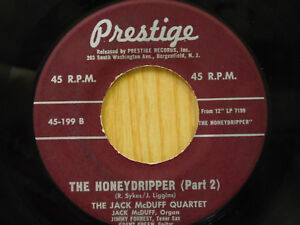
"The Honeydripper" was written and performed by rhythm and blues pioneer Joe Liggins. It
was a huge hit for him on the race charts in 1945-46, and it spawned a number of first-rate covers, mostly by blues and rhythm and blues artists. Not so much in the jazz field, although you'd think it would have been a natural for soul jazz artists. But Cab Calloway did record it in 1946, and Oscar Peterson in 1963. On this one, McDuff really does carry the walking bass part on his organ.
"I Want a Little Girl" was first recorded in 1930 by McKinney's Cotton Pickers. It was written by Murray Mencher and Billy Moll, two gentlemen with whom you really would not associate the authorship of a blues standard. Mencher is best known for "Merrily We Roll Along," the theme music for the Merrie Melodies cartoons, and Moll for "I Scream, You Scream, We All Scream for Ice Cream." The song lay dormant for a decade, had a couple of covers in the 1940s, including one by Jay McShann. In 1955 it was picked up as "I Want a Little Boy" by Kay Starr, a big band singer trying her best to stay relevant in the rock and roll era. That wouldn't seem to be an auspicious comeback for a song with ambitions to be a blues classic, but then in 1956 and 1957 it was recorded by two of Atlantic's greatest blues singers, Joe Turner and Ray Charles, and those gave it thoroughly hip credentials. McDuff's was actually not the first jazz organ version of the tune: rhythm and blues bandleader Doc Bagby had done it in 1955. McDuff, Forrest, Green and Dixon do a great rendition, probably my favorite cut on the album.
Esmond Edwards produced. The Honeydripper was the title of the album, and given how huge a hit the title song had once been on 78 RPM, it was chosen as a two-sided 45 RPM single.
A busy couple of days for Gene Ammons, recording eight ballads on Thursday for Moodsville, and eight with soul jazz overtones for Prestige on Friday. He had a stellar crew of musicians with him--Richard Wyands, Doug Watkins and J. C. Heard, with organist Clarence "SLeepy" Anderson replacing Wyands for a couple of tunes on the second day.
If you wanted a musician who could cover both bases for you, give you two genres of music that have commercial appeal without letting down hard core jazz fans, Gene Ammons would be your guy. Starting with the first song on the Moodsville album, he shows why.
That's "Till There Was You." by Meredith Willson, from his hit 1957 musical, The Music Man, a celebration of middle America and its square, square, county fair musical tastes. Well, Miles Davis brought some spice to white bread with his versions of "Someday My Prince Will Come" and "Surrey with the Fringe on Top." "Till There Was You" had had an interesting history by the time Ammons got hold of it. Its first jazz rendition was by Jimmy McPartland for an album called"The Music Man" Goes Dixieland. Jimmy McPartland was a fine musician, but by the late 1950s, Dixieland had long since lost its creative drive, and become a music of Rotarian luncheons and county fairs. It was next picked up Jonah Jones for his album Swinging on Broadway, more jazz for the tired businessman. But at the same time, Jimmy Giuffre and and Sonny Rollins were recording it, so serious jazzmen were liking its possibilities. But mostly, it was fodder for the likes of anti-gay activist Anita Bryant, Liberace, Mantovani, Ferrante and Teicher. And still later, it became the only show tune the Beatles ever recorded. So how did Ammons and Co. handle it?
Well, Gene Ammons bowed to none in his ability to capture the lyricism of a ballad, and he does that here. But that's just where he starts. If you're a jazz fan, you want more than sensitive lyricism. You want some creativity,, and Ammons delivers, as does the underrated but always hip Richard Wyands.
The difference between the two albums can be seen in the marketing. The Moodsville session you can sit down and listen to, appreciate the artistry of all four musicians, especially Ammons and Wyands. Or you can put it on your turntable as you serve a romantic dinner to your girl friend. You want to set a mood; this will do it. Moodsville, an LP.
The Friday session was released on LP under the Prestige banner and under the earthy title Jug (the Moodsville session had been Nice 'N Cool). But six of the eight tunes were also released on 45 RPM singles, and that should tell you something. They were aimed toward the jukeboxes, they were aimed toward the record hops.
This is the little secret of modern jazz, the one that everyone forgets: You could dance to it. Yes, the image it left behind in the public perception was an audience of beatniks in berets sitting at tables in smoky boites, snapping their fingers instead of clapping to show appreciation. And in New York, on 52nd Street, there wasn't much dancing (except for the strippers) because New York City had begun levying an "cabaret tax" of 30 percent of revenues on establishments where food and drink was served and dancing was permitted. But elsewhere in the country, going out to a night club meant
going out dancing, and if the night club featured cats playing the modern stuff, well, you were young, you were hep, you danced to that. Charlie Parker once played a gig in Detroit at a club that featured a chorus line of dancing girls, and they danced to Parker. The trick was to listen to the bass for the beat.
Jug had tremendous cooking interplay between all four players. On two cuts. "Namely You" and "Let It Be You." Ammons joined the current trend, and an organist, Clarence "Sleepy" Anderson, replace Wyands. The organ was a nice touch. But Wyands was providing all the necessary propulsion, plus some great solos.
These would be Doug Watkins' last sessions for Prestige. He made his debut with the label in 1956 with Jackie McLean (he had recorded the previous year with Art Blakey's Jazz Messengers for Blue Note), and later that year joined Sonny Rollins for the Saxophone Colossus album. These two Ammons sessions were his 30th and 31st for the label. He would do a session in the spring with Donald Byrd for Blue Note. and in the fall with Bill Hardman for Savoy. He would be Charles Mingus's choice for bass player on the Oh Yeah and Tonight at Noon sessions for Atlantic, where Mingus played piano, in November. And then there would be no more. He was killed in an auto accident early in 1962. A recording career of six short years, with a lot of music poured into that time.
Esmond Edwards produced both albums.
Listening to Prestige Vol. 2, 1955-56, and Vol. 3, 1957-58 now include, in the Kindle editions, links to all the "Listen to One" selections. All three volumes available from Amazon. And Volume 4 in preparation! The most interesting book of its kind that I have ever seen. If any of you real jazz lovers want to know about some of the classic records made by some of the legends of jazz, get this book. LOVED IT. – Terry Gibbs
This is a Session of the Lost. The rhythm section is the same two guys who played with Jimmy Neeley on his one session as leader for Prestige, of which I can find no trace, although they were fine musicians. Bassist Michael Mulia played on one other Prestige session, for Etta Jones.
Rudy Lawless was one of that group of guys who grew up together in Harlem's Sugar Hill--the group that included Jackie McLean, Sonny Rollins and Art Taylor. His credits included stints with Andy Kirk, Blue Mitchell, Hank Jones and Roy Eldridge.
Al Sears and Willie Dixon, and we'll see him again later in the decade with a successful fusion album.
Wally Richardson made two albums for Prestige, with
Betty Roché, who did some important work with Ellington and got deserved acclaim for it. managed her own disappearing act, never recording again after this session. I've written more about her on-again, mostly off-again career in my entry on her first Prestige album.
The Ellington work, especially her two recordings of "Take the A Train," remains the benchmark of her career, and of this second Prestige album I can find only two cuts, "Polka Dots and Moonbeams" and "I Had the Craziest Dream," although it shouldn't be that obscure. It did get a CD release on Original Jazz Classics.
They are gems. "Polka Dots and Moonbeams," with melody by Jimmy Van Heusen, known for light but tuneful pop fare ("High Hopes," "The Tender Trap," "All the Way") and lyrics by Johnny Burke, is probably not all that familiar to the casual pop music fan, but it's become much beloved by jazz singers and jazz musicians, with over 300 versions. It's a musician's song, and Roché makes the most of it.
She should be more remembered. She should have done more to make herself more remembered. But listen to her "Polka Dots and Moonbeams." You'll love it.
Listening to Prestige Vol. 2, 1955-56, and Vol. 3, 1957-58 now include, in the Kindle editions, links to all the "Listen to One" selections. All three volumes available from Amazon.
Listening to Prestige Vol. 4 is now in preparation!
The most interesting book of its kind that I have ever seen. If any of you real jazz lovers want to know about some of the classic records made by some of the legends of jazz, get this book. LOVED IT. – Terry Gibbs
This is another from the Swingville catalog. and every one of them has been an invaluable contribution to the story of American music. This is partly because they gave a voice to important American musicians who were being passed over in the rush to modernism that was mainstream jazz. This was a rush that could not be stopped or slowed down, and should not have been. Jazz in the mid-twentieth century was an unparalleled cultural phenomenon. But it's progenitors were not gone, and should not have been forgotten.
All right, so partly because Swingville gave a voice to these almost-forgotten musicians. What was the other part? The other part was the voice itself. As I've noted before, these were not re-creations of 1930s swing. The older musicians were making their music, not Charlie Parker's or Dave Brubeck's or John Coltrane's, but they were making it for a new age, and with full awareness that it was a new age.
I suspect producer Esmond Edwards had a good deal to do with that. But give full credit to the musicians themselves. They had ears, and they knew what was going on around them.
Ten years separate Shorty Baker and Doc Cheatham. Baker was born in 1914, and at the time of this recording, had been a semi-regular in Duke Ellington's orchestra for twenty years. He had also spent some time with Johnny Hodges during the early 1950s, when Hodges had his own band. He had participated in an earlier Swingville session with Bud Freeman. Prior to that, he had worked with Don Redman, Andy Kirk and Teddy Wilson.
Cheatham was born in 1905 in Nashville, and was not really exposed to a lot of jazz until he moved to Chicago in 1924 and met King Oliver. Before that, he had played in a pit band in a Nashville theater, where he had plenty of experience with the blues, accompanying both Ma Rainey and Bessie Smith among others. Meeting Oliver was a life-changing experience for him, but the real life-changer came a couple of years later, when Louis Armstrong joined Oliver. Armstrong became his mentor, and even asked Cheatham to fill in for him at a few performances. "It was hard to do," Cheatham said in an interview with National Public Radio, "because he was such a great player. I knew I wasn't capable, but I was young and I listened to what he was doing, and I learned what he was playing."
Cheatham went on to play with Chick Webb and McKinney's Cotton Pickers, among others, before landing a long-term gig with Cab Calloway. After that, he played with a number of Latin orchestras, including Perez Prado's and Machito's.
Some critics, while praising this album, have commented that Cheatham sounds a little old-fashioned compared to Baker. If that was so in 1961, it was not to remain that way. Baker died in 1966, and so did not live to witness the late-life renascence of his bandmate. In his sixties, Cheatham decided to completely rethink his music and reshape his career. He had always been a section man (Shorty and Doc was the exception), and he decided to work at developing not only the chops, but the whole mental approach to music necessary to become an effective soloist.
How well he succeeded is best described by a younger trumpeter, Jon Faddis:
One of the prime motivations in improvised music for jazz musicians is to be able to tell a story when we play a solo. Doc is a master at that, because you can hear all of his background and influences.
And the ability of Cheatham to stay relevant through seven decades of music was shown in his final album, a two-trumpet reprise of Shorty and Doc that paired the 91-year-old with 22-year-old Nicholas Payton. Cheatham died in 1997, on tour.
I'm guessing that Esmond Edwards may have had a good deal of input into choosing the songs for this session. One of them, "Chtlin's," is credited to him as composer, which is a rarity. But it's dead center for these two guys, starting with some blues wailing by Doc and moving into some lyrical playing by Shorty. It was the first tune on the album, and at nearly eleven minutes, the longest, giving the listener plenty of time to warm up to these old pros.
The first tune they actually recorded that day, the one where they got to warm up to each other, was "Baker's Dozen." the only original by either of the two leads. So we can pretty safely assume that Baker knew the tune pretty well, and probably Cheatham did too. The first sound we here is the intro by Walter Bishop Jr., and his contribution to this session is incalculable. A first-generation bebopper, Bishop's comps, lead-ins and solos sound nothing like the piano stylings of Teddy Wilson, Jess Stacy or any of the other great swing era piano players. They give the music a very different edge, and then they fit right in. The two trumpeters contribute in much the same way they would in "Chitlin's," one wailing, the other lyrical, and they set a tone for the session.
Most likely Edwards brought in the next tune, the Jimmy Forrest take on a Duke Ellington riff that became a rhythm and blues classic: "Night Train." Bishop and J. C. Heard sets a syncopated but solid beat, and Bishop does some of his most boppish playing, while still making it worth with the Ellingtonian/rhythm and bluesian demands of this irresistible riff-driven melody. Both trumpeters hit all the right notes in their solos, and "Night Train" does its job.
Next they take on two standards. "Lullaby in Rhythm" is credited to Benny Goodman, Edgar Sampson ("Stompin' at the Savoy"), Clarence Profit and Walter Hirsch (lyrics). They pick up the tempo on this one. Again, Irresistible.
For the beautiful Rodgers and Hart tune, "I Didn't Know What Time It Was," the trumpets start it right off, and they set up two contrasting tones of sweetness, both of them loving the melody Bishop comes in later with an extended solo. Beautiful, all of it.
After "Chitlin's," they finish up with a tune from Baker's Johnny Hodges days. "Good Queen Bess," which brings everyone into the mix, but spotlights the two trumpets.
There is absolutely nothing not to like about this Swingville session.
Listening to Prestige Vol. 2, 1955-56, and Vol. 3, 1957-58 now include, in the Kindle editions, links to all the "Listen to One" selections. All three volumes available from Amazon. The most interesting book of its kind that I have ever seen. If any of you real jazz lovers want to know about some of the classic records made by some of the legends of jazz, get this book. LOVED IT. – Terry Gibbs
Willis Jackson came to Prestige in 1959 with his longtime bandmates Jack McDuff and Bill Jennings. They had been playing the genre of jazz often dismissed as rhythm and blues, but with the cachet of the Prestige label, their music was now called mainstream jazz, and soon, soul jazz. By 1961, McDuff had gone out on his own, and was on his way to becoming one of the biggest stars on the Prestige label, forming a one-two organ punch with Shirley Scott. Bill Jennings would continue to play off and on with Jackson, creating a guitar sound that would deeply influence a future generation of guitarists, but would never win him stardom in his own career.
This was Jackson's first session with neither of his old cohorts, but he's still the same Gator, playing pretty for the people, and absorbing some lessons from his rhythm and blues years, when you played tunes that could fit on a 78, later 45, RPM record, and would get play on jukeboxes. The tunes could be long enough to fit on both sides of 45, like Bill Doggett's "Honky Tonk" or Cozy Cole's "Topsy," but mostly they weighed in at under three and a half minutes. He does have a couple of six-minute songs here (by the album standards of the day, still short), but most of the cuts come in around four minutes. The other lesson was pay attention to tunes and hooks. Give people something to respond to quickly.
These aren't the only criteria for making good music. In the age of Ornette Coleman, they might even have seemed a little quaint. But Jackson used them wisely and skillfully, and if he didn't make Down Beat's polls, nor is he remembered widely by today's jazz aficionados (did not make ranker.com's list of 200 greatest saxophonists of all time; by contrast, Jack McDuff is #16 on their organist list), he nevertheless made music that is beautiful, soulful, earthy, danceable, and well worth your nickel in the jukebox.
This session featured Jimmy Neeley on piano. Neeley, whose name was also spelled Neely from time to time, had visited Englewood Cliffs before at Prestige's behest: the previous December, he had led a
trio in a session that was released on Prestige's short-lived budget label Tru-Sound. And he might have had a longer history with the label; he worked with blues singer H-Bomb Ferguson, who recorded for Prestige in the early days, but as with a lot of vocalist recordings, the session musicians weren't noted. He played with rhythm and blues/jazz artists Mickey Baker and Red Prysock, and wit Roy Eldridge.
Gus Johnson had recorded for Prestige with Coleman Hawkins, Lem Winchester, Taft Jordan and Willie Dixon. Wendell Marshall was one of their most often-used bassists of the era, and Juan Amalbert was the leader of the Latin Jazz Quintet.
Benny Golson's "I Remember Clifford" had already become a standard since its first appearance on record, performed by Donald Byrd and Gigi Gryce. Jackson treats it with the love you'd appropriately give to a classic. He does the same with "Careless Love," here credited to W. C. Handy, although it's an old folk blues which predates Handy. He has a few of his own tunes, a couple from other sources. "Again," by Lionel Newman, was introduced by Ida Lupino in the film noir cult favorite, Road House. "Girl of My Dreams" was the only hit for Charles "Sunny" Clapp, who led a territorial band, mostly in Texas, in the 1930s. And I think my favorite tunes on the album are the two composed by Johnny Griffin: "Oatmeal" and "Sweet Peter Charleston," featuring some hot blowing by the Gator, and some tasty work by Amalbert and Neeley.
The album was Really Groovin', which also featured one track from a different session and with a different band. "Careless Love" and the Jackson composition "He Said, She Said, I Said" (two more favorites) were the 45 pm single. One tune from session, "Estrellita," was held back for a later Moodsville album, In My Solitude. Esmond Edwards produced.
Listening to Prestige Vol. 2, 1955-56, and Vol. 3, 1957-58 now include, in the Kindle editions, links to all the "Listen to One" selections. All three volumes available from Amazon. Volume 4 is in preparation now! The most interesting book of its kind that I have ever seen. If any of you real jazz lovers want to know about some of the classic records made by some of the legends of jazz, get this book. LOVED IT. – Terry Gibbs
Prestige hasn't gone in much for live albums, although with Bob Weinstock's spontaneous, recreating-a-jam-session philosophy, live recording would seem like a natural. But having made the decision to take the plunge with this one they went all in, and why not? Two wailing tenors and a cooking quintet at the jam session capital of the world, Minton's Playhouse on 118th Street in Harlem. Four sets of music.
What would you leave out?
Nothing? That's how they felt, too. Four sets became four separate albums, two of them released in 1961, the others a few years later.
A live session may not have the optimal sound you'd get in a studio, especially Rudy Van Gelder's studio, and there aren't any do-overs--or weren't, back then. More sophisticated recording techniques made it possible to go into the studio, correct a wrong note, and splice it in. These days, I suppose you wouldn't even have to do that: you could just autotune out all the clinkers. What balances that out, and makes a live set worth it, is the excitement that comes from playing off a live audience.
A lot of the time, that excitement is going to come from giving the audience what it wants. Perhaps the most famous description of the thrill of live jazz can be found in Jack Kerouac's On the Road, the scene that has been anthologized as "Jazz of the Beat Generation." when Sal and Dean find themselves in a jazz club in Oakland, with a behatted tenor player who:
was blowing at the peak of a wonderfully satisfactory free idea, a rising and falling riff that went from "EE-yah!" to a crazier "EE-de-lee-yah!" and blasted along to the rolling crash of butt-scarred drums hammered by a big brutal Negro with a bull neck who didn't care about anything but punishing his busted tubs, crash, rattle-ti-boom, crash. Uproars of music and the tenorman had it and everybody knew he had it. Dean was clutching hie head in the crowd, and it was a mad crowd. They were all urging that tenor man to hold it and keep it with cries and wild eyes, and he was raising himself from a crouch and going down again with his horn, looping it up in a clear cry above the furor...
Kerouac wonderfully describes an ecstatic moment, but what were Sal and Dean listening to in that club in Oakland? Not bebop, certainly. In the late 1940s, when Sal and Dean were on the road, bebop had yet to make a serious impact on the West Coast, not even in Los Angeles, where Charlie Parker and Dizzy Gillespie had played a famous engagement in late 1945 and early 1946, to the enthusiastic support of fellow musicians and a few cognoscenti, most notably Ross Russell, who started the Dial record label to record Bird; But bebop hadn't really caught on, and when Sal and Dean were club-hopping in Oakland, and Bird was relaxing at Camarillo State Hospital, what were they listening to? From Kerouac's description, I'd say rhythm and blues. I've always wondered whether they might have happened in on a set by Big Jay McNeely.
The point of this is that a live set, in a live club, may not inspire the ecstasy that the behatted tenor man inspired in Dean Moriarty, but you are playing to an audience, and the music is only going to go by once. Proust says that if there are things that immediately grab you in a piece of music, you're going to go back to them over and over, and pretty soon you're going to start falling in love with other things about the same piece, and your love for it will deepen, but you'll gradually stop listening for the things that attracted you in the first place. This was true with Proust as he followed a popular composer around to his recitals in the salons of Paris; it's even more true in the era of recorded music.
Musicians working a live audience for a live recording are going to have to think of both: the effect on patrons of the club on that night, and the effect on buyers of the record. Of course, a sophisticated audience like the patrons of a New York City jazz club, especially Minton's, the birthplace of bebop, so they aren't going to be satisfied with the brutal hammering of butt-scarred drums, however bullnecked the drummer may be. But the guys on the bandstand are still likely to do well with material that the audience knows. The poet Billy Collins has described the poet as a sort of travel agent, starting the tour at a place his readers are familiar with, and taking them from there into new and unfamiliar realms. The modern jazz player may well want to do much the same thing, starting with a familiar melody -- a jazz standard, or a ballad from the Great American Songbook. Tuns that all the musicians on the gig are comfortable with, so that they know what they're doing and what they can expect from each other.
All of which is a roundabout way of noticing that this is what Griffin and Davis are doing--familiar jazz riffs like Charlie Parker's "Billie's Bounce," standards like "I'll Remember April"...and tunes by Thelonious Monk.
We're accustomed to think of Monk, today, as one of the great composers of the 20th century, but that reputation was slow in building. At this time, early 1961, only one jazz artist other than Monk had ever recorded an album of Monk's music (Steve Lacy, on Prestige, in 1956). So this much Monk on a series of live sets in a club suggests that his compositions are starting to be a common language not only of musicians (no surprise) but also audiences--and granted, this is Minton's, so even though it's not Minton's in 1946, it probably still has an audience closer to the cutting edge than most.
But I'm not exaggerating about how long it took for Monk's music to catch on. In the first set, Davis and Griffin perform "Epistrophy." One of Monk's classic tunes, written in 1948 it has been recorded 128 times, according to Secondhandsongs. But in 1961 it had been recorded exactly three times: by Milt Jackson in France, on a European label; by Bud Powell, on Verve; and by a group led by Art Taylor, on Blue Note.
"Well, You Needn't," the other Monk composition from the first set, had already achieved jazz standardhood, with 12 recordings by 1961, on its way to well over 200 to date. It also evoked an answer song -- common in rock and country, rare in jazz -- "I Didn't," recorded by Miles Davis.
From the late evening sets: "In Walked Bud," written and recorded by Monk in 1948, now a jazz standard with at least 130 recordings, had been recorded exactly once before 1961, by Sam Most for Bethlehem in 1957. And it's hard to believe that "Straight, No Chaser," now with 180 versions on record, was ever anything but a standard. It is now credited with being the second most widely recorded tune of 1951, trailing only "The Little Drummer Boy." But before the Davis-Griffin version, there had only been five others.
The jazz world would shortly see a second studio album of all Monk compositions, and we'll be looking at that before too long: it was Davis and Griffin (who had been closely associated with Monk), on Prestige.
Larry Gales and Ben Riley had close ties to Monk. They both played on the Davis-Griffin Monk album, played with Monk himself for several years, and then in 1990 made their Monk album, A Message from Monk, with Riley as nominal leader of the group. Gales had made one previous Prestige session, with Buddy Tate and Clark Terry. Ben Riley had been the drummer on the first Davis/Griffin pairing for Prestige.
Junior Mance made his return to Prestige after a ten-year hiatus, and his Davis-Griffin association would last through their Monk album. His career as a recording artist had started in 1947 with Gene Ammons (for Aladdin). but his performing career had started earlier than that. When he was ten years old, the saxophone player who lived in the Chicago apartment above his had a gig in a local roadhouse, and had lost his piano player. He had heard Junior practicing, and asked his dad (Julian Mance Sr.) if Junior could fill in. Roadhouses in those days tended to be lax about asking for ID, but even so, one might have guessed that they would have noticed a ten-year-old. Nonetheless, he played the gig.
He went from Gene Ammons to Lester Young, with whom he learned a valuable lesson. As he told Marc Myers in a 2011 interview:
I once made a mistake while playing something. I said, “Damn.” The guys told me never to say that. They said, “Play right through it.”
As Miles Davis said, " It's not the note you play that's the wrong note - it's the note you play afterwards that makes it right or wrong."
He was back with Ammons (and Sonny Stitt) for his first Prestige recording. As he told Myers:
Jazz in those days was always competitive and supportive. We didn’t rehearse. What you heard on those records is what those guys came up with on the spot. We’d do the same thing on stage.
He also shared with Myers another great piece of advice he got from Jimmy Jones, when he first started working with Dinah Washington:
Look, when you’re working with a singer, imagine a portrait painting hanging in the museum. The singer is the subject of that portrait. What does the portrait need? A good frame. That’s you.
Prestige released an album called The Tenor Scene in 1961. It was the tunes from the second set of the evening, designated "the breakfast set": the Davis/George Duvivier composition "Light and Lovely." previously recorded with Arnett Cobb and Shirley Scott in 1959, "Straight, No Chaser," Dizzy Gillespie's "Woody 'n' You," Davis's "Bingo Domingo," and the standard "I'll Remember April."
In 1964, they began plans to roll out the entire performance, starting with the first set, and they titled the album The First Set. It featured the Charlie Parker tune and the two Thelonious Monk compositions: "Billie's Bounce," "Epistrophy," "Well, You Needn't." Added on, from the second set and first album, "I'll Remember April." This was followed by the third set, in an album entitled The Late Show, also in 1964.
1965 saw The Midnight Show, from the final set of the evening, followed by re-release of The Tenor Scene, this time titled The Breakfast Show, and maybe this explains the reason why the "breakfast" moniker was hung on this set.
Esmond Edwards produced.
Listening to Prestige Vol. 2, 1955-56, and Vol. 3, 1957-58 now include, in the Kindle editions, links to all the "Listen to One" selections. All three volumes available from Amazon. Volume 4 is in preparation now! The most interesting book of its kind that I have ever seen. If any of you real jazz lovers want to know about some of the classic records made by some of the legends of jazz, get this book. LOVED IT. – Terry Gibbs
Billy Taylor's piano trio albums, one of them augmented by the great percussionist Candido, were a staple of Prestige's first half decade. He stopped back in Englewood Cliffs for a brief interlude to usher in the 1960s, and he would be back once more to bookend the decade.
The 1960s would be a busy time for Dr. Billy Taylor, who would start getting the multiple honorary degrees that earned him his honorific (he would also earn an academic PhD. from the University if Massachusetts. He would keep on making music, most often in the trio setting, but his commitment to jazz found other avenues as well. In 1958, he became music director of NBC'sThe Subject Is Jazz, the first network TV show to be devoted to America's music, and in 1964, he founded what became one of New York's cultural treasures, the Jazzmobile that brought some of America's greatest musicians to underserved neighborhoods.
He had worked for many years with a regular trio of Earl May on bass and Percy Brice (later Charlie Smith) on drums, but here is tries on a different configuration. Doug Watkins was a frequent
contributor to Prestige recordings, and one of the best (and most underappreciated) bassists of his day. Ray Mosca was a New York-born drummer who worked regularly in those years, with singers and with a wide range of jazz groups.
Taylor and his partners focus on ballads for this Moodsville session, released as Interlude. The compositions are all Taylor's except for "You're Mine." The titles sound like titles of songs with lyrics, but I haven't been able to find vocal versions of any (the often recorded "Remembering all those little things / All of a sudden my heart sings" is a different song, as is the gospel tune with the same title).
Listening to Prestige Vol. 2, 1955-56, and Vol. 3, 1957-58 now include, in the Kindle editions, links to all the "Listen to One" selections. All three volumes available from Amazon.
The most interesting book of its kind that I have ever seen. If any of you real jazz lovers want to know about some of the classic records made by some of the legends of jazz, get this book. LOVED IT. – Terry Gibbs
Every year I look at the list of best albums of the year on rateyourmusic.com, a reader-voted website. The Down Beat poll gives us a look at what they were thinking back then; the rateyourmusic poll gives us a sense of what's endured.
It's always an idiosyncratic poll, with some definite surprises. It's also an ongoing poll, so while the albums at the top of the poll have accrued enough votes to be safely ensconced there. there can conceivably be fluctuation down at the bottom, BuT we're not going that far. Just the top 50, omitting the recordings that weren't jazz or blues:
1 Giant Steps
John Coltrane
Atlantic
Deserves its ranking, then as now. A major album, a giant step forward in jazz.
2 Blues & Roots
Charlie Mingus
Atlantic
One of the reviewers on rateyourmusic described it as “Arty enough for the avant-jazz types, energetic enough for the swingers,” and that’s not bad. Mingus, like Monk, has gained in stature over the years, and this ranking confirms that.
3 Sketches of Spain
Miles Davis
Columbia
4 The Incredible Jazz Guitar of Wes Montgomery
Riverside
This was Montgomery’s second album for Riverside, and really the beginning of his domination of the instrument, and the jazz charts, in the 1960s.
6 Soul Station
Hank Mobley
Blue Note
8 Portrait in Jazz
Bill Evans Trio
Riverside
This was Scott LaFaro’s first album with Bill Evans. There would be three more, before LaFaro’s death in an auto accident, which left Evans so devastated he could not play for months. Many consider this the definitive Evans trio.
9 At Last!
Etta James
Argo
11Change of the Century
Ornette Coleman
Atlantic
12True Blue
Tina Brooks
Blue Note
Very good stuff, with Freddie Hubbard, Duke Jordan, Sam Jones and Art Taylor, and one example of the idiosyncratic voting of rateyourmusic voters. Not saying that this album shouldn’t be highly rated, just surprised that it is. Tina Brooks had a very short career – this was his only album as leader to be released during his lifetime. Recently, some long-buried sessions have been released, prompting a reconsideration of his essentially forgotten career, and some serious praise from jazz cognoscenti. I guess there are a lot of cognoscenti voting on rateyourmusic.
15 Blues-ette
Curtis Fuller's Quintet
Savoy
Amazing to me that this album is rated so high, and the more acclaimed “Meet the Jazztet” comes in at number 86. Again, not a reflection on the blowing here, but a surprise that the voting has gone that way.
16 Thelonious Alone in San Francisco
Thelonious Monk
Riverside
Monk alone, going with his first takes, and his solo version of “Blue Monk” alone Is worth the price of admission. But the same could be said of every other track.
17O amor, o sorriso e a flor
João Gilberto
Odeon
It took Stan Getz, in 1961, to launch the Brazilian samba/bossa nova craze, so this album was ahead of the curve. A recent CD reissue as part of a box set of Gilberto and Jobim may in part account for its popularity with the rateyourmusic crowd. There’s a very nice description by one of their reviewers:
Somewhat like the British Invasion in rock in the early 1960s, there was a Brazilian invasion in jazz and pop starting in the late 1950s. And just as the British Invasion can be traced back to two guys – John Lennon and Paul McCartney – the Brazilian invasion can be traced back to João Gilberto and Antonio Carlos Jobim. Gilberto single-handedly created bossa nova from samba, transmuting a rather boisterous dance form into a perfect vehicle for crooning intimiacies and meditations; Jobim supplied the songs, the arrangements, and the orchestra.
19The Big Beat
Art Blakey & The Jazz Messengers
Blue Note
20Open Sesame
Freddie Hubbard
Blue Note
21Mingus Dynasty
Charles Mingus and His Jazz Groups
Columbia
22Piano in the Background
Duke Ellington and His Orchestra
Columbia
24Blues in Orbit
Duke Ellington
Columbia
25Outward Bound
Eric Dolphy Quintet
Prestige
26Have Guitar, Will Travel
Bo Diddley
Checker
27House of the Blues
John Lee Hooker
Chess
28East Meets West
Ahmed Abdul-Malik
RCA Victor
30Ella Fitzgerald Sings Songs From "Let No Man Write My Epitaph"
Verve
31Sin & Soul
Oscar Brown Jr.
Columbia
32Work Song
Nat Adderley
Riverside
33Ben Webster Meets Oscar Peterson
Verve
34Muddy Waters Sings Big Bill Broonzy
Chess
35Satchmo Plays King Oliver
Louis Armstrong
Audio Fidelity
37Bo Diddley Is a Gunslinger
Checker
38Blues & Ballads
Lonnie Johnson With Elmer Snowden
Prestige
39Travelin'
John Lee Hooker
Vee Jay
40Gerry Mulligan Meets Ben Webster
Verve
41Quiet Kenny
Kenny Dorham
New Jazz
43Them Dirty Blues
The Cannonball Adderley Quintet
Riverside
44Otis Spann Is the Blues
Otis Spann
Candid
45Art Pepper + Eleven: Modern Jazz Classics
Art Pepper
Contemporary
47
Frank Sinatra
Nice 'n' Easy
Capitol
48Ella Wishes You a Swinging Christmas
Ella Fitzgerald
Verve
Prestige in 1960 began its second full decade in the jazz business (second of two--there had been one year in the 1940s, and there would be a couple in the 1970s) by looking ahead, looking back, and looking straight at the present.
Looking back is what they did by the formation of the Swingville and Bluesville labels. As to looking back at the immediate past...not so much. As with Bill Clinton and the era of big government, the era of bebop seems to be over for Bob Weinstock and associates. Comparing their releases of 1957, just three years earlier, one finds an overlap of exactly two names: Red Garland (three sessions in 1957, three in 1960) and Tommy Flanagan (one and one). No Gene Ammons, though he was absent by force of incarceration, and would be back. No more Jackie McLean, Kenny Burrell, Phil Woods. Some, like John Coltrane, Art Farmer, Mose Allison, had moved along. Prestige was a great launching pad for young talent, musicians would go on to sign with bigger labels who would give them more money, more promotion, more exposure.
Looking back through Swingville and Bluesville gave the label a deeply enriched catalogue that has only grown more valuable through the years. We look back at the 1950s as a golden era of jazz not just because of the new music that was being created, but because it was a time when every era of jazz still existed. Louis Armstrong, Benny Goodman and Dizzy Gillespie became international ambassadors. And so many of the titans of jazz, from virtually every era, were still playing, often in obscurity.
One such titan was Coleman Hawkins, still so revered that as the era of John Coltrane was ushered in by his Prestige recordings and brought to full flower by his Atlantic recordings, the Down Beat critics', polled for their leading jazz artists of 1960, still named Hawkins as the top tenor saxophonist. Prestige brought Hawkins into the studio four times in 1959, three more in 1960. He had played with the Prestige Blues Swingers, in which moderns like Idrees Suleiman, Jerome Richardson and Pepper Adams joined forces with blues guitarist Roy Gaines and future star Ray Bryant. He had recorded with swing veterans Charlie Shavers and Tiny Grimes for an album that was originally released on Prestige, but may well have given Bob Weinstock the idea for Swingville, because soon after that the label was launched, and this became one of its first titles. Under the catchall name of Prestige All Stars, he recorded with Buddy Tate and Arnett Cobb, soon to become Swingville regulars, and Eddie "Lockjaw" Davis and Shirley Scott, two of the brightest stars in Prestige's new soul jazz firmament. He worked in a quartet session with the Red Garland Trio and another trio led by Tommy Flanagan, and in a sextet setting with swing veterans Vic Dickenson and Joe Thomas. And on a December, 1960 session with Flanagan and Davis, he brought aboard a youngster just starting out in the jazz business--Ron Carter.
Hawkins would go on to have an active decade of recording, with Prestige and other labels, in a wide variety of musical settings, from blues veteran Ida Cox to Sonny Rollins. Who wouldn't want the chance to play with the Hawk? He died in 1969.
In addition to Tate and Cobb. Prestige Swingville also recorded Buck Clayton, Al Casey, Claude Hopkins, Budd Johnson, Bud Freeman. And guys who made their bones in rhythm and blues also joined the Swingville roster: Willis "Gator Tail" Jackson, Al Sears, Jimmy Forrest, King Curtis, Bill Jennings.
A lot of the new Prestige/Swingville/Bluesville roster was the work of Esmond Edwards. Edwards was African American, which was something of a rarity in those days for someone in the production/management end of the music business, and his familiarity with the smaller clubs and music establishments in Harlem and the Bronx led to a lot of these signings, both the rhythm and blues veterans and the new soul jazz players.
In at least one case, those two categories overlapped. Willis Jackson's long-time associate was organist Jack McDuff, and he would go on to become one of the big selling artists of the soul jazz world.
Shirley Scott was the star of Prestige's soul jazz roster, and one of the players, along with Jimmy Smith, to really popularize the organ sound in jazz. Along with Scott and McDuff, Prestige had Johnny "Hammond" Smith, Robert Banks, and Larry Young, who would go on to a trailblazing career after leaving Prestige.
Bluesville was an interesting label, and Prestige's blues roster was always interesting to follow. They recorded legends like Memphis Slim, Sonny Terry and Brownie McGhee, Willie Dixon, Lonnie Johnson (who was plucked from obscurity by producer Chris Albertson), Sunnyland Slim, Roosevelt Sykes,Tampa Red. They also recorded some blues singers who never made it beyond obscurity -- Arbee Stidham, Shakey Jake, St. Louis Jimmy, and particularly the marvelous and completely forgotten singers Al Smith and Mildred Anderson.
They were forward-looking, too. Eric Dolphy was their real torchbearer for the new generation, and he was to die young, before the end of the decade. Booker Little joined him on his last album of 1960, and for some memorable live sessions in 1961, but death was to overtake him before the year was out. Oliver Nelson was an important new composing talent; his most famous work, though, was to come the next year, when he recorded Blues and the Abstract Truth. Lem Winchester had a bright future ahead of him, an he was just beginning to glimpse it, when a freak accident took him in 1961.

.jpg/220px-Satin_Doll_(Shirley_Scott_album).jpg)


:format(jpeg):mode_rgb():quality(40)/discogs-images/R-3002153-1311186025.jpeg.jpg)



:format(jpeg):mode_rgb():quality(90)/discogs-images/R-4509799-1366913632-1446.jpeg.jpg)


:format(jpeg):mode_rgb():quality(40)/discogs-images/R-3584206-1477852816-5989.jpeg.jpg)

:format(jpeg):mode_rgb():quality(40)/discogs-images/R-5160014-1386122152-9872.jpeg.jpg)