Wednesday, February 10, 2016

Listening to Prestige Part 170: Elmo Hope All-Star Sextet

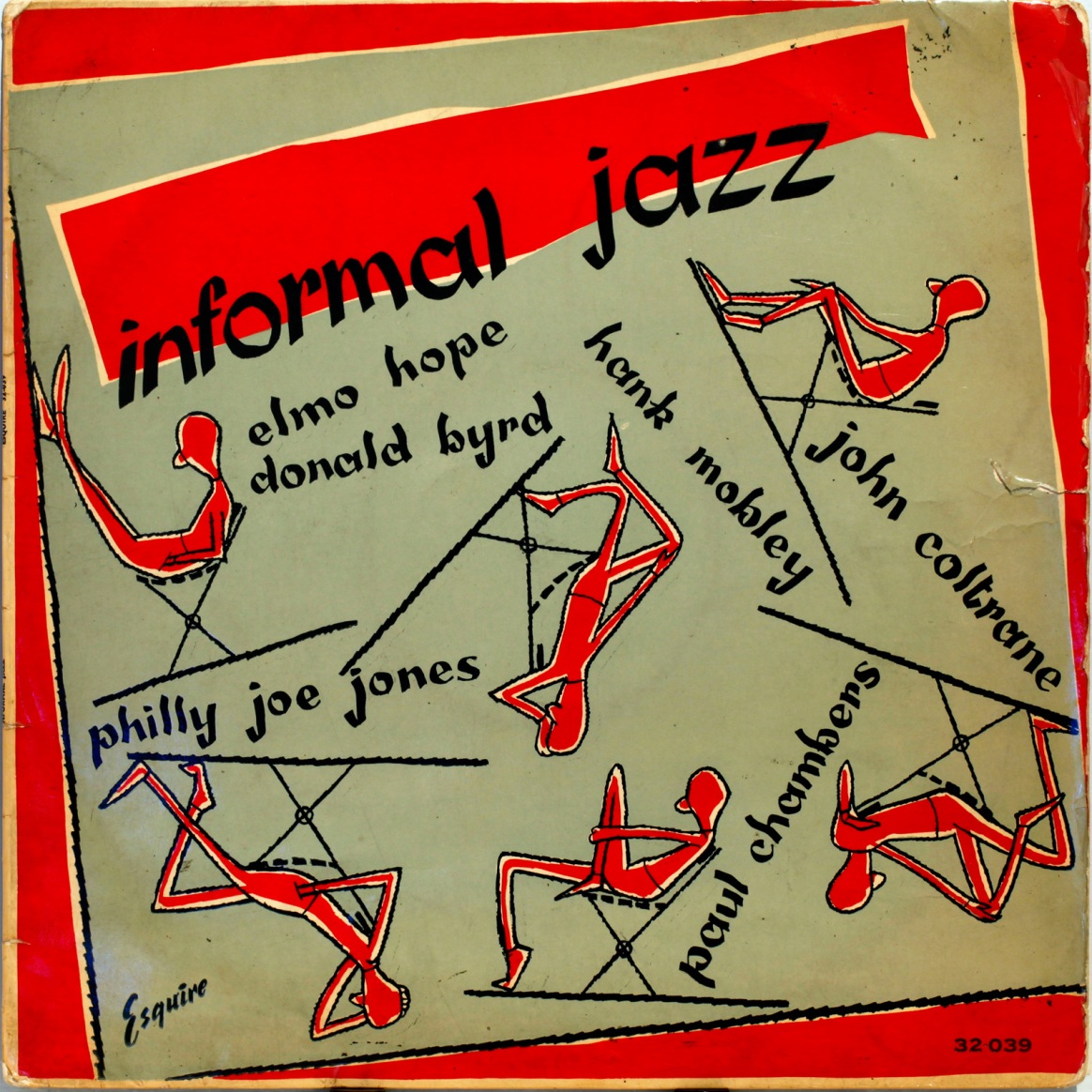
Elmo Hope's star, never as bright as it should have been, was perhaps beginning to wane at this point. The session is listed as "Elmo Hope All-Star Sextet," and the album was released as by the Elmo Hope Sextet, but at exactly the same time, so it would seem, it was also released as by Hank Mobley and John Coltrane, as Prestige PRLP 7043 and 7043 (alt).

And Ira Gitler, in his liner notes, describes the session as being "the nominal leader on the date," whatever that means. Gitler also suggests, without actually saying it, that the session is a buncha guys who happened to drop in at Rudy's parents' living room on a Friday afternoon to see what was happening.


If so. that would make this just about the perfect Bob Weinstock jam session, and maybe Gitler is exaggerating the casualness of the ensemble a little bit, but maybe not. I'm willing to take it as mostly true, and I'm willing to credit it as a quintessential tribute to the Weinstock philosophy of what jazz is.

As Gitler goes on to point, out, these musicians were hardly strangers to each other. Donald Byrd and Hank Mobley had played together in the Jazz Messengers; John Coltrane, Paul Chambers and Philly Joe Jones were the nucleus of the new Miles Davis Quintet, and Jones and Hope went even farther back.
It's interesting to note how strong the rhythm and blues roots were for these musicians. Jones and Hope had first played together in Joe Morris's band, Hank Mobley with Paul Gayten, John Coltrane with Eddie "Cleanhead" Vinson. Also interesting that when they get together for a casual jam session, they go to bebop, not rhythm and blues, as a lingua franca.

Even more interesting, to me, is how powerful a lingua franca this is. Gitler, in his liner notes, lists the order of solos, as he oftenh does, and I wonder if he got, or gets, enough credit for this service. Too many serious jazz aficionados are also jazz snobs, and would dismiss this as pablum, but for the rest of us, it's very useful in following a jazz recording. In this case, Gitler gives us a remarkably involved and complex series of solos:
Weejah: Opening riff, Hank, Donald, Trane (bridge), Hank, Donald (4), Hank (2), Trane (2), Hank (1), Trane (1), Hank (1), Trane (1), Elmo (3), Chambers (2), Donald, Hank, Trane in fours with Joe (1), Joe (1), out chorus in same order as opener.
And even with Ira's help, I get lost. Well, I did recognize when Elmo came in. Or:

On it: Donald (8), Elmo (8), Hank (3), Trane (3), then two choruses each, followed by one chorus each, followed by two choruses of fours, two of twos, and another of fours. Hank is first at the beginning of the conversations.
This is a good thing to keep in mind the next time I'm tempted to criticize Gitler as a commentator on jazz. Yeah, I got lost again here. But there are a couple of reasons. One is, at a certain point I have to give up feeling the pressure -- am I going to be able to tell where they go from trading fours to trading twos? -- and just listen to the music.

The other is--it's almost beyond understanding how completely these loose, informal jammers are on the same page. Very often, especially in the early days of bebop, when the music was shifting from dance-centric to listener-centric, and the idea of a virtuoso solo was moved to the forefront, a soloist would finish off his turn with a little statement -- "Here, what are you going to do with that?" -- and there'd be a vamp by the piano or bass (not so often bass when recording engineers couldn't pick him us as well), for the listener and the next soloist to reflect on what had just been heard. Not so here. This music is seamless, so much so that you sometimes even forget to notice whether you're listening to Byrd or Coltrane -- and that's not leaving out of account that we're listening to some of the most distinctive voices in jazz.

Two of the pieces are Elmo Hope compositions -- "riffers which expedite the blowing," in Gitler's words, but they're more than that. Both, especially the bluesy "On It," are lyrical. Hope was a gifted composers, and these two tunes justify this being labeled as an Elmo Hope sessions.

The other two are standards, very much "mainly vehicles for blowing," in that like the two Hope tunes, they give the soloists the basis for work which is so seamless it almost makes a succession of solos sound like an ensemble. "Polka Dots and Moonbeams" was a Jimmy Van Heusen pop hit for Tommy Dorsey/Sinatra which has become a favorite of the moderns, with versions by Bud Powell, Chet Baker, Bill Evans, Wes Montgomery, Blue Mitchell...it has been listed as one of the most frequently recorded jazz standards.

I've commented before on how many times beboppers have reached back to a very early age, taking songs from operetta to transform into a modern idiom. "Avalon," in a way, harkens back even farther. It's credited to Al Jolson, Buddy deSylva and Vincent Rose, and while it's questionable whether Jolson really did any of the writing, it's also sort of questionable whether Rose did. The melody is close enough to an aria from Tosca that the Puccini estate was able to sue for plagiarism and win.

Are there any other modern jazz versions of operatic arias (not counting Porgy and Bess)? Probably. There must be some from Carmen. But I can't think of any offhand.

A couple of digressions before I let you go. A lot of the Prestige catalog was licensed in England to the Esquire label. The Esquire release of this album, which must have been not long after the Prestige release, has cover art by Ralph Steadman. Steadman is one of the great illustrators of our era, and I suspect he may be pretty embarrassed by this, which doesn't begin to suggest Alice in Wonderland or Fear and Loathing in Las Vegas. He must have still been an art student at this time, and nowhere in his biography does it mention any work as an illustrator for record labels.

Second digression. And I know I'm preaching to the choir here. Everyone who cares about music, or cares about education, knows how important music education is. Donald Byrd went to Cass Technical High School in Detroit. We think of Detroit today as the epicenter of urban blight and hopelessness, but Cass Tech has held onto its music ed program, and according to its Wiki page, "Cass Tech students' strong academic performances draw recruiters from across the country, including Ivy League representatives eager to attract the top minority applicants."

Because Cass Tech continues to have a music education program, its graduates have made their mark from swing to hip-hop, not to mention opera and gospel. I promise I won't keep posting lists like this, but here are some of Cass Tech's graduates, and of course I'm not including the kids who went on to become teachers, or the kids who simply stayed in school because there was a band and a concert choir.


  • Dorothy Ashby, jazz harpist and composer.
  • Geri Allen, post bop jazz pianist.
  • Sean Anderson aka Big Sean; hip-hop artist signed to Kanye West's Label (G.O.O.D. Music).
  • Kenny Burrell, jazz guitarist.
  • Ellen Burstyn, won Academy Award for Best Actress for Alice Doesn't Live Here Anymore and starred in The Exorcist, Tony Award winner, Emmy Award winner, Golden Globe Award winner (did not graduate).
  • Donald Byrd, jazz and rhythm-and-blues trumpeter.
  • Regina Carter, jazz violinist.
  • Ron Carter, jazz double-bassist.
  • Doug Watkins, jazz bassist.
  • Paul Chambers, jazz bassist.
  • Alice Coltrane, jazz pianist, organist, harpist, composer, and the wife of John Coltrane.
  • Muriel Costa-Greenspon, mezzo-soprano who had a lengthy career at the New York City Opera between 1963 and 1993.
  • Jerald Daemyon, electric jazz violinist, composer and producer known for bringing technical refinement to violin improvisation.
  • Delores Ivory Davis, was internationally recognized in opera, oratorio, and for performances with Springfield (Mass.) Symphony, St. Paul Symphony, and Detroit Symphony Orchestra.
  • Carole Gist, 1990 Miss USA, first African American woman to win the Miss USA title.
  • Wardell Gray, jazz tenor saxophonist who straddled the swing and bebop periods.
  • David Alan Grier, actor, comedian.
  • J. C. Heard,[36] swing, bop, and blues drummer.
  • Major Holley, jazz upright bassist.
  • Ali Jackson, jazz drummer.
  • Philip Johnson actor, leading role in the Lifetime movie America.
  • Ella Joyce, actress.
  • Hugh Lawson,[36] was one of many talented Detroit jazz pianists of the 1950s
  • Donyale Luna, model and actress.
  • Howard McGhee, one of the first bebop jazz trumpeters, together with Dizzy Gillespie, Fats Navarro and Idrees Sulieman.
  • Al McKibbon,[36] jazz double bassist, known for his work in bop, hard bop, and Latin jazz.
  • Billy Mitchell,[36] jazz tenor saxophonist best known for his work with Woody Herman when he replaced Gene Ammons in his band.
  • Kenya Moore, 1993 Miss USA.
  • Naima Mora, fashion model, America's Next Top Model winner (Season 4).
  • J. Moss (aka James Moss), Grammy Award-winning gospel singer-songwriter, composer, arranger, and record producer.
  • Greg Phillinganes, (1974) session keyboardist.
  • Della Reese, singer, actress, later famous for playing Tess on the television show Touched by an Angel
  • Frank Rosolino,[37] was an American jazz trombonist.
  • Diana Ross (1962), singer, actress, graduated one full semester ahead of her classmates; major listed in Cass Tech Triangle Yearbook was "home economics"; studied costume design as her curriculum path; 2007 Kennedy Center Honors recipient.
  • Donald Sinta, classical saxophonist, educator, and administrator; in 1969 he was the first elected chair of the World Saxophone Congress.
  • Cornelius Smith Jr., actor, 2010 NAACP Image Award winner for Outstanding Actor in a Daytime Drama Series.
  • Lucky Thompson,[36] jazz tenor and soprano saxophonist.
  • Lily Tomlin, comedian, actress, 2014 Kennedy Center Honors recipient; winner of two Tony Awards, a Grammy Award, 5 Emmy Awards and a Daytime Emmy Award. Listed and pictured in the Yearbook as Mary Jane Tomlin – a cheerleader.
  • Jack White, acclaimed musician and member of The White Stripes, The Raconteurs, and The Dead Weather.[38]
  • Gerald Wilson, influential jazz trumpeter, Big Band leader and composer.

This session was released simultaneously under Hope's name as Informal Jazz, and under Coltrane's and Mobley's names as Two Tenors. Later, as Coltrane became the big star, it was reissued under his name as Two Tenors with Hank Mobley.


.

Saturday, February 06, 2016

Listening to Prestige Part 169: Gene Ammons

What does a producer of jazz records do? Probably, at best, not all that much. Bob Weinstock recalls that he and Miles Davis would sit down and kick around names -- who's in town, who would you like to record with? -- and that may have been the most of it. Weinstock had his jam session philosophy -- no rehearsal, just get 'em together and let 'em play -- and even so, Miles complained later that he (and every other producer Miles worked with) interfered too much.

So what about this session? Gene Ammons was one of Prestige's stalwarts, going back to the early days, often paired with Sonny Stitt, just as often without, generally preferring the fuller sound of a larger-than-quintet group. For a while he worked with a more or less steady group. almost always including trumpeter Bill Massey. By 1955, he had begun branching out. His three 1955 sessions for Prestige saw almost a complete turnover from session to session (Art and Addison Farmer were on one of them).

Why? Ammons had trouble keeping a group together? Seems unlikely. With his warm touch on ballads, earthy touch on blues, ability to wail with the best of the R&B saxmen, Ammons was one of the most popular jazz artists of the day.

Or perhaps, as he had done with Miles, Bob Weinstock sat down with him and said, "Hey, Gene, let's start mixing it up some. Look how well it worked with Miles. We'll kick around some names, get a bunch of guys together in the studio, see what happens."

So maybe that's what a producer of jazz records does.  And how much careful thought and planning went into choosing that bunch of guys? I'd like to think very little. Art and Addison Farmer were around -- they'd just played the Bennie Green session a week or so earlier. The others were inspired choices, but none of them would have required a lot of thought.

What about Candido? Did Bob Weinstock and Ira Gitler sit up all night, saying "We've got to find something new for the next Ammons recording. How about a French horn, like the Miles Davis nonet? Bring Earl Coleman back for some vocals? Or a pianoless group like Gerry Mulligan? Wait! I've got it! We'll bring in some Latin percussion!" Or did Candido just happen to drop by the office that day, and say "Hola - I'm looking for a gig. Got anything?"

I like to think it was the latter.

And Duke Jordan? He was certainly doing a lot of session work in the 50s, not all that much of it with Prestige. He'd played with Art and Addison on a Farmer/Gryce session the previous fall. But for whatever reason they chose him, it was an inspired choice. It goes without saying that with Candido on board, you're going to have some hot rhythms, but it's Jordan whom I keep hearing driving this session. He turns out to be the real inspired choice.

Jordan had also recently written what was to become his most famous composition, "Jor-du," and one certainly wouldn't be surprised to hear it on a date where he was playing, but not so on this one.

Which raises another "what does a producer do?" question. Who chooses the tunes that will go into a recording session, and what's behind that? Obviously, there's a few extra bucks for the composer, and especially for the publishing rights, but there weren't all that many bucks in jazz overall, in those days. Jackie McLean seems almost certainly to be the composer of "Dig," for which Miles Davis took the credit, but when McLean looked into suing over it, he was told not to bother -- even if he won, there wouldn't be any money in it.

Still, you had a couple of excellent composers on this date (in addition to Jordan) and it's no surprise that they're represented--McLean with "Madhouse," Art Farmer with "The Happy Blues."

It's also not surprising that a standard was included. Ammons was great on ballads, and Weinstock liked standards, and although not much jazz was being released on single records any more by 1956, Ammons was still a jukebox favorite. Why "Can't We Be Friends" in particular? Why not? It's a beautiful song.

The one that really interests me is "The Great Lie," a swing era song by Andy Gibson -- credited to Gibson and Cab Calloway. Perhaps there were lyrics by Calloway? I could not find a version of it that included a vocal, but I did find a reference to it in a list of WWII-era songs by Calloway that had social commentary.

Andy Gibson was an underrated composer, whose best known work is probably his brilliant rhythm-and-bluesification of Charlie Parker's "Now's the Time" -- "The Hucklebuck."

It's certainly not unusual for a big band tune to be picked up and adapted by moderns, but I decided to see how this one mutated with different versions, so I listened to four: Cab Calloway (without vocal), Charlie Barnet, Gene Ammons, and Chet Baker/Art Pepper.

I liked Calloway's version, but loved Barnet's. And it brought home to me just how much big band music was an arranger's medium. I don't know who the arranger was for this version of "The Great Lie" -- it could have been Gibson, who worked a lot with Barnet. But it's wonderful, with the shifting horn patterns and solos that weave in and out of them. Charlie Barnet, like Artie Shaw, was heir to millions, and like Shaw, he got out of the music business at a fairly young age, and is probably underrated. Certainly he was by me -- I had listened to "Cherokee," maybe nothing else. This is a terrific band, and a terrific number.

Like Woody Herman, Barnet was open to the influences of bebop, and his later bands had some of the finest modern jazz musicians. But as we move seriously into the bebop-hard bop era, you can hear, listening to Barnet and then Ammons, how much the emphasis has shifted to the soloists. Both versions are hard-swinging, and they share a lot more in common than you'd think. The swing band is fresh and innovative, the bop ensemble is melodic. With all those great soloists, the Ammons band extends the tune a lot longer than Barnet's traditional song, 78 RPM length. Ammons goes nearly nine minutes, and everyone gets solo space, and makes the most of it.

With Baker and Pepper, it's pretty much all solos, and it's cool, and mellow, and all the things you expect from West Coast jazz, and also quite cerebral, but they don't forget to swing, either. And just as I found myself caught up by Duke Jordan's contribution to the Ammons group, I found myself listening to Leroy Vinnegar here, who really propels the swing of the two cool soloists with his bass.

"Madhouse" is the Jackie McLean composition, and it's also the one where Candido really shines.

It's also the one that ended up on the jukeboxes. If Weinstock had thought about using the ballad, he would have had to think again, when the boys stretched it out to over 12 minutes. Of course, "The Happy Blues," which did become the single (as Parts 1 and 2) was also over 12 minutes, but maybe it was easier to edit down. It was also the title track for the LP.


Wednesday, February 03, 2016

Listening to Prestige Part 168: Bennie Green

Let's start with the music. Bennie Green and Art Farmer have an affinity for each other that keeps on giving.

I talked about sentimentality in my last post, and defended its place in art, but you can also ignore it altogether. Green and Farmer take "My Blue Heaven" at a bebopper's pace, using the melody as a springboard for great improvisation, pretty much forgetting about Molly and me and the baby, although there's a real sweetness to Farmer's restatement of the melody at the end. And although there aren't any blues in that cozy place with the fireplace, these guys find room for them in their improv.

"Cliff Dweller " is a composition by piano player Cliff Smalls, and it kicks off with some very
complex but driving interplay between Smalls, Addison Farmer and Philly Joe Jones. Smalls worked often with Bennie Green, and there may have been an extra affinity there because Smalls was also a trombonist. Further, they shared a taste for the accessibility of rhythm and blues -- Smalls would go on to be the bandleader for Clyde McPhatter, Smokey Robinson, and Brook Benton.

"Let's Stretch" seems to come with no composer credit, so we'll take it as a collectively improvised Five O'clock Blues, and stretch they do, for a well-spent ten-plus minutes.

They finish the set with a nice moody version of "Gone With the Wind."
Now, moving on to the digression. Jazz.com's online encyclopedia gives this biographical note:

Bernard Green was born on April 16, 1923 in Chicago, to a family of musicians. His older brother Elbert had played with trumpeter Roy Eldridge in the local Chicago scene, and both attended DuSable High School, a hotspot for music education at the time. It was under the direction of his music teacher at DuSable where Bennie began to study trombone. 

At a time when music education is disappearing from our test-obsessed schools, it's good to stop and remember how important it was to the American Century in music, our great contribution to world culture. People talk about musicians, particularly soul musicians, and how they learned their music in church, but there were far more who learned in school.

And what about DuSable High? Who started their music careers there?

Holy smoke.

Here's a list from Wikipedia:

  • Gene Ammons — pioneering jazz tenor saxophone player.
  • Ronnie Boykins — jazz bassist, most noted for his work with Sun Ra.
  • Sonny Cohn — jazz trumpet player, perhaps best known for his 24 years playing with Count Basie.
  • Nat King Cole — pianist and crooner, predominantly of pop and jazz works (Unforgettable).
  • Jerome Cooper — jazz musician who specialized in percussion.
  • Don Cornelius — television show host and producer, best known as the creator and host of Soul Train. 
  • Richard Davis — bassist and professor of music at the University of Wisconsin–Madison.
  • Dorothy Donegan — jazz pianist.
  • Von Freeman — jazz tenor saxophonist.
  • John Gilmore — clarinet and saxophone player, best known for his time with the Sun Ra Arkestra, a group he briefly led after Sun Ra's death.
  • Johnny Griffin — bebop and hard bop tenor saxophone player.
  • Eddie Harris — jazz musician best known for playing tenor saxophone and for introducing the electrically amplified saxophone.
  • Johnny Hartman — jazz singer (Lush Life), best known for his work with John Coltrane.
  • Fred Hopkins — jazz bassist.
  • Joseph Jarman — jazz composer, percussionist, clarinetist, and saxophonist.
  • Ella Jenkins — Grammy Award–winning musician and singer educations  best known for her work in folk music and children's music.
  • LeRoy Jenkins — violinist who worked mostly in free jazz.
  • Clifford Jordan — jazz saxophonist.
  • Walter Perkins — jazz percussionist.
  • Julian Priester — jazz trombone player.
  • Wilbur Ware — hard bebop bassist.
  • Dinah Washington — Grammy award–winning jazz singer.


And that's not even all. Soul singers like Joann Garrett. Doowop groups like the Esquires. Other groups like the El Dorados and the Danderliers played talent shows there.

Let's give a tribute to the men and women who taught at Dusable, and contributed so much to our culture.

This  session was released on LP as Bennie Green with Art Farmer.


Tuesday, February 02, 2016

Listening to Prestige Part 167: Sonny Rollins/Clifford Brown

It's impossible to listen to this session without looking at the date. Three months later, Clifford Brown and Richie Powell would be killed in an automobile accident.

Clifford Brown's contribution to jazz cannot be overstated. As a trumpeter, he ranks among the very best to ever play the instrument.

As a role model, he may have been just as important. At a time when creativity and drug use were all too often linked in the minds of young jazz musicians. Brownie stood out as an example of the creative and innovative heights that a clean-living artist could attain.

Sonny Rollins is a living testament to that. Rollins stands today, by virtue of artistry and longevity, as one the greatest of all jazz musicians, but in 1955, he was putting the pieces of his life back together, and beset by self-doubt. He had kicked his heroin habit, but he had bought too deeply into the myth that heroin and creativity went together, and he had terrifying doubt about his ability to play and grow as a jazz musician, and because of that, he stayed away from New York for a while. He returned to play with Miles Davis, who had followed a similar pattern--addiction, withdrawal, self-imposed exile. But then later on that year, he became a member of the Brown/Roach group, and experienced his true epiphany: the example of a jazz musician who had always led a clean, drug-free life, and whose creativity was unbounded. Rollins later described Brown's effect on him as "profound."

Brown hit New York in 1953 and appeared on several Blue Note albums, then signed on for the Lionel Hampton European tour, where he recorded extensively with Art Farmer, Gigi Gryce and others of that contingent.

Returning stateside, he joined Art Blakey's quintet (they weren't the Jazz Messengers yet), and an engagement at Birdland yielded enough material on one night of live recording to make several albums for Blue Note (the recording notes list some tunes as being from the fifth set). Then he joined forces with Max Roach, to create one of jazz's most legendary quintets, and they made a series of classic albums for EmArcy. EmArcy also had some of the finest jazz singers around, and they had the good taste to back them with jazz greats instead of syrupy pop arrangements, so we have Brown with Dinah Washington, Sarah Vaughan and Helen Merrill. And -- not at all syrupy -- they made an album of standards with the Neal Hefti orchestra.

Brown did some work on the West Coast with different configurations, and in 1955...well, if you
could go back in time to the 1955 Newport Jazz Festival, just so you could catch the now-legendary Miles jam session / audition for George Avakian, you might have missed another remarkable jam session -- Brubeck and Desmond with Clifford Brown, Chet Baker and Gerry Mulligan. "Tea for Two" was captured from that session, and it's not the greatest recording quality, but still....

Rollins joined the quintet in 1955, replacing Harold Land, and they were able to record, in February and March, for both EmArcy and Prestige. The EmArcy recordings mixed standards and originals by Brown; this one has three standards and two Rollins originals.

Both of the two originals have become jazz standards, with "Valse Hot," in particular, now a favorite of a newer, 21st century generation of jazz musicians. There aren't all that many jazz waltzes--Bill Evans's "Waltz for Debbie" is one that springs to mind, and of course John Coltrane's reworking of "My Favorite Things."

"Pent-Up House" seems to have become a favorite of gypsies, with Stephane Grappelli and the gypsy jazz contemporaries, The Rosenberg Trio. Tito Puente has also recorded a version that burns down the house. But this pent-up house was certainly made for burning, as is made abundantly clear in this original version. Rollins and Brown trade blistering solos, and there's plenty of room for Richie Powell to stretch out as well -- and Max Roach, whose solos throughout the session are a reminder of how great jazz drumming can be, and also how far recording engineering has come.

Of the standards, "Count Your Blessings" is an interesting choice. It's an Irving Berlin song, from his latter years--written in 1954 for the movie White Christmas (the remake of Holiday Inn), it was a hit for Eddie Fisher, in a thoroughly schmaltzy version. Berlin was no stranger to sentimentality, and he pulls out most of the stops in this one.

But sentimentality gets a bad rap. James Joyce defined it as "unearned emotion," but why does emotion have to be earned, and what does one to to earn it, exactly? I had a girlfriend who had an absolute horror of sentimentality, and was constantly warning against unearned emotion, but she was a huge fan of country music, especially the songs of George Jones and Tammy Wynette, and she dealt with their sentimentality by denying there was anything sentimental about them.

The truth is, sentimentality is a tool like any other the artist has at his/her disposal, and it can be used well (as George Jones or Irving Berlin use it), or poorly (Eddie Fisher). The poet Richard Hugo has written,
[20th century] writers came to believe that the further from sentimentality we got, the truer the art. That was a mistake. As Bill Kittredge, my colleague who teaches fiction writing, has pointed out: if you are not risking sentimentality, you are not close to your inner self.
You'd think that modern jazz, with its hip, incisive intellectualism, would be at the opposite end of the spectrum from sentimentality, but some of its greatest performances have come from the sentimental melodies of composers like Victor Herbert and Sigmund Romberg. And a couple of pinnacles of the art form have come from jazz interpretations of valses more syrupy than hot: Coltrane's "My Favorite Things" and Miles Davis's "Someday My Prince Will Come" (or "Surrey With the Fringe on Top," not a waltz, but no less sentimental). And Rollins wasn't the first jazz artist to cover "Count Your Blessings" -- Gene Ammons did it in 1954, while the song was still riding the charts.

Rollins doesn't shy away from the tenderness of the melody, though he gives it a depth...no, let's say, finds depth. Irving Berlin may have been sentimental as all get-out, but he wasn't shallow. Richie Powell, in a beautiful solo, probably concerns himself less with exploring the emotional rewards of counting one's blessings, but Rollins brings us back to it.

Sonny Rollins + 4  -- not Sonny Rollins Quintet -- was released on a 12-inch LP.


Friday, January 29, 2016

Listening to Prestige Part 166: Miles Davis

This was part of the Contractual Miles period, but not one of the marathon sessions, and not one of the new quintet sessions, which is interesting, because Miles was pretty well committed to the new quintet at that point. They played on the late 1955 session and the marathon sessions of later this year.

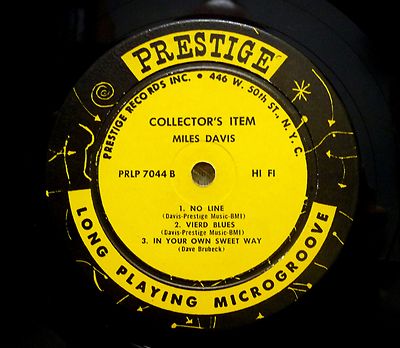
Also interesting was the brevity of this session. Only three songs, but it turned out that was all they needed to make up one of the albums that Miles owed Bob Weinstock. They had an unreleased session from 1953,  and they put it together with this session to make the album called Collector's Items.

This sent me back to the 1953 session. Miles, in his autobiography*, paints that session as something of a disaster. Miles himself was heading into the depths of his heroin addiction. Bird was drunk. He polished off a quart of vodka at the rehearsal, according to this account, but since Bob Weinstock didn't do rehearsals, this was probably at the session itself. At some point he fell asleep, and Davis recalls being so mad he played poorly, or at least that was his opinion, and session producer Ira Gitler's, and this is probably why the session wasn't released at the time. In the liner notes to Collector's Items, Gitler says that the session was shelved because it was too short, and that may be part of it. But Prestige was releasing 45 RPM EPs at the time, and it could have been brought out that way.

Probably a good part of the reason the session was so short was that given the condition of the participants. Sonny Rollins was also addicted at this time, as were Walter Bishop and Philly Joe Jones.

So was the session good enough to be released in Contractual Year 1956?

It was good enough to be released any time.

Don't forget there's another joker in the contractual deck. Miles has already cut his first album for Columbia, due to be released after the Contractual Completion. That album, when it comes out in early 1957, will be called Round About Midnight, and will feature the quintet's version of the Monk classic. Did Weinstock know this, and was he trying to steal a march on George Avakian and the Columbia marketing division?

And this circles back around to a question I pondered in my last Miles blog entry:

The first Columbia album, Round About Midnight, came out in 1957, and was not all that well reviewed. Critics found it wanting in comparison to the Prestige albums, though this judgment was to change over time, and Round About Midnight would become a classic and beloved jewel in the Davis crown. But the first response to it was tepid, and this strikes me as interesting.
...what really interests me here is the possibility that the passing of time may have led to a changing of tastes. Today, there's a lot more awareness of the evils of conglomerates and mega-corporations than there was in the 50s, and an indie label, or no label at all, might get a more sympathetic ear from critics, especially indie critics. But back then, I don't think this would have been an important issue.  
...Today some critics, perhaps many of them born and raised in the in the era of studio perfection, are a little snarky in assessing the Prestige catalog. Ragged, they say. Bob Weinstock preferred quantity to quality, rushed his sessions, didn't allow his musicians to rehearse, never did more than a couple of takes. But maybe back then, that ragged edge was more appealing, more authentic. Maybe the critics of 1957 were put off a little by the studio-perfected sound.

Maybe. And the 1953 "Charlie Chan" session provides an even greater contrast: a finely honed, rehearsed session vs. a total mess. And out of that whole chaotic fiasco, "Round Midnight" was probably the most chaotic. As Gitler describes it euphemistically, "for various reasons the date had not jelled to expectations," and by six o'clock, when the engineer (not Van Gelder) was scheduled to go off duty, and had announced that there'd be no overtime, they only had three tunes in the sack. Actually, only two, but for Collector's Items they use two different versions of "The Serpent's Tooth." They were planning to finish off the day with Monk's "Well, You Needn't," but they couldn't get it together. With 15 of studio time left, they somehow managed to pull it off.

Which is better, the once-maligned, now treasured Columbia version, or the once-shelved, now mostly overlooked collector's item?

Dumb question, of course. They're both magnificent, and no one should be expected to choose one. But, God help me, I like the earlier one. Gitler, in his liner notes, says that Bird's opening solo "is full of the pain and disappointment he knew too well. That borders on the pathetic fallacy, assigning such specific emotions to an abstraction like a piece of music.

But Gitler is right. The pain is nearly palpable. One can't help but be moved.

So, on to the new session, with only Paul Chambers from the
quintet, with Miles in full possession of his Harmon-muted voice, And with another unexpected collaboration-of-sorts, between the two jazz mega-stars of their era: Miles and Dave Brubeck. The session starts with a beautiful Brubeck composition, "In Your Own Sweet Way." There are some--not many-- who have reservations about Brubeck as a pianist, but I don't think anyone can question his brilliance as a composer. Miles would record "In Your Own Sweet Way" again with the quartet, and it has become a kind of touchstone for trumpeters, with versions by Chet Baker, Woody Shaw and Art Farmer.

"Vierd Blues" is a Miles composition that has become a standard, often for pianists (Bill Evans, George Shearing, Oscar Peterson), but also for unlikely artists such as German avant-gardist Albert Mangelsdorff. It has a striking piano solo here by Tommy Flanagan, who had just arrived in New York from Detroit (where he had been house pianist at the Blue Bird Inn) with a reputation that preceded him: in one week in March, he broke into the recorded jazz canon with sessions with Thad Jones, Kenny Burrell, Jones again, and this session with Miles.

This is a session without much or a history. It was released in 1956, and then again in a 1971 compilation-of-this-and-that reissue. But like everything else Miles did in his Contractual Farewell Tour, it has immediacy and urgency.


* Taken from Wikipedia

Listening to Prestige, Vol 1, 1949-53, available in book or Kindle format here.

Tuesday, January 26, 2016

Listening to Prestige Part 165: Tadd Dameron

How do you make a modern jazz sound with a full group after Miles Davis's nonet, with its tubas and French horns and world-changing arrangements? If you're Tadd Dameron, you assemble an octet of mainstream instrumentation: trumpet, trombone, three saxophones, rhythm section. You get extraordinary musicians, with an emphasis on a great trumpet player just coming into the full flowering of his greatness -- Clifford Brown on Dameron's first Prestige album, Kenny Dorham on this one. And do what Dameron said was most important to him, and what he did so well: you make it beautiful.

All the tunes here are Dameron's compositions, as well they should be. He was one of the important composers of his era.

Let's start with "Fontainebleau." How do you make a new modern jazz sound with an octet? Well, you can start by not worrying all that much about whether it's modern. "Fontainebleu" is a beautifyl melody that became a tone poem in the hands of Benny Goodman, and (with lyrics by Milt Gabler), a bouncy ballad (with no crying) for Johnnie Ray. In Dameron's own version, it has beauty enough to melt the heart of a romantic, and innovation enough to get the blood of a modernist racing. It's mostly ensemble work, with the ensemble voices doing counterpoint, call-and-response, and fascinating rhythmic shifts. Most of all, they keep it melodic. And I love the closing riffs.

"Delirium" is wilder, with a lot of back and forth between the horns, leading into some powerful solos, particularly by Dorham. It's a great change of pace from the first cut. There are so many tunes named "Delirium" I can't really track the discography for this one.

"The Scene Is Clean" gives Dameron his first extended solo space, and he turns it into what feels like a succession of different solos, each of them remarkable, one of them a dialog with bassist John Simmons. Simmons and drummer Shadow Wilson are both mostly associated with pre-bopmusicians. Simmons played with Teddy Wilson, Nat "King" Cole, Benny Goodman and Louis Armstrong among others. Wilson was a swing-to-bop guy, playing with  Lucky Millinder, Benny Carter, Tiny Bradshaw, Lionel Hampton, Earl Hines, Count Basie, and Woody Herman, and later with Erroll Garner, Thelonious Monk, Sonny Stitt and Phil Woods.

Dameron was certainly a modernist, one of the great composers of the bebop era, but for this session his choice of two veterans could not have been better. This would be Wilson's second Prestige session within the week--he had backed up Earl Coleman as well..

"The Scene is Cleean" has been widely recorded: by Brown and Roach, by Kenny Barron, Zoot Sims, Ronnie Cuber, Joe Lovano, Archie Shepp and others.

"Flossie Lou" has the melody, the Dameron solo work, but more than anything Kenny Dorham. This was another that was most famously recorded by Clifford Brown and Max Roach.

"Bula Beige" has all of the above, and with 11-plus minute to work with, it has even more of the above, and some great ensemble and solo work from the entire horn section. "Bula-Beige" is another Dameron tune that was picked up by a great pre-modernist, in this case Jimmy Dorsey.

Speaking of the horn section, the one who recorded the least, but was certainly not least in talent, was Joe Alexander. He was another one of those guys who mostly eschewed the big recording centers of New York and LA, but he became a legend in his adopted home town of Cleveland--so much so that one tavern where he played regularly issued a challenge -- $500 to anyone who could outblow Joe Alexander.

Prestige issued this LP as Fontainebleau. It was also scheduled to be a New Jazz release under the title Dameronia, but somehow that never happened. Dameronia did become the title of a later reissue. The session, minus "Bula-Beige," also became part of an album entitled Gil Evans/Tadd Dameron--The Arranger's Touch, and these were two arrangers who were touched by the angels.


Wednesday, January 20, 2016

Listening to Prestige Part 164: Earl Coleman

This is the first of two sessions that would be released by Prestige as Earl Coleman Returns, though what he was returning from, it's hard to say. Probably not the two Gene Ammons sessions that he appeared on, both of which were pretty much buried by Prestige. Perhaps a long-postponed return from his one big success--the 1947 session with Charlie Parker and Errol Garner that brought him his one hit record?

Actually, Earl Coleman never quite returned, never quite went away. His singing style, the rich Mr. B-type baritone, faded in popularity, but he hung on, singing in what one presumes were smaller venues, but always called upon to sing in some pretty distinguished musical settings. When he died in 1995, he received a featured obituary in the New York Times, which is something not given to every veteran jazz musician. including some who one might think of as having made more of a musical impact.

Coleman broke in in 1939, singing with Ernie Fields (he could only have been 14 at the time). The '40s saw him with Jay McShann, Earl Hines, and, interestingly, the Billy Eckstine orchestra, before his 1947 recording debut with Bird, and his one hit, "This is Always." He would also record with Howard McGhee and Fats Navarro.

In the 50s, he also recorded with Sonny Rollins and Elmo Hope, in the 60s with Don Byas (in Paris). with Gerald Wilson, and with Billy Taylor and Frank Foster. In the 8os, he worked and recorded for several years with Shirley Scott.

So what kept him, maybe on the fringes of jazz royalty, but still never far from those fringes, for a lot longer than a lot of the other Eckstine acolytes?

He was very good. And I really started to appreciate how good he was, listening to this session with some much younger musicians (and a veteran rhythm section composed of considerably older musicians--a very interesting group). His sound is very much influenced by Al Hibbler, as well as by Mr. B., and what's probably most important about him is that he works very well with musicians. He doesn't improvise a lot, but he listens to what they're doing, and he gives them a solid ground to solo from. This is true for Farmer and Gryce, and especially true for Jones.

Earl Coleman Returns was made up of this session and another later in 1956, with a smaller group.

No one has posted any of the Earl Coleman Returns tunes on YouTube, so to give you a sample, here he is with Billy Taylor;


Sunday, January 17, 2016

Listening to Prestige part 163: Jackie McLean

This music makes me happy. For all sorts of reasons. Some of it is the happiness of nostalgia, the kind that Donald Byrd brings back. Part of it is the joy of discovery--so much of it, like this particular session, I had not heard before. Combine that with the saisfaction of making new acquaintance with the familiar, like this version of Gershwin's lovely "A Foggy Day." More than anything else, perhaps, it's the deep sense of wonder and bliss that comes with opening oneself up to great art.

And it wasn't necessarily supposed to have that effect. The hipster ethos (I mean the real hipsters, not these bozos of today) was about cool, not bliss. And the heroin epidemic that took so many of these great musicians...you don't use heroin unless you have some pretty serious pain that needs to be masked.

The jazz of the 40s and 50s was not meant to be danced to--it was considered undanceable, as opposed to the swing of the previous decade. Actually, though it might not have made it onto Dick Clark's American Bandstand, much of it has a good beat--you can dance to it. I've described watching teenagers boogieing to the idiosyncratic rhythms of Dave Brubeck at the New Orleans Jazz and Heritage Festival.

And then there was the association of modern jazz with menace...the Peter Gunn Effect. Mad Comics' Harvey Kurtzman parodied that with a private eye named Thelonious Violence.

The undanceable quality of bebop was deliberate in a couple of ways.

First, there was the cabaret tax put on establishments that allowed dancing. Eric Felten gives an account of those days in the Wall Street Journal:
In 1944, a new wartime "cabaret tax" went into effect, imposing a ruinous 30% (later merely a destructive 20%) excise on all receipts at any venue that served food or drink and allowed dancing. The name of the "cabaret tax" suggested the bite would be reserved for swanky boîtes such as the Stork Club, posh "roof gardens," and other elegant venues catering to the rich.
But shortly after the tax was imposed, the Bureau of Internal Revenue offered this expansive definition of where it applied: "A roof garden or cabaret shall include any room in any hotel, restaurant, hall or other public place where music or dancing privileges or any other entertainment, except instrumental or mechanical music alone, is afforded the patrons in connection with the serving or selling of food, refreshments or merchandise." 

The big dance palaces like Roseland could afford it as part of the cost of business. The smaller clubs like the 52nd Street places couldn't, so they encouraged a kind of music that relied on the appeal of virtuoso soloists, whom people would want to sit and listen to.

You go back and listen to that music -- the music I call swing-to-bop. People like Zoot Sims. Of course you could dance to it. But that became not the point. You could certainly dance to Stan Getz if you wanted to, but the hip response became to listen. Maybe not to the far-out inventions of musicians like Lennie Tristano and Warne Marsh, but to much of it.

Also, those cats were intellectuals. And they were stung by racism. They were stung by artists like Cab Calloway and Louis Armstrong -- and those were just the famous ones. There were others who weren't that good, but they were still putting on what the beboppers perceived as a coon show. Read Arnold Shaw's Black Popular Music in America. Look at Ernest Hogan, who wrote "All Coons Look Alike to Me," and made a fortune off it, and never forgave himself for having written it. What was the stereotype of happy darkies? "They sure can sing and dance." Well, the beboppers weren't having it.

 But times change, and while I may not be getting up and dancing (well, I'm typing), I'm still blissful.

James Baldwin, in his great short story "Sonny's Blues," talks about "the tale of how we suffer, and how we are delighted, and how we may triumph" -- a tale that "is never new, [but] must always be heard." The delight is always a part of it.

The first number on this recording session (not the first on the album) is Gershwin's "A Foggy Day." I started listening to it without looking closely at the session lineup, but the remarkable piano work, first melancholy, then joyful, as with the message of the song, brought me back to the printed word, and I discovered that it was Elmo Hope.

I've talked about Hope before--the pain in his life, and the joy that leavens the pain in his music. He's at his best here. Accompanying two great soloists, he's supportive and inventive at the same time.

What's a piano player in a jazz quintet supposed to do? Miles Davis famously wanted Thelonious Monk to lay out while he soloed, and it led to words between them, if not to blows. Max Roach said that what they most wanted in a piano player was to stay outta the way, and he admired George Wallington for his ability to do just that--but then, Max said, when the time came to solo, he'd "fill it up."

Not everyone wants the same thing in a piano player. If you're hiring Thelonious Monk to play in your quintet, you're probably not getting a cat who'll stay outta the way, as Miles discovered. And Elmo Hope, here? He doesn't exactly stay outta the way, but he's always supportive, always discovering and adding new possibilities, and filling it up when he solos.

In addition to Gershwin, the composers here are Byrd ("Lorraine" and "Kerplunk") and McLean ("Lights Out," "Up," "Inding"). We know that McLean was a good enough composer to inspire Miles Davis to steal "Dig" from him. Byrd is new on the scene and making his presence felt. He's ready to play with the big boys, and compose with the big boys, and everyone knows it. Between the two of them, you have some five o'clock blues to remember.

"Lights Out" was issued on two sides of a 45, as well as being the title cut for the album.


Wednesday, January 13, 2016

Listening to Prestige part 163: George Wallington

The new name here is Donald Byrd, who was at the beginning of a major career in American music. He was 24, and had already recorded more than a lot of musicians ever do, beginning with a 1955 album laid down in his native Detroit, for Transition, a short-lived label run by Tom Wilson, who would later achieve considerable renown as Bob Dylan's producer, one of the reasons why Dylan's albums were so good musically.   Byrd Jazz featured fellow Detroiters Yusef Lateef and Barry Harris, and was the first of a bunch of albums he would make for Transition in 1955, the rest after his move to New York.

There's a lot more to say about Donald Byrd, and I'll save most of it, since he would be very active on Prestige before signing an exclusive deal with Blue Note in 1959. But I will mention the quintet he led with Pepper Adams, another Detroiter, from 1958-1961, because it had such a profound effect on me.  This would have been 1959, me living in New York for the first time, starting my own transition from scared kid to having an actual sense of myself as a person, with jazz playing a major part in that. And finding my way up to 135th Street, to Smalls Paradise (the picture is from a few years later, when Wilt Chamberlain had bought the club). The Byrd/Adams Quintet was playing there, and there was no minimum, and you could get a beer for 75 cents and nurse it all night. I was still mostly scared kid, and not at all sure I had a right to be there with the real hip cats, but the music drew me in, and I'll never forget it.

That quintet would make several albums, including one live at the Half Note. No live at Smalls, but always in my heart.

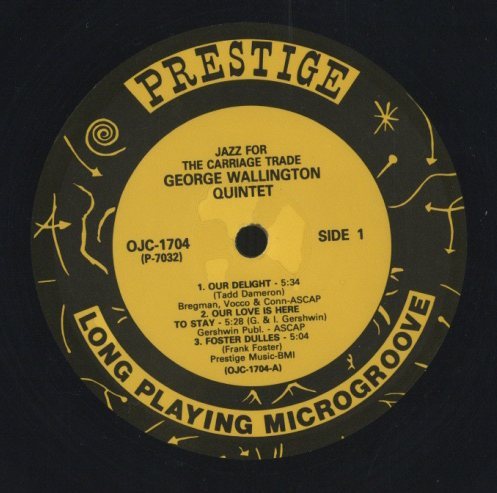
Listening to this album, with George Wallington as leader, is almost as much of a treat as being back at Smalls. It's that good. I'm listening, as always, to the tunes in order of set list for the recording session, not as they appear on the LP, starting with a couple by two important jazz composers. Tadd Dameron is one of the most important, and "Our Delight" is a delight, with some remarkable trade-offs between Woods and Byrd, and maybe even more remarkable piano solos by Wallington. Jazzdisco.com, probably going from the original set list, gives the drummer as Bill "Junior" Bradley, who had been working with the Woody Herman band and was working regularly with Wallington at that time. But the liner notes credit Art Taylor, who was doing a lot of drumming for Prestige in this days, so it's almost certainly him. Ira Gitler explains that although it's Bradley's picture on the album cover (I'll have to take Ira's word for this; I don't know what Bradley looked like, but the picture shows four white guys and Donald Byrd, so that would seem to be the case), he was out of town for the recording date--probably doing a gig with Herman.  In any event, the drum fills are very tasty indeed.

The second cut, "Foster Dulles," is not so much a tribute to Eisenhower's secretary of state as a play on the name of its composer, Frank Foster, and thank goodness boppers have not completely forsaken the art of punning on their names. Whoever picked the tunes for this session, Wallington or Weinstock -- and I have to guess it's Wallington, because it's such an eclectic mix -- did a great job.

Gershwin is next, with "Our Love is Here to Stay." It's fascinating to follow the range of composers, noted and obscure, from early 20th Century operetta to Fifties pop, who have caught the attention of modern jazz improvisers. But Gershwin remains the gold standard.

Two Phil Woods compositions suggest, from their titles and from the free-swinging good time music, that these are Rudy Van Gelder's "Five O'Clock Blues." "Together We Wail" is aptly titled, as Byrd and Woods wail together, separately, and closely conjoined., For that matter. so is "But George," which has more Byrd/Woods work, but also allows Wallington a large open space to make the most of.

"What's New" is a showcase ballad for a vocalist, with notable recordings by Linda Ronstadt and Frank Sinatra among others, and I hadn't realized it was written by dixieland bass player Bob Haggart. It makes a fine moody showcase for Wallingford.


Saturday, January 09, 2016

Listening to Prestige part 162: Jon Eardley

The thing to remember about mainstream or straight ahead jazz is that it's never really mainstream, and never really straight ahead. I'd always usd the terms pretty much imterchangeably, to refer to,the music of the time period I'm writing about. Wikipedia says there's a difference, "Mainstream" refers to players like Buck Clayton who continued to perform and record after the big bands broke up, but never  embraced bebop. "Straight ahead" refers to,the music made after the Charlie Parker era and before the Dolphy-Coltrane-Coleman era. Music such as was made by guys like Jon Eardley. I suspect I'll comtinue to use them interchangeably.

You can put it on as background music because, let's face, any kind of music can be background music. You put on something you like, even if it's Charlie Parker or Ornette Coleman or Igor Stravinsky or Gustav Mahler, and you're doing something else, whether it's an architectural rendering or washing the dishes, it's background music. If you're writing a blog about jazz, and your whole point is that this music is important, and you should set yourself down in a quiet room with no distractions and listen to it, and you're writing this at the same time the music is playing, then it's background music.

But mainstream or straight ahead are words that seem to describe music that can easily fade into the background as you concentrate on your rendering or dishwashing or jazz blogging, and it never can. With the kind of player that Bob Weinstock brought into the studio, and Rudy Van Gelder recorded, it never gets predictable, These guys played jazz because they came, consciously or not, out of modernism, out of Pound's dictum to "make it new." They came out of Louis Armstrong, who made it new, and Charlie Parker, who made it new, and they were inspired to keep building on that, to keep searching for the new.

John Eardley was to pretty much fade into oblivion after this album, and in fact, when it was rereleased in the 60s, it would be under Zoot's name.. He wouldn't record again as a leader until some sides for European labels in the late 70s. He'd be remembered, if at all, as one of those guys who played hard bop, just as if "one of those guys" was a phrase that had any meaning at all. As if those guys were minnows swimming straight ahead down a main stream. This album is none of that. It's full of surprises, full of inventiveness, full,of musical ideas and inventiveness, of phrasing, of time, of creative flight. And you don't get guys like Phil Woods and Zoot Sims for a session unless you're well respected.

"Koo Koo" is an Eardley composition (as are "On the Minute" and "Ladders"), and it's the gem of an excellent lot. It became the title track for the Zoot Sims reissue, and I'm surprised that it hasn't become more of a standard. Maybe because there are so many songs named "Koo Koo." "Eard's Word," interestingly, is a Zoot composition.

Milt Gold played with Kenton, and later in a three-trombone ensemble led by Bill Harris. When you're playing in a group with Eardley, Sims and Woods. you're not going to get a lot of solo time, but Gold sounds great when he does get a horn in edgewise.
There are so many great Zoot Sims stories, it's hard to resist putting them in every chance I get. This is David Amram reminiscing about the old Five Spot.

One time Larry Rivers was playing. Larry loved to play as much as anybody in the world
and he had a great band with Freddie Redd and Elvin Jones and all these tremendous musicians. But Larry was so busy painting, I don’t think he ever practiced in 30 years. He was blasting away, hitting a lot of clinkers. Zoot Sims was sitting at the bar and Zoot was the most big-hearted person. As Larry was playing more and more clinkers, Zoot was quietly sinking down in his bar stool, waiting for it to be over. I said, “Zoot, wasn’t that something?” He looked up very quietly and said, “Man, I think I’m gonna take up painting.”

The Jon Eardley Seven was released on 12-inch LP. which was now the standard.


Friday, January 01, 2016

Listening to Prestige part 161: Wrapping up 1955

Certainly the most significant event of 1955 was the death of Charlie Parker. Everybody knows the story: Bird died in the Stanhope Hotel suite of Baroness Pannonica de Konigswater, his body so racked with the ravages of addiction that the coroner guessed his age as 60. The story has it that Baroness Nica called her Park Avenue physician, who had never heard of Bird, to his side. The doctor asked, "Mr. Parker, do you drink?" Bird replied with a straight face, "Sometimes I take a glass of sherry after dinner,"

And legend has it that at the moment he passed away, a single white feather fell from the rafters of Carnegie Hall.

Nearly as significant, the death of Wardell Gray. And nobody knows the story, because it's unknowable. He died in Las Vegas. Perhaps he was murdered. We'll never know, because the racist Las Vegas police force couldn't be bothered to investigate the death of a black man.

Dave Twardzik, who shared a love of Bartok with Charlie Parker, and whose exploratory jam sessions with Bird went sadly unrecorded, also shared heroin addiction with Bird, and also passed away in the same year.

Other passings of note included James P. Johnson, piano great and composer of "Charleston," saxophonist Eddie Pollack, Ellington basssist Junoior Raglin.

The timeline on allaboutjazz.com does a nice job with the year's highlights, including this one:

The Hard Bop style is emerging via people like drummer Art Blakey and piano player Horace Silver. Blue notes are disappearing from Jazz. They are being replaced by minor notes. For instance, the blue seventh becomes the minor seventh, etc. 
Billboard's April 23rd issue led off with a front page headline announcing that jazz record sales were up by 55 percent, and devoted a large section of its issue to jazz. The lead article:
Concert and Nitery Fields Get Shot in Arm from Jazz Boom
From Carnegie Hall to Neighborhood Hideaway, it's Loud at Cash Register
"It is," the article goes on to say, "virtually the only nocturnal attraction the younger generation will spend money for." Jazz clubs are springing up all over the country. Carnegie Hall is swamped with  requests for jazz bookings, and there's a new college circuit, thanks largely to Dave Brubeck. The legendary 52nd Street jazz clubs, by the early 50s, had mostly become strip joints, but according to Billboard, "even the one-time shrine, 52nd Street, is showing signs of forsaking flesh and returning to jazz." Credit for the boom is given to publicity in national magazines like Time, Life, Esquire and Vogue. Billboard doesn't mention Playboy, but that has to be important too. Disc jockeys are also credited for playing jazz, and an other important contributing factor is the rise of hifi recording.

And--this has to be good news for the working musician--jazz was starting to pay.
Previously, most [jazz] spots employed a trio at trio at about $350 and a pianist at $125, for an average weekly bill of $475. Now these same spots are paying $1750 and $2000 for jazz units and making money. 
Jazz labels taking large display ads in the issue included Atlantic (promoting Shorty Rogers), the Norman Granz stable (Clef/Norgran, with a huge list of artists), London (more LPs than you can imagine from Ted Heath), Bethlehem (to me, Bethlehem is always Chris Connor), RCA Victor (including Ellington, Al Cohn, Don Elliott, but not heavy on modern jazz), Pacific Jazz (including "Gerry Mulligan's latest--a truly high fidelity 12" concert LP"), Fantasy (nothing by Brubeck--he had already discovered Fantasy was ripping him off and jumped to Columbia), Columbia (a full page ad announcing "sensational news" coming June 1 from "the most famous house in jazz" -- probably the signing of Miles Davis), EmArcy ("In a matter of months...the hottest jazz line in the business!"), Capitol (Kenton and Goodman mostly, but a lot more too), and a handful of smaller ads from smaller labels, not including Prestige or Blue Note.

There's an article on the resurgence of the jazz DJ, highlighting Al "Jazzbo" Collins. who "doesn't play any 'screaming' jazz discs, but otherwise he features a wide variety of jazz discs, ranging from Dixieland to modern."  What's screaming jazz? Your guess is as good as mine. I remember, new to jazz and looking for it on the radio, tuning in Jazzbo because of his name, and being disappointed that he really wasn't playing anything I wanted to hear.

Modern jazz is what's selling, Billboard tells us.
True, the names of old-time greats garnish the list--Louis Armstrong, Sidney Bechet, Fats Waller and even Bix Beiderbecke. However, this is the hour of Brubeck, Shorty Rogers, Mulligan, Chet Baker, etc.

Billboard's jazz best seller list--and don't forget, this is only April. There's a lot of 1955 to come:

Atlantic: The Rampart Street Ramblers, Errol Garner, Dizzy Gillespie, Sidney Bechet and Muggsy Spanier, Billy Taylor.

Bethlehem: Three by Chris Connor, Carmen McRae, Herbie Mann.

Blue Note: Art Blakey and Clifford Brown, Tal Farlow, Bud Powell, Miles Davis with Horace Silver, Lionel Hampton.

Capitol: Goodman, Kenton, June Christy, Marian McPartland, Woody Herman.

Clef: Basie, Hampton, Krupa, Oscar Peterson, Tatum.

Columbia: Brubeck, Brubeck, Armstrong, Brubeck, Buck Clayton.

Commodore: Dixieland Jamboree, two by Billie, Jam Session with Eddie Condon, Chicago jazz with Muggsy Spanier.

Contemporary: Two by Barney Kessel, Howard Rumsay, Shelley Manne, Lennie Neihaus.

Coral/Brunswick: Les Brown, a couple of compilation albums, Tony Scott, Terry Gibbs.

EmArcy: Sarah, Dinah, Brown/Roach, Dinah, Garner.

Epic: Lester, Bobby Hackett (it looks like Buddy Hackett in the blurred facsimile that I have, but that can't be right), Lou Stein, the Duke's men, Swingin' Trends in Chamber Sounds with the Harris Lee Woodwinds. If I had time and resources I'd listen to everything, including the Harris Lee Woodwinds, who sound interesting.

Esoteric: Charlie Christian, Jazz off the Air (with Eldridge), Al Haig, Sonny Berman, more Jazz off the Air,

Fantasy: Mulligan, four by Brubeck. He'd left Fantasy, but they still had the product.

Good Time Jazz: The Firehouse Five Plus Two, Kid Ory, Bob Scobey, the Banjo Kings, Ory.

MGM: Hampton, Max Kaminsky, Shearing, Ralph Burns, Clark Terry. This was the famous -- well, should be famous -- Cats vs. Chicks album, with Clark Terry on trumpet, Urbie Green on trombone, Lucky Thompson on tenor sax, Horace Silver on piano, Tal Farlow on guitar, Oscar Pettiford and Percy Heath swapping off on bass, and Kenny Clarke on drums for the cats, and Terry Pollard Septet (Norma Carson on trumpet, Beryl Booker on piano, Terry Pollard on vibraphone, Corky Hale on harp, Mary Osborne on guitar, Bonnie Wetzel on bass and Elaine Leighton on drums) for the chicks, and according to one reviewer on Amazon,

At first glance one would think this was a lopsided comparison that pitted world class male musicians against a group of unknown women. That would be a mistake because Mary Osborne was a renowned, world class guitarist. Terry Pollard was easily the equal of any male pianist or vibraphonist (she was a master of both instruments), who bested the great Terry Gibbs in many vibraphone duels when she was with his band as a pianist. Norma Carson was no slouch on trumpet either, giving Terry Clark a run for his money on every track.
The final track - Anything You Can Do I Can Do Better -pits Norma Carson against Clark Terry, Mary Osborne against Tal Farlow, and Terry Pollard against Horace Silver. Personally, I think the women smoked the guys here and I am not saying this to be politically correct. I honestly believe that assertion.

Nocturne: Shorty Rogers, Virgil Gonzalves, Harry Babasin, Herbie Harper, Bob Enevoldsen. The last four were unfamiliar names, so I found and played a little of Gonsalves' album, which also featured Babasin and Enevoldsen. Very nice stuff. In the 1970s, Gonsalves, a San Francisco musician, joined the rock band Pacific Gas and Electric.

Norgran: Getz, Buddy deFranco, Dizzy, Johnny Hodges, Louis Bellson.

Pacific Jazz: Mulligan, Baker, Baker, Mulligan, Laurindo Almeida.

Period: Ralph Burns, two by Teagarden, Osie Johnson, Django Reinhardt. Some of these are very obscure labels indeed. Period lasted only a few years, but was very highly regarded for its sound quality. They mostly a classical label, but did record some jazz.

RCA: Two by Sauter-Finnegan, two by Shorty Rogers (one with Andre Previn), Ellington.

Riverside: Fats Waller, Armstrong, Waller, Jazz of the Roaring 20s, Bix. I hadn't realized Riverside started out as a trad jazz label -- I associate them mostly with Monk. There's an article in this same Billboard by Riverside prez Orrin Keepnews on the jazz reissue business.

Roost: Johnny Smith, Getz, Smith, Smith, Roost 5th Anniversary.

Savoy: Bird, Jay and Kai, two by Kenny Clarke, Mingus. Amazing that this is the first mention we've seen of Bird.

Storyville: Lee Wiley, Teddi King, Lee Konitz, Jackie and Roy, Ellis Larkins.

Vanguard: Vic Dickenson, Jimmy Rushing, Mel Powell, Buck Clayton and Ruby Braff, Sir Charles Thompson.

X: George Handy, Red Norvo, Original Dixieland Jazz Band, Bob Pollack, Eddie Condon.

I've saved Prestige for last. They had two lists, since New Jazz was still active in 1955.

On New Jazz: Jimmy Raney, Zoot Sims, Phil Woods, Jimmy Raney, Jon Eardley.

On Prestige: MJQ, MJQ, Billy Taylor, Kai and Jay, Miles Davis. This was still in the 10-inch period for Prestige, and these two albums, later became one, the legendary Django. The Billy Taylor album was his Town Hall concert. This was the first pairing of Jay and Kai, and Weinstock was taking a chance. It wasn't a given that these two would work well together. The Miles Davis session to make the Prestige hit parade for April was the sextet with J. J. Johnson and Lucky Thompson.


Billboard continued to follow jazz through the year. June brought a story on how jazz labels would try to build an audience for progressive jazz by issuing more DJ-friendly shortened versions of jazz cuts to selected disc jockeys. I'm guessing this wasn't a huge success. Norman Granz was touring with a Jazz at the Philharmonic show headlining Sarah Vaughan, Dave Brubeck, Oscar Peterson, Jackie and Roy, and Cal Tjader, and wouldn't you like to have caught one of those? Reviews included Brubeck and Desmond's Interwoven ("This is Paul's set all the way...(the album) will find a receptive market, since Brubeck's popularity has waned but little"). Columbia's I Like Jazz album was the fastest-selling LP in the label's history.

In July, a plaint from a record store owner. He's delighted that the sales of jazz albums are doing so well, but

Customers do not buy jazz singles at all any more. This does create a problem...they often want an LP with a particular selection, and it is difficult to find it without taking down quite a few. Can't someone come up with a catalog that would help us locate selections in the various LPs?

The National Council of Churches will feature jazz on its Sunday morning TV show, as a counter to the argument that jazz promotes juvenile delinquency. Dave Brubeck is scheduled for a series of concerts with symphony orchestras.

In August, Epic Records starts a jazz division, and signs "Ray Bryant, a Philadelphia pianist who reportedly plays a strange combination of bop and spiritual styles. Count Basie has "found a fine new jazz and blues singer in Joe Williams, who captured the attention of the Rock and Rollers. Now Norman Granz has a tremendous hit single, his first, in Basie's "Every Day."

In September, we learn that Madison Avenue has discovered jazz, and "it's no longer unusual to dig jazz in an atmosphere heavy with perfume and high fashion." And in an atmosphere heavy with goatees and elbow patches, Marshall Stearns offers, for the third year, a course entitled "The Role of Jazz in American Culture." Each lecture and discussion is followed by a field trip to a local jazz spot.

In October, EmArcy announces it will unveil a "Mystery Band" sometime this fall.

November brings Leonard Feather's Encyclopedia of Jazz.


Our old standby rateyourmusic.com does its usual idiosyncratic list of the top 500 albums of the year, and it continues to  be a pretty good overview of the year in jazz. A competing listener-voted list, bestmusicever.com, is somewhat different, and reflects the fact that the LP market has expanded to include a wide range of popular music styles, so that of the top five albums of the year, two are by Bill Haley and the Comets, one by Hank Williams.

Rateyourmusic leads off with the 1951 Bayreuth Festival as its album of the year, then moves seriously into jazz.

2. Sarah Vaughan (EmArcy). EmArcy was the jazz arm of Mercury Records, and they had a seriously impressive cast of characters, as evidenced by the musicians on this set: Clifford Brown, Paul Quinichette, Herbie Mann, Jimmy Jones, Joe Benjamin, Roy Haynes.

3. Clifford Brown & Max Roach, Study in Brown (EmArcy)

4. Helen Merrill (EmArcy). This one with Clifford Brown, Jimmy Jones and Oscar Pettiford, with arrangements by Quincy Jones. Helen Merrill is still with us, and recorded as recently as 2003. Her website lists her most recent club date as Birdland in New York in 1903.

5. Frank Sinatra, In the Wee Small Hours (Capitol). This was the first of Sinatra's great Capitol albums (there had been two EPs preceding it). The 70s rockers seem to think they invented the concept album, but Sinatra on Capitol created the greatest series of concept albums ever recorded,

6. Louis Armstrong, Satch Plays Fats (Columbia). This actually was the first LP I ever bought. I don't count it as my first jazz LP, because I really didn't know what I was doing when I bought it, and I wasn't consciously a jazz fan yet.

7. Kenny Dorham, Afro-Cuban (Blue Note)

8. Julie London, Julie is her Name (Liberty)

9. Clifford Brown and Max Roach, Brown and Roach Incorporated (EmArcy)

12. Chet Baker Sings and Plays With Bud Shank, Russ Freeman and Strings (Pacivic Jazz)

14. Thelonious Monk Plays the Music of Duke Ellington (Riverside). Monk's first album after leaving Prestige, the material apparently chosen because Monk was stung by criticism that he couldn't play anything except his own compositions.

15. Dinah Washington, For Those in Love (EmArcy)

16. Helen Merrill With Strings (EmArcy)

19. Erroll Garner, Contrasts (EmArcy)

20. Billie Holiday, Music for Torching (Clef). Lady backed up by Harry "Sweets" Edison, Benny Carter, Jimmy Rowles, Barney Kessel, Larry Bunker.

Also on the list: Gene Krupa & Buddy Rich, J. J. Johnson, Stan Getz, Getz and Hamp, Getz and Diz--Diz also with Roy Eldridge. So we have a couple of pairings that explode the myth that this era was a constant battle between the beboppers and the moldy figs--but we know that the Hampton band, though it played trad jazz, was a fertile breeding ground for young moderns.

There were both MJQs -- Modern and Milt.

Also in the top 100, in alphabetical order, Art Farmer, Barney Kessel, Beverly Kenney, Bobby Jaspar, Cannonball Adderley, Carmen McRae, Charles Mingus & John LaPorta, Chico Hamilton Featuring Buddy Collette, Clark Terry, Dave Brubeck, Dexter Gordon, Don Shirley, Duke Ellington, Ethel Ennis, Frank Morgan, Gerry Mulligan, Gigi Gryce, Hampton Hawes, Hank Mobley, Herbie Nichols, Horace Silver, Jack Montrose, Kenny Clarke, Lee Konitz, Lennie Niehaus, Miles Davis, Nat "King" Cole, Pérez Prado & Shorty Rogers, Shelly Manne, Sonny Rollins and Thelonious Monk, The Four Freshmen, The Trio (Hank Jones, Wendell Marshall, Kenny Clarke), Tony Fruscella, Victor Feldman.

A couple of these names were unfamiliar to me, so I followed them up. Ethel Ennis's 1855 album was entitled Lullabyes for Losers, which was intriguing enough. It came out on Jubilee, with Hank Jones, and it's very, very good. Although an outspoken Democrat, she was invited to sing at Richard Nixon's 1972 inaugural. And she is still with us. Beverley Kenney recorded this album with Johnny Smith. She's sort of a cross between Annie Ross and Blossom Dearie, and a good singer, though perhaps best known in her day for hating rock and roll, and singing a song of her own composition, "I Hate Rock and Roll,"on the Steve Allen  show (Steve hated rock and roll too).

Prestige continued to roll out--some old standbys, some new faces, including some that would last and some that wouldn't quite make it. Tony Luis and Terry Morel recorded one session, four songs with piano trio and four with Morel's vocals, making two EPs, neither of which can be found today. Sanford Gold made one solo piano LP , which deserves to be better remembered than it is.

The MJQ recorded twice--in January with Kenny Clarke, in July with Connie Kay. The January session was the "La Ronde Suite," and July brought the session that became Concorde, and farewell to Prestige. Kay actually sort of joined the group earlier, for a Milt Jackson session with Horace Silver on piano.

Miles Davis had a busy year with three recording sessions--three for Prestige, that is. He had already recorded his first Columbia album, though it would have to wait for release. James Moody and Gene Ammons remained vigorously active, as did Phil Woods, Jimmy Raney and Bennie Green.

DownBeat, as was its custom, had its separate readers' and critics' polls. Readers and critics agreed on band (Basie)tenor sax (Getz), baritone sax (Mulligan), trumpet (Miles--critics made it a tie with Dizzy), trombone (J. J.), vibes (Milt), female vocalist (Ella). The readers had more categories than the critics, one of them being Hall of Fame, to which they voted Charlie Parker. One would think that was long overdue.

The readers had something called combo-instrumental, and the critics something called acoustic jazz group. Probably the same thing, but acoustic jazz group? There were electric jazz groups in 1955? Anyway, presumably the same category, different results. Brubeck for the readers, MJQ for the critics. I'll go with the critics. The readers picked Buddy DeFranco over Tony Scott on clarinet--with the readers this time. Drums, Max for the readers, Blakey for the critics. I wouldn't want to choose. If I had to, I'd go with Max. Bass was Ray Brown vs. Oscar Pettiford, and I guess I'll take Ray because I've heard more of him. The critics' category specified "acoustic bass," and there actually were a few electric bassists by then. Piano is Garner vs. Tatum. I'm a little surprised Tatum is still that big in 1955, and the critics aren't picking a more modernist like Monk or John Lewis. But of course, you have to go with Tatum. Guitar is Johnny Smith vs. Jimmy Raney, and I'm with the critics here. Male vocalist Frank Sinatra vs.Louis Armstrong. 1955 was the year of In the Wee Small Hours, the first great Sinatra/Nelson Riddle collaboration on Capitol, which makes it a really hard choice. Sinatra probably deserves it for 1955. But I can never vote against Armnstrong.

The readers also chose personalities of the year: Pop--Frank Sinatra, Jazz--Dave Brubeck, Latin--Perez Prado, R&B: Bill Haley. Leading me to believe that DownBeat readers didn't exactly know what R&B was. Tito Puente is my vote for Latin musician of the year, every year, but 1955 was the year of "Cherry Pink and Apple Blossom White," one of the top selling songs of the decade. Vocal group was the Four Freshmen, once again making me think the DownBeat readers didn't listen to enough R&B. This was the era of musical wars: the moderns vs. the moldy figs, and all jazz people violently anti-rock and roll. There were a number of doowop groups active in 1955 who were a lot more interesting than the Four Freshmen.

They chose accordion (Art Van Damme), miscellaneous instrument (Don Elliot--mellophone; this was before Rahsaan Roland Kirk), arranger (Pete Rugolo). The readers' poll had a long-standing category of band singers, which had become pretty irrelevant by this time. That continues to be the case with girl singers--the readers chose Ann Richards, who had appeared briefly with the Kenton band and less briefly with Kenton--he married her. The boy band singer, on the other hand, was Joe Williams.

I got interested in the acoustic bass issue. I had thought of Monk Montgomery as the first jazz electric bassist, and in fact his Prestige session with Art Farmer may well have been the first use of the electric bass in a modern jazz recording.  

Actually, Monk may have been the second. According to musicradar.com's  history of the electric bass

Leo [Fender] would call in at concerts and nightclubs to show off his instruments and in New York he encountered Lionel Hampton's band.
Bassist Roy Johnson tried the Precision and Lionel loved the sound. Leo told them to keep it and the Bassman amplifier as it would be good publicity for Fender. When Roy left to be replaced by Monk Montgomery (brother of guitarist Wes), Monk was asked to play the Precision.
As a well respected upright player Monk was horrified but Hampton was insistent as the bigger bass sound had become a trademark of the band.
Conventional bass players recognised it as a threat and it was referred to as 'the bastard instrument' but Monk got to grips with it and was soon making a name for himself.

With electric jazz still far in the future, on to 1956!