Saturday, March 15, 2008

Poetry: The First Ten Years


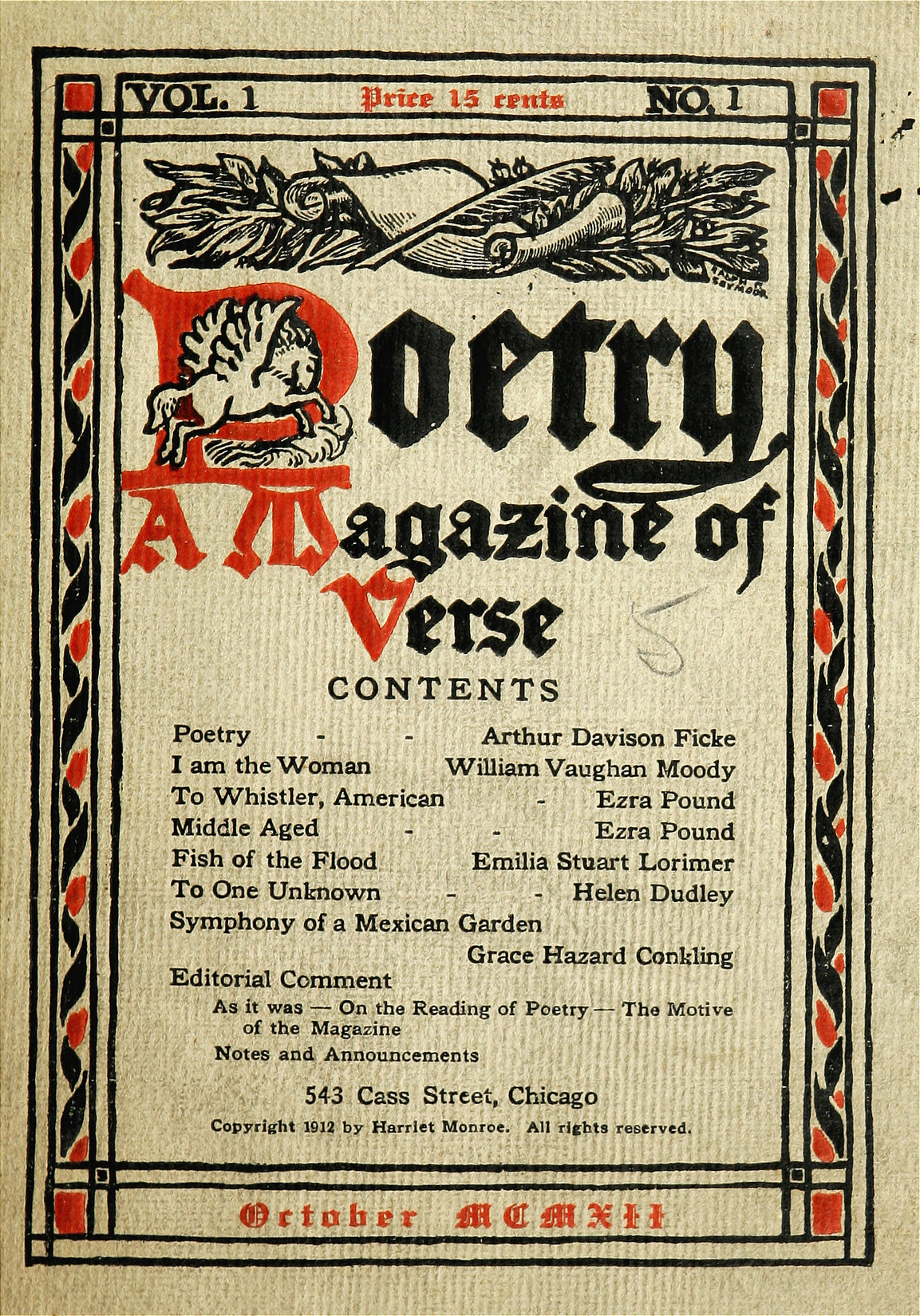
This is a real online treasure trove, facsimile editions, page by page, of the first ten years of Harriet Monroe's Poetry Magazine. I'm going to try and work my way through a play-by-play, issue by issue, which may take a while, and is certainly a quixotic endeavor. Still, a journey of a thousand poems starts with a single metaphor, so let's look at Issue 1, from October 1912, priced at 15c, and beginning, not with a manifesto (although there is a statement of purpose at the end), but with a poem -- a tw0-sonnet sequence by Arthur Davison Ficke. best remembered now for being Witter Bynner's co-conspirator in the Spectrist Hoax of a few years later.

How forward-looking was Poetry? Well, we know how forward-looking it was -- the epicenter of Modernism, champion of Pound. But you wouldn't prove it by Ficke, who looked more toward the mid-Victorian uplift of a poet like William Ernest Henley. I don't demand that poetry reflect today's tastes -- in fact, I rather prefer it not to -- but I'm hard pressed to find much in Ficke's homilies about poetry, that "little isle amid bleak seas."

Curiously, it contains a typo -- Harriet Monroe must have agonized over that after it was off the presses -- a typo in the very first poem of the very first issue.

Ficke goes on to compare poetry to a holy war, which makes it a manifesto of sorts. He's followed by William Vaughn Moody, the late William Vaughn Moody at this point -- he died young, of brain cancer, in 1910, leaving behind

one play, yet so full of promise was The Great Divide, so American in the best sense, that his early death cannot but be the source of the deepest regret.
His posthumous entry here is mid-Victorian, too, but it looks back toward a more promising model, Robert Browning. He has some of Browning's pomposity, and some of his gift for characterization -- the woman of Moody's "I am the Woman" is more archetypal than Browning's finely tuned individuals, but at least she doesn't roar or bring home the bacon and fry it up in a pan. Moody gives us some nice metrical variations between iambs and anapests, and some nice rhetorical flourishes, like this chiasmus:

I comfort and feed the slayer, feed and comfort the slain.
He remains readable.


Then, on page 11, we get to what we've been waiting for -- the leap into the future, with Ezra Pound. He leads off with an homage to Whistler that reads too much like most homages and most poems about art. He singles out Whistler and Abe Lincoln from the "mass of dolts" that populate and have populated America.

Then "Middle Aged: A Study in Emotion" takes from romping tourists down into the sarcophagus of a long-dead king, but Pound's snobbery gets subsumed in the sudden brilliance of insight and imagery, and here we are, moving into the 20th Century.


As the fine dust, in the hid cell beneath
Their transitory step and merriment,
Drifts through the air, and the sarcophagus
Gains yet another crust
Of useless riches for the occupant


And back next time with more.


Wednesday, March 12, 2008

The Realist


Have I posted this this before? There's a new website devoted to scanning and uploading -- eventually -- every issue of The Realist. So far, they've put up one of the issues with me in it -- my very first Realist appearance.

Tuesday, March 11, 2008

THE 40s
Four Voices
The One I Love

THE 50s
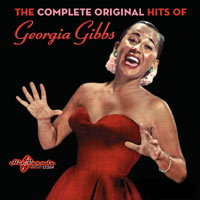
Georgia Gibbs
Seven Lonely Days (1953)


THE 60s
Secret Agent
Johnny Rivers


THE 70s
Donny & Marie Osmond
Deep Purple


THE 80s
Pat Benatar
Invincible


THE 90s
Beck
Loser


"Get a Job" waltzes off with the honors for last time, since Tony deFranco wasn't in the running.

I started one a few days ago, and it would have been interesting -- the two top contenders were The Spencer Davis Group doing "Gimme Some Lovin'" from 60s, and Salt-n-Pepa doing "Let's Talk About Sex" from the 90s, and I was probably going to go for Salt-n-Pepa, in spite of considerable affection for "Gimme Some Lovin,'" but realizing "Let's Talk About Sex" was probably the better song...but my computer froze and I lost the list.

So here's yet another, and...guess what? It's like I never left home.

I'm hoping not even Charis will go for Donny and Marie. I'm fairly certain the 40s and 50s will get left at the gate.

Pat Benatar was OK, but it would take an awfully weak set of competitors to make me vote for her.

So we come down to the 60s and 90s again, with a 60s song that I have even more affection for, and 90s song I know I have to vote for. Beck's an original, an elite talent. So although I am in fact a man who lives a life of danger..

Friday, February 29, 2008

Battle of the Decades

I haven't done a Battle of the Decades in a while, but I have an excuse. I got a download of the Complete Buddy Holly, in ten volumes, boing back to a home tape recording he made when he was 12, and I've been cataloging it. A lot of it is great -- Holly, fooling around in the studio but more than just fooling around, did his version of a whole lot of rock 'n roll hits of the day, from Bo Diddley to Rip it Up to Smokey Joe's Cafe. One not-very-effective cover is Ferlin Husky's Gone -- Buddy's strength wasn't in country ballads. Which explains why, when he started out in the early 50s in Texas, as Buddy and Bob, Bob did most of the lead vocals. Buddy had a different muse. This follows the theory that so much innovation in art comes from artists who don't have the ability to imitate -- Dizzy Gillespie tried to sound like Roy Eldridge but couldn't, so he moved on to create his own unique style. Miles Davis tried to sound like Dizzy but...

THE 40s
Glenn Miller v/Ray Eberle
Moon Love

THE 50s
The Silhouettes
Get a Job

THE 60s
Paul Revere & the Raiders
Him or Me (What's It Gonna Be?) (67)

THE 70s
Donny Osmond
Puppy Love


THE 80s
Survivor
High On You

THE 90s
Heart
All I Want To Do Is Make Love To You


I trust I don't have to explain to anyone why I'm eliminating Donny Osmond first.

Paul Revere and the Raiders were always mediocre, but they recorded some very catchy songs -- this isn't one of them. Survivor was just another disco group. Ray Eberle leading the Glenn Miller Orchestra isn't exactly breaking any new ground.

Speaking of Survivors, who would have expected Heart to craft one of the longest-lasting careers in rock? But they're still going, and they were particularly strong in the 90s, rocking as hard as they ever did, and adding those nice harmonies to a full-tilt rock sound.

But I have to go the fogey route again. Peter, Wendy, Jon and Tad as teenagers, cruising around Woodstock and surrounding areas, listening to George ("The Hound") Lorenz, sponsored by Mother Goldstein's Top of the Vine New York State Wine , and -- one suspects -- sampling the Mother's Malaga. I don't know how much Payola entered the picture, but when the Hound liked a song, he'd play it over and over -- the DJ in "The Buddy Holly Story" who locks himself in the studio and plays Buddy Holly until they break the door down -- that was The Hound. Here's a good web site for him (even though they do mention "Clyde McFatter).

On this night, when he broke "Get a Job," we knew what we had to do. WKBW Buffalo was clear channel, but it drifted in and out of clear reception in the valley of the Catskills. So we drove around for hours, looking for good reception areas, because we knew that if a new song was this good, The Hound would keep coming back to it all night. That was back when music was still magic.

Thursday, February 28, 2008

Revision

Not revision of poems -- that's a different subject, and deserving of its own post, or series of posts. This is about teaching Freshman Comp students to revise -- a dark and tangled task, but someone's gotta do it. After going over a student's first paragraph recently, making editorial suggestions, then explaining why I made the changes I did, I wrote:

If this seems an improvement over your paragraph (I hope it does), and if my explanation of my rationale is clear, it’s not necessarily because I’m a better writer than you are. It’s because I revise constantly as I write, changing the connectives between thoughts, breaking sentences differently, looking for the right word and changing my first choice if I decide it’s not right, moving thoughts around, making sure that my afterthoughts are moved up so that they don’t sound like afterthoughts. Some time, I should try to save every correction that I make to a critique like this, to show you all how horribly I can write, too, if I leave everything as first draft stuff.
But I couldn't really do that...the process is too fast, too intuitive. Nevertheless, I tried to do it for one sentence:

I started writing this:

Look at all the good things you do later on in

“Good things?” blah….

Look at all the good insights you present later on in the paper – desire to live in a world where he still has the option to pursue, obsession, inner turmoil due to the fact that she might be out of his reach, cannot grasp, fear of commitment, difficult to conceive why she’d marry, life is incomplete, jealousy and greed, incompetent,

“Insights” is better. Then, midway through making a list of the words the writer uses, I realized that the insights gain their force by this forceful language. So I went back:

Look at all the good things you do insights you present powerful and expressive language you use later on in the paper, and the insights you are able to offer with this language:

“Good powerful and expressive language”? That’s awful. “Good” doesn’t belong there – at which point I realized that it didn’t belong with “insights” either, and I should have cut it out in the earlier revision.

Look at all the powerful and expressive language you use later on in the paper, and the insights you are able to offer with this language:

“Language” used twice? I could tighten that:

Look at all the insights you are able to offer with the powerful and expressive language you use later on in the paper:

But for my taste, now I’ve tightened it too much. I’d rather start with language, move to insights, and then finish with language, which is the word that has to go before the colon (changed from a dash), because it’s the word that introduces the list:

Look at all the powerful and expressive language you use later on in the paper, and the insights you are able to offer with this language: Look at all the good insights you present later on in the paper – desire to live in a world where he still has the option to pursue, obsession, inner turmoil due to the fact that she might be out of his reach, cannot grasp, fear of commitment, difficult to conceive why she’d marry, life is incomplete, jealousy and greed, incompetent…


Scratches the surface. But at least it shows a little about the process -- as i do it, anyway. Everyone is different.

Monday, February 25, 2008

THE PERSISTENCE OF MEMORY


Tom Paxton calls them "short shelf life songs." They're the ones you make for a moment in time, but six months later you’d have no reason to sing them. So why do they persist in memory? Mine, anyway. Perhaps summoned up by the re-emergence of Raul Castro, another Castro sibling came to mind – sister Juanita, who denounced the revolution and left Cuba early on, and who makes a guest appearance in this mid-60s song that Peter Jones and I wrote. Memory then took over, and a host of others came flooding back. Here they are, with links for the younger generation. The first is to the tune of “Rosin the Beau”:

HUAC SONG

Well, I’ve traveled all over Havana
And now to the US I’ll sail,
And I know that the HUAC Committee
Will be waiting to put me in jail.

Will be waiting to put me in jail, boys,
Will be waiting to put me in jail,
And I know that the HUAC Committee
Will be waiting to put me in jail.

I see the committee approaching,
That cruel remorseless old foe,
They say, “You’re found guilty of treason,
In the words of Juanita Castro.

In the words of Juanita Castro
They say, “You’re found guilty of treason,
In the words of Juanita Castro.

When I’m jailed and deprived of my passport,
A voice I will hear coming through,
“You’re unjustly deprived of your freedom,
Take your case to the ACLU.”

Take your case to the ACLU
“You’re unjustly deprived of your freedom,
Take your case to the ACLU.”

Then get me a dozen stout liberals
To come to the aid of a friend,
And ask them to give an opinion,
And watch them cop out in the end.

And watch them cop out in the end,
And watch them cop out in the end
Then ask them to give an opinion,
And watch them cop out in the end.

When I’m dead and my obit is written,
The liberals will kick up a fuss,
They’ll say, “He’s a martyr to freedom,
We’re proud that he was one of us.”

We’re proud that he was one of us
They’ll say, “He’s a martyr to freedom,
We’re proud that he was one of us.”


And this one, from the same period, also with Peter Jones, to the tune of “The Wild Colonial Boy”:

THE WILD MIDWESTERN BOY

There was a wild Midwestern boy, Bob Zimmerman his name,
He was raised in Minnesota, the Mesabi iron range
He left his mother’s cozy home, he changed his father’s name
He called himself Bob Dylan, and to New York town he came.

He wandered through the Village, a-strummin’ his guitar,
He wore a cap of corduroy, and sang of peace and war,
He said the times were changing and filled young men’s hearts with joy,
A terror to the establishment was this wild Midwestern boy.

One day upon MacDougal Street, as Bob he strode along,
A-strummin’ on his guitar, and a-singin’ a protest song,
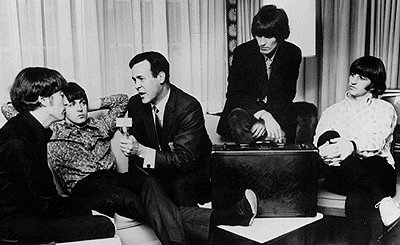
A vision came before his eyes, as plain as he could see,
The All-American Super Hits on WABC.

“Surrender now, Bob Dylan, and a millionaire become,
Surrender to the Establishment, you aren’t the only one.”
Bob plugged into an amplifier, and said, “I like the tone,”
Then promptly he sat down and made “Just Like a Rolling Stone.”

Now Dylan is a hero, with an amplified guitar
He sings of screwed-up women, and forsakes the Vietnam War,
He claims he’s got the misery, but he’s havin’ a lot of fun,
Gunnin’ his motorsickle down on Highway 61,

There was another from the same period, about Joe Namath, and I remember it all except for two lines, but that doesn’t count for a perfect memory. So I’ll go back farther into the past, to my college days at Bard, and this one I wrote with Lenny Rosen, to the tune of “The Frozen Logger”:

THE FROZEN BEATNIK

I sat down one evening,
‘Twas in an espresso café,
An 18-year-old waitress
To me these words did say:

“I see that you are a beatnik,
And not just a common weird,
For nobody but a beatnik
Stirs his coffee with his beard.

“My lover was a beatnik,
There’s none like him today,
If you told him there was pot in it
He would smoke a bale of hay.

“My lover came to see me,
‘Twas on a winter day,
He read to me his poetry
And rotted my mind away.

“I saw my lover leaving,
He was leaving on the sly,
When two men came up behid him
It was the FBI.

“And so I lost my lover
And in this café I’ve appeared,
And here I wait till someone
Stirs his coffee with his beard.”


And again from Bard, this one written all by my lonesome, to the tune of “Barbara Allen.” It contains one word that I’ve never actually heard used, though its meaning is clear. I have, however, seen it written, in Evan Hunter’s The Blackboard Jungle: “Do you know what planked means, West?” Here’s the song:

BARBARA FELDMAN

In New York town, where I was born,
There was a wild chick dwelling,
Made every cat to blow his cool,
Her name was Barbara Feldman.

All in the merry month of May,
When maidenheads were fallin’,
Sweet William in his own pad lay,
Dreamin’ of Barbara Feldman.

He made a phone call to her house
In the Bronx where she was dwellin’,
“Oh come ye to MacDougal Street,
The joint is really wailin’.”

When she first walked into that place,
A strange smell she was smellin’,
“What is that strange smell that I smell?”
“It’s a reefer, Barbara Feldman.”

Then slowly, slowly, she took a puff,
The first one she was tryin’,
Then slowly, slowly, she lay down,
“Oh, man, I’m really flyin’.

“You’ve turned me on to a great new kick,
How can I ever thank you?”
“That’s very easy, Barbara dear,
For now I’m going to plank you.”

Just then two cops knocked at the door,
While they were still a-ballin’,
“Oh come ye to the station house,
If your name be Barbara Feldman.”

They took them up before the judge,
And said to him, “Your honor,
We’ve arrested these two beatniks here
For possessing marijuana.:

They took them up before the judge,
Barbara Feldman and Sweet William,
She went to the Women’s Detention Home,
He went to Riker’s Island.

It had not been two months or three,
When she began a-swellin’.
“Sweet William, babe, what have you done?
You’ve knocked up Barbara Feldman.

“You should have used a contraceptive,
Why didn’t you think of it?”
Then tenderly he said to her,
“I thought you were on Enovid.

“A cruel blow’s been dealt to us
By the fickle hand of fortune,
But don’t you worry, Barbara dear,
We’ll get you an abortion.”

“Oh, not so fast, sweet Willie boy,
That’s not why I let you mount me,
You’ll marry me, and get a job,
And move to Fairfield County.”

Now he works for BBD and O,
And goes to the city to labor,
While Barbara’s having an affair
With the milkman and a neighbor.


And retreating back further in time, this is high school vintage, and a joint venture between me, my brother Jon, Peter Jones, and his brother Wendy. It’s not too PC, but it has a happy ending, and I’ve sung it for gay activists, who’ve loved it:

FRANKIE AND JOHNNY

Frankie and Johnny were fairies,
Oh Lordy how they could love,
Swore to be true to each other,
Just as true as the stars above,

He was his man,
But he done him wrong.

Frankie and Johnny went walkin’,
Johnny was dressed up in drag,
“Oh lordy me,” says Frankie,
“Don’t my Johnny look like a fag?”

He was his man,
But he done him wrong.

Frankie went down to the barroom,
Bought himself an imported beer,
Said to the gay bartender,
“Have you seen my lovin’ queer?”

He is my man,
But he’s doin’ me wrong.

“Well, I don’t want to cause you no trouble,
But I don’t want to raise no false hope,
I seen your lover Johnny,
Makin’ love with Truman Capote,

He is your man,
But he’s doin’ you wrong.

Frankie went to Fire Island,
He was hopin’ against hope,
But he seen his lover Johnny
Makin’ love with Truman Capote,

He was his man,
But he done him wrong.

Frankie went back to the Village,
Washed off all of his rouge,
Wiped off all his lipstick,
Kicked off his high heeled shoes,

He was his man,
But he done him wrong.

Frankie he went to the barber,
Said “Give me a big crewcut,
I’m gonna join the Marine Corps,
Just to cut my Johnny up,

He is my man,
But he done me wrong.

Now Frankie he is a Staff Sergeant,
Stationed down at Fort Dix,
Every weekend he comes to the Village,
Just to see his Johnny for kicks,

He is his man,
Does him no more wrong.


Friday, February 22, 2008

Dean and Sylvia

SYLVIA

--When are Tom Hanks and Meg Ryan going to make another of those wonderful romantic comedies, like Sleepless in Seattle or You’ve Got Mail?

--Tom and Meg will certainly be looking for scripts they can do together. But meanwhile, they each have projects going on their own. They’ll both be going in front of the cameras in biopics—Tom playing Dean Martin, while Meg does the life of Sylvia Plath.

Give up those adorable
Tom and Meg romances?
It’s too much to ask.

And there’s a better way.
Sylvia loses the Mademoiselle
competition. To make it up,

her parents take her
for a week in Havana. She meets
Dino--handsome, gifted, unfulfilled.

She tells him he needs a partner,
a wisecracker, zany—“What about you,
sweetheart?” Dean asks, eyes twinkling.

Her parents take her back to Boston.
She’s shoved into Wellesley, Lowell, poetry,
Ted Hughes, and Dean meets Jerry,

who looks sort of like Sylvia, without her
vivacious wit. Life pulls them apart,
their chance at happiness lost…forever?

It looks that way for Sylvia. One day,
she decides to end it all. She goes to turn on
the gas jet, but by mistake, hits the radio,

hears, through the static, Everybody
loves somebody sometime…Dean! He’s playing
the Albert Hall, with Jerry! She leaves

Ted and his mistress minding the kids,
she takes a cab, gets backstage to find
Dean in his dressing room, a gun to his head.

She pries it gently from his fingers. They talk
all night, walking beside the Thames. Dean tells her
he can’t stand another night with Jerry.

They’ve found each other. Jerry
goes off to France, Dean and Sylvia
head for Vegas, where he teaches her

how to laugh again, she writes
new material for him, brings
a touch of profundity to his act:

When a boot hits your eye
like a big Nazi spy
that’s a Daddy…

It’s a happy ending for Sylvia,
and there’s a lesson to be learned
for all of us:

Wednesday, February 20, 2008

Peggy Sue Got Analyzed

Freshman comp paper -- first graded assignment of the semester, actually, and I love it.

“Please don’t tell, no-no-no…” Repression and self-doubt are expressed by a struggling Holly in his original nervous ditty, “Peggy Sue.” This apprehension turns into indifference with a hint of anger in the second, more rockin’ version.

Holly, like most males, is struggling with an Oedipus complex- essentially wanting to love his mother and get rid of his father. With this comes a castration complex; he is afraid that his manhood could be taken away from him, thus making him fail at loving Peggy properly. Even though Holly’s mother is the ultimate goal, Holly invests his emotions in Peggy instead; loving her is okay but loving his mother is not. The relationship between Peggy Sue and Holly’s mother is evident with lines like, “She’s the one, I’ve been told/ Now she wears a band of gold.” This “band of gold” must represent something for Holly. It must have had some sort of effect on his life prior to Peggy Sue- it seems as if it had caused him some sort of pain. Holly saw his mother’s band of gold as the reason he couldn’t be with her- a constant reminder that his father had what he needed.

Peggy Sue, being a woman, naturally wants to be taken care of by a man. She is inclined to submit to the societal norm of marriage when she realizes her natural female Penile envy. Since she couldn’t be satisfied by Holly, she had to find someone else to fulfill her needs. This meant that she had to leave Holly and now he’s alone and emotionally confused . This only furthered his Oedipus complex and now he is dealing with feeling even more inferior. First he was rejected by his mother and now Peggy Sue.

The unconscious is the main site of creativity and obviously thoughts of Peggy Sue have been deep-seeded into Holly’s unconscious, “You recall the girl that’s been in nearly every song.” Being sensitive about this subject, and being bombarded by the anger he feels toward Peggy Sue’s new husband and his own father, he quickly gets uncomfortable and focuses again on his confusion, “This is what I heard, of course the story could be wrong.” He is comfortable describing his confusion because that’s one feeling that is socially okay to have.

In the second, more upbeat version of Peggy Sue, Holly’s self-doubt develops into indifference and apathy toward the situation. He has realized why Peggy Sue left him and he has come to the conclusion that he lacks the ability to please the women he loves and is too embarrassed to admit to it. Now he has been so emotionally beaten down by that fact that he is pretending to not really care. He has somewhat gotten over it, or is atleast trying to ignore his feelings so he can move on. He feels as if he has wasted too much time on this girl and has recognized that every relationship he has wanted in his life (his mother, Peggy Sue) has been ruined by a wedding ring and he is trying to recover and move on with his life.

Peggy Sue was just a medium through which Holly acted out his feelings toward his mother. The let down of this relationship was devastating to Holly and left him emotionally drained and embarrassed to admit his true feelings. In the second version, Holly’s situation is turned into a renunciation of these same girls and is portrayed as sick of being left behind and is ready to forget the pain both women have caused him.

Thursday, February 14, 2008

Over There! Beside the Red Wheelbarrow! Could it Be...?

WHAT’S THAT OVER BY THE WHEELBARROW?

in the approximate vicinity
of the albino poultry.

Donald Hall


Whatever chicken, broad or narrow,
That pecked beside that red wheelbarrow,

May have appeared, to judge or wino,
It certainly was not albino.

Mr. Hall, a farmer-poet-
New Hampshireman, should surely know it.

It may have been Ameraucana,
Imported from Brazil or Ghana,

Both noted for abundant fauna.
Perhaps the Rumpless Araucana

-- But could so much indeed depend
On barnyard fowl with no rear end?

Aseel, Cochin, or Barnevelder
(You won't forget one once you've held her),

The Cubalaya's a petite bird,
but also Cuba's fighting meat bird.


Antwerp Belgian, Belgian D'Uccle
Booted or Sabelpoot, a muckle,

Not likely it's a Chantecler,
Even in Canada they're rare.

Cornish, Delaware (rare), Dorking,
Dutch or Hamburg might be working,

To get an egg one fries or boils
He might have chosen Faverolles,

For an egg that's truly fresh,
Langshan, Phoenix, or La Fleche,

For oven or for frying pan
American Holland, or Houdan.

Chabo or Japanese (still called
Japs in some parts of the world).

Since so much depends upon her,
Better not choose a Lamona,

Red-ear-lobed and quite distinct,
But quite possibly extinct.

If the farm was near foreclosing
Dr. Will might well have chosen

Leghorn , big and white and mean,
The ultimate egg-lay machine.

He could have gone to court a dame
With the Modern English Game,

The game bird with style and carriage
(Courtship might then lead to marriage).

Or, if he's only after sex,
Transylvanian Naked Necks

Enchant the girl who loves to swing
Or Russian Orloff, that wild thing.

Orpington is big and friendly,
Nothing fancy, nothing trendy

Plymouth Rock, Rhode Island White,
Yokohama, Rosecomb might

Be dependable commodities,
Not Silkie (oddity of oddities).

Wyandotte's the "bird of curves,"
Still, that might get on your nerves.

Sultan? No, it's all for show.
Dr. William C. should go

For something local, large, compliant,
Dependable -- the Jersey Giant.


With apologies to Donald Hall, William Carlos Williams, and poetry in general, and thanks to Ithaca College’s ICYouSee Handy-Dandy Chicken Chart

Sunday, February 10, 2008

Not Bloody Enough

How do I create these images? (For the show advertised below.) It's kind of a technique of my own invention. When Rachel Loden and I were doing "Affidavit," my art work for that was black and white, drawn directly on my computer screen using Microsoft Paint and one tool -- the one called "free-form select," shaped like a star on your MSPaint toolbox. I'd draw a shape, then invert it (using a little trick I had to discover -- you can't just invert with MSPaint), and keep working positive and negative space against each other until I had an image I liked. It's the same technique I use for the Film Noir images.

Then, because Rachel's amazing poem was about a gruesome murder, I decided I'd put some blood into each picture, which meant adding red, which scared me a little, because I'd always worked in black and white, and had no confidence in my ability to use color. So I started sending the new bloody images to Rachel, and she kept responding "Great! But not bloody enough." So I kept changing the color, looking for ever-gorier shades of red. Which should have been relatively easy -- you just take the paint bucket tool, and pour the new red over the old. (Note: this image has one of the early, discarded blood colors -- can't locate where I filed the final version at the moment.)

Except it wasn't. I discovered that MSPaint was an inefficient program that could not save color true. Once you saved an image, when you retrieved it, the middle of it was true, but it pixillated around the edges. It became discolored, mottled, and the new color wouldn't cover that part. None of this is a problem with PhotoShop, but fortunately I didn't have PhotoShop then, so I had to work with the frustration, and ultimately get it to work for me. While the mottled effect was driving me nuts for "Affidavit," it was also intriguing me, and it occurred to me that if you worked with dots of color, and saved frequently, every part of the image would have that effect. So I gathered up all my courage and made the jump into color -- computer pointillism, beginning an image with separated dots of color, and gradually merging them.

It is a horribly painstaking process -- each one of these can take up to three months to finish. But it keeps me off the streets.

Saturday, February 02, 2008

"It was easy," I said.

There's a connection insisting its way in here, try as I will to stop it. My spellcheck red-flags "Villanelle," and one of the alternatives it offers is "Spillane."

There has to be a villanelle in that somewhere, and I'll work on it -- even though the trochee-iamb of "Mickey Spillane" is unpromising - maybe anapests? Or a catelectic line with a two-unstressed-syllable patter?

This is the story of Mickey Spillane

...that sort of thing?

Anyway, connections between poetry and Mickey Spillane won't let go of me. I'm working on a series of chapbooks based on film noir stills, and I suddenly remembered I had done a series based on Mickey Spillane paperback covers. I wondered if I could find them in a file somewhere, so I Google-Desktopped "Spillane," and the first place I was directed to was a list of literary contemporaries of Donald Justice.


"How c-could you?" she gasped.
I only had a moment before talking to a corpse, but I got it in.
"It was easy," I said.

ABC WXYZ -- The cat's in the cupboard but he can't see me

Mike Snider is gracious enough to say nice things about my "Barefoot in Florence," my ABC villanelle for Anny Ballardini (see a couple of entries below), and to extend the fledgling tradition with an ABC villanelle of his own.

I do seem to be inventing forms these days, without really setting out to do so. But I've always been a tinkerer, I guess. At Iowa, in my frighteningly extreme youth, the first time I tried to write a sestina, I didn't know how to do it, and so instead of making the second stanza FAEBDC, I just made it BCDEFA. I suppose I could have claimed that as an innovation, but it was just dumb. But in the same poem I did something else deliberately, that I hadn't thought of as an innovation, but Don Justice was very generous in praise of -- the Walking Enjambment. The first line of the first stanza was enjambed into the second line, then the second line of the second stanza into the third line, and so on. When I got to the last stanza, of course, there was no place for the enjambment to go, so I hit upon the perfect terrible idea of enjambing it in a circle, putting a caesura at the beginning of the first line of the last stanza, as if it had been enjambed from somewhere or other. Fortunately, no one noticed that, and Justice complimented the gracefulness of just letting the device disappear.

It's a device I haven't overused, I hope, but I did use it again in The Map of the Bear, which you can find on my page on Anny's Poet's Corner. There, I took the refrain line, "The only map is the map of the bear," and enjambed it on a different foot at the end of every stanza, so one foot of it appears at the end of the first stanza, two at the end of the second, three at the end of the third, and the whole line, unbroken, at the end of the poem.

And then there are my 5/4 syllabic poems, which are featured in my new chapbook "Take Five: Poems in 5/4 Time."

Here's the youthful sestina:

IF YOU'S WHITE

"They are developing some very strong feelings about this music -- so much so that I have heard some white country blues singers say, `I want to be Negro.'"
John Cohen, Sing Out!


A young man with dark sweater and a white
Face, in the sidewalk shadows of New York,
Shading his eyes to dim his skin toward black,
A battered (by choice) guitar held in his hands
While in his mind he sees a soulful blues
Moaning along the highways of the South.

There is no earth--it's barren in New York--
He tries to pluck a bass string with a black
Thumb, but the sterile whiteness of his hands
Is not for digging roots and picking blues
That grow along the highways of the South.
He pulls up milkweed, fluffy, dry and white.

The woman that he's living with is black,
He sees the race's character in her hands;
The suffering that goes to breathe the blues
Alive, in the fields and road gangs of the South
Whispers beyond the range of any white--
Although she's never been outside New York.

He'll tell you, "Man, just look at that spade's hands!
They look like they were born to play the blues!
(You know the way they breed 'em in the South.)
There's nothing wrong with him except that white
Soul, from the shallow spirit of New York
That robbed him of his birthright (which was black).

Sometimes a weary voice sings him a blues.
It may have drifted upward from the South,
He scarcely hears it: "Fella, be glad you're white!
You can buy better guitars up in New York
To sing about what happens to a black
Man, with cold iron shackles on his hands."

The kind of thing that happens in the South,
And hate the cops--that's safer if you're white,
Yes, fella, even up here in New York.
This is the time, you're thinking, to be black;
Well, if that's so, you have it on your hands."
"Was that an eight-bar or a twelve-bar blues?"

He sits in a White Castle in New York,
A cup of black coffee warming his cool hands
Too frigid for a blues bred in the South.

The Death of Dick Stillwell

A reminiscence of Woodstock in the 50s, from David McDonald's movie, featuring yours truly.


Sunday, January 27, 2008

Barefoot in Florence

Here's the background from Poetryetc.

Joseph Duemer wrote:
> Well, Anny, If you keep telling us stories about being barefoot in Florence
> at four in the morning wearing a pink dress -- is that how the story went?
> -- how can you blame us?

> On Jan 27, 2008 9:52 AM, Anny Ballardini wrote:
>
>
>> Me fetishized? Is it a severe condition, does it have secondary effects?


And here's the villanelle I spun from it. I'm kind of modestly pleased with my solution to the problem of an ABC-first stanza villanelle. At least, I've never seen it before.

Anny assures me that she wasn't actually barefoot -- that was Joe Duemer's poetic license.


BAREFOOT IN FLORENCE

Barefoot in Florence --
A dress that was pinkish
At four in the morning.

Pleasure in torrents,
Adventure to relish
Barefoot in Florence.

Tourists, take warning:
Pleasure can vanish
At four in the morning;

Borne by those currents,
The young and the foolish
Are barefoot in Florence.

Libidos are churning --
It's something to cherish
At four in the morning.

Anny – concurrence
To any such yearning
May still be a fetish
At four in the morning.
Barefoot in Florence.


Tuesday, January 15, 2008

Winter View

Put Them All Together...

P is for the promises it never keeps,
O is for the ode, no longer hip,
E is for ekphrasis, in the Musee d’Oasis,
T says that it’s been a long strange trip,
R is for the readers that it doesn’t have,
Y? Because we don’t like you, you see,
Put them all together, they spell CHAOS
That’s a word that means The World to me.

Sunday, January 06, 2008

Battle of the Decades

Here's a game I've been playing with my family and a few friends over email. The premise is simple: I open up XM Radio online when the spirit moves me, copy the songs which are playing at that moment on XM's Decades channels, whatever they may be, and send them out to my Battle of the Decades mailing list.

The rules are simple: Vote for the best song. You must vote for one (hard if none of them are any good, which can happen) and only one (hard if there are two or more really strong candidates -- this last rule is broken so frequently that I've abandoned it).

As the game has developed, I've taken to writing desultory notes -- criticism, reminiscence, biography, trivia -- on the list. These have gotten lengthy enough, and at least no less interesting than most of the nonsense here, that I thought I might as well start posting them. Y'all are welcome to join in and vote.


In the last competition -- a two-way race, which surprised me a little -- it was 4 Non Blondes over Elvis. I'm certainly not surprised that none of my daughters voted for Elvis. But I'm surprised that neither Queen not Marvin Gaye/Martha and the Vandellas got any votes. I


So here's the new one, and I predict near-unanimity between young and old.


THE 40s
Freddy Martin
Easy To Love


THE 50s
Bobby Darin
You Must Have Been a Beautiful Baby


THE 60s
James & Bobby Purify
I'm Your Puppet


THE 70s
Paul McCartney & Wings
With A Little Luck


THE 80s
Janet Jackson
The Pleasure Principle


THE 90s
Right Said Fred
I'm Too Sexy


But first, a word about young and old, and the generation gap. I'm certainly not going to vote for Freddy Martin, and I feel confident that no one else will, unless my brother is in a really weird mood, but there is a memory attached to him. When Jon and I first started listening to music, and buying records, naturally we listened to, and bought, rock and roll, which was in its early days back then. This was so long ago that for those of you who don't remember 45s, and barely remember LPs, this goes back further -- our first purchases were 78s. Jon can maybe correct me on this, but I remember our very first being "Bazoom (I Need Your Lovin')" by the Cheers. The Cheers are mostly noted for having, as lead singer, a future TV game show host -- according to Wikipedia,

Convy soon took the podium himself as host of several game shows, including the fourth edition of Password, Super Password (1984–1989), but he remains best known for his first television game show, Tattletales (1974–1978, 1982–1984), for which he was awarded an Emmy for "Best Game Show Host" in 1977.

He also hosted the syndicated version of Win, Lose or Draw (1987–1990), which he co-produced with Burt Reynolds (under the firm Burt and Bert Productions). The final season of Win, Lose or Draw was hosted by Robb Weller, freeing up Convy to host his last game show, 3rd Degree, a syndicated program that ran during the 1989–90 TV season. He was also slated to host the 1990 revival of Match Game but was too ill to do so (comedian Ross Shafer took the role instead).


The Cheers also recorded "Black Denim Trousers and Motorcycle Boots," an early entry into the rock and roll world by Jerry Leiber and Mike Stoller, at that point mostly known for R&B classics like Big Mama Thornton's "Hound Dog." Loyal rock and rollers, we listened to the Cheers' version and scorned the pop cover by Vaughn Monroe, but actually the Cheers didn't bring much to rock 'n roll, and Vaughn Monroe's version was just as good.

But I digress. My mother, hating everything we listened to, and really hating the idea that we were wasting our allowance money on rock 'n roll records, tried out the classic parent ploy of assuming that all pop music was the same, and if we wanted to listen to records, why didn't we listen to her old records from the 30s? So she got them out, and when we listened to them, we immediately had the answer as to why we didn't listen to them. But the one we kinda didn't mind, because it was a mildly clever novelty and we were, even back then, into clever, was "The Broken Record," a 1936 for both Freddy Martin and Guy Lombardo -- the general gist of which was that this broken record kept sticking, fortuitously, just at the places which delivered the young swain's message most punchily: "My sweetneart, I love you -- I love you -- I love you -- I love you..."

Yes, it's as corny as it sounds. But it conjures up a memory of Nonna, and so gets a sentimental nod. But no vote.

I pretty much hate everything Paul McCartney & Wings ever recorded, and Janet Jackson's Super Bowl breast (as opposed to Super breast) didn't do anything to win me over, and Bobby Darin was mostly boring -- so much so that even a major fan like Kevin Spacey couldn't make his movie life interesting. Of course, Jerry Lee Lewis' movie bio was boring too...

Here's one of my favorite exchanges in movie-bio-making history.

Dennis Quaid: Jerry Lee, I just don't feel I can play this part right if I can't sing the songs myself.
Jerry Lee: Well, son, that gives me a pretty good idea of your acting ability.

"I'm Your Puppet" was a great song. Maybe not given its due, because it was one of many great soul numbers during an era of great soul records by masters like Otis Redding and Wilson Pickett, and James and Bobby were one-hit wonders. Interestingly, for one-hit wonders, and for apparently a brother act, they had a personnel change. James was a real Purify, but the original Bobby, actually named Bobby, was his cousin Bob Dickey. He was replaced in the group by Ben Moore, neither Purify nor Bobby, nor related to Scotty Moore, Sam Moore, Wild Bill Moore, Johnny Moore, the other Johnny Moore, Mandy Moore, or Thurston Moore. Quick trivia quiz -- who can identify all the above Moores? I didn't include Dudley, Mary Tyler or Henry, because they weren't primarily associated with music, although Dudley was a brilliant musician.

"I'm Too Sexy" was also a great song -- also by a one-hit wonder group, but more distinctive, more readily identifiable, and terminally catchy. It gets my vote.

Saturday, January 05, 2008

Opus 40 on YouTube

A surf of YouTube reveals these home videos of Opus 40, by imtubester:


And two by raymilauren:


And we're included in this one from WeirdUSTV:


And don't forget our own wedding promo video.

Friday, January 04, 2008

A Low Dishonest Decade

I've been reading The Auden Generation: Literature and Politics in England in the 1930's by Samuel Hynes.
It's about Auden, Spender, Isherwood, etc. -- the intellectuals who were too young to have served in World War I, who felt the strain of having missed a defining experience, and by the late 1920s they were already defining themselves in terms of the coming war. There was a powerful feeling that WWI had proved liberal democracy a failure, and a strong pressure to turn either Communist or Fascist. It's the "low dishonest decade" that Auden came to repudiate, and a powerful cautionary tale to those who feel a demand to politicize art.

As EM Forster said at the time, and this should be required reading for the Bush administration:

As for their argument for revolution – the argument that we must do evil now so that good may come in the long run – it seems to me to have nothing in it. Not because I am too nice to do evil, but because I don’t believe that the Communists know what leads to what. They say they know because they are becoming conscious of the ‘causality of society.’ I say they don’t know, and my counsel for 1938-39 is rather: Do good, and possibly good may come of it. Be soft even if you stand to get squashed. Beware of the long run. Seek understanding dispassionately, and not in accordance with a theory."


And as Johnny Cash said a couple of generations later,

"Don't go mixing politics with the folk songs of our land."

Tuesday, January 01, 2008

Instant Mantra


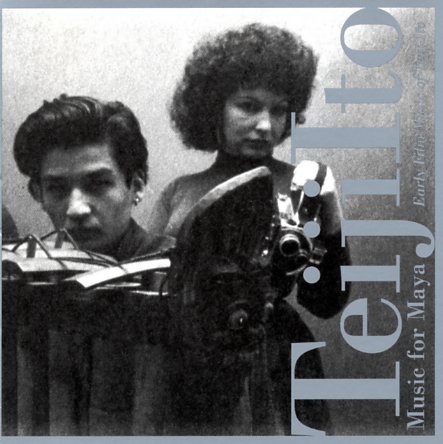
This is the image of Maya Deren that everyone remembers -- beautiful, ethereal. All the images I've been able find of her on the internet are from this time in her life -- the brilliant, beautiful avant-garde filmmaker.

There are no images of the Maya Deren I remember, but she's indelible in my memory. In this memory, she's 39 years old. and I am 16. It's 1956. It's the summer that I started to find my own Woodstock, not the Woodstock of my parents and their friends.

I met Jimmy Gavin, a Greenwich Village folksinger, who wore jeans, an open collar Oxford shirt with black T shirt under it, and a fraying tweed sport jacket, which became my model for how I wanted to look for a long time, maybe still. I started to write a short story about Jimmy once, never finished it. Here's all there is of it, at least so far:

Driving to work today, I surprised myself by remembering all the words to “Johnny Rollin’Stone” by Jimmy Gavin – at least, I remembered all the words if “Johnny Rollin’Stone” only has three stanzas. If it has a fourth, I’ve forgotten it, and if I’ve forgotten it, the chances are no one remembers it. Jimmy Gavin, a Google search confirms, has been completely forgotten. Maybe not so surprising; the first verse of “Johnny Rollin’Stone” was:

Well, I’ve worked in the town
And I’ve worked on the farm
But all the work that I ever done
Was by my strong right arm

They call me rambler
Gambler
Roller through this land
It’s Johnny Rollin’Stone
Johnny Rollin’Stone
I’m a roller through the land


Well, it’s no worse than the sort of song the Limelighters recorded, or the Kingston Trio, or the Brothers Four, back in the days of the folk boom, when all those groups did what Jimmy did, which was lift verses more or less whole from songs collected by the Lomaxes or Moe Asch or Izzy Young, printed in Sing Out!, sung in the dry fountain at the center of Washington Square on Sunday morning. “Johnny Rollin’Stone” lifted the ramblin’ and gamblin’ from more or less everywhere, and the guy who works on the farm by his strong right arm from Carl Sandburg, who in turn…

It was released on Epic, and Epic was an odd label with no clear style back then, not like Chess or Atlantic or Gee. I didn’t have too many Epic records in my collection. I had “Don’t Let Go” by Roy Hamilton, which began

Hear that whistle it’s ten o’clock
Don’t let go – don’t let go
Come on baby it’s time to rock
Don’t let go – don’t let go

But it was never really time to rock for Roy Hamilton, whose throbbing tenor was more suited for songs like “Ebb Tide” and “Unchained Melody.” And I had “Bacon Fat,” by Andre Williams “Mr. Rhythm” and his New Group, which began

When I was down in, ah, Tennessee
All my friends was, ah, glad to see me
Seen some down by the railroad track
Seen some cotton pickers with their sacks on their backs
They said, hey man, we’re glad to see you back
We got a new dance called the Bacon Fat

It goes, diddly diddly dit…

It would be inaccurate to say that I’ve never thought of Jimmy from that day to this, though for someone who was, for a short time, such a powerful influence, I’ve thought of him remarkably little. After all, I was to find out from Washington Square regulars like Ben Rifkin and Happy Traum and others whom I scarcely dared approach because they wouldn’t talk to anyone who didn’t have a prewar Martin, and wasn’t adept at at least ten styles of finger picking, that one was supposed to have no respect for guys like Erik Darling who’d sold out and made hit records. Sort of like having the de rigueur no respect for Billy Collins today. And that was, of course, a few years before having no respect for a Village folksinger like Peter Tork who had sold out and Hey, hey, he was a Monkee. So what respect could one have, I guess, for a guy like Jimmy who’d sold out and hadn’t made hit records.


There was the time, 25 years ago, in the mid-70s, when worked for a furniture moving company in Greenwich Village, and went on a job on a job for a guy who turned out to be Jimmy’s manager. He had pictures on the wall of his office of a 40ish Jimmy, still trim and good-looking, a bland Johnny Cash – blander than I remembered him – still carrying a guitar, but now dressed in the black tie and dinner jacket of a Vegas supper club entertainer.

The manager was not impressed with the information that I knew Jimmy, or had once known him. He should have been. I would guess that by the mid-Seventies, Jimmy was close to being as forgotten as he is now.

The manager said something about Jimmy being big in Europe. Basically, no one wants any kind of bonding experience with his moving man, so it didn’t go farther than that.

Epic Records changed. It had British Invasion stars like Donovan and the Dave Clark Five and Jimmy Page. Later, the Clash. Culture Club, Sade, Luther Vandross, George Michael. Later still, Jessica Simpson, Good Charlotte. My good friend and former student, Scott Graves, works there now.

Jimmy changed. Jimmy in a tux, on an 8x10 glossy...that's as far I got with the story.


That same summer I met Lenny Horowitz, a painter, who I think did have something of a career in the New York art world, but I can't find him on Google now, either. He introduced me to the records of Lord Buckley.

I met Rommel Stubbs, a jazz musician, also disappeared from the kind of recognition that gets you a Google hit. Rommel took me to a party that was being given by the guy whose group he played in, Teiji Ito, and his wife, Maya Deren.

The Maya Deren I remember.

Teiji and Maya had rented a house on Rock City Road for the summer, the house that is now the Colony Café. When they reopened the Colony a few years ago, and I walked into it for the first time in over 40 years, I remembered it with the force that only a few memories hit you with,

When I walked into that room in 1956, Maya Deren was holding court. And she could. She was that powerful a person. Broad, handsome, an earth mother, dressed like a gypsy. I had never heard of her, in 1956. But I didn't need to have heard of her to be impressed.

As I walked in, she was saying -- about somebody, I have no idea who -- "He's the three middles I can't stand -- middle age, middle class and middle brow!"

And I said to myself. I'm never going to be any of those. Instant mantra. Then, and still. I met her once, and Maya Deren changed my life.

Monday, December 31, 2007

7 Things You Should Know About Being a Poet

Deborah Ager, taking off from a list by Aaron Mccullough in an interview in the Michigan Daily, offers her own 7 Things You Should Know About Being a Poet, with a challenge to come up with one's own list. Hers is worth checking out, and here's my response to the challenge. I've somewhat cheated, fudging on "you" -- some of my items are are directed to you the fledgling poet, some to you the general non-reader who's had the misfortune to be introduced to a poet at the office Christmas party:


1. There are things that pay worse.


2. Staying on the economics, it's a bizarre way of making a living, in that your entire product is a loss leader. You give it away to magazines that won't pay you anything, in order tio generate ancillary revenues -- teacthing jobs, grants and reading fees if you're lucky.


3. You can play the guitar in C and get by, but if you really care about what you're doing, you need to learn to play in every key. If you really care about poetry, you need to learn to write in form, and you need to learn how to break away from it.


4. Don't say anything that the reader will know without your saying it.


5. The question "what do you write about?" isn't a stupid question, but the answer has to be longer than anyone really wants to hear.


6. Just because you hate about 80% of the poems you read, it doesn't mean that you hate poetry.


7. We all begin to write poetry for the same reason: we have something to say. We have thoughts we want to express to the world, and we have feelings we want to share with the world.

So we start writing, and before long (if we’re lucky), but eventually (guaranteed), we will realize something. And this should be every poet's mantra, never to be forgottenr:

All your thoughts are shallow, and all your feelings are banal.

Saturday, December 22, 2007

We Are the Answer

Yes, in this month's issue of LocumLife, the magazine for locum tenens physicians, we are the winner of...

but wait. You're wondering what locum tenens physicians are?


Well, I was, so I looked it up.

Locum Tenens is temporary employment for physicians. It's usually a temporary position where you're filling until the position can be filled permanently.

Locum Tenens has only existed for about 30 years, but the number of physicians who take advantage of it is steadily increasing.

So locum tenens physicians are like the adjuncts of the medical world. Well, not quite. They get more respect than adjuncts. Which is, I realize, not saying a lot. The guy who cleans up after the elephants at the circus gets more respect than adjuncts, and he's in show business.

They also get paid more than adjuncts, which is not saying much, because panhandlers get paid more than adjuncts. But they get paid a lot more -- from $400 a day for your average Johnny-come-locum, up to $1500 a day for a radiologist or anesthesiologist.

And they probably don't have to put up with all that steamy sex that those doctors stuck in one hospital do, like on Gray's Anatomy.

Anyway, what does this have to do with our little poetry cum education cum world class sculpture blog?

Well, for these locum tenens physicians, who travel a lot, Locumlife magazine has a feature called "Destination: Anyone's Guess." They show a picture of a wonderful place to visit, and you have to identify the name of the attraction, its city and state. For example, this month's picture is of a picturesque oceanfront, and the clue is it's a prestigious military school in a mid-Atlantic state, whose alumni include John McCain, Jimmy Carter and David Robinson.

And we are the winning answer to last month's competition. Naval Academy...Opus 40...all the most prestigious sites.

Monday, December 10, 2007

For the Christmas Season

For the Christmas season, here's a song I wrote with John Hall, of Orleans and now the Honorable, one of the good guys in Congress:


I Wish I could Have Been There


That's Keith Whitley singing backup harmonies to John on the chorus.

Saturday, December 08, 2007

The Naked Blogger

What to make of this? Best not to wonder about it too much. I was looking at my stat keeper this morning, for no particularly good reason, and discovered that someone had surfed into my blog after doing a search for "Wendy Jones nude."

Wendy Jones -- Wendell Jones -- was a close friend of my youth, tragically dead while we were still barely more than youths. His father, also Wendell Jones, a wonderful artist who also died too young, in the 1950s. I had written about Wendy Jones, Senior, and his studies for the San Francisco Post Office mural, the last great mural competiton of the WPA, on the same blog page where I'd also written about some of my nude paintings. So that can't have satisfied our searcher much.

The only Google hit ahead of me was the Victoria and Albert Museum, and an entry about potter/transvestite/documentarian Grayson Perry, and his biographer Wendy Jones. This Wendy Jones, in the bio, quotes Peery telling an anecdote of his youth:

We used to spend many hours snogging and fondling – nothing more – to Roy Orbison on a velour sofa. One night one of the kids came downstairs while we were lying there in the nude. Years later I found out from the parents, ‘Yes, he remembered that.’


Next, a blogger named Paul Katcher who has a note on a Wendy the Snapple Lady doll, and "andruw jones nude" -- Your source for naked center fielders!

This last comes from Katcher having the same unhealthy interest that I do -- wondering what odd combinations of search terms bring people to his list. Funny stuff, as he comments on each search term. Woner what he'll have to say about "Wendy Jones nude."

So I don't know if any of these sites helped our searcher much, but there's a valuable lesson to be learned for all of us: if you put the word "nude" in your blog, you're going to get a lot of extraneous hits. I also got one for "40 nude wives."

So what am I going to label this post? Nudes? I think not. I like trouble, but not that much.

Sunday, November 25, 2007

Film Noir -- The Lineup


Names to Watch Out For

What names can you not give a character without creating a distracting reference?

Hitler and Stalin, obviously. You might get away with Churchill, probably with Patton, certainly with Montgomery, probably with Rommel. Not with Goebbels or Himmler. Goering maybe, if you spelled it Gehring. Eichmann perhaps -- it's not that uncommon a name.

Not with Roosevelt, although in one of those Ogden Nash prose poems that so influence Russel Edson, though no one but me remembers them and makes that claim -- anyway, in this Nash poem there's a butler named Roosevelt. The protagonist asks him if he's any relation to the Roosevelt, and he replies that all Roosevelts are the Roosevelt. Not with Vanderbilt or Rockefeller, possibly with Astor.

Moving back to presidents, you could certainly use Kennedy or Johnson or Carter, maybe not Nixon, although it's nearly as common a name. Ford -- if his name raised irrelevant associations, they'd be to the car, not the president. Reagan and Bush and Clinton -- maybe not now, but in a few years they'll be OK.

McVeigh, no way. Oswald...it's a common enough name that maybe you could, but of you gave the character a first and middle name, you'd be sunk. And certainly, you could not give a character the first and middle names of Lee Harvey.

I can't think of any 20th century poet whose name you couldn't use, either because they're too common -- Williams, Stevens, even Pound or Eliot (although if you used them both you'd be sunk) or because they're too obscure. Maybe Plath would be a problem.

The only 19th Century American writer you'd have trouble with is Longfellow -- at least the only one who occurs to me. Twain isn't really a name. Poe...you could slip that one by.

Starkweather? Gacy?

Thursday, November 15, 2007

Film Noir

Something new I've been fooling with -- sequences of film noir drawings, made by watching a movie on DVD or TiVo, pausing it when I see an image that strikes me, and making a sketch, using my direct-to-computer printmaking technique. I'm not so much trying to tell the story of the movie as to create a coherent and striking group of images. Here's the first group, simply titled "Film Noir" because at the time I did them, I didn't know I was going to be doing more, and now I can't remember what movie they came from (might have been The Big Heat):


Wednesday, November 14, 2007

Who New?

An exchange between me and my old pal Bob Berner:

Me (Not super-original, but it was a throwaway line in a longer correspondence)
I think somewhere around our generation, the pantheon of influence shifted from Pound and Eliot to Stevens and Williams.


Bob (the good part)
Yeah, and even though Williams was still publishing when we were in our early 20s the influence was already in the process of shifting from Stevens and Williams into two streams,one coming from Ginsberg and Ferlinghetti and the Beats, the other from Lowell and Berryman and Ann Sexton. By the mid-60s you could say that the Tate-Ransom-Winters school was dead and that nobody wanted to write like Eliot, but a whole lot of people wanted to write like Lowell and another whole lot like the Beats.

So who's the model now? Certainly not Pinsky or Paul Muldoon or a ton of other leading lights we could name. By my lights, somebody starting out could do a hell of a lot worse than to look to Marvin Bell or to Phil Levine or to Lawson Inada or to Vern Rutsala or to Tad Richards to see how it's done.

Pax et Peredelkino,
Bob


Bob is loyal to a fault to his old classmates at Iowa, and I don't know that I belong on that list (all the others, old classmates except for Levine, certainly do). But I like his analysis. So who is the model now? Who for the generation that was young in the 70s, when the Beat/Academic wars were over, and Lowell and Ginsberg playing on the same team? And who for the 21st Century poets? Bernstein? Simic? The other Tate? Who?