I've been tagged by Jeff Newberry to list "Five Songs That Knock My Sox Off." Since I kinda shy away from "interesting stuff about my life" on this blog, I've tried to come up with five songs that not everyone who ventures in here will necessarily have listened to -- but everyone should. I've also kept it to songs with vocals, because otherwise it would just be too hard.
Parker's Mood, by King Pleasure.
I want this one played at my funeral. It's evocative, yearning, and ultimately about that last journey alone. Bird probably did not want it played at his funeral. His waxing of lyrics set to one of Parker's most haunting melodies (and a tune that Parker only recorded once) came out in 1952, at a time when Bird was increasingly strung out and facing the bitter end of his own mortality. he did not want to hear what could have been his obituary blaring out of every jukebox.
Don't Drive Your Mama Away, by Shirley Caesar.
I heard this song once, on the radio of a cab in New Orleans, and could not rest until I had tracked it down. I haunted gospel music bulletin boards on Prodigy, describing the song as best I could, until someone was able to identify it for me.
Once heard, never forgotten. It sears, it soars, it has all the feeling that only the greatest gospel singers can put into a song, and a powergul story -- a variation on the Prodigal Son story, set in modern times, with a bittersweet twist. Composed by Shirley.
Lover Come Back, by Dinah Washington. "Parker's Mood" is a brilliant example of "vocalese," the technique of setting words to a jazz solo, but King Pleasure is still a vocalist. Dinah Washington, on this cut, is an instrument. Dinah jams, here, with Clifford Brown, Max Roach, Richie Powell, Clark Terry, Harold Land, and others. The session was recorded live in front of an audience that I would have given an arm and a leg to be part of. When people play the "what era would you like to have been born in?" game, for me it's always ten or fifteen years before I was actually born. And I would have liked to be born hipper than I actually was, so that I could have been on 52nd Street, and up at Minton's, to bear witness at the birth of bebop.
Voice as instrument -- I could have chosen Sarah Vaughan's Shulie a Bop just as easily...or anything by Louis Armstrong. The trouble with Armstrong is that there are so many great titles competing for one's attention, how can you choose one. But I'm happy to go with Dinah for this pick.
Banks of the Hudson, by John Hall. I take enough pride in my own work that I'll choose one of my songs here -- lyrics by Tad Richards, music by John Hall, now The Honorable -- freshman Congressman from Dutchess County. Partially inspired (not the first time this has inspired me) by Thomas Cole's great "Voyage of Life" paintings, partly by love of my native soil, and the river that runs through it.
Ballad for Americans, by Paul Robeson. The greatest and most thrilling of American voices. I first heard "Ballad for Americans" as a child, and though some of the concepts of Americanism in it are a little dated, I wouldn't change one word of it, or one note of Robeson's magnificent voice. I interviewed Earl Robinson not long before he died, and he told me that he had deliberately written a melody simple enough that schoolchildren would sing it. I asked him if it was a surprise, then, to hear it sung by the greatest voice of his era. He said it was, and a pleasant one.
How could I leave out...? But I did. Had to leave out something. Anything by Ray Charles, I wouldn't know what to choose. Maybe "What'd I Say?" "Blue Suede Shoes" by Carl Perkins, which has much of a claim as anything I can think of to the title of The Great American Song. I hated to leave out doo-wop - maybe "When You Dance," by the Turbans, "Church Bells May Ring" by the Willows, "That's My Desire" by the Channels, "I Promise to Remember" by Frankie Lymon and the Teenagers. "Please Send Me Someone To Love," by Percy Mayfield, the Poet of the Blues. Specialty Records owner Art Rupe said of Percy that he suffered from a terrible self-image -- if he'd had the right encouragement, he could have been another Langston Hughes. I believe it.
I will tag someone new.
Monday, June 04, 2007
Saturday, May 26, 2007
New Growth

One of the most life-affirming moments in the movies comes in the otherwise-grim Ingmar Bergman classic, The Seventh Seal. An actor, who is resting for the night in the sanctuary of a tree, looks below to find Death sawing the tree down. He pleads, to no avail. His engagements have been cancelled, his contracts have been annulled. The tree crashes to the ground, and as the echoes of the crash still float on the air, a tiny squirrel scampers up onto the stump.
No squirrel here, but our masterful grounds and landscaping guy, planting a new tree where the old one grew. John scoured nurseries from here to Albany to find just the right tree -- about six fee tall, healthy enough to grow strong, slightly flattened on the side that faces the path. bushy out over the
 water. As time goes on, he'll prune it from the bottom so that it grows tall rather than wide.
Here's the new tree going into
 the ground.

Wednesday, May 09, 2007


Monday, May 07, 2007
Say Goodbye

Say goodbye to this wonderful old tree, that's been a part of Opus 40 forever. We've kept it going on life support and nutrients for the last decade or so, but there's no life left in it now.
Tomorrow it comes down, and a new tree will be planted in its place, thanks to the generosity of the Richards/Jessup family of Santa Fe, as a gift in honor of their daughter Alexandra's wedding, that will take place this June.
Trees go...it's a fact of nature. An environmental sculpture, unless it's a temporary piece like the ones Christo and Jeanne-Claude make, is always a work in progress, and always a collaborative work. Your collaborator is Nature, and you collaborator doesn't always like you very much, and she rarely has the same ideas you do.
And if you don't keep up your end, Nature may just decide to scrap the project altogether, as was the fate of many of the earthworks of the 1970s. We're dedicated to making sure that doesn't happen to Opus 40. We have said that Opus 40 could stand for a thousand years, and it could, but not quite in its present form -- all kept up for viewing, and for walking on. That takes a lot of work, and a lot of money. We're good on the first, always struggling on the second.
Thursday, April 26, 2007
Seasons at Opus 40

We had Spring Friday and Saturday. By Sunday it was summer. Now it's regressed a little, but the forsythia is blooming along Fite Road, and here's Opus 40 with blue skies behind it.
And here we are getting the flower boxes ready, and checking on the return of the goldfish from hibernation.


Wednesday, April 25, 2007
Thrusting Metaphors
From the NY Times:
And from Comedy Central, this battle of metaphors between Stephen Colbert and Sean Penn, with Robert Pinsky playing the role of game show host.
This is the funniest poetry bit on TV since LA Law's "Poetry Expo" show, which featured Mamie Van Doren reading "Howl." Unfortunately, this does not seem to have been preserved on YouTube.
Edward Albee likes to tell about the time when, at 18, having fled his adoptive parents’ stiflingly conservative household to begin a more expansive self-education in Greenwich Village, he knocked on W. H. Auden’s door. Mr. Albee, frequently referred to as America’s greatest living playwright, thought himself a poet then.
“I thrust my poems in his hand and said, ‘I’ll be back in a week,’ and then I ran,” he recalled. “A week later I showed up, and he invited me in. He spent two hours talking about my poems.”
And from Comedy Central, this battle of metaphors between Stephen Colbert and Sean Penn, with Robert Pinsky playing the role of game show host.
This is the funniest poetry bit on TV since LA Law's "Poetry Expo" show, which featured Mamie Van Doren reading "Howl." Unfortunately, this does not seem to have been preserved on YouTube.
Sunday, April 22, 2007
Jazz in the Fifties
Still reading Blue Note Records, by Richard Cook, and thinking about my jazz experiences in those years. People love to play the game of "What era would you like to go back to, if you could travel in time?" and mine, oddly enough, is so close to the era I was born in, I could reach out and touch it. I'd like to have been 25 in the 1940s --( well, 30 and 4F, but it's my time travel, and I'm being selective in my wishes). 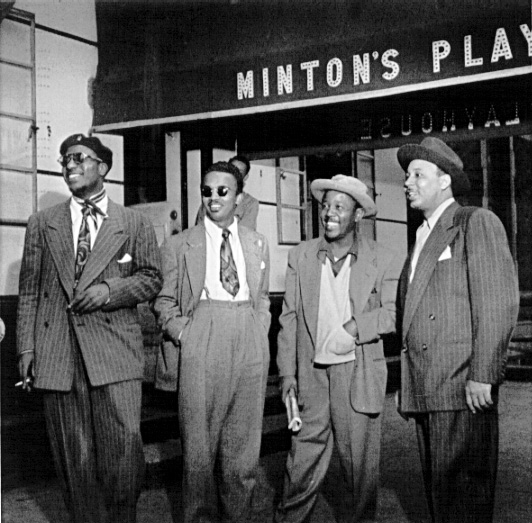 I'd like to have been around at the birth of bebop, to hear Charlie Parker playing on 52nd Street. I picked 30 because that would make me old enough to have some artistic experience and sophistication, young enough to stay out all night, to go up and catch the jam sessions at Minton's and Monroe's. And of course, in this fantasy, I'm totally hip, hipper than I ever was in real life (though not too hip, like Terry Southern's character).
In real life, here are my recollections of jazz in the 50s. The drinking age back then was 18, so these recollections are 1958-59.
My very first time in a jazz club...Smalls Paradise on 135th St. There was no cover, and one drink minimum. One drink for me meant a bottle of beer, which cost 75 cents, and which you could nurse all night. The first band I heard there was led by Donald Byrd and Pepper Adams. Pepper Adams played a gig at Opus 40 not long before his death, and I made sure to tell him what an honor it was to present the first jazzman I'd ever heard live. "Yeah, I remember that gig," he said.
Al Cohn and Zoot Sims at the Half Note, on Spring Street, with my friend Lenny Rosen. Mose Allison was the piano player in the band -- Back Country Suite had been released by then, and maybe Local Color too, but he hadn't gone full bore into his career as a leader/vocalist yet. At any rate, Lenny and I were huge Mose fans, and it was exciting to hear him in another context (Mose discusses his years with Al and Zoot here).
Less than a year later, I was married, and I remember Lenny telling me I'd made the right decision: "Just remember two lonely guys down at the Half Note." Well, a failed marriage is a plethora of memories, some good and some bad, but I remember those nights at the Half Note with unalloyed pleasure.
Henry "Red" Allen at the Metropole, in Times Square. Strangely, there's very little on the Web about the Metropole, though I did find these memories. No pictures. And it was an oddly picturesque spot. I didn't appreciate it enough at the time. I was young and bebopper, and I wish now I had listened more to these great traditional musicians. But the oddness of the place, in part, worked against a young would-be hipster appreciating it. It wasn't in the Village, or Harlem -- it was right there in Times Square, you could see the musicians from the street, through the window, you could just pop in, listen for a few minutes, and pop back out. They played in the daytime. The bandstand was long and narrow, behind the bar -- it looked more like a strip club, which it later became.
Count Basie at Birdland.
And the main memory of all.
About 15 years ago, I was in New York, walking near NYU, and I ran into a friend of mine, Bill Petkanas, younger than me, then an NYU graduate student. We decided to go for a beer. "I know a place over on Cooper Square," he said. "It's a thrash punk club, but the music doesn't start till late, and we can get a beer and talk now."
We went in. It was a punk club, all right, with black spray painted graffiti on the mirror behind the bar, and all over the bandstand. But I knew that bar, that bandstand. "I've been here before," I dold Bill. "But not to hear a thrash punk band. The last time I was here, Ornette Coleman and http://en.wikipedia.org/wiki/Don_Cherry_(jazz) were on that bandstand."
Yep, it was the Five Spot.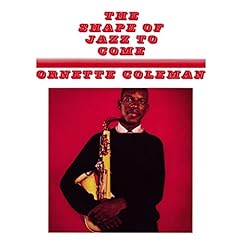 And that's the last reminiscence in my "I'm Not So Old" poem. I went there a lot in that winter of 1958-59, but once Ornette started his gig there, I went there all the time. I may not have been around for the birth of bebop, but I was there for the birth of Free Jazz, and that was as thrilling as it sounds. The white plastic sax, the tiny B-flat trumpet, and music like nothing anyone had ever heard.
I'd like to have been around at the birth of bebop, to hear Charlie Parker playing on 52nd Street. I picked 30 because that would make me old enough to have some artistic experience and sophistication, young enough to stay out all night, to go up and catch the jam sessions at Minton's and Monroe's. And of course, in this fantasy, I'm totally hip, hipper than I ever was in real life (though not too hip, like Terry Southern's character).In real life, here are my recollections of jazz in the 50s. The drinking age back then was 18, so these recollections are 1958-59.
My very first time in a jazz club...Smalls Paradise on 135th St. There was no cover, and one drink minimum. One drink for me meant a bottle of beer, which cost 75 cents, and which you could nurse all night.
The first band I heard there was led by Donald Byrd and Pepper Adams. Pepper Adams played a gig at Opus 40 not long before his death, and I made sure to tell him what an honor it was to present the first jazzman I'd ever heard live. "Yeah, I remember that gig," he said.Al Cohn and Zoot Sims at the Half Note, on Spring Street, with my friend Lenny Rosen. Mose Allison was the piano player in the band -- Back Country Suite had been released by then, and maybe Local Color too, but he hadn't gone full bore into his career as a leader/vocalist yet. At any rate, Lenny and I were huge Mose fans, and it was exciting to hear him in another context (Mose discusses his years with Al and Zoot here).
Less than a year later, I was married, and I remember Lenny telling me I'd made the right decision: "Just remember two lonely guys down at the Half Note." Well, a failed marriage is a plethora of memories, some good and some bad, but I remember those nights at the Half Note with unalloyed pleasure.
Henry "Red" Allen at the Metropole, in Times Square. Strangely, there's very little on the Web about the Metropole, though I did find these memories. No pictures. And it was an oddly picturesque spot. I didn't appreciate it enough at the time. I was young and bebopper, and I wish now I had listened more to these great traditional musicians. But the oddness of the place, in part, worked against a young would-be hipster appreciating it. It wasn't in the Village, or Harlem -- it was right there in Times Square, you could see the musicians from the street, through the window, you could just pop in, listen for a few minutes, and pop back out. They played in the daytime. The bandstand was long and narrow, behind the bar -- it looked more like a strip club, which it later became.
Count Basie at Birdland.
And the main memory of all.
About 15 years ago, I was in New York, walking near NYU, and I ran into a friend of mine, Bill Petkanas, younger than me, then an NYU graduate student. We decided to go for a beer. "I know a place over on Cooper Square," he said. "It's a thrash punk club, but the music doesn't start till late, and we can get a beer and talk now."
We went in. It was a punk club, all right, with black spray painted graffiti on the mirror behind the bar, and all over the bandstand. But I knew that bar, that bandstand. "I've been here before," I dold Bill. "But not to hear a thrash punk band. The last time I was here, Ornette Coleman and http://en.wikipedia.org/wiki/Don_Cherry_(jazz) were on that bandstand."
Yep, it was the Five Spot.
And that's the last reminiscence in my "I'm Not So Old" poem. I went there a lot in that winter of 1958-59, but once Ornette started his gig there, I went there all the time. I may not have been around for the birth of bebop, but I was there for the birth of Free Jazz, and that was as thrilling as it sounds. The white plastic sax, the tiny B-flat trumpet, and music like nothing anyone had ever heard.
Thursday, April 19, 2007
I'm Not So Old
I'M NOT SO OLD
I was just fifteen when Charlie Parker died
My older brother took me aside
And said, Kid, it's a bad day
It's a sad day
Well, I didn't know why and I had to be told
Hey, but I grew up
And I learned my stuff
And I learned enough
And I'm not so old
When I was a kid just starting to move
I filled my soul with that rhythm and blues
And I listened to the Clovers
And the Coasters
And I couldn't get enough of that rock and roll
I was growing up
And the beat was mine
And it still sounds fine
And I'm not so old
Then one night I turned on the radio
Looking for some of that rock and roll
And I heard some bebop
Brought me to a full stop
Didn't know what it was but it moved my soul
I was almost grown
And they said it was Miles
I still dig his style
And I'm not so old
I saw Monk dance around the Five Spot floor
And a cat from Texas made the Five Spot roar
His sax was plastic
His sound fantastic
And I went back again to hear Ornette blow
I was all grown up
And he made jazz free
Still sounds good to me
And I'm not so old
Once they said that jazz had passed away
But I go down to hear the young cats play
They play in the tradition
They've got a mission
They play sweet and strong and free and bold
Well, I may be grown
But the cats blow on
And the music's young
And I'm not so old

 Most of this is true…the first part isn’t. There was no older brother to tell me about Charlie Parker, and when he died, I didn’t know about it. Actually, neither did much of anyone else. He died on March 12, 1955, and the New York Times obituary didn’t appear till the 15th, at which time it listed the 35-year-old Bird as “about 53,” which was the coroner’s best estimate. My favorite story of that sad ending: Bird died in the Stanhope Hotel apartment of the “jazz baroness” Pannonica de Konigswater, while watching the Dorsey Brothers’ TV show (not Elvis -- he wouldn’t appear with the Dorseys till the following year). Nica called her Park Avenue physician, who arrived at the Stanhope to find a desperately ill and disreputable black man, dying of pretty much every excess known to man. As he began his examination, he asked,
“Mr. Parker…do you drink?”
“Sometimes I have a glass of sherry after dinner.”
From Wikipedia's entry in Nica, a followup that I hadn't known. Because of the negative publicity surrounding the death of this Negro in her apartment, she was asked to leave the Stanhope.
The other part that’s not quite true…it wasn’t Miles. But otherwise, it happened just like that. I was a sophomore at Bard, coming in from a late night of drinking at Adolph’s. Now, what you have to remember about those days is that we had a sort of paranoid protectiveness

about rock ‘n roll. That’s why you heard songs like “Rock and roll is here to stay/It will never die.” Because we weren’t so sure. The popular press kept telling us that rock 'n roll was a fad, doomed to die out like the hula hoop or Davy Crockett caps -- that we'd all outgrow it as we had the King of the Wild Frontier. And for all we knew, it was true. Something would happen to us when we turned 21, and we'd be listening to Jackie Gleason's Music For Lovers Only.
I knew that jazz existed, but I had never listened to it. I had, by that time, fallen thoroughly under the spell of rhythm and blues, which remains my passion to this day. So I came home from Adolph's, and, like the poem says, I turned on the radio. AM, of course, in those days. Alan Freed was gone in the payola scandal. You could sometimes pick up Jocko, your Ace from Outer Space upstate; mostly, we went for George "The Hound" Lorenz, out of WKBW in Buffalo. But this night, turning the dial, looking for the real rhythm and blues, I was literally brought to a full stop. I stood and stared at the radio. Music had never gone through me like that.
As I said, it wasn't Miles. That's a little poetic license. But close enough. It was John Coltrane, with the Red Garland Trio, on Prestige. It became the first jazz album I ever bought, followed by Gerry Mulligan and Chet Baker on World Pacific, King Pleasure/Annie Ross on Prestige, and Mose Allison's "Back Country Suite." The radio station, if I remember correctly, was CKLW, from Detroit and Windsor, Ontario. The disc jockey was Speed Anderson, seemingly completely forgotten today...a Google search turns up nothing.
All of this comes to mind because I've just started reading Blue Note Records: The Biography, by Richard Cook, a fascinating book. More about it, and about me and jazz in the 50s, later.
The Ten Percent Solution
For my subtext, or the hidden 90 percent, assignment, I put together a few teaching aids that I'd used separately, and it made for a pretty effective unit.
I started with a unit I've used in the past, the soap/Bogie unit. I play a short segment from a soap opera, and when it's over, I ask the class what they know as a result of watching it. And what they know is that the Wheelchair Bitch (as they dubbed her) is in a wheelchair because Babe ran her over, that Babe's boyfriend is a rich boy, that the boyfriend thinks she's lying, that in fact she is lying, etc., etc. How do they know all this? They know all of it because the characters tell them. It's all in the dialog. In a soap opera, everything is. There's no subtext to speak of...it's all laid flat out for you. This is one way of presenting a scene, and it works in a soap, because they have to bring the viewer up to speed who maybe only gets to watch once a week, and they have to play to the viewer who's half paying attention while putting the clothes in the dryer.
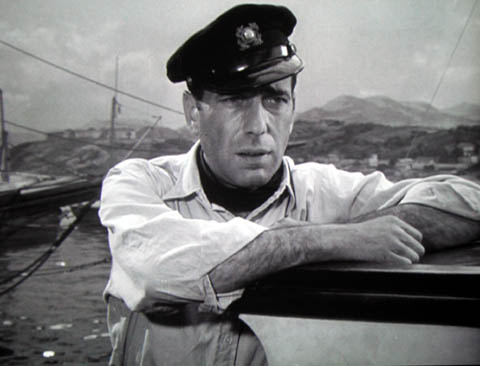 Then I use a scene from the Hawks/Bogart/Bacall classic, To Have and Have Not -- a scene which has virtually no dialog -- and ask the same questions. What do you know, and how do you know it? It's the scene where Bogart (Morgan) and Bacall (Slim)'s eyes meet across the nightclub, when she gets up to sing "Am I Blue" with Hoagy Carmichael (Cricket). What do we know? We know she's being ironic and mocking about the lyrics to the song, but she means them, too. We know that there's something happening between the two of them, but we don't know what. We know that she doesn't want to be with the man she's with (Johnson). We suspect there may be a business connection between Morgan and Johnson. We know Johnson drinks too much. And more. The scene opens with a black waitress moving through a cordon of men, some of them in uniform. We know it's an exotic Caribbean setting, and maybe wartime, maybe a dangerous setting. We know it's a mostly male setting, and a woman has to know how to negotiate her way through it. Then, as the camera catches sight of Morgan over the waitress's shoulder, it seeks him out and comes to rest on him, first in a two shot with a waiter, then quickly to a medium closeup. We know he's a loner, and we know he's a figure of authority. His eyes look up, and we know that everything we see thereafter will be from his point of view. He lights a match, and Cricket's piano starts at the same moment -- Morgan is setting the scene into motion.
There's a shot of the drummer in Cricket's band reading a newspaper. He puts down the newspaper, picks up his brushes, and starts to play. What's it doing there? What do we know from it? We know what the whole scene is about. It's about what Hemingway writes about, and Hawks makes movies about. It's about being in synch, about being hip, about being one of us. The drummer is in synch, Cricket is, Slim and Morgan are. Drunken, pawing Johnson is not. Frenchy, who enters to the new, nervous, ricky-tick tune Cricket starts playing after "Am I Blue," is not, but he's OK anyway. He comes to tell Morgan that the men who want to rent his boat are there - the men who are in danger. He makes the camera shift slightly, so he can share the space with Morgan, but the camera doesn't like it. It's glad when Frenchy leaves, and it can put Morgan back in the center of the frame.
 What I added to the unit this time -- I've used it before, but in a different context -- is the Moe Green scene from The Godfather. Michael arrives in Las Vegas to buy the casino from Moe Green. Green doesn't want to sell. Fredo is obviously on Moe's side. What's the scene really about? It's about power, control...and loyalty. Moe makes the first power play, by not being there when Michael arrives -- letting Fredo greet him with temptation, girls and a band. Michael makes his first test of loyalty, when he tells Johnny Fontane, the Sinatra character, that he'll be buying the Hotel from Moe, and he wants a signed commitment from Johnny to appear at the club five times a year, and convince some of his Hollywood friends to appear as well. Fredo hovers in the background, giving Johnny an out with his protestation that he's sure Moe doesn't want to sell out. Johnny hesitates. It's a tough spot. Is Michael bluffing, playing from weakness? Should he take the safe route, and say "Let's wait and see what Moe says"? But he comes through. "Sure, Mike, you know I'll do anything for my godfather." Maybe it's not as total an expression of support as "Sure, Mike, you know I'm with you." But it's the best Michael can expect.
What would the scene be like, if it had been written like the soap opera? If at the end of the scene, Michael had gone over to Tom Hagen and said, "Well, Johnny's with us, and Fredo isn't." "That's true, Mike, but maybe you should give Fredo a pass because he's your brother." "No, I can't do that, because with my father's illness, I have to show more ruthlessness than I would have otherwise." As one of my students said, "We've come a long way from the soap opera."
And in fact, Moe does talk a little like the soap opera characters, when he tells Michael that the Corleone family doesn't have that kind of power any more, the Godfather is ill, and he can get a better deal from Barzini. His dialog is better -- "I buy you out -- you don't buy me out!" but he's leaving his whole game on the table. He's like Johnson, the lecherous drunk.
Like writer, like character. Morgan and Michael both reveal their strength by what they don't reveal, what they hold back.
I started with a unit I've used in the past, the soap/Bogie unit. I play a short segment from a soap opera, and when it's over, I ask the class what they know as a result of watching it. And what they know is that the Wheelchair Bitch (as they dubbed her) is in a wheelchair because Babe ran her over, that Babe's boyfriend is a rich boy, that the boyfriend thinks she's lying, that in fact she is lying, etc., etc. How do they know all this? They know all of it because the characters tell them. It's all in the dialog. In a soap opera, everything is. There's no subtext to speak of...it's all laid flat out for you. This is one way of presenting a scene, and it works in a soap, because they have to bring the viewer up to speed who maybe only gets to watch once a week, and they have to play to the viewer who's half paying attention while putting the clothes in the dryer.
Then I use a scene from the Hawks/Bogart/Bacall classic, To Have and Have Not -- a scene which has virtually no dialog -- and ask the same questions. What do you know, and how do you know it? It's the scene where Bogart (Morgan) and Bacall (Slim)'s eyes meet across the nightclub, when she gets up to sing "Am I Blue" with Hoagy Carmichael (Cricket). What do we know? We know she's being ironic and mocking about the lyrics to the song, but she means them, too. We know that there's something happening between the two of them, but we don't know what. We know that she doesn't want to be with the man she's with (Johnson). We suspect there may be a business connection between Morgan and Johnson. We know Johnson drinks too much. And more. The scene opens with a black waitress moving through a cordon of men, some of them in uniform. We know it's an exotic Caribbean setting, and maybe wartime, maybe a dangerous setting. We know it's a mostly male setting, and a woman has to know how to negotiate her way through it. Then, as the camera catches sight of Morgan over the waitress's shoulder, it seeks him out and comes to rest on him, first in a two shot with a waiter, then quickly to a medium closeup. We know he's a loner, and we know he's a figure of authority. His eyes look up, and we know that everything we see thereafter will be from his point of view. He lights a match, and Cricket's piano starts at the same moment -- Morgan is setting the scene into motion.There's a shot of the drummer in Cricket's band reading a newspaper. He puts down the newspaper, picks up his brushes, and starts to play. What's it doing there? What do we know from it? We know what the whole scene is about. It's about what Hemingway writes about, and Hawks makes movies about. It's about being in synch, about being hip, about being one of us. The drummer is in synch, Cricket is, Slim and Morgan are. Drunken, pawing Johnson is not. Frenchy, who enters to the new, nervous, ricky-tick tune Cricket starts playing after "Am I Blue," is not, but he's OK anyway. He comes to tell Morgan that the men who want to rent his boat are there - the men who are in danger. He makes the camera shift slightly, so he can share the space with Morgan, but the camera doesn't like it. It's glad when Frenchy leaves, and it can put Morgan back in the center of the frame.
What I added to the unit this time -- I've used it before, but in a different context -- is the Moe Green scene from The Godfather. Michael arrives in Las Vegas to buy the casino from Moe Green. Green doesn't want to sell. Fredo is obviously on Moe's side. What's the scene really about? It's about power, control...and loyalty. Moe makes the first power play, by not being there when Michael arrives -- letting Fredo greet him with temptation, girls and a band. Michael makes his first test of loyalty, when he tells Johnny Fontane, the Sinatra character, that he'll be buying the Hotel from Moe, and he wants a signed commitment from Johnny to appear at the club five times a year, and convince some of his Hollywood friends to appear as well. Fredo hovers in the background, giving Johnny an out with his protestation that he's sure Moe doesn't want to sell out. Johnny hesitates. It's a tough spot. Is Michael bluffing, playing from weakness? Should he take the safe route, and say "Let's wait and see what Moe says"? But he comes through. "Sure, Mike, you know I'll do anything for my godfather." Maybe it's not as total an expression of support as "Sure, Mike, you know I'm with you." But it's the best Michael can expect.What would the scene be like, if it had been written like the soap opera? If at the end of the scene, Michael had gone over to Tom Hagen and said, "Well, Johnny's with us, and Fredo isn't." "That's true, Mike, but maybe you should give Fredo a pass because he's your brother." "No, I can't do that, because with my father's illness, I have to show more ruthlessness than I would have otherwise." As one of my students said, "We've come a long way from the soap opera."
And in fact, Moe does talk a little like the soap opera characters, when he tells Michael that the Corleone family doesn't have that kind of power any more, the Godfather is ill, and he can get a better deal from Barzini. His dialog is better -- "I buy you out -- you don't buy me out!" but he's leaving his whole game on the table. He's like Johnson, the lecherous drunk.
Like writer, like character. Morgan and Michael both reveal their strength by what they don't reveal, what they hold back.
Tuesday, April 17, 2007

Monday, April 16, 2007
Holding Back 90 Percent
So not long ago, I run into a former student, and by former I mean way former, from the first part of my teaching career, way back in the Sixties, before I was blacklisted and spent 20 years wandering in the wilderness. He tells me that I gave him one of the most valuable pieces of advice he ever received as a writer.
Oh? And what was it?
“Before you start writing, know everything, and then write ten percent of what you know.”
I said that?
Yep, and he’s never forgotten it.
Hmm, come to think of it, that is pretty good. Maybe I’ll start using it again.
…
So that brings us to the present, which is my Creative Writing class this semester, and the unit I do on subtext. Subtext is hard to teach, and my assignment -- to write a scene with subtext -- is pretty close to impossible. The good thing is, I know it, so I’m not really asking my students to do the impossible.
Here’s the assignment:
Write a scene between two characters, featuring dialog, in which the characters are talking about, or doing, anything you want them to be talking about or doing. But what underlies the scene -- which you know, but you don’t address directly -- is one of the following.
At some point in the future, the characters will have sex with each other
The characters will never have sex with each other, but one of them thinks they will.
One character is going to betray the other.
One character has already betrayed the other.
Saturday, April 14, 2007
Jackie Answers the Phone
From my brother Jon Richards, creator of the cartoons that grace this blog, this reminiscence of Jackie Robinson, actually written as a gracious gift to this blog, but also published in the Santa Fe New Mexican:
Sunday is Jackie Robinson Day in Major League Baseball, the 60th anniversary of the day Jackie first stepped onto a Major League baseball field, and honored baseball by his presence.
During the 1972 season, Willie Mays was traded to the New York Mets for a ballplayer named Charlie Williams and $50,000. I took the occasion to write a magazine article about the trading of baseball superstars in their declining years. The list is long and eye-opening.
Among those who, in the days before free agency, wound up their careers playing in strange uniforms are such Hall of Famers as Babe Ruth, Cy Young, Dizzy Dean, Christy Matthewson, Tris Speaker, Hank Greenberg, Rogers Hornsby and a raft of others.
Ruth at least left the Yankees of his own accord. But the Yankees didn't bother to retire his number. The legendary journalist Heywood Hale Broun was a boy at the time, and a die-hard Yankee fan.
"When George Selkirk trotted out on the field wearing number 3," he once told me, "I left Yankee Stadium and vowed never to go back there."
It was a little different with Jackie Robinson, the pioneer who baseball honors this year on the 60th anniversary of his epoch-making arrival in the Major Leagues.
Robinson was traded from the Brooklyn Dodgers, the team with which he had broken the color barrier when he crossed the first base line at Ebbetts Field on April 15, 1947, the team for which he had done so much and endured so much, the team for which he had played his entire career.
He was traded across town to the hated New York Giants. He was traded for a journeyman relief pitched named Dick Littlefield, and a reported $35,000. He didn't go.
In researching the Mays article, I tracked Robinson down for an interview. He had a construction company then, and I reached him at a New Jersey building site. He answered the phone himself, which floored me so much I could hardly think of what to ask him.
Jackie Robinson! At the other end of the telephone line!
The irony, he told me, was that he had already decided to retire after the 1956 season, his tenth with the Dodgers. He hadn't made the announcement yet because he had a deal with Look Magazine for the story.
That irritated some people, including the veteran sports columnist Red Smith, who wrote that for "peddling a news story, the rights to his retirement, no defense is discernible ... He has embarrassed the Dodgers, dislocated the plans of the Giants, and deceived the working newspapermen whose friendship he had and who thought they had his confidence ... . But for the Dodgers, the Jackie Robinson of this last decade would not have existed."
But for Robinson, the Dodgers of that decade would not have existed, not as we remember them, not as the Boys of Summer, who had capped the Robinson years with the franchise's first ever World Series triumph in 1955, a year before the trade.
"I saw it coming," Robinson told me. He and Dodger owner Walter O'Malley, who had bought the team from Branch Rickey and who would break the hearts and the spirit of the borough of Brooklyn in another year by removing the team to Los Angeles, did not get along. Robinson was a Rickey loyalist, and that sat ill with O'Malley.
Robinson suspected some other reasons for the trade. There was still plenty of racism in baseball a decade after he ended its apartheid. When a top star finished his playing days it was common practice for the organization to find him a job, managing or coaching or in the front office, if he wanted one. But for a black star, Robinson said, it was a different story.
O'Malley and the Dodgers did not want the embarrassment of having to face that delicate question when baseball's first black superstar reached that awkward age.
So Jackie Robinson said "no thanks" to the New York Giants, and packed up his equipment bag, and moved away from baseball. He became a successful businessman, and a major civil-rights leader. He died young, at 53, from heart problems and diabetes, a year after that afternoon when we talked on the phone.
Once, 10 years earlier, I had stood next to Jackie Robinson, backstage at the Ed Sullivan Show, where I was working and he was appearing.
We were among a knot of guys hanging around the security guard's desk watching the New York Mets, then in their first hapless season, on TV. Jackie shook his head.
"What a bunch of clowns," he chuckled, as Rod Kanehl in center field played an innocent pop fly into a triple.
Al Jackson, a pretty good pitcher, was on the mound for the Mets that night. He was an African American, and without the man standing next to me, he wouldn't have been out there.
Sunday is Jackie Robinson Day in Major League Baseball, the 60th anniversary of the day Jackie first stepped onto a Major League baseball field, and honored baseball by his presence.
Alice Denham at New Paltz
Novelist-turned-memoirist Alice Denham visited New Paltz on Thursday, to speak to my Honors English class in the afternoon and give a reading-book signing in the evening.
My class has been studying the literature and culture of the 50s, and Alice's new memoir, Sleeping With Bad Boys, is about literary New York in that era, a time when serious novelists had star status, at least in Manhattan. But since so many of my students are writing their research papers about women's issues, the class discussion focused on that part of her experience -- being a young woman in the 50s, how Alice (a founding member of NOW) viewed the changes in the lives of women over the decades. It's hard, today, to imagine a world where abortion was illegal, and Alice, while lucky enough to find a doctor who would do it, had to have her abortion without anesthetic, since the doctor could not risk having an anesthetist in the room. Hard to imagine, as well, how lonely and isolated a young woman could feel back then -- thinking she was the only one having sex, much less having an abortion.
I asked Alice to read my class the section of her book about a party she attended, new and innocent in New York, at Norman Mailer's apartment, where Mailer and his then-wife Adele did an impromptu strip. I think Alice was a little surprised to be asked to read something that risque in class -- and it occurred to me, not for the first time, that I'd have been long since fired for such a thing, if this were still the 50s. The students enjoyed it. But I don't think they have any real sense of Norman Mailer as an American literary figure, although we did read and discuss "The White Negro" in class.
The evening reading was well attended -- I'd guess 100 people or more -- thanks to Lyn Thoman's efforts in promoting it. After 17 years teaching at Marist, where there was no interest in any intellectual gathering outside of class, I'm always particularly gratified (and still a little surprised) to see this kind of turnout. Alice read from the early part of her book, a fascinating sequence about her new-in-New-York relationship with the still-unknown James Dean. She did, however, skip over the section that gave the details on what Jimmy was like between the sheets. For that, read the book.
Thursday, April 12, 2007
Alice Denham
I'll give a full report on the reading tomorrow.
But anyone happening on this blog, from the New Paltz area, be sure to come to the reading/book signing by Alice Denham, at the Coykendall Auditorium on the SUNY New Paltz campus, tonight at 7:30.
But anyone happening on this blog, from the New Paltz area, be sure to come to the reading/book signing by Alice Denham, at the Coykendall Auditorium on the SUNY New Paltz campus, tonight at 7:30.
Kurt Vonnegut
Here's a Kurt Vonnegut story I've always liked. A friend of mine was his lawyer, so I was at a dinner with him once, and he told the story on himself.
Vonnegut was an amateur magician, and he used to like to do little magic tricks when he gave readings. So he was giving a reading in London, and he wanted to end the evening by magically producing a bouquet of roses to hold out to the audience. He went to a local magic store to get the harness to put up his sleeve, to release the bouquet of roses at the appropriate time.
\As Vonnegut put it, there are always a lot of young guys hanging around a magic shop, the way young guys who like cars will hang around a mechanic's garage, and so it was with this store...a bunch of young layabouts, magic aficionados, not paying any particular attention as Vonnegut walked in and asked the clerk for the roses-up-the-sleeve harness.
A bored clerk, who clearly didn't recognize Vonnegut, said, "Sorry, sir, we don't have anything like that."
Vonnegut was amazed and irritiated. "What do you mean? Every magic store has them. I could go into any magic shop in Manhattan, and get one."
"Well, that's remarkable," the clerk said. "They must be so advanced in America. Any of you chaps ever hear of this?"
There was a general muttering of "no...no..." from the not-very-interested layabouts.
Vonnegut, getting really irritated by now, describes the harness one more time, carefully and slowly.
"No, sir, I'm sorry, nothing at all like that."
Vonnegut turned to walk out of the store. As he got to the door, he heard the clerk's voice behind him.
"Oh, Mr. Vonnegut..."
He turns around to find the clerk, and every other layabout in the whole store, holding out a bouquet of roses to him, plucked out of their sleeves.
Thank you for everything, Mr. Vonnegut, and may the Sirens of Titan sing thee to thy rest. All of us were in your karass.
Friday, March 30, 2007
I Met Someone Who Really Knew Belushi...
My Honors English this semester, a bunch of students I love, are finding out way too much about me.Something about the dynamic of the class makes things keep leaking out. They probably don’t believe half of what I’m telling them, but actually, it’s all been true, and it’s been bringing back memories to me. Like somehow yesterday I got into talking about how I taught John Belushi about the blues.
Which I actually did. It began with my friend Aardvark, who is no longer with us. Aardvark was a very good friend, if not in every respect a completely good person. Actually, he was drug dealer, though not when I first knew him. That developed over time, and I assume that was his connection to Belushi.
An aside: Acquaintances always used to ask me what Aardvark’s real name was; and, since I knew him better, I actually knew his real name. My answer was always, “If I tell you, then you will no longer have the pleasure of knowing someone whom you know only as ‘Aardvark.’”
The exceptions to this rule were his succession of beautiful and wealthy girlfriends, who always called him “Rick.” On reflection, I could understand this. It’s hard to imagine calling out, in the heat of passion, “Oh, Aardvark…Oh, Aardvark…”
But back to Belushi. This was in my
I had, at the time (they’re still safe, but now with my brother) one of the world’s great collections of rhythm and blues 45’s from the 1950s. I packed them into a suitcase, and headed over to Belushi’s. I brought my girl friend at the time, who was newly arrived from the
But Aardvark and Belushi and I spent the next couple of hours listening to Muddy Waters, and Magic Sam, and Lightning Hopkins, and the Clovers. Belushi and Dan Aykroyd had just done the Blues Brothers sketch for the first time on Saturday Night Live, and the response to it had been phenomenal. People wanted more Blues Brothers. An album. More SNL performances. And eventually, a movie, but that would come later. But he didn’t really know anything about the blues. He’d never listened to the blues particularly, and if he was going to be doing an album…
And we spent all of the next day with Belushi in the Colony Record Store in
Obviously, he was a quick study. I mentioned to a jazz musician friend that Belushi had just heard the blues for the first time last week, and now he was going to make a record. The musician said, “Well, sometimes that’s all it takes.”
Songs I know I brought to Belushi’s attention were “Rubber Biscuit,” originally by the Chips, “Flip, Flop and Fly,” originally by Joe Turner, and “Riot in Cell Block #9,” originally by the Coasters.
That’s pretty much the whole story, except that I had to call him every night for about a year before he finally got around to giving my records back.
Oh, and one other phone call -- this time from him to me, and characteristically for those days and this cast of characters, late at night. They were getting close to ready to make the record, and did I know any good blues musicians. I named a few. There was a pause at the other end of the line.
“Aren’t they all……………black?”
“Well, yeah…blues and all, you know how it is…”
“Do you know any white blues musicians? I’m a little afraid of black people…”
Well, if he was, he got over it. They had some of the greatest white blues musicians around on that first album, like Steve Cropper and Donald “Duck” Dunn, and some great black musicians too, like Matt “Guitar”Murphy. And some of the greatest blues people of all time in the movie. Thinking about it in later years, I wonder if maybe he just meant that when it came to the blues, he was intimidated by the black blues greats.
No need, John. You made your own strange contribution to the blues, and to American culture. And I hope your old evil spirit caught a Greyhound Bus and rode.
And to my old friend Larry the Fluff, if you’re reading this…you were one of the white musicians I recommended to John.
Wednesday, March 28, 2007
Why You Need to Be Careful Before Embarking on an On-Air Career
On WAMC, the local NPR radio station, this afternoon, a call-in show giving advice to would-be authors from two mostly helpful and well-informed local published writers. Someone calls in with this question: "I just finished a novel, and somebody tells me something with a similar name and theme has already been published. My book is called 'On The Road,' and it's about two guys named Sal Paradise and Dean Moriarty who travel around the US."
Published authors: "Wasn't that book by Jack Kerouac called something like that? Well, there are lots of books about two characters travelling around -- they're called picaresque novels. So yours should be OK. But you should probably change the title."
Published authors: "Wasn't that book by Jack Kerouac called something like that? Well, there are lots of books about two characters travelling around -- they're called picaresque novels. So yours should be OK. But you should probably change the title."


Friday, March 23, 2007
John Prine, Fred Koller
I found myself telling this story in a couple of different places within the last few weeks, so it must be on my mind. On my first visit to Nashville, more years ago than I care to remember, I met a guy named Art Sparer, who was to become one of my closest friends in Nashville, and whose couch I regularly stayed on when I visited -- "the songwriters' couch," he called it.
Art went out of his way to introduce me around town, and in one out of the way tavern, he introduced me to John Prine, who invited me to come to recording session he was doing the next day at Cowboy Jack Clement's studio.
Naturally, I was there. The song he recorded that day was "Let's Talk Dirty In Hawaiian," which you can find on Prine's German Afternoons and Lucky 13 albums, not to mention his massive The Full Johnny collection. The song was co-written by Prine and Fred Koller, whom I was to meet within the next couple of days, and who would become my other closest friend in Nashville.
Art, a true gentleman, a wonderful musician and producer, is no longer with us, but Fred is, very much so, and he remains a close friend.
Fred is a first-class bibliophile and the co-owner of Rhino Booksellers in Nashville.
More than that, he's one of Nashville's great talents, as songwriter and performer. You can find his full discography at the link above, and it's all good. He and I have written several songs together, and I'm including one here, from his Songs From the Night Before album, which also has his version of "Let's Talk Dirty."
The Hell We Created
Monday, March 19, 2007

Thursday, March 08, 2007
Situations
I've decided to put Situations, my epic newsletter, up on the Internet. Situations was originally sent out as a weekly newsletter to about 100 subscribers, then published in 2002 by Ye Olde Font Shoppe Press, Victoria Rivas' home of exquisitely produced books.
Now I'm recreating its original format. I'll be putting it up in installments, one week at a time. Well, I've started with the first two episodes, to whet appetites. They, along with the introduction that was written for the book, are up now on my Situations web page, linked above.
I'll also post the Introduction here, tomorrow.
Saturday, March 03, 2007


Friday, March 02, 2007


Tuesday, February 27, 2007
The Bat Test
I've posted this before, but who can find old posts in a blog? Besides, I've revised it, and who knows, maybe I even have some new readers.
It's the background for an exercise I give my Creative Writing I students.
This is a student poem from a few years ago – the first draft of a poem that went on to become much, much better – bright and sensual and well-realized.
First Kiss
And my response, or the relevant part for this exercise:
Richard Hugo, in The Triggering Town, talks about "writing off the subject." I'd add another, similar suggestion: "Writing away from the subject."
Not only do you not need to say what you've already said, you don't need to say what you've already suggested. It’s close to impossible to write total non sequiturs. If something pops into your head, no matter how disconnected it may seem from what went before, it's connected because your head is the one it popped into.
 So the connections are there. They can’t help but be. Our minds are connection-making machines. That’s what they do. And that means you need to trust us as readers to make those connections. We will make them...sometimes even better than you, the poet, will, because we expect them to be there. If we know a poem is called "First Kiss," we'll connect anything that follows to the experience of a first kiss (whatever our experience of a first kiss is). So write away from it. Don't describe a first kiss. Describe something else.
Here's a stanza from a poem called “Summer Haiku” by Alicia Ostriker, which I originally found on Poetry Daily, and which you can now find on a website of the Montfort Literary Society, but I’ll post the whole poem below.The stanza reads
Now, instead of “Summer Haiku,” let’s call the poem
Once we see the title "First Kiss," we're going to relate whatever comes after to the idea of a first kiss. We may read this and think -- this is a kiss she shouldn't have gotten into. This is a dangerous first kiss -- irresistible because of its crazy danger, because of the moonlight...but dangerous.
I revised the first line slightly, but suppose we restore it to its original state?
FIRST KISS
A mother bat soars
Crazily across the moon,
Mouth full of insects.
What’s her mother doing in a poem about a first kiss? Because it has to be her mother…she’s the first thing in the poem, and she’s at a vantage point to spy on the girl.
And the mother is nurturing. Maybe too nurturing for a girl who’s ready to try life on her own, with a first kiss.
Let’s put the same stanza under another title from another student poem, the next in my stack:
It's the background for an exercise I give my Creative Writing I students.
This is a student poem from a few years ago – the first draft of a poem that went on to become much, much better – bright and sensual and well-realized.
The surf rushes forward,
falling with fury into a fluid fusion.
Waves whirl and intertwine.
Surges of synergic seduction plunge deeper
as they rise and tumble.
Ripples diminish, and bliss licks the shore.
The ocean’s caress recedes
and I, standing barefoot in the sand
know.
And my response, or the relevant part for this exercise:
You’ve already let us know that the poem is going to be about a romantic, breathtaking moment, by titling it “First Kiss.” So you don’t need to explain that.
You also don’t need to explain to the reader that surf is a crashing, exciting phenomenon. So ANYTHING you say about the waves will carry that. Which means that’s the one thing you DON’T want to say, because you’re saying it already. Adding anything about rushing, or fury, is going to be redundant, and will feel like overkill.
Richard Hugo, in The Triggering Town, talks about "writing off the subject." I'd add another, similar suggestion: "Writing away from the subject."
Not only do you not need to say what you've already said, you don't need to say what you've already suggested. It’s close to impossible to write total non sequiturs. If something pops into your head, no matter how disconnected it may seem from what went before, it's connected because your head is the one it popped into.
 So the connections are there. They can’t help but be. Our minds are connection-making machines. That’s what they do. And that means you need to trust us as readers to make those connections. We will make them...sometimes even better than you, the poet, will, because we expect them to be there. If we know a poem is called "First Kiss," we'll connect anything that follows to the experience of a first kiss (whatever our experience of a first kiss is). So write away from it. Don't describe a first kiss. Describe something else.
Here's a stanza from a poem called “Summer Haiku” by Alicia Ostriker, which I originally found on Poetry Daily, and which you can now find on a website of the Montfort Literary Society, but I’ll post the whole poem below.The stanza reads
A mother bat soars
Crazily across the moon,
Mouth full of insects.
Now, instead of “Summer Haiku,” let’s call the poem
FIRST KISS
That night, a bat soared
Crazily across the moon,
Mouth full of insects.
Once we see the title "First Kiss," we're going to relate whatever comes after to the idea of a first kiss. We may read this and think -- this is a kiss she shouldn't have gotten into. This is a dangerous first kiss -- irresistible because of its crazy danger, because of the moonlight...but dangerous.
I revised the first line slightly, but suppose we restore it to its original state?
A mother bat soars
Crazily across the moon,
Mouth full of insects.
What’s her mother doing in a poem about a first kiss? Because it has to be her mother…she’s the first thing in the poem, and she’s at a vantage point to spy on the girl.
And the mother is nurturing. Maybe too nurturing for a girl who’s ready to try life on her own, with a first kiss.
Let’s put the same stanza under another title from another student poem, the next in my stack:
AFTER AN ARGUMENT WITH MY GIRLFRIEND, I QUESTION MY LOVE FOR HER
A bat soars
Crazily across the moon,
her mouth full of insects.
Uh oh. We're in the present tense now -- not looking back at the first kiss from a distance of time, but right there with the guy as his girl friend storms away, and his mind is full of doubts. Why is he looking at the sky, and not at her? Maybe because of the doubts. He wants to shut her out, at least for the moment. But he can't shut her out -- anything he sees is going to be relevant. And he sees a bat flying crazily across the moon -- the symbol of romantic love being crossed by the symbol of vampirism -- the creature who will first appear sexual and enticing, but will then suck the blood and the soul out of you. And in the speaker's mind -- because there's no way he could actually know this -- the bat is a woman.
The mouthful of insects may not be such a symbol of nurturing here. It may be the girlfriend’s mouth when he kisses her, or when they argue.
I went back to Poetry Daily, grabbed the titles to next couple of titles after Ostriker’s, and stuck the bat under them.A DOG'S GRAVE
A mother bat soars
Crazily across the moon,
mouth full of insects.
He's visiting the dog's grave at night. He must be very lonely. And the solitary bat makes him feel even lonelier. But...it's a mother bat. Her mouth is full of insects for her babies. Even this world, bereft of a beloved dog, is full of life and nurturing in the strangest places...maybe? We have to read on.FAMILY REUNION
A mother bat soars
Crazily across the moon,
mouth full of insects.
You make the interpretation.
Or how about this? Ezra Pound's famous two-line poem.IN A STATION OF THE METRO
The apparition of these faces in the crowd,
Bats flying crazily across the moon.
Or William Carlos Williams:So much depends
upon
a mother bat
flying
crazily across
the moon
mouth full of
insects
The exercise? Take any one of the poems they've written for me up to this point in the semester, and revise it to include the bat.
Here’s the original:Summer Haiku
by Alicia Ostriker
All night the peepers
Singing around our small pond,
Drunk men, happy men.
A mother bat soars
Crazily across the moon,
Mouth full of insects.
A grasshopper leaps
Through the meadow, escaping
The mower. This time.
I am so little,
Thinks the leaping grasshopper,
Why not let me live?
Sunday, February 25, 2007
Let a Smile be Whose Umbrella?
"In poetry, to say "I" is to put on the mask."
-- Jon Corelis, on the Poetryetc. list
May a smile be my umbrella!
But of course, I'm not the fella,
And that smile is a corona
Not for me, but my persona.
-- Jon Corelis, on the Poetryetc. list
May a smile be my umbrella!
But of course, I'm not the fella,
And that smile is a corona
Not for me, but my persona.
Friday, February 23, 2007
Tagged for Ten
I am, apparently, part of a tag-team blogroll. I have been tagged by the redoubtable Anny Ballardini, as follows:
So, here is Anny's list:
As it happens, I just did this exercise about a year ago for a website called The Cinematheque, so although Anny is quite right, and one's lists are subject to change at a moment's notice, I'll reprise that list here:
And extras. Anything by Kurosawa, but especially Dersu Uzala: The Hunter and the underrated Dreams. Anything with Errol Flynn, but special mention to Robin Hood, which I'm re-watching now with my 6-year-old grandson, and The Sea Hawk, where Michael Curtiz once again had the benefit of a wonderful screenplay by Howard Koch. Some Hollywood B movies that achieved a level of greatness: Abbott and Costello Meet Frankenstein, Tarzan and his Mate, The Incredible Shrinking Man. Rosselini directing De Sica in Generale Della Rovere. Cagney in Yankee Doodle Dandy. And on that note...my mother thanks you, my father thanks you, my sister thanks you, and I thank you.
I can't think of anyone to pass it along to. Who do I know who has a blog, whom Anny doesn't know? I'm sure I'm forgetting someone. But I'll post this anyway.
Okay, I have been tagged by our Great Tom Beckett who was tagged by Richard Lopez (who by the way mentions The Hitcher - movie I also wanted to quote) to name 10 favorite movies, not too bad, indeed. Difficult, though, these are just the first I was able to dig up, I am sure there are plenty more and will come out in the next few hours with a comment, how could I forget that one?
So, here is Anny's list:
1. La vita è bella (Life is beautiful) Benigni
2. Apocalypse now (Redux is all right) Francis Ford Coppola (loosely based on Heart of Darkness by Joseph Conrad)
3. A Beautiful Mind by Ron Howard
4. American Beauty by Sam Mendes with Kevin Spacey and Annette Bening
5. Catch Me If You Can by Steven Spielberg, I even liked Leonardo Di Caprio in this perfomance besides the usual Tom Hanks (see Philadelphia, Save Private Ryan, The Da Vinci Code, There is mail for you,
6. Dogville by Lars von Trier (not exceptional but I can forgive much to a movie that features Nicole Kidman)
7. The Experiment (a must see) by Oliver Hirschbiegel (based on the 1971 Stanford University simulation study of the psychology of imprisonment)
8. Girlfight by Karyn Kusama with Diana Guzman
9. The Lord of the Rings (3) by Peter Jackson and Harry Potter (the entire series)
10. Eyes Wide Shut by Stanley Kubrick with Nicole Kidman and Tom Cruise
10. The Matrix + The Matrix Reloaded by Andy Wachowski with Keanu Reeves and Carrie Ann Moss, originally taken from William Gibson’s homonymous novel.
As it happens, I just did this exercise about a year ago for a website called The Cinematheque, so although Anny is quite right, and one's lists are subject to change at a moment's notice, I'll reprise that list here:
1. Casablanca (Michael Curtiz, 1943)
It's customary to list a movie by director, so I've followed that custom, and Michael Curtiz was a Hollywood giant, with a career that stretched from the slient era to the 60s. He directed some of Errol Flynn's classics (which means some of my favorite movies) like Captain Blood and Charge of the Light Brigade; he directed Yankee Doodle Dandy and Young Man With a Horn and We're No Angels, a movie I had occasion to quote to my Honors English class last week. And he directed The Sea Hawk, also with Errol Flynn, but I'll get to that.
But for me, Casablanca is not Curtiz's movie, or even Bogart's. It belongs to Howard Koch, beloved friend and mentor, who co-wrote the screenplay. Here's looking at you, Howard.
2. The Seventh Seal (Ingmar Bergman, 1957)
Your most formative experiences are, unsurprisingly enough, come in your most formative years. I was seventeen when I first saw The Seventh Seal, and I can't count the number of times I've seen it since then. And every time, I get that same rush of awe that I felt the first time I saw it.
3. The Bicycle Thief (Vittorio De Sica, 1948)
I have an Italian film too, Anny -- not at the top of the list, but high up. I used to tell my screenwriting students, "Any one of you could make this movie. You could raise the kind of budget he had. You could go out in the streets of Poughkeepsie with a hand held camera, as he did in Rome. You could use amateur actors, as he did. All you'd need would be genius."
4. Ran (Akira Kurosawa, 1985)
Anything by Kurosawa. Throne of Blood did Shakespeare (a Samurai Macbeth) almost as well, but Ran, his Samurai King Lear, benefits from Kurosawa's masterful use of color and the big screen. And why you should still go out to the movies: There's a scene in Ran where the king and the fool are sitting on top of a hill, talking. At the foot of the hill, in the lower right hand corner of the screen, is a dappled white horse. And I thought as I watched it, "On TV or vCR that horse won't even be on the screen."
5. Red River (Howard Hawks, 1948)
The classic Oedipal Western, worth the price of admission just for the closeups of the cowboys' faces yelling as the trail drive begins. If you wondered whether John Wayne could act, watch his disintegrating personality in this movie.
6. A Night at the Opera (Sam Wood, 1935)
You could pick any Marx Brothers movie. I picked this one.
7. Cabin in the Sky (Vincente Minnelli, 1943) -– the best Louis Armstrong showcase on film, and no ten best list of anything that has an opportunity to include Louis Armstrong should leave him out. I almost picked High Society for the same reason – I know most people don’t even think it’s the best version of this story, but it is, because of Satch, Bing and Frank.
8. Scaramouche (George Sidney, 1952) -- I am pleased to report that two movies on my list -- Scaramouche and Cabin in the Sky -- didn't even make the NY Times list of the 1000 best movies (three if you count my honorable mention for High Society). I take this as a tribute to my unerring good taste. Swashbuckling is one of the things the movies do best, how can you pass up a guy who was born with the gift of laughter and a sense that the world was mad?
9. War and Peace (Sergei Bondarchuk, 1968) -- It would be easy to make a ten best list entirely from movies that did not make the NY Times 1000 Best List (Modern Times, Ivan the Terrible Parts I and II, Rio Bravo, just to name a few). I had put Lawrence of Arabia on my listoriginally, and it's a great spectacle, but I had forgotten the greatest spectacle of all time (so did the NY Times, but I'm making amends for my error). Featuring the entire Russian army, and wonderful acting, and not a slack moment in nearly seven hours of running time.
10. The Last Waltz (Martin Scorsese, 1978)
Best concert film ever.
And extras. Anything by Kurosawa, but especially Dersu Uzala: The Hunter and the underrated Dreams. Anything with Errol Flynn, but special mention to Robin Hood, which I'm re-watching now with my 6-year-old grandson, and The Sea Hawk, where Michael Curtiz once again had the benefit of a wonderful screenplay by Howard Koch. Some Hollywood B movies that achieved a level of greatness: Abbott and Costello Meet Frankenstein, Tarzan and his Mate, The Incredible Shrinking Man. Rosselini directing De Sica in Generale Della Rovere. Cagney in Yankee Doodle Dandy. And on that note...my mother thanks you, my father thanks you, my sister thanks you, and I thank you.
I can't think of anyone to pass it along to. Who do I know who has a blog, whom Anny doesn't know? I'm sure I'm forgetting someone. But I'll post this anyway.
Tuesday, February 20, 2007
Lips Like Chew Toys
Can't keep doing the same things every year, even though they always come out differently, so I tried a new exercise in my creative writing class last night, and it worked pretty well. I passed out strips of paper to all my students, and had each of them write a simile -- whatever came into their heads.
Then I had them read out their similes, and discuss how they worked -- what the second part of the simile told us about the first part. Pretty standard exercise. "Her lips were like orchid petals" -- her lips were soft, moist, warm, rare, valuable, etc. -- even bluish in color.
Then I collected all the slips of paper, tore them in half, shuffled them around, retaped them together, read the similes created that way, and discussed what these new similes told us.
"Her lips were like a chew toy for men." That makes the lips different, doesn't it? What do we picture now? Chapped -- maybe rough and reddened from too much passionate, violent kissing -- and apparently with more than one man.
"Her unshaven legs were like a desert cactus" became "Her unshaven legs were like burning embers." So rough you could strike a match on them? Capable of exciting passion even though unshaven?
My point...you don't have to worry about making connections too obvious. The human mind is a connection-making machine -- it's wired to look for connections between things. You can take chances, try for the unexpected, try for effects you may not even understand yourself.
As Richard Hugo says in his great book, The Triggering Town, "when you are writing you must assume that the next thing you put
down belongs not for reasons of logic, good sense, or narrative development, but because
you put it there. You, the same person who said that, also said this. The adhesive force
is your way of writing, not sensible connection."
Wednesday, February 14, 2007
Speaking of Auden
I think for a lot of our generation, Auden was a god that failed and then was partially resurrected. He was one of my poetic heroes, then became someone I didn't want to be -- glib, superficial, and either wit at the expense of substance or substance at the expense of wit. Richard Hugo said it really well in his wonderful book, The Triggering Town:
So I -- and a lot of others I've talked to -- didn't want to be in that Auden camp. I didn't want to write about things I was sure of, and bend language to illustrate those sureties.
But hey, Auden was great, and gradually I came back to recognizing that, if never back to looking at him as a poetic role model. He wrote lots and lots of poems that had both wit and substance.
When you start to write, you carry to the page one of two attitudes, though you may not be aware of it. One is that all music must conform to truth. The other, that all truth must conform to music. If you believe the first, you are making your job very difficult, and you are not only limiting the writing of poems to something done only by the very witty and clever, such as Auden, you are weakening the justification for creative writing programs. So you can take that attitude if you want, but you are jeopardizing my livelihood as well as your chances of writing a good poem. If the second attitude is right, then I still have a job. Let's pretend it is right because I need the money. Besides, if you feel truth must conform to music, those of us who find life bewildering and who don't know what things mean, but love the sounds of words enough to fight through draft after draft of a poem, can go on writing--try to stop us.
So I -- and a lot of others I've talked to -- didn't want to be in that Auden camp. I didn't want to write about things I was sure of, and bend language to illustrate those sureties.
But hey, Auden was great, and gradually I came back to recognizing that, if never back to looking at him as a poetic role model. He wrote lots and lots of poems that had both wit and substance.
Saturday, February 10, 2007
What Poets Do
I don't use the Fucking Your Sister letter as an assignment to critique, I use it as an assignment to provoke discussion. What was hard about the assignment? I get a variety of answers, but generally they're along these lines; It was about emotions that were painful. It was hard to imagine myself in that situation. I didn't know what to start with. I had a hard time fitting it all in, or putting it together. I didn't know why I would be telling all this to this person I hadn't talked to in a long time.
And what was fun about it? I got to use my imagination. It was a challenge. It has...no one actually ever says this in my class, but I think that's because they're scared of me at that point...it has all that neat stuff like sex and death and forbidden desires. Anyway, whatever they come up with, I can turn into my object lesson...this is what poets do. They have to reach deep into themselves for emotions they may not be comfortable with. They have to find words for those emotions, and organize them. But they get to exercise their imagination, and write about all that neat stuff.
And what was fun about it? I got to use my imagination. It was a challenge. It has...no one actually ever says this in my class, but I think that's because they're scared of me at that point...it has all that neat stuff like sex and death and forbidden desires. Anyway, whatever they come up with, I can turn into my object lesson...this is what poets do. They have to reach deep into themselves for emotions they may not be comfortable with. They have to find words for those emotions, and organize them. But they get to exercise their imagination, and write about all that neat stuff.
Sunday, January 28, 2007
More About That Letter
This came from a poetry class I taught years ago in prison. I assigned different students to lead the class discussion of different poets in our anthology. One was Diane Wakoski, and one of her poems was this:
The guy who had been given the assignment said, "This broad is crazy - and if she ever wrote me, I wouldn't even write her back."
it occurred to me that this was prison, and there wasn't much outside stimulation, crazy or otherwise, that wouldn't get a response. But there was something about his formulation that got to me, and I said,
"Are you sure? You get a letter from someone you haven't heard from in a long time - 'Dear Ken, I have to talk to someone about this, and you're the only one I can turn to. My brother....' Sure she's crazy -- grief and stress have driven her around the bend. But she's reaching out to you. Are you sure you wouldn't write her back?"
His face was very serious now. "Yes, of course I'd write her back."
Well, a poem is a letter to someone we don't know. But we want them to write us back -- to be moved enough that we've established a connection. And we can't count on friendship, or prior emotional ties, to get them to read our letter and write back. We can count to some small degree on the story being good enough. But mostly we have to draw them in by writing it well enough.
Justice Is Reason Enough
He, who once was my brother, is dead by his own hand.
Even now, years later, I see his thin form lying on the sand
where the sheltered sea washes against those cliffs
he chose to die from. Mother took me back there every
day for over a year and asked me, in her whining way, why it
had to happen
over and over again—until I wanted
never to hear of David any more. How
could I tell her of his dream about the gull beating its
wings
effortlessly together until they drew blood?
Would it explain anything, and how can I tell
anyone here about the great form and its beating wings.
How it
swoops down and covers me, and the dark tension leaves
me with blood on my mouth and thighs. But it was that
dream,
you must know, that brought my tight, sullen little
brother to my room that night and pushed his whole
taut body
right over mine until I yielded, and together we yielded
to the dark tension.
Over a thousand passing years, I will never forget
him, who was my brother, who is dead. Mother asked
me why
every day for a year; and I told her justice. Justice is
reason enough for anything ugly. It balances the beauty
in the world.
The guy who had been given the assignment said, "This broad is crazy - and if she ever wrote me, I wouldn't even write her back."
it occurred to me that this was prison, and there wasn't much outside stimulation, crazy or otherwise, that wouldn't get a response. But there was something about his formulation that got to me, and I said,
"Are you sure? You get a letter from someone you haven't heard from in a long time - 'Dear Ken, I have to talk to someone about this, and you're the only one I can turn to. My brother....' Sure she's crazy -- grief and stress have driven her around the bend. But she's reaching out to you. Are you sure you wouldn't write her back?"
His face was very serious now. "Yes, of course I'd write her back."
Well, a poem is a letter to someone we don't know. But we want them to write us back -- to be moved enough that we've established a connection. And we can't count on friendship, or prior emotional ties, to get them to read our letter and write back. We can count to some small degree on the story being good enough. But mostly we have to draw them in by writing it well enough.
Tuesday, January 23, 2007
Some Winter Shots
Not much winter, so far. No snow, and not cold weather till mid-January. But winter mornings can yield their own pleasures, especially if you're lucky enough to catch the dawn just coloring the mountain behind Opus 40:


New Semester, First Exercise
I generally start out my semester in Creative Writing with the following exercise.
You're writing a letter to someone -- it doesn't matter who -- someone of your choosing, real or imagined. It's someone you have not communicated with in a while, and you have to fill this person in on what's been happening in your life. And what's been happening is not good. You have a twin -- probably of the opposite sex, but that's your choice, too. About a year ago, your twin committed suicide by jumping off a cliff. It's been a terrible shock, but you're trying to put it behind you and get on with your life.
But your mother can't do it. She can't put it behind her. She keeps taking you up to the cliff, over and over, and asking, "Why did this have to happen?"
The worst part of it is, you know something that she doesn't, that might explain why it happened. Three days before the suicide, your twin came into your room at night, and had sex with you.
You're sure it happened. But you're a little foggy beyond that -- maybe you were dreaming, maybe your consciousness was a little off. Perhaps you don't know for sure whether you were forced, or a willing participant.
OK, write the letter. You can leave when you turn it in, we'll talk about it next time.
That's all I tell them. So that's all I'll write here, for now.
Monday, January 22, 2007
Winter Visitor

For four days this week, we had a guinea fowl take up residence on our deck. Certainly not a wild fowl -- they aren't exactly indigenous -- and much too willing to make himself at home. We fed him birdseed, and finally we called our friend and neighbor, local farmer John Wrolsen, who came and took it -- it will bunk with his birds until he finds its real home.
Anyway, here's the little feller, with Opus 40 in the background:
Sunday, December 17, 2006
Harvey with a student
Very nice picture from the Bard archives at the Hudson River Valley Heritage site.
Thursday, November 30, 2006
Thwarted
I wrote this in response to questions from a high school student working on a paper about what writers do.
The interviewer was my friend Mary Shen Barnidge, for her newsletter about stage fighting, Moulinet. The interviewee was Dawn "Sam" Alden of Babes With Blades.
1) How do you look at your original insight, inspiration, idea for your writing? Is it something that you control, or is it something with a life of its own? (I'm talking about the main idea of a book, not necessarily the characters or anything else)
You control the main idea -- the original insight. And while it comes from somewhere, you can generally trace where it comes from. The novel I've just finished, "Nick and Jake," comes from many conversations with my brother (we co-wrote it) over the years about the idea of having the main characters of The Great Gatsby and The Sun Also Rises meet, 25 years later, after WWII. We were prodded to start writing it post 9/11, post- George Bush's destruction of the worldwide concern and good will for America. We started thinking about how that happened post WWII, in the 50s McCarthy-CIA era, and realized our Nick and Jake story would be a perfect vehicle.
Now we're getting ready to start work on another book we've wanted to write for years, and the inspiration for this is our heritage -- our parents and their friends, the people we had for role models growing up. It'll be a historical novel about the Woodstock artists' colony in the 20s and 30s, and a theme involving two artists whom we respected and admired, who came to be rivals.
2) How do you develop your characters, scenarios, or the main ideas for your writing? How do you test out different ideas for characters, for example?
That really comes from the writing. This is not a usual experience, but if you're looking for odd stories from the writing life. My brother Jon and I live on opposite sides of the continent, and we decided to try and collaborate by email and instant message. That led to the choice of an epistolary novel, although we might have chosen it anyway. So our character development -- of the main characters, and the supporting characters -- came, to a considerable extent, by daring each other -- "let's see what you can do with this!!!" It proved to be a wonderful technique.
And last of all, the most important question for my purposes (and I think the most interesting one of all):
3) So, when its all said and done, do you feel that you lose control of your characters in a way? Does your perception of them change over time? Do you find them doing things you didn't forsee or plan? Do they take the book in a different direction than you intended? Why do you think this is, if at all?
I just read something terrific in an interview with a woman who choreographs fight scenes for stage productions. She was talking about choreographing a duel between two topless ladies.
The interviewer asked: Did you start stripping from the beginning, or work up to it gradually?
Choreographer: We choreographed all the fights first, concentrating on what you always concentrate on when creating a fight --
What story is being told?
How would these characters fight in these circumstances?
What choices do they make to accomplish their goals?
What do they do when thwarted?
So when we began to rehearse with the shirts off, we found that no changes were necessary.
You probably can't use the topless part of it in your paper, but the rest is incredible -- it's exactly what we need to do in writing a story. And the part about the choices characters make to accomplish their goals. and what they do when thwarted -- well, you can see exactly how that applies to stage fighting, but it applies to creating characters too. And you really don't know before you start -- have to discover in the writing -- the choices -- emotional, psychological, strategic, well-chosen, poorly chosen -- that your characters will come up with until you put them into a situation. And you certainly don't know what they're going to when thwarted until you put the obstacles in their paths.
One more story -- I once had to write a novel very very fast, against a deadline. At a certain point in the novel, the heroine has to plead with her old lover, now the leader of a revolution, for the life of her new lover. I knew, because I'd outlined the whole story, that she succeeds. But when I got to the scene, I couldn't figure out how. What could she possibly say? I didn't have time to wrestle with it, because of the deadline. But I was stuck, and I couldn't afford to be stuck. I decided to go ahead and write the next chapter, and come back to this, but I couldn't do it. Too linear. So
I came up with a solution out of desperation -- I never would have done this in my right mind. I decided to fool myself. Write "Chapter 14," then write seven or eight pages of total gibberish, then write "Chapter 15." So I did. And I got to the end of the book. And when I came back to actually write Chapter 14, I found to my amazement some phrases that contained psychological insights that would work for the confrontation. Who knows where they came from?
The interviewer was my friend Mary Shen Barnidge, for her newsletter about stage fighting, Moulinet. The interviewee was Dawn "Sam" Alden of Babes With Blades.
Saturday, November 25, 2006
The Dead
A poem of mine in Iowa Writes, an online feature of the University of Iowa and Iowa Review.
Thursday, November 09, 2006
Congratulations
To John Hall, our friend and neighbor, great musician, and now Congressman from the 19th congressional district, described by the Poughkeepsie Journal as
The first rock star ever to make the move to Congress, John is no stranger to local politics, and no stranger to involvement with major issues. I'm confident that he'll join Maurice Hinchey in giving the Hudson Valley some of the strongest and best representation in Congress.
northern Westchester and all of Putnam, expanding north to cover most of Dutchess County, traveling through northern Rockland County, then gobbling up most of Orange County all the way to the New Jersey and Pennsylvania borders. The district is a fascinating mix of suburban wealth, rural quiet, farmland and small-town struggles. While not quite a microcosm of New York state - the district lacks big cities and their problems - the 19th does bridge upstate with downstate, even reflecting "middle America'' and its struggles.
The first rock star ever to make the move to Congress, John is no stranger to local politics, and no stranger to involvement with major issues. I'm confident that he'll join Maurice Hinchey in giving the Hudson Valley some of the strongest and best representation in Congress.
Opus 40 in the Autumn
Is mid-November still autumn? It is this year. The leaves have fallen, but the weather is still beautiful.
Not beautiful yet, but a huge advance. Last night it rained, so the pool needs to be pumped again, but not very much. This time we'll also bring in a mudsucker to get down into the last layer of leaves and suck out all the water, so we can get everything.
The pool won't really fill up till next spring, but a little water will come back into it, so when it freezes this winter we'll have a sunken ice rink. I'll get photos of that, too.
Our big autumn job this year is cleaning out the Shallow Pool, the big one by the meadow. It's long overdue, but it's being done. We're probably about three quarters of the way through it, as of last weekend. Most of the leaves and muck are out, and it looks like this:
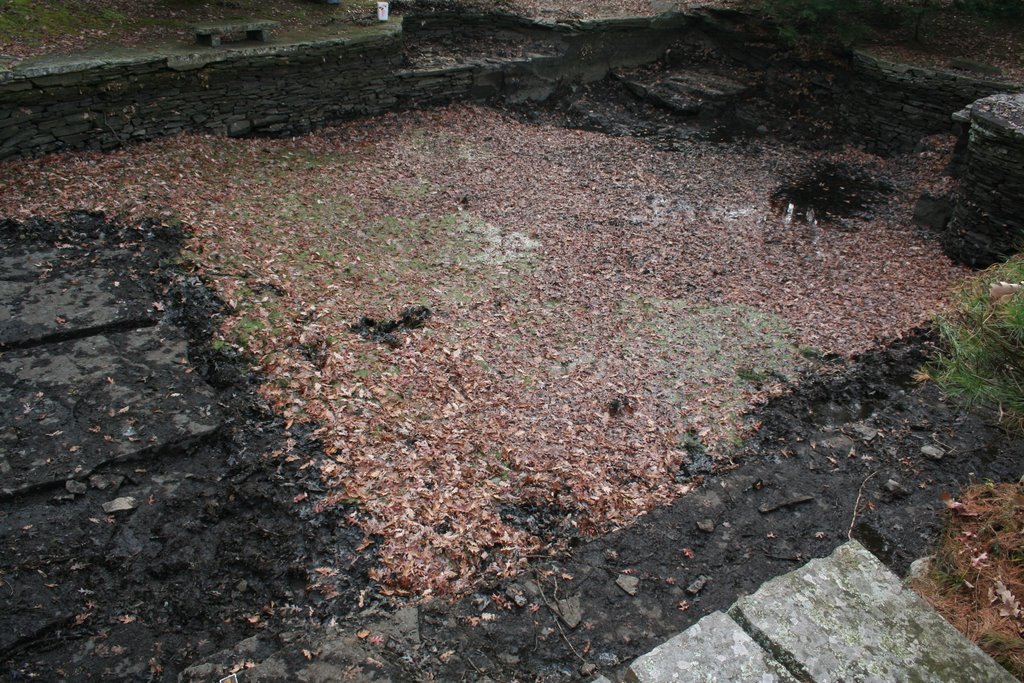
Not beautiful yet, but a huge advance. Last night it rained, so the pool needs to be pumped again, but not very much. This time we'll also bring in a mudsucker to get down into the last layer of leaves and suck out all the water, so we can get everything.
The pool won't really fill up till next spring, but a little water will come back into it, so when it freezes this winter we'll have a sunken ice rink. I'll get photos of that, too.
Subscribe to:
Posts (Atom)