Monday, January 15, 2018

Listening to Prestige 302: Phil Woods

Phil Woods is back for a Prestige session after a couple of years absence, and this will be his last session for Prestige. In fact, for someone who is remembered as one of the most prolific jazz recording artists of all time, he did very little recording for most of the 1960s. So it’s a shame that this session was put on the shelf, and never actually released until the late 1960s, by which time he was back on the recording scene again,with a pace that never slackened.

It’s a shame because it’s a wonderful recording, and also because it’s a rather unusual group of musicians.

Dick Hyman, who is recognized as one of the masters of jazz piano (quite literally: he was named an NEA Jazz Master in 2017),and who rivals Phil Woods for a prolific catalog, did very little recording in the widely preferred small group setting. He could play anything, and did. He played tribute albums in the style of everyone from Jelly Roll Morton to Thelonious Monk. He worked extensively in radio and television, including stints as musical director for Arthur Godfrey and Sing Along With Mitch, two gigs you might not want on your resume if you were trying to show how hip you were, but Hyman didn’t care much about that. However, another one of his TV gigs was as the piano player on Charlie Parker’s only television appearance. In 1955, he recorded “Moritat: Theme from the Threepenny Opera,” and his mournful instrumental version sold a million copies, making it the most successful recorded version of the tune until Bobby Darin swung it, with Doc Severinsen on trumpet, as “Mack the Knife.”

Hyman had done another small group recording for Prestige in 1956, backing vocalist Barbara Lea, under the pseudonym Richard Lowman (he was under contract to MGM at the time).

Howard McGhee is one of the premiere bebop trumpeters. When Charlie Parker made his ill-fated West Coast tour in 1945, McGhee was one of the few artists who understood him and were able to play with him.

Because of McGhees 1946-47 sessions with Parker, I’d always thought of him as a West Coast musician, but in fact he spent very little time on the West Coast. Addiction problems meant that he didn’t work or record much in the 1959s, but his career would have a renaissance in the 1960s.

With McGhee, Teddy Kotick and Roy Haynes, who can play some bebop, and Dick Hyman, who can play anything, there’s some terrific music here, none of which I can share with you on Listen to One, because no one has put it up on YouTube.  This may have been Kotick’s last New York recording session, with the exception of one he did with Helen Merrill in the mid-1960s. Here’s a poem I wrote about him (recently published in the online journal Verse-Virtual):


TEDDY KOTICK

I deliver the mail

in Needham Mass

middle aged white

guy in blue shorts

Fridays I drive

three hours to Albany

bass in the back

play for the door

back to the route where

everyone knows me

even the dogs

who sniff at my ankles

but no one

would know what it meant

if someone told them

I’d played with Bird


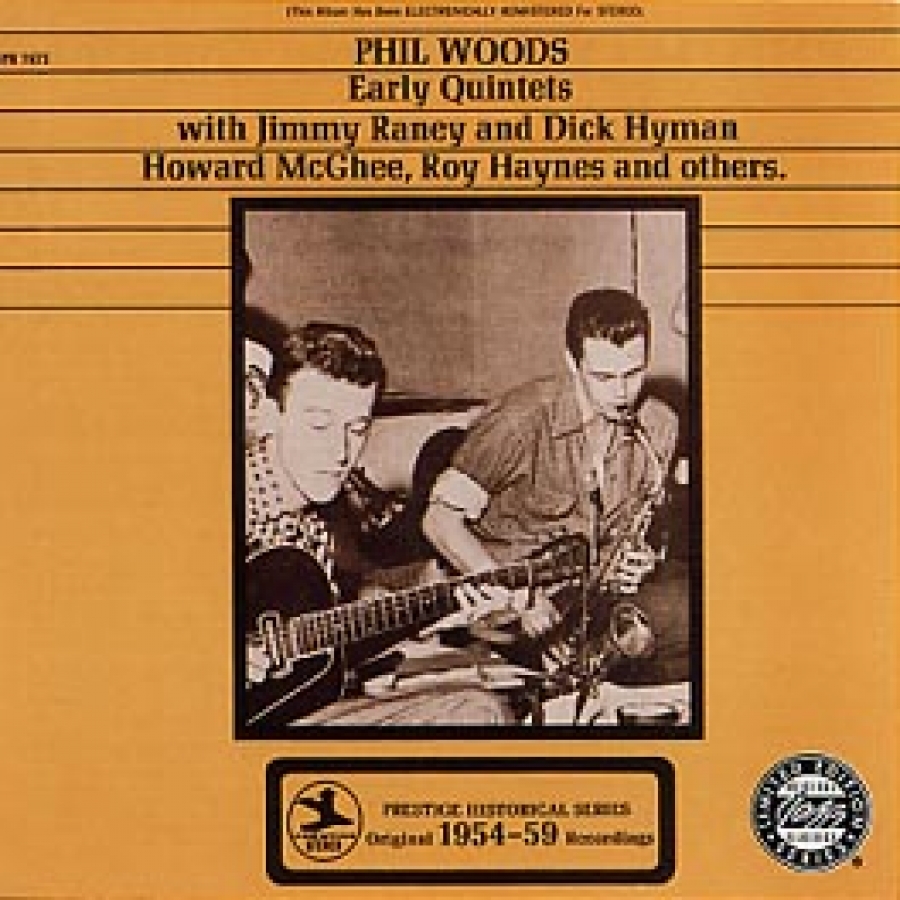
It’s a short session: four songs, the kind you used to see when they were still making 78s. When it was finally released, it made up side of an LP. The other side was a session with Jimmy Ramey--actually a Jimmy Ramey ssesion--from 1954. it had been released on New Jazz and on the odd formats they
were experimenting with back then: 16 2/3, 45 RPM EPs.

This album was released as Early Quintets, and the cover art suggests even earlier quintets than they actually are: it looks like something from the early days of LPs, back in 1952. Makes you wonder about the marketing: did Weinstock expect people to see it in the bins and say, "Wow! Phil Woods from back in the day! Wonder how I missed this?"

Order Listening to Prestige Vol 2


Listening to Prestige Vol. 2, 1954-1956 is here! You can order your signed copy or copies through the link above.


Tad
Richards will strike a nerve with all of us who were privileged to have
lived thru the beginnings of bebop, and with those who have since
fallen under the spell of this American phenomenon…a one-of-a-kind
reference book, that will surely take its place in the history of this
music.


--Dave Grusin

An
important reference book of all the Prestige recordings during the time
period. Furthermore, Each song chosen is a brilliant representation of
the artist which leaves the listener free to explore further. The
stories behind the making of each track are incredibly informative and
give a glimpse deeper into the artists at work.
                                                                                                                --Murali Coryell

Saturday, January 13, 2018

Listening to Prestige 301: Arnett Cobb

If you’ve got that soulful, bluesy sound on the tenor sax, and you want to make a record in 1959, you’re going to need an organ.

You’re not going to be able to get Jimmy Smith. He’s way too big, way too much in demand. And he's signed to Blue Note. Shirley Scott’s made a bunch of recordings for your label, but she’s not available either. And your old pal Wild Bill Davis, who just sat in on your debut album for your new label, was just passing through and is out for this one.

So who you gonna call?


Or...this being 1959, and a jazz organist being what you require, here’s a better question: Where you gonna call?

Philadelphia!!!

It's amazing how one city can be so much the hot center of the newest craze to be sweeping jazz. Jimmy Smith took up the Hammond B-3 because its tones were generated electronically, so unlike the piano, it never went out of tune. This can be a big deal for a keyboard player who's on the road a lot, playing Lord knows what instrument in Lord knows what state of repair.

What keyboard instruments have in common is that if you press down one key you get a note, and if you press down a few keys at the same time, you get a chord. Beyond that, not much. So Smith, with his Hammond B-3 organ, really had to create a whole new sound, and the sound that he created inspired a generation of keyboard players.

Shirley Scott was one of the first. and we've listened to her exploration of the whole range of the two 61-key keyboards on the Hammond, and the excitement of finding new voicings and new sounds. But she would not be the only one. Jimmy McGriff, a Philadelphia cop, gave up walking his beat for a different beat, studied with Smith, and went on to make his own mark. Richard "Groove" Holmes was another. Charles Earland followed him, as did a second generation Philadelphia organist, "Papa John" deFrancesco's son Joey.

Philadelphia and the organ go even farther back. Bill Doggett was from Philadelphia, as was Doc Bagby, jazz veteran who hit the rhythm and blues charts with "Dumplin's." And many more who may not have left town, but continued to play the Philly jazz clubs and give the city its rich organ heritage.

One such was the gentleman who for decades needed only to be known in his home town, and up and down Catherine Street,  as "Mitchell at the Hammond Organ," but when he made the two hour drive to Hackensack, New Jersey, to be the organ guy on Arnett Cobb's second Prestige recording, he used his full name, Austin Mitchell.

There's no typical sax-organ sound, any more than there's a typical sax-trumpet sound. Austin Mitchell is very much influenced by Jimmy Smith, but he's his own man, too. And here's something that particularly interested me, in listening to this session. Mitchell for most of his professional career was an organ trio guy, leading his own groups around Philadelphia. But with Arnett Cobb, though his solos are consistently interesting and inventive, I found myself particularly interested in the work he did behind Cobb when Cobb was soloing. Never intrusive, but always important. In every Cobb solo, from the sensitive ballad work in "Ghost of a Chance" to the rhythm and bluesy honking on "Smooth Sailing," to the melodic ("Charmaine"), to the uptempo beboppery of "Let's Split," to the blues ("Blues at Dusk"), Mitchell is enriching, deepening, going from comp to counterpoint at just the right moment.

Buster Cooper has been on one previous Prestige session, the first Prestige Blues-Swingers, which was essentially a big band session, so this is his first small group recording. Not every trombonist, especially those who have thrived in a big band setting, is going to be a bebop virtuoso. Cooper is more the old school, playing with gusto, with humor, with that down home dirty blues sound.


After listening to a few sessions of what George Duvivier can do with this sort of music, you really wouldn't want anyone else playing bass for you. Cobb and producer Esmond Edwards agree, and Edwards has let Rudy Van Gelder know that he wants the listener to hear what Duvivier is doing, Duvivier also contributes one original composition ("Cobb's Mob").

Osie Johnson takes Arthur Edgehill's accustomed seat behind the drums, and he does just fine. Johnson was one of the drummers that Prestige would call on for its bluesy sessions, and with good reason.

Smooth Sailing was the name of the album, and the title tune plus "Ghost of a Chance" were the 45 RPM release.

Order Listening to Prestige Vol 2


Listening to Prestige Vol. 2, 1954-1956 is here! You can order your signed copy or copies through the link above.


Tad Richards will strike a nerve with all of us who were privileged to have lived thru the beginnings of bebop, and with those who have since fallen under the spell of this American phenomenon…a one-of-a-kind reference book, that will surely take its place in the history of this music.

                                                                                                                                                --Dave Grusin

An important reference book of all the Prestige recordings during the time period. Furthermore, Each song chosen is a brilliant representation of the artist which leaves the listener free to explore further. The stories behind the making of each track are incredibly informative and give a glimpse deeper into the artists at work.
                                                                                                                --Murali Coryell

Friday, January 12, 2018

Listening to Prestige 300: Hal Singer

Hal Singer had his moment in the sun in 1948 when his 78 RPM single, "Corn Bread," went to Number One on the rhythm and blues charts, or rather the Race Records chart, because Billboard didn't start using the appellation "Rhythm and Blues" until 1949. "Corn Bread" has a solid blues riff, builds on it with energy and humor and some clever interplay between Singer's saxophone and a trombone. The two work closer and closer together on an improvisation that gets wilder and more intense. It would have been great to dance to. It still is. And of course, it was ignored by the jazz critical establishment, hiosters and moldy figs alike. It wasn't abstract like Lee Konitz. It didn't swing like Harry James. And it didn't have real jazz musicians playing.

No identification of individual musicians on the Savoy record label, as was common with R&B, because no one was reviewing them or writing think pieces about them. But we know who they were. The trombone was Milt Larkin. Wynton Kelly was on piano, Franklin Skeete bass, Heywood Jackson, drums. Jazz enough for you?

"Corn Bread" wasn't all that Singer wanted to do. He said in an interview years later that the thing he was most proud of about the recording was giving Wynton Kelly his first chance on record. That, and that it led to his joining the Duke Ellington band a few years later, so the Duke knew jazz where he heard it.

Singer's followup, "Beef Stew," went nowhere, and so did his career, for a while. He still had work (a beloved Number One hit will do that for you), but he couldn't recapture the magic on a few more singles for Savoy and some smaller labels.

By the time of the Prestige session he had joined the Ellington Orchestra and left it to work with his own  small groups again--a tough decision, but maybe the right one.

This was his first ever booking to make a whole LP record. He was teamed with another jazz veteran, Charlie Shavers. The two were about the same age, Shavers 42 and Singer 40. They had similar backgrounds, although Shavers had always managed to stay on the respectable side of the swing/rhythm and blues divide, playing with Tommy Dorsey, Benny Goodman, Billie Holiday and Jazz at the Philharmonic.

He was always in demand. His 1950s had been marked by recordings with Louis Bellson, Coleman Hawkins, Count Basie, Woody Herman, and Gene Krupa and Buddy Rich (together).

This session includes one standard ("With a Song in My Heart") and a bunch of originals. You can hear stylistic difference between Singer and Shavers--rhythm and blues and swing are not exactly the same--but the mesh together to create an exciting and organic music.

The difference between record like "Corn Bread" and a record like "Blue Stomping" -- "Corn Bread" is three minutes long. That's a little long for a 78 RPM record, but it's within the limits, which is how you made a record in 1948. And as a result, it's essentially an extended saxophone solo. There's nothing in it that would confuse or slow down a dancer.

"Blue Stomping" is Hal Singer stretching out to LP length, at six and a half minutes, so the full-out excitement of "Corn Bread" is there, but now it's part of a larger picture, with solos traded off between Shavers and Singer, not so much ensemble work, and a piano solo by Ray Bryant, including some give and take with Wendell Marshall and Osie Johnson, which you would not hear in a rhythm and blues recording, or a swing record either, for that matter.

Shavers died in 1971, within days of his friend Louis Armstrong; his last request was that his mouthpiece be buried atop Armstrong's coffin.

Singer's career was revived with this session. He would make one more record with Prestige. Then not long after, on a European tour, he would become yet another jazzman to fall under the spell of Paris skies. He stayed there, becoming an important part of the European jazz scene. He was awarded the title of Chevalier and later Commandeur de l'Ordre des Arts et des Lettres, along with T. S. Eliot, Audrey Hepburn and Marcel Marceau, and of course, this being France, Jerry Lewis.

This album was released as Blue Stompin' on Prestige, and was a later Swingville rerelease. The title track became a two-sided 45.

Order Listening to Prestige Vol 2 


Listening to Prestige Vol. 2, 1954-1956 is here! You can order your signed copy or copies through the link above.


Tad Richards will strike a nerve with all of us who were privileged to have lived thru the beginnings of bebop, and with those who have since fallen under the spell of this American phenomenon…a one-of-a-kind reference book, that will surely take its place in the history of this music.

                                                                                                                                                --Dave Grusin

An important reference book of all the Prestige recordings during the time period. Furthermore, Each song chosen is a brilliant representation of the artist which leaves the listener free to explore further. The stories behind the making of each track are incredibly informative and give a glimpse deeper into the artists at work.
                                                                                                                --Murali Coryell

Saturday, January 06, 2018

Listening to Prestige 299: Mose Allison 

I wonder if Bob Weinstock didn’t exactly know what to do with vocalists. In a late interview, looking back at his career, he mentions in passing that vocals were always the records that sold best, and he gives King Pleasure and H-Bomb Ferguson as examples. But he only produced one session with Ferguson, and only released one 78 from that session. 

His history with Pleasure is perplexing. “Moody’s Mood” was one of his biggest hits, but he didn’t make an effort to get behind Pleasure’s career. The “Moody’s Mood” session consisted of a band led by Teacho Wiltshire, playing some instrumentals and backing a couple of singers—Pleasure happened to be one of them.

And OK, he may not have known Pleasure was something special going into the session, but he surely knew coming out of it, especially as “Moody’s Mood” began to climb the charts, eventually reaching number two in rhythm and blues. But Weinstock’s next session with him was listed in the session log as the “Charlie Ferguson Quintet,” and it was mostly an instrumental session, with Pleasure called in to do a couple of vocals.

Obviously Weinstock knew he had something good with “Moody’s Mood” (it’s hard not to noice when your record reaches number two on the charts) because he ran into the young Annie Ross at a party and asked her if she could do something like it. She came back the next day with two classics, “Twisted” and “Farmer’s Market,” But that was the only session he ever booked with her. When the LP era came into its own, and jazz labels were re-releasing collections of their old 78s, Prestige did not have enough of either Pleasure or Ross to make a full 12-inch LP.

And what about the two young female vocalists that Pleasure brought in with him to help out—Blossom Dearie on “Moody’s Mood” and Betty Carter on “Red Top”? Didn’t he see the promise there?

This is not really a criticism. If Weinstock had focused on following the hits, Prestige would have been a very different, and likely much less interesting, label.

And how does this connect to Mose Allison? I’m not sure, really. Allison had a long and brilliant career in a field he almost invented for himself: jazz singer/songwriter. He could be called a cult favorite. If that term has negative connotations for you, then he wasn’t. If it has positive connotations, he was. His albums were never huge sellers, and I don’t believe he ever scored very high on Down Beat’s male vocalist poll. But the people who loved him, loved him passionately.

I loved him, and passionately, from the first time I heard Back Country Suite. But the most passionate fandom probably came from the later singer/songwriter work. So why wasn’t he exploring this side of his talent in his early Prestige albums? Or for that matter, in his Columbia albums? He really didn’t become the quirky, funky, literate troubadour until he began with Atlantic in 1962. Was it Weinstock’s limited vision when it came to the possibilities of jazz vocals, or an unwillingness to mess with a formula that was working pretty well? Or did it really take Allison another five years to find that voice? Could be.

  In any event, vocals were always a part of what Allison did on Prestige, and the vocals were the ones that Weinstock released on 45. And Weinstock certainly liked what he was doing enough to bring him back over and over. We have five albums over two years, and people are still listening to them, even though they’ve been somewhat eclipsed by the later work, and the Mose Allison Sings double LP compilation is by far his best seller on Prestige.

There are three vocal tracks on Autumn Song. Two are Chicago blues, one is Ellington. All become Allison.

“That’s Alright” was written by Muddy Waters’ guitar player Jimmy Rogers. Recorded by Rogers in 1950, it became a hit for Little Junior Parker in 1957, and has since become a beloved blues standard. Rogers, who retired from the music business right around the time that Parker’s version of “That’s Alright” was breaking, would mount a comeback in the 1970s, and shortly before he died in 1997 would record his own cover of his own song, with Eric Clapton.


It’s not hard to see the continuing appeal of the song, the bittersweet aching loss of a lover who insists that everything is all right, and forgives his faithless lover. Allison’s wry reserve only deepens the emotion.

Sonny Boy Williamson’s “Eyesight to the Blind” is another blues that’s gone on to become a classic, this one with an unusual twist.

Williamson recorded “Eyesight to the Blind” in 1951, and a doowop cover version by the Larks came out the same year on the Apollo label, making a a strong showing on the R&B charts. The Larks put another Williamson song, “Fattening Frogs for Snakes,” on the flip side. One can tell just from these two titles how imaginative Williamson was as a songwriter, and that had to appeal to Allison. In his version of “Eyesight,” he picks up the tempo and gives it his own crisp piano styling.

The unusual twist to “Eyesight to the Blind”? The Who’s Pete Townshend, always an Allison fan, took the lyric, created his own melody, and  made the song a part of his rock opera Tommy, about a deaf, dumb and blind kid. He gave Williamson full credit for the composition.

If there was ever a lyric suited to Allison’s fine-tuned sense of irony, it’s Bob Russell’s “Do Nothin’ Till You Hear From Me,” to a tune by Duke Ellington, in which a lover vows his fidelity to his distant partner while more or less admitting that he’s fooling around on her. From the plaintive melody of Rogers’s betrayed lover to the Ellington sophistication of Bob Russell’s cad, Allison gets an opportunity to show his range.

Allison’s final Prestige album was released as Autumn Song. “Do Nothin’ Till You Heat From Me” was the first single release from the session, as the flip side of “Seventh Son.” It would be followed by “That’s All Right” / “Eyesight to the Blind.”  Then there’d be the three albums for Columbia (the third on Epic) before the long association with Atlantic, where his first album included “I Don’t Worry About a Thing” and “Your Mind is on Vacation.” Whether he had only just started writing this way, or whether the Ertegun brothers saw a side of him that had always been there, and encouraged him to express it, who knows?

But we’re grateful for what we have. Bob Weinstock might not have realized that Miles Davis could be a superstar I f he put together an identifiable quintet and created a brand, but because of that, we have all those fascinating recordings of Miles in different contexts. And the Allison albums on Prestige give us Mose the important composer-piano player, with a little trumpet, a little singing. We can only be grateful.


Order Listening to Prestige Vol 2 


Listening to Prestige Vol. 2, 1954-1956 is here! You can order your signed copy or copies through the link above.


Tad Richards will strike a nerve with all of us who were privileged to have lived thru the beginnings of bebop, and with those who have since fallen under the spell of this American phenomenon…a one-of-a-kind reference book, that will surely take its place in the history of this music.

                                                                                                                                                --Dave Grusin

An important reference book of all the Prestige recordings during the time period. Furthermore, Each song chosen is a brilliant representation of the artist which leaves the listener free to explore further. The stories behind the making of each track are incredibly informative and give a glimpse deeper into the artists at work.
                                                                                                                --Murali Coryell


,


Monday, January 01, 2018

Listening to Prestige 298: The Prestige Blues-Swingers

This is mostly a new edition of the Prestige Blues-Swingers from the previous August. Jerome Richardson, Pepper Adams and Ray Bryant are back, and perhaps most importantly arranger Jerry Valentine, the central figure behind both dates. This time, Valentine is given Coleman Hawkins to work with, which has to be a good thing.

One would think Hawkins would be most closely associated with the 1920s, when he changed jazz irrevocably by making the tenor saxophone a jazz instrument, or the 1930s when he changed improvisation irrevocably with his 1939 recording of “Body and Soul.”

But then you’d have to take into account the 1940s, when a new revolution swept jazz, leaving earlier innovators like Hawkins in its wake, except that it didn’t. Hawk led a group on 52nd Street with Monk, Miles Davis, Oscar Pettiford and Max Roach, and led a group with Dizzy Gillespie in what many consider to be the first bebop recording, in 1944.

But Hawk never slowed down, and the 1950s were probably his most prolific recording decade. It’s hard to keep track, but in 1958 and 1959 alone he appeared on close to twenty albums as leader, and several more as sideman. Everyone wanted to play with Hawkins. And a couple of lesser known names are getting their chance here.

The LA Times obituary for Walter Bolden, who died in 2002, was entitled “Drummer Played With Jazz Greats,” and there are certainly worse ways to be remembered.

Here’s how that started. Sometimes a touring musician will go it on his own, generally for economic reasons, and work a date with local musicians. That was the case in 1950 when Stan Getz played a club date in Hartford, which was home to the Hartt School of Music, so Getz could count on getting some competent guys. But if Getz was planning on saving money by not hiring a band, economy gave way to the chance to snatch up some very good players. He left town with a drummer, Walter Bolden, and a piano player, Horace Silver. When he got back to New York, he used them on a couple of recording sessions for Roost.

Bolden may not have gone on to have the impact that Horace Silver did, but he stayed in New York and became a solid go-to drummer, recording with Gerry Mulligan, J. J. Johnson, Junior Mande, Howard McGhee and others. He toured with Lambert, Hendricks and Ross, and ultimately returned home, where he took a place on the faculty of the University of Hartford.

23-year-old Roy Gaines’s is strangely omitted from the session log as posted on the always-reliable jazzdisco web page. But there's definitely a guitar on the session, and it's definitely Gaines. He's listed on a couple of other sources. And a German reissue of the album gives leader credit to Hawkins-Bryant-Gaines.

Gaines had been playing professionally since his mid-teens, When admiration for T-Bone Walker had led him to leave Texas for the West Coast, where he found work in the touring bands of Roy Milton and Chuck Willis, and some gigs with his idol, Walker. He probably played on Willis's 1952 recording of "Loud Mouth Lucy," because he would cover the song on his own in 1956.

The thirty years between the early 1950s and the early 1980s are the history of the unsung working musician, which is to say no history at all, but he apparently did spend some time up and down the East Coast. "Loud Mouth Lucy" was recorded for Miami-based Chart Records, and 1958 seems to have found him in New York recording for "Skippy is a Sissy" for RCA Victor, which had some minor success. His later blues albums are terrific, but so are the 50s R&B records, and must have played a gig somewhere to catch the ear of Jerry Valentine, who was certainly looking for a blues sound for this session. In 1982 the one-nighters and smoky rooms finally paid off for him, as he got a recording contract for a traditional blues album, and he went on to record several more through the end of the millennium and into the next, winning a W. C. Handy Award and the Living Blues Comeback of the Year Award. One of his albums, fittingly, was a tribute to T-Bone Walker.


Valentine has chosen an interesting group of tunes for the session. There are two of his own, “Stasch” and “Skrouk.”

There are three blues tunes, each generally associated a vocalist, and three very different sorts of vocalists. Well, “Since I Fell For You,” with its sweet, bluesy, romantic melody, has proved a natural for almost every kind of vocalist. Originally written by bandleader Buddy Johnson for his sister Ella, it’s been recorded by jazz singers (Nina Simone, Dinah Washington, Morgana King, Arthur Prysock, Shirley Horn), pop singers (Doris Day, Jack Jones, Eydie Gorme), doowoppers (the Harptones, the Spaniels, the Dells), rhythm and blues singers (Lloyd Price, Wilbert Harrison), soul singers (the Righteous Brothers, Fontella Bass, Barbara Lewis, Barbara George, Aaron Neville), country singers (Ketty Lester, Con Hunley, Willie Nelson). It’s been recorded over 200 times.

“Roll ‘em Pete” and “My Babe” are each associated with only one version: The former with Big Joe Turner’s vocal over Pete Johnson's boogie woogie piano, and the latter Little Walter's harmonica-and-vocal treatment of a song by Willie Dixon, one of the great blues songwriters, for Chess Records.

Hawkins gives the crooner treatment to “Since I Fell For You,” and it’s beautiful. Valentine gives a little more bite to the ensemble sections, and there are brief solos by all concerned. They’re all good, and all can’t help but remind one that in a really important sense, all modern improvisation comes from Coleman Hawkins and “Body and Soul.” This is still true in 1959, and will be until the free boys take over, which they're starting to.

Nobody is going to do what Big Joe Turner did with “Roll ‘em Pete,” but Jerry Valentine takes it back to Kansas City. Hawkins knows how to do that: he was there. And Valentine was close: his first important arranging gig was with Earl Hines. The Hawk shows everything he learned back then, and everything he’s learned since. And we can stop to appreciate what a perfect choice Ray Bryant is for this session. He can play anything, including an updated but pulsing take on Pete Johnson’s riffs.

Roy Gaines’s web page concentrates on his post-1980s work, and this session isn’t mentioned. You’d think he’d be prouder of it, but probably his web page was built by young guys. At any rate, he delivers a solo on “Roll ‘em Pete” that should, yet again one more once, clinch the argument as to whether rhythm and blues is jazz.

And Gaines’s solo on “Roll ‘em Pete” is his strongest and most personal, although you’d think that “My Babe,” from the guitar-dominated Chess Records library, might have been the one. But Valentine writes a real big band arrangement for “My Babe,” and Gaines plays a Charlie Christian-influenced solo.

 Valentine’s own two tunes are big band swing, as well. If you name your compositions “Stasch” and “Skrouk,”you’re probably not expecting them to have a long shelf life, but they’re good tunes.

"Trust  in Me," the one tune from the standards repertoire, was written by Jean Schwartz, already a veteran ("Trust in Me" would be one of his last) and Ned Wever. It was originally recorded in 1937 by Wayne King, the Waltz King (although a fox trot), and almost immediately covered by Mildred Bailey, setting up a schmaltz-hip dichotomy that would endure, with the likes of Eddie Fisher in one camp, and Louis Jordan, Clyde McPhatter and Thelonious Monk in the other, not to mention Beyoncé and Rolling Stone Bill Wyman.

Wever was better known as an actor than a composer, starring on radio as Dick Tracy and Bulldog Drummond. Jerome Richardson walks right down that street like Bulldog Drummond in thie recording, and so does Ray Bryant.

Bob Weinstock was gearing up to start his Moodsville and Swingville subsidiary labels by the end of the year, and Stasch, credited to the Prestige Blues Swingers featuring Coleman Hawkins, was one of their first Swingville releases, in 1960. It would later be released as part of a Prestige CD package (Prestige as a subsidiary of Concord) called Coleman Hawkins--Bean and the Boys.


Order Listening to Prestige Vol 2 


Listening to Prestige Vol. 2, 1954-1956 is here! You can order your signed copy or copies through the link above.


Tad Richards will strike a nerve with all of us who were privileged to have lived thru the beginnings of bebop, and with those who have since fallen under the spell of this American phenomenon…a one-of-a-kind reference book, that will surely take its place in the history of this music.

                                                                                                                                                --Dave Grusin

An important reference book of all the Prestige recordings during the time period. Furthermore, Each song chosen is a brilliant representation of the artist which leaves the listener free to explore further. The stories behind the making of each track are incredibly informative and give a glimpse deeper into the artists at work.
                                                                                                                --Murali Coryell

Friday, December 29, 2017

Listening to Prestige 297: Arnett Cobb

No doubt about it, the new sound is here. Soul jazz, the latest thing in jazz. It's got everything. The virtuoso solo space of bebop, the drive of swing, the gutbucket bluesy warmth of rhythm blues, that new intensity that arose when the gospel sound burst out of the church. You can groove to it, you can dance to it. It's got those honking, driving tenors, that thrilling new combination of tenor sax and organ. So what new talent can we find who can bring us all of  that?

How about someone who's been doing it since the 1930s?

This is a sound that goes back in time, and back in place, all the way to Texas. Nick Morrison of Tacoma, WA station KNKX (jazz, blues and NPR news) described it nicely: “a sound which is very robust, sometimes raw, and which mixes the musical vocabularies of swing, bebop, blues and R&B.”

The Texas tenor sound embedded itself indelibly into the jazz fan’s consciousness on May 26, 1942, in a New York City recording studio, when a 19-year-old Louisiana-born, Houston-bred musician named Illinois Jacquet stepped up in front of the Lionel Hampton orchestra to play one of the most famous jazz solos ever recorded, on what may well be the perfect single record, “Flying Home.”

Arnett Cobb would replace Jacquet in Hampton’s band later in 1942, and gain renown for his own solos on what would become Hampton’s theme, “Flying Home #2.”

Cobb got his start in Texas playing with local bands and then with one, Milt Larkin, that toured beyond the Southwest, and showcased bandmates Cobb and Jacquet for greater things.

Cobb went on to lead his own band in the 1940s, but the 1950s were a tough decade for him. Spinal surgery in 1950 set him back, and when he recovered, he was shortly to be involved in a serious auto accident, after which the Wild Man of the Tenor Sax could only walk with crutches, and could only play propped up on a crutch. When Bob Weinstock signed him to Prestige in 1959, he had not led a recording date since 1947.

But he was the right man, in the right place, in the right time. The new gospel-tinged sound of soul jazz, as pioneered by the likes of Ray Charles and Horace Silver, may have been news to white northern critics, but it was mother’s milk to an old Texas tenorman like Arnett Cobb. And that innovative new organ-tenor combination that was being introduced to jazz audiences by Shirley Scott and Eddie Davis? Cobb and Wild Bill Davis could handle it. They’d first played it together back in the 1930s, with Milt Larkin.

It’s interesting to listen to the difference. With Scott and Davis you can hear that searching, that experimentation, that sense of creating something new. With Cobb and Davis, there’s that familiarity that allows for a different, no less exciting kind of exploration.

And of course, here it’s Cobb, Davis and Davis.

 The group takes on a series of originals, including some, like “The Eely One,” “Go Red Go” and
“Dutch Kitchen Bounce” that are long time features of Cobb’s repertoire, and a Sigmund Romberg standard, “When I Grow Too Old to Dream.” We know from listening to Davis and Gene Ammons that the gutbucket blues stars of the tenor saxophone often have a softer side, and a sensitive way with a romantic ballad, and this is true of Cobb too...to an extent. Cobb is from Texas, and as Nick Morrison describes it, “Cobb's solos are textbook examples of how to play Texas Tenor blues [or in this case, ballads]: cool and smooth at the beginning, but sassy and feisty at the end.

This was ballad enough, and feisty enough, for Weinstock to release it as the 45 from the session, with “Dutch Kitchen Bounce” on the flip side.

Guys who work at night making sublime art are often likely to want to relax the next day with cartoons, and perhaps that’s what George Duvivier had been doing when he penned the composition he was bringing to the session. Perhaps he’d been listening to one of the commercials that went with those kiddie shows:

He’s got go power, there he goes!
Whooosh! He’s feeling his Cheerios.

These guys were feeling their Cheerios—or something—when they recorded this. It doesn’t let up for a second. It’s soul jazz, Texas style, and it’s a thrill ride. They don't let up, and they don't ever stop improvising, either. If you think that all honking tenor riffs sound alike, think again. Illinois Jacquet may have kick-started the engine, but he and the other jazzmen who played in this style were always looking to take it farther, and faster, and wilder. Cobb and Davis spur each other here--and if you're not afraid of losing your seat on the express, take a moment to listen to what George Duvivier and Arthur Edgehill are doing to propel this juggernaut. Shirley Scott and Eddie Davis knew what they were doing when they tabbed them.

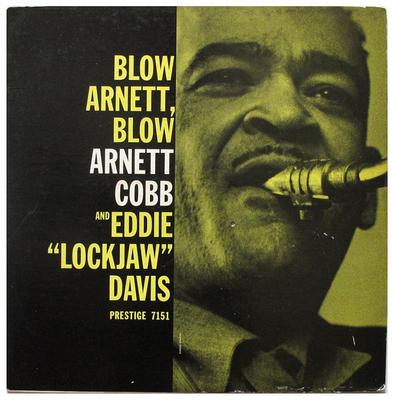
This album has Go Power, and it would be rereleased as Go Power, but the original release is Blow, Arnett, Blow. And good on Bob Weinstock, who was adding Arnett Cobb, who'd been more or less forgotten by 1959, to one of the hot new stars of his label, but gave Cobb the lead billing.

Order Listening to Prestige Vol 2 


Listening to Prestige Vol. 2, 1954-1956 is here! You can order your signed copy or copies through the link above.


Tad Richards will strike a nerve with all of us who were privileged to have lived thru the beginnings of bebop, and with those who have since fallen under the spell of this American phenomenon…a one-of-a-kind reference book, that will surely take its place in the history of this music.

                                                                                                                                                --Dave Grusin

An important reference book of all the Prestige recordings during the time period. Furthermore, Each song chosen is a brilliant representation of the artist which leaves the listener free to explore further. The stories behind the making of each track are incredibly informative and give a glimpse deeper into the artists at work.
                                                                                                                --Murali Coryell


Tuesday, December 26, 2017

Wrapping up 1958 -- Part 3


Here’s my annual dip into the top albums of 1958 as seen from a contemporary vantage point, voted on by the participants in the rateyourmusic.com website’s poll. This is a snapshot of a moment in time,because the voting is ongoing, and albums may slip up and down in the ratings,although the ones on top have enough votes to be fairly securely ensconced John Coltrane has over 6000 ratings as of this entry, Cannonball Adderley over 3000.

Rateyourmusic uses some sort of algorithm based on the total number of ratings, and the value (1-5 stars) of each rating. What it is, I couldn’t begin to guess,and I really don’t want to know. It’s enough that this quirky, idiosyncratic, but exhaustive list (500+ albums in all) exists.This is very much the year of the independent jazz label, and specifically, very much the year of Blue Note and Verve.
I’ve only included the jazz albums, but every year those make up the bulk of the list, as jazz fanciers seem to gravitate here.
1.      Blue Train, John Coltrane (Blue Note)
With all the albums Trane made for Prestige in 1958, this is the one that has endured as the classic of that era in his career. That it, and not any of the 1958 Prestige recordings is so dominantly atop the RYM hit parade is partly due to the fact that Prestige didn’t release any of those sessions in 1958, largely due to the presence Miles Davis on this one, the only time the Dark Prince appeared on a Coltrane session.

2.      Somethin' Else, Cannonball Adderley (Blue Note)
Blue Train grew in popularity over the years. Somethin’ Else started hot and has stayed hot. Also with Miles.

Cannon’s only album on Blue Note.

3.      Ascenseur pour l'échafaud, Miles Davis (Fontana)
Completely improvised to a screening of the Louis Malle film, with Miles and a French quartet includingtenor saxophonist Barney Wilen and expatriate Kenny Clarke. This was a cult rather and mainstream favorite when  released, partly because it was on an obscure European label and hard to find (Fontana would become better known in 1960s as the label of several British Invasion groups). The RYM voters clearly include a serious cult coterie.
6.    A Night at the Village Vanguard, Sonny Rollins (Blue Note)

7.    Milestones, Miles Davis (Columbia)

8.   Misterioso, Thelonious Monk Quartet (Riverside)

9.   Cool Struttin', Sonny Clark (Blue Note)
Sonny Clark has definitely had a renaissance since 1958, and not because he stayed around long enough to reap late career recognition, like Marian McPartland. He died young, in 1963.

He doesn’t even make the list of top 30 piano players in the Down Beat poll, and the 30th name (Ellis Larkins) gets only 18 votes. Clark was on a number of Blue Note albums during the late 1950s and early 1960s, and had several releases as leader. Cool Struttin’ features Art Farmer, Jackie McLean, Paul Chambers and Philly JoeJones. Clark’s presence three times in the top forty is a tribute to his music, to the searching and eclectic tastes of RYM listeners, and to the fact they’re not perfect. Sonny Clark Trio was actually not released until 1960.
Contemporary musician John Zorn has recorded an album of Clark’s compositions.
10.  Lady in Satin, Billie Holiday with Ray Ellis and His Orchestra (Columbia)
Pretty near the end for Lady Day. This is the album where her voice was a scratchy remnant, all the more raw andpainful for the lush string arrangements. But the emotional depth was still
there, and that makes it, for some, a favorite album. She would be dead a year later.

11.   Little Richard  (Specialty)    
Using my definition of a jazz singer as someone who can sing with jazz musicians and keep up, Little Richard here keeps up with some of the finest musicians in New Orleans, and if keeping up with the finest musicians in New Orleans isn’t credential enough for a jazz
singer, I don’t know what is. I’m talking about the tenormen Alvin “Red” Tyler and Herbert Hardesty, and especially drum innovator Earl Palmer. If Frank Sinatra, singing with Nelson Riddle’s lush orchestral accompaniment, is a jazz singer (and he is), Little Richard is a jazz singer. And rhythm and blues is jazz.

12.  Frank Sinatra Sings for Only the Lonely (Capitol)
See above.         

13.   Relaxin' With the Miles Davis Quintet (Prestige)       

14.  Thelonious in Action, Thelonious Monk Quartet (Riverside)
A busy year for Monk, and a rewarding year for his fans, who have grown legion over time. This one was recorded live at the Five Spot, the best place to hear Monk live back in the day, with Johnny Griffin on tenor.

16. Songs for Distingué Lovers, Billie Holiday (Verve)
Again, that voice at the end of its tether, this time with some great and deeply simpatico musicians: Harry Edison, Ben Webster, Jimmy Rowles, Barney Kessel.
                                                                                                                                                                                                                     
17. For Musicians Only,Stan Getz, Dizzy Gillespie & Sonny Stitt (Verve)
I had not heard of this album, but the lineup was so intriguing I had to find it and listen to it. Not surprising it’s from Verve: this is the kind of all-star blowing session that probably no one but Norman Granz could pull together. It’s very much a Gillespie session,with two giants of jazz taking their cues from the master.

I thought I’d read this in Geoff Dyer’s But Beautiful, but I can't find it there, so it’s either an original thought (unlikely) or I owe it to someone else. Aficionados of other human enterprises can exercise their imaginations, thinking of what ifs: What about an outfield of Willie Mays, Babe Ruth and Ichiro? What if Beethoven could conduct Yo Yo Ma in the cello and piano sonatas?

In jazz, we don’t have to wonder. What if Louis Armstrong and Dizzy Gillespie were to play together? They did, even after Louis trashed beboppers in his parody of the Whiffenpoof Song. What would it have been like if you could have put Satch together with Ella Fitzgerald? We know, don’t we? Lionel Hampton and Stan Getz? Lester Young and Charlie Parker?
We have Norman Granz to thank for that last pairing, in his Jazz at the Philharmonic. And thanks for this one, too, Norman.

18. But Not for Me: Ahmad Jamal Trio at the Pershing (Argo)
Always a huge popular success, gradually a critical success with a strong boost from Miles Davis. Jamal and his trio were the house band at the Pershing Hotel in Chicago, and they recorded for Argo, the jazz subsidiary of the Chicago label Chess Records.

21. The Cooker, Lee Morgan (Blue Note)
Lee Morgan was 19, and had already recorded six albums, and had appeared on John Coltrane’s Blue Train just two weeks before.

22. Soulville, The Ben Webster Quintet (Verve)
You know, even before looking it up, that this has to be a Verve session. Again, another what if? made real through the magic of jazz. Webster with Oscar Peterson, Herb Ellis, Ray Brown and Stan Levey. One of my most treasured vinyl albums is a 1972 BenWebster recording with Tete Montoliu, Did You Call?  Which is another one of those only-in-jazz pairings, across styles and generations and continents.

Webster would die in 1973.

23. Ella Fitzgerald Sings the Irving Berlin Song Book (Verve)

24. Sonny Clark Trio (Blue Note)

26. Basie, Count Basie and His Orchestra + Neal Hefti Arrangements (Roulette)

27. Time Waits: The Amazing Bud Powell, Vol. 4 (Blue Note)
A couple of notes here. First, on the interesting and inscrutable RYM algorithm. Powell beats out Basie on the star-rating average, 3.88 to 3.79, but Basie has over 1000 ratings, Powell under 150. So by next week, these positions could be reversed, or Powell could be somewhere completely different. That’s interesting for a number of different reasons, principal among them that none of this matters. Count Basie had the 26th best album of 1958, and Bud Powell had the 27th best—as of the end of 2017? But by the beginning of 2018 that could change? Of course not. It means that in 2017 and 2018, people are still listening to these great jazz masters. And that a newer fan, running across this list, might go out and listen to both of them.
Also of interest. By 1958, Powell was already, in the eyes of most in the jazz world, in the grip of an irreversible decline. Contemporary Down Beat voters don’t vote him into the top ten, although he was still working and still recording. But looking back through the prism of time, just as listeners are still finding value in late Billie Holiday, they’re finding value in late Bud Powell. And not undeserved.

28. Newport 1958, Mahalia Jackson (Columbia)
No one really knew what to do with Mahalia Jackson back in1958. Everyone thought she would have been a great jazz singer, or a great blues singer, or even a great pop singer, but she would not sing anything except gospel, with anything except gospel instrumentation and arrangements. So she’s voted in on the strength of the awe she was held in, deservedly, in spite of the fact that she did not sing with jazz musicians. And other singers who did sing with jazz musicians don’t make the cut. Like Ruth Brown or LaVern Baker. Or lesser known fine singers like Varetta Dillard or Faye Adams. Because they were rhythm and blues singers, and everyone knows that’s not jazz.
29. Ray Charles at Newport (Atlantic)
If Ray Charles didn't sufficiently blur the lines between what people called jazz and what people called rhythm and blues, no wonder it was considered a hopeless cause, if anyone even bothered to call it a cause at all.

30. The Art Tatum - Ben Webster Quartet (Verve)

32. Volume IV, The Ahmad Jamal Trio (Argo)
33. A Night in Tunisia, Art Blakey's Jazz Messengers (RCA)
This was released on both the RCA Victor subsidiary Vik and on RCA. Blakey recorded for everyone, indie and major alike. In 1957-58 alone, he had recording sessions for Columbia, Blue Note (4 sessions), Elektra, Vik (2), RCA Bluebird (2), Cadet, Jubilee, Atlantic, Bethlehem, and the European labels Calliope, Jazzband, Fontana (3), Solar, and French RCA. And that doesn't count the recording sessions with Milt Jackson, Hank Mobley (2), Jimmy Smith (6), Clifford Jordan/John Gilmore,Johnny Griffin, Sonny Rollins, Thelonious Monk (2), Cannonball Adderley (2), Tina Brooks, Gil Evans (3), and Kenny Burrell.
35. LaVern Baker Sings Bessie Smith (Atlantic)
The jazz establishment may not have recognized that LaVern Baker and Ruth Brown were jazz singers, but they surely did, and the Ertegun brothers of Atlantic Records surely did. Here are the musicians with Baker for this session: Buck Clayton trumpet), Jimmy Cleveland, Urbie Green, Vic Dickenson (trombone),  Paul Quinichette (tenor sax), Jerome Richardson, Sahib Shihab (baritone sax), Danny Barker (guitar), Nat Pierce (piano), Wendell Marshall (bass), Joe Marshall (drums), arrangements by Ernie Wilkins, Nat Pierce, Phil Moore.

36. I'm Jimmy Reed (VeeJay)
Robert Frost wrote that
 ...though there is no fixed line between wrong and right,
There are roughly zones whose laws must be obeyed. 
And we're pretty much stuck with that truth. The horn-based rhythm and blues of the two coasts, coming from Memphis and the urban centers of the South, is jazz, the guitar-based blues of Chicago and Detroit, coming from the Delta, isn't. So Jimmy Reed is really on the outside of this list. But there is a larger zone: the Great American Century in music, all of it with its roots in the blues. And if establishment America owes reparations to the black community for anything, surely it starts here.
 
37. Sonny's Crib, Sonny Clark (Blue Note)

38. Duets, Dizzy Gillespie with Sonny Rollins and Sonny Stitt (Verve)
Another fascinating and new to me collaboration between Dizzy and some of the finest jazz players around. But there is probably no year across five decades that would not find Dizzy Gillespie at the center of some of the most interesting music being made.

39. Art Blakey's Jazz Messengers with Thelonious Monk (Atlantic)

40. The Congregation, Johnny Griffin (Blue Note)

There you have it. A pretty good cross section of the jazz that was being played and recorded in 1958. RYM's list is 500 deep, and leafing through it is a guide to the Big Picture. 

Other musicians whose output got mention: Gerry Mulligan, Louis Smith, Max Roach, Ornette Coleman,  Duke Ellington, Louis Armstrong, Cal Tjader, Red Garland, Nat "King" Cole, Benny Carter, Hampton Hawes, Barney Kessel, Shelly Manne, Red Mitchell, J. J. Johnson, Dave Brubeck, Gene Ammons, Clark Terry, Blossom Dearie, Chet Baker, Julie London, Horace Silver, Sam Cooke, Lambert, Hendricks and Ross, Little Willie John, Sarah Vaughan, Dorothy Ashby, Tito Puente, Anita O'Day, Lou Donaldson, Blue Mitchell, Charles Mingus, Johnny Hodges, Yusef Lateef, King Pleasure, Modern Jazz Quartet, Allen Toussaint, Chris Connor, Barney Wilen, Steve Lacy, Peggy Lee, Jackie Wllson, Kenny Drew, Coleman Hawkins, Paul Gonsalves, Dinah Washington, Perez Prado, Wynton Kelly, Jimmy Giuffre, Mal Waldron, Harold Land Bob Cooper, Jimmy Raney, Machito, Bennie Green, Sabu, Eddie Costa, Fats Domino, Mose Allison, Benny Golson, Pepper Adams, Louis Prima, Roy Eldridge, Harry Edison, Anne Phillips, Dexter Gordon, Stephane Grappelli, Eddie "Lockjaw" Davis, Beverley Kenney, Harry Belafonte, Frank Rosolino, Tiny Grimes, Erroll Garner, Jack Costanzo, Kenny Dorham, Abbey Lincoln, Donald Byrd, Dakota Staton, Peggy Lee, Philly Joe Jones, Kenneth Patchen, Mel Torme, Leroy Vinnegar, Wilbur Harden, Marty Paich, Louis Bellson, Gigi Gryce, Nat Adderley, Phineas Newborn, June Christy, Johnny Mandel, Wilbur Ware, Warne Marsh, PeeWee Russell, Herbie Mann, Bobby Jaspar, Laurindo Almeida, Bud Shank, Andre Previn, Sue Raney, Jonah Jones, Conte Candoli, Jean Thielemans, Woody Herman, Curtis Fuller, Al Hirt, Betty Carter, Jeri Southern, Billy Eckstine, John Jenkins, George Wallington, Ernie Henry, Tiny Grimes, J. C. Higginbotham, Lee Allen, Paul Bley, Stan Kenton, the Four Freshmen, Buddy DeFranco, Cootie Williams, Johnny Otis, George Shearing, the Hi-Los, Tal Farlow, Jimmy Rushing, Charlie Mariano, Phil Woods, Rosemary Clooney, Carmen McRae, Ernie Henry, Joe Houston, Charlie Byrd, Terry Gibbs, Candido, Hal McKusick, Ken Nordine, Morgana King, Shorty Rogers. A good year for jazz.

On to 1959!