Tad Richards' odyssey through the catalog of Prestige Records:an unofficial and idiosyncratic history of jazz in the 50s and 60s. With occasional digressions.
The Lionel Hampton gang still in Sweden, still breaking away from Hamp to play some bebop with the Swedes, still giving Gigi Gryce and Quincy Jones to work out the arrangements they want to hear. This time it's Jones, and these are archetypal Quincy Jones arrangements -- full, melodic, adventurous, great ensemble voicings, plenty of room for improvisation.These Swedish sessions are the first recordings of Jones as an arranger, and they really show him already at a peak of form.
Jones doesn't play any trumpet on this set -- I guess if you've got Art Farmer handling that aspect, you don't really need to. Farmer has plenty of room to stretch out here, and he sounds great.
Jones doesn't play any piano, either, but it turns out that's covered very nicely too. Bengt Hallberg never ventured far beyond his native Sweden, but he made a name for himself that stretched far beyond the Scandinavian borders. Miles Davis, in a 1955 Leonard Feather blindfold test for Billboard, was
played one of these tunes, and said,
The piano player gasses me – I don’t know his name. I’ve been trying to find out his name. He’s from Sweden. . . . I think he made those records with Stan, like “Dear Old Stockholm.” I never heard anybody play in a high register like that. So clean, and he swings and plays his own things…
Billy Taylor's long and illustrious career includes a number of trio sessions for Prestige, which were released on 78, on 45 EP (Billy Taylor Trio Vols. 1-4), on 10-inch LP (Billy Taylor Trio Vols. 1-3), on 12-inch LP (Billy Taylor Trio Vols. 1-2), and even on the almost completely forgotten 16 2/3 LP format (Billy Taylor Trio--Let's Get Away From It All). And all of it is pretty close to completely unavailable online, either streaming or download. And it doesn't seem to have been reissued, ether on later Prestige or Fantasy/Prestige or Original Jazz Classics, which is strange considering Dr. Bill's popularity and the fact that P-F/P-OJC left very few stones unturned. What I was able to hear is lush, romantic and thoughtful -- beautiful piano jazz for a Sunday morning by a master.
There were eight songs on this session, which is a lot. Presumably the engineering for a piano trio is relatively simple, and Taylor, May and Smith had played together a lot, so there wouldn't have been much hesitation.
The Modern Jazz Quartet were a fairly rare phenomenon in jazz in the 50s -- a stable group that had a collective name, as opposed to, say the Gene Ammons Septet or the Stan Getz Quartet, which would be Gene or Stan and whoever else was in town for the recording or club date. The musicians had come together as Dizzy Gillespie's rhythm section, and then had become the MJQ -- that is, the Milt Jackson Quartet. As the MJQ1, they were, as far as anyone knew, three guys whom Milt Jackson had gotten together for a gig. As the MJQ2, they were a different entity, but no one knew what. Certainly, no one knew that they would, with one change, be together for the next 40 years, thus becoming not just rare but unique.
So what had Prestige done with them to date?
John Lewis had done a number of sessions for Prestige, starting in 1949 with J. J. Johnson's
Boppers, when he was 29 and already a veteran of the New York jazz world, from his days newly out of the army with Dizzy Gillespie through his work as one of the major contributors to the Miles Davis nonet. He worked with Zoot Sims, with Miles and Sonny. And even after the first MJQ session--it was pretty clear how good these tunes were, and it had always been clear how good these musicians were, but there was no hint that they were to become. probably rivaled only by the Dave Brubeck Quartet, the most legendary sustained unit in the history of jazz. Yes, there have been other legendary units, like the Miles Davis quintet of the 50s, but that group was only a small part of Miles's career, and only a small part of Coltrane's. So they went on working. Lewis and Kenny Clarke worked on one Prestige recording date with Miles, Lewis and Percy Heath on another. Heath also played on the Miles and Bird (Charlie Chan) session. And they did sound good together, no doubt about it. The three of them were brought in to back up King Pleasure and the Dave Lambert Singers, and the quartet was brought in for a session with Sonny Rollins, and although Rollins was the featured performer on the gig, the Modern Jazz Quartet was credited as such. This would change, a few years later, when Atlantic would bring out The Modern Jazz Quartet at Music Inn, Vol 2 -- guest artist, Sonny Rollins.
The Atlantic album has been in my collection since the 50s, but I'd never heard this earlier collaboration before. It's a fascinating one. This is definitely a Sonny Rollins session, but it's definitely MJQ, too. This is probably the first time all four of them had worked as the MJQ with another artist, and it's an experiment worth listening to.These guys knew how to play together as a rhythm section, and they show that here. But they also knew who they were, and they show that here, too. And all five of
them make a pretty convincing argument that bebop is not dead.
They would go on to make enough tunes for Prestige to fill two 12-inch albums which are no strangers to Greatest Jazz Albums of All Time lists. But before they were legends, they were working musicians playing the gigs that they got -- sort of unlike the Brubeck Quartet, who pretty much made it clear that they were legends to begin with. And working musicians like these are always worth listening to.
These came out on 78, 45, EP, 10-inch and ultimately 12-inch LP.
Does it seem that every time Bob Weinstock decides to make a record with King Pleasure, he gets it all wrong, and yet it comes out so right?
In earlier sessions, he seems to have thought of Pleasure as a rhythm and blues singer. He's tossed him into recording sessions with other R&B singers, and given him R&B musicians, and come up with one of the most enduring and beloved classics of jazz vocal music, in "Moody's Mood For Love."
The success of "Moody's Mood" didn't give him the idea that he should put Pleasure in with some of the A-list jazz musicians he'd been recording; he did a second session with a rhythm and blues band, on which his tracks were sort of a throw-in -- the session was mostly about Charlie Ferguson's band, but they did include two King Pleasure vocals. On one of them, just as they'd tossed in a chick singer to the "Moody's Mood" recording who happened to be Blossom Dearie, they tossed in another chick singer, a girl who was scuffling around New York after being fired by Lionel Hampton for insisting on singing bebop instead of swing. That was Betty Carter, and the tune was "Red Top." And the other throw-in on the Charlie Ferguson session was "Jumpin' With Symphony Sid."
So this time, he brings in the creme de la creme, the A-list of A-lists, three quarters of the Modern Jazz Quartet, but you can't really hear them -- they're not given any solo time. In fact, at least on "Sometimes I'm Happy," King Pleasure takes something of a back seat to the Dave Lambert Singers.
Dave Lambert, in 1953, was 36 years old and a veteran of the music business. He was a singer and vocal arranger who seemed more at home in a group setting, although he was a pioneer of the bebop scat style that King Pleasure, Eddie Jefferson, Jackie Paris and others were to bring to fruition as solo artists, and that Lambert was ultimately to find the best expression of when he teamed with John Hendricks and then Annie Ross. He had made what many consider the first bebop vocal recording with Gene Krupa's band, as a duet with Buddy Stewart.
In September of 1953, he was coming off what was generally acknowledged to be a failure: Charlie Parker with Voices. This was the followup to the successful and popular "Charlie Parker with Strings," and it featured an orchestra under Gil Evans' direction, and a 12-voice group of Dave Lambert Singers. Marc Myers interviewed Hal McCusick, who played on the session, about what went wrong:
The voice parts were way too complicated. Gil’s charts were beautiful and complex, as always. His arrangements always could push your buttons, musically. But Dave’s vocal charts were heavy, and by the time everyone realized this, it was too late. The recording session was already underway.
JW: Was Dave aware of that?
HM: I'm sure he was. But in all fairness to Dave, he was in over his head. First, there were too many singers. Dave could have accomplished the same goal with better results if he had used four. All of us in the woodwind section knew it at the time. Second, Dave wasn’t skilled enough as an arranger to write for so many singers. What's more, the singers weren’t polished enough as a group to pull off what Dave had in mind and had written.
This may be a little rough on Lambert, and on the session. You can hear it on YouTube and decide for yourself, but you can understand what McKusick means. He goes on to say that
Dave was terrific when singing take-offs on jazz instrumentals and writing for small-group things. But to write structured charts for so many singers behind arrangements by a guy like Gil Evans requires enormous skill. When you're writing for 10 or 12 singers, you have no choice but to double up voicings. This means two or more vocalists need to sing the same notes. It’s the only way a vocal group can be heard clearly.
But doubling up parts means greater room for intonation error, since you’re more likely to hear somebody wavering off the written notes. When a voice wavers, it throws everyone else off, or the producer catches it and calls for another take. It’s like two people walking a tightrope out of synch. Someone’s more likely to fall. That happened quite a bit that day. The vocal charts were too hard to sing. The result was false starts and re-takes.
Lambert had cut down his ensemble by September. He hasn't found the magic he would capture with LHR -- his arrangements here are more reminiscent of a group like the Four Freshmen -- but he provides a nice group sound for Pleasure to wing it from.
This session didn't provide classics like "Moody's Mood" or "Symphony Sid" or the later "Parker's Mood," but they're still good, and I love Pleasure's solo on "Sometimes I'm Happy." I don't know whose instrumental solos he's basing these on.
And again, speaking of Weinstock's mistakes in recording King Pleasure that turned out to be not so mistaken, why only two songs per session? In 1951 and 1952, no one was thinking about LPs, but a recording session was still generally four songs, so you could put out two 78s. But by 1953, the 10-inch LPs and the 45 RPM EPs were common. The upshot of it was, when it came time to put his vocalese stars on a 12-inch LP, he had not enough songs from Pleasure and even fewer from Annie Ross, so he had to put them together on one disc. And the result? King Pleasure Sings/Annie Ross Sings is one of the absolute treasures of the LP era. You couldn't ask for better.
These two songs came out on both 78 and 45, on an EP with "Red Top," and on a 10-inch LP in 1954.
This is only on the very borderline of qualifying for this blog. Originally a French Vogue recording, it was first released in the US by Blue Note, and only came out on Prestige as one of their 7800 reissue releases in 1971. It was still Bob Weinstock's in 1971, but he was soon to sell to Fantasy, where it would become strictly a reissue label. I haven't been including any of the 7800 reissues, but I'm including this because...well, because by the time I read the small print and realized I shouldn't be including it, I'd already listened to it a couple of times through, and I was hooked.
This is the Hampton touring band, plus a few French musicians, and again it's Gigi Gryce and Quincy Jones taking center stage, as they continue to make their bones as the hot new, young arrangers. Jones is credited as arranger and Gryce as leader. I suspect that being leader, on this session, may have involved more than just standing in front of the bandstand with a baton. It sounds as though some full-scale conducting was needed. This sound is so full, so orchestral, so dynamic. He had begun his studies in classical composition in 1948, and while this is jazz, not some third stream music, it combines the power and sensitivity of classical music with...well, with the power and sensitivity of jazz.
Most of the rereleases, both European and American, have been under Clifford Brown's name, and Brownie is always an important addition to any session he's on, and he has some great solos, but it's Gryce and Jones who make this a singular experience. Shows what a couple of inspired and ambitious young composer/arranger/conductors can do when you give them their head and a 17-piece orchestra. And it's not what these guys were playing with Hampton. These recordings were made "against Hampton's wishes," according to Gryce's web page. There must have been a certain amount of unrest at this point in the tour. Annie Ross was fired, George Wallington either quit or was fired, and the rest of the band was making music that Hamp did not want them to make.
I love Lionel Hampton. I think that as revered as he is as a giant of jazz, he actually doesn't get enough credit for being the true giant he was. But I'm glad Gryce and Jones went against his wishes here.
Was anyone left in New York or LA in the summer of 1953. It seems as though a goodly portion of the talents of both cities had relocated to Sweden, and it also seems that they were all drawn there by Lars Gullin, the only musician all these sessions have in common. Gullin is one of the most highly regarded of European jazz musicians, and another musician whose career was cut short by heroin. Although he lived until 1976, he was almost completely finished as a musician by the end of the 50s.
The first of these sessions, under Gullin's name, was on August 25, the others on a very busy September 15 and 16. Gullin led--I was going to say a mixed group of East and West Coast musicians, but actually most of the individual musicians are mixed groups in themselves. Conte Candoli is pretty solidly identified with the LA scene, and Konitz, through his close association with Lennie Tristano, surely represents New York. Don Bagley is also a through and through West Coaster. But Frank Rosolino was a Midwesterner from the jazz hotbed of Detroit before he found his way to 52nd Street, and from there to the LA jazz and studio world with which he is most closely associated, and Zoot Sims a native Californian whose jazz life was mostly in New York. I would have associated Stan Levey entirely with 52nd Street and the bebop scene, but actually within months of this session he had relocated to California. Perhaps Candoli and Rosolino bent his ear.
Peter Jones, who listened to this with me, through Spotify, from the hinterlands of northern Louisiana, aptly described this session as "sounds midway between Birth of the Cool and Oliver Nelson," which I thought captured it pretty well.
Most of these musicians had big band experience, and specifically, most of them had played with Stan Kenton, and I think a lot of them may have been on a European tour with Kenton in August of 1953. I know that the September sessions featured musicians from Lionel Hampton's touring band - Hampton didn't pay all that much, and his sidemen had to pick up extra work where they could. Checking further -- they all were on Kenton's tour.
So you have a bunch of musicians who've been playing Kenton arrangements, and they take a day off and go to dear old Stockholm -- well, they're probably in Stockholm already -- to make a record with a talented instrumentalist whose life had been changed in 1949 when he first heard the 78s of the nonet sessions and was so powerfully influenced by Gerry Mulligan that
he took up the baritone saxophone, then changed again in 1951 by meeting
Lee Konitz -- which is, in a way, more of the same change. So what
would the Mulligan arrangements for Birth of the Cool sound like if they were played by the Kenton orchestra? And isn't that one of the things we love about jazz...about American music? It's so cross-pollinated. Musicians talk to each other, dance with each other, copulate with each other in combinations that would make a swingers' club pale with envy. And it keeps coming up new.
So all of the musicians from the August session were from the Kenton band. And were all of the September musicians from the Hampton orchestra? It turns out yes -- including Annie Ross. Who knew that she had toured with Hampton? Thanks to Mario Schneeburger, we have the complete personnel of the band, and its complete itinerary. I'll give an excerpt:
1953/09/05
Arrival at Fornebu Airport after flight from NYC with SAS.
These musicians are willing to undertake the adventure of a tour across a foreign continent: Lionel Hampton(ld,vb,p,dr,vcl), Walter Williams(tp), Art Farmer(tp), Quincy Jones(tp), Clifford Brown(tp), Al Hayse(tb), Jimmy Cleveland(tb), George "Buster" Cooper(tb), Gigi Gryce(as), Anthony Ortega(as,fl), Clifford Solomon(ts), Clifford Scott(ts), Oscar Estelle(bs), George Wallington(p), Billy Mackel(g), Monk Montgomery(b), Alan Dawson(dr), Curley Hamner(dr,dancing,vcl), Annie Ross(vcl), Sonny Parker(vcl,dancing). Gladys Hampton, Lionel's wife and band manager, is with them.
New to the band are Clifford Brown replacing Eddie Mullens, Gigi Gryce replacing Bobby Plater, George Wallington replacing Elmer Gill, and Annie Ross.
All of them except for Annie Ross and George Wallington stay in the band until the end of the tour.
The tour is originally planned to last six weeks. Its success leads to a substantial expansion. Lionel Hampton recalls in 1954: "We went over in September for six weeks and we stayed 12."
...
1953/09/07
The band arrives in Stockholm "..directly after successful concert in Oslo", Orkester Journalen.
At Stockholm main station the band is bid welcome by Simon Brehm's band. A press conference is held.
A welcome party takes place at Hotel Malmen. Hampton and Wallington play a piano duet, Annie Ross sings "Twisted", band members and local musicians jam together. Later on they move to 'Bal Palais' where the party continues until dawn.
[From Sept 8-13: concerts in Helsinki, Finland, then in Sweden's Falun, Hofors, Uppsala,Västerås, Linköping, Norrköping, Örebro, Eskilstuna, so if anyone ever tries to sucker you into a bar bet that no jazz great has ever played Linköping and Norrköping on the same day, don't take it. And finally back to Stockholm, for a]
concert at Konserthuset, starting at 21:15. The concert is recorded and partly issued. The Tom Lord discography
gives a wrong date: 1953/09/15. Most other sources give only vague dates such as fall, Sept., Oct.
Some days earlier, between September 9 and 12, Lionel Hampton and George Wallington are interviewed at the
Swedish radio. In the studio they play a fine How High The Moon at the piano with four hands. Hampton says twice
to the radio reporter: "See you on Monday". Coming Monday is September 14. The radio obviously plans to record
the concert of September 14 in Stockholm.
Recording session in Sweden: Annie Ross and George Wallington (2 titles each).
1953/09/15,
Gothenburg. Concert at the Concert Hall.
After the concert a jam session takes place at Lorensberg restaurant. Among the participants are Anthony Ortega,
Clifford Brown, George Wallington and Jimmy Cleveland with pianist Bengt Hallberg, drummers Kenneth Fagerlund
and Arne Milefors among the "locals".
"One night we had a recording session [in fact it was a jam session] after the concert in Gothenburg (Sweden).
Brownie and Bengt Hallberg played 'Yesterdays' as if the tune would become, by some way, forbidden to be played
anymore", remembers Art Farmer.
Clifford Brown, Art Farmer and Quincy Jones find the time for a recording session in Stockholm with Bengt Hallberg
and other Swedish musicians. This session probably takes place in the morning or early afternoon, before the
band's departure from Stockholm to Gothenburg.
Recording session in Stockholm on 1953/09/15: Clifford Brown-Art Farmer (4 titles with
alternate takes)
Yes, I know I have a tendency to go way, way off on tangents sometimes, but I wouldn't be doing this blog at all if I weren't a little too much in love with jazz history. Anyway, the tour continues. More
highlights include two concerts on the same evening in the Netherlands, fortunately a small country, the first one in Scheveningen at 8 pm, the second in Amsterdam, a "concert at Concertgebouw, starting at 24:00. Hampton is suffering from fever. Nevertheless '..Hampton began to dance with a girl in the audience, and the rest of the hall took up the dance till the whole Concertgebouw seemed to be jumping.'" And trouble the next day in Brussels, at a
concert at Palais des Beaux Arts. It is Annie Ross' last appearance with the band.
“Annie
Ross is fired by Hamp in Brussels after a few unruly
hecklers had booed her performance there”, says George Wallington.
On the same day or thereafter George Wallington quits the band, either
as a gesture of sympathy for Annie Ross, or because he is fired as well.
Anyway, back to the Stockholm recording sessions. Annie does the Kern/Hammerstein standard (her version omitted from the Wiki discography for this song; I added it), and "Jackie," another from the Wardell Gray/Art Farmer sessions that yielded "Twisted" and "Farmer's Market," this one a Hampton Hawes composition that Annie turns into a history of bebop. Here's Billboard's review:
Jackie: The hip cats should flip for this cool item. The gal delivers a fast-talking story about a wild mouse on her blouse. It's fine for kicks.
The Song is You: Here Miss Ross, a hip singer, tackles the standard for a reading which the jazz collectors should go for to some extent. She's much better, tho, in handling the [unintelligible] stuff.
The Billboard reviewer isn't entirely wrong. Annie is great on standards, but her vocalese is in a class by itself.
Ross appears with her soon-to-be-ex-bandmates from the Hampton orchestra; Wallington is with a group of Swedish musicians. It's a testament to the growing importance of both Quincy Jones and Gigi Gryce as arrangers that they're credited on these sessions. And although Jones was the one who went on to a megastar career, Gryce more than once arranges sessions on which Jones plays piano.
The piece de resistance, however, of this fine group of Swedish sessions, is the Clifford Brown/Art Farmer set. Both in amazing form, each spurring the other on.
All these were originally issued on the Swedish Metronome label; most also came out on the British Esquire label. Prestige put the Lars/American All-Stars on an EP, Americans in Sweden, as Zoot Sims/Lars Gullin/Kenton All-Stars, along with an earlier Zoot/Lars session from 1950.
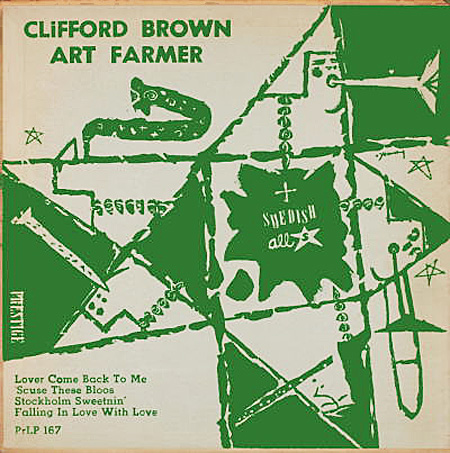
The two Annie Ross songs came out on a Prestige 78. The Wallington session was an EP, George Wallington And The Swedish All Stars. Clifford Brown and Art Farmer seem to have been on EP, were definitely on a 10-inch LP with cover art that's credited to David X. Young, although it doesn't look like his work. It's certainly not his best work.
I continue to wonder what was the master plan involved in sending Teddy Charles out to be Prestige's West Coast representative. Was it to find out what the evolving West Coast sound was all about, and tap into it for Prestige? Or was it to find a new group of musicians to plug into the evolving Teddy Charles sound? If the former, he might not have been the best choice. (Certainly not the worst choice. That honor goes hands down to Art Rupe of Specialty Records, who, when he lost Bumps Blackwell, who had brought him Little Richard, Lloyd Price, Larry Williams, etc,, chose as his new New Orleans talent scout and A&R man...Sonny Bono?) My guess, it was a little of the former (in Bob Weinstock's mind) and a little of the latter (in Teddy Charles's mind). Anyway, Charles didn't come back with the next Brubeck or Mulligan/Baker, but he came back with some remarkable music.
And wondering leads to Google, and Google led me to this interview with Charles, which I had not seen before, where he talks about his West Coast sojourn:
One day in late 1952 or early 1953, after I had recorded those New Directions dates, he asked if I wanted to move to the West Coast to be the A&R director out there. The West Coast was a completely new scene for East Coast labels. They didn't quite get what was happening there, but they knew they had to be in on it.
"The first thing Bob wanted me to do was record Wardell Gray, which I did. Wardell was the hot guy out there. He and I had played together in Benny Goodman's group in the late 19940s. Bob had wanted me to put together a couple of sessions and record standards. But I had other things in mind. I wanted to put different musicians in challenging musical situations to see what came of it.
You don't have to have read too many of my blog entries to know that in my opinion, bringing Wardell Gray into any project is bound to be a good idea. I've written about that session. Listening to it, and especially listening to this session, I also couldn't help wondering whether Charles completely bought into Weinstock's "get together and jam" philosophy. Well, no. There was only one Bob Weinstock, and he made it work. He had a fan's enthusiasm, and it carried over into the making of some of the greatest jazz records ever made, so you'll never hear me knocking his philosophy. But it was a fan's philosophy; a musician's is bound to be different. So from the same interview, here's Teddy Charles talking about rehearsal, and also about tapping into the emerging West Coast sound:
In most cases, I’d get guys together and we’d run through the material I wrote. If it worked, we’d go into the studio. Or we’d have a date set, and we’d be in my apartment rehearsing. I also played quite a bit at the Lighthouse down at Hermosa Beach.
When I got out on the West Coast, I didn’t want to do the West Coast cool jazz thing that was so popular then. Frankly I didn’t care for the West Coast style of playing. The music was too laid back and didn’t have the sound. Not enough urgency. Instead, I brought an East Coast sound I was experimenting with out there, and I used West Coast guys to play it.
This interview was conducted by Marc Myers for his JazzWax blog. He's one of the great interviewers, so I strongly recommend reading the whole thing...and his blog is a treasure. Charles told Myers about one session he tried to put together with Stan Getz, Chet Baker and Al Haig, which ultimately had to be abandoned, as he discovered that not all great musicians had a feel for what he wanted to do -- "Stan could play anything, of course, [but] the music wasn't happening and felt forced."
I would have thought Shorty Rogers an odd choice for a Teddy Charles session. I wasn't that familiar with his work, and thought of him as a typical West Coaster, with an ear toward the pop market. I'd heard his album of jazz takes on contemporary pop songs, Chances Are It Swings, and I knew he'd done some Hollywood stuff, like The Man With the Golden Arm. I hadn't realized he had such an interest in experimental music. When you look at some of his credits, you can see why Charles gravitated toward him. From Wikipedia:
In the 1950s, when Igor Stravinsky began experimenting with dodecaphony, one of the twelve-tone techniques originally devised by Arnold Schoenberg, Stravinsky was very impressed with Rogers's playing, which, as Robert Craft reports in his book Conversations with Stravinsky, influenced the composer's 1958 choral work Threni.
Rogers is the sole horn on the first four tracks, from the August 21 session, and he works well with Charles, understanding and developing his ideas. I think the group is even better when Jimmy Giuffre joins them on August 31 -- of course, this is also ten more days of rehearsal.
Shelley Manne was one of the most ubiquitous, and one of the most commercially successful musicians on the West Coast. His albums like My Fair Lady Loves Jazz, with Andre Previn, showed that you could satisfy the demands of art and the market at the same time. But did his comfort level stretch far enough to accomodate the seriously experimental sounds of Teddy Charles?
Oh, god, yes. Rogers and Giuffre work beautifully with Charles, but Manne does more. He brings ideas that take Charles to a new level. As I listened to these sides over a number of times, which is what I do in writing one of these entries, I found myself more and more looking forward to "what's Shelly going to do next?" Give a listen and see what I mean.
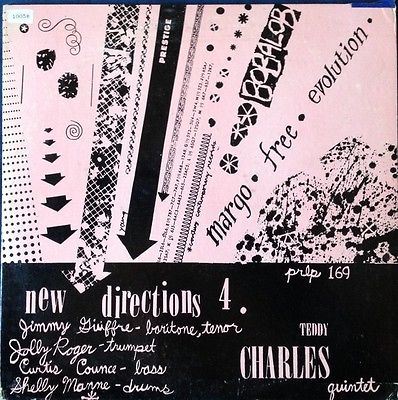
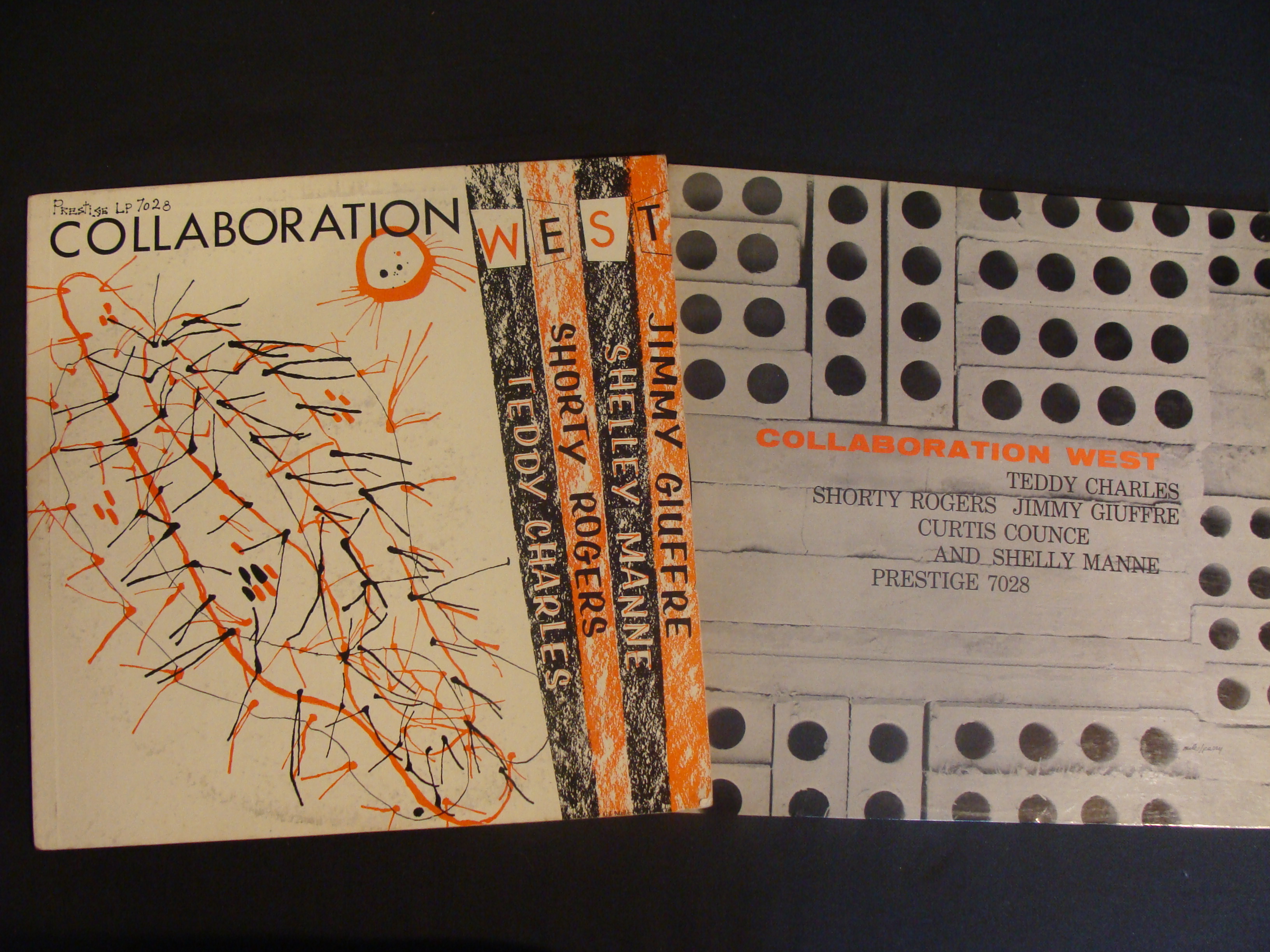
These came out on two 10-inchers, New Directions 3 and 4, and again in 1956, when Prestige had moved to the 12-inch LP standard, as Collaboration West - Teddy Charles/Shorty Rogers.
A septet is an interesting alignment, not quite a big band, but big enough that it's not just two guys and a rhythm section. Even three guys and a rhythm section is still a small combo, but with a septet it's probably a good idea to have charts and an arranger, and this septet had two, by the time it was finished. The 12-inch, 7000-series LP that contains the tunes from this session is called The Art Farmer Septet Plays the Arrangements of Quincy Jones and Gigi Gryce (on the front. On the back it's "Compositions and Arrangements of...) This session seems to be the Quincy Jones, half. The composer credits are Jones and Farmer on three of the songs. The fourth, "Up In Quincy's Room," one might well expect to have been written by Jones, but in fact it was written by Gryce.
Quincy Jones was 20 years old in 1953, and he had been touring with the Lionel Hampton Orchestra, that cradle for so many great jazzmen. He had shown promise as an arranger very young, and had done some arranging for Hampton. I'm trying to figure out if this was his first recording session, both as performer and arranger, and I think it may be.
Art Farmer was only 25, and this was his first session as a leader, and his first session in New York -- his breakthrough had been his West Coast recording with Wardell Gray the previous year. So these were young musicians, guys who had not been around for the birth of bebop, certainly not for the big band era. Jones had played with Hampton; Farmer had had an unsuccessful audition for Dizzy Gillespie's band in 1948, and had played briefly with Jay McShann, before joining the Hampton tour where he met Jones and Monk Montgomery; but basically these were the jazz generation of the 1950s.
Jones, of course, would follow a career trajectory that would take him beyond jazz...if one wants to look at it that way. I don't see jazz as a barrier to creativity that has to be broken through. It was what Jones wanted to do, and he probably wanted to do it from a pretty young age. His first album as a leader, in 1956, was called This is How I Feel About Jazz, which sort of implies "now I've got that out of the way, I'm going to on and tell you how I feel about other things."
It's easy to knock Quincy Jones. Sold out to money and movies and Michael Jackson. One could say of him, in the words of Michael S. Harper's poem,
A friend told me
he'd risen above jazz.
I leave him there.
But he went in the direction, or directions, that his restless talents took him. And his contribution to jazz was real, and significant. His contribution, at age twenty, to his first recording session is pretty damn significant, just as young Art Farmer's was to Wardell Gray, on his first recording session. He's not rising above jazz, whatever that means, in these tunes. He's creating a rich and exciting texture that makes full use of the seven piece band, and makes space for some amazing solos by Farmer.
The only musician over 30 on this date was Monk Montgomery, but he was really just getting started in music. His first professional gig, also with Lionel Hampton, came at age 30. Montgomery was a pioneer of the Fender electric bass, and this session may have been the first use of Fender bass in a jazz recording. "Mau Mau" has some powerful electric bass in the intro, as well as some percussion that seems to be uncredited.
Oh, and I have made a contribution, in a small way, to Oklahoma jazz history. The Oscar Estell page on the Oklahoma Jazz Hall of Fame website says that Estell's only recording session was this one with Art Farmer. I wrote and told them that he had also recorded with Tadd Dameron, and if anyone is actively maintaining the site, hopefully that will be updated.
"Mau Mau" was released as two sides of a 78. "Mau Mau" and "Work of Art" on an EP, and the whole session on a 10-inch LP entitled Work of Art. The later 12-inch release, combined with the Gryce sessions, is described above.
The farther away from New York City (with the exception of LA), the less likely for a Prestige recording to survive the test of time, unless you're James Moody and you happen to have stopped in a recording studio in Sweden to try out an unfamiliar alto sax on a little ditty called "I'm in the Mood for Love." But Charlie Mariano and Al Vega and the other musicians who recorded "new sounds from Boston" have slipped through the reissue cracks, and so have the musicians who called themselves, perhaps taking a page from the fledgling Modern Jazz Quartet, the Contemporary Jazz Ensemble. Their session, recorded in Rochester, NY, and released on a 10-incher called New Sounds From Rochester With The Contemporary Jazz Ensemble, has disappeared even more completely than the new sounds from Boston. And although it's not as big a town as Boston, Rochester isn't exactly a musical backwater. It's the home of the Eastman School of Music, which presumably was the magnet that drew these musicians together.
Too bad this one has disappeared; I would have liked to have heard it. I knew Ed Summerlin, the tenor player. He made his mark as a composer of jazz liturgical music which was quite beautiful. One winter back in the 1980s, when I was tending bar in Rosendale, NY, Ed and bassist Charlie Knicely asked if they could use our bandstand on Wednesday nights to rehearse some music they were working on. Wednesday nights of a Rosendale winter did not add up to large crowds, but they just wanted the space, and I was privileged to be their audience. The first Wednesday, it might as well have been one of them in Rochester and the other in Sweden--I couldn't imagine they'd ever come together musically. But every week, as I listened, they brought this difficult music closer together, until they were playing as one, and Wednesdays were a delight. Well, all those Wednesdays were a delight. It was a course in music education for me.
I'm particularly sorry not to be able to listen to this, because it represents a snapshot in time of musicians who were to take remarkably divergent paths. Bob Norden, on trumpet here, later on trombone, stayed with music -- he recorded in 1971 as a member of Bobby Bradford's Spontaneous Music Ensemble, described as "a style somewhere between the freewheeling post-bop of Ornette Coleman and the cerebral improvisations of European avant jazz." Alto player Bob Silberstein moved in a less experimental direction -- his resume includes backing Nat King Cole, Johnny Mathis, Frank Sinatra, Sammy Davis Jr., Peggy Lee, Steve Lawrence and Eydie Gorme, Pearl Bailey and Tony Bennett. And he stayed with music, too -- he released his first album under his own name in 2005. Neil Courtney (Courney on this session) went in a third direction, becoming the double bassist for the National Symphony and the Philadelphia Orchestra. and he too had a long and distinguished career in music, retiring from the Philadelphia Orchestra in 2010. There's a wonderful interview with him here. These are the lives of the unsung heroes who are the backbone of the music you love.
Mary Lou Williams made this recording in London with British session musicians who had interesting Trinidadian connections. Ray Dempsey played for many years with Edmundo Ros, and Trinidad-born Rupert Nurse started by playing calypso, learned big-band jazz from a mail-order book on arranging by Glenn Miller, and when Americans came to the island (the sailor boys immortalized in Norman Span's "Brown Skin Girl"), he began playing with them and writing jazz arrangements of calypsos.
These were issued on the British Esquire label, and then picked up by Prestige for inclusion on a ten-incher along with an Al Haig session.
Williams is a jazz legend and a jazz master. She influenced Thelonious Monk, among others (his "Rhythm-a-ning" is essentially a Williams tune). In 1922, at age 15, she started playing with Duke Ellington's early band, the Washingtonians. She learned her trade in the rough and tumble world of the Midwestern territorial bands, and came to Kansas City with Andy Kirk's Twelve Clouds of Joy. Eventually relocating to New York, she became a mentor to a new young group of musicians including Monk and Dizzy Gillespie, becoming known as the "mother of bebop."
And her recorded work is widely available--with, it seems, the exception of this album. I was able to listen to "Melody Maker" and "Musical Express," both of which seem to have been commissioned by the British music magazines of the same names. She's a unique talent, and an influential one -- you can hear how she influenced Monk. On these sessions, if she reminds me of anyone, it's Art Tatum -- the same incredible virtuosity linked to a wonderful ear for melody and unerring swing. It's odd to think of someone as a link between Tatum, widely considered the greatest piano virtuoso in jazz, and Monk, whose genius is not generally associated with virtuosic performance, but amazingly, the link is there.
The Prestige release is called Al Haig / Mary Lou Williams - Piano Moderns.
The 1956 12-inch LP that contained this session, Django, was in my collection and on turntable a lot. I don't remember when I bought it -- certainly not 1956, because I wasn't listening to jazz that early. Probably 1959 or so. By that time, the Django LP had been out long enough to become a classic, and the original releases on 10-inch, 45 and 78 had been out even longer, so I don't know what the first critical reaction was. I'm guessing they hadn't heard anything quite like "The Queen's Fancy" before.
But they had, really. It's still Dizzy Gillespie's rhythm section, guys who'd been around since the birth of bebop, guys who were present at the creation of modern jazz and were playing modern jazz--who had, in fact, even named themselves after modern jazz. And if "The Queen's Fancy" starts out with a fugue that could have been written by Bach, why not? The musical tradition that these great musicians came out of was everything that came before them, the music they were looking to make was everything that lay ahead. Dale Turner, the fictional jazzman played by Dexter Gordon, surprises his French host when he acknowledges his debt to Debussy, but there should be no surprise there, either, any more than a debt to Louis Armstrong, Russian Jewish immigrant composers, or the blues. Duke Ellington was exactly right when he said that there are only two kinds of music, good and bad.
So these beboppers developed something beautiful. Tadd Dameron said it always has to be beautiful, and Lewis, Jackson, Heath and Clarke knew that too. They made beauty out of a fugue, and out of a bebopper's tribute to the hot jazz of the Hot Club of Paris, and out of compositions by Vernon Duke and George Gershwin -- transforming beauty into beauty, which may not sound alchemical, but it surely is.
You take what you know, and take it somewhere new. If you're like John Lewis and his cohorts, you know a lot, and you can see the road ahead with clarity and excitement. I interviewed the poet Billy Collins some years ago, and he described what he did as “a kind of travel writing, a genre in which the poet can take the reader on vicarious trips to places that may be otherwise inaccessible...[I find] a common ground that the reader and I can both stand on...and try to deliver pleasure by taking the reader into a state of suspended animation, where the subject matter is left behind, and other explorations begin." The Modern Jazz Quartet does something very similar, and for that experience to be happening for the reader/listener, it has to be happening for the artist as well, whether that artist be a poet like Collins, a composer like Lewis, a master improviser like Milt Jackson.
This comes from a total involvement with your art. Larry Audette, himself a fine jazzman, told me of a conversation he recently had with Tootie Heath about his brother. Percy, on his deathbed, was still listening to music through headphones. Finally, when it was time, his wife took the headphones off, and he slipped quietly away.
"The Queen's Fancy" and "Autumn in New York" were released as a 45 RPM single. The other two songs weren't, although all were released on 78, in a different configuration -- "The Queen's Fancy" b/w "But Not For Me," and "Delaunay's Dilemma" b/w "Autumn in New York." Odd to think that in 1953 the 78 was still the dominant format, but 78s lasted well into the 50s. According to the Yale Library's guide to music cataloging, the 78 was pretty much phased out by 1955, although there's no exact record of the last 78 to be issued -- in fact, according to Yale, some children's records came out on 78 as late as the 70s. I bought my first record in 1954. I was 14, and it was rock and roll -- "Bazoom," by the Cheers, the first rock and roll hit by Jerry Leiber and Mike Stoller, whose songs I would come to worship with a passion. I think that by the end of that summer, I was buying more 45s than 78s, and by the next year nothing but 45s, so my personal history pretty much tracks the Yale Library, The four songs also came out on a 45RPM EP, which seems to have been a form favored early by Prestige, before they'd really embraced the 45 RPM single. There was a 10-inch LP, and then the classic Django in 1956, and many later repackagings and reissues.
Here we have a powerful ten-piece band, with an all-star amalgam of musicians, but two of them stand out for special mention: Tadd Dameron, who was one of the most influential composer-arrangers of the bebop and hard bop eras, and whose name is legend to other musicians, but who remains a cult figure to the general listening public; and Clifford Brown, whose star blazed brightly for a very short time, bookended by terrible auto accidents, the second of which took his life.
June of 1953 was the time when Brown made his first powerful mark on the jazz recording scene. He had made a few records the year before, some rhythm and blues in Chicago with a group led by Chris Powell (no relation to beboppers Bud and Richie Powell), and a session of bebop standards, including "A Night in Tunisia" and "Donna Lee," recorded live at a club in Philadelphia, where Brown spent some important early years. Because his career was so short, and his recorded output so much less than it might have been, all of his work, including these early sessions, has been reissued. You can find the R&B sides, which are striking, and the Philadelphia club tapes, which are amazing, on a Columbia reissue album called Clifford Brown: The Beginning and the End. Brown was 22 when he made these recordings, which is young, but his career had actually been held back by a debilitating injury suffered in an auto accident in 1950.
He hit the recording studios of New York in June of 1953, with a prodigious series of sessions. On June 9, he recorded with Lou Donaldson, Elmo Hope, Percy Heath and Philly Joe Jones for Blue Note, and two days later he was back in the studio with the Tadd Dameron group. Later in the month, he was back for another Blue Note session with J. J. Johnson, Jimmy Heath, John Lewis, Percy Heath and Kenny Clarke.
Tadd Dameron arranged for arranged for Count Basie, Artie Shaw, Jimmie Lunceford, Dizzy Gillespie, Billy Eckstine, Milt Jackson and Sarah Vaughan, among others, and he composed some of bebop's most enduring standards. He did record several albums as a leader, but they haven't all survived. This one can't be found on Spotify or YouTube with a search under Dameron. Spotify has it as part of a collection called Clifford Brown Memorial.
And Clifford Brown deserves to be remembered as vividly as he is, for a blazing career that lasted only until 1956. But Tadd Dameron deserves to be remembered also, and this session shows why. He knew how to showcase Clifford Brown's amazing talent, but he knew how to write and arrange for a jazz orchestra, too, as well as anyone ever did. Count Basie, similarly, could make a great soloist like Lester Young simultaneously part of and separate from an ensemble.
Bebop was a soloist's art form. Gerry Mulligan was in demand as an arranger in jazz circles, but he didn't emerge as a star until he stepped out front as a soloist. Conversely, Count Basie almost never soloed, but he came from an era, and a musical genre, in which the bandleader was king. Dameron actually takes some solo space here, and he sounds great -- but not a lot.
All the compositions here are Dameron's. Of his composing style he has said (quoted by Ira Gitler in his liner notes), "When I write something it's with beauty in mind. It has to swing, sure, but it has to be beautiful."
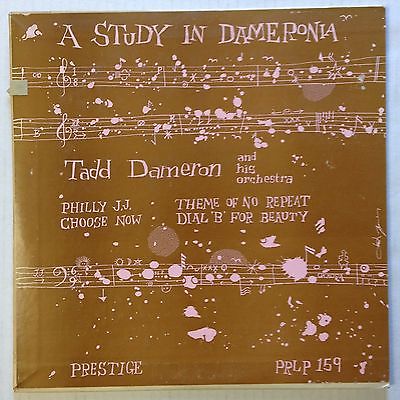
These were released as a 10-inch LP entitled A Study in Dameronia (cover art by David X. Young), and on an EP as Clifford Brown with Tadd Dameron's Band. There was a later reissue called The Arranger's Touch that featured work by Dameron and Gil Evans, but mostly the reissues have been under Brown's name.
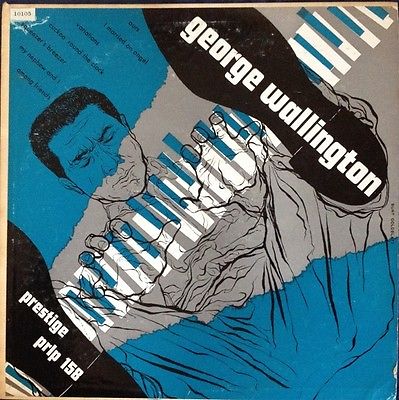
George Wallington chose two of the staunchest beboppers to accompany him on this trio session, the most stripped-down of all jazz groupings, for what turned out to be something other than a classic bebop session. Wallngton has the drive and the instrumental virtuosity of the beboppers here, but he brings to it an unashamed romanticism, full of gorgeous tone and musical flourishes. It's a winning combination.
Prestige was famous for not doing too many takes, but they must have really breezed through these tunes, because they got seven done in one session. Perhaps it made a difference that they're mostly Wallington originals ("I Married an Angel" is Rodgers and Hart, "Ours" is Leonard Feather), so he was familiar with the material. And it was less complicated, perhaps, with only three instruments and basically only one soloist, but good jazz is never uncomplicated.
Still, the floor belongs to Wallington here, because that's the kind of music it is--a setting for Wallington's stylish piano. No real space for Max Roach to stretch out, and Curly Russell never soloed.
And I wonder if that's part of the reason Russell's star started to fade. He would play one more session with Wallington, and a few more sessions on other labels, but by the mid-50s he was mostly gone from the jazz scene and into rhythm and blues, and then he retired from music altogether. The role of the bass was changing. Charles Mingus, of course, was in a category all his own: leader, composer, soloist. But other virtuoso bass players like Paul Chambers and Ray Brown were also changing the role of the instrument, making it more melodic, taking solo space.
Was this partly because recording techniques were changing, and the bass could be picked up better? Could be. And the mechanisms for playing music were changing, too. The long playing record made longer cuts possible, with more room for a variety of solos. And sound reproduction was better. I remember when I got my first high-fi record player, and a set of good--not great--speakers. The first album I put on was Gerry Mulligan and Chet Baker, the famous Mulligan experiment with a pianoless quartet. And I was entranced. Wow...I could hear all the instruments! I could hear what Larry Bunker and Chico Hamilton were doing, all the way through.
In this session, you actually can hear what Curly Russell is doing. Max Roach less so, but you know he's there, providing the rhythmic propulsion and complexity for Wallington's virtuoso work.
These were released on a 10-inch LP, and then on much later reissues.
A ballad session with Miles Davis and a group of great musicians. What more is there to say? There's a quote from Miles somewhere, which I can't find, to the effect that what he loved most was playing ballads, and he would have been happy to spend his whole life playing them. Which, of course, is why he couldn't. Miles had a restless, searching genius which was never about being happy or comfortable.
When I lived in New York in the late 70s, WKCR, the Columbia Univeraity station, did a week-long Miles Davis marathon, in which they played everything that Miles had ever recorded, in chronological order. I made it my business to stay home and listen to all of it, so you can see that this blog isn't the first crazy jazz-related thing I've ever done. I didn't totally succeed -- I'm not that crazy -- but my girl friend at the time, who'd been out of town, came back in the middle of the week and called me, and I told her she could come over if she wanted to, but that I was preoccupied.
So...I didn't listen to all of it, but I listened to enough that I got a real sense of Miles's progression. I felt like I could understand how bebop with Bird led to the Nonet sessions to the quintet to Kind of Blue to Filles de Kilimanjaro to On the Corner to Big Fun, and I could understand how he had to do all of it, even if I wasn't going to listen to Big Fun as often as I listened to Dig or Relaxin'.
And I could listen to this session many times, which of course I have, because that's how I'm doing this blog, immersing myself in each session, but I could listen to it many times more. Miles playing ballads, a Benny Carter tune and three originals, with a group of great musicians. "Tune Up" is credited to Miles, "Miles Ahead" to Miles and Gil Evans, "Smooch" to Miles and Charles Mingus. Mingus appears on "Smooch," replacing John Lewis on piano rather than Percy Heath on bass. Lewis is on the first three cuts, Heath and Max Roach on all four.
Bob Weinstock, in an interview, talked about those early Miles sessions:
So, our basic idea was just to make records with different people, to record with the best people around. That's what we did until the end, when he had the quintet with John Coltrane, Red Garland, Paul Chambers, and Philly Joe Jones. But everything up to that point developed from where we would sit down and talk about it. Miles would mention who was in town, who he would like to record with. I'd say who I'd like to hear him record with.
Yes, I would have loved to be a fly on the wall for those cpnversations. Fly on the wall? Hell, I would have loved to be a part of the,. "Hey, Miles and Bob, why don't we get..."
These were released on singles, on an EP, and as part of a 10-inch LP. And of course, in many reissue packages.
Have you noticed that the fun has gone out of names in the jazz world? No more bop-punning titles like "Flight of the Bopple Bee." No more group names like "J. J. Johnson's Boppers" or "Terry Gibbs New Jazz Pirates" (oh...Terry and the Pirates. I just got it!) Now if anyone even thought of calling this group "Billy Taylor and his Mambo Maniacs" ... but no. Nobody did.
Billy Taylor was a good choice for Prestige's latest mambo jazz entry. There's the fact that he could play anything, from bop to swing and all points in between. More to the point, much of his early background had been Latin, with Candido and Mario Bauza.
It's very hard to find any of this album to listen to on the Internet. Spotify nothing, although Taylor's later Latin work is represented. YouTube is better. I found one track -- "Early Morning Mambo" -- on a site called Office Naps, which has a whole page on Prestige and Latin jazz, and it's a very good page, although the guy does stoop to giving the inevitable backhanded compliment to Bob Weinstock (Prestige "operated on a dizzyingly prolific schedule, occasionally at the expense of quality and fidelity"). He also mildly chastises Prestige for its commercial aspirations:
Prestige Records had an eye attuned to commercial markets from the start, perhaps more than any other jazz-oriented label in its day, with many bop singles issued, a handful of them – including sides by King Pleasure (“Moody’s Mood for Love,” 1952), Stan Getz (“Four and One More,” 1949), Sonny Stitt (“All God’s Chillun Got Rhythm,” 1949) and Annie Ross (“Twisted,” 1952) – achieving some modest chart success.
Come on. In the first place, commercial success is not a bad thing. It was a healthy thing for American popular music that great jazz of the bebop era made the charts. In the second place, this
was a label for which the very first recording session was Lennie Tristano, which put Miles Davis and Lee Konitz back together, after the commercial failure of the nonet recordings, for an even more experimental session, which gave Teddy Charles his head and predated the electronic experiments of LaMonte Young and Steve Reich.
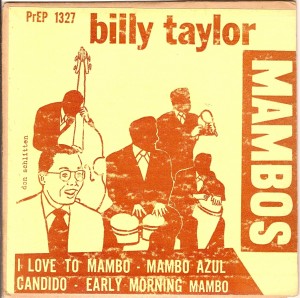
Anyway, thanks to Office Naps for some good information, and most of all for "Early Morning Mambo," and the cover art.
These four sides were released as two singles, and as an EP. Once again, all great stuff. I suppose if I were stuck on a desert island and could only take one, I'd go with "Mambo Azul" (below, from YouTube). Hard to choose, though.
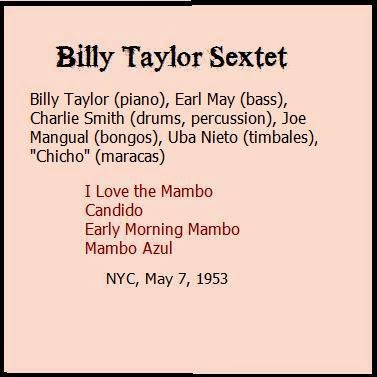
A little disagreement on the personnel. The Japanese site jazzdisco.org, which I'm using as my Bible for this whole project, lists the three percussionists as Chico Guerrero, Jose Mangual, and Ubaldo Nieto (bongos, congas). The YouTube uploader credits the group as "Billy Taylor Trio with Machito's Rhythm Section," and lists the three percussionists as Joe Mangual (Bongos), Uba Nieto (Timbales ), Machito (Maracas ). Looks as though the YouTube guy was right. a faded 45 RPM lists Mangual Nieto, and "Chicho" on maracas (undoubtedly Chicho was a cousin of Charlie Chan and Sven Coolson). The record label and the EP cover omit both "Trio" and "Sextet" and simply go with Billy Taylor Mambos.
Just as with Charlie Parker, an alias doesn't do much to hide the sound of Stan Getz. The aliases were necessary because the artists had exclusive deals with other record companies. This can't have fooled anyone. If it happened today, there'd be lawsuits, injunctions, records pulled from the shelves.
Hall Overton is back, with his other protege, Jimmy Raney, but a session with Stan Getz on it is going to be a Stan Getz session. Still, not quite like any other Stan Getz session. Do the avant-garde leanings of Raney and Overton pull Getz a little farther out into left field? I think so. He's lyrical as only he can be, but he's edgier, too.
This is an incredibly interesting session. It has the structure of a bebop blowing session, but a different dynamic. Or maybe that's not so. Maybe bebop had a lot more flexibility, a lot more nuance, a lot more room for growth than a lot of people gave it credit for. Maybe this wasn't the death throes of bebop that so many back then were predicting, and that so many since then have taken as an article of faith. Maybe this was bebop. Listen to Hall Overton's solo in "Lee." He's soloing in the bebop tradition, taking it to some strange but logical places, trading some great stuff with bassist Red Mitchell, then setting up Getz to take it out.
I've listened to this one a lot, and every time I listen, I appreciate more and more how these musicians worked with each other. Only in jazz, and maybe especially in the jazz of this era, do you find this kind of collective experimentation, and at this high level, and with this expectation of success. Putting Stan Getz together with Jimmy Raney and Hall Overton is more than just throwing a bunch of stuff at a wall and seeing what sticks. It's an inspiration.
The songs are "Round Midnight" and three Raney compositions. I had thought that "Lee" might have been a tribute to Konitz, but it's named after Raney's wife.
It's damned hard, even in the age of Google, to track down composer credits for jazz tunes, unless you happen to have the record in front of you. My ability to give credit has been, and will be, spotty at best.
New to Prestige, and perhaps new to recording -- I haven't found anything earlier -- are Red Mitchell and Frank Isola, although they had been playing and making significant names for themselves since the late forties.
Mitchell came to New York in 1948, just out of the army, and was to leave for the West Coast not long after this recording, where he made most of his career, and where he became an important innovator, tuning his bass in fifths -- the tuning used on a violin or cello -- instead of the conventional fourths. He would later join the expatriate jazz community in Stockholm.
There's a great chapter on Frank Isola, who came to New York around the same time as Mitchell, but didn't stay in the jazz world for long, in a book called Fifties Jazz Talk by Gordon Jack (Scarecrow Press). I would love to have a copy of it, but it costs 50 bucks, so it's on my gift list. Meanwhile, it is excerpted at Google Books, so we can get part of the story. We know Isola walked away from the jazz scene in 1957, after having established an important reputation as a modern jazz drummer. He worked a lot with Stan Getz, which may explain his presence on this session, and was involved in some important Prestige recordings, so we'll see him again.
In 1942, at age 17, he won the Detroit division of a national Gene Krupa drumming contest, and would have gone on to the finals in New York, if he hadn't been disqualified as an amateur for having joined the union. Had he gone, he would have given stiff competition to the eventual winner of the contest -- Louis Bellson.
He seems to have made a number of recordings that didn't quite happen, before the Prestige date. He was with a group including Don Lanphere and Teddy Kotick that backed up Babs Gonzalez on a demo for Capitol. Babs got the contract, but they didn't use the group. He made some sides with Lanphere and Herb Geller for a nascent label that never got off the ground. And in 1950, he acompanied Charlie Parker on a private session that was recorded, but I can't find a record of its having been released.
Just as he was getting ready to leave the music biz behind in the late 50s, he got a call from the Tommy Dorsey orchestra, wanting to hire him. His response: "No, thanks. Tell Tommy I'm not in a sentimental mood."
These sessions -- Raney's first as leader -- seem not to have been released as singles. Strange if true, given Stan Getz's popularity, but then his name wasn't on them. They came out on an album called Jimmy Raney Plays, with cover art by David X. Young of the Hall Overton / W. Eugene Smith jazz loft fame, one of the first Prestige albums to take cover art seriously.
Today, they're most available because of Getz, appearing on a reissue package called Early Stan.
The big band era ended with World Wat II, and a combination of social and economic factors, and some aesthetic factors as well --people liked the supple acrobatics of the great bebop soloists in a small group setting -- a rhythm section and one or two -- at the most, three -- soloists. But there's still something about the texture, and the power,that can come out of a larger group of musicians, and there was always the temptation to try and recreate it. Dizzy Gillespie put together a big band. Others tried to capture theflavor of the big bands in different ways. Louis Jordan came from the Chick Webb orchestra, and his search for a way to capture the spirit of Chick Webb with a smaller group led to the sound that we now know as one of the cornerstones of rhythm and blues.
Others tried different approaches,and in the early '50s, in what was coming to be known as the poat-bebop era, perhaps the most influential sound of a group that was larger than a sextet was the Miles Davis nonet, which I know I keep coming back to, but you can't help it. And although there were several arrangers for the Birth of the Cool sessions, including John Lewis, who take his search for the new sound in a different direction, perhaps the most influential were two of the greatest arrangers jazz has ever produced: Gerry Mulligan and Gil Evans.
So it's hard to hear a group of this size without thinking of the nonet, and ruminating on what they took from that seminal sould. Joe Holiday, of course, had taken jazz in his own direction, back toward dance music, with his mambo jazz, but this was different. He was coming back toward the mainstream, and although the general public didn't know it yet, that mainstream was flowing from the Royal Roost in 1948, and the records that Ira Gitler described as "the sound heard 'round the world," that were still four years away from being released on an LP by Capitol. I loved the Joe Holiday mambo stuff, but it's easy to see why any jazz musician would want to try putting together this sort of small big band. I hear an Evans influence more than Mulligan in these arrangements.
An octet is an ambitious undertaking, the more so when you remember Bob Weinstock's prohibition on rehearsal time. You have to be be pretty good to hold it together, and Holiday proves himself pretty good, especially when you consider the disparate group of musicians he put together.
It helps to start with Max Roach, the consummate drummer of the era, and a mainstay of many a Prestige recording session. And one of the fathers of bebop.
John Acea was of Cuban ancestry, but not a mambo man. He was born in Philadelphia, and grew up in that city's musical scene. He was gifted on nearly every, but settled on piano after he got out of the army, and played on a wide range of sessions, behind vocalists from Dinah Washington to Patti Page, with jazz groups from Cootie Williams to Zoot Sims. He was one of those guys you're glad to get for a session.
I can't find much on Franklin Skeete, but he was on the scene. There's a Lester Young session with Horace Silver and Connie Kay, a session with Cecil Payne. They're earlier, and it could be that after this session he sort of faded out of the scene.
Payne played up and down the sax scale, but when he settled on baritone, he became one of the leading boppers on the instrument. He was essentially a child of the bebop era, getting his start with J. J. Johnson and Dizzy Gillespie, although he did play a stint with Roy Eldridge, and made some hot R&B sides (with Franklin Skeete) for Decca in 1949.
Idris Sulieman was one of the first jazz musician/Islam converts, with Art Blakey (Abdullah Ibn Buhaina) being the most famous. His early credits show the range in a jazzman's life: studied at the Boston Conservatory of Music, then got his first professional experience with the Carolina Cotton Pickers. Like Cecil Payne, he came up in the bebop era of the 40s, became an important figure in the hard bop era of the 50s. Like Payne, he is treasured by jazz enthusiasts, not really known to the casual listener.
Earle Warren (misspelled on the session list) was from a different source altogether. He was a longtime member of the Basie band, and played some rock and roll with Alan Freed.
So how indebted is Joe Holiday to the Birth of the Cool nonet? I think a lot, especially in the two ballad numbers, "And Now it is Love" and "My Funny Valentine," in their exploration of the tonal and textural possibilities of a medium sized band. I confess I was a little disappointed on first listening not to hear more mambo jazz, and I responded more to the uptempo numbers, "Cotton Candy" and "Martha's Harp." But on repeated listenings, the ballads grew on me, and the disappointment fled.
These came out on 78, 45, and 45/EP; not in album form till many years later, in the reissue days.
Teddy Charles arrived on the West Coast in February of 1953 as Bob Weinstock's emissary, and immediately started putting together some extraordinary musicians.
Why Teddy Charles? Why expand to the West Coast? Probably because the jazz world was small and close-knit, and people did things because it seemed like a good idea at the time. Probably because Weinstock liked Charles, and Charles had mentioned that he'd love to go out to California. The other alternative is that Weinstock thought it through carefully, and said to himself, "I know! I'll take the most avant-garde musician I can find, and send him out to California! After all, look how well that worked seven years ago, the last time the most advanced musician of his day went out to California!"
In this case, unlike Charlie Parker's ill-fated West Coast debut at Billy Berg's, the world was probably ready for this incarnation of Teddy Charles, and Charles could hardly have put together a better group of West Coasters--including one musician who'd recorded with Bird during that West Coast sojourn, after Parker had relaxed at Camarillo.
This would be Wardell Gray's last recording session for Prestige. Two years later he was dead, his body found alongside a highway several miles outside of Las Vegas. It's quite possible -- probable -- that he was murdered, but the viciously racist Vegas of the 50s, no one cared. There was no investigation.
But this was an active period in Gray's life, and since we're saying goodbye in this blog to one of my favorite jazz artists, let's look at some of the recording gigs he made in the last part of '52 and '53, for an idea of his range and versatility.
A gig with Dexter Gordon, his partner on the famous "The Chase" recording.
A live recording at The Haig with Art Farmer, Hampton Hawes and Shelley Manne,
A Shorty Rogers big band concert at the Rendezvous Ballroom in Balboa Beach, with June Christy on vocals, and a band that included Chet Baker, Art Pepper, Gerry Mulligan, and Hampton Hawes. 21 songs were recorded on an Ampex reel to reel by Rogers's wife, and according to the Wardell Gray web page, they have only recently been released on 2 CDs available only to members of the Los Angeles Jazz Institute. A couple more dates with Baker, Pepper, Mulligan and Hawes were recorded during the fall. One has been issued but is, according to the website, of poor quality; the other unissued. It would have been a treat to follow that band around.
A four-song date for Norman Granz with a Louis Bellson big band, including Harry "Sweets" Edison, Maynard Ferguson, Benny Carter and Barney Kessel.
A Norman Granz jam session which included Benny Carter, Sweets Edison, Buddy DeFranco, Stan Getz, Count Basie, Freddie Green and Buddy Rich.
A Little Willie Littlefield R&B date for Federal.
A Billy Eckstine session for MGM, with an orchestra that included Gray and Harry "Sweets" Edison.
A line that has stuck in my head for years: Annie Ross, in her vocalese rendition of Art Farmer-composed, Wardell Gray-influenced "Farmer's Market," sends her heroine from the sticks and her crew-cut cat with the crazy goatee off "touring the country with Wardell Gray." Somewhere, in some better place, they are still touring.
Back to Teddy Charles.
This was Frank Morgan's first recording session.
Most of Morgan's career took place late in his life, after he had finally overcome more than 30 years of addiction, Between his first arrest in 1955 and his final release from prison in 1986, he spent much of his time behind bars, and pretty much all of it in the clutches of heroin. And his late career was such a productive one, it's pretty much overshadowed his brief early days, including his very early days.
I had known that Morgan, like every alto player of his generation, was deeply influenced by Charlie Parker, but I hadn't known that he was actually a protege of Bird's. At age seven, his guitar playing father (sometime accompanist for the Ink Spots) had already started him on guitar, but when they went to hear Jay McShann's orchestra play in Detroit, and he heard Charlie Parker play the alto, that was all he wanted to do in life.
Not many 7-year-olds have that kind of epiphany, but even fewer have the followup. As a musician with some reputation, Stanley Morgan was able to go backstage with his son, where little Frank was introduced to Charlie Parker, and where Bird took an immediate interest in the boy. He arranged to meet him at a music store the next day, and picked out an instrument for him--a clarinet, as better suited to develop a 7-year-old's embouchure. He and Parker remained in touch.
Morgan was precocious in more ways than one. When he was 14, and living with his grandmother in Milwaukee, he was caught smoking pot,and sent to live with his father in Los Angeles -- presumably because his grandmother felt she couldn't handle him, not because LA was thought to be a more drug-free environment. There, he immediately was thrown into jam sessions with the likes of Wardell Gray and Dexter Gordon, and age 15 was offered Johnny Hodges's spot in Duke Ellington's Orchestra, but his father decided he was too young to be touring with a band, For the next several years, his credentials are stellar. And in 1955, the same year Charlie Parker died, the 22-year-old's career was shut down.
This may have been a tough session for Teddy Charles to put together. Wardell Gray was sinking into addiction, after resisting it for a long time. 20-year-old Frank Morgan and 22-year-old Sonny Clark were already addicted. Morgan finally overcame it; Clark never did. Ten years later he was dead. The Paris Review, in 2011, ran a two-partprofile of Clark which is beautiful, devastating, and complete, so I'll refer you to it.
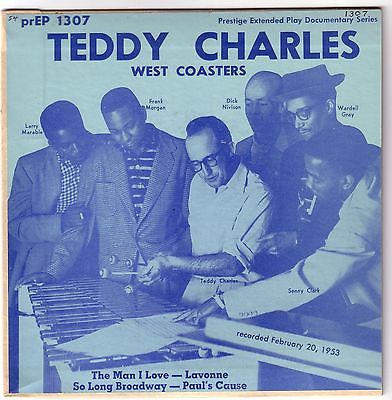
And move on to the music, which is inspired. Who knows what Bob Weinstock had in mind when he sent Teddy Charles out to Los Angeles, but what he got was a meld of talent and style between New York's most intellectual and avant-garde stylist this side of Lennie Tristano, and the West Coast's equally intellectual but earthy and crowd-pleasing giant of the tenor sax. The cover of their 45 RPM EP is posed, of course, but the way it shows all of them gathered around Charles, discussing a point of music, rings true.
I love all the songs on this session, but let me linger for a bit on "The Man I Love." I have a special weakness for bebop treatments of ballads from the Great American Songbook, and this one is no exception. Sonny Clark starts it off with a dense and moody piano intro, heavy on the sustain pedal, Wardell Gray comes in on top with an emotional statement of the melody, and then Teddy Charles comes in, under the piano at first, then above the piano but under the sax, then the two of them, Gray and Charles, improvising in tandem, one or the other of them taking the lead, or neither of them, with the tempo increasing, until it's time for a very young alto player, his head and heart full of Charlie Parker, to come an joyously take us into heart of Bebop Nation. There's no restatement of theme at the end--the tempo and the mood have gone too far beyond the aching plea for Mr. Right to come along. These guys are Mr. Right.
I could listen to this all day. In fact, I did. For the last couple of days.
It's more difficult than it should be to find composer credits for jazz compositions. AllMusic used to be good on this score, but they changed their format. "Lavonne"was pretty definitely written by Sonny Clark. I've seen "Paul's Cause" and "So Long Broadway" credited to both Charles and Gray, but the site that credited Charles also gave composer credit for the Gershwin classic "The Man I Love" to Davis, Sherman and Ramirez, who actually wrote "Lover Man." Still, Charles was the one who had recently said so long to Broadway, so there's a good chance it's his. Sonny Clark, much later, deeply in the throes of addiction, stole a tune from Thelonious Monk and recorded it as his own, but that was much, much later.
"So Long Broadway" was released as a single b/w a tune from a later West Coast session. All four tunes came out on a 45 RPM EP, and later on the Wardell Gray Memorial LP, Much later -- 2006 -- all the Teddy Charles California sessions were gathered on an CD, Adventures in California, but not issued by Prestige.