Monday, March 13, 2017

Listening to Prestige 251: John Coltrane

This was the moment that changed my life. It was late winter or early spring of 1958. I was a freshman at Bard, and I was living in the Barracks. The barracks were really exactly that. From a 1954 article in the Harvard Crimson:
The girls' dormitories and one of the boys dormitories are excellent, both roomy and comfortable. Most of the men, however, live in barracks--wooden structures put up temporarily after the war and never replaced. 
I liked the Barracks. I probably would have liked them less if I were an actual World War II vet, but I wasn't. I was a kid away from home. Not for the first time, but these were not the boarding school dormitories that I'd hated. They were ramshackle and casual and casually named, and they were my first home away from home, and I could come in whenever I wanted to, including, this particular night, sometime after midnight.

I would have been just barely 18, the legal drinking age in those days, and would probably have been drinking, something I'd just learned to do. For sure, I was passionately in love with rhythm and blues. I was of the first rock and roll generation, raised on the Hound from WKBW in Buffalo, and, when I could get him (WINS' signal didn't travel well to upstate) Alan Freed, and when, even more rarely (WOV's signal was even more unlikely), I could get Jocko, your ace from outer space. Rock and roll made me passionate about music, and I learned quickly that I wanted the real thing. I wanted what Alan Freed played, the original records, the Chords' version of "Sh-Boom" and not the Crew-Cuts, LaVern Baker and not Georgia Gibbs singing "Tweedle Dee" (finding out about Red Garland's version came later). I discovered that the names in tiny letters below the titles of songs meant the person or persons who had written them, and "Lieber-Stoller" became my new heroes. And I discovered that, with the exception of Elvis and a few others (most of whom recorded on Sun Records), the music I loved was made by black people.

I lived in a Bohemian environment of artists and political leftists, so I discovered the folk music of the 50s, and a new writing role model to put alongside Lieber and Stoller -- Lead Belly. And then the other blues singers who had crossed over to that audience of leftists and other folk music enthusiasts -- Big Bill Broonzy, Josh White, Sonny Terry and Brownie McGhee.

Then somehow--I can't remember how, and I can't even imagine how, a white teenager in upstate New York--I discovered that there was a whole different kind of music out there, that was being made by black people and listened to by black people, and it was called rhythm and blues. Some of the rhythm and blues artists, like Larry Williams and Smiley Lewis, got some airplay on the hipper rock 'n roll stations. Some, like Magic Sam and Lightnin' Hopkins and even Muddy Waters, you just had to find. Some like Roy Brown and Arthur "Big Boy" Crudup were covered by Elvis.

So in that spring of 1958, away at college, I was already passionate about music as only a seeker can be. My kind of music. Rhythm and blues, and the R&B artists like Little Richard who had made their mark in rock 'n roll. I didn't know anything about jazz. I had one Louis Armstrong record, Satch Plays Fats. I knew that jazz fans thought they were better than rock 'n roll fans, and maybe they were--if you were a rock 'n roller and traveled in intellectual bohemian circles, you always felt a little self-conscious. And neither the jazzers nor the rock 'n rollers knew much about rhythm and blues.

But sometimes you could find it on all-night radio, and that's what I was doing in those wee hours of the morning in my dorm room in the Barracks. Twisting the dial of my AM radio, looking for some far-off station that might be playing Varetta Dillard or Joe Turner or the Harptones.

And then I stopped. I didn't touch the dial of the radio again. And I couldn't even look away. I stopped and stared at the radio. I was suddenly and instantly under the spell of a music I had never heard before.

I remember everything about that moment in time. The station was CKLW in Detroit and Windsor, Ontario, and the disc jockey was Speed Anderson. Except I seem to remember it wrong. Ezra "Speed" Anderson was a late night jazz DJ in Boston. Maybe I might still be right. For a short time his program was syndicated nationally. Anyway, the place was the Barracks, Bard College, Annandale-on-Hudson, New York. The disc jockey was Speed Anderson. And the music was John Coltrane and the Red Garland Trio.

I was struck by lightning as sure as Michael Corleone in Sicily in The Godfather, Part II.

Speed Anderson went on to become the most beloved hot dog vendor in Boston. John Coltrane went on to become one of the greatest jazzmen of his generation. And I went on to love jazz for the rest of my life.

The album, which I bought as soon as I could find it, was John Coltrane with the Red Garland Trio. It had that red-on-black Abstract Expressionist cover. It was my first jazz record.

I was not hip enough, or experienced enough, to listen to the complex and subtle interactions of the instruments. Certainly not over a little dorm room AM radio. It was Coltrane that got to me.

And still does. To me, the five tracks, even though only two of the tunes were written by Coltrane, have always felt like an extended suite to me, to be listened to all the way through. So I'm listening and responding in the order they appear on the record, not, as I usually do, in the order they were recorded in the studio.

The suite begins with Red Garland, doing a nearly five-minute intro/solo on "Traneing In," the longest individual cut, after which Coltrane enters, and as great as the other musicians are, it's his voice that you hear the rest of the way.

Funny...I said this album has always felt to me like a suite, and the next track, "Slow Dance," actually was part of a suite: Manhattan Monodrama, written by contemporary composer Alonzo Levister for a group that included Teddy Charles. It was released on Charles Mingus's Debut label.

"Slow Dance" actually is kinda slow, but the climactic piece, "Soft Lights and Sweet Music," is anything but soft and sweet. It's an Irving Berlin tune, and though I often imagine the great American composers of popular song listening to modern jazz interpretations and approving, I'm not sure Coltrane's approach is exactly what Berlin had in mind. The tune, as recorded by singers like Lee Wiley and Barbara Lea, and swingers like Benny Goodman, is more sprightly than dreamy, but as Ira Gitler noted in his liner notes, this is more like the soft headlights of an express train roaring down the track.

Unlike most of Coltrane's work for Prestige, this wasn't held back for a more opportune time. It was released in early 1958, in time for Speed Anderson to play it and for a young rhythm and blues-loving college freshman to have his life changed irrevocably.


 Order Listening to Prestige, Vol. 1 here.

Saturday, March 11, 2017

Listening to Prestige 250: John Coltrane

Bob Weinstock got several years worth of albums out of Miles Davis when he booked the Contractual Marathon sessions--the last one appearing in 1961, two years after he had changed the shape of jazz completely with Kind of Blue, for Columbia.

He scheduled those sessions because he knew Miles was leaving. He may not have known Coltrane was leaving, but perhaps he knew that this was an eagle in flight, and he wouldn't be in his eyrie long. He recorded a lot for Prestige--14 more sessions either as leader or sideman, through the end of 1958 (with some sessions for Blue Note and Savoy thrown in). Then, like the MJQ before him, he decamped for Atlantic, and his second Atlantic session, in April of 1959, was Giant Steps. Like Miles Kind of Blue, Coltrane changed the shape of jazz. (Ornette Coleman would record Tomorrow Is the Question!, The Shape of Jazz to Come, and Change of the Century in the same year.) And as with Miles, Weinstock made sure that the bebop/hard bop tradition in jazz didn't vanish right away even as its leading practitioners moved away from it: Prestige was still releasing its stockpile of Coltrane material for more than two decades. The tunes from this session bracketed that discography, first released on 1961's Lush Life album (all but "Slowtrane"), then again on the 1972 double album, More Lasting than Bronze. "Slowtrane," aka the alternate take of "Trane's Slo Blues." "Slowtrane" is also on The Last Trane (1965); "I Love You" and "Like Someone in Love" on John Coltrane Plays for Lovers (1966). "I Love You" was on the B side of a 45 in 1960, the A side in 1966.

I won't say a lot more about Coltrane's music because there are so many more sessions coming up, including Prestige's very next session, the following week, which is one that changed my life. But this great stuff: Coltrane in a trio setting, with Billy Taylor's Earl May on bass, Art Taylor on drums. They do everything asked of them, and Taylor's lead-in on Cole Porter's "I Love You," followed by his punctuation of Trane's first solo, is especially noteworthy. But Trane is the main event. The cuts are between five and six minutes long, showing that while Trane became famous for the long and very long forms, he could say a lot in a compact, and in some ways more listener-friendly setting.

"I Love You" and "Like Someone in Love" are probably included on a compilation called John Coltrane Plays for Lovers because of their titles. but they are as romantic as they come. Modern jazz is supposed to be cerebral and intellectually rigorous, and it is, but on Jimmy Van Heusen's "Like Someone in Love," especially, you can be listening to and appreciating the musical complexity of Coltrane's soloing, and then he'll cut through and hit you in the heart as immediately as anything by the Five Satins or Billy Eckstine. In Jerry Maguire, Tom Cruise's friend gives him a Miles Davis and John Coltrane tape to play as an accompaniment to lovemaking. Cruise puts it on, but after a minute, he says, "What is this shit?" and rips it out of the tape player. Jerry Maguire had no taste and no soul.


 Order Listening to Prestige, Vol. 1 here.


Thursday, March 09, 2017

Listening to Prestige 249: Tommy Flanagan

Tommy Flanagan went a long way to record this one: Sweden, which if it wasn't quite the Mecca for American jazz musicians that it had been a few years earlier, was still one of the great jazz centers of Europe. Stockholm was a long way from New York, where Flanagan, Wilbur Little and Elvin Jones had been playing in J. J. Johnson's group, and had joined Johnson's European tour. It was even farther from Detroit, where both Flanagan and Jones had gotten their start.

I've written a lot about Detroit in this blog, because it keeps coming up. Detroiters made such a contribution to Prestige Records, and to modern jazz as a whole. As Pepper Adams said, when he joined the army, he was thrown in with older and more experienced musicians, and he looked forward to learning from them, but he discovered that because of his apprenticeship in Detroit, he was more advanced than they were.

A history of jazz in Detroit was waiting to be written, and it waited a long time. It wasn't until 2001 that a book-length history of Detroit jazz was published, and it was worth the wait. The book is Before Motown,  by University of Michigan-Dearborn professor Lars Bjorn, with assistance from Jim Gallert, jazz DJ and journalist. I, of course, have been focused on the musicians (like Flanagan and Jones) who emigrated from Detroit to New York in the 1950s, but the book goes back to the 1920s--the society bands that morphed into jazz bands, and the contributions to music that the Motor City was making even then: Jean Goldkette's bands that were the first to feature Bix Beiderbecke and Frankie Trumbauer, McKinney's Cotton Pickers with their great arranger Don Redman. The book is both scholarly and readable, Highly recommended.

J. J. Johnson's European tour may not have produced the number of splinter group recordings that Lionel Hampton's 1953 tour did, but this session makes up for it quality. It is the first recording by Tommy Flanagan as a leader, but certainly not the last. In a career spanning four decades, he became one of the most celebrated and critically acclaimed musicians of his time.

Most of the cuts here are Flanagan originals, the exceptions being "Willow Weep for Me," by Gershwin protégé Ann Ronell, "Chelsea Bridge" by Billy Strayhorn, and "Relaxin' at Camarillo" by Charlie Parker. Playing a Bird composition means that you still have at least one foot planted firmly in bebop, and if you're a piano player and have that planted foot, you've done a lot of listening to Bud Powell. Flanagan has named as his chief early influences Art Tatum and Teddy Wilson, two masters of the piano, and Powell, the pianist who steered him to bebop.

I went back and listened to Bud Powell's version of "Relaxin' at Camarillo," and then to Flanagan's again. Both feature great piano, and certainly no one wrote springboards for improvisation like Charlie Parker, but the big difference between the two is Elvin Jones. Powell's "Relaxin'" was recorded at almost exactly the same time as Flanagan's, in late 1957, and with Art Taylor on drums, but Jones, who had been restrained on previous Prestige sessions, really breaks out here,

I went back and listened to some of Powell's earlier recordings, from the 40s, with Max Roach on drums. Roach was certainly one of the most important drummers in his day, one of the pioneers of modern bebop drumming, and in a club, in a trio setting, he must have been wonderful to hear, but on record, you can hear very little of him. And that makes you realize what a difference arriving on the scene in the era of advanced recording techniques pioneered by Rudy Van Gelder and others, when the bass and drums could be miked so as to show the full range of the players.

But the other difference in Jones's playing on this session is Tommy Flanagan, who brings him to the forefront, and provides a framework for him to show himself at best advantage. Flanagan was one of the great accompanists in jazz, working with Ella Fitzgerald for many years, and of course a vocalist like Ella is going to be able to find and hire the best accompanist, but it turns out that Flanagan is also a great accompanist to a drummer, which is a little more unusual.

Just listen to "Beat's Up," a Flanagan composition which is a showcase for Jones, and listen to the piano, the way Flanagan provides melodic and rhythmic prods that move Jones into new directions and new innovations.

You can tell this was recorded outside of Bob Weinstock's purview because there are alternate takes. It was released as Tommy Flanagan Trio on the Swedish Metronome label, then licensed to Prestige, where it became Overseas.


 Order Listening to Prestige, Vol. 1 here.

Saturday, March 04, 2017

Listening to Prestige 248: Red Garland

Red Garland was Miles Davis's legacy to Prestige, as Miles sat out one of the tunes on one of his Contractual Marathon sessions and let Garland and his trio audition for a  regular gig with the label. This has to have been one of the most successful auditions of all time, because Garland, as leader of a trio or with the addition of a horn, would record close to thirty albums for Prestige and its subsidiaries, and with good reason. Garland was not only an important piano innovator, he was also consistently entertaining.

Riccardo Scivales, author of a number of books on jazz piano technique, analyzed Garland's piano technique as follows (and I quote this at some length because it relates to my listening experience as a fan):
 Garland...became especially famous and influential for his trademark “block chord” technique, which was very different from earlier “block chord” stylings devised by Milt Buckner, George Shearing and Nat “King” Cole, and was slightly different from [Ahmad] Jamal’s ...Garland’s innovative and distinctive “block chord” style was made of three notes in the right hand and four (rarely three) notes in the left hand, with the left hand playing around middle C and the right hand playing one octave above the left. In this style:
1.the right hand plays the melody in octaves, with a perfect 5th always placed above the lowest note of the octave. As a very important feature of this styling, note that perfect 5ths are played in the middle of right hand octaves even when they seem to not suit the underlying harmony...In fact, these perfect 5ths become virtually inaudible when left hand chords are played simultaneously, and above all they also give these voicings a particularly rich, distinctive and slightly out-of-tune delightful character;
2.the left hand mostly plays four-note (rarely three-note) “rootless chords” in exact rhythmic unison with the right hand. On this matter, it should also been noted that Garland was one of the earliest pianist to make extensive use of “rootless chords”. (Along with Gershwin, Ellington, Tatum and Garner’s pioneering examples of “synchronizing” the melody with left hand chords, “rootless chords” are discussed—with practical applications too—in my method Jazz Piano: The Left Hand, published by Ekay Music/Steinway & Sons.)
As testified by existing recordings, Garland seems to have perfected such voicing towards 1955, when he started using them extensively in his recordings with Davis. Compared to previous “block  chord” stylings, Garland’s had a brighter quality, slightly more dissonance, and more fullness in the upper register.
So how does this work out when you're actually listening to it? Well, playing the Duke Ellington/Barney Bigard classic "C-Jam Blues," Garland joins Paul Chambers in a lead-in vamp in which both piano and bass are functioning as rhythm instruments, and when that right hand, an octave higher as Scivales says, starts playing the melody, the piano is still working as a rhythm instrument.

Ellington's orchestra, of course, while making some of the greatest and most complex music of any era, was always a dance band. Modern jazz is supposed to have lost that danceability factor when the virtuoso soloists became the attraction, and drummers stopped keeping the beat with the bass drum, but Garland's "C-Jam" blues has as good a beat as anything a teenager ever gave a 93 to on American Bandstand, and the only thing that stopped me from getting up and dancing to it was that I was driving in traffic at the time.

Garland's sessions are full of variety. Here we have Ellington. We also have Matt Dennis ("Will You Still Be Mine?"), composer of quirky, wry romances, and Eddie deLange, perhaps not as well known as he should be, given that he gave us "Moonglow"  and "Darn That Dream," among others. "Lost April" comes from a Nat "King" Cole album cut ("Unforgettable" was the hit off the album). It's a beautiful melody, and if it hasn't exactly become a jazz standard after its discovery by Garland, it's had a few solid covers, by George Shearing, Sonny Red and Phil Woods among others.

If you were planning on using this session for a dance evening, "Lost April" makes a romantic, dreamy slow dance. Of course, with the right partner you can slow dance to anything, even a tornado, so you could probably grind along to "Will You Still Be Mine?", even though it's the most boppish of the cuts here.

You certainly ought to be able to dance to Lionel Hampton, and "Gone Again" provides another slow, dreamy sway, as does the bluesy, mood-enhancing Garland original, "The P. C. Blues." And "Tweedle Dee Dee," the Winfield Scott rhythm and blues classic that kids really did dance to on American Bandstand, will get you up and swinging those hips again. The kids on American Bandstand might have been dancing to either the Lavern Baker original or the Georgia Gibbs cover -- it wouldn't have much mattered which, since the Gibbs arrangement matched Baker's note for note and beat for beat. Baker sued but lost -- it was ruled that you can't copyright an arrangement. Garland had unerring taste and judgment in the songs he picked, and if there was a war between jazz and rock 'n' roll in the 50s, Garland may have been its no man's land, with the same generosity of spirit that led troops on either side to stop shooting and toss gifts across the trenches to each other on Christmas Eve, 1914.

Garland's popularity during this era, and his enduring legacy, comes from that unique block chording style, the depth of feeling he gave to his recordings, and his sheer piano wizardry. I got caught up in a dancing mood while writing this, but there is no track in this whole session where Garland doesn't surprise with a sudden run up into the upper register or a captivating blues variation.

And let's not forget his ability to choose material to put together a spellbinding set. And, it turns out, the set is just as spellbinding if Prestige chose to mix and match.

Which they did. "C Jam Blues," "Gone Again" and "Will You Still Be Mine" were released in 1957 on Garland's Groovy album, which also included one track from his May 24 recording date, and two from the previous December, and it's still a great album. The others were held off for a later release as The P. C. Blues.


 Order Listening to Prestige, Vol. 1 here.

Monday, February 27, 2017

Listening to Prestige 247: John Jenkins - Clifford Jordan - Bobby Timmons

John Jenkins, Clifford Jordan and Bobby Timmons were all young in 1957; they were barely out of short pants when Dizzy Gillespie and Charlie Parker first hit 52nd Street. Jordan and Jenkins, both 26, were newly arrived in New York from Chicago, where they had been classmates at DuSable High, and part of the Windy City jazz scene with Ira Sulivan, Johnny Griffin and others. Timmons, four years younger, had been the first one to arrive in New York, in 1954. He had played gigs with Kenny Dorham and Chet Baker among others, but 1957 was his breakout year.

They were heading in very different directions. Timmons would become associated with the soul jazz movement, and write some of its greatest hits, like "Moanin'," "Dis Here" and "Dat Dere." His compositions have become jazz standards, and "Moanin'" is probably still one of the most recognizable tunes in the jazz repertoire. As with "Moody's Mood For Love," its popularity was enhanced when lyrics were set to it (by Jon Hendricks), but the melody was ubiquitous before that.

Timmons was part of Art Blakey's Jazz Messengers when he wrote "Moanin'," and he's probably mostly associated with that group, and its Blue Note recordings, but he would record several albums as a leader for Riverside, and then return to Prestige for several more in the mid-sixties. He would die young, at 34, another victim of heroin.

Jenkins would record only two more albums as a leader, both in 1957, but soon after circumstances in life forced him to the streets, where he would hustle a living as a pedlar and street musician for the next three decades.

Jordan would have a long and distinguished career, known as a musician's musician, not really associated with any one school, playing with funksters (Horace Silver), experimentalists (Eric Dolphy), funky experimentalists (Charles Mingus), touring Africa with Randy Weston. Jordan's style was strongly influenced by Lester Young, at a time when Young's influence was diminishing, but he drew from a multitude of sources, including Nobel Laureate Herman Hesse's novel The Glass Bead Game, and the songs of folk blues artist Lead Belly.

The decades after the Prestige era. the 70s and 80s, saw a different breed of independent label, and Jordan recorded for several of them. Muse was the creation of Prestige alumni Joe Fields and Don Schlitten. Many of the later small indies were formed by musicians. One such was Strata-East (Charles Tolliver and Stanley Cowell), which released a number of Jordan titles. Others like SteepleChase and Soul Note came from the European love for American jazz. Jordan would ultimately make over 40 recordings, and in 1990. he would bring John Jenkins off the streets for a final recording.

Jenkins and Jordan would go out together, dying within a couple of months of each other in 1993, DuSable High School. Their shared background shows in the intuitive closeness they bring to this session, abetted by another DuSable graduate, Wilbur Ware. Dannie Richmond, who had just begun his long association with Charles Mingus, is on drums.
just as they had come in together from Chicago in 1957. Chicago is best known today as the cauldron of the postwar electric blues sound (and both these young horn players played in rhythm and blues bands in their home town), but it has a powerful jazz history too, beginning with the New Orleans diaspora of King Oliver and Louis Armstrong, and their young white acolytes from a local high school. Bix Beiderbecke and Frankie Trumbauer. Later it was to become a hotbed of the avant-garde, with the Association for the Advancement of Creative Musicians and the Art Ensemble of Chicago. But in between, as the bebop revolution inspired musicians throughout the country, it had a music scene to be reckoned with, with many of the young cats (including Jordan) getting their start at

The album was released on New Jazz as Jenkins, Jordan, Timmons.


Sunday, February 19, 2017

Listening to Prestige 246: Phil Woods-Red Garland

Found "Sugan" on YouTube, hit "play," forgot what was I was doing, half-listening to great Phil Woods solo, then gradually found myself asking, "Wow...what's happening with the piano behind Phil? That's amazing."

Ah yes, as well it should be. A Phil Woods - Red Garland collaboration? You couldn't ask for better. And then, with my attention fully engaged, Red went into his solo.

Anyway, I got held up for a while. "Sugan" grabbed my attention and wouldn't let go, through four consecutive listenings, and since it's nine and a half minutes long. that meant a sustained half hour plus of "Sugan," every time marveling at it. Garland's solo is three minutes long, and with at least four unexpected twists and changes of direction. Ray Copeland does some fine solo work too, but even better are his duet exchanges with Woods. The number concludes with something you didn't hear all that often in jazz of the fifties, and that's a fadeout. Whether that was Rudy's or Weinstock's idea, it happened to work perfectly with Copeland's and Woods's exchanged phrases. Give a listen.

The session is half Woods originals, half Charlie Parker. A gutsy choice by Phil, for whom an exchange with Bird was a turning point in his career, and who would, in fact, marry his widow, Chan Parker. Maybe "gutsy choice"  isn't right. Maybe a natural choice. Anyway, a good choice.

I'd just be repeating myself if I went over every cut on this album. The level of inventiveness never flags. The musicians do everything you want jazz musicians to do. They go off on their own, they're always working with each other. They respect the melody, they're not limited by the melody. Ronny Graham, in his great comedy routine "Harry the Hipster's Commencement Address to the School for Modern Jazz Musicians" tells his graduating class, "When you cats came here, all you could play was the melody. Now you wouldn't know a melody if it hit you in the mouthpiece." These cats know the melody, and a whole lot more, and you don't even need a cache of stashay in your sachet to appreciate it.

It's good to hear Ray Copeland, who didn't record much. His only other Prestige outing was with Monk in 1954, and I commented about that session, "perhaps the only thing better than listening to Thelonious Monk is listening to Monk play with someone who really gets him." Monk was a rare and idiosyncratic talent, but Copeland gets Woods and Garland too, and their interplay is one of the joys of this album.

Copeland's most active collaboration was with Randy Weston, another visionary. He went on to have a distinguished career as an educator, teaching jazz composition at Hampshire College in Amherst Massachusetts, part of Amherst's five college consortium that was a pioneering center of jazz education (Max Roach taught at Amherst). In 1974, he published The Ray Copeland Method and Approach to the Creative Art of Jazz Improvisation.

You need to wonder about the marketing of this one. Was Prestige overloaded with product at this point? They did a lot of recording in 1957 -- 70 sessions, as compared to a little more than half of that the following year. How much is too much product? I guess it depends on your pressing capabilities and your distribution capabilities. Anyway, this wonderful record, titled Sugan and with nice but not really inspired cover art, was dumped into the budget bins as a Status release. It was also included as part of one of those weird 16 2/3 super-LPs, called George Wallington, Phil Woods, Donald Byrd, Red Garland - Modern Jazz Survey - New York Jazz. 


 Order Listening to Prestige, Vol. 1 here.

Wednesday, February 15, 2017

Listening to Prestige 245: Jackie McLean

This is around the time when Bob Weinstock stops being the hands-on guy in the studio (although his idea of hands-on was mostly hands off), and starts turning some sessions over to other producers. He's had Teddy Charles produce a few, but those were really Teddy Charles projects.

Here he gives over some of his regulars to a new guy, Don Schlitten. And this is, in fact, a session that makes up part of an album begun back in February, with Weinstock at the helm. Schlitten was a young guy -- at 24, four years younger than Weinstock, and at the beginning of a long career in jazz. Like Weinstock, he had started his own label at a young age,

but perhaps had not had the business acumen, or perhaps just hadn't found his focus yet. His label, Signal, which he formed with Ira Gitler, did some significant work, recording Duke Jordan, Gigi Gryce, Red Rodney, Cecil Payne, and a live tribute to Charlie Parker from the Five Spot. They also put out an interesting series called Jazz Laboratory, which was sort of similar to Music Minus One. It featured quartets led by pianists like Duke Jordan and Hall Overton, with one horn player. On the reverse side of the album, the horn player dropped out, and the remaining trio did the same songs.

After a couple of years, Schlitten sold the label to Savoy, and went into independent production. He would go on to form other labels, and make a major contribution to jazz.

He brings a few faces to this session in the rhythm section. Jon Mayer didn't make much of a name for himself in the 1950s (and the name he did make was not entirely his own, if this session is an indication), but that would  change several decades later. He made one other album (with Coltrane), played on gigs with Ray Draper (who may have recommended him here, as he did earlier with Webster Young), Kenny  Dorham, Tony Scott and others, and in the 60s he performed with the Thad Jones/Mel Lewis big band, and accompanied Dionne Warwick, Sarah Vaughan and the Manhattan Transfer. Then he dropped out of sight until the 1990s, when he made a series of highly regarded albums, including a couple with Mark Feldman's Reservoir Records, out of Kingston, NY. He is still active.

Bill Salter is probably best known for his years as bass player and musical director for Miriam Makeba, but he picked an odd route into jazz--his first professional job was with Pete Seeger. Salter sort of passed through jazz. It was only part of what he did. His folk music credentials included Harry Belafonte and John Prine as well as Seeger. He was in the pit for Broadway shows. He wrote hit songs for Shirley Bassey, Roberta Flack and Donny Hathaway, Grover Washington, Jr. and Rod Stewart.  But as he passed through, he left a mark: recordings with Sabu, Herbie Mann,Yusef Lateef, David "Fathead" Newman, Rahsaan Roland Kirk. He currently plays traditional black vaudeville music with his own group, the Ebony Hillbillies.

Like Gil Melle and Larry Rivers, Larry Ritchie was torn between painting and music, and over time he drifted more into painting. He would be back in Hackensack one more time in 1957, recording with Ray Draper and John Coltrane.

Draper and Webster Young make up the rest of the sextet part of the session, and Draper contributed one tune, the oddly named  "Disciples Love Affair." McLean pairs down to a quartet for the final number of the day. "Not So Strange Blues" is sort of a companion piece to "Strange Blues," from the earlier session, and it may not be strange, but it sure is the blues.

If Schlitten was looking for instant recognition from his first Prestige session, he was doomed to disappointment. Strange Blues, which included these three tracks, would not be released for another ten years. But Weinstock was satisfied enough to hand him more assignments. And this whole McLean project was pretty weird. The long February session, which included "Strange Blues," would be released in dribs and drabs on New Jazz starting in 1959.

Tuesday, February 14, 2017

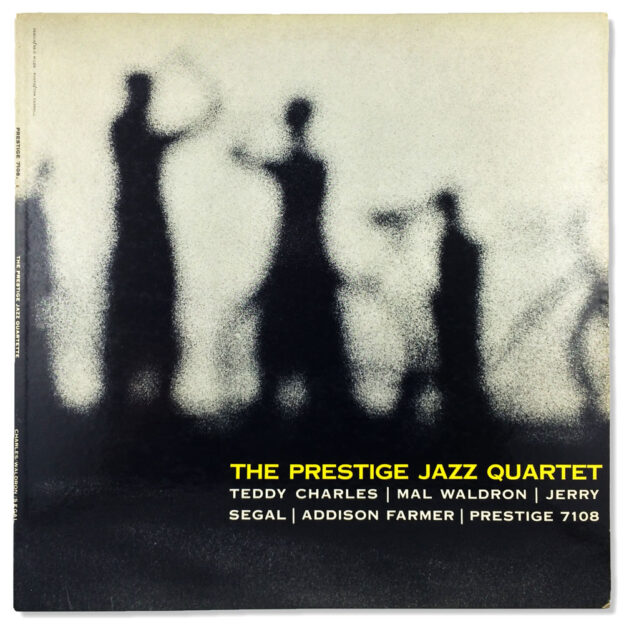
Listening to Prestige 244: Prestige Jazz Quartet

There are many things that can be said about this meeting of four minds, but let's start with asserting that it's a composer's album. This should be stated at the outset, because it's important, and its importance is one of the reasons why I continue to believe that looking at the history of jazz in the 1950s through the lens of one label is worth the undertaking.

So let's start with the jazz figures who made a major contribution not just to jazz, but to composed music of the 20th century. You know the names. Duke Ellington, of course, heads the list--the same Duke Ellington who was not awarded the Pulitzer Prize for Music in 1965 by a pusillanimous committee that knew he deserved it but didn't dare nominate him. Instead, they recommended a "special citation," which the Pulitzer Board, having the courage of its racism and cultural snobbery, rejected.

The composers who did win Pulitzers in those days were people like Gian Carlo Menotti, Elliot Carter, Samuel Barber, Walter Piston--names that even I'm familiar with. And people like Ernst Toch, Norman Dello Joio, John La Montaine, names that mean nothing to me, but I'm sure they mean something to people who really follow contemporary classical music. What''s more, I'm sure they cared passionately about the music they were making, and they were creating work of value.

So, never having met a digression I didn't like, I looked up John La Montaine, and I'm now a fan. For one thing, he took and passed the New York State licensing exam to become a stockbroker, theorizing, "what can I do that will make me the most amount of money in the least amount of time, so I can stop earning money and just write music?" For another, he never did become a stockbroker.

For another, his music is beautiful. I listened to his piano concerto No. 9, and couldn't help thinking how much he, Teddy Charles and Mal Waldron would have enjoyed each other's company.

And so it goes. John La Montaine is not necessarily a household name even to people who know who Samuel Barber was, and just because jazz listeners of today can name Duke Ellington and Thelonious Monk as major jazz composers, there's no guarantee that they'll come up with Mal Waldron or Teddy Charles.

Anybody who's read any of this blog knows how I feel about both of these guys, particularly Mal Waldron. These are major composers. That they are not more widely recognized as such can probaby be attributed to the reality that no one cares about jazz composers. Jazz...oh, yeah. It's that music where guys improvise on a bunch of show tunes. Or else they make up a riff and improvise on that. Or on the blues, and the blues is the blues, right?

Well, this is a recording session featuring the compositions of two of the principals and one of the acknowledged masters of twentieth century composition, and for all that you want to listen to the playing, and the improvisation, and the immediate creativity that jazz offers, you have to listen to what these guys wrote.

"Friday the Thirteenth" was a spur-of-the-moment, in-studio composition for a 1953 Prestige session featuring Thelonious Monk and Sonny Rollins, and it took its title from the day of the session, one of the Prestige Fridays With Rudy. That kind of spur-of-the-moment work can be a one-off: good for the date, but then you go on to other things. Or, if the composer is Monk, maybe there's more to it, and it doesn't just get forgotten. Teddy Charles picked it up for this session four years later, and in 1959, it was one of the compositions that Monk and Hall Overton developed for Monk's orchestral concert at Town Hall. What strikes me most, listening to the Charles/Waldron version, is how close Waldron sticks to the melody, which fits right in with Monk's classic advice to musicians, as strange and original and insightful as Monk's own music. Here's a selection from that handwritten list of instructions:
PAT YOUR FOOT & SING THE MELODY IN YOUR HEAD, WHEN YOU PLAY.
STOP PLAYING ALL THOSE WEIRD NOTES (THAT BULLSHIT), PLAY THE MELODY!
And one more:
DON’T PLAY THE PIANO PART, I’M PLAYING THAT. DON’T LISTEN TO ME. I’M SUPPOSED TO BE ACCOMPANYING YOU!
Chances are, Charles and Waldron never saw Monk's instructions, but they're spot on anyway. Waldron is with the melody all the time (and he's playing the piano part); Charles is always aware of it, which doesn't mean he's playing it. He's probably listening to it, but not in the limiting way Monk warns against.

Neither of Waldron's compositions have been picked up by other performers, but Waldron wrote so much (he's credited with over 400 compositions) that anyone looking to showcase his work as a composer would have a lot to choose from (and someone should, in the way that Philly Joe Jones created an ensemble to play the works of Tadd Dameron). Thom Jurek, in his perceptive review of the album at AllMusic.com, cites the "odd meters and drastic melodic interventions" of the two Waldron compositions.

But "Dear Elaine" and "Meta-Waltz" were written with this quartet in mind, and this quartet was a very particular one. You can't say that the instrumentation hadn't been tried before -- piano, bass, drums, vibes, making up the (something) Jazz Quartet -- where have we heard that before? But that was a large part of the point--to go where the MJQ had not gone.

Jurek referenced Ira Gitler's liner notes to the album,
 while the players in the PJQ are as influenced by classical music as the MJQ, they are interested "in the more contemporary developments...with more regard to devices and spirit than actual form." Sure, but what he is really saying is that these cats are pure jazz players who understand the understated dynamic of the MJQ and can make it just as seamless, just as smooth, just as adventurous, and still make it swing like hell. 
He went on to say that Waldron
may indeed have had ideas of the piano pieces of Webern in his head when he was
composing, but it's more likely he was thinking of Art Tatum and Bud Powell. 
It is, for whatever reason, hard to talk about contemporary composed music without talking about classical composers. Even I did it, which may undercut my argument about composers in the jazz realm being judged on their own merits, but I hope not. They should be.

Teddy Charles's "Take Three Parts Jazz" is a particularly ambitious piece, a three part suite measuring fourteen and a half minutes. It's been recorded by others, including Booker Ervin and the Australian Jazz Quartet, and parts of it have held up when recorded separately. John Coltrane recorded "Route 4," the first movement. The second, "Lyriste," was done by the Prestige All Stars group led by Curtis Fuller and Hampton Hawes.

The group made a second trip to the studio to cut "Meta-Waltz," but all were included on the self-titled LP. 


 Order Listening to Prestige, Vol. 1 here.

Saturday, February 11, 2017

Listening to Prestige 243: Prestige All Stars

This is the kind of album that if you're listening to it while doing something else, you keep getting pulled back to it. You keep hearing riffs that have you saying. "Oh, my, yes," or you realize that you're in the middle of a solo that started out good and keeps getting better, and pretty soon whatever else it was that you were doing, you're not doing it any more. You're just listening to jazz.

All the tunes are by Mal Waldron, and each one is different, and each is remarkable in its own way.

"Count One" with some rollicking, stomping Waldron piano, and then allows Frank Wess and Thad Jones to show some of their Basie chops. Wess opens it up with his solo, then Jones tears it up with his, taking Basie to a whole new dimension. His solo is probably the highlight of the number, except that everyone else is pretty near as good. A tight solo by Kenny Burrell, then Waldron again, and maybe he's the highlight. Paul Chambers contributes a lengthy solo, and by this time we've left Basie far behind for some vintage Prestige-style jamming bebop, but then Basie veterans Jones and Wess come back for a swinging solid jazz ensemble that could work in any era.

"Steamin'" lives up to its name, and where'd the name come from? It's the title of one of the albums drawn from the Miles Davis Contractual Marathon, so is this Waldron's tribute to Miles, following his tribute to the Count? Not in a million years. For one thing, the Marathon sessions may have preceded this one, but the Steamin' album would not be titled, or released, for a few years yet, so it's more likely the other way around. Weinstock was looking for another gerund with a dropped "g," and remembered this one. That's a reasonable theory, because how could you forget it? Chambers and Taylor lay down a groove that would turn Lawrence Welk into a bebopper. The head is a maniacally repeated riff, and as with the previous cut, each solo leaves you thinking no one can possibly top it, until the next one comes along. Kenny Burrell picks up Thad
Jones so seamlessly that you almost can't tell where one leaves off and the other begins, which is no mean trick if you're dealing with a trumpet and a guitar. Frank Wess, on flute this time, manages the same feat, and if you had to pick one solo on this cut to give the blue ribbon to, it might be Wess. Mal Waldron had just started working as Billie Holiday's accompanist, and accompanying a singer takes a certain kind of focus, especially a singer as unique as Holiday, especially a singer as unstable as Holiday was by this time in her life. So I guess he had that urge to let loose, and play some of the blindingly fast and endlessly inventive stuff he plays here.

"Empty Street" is a ballad as haunting as its title, and gives Burrell his best solo space. "Blue Jelly" is more than just a late afternoon five o'clock blues. It's another superb Waldron composition, with some extended ensemble play along with the great solos.

The album came out as an All Stars session--that is, no name above the title, which was After Hours.  Thad Jones's name came first, and it's often thought of as a Jones album. Later -- after the Miles Davis release -- it became Steamin', by Frank Wess and Kenny Burrell.


 Order Listening to Prestige, Vol. 1 here.

Friday, February 10, 2017

Listening to Prestige 242: Webster Young

There's no one who didn't, and doesn't love Billie Holiday, but few with the devotion of Webster Young. In fact, Billie Holiday may have saved his life. Don Alberts, in his book Diary of the underdogs: Jazz in the 1960s in San Francisco, described this episode:
Young trumpeter Webster Young loved Billie Holiday. He knew all her tunes and he could sing the lyrics. Once in Los Gatos at Lorraine Miller's house, Webster was invited into the peyote experience. He was curious and he accepted. The hallucinogenic qualities of peyote cactus are legendary and the comfort mode can go either way. With Webster it may have been disquieting and he became immediately silent, he said nothing to anyone. He listened to Billie's records over and over all that night without moving from a cocoon position in front of the stereo. Billie's voice seemed to gve him peace, help him hold onto reality.

This is an unusual glimpse into the life and psyche of Webster Young. It's surprising that he was out in San Francisco in the 60s, even more surprising that he took this walk on the wild side. One thinks of Young leaving the dangers of Manhattan jazz life behind him, going back to Washington. DC, and beginning his second career as an educator, which would occupy the rest of his life.

But maybe there was a detour. There's Alberts' story, which takes him out to San Francisco, and there's a 1961 three-volume live recording of a tribute to Miles Davis, about which not much is known, but it was made with St. Louis-based based musicians, so that may have been another stop for him.

Davis was his chief influence on the trumpet, but not his only one. As a boy, he corralled Louis Armstrong backstage at the Howard Theater in Washington and convinced the trumpet legend to give him an impromptu lesson. Hearing Dizzy Gillespie for the first time drew him toward bebop. But Miles was the one who took him under his wing in New York, and on For Lady he plays a cornet loaned to him by Miles.

For Lady is one composition by Young, dedicated to Lady Day, and five songs closely associated with her. Of course, the musician most closely associated with Holiday is Lester Young, and for this session, Webster Young does the next best thing and taps Paul Quinichette, the Vice Pres, as his partner. As Marc Myers notes in his JazzWax blog,
What's particularly interesting about this album is you get to hear what Miles Davis and Lester Young would have sounded like had they recorded together in the studio in the '50s. Webster Young's blowing here is often with a mute, and his pacing is distinctly in the manner of Davis. Joining
him on tenor sax was Paul Quinichette, whose playing was a traced sketch of Lester Young's laid back and languid blues-saturated style. 
You don't necessarily associate the guitar with Lady, but Joe Puma fills out the sextet, and does some excellent work, particularly on "Good Morning Heartache." Mal Waldron, who had just started working with Holiday and would be her accompanist for the rest of her career, surrenders his composing duties to the songsmiths associated with her, including herself (with Arthur Herzog) for "God Bless the Child" and "Don't Explain." Ed Thigpen was a frequent occupant of the drum seat on Prestige recordings of this era. He was also working with Billy Taylor, and brought Taylor's bassist Earl May along for this session.

For Lady was Young's only studio session as a leader.

Tuesday, February 07, 2017

Listening to Prestige 241: John Coltrane

This was a pivotal time for John Coltrane. He had been plucked from obscurity in Philadelphia by Miles Davis in late 1955. He had "started with a style imitating Eddie Lockjaw Davis," Miles later reminisced, but he saw something in the young saxophone player that others missed. Coltrane was searching for a new way of approaching, and Miles heard that search.

According to an article in Jazzwise magazine,
Coltrane was searching for something original, and that search was part of his sound. He repeated phrases as if he was wringing every possibility out of note combinations. He was determined never to play predictable melodic lines; instead, unusual flourishes and rhythmic fanfares cut through the structure of the tune. Many writers would puzzle over – some actively denounce – this new, 'exposed' style. They were familiar with polish, not process. Was he practising or performing? Was that harsh rasp intentional, or just a loose mouthpiece?
And we're back to the discussion of perfection versus the capturing of the creative process.

Coltrane was working a lot. He had a heavy touring schedule with the Miles Davis Quintet, and he was also on call in the studio, especially for Prestige. From October of 1955 and his debut with Miles up until this first session as a leader, he was a sideman on eleven different gigs for Prestige, and four more for Blue Note.

And he was doing a lot of self-medicating during this period, with alcohol and especially with heroin. In April of 1957, Miles Davis fired both him and Philly Joe Jones for heroin abuse.

Coltrane went back to Philadelphia, and went cold turkey, helped by friends, by his wife, Naima, who had converted to Islam, and by his own spiritual awakening. It worked. By the end of May, he was back in New York, clean, and with a contract to make three albums a year for Prestige. this being the first one, and his first album as a leader.

He brought some of Philadephia with him, including Johnny Splawn, who played on the first four tunes. This was his only recording date, and I couldn't find anything about him, except that he may have come from a musical family. Clyde Barnhardt, in his memoir 80 Years of Black Entertainment, Big Bands, and the Blues, recalls playing during the 1920s in Charlie Grear's Midnite Ramblers with a trumpeter named John F. Splawn.

Also from Philadelphia, also making his New York recording debut, was a drummer who stayed around for a good long time, Albert Heath, better known as "Tootie." Tootie Heath would play with pretty nearly everybody, most notably his brothers Jimmy and Percy. And he is still playing.

Curiously, Trane employed two piano players: Mal Waldron on the first three cuts, Red Garland on the last four. He must have planned it that way. It doesn't seem likely that Garland was just wandering through Hackensack and decided to pop in during the middle of the session, and Trane just decided to fire Waldron and take him on. Coltrane and Garland did work together a lot, both with Miles and together on Prestige sessions.

The Waldron cuts include two Coltrane originals (one of the few Waldron sessions where they didn't use any of his compositions). These are tunes he must have brought with him from Philadelphia, composed as part of his therapy: "Straight Street" and "Chronic Blues." The other, and the second tune of the day, is "While My Lady Sleeps," by Bronislaw Kaper, a Polish emigre film composer whose credits include another jazz standard, "Green Dolphin Street." "While My Lady Sleeps" is particularly noteworthy because near the end, Coltrane employs, for the first time, a technique he would use extensively in some of his most famous later recordings: multiphonics. This involves playing more than one melody or sequence of notes at the same time, and it's done by a combination of false fingering and embouchure adjustment, sometimes by humming one tune inside your mouth while you're playing another through the saxophone. This is another thing Coltrane brought with him from Philadelphia: he credits local saxophonist John Glenn with teaching him.

Waldron has a particularly vivid solo on "Straight Street."

These three and "Bakai," the first Garland song, employ Splawn on trumpet, and all but "While My  Lady Sleeps" also include Sahib Shihab on baritone, and the three-horn front line is powerful and complex, especially on "Bakai," which is the Arabic word for "cry," and has an Arabic flavor to it. "Bakai" was written by Calvin Massey, and the cry is for Emmett Till, the black teenager who was murdered in 1955 in Mississippi (everyone knew who had done it, but his white killers were never brought to justice). Massey was an esteemed jazz composer, and he was also very political. He worked closely with the Black Panthers, writing The Black Liberation Movement Suite for them, and his outspoken political stances led to blacklisting by most white-owned record companies.
"Violets for Your Furs," "Time Was" and "I Hear a Rhapsody" were all in the quartet with Red Garland that was to be the format for the rest of his tenure with Prestige.

"I Hear a Rhapsody" didn't make the album that came from this date, presumably for reasons of space. It would come out on a later package thrown together after Coltrane had left the label, Lush Life. This album would be called simply Coltrane, and later The First Trane. Prestige released one 45 RPM single, "Time Was," parts one and two. This was from the pen of a Mexican composer, Paz Miguel Prado, from San Miguel de Allende, where I am as I write this, and it had a brief splash as an American pop tune, with recordings by Bob Eberle and Kate Smith.


 Order Listening to Prestige, Vol. 1 here.

Saturday, February 04, 2017

Listening to Prestige 240: Red Garland

Red Garland's playing is always spot on, and his song selection is always the most interesting. Here he starts out with the traditional children's song "Billy Boy," and it's more than just a gimmick. He makes a six and a half minute improvisation out of a tune that turns out to have been a pretty good choice.

Remember that fadlet among super-hip beboppers to include snatches of nursery rhymes in their solos, either sung or played? This isn't that. Garland treats "Billy Boy" as a tune worth his attention. He cuts out the jingly aspect of the melody when he plays the head, but the melody is still there, and it forms the basis for his improvisation. Actually, Paul
Chambers, in his bowed solo, stays closer to the melody, and that really is kinda cool. "Billy Boy" may not have the sophistiicated chord changes of a GASB pop tune, but then, neither do the blues.

"It Could Happen to You" is one of those sophisticated pop tunes, this time by Jimmy Van Heusen, and it's the first of three tunes that Garland and Chambers also recorded with Miles Davis during the Contractual Marathon. Interesting that he chose to do three in a row of tunes closely associated with Miles, but they're tunes he apparently wasn't quite finished with. Every Red Garland Trio number is to some extent a showcase for Paul Chambers, and this one (in this case a plucked solo) is no exception.

The log lists this as a quartet session, but actually it's only a quartet--rounded out by Kenny Burrell-- for the other two Miles covers, "Four" and "Walkin'." "Four" is by Miles, and one of my favorites among his compositions. The interplay between Garland and Chambers and Burrell is so perfectly realized that you almost can't tell where one left off and another one started, in spite of the tonal and stylistic differences between them. And one has to give a few kudos to Rudy Van Gelder for the balance.

Composer credit for "Walkin'" is given to Richard Carpenter--the bad Richard Carpenter, one of the most egregious thieves of other people's music in American history. The tune was almost certainly written by Jimmy Mundy, and I've written about it before. Again, it's a textbook demonstration of three great soloists working together in a group without horns, and features some especially tasty work by Burrell.

Then back to the trio again, for an Irving Berlin number, "You Keep Coming Back Like a Song," that
hasn't been widely recorded even though it was nominated for an Academy Award back when "Best Song" Oscars really meant something. Dinah Shore, Jo Stafford, Bing Crosby and Ella Fitzgerald have the best known versions, and if there are any other jazz instrumentals, I haven't found them, which is odd, because the melody is the best part of the song. Here Garland really takes center stage, in a stately and moody version.

"Everybody's Somebody's Fool" is, fortunately, not the Connie Francis hit. It's a really nice bluesy ballad originally recorded by Little Jimmy Scott in 1949 and re-recorded by him with Lionel Hampton in 1950. Both versions are beautiful. Lavern Baker and Michael Jackson, among others, have also recorded it, and Red
Garland has such a feeling for this sort of R&B-tinged blues. I love the song, and I love his reading of it.

The day wrapped up in a most satisfactory way, with Red's version of a five o'clock blues, "Hey Now!" which was combined on a 45 with "Billy Boy." The album was called Red Garland Revisited!, and the question of trio or quartet is nimbly avoided, as Red's name takes top billing, with the other three tucked under. The label on the record itself just credits Red.


 7u7?"
""""""""""""""""""""""


 Order Listening to Prestige, Vol. 1 here.

Thursday, February 02, 2017

Listening to Prestige 239: Prestige All Stars (Fuller/Hawes)

These days, of course, CD sales are a very poor guide to what music is actually being listened to, but they are documented by Amazon, so they can give some sort of a sense of relative popularity. And we know that relatively speaking, not many people are listening to jazz, although perhaps more than jazz is generally given credit for. Using the admittedly poor yardstick of CD sales on Amazon, Kind of Blue ranks (as of today) #307 on the music sales list. Kind of Blue is an outlier, of course, widely considered the most popular jazz album of all time. More typical of might be a representative album from Davis's Prestige years, like Walkin' (111,455). That means it's not exactly wearing out the folks in the mail room at Amazon, but more than a few people are still buying it, and it's over 60 years old. So, while we're on the subject, let's look at a couple of other albums that I've just finished writing about -- fairly typical albums from 1956. The Paul Quinichette-John Coltrane album comes in at #137,128. People still listen to John Coltrane. Mal Waldron'sMal-2 is #233,258. It's over 60 years old, Mal Waldron is not a household name, so it's not a huge seller, but people are still buying it--and the box set of the Complete Mal Waldron remastered recordings, going for a hefty $55, is #88,713, which means that a decent number of people are still buying it.

Curtis Fuller and Hampton Hawes with French Horns is #1,187,225, which means that no one is buying it, and maybe no one ever did. It was recorded in 1957, put on the shelf, released, according to Wikipedia, "possibly December 1964 (liner notes are dated November 1964)." So released without much fanfare, and released on the Status label, which means it was dumped in the budget racks with reissues and repackagings. Oh, yes, and it was also included on the Baritones and French Horns album, released in 1957, and if there was any format guaranteed to be less bought and less listened to than a budget-rack Status album, it would be this one: Baritones and French Horns was released on 16 2/3.

And this is a crying shame, because this is a wonderful album. It has Curtis Fuller just coming into his own. It has Hampton Hawes, who had just won the "New Star of the Year" award in Down Beat and "Arrival of the Year" award in Metronome, and was making one of his very few East Coast recordings. It has a remarkable instrumentation, with two French horns as featured front line horns.

And what else? Someone spent some time planning this album, Maybe not rehearsal time, this being a Prestige production, but some time planning the instrumental lineup, getting the soloists...and some time in choosing the tunes for the session. They aren't your typical mix of standards and originals by the guys who showed up. Bob Weinstock is listed as the producer for the session, but you have to figure Charles was pretty deeply involved, too. The Teddy Charles web site at http://attictoys.com lists this as a session supervised or produced by Charles, and the Status LP liner notes say "supervised by Teddy Charles."

Three of the tunes are by Charles. The first is "Roc and Troll," which Fuller had just recorded four days earlier on a date which Charles did produce. On that version, there are only two horns, Fuller and Sonny Red, and the tempo is a little slower. Here, the pace is picked up, and the twin lines of trombone and saxophone in the head are replaced by some intricate interplay between Sahib Shihab and the ensemble, followed by a Hawes solo, followed by lots more good stuff.

"Lyriste" was was part of a more ambitious Charles composition, Take Three Parts Jazz Suite, which would be recorded the following month by Charles and Mal Waldron. Charles takes over for Hawes on this cut.

"No Crooks" doesn't seem to have ever been recorded elsewhere, and it's a fine vehicle for Fuller and Shihab, following a dense and intriguing ensemble head.

David Amram composed "Five Spot."  Amram, a regular at the Five Spot in its glory days as a jazz hot spot of the 1950s, would become better known as a composer of modern classical music, and as one of the most eclectic figures of modern times. He has worked with Jack Kerouac (participated with Kerouac in the first poetry and jazz performances, appeared in and wrote the music for the Robert Frank Beat Generation film Pull My Daisy). He has won the Jay McShann Lifetime Award of the Oklahoma Jazz Hall of Fame and the Pete and Toshi Seeger Power of Song Award, which is a fairly wide cultural stretch. He has worked with Dizzy Gillespie, Langston Hughes, Levon Helm, Willie Nelson and Raffi. "Five Spot" is a neat piece of work, with room for French horn solos and a particularly delightful finish.

For the other two tunes on the album, Charles (or whoever was picking them) called on composer Salvatore "Torrie" Zito, who ultimately was known as less a composer than as an arranger, primarily for strings, and his credentials are pretty near as eclectic as Amram's. He did jazz arrangements for Herbie Mann and James Moody, and for Doc Severinsen and the Tonight Show orchestra, and for jazz singers Morgana King and Helen Merrill (his wife of many years). He did pop arrangements for Bobby Darin, Frank Sinatra, Perry Como, and especially Tony Bennett, for whom he was pianist/conductor/arranger for seven years. He did string arrangements for rockers whom one doesn't associate with string arrangements, like George Michael, and especially John Lennon (the arrangements for Lennon's Imagine album). Tony Bennett, who knew one hell of a lot about music, once said that Zito "gave me the greatest musical education I ever had."

Put it all together, and you get one of the best and most interesting albums that nobody ever heard. A guy named "Rare Jazz Records" has put the whole album up on YouTube, and I guess at least a few people have heard it, because it has 52 thumbs up. Listen. Give it more. Thank you, Bob Weinstock and Teddy Charles, for recording it, but what the hell, Bob? Why didn't you give it its due?