Wednesday, October 30, 2019

Listening to Prestige 424: Wrapping up 1960

Reading through the issue of Down Beat that contains the 1960 Readers' Poll, I'm struck by the judgmental quality of the reviews. "[Benny Golson's solo] makes [Curtis] Fuller's weak solo anticlimactic...although he is extremely fast, Fuller is not always clean." Of an album by the Slide Hampton Octet: "[George] Coleman is a capable tenor man, but he is overshadowed in this company...it is disappointing to find a sameness of sound dominating the LP." Of Spiritsville by Julian Priester: "Despite the title, there is not much spirit here. Moreover, the writing...becomes downright boring...[McCoy] Tyner...is given to fast, boppish right hand runs that substitute flash for originality of thought." Of Wayne Shorter's debut album: "Shorter's debut as a leader is unimpressive...[Lee] Morgan and [Wynton] Kelly add little but monotony to a monotonous set." And an even on an album that the reviewer really likes, by Julius Watkins and Charlie Rouse: "It is unfortunate that it contains moments of pretentiousness, for it could have been a more memorable milestone in the careers of Watkins and Rouse."

I suppose the Down Beat reviewers were following the mandates of their job: to be, in their phrase, a "Jazz Record Buyer's Guide," highlighting the albums that are most worthy of your $4.98. And I'm not denigrating Down Beat. I guess this is as good a place as any for my annual appeal: why haven't all back issues of this national treasure been digitized and made available to jazz scholars and aficionados? Where is the grant from the NEH for this? Why doesn't Smithsonian buy the Down Beat archives and digitize them?

But today, we are grateful for all these records--and for the ones that Down Beat never reviewed. They're what we have of this golden decade in the American Century in music, and listening from the perspective of time we can appreciate their beauty, their creativity, their value. And we can want to go back and pop one on the nose of the guy who shortchanged Curtis Fuller or Lee Morgan or Wynton Kelly (as Curtis and Lee and Wynton surely wanted to do also), but they were of their time, and we can be grateful for their contributions too.

1960 was very much a year for the bifurcation of jazz into soul and free. The organ groups, particularly Jimmy Smith but including Prestige artists Shirley Scorr, Jack McDuff, Johnny "Hammond" Smith and Larry Young, were becoming hugely popular. Cannonball Adderley on Riverside and Horace Silver on Blue Note were helping to define the new sound. Addereley's seminal Live at the Lighthouse was recorded in 1960. Bobby Timmons went into the studio three times during the year for Riverside. His first release, This Here is Bobby Timmons, contained three of his compositions that were to become soul jazz anthems: "Moanin'," "This Here" and "Dat Dere."

In 1960, Ornette Coleman recorded an album that featured two quartets, each playing on a separate stereo channel. He called the album Free Jazz, and he wasn't necessarily trying to give a name to a new movement, but that's what happened. The free jazz revolution put an indelible stamp on the music in 1960. John Coltrane released Giant Steps and recorded My Favorite Things. Eric Dolphy launched a meteoric and all-too-brief career with Prestige. Cecil Taylor released The World of Cecil Taylor, with a group that included Archie Shepp.

Dolphy joined Charles Mingus for the album Charles Mingus Presents Charles Mingus. Mingus had initially disparaged Coleman's playing, but in April of 1960, Mingus was given a blindfold test by Leonard Feather in Down Beat, and he had this to say:
Now aside from the fact that I doubt he can even play a C scale in whole notes—tied whole notes, a couple of bars apiece—in tune, the fact remains that his notes and lines are so fresh. So when Symphony Sid played his record, it made everything else he was playing, even my own record that he played, sound terrible.
I’m not saying everybody’s going to have to play like Coleman. But they’re going to have to stop copying Bird. 
It actually took a little while for "free jazz" to become the standard name for that style of jazz that broke free from the bonds of chord progressions. In Art Taylor's book, Notes and Tones, composed of interviews with other jazz musicians between 1968 and 1972, they talk a lot about "freedom music."

Some jazz musicians were into another kind of "freedom music" as the new decade began, a decade in which the civil rights struggles erupted passionately.  We think of folk singers and protest songs, but jazz musicians were involved too, and one of the most politically active was Max Roach. 1960 saw the release of his album We Insist, a collaboration with lyricist Oscar Brown Jr. Randy Weston's Uhuru Africa, featuring the poetry of Langston Hughes on some cuts, would be banned in apartheid South Africa.

And there was still plenty of fresh and creative bebop-influenced jazz, notably Art Farmer, Benny Golson and Curtis Fuller's collaborative Meet the Jazztet.

Oscar Pettiford died in 1960.

Here's how various polls saw the year in jazz:

Dizzy Gillespie was 1960's inductee into the Down Beat hall of fame. Billie Holiday and Miles Davis were runners-up; others trailed far behind.

In Down Beat, here weren't as many categories as in previous years. Rhythm and blues, finally recognized in 1959 because they could no longer ignore Ray Charles, is gone again. Personality of the Year is gone; it was an odd one, anyway.

All stars by instrument:

Trumpet:

1. Miles Davis
2. Dizzy Gillespie
3. Maynard Ferguson
4. Art Farmer
5. Lee Morgan
6. Louis Armstrong
7. Donald Byrd
8. Nat Adderley
9. Chet Baker

Those were the ones who got more than 100 votes, and no real surprises. The top four were unchanged from the previous year. Donald Byrd and Nat Adderley jumped up considerably in the rankings--and so, unaccountably, did Louis Armstrong, since there wasn't exactly an Armstrong renaissance in 1960. No free jazz here -- but in the Japanese Down Beat readers' poll, a new feature for 1960, Don Cherry made the list.

Armstrong was certainly not forgotten by what may have been a more sophisticated group, the Down Bear critics poll, where he finished fourth to Davis, Gillespie and Farmer. Nor was he forgotten by an arguably less sophisticated group--Playboy readers voted him second to Davis. And he was still hot internationally, finishing second in Britain's Melody Maker and France's Jazz Hot,

Trombone:

1. J. J. Johnson
2. Bob Brookmeyer
3. Curtis Fuller
4. Frank Rosolino
5. Jack Teagarden
6. Urbie Green
7. Kai Winding
8. Jimmy Cleveland
9. Jimmy Knepper
10. Slide Hampton

J. J. Johnson continued to dominate this field, with 4097 votes to Brookmeyer's  932. The only more dominant instrumentalist was Gerry Mulligan. Curtis Fuller rose in popularity, largely due to his work with the Jazztet, and he rose even higher in the Critics' Poll, finishing second to Johnson. My instinct tells me that the trombone was not a really hot instrument in the jazz world of 1960. Checking up on that instinct with the rateyourmusic poll, about which more later: The second most popular album on that list is Mingus's Blues and Roots, which featured two trombones, Jimmy Knepper and the less familiar Willie Dennis. Curtis Fuller has an album at #15, and that's about it in the top 50 except for a couple of big band albums, where you'd expect to find trombones. Third on the list is Miles Davis's Sketches of Spain, with Frank Rehak and Dick Nixon (I guess he had to do something after losing to Kennedy). But that was a big band, so of course they had trombones.

Alto Sax:

1. Cannonball Adderley
2. Paul Desmond
3. Sonny Stitt
4. Art Pepper
5. Johnny Hodges
6. Ornette Coleman
7. Jackie McLean
8. Lee Konitz
9. Phil Woods
10. Bud Shank

Cannonball Adderley replaced Paul Desmond at the top spot, an indication of the growing popularity of soul jazz--among voters, at least. That the editors of Down Beat were still reluctant to admit that jazz had changed a lot over the course of a couple of decades can be seen by their unchanging categories. There was still no organ category in 1960. Bizarrely, there was still an accordion category.

Looking at last year's poll, I guessed that no one would ever outpoll Paul Desmond.  If I only could have looked into the future...and of course, I could have. But I prefer to let the unrolling of history surprise me.

Adderley and Desmond both got well over 2000 votes, and everyone else was an also-ran. But Ornette Coleman made his first appearance as a vote-getter. One could no longer ignore him, although a lot of voters still chose to reject him.

Desmond was never as much beloved by the Down Beat critics, perhaps because of East Coast bias. He did not even finish in the top three (Hodges and Stitt trailed Adderley). But if the critics were the real cognoscenti, why didn't they have Ornette in their top three?


Tenor Sax:

1. John Coltrane
2. Stan Getz
3. Coleman Hawkins
4. Zoot Sims
5. Ben Webster
6. Sonny Rollins
7. Benny Golson
8. Sonny Stitt
9. Bill Perkins
10. Johnny Griffin

It's worth noting that in 1960 two black instrumentalists replaced two longstanding white poll winners. Cannonball Adderley outpaced Paul Desmond by 400 votes. And John Coltrane drew about 1500 votes more than Stan Getz (2945-1495). I don't know that this says anything about changing racial attitudes in America.

Getz in the previous year had stood like a colossus, getting more than double the votes of second place finisher Sonny Rollins, and like Desmond, he looked unbeatable. Coltrane would go on to achieve mythic status, but in 1960 that was just starting to happen.

Rollins faded in the polls, because he seemed to have retired from jazz, no one knew why, and no one knew if he was ever coming back. We know now, of course. He was right in the middle of a three-year, self imposed trip to the woodshed, his particular woodshed being under the Williamsburg Bridge. There is currently a campaign to rename that structure the Sonny Rollins Bridge, and isn't that a no-brainer? It should have been done already. It should be done now.

Benny Golson still languished low on the list, which surprises me a little. Te Jazztet were a big deal back in 1960, and Golson was starting to make an impact on the public consciousness as a composer, with "Killer Joe" and "I Remember Clifford," just to name two.

The critics went with tradition on the tenor sax. John Coltrane, before and especially after his death, attained Olympian status, and were there a Mount Rushmore of tenor players, he would certainly be carved into it, but at that time, that Mt. Rushmore only had three names: Coleman Hawkins, Lester Young and Ben Webster. Young had died the year before, so Coltrane edged his way in. Hawkins was their top choice, and Webster and Coltrane tied for second.

Some very good tenor saxophonists whose roots were in rhythm and blues, such as Willis "Gator Tail" Jackson, made some very good records in 1960, but they had never gotten any respect from the jazz clique, and they never would.


Baritone Sax:

1. Gerry Mulligan
2. Pepper Adams
3. Harry Carney
4. Frank Hittner
5. Cecil Payne
6. Sahib Shihab
7. Ronnie Ross
8. Jimmy Giuffre

A category owned by Gerry Mulligan. In 1960, he was some 6500 votes ahead of his closest competitor.

Down Beat had a problem that year with rigged voting, involving "faked ballots." I take that to mean that you had to use the tearout ballot that came with the magazine, which must have meant that you had to buy a magazine to vote, and more than one copy of the magazine if you wanted to vote more than once. A couple of musicians were disqualified because of ballot-stuffing, just like what had happened to Major League Baseball in 1957, when overenthusiastic Cincinnati voters placed Redlegs at every position except first base (Stan Musial made the cut; Hank Aaron and Willie Mays were outpolled). But you have to wonder if the Down Beat staff, overwhelmed by double the number of votes they had ever gotten before, may have let a few slip by them. Frank Hittner was a solid journeyman who played in Woody Herman's and Maynard Ferguson's big bands for many years, but fourth place among baritone saxophonists?


Clarinet:

1. Buddy DeFranco
2. Jimmy Giuffre
3. Tony Scott
4. Benny Goodman
5. Pete Fountain
6. Jimmy Hamilton
7. Art Pepper
8. Sam Most
9. Edmond Hall
10. Woody Herman

I'm guessing that Down Beat's editors did not give a lot of thought to the issue of downgrading some instruments to Miscellaneous and upgrading others to their own category. And if they had, I suppose they would have had a hard time retiring the clarinet category. It had once been the dominant woodwind instrument in jazz. And DeFranco, Giuffre and Scott were still doing forward-looking work on the instrument, although in a few years DeFranco would choose making a living over trying to make a space for an increasingly irrelevant instrument, and took over leadership of the Glenn Miller Orchestra.

If I had been advising Down Beat back in 1960, and knew then what I know now,  I would have expanded the clarinet category to include all clarinets, so that Eric Dolphy's bass clarinet could have been included here, rather than in Miscellaneous Instruments.


Piano:

1. Oscar Peterson
2. Thelonious Monk
3. Horace Silver
4. Dave Brubeck
5. Bill Evans
6. Andre Previn
7. Errol Garner
8. Red Garland
9. John Lewis
10. Wynton Kelly

There were so many great piano players.You look at Red Garland and John Lewis and say "How can they be so far down?" But who on the list deserves to be lower?

According to Down Beat, the race between Peterson and Monk was not settled until the end of counting.

The big jump in the balloting was Horace Silver, 7th place to 3rd, again reflecting the growing popularity of soul jazz. Soul jazz also brought two newcomers to the list, lower down--Bobby Timmons and Les McCann.

Do the critics have better taste than the readers? Since there's no answer to that unless you rephrase the question, "Do the critics agree with me more than the readers do?" I will rephrase it that way. And the answer is, at least where the piano is concerned, more or less yeah. They put Monk--more idiosyncratic, a little more difficult--ahead of Peterson, and I'd go along with that. And critics, snobs that they are, tend to shrink from the popular and go for the more esoteric, so they were not quite ready to jump on the Horace Silver bandwagon. Their third choice was Bill Evans, and I have to say I'd go along with that, too.


Guitar:

1. Barney Kessel
2. Wes Montgomery
3. Kenny Burrell
4, Charlie Byrd
5. Jim Hall
6. Herb Ellis
7.Johnny Smith
8. Freddie Green
9. Sal Salvador
10. Tal Farlow

Here's a category with a real rising star. Wes Montgomery placed 10th in the Readers' Poll in 1959, the first year that he registered in the voting at all. Barney Kessel was a hard man to beat, although Kenny Burrell topped him in the critics' poll. Montgomery would dominate the category throughout the next decade.


Bass:

1. Ray Brown
2. Paul Chambers
3. Charles Mingus
4. Red Mitchell
5. Percy Heath
6. Leroy Vinnegar 
7. Sam Jones
8. Gene Wright
9. Oscar Pettiford
10. Milt Hinton

No change to speak of from 1959 as far as bass players are concerned. There was an important new talent on the scene, but no one as yet knew how important he was going to become. Ron Carter made his recording debut in 1960, and before the year was out, he had recorded with Eric Dolphy, Don Ellis, Coleman Hawkins, Yusef Lateef, Howard McGhee, Randy Weston, and Kai Winding. But it takes a while for a bass player to get noticed. And because it takes awhile for a bass player to get noticed, the bassists who were anchoring the new jazz lagged behind lead instrumentalists like Coltrane, Coleman and Dolphy. Scott LoFaro would die before he was fully recognized. Charlie Haden and Jimmy Garrison were at the beginning of their careers, noticed by their peers, and making some of the most important music of the day, but not yet in the eyes and ears of the general public,


Drums

1. Shelley Manne
2. Joe Morello
3. Max Roach
4. Philly Joe Jones
5. Art Blakey
6. Buddy Rich
7. Jo Jones
8. Chico Hamilton
9. Gene Krupa
10. Louis Hayes

It was still an old boy's club on the drums, too, and nothing wrong with that. Every one of these guys had made their bones.  Some of them, like Jimmy Cobb (15th on the list) and Roy Haynes (inexplicably overlooked) are even older boys now, and still playing into their 90s. You would have thought the jazz public would have started to recognize Elvin Jones. He'd been recording with the best in the business for a good five years, and in 1960 he had made three albums with John Coltrane, including My Favorite Things.


Flute

1. Herbie Mann 
2. Frank Wess
3. Bud Shank
4. James Moody
5. Yusef Lateef
6. Eric Dolphy
7. Buddy Colette
8. Sam Most
9. Jerome Richardson
10. Paul Horn

The big new story here, of course, is Eric Dolphy, but there was a significant rise in recognition for Yusef Lateer, too, from 11th the previous year.


Vibraharp 

1. Milt Jackson
2. Lionel Hampton
3. Terry Gibbs
4. Red Norvo
5. Cal Tjader
6. Vic Feldman
7. Mike Mainieri

I've talked a little, and will talk more, about the ossification of categories in the Down Beat polls of this era, but there was one significant change, and it was accidental. Vibraharp was dropped by virtue of being accidentally left off of the new voting forms. This list was put together from votes in the miscellaneous category, and it ended up exactly the same as last year, except maybe even a little more lopsided in favor of Milt Jackson, and with Mike Mainieri the one newcomer.


Accordion

1. Art Van Damme
2. Mat Mathews
3. Pete Jolly
4. Leon Sash
5. Dick Contino
6. Lawrence Welk
7. George Shearing
8. Tommy Gumina

Oh, come on. Why is the accordion still given its own category? Actually, there were some very important musicians playing the accordion in these years, but they were down in the swamps of Louisiana and the Down Beat readers either didn't know about them or didn't think they were worthy of inclusion, although they included Lawrence Welk. Tommy Gumina would make some interesting but not well-remembered albums with Buddy DeFranco, combining two fringe instruments, in the 1960s.


Miscellaneous Instrument

1. Don Elliot, mellophone (1)
2. Jimmy Smith, organ (2)
3. Miles Davis, flugelhorn (3)
4. Julius Watkins, French horn (5)
5. Shirley Scott, organ (10)
6. Jean Thielemans, harmonica (4)
7. Yusef Lateef, oboe (-)
8. Maynard Ferguson, baritone horn (-)
9 Steve Lacy, soprano saxophone (14)
10. Shorty Rogers, flugelhorn (6)

The Miscellaneous Instrument category seems to have been invented for Don Elliot, and still in 1960 he was winning it, in spite of the rocketing rise to stardom of a bunch of organists led by Jimmy Smith, but surely including Shirley Scott. Nobody much cared about the category, anyway. Over 9000 ballots were cast altogether in 1960, and Elliot's winning total was 705. Of course, there were also all those votes cast for Milt Jackson because they'd forgotten the vibraharp category.

If they had just made one category for Trumpet Family, the flugelhorn and cornet votes could have gone there, and more room would have been made for actual musical instruments, like Roland Kirk's manzello. And if they'd included the bass clarinet with clarinets, Eric Dolphy would likely have gotten a lot more recognition.

And no votes anywhere for percussionists, who probably also deserved their own category. How important was Ray Barretto in these years? Sabu Martinez? Mongo Santamaria? Yet no category, no recognition.

The critics' top two choices were Julius Watkins and violinist Stuff Smith.

Composer and Arranger

1. Gil Evans
2. Quincy Jones
3. Duke Ellington
4.  John Lewis
5. Benny Golson
6. Andre Previn
7. Marty Paitch
8. Thelonious Monk
9. Henry Mancini
10. Horace Silver

I've said this before, and it doesn't particularly bear repeating. Nobody really knew who counted as a composer-arranger. People like Frank Loesser were still writing, and their songs were still being recorded by jazz musicians. Ornette Coleman had written classics like "Lonely Woman," and John Coltrane classics like "Naima." George Russell was still doing hugely important work, and Oliver Nelson was estabishing himself as an important composer, although The Blues and the Abstract Truth was still a year away. And so on.

The Down Beat critics went for Ellington, Evans, Golson, and the readers of Japanese Down Beat, in something of an upset, chose Benny Golson.


Big Band - Jazz

1. Count Basie (1)
2. Maynard Ferguson (3)
3. Duke Ellington (4)
4. Stan Kenton (2)
5. Gerry Mulligan (-)
6. Quincy Jones (16)
7. Gil Evans (7)
8. Woody Herman (9)
9. Herb Pomeroy (6)
10. Dizzy Gillespie (14)

Big Band-Dance

1. Les Brown (1)
2. Count Basie (3)
3. Maynard Ferguson (4)
4. Les Elgart (2)
5. Stan Kenton (6)
6. Si Zentner (6)
7. Harry James (5)
8. Duke Ellington (8)
9. Ray McKinley (10)
10. Woody Herman (11)

Count Basie was at or near the top of both lists, appropriately. He was as good to dance to as to listen to. Les Brown was the perennial dance band poll winner, and I'm not quite sure why. Did people vote for him because hey, he was at the top of last year's poll and the year before, so he must be good? Or because he really was better to dance to than anyone else? It seems to me that the best reason for voting for a dance band would be: you went to a dance where they were playing, and you had a good time.

Completely missing from both the jazz band (incomprehensible) and the dance band (inexcusable) lists are the great Latin bands: Tito Puente and Machito, Perez Prado and Xavier Cugat, Jack Costanza, many others.

Also missing are the society bands: Lester Lanin, Meyer Davis. They may not have been very exciting musically, but people certainly danced to them.  A more striking omission: Guy Lombardo. He was considered the apotheosis of squaredom, but his reputation has been at least modestly reconsidered in recent years with the revelation that he was Louis Armstrong's favorite bandleader. And if the Down Beat readers were so appalled by squares, how come the 73 votes for Lawrence Welk on accordion?

Receiving votes in Japan but not the USA was Glen Gray, and who knew he was still around? The Casa Loma Orchestra disbanded in 1947. But they made a comeback in the late 1950s, recording and making the occasional TV appearance, but not touring and playing dances, from 1957 until Gray's death in 1963.

Combo 

1. Modern Jazz Quartet
2. Dave Brubeck
3. Miles Davis
4. Farmer-Golson Jazztet
5. Horace Silver
6. Oscar Peterson
7. Art Blakey's Jazz Messenger
8. Charlie Mingus
9. Ahmad Jamal
10. Ornette Coleman

The Jazztet and Horace Silver, and of course Ornette Coleman, represent the new combos for a new decade. Silver had been leading groups for a while, but as the decade ended he was producing works of melodic immediacy that caught people's attention. Both Silver's groups and the Jazztet combined instrumental virtuosity with powerful compositions.


Vocal Group

1. Lambert-Hendricks-Ross 
2. Four Freshmen 
3. Hi-Los 
4. Kingston Trio 
5. Jackie Cain-Roy Kral
6. Mills Brothers 
7. Axidentals 

Nothing new to report here. Not even any new complaints. Why are the Kingston Trio considered a better jazz group than a real jazz group like Jackie and Roy (the critics put Jackie and Roy in their top 3)? Why are the Kingston Trio considered a jazz group, at all, and the doowop harmony groups not? But it's 1960, and the era of that underrated genre, including several of the finest singers and harmonists of their day, was coming to an end. Well, the era of the Mills Brothers, wonderful as they were. had ended some time ago, and that didn't seem to bother the voters.

Male Singer

1. Frank Sinatra 
2. Joe Williams 
3. Mel Torme 
4. Ray Charles 
5. Jon Hendricks 
6. Johnny Mathis 
7. Jimmy Rushing
8. Bill Henderson 
9. Nat Cole 
10. Mose Allison 

Nothing to argue with here. Well, not much. Ray Charles broke through the jazz crowd's fear of rock 'n roll, but Sam Cooke did not. Mose Allison cracked the top ten for the first time, and about time. Bill Henderson is a new name on the list, though he'd really come to prominence a couple of years earlier, recording "Senor Blues" with Horace Silver, his biggest hit.


Female Singer

1. Ella Fitzgerald 
2. Sarah Vaughan 
3. Anita O'Day 
4. Nina Simone 
5. Annie Ross
6. Peggy Lee 
7. June Christy 
8. Chris Connor 
9. Dinah Washington 
10. Dakota Staton

Absolutely nothing to argue with here. Oh, you could quibble. Why isn't your favorite singer on the list? How about Carmen McRae? (She's number 11.) How about Betty Carter? Etta Jones? (Carter was still pretty new, and her great duet album with Ray Charles wasn't till the following year; Jones never did get her due.) The great rhythm and blues singers -- Etta James, Big Maybelle? (Jazz snobs.) Blossom Dearie? (She's in France.) But the truth is, there were so many great female singers in this era, no list is going to be big enough for them.

More 1960 wrapup next time.

Monday, October 14, 2019

Listening to Prestige 422: Coleman Hawkins

The brain trust behind Swingville, primarily Bob Weinstock and Coleman Hawkins, had a lot of good ideas, and surely pairing Coleman Hawkins and Eddie "Lockjaw" Davis was one of the best. Davis cited Hawkins as one of his chief influences, which is no surprise, since Hawkins influenced everyone who came after him.

This was 1960, and stereo was still a novelty. In 1958, people had bought, and listened awestruck to, the sound of a locomotive passing from one channel to another (You can hear it! Going across the
room!)  Ornette Coleman made more creative use of the new technology with his double quartet, one quartet playing over one channel and the other over the other. Hawkins and Davis may not be as adventurous as Ornette, but they had their go at stereo separation, with one tenor saxophone in each channel.

Technology, these days, has moved in a different direction, and someone listening to a streaming service over their iPad speaker is not going to get the full effect available to the 1960 stereo buff, with his speakers placed exactly such and such many feet and inches apart, exactly so many inches off the ground, exactly at such and such an angle, standing exactly so many inches away. stooping if you were over six feet tall, getting up on a stepstool if you were...but that was rarer. Not many women were as likely to make fools of themselves over technology in those days.

And it's kinda too bad. The stereo separation of tenors was sort of a gimmick, but it was a nice one, especially on "In a Mellow Tone," which they start out with a channel-combining unison on the head, then proceed to battle stations on the right and the left for their solos. The master and the disciple, now a full-fledged star in his own right, trading solos with love and respect and lot of competitive fire.

Tommy Flanagan, at 30, was already a veteran of countless recording sessions--this made his 24th appearance on Prestige alone, playing with everyone, but especially the swing-to-bop veterans. (Certainly not exclusively--he had been the piano player on John Coltrane's groundbreaking Giant Steps.) He could always be counted on to do everything well,  Ron Carter was still at the beginning of his jazz Odyssey. Gus Johnson, for Prestige, had played the blues with Memphis Slim and Willie Dixon, swing with the Swingville All Stars, and modern with Lem Winchester. He was a decade younger than Hawkins and at least that much older than everyone else in the group, and a perfect fit.

The album was released on Swingville (and later on Prestige, with "Lover," left off the original package, added in) as Night Hawk, after its only Hawkins original. Esmond Edwards produced.


Listening to Prestige Vol. 2, 1955-56, and Vol. 3, 1957-58 now include, in the Kindle editions, links to all the "Listen to One" selections. All three volumes available from Amazon.

The most interesting book of its kind that I have ever seen. If any of you real jazz lovers want to know about some of the classic records made by some of the legends of jazz, get this book. LOVED IT.
– Terry Gibbs

EXPECT VOLUME 4, 1959-60, BY THE END OF THIS YEAR.


Listening to Prestige 421: Lonnie Johnson

Prestige used some of its jazz rhythm section regulars on a number of their Bluesville recordings,  which is one of the reasons the Bluesville recordings are so interesting. Lonnie Johnson always considered himself more of a jazzman than a bluesman--he had built a career in blues because that was where the money was--he was able to get a recording contract as a blues singer. For his first Prestige session, producer Chris Albertson put him together with tenor sax man Hal "Cornbread" Singer, pianist Claude Hopkins, bassist Wendell Marshall and drummer Bobby Donaldson.

Next, he was matched with Elmer Snowden, like Johnson a Chris Albertson discovery after years of obscurity. Snowden was a master guitarist and former bandleader (Count Basie, Jimmie  Lunceford. Benny Carter, Roy Eldridge and Chick Webb all played in his band when they were starting out, and his group, the Washingtonians, formed the nucleus of the Duke Ellington Orchestra). Wendell Marshall rounded out their trio, and they played some blues songs, a standard, and a number of instrumental pieces.

This time around, with Esmond Edwards producing, it's just Johnson and his guitar (sometimes piano) and vocals. It's a good choice: Johnson alone is compelling listening, And it's still not exactly a traditional blues album--he includes a couple of standards and a rhythm and blues ballad by Buddy Johnson, and his guitar and piano work--especially his guitar work--is subtle and exciting.

Losing Game is the title of the album, but any collection by Lonnie Johnson is going to be a winning game. It was released on Bluesville.


Listening to Prestige Vol. 2, 1955-56, and Vol. 3, 1957-58 now include, in the Kindle editions, links to all the "Listen to One" selections. All three volumes available from Amazon.

The most interesting book of its kind that I have ever seen. If any of you real jazz lovers want to know about some of the classic records made by some of the legends of jazz, get this book. LOVED IT.
– Terry Gibbs

EXPECT VOLUME 4, 1959-60, BY THE END OF THIS YEAR.


Saturday, October 12, 2019

Listening to Prestige 423: Tampa Red

These were Tampa Red's last recordings. He was 57 years old, and already not in good health, although he would live another twenty years. His best years may have been the late 1920s, when he moved to Chicago and teamed up with piano player Georgia Tom as The Hokum Boys. Hokum was a somewhat genre-bending form--there's country hokum as well as blues hokum--and its main characteristic is suggestive lyrics. Tampa Red and Georgia Tom can be said to have started the hokum craze with their 1928 hit, "It's Tight Like That." Georgia Tom, who had also been Ma Rainey's piano player and arranger, was pretty good at
writing dirty songs. In fact, he was very good. But when, a couple of years later, he got religion, reclaimed his birth name of Thomas A. Dorsey, and began writing hymns, he found his true calling, and wrote some of the most beloved songs in the American canon, including "Take My Hand, Precious Lord" and "Peace in the Valley."

Red remained in Chicago, playing the blues. He and Big Bill Broonzy formed the nucleus of the Chicago blues scene of the 1930s, but the 1930s were not a great time for the blues as a commercial venture. It was the Depression, and too many people had the blues. Still, they persevered, and became the elder statesmen of the 1940s Chicago blues scene. Red was known for helping out blues singers and musicians new in town, with a hot meal and a place to sleep. He had some successes, including a local  hit with "Black Angel Blues." written by the queen of seriously dirty blues, Lucille Bogan. But his life really fell apart in 1954, when his wife died, and he spent some time in mental institutions.
This recording doesn't display the bottleneck guitar wizardry of the performances from his prime, but his guitar work is still lovely. It does feature his kazoo, which he had first employed as a street singer in the 1920s. And it features a couple of his classic hokum songs, "Let Me Play With Your Poodle" and "It's Tight Like That." And it's a winning, endearing record.

It was recorded in Chicago, but beyond that, there's no record of where, or who supervised the recording. This, and one other Chicago session for Bluesville, marked the end of his career. He lived with a friend who took care of him until 1974, and after death he was in a nursing home until he died in poverty in 1981. Certainly not the only sad story in lives of blues greats, but our country and our culture owed these people so much more.


Listening to Prestige Vol. 2, 1955-56, and Vol. 3, 1957-58 now include, in the Kindle editions, links to all the "Listen to One" selections. All three volumes available from Amazon.

The most interesting book of its kind that I have ever seen. If any of you real jazz lovers want to know about some of the classic records made by some of the legends of jazz, get this book. LOVED IT.
– Terry Gibbs

EXPECT VOLUME 4, 1959-60, BY THE END OF THIS YEAR.

Thursday, October 10, 2019

Listening to Prestige 420: Eric Dolphy - Booker Little

This is one of the most storied pairings in jazz lore, like Charlie Parker and Dizzy Gillespie, or Clifford Brown and Max Roach, and like them, it was destined to end much too soon. Bird, of course, was destroyed by drugs. Clifford Brown died in an auto accident. And both Eric Dolphy and Booker Little succumbed to illness--Little at the age of 23, less than a year after making this recording.

During a period in which Prestige was turning a lot of its attention to the tradition, with its Swingville and Bluesville sessions, Eric Dolphy was their standard bearer for what one of Ornette Coleman's album titles had described as the shape of jazz to come. Dolphy had last been in the studio as a leader on August 31, and that album had been titled Out There. The labelsthat were taking a chance on the new jazz were not at all shy about marketing its newness. Other Atlantic titles for Coleman were Tomorrow is the Question and Change of the Century. Albert Ayler's debut was Something Different!!!!!! (yes, with all the exclamation points). Cecil Taylor, who may have been the first important jazz figure to enter the avant garde, or this particular avant garde, put out albums called Jazz Advance and Looking Ahead! John Coltrane's step into the next incarnation of jazz was a little more modestly--but absolutely accurately--called Giant Steps.

This session by Dolphy would be titled--an evocative touch, rather than a manifesto--Far Cry, but it still carries the message. This was staking out new ground, and if Little hadn't yet gone quite as far into uncharted waters, Dolphy saw something there, and Little responded. The quintet they formed together played one memorable two-week gig (also recorded by Prestige) at the Five Spot in June of 1961, but by October Little was gone, a victim of complications from uremia.

It had already been a busy day for Dolphy by the time he got to Englewood Cliffs. Earlier in the day, he had participated in a groundbreaking Ornette Coleman session for Atlantic. The Atlantic album would be called Free Jazz, and it featured a double quartet--that is, two separate quartets, each playing over a separate stereo channel: on the left, Coleman and Don Cherry, with Scott LoFaro and Billy Higgins on bass and drums; on the right, Dolphy and Freddie Hubbard, with Charlie Haden and Ed Blackwell. This one, like so much of the new jazz, was an opinion divider: Downbeat assigned it to two reviewers, of whom gave it five stars and the other, no stars.

Dolphy was well into the world of jazz by this album; it was a newer experience for Booker Little, but Dolphy hadn't picked him capriciously: he heard something.

The session begins with two Parker tributes: one to Charlie, one to his mother, both composed by Jaki Byard, who had also been with Dolphy on his debut album for Prestige from the previous April. "Ode to Charlie Parker" has a dirgelike quality at the head, but the soloists break free from that, each in his own way. Dolphy, playing flute, is certainly the freest. Little's solo comes next, and it gives the jazz listener who's grown up with bebop more reference points to hold onto, but it's still in keeping with Dolphy. Byard takes the third solo, and I love what he's doing too. One might say he keeps the melody a little more in mind, but then, it's his melody. When they come back to the head, it still starts with the dirge-like statement, but then, still playing it, they rise above it to a kind of exaltation, almost like the brass bands returning from a New Orleans jazz funeral. How's that for a cross-cultural reference? But that is what it feels like.

For whatever reason, Parker's mother gets the more uptempo, boppish tune. Dolphy plays bass clarinet on this one, but we don't get to him right away. The first solo goes to Little, and it'll make your head spin, for both its passion and its virtuosity. Byard keeps it up, and then Dolphy comes in and blows the roof off. This is a sound that can take you back to 1960, to the realization that the jazz torch is being passed to a new generation, and you're here to bear witness to it, and marvel at it, and if you listen closely, to tell yourself yes, this is the way it has to go.

Ron Carter dazzles with a bowed bass solo, and the number finishes with some ensemble playing that makes you rethink everything you ever thought you knew about playing together.

From there, they go into "It's Magic," a syrupy romantic ballad that was a favorite of crooners, not so much of jazz instrumentalists. In fact, this was probably the first jazz treatment of it, and there have precious few since. Little starts out with a surprisingly straight version of the melody, and then--well, you could say it's the standard bebop small group structure: head, solo, solo, solo, head. And why not? Not everyone agreed with John Lewis that jazz had to break free from that template. Musicians like Dolphy, Byard and Little were here to prove you could break free within that template. As they come back to an almost, but not quite, straightforward statement of the melody, still somewhat syrupy but not the way Little plays it, you know you've been taken a far cry from Doris Day and her Latin lover who introduced the song in a forgotten 1948 movie.

"It's Magic" featured Dolphy again on bass clarinet, and so does "Serene," a Dolphy composition that didn't make it onto the LP but was added to the CD reissue. "Serene" is the kind of title that jazz musicians often give to workouts that are anything but. However, in this case, there is a certain serenity to the tone, at least as serene as a group of avant garde musicians who are pushing limits can get. Little seems to keep taking more chances with each cut, and in this one especially, Dolphy keeps prodding him onward. Dolphy as a bandleader was famous for not giving a lot of verbal instruction to his bandmates, but it's pretty clear from this session that he didn't need to.

"Miss Ann" is a Dolphy composition which hasn't quite become a standard but has gotten its share of adherents and has been recorded several times over the years. "Far Cry" is the final Dolphy original. He plays alto sax on both of them, matching the instrumentation of the original Ornette Coleman combo with Don Cherry, but Dolphy and Little are finding their own paths to freedom, abetted by Jaki Byard (Coleman had a pianoless quartet), who is finding his own way, too.

"Left Alone" is Mal Waldron's tribute to Billie Holiday. "Tenderly" is the standard by Walter Gross, with Dolphy alone on alto sax, everyone else dropping out. It's lyrical and disturbing, respectful of the melody and willing to leave it behind at a moment's notice, It's lovely.

Far Cry became the name of the album, which was issued on New Jazz.. Esmond Edwards produced.


Listening to Prestige Vol. 2, 1955-56, and Vol. 3, 1957-58 now include, in the Kindle editions, links to all the "Listen to One" selections. All three volumes available from Amazon.

The most interesting book of its kind that I have ever seen. If any of you real jazz lovers want to know about some of the classic records made by some of the legends of jazz, get this book. LOVED IT.
– Terry Gibbs


Monday, September 30, 2019

Listening to Prestige 420: Buck Clayton - Buddy Tate

You've heard of swing-to-bop. Well, everything old is new again, and maybe this is bop-to-swing--taking some modern concepts and swinging them hard. And it's American music, right in the heart of it, drawing from blues and swing and rhythm and blues and American song to create a sound that's timeless and modern. As I've said before, these Swingville releases, with swing veterans, are not recreations of the music of the 1930s.

These guys have great swing credentials. Buck Clayton (Basie, Ellington, Goodman, Harry James) and Buddy Tate (Andy Kirk, Basie, Goodman) we've met before on Prestige, and recently.

And great credentials in general. Sir Charles Thompson (knighted by Lester Young) covered swing (Bennie Moten, Clayton, Vic Dickenson), bop (Bird, Miles), rhythm and blues (Lucky Millinder, Earl Bostic), and everything in between (Coleman Hawkins).  He co-composed the jazz standard Robbins Nest with Illinois Jacquet when he worked in the latter's band.

Gene Ramey is a long time between Prestige appearances. In the label's very early days, he played bass on a Stan Getz date. It seems odd now to think of Getz as a Prestige artist, but a lot of the label's early artists were Woody Herman alumni, and Getz filled that bill. He had a similar background to Thompson, moving from Kansas City swing (Walter Page, Jay McShann) to bebop (Bird again, Horace Silver, Thelonious Monk) to those great tenor players who seemed to exist out of time (Ben Webster, Hawkins) and, like Thompson, easily moving back and forth, continuing to play with trad ensembles as well as the
moderns.

Mousie Alexander essentially worked the traditional side of the street, starting out with Jimmy McPartland (who made two 78s for Prestige--Alexander played one of them). He worked almost exclusively with traditional jazzmen (and women, an extensive stint with Marian McPartland), so I had assumed he must be the elder statesman of the bunch, but actually, born in 1922, he was a decade or more younger than the others. He did have one modern gig on his resume, with ultra-modern Lennie Tristano acolyte Lee Konitz.

Three of the tunes on the date are Clayton originals, including a tribute to the jazz Mecca where four of the five had learned their trade, "Kansas City Nights," which features inspired blowing by the two leads, and a lovely solo by Sir Charles Thompson. "When a Woman Loves a Man" is a Johnny Mercer song, and "Thou Swell" a Rodgers and Hart classic. "Can't We Be Friends," which has become a standard for jazz musicians and pop singers alike, is one of the relatively few hit tunes to be written by an investment hanker--all right, probably the only hit tune to be written by an investment banker. Lyricist "Paul James," in his banking life Paul Warburg (and a member of Franklin D. Roosevelt's first cabinet), was briefly married to composer Kay Swift, and collaborated with her on this tune.

The album was entitled Buck and Buddy, on Swingville. Esmond Edwards produced.


Saturday, September 21, 2019

Listening to Prestige 419: Latin Jazz Quintet

The Latin Jazz Quintet appears not to have been locked into the idea of a set lineup, not even within the same session:two different piano players are used here. And they appear not to have been locked into the notion that a quintet should have five members: Here there six, or seven if you count both piano players. There was a great rhythm and blues/doo wop group of this same era named the "5" Royales, and they, too, were not exactly committed to the idea of being limited to five members, so maybe these guys should have called themselves the Latin Jazz "Quintet," but so it goes. Conguero Juan Amalbert and bassist Bill Ellington, at least so far, seem to be the only constants, appearing on their earlier recordings with Shirley Scott and Eric Dolphy.

Alto sax player Bobby Capers was part of Mongo Santamaria's band, where he played both alto and baritone. His younger sister, pianist Valerie, came onto the scene as a pianist later in the decade, and put together a substantial career. Will Coleman, Bill Ellington and Jose Ricci seem not to have recorded beyond the Latin Jazz Quintet, and I can find no further information about them.

Ernest Phil Newsom was better known, to the extent that he was known at all, as Phil Newsum. And within the confines of the Bronx, he was quite well known. Although he and other Latin music-loving African- Americans met with resistance from some in the Latino community, they became very much a part of the Bronx Latin music scene (the lineup of the Latin Jazz Quintet is evidence of that), and it was a vibrant and thriving musical hot spot. “There was all this intermingling of musicians,” Newsum told an interviewer for the Bronx Historical Society. “I don’t think African-Americans are as involved with this now.” African American and Puerto Rican singers came together in Harlem, too, and Frankie Lymon and the Teenagers were the result. An amazing treasure trove of oral histories of Black and Latin music in the Bronx can be found at Fordham University's Bronx African American History Project. Newsum also recorded with Sabu Martinez.

Two of the hottest spots for Bronx Latin jazz were club 845, at 845 Prospect Street in the Morrisania section of the Bronx, and the Blue Morocco on Boston Road. A New York Times article by Manny Fernandez, recalls a
Sunday afternoon in March 1946, [when] you could have stepped into Club 845 -- admission $1.25, plus tax -- and danced to a goateed, bespectacled trumpet player named Dizzy Gillespie.
And later, in the late 1950s, the Latin Jazz Quintet's Arthur Jenkins played piano at the Blue Morocco, accompanying two African American singers--first Irene Reid, who had already made a solid name for herself but had not cracked the supper club big time of Ella Fitzgerald. The Blue Morocco's second chanteuse of the era was Nancy Wilson, who was discovered there.

The one breakout career from the Latin Jazz Quintet belonged to Arthur Jenkins, who made his recording debut here on one track (which ended up on the cutting room floor), but who was the full time piano man when the six-man quintet next gathered in May of 1961. After his stint at the Blue Morocco, and his recording debut with Amalbert, Jenkins went on to a career that touched a lot of bases. He spent nine years with pop-reggae-soul star Johnny Nash, and while working with him in Jamaica, also participated in recording Bob Marley and Peter Tosh.  He recorded, toured with, and arranged music for Harry Belafonte. He had a hand in hit recordings in the disco field (Van McCoy's "The Hustle") and cool jazz (Roberta Flack and Donny Hathaway, Grover Washington Jr. and Bill Withers).

And as a result of being recruited to work on Yoko Ono's album Feeling the Space, he came to the attention of John Lennon. He played on Lennon's Mind Games album and on all his subsequent projects.

He worked in the Broadway theater, on commercials, and made two solo albums of jazz keyboards, which are worth a listen if you can find them. I love running across these stories of the under-the-radar lives in the music business.

The session included two originals (by Amalbert? not sure). two pop standards ("Summertime" and "Blue Moon") and two jazz standards ("Red Top" and "Round Midnight"). They're very percussion-focused, with Will Coleman's vibes the chief melody instrument. Bobby Capers's alto sax is much more sparingly used.

This and a subsequent Latin Jazz Quintet session each became part of two LPs--one on Prestige entitled Latin Soul, and the other on a short-lived Prestige budget imprint, Tru-Sound. That one was called Hot Sauce and the ensemble was billed as Juan Amalbert's Latin Jazz Quintet.

Listening to Prestige Vol. 2, 1955-56, and Vol. 3, 1957-58 now include, in the Kindle editions, links to all the "Listen to One" selections. All three volumes available from Amazon.

And Vol. 4 is very close to completion. Watch for it!

The most interesting book of its kind that I have ever seen. If any of you real jazz lovers want to know about some of the classic records made by some of the legends of jazz, get this book. LOVED IT.
– Terry Gibbs

Wednesday, September 18, 2019

Listening to Prestige 418: Budd Johnson

Budd Johnson never lacked for work over a five-decade career. The gig he's best known for is Earl Hines, for whom he worked in the 1930-1940s, and then again in the 1960s-1970s, but when he wasn't with Hines he was with someone, from the Kansas City sound of Jesse Stone to the hot jazz of Louis Armstrong to the swing of Roy Eldridge, Ben Webster and Benny Carter. When the Count met the Duke, he was there. When Coleman Hawkins went to 52nd Street to help develop bebop, he was there, and he played with beboppers like Dizzy Gillespie, Bud Powell and Sonny Stitt, with soul jazzers like Cannonball Adderley and Jimmy McGriff, with jazz
singers like Carmen McRae and rhythm and blues singers like Ruth Brown And that just scratches the surface. For a few years in the late 1950s-early 1960s he recorded as a leader (just this one album for Prestige), and again for a few years in the early 1970s. He certainly had the stuff to step out front under his own name, as he proves here, and he shows his range and versatility, from the sweet sound of "Someone to Watch Over Me" to the hard-edged drive of his own "Uptown Manhattan" and "Downtown Manhattan," to the bebop subversion of Harry Warren's "I Only Have Eyes For You." The sentimental, dreamy side of this tune had recently been brought to the fore with the Flamingos' doowop hit; Johnson and his group romp and stomp through it.


The group includes Johnson's older brother Keg on trombone. Budd had the more prominent career of the two brothers, but both claimed their place in jazz history.  They started out together in Dallas playing in their father's band and also--an unusual credit--in the ensemble of Portia Washington Pittman, the daughter of Booker T. Washington and a noted music educator in Dallas. They played in bands together in Dallas and later in Kansas City, but then Keg struck out on his own for Chicago, where he joined Louis Armstrong's ensemble. He put together a solid career in music, including 15 years with Cab Calloway. This was his only recording with his brother. Shortly thereafter, he would join Ray Charles's band, and remain in that group until his death in 1967.The rhythm section of Tommy Flanagan, George Duvivier and Charlie Persip is impeccable, and all three are active participants, especially Duvivier and Persip. Duvivier has some memorable exchanges with Budd, and Persip some infectious solos.Duvivier by this time was a solid regular on many Prestige sessions. Persip had done a few others, starting in 1956 with Phil Woods and Donald Byrd. And he had been a spectator at a memorable early Prestige session--the 1954 Miles Davis Quintet, where Miles and Monk almost came to blows. Persip had been invited along as a protégé of Kenny Clarke, the drummer on the session, and his account of the conflict, and the story behind one of Monk's oddest piano solos, is in our entry on the date.

Tommy Flanagan, straight from Detroit in 1956, had made his Prestige debut  that same year on a Miles Davis session. In those days, coming from Detroit was virtually all the credential one needed to gain a foothold in New York's highly competitive jazz world, but Flanagan was one of the best Detroit had to offer. He had already played on over two dozen Prestige sessions, and would do many more, including a few as leader later in the 1960s. He is particularly strong here on "Blues by Budd," my favorite cut, and my "Listen to One."

The album was called Let's Swing!, and it was appropriately released on Swingville. Esmond Edwards produced.

Listening to Prestige Vol. 2, 1955-56, and Vol. 3, 1957-58 now include, in the Kindle editions, links to all the "Listen to One" selections. All three volumes available from Amazon.

And Vol. 4 is very close to completion. Watch for it!

The most interesting book of its kind that I have ever seen. If any of you real jazz lovers want to know about some of the classic records made by some of the legends of jazz, get this book. LOVED IT.
– Terry Gibbs


Tuesday, September 17, 2019

Listening to Prestige 417: Arnett Cobb

Prestige, for most of the last part of 1960, is in a holding pattern, not looking to break new ground. A lot of Swingville, Moodsville and Bluesville albums with veteran players and vocalists. But if this is a holding pattern, thank God they held onto it for as long and hard as they did. There isn't a one of these albums that you would wish unmade. And if it's a holding pattern in the history of jazz, or in terms of the music industry, it's not a holding pattern for these artists. Jazz musicians are always exploring, and probably no jazz musician ever has gone into the studio so often that he or she runs out of ideas, or the urgency to create.

Al Sears, who had been in Rudy Van Gelder's studio the day before Arnett Cobb, made three albums for Prestige in 1960 and 1961. Too much Al Sears? Too much of a holding pattern? Well, let's put it another way. Al Sears played jazz, and some rhythm and blues and rock 'n roll, on a professional level for over 50 years, which means that over five decades, bandleaders (like Duke Ellington) wanted him in their bands, club owners wanted to book him, people wanted to hear what he was playing. Yet in those five decades, those three Prestige albums were his only albums as leader. Try to tell me that's too much. We're lucky to have them.

Arnett Cobb made eight albums for Prestige in 1959 and 1960, and there's not a one of them that's too much Arnett. There's not a one of them that's not Arnett giving his all, and delivering music of lasting value and lasting joy. Before his "holding pattern" with Prestige, he had recorded a handful of 78s and 45s from the mid-1940s to the mid-1950s, and afterwards, he did not record again until 1970.

Opportunity, or lack of it. is part of the reason for a long hiatus between recording sessions. Another...these guys go into the studio because they have something new to say, and they frequently will stay away if they don't feel that they do. The most famous example of this is Sonny Rollins's two-year sabbatical at a height of popularity, retreating to a solitary woodshed under the Williamsburg Bridge (there's a movement to rename the bridge the Sonny Rollins Bridge, which I support--you can find out more, sign a petition, make a contribution at this website).

Cobb's retreat, before and after this recording, had to do with health. In 1956 he had been in a devastating auto accident, one that left him bedridden and flat on his back for a year, and left him in pain for the rest of his life. His 1959-60 recording burst was heroic.

Cobb was no stranger to injury. When he was a ten-year-old boy in Houston, he sneaked out of his home and took the trolley downtown to go to the movies. Crossing the street, he was hit by a car. He got up and walked away, but told no one, because he didn't want to be punished for sneaking out. But the untreated injury to his hip would lead to lifelong pain until finally twenty years later, in 1948, the hip had to be operated on, leading to his first enforced absence from music. He needed crutches for the rest of his life, and learned to play his powerful driving tenor saxophone while balancing on a crutch.

The auto accident in 1956 crushed both of his legs. They were not reset properly, so he was left with one leg shorter than the other.

On this album he is matched, as on his November session with Red Garland and his trio, George Tucker replacing George Duvivier on bass and J. C. Heard on drums, playing some blues and some standards. Tucker got quite a bit of work from Prestige in those days, and across a range of styles. In 1959-1960 he appeared with Johhny "Hammond" Smith, Shirley Scott, Eric Dolphy, and Oliver Nelson. He was at the beginning of a career that would be shockingly short: He died in 1965 of a brain henhorrage while playing with KennyBurrell.

The session starts out with "The Way You Look Tonight," one of my favorite songs. Lyricist Dorothy Fields said of it that when Jerome Kern first sent her the melody, she cried when she head it. And it is that beautiful. Originally written for Fred Astaire in Swing Time, it has become one of the most beloved of standards, with over 500 recordings, by pop, jazz, doo wop, country, British Invasion and opera singer, and a wide spectrum of jazz instrumentalists.J.C. Heard starts it off setting an intriguing rhythm. Cobb honors the melody, with a warm and sensitive statement of the head and an improvisation that finds new resonance in the melody's beauty.

The other standards are "Sweet Georgia Brown,: everyone's idea of a fun song, so much so that it's also been recorded over 500 times, not to mention the Harlem Globetrotters performing their pre-game workout to it. Cobb has fun with it too, but it's a more sophisticated kind of fun, a little bebop, a little rhythm and blues. Garland and Tucker contribute a bebop-tempoed break, and Heard has some hot licks as well. And "Georgia on My Mind," the Hoagy Carmichael classic that bests both of the others in the popularity, with nearly 600 cover versions--and one that dominates all the others. Ray Charles had released his just a couple of months previous, and it had shot up to Number One on the charts. Everyone knew how good it was, but it had not yet reached the iconic status where it would be named the state song of Georgia, and covering it seemed like a good idea. And it was a good idea. Cobb and the guys do it proud.

Cobb and Illinois Jacquet have always been linked by the two great versions of "Flying Home" with the Lionel Hampton band, and Cobb chooses a Jacquet composition (with prolific composer Jimmy Mundy) for this set,  "Black Velvet," which has also become a jazz standard, though on a more modest scale, both under its original title and, with lyrics added, as "Don'cha Go Way Mad." Cobb lets some of his wailin' side loose here, though the melody has a sweetness to it.

His own compositions are "Blue Sermon" (bluesy, funky, a delight, with some great work by Garland) and "Sizzlin' (walking vamp by Tucker sets the pace and the mood; Cobb sizzles).

Sizzlin' was a Prestige release, Esmond Edwards producing.

Listening to Prestige Vol. 2, 1955-56, and Vol. 3, 1957-58 now include, in the Kindle editions, links to all the "Listen to One" selections. All three volumes available from Amazon.

And Vol. 4 is very close to completion. Watch for it!

Tuesday, September 10, 2019

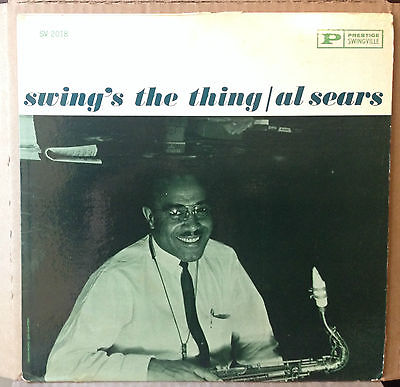
Listening to Prestige 416: Al Sears

Al Sears in his first Prestige session as leader. He'd co-helmed a Swingville session with Taft Jordan and Hilton Jefferson previously (as the Swingville All Stars), and played on Mildred Anderson's Bluesville recording in September 1960. Here he arrives with a quintet of mostly new to Prestige and mostly unfamiliar names, but they can swing, and as the title of his album declares. Swing's the Thing.

Wendell Marshall is the Prestige veteran here, the stalwart of many a Prestige, Moodsville, Bluesfille and Swingville recording session. Drummer Joe Marshall is no relation, and neither of them are related to the earlier Joe "Kaiser" Marshall, also a drummer for virtually everyone from the 1920s
through the 1940s. Or, for that matter, rock drummer John Marshall or British swing drummer Jim Marshall, later to gain fame as the inventor of the Marshall amp. This Joe Marshall kept the name alive starting in the 1940s with Milt Larkin, Jimmie Lunceford and Duke Ellington (the two Joes could almost have overlapped in the Ellington orchestra). In the 1950s, he played on a lot of rhythm and blues recordings, including albums by Ruth Brown and LaVern Baker, and was used on one of the first experiments with doubling up drummers, joining with Bobby Donaldson to provide the punch for a recording by Louisiana swamp rocker Joe Clay. He's on the original cast recording of the Fats Waller Broadway musical, Ain't Misbehavin'.

Guitarist Wally Richardson, born in 1930, came of age in the 1950s, playing jazz (Louis Armstrong), blues ( Willie Dixon -- for Prestige-- and John Lee Hooker), pop (Tony Bennett and Eartha Kitt), rhythm and blues (Frankie Lymon and the Four Tops). and even gospel (Mahalia Jackson). And in 1968, he returned to Prestige to make the recording, Soul Guru, for which he is best remembered.

Soul Guru reflected the fractured and fused music of the late 1960s, but jazz remained his first love. Now retired, he reflected in a recent interview with Pennsylvania's online newspaper The Citizen's Voice:
Jazz will never end. Maybe people won’t listen to it but it will always be there being created in some little club. It may take a curb because it is influenced by different parts of the world — Middle East, Africa, Europe — but it’s wherever Jazz people are. It’s a strong influence but it doesn’t make as much money as rock, but it’ll be there all the time. It’s like the spirit of music, the spirit of ...
Don Abney appeared on Sears' Swingville All Stars session, so he's had experience with Sears before. My guess is that all of them were guys who worked regularly in clubs with Sears. They certainly have an easy swinging familiarity.

The album is divided between originals and compositions by others, starting (taking them in the order of presentation on the record) with one by Walter Bishop, "Moving Out." Bishop was originally
Jamaican--his calypso, "Sex is a Misdemeanor (De More You Miss, de Meaner You Get)," continues to be widely performed--who went on to write songs recorded by Count Basie, Louis Jordan and others. His son, Walter Bishop, Jr., became an important pianist in the bebop era. "Moving Out" sounds as though it might be an Eric Dolphy title, but it's a lovely swing ballad that's given a choice introduction by Richardson before Sears takes over with some beautiful, relaxed, thoughtful swing. Abney has a strong solo also.

Three compositions by Sears follow. "Record Hop" is appropriately danceable, with some boppish elements (mostly provided by Abney). It's a four-and-a-half minute cut, and while that can all fit into the grooves of a four-and-a-half-minute 45 RPM disc, I'm guessing Abney's solo was cut for the jukebox release. "Take Off Road" takes off, from lyrical to harder driving swing, but without ever losing that lyrical feel. "Already Alright" has that lyricism too. As a composer, Sears is really only known for "Castle Rock," but these show him to be a worthy melodist.

Don Abney is also represented with one original, "Ain't No Use," which features a lot of piano and guitar, and which I liked a lot."

The others are standards, which Sears and co. handle with aplomb, particularly the Ellington standby, "In a Mellow Tone."

"Record Hop" is probably my favorite from the session, and it was released on 45 along with "Take Off Road." Esmond Edwards produced.

Listening to Prestige Vol. 2, 1955-56, and Vol. 3, 1957-58 now include, in the Kindle editions, links to all the "Listen to One" selections. All three volumes available from Amazon.

And Vol. 4 is very close to completion. Watch for it!

The most interesting book of its kind that I have ever seen. If any of you real jazz lovers want to know about some of the classic records made by some of the legends of jazz, get this book. LOVED IT.
– Terry Gibbs

Thursday, September 05, 2019

Listening to Prestige 415: St. Louis Jimmy

Jimmy Oden wasn't St. Louis's most famous blues export to Chicago--that would be Chuck Berry--but he was the one whose name identified him with the city, although he had actually been born in Nashville. Moving to the Gateway City in the 1920s, he entered a musical partnership with Roosevelt Sykes, and they dominated the St, Louis blues scene for a decade, sufficiently that when the two of them moved to Chicago, he brought the city's name with him, and kept it for the rest of his career. He had begun as a piano player, but perhaps because of his association with the piano virtuoso Sykes, he came to concentrate on vocal performance and songwriting. He
wrote a couple for Muddy Waters, and Waters and Sunnyland Slim backed him up on some of his early recordings.

Like another songwriter/vocalist, Percy Mayfield, he is mostly remembered for his songs, especially "Goin' Down Slow," a hit for him on the race records charts in 1941 which went on to become one of the most widely recorded of blues standards. It has been recorded by Chicago blues royalty--Little Walter, Howlin' Wolf, James Cotton, and by acoustic folk blues singers like Mance Lipscomb , Sonny Terry/Brownie McGhee, and Memphis Slim. Ray Charles recorded it twice, once in his early West Coast days and once in the 1960s on a blues album for ABC-Paramount. Jazz versions included Jimmy Witherspoon with Ben Webster. Rhythm and blues stars like Little Junior Parker, Bobby "Blue" Bland and B. B. King recorded. Across the Atlantic, it was picked up by Alexis Korner, the Animals,  ex-Animal Alan Price, Procol Harum and others. Movie stars have recorded it (Danny Glover). And new versions are still being recorded, most recently by Dee Dee Bridgewater (jazz) and Peter Frampton (rock).

Also like Percy Mayfield, his career had been spiked by a serious auto accident, in 1957. So this, his first album session, was also his first since recuperating from the accident.

Oden's voice had the rawness we associate with Chicago blues, but it also had a bit of a silken quality--again like Percy Mayfield, but still more Chicago raw than West Coast smooth. And he was used to working with the aggressive, take no prisoners style of the best Chicago bluesmen.

He had one of them on this session--Jimmie Lee Robinson, who had worked the Shakey Jake Harris date for Ozzie Cadena and Prestige just two days earlier. Pianist Robert Banks also comes over from the Shakey Jake session, and plays a much more featured role than he did with Harris. That had been full steam ahead electric guitar and mouth harp blues, this features a more sophisticated
 arrangement, built mostly around Banks's piano--similar to the original 1941 version on Bluebird, although Oden's voice has also developed in sophistication over the years.

Listening to Prestige Vol. 2, 1955-56, and Vol. 3, 1957-58 now include, in the Kindle editions, links to all the "Listen to One" selections. All three volumes available from Amazon.

The most interesting book of its kind that I have ever seen. If any of you real jazz lovers want to know about some of the classic records made by some of the legends of jazz, get this book. LOVED IT.
– Terry Gibbs

And Listening to Prestige Vol. 4 is not far off!  


Wednesday, September 04, 2019

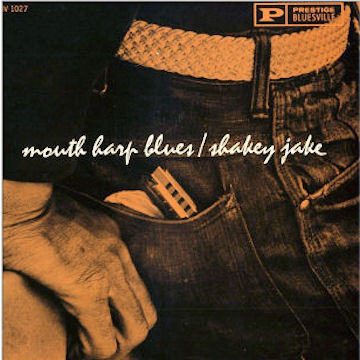
Listening to Prestige 414: Shakey Jake

Shakey Jake Harris's first Prestige outing put him together with two of the label's soul jazz all stars, Jack McDuff and Bill Jennings. This time he's given Robert Banks, who has played keyboards on a wide variety of blues recordings for Prestige, and Leonard Gaskin, one of the label's most reliable bassists. But the real sound here is pure Chicago, with Harris's harmonica and vocals, Jimmie Lee Robinson's guitar, and John "Junior" Blackmon's drums.

Prestige had used Robinson once before, on Al Smith's first album, where he also worked with Robert Banks, but this is his real wheelhouse. He was a Chicago bluesman, playing with Freddie King, Little Walter, Howlin' Wolf and Harris's nephew Magic Sam, before retiring to a certainly blues-traditioned career: running a Chicago neighborhood candy store. Blackmon was also from Chicago, and considered a reliable session man for blues recordings. Between the three of them, they bring pure Chicago to Englewood Cliffs, in the style of Magic Sam or Jimmy Reed, but very much his own man.

The songs are mostly by Harris. There's one by Armand "Jump" Jackson ("Angry Lover"), another Chicagoan, and one by producer Ozzie Cadena ("Things Are Different Baby"). There's an unusual instrumental ("Jake's Cha Cha"), a slower and soulful instrumental
("Mouth Harp Blues," which is Robinson's even more than Harris's, and has some nice piano by Banks), and a lot of solid Chicago blues, the sound that had fired up the rhythm and blues charts in the 1950s, and would rule the world as it began to be discovered by a younger generation in far-off England. Shakey Jake would never cash in on the popularity of Chicago blues the way some of his contemporaries did, but he would have a solid career, as musician, nightclub owner and crapshooter.

Mouth Harp Blues is the title of the album.


Listening to Prestige Vol. 2, 1955-56, and Vol. 3, 1957-58 now include, in the Kindle editions, links to all the "Listen to One" selections. All three volumes available from Amazon.

The most interesting book of its kind that I have ever seen. If any of you real jazz lovers want to know about some of the classic records made by some of the legends of jazz, get this book. LOVED IT.
– Terry Gibbs

And Listening to Prestige Vol. 4 is not far off!  


Thursday, August 22, 2019

Listening to Prestige 413: Memphis Slim

Prestige Bluesville released two Memphis Slim albums in 1961, each of them culled partly from an earlier session (April 26, 1960) and partly from this one. Although Slim had, throughout most of the 1940s and 1950s, fronted a rhythm and blues ensemble with a couple of saxophones, and one might have thought that side of him would have appealed to Bob Weinstock's jazz-oriented sensibilities, Prestige--like Folkways, which recorded him at about the same time--decided to emphasize his folk blues persona. The April session put him together with Lafayette Thomas, a rhythm and blues guitarist from the West Coast who was taking a folk blues sabbatical in New York, and jazz bassist Wendell Marshall. For this November session, Marshall is dropped, and Thomas is replaced by Buster Brown, here called Buster "Harpie" Brown, on harmonica.

Both sessions, though, belong to Memphis Slim's inventive boogie-woogie and blues piano playing, and his distinctive vocals.

One of the interesting things about different blues singers, as they expanded their audience from their neighbors in the delta to white folks from the north, is their different levels of intelligibility. Sometimes you didn't even have to be from the north. Early blues scholars and musicologists puzzled over some of Charley Patton's lyrics. Some they had to guess at, some they couldn't get at all. When Patton's friend and blues partner Son House was rediscovered in Rochester, New York, the scholars beat a path to his door, played some of the old records, and asked, "What's Charley saying here? And here? And here?"

House just laughed. "Nobody could ever understand what Charley was saying. You could be standing on the bandstand right next to him and you wouldn't understand."

Muddy Waters is supposed to have told Mick Jagger that too much attention to diction took away from the emotional power of the song, and it's an interesting idea, although Mick--and Elvis before him--were smart enough to know that you can't imitate the unintelligibility of a Delta blues singer, although Elvis himself was from pretty close to the Delta.

And Muddy may have something. People who don't speak a word of Italian can still be moved to tears by grand opera. On the other extreme from Charley Patton, whose music is emotionally searing, you have Josh White, whose diction is supper-club perfect, as opposed to coffee-house casual, and doesn't deliver that much of an emotional punch. Of course, diction is only part of that story. You can understand all the words to both Josh White's and Billie Holiday's version of "Strange Fruit," but only one of them will tear your guts out.

Robert Pete Williams is closer to the Patton end of the spectrum, and if you really wanted to get every word he was saying, you'd have to listen awfully closely, which of course is why you don't. You can get the drift of "Parole Renied Again," and feel the lonesome desperation a prisoner's hopes dashed, without understanding every word.

Muddy Waters' first recordings for the Library of Congress, when he was still in the Delta. By the time he started recording for Chess, even though it was still "race records," he'd spent some time in the North and while he wasn't thinking in terms of communicating with white audiences, his Delta accent has still thinned out some. Chuck Berry came to Chess a few years later. He was from St. Louis, and had grown up listening to Louis Jordan and Cab Calloway, and to the very different accents of the white country and western singers he heard and admired on the radio. The brilliance and wit of his lyrics, the incisiveness of his character development and social commentary, demanded that the words be understood.

Memphis Slim was originally from Memphis, but he made Chicago his home for many years, and, as with Muddy Waters, the North had its effect on his diction, although it's still very much his own, and he's certainly not sacrificing anything on the altar of making sure he's understood, although when the lyric is clever, as in "Beer Drinking Woman." the words come across clearly.  By the time he was reinventing himself as a purveyor of folk blues for Bluesville and Folkways, he knew his audience would be the white leftists for whom Lead Belly and Big Bill Broonzy and Brownie McGhee had reinvented themselves, creating a new audience and a new blues style. More power to them. They played their music, and got paid for it. And Memphis Slim was one of the greats.

How much he's adapted himself to a new audience can be heard in his Dragnet intro to an original blues he's been singing for a long time, "Beer Drinking Woman" (it's also on one of his Folkways albums with Willie Dixon).

His version of "My Baby Left Me" is very different from Arthur Crudup's (the one covered by Elvis)., but they have an opening verse in common. There are variations, but the basic structure is the same -- his baby has left him without saying a word, so he doesn't know if it was something he did or something that she heard.

"When Your Dough Roller Is Gone" sounds as though it's going to be another clever one, "dough roller" working as both allusion to sexual and breadwinning prowess, but it turns out to be a pretty straightforward blues about a lost lover. So is "Darling, I Miss You So," for all that the title sounds more like something Perry Como would sing. There's a comedy routine about what blues lyrics can and can't be about. It includes names that would never fit into a blues, like Sierra, Sequioa, Auburn or Rainbow. "Darling" comes close to making that list, but frankly, Memphis Slim could sing a blues about a woman named Sequoia, or even Muffy, and make it work.

And as good as his singing is, his piano playing seals the deal. If there are limitations on the possibilities of blues or boogie-woogie piano styles, you couldn't prove it by Slim. He includes some instrumental numbers in this session,  and each of them is a treat.

Slim is the engine that drives this whole session, and Buster Brown doesn't have that much to so. But when he is featured, as in "IC Blues" or "Motherless Child," he more than holds up his end.

These tracks were meshed with the earlier session and put out on two Bluesville albums, Just Blues and No Strain, both released on Bluesville during 1961.


Listening to Prestige Vol. 2, 1955-56, and Vol. 3, 1957-58 now include, in the Kindle editions, links to all the "Listen to One" selections. All three volumes available from Amazon.

The most interesting book of its kind that I have ever seen. If any of you real jazz lovers want to know about some of the classic records made by some of the legends of jazz, get this book. LOVED IT.
– Terry Gibbs

Monday, August 19, 2019

Listening to Prestige 412: Robert Pete Williams

November of 1960 was pretty much devoted to the blues at Bob Weinstock's label. Robert Pete Williams is another artist brought to Bluesville by folklorist Kenneth. S. Goldstein, Free Again is a more than apt title for the album: Williams had just been released from the Louisiana State Penitentiary at Angola, where he was serving time for murder (he had shot a man in a bar fight in 1956: he claimed self defense).

By that time he had been playing music around Baton
Rouge, Louisiana, since the 1930. while he supported himself by working in a sawmill. He had never made much money from the local fish fries, dances an church picnics he played at, but he was developing a unique guitar style and a powerful if idiosyncratic command of the blues, composing his own material, largely on the spot and improvised. He was discovered in prison by folklorists Harry Oster and Richard Allen.


Oster had found a circuitous route to the Angola prison. The son of Polish-Russian Jewish immigrants, a WWII vet and a Columbia Business School MBA, he then switched directions and took a BA from Harvard and a PhD from Cornell in English, and following the route of the migrant academic, took a position in the English Department at Louisiana State University, Baton Rouge, in 1955. If he didn't exactly travel in the same Baton Rouge social circles as Williams, their paths would cross soon enough as his burgeoning interest in folklore (He co-founded the Louisiana Folklore Society in 1956)  took him inside the walls of Angola to record the songs and reminiscences of inmates.

Struck by Williams's talent, as John and Alan Lomax had been by Lead Belly a generation earlier, and like the Lomaxes, he successfully petitioned the governor of Louisiana to give Williams a pardon. But it came with more strings than had been attached to Lead Belly's pardon. He had been able to go to New York (officially listed as the Lomaxes' chauffeur) and create something of a career for himself as a musician. Williams was placed on something called "servitude parole," which was like indentured servitude, only worse. He was ordered to work 80 hours a week on a farm near Baton Rouge, with only room and board for compensation. In "Death Blues," he compares his life in prison to his life of so-called freedom:

You know, they, they do allow a man a break up there.  But I ain't had nary here, since I been here.   

So there was no flying to New York for a Bluesville recording session in Englewood Cliffs with some of Prestige's finest musicians. Dr. Goldstein had to come down to Baton Rouge to record him there, with just his guitar.

Which for a Delta blues singer like Williams, with a style as idiosyncratic as his, is probably the best way to present him. He doesn't often bother with niceties like rhyme, and his songs often drift between free associative asides and equally free-associative sung parts. "Death Blues" is mostly talking -- addressed to a loved one, confessing thoughts of suicide and revealing that he sometimes feels dead already, before breaking into song with the heartbreaking "I don't blame nobody, nobody but myself."

The early country blues of Charlie Patton, Peetie Wheatstraw and the like are rightly prized for their authenticity. Decades later, the focus of the blues had shifted from the Delta to places like Chicago,  and Po' Henry Dorsey, a valued octogenarian blues singer from Louisiana, was to tell a 21st century interviewer that his chief influences had come from John R., the popular rhythm and blues disc jockey from WLAC in Nashville whose shows went out over clear channel starting in the 1950s. Coming a generation after the blues pioneers, Williams's music is still as authentic as it gets. The subject matter of his songs as recorded by Oster and Goldstein is largely his prison experience, with titles like "Parole Renied Again."

One of his most powerful songs. "I've Grown So Ugly," dessribes what prison will do to a man, changing him to the point where his girlfriend no longer recognizes him:

I left Angola
1964
Go walking down my street
Knock on my baby’s door
My baby come out
She asks me who I am
And I say, honey,
Don’t you know your man?
She said my man’s been gone
Since 1942
And I’ll tell you Mr. Ugly,
He didn’t look like you

The song, also called "Grown So Ugly," has been covered a couple of times by more contemporary artists. The iconoclastic Captain Beefheart recorded it in 1967, probably drawn to its dysphoric theme. In 2004, it was recorded by the Black Keys,  a white rock duo known for its blues influences.They're a good band, and they do a creditable job on the song, but it is very much the blues filtered through the prism of white privilege. Hopefully Williams got some royalties from the Beefheart version; he died in 1980, so the Black Keys were too late for him. An arrangement of it by the modernist classical composer Steven Mackey has been recorded by the Brentano String Quartet.

Williams's servitude parole ended in 1964, and he was able to play the Newport Folk Festival that year, and continue touring and playing folk and blues festivals in the USA and Europe. He would make several more albums, but Free Again is regarded by many as his best recorded session.


Friday, August 16, 2019

Listening to Prestige 411: Al Casey

Al Casey's second album for the Prestige family of labels has hum shifted from Swingville to Moodsville, but he's playing the same smart, snappy swing that he learned as a teenager in Fats Waller's band, and brought up to date in a regular gig with King Curtis that began in 1957.

Necessarily in the shadow of the flamboyant Waller, Casey stepped out on his own after the Fat Man's death in 1943, switching from acoustic to electric guitar, playing with Louis Armstrong, and winning the Esquire Magazine jazz critics poll for best traditional guitarist in both 1944 and 1945. He
remained in demand, playing with a wide variety of jazz greats who were looking for a traditional guitar sound (and some who weren't--he played with Charlie Parker). He made his debut for Prestige in 1950 in a group led by Eddie "Lockjaw" Davis, and his debut as leader ten years later.

The rest of the quartet is Belton Evans, who was playing a lot of drums for Prestige's blues and swing sessions in those days; and Jimmy Lewis, who would go on to make a name for himself in soul music. Both of them had played on his first Prestige album, and knew him from the King Curtis days. It's possible that Lee Anderson is from the same pool, but there's little to be discovered about him.

The Los Angeles Times obituary for Casey says that his job with the Fats Waller band was to  "keep
the band tight during Waller’s fun yelps and scats," and it's training he didn't lose when allowed to stretch out and take center stage as leader. On this session, comprising standards and one short blues number by Jimmy Lewis, he steps out and plays inventively in a style of his own, but still runs a tight ship.

The album was simply called Al Casey Quartet. It came out on Moodsville, and strangely has never been rereleased on CD as part of Concord's Original Jazz Classics.


Thursday, August 15, 2019

Listening to Prestige 410: Curtis Jones

Curtis Jones was another blues veteran who had a career in the 1930s, recording for Bluebird, Vocalion and Okeh, all of them budget labels (cheaply pressed, cheaply sold) specializing in race record, then faded from the recording scene sometime in the early 1940s, then resurrected a career in the Chicago folk music coffee houses in the 1950s. He was a little unusual for the folkie coffee house scene in that the tended to favor guys who played portable instruments like guitars, and Jones was a piano man, although he had started out on guitar, and could certainly have returned to it if that was where his bread and butter lay. A working musician does what he has to.

But Chicago had always had a blues piano scene, starting with Leroy Carr and including the likes of Memphis Slim and Champion Jack Dupree. And it was a good town for finding the kind of bluesmen that Bob Weinstock wanted to bring to New York--traditional blues with a touch of jazz thrown in--although Jones didn't stay long. He recorded the one album for Prestige Bluesville, then one back in Chicago in 1962 for Delmark, a latecomer to the jazz and blues independent label scene. Then he headed east again, but didn't stop until he got to Europe, where he would spend the rest of his life, dividing his time between the continent and Morocco.

Bluesville's producer Ozzie Cadena put Jones together with organist Robert Banks, veteran of several Prestige blues sessions, and Johnny "Moose" Walker, a Chicagoan and another fine blues piano player/organist. Organ and piano are pretty well covered for this session, though, so Walker, who also played bass for Muddy Waters. is heard on guitar. The primary instrumental voice, however, belongs to Jones's piano, and he really is one of the top notch blues stylists on the instrument.

Jones's biggest hit in the 1930s was "Lonesome Bedroom Blues," a 1937 recording for Vocalion. He reprises it here, and it would become the title cut for his Delmark album. The title cut for this one is "Trouble Blues," co-writing credit given to Jones and Cadena. Cadena is credited as sole composer for "Please Say Yes," which breaks away from the traditional 12-bar-blues structure often favored by Jones, and uses verse-chorus in a manner reminiscent of Ray Charles. He goes to Armand "Jump" Jackson for two songs, and to Pinetop Smith for "Pinetop's Boogie" (left off the original album, included on the CD reissue). The rest are all his own. Jazzdisco only has "NYC" as the location of the recording studio, while Wikipedia puts it at the Van Gelder studio in Englewood Cliffs.


Listening to Prestige Vol. 2, 1955-56, and Vol. 3, 1957-58 now include, in the Kindle editions, links to all the "Listen to One" selections. All three volumes available from Amazon.

The most interesting book of its kind that I have ever seen. If any of you real jazz lovers want to know about some of the classic records made by some of the legends of jazz, get this book. LOVED IT.
– Terry Gibbs