I've decided to put Situations, my epic newsletter, up on the Internet. Situations was originally sent out as a weekly newsletter to about 100 subscribers, then published in 2002 by Ye Olde Font Shoppe Press, Victoria Rivas' home of exquisitely produced books.
Now I'm recreating its original format. I'll be putting it up in installments, one week at a time. Well, I've started with the first two episodes, to whet appetites. They, along with the introduction that was written for the book, are up now on my Situations web page, linked above.
I'll also post the Introduction here, tomorrow.
Thursday, March 08, 2007


Saturday, March 03, 2007


Friday, March 02, 2007


Tuesday, February 27, 2007
The Bat Test
I've posted this before, but who can find old posts in a blog? Besides, I've revised it, and who knows, maybe I even have some new readers.
It's the background for an exercise I give my Creative Writing I students.
This is a student poem from a few years ago – the first draft of a poem that went on to become much, much better – bright and sensual and well-realized.
First Kiss
And my response, or the relevant part for this exercise:
Richard Hugo, in The Triggering Town, talks about "writing off the subject." I'd add another, similar suggestion: "Writing away from the subject."
Not only do you not need to say what you've already said, you don't need to say what you've already suggested. It’s close to impossible to write total non sequiturs. If something pops into your head, no matter how disconnected it may seem from what went before, it's connected because your head is the one it popped into.
 So the connections are there. They can’t help but be. Our minds are connection-making machines. That’s what they do. And that means you need to trust us as readers to make those connections. We will make them...sometimes even better than you, the poet, will, because we expect them to be there. If we know a poem is called "First Kiss," we'll connect anything that follows to the experience of a first kiss (whatever our experience of a first kiss is). So write away from it. Don't describe a first kiss. Describe something else.
Here's a stanza from a poem called “Summer Haiku” by Alicia Ostriker, which I originally found on Poetry Daily, and which you can now find on a website of the Montfort Literary Society, but I’ll post the whole poem below.The stanza reads
Now, instead of “Summer Haiku,” let’s call the poem
Once we see the title "First Kiss," we're going to relate whatever comes after to the idea of a first kiss. We may read this and think -- this is a kiss she shouldn't have gotten into. This is a dangerous first kiss -- irresistible because of its crazy danger, because of the moonlight...but dangerous.
I revised the first line slightly, but suppose we restore it to its original state?
FIRST KISS
A mother bat soars
Crazily across the moon,
Mouth full of insects.
What’s her mother doing in a poem about a first kiss? Because it has to be her mother…she’s the first thing in the poem, and she’s at a vantage point to spy on the girl.
And the mother is nurturing. Maybe too nurturing for a girl who’s ready to try life on her own, with a first kiss.
Let’s put the same stanza under another title from another student poem, the next in my stack:
It's the background for an exercise I give my Creative Writing I students.
This is a student poem from a few years ago – the first draft of a poem that went on to become much, much better – bright and sensual and well-realized.
The surf rushes forward,
falling with fury into a fluid fusion.
Waves whirl and intertwine.
Surges of synergic seduction plunge deeper
as they rise and tumble.
Ripples diminish, and bliss licks the shore.
The ocean’s caress recedes
and I, standing barefoot in the sand
know.
And my response, or the relevant part for this exercise:
You’ve already let us know that the poem is going to be about a romantic, breathtaking moment, by titling it “First Kiss.” So you don’t need to explain that.
You also don’t need to explain to the reader that surf is a crashing, exciting phenomenon. So ANYTHING you say about the waves will carry that. Which means that’s the one thing you DON’T want to say, because you’re saying it already. Adding anything about rushing, or fury, is going to be redundant, and will feel like overkill.
Richard Hugo, in The Triggering Town, talks about "writing off the subject." I'd add another, similar suggestion: "Writing away from the subject."
Not only do you not need to say what you've already said, you don't need to say what you've already suggested. It’s close to impossible to write total non sequiturs. If something pops into your head, no matter how disconnected it may seem from what went before, it's connected because your head is the one it popped into.
 So the connections are there. They can’t help but be. Our minds are connection-making machines. That’s what they do. And that means you need to trust us as readers to make those connections. We will make them...sometimes even better than you, the poet, will, because we expect them to be there. If we know a poem is called "First Kiss," we'll connect anything that follows to the experience of a first kiss (whatever our experience of a first kiss is). So write away from it. Don't describe a first kiss. Describe something else.
Here's a stanza from a poem called “Summer Haiku” by Alicia Ostriker, which I originally found on Poetry Daily, and which you can now find on a website of the Montfort Literary Society, but I’ll post the whole poem below.The stanza reads
A mother bat soars
Crazily across the moon,
Mouth full of insects.
Now, instead of “Summer Haiku,” let’s call the poem
FIRST KISS
That night, a bat soared
Crazily across the moon,
Mouth full of insects.
Once we see the title "First Kiss," we're going to relate whatever comes after to the idea of a first kiss. We may read this and think -- this is a kiss she shouldn't have gotten into. This is a dangerous first kiss -- irresistible because of its crazy danger, because of the moonlight...but dangerous.
I revised the first line slightly, but suppose we restore it to its original state?
A mother bat soars
Crazily across the moon,
Mouth full of insects.
What’s her mother doing in a poem about a first kiss? Because it has to be her mother…she’s the first thing in the poem, and she’s at a vantage point to spy on the girl.
And the mother is nurturing. Maybe too nurturing for a girl who’s ready to try life on her own, with a first kiss.
Let’s put the same stanza under another title from another student poem, the next in my stack:
AFTER AN ARGUMENT WITH MY GIRLFRIEND, I QUESTION MY LOVE FOR HER
A bat soars
Crazily across the moon,
her mouth full of insects.
Uh oh. We're in the present tense now -- not looking back at the first kiss from a distance of time, but right there with the guy as his girl friend storms away, and his mind is full of doubts. Why is he looking at the sky, and not at her? Maybe because of the doubts. He wants to shut her out, at least for the moment. But he can't shut her out -- anything he sees is going to be relevant. And he sees a bat flying crazily across the moon -- the symbol of romantic love being crossed by the symbol of vampirism -- the creature who will first appear sexual and enticing, but will then suck the blood and the soul out of you. And in the speaker's mind -- because there's no way he could actually know this -- the bat is a woman.
The mouthful of insects may not be such a symbol of nurturing here. It may be the girlfriend’s mouth when he kisses her, or when they argue.
I went back to Poetry Daily, grabbed the titles to next couple of titles after Ostriker’s, and stuck the bat under them.A DOG'S GRAVE
A mother bat soars
Crazily across the moon,
mouth full of insects.
He's visiting the dog's grave at night. He must be very lonely. And the solitary bat makes him feel even lonelier. But...it's a mother bat. Her mouth is full of insects for her babies. Even this world, bereft of a beloved dog, is full of life and nurturing in the strangest places...maybe? We have to read on.FAMILY REUNION
A mother bat soars
Crazily across the moon,
mouth full of insects.
You make the interpretation.
Or how about this? Ezra Pound's famous two-line poem.IN A STATION OF THE METRO
The apparition of these faces in the crowd,
Bats flying crazily across the moon.
Or William Carlos Williams:So much depends
upon
a mother bat
flying
crazily across
the moon
mouth full of
insects
The exercise? Take any one of the poems they've written for me up to this point in the semester, and revise it to include the bat.
Here’s the original:Summer Haiku
by Alicia Ostriker
All night the peepers
Singing around our small pond,
Drunk men, happy men.
A mother bat soars
Crazily across the moon,
Mouth full of insects.
A grasshopper leaps
Through the meadow, escaping
The mower. This time.
I am so little,
Thinks the leaping grasshopper,
Why not let me live?
Sunday, February 25, 2007
Let a Smile be Whose Umbrella?
"In poetry, to say "I" is to put on the mask."
-- Jon Corelis, on the Poetryetc. list
May a smile be my umbrella!
But of course, I'm not the fella,
And that smile is a corona
Not for me, but my persona.
-- Jon Corelis, on the Poetryetc. list
May a smile be my umbrella!
But of course, I'm not the fella,
And that smile is a corona
Not for me, but my persona.
Friday, February 23, 2007
Tagged for Ten
I am, apparently, part of a tag-team blogroll. I have been tagged by the redoubtable Anny Ballardini, as follows:
So, here is Anny's list:
As it happens, I just did this exercise about a year ago for a website called The Cinematheque, so although Anny is quite right, and one's lists are subject to change at a moment's notice, I'll reprise that list here:
And extras. Anything by Kurosawa, but especially Dersu Uzala: The Hunter and the underrated Dreams. Anything with Errol Flynn, but special mention to Robin Hood, which I'm re-watching now with my 6-year-old grandson, and The Sea Hawk, where Michael Curtiz once again had the benefit of a wonderful screenplay by Howard Koch. Some Hollywood B movies that achieved a level of greatness: Abbott and Costello Meet Frankenstein, Tarzan and his Mate, The Incredible Shrinking Man. Rosselini directing De Sica in Generale Della Rovere. Cagney in Yankee Doodle Dandy. And on that note...my mother thanks you, my father thanks you, my sister thanks you, and I thank you.
I can't think of anyone to pass it along to. Who do I know who has a blog, whom Anny doesn't know? I'm sure I'm forgetting someone. But I'll post this anyway.
Okay, I have been tagged by our Great Tom Beckett who was tagged by Richard Lopez (who by the way mentions The Hitcher - movie I also wanted to quote) to name 10 favorite movies, not too bad, indeed. Difficult, though, these are just the first I was able to dig up, I am sure there are plenty more and will come out in the next few hours with a comment, how could I forget that one?
So, here is Anny's list:
1. La vita è bella (Life is beautiful) Benigni
2. Apocalypse now (Redux is all right) Francis Ford Coppola (loosely based on Heart of Darkness by Joseph Conrad)
3. A Beautiful Mind by Ron Howard
4. American Beauty by Sam Mendes with Kevin Spacey and Annette Bening
5. Catch Me If You Can by Steven Spielberg, I even liked Leonardo Di Caprio in this perfomance besides the usual Tom Hanks (see Philadelphia, Save Private Ryan, The Da Vinci Code, There is mail for you,
6. Dogville by Lars von Trier (not exceptional but I can forgive much to a movie that features Nicole Kidman)
7. The Experiment (a must see) by Oliver Hirschbiegel (based on the 1971 Stanford University simulation study of the psychology of imprisonment)
8. Girlfight by Karyn Kusama with Diana Guzman
9. The Lord of the Rings (3) by Peter Jackson and Harry Potter (the entire series)
10. Eyes Wide Shut by Stanley Kubrick with Nicole Kidman and Tom Cruise
10. The Matrix + The Matrix Reloaded by Andy Wachowski with Keanu Reeves and Carrie Ann Moss, originally taken from William Gibson’s homonymous novel.
As it happens, I just did this exercise about a year ago for a website called The Cinematheque, so although Anny is quite right, and one's lists are subject to change at a moment's notice, I'll reprise that list here:
1. Casablanca (Michael Curtiz, 1943)
It's customary to list a movie by director, so I've followed that custom, and Michael Curtiz was a Hollywood giant, with a career that stretched from the slient era to the 60s. He directed some of Errol Flynn's classics (which means some of my favorite movies) like Captain Blood and Charge of the Light Brigade; he directed Yankee Doodle Dandy and Young Man With a Horn and We're No Angels, a movie I had occasion to quote to my Honors English class last week. And he directed The Sea Hawk, also with Errol Flynn, but I'll get to that.
But for me, Casablanca is not Curtiz's movie, or even Bogart's. It belongs to Howard Koch, beloved friend and mentor, who co-wrote the screenplay. Here's looking at you, Howard.
2. The Seventh Seal (Ingmar Bergman, 1957)
Your most formative experiences are, unsurprisingly enough, come in your most formative years. I was seventeen when I first saw The Seventh Seal, and I can't count the number of times I've seen it since then. And every time, I get that same rush of awe that I felt the first time I saw it.
3. The Bicycle Thief (Vittorio De Sica, 1948)
I have an Italian film too, Anny -- not at the top of the list, but high up. I used to tell my screenwriting students, "Any one of you could make this movie. You could raise the kind of budget he had. You could go out in the streets of Poughkeepsie with a hand held camera, as he did in Rome. You could use amateur actors, as he did. All you'd need would be genius."
4. Ran (Akira Kurosawa, 1985)
Anything by Kurosawa. Throne of Blood did Shakespeare (a Samurai Macbeth) almost as well, but Ran, his Samurai King Lear, benefits from Kurosawa's masterful use of color and the big screen. And why you should still go out to the movies: There's a scene in Ran where the king and the fool are sitting on top of a hill, talking. At the foot of the hill, in the lower right hand corner of the screen, is a dappled white horse. And I thought as I watched it, "On TV or vCR that horse won't even be on the screen."
5. Red River (Howard Hawks, 1948)
The classic Oedipal Western, worth the price of admission just for the closeups of the cowboys' faces yelling as the trail drive begins. If you wondered whether John Wayne could act, watch his disintegrating personality in this movie.
6. A Night at the Opera (Sam Wood, 1935)
You could pick any Marx Brothers movie. I picked this one.
7. Cabin in the Sky (Vincente Minnelli, 1943) -– the best Louis Armstrong showcase on film, and no ten best list of anything that has an opportunity to include Louis Armstrong should leave him out. I almost picked High Society for the same reason – I know most people don’t even think it’s the best version of this story, but it is, because of Satch, Bing and Frank.
8. Scaramouche (George Sidney, 1952) -- I am pleased to report that two movies on my list -- Scaramouche and Cabin in the Sky -- didn't even make the NY Times list of the 1000 best movies (three if you count my honorable mention for High Society). I take this as a tribute to my unerring good taste. Swashbuckling is one of the things the movies do best, how can you pass up a guy who was born with the gift of laughter and a sense that the world was mad?
9. War and Peace (Sergei Bondarchuk, 1968) -- It would be easy to make a ten best list entirely from movies that did not make the NY Times 1000 Best List (Modern Times, Ivan the Terrible Parts I and II, Rio Bravo, just to name a few). I had put Lawrence of Arabia on my listoriginally, and it's a great spectacle, but I had forgotten the greatest spectacle of all time (so did the NY Times, but I'm making amends for my error). Featuring the entire Russian army, and wonderful acting, and not a slack moment in nearly seven hours of running time.
10. The Last Waltz (Martin Scorsese, 1978)
Best concert film ever.
And extras. Anything by Kurosawa, but especially Dersu Uzala: The Hunter and the underrated Dreams. Anything with Errol Flynn, but special mention to Robin Hood, which I'm re-watching now with my 6-year-old grandson, and The Sea Hawk, where Michael Curtiz once again had the benefit of a wonderful screenplay by Howard Koch. Some Hollywood B movies that achieved a level of greatness: Abbott and Costello Meet Frankenstein, Tarzan and his Mate, The Incredible Shrinking Man. Rosselini directing De Sica in Generale Della Rovere. Cagney in Yankee Doodle Dandy. And on that note...my mother thanks you, my father thanks you, my sister thanks you, and I thank you.
I can't think of anyone to pass it along to. Who do I know who has a blog, whom Anny doesn't know? I'm sure I'm forgetting someone. But I'll post this anyway.
Tuesday, February 20, 2007
Lips Like Chew Toys
Can't keep doing the same things every year, even though they always come out differently, so I tried a new exercise in my creative writing class last night, and it worked pretty well. I passed out strips of paper to all my students, and had each of them write a simile -- whatever came into their heads.
Then I had them read out their similes, and discuss how they worked -- what the second part of the simile told us about the first part. Pretty standard exercise. "Her lips were like orchid petals" -- her lips were soft, moist, warm, rare, valuable, etc. -- even bluish in color.
Then I collected all the slips of paper, tore them in half, shuffled them around, retaped them together, read the similes created that way, and discussed what these new similes told us.
"Her lips were like a chew toy for men." That makes the lips different, doesn't it? What do we picture now? Chapped -- maybe rough and reddened from too much passionate, violent kissing -- and apparently with more than one man.
"Her unshaven legs were like a desert cactus" became "Her unshaven legs were like burning embers." So rough you could strike a match on them? Capable of exciting passion even though unshaven?
My point...you don't have to worry about making connections too obvious. The human mind is a connection-making machine -- it's wired to look for connections between things. You can take chances, try for the unexpected, try for effects you may not even understand yourself.
As Richard Hugo says in his great book, The Triggering Town, "when you are writing you must assume that the next thing you put
down belongs not for reasons of logic, good sense, or narrative development, but because
you put it there. You, the same person who said that, also said this. The adhesive force
is your way of writing, not sensible connection."
Wednesday, February 14, 2007
Speaking of Auden
I think for a lot of our generation, Auden was a god that failed and then was partially resurrected. He was one of my poetic heroes, then became someone I didn't want to be -- glib, superficial, and either wit at the expense of substance or substance at the expense of wit. Richard Hugo said it really well in his wonderful book, The Triggering Town:
So I -- and a lot of others I've talked to -- didn't want to be in that Auden camp. I didn't want to write about things I was sure of, and bend language to illustrate those sureties.
But hey, Auden was great, and gradually I came back to recognizing that, if never back to looking at him as a poetic role model. He wrote lots and lots of poems that had both wit and substance.
When you start to write, you carry to the page one of two attitudes, though you may not be aware of it. One is that all music must conform to truth. The other, that all truth must conform to music. If you believe the first, you are making your job very difficult, and you are not only limiting the writing of poems to something done only by the very witty and clever, such as Auden, you are weakening the justification for creative writing programs. So you can take that attitude if you want, but you are jeopardizing my livelihood as well as your chances of writing a good poem. If the second attitude is right, then I still have a job. Let's pretend it is right because I need the money. Besides, if you feel truth must conform to music, those of us who find life bewildering and who don't know what things mean, but love the sounds of words enough to fight through draft after draft of a poem, can go on writing--try to stop us.
So I -- and a lot of others I've talked to -- didn't want to be in that Auden camp. I didn't want to write about things I was sure of, and bend language to illustrate those sureties.
But hey, Auden was great, and gradually I came back to recognizing that, if never back to looking at him as a poetic role model. He wrote lots and lots of poems that had both wit and substance.
Saturday, February 10, 2007
What Poets Do
I don't use the Fucking Your Sister letter as an assignment to critique, I use it as an assignment to provoke discussion. What was hard about the assignment? I get a variety of answers, but generally they're along these lines; It was about emotions that were painful. It was hard to imagine myself in that situation. I didn't know what to start with. I had a hard time fitting it all in, or putting it together. I didn't know why I would be telling all this to this person I hadn't talked to in a long time.
And what was fun about it? I got to use my imagination. It was a challenge. It has...no one actually ever says this in my class, but I think that's because they're scared of me at that point...it has all that neat stuff like sex and death and forbidden desires. Anyway, whatever they come up with, I can turn into my object lesson...this is what poets do. They have to reach deep into themselves for emotions they may not be comfortable with. They have to find words for those emotions, and organize them. But they get to exercise their imagination, and write about all that neat stuff.
And what was fun about it? I got to use my imagination. It was a challenge. It has...no one actually ever says this in my class, but I think that's because they're scared of me at that point...it has all that neat stuff like sex and death and forbidden desires. Anyway, whatever they come up with, I can turn into my object lesson...this is what poets do. They have to reach deep into themselves for emotions they may not be comfortable with. They have to find words for those emotions, and organize them. But they get to exercise their imagination, and write about all that neat stuff.
Sunday, January 28, 2007
More About That Letter
This came from a poetry class I taught years ago in prison. I assigned different students to lead the class discussion of different poets in our anthology. One was Diane Wakoski, and one of her poems was this:
The guy who had been given the assignment said, "This broad is crazy - and if she ever wrote me, I wouldn't even write her back."
it occurred to me that this was prison, and there wasn't much outside stimulation, crazy or otherwise, that wouldn't get a response. But there was something about his formulation that got to me, and I said,
"Are you sure? You get a letter from someone you haven't heard from in a long time - 'Dear Ken, I have to talk to someone about this, and you're the only one I can turn to. My brother....' Sure she's crazy -- grief and stress have driven her around the bend. But she's reaching out to you. Are you sure you wouldn't write her back?"
His face was very serious now. "Yes, of course I'd write her back."
Well, a poem is a letter to someone we don't know. But we want them to write us back -- to be moved enough that we've established a connection. And we can't count on friendship, or prior emotional ties, to get them to read our letter and write back. We can count to some small degree on the story being good enough. But mostly we have to draw them in by writing it well enough.
Justice Is Reason Enough
He, who once was my brother, is dead by his own hand.
Even now, years later, I see his thin form lying on the sand
where the sheltered sea washes against those cliffs
he chose to die from. Mother took me back there every
day for over a year and asked me, in her whining way, why it
had to happen
over and over again—until I wanted
never to hear of David any more. How
could I tell her of his dream about the gull beating its
wings
effortlessly together until they drew blood?
Would it explain anything, and how can I tell
anyone here about the great form and its beating wings.
How it
swoops down and covers me, and the dark tension leaves
me with blood on my mouth and thighs. But it was that
dream,
you must know, that brought my tight, sullen little
brother to my room that night and pushed his whole
taut body
right over mine until I yielded, and together we yielded
to the dark tension.
Over a thousand passing years, I will never forget
him, who was my brother, who is dead. Mother asked
me why
every day for a year; and I told her justice. Justice is
reason enough for anything ugly. It balances the beauty
in the world.
The guy who had been given the assignment said, "This broad is crazy - and if she ever wrote me, I wouldn't even write her back."
it occurred to me that this was prison, and there wasn't much outside stimulation, crazy or otherwise, that wouldn't get a response. But there was something about his formulation that got to me, and I said,
"Are you sure? You get a letter from someone you haven't heard from in a long time - 'Dear Ken, I have to talk to someone about this, and you're the only one I can turn to. My brother....' Sure she's crazy -- grief and stress have driven her around the bend. But she's reaching out to you. Are you sure you wouldn't write her back?"
His face was very serious now. "Yes, of course I'd write her back."
Well, a poem is a letter to someone we don't know. But we want them to write us back -- to be moved enough that we've established a connection. And we can't count on friendship, or prior emotional ties, to get them to read our letter and write back. We can count to some small degree on the story being good enough. But mostly we have to draw them in by writing it well enough.
Tuesday, January 23, 2007
Some Winter Shots
Not much winter, so far. No snow, and not cold weather till mid-January. But winter mornings can yield their own pleasures, especially if you're lucky enough to catch the dawn just coloring the mountain behind Opus 40:


New Semester, First Exercise
I generally start out my semester in Creative Writing with the following exercise.
You're writing a letter to someone -- it doesn't matter who -- someone of your choosing, real or imagined. It's someone you have not communicated with in a while, and you have to fill this person in on what's been happening in your life. And what's been happening is not good. You have a twin -- probably of the opposite sex, but that's your choice, too. About a year ago, your twin committed suicide by jumping off a cliff. It's been a terrible shock, but you're trying to put it behind you and get on with your life.
But your mother can't do it. She can't put it behind her. She keeps taking you up to the cliff, over and over, and asking, "Why did this have to happen?"
The worst part of it is, you know something that she doesn't, that might explain why it happened. Three days before the suicide, your twin came into your room at night, and had sex with you.
You're sure it happened. But you're a little foggy beyond that -- maybe you were dreaming, maybe your consciousness was a little off. Perhaps you don't know for sure whether you were forced, or a willing participant.
OK, write the letter. You can leave when you turn it in, we'll talk about it next time.
That's all I tell them. So that's all I'll write here, for now.
Monday, January 22, 2007
Winter Visitor

For four days this week, we had a guinea fowl take up residence on our deck. Certainly not a wild fowl -- they aren't exactly indigenous -- and much too willing to make himself at home. We fed him birdseed, and finally we called our friend and neighbor, local farmer John Wrolsen, who came and took it -- it will bunk with his birds until he finds its real home.
Anyway, here's the little feller, with Opus 40 in the background:
Sunday, December 17, 2006
Harvey with a student
Very nice picture from the Bard archives at the Hudson River Valley Heritage site.
Thursday, November 30, 2006
Thwarted
I wrote this in response to questions from a high school student working on a paper about what writers do.
The interviewer was my friend Mary Shen Barnidge, for her newsletter about stage fighting, Moulinet. The interviewee was Dawn "Sam" Alden of Babes With Blades.
1) How do you look at your original insight, inspiration, idea for your writing? Is it something that you control, or is it something with a life of its own? (I'm talking about the main idea of a book, not necessarily the characters or anything else)
You control the main idea -- the original insight. And while it comes from somewhere, you can generally trace where it comes from. The novel I've just finished, "Nick and Jake," comes from many conversations with my brother (we co-wrote it) over the years about the idea of having the main characters of The Great Gatsby and The Sun Also Rises meet, 25 years later, after WWII. We were prodded to start writing it post 9/11, post- George Bush's destruction of the worldwide concern and good will for America. We started thinking about how that happened post WWII, in the 50s McCarthy-CIA era, and realized our Nick and Jake story would be a perfect vehicle.
Now we're getting ready to start work on another book we've wanted to write for years, and the inspiration for this is our heritage -- our parents and their friends, the people we had for role models growing up. It'll be a historical novel about the Woodstock artists' colony in the 20s and 30s, and a theme involving two artists whom we respected and admired, who came to be rivals.
2) How do you develop your characters, scenarios, or the main ideas for your writing? How do you test out different ideas for characters, for example?
That really comes from the writing. This is not a usual experience, but if you're looking for odd stories from the writing life. My brother Jon and I live on opposite sides of the continent, and we decided to try and collaborate by email and instant message. That led to the choice of an epistolary novel, although we might have chosen it anyway. So our character development -- of the main characters, and the supporting characters -- came, to a considerable extent, by daring each other -- "let's see what you can do with this!!!" It proved to be a wonderful technique.
And last of all, the most important question for my purposes (and I think the most interesting one of all):
3) So, when its all said and done, do you feel that you lose control of your characters in a way? Does your perception of them change over time? Do you find them doing things you didn't forsee or plan? Do they take the book in a different direction than you intended? Why do you think this is, if at all?
I just read something terrific in an interview with a woman who choreographs fight scenes for stage productions. She was talking about choreographing a duel between two topless ladies.
The interviewer asked: Did you start stripping from the beginning, or work up to it gradually?
Choreographer: We choreographed all the fights first, concentrating on what you always concentrate on when creating a fight --
What story is being told?
How would these characters fight in these circumstances?
What choices do they make to accomplish their goals?
What do they do when thwarted?
So when we began to rehearse with the shirts off, we found that no changes were necessary.
You probably can't use the topless part of it in your paper, but the rest is incredible -- it's exactly what we need to do in writing a story. And the part about the choices characters make to accomplish their goals. and what they do when thwarted -- well, you can see exactly how that applies to stage fighting, but it applies to creating characters too. And you really don't know before you start -- have to discover in the writing -- the choices -- emotional, psychological, strategic, well-chosen, poorly chosen -- that your characters will come up with until you put them into a situation. And you certainly don't know what they're going to when thwarted until you put the obstacles in their paths.
One more story -- I once had to write a novel very very fast, against a deadline. At a certain point in the novel, the heroine has to plead with her old lover, now the leader of a revolution, for the life of her new lover. I knew, because I'd outlined the whole story, that she succeeds. But when I got to the scene, I couldn't figure out how. What could she possibly say? I didn't have time to wrestle with it, because of the deadline. But I was stuck, and I couldn't afford to be stuck. I decided to go ahead and write the next chapter, and come back to this, but I couldn't do it. Too linear. So
I came up with a solution out of desperation -- I never would have done this in my right mind. I decided to fool myself. Write "Chapter 14," then write seven or eight pages of total gibberish, then write "Chapter 15." So I did. And I got to the end of the book. And when I came back to actually write Chapter 14, I found to my amazement some phrases that contained psychological insights that would work for the confrontation. Who knows where they came from?
The interviewer was my friend Mary Shen Barnidge, for her newsletter about stage fighting, Moulinet. The interviewee was Dawn "Sam" Alden of Babes With Blades.
Saturday, November 25, 2006
The Dead
A poem of mine in Iowa Writes, an online feature of the University of Iowa and Iowa Review.
Thursday, November 09, 2006
Congratulations
To John Hall, our friend and neighbor, great musician, and now Congressman from the 19th congressional district, described by the Poughkeepsie Journal as
The first rock star ever to make the move to Congress, John is no stranger to local politics, and no stranger to involvement with major issues. I'm confident that he'll join Maurice Hinchey in giving the Hudson Valley some of the strongest and best representation in Congress.
northern Westchester and all of Putnam, expanding north to cover most of Dutchess County, traveling through northern Rockland County, then gobbling up most of Orange County all the way to the New Jersey and Pennsylvania borders. The district is a fascinating mix of suburban wealth, rural quiet, farmland and small-town struggles. While not quite a microcosm of New York state - the district lacks big cities and their problems - the 19th does bridge upstate with downstate, even reflecting "middle America'' and its struggles.
The first rock star ever to make the move to Congress, John is no stranger to local politics, and no stranger to involvement with major issues. I'm confident that he'll join Maurice Hinchey in giving the Hudson Valley some of the strongest and best representation in Congress.
Opus 40 in the Autumn
Is mid-November still autumn? It is this year. The leaves have fallen, but the weather is still beautiful.
Not beautiful yet, but a huge advance. Last night it rained, so the pool needs to be pumped again, but not very much. This time we'll also bring in a mudsucker to get down into the last layer of leaves and suck out all the water, so we can get everything.
The pool won't really fill up till next spring, but a little water will come back into it, so when it freezes this winter we'll have a sunken ice rink. I'll get photos of that, too.
Our big autumn job this year is cleaning out the Shallow Pool, the big one by the meadow. It's long overdue, but it's being done. We're probably about three quarters of the way through it, as of last weekend. Most of the leaves and muck are out, and it looks like this:
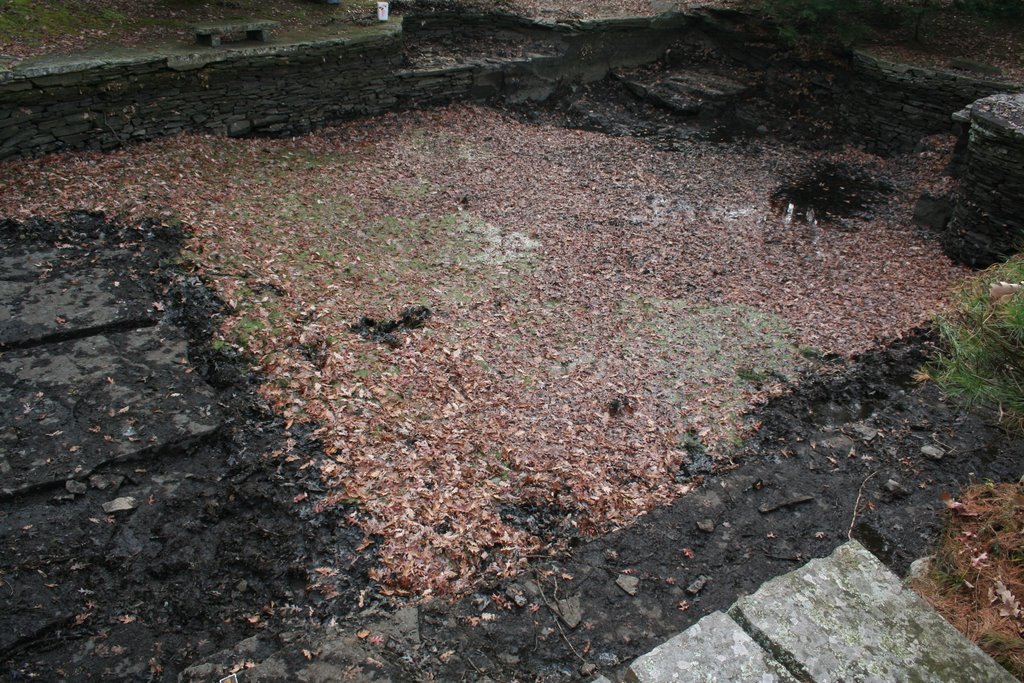
Not beautiful yet, but a huge advance. Last night it rained, so the pool needs to be pumped again, but not very much. This time we'll also bring in a mudsucker to get down into the last layer of leaves and suck out all the water, so we can get everything.
The pool won't really fill up till next spring, but a little water will come back into it, so when it freezes this winter we'll have a sunken ice rink. I'll get photos of that, too.
Subscribe to:
Posts (Atom)