Tad Richards' odyssey through the catalog of Prestige Records:an unofficial and idiosyncratic history of jazz in the 50s and 60s. With occasional digressions.
The day after backing Roosevelt Sykes, King Curtis and his group were back in the studio with another blues piano man, Sunnyland Slim.
It was a contrast in styles Both were from the Delta area--Sykes from Elmar, Arkansas, and Slim (Albert Luandrew) from Vance, Mississippi. They were they same age--54 at the time these recordings were made. Both called Chicago home, and were part of that Chicago blues scene, Slim even more than Sykes. He played, over the years, in the bands of Muddy Waters (Muddy was his guitar player for his first recording session), Sonny Boy Williamson, Little Walter, Howlin' Wolf, and Robert Jr. Lockwood, whereas Sykes eschewed the electric blues sound,
decamping from Chicago to New Orleans in the early 1950s, as that style gained the ascendancy on the South Side.
But Sykes, who first came north in 1929 to record for Okeh Records in New York, adopted a more urban style. Slim's journey to Chicago led through Memphis in the 1920s, where he worked with Ma Rainey among others, and while his piano style reflected the modernity of his associations, his voice stayed in the Delta, with that rich rawness we associate with the Delta blues singers.
This makes for a different kind of collaboration with Curtis and his urban jazz/rhythm and blues musicians. On two cuts, "I'm Prison Bound" (by Brownie McGhee) and "Harlem Can't Be Heaven," Curtis sits out, leaving the field to Slim and Robert Banks, whose organ brings the arrangement up to 1960, while at the same time carrying that Delta feeling. By contrast, on "Shake It," a Big Joe Turner composition but a standard part of Slim's repertoire, he brings a lot more Chicago into his vocal, and Curtis provides a foot-stomping solo.
This admixture of styles makes for a fascinating album, where you never quite know what mixture you're going to get net. "Decoration Day" starts out with a moody blue intro from Curtis, and then Slim enters with his Delta voice and a real down home twelve-bar blues that nonetheless fits with what Curtis had started. Curtis returns with another sax solo, followed by Banks pulling out all the stops (or the equivalent on an electric organ). In other words, this is a session that gives the participants a chance to explore every possible way of playing together.
Of particular interest, the Leroy Carr classic "How Long Blues." just because it's such a great tune and it's interesting to hear anyone play it. And the two instrumental numbers, "Slim's Shout" (co-composer credit, Ozzie Cadena) and "Sunnyland Special," both of which feature just some great blowing. Chicagoan Slim pays an affectionate tribute to the Big Apple with "Harlem Can't Be Heaven."
Robert Banks should have had more of a prominent career than he did.
This is a great album.
A curiosity: Most of Slim's originals are credited to Sunnyland Slim, but one ("Sunnyland Special") is under his birth name, Albert Luandrew. And even odder. on "Every Time I Get to Drinking," co-composer credit is given to Luandrew and Slim.
Two Bluesville 45s came from the session: "Baby How Long" / "It's You Baby" and "I'm Prison Bound" / "Slim's Shout." Slim's Shout was also the name of the Bluesville album. "Every Time I Get to Drinking" and "Tired of You Clowning" were left off the LP, but added to the CD reissue.
Listening to Prestige Vol. 2, 1955-56, and Vol. 3, 1957-58 now include, in the Kindle editions, links to all the "Listen to One" selections. All three volumes available from Amazon.
The most interesting book of its kind that I have ever seen. If any of you real jazz lovers want to know about some of the classic records made by some of the legends of jazz, get this book. LOVED IT.
This is Roosevelt Sykes' second album for Prestige. The first used a rhythm and blues lineup of tenor sax and rhythm section such as Sykes had used on his biggest hit, "The Honeydripper." That seemed to work well, so they've returned for it with this outing, but this time the Chicago session men from the first outing are replaced by King Curtis and a crew of some of New York's finest musicians from the rhythm and blues side of the jazz spectrum. Curtis regular Robert Banks, who joined the King or an Al Smith session on Prestige, is here on the organ, and Belton Evans, previously used by Prestige on a Swingville session with Al Casey, plays drums. The bassist is bebop veteran Leonard Gaskin, who
appeared on one of Prestige's first recording sessions with J. J. Johnson and Kenny Dorham, and more recently joined Curtis and Banks to back up Al Smith.
He's still in good form here, playing and singing the blues with a flair for double entendre, a powerful voice and a steady rolling piano that sets the tone.
What's really new here comes on the fourth cut of the day (and the third on the album), "Yes Lawd." It's the only song not written by Sykes--it was supplied by Ozzie Cadena, who would in a couple of years become a producer and head of Artists and Repertoire for Prestige. I've remarked before that the main practical difference between jazz and rhythm and blues in the 1950s was that jazz became an LP art form, while rhythm and blues was still essentially a singles art form. Jazz recordings opened up to take advantage of the greater length of the LP record, and so it is here with "Yes, Lawd." Every other track on the album is short -- "Miss Ida B.," at 4:57, is the only one that pushes the limits of the 45 RPM
single. "Yes, Lawd," is over 9 minutes, and allows for extended solos by Banks and Curtis, and one by Sykes as well.
Esmond Edwards produced. The album came out on Bluesville, and was titled The Honeydripper, although Sykes's signature song was not on it. A Bluesville 45 had "Miss Ida B." as the A side, "Satellite Baby" as the flip side.
Listening to Prestige Vol. 2, 1955-56, and Vol. 3, 1957-58 now include, in the Kindle editions, links to all the "Listen to One" selections. All three volumes available from Amazon. The most interesting book of its kind that I have ever seen. If any of you real jazz lovers want to know about some of the classic records made by some of the legends of jazz, get this book. LOVED IT. – Terry Gibbs
On the YouTube page for "Soul Street," the person who uses the nom de tube NAFTALI2 says:
Those who heard Jimmy Forrest in person said the most dreaded position on stage is being another tenor player along side of him.
NAFTALI2 may be a little biased in favor of Forrest:
In this cut, standing with jazz stalwarts, not amateurs by any means, guys who are more critically acclaimed, guys who got more studio time, guys you've heard of--from Jimmy's first flourish, you can sense they just want to go home. He continues his solo showing his harmonic complexity, incredible sense of rhythm and groove, the ability to move effortlessly from the beautiful to the honking blues, and the ability to build his solo.
That's going a little overboard. Nelson and Curtis contribute wonderfully to this session too, but he's not wrong about Forrest, an unjustly overlooked jazzman. I've checked a few internet lists of greatest jazz saxophonists, and he doesn't make any of them (well, he makes the Ranker.com list now, because I added him). And this is a real oversight.
Forrest is probably best known for "Night Train," one of the best-known rhythm and blues instrumentals. Forrest takes composer credit for the tune, developed from a Duke Ellington riff, and all in all he probably deserves it. He made the first recording of "Night Train," and it's been recorded over 120 times since, mostly but not always as an instrumental, including a 1982 version by Forrest with Shirley Scott.
Forrest's first appearance on Prestige was a 1952 session recorded live in a nightclub in his native St, Louis, with Miles Davis sitting in on trumpet. I wrote about it:
A few online reviews of this session tend to give it short shrift -- recording quality not all that great, playing competent but uninspired.
They couldn't be more wrong...this session, recorded live in a St. Louis nightclub, is the real thing. This is jazz in 1952, a piece of living history, jazz as it was, and played by working musicians in small clubs in the Midwest, music that came out of the legacy of the territorial bands of the 20s and 30s, the nighttime wail of America that John Clellon Holmes captured so vividly in The Horn, still the greatest jazz novel.
He returned to the label in 1958, with the Prestige Blues-Swingers ensemble, then joined with fellow Midwesterners Jack McDuff and Bill Jennings to back up singer Betty Roché, made an album with McDuff and Lem Winchester, and just a month before this session, an album as leader with young organ phenom Larry Young. He would continue to record for Prestige through 1962.
This is mostly an Oliver Nelson album, and I'll get on to him, but NAFTALI2's praise of Forrest's contribution to "Soul Street" is not misplaced. His solo is lyrical and raunchy, inventive and deeply satisfying.
NAFTALI2 finishes his encomium to Forrest with these words:
For years there were alto players in St. Louis who were disciples of Nelson, all the while never having heard Jimmy Forrest, who lived just around the corner. Upon hearing Forrest for the first time, they always asked why they hadn't heard of him before, shaking their heads in awe.
Forrest wrote "Soul Battle," and it was left off the original release of the album, only added as a bonus track for the CD release, perhaps another nail in the coffin of Forrest's legacy.
Nelson wrote all the rest of the tunes on the album except for Juan Tizol's "Perdido." He was rightly becoming recognized as a rising star and a brilliant composer. As I said in my notes to his previous Prestige session, it's amazing that his compositions really haven't broken through to become jazz standards. There are some terrific ones here.
"Blues at the Five Spot" opens with an evocative interplay between Gene Casey and George Duvivier, then introduces a repeated riff that morphs into some blues figures that are just right for three saxophone players who each have a feeling for the blues.
Nelson stays with the blues, and stays in New York, moving from the legendary downtown jazz club to the radio, with "Blues for M. F. (Mort Fega). Fega was one of New York's early champions of jazz on the radio, with a show that ran opposite the better-known Symphony Sid Torin on radio station WEVD. Nelson's tribute is a real atmospheric blues, with plenty of room, at nearly ten minutes, for soloists to explore all its possibilities.
"Anacruses" are the series of unstressed notes that come before the first complete measure of a composition, which makes an interesting title for this composition, because there aren't any. After a complex but driving drum roll by Roy Haynes, Nelson and cohorts hit the ground running in this very different take on the blues, powerful and aggressive.
"In Passing" begins as an almost nostalgic blues, and then becomes very modern--a striking and powerful transition.
Esmond Edwards produced the session. Except for "Soul Street," the tunes comprised the Prestige album Soul Battle, credited to the three tenormen. "Soul Street" appeared as the title track on a New Jazz album, a 1964 release joining numbers from different sessions.
Listening to Prestige Vol. 2, 1955-56, and Vol. 3, 1957-58 now include, in the Kindle editions, links to all the "Listen to One" selections. All three volumes available from Amazon.
"The most interesting book of its kind that I have ever seen. If any of you real jazz lovers want to know about some of the classic records made by some of the legends of jazz, get this book. LOVED IT." – Terry Gibbs
The Davis/Griffin pairing, two intense, hard-blowing, hard-bop tenor saxophonists, is legendary among jazz aficionados, but it was surprisingly short-lived. This, their first pairing, was also their only studio album for Prestige, although an extended live recording was released on four different albums over the next several years, so the recorded output of their partnership lasted a good deal longer than the partnership, or than Griffin's tenure on this side of the Atlantic. They also recorded a few albums together for the Riverside subsidiary Jazzland, and Griffin on his own for Riverside, before the diminutive "Little Giant" of the tenor decamped for Europe. where years later they would reunite for one more session.
Johnny Griffin had made plenty of music before he got together with Mr. Jaws, starting as a student at that cradle of jazz, Chicago's DuSable High School, where at age 15, in 1943, he was already playing in T-Bone Walker's band. Immediately after graduation, in 1945, he joined Lionel Hampton's band, which became a proving ground for many future beboppers.
Still primarily working out of Chicago, he made his first recording as leader in 1956, for the Chess subidiary Argo, after which he came to New York as a Blue Note artist, and his first Blue Note session became the first album to actually be released under his own name.
There were recordings for Riverside, and some memorable sessions with Art Blakey's Jazz Messengers and with Thelonious Monk, including one album with a group co-led by the two jazz giants, before Bob Weinstock and Esmond Edwards got him together with Davis.
This is a full-throttle session, starting with "Pull My Coat," a tune written by Richard Evans. Since there are several composers named Richard Evans, it took some digging to find the right one, but the digging was worth it, as it uncovered another fascinating jazz story of a young Chicagoan and contemporary of Griffin's, who also made his recording debut (and only album as leader) for Argo.
Let's digress a little and find out more about Evans, who grew up in Chicago in the 1940s, going to
...the Regal Theater. Later, I found out it was part of what they called the chitlin circuit. I remember being about nine years old and going there. You could watch two movies, and then watch Count Basie live, Duke Ellington live, and Fats Waller live. And we loved Fats Waller because at the end of the show, he’d take the curtain, wrap it around his belly, and shake it. [laughs] Cab Calloway was there too. I tell you this because, for some reason, we knew we were getting something special and that we were privileged to see these people live.
And if you turned on the radio, you had Al Benson, a Black disc jockey who’d play Black music. And when the Black programming was done, you’d hear Polish programming and their music. And I never turned the radio off. I listened to all kinds of stuff. I knew polkas, how they went, and how they sounded. Chicago has the largest Polish population outside of Warsaw, so I absorbed a lot of Polish tunes and their distinct style. My stepfather was [actually] a farmer and began working the steel mill when the war started. When he’d make us breakfast, he’d listen to country music, so that’s how I heard country. So I had listened to jazz, the blues, Polish music, and country, and Minnie Pearl even.
As a kid, I didn’t know I was gonna grow up to be a musician. It just worked out that I came across diverse stuff when I was young. Plus, later I found out I could listen to a song once and arrange it without reading the sheet music.
Evans knew he wanted to be an artist, but he hadn't connected with music until his older brother, in a letter from Guam, told him he should be a musician, and since he idolized his older brother, he started playing the bass, because
...it was a quiet instrument. People could see me play it but could not really hear it, so they wouldn’t know that I wasn’t a real musician.
But when his brother got out of the service and went to work in the steel mill, he saved up his money
and bought young Richard a bass, and then the boy knew that he couldn't let his hero down. He had to become a real musician. He went on to become a musician (with Sun Ra), composer and producer--for Cadet, which was Argo with a new name, and for whom he produced Marlena Shaw (he wrote her biggest hit, "Woman of the Ghetto"), Donny Hathaway, and Woody Herman, in spite of Leonard Chess's misgivings:
Leonard Chess called me and said, “You signed that old fade Woody?” I told Leonard that I could still get a hit out of him. So we went to a hotel ballroom in North Chicago and rehearsed some songs. We only had four tracks: one track for reeds, one for rhythm, one for solos, and one for brass. We cut that whole album, Light My Fire, in two and a half hours. It turned out to become a Grammy-nominated album.
Another life in the jazz business. There eight million stories in the Naked City, three million stories in the Windy City, and Lord knows how many in the disapora of jazz, and they're all good. This has been one of them.
Does "Pull My Coat" reflect Evans's early Polish influence? Maybe only the title -- "The Pull My
Coat Polka?" -- sounds like a hit for Jimmy Sturr, doesn't it? Certainly not the way Griffin and Davis play it. It's bebop you can dance to, driving and wailing and riff-driven and lyrical at the same time.
The rest of their set list is wonderfully eclectic. They go to Fletcher Henderson for the little-heard "What's Happening?", which includes a romping and stomping piano solo from Norman Simmons, and Simmons himself contributes the next number, "Abundance," which is a vehicle for a dialogue between the contrasting sounds of the two boss tenors.
"63rd Street Theme" is a Griffin original, down and dirty, with lots of room for great blowing, and you could dance to it. "Hey Jim" is solidly from the bebop era, by Babs Gonzalez and James Moody,.
And "If I Had You"is a chestnut from the 1920s by Jimmy Campbell and Reg Connelly, composers of the drunkard's anthem "Show Me the Way to Go Home," and the romantic ballad "Try a Little Tenderness," co-written with Tin Pan Alley veteran Ted Shapiro. It was the last tune of the day for them, the only ballad, and the one song from the entire set that can be called a standard, with admirers in virtually every genre. Every genre? Well, in 1955 alone, it was covered by jazz singer Barbara Carroll, pop singer Margaret Whiting, avant-gardist Lennie Tristano, and country singer Rusty Draper. We've heard it recently on a Prestige session by Etta Jones. Davis and Griffin give it that classic bebop treatment of starting sweet and opening up to some wild and creative blowing, before cycling back to the head again.
The players in the rhythm section are all making their Prestige debuts. Pianist Norman Simmons was Johnny Griffin's homeboy from Chicago, and like Griffin, had made his debut as a leader for Argo in 1956. He would become probably best known as an accompanist to some of jazz's finest singers, including Betty Carter, Anita O'Day, Etta Jones and Dakota Staton, with long and fruitful collaborations with both Carmen MacRae and Joe Williams. He was also in demand as an arranger, working with Johnny Griffin's big band and others--most famously, arranging Ramsey Lewis's hit record "Wade in the Water."
Victo Sproles was also part of that Chicago gang. He and Simmons started out together, playing with Red Rodney and Ira Sullivan on an album called Modern Music from Chicago. He was part of Griffin's big band, and teamed up with Simmons behind Joe Williams.
Ben Riley played on all the Davis/Griffin sessions for Prestige and Riverside/Jazzland, and a lot more--over 300 albums to his credit. In an obituary, Michael J. West, for WBGO's web page, described his style:
His drumming was noted for understatement, and for a slightly skewed rhythmic conception that could keep the listener off balance. If these seem contradictory, it was perhaps Riley’s greatest gift that he reconciled them.
On this album, particularly on "Abundance," you can hear him doing exactly that.
Esmond Edwards produced the session, which was released on Prestige as Battle Royal. "Pull My Coat" also came out as a two-side 45 RPM disc, edited down for the jukeboxes and the dancers to feature the two saxophones--Norman Simmons's piano solo is cut.
Listening to Prestige Vol. 2, 1955-56, and Vol. 3, 1957-58 now include, in the Kindle editions, links to all the "Listen to One" selections. All three vokunes available from Amazon.
The most interesting book of its kind that I have ever seen. If any of you real jazz lovers want to know about some of the classic records made by some of the legends of jazz, get this book. LOVED IT.
How does one get a recording contract? Or how did one, back in the day? John Wright was playing a gig in his native Chicago. There was a Sunday jam session at a club near the hotel where most of the touring big bands stayed, and players from the Hampton or Ellington band, or whatever band was passing through Chicago, would come and jam. After one of these sessions,
a fellow walked in and said, “I’m from New York, I’m a hiring man for one of the companies in New York, and I’ve got a spot for you. Would you like to come to New
York and record?” Well, I’ve heard of Prestige Records and Riverside, Coral, and Blue Note, those were the most prestigious jazz records back in the day. Quite naturally, I said yes. So, he gave me a plane ticket and $500. In August 1960, I went to New York City and that’s where I got to record five albums on Prestige Records.
Why not? Wright brought his regular trio with him, and he brought a breath of Chicago with him--not the breath that was hog butcher to the world, but the one that came out of the jazz clubs on the South Side. As Wright ran it down in a later interview, the album
...was talking about the streets of Chicago; South Side Soul; Sin Corner (Sin Corner was about every corner); Amen Corner (Amen Corner was the churches); 63th and Cottage Grove; 35th Street Blues, 47th Street (47th street was a red-light district) and LaSalle Street was the financial district. The blocks on State Street, Wentworth, and Cottage Grove, were always storefront churches. It was about two or three storefront churches in every block.
One might expect such a thematic album to be entirely self=composed, but such is not the case.
Wright takes composing credit for the red light district and "63rd and Cottage Grove." bandmate Wendell Roberts contributes the "35th Street Blues" and the "Amen Corner." The financial district after hours and the sin corner were the product of another composer, and an understandable pairing, since who knows what goes on in the financial district of a large metropolis after hours, especially in those days, when the big brokerage offices were macho central? The composer was Armand "Jump" Jackson, a jazz and rhythm and blues drummer and all-around entrepreneur and impresario. "South Side Soul," which became the album's title, Wright's signature song, and part of his name--from then on he was John "South Side Soul" Wright, appears not to have been written by a Chicagoan at all. Composer credit goes to producer Esmond Edwards, and since Edwards did not make a regular habit of slapping his name on other people's compositions, it seems likely that the credit was deserved.
By the end of the 1950s, Chicago had started to make a significant name for itself as the home of the electric blues of Muddy Waters and Howlin' Wolf, Chuck Berry and Bo Diddley, but Wright was making South Side soul of a different sort, the kind of piano trio jazz that Chess Records songwriter-producer Willie Dixon started out in, and that Ahmad Jamal was making in the more upscale part of the city.
But if Wright wasn't making quite the kind of hard-edged blues that Chess artists like Otis Spann were making, his South Side sound was funkier and bluesier than the uptown jazz of Jamal. The blues penetrate every note he plays, and it makes for some very good listening.
Wendell Roberts and Walter McCants are South Siders who remained part of the Chicago scene without making broader waves in the jazz world, but they know about the blues and provide sympathetic support to Wright. McCant's son Nolan has made a name for himself as a photographer.
"Sin Corner" and "Amen Corner" were released as a 45 RPM single.
I've talked about the blues revival starting in earnest after the 1962 release of Robert Johnson: King of the Delta Blues Singers in 1962, and of course by "blues revival" I mean the new expanded audience, mostly white, that started putting on blues festivals, that sought out old Delta musicians like Son House, that followed the British rockers to sweet home Chicago and the musicians who had been creating a new electric blues. But there were some young white folks who had fallen in love with the blues earlier, people like Happy Traum who sought out and studied with Brownie McGhee, and other young New Yorkers who came up to Harlem to learn from the blind preacher and street singer, Blind Gary Davis, also known as the Reverend Gary Davis (which he was), or the Harlem Street Singer (which he also was.)
Just a few of those: Bob Dylan, Stefan Grossman, David Bromberg, Dave Van Ronk, Rory Block, Larry Campbell, and the Grateful Dead's Bob Weir (the Dead would record "Samson and Delilah" and "Death Don't Have No Mercy." So Davis's influence and his sound were far-reaching, far beyond those who actually heard him in performance or on record.
His influence went deeper than that. Originally from the Piedmont region, he taught Blind Boy Fuller, who in turn mentored Sonny Terry and Brownie McGhee. He was a remarkably gifted musician. Some credit part of his virtuosity to a broken wrist that was set at an odd angle, making it possible for him to reach in and make difficult chords.
He had made a few records in the 1930s for ARC, the "race" records subsidiary of Columbia, not very successfully. He could never get used to the recording studio, and saw no need to finish a song just because the red "recording" light went out. He was a more accomplished musician than Blind Boy Fuller and the other blues musicians who had been signed, but he was paid less, because of his lack of studio experience and skills, and that rankled him. He was also, by that time, singing religious music (he became an ordained minister in 1937) and clashed with ARC's producers over that--they wanted blues.
He would not record again until 1954, when he made an album for Stinson, a New York-based label. Stinson may have been the perfect archetype of the adoption of blues and rural folk music by urban leftists: it was founded by Communists for the purpose of issuing recordings from the Soviet Union. It even pressed its records on red vinyl.
He next recorded one album for Riverside in 1956, then nothing until his series of Folkways albums in 1960-61. He recorded through the mid-1960s, and went on preaching and performing until shortly before his death in 1972.
The session--all spirituals, although as Davis became more and more embraced by the new blues audience, he did start to expand his repertoire to include some secular music--was produced by folklorist Kenneth S. Goldstein, and released by Bluesville as Harlem Street Singer. The Jazzdisco website lists the session as having taken place in New York City. Wikipedia puts in the Van Gelder studio, but it seems more likely that it was not. About half the songs recorded that day were never released. Later rereleases on Prestige and the short-lived Prestige Folkore were titled Pure Religion.
You may start listening to this album thinking of the poignancy of two young lives. Lem Winchester would be dead a few months after this session. Oliver Nelson was at the beginning of a career that would last into the next decade and include many recordings, but he would die of a heart attack at age 45.
But however you started listening to it, you would very quickly be in the thrall of the music. Nelson and Winchester are both brilliant soloists, and so is the underrated Richard Wyands. But the real show-stopper here is Nelson as composer.
Nelson began to be recognized as a composer for his Impulse! album, Blues and the Poetic Truth, and he went on to have considerable commercial success composing and arranging music for movies and TV, and he composed several symphonic works. But his greatness as a composer didn't start with Blues and the Poetic Truth. Listen to any of his originals on this album: "Nocturne," "Early Morning," or particularly "Bob's Blues."
It surprised me to discover, as highly regarded as Nelson is in jazz circles, how few recordings of the tunes from Blues and the Poetic Truth have been made by others. It absolutely shocked me to discover that none of his other compositions have even been recorded. I defy any jazz musician reading this blog to listen to "Bob's Blues" and say that he or she wouldn't like to make their own interpretation of it.
The album is called Nocturne. Esmond Edwards produced. It was released on Moodsville after Winchester's death, as we see in this four-star review from the April 24, 1961 issue of Billboard:
One of the newer jazz names is spotlighted in this moody compilation of torch ballads. Oliver Nelson plays both tenor and alto on the date with a genuine regard for the ballad form. He is caught, along with the late vibes player Lem Winchester, on seven feelingful tracks playing some beautiful melodic material.
The Billboard reviewer goes on to single out "In a Sentimental Mood" (Duke Ellington),"Time After Time" (Jule Styne) and "Man with a Horn" (Jenney, Lake, deLange) for mention, but none of Nelson's originals, so recognition of his composing skills was a little slow in coming. Granted, these are all first-rate tunes, but so are Nelson's.
Listening to Prestige Vol. 2, 1955-56, and Vol. 3, 1957-58 now include, in the Kindle editions, links to all the "Listen to One" selections. Available from Amazon.
Brownie McGhee had recorded for Prestige once before, in 1951, predating the Bluesville label by nearly a decade, during an earlier and shorter-lived flirtation with folk blues by Bob Weinstock. I've pointed out that Weinstock's Bluesville anticipated the full-out blues craze that would come later in the 1960s, generally credited with dating from the 1961 Columbia release on LP of Robert Johnson: King of the Delta Blues Singers, which gathered together some of the recordings Johnson had made in the 1930s.
Terry and McGhee were contemporaries of Johnson's, but from a different region. Johnson was from the Mississippi Delta, as were the blues singers like Muddy Waters, Howlin' Wolf and Sonny Boy Williamson who migrated to the Midwest, mostly Chicago. Terry and McGhee were from the East Coast, the Piedmont plateau, which runs more or less parallel to the Appalachian mountain range across several southern states, and which gave its name to the Piedmont style of blues.
The most important progenitor of the Piedmont blues style was Blind Boy Fuller, both McGhee and Terry worked with him, Terry as his harmonica-playing sidekick, McGhee leading him and absorbing his guitar style. All three of them had become full time musicians, playing on the street or for local dances, because physical disabilities left them with no other career choices. Fuller and Terry were both blind; McGhee's legs were crippled by polio.
Fuller was, among other things, a master of the double entendre dirty blues, the composer of such classics as "Keep on Truckin', Mama" and "What's that Smells Like Fish?" Like Robert Johnson, he had been sought out by John Hammond to appear in his 1938 "From Spirituals to Swing" concert at Carnegie Hall (presumably to do cleaner material), and like Johnson, he didn't make it. In both cases, in true blues fashion, there was a woman involved. Johnson was dead, poisoned by a jealous husband; Fuller was in prison for shooting his wife in the leg. Terry took his place, and stayed in New York.
The two of them began their guitar-harmonica partnership in New York in the early 1940s. Later in the decade, they drifted apart. McGhee tried his hand at rhythm and blues, following the lead of his brother, Stick McGhee, who had a substantial R&B hit with "Drinkin' Wine Spo-Dee-O-Dee." Terry found himself on Broadway, in the cast of the musical Finian's Rainbow, about an Irish family (and leprechaun) in the segregated South.
In the 1950s, they resumed their professional partnership, which was to last over the next several decades. Like Lead Belly before them, they learned quickly that the audience for folk blues in New York was white leftists, and they adapted their style to that audience. Terry frequently collaborated with Woody Guthrie. They developed a repertoire of old songs adapted to their style, and songs of their own composing, that--unlike the electric blues that Southern transplants to Chicago and Detroit were developing--remained acoustic and fit in well with the folk music scene that was developing around Woody Guthrie, Pete Seeger and their ilk.
Terry wrote a song about Lead Belly -- "Me and Huddie Ledbetter, Huddie Ledbetter was my friend," which McGee adapted to "Me and old Sonny, Sonny Terry was my friend," but from many accounts, that was not strictly true. They did not get along. But unlike the rock groups that came
along in the late 20th century, that let personality and ego clashes break them up just when they were reaching their pinnacle of success, Terry and McGhee kept a successful business relationship going, and McGhee kept singing about how old Sonny was his best friend.
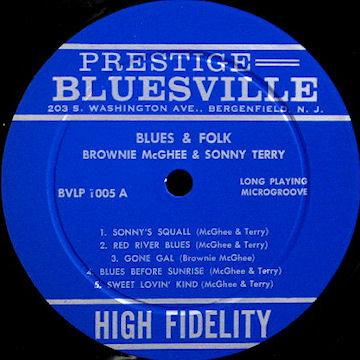
Their sessions for Bluesville mostly featured the same songs, and the same arrangements, that they recorded for Folkways and Stinson and whatever other folk-oriented labels wanted to pick them up. Roy Haynes joins them on a few tracks, but essentially they resisted the Prestige Bluesville treatment. And that's mostly good. I love the Bluesville albums that put traditional bluesmen together with jazz musicians from the Prestige orbit, but McGhee and Terry had a formula that worked, and went on entertaining people for a great many years, so why mess with it?
These sessions were released on a series of Bluesville albums: Down Home Blues (also on Prestige Folklore, a short-lived Prestige venture that did mostly re-releases in 1963-64), Blues And Folk, Blues All Round My Head, Blues In My Soul. There were some 45 RPM releases: "Let Me Be Your Little Dog" / "Stranger Here," "Too Nicey Mama" / "Pawn Shop," and "Beggin' And Cryin'" / "Freight Train."
Listening to Prestige Vol. 3, 1957-58 now includes, in its Kindle edition, links to all the "Listen to One" selections. Available from Amazon.
This is the second outing for the Latin Jazz Quintet and a Prestige star, following their July 8 outing with Shirley Scott. The lineup is 4/5 the same, with a bongo player dropped and vibist Carlie Simons added. I talk more about the other members of the group in the Scott entry, and I can't find any information at all on Simons, not even after plowing past all the Carly Simon links that Google starts you out with. Another source gives his name as Charlie Simmons, but I can't find anything under that name either.
The LJQ was primarily Juan Amalbert's group, with the rest of the personnel given to fluctuation. They made a second recording with Dolphy for United Artists a year later, and only Amalbert and Bill Ellington remained of the original group.
Critics have described this session as a mismatch, with Dolphy and the quintet paying little attention to each other. I've seen the same criticism leveled at Charlie Parker's collaborations with Machito (and for that matter at some of the Prestige recordings featuring Ray Barretto). I don't buy it. Bird in his day, and Dolphy in his, were far too aware, and far too appreciative of a wide range of musical styles and voices, to come into a session so contemptuous of their fellow musicians that they wouldn't listen to what was being put down, or to simply not be able to follow Latin rhythms. I don't buy it, and they sound good to me. The Quintet have a busy, agitated style of playing for the most part, and Dolphy gets with them and then takes them in directions that are his own. He's a better, more inventive musician than they are, but he's a better and more inventive musician than almost anyone, and he works with them to create something that's musically satisfying to this listener, at any rate. And it must have been sufficiently musically satisfying to all concerned that they agreed to do it again.
I particularly liked Dolphy playing flute on Gene Casey's "Sunday Go Meetin'," which also features some impressive piano work by Casey, a versatile composer who is responsible for three of the tunes on this album, the others being "Caribé" and "First Bass Line." "Blues in 6/8" and "Mambo Ricci" are co-credited to Amalbert and Jose Ricci, a sometime member of the Quintet who is not in their lineup for this session.
As always, it's good to hear the new sounds and new approaches that come out of one of Weinstock's Mis and Match sessions.
Caribé was a New Jazz release, Esmond Edwards producing.
Listening to Prestige Vol. 3, 1957-58 now includes, in its Kindle edition, links to all the "Listen to One" selections. Available from Amazon.
Willis, Jack, and Bill, back again, and proving once more that they know how to play the music folks want to hear.
And proving once again what a blessing it was that Bob Weinstock decided to sign up musicians like Jackson and Hal Singer, bringing what had been marginalized as rhythm and blues into the main stream of jazz, into the recording cathedral of Rudy Van Gelder, and onto the long playing record.
The main difference between jazz and rhythm and blues, as I've said before, is basically the difference between the jukebox and the jazz radio broadcast, between the 45 RPM record and the LP. Give musicians like Willis Jackson, Jack McDuff and Bill Jennings eight minutes instead of three to play a tune like "Cookin' Sherry," and you get the full potential of rhythm and blues--room for three great soloists to open up, stretch out, and develop their solos without sacrificing any of that rhythm and blues intensity. You can dance your ass off to "Cookin' Sherry," or you can snap your fingers and listen to what the soloists are doing, what the two other principals are doing behind the solo, what Wendell Marshall and Bill Elliott are doing--all the things that make jazz the twentieth century's answer to chamber music, only hotter. Or any combination of the above.
"Cookin' Sherry," "Blue Gator" and "Tu'gether" are the three Jackson originals from the session, with composer credit for "Mellow Blues" given to the three of them. But this trio, although they would go their separate ways, made such tight, inventive and listenable music together that you wouldn't go far wrong in thinking of them as the MJQ of gutbucket. On all of these numbers they each have solos that complement the others as though they shared one mind or set of guts, while still expressing irrepressible individualism.
They do right by other people's compositions, too. Jackson shows his ballad side on "Try a Little Tenderness," which comes in at just under six minutes and is mostly him, although Jennings contributes a sensitive and unusual guitar solo. Jimmy Dorsey's "Contrasts" brings rhythm and blues to swing, or vice versa, and why not?
Esmond Edwards produced. The session was split up and sprinkled over three albums. "Blue Gator" was on its eponymous album along with "Try a Little Tenderness." "Cookin' Sherry" was also eponymous, joined by "Contrasts" and "Mellow Blues." "Tu'gether" didn't quite manage eponymity, but close. It was on the album called Together Again. Three two-sided 45s came out of the session: "Cookin' Sherry," "Blue Gator" and "Tu'gether."
Listening to Prestige Vol. 3, 1957-58 now includes, in its Kindle edition, links to all the "Listen to One" selections. Available from Amazon.
This is the debut session for one of the most auspicious careers in jazz. Ron Carter would go on to make over 2,000 recording dates, almost certainly the most by any jazz musician. But it's an unusual debut in that the pre-eminent bass virtuoso of his era is playing the cello, rather than the bass.
The cello has a sparse history in jazz, but it does have a history, going back to W. C. Handy, who used a cellist in his ensemble. One of his cellists was William Grant Still, who went on to establish a reputation as America's first important African American classical composer. During the 1950s, probably the best known jazz cellist was Fred Katz, who worked with the Chico Hamilton Quintet--a group which included Eric Dolphy in 1958-59, just before Dolphy came to New York to move forward with his own career. Ron Carter had been trained
as a cellist before picking up the bass, but there was never going to be all that much call for a cellist in jazz.
Still, it makes a striking debut for him, and this whole session is a striking musical outing. Dolphy is really coming into his own here, making a kind of music that was so thoroughly his own that it's still hard to describe. The three great innovators of this era were Coltrane, Ornette Coleman and Dolphy, and sometimes they, and the others who pursued experimentation in the same era, like Albert Ayler, Sun Ra, Pharaoh Sanders and Cecil Taylor, are grouped together as free jazz, but they really were doing very different things. Dolphy is also sometimes labeled as "third stream," which is probably even more difficult to define than free jazz. His collaborations with John Colrane were also panned in Down Beat as "anti-jazz," but that's just shortsighted and not worth discussing.
Free jazz, more or less, is generally defined as jazz that is not structured around chord changes. It was a polarizing musical form in the early 1960s, as bebop was in the 1940s. Miles Davis, though he was to pioneer he his own revolt against the conventions of bebop, remarked that Ornette Coleman had just fucked up everybody; Roy Eldridge thought he was jiving everyone. Arthur Taylor was compiling his remarkable book of interviews during the years that free jazz (or "freedom music," as he calls it in the book) was in its ascendancy, and he asked a lot of musicians about it.
Dexter Gordon, when Taylor asked his opinion of free jazz, said "My manager told me there would be days like this!" and continued to evade Taylor's every attempt to pin him down on the subject. Randy Weston loved Ornette Coleman but hated the concept of free jazz--"It is completely built up by white writers...My objection is that I don't see how this music is more free than another," and others felt the same way. Philly Joe Jones said that "freedom music doesn't mean anything to me because I've been playing free my whole life." He admired Coltrane and Dolphy -- "These men were geniuses. They knew exactly what they were going to do," but he had little use for those for whom "John Coltrane opened the door...I call them bag carriers. The bags that they carry their instruments in...They...don't know anything about the horn and just make a bunch of noises...I think freedom music should be limited to those who can play it."
And Ron Carter, in Taylor's interview with him, made an excellent point: "If you hear some guy play freedom who does not know bebop and is not hip to swing, he is just playing off the top of his head. He's not really as free as someone with a musical background."
Third stream is even harder to pin down. This album could be third stream, because you have one guy playing the cello and another guy playing the bass clarinet, except that Gunther Schuller, who invented the term and mostly defined it in terms of what it was not, said that "it is not jazz played on 'classical' instruments. In fact, he said that there was no such thing as third stream jazz--third stream music was a third stream, neither classical nor jazz. Not to put down Schuller, whose contribution to modern music is immense, but neither classical nor jazz is a single stream.
Which brings me back to the contribution of Eric Dolphy, who died much too young, but in the space of a very few years created a voice which was one of the most original and expressive in jazz history. Call it third stream, free jazz, freedom music, anti-jazz or advanced bebop, it is some of the most arresting, nourishing, invigorating music anyone has ever made. The collaboration of cello and whatever instrument Dolphy is playing on any given track could not be richer and more satisfying.
"Out There" is the title track to the album, and one could say it continues the journey he started with Outward Bound. Now he's there...but of course, every new outing by Dolphy was a new stop on an outward bound journey. "Out There," a Dolphy composition, is probably as close as the album comes to a more familiar form of jazz, with a sort of beboppish structure, but Dolphy is taking it to unexpected places, and so is Carter. This is the first tune of the day, and the first cut on the record, so it was the group's introduction to what they'd be doing that day, and it's the listener's introduction to where Dolphy is now.
It's hard to look back in time and try to imagine yourself hearing 1960's music through 1960's ears. Or 1944's music, for that matter. Or any era. It's hard to imagine the waltz causing a scandal, but it did when it was first introduced. The author of the Wikipedia entry on the waltz found this shocked description of it:
In the 1771 German novel Geschichte des Fräuleins von Sternheim by Sophie von La Roche, a high-minded character complains about the newly introduced waltz among aristocrats thus: "But when he put his arm around her, pressed her to his breast, cavorted with her in the shameless, indecent whirling-dance of the Germans and engaged in a familiarity that broke all the bounds of good breeding—then my silent misery turned into burning rage."
Of course, the history of jazz is so dynamic, and so compressed in time, that in 1960 there were still those who thought that bebop was just so much noise, and there were those who thought it was the soundtrack of their lives, and there were those who thought it was a straitjacket they had to burst out of. It's hard to imagine what it would be like to find the waltz scandalous, and it's hard to imagine what it would be like to find bebop cacophonous. I can't go back and try to imagine being flummoxed by Eric Dolphy, because in 1960, I was young enough and adventurous enough to embrace the avant garde with open arms. I had stood in front of Ornette Coleman's bandstand at the Five Spot, I had taken John Coltrane's Giant Steps to my heart, and I was ready for the next new thing. But even so, it's hard to recapture that feeling. Dolphy still sounds fresh and new, just as Charlie Parker still sounds fresh and new (Johann Strauss, not so much), but listening to him today, he sounds very much in the tradition. You can hear the progression of jazz history in his playing, which is what Philly Joe Jones was talking about.
"Feathers" was written by Hale Smith, and if there's a third stream, Smith was right in the middle of it. Trained in both classical and jazz piano from age seven, played in a band with Ernie Freeman and Howard Roberts as a Cleveland teenager (where he was also a protege of Duke Ellington), conservatory trained at the Cleveland Institute of Music (where was the winner of the first BMI Student Composer Award in 1952), composer of classical pieces for orchestra and chamber ensemble, often incorporating jazz concepts. "Feathers" was the second track recorded that day and is the last track on the album, and both placements are interesting. Dolphy let his musicians know, early on, the range they were going to be covering in this important, groundbreaking session. The jazz fan picking up the album had some time to get acclimated to all the possibilities in Dolphy's approach before getting to this.
Interestingly, and I'm sure by design, Dolphy chooses, for this most classically-influenced piece, his most jazz-acclimated instrument, the alto saxophone, and about halfway through the piece he moves into thoroughly jazz-oriented improvisation, wonderfully turning the direction of the piece while holding true to a unity. Again back to Philly Joe--Dolphy was a genius who knew exactly what he was going to do.
"The Baron," "Serene," and "17 West" are all by Dolphy. "The Baron" puts bass clarinet together with cello in some unison work, some trading and some solos. including some thrilling descents into the lower register of the bass clarinet. "Serene," which Dolphy would record again with Booker Little, is serene until it isn't, with bass clarinet and cello again. an extended pizzicato cello solo, and some wonderful drum solo work by Roy Haynes, rhythmically exciting while at the same time capturing the "out there" spirit of the date. "17 West finds him switching to flute, and giving you something you don't hear every day: one of the most distinctive, unique voices in jazz coming at you from four different instruments. The cello gets down below the flute here and is anchored by George Duvivier's bass. Duvivier and Haynes both get solid turns here.
Charles Mingus and Randy Weston are the other two composers to contribute to the session. Dolphy plays the standard B-flat clarinet on Mingus's "Eclipse," stately, melodic, atonal,and allowing Carter some very interesting choices. Weston is represented by "Sketches of Melba," with flute and cello again, first one then the other setting the improvisational direction.
Esmond Edwards produced, showing that he has some pretty serious range, too, even if it's only to know when to stand back and let Dolphy's genius take over. Out There was a New Jazz release.
Listening to Prestige Vol. 3, 1957-58 now includes, in its Kindle edition, links to all the "Listen to One" selections. Available from Amazon.
Al Smith never managed to make a name for himself, perhaps in part because "Al Smith" was a hard name to make. Too much competition. Smith was never likely to be confused with New York governor Al Smith, the "Happy Warrior" who ran for president in 1928, or Al Smith the cartoonist who drew Mutt and Jeff for 50 years, or any of the professional athletes named Al Smith, but there were also two other Al Smiths playing and singing the blues. The best known was the Midwestern blues and jazz bandleader and bass player who may have inspired the old joke about the bass player sitting on the edge of the bandstand, crying his heart out. "What's the matter?" the bandleader asks solicitously. "The guitar player untuned one of my strings!" "Well, that's very childish of him, but I don't see why it's something to cry about." "He won't tell me which one!"
That Al Smith was a successful bandleader because he could always hustle up gigs and he paid his musicians on time, but he didn't know how to tune his own bass, and always had someone in the group tune it for him.
Another Al Smith sang with Jack ("Open the Door, Richard") McVea on the West Coast.
Prestige's Al Smith was a terrific singer who never emerged from the pack. He doesn't get an entry in Wikipedia, and AllMusic has a listing for him but no bio. The listing is a bit of a mess. His genre is described as Blues, Comedy/Spoken Word, and I'm not sure who they're confusing him with. His discography is correct--the two Prestige/Bluesville albums--but his list of song credits seems to encompass songs by all three Al Smiths, and maybe even a couple by the governor. His birth stats are given as Bolivar City, MS in 1923, which is the correct information for the untuned bass player (this Al Smith was born in 1936 in Columbus, Ohio).
Anyway, what you need to know about Al Smith is that he was a terrific blues singer. He could shout the blues, old style. He could croon the blues in a manner that suggested something of both of the premiere rhythm and blues stylists of the day, Sam Cooke and Jackie Wilson.
He is given a different set of musicians this time around, headed by King Curtis, who had recently begun recording for Prestige. Maybe Bob Weinstock was looking to capture some of the rhythm and blues success of Atlantic Records, for which label Curtis contributed some memorable solos. But maybe not. Curtis is not really the dominant instrumental voice here. He has some terrific solos, particularly on "Don't Worry 'Bout Me" and "Ride On Midnight Special," as does guitarist Jimmie Lee Robinson, but the main instrumental voice is that of organist Robert Banks. Which makes a certain amount of sense. The rhythm and blues style of King Curtis is associated with 1950s hits like those of the Coasters, and the organ sound was very much in vogue in 1960.
Banks and Robinson are both new to Prestige. Banks would do a few more sessions for Prestige/Bluesville, and go on to have his greatest success as keyboardist for Solomon Burke. He has a discography note I've never seen before: a couple of songs that were released only on 8-track cartridge.
Robinson was a well-regarded session man around Chicago in the 1950s-60s, so actually he could have played with the other Al Smith, though there's no record of it. He did play with Little Walter, Howlin' Wolf, Magic Sam and Buddy Guy, and mentored Freddie King, who called Robinson his most important influence. He had a career renaissance in the 1980s.
The musicianship and arrangements on the session are first rate, as is the singing. In addition to the album, which was titled Midnight Special, Bluesville released two singles, "You're A Sweetheart" / "Ride On Midnight Special" and "Don't Worry 'Bout Me" / "Goin' To Alabama." None of it made a dent, and Smith would not record again.
Maybe he should have changed his name to something distinctive, like Brenton Wood. It worked for Brenton Wood, who had a couple of big soul hits in the 1960s, and who had in fact changed his name. From Al Smith.
The two Newark youngsters, Larry Young (19) and Jimmie Smith (22), are teamed up here with a seasoned professional for their second record date, a week after their debut under Young's name. Hard to say why. They'd given a veteran journeyman (Joe Holiday) for two cuts in his initial outing, and very good cuts they were, but he had surely shown he didn't need guidance. But whatever the reason, it's hard to complain about the results.
Jimmy Forrest was the veteran. He had started with Fate Marable, the riverboat bandleader who discovered the young Louis Armstrong, and around the time that Larry Young was born, he was joining Jay McShann's orchestra in Kansas City.
Forrest was a midwesterner. Born in St. Louis, he spent a good deal of his professional life in the heartland, including a 1952(?) live session at a small club in St. Louis, The Barrel, with Miles Davis. This was during the period of Miles's self-imposed exile, after the nonet's non-acceptance and before the Prestige years. I wrote about the session:
A few online reviews of this session tend to give it short shrift -- recording quality not all that great, playing competent but uninspired.
They couldn't be more wrong...this session, recorded live in a St. Louis nightclub, is the real thing. This is jazz in 1952, a piece of living history, jazz as it was, and played by working musicians with (essentially the same guys with whom he would record "Night Train") in small clubs in the Midwest, music that came out of the legacy of the territorial bands of the 20s and 30s, the nighttime wail of America that John Clellon Holmes captured so vividly in The Horn, still the greatest jazz novel.
Forrest was in New York by the late 1950s, and had been working his way into the Prestige family, starting with a 1958 session with the Prestige Blues Swingers (Art Farmer, Pepper Adams, Tiny Grimes, etc.) He did two dates with Jack McDuff, one backing up vocalist Betty Roche, the other a McDuff session, while also going back to the Midwest to make a couple of albums with the Delmark label of Chicago (like Forrest, originally from St. Louis). This would be the beginning of a productive three-year, five-album association with the label, during which time he would also back up Jack McDuff (again) and Oliver Nelson.
This is a fantastic session, with the range of bebop, the guts of rhythm and blues, the soul of soul jazz. It's the kind of album you immediately want to listen to again--first just to groove with the soloists, and second to catch all the other stuff you were aware was happening but weren't focusing on: what Young is doing behind Forrest's solos, what Schwartz is doing behind Young's solos. By an odd coincidence, Forrest's perhaps-1952 session with Miles lists an unknown conga player among the personnel, and so does this session. Very odd--Prestige didn't generally forget to add names to its session notes. Ray Barretto? Maybe. Very good whoever he is.
The session starts out with Einar Aron Swan's "When Your Lover Has Gone," written in 1931 for a Jimmy Cagney musical, an unlikely source for a jazz standard, but it entered the jazz repertoire almost immediately, when Louis Armstrong and his orchestra recorded it in an oddly sweet arrangement, until he starts singing, and it starts to take off, and then his trumpet solo is as hot and brilliant as anything you could imagine. But Armstrong or no, the tune went back into the hands of pop singers until 1955, when there were suddenly versions by Earl Bostic, Bud Shank/Bob Brookmeyer, Urbie Green and Coleman Hawkins, and since then it seems to have gone to the front of every jazz musician's fake book. Forrest's recording starts out with the mystery conga player setting the beat, and is mostly Forrest, with a nice solo break by Young,
Then they get down to some hardcore swing-to-bop to soul, in other words some serious blowing with tunes from Dexter Gordon ("Dexter's Deck"), Milt Jackson ("Bags' Groove"), Doug Watkins ("Help," the only non-self-referential title) and Forrest ("Jim's Jam"). These are all hot, but the hottest is "Dexter's Deck," with smoking solos by both of the lead instruments, plus some continued hot work from the conga player.
The session winds up with Irving Berlin's "Remember," like "When Your Lover Has Gone" a favorite among ballad singers. Hank Mobley recorded this same tune right around the same time, for Blue Note. His album. Soul Station, is considered the pinnacle of his career, and his version of "Remember" a sort of gold standard for the tune, but Forrest, Young and Schwartz do a version that should not be forgotten. Album title notwithstanding, Mobley's version is more bop than soul, whereas Forrest's group sets the soul standard. It was the last number they cut that day, and the firsttrack on the album. It was also the track chosen for 45 RPM release, and here YouTube gives us a nice little demonstration of what happens when a jazz track is edited for single release. As I've mentioned before, in discussing King Curtis:
The big difference between jazz and rhythm and blues of this era? Length. Jazz was an LP music, R&B was tailored to 45s, the jukeboxes, the radio DJs whose audiences were used to that three-minute format. That meant that an R&B instrumental number was built almost entirely around the main solo instrument, be it saxophone, guitar, piano or even harmonica. A jazz tune can easily, with extended improvisation and with solo space given to every member of the ensemble, go eight to ten minutes or longer. Obviously, this creates a whole different dynamic.
And you can hear that perfectly illustrated here. The album version, at 5:27, has solos by not only Forrest and Young but also Schwartz (and a very tasty one); the 45 is 2:48 and all Forrest.
Forrest Fire is the name of the album. Esmond Edwards produced the New Jazz release.
Larry Young's real importance in jazz history would come later, in his Blue Note years (1964-69), when he became the first organist to follow the path blazed by John Coltrane(with whom he jammed but never recorded), into the avant garde. Teaming with Coltrane's drummer Elvin Jones, he took the organ out of the soul jazz groove which had been laid out for it by Jimmy Smith, Shirley Scott and others. And he never looked back. He went on to an uncredited appearance on Miles Davis's Bitches Brew album, joined Tony Williams and John McLaughlin in Lifetime, and McLaughlin and Carlos Santana for Love Devotion Surrender. He made groundbreaking albums in both free jazz and jazz-rock fusion, before succumbing to pneumonia and dying at 37.
So it would be easy to overlook Young's debut album for Prestige, at age 19, and the Prestige/New Jazz albums that followed it, and that would be a huge mistake. Artists grow, mature, and develop in different ways over the course of lifetimes, but that doesn't negate the importance of their earlier work. I've written before about how today's young Coltrane fans betray a great impatience with Trane's early work on Prestige with the Red Garland trio, and I've said how much of a mistake I think that is. And sometimes artists grow and develop in ways that not only don't eclipse their earlier work, but don't live up to it.
What's the best Miles Davis? Some would say the groundbreaking nonet sessions for Capitol in 1948-49. I've argued that Birth of the Cool, and not Kind of Blue, is the most important album of the 1950s, but many would disagree. Kind of Blue remains the most popular jazz album of all time, and its fans are legion. Others would argue for the jazz-rock fusion of Bitches Brew. Others--probably fewer--would go for the later stuff like Big Fun and Jack Johnson. But while many would not want to make the case that Miles kept getting better and better, few would argue that he should have kept doing the same thing.
Igor Stravinsky had a long and successful life as a composer, but his youthful Rite of Spring and The Firebird are what he's remembered for most. William Wordsworth lived to be 80, and wrote poetry all his life, but he's remembered for the work he did before the age of 30.
The Beatles are celebrated for Rubber Soul and Sergeant Pepper, but for sheer enjoyment, it's hard to top "I Wanna Hold Your Hand" or "Ticket to Ride." And so it is with Larry Young. Jazz changed a lot over the years that Young was making music, and he changed with it, but if you love soul jazz, it's hard to beat the burning, churning music that this teenager turned out on his debut album.
A contemporary review of Young's first Blue Note album talks about Young "freeing the Hammond organ from a jaded rhythm’n’blues context," just as other jazz writers have talked about Kind of Blue liberating jazz from the sweaty clichés of bop, but this is frankly bullshit. Bop wasn't a cliché and rhythm and blues is not a jaded context, certainly not the way Larry Young was playing it in 1960.
Young came from Newark, halfway between the jazz mecca of New York City and the organ hotbed of Philadelphia. He had begun to make a name for himself with rhythm and blues bands in his father's Newark clubs when he was signed by Prestige. He came into the session young, but fully formed in technique and jazz awareness.
He leads a trio for most of this session: organ, guitar and drums. The guitarist is Philadelphian Thornel Schwartz, who we've heard before on two Johnny "Hammond" Smith sessions, and who was developing a reputation as an organist's guitar player. He would eventually work with nearly all the major jazz organists.
If someone tells you they're going to play you an organ album featuring Jimmie Smith, you don't expect him to be the drummer, but in this case, that's exactly what you get. This is the other Jimmie Smith, like Larry Young a Newark native, and youthful. He was fresh out of Juilliard and making his recording debut. He would go on to have a fine if mostly unheralded career. He starts the session off with a blistering drum intro to J. J. Johnson's bebop standard "Wee Dot," taken here in a version that favors soul over bop, and gives a whole new feeling to the tune.
They are joined on the second number by an old favorite, at least an old favorite of mine: Joe Holiday, whose melding of mambo and bebop in three 1953-54 albums remains a highlight of my Prestige Odyssey. Holiday contributes an original composition, "Exercise for Chihuahuas," and comes back again later in the session to take the lead on a familiar standard, "Flamingo," best known for Earl Bostic's R&B chart-topping version in 1951.
If you think turning a bebop standard like "Wee Dot" into a soul jazz burner is a feat, how about making a soul jazz conflagration out of a Sigmund Romberg warhorse, "When I Grow Too Old to Dream"? But they do that too, and the same with Rodgers and Hart's "Falling in Love With Love."
The rest of the album is two Larry Young originals. "Some Thorny Blues" is a virtuoso piece written for Thornel Schwartz, and he comes through. "Testifying" is a remarkable piece of soul, with catchy rhythm and blues riffs morphing into the sonority of a church pipe organ.
So if you think you know Larry Young from his fusion and free jazz phases, it's worth going back and checking out where he started from. This is soul jazz and hot and fresh as sweet potato pie from a Muslim street baker in Newark. Testifying was the name of the album, and Esmond Edwards produced.
 decamping from Chicago to New Orleans in the early 1950s, as that style gained the ascendancy on the South Side.


:format(jpeg):mode_rgb():quality(90)/discogs-images/R-11984272-1525996627-6907.jpeg.jpg)


:format(jpeg):mode_rgb():quality(40)/discogs-images/R-4589360-1369250062-9568.jpeg.jpg)

:format(jpeg):mode_rgb():quality(40)/discogs-images/R-4193425-1358155553-4376.jpeg.jpg)

:format(jpeg):mode_rgb():quality(40)/discogs-images/R-2200687-1269462399.jpeg.jpg)

:format(jpeg):mode_rgb():quality(40)/discogs-images/R-1219801-1201620544.jpeg.jpg)



:format(jpeg):mode_rgb():quality(90)/discogs-images/R-12908590-1544301105-8189.jpeg.jpg)

:format(jpeg):mode_rgb():quality(90)/discogs-images/R-1117504-1406556023-9665.jpeg.jpg)


