Wednesday, February 20, 2008

Peggy Sue Got Analyzed

Freshman comp paper -- first graded assignment of the semester, actually, and I love it.

“Please don’t tell, no-no-no…” Repression and self-doubt are expressed by a struggling Holly in his original nervous ditty, “Peggy Sue.” This apprehension turns into indifference with a hint of anger in the second, more rockin’ version.

Holly, like most males, is struggling with an Oedipus complex- essentially wanting to love his mother and get rid of his father. With this comes a castration complex; he is afraid that his manhood could be taken away from him, thus making him fail at loving Peggy properly. Even though Holly’s mother is the ultimate goal, Holly invests his emotions in Peggy instead; loving her is okay but loving his mother is not. The relationship between Peggy Sue and Holly’s mother is evident with lines like, “She’s the one, I’ve been told/ Now she wears a band of gold.” This “band of gold” must represent something for Holly. It must have had some sort of effect on his life prior to Peggy Sue- it seems as if it had caused him some sort of pain. Holly saw his mother’s band of gold as the reason he couldn’t be with her- a constant reminder that his father had what he needed.

Peggy Sue, being a woman, naturally wants to be taken care of by a man. She is inclined to submit to the societal norm of marriage when she realizes her natural female Penile envy. Since she couldn’t be satisfied by Holly, she had to find someone else to fulfill her needs. This meant that she had to leave Holly and now he’s alone and emotionally confused . This only furthered his Oedipus complex and now he is dealing with feeling even more inferior. First he was rejected by his mother and now Peggy Sue.

The unconscious is the main site of creativity and obviously thoughts of Peggy Sue have been deep-seeded into Holly’s unconscious, “You recall the girl that’s been in nearly every song.” Being sensitive about this subject, and being bombarded by the anger he feels toward Peggy Sue’s new husband and his own father, he quickly gets uncomfortable and focuses again on his confusion, “This is what I heard, of course the story could be wrong.” He is comfortable describing his confusion because that’s one feeling that is socially okay to have.

In the second, more upbeat version of Peggy Sue, Holly’s self-doubt develops into indifference and apathy toward the situation. He has realized why Peggy Sue left him and he has come to the conclusion that he lacks the ability to please the women he loves and is too embarrassed to admit to it. Now he has been so emotionally beaten down by that fact that he is pretending to not really care. He has somewhat gotten over it, or is atleast trying to ignore his feelings so he can move on. He feels as if he has wasted too much time on this girl and has recognized that every relationship he has wanted in his life (his mother, Peggy Sue) has been ruined by a wedding ring and he is trying to recover and move on with his life.

Peggy Sue was just a medium through which Holly acted out his feelings toward his mother. The let down of this relationship was devastating to Holly and left him emotionally drained and embarrassed to admit his true feelings. In the second version, Holly’s situation is turned into a renunciation of these same girls and is portrayed as sick of being left behind and is ready to forget the pain both women have caused him.

Thursday, February 14, 2008

Over There! Beside the Red Wheelbarrow! Could it Be...?

WHAT’S THAT OVER BY THE WHEELBARROW?

in the approximate vicinity
of the albino poultry.

Donald Hall


Whatever chicken, broad or narrow,
That pecked beside that red wheelbarrow,

May have appeared, to judge or wino,
It certainly was not albino.

Mr. Hall, a farmer-poet-
New Hampshireman, should surely know it.

It may have been Ameraucana,
Imported from Brazil or Ghana,

Both noted for abundant fauna.
Perhaps the Rumpless Araucana

-- But could so much indeed depend
On barnyard fowl with no rear end?

Aseel, Cochin, or Barnevelder
(You won't forget one once you've held her),

The Cubalaya's a petite bird,
but also Cuba's fighting meat bird.


Antwerp Belgian, Belgian D'Uccle
Booted or Sabelpoot, a muckle,

Not likely it's a Chantecler,
Even in Canada they're rare.

Cornish, Delaware (rare), Dorking,
Dutch or Hamburg might be working,

To get an egg one fries or boils
He might have chosen Faverolles,

For an egg that's truly fresh,
Langshan, Phoenix, or La Fleche,

For oven or for frying pan
American Holland, or Houdan.

Chabo or Japanese (still called
Japs in some parts of the world).

Since so much depends upon her,
Better not choose a Lamona,

Red-ear-lobed and quite distinct,
But quite possibly extinct.

If the farm was near foreclosing
Dr. Will might well have chosen

Leghorn , big and white and mean,
The ultimate egg-lay machine.

He could have gone to court a dame
With the Modern English Game,

The game bird with style and carriage
(Courtship might then lead to marriage).

Or, if he's only after sex,
Transylvanian Naked Necks

Enchant the girl who loves to swing
Or Russian Orloff, that wild thing.

Orpington is big and friendly,
Nothing fancy, nothing trendy

Plymouth Rock, Rhode Island White,
Yokohama, Rosecomb might

Be dependable commodities,
Not Silkie (oddity of oddities).

Wyandotte's the "bird of curves,"
Still, that might get on your nerves.

Sultan? No, it's all for show.
Dr. William C. should go

For something local, large, compliant,
Dependable -- the Jersey Giant.


With apologies to Donald Hall, William Carlos Williams, and poetry in general, and thanks to Ithaca College’s ICYouSee Handy-Dandy Chicken Chart

Sunday, February 10, 2008

Not Bloody Enough

How do I create these images? (For the show advertised below.) It's kind of a technique of my own invention. When Rachel Loden and I were doing "Affidavit," my art work for that was black and white, drawn directly on my computer screen using Microsoft Paint and one tool -- the one called "free-form select," shaped like a star on your MSPaint toolbox. I'd draw a shape, then invert it (using a little trick I had to discover -- you can't just invert with MSPaint), and keep working positive and negative space against each other until I had an image I liked. It's the same technique I use for the Film Noir images.

Then, because Rachel's amazing poem was about a gruesome murder, I decided I'd put some blood into each picture, which meant adding red, which scared me a little, because I'd always worked in black and white, and had no confidence in my ability to use color. So I started sending the new bloody images to Rachel, and she kept responding "Great! But not bloody enough." So I kept changing the color, looking for ever-gorier shades of red. Which should have been relatively easy -- you just take the paint bucket tool, and pour the new red over the old. (Note: this image has one of the early, discarded blood colors -- can't locate where I filed the final version at the moment.)

Except it wasn't. I discovered that MSPaint was an inefficient program that could not save color true. Once you saved an image, when you retrieved it, the middle of it was true, but it pixillated around the edges. It became discolored, mottled, and the new color wouldn't cover that part. None of this is a problem with PhotoShop, but fortunately I didn't have PhotoShop then, so I had to work with the frustration, and ultimately get it to work for me. While the mottled effect was driving me nuts for "Affidavit," it was also intriguing me, and it occurred to me that if you worked with dots of color, and saved frequently, every part of the image would have that effect. So I gathered up all my courage and made the jump into color -- computer pointillism, beginning an image with separated dots of color, and gradually merging them.

It is a horribly painstaking process -- each one of these can take up to three months to finish. But it keeps me off the streets.

Saturday, February 02, 2008

"It was easy," I said.

There's a connection insisting its way in here, try as I will to stop it. My spellcheck red-flags "Villanelle," and one of the alternatives it offers is "Spillane."

There has to be a villanelle in that somewhere, and I'll work on it -- even though the trochee-iamb of "Mickey Spillane" is unpromising - maybe anapests? Or a catelectic line with a two-unstressed-syllable patter?

This is the story of Mickey Spillane

...that sort of thing?

Anyway, connections between poetry and Mickey Spillane won't let go of me. I'm working on a series of chapbooks based on film noir stills, and I suddenly remembered I had done a series based on Mickey Spillane paperback covers. I wondered if I could find them in a file somewhere, so I Google-Desktopped "Spillane," and the first place I was directed to was a list of literary contemporaries of Donald Justice.


"How c-could you?" she gasped.
I only had a moment before talking to a corpse, but I got it in.
"It was easy," I said.

ABC WXYZ -- The cat's in the cupboard but he can't see me

Mike Snider is gracious enough to say nice things about my "Barefoot in Florence," my ABC villanelle for Anny Ballardini (see a couple of entries below), and to extend the fledgling tradition with an ABC villanelle of his own.

I do seem to be inventing forms these days, without really setting out to do so. But I've always been a tinkerer, I guess. At Iowa, in my frighteningly extreme youth, the first time I tried to write a sestina, I didn't know how to do it, and so instead of making the second stanza FAEBDC, I just made it BCDEFA. I suppose I could have claimed that as an innovation, but it was just dumb. But in the same poem I did something else deliberately, that I hadn't thought of as an innovation, but Don Justice was very generous in praise of -- the Walking Enjambment. The first line of the first stanza was enjambed into the second line, then the second line of the second stanza into the third line, and so on. When I got to the last stanza, of course, there was no place for the enjambment to go, so I hit upon the perfect terrible idea of enjambing it in a circle, putting a caesura at the beginning of the first line of the last stanza, as if it had been enjambed from somewhere or other. Fortunately, no one noticed that, and Justice complimented the gracefulness of just letting the device disappear.

It's a device I haven't overused, I hope, but I did use it again in The Map of the Bear, which you can find on my page on Anny's Poet's Corner. There, I took the refrain line, "The only map is the map of the bear," and enjambed it on a different foot at the end of every stanza, so one foot of it appears at the end of the first stanza, two at the end of the second, three at the end of the third, and the whole line, unbroken, at the end of the poem.

And then there are my 5/4 syllabic poems, which are featured in my new chapbook "Take Five: Poems in 5/4 Time."

Here's the youthful sestina:

IF YOU'S WHITE

"They are developing some very strong feelings about this music -- so much so that I have heard some white country blues singers say, `I want to be Negro.'"
John Cohen, Sing Out!


A young man with dark sweater and a white
Face, in the sidewalk shadows of New York,
Shading his eyes to dim his skin toward black,
A battered (by choice) guitar held in his hands
While in his mind he sees a soulful blues
Moaning along the highways of the South.

There is no earth--it's barren in New York--
He tries to pluck a bass string with a black
Thumb, but the sterile whiteness of his hands
Is not for digging roots and picking blues
That grow along the highways of the South.
He pulls up milkweed, fluffy, dry and white.

The woman that he's living with is black,
He sees the race's character in her hands;
The suffering that goes to breathe the blues
Alive, in the fields and road gangs of the South
Whispers beyond the range of any white--
Although she's never been outside New York.

He'll tell you, "Man, just look at that spade's hands!
They look like they were born to play the blues!
(You know the way they breed 'em in the South.)
There's nothing wrong with him except that white
Soul, from the shallow spirit of New York
That robbed him of his birthright (which was black).

Sometimes a weary voice sings him a blues.
It may have drifted upward from the South,
He scarcely hears it: "Fella, be glad you're white!
You can buy better guitars up in New York
To sing about what happens to a black
Man, with cold iron shackles on his hands."

The kind of thing that happens in the South,
And hate the cops--that's safer if you're white,
Yes, fella, even up here in New York.
This is the time, you're thinking, to be black;
Well, if that's so, you have it on your hands."
"Was that an eight-bar or a twelve-bar blues?"

He sits in a White Castle in New York,
A cup of black coffee warming his cool hands
Too frigid for a blues bred in the South.

The Death of Dick Stillwell

A reminiscence of Woodstock in the 50s, from David McDonald's movie, featuring yours truly.


Sunday, January 27, 2008

Barefoot in Florence

Here's the background from Poetryetc.

Joseph Duemer wrote:
> Well, Anny, If you keep telling us stories about being barefoot in Florence
> at four in the morning wearing a pink dress -- is that how the story went?
> -- how can you blame us?

> On Jan 27, 2008 9:52 AM, Anny Ballardini wrote:
>
>
>> Me fetishized? Is it a severe condition, does it have secondary effects?


And here's the villanelle I spun from it. I'm kind of modestly pleased with my solution to the problem of an ABC-first stanza villanelle. At least, I've never seen it before.

Anny assures me that she wasn't actually barefoot -- that was Joe Duemer's poetic license.


BAREFOOT IN FLORENCE

Barefoot in Florence --
A dress that was pinkish
At four in the morning.

Pleasure in torrents,
Adventure to relish
Barefoot in Florence.

Tourists, take warning:
Pleasure can vanish
At four in the morning;

Borne by those currents,
The young and the foolish
Are barefoot in Florence.

Libidos are churning --
It's something to cherish
At four in the morning.

Anny – concurrence
To any such yearning
May still be a fetish
At four in the morning.
Barefoot in Florence.


Tuesday, January 15, 2008

Winter View

Put Them All Together...

P is for the promises it never keeps,
O is for the ode, no longer hip,
E is for ekphrasis, in the Musee d’Oasis,
T says that it’s been a long strange trip,
R is for the readers that it doesn’t have,
Y? Because we don’t like you, you see,
Put them all together, they spell CHAOS
That’s a word that means The World to me.

Sunday, January 06, 2008

Battle of the Decades

Here's a game I've been playing with my family and a few friends over email. The premise is simple: I open up XM Radio online when the spirit moves me, copy the songs which are playing at that moment on XM's Decades channels, whatever they may be, and send them out to my Battle of the Decades mailing list.

The rules are simple: Vote for the best song. You must vote for one (hard if none of them are any good, which can happen) and only one (hard if there are two or more really strong candidates -- this last rule is broken so frequently that I've abandoned it).

As the game has developed, I've taken to writing desultory notes -- criticism, reminiscence, biography, trivia -- on the list. These have gotten lengthy enough, and at least no less interesting than most of the nonsense here, that I thought I might as well start posting them. Y'all are welcome to join in and vote.


In the last competition -- a two-way race, which surprised me a little -- it was 4 Non Blondes over Elvis. I'm certainly not surprised that none of my daughters voted for Elvis. But I'm surprised that neither Queen not Marvin Gaye/Martha and the Vandellas got any votes. I


So here's the new one, and I predict near-unanimity between young and old.


THE 40s
Freddy Martin
Easy To Love


THE 50s
Bobby Darin
You Must Have Been a Beautiful Baby


THE 60s
James & Bobby Purify
I'm Your Puppet


THE 70s
Paul McCartney & Wings
With A Little Luck


THE 80s
Janet Jackson
The Pleasure Principle


THE 90s
Right Said Fred
I'm Too Sexy


But first, a word about young and old, and the generation gap. I'm certainly not going to vote for Freddy Martin, and I feel confident that no one else will, unless my brother is in a really weird mood, but there is a memory attached to him. When Jon and I first started listening to music, and buying records, naturally we listened to, and bought, rock and roll, which was in its early days back then. This was so long ago that for those of you who don't remember 45s, and barely remember LPs, this goes back further -- our first purchases were 78s. Jon can maybe correct me on this, but I remember our very first being "Bazoom (I Need Your Lovin')" by the Cheers. The Cheers are mostly noted for having, as lead singer, a future TV game show host -- according to Wikipedia,

Convy soon took the podium himself as host of several game shows, including the fourth edition of Password, Super Password (1984–1989), but he remains best known for his first television game show, Tattletales (1974–1978, 1982–1984), for which he was awarded an Emmy for "Best Game Show Host" in 1977.

He also hosted the syndicated version of Win, Lose or Draw (1987–1990), which he co-produced with Burt Reynolds (under the firm Burt and Bert Productions). The final season of Win, Lose or Draw was hosted by Robb Weller, freeing up Convy to host his last game show, 3rd Degree, a syndicated program that ran during the 1989–90 TV season. He was also slated to host the 1990 revival of Match Game but was too ill to do so (comedian Ross Shafer took the role instead).


The Cheers also recorded "Black Denim Trousers and Motorcycle Boots," an early entry into the rock and roll world by Jerry Leiber and Mike Stoller, at that point mostly known for R&B classics like Big Mama Thornton's "Hound Dog." Loyal rock and rollers, we listened to the Cheers' version and scorned the pop cover by Vaughn Monroe, but actually the Cheers didn't bring much to rock 'n roll, and Vaughn Monroe's version was just as good.

But I digress. My mother, hating everything we listened to, and really hating the idea that we were wasting our allowance money on rock 'n roll records, tried out the classic parent ploy of assuming that all pop music was the same, and if we wanted to listen to records, why didn't we listen to her old records from the 30s? So she got them out, and when we listened to them, we immediately had the answer as to why we didn't listen to them. But the one we kinda didn't mind, because it was a mildly clever novelty and we were, even back then, into clever, was "The Broken Record," a 1936 for both Freddy Martin and Guy Lombardo -- the general gist of which was that this broken record kept sticking, fortuitously, just at the places which delivered the young swain's message most punchily: "My sweetneart, I love you -- I love you -- I love you -- I love you..."

Yes, it's as corny as it sounds. But it conjures up a memory of Nonna, and so gets a sentimental nod. But no vote.

I pretty much hate everything Paul McCartney & Wings ever recorded, and Janet Jackson's Super Bowl breast (as opposed to Super breast) didn't do anything to win me over, and Bobby Darin was mostly boring -- so much so that even a major fan like Kevin Spacey couldn't make his movie life interesting. Of course, Jerry Lee Lewis' movie bio was boring too...

Here's one of my favorite exchanges in movie-bio-making history.

Dennis Quaid: Jerry Lee, I just don't feel I can play this part right if I can't sing the songs myself.
Jerry Lee: Well, son, that gives me a pretty good idea of your acting ability.

"I'm Your Puppet" was a great song. Maybe not given its due, because it was one of many great soul numbers during an era of great soul records by masters like Otis Redding and Wilson Pickett, and James and Bobby were one-hit wonders. Interestingly, for one-hit wonders, and for apparently a brother act, they had a personnel change. James was a real Purify, but the original Bobby, actually named Bobby, was his cousin Bob Dickey. He was replaced in the group by Ben Moore, neither Purify nor Bobby, nor related to Scotty Moore, Sam Moore, Wild Bill Moore, Johnny Moore, the other Johnny Moore, Mandy Moore, or Thurston Moore. Quick trivia quiz -- who can identify all the above Moores? I didn't include Dudley, Mary Tyler or Henry, because they weren't primarily associated with music, although Dudley was a brilliant musician.

"I'm Too Sexy" was also a great song -- also by a one-hit wonder group, but more distinctive, more readily identifiable, and terminally catchy. It gets my vote.

Saturday, January 05, 2008

Opus 40 on YouTube

A surf of YouTube reveals these home videos of Opus 40, by imtubester:


And two by raymilauren:


And we're included in this one from WeirdUSTV:


And don't forget our own wedding promo video.

Friday, January 04, 2008

A Low Dishonest Decade

I've been reading The Auden Generation: Literature and Politics in England in the 1930's by Samuel Hynes.
It's about Auden, Spender, Isherwood, etc. -- the intellectuals who were too young to have served in World War I, who felt the strain of having missed a defining experience, and by the late 1920s they were already defining themselves in terms of the coming war. There was a powerful feeling that WWI had proved liberal democracy a failure, and a strong pressure to turn either Communist or Fascist. It's the "low dishonest decade" that Auden came to repudiate, and a powerful cautionary tale to those who feel a demand to politicize art.

As EM Forster said at the time, and this should be required reading for the Bush administration:

As for their argument for revolution – the argument that we must do evil now so that good may come in the long run – it seems to me to have nothing in it. Not because I am too nice to do evil, but because I don’t believe that the Communists know what leads to what. They say they know because they are becoming conscious of the ‘causality of society.’ I say they don’t know, and my counsel for 1938-39 is rather: Do good, and possibly good may come of it. Be soft even if you stand to get squashed. Beware of the long run. Seek understanding dispassionately, and not in accordance with a theory."


And as Johnny Cash said a couple of generations later,

"Don't go mixing politics with the folk songs of our land."

Tuesday, January 01, 2008

Instant Mantra


This is the image of Maya Deren that everyone remembers -- beautiful, ethereal. All the images I've been able find of her on the internet are from this time in her life -- the brilliant, beautiful avant-garde filmmaker.

There are no images of the Maya Deren I remember, but she's indelible in my memory. In this memory, she's 39 years old. and I am 16. It's 1956. It's the summer that I started to find my own Woodstock, not the Woodstock of my parents and their friends.

I met Jimmy Gavin, a Greenwich Village folksinger, who wore jeans, an open collar Oxford shirt with black T shirt under it, and a fraying tweed sport jacket, which became my model for how I wanted to look for a long time, maybe still. I started to write a short story about Jimmy once, never finished it. Here's all there is of it, at least so far:

Driving to work today, I surprised myself by remembering all the words to “Johnny Rollin’Stone” by Jimmy Gavin – at least, I remembered all the words if “Johnny Rollin’Stone” only has three stanzas. If it has a fourth, I’ve forgotten it, and if I’ve forgotten it, the chances are no one remembers it. Jimmy Gavin, a Google search confirms, has been completely forgotten. Maybe not so surprising; the first verse of “Johnny Rollin’Stone” was:

Well, I’ve worked in the town
And I’ve worked on the farm
But all the work that I ever done
Was by my strong right arm

They call me rambler
Gambler
Roller through this land
It’s Johnny Rollin’Stone
Johnny Rollin’Stone
I’m a roller through the land


Well, it’s no worse than the sort of song the Limelighters recorded, or the Kingston Trio, or the Brothers Four, back in the days of the folk boom, when all those groups did what Jimmy did, which was lift verses more or less whole from songs collected by the Lomaxes or Moe Asch or Izzy Young, printed in Sing Out!, sung in the dry fountain at the center of Washington Square on Sunday morning. “Johnny Rollin’Stone” lifted the ramblin’ and gamblin’ from more or less everywhere, and the guy who works on the farm by his strong right arm from Carl Sandburg, who in turn…

It was released on Epic, and Epic was an odd label with no clear style back then, not like Chess or Atlantic or Gee. I didn’t have too many Epic records in my collection. I had “Don’t Let Go” by Roy Hamilton, which began

Hear that whistle it’s ten o’clock
Don’t let go – don’t let go
Come on baby it’s time to rock
Don’t let go – don’t let go

But it was never really time to rock for Roy Hamilton, whose throbbing tenor was more suited for songs like “Ebb Tide” and “Unchained Melody.” And I had “Bacon Fat,” by Andre Williams “Mr. Rhythm” and his New Group, which began

When I was down in, ah, Tennessee
All my friends was, ah, glad to see me
Seen some down by the railroad track
Seen some cotton pickers with their sacks on their backs
They said, hey man, we’re glad to see you back
We got a new dance called the Bacon Fat

It goes, diddly diddly dit…

It would be inaccurate to say that I’ve never thought of Jimmy from that day to this, though for someone who was, for a short time, such a powerful influence, I’ve thought of him remarkably little. After all, I was to find out from Washington Square regulars like Ben Rifkin and Happy Traum and others whom I scarcely dared approach because they wouldn’t talk to anyone who didn’t have a prewar Martin, and wasn’t adept at at least ten styles of finger picking, that one was supposed to have no respect for guys like Erik Darling who’d sold out and made hit records. Sort of like having the de rigueur no respect for Billy Collins today. And that was, of course, a few years before having no respect for a Village folksinger like Peter Tork who had sold out and Hey, hey, he was a Monkee. So what respect could one have, I guess, for a guy like Jimmy who’d sold out and hadn’t made hit records.


There was the time, 25 years ago, in the mid-70s, when worked for a furniture moving company in Greenwich Village, and went on a job on a job for a guy who turned out to be Jimmy’s manager. He had pictures on the wall of his office of a 40ish Jimmy, still trim and good-looking, a bland Johnny Cash – blander than I remembered him – still carrying a guitar, but now dressed in the black tie and dinner jacket of a Vegas supper club entertainer.

The manager was not impressed with the information that I knew Jimmy, or had once known him. He should have been. I would guess that by the mid-Seventies, Jimmy was close to being as forgotten as he is now.

The manager said something about Jimmy being big in Europe. Basically, no one wants any kind of bonding experience with his moving man, so it didn’t go farther than that.

Epic Records changed. It had British Invasion stars like Donovan and the Dave Clark Five and Jimmy Page. Later, the Clash. Culture Club, Sade, Luther Vandross, George Michael. Later still, Jessica Simpson, Good Charlotte. My good friend and former student, Scott Graves, works there now.

Jimmy changed. Jimmy in a tux, on an 8x10 glossy...that's as far I got with the story.


That same summer I met Lenny Horowitz, a painter, who I think did have something of a career in the New York art world, but I can't find him on Google now, either. He introduced me to the records of Lord Buckley.

I met Rommel Stubbs, a jazz musician, also disappeared from the kind of recognition that gets you a Google hit. Rommel took me to a party that was being given by the guy whose group he played in, Teiji Ito, and his wife, Maya Deren.

The Maya Deren I remember.

Teiji and Maya had rented a house on Rock City Road for the summer, the house that is now the Colony Café. When they reopened the Colony a few years ago, and I walked into it for the first time in over 40 years, I remembered it with the force that only a few memories hit you with,

When I walked into that room in 1956, Maya Deren was holding court. And she could. She was that powerful a person. Broad, handsome, an earth mother, dressed like a gypsy. I had never heard of her, in 1956. But I didn't need to have heard of her to be impressed.

As I walked in, she was saying -- about somebody, I have no idea who -- "He's the three middles I can't stand -- middle age, middle class and middle brow!"

And I said to myself. I'm never going to be any of those. Instant mantra. Then, and still. I met her once, and Maya Deren changed my life.

Monday, December 31, 2007

7 Things You Should Know About Being a Poet

Deborah Ager, taking off from a list by Aaron Mccullough in an interview in the Michigan Daily, offers her own 7 Things You Should Know About Being a Poet, with a challenge to come up with one's own list. Hers is worth checking out, and here's my response to the challenge. I've somewhat cheated, fudging on "you" -- some of my items are are directed to you the fledgling poet, some to you the general non-reader who's had the misfortune to be introduced to a poet at the office Christmas party:


1. There are things that pay worse.


2. Staying on the economics, it's a bizarre way of making a living, in that your entire product is a loss leader. You give it away to magazines that won't pay you anything, in order tio generate ancillary revenues -- teacthing jobs, grants and reading fees if you're lucky.


3. You can play the guitar in C and get by, but if you really care about what you're doing, you need to learn to play in every key. If you really care about poetry, you need to learn to write in form, and you need to learn how to break away from it.


4. Don't say anything that the reader will know without your saying it.


5. The question "what do you write about?" isn't a stupid question, but the answer has to be longer than anyone really wants to hear.


6. Just because you hate about 80% of the poems you read, it doesn't mean that you hate poetry.


7. We all begin to write poetry for the same reason: we have something to say. We have thoughts we want to express to the world, and we have feelings we want to share with the world.

So we start writing, and before long (if we’re lucky), but eventually (guaranteed), we will realize something. And this should be every poet's mantra, never to be forgottenr:

All your thoughts are shallow, and all your feelings are banal.

Saturday, December 22, 2007

We Are the Answer

Yes, in this month's issue of LocumLife, the magazine for locum tenens physicians, we are the winner of...

but wait. You're wondering what locum tenens physicians are?


Well, I was, so I looked it up.

Locum Tenens is temporary employment for physicians. It's usually a temporary position where you're filling until the position can be filled permanently.

Locum Tenens has only existed for about 30 years, but the number of physicians who take advantage of it is steadily increasing.

So locum tenens physicians are like the adjuncts of the medical world. Well, not quite. They get more respect than adjuncts. Which is, I realize, not saying a lot. The guy who cleans up after the elephants at the circus gets more respect than adjuncts, and he's in show business.

They also get paid more than adjuncts, which is not saying much, because panhandlers get paid more than adjuncts. But they get paid a lot more -- from $400 a day for your average Johnny-come-locum, up to $1500 a day for a radiologist or anesthesiologist.

And they probably don't have to put up with all that steamy sex that those doctors stuck in one hospital do, like on Gray's Anatomy.

Anyway, what does this have to do with our little poetry cum education cum world class sculpture blog?

Well, for these locum tenens physicians, who travel a lot, Locumlife magazine has a feature called "Destination: Anyone's Guess." They show a picture of a wonderful place to visit, and you have to identify the name of the attraction, its city and state. For example, this month's picture is of a picturesque oceanfront, and the clue is it's a prestigious military school in a mid-Atlantic state, whose alumni include John McCain, Jimmy Carter and David Robinson.

And we are the winning answer to last month's competition. Naval Academy...Opus 40...all the most prestigious sites.

Monday, December 10, 2007

For the Christmas Season

For the Christmas season, here's a song I wrote with John Hall, of Orleans and now the Honorable, one of the good guys in Congress:


I Wish I could Have Been There


That's Keith Whitley singing backup harmonies to John on the chorus.

Saturday, December 08, 2007

The Naked Blogger

What to make of this? Best not to wonder about it too much. I was looking at my stat keeper this morning, for no particularly good reason, and discovered that someone had surfed into my blog after doing a search for "Wendy Jones nude."

Wendy Jones -- Wendell Jones -- was a close friend of my youth, tragically dead while we were still barely more than youths. His father, also Wendell Jones, a wonderful artist who also died too young, in the 1950s. I had written about Wendy Jones, Senior, and his studies for the San Francisco Post Office mural, the last great mural competiton of the WPA, on the same blog page where I'd also written about some of my nude paintings. So that can't have satisfied our searcher much.

The only Google hit ahead of me was the Victoria and Albert Museum, and an entry about potter/transvestite/documentarian Grayson Perry, and his biographer Wendy Jones. This Wendy Jones, in the bio, quotes Peery telling an anecdote of his youth:

We used to spend many hours snogging and fondling – nothing more – to Roy Orbison on a velour sofa. One night one of the kids came downstairs while we were lying there in the nude. Years later I found out from the parents, ‘Yes, he remembered that.’


Next, a blogger named Paul Katcher who has a note on a Wendy the Snapple Lady doll, and "andruw jones nude" -- Your source for naked center fielders!

This last comes from Katcher having the same unhealthy interest that I do -- wondering what odd combinations of search terms bring people to his list. Funny stuff, as he comments on each search term. Woner what he'll have to say about "Wendy Jones nude."

So I don't know if any of these sites helped our searcher much, but there's a valuable lesson to be learned for all of us: if you put the word "nude" in your blog, you're going to get a lot of extraneous hits. I also got one for "40 nude wives."

So what am I going to label this post? Nudes? I think not. I like trouble, but not that much.

Sunday, November 25, 2007

Film Noir -- The Lineup


Names to Watch Out For

What names can you not give a character without creating a distracting reference?

Hitler and Stalin, obviously. You might get away with Churchill, probably with Patton, certainly with Montgomery, probably with Rommel. Not with Goebbels or Himmler. Goering maybe, if you spelled it Gehring. Eichmann perhaps -- it's not that uncommon a name.

Not with Roosevelt, although in one of those Ogden Nash prose poems that so influence Russel Edson, though no one but me remembers them and makes that claim -- anyway, in this Nash poem there's a butler named Roosevelt. The protagonist asks him if he's any relation to the Roosevelt, and he replies that all Roosevelts are the Roosevelt. Not with Vanderbilt or Rockefeller, possibly with Astor.

Moving back to presidents, you could certainly use Kennedy or Johnson or Carter, maybe not Nixon, although it's nearly as common a name. Ford -- if his name raised irrelevant associations, they'd be to the car, not the president. Reagan and Bush and Clinton -- maybe not now, but in a few years they'll be OK.

McVeigh, no way. Oswald...it's a common enough name that maybe you could, but of you gave the character a first and middle name, you'd be sunk. And certainly, you could not give a character the first and middle names of Lee Harvey.

I can't think of any 20th century poet whose name you couldn't use, either because they're too common -- Williams, Stevens, even Pound or Eliot (although if you used them both you'd be sunk) or because they're too obscure. Maybe Plath would be a problem.

The only 19th Century American writer you'd have trouble with is Longfellow -- at least the only one who occurs to me. Twain isn't really a name. Poe...you could slip that one by.

Starkweather? Gacy?

Thursday, November 15, 2007

Film Noir

Something new I've been fooling with -- sequences of film noir drawings, made by watching a movie on DVD or TiVo, pausing it when I see an image that strikes me, and making a sketch, using my direct-to-computer printmaking technique. I'm not so much trying to tell the story of the movie as to create a coherent and striking group of images. Here's the first group, simply titled "Film Noir" because at the time I did them, I didn't know I was going to be doing more, and now I can't remember what movie they came from (might have been The Big Heat):


Wednesday, November 14, 2007

Who New?

An exchange between me and my old pal Bob Berner:

Me (Not super-original, but it was a throwaway line in a longer correspondence)
I think somewhere around our generation, the pantheon of influence shifted from Pound and Eliot to Stevens and Williams.


Bob (the good part)
Yeah, and even though Williams was still publishing when we were in our early 20s the influence was already in the process of shifting from Stevens and Williams into two streams,one coming from Ginsberg and Ferlinghetti and the Beats, the other from Lowell and Berryman and Ann Sexton. By the mid-60s you could say that the Tate-Ransom-Winters school was dead and that nobody wanted to write like Eliot, but a whole lot of people wanted to write like Lowell and another whole lot like the Beats.

So who's the model now? Certainly not Pinsky or Paul Muldoon or a ton of other leading lights we could name. By my lights, somebody starting out could do a hell of a lot worse than to look to Marvin Bell or to Phil Levine or to Lawson Inada or to Vern Rutsala or to Tad Richards to see how it's done.

Pax et Peredelkino,
Bob


Bob is loyal to a fault to his old classmates at Iowa, and I don't know that I belong on that list (all the others, old classmates except for Levine, certainly do). But I like his analysis. So who is the model now? Who for the generation that was young in the 70s, when the Beat/Academic wars were over, and Lowell and Ginsberg playing on the same team? And who for the 21st Century poets? Bernstein? Simic? The other Tate? Who?

Thursday, November 01, 2007

That Was Now

After a certain age you get to be afraid of your own taste. It's not that you can't bring yourself to turn on the radio, or download from iTunes, or check out today's music channels on XM or Sirius, it's more that you're afraid you'll get it wrong.

I suddenly realized that I was a victim of this fear. I had started an email family game: Battle of the Decades. It worked like this: I would go to XM Online, and copy and paste the "Now Playing" list for the 40s, 50s, 60s, 70s and 80s. Whatever happened to be playing at that moment. Then we each had to vote row which decade had the best song of the moment.

A good game, a good email connector for a far-flung, music-loving family. But, my 27-year-old niece asked, what about the 90s?

The 90s? Did anyone care about the music that came out of the 90s? Well, Alex seemed to. Hard to imagine...she was a Richards, wasn't she? But I added the 90s, and sure enough, the songs began garnering votes, and not only from Alex (The Notorious B.I.G. over Chuck Berry?) but sometimes from her sister and even her cousins--my own daughters--all older than she.

And from me? As Commissioner of Battle of the Decades, I figured it was my duty to listen to at least samples of the songs I didn't know. And sometimes--like if the 50s Channel was playing Connie Francis and the 60s had Brian Hyland and the 70s had The Carpenters--the 90s Channel might turn out to be my choice too.

That was when the fear set in. Suppose I really liked someone on the 90s, and I voted for it, and it turned out to be the 90s version of Brian Hyland?

I'm serious. How could I be sure I could distinguish, in 1997 or 2007, between the hip and the unhip?

I who once was the arbiter of hip. I, who knew that Big Joe Turner was the real thing and Paul Anka wasn't, that Miles was hip and the Dukes of Dixieland were frat-boy pap. Well, that one would have been too easy. I, who knew just how far you could go in digging Cannonball Adderley and still be on the cutting edge of hip. I, who knew why "We don't want to think we're Listening to Lacy -- it's gotta be Bird, Pres, Shearing or Count Basie." And knew why Shearing had made the list, and why he no longer belonged there.

Worse, maybe I did know what was cool and I didn't care. That started to happen around the mid-80s, after The Clash and Springsteen. After that...I knew who Metallica and Van Halen were, but they didn't sound hip to me -- they sounded like kid stuff. Paul Anka with more noise. I watched Ozzy Osbourne on TV, dripping eye makeup, singng that he was going to take me to hell, and I knew that his chances of offering a credible guided tour of that zone were on a par with those of any State Farm agent.

And then, of course, the great generation-divider, as sure as rock and roll in my youth -- hip-hop.

So I accepted who I was. As Jesse Winchester once wrote,

Someday I'll be an old gray grandpa,
All the pretty girls'll call me sir
Now they're asking me how things are
Then they'll ask me how things were

And sure enough, the pretty girls in my English class were writing in their evaluation, "He's like the grandfather I never had."

That was now; this is then.


And that was fine. I knew what it meant to see the Alan Freed holiday show at the Times Square Paramount, with Jerry Lee Lewis, and the Moonglows, and Buddy Holly and the Crickets, or the Coasters and Frankie Lymon at the Apollo, or Ornette Coleman and Don Cherry at the Five Spot. And I'm fine with being the human archive who can tell about what it was all like.


But...to turn on XM, find something I like, only to discover that she or he is the 21st Century equivalent of Air Supply...? I'm not sure I want to take the risk.

Anyone want to listen to some Big Al Sears?

Monday, October 29, 2007

Revision, and Remembering to Take One's Own Advice

Spent the last couple of days wrestling with an abominable last line to a poem. And what I was doing was substituting one quality adjective-abstract noun combination after another. They all sucked. I kept thinking the elusive mot juste was out there, just dancing in front of me, if I could only find it.

Then it hit me. I would never let a student get away with this. My cardinal rule: never define an abstraction with an abstraction. Everything I've said about tired words and working words. I would tell the student, "find an image." So that's what I did. I don't know if it's the right image yet, but it's the right direction.

Sunday, October 28, 2007

Opus 40 on Wikipedia

This was more of an adventure than I expected it to be -- certainly more than I would have hoped for.

There was a Wiki entry on Opus 40, and it was pretty good, with a couple of errors. But also,the entry was pretty short, and there was a lot more that could be said, so Iended up pretty much rewriting the whole piece. That was the easy part. I posted it to Wikipedia, and it was promptly rejected, for violation of the original sources and conflict of interest guidelines. Conflict of interest because of being related to Harvey, and Original Source because I didn't reference already published material, which is apparently a no-no. And one that makes sense in most cases, but not in this one. As I wrote, disputing the decision,

  • If my information on Opus 40 is unsourced, then all information on Opus is unsourced, because I am the original source of all of it. If you'll check the link that's up there now, to the New York Times article, you'll see that it is entirely based on an interview with me.
This did not impress my censor, who responded,

Did you read the original research and conflict of interest guidelines?

I followed it up with:

Yes, but in this case they don't make sense. You'll allow the Opus 40 website, which I wrote, to be used as a source, and you'll allow the New York Times article, which is entirely based on an interview with me and quotes me extensively, as a source, but you won't allow me to correct errors that those secondary sources made?

And yes, I am a descendant of Harvey Fite, but this has not stopped every other piece of literature written about Opus 40, from the sources you've quoted to numerous other newpaper and magazine articles, and chapters from various books, from using me as a wource. I know more about the subject than anyone eise.

By this time, the guy had lost interest in me, and didn't respond at all. So I decided that I would post my new bio of Harvey on the Opus 40 website, so that I could then refer to it, and I'd get Peter Jones, who has the creds as a professor of fine art, to submit it.

I got as far as rewriting the Opus 40 website, but then Wikipedia did an about face, thanks to an online friend who does a lot of stuff for them, and posted my entry, which you can read there now. In posting it to the website, I expanded it a little more, and I think it's pretty good now. You can judge for yourself.

Arnold Shaw on Wikipedia

Actually, he wasn't. But he is now. Arnold Shaw, whom I've written about previously, great music historian, no Wiki entry. So I wrote and posted one, and it can be read there now.

Wednesday, October 24, 2007

Belle and Ginger

It’s not hard to slip into thinking of Donald Justice – his generosity, his vast knowledge, the deep impression he made on all who were lucky enough to be his students; and mostly, his poetry.

I slipped into thinking about Don this past couple of weeks, teaching a unit on poetry in the 1950s. I’m doing the poetry culture wars of that era. Right now we’re on the Hall-Pack-Simpson New Poets of England and America anthology, hugely influential in those days of my youth, hugely forgotten today – out of print. I had to tell my students to order used copies from Amazon or Bookfinder, another Internet boon to teaching. Next we’ll move on to Donald Allen’s The New American Poetry, the angry counter-anthology that flung the barbaric yawp of the Beats into the faces of the American poetry-consuming public, not that there’s ever been one. The Donald Allen anthology is still in print, and monstrously expensive, at 20 bucks a pop, which would seem to indicate that this particular culture war was won by the Beats, and it probably was, when Robert Lowell, poster boy for the Academics, crossed over to the other side. Actually, that signaled a truce more than a surrender – a cessation of hostilities.

And hostilities they were. Here’s Kenneth Koch, from his long poem “Fresh Air”:

Where are young poets in America, they are trembling in publishing houses and universities,
Above all they are/ trembling in universities, they are bathing the library steps with their spit, They are gargling out innocuous (to whom?) poems about maple trees and their children,
Sometimes they brave a subject like the Villa d’Este or a lighthouse in Rhode Island,
Oh what worms they are! They wish to perfect their form.

On the other side…certainly one would never find Donald Justice engaged in a similar diatribe, but when I once mentioned to him that I had sent a group of poems to Evergreen Review, his response was a raised eyebrow. This was maybe 1964…I suspect the same response would not have been forthcoming a few years later.

My assignment in teaching an anthology of poems is generally something like this:

When I get a new anthology of poetry, I don’t sit down and read it cover to cover. I’ll skim through it first, letting my attention stop where it will, where my eye is caught by a phrase, a line, an image…whatever.

So that’s what I want you do. Graze through the anthology, and bring into class a poem that you like, and be prepared to talk about what you respond to in it.

I first did this a few years ago with an anthology of World War II poets, and I loved the response I got. I also love that I never know what I’m going to be discussing – there’s no predicting or controlling what students will bring in. Interestingly, in both sections, more than one student chose Donald Hall, and more than one chose Vassar Miller.

None, this time through, for Donald Justice. But I went back to the work in that early anthology, and I was particularly glad to re-make the acquaintance of this poem:

Beyond the Hunting Woods

I speak of that great house
Beyond the hunting woods,
Turreted and towered
In nineteenth-century style,
Where fireflies by the hundreds
Leap in the long grass,
Odor of jessamine
And roses, canker-bit,
Recalling famous times
When dame and maiden sipped
Sassafras or wild
Elderberry wine,
While far in the hunting woods
Men after their red hounds
Pursued the mythic beast.

I ask it of a stranger,
In all that great house finding
Not any living thing,
Or of the wind and the weather,
What charm was in that wine
That they should vanish so,
Ladies in their stiff
Bone and clean of limb,
And over the hunting woods
What mist had made them wild
That gentlemen should lose
Not only the beast in view
But Belle and Ginger too,
Nor home from the hunting woods
Ever, ever come?

In the middle of writing this entry, I wandered over to Joe Duemer’s Sharp Sand blog, and his current entry in which he discusses revisiting James Wright’s “A Blessing,” which the years have not treated kindly. What seemed powerful and insightful now seems drenched in sentimentality.

Justice starts off his poem with the emotional distance and detachment of a form-perfecting worm, and tells us of a time historically, socially and emotionally distant, but at some point we realize that we have been pulled into it. Wright gives us, much too soon, the eyes of those two Indian ponies darkening with kindness. Justice gives us the lost dogs, Belle and Ginger, only at the end of the poem – two named creatures, the only ones in the poem, and what risks sentimentality more than the sad end of a beloved dog? But we’ve gotten there incrementally. The jessamine and roses give way to ladies clean of limb, and all vanish. The ravenous red hounds of the hunt become Belle and Ginger, and they vanish too. And so much emotion, so much loss, makes its way through that quiet, modulated voice.

Thank you, Don, once again, for everything, and most of all for your art. Thank you not for the first time, and not for the last.

Friday, October 12, 2007

Thursday, October 11, 2007

It Turns Out I'm a Genius After All

A while back, I was introduced to the hay(na)ku, a recently minted verse form, which is sort of a condensed haiku -- three lines, of one, two, and then three words. It came up as a topic of discussion on NewPo, and I contributed -- not slaving over it, I confess, a hay(na)ku of my own:

I didn't give a lot more thought to it, but it seems to have entered, to some small degree, the canon of the hay(na)ku, and it's been included in Bob Grumman's new book, From Haiku to Lyriku (Runaway Spoon Press, along with a critical exigesis of the poem by Mr. Grumman.

Bob Grumman is a strange bird and a tireless proselytizer for the kind of poetry that makes most people, even po-biz types, scratch their heads. The thing of it is, he's a wonderfully acute critic, and his essays on his cockamamie theories make for consistently challenging and thought-provoking fare (my favorite, and one that I regularly assign to my creative writing students, is his essay on MNMLST Poetry).

So I was delighted to find myself, and my hay(na)ku, the subject of such scrutiny, if a little nonplussed. Bob has posted a version of this critique before, on his blog, but somehow seeing it between covers, along with Robert Creeley, Jack Kerouac, Richard Kostelanetz and other notables, gives it a new levelof reality. Well, I guess true genius will out, sometimes in the most unexpected places. Or to look at it another way...what if this becomes my one canonized poem, the only thing people will remember me for?

Well, here it is, excerpted from Bob Grumman's book, which I am now reading from start to finish, with much delight.


I've not come across many comic as opposed to gently humorous senryu, either. One such is Tad Richards's hay(na)ku:


fuck
this shit
and the horse


Brace yourself, for I'm going to spend a lot of time on this, most of it clattering rather far afield. That's because the thing immediately awakened my taxonomical instinct (which, as is widely known, is a very light sleeper). I suddenly had to know what to call it. Since it is clearly both verbal and lineated—which makes it in any level of my taxonomy a poem—how can I believe it could be something other than a work of literature? Well, the work is totally advocaturical, in my jargon, in that it does nothing on the surface but tell the reader what to do. The question is really, how can we consider it literature, or, specifically, a poem?

A question mine enemies would ask at this juncture is why I don't just junk my taxonomy on the grounds that it must be worthless if it has any problem with an obvious poem like Richards's piece. My taxonomy covers too much territory well for me to junk just because it is not perfect, however. No taxonomy, as I keep saying over and over, can be perfect. There will always be objects right at the border between some pair of its pigeon-holes that cannot readily be assigned to either.

I do think the piece a poem. First of all, it is presented as one. This needn't make it a poem, but is evidence it is. Second, and much more important, it provides pleasure (aside from any moral pleasure its message might give an engagent). It does this by (a) excellently enacting a clearly defined poetic form; (b) being a vivid snapshot of its persona, as opposed to (or on top of) being an expression of a point of view; and (c) entertaining us as a boffo joke.

Phrased thus, "Fuck this shit and the horse," Richards's text would be simple advocature, or verbal propaganda, telling us what to do with "this shit," according to my taxonomy. By lineating his text, Richards increases its qualifications as a poem, but doesn't by itself make it one. Advertising text, a form of advocature, is often lineated, and addresses on envelopes, a form of I call "informrature" for words used mainly only to inform, always are; this doesn't make these things poems.

That Richards's text fastidiously follows the rules for being a rigorously defined poetic form, the hay(na)ku (a special form which consists of three lines the first of which has just one word, the second of which has two, and the third three), further increases its qualifications as a poem. Again, that's not enough to make it certainly a poem, for advertising jingles and didactic verse can also follow such rules. (Here, I'm distinguishing literary poems, or serious poems, from texts that could also be called poems, and are, but are clearly significantly different from literary poems.)

What finally makes Richards's text, in my view, a (literary) poem is my subjective opinion that it does more in the way of entertaining the engagent than in advocating some morally correct course of action. What is being advocated is silly and too general to be taken seriously as advocature. On the other hand, it is quite entertaining as mechanism for revealing the character of its persona. He seems to be stuck in a bad situation ("this shit"), but capable of a certain amount of reflection: he condemns his present situation— then realizes that the horse, too, deserves to be condemned. (It's the horse "she came in on," I've been informed, by the way.) For me, at any rate, the poem has brought an enjoyable character to life.

Then there are the jokes carried off. The first (for me) is the jump from the generality of "this shit," which could be all existence," to some specific horse. Related to that is the

pun of "fuck" as both "do evil to" and "have sexual intercourse with." The first meaning holds for the first two lines, but the second, absurdly, becomes a factor in the third. (Of course, those whose consciousnesses have been raised to the proper height, as mine never will be, will be unlikely to laugh when visualizing a man's making it with a horse.) The involvement of the horse is ridiculous, too, at first, but then makes a kind of sense since horseshit is a common kind of shit, which could make the horse the creator of the shit.

A second joke is involved: the use of the formal verse form to package the coarsest of messages. A satire on the verse form--even on any verse form is thus there.

To return to the text's adhering to a strict form, it always amazes me how pleasurable it is when a text does that. I contend that observing a display of mastery encourages us in the belief that Man can Overcome Existence. Poetry should do a lot more, but succeeding in obeying the rules for a strict form without being predictable, as this piece does, is an Important Value. Note, by the way, that Richards's text is not just one word, two words, three words, but one syllable, two syllables, three syllables. All sharply Anglo-Saxon.


There, now. Aren't you sorry you weren't the first to recognize its profundity?

Newest Richards Family Writer

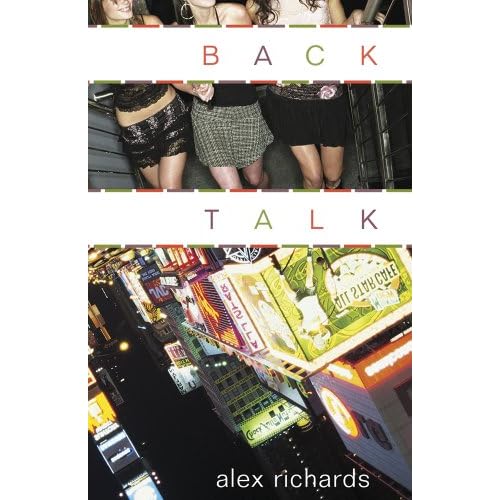
Thumbs up to my niece, Alex Richards and her debut young adult novel, Back Talk. The characters are vivid and believable. Gemma, the ingenue from Idaho, new to New York and working as an intern at a TV talk show, is just the right balance of naive and hip. Her roomates, celebrity-money Dana and old-money America, are distinctly drawn and complementary to each other and Gemma. I think I especially liked America, understated and from a totally different world than either of the others.

The villains, twins with claws, were wonderful, and their comeuppance was brilliantly plotted and completely satisfactory. The whole plot involving a teenage prostitute whom Gemma finds for the talk show, then befriends, was excellent, and Gemma makes a significant personal odyssey.

There's a lot more sex and booze and drugs than in Nancy Drew.

Monday, October 01, 2007

Hot Asphalt, Crushed Stone, Craft and Creativity

A friend asked me "what happens when you begin to construct a verse and at what juncture in the process do your muses merge with your craft to produce a poem"?

Well, Sookie doesn't like the idea of merging with anything unless there's oral sex in it for her, and she won't be lumped together with any other muses, but I managed to bat out a response to the question without telling her, and let's hope she doesn't find out.

Here's what I said.

I don't know if there's any one answer to that, so maybe I can start with a few small answers.

You have to find a way in to the heart of the poem, and you don't know before you start what that way will be. My friend, the poet Marvin Bell, has said, "Writing poetry is not a way of saying what one already has the words for, but a way of saying what one didn't know one knew." And it's even more elusive than that. It's not about finding the words to say what one already knows, either.

Another friend, Patti Marshock, wrote a wonderful essay on one process of finding your way in. If you're interested, it's here.


Sometimes to find a way in, I'll reshape the poem. I'll change long lines to short lines, or vice versa. I'll impose rhyme and meter on the words, or I'll take them away, and try the poem in free verse.

I've talked to other poets who do this too. Donald Finkel told me of trying to write a poem about an experience a student had related to him, of being struck by lightning. He couldn't make it work, although he knew there was something there. Finally, he tried doing two things he never did, and would never have recommended to anyone. He had tried the poem in the first and third person; now he cast it in the second. He had tried it in the present and past tense, now he tried the future ("You will...") And that was the way in. "You" gave him the distance he needed between the speaker of the poem and the subject of the poem; "will" gave the event a sense of inevitability.

At least that's my guess. All Don told me was that it worked.

Sometimes I'll change the gender of the persona in the poem, from male to female, female to male. Perhaps this can be criticized as "femininity defined by men," but I hope it's not. I don't think of it that way. I'm just looking for the voice within me that's right for the poem.

here's one example. I had found a line in a notebook, a line I discarded from another poem, about carrying belongings in a mesh bag. I started building around it, making the belongings old records, and pretty soon discarded the mesh bag, because you can't carry old records in a mesh bag. So who was carrying the records? It became a woman, a woman leaving her husband, and taking nothing but these records. Why would she do that? They meant something to her beyond their values as music or collector's items. They were her father's -- he was a jazz musician. So the poem started to be about what you take, and what you leave behind. The form that worked for it turned out to be regular but syncopated -- a three-stress line, sometimes iambic, sometimes trochaic.

Here it is.


WALKING BLUES

She left home after sunrise,
but before Jack woke. She took
— scrupulously — only
a cardboard suitcase. In it
all she knew was hers:
six polyvinyl choride
records, 78
RPM, cut in
1947
by a band called Ellis
Perkins’ Swing Commandos
.
Her father was Ellis Perkins.
Curiously, she had no
pictures of her father,
but one was in the archives
of the Chicago Defender —
when the Commandos played
The Gate of Horn, their
one brush with the big time.

What she had were solos,
trumpet — plunger mute —
derived from Bubber Miley,
more from burlesque: old-fashioned,
even for ‘47.
Ellis Perkins played
with dogged fervor, on
the beat, half-step behind
the feeling. Late at night,
listening, she would urge him
with wrists, breasts, shoulders,
to walk astride the notes,
to walk inside the tone,
like Bubber, Cootie, Buck
Clayton, Red Allen, Roy
Eldridge — till she realized
Ellis was done walking.
Now it was her turn.

She lined the suitcases with
dishtowels, to protect
the fragile vinyl. She
didn’t think Jack would miss them,
but she planned to send them back.


Some of the details -- her Chicago background, the fact that her father played the trumpet and was influenced by musicians of the 20s and 30s -- came out of the three-stress music of the poem.

A while later, I had a line I tried to build a poem around -- "the days when they still talked about jazz." But it wouldn't work. I loved the line, but maybe I loved it too much, and for the wrong reasons -- for what I felt about it, not for what it felt. It was too sentimental -- it forced sentimentality into a poem every time I tried it.

While I was keeping this line in the back of my mind, I went to visit a friend in New Jersey, took a wrong turn, and passed by a sign that read: HOT ASPHALT, CRUSHED STONE, SAND AND GRAVEL. It sounded right, For something. What, I didn't know, but I wrote it down.

Then I started wondering about the jazz line again, and wondering if it would work in another context. But what? How about if someone else said it, not me? I hadn't intended to go back to the woman from "Walking Blues," but I started to wonder if she might be right for this. What do you leave, what do you take? How do you use the past to find yourself in the present? I decided to bring her closer to me. She was looking for a new life -- why not bring her up to the Hudson Valley, put her in a new place that would give her a different perspective? That led to this:

quote:
HOT ASPHALT, CRUSHED STONE

By spring, she was living in upstate
New York, working for a paving company:
hot asphalt, crushed stone, sand and gravel.
The view from her window was great heaps
of stone, scooped, conveyed to barges,
an inlet of water, a distant high bridge, mountains.
Below her flat, old white men drank and talked
about guns and rights. She could hear,
late into night, the tunk! of darts, like
the patter of of raindrops slowed way, way down
by a drummer intent on mastering their rhythms.
She thought about her father, Ellis Perkins,
in the days when they still talked about jazz --
Louis Armstrong and Jabbo Smith at the Rockland Palace
and the next day it was all over Harlem
how Satch had smoked him with F over high C.
How Cootie left the Duke.
How one day everyone opened the windows, and played
Illinois Jacquet’s solo on “Flying Home”
to the streets and stoops: blat... blat... blaat... blaat... blaat...


And that led to several other poems, as this character became an important persona for me for a while.