Showing posts with label Sam Jones. Show all posts

Friday, August 12, 2022

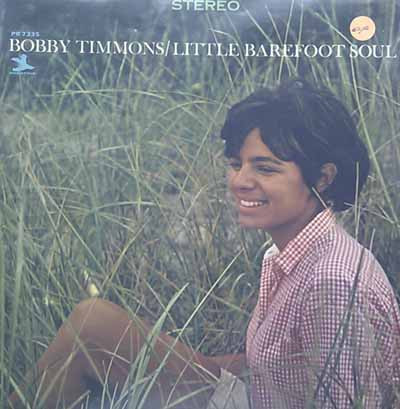
Listening to Prestige 635: Bobby Timmons


LISTEN TO ONE: A Little Barefoot Soul

In my mind, Bobby Timmons was Blue Note. But the mind can play tricks. Timmons did record extensively on Blue Note, as a member of Art Blakey's Jazz Messengers, and before that, with Kenny Dorham's Jazz Prophets, and with Lee Morgan. But to my surprise, He never recorded as a leader with Blue Note. His first record as a co-leader (with Clifford Jordan and John Jenkins) was on New Jazz. Then, starting in 1960, he recorded a series of albums for Riverside, while continuing to play and record with Blakey through 1961. This session marked his return to Prestige, the first of seven albums he would make for the label over the next two years.


Timmons has been something of a controversial figure in jazz criticism, with "underrated" being a term applied to him with surprising regularity, while other critics have suggested there wasn't much to him below the surface--that he was basically just a guy who wrote simple tunes, a few of which have clicked to become hits and jazz standards. 

His recording career is curious also. Between 1958 and 1961, from his first emergence on the New York Scene through his associations with Art Blakey and Cannonball Adderley, he was much in demand, playing on sessions with Pepper Adams, Chet Baker, Kenny Burrell, Arnett Cobb, Kenny Dorham, Art Farmer, Benny Golson, Dexter Gordon, Lee Morgan and others. Then nothing. He continued to tour with a trio and to make records under his own name through the 1960s. Perhaps it was his heroin addiction that made him too unreliable as a sideman. His substance abuse problem was a serious one, and it led him to an early grave.

But soul jazz was marketable, and Timmons was a marketable name. "Moanin'" and "Dat Dere" had become hugely popular jazz tunes, the more so because they had had lyrics attached to them by two masters, Jon Hendricks and Oscar Brown Jr., respectively. 

Certainly his labels weren't shy about pushing the soul connection. Riverside, for whom he recorded from 1960-64, gave his albums titles like This Here is Bobby Timmons (included "Moanin'," "Dis Here" and "Dat Dere"), Soul Time, Sweet and Soulful Sounds. His debut album for Prestige was, if anything, even less subtle...Little Barefoot Soul,

There is nothing on the album anywhere near as catchy as Timmons's big three, for all the catchy titles. So this may not be the place to look for Timmons, the simple soul tunesmith. 

But it might be a good place to start considering Timmons, the underrated jazz pianist. Rather than depend on the restatement of catchy riffs, he engages here in thoughtful and often daring improvisation. He's accompanied on drums by King Curtis sideman Ray Lucas, who keeps him honest, and Sam Jones, who spurs his creativity. He would work with a variety of sidemen in his two years with Prestige, probably a result of his drug-fueled unreliability, but this is an excellent pair.

The producer credit for the session is a little ambiguous: longtime Prestige producer Ozzie Cadena is credited with "supervision," producer is listed as Joel Dorn, who also wrote the liner notes. 

Dorn was an interesting guy. He knew from age 14 that he had one ambition in life--to produce records for Atlantic, and at that young age he started writing to Nesuhi Ertegun, making his case. Ertegun finally relented, telling him he could produce one album by an artist of his choice. He chose Hubert Laws, and it was the beginning of a fabulously successful career, which included discovering the Allman Brothers and the Neville Brothers, and winning a Grammy for his production of Roberta Flack's "Killing Me Softly with His Song."

He recorded Laws for Atlantic in April of 1964, the fulfillment of his lifetime ambition at age 22, so one has to wonder what he was doing in Englewood Cliffs in June of that year, working with a new Prestige artist. Perhaps Ertegun was waiting to see how The Laws of Jazz did before making a commitment. And maybe the problems Dorn enumerates in his somewhat defensive liner notes for the album might not have arisen had his head not been too swiveled toward the orange, black and green of Atlantic. The album, Dorn reports,

was supposed to have been a quintet date. But when Bobby arrived at the studio only one musician, Sam Jones, was on hand. Then came the inevitable phone calls with excuses from the sidemen for not showing up...So with practically two hours of recording time eaten away...it seemed the session would have to be cancelled. Fortunately, someone remembered that Ray Lucas was in town...and within half an hour had his drums set up and ready to record.

Dorn also refers, while declining to get into specifics, to "an air of antagonism...between the artist, the A&R man, and the engineer." It's not clear whether he's referring to himself or Cadena, but in any event, he was off to the Atlantic recording studios and Tom Dowd after this, while Timmons continued working with Cadena, Van Gelder, and a different crop of musicians. And after  two tunes that had to be thrown out because Lucas had trouble finding a groove with two musicians he'd never met before, everything clicked with "A Little Barefoot Soul" (the first word was dropped for the album title), and from there on things went smoothly. Perhaps the unexpected loss of two front men forced Timmons to improvise more than he had intended to, and the results are salutary.

The title track, with "Walkin', Wadin', Sittin', Ridin'" on the flip side, was released as a 45 RPM single.

Wednesday, May 29, 2019

Listening to Prestige 396: King Curtis

I always had this fascination with jazz and with rhythm and blues. I grew up in a time and place where the adults I knew, at least the ones I was trying to emulate, were artists and intellectuals, who listened to classical music if they were old guard, jazz if they were on the cutting edge, rock and roll not at all. And if you were part of that world, or on the fringes of that world, and you loved rock and roll, you had a bit of an inferiority complex. You probably had it anyway.

I was never going to do what I really wanted to do, which was drop out of school, go to New York, find the Brill Building, camp out in front of Jerry Leiber and Mike Stoller's office, and pester them until they took me in as an apprentice. Other teenagers like Carole King and Neil Sedaka were actually doing it, but I was so locked in to a certain world view that it not only never occurred to me to do it, it never occurred to me until much, much later that I had really wanted to do it.

So the part of me that was turning to jazz was looking for approval, the part that still loved rock and roll was still defensive. And the part that loved rhythm and blues...well, no one much noticed of cared about that part. Norman Mailer, in "The White Negro," described, in Nelson George's summary, 
a new white outlaw...wandering the landscape, a "hipster," a "philosophical psychopath," whose primary inspiration was the music and sexuality of Afro-Americans...Yet in perpetuating the romance of blackness, supporting the notion that black juazzmen, for example, were in touch with some primal sexual energy, Mailer was as guilty of stereotyping blacks as the rednecks and social mainstreamers his white Negro opposed. While liberals hailed and debated Mailer's provocative rhetoric, many working class white teens were already living out the ideas Mailer articulated, infatuated as they were with black style and culture. But Mailer saw jazz as the crucial element in this new modern white personality; he had no idea of what most Negroes, or their white teenage fans, were really recording or buying.
I had a foot in both worlds. I read Norman Mailer, and I read Jack Kerouac's "Jazz of the Beat Generation" -- and I realize now, in hindsight, what Sal Paradise and Dean Moriarty must have been really listening to in Oakland on that sweaty summer night in 1947.  Charlie Parker's jazz revolution had not made it as far as Oakland; his 1946 gigs in Los Angeles had been pretty much of a fiasco, and had let to a six-month relaxation at Camarillo State Mental Hospital. Sal and Dean were most likely listening to rhythm and blues--someone like Big Jay McNeely. And they thought it was jazz because, dammit, they were right. It was jazz.

I didn't have Nelson George and his great book, The Death of Rhythm and Blues, as a guide then. My other foot was with the white teenagers listening to Fats Domino and Little Richard (a music that in 1960, post-payola, was running very thin) and a ways deeper, with the Negroes that George describes, listening to Muddy Waters and Willis "Gator Tail" Jackson and Amos Milburn. And with no brilliant theoretician like George to give me intellectual support, I remember how thrilled I was to buy this album when it came out: one of my rhythm and blues heroes, King Curtis, playing real jazz along with card-carrying modern jazzmen like Nat Adderley. Playing Ellington!

Soul Meeting is the name of the album (on a re-release intensified to Soul Meeting!), and it precedes the other, somewhat better known Soul Meeting between Ray Charles and Milt Jackson by a year. And certainly, soul is the meeting ground for these diverse and considerable talents. They do take on Ellington: "Jeep's Blues." written with Johnny Hodges and originally recorded in 1938 under his name, later and most famously on the 1956  Ellington at Newport album. Ellington knew his way around the blues, and so do these guys. They also show their skill with standards and pop ballads (Cole Porter's "What Is This Thing Called Love?" and the Sammy Cahn/Jimmy Van Heusen hit for Frank Sinatra, "All the Way"). But they really find their groove, and their bliss, in the three Curtis originals, which bring out the best in both lead instruments and in Wynton Kelly, who contributes solid accompaniment and some smashing solos.

Production credit is shared by Esmond Edwards and Ozzie Cadena, who would take over as chief of A&R for the label when Edwards left a couple of years later. The album was something of a Prestige producers' convention, as Don Schlitten, who produced two sessions for the label in 1957 and would do a bunch more later on, provided the art direction and album cover design to go with Edwards' photo of Curtis.

"Soul Meeting" and "All the Way" were released as a 45 RPM single on New Jazz.

Listening to Prestige Vol. 2, 1955-56, and Vol. 3, 1957-58 now include, in the Kindle editions, links to all the "Listen to One" selections. All three volumes available from Amazon.

The most interesting book of its kind that I have ever seen. If any of you real jazz lovers want to know about some of the classic records made by some of the legends of jazz, get this book. LOVED IT.
– Terry Gibbs


Monday, February 18, 2019

Listening to Prestige 380: Red Garland

The most striking news from this Red Garland session is that Red gets on the organ bandwagon (if you can put an organ on a bandwagon) for one number, "Halleloo Y'All." That doesn't mean it's exactly a church organ, although all of three of the Garland originals from the first half of this session--which also means the first album from this session--have gospel-related titles. Or is "Back Slidin'" a sort of anti-gospel title? Certainly it smacks of sin more than salvation. And a fourth carries on Garland's frequent practice of reaching into the folk and blues traditions for unexpected inspiration, but in this case it's gospel: "Every Time I Feel the Spirit."

I don't know what Garland's religious leanings were, but this is hardly a sanctified album. He doesn't reach into the musical language of the church the way Ray Charles does, or the way singers like Otis Redding would. Garland is a jazzman through and through, and this is a jazz album, with Garland's signature block chords finding new voicings that almost remind one of that other great block chordist, Thelonious Monk, although Garland's voice, even when he's reaching outside what has been his comfort zone, is very much his own.

Art Taylor continues to be his go-to drummer, and Sam Jones, who first joined him for 1959's Red in Bluesville, is back on bass. As he did with Paul Chambers, Garland gives Jones plenty of room to express himself, and Jones comes through.

The gospel-tinged originals and the spiritual represent the first half of this Friday With Rudy. The second half is mostly given over to other composers: Harold Arlen for "Blues in the Night." Duke Ellington for "Rocks in my Bed," Bennie Benjamin (whose hits ranged from "I Don't Want to Set the World on Fire" in 1941 to "Don't Let Me Be Misunderstood" in 1977) for "I'll Never Be Free."

The session had two distinct themes and produced two distinct albums, with "I'll Never Be Free" the only one from the second group to join the gospel-y titles on 1960's Halleloo Y'All. One more Garland original, "Soul Burnin'," became the title tune of the second album, which included a couple of cuts from a 1961 session with Oliver Nelson, and was released in 1964, when soul music was really burnin'.

Esmond Edwards produced.


Friday, January 25, 2019

Listening to Prestige 375: Ken McIntyre

Ken McIntyre's early career with Prestige is an interesting tangle. This is his debut album as far as the public is concerned; it was the first one to be released, although it was recorded after his May 31 session featuring musicians from Boston with whom he had been playing regularly.

Why release this one first? Prestige's marketing department, which was essentially the same as its creative department--i.e., Bob Weinstock--must have felt that this was a stronger way to introduce a new artist creating a new and edgy kind of music.

New Jazz was becoming, more or less, Prestige's label for the edgier stuff--the new jazz, as it were. And it was happening. Ornette Coleman could no longer be ignored. Coltrane had opened a new door with Giant Steps. Eric Dolphy was on the brink of becoming Prestige's breakout star of the new jazz, and his presence on this album gives it a significance that perhaps Weinstock was afraid would not be so apparent with the other session.

Prestige is definitely telling us something with the album's title. In the wake of Ornette's Something Else!!!!, Tomorrow Is the Question!, The Shape of Jazz to Come and Change of the Century, McIntyre's debut is titled Looking Ahead.

McIntyre himself might not have agreed with the decision. He saw his first session, with the guys he had developed his music with, as a truer representation of his music.  And maybe he was right, but maybe he was wrong. I don't want to judge either way. But Weinstock's classic approach--Let's put a bunch of cool cats together and see what develops--produced some exciting music, and it does so here.

All but one of the selections are McIntyre originals. The exception is the old Gershwin chestnut, "They All Laughed," and it's interesting to see how these modernists take it. They play the head remarkably straight, and they never really lose it. They go far enough out in their improvisations to be satisfying--and because they're that good, to be deeply satisfying--but they always have that ha-ha-ha, who's got the last laugh now? feeling. Who says the avant-garde can't have a sense of humor? Walter Bishop's solo brings them back into home territory, and they finish up with Gershwin again.

It's hard to top Gershwin, and of course McIntyre doesn't try. It's interesting to try and imagine what his original compositions, and the improvisatory flights of the soloists, but it's ultimately a mug's game. Which of the two sessions is better? It's close to impossible not to lean toward this one, but that may be because Eric Dolphy achieved such heights in his short career that looking back, we want to listen closely to everything he did. How difficult and experimental did this music sound to contemporary audiences? We can't hear it with their ears. Today it sounds mainstream. I can remember the excitement of being young and having discovered jazz not all that long ago, and living in New York for the first time, and going down to the Five Spot to hear Ornette Coleman and Don Cherry, but I can't recover those ears. It's part of nostalgia for my youth now. I wouldn't go so far as to say that The Shape of Jazz to Come will ever exactly be comfort music, but it is now part of a tradition. And listening to Ken McIntyre and Eric Dolphy today, they sound like a couple of cats playing very good music in that tradition. I had never heard this album before, and I'm glad I'm getting the chance to hear it now. It's good jazz, real jazz. And I like his originals, especially "Lautir" and "Head Shakin'."

Looking Ahead and Stone Blues were the only two albums McIntyre would make for Prestige as leader, although he would appear on one other Prestige session backing up a vocalist.

Esmond Edwards produced.

Sunday, July 22, 2018

Listening to Prestige 341: Arnett Cobb

Two days in the studio with Arnett Cobb and a quintet, rhythm section augmented by congas, but with a different piano player and a different conguero each day, continuing the pattern he had established on his previous Party Time session for Prestige, with Ray Bryant and Ray Barretto.

The piano guys were two more of the best young players on the scene, 30-year-old Tommy Flanagan and 25-year-old Bobby Timmons. Flanagan had made his Prestige debut in 1956, newly arrived from Detroit, on an abbreviated Miles Davis session.
He would shortly thereafter be tabbed for one of the decade's most important albums, Sonny Rollins' Saxophone Colossus, and would make his debut as leader the following year with a trio: Overseas, recorded in Sweden. By the time of this recording, he was a solid regular with the label, with 15 recording dates as leader or sideman.

Flanagan's versatility could be amply illustrated right at this moment in time: just two weeks before he went to Englewood Cliffs to record with one of the veteran masters of good-time, mainstream jazz, he had seen the release of a session with young players who would be standing jazz on its year: John Coltrane's Giant Steps.

Bobby Timmons had recorded once previously for Prestige, with Clifford Jordan and John Jenkins, but he was best known for his work with Blue Note, particularly with Art Blakey's Jazz Messengers.

Danny Barrajanos took the conga chair for the first day. He was primarily known for his work with Harry Belafonte and Miriam Makeba. Buck Clarke, who came in for the second day, was more of a jazz figure, with credits that would include Freddie Hubbard, Herbie Hancock and Les McCann.

Latin percussion was still a somewhat outside-the-box idea for a modern jazz album, and one might think of Cobb as an inside-the-box kinda guy, but boy, does he know how to make it swing! Listen to the work they do on "Blue Lou," composed by Edgar Sampson, one of the few composer/arranger/ musicians of his era to move back and forth between mainstream and Latin jazz. He played with Duke Ellington, Rex Stewart, Fletcher Henderson and Chick Webb (for whom he composed "Stompin' at the Savoy" and "Don't Be That Way"); and worked as an arranger for Marcelino Guerra, Tito
Rodgriguez and Tito Puente. And raised a musical family--his daughter Grace co-wrote "Mambo Inn" with Mario Bauzá. "Blue Lou" is a killer, with Barrajanos pushing the beat throughout, getting some wild and crazy sax playing of Cobb and smoking solos from Flanagan, Taylor and himself.

"Blue Lou" was followed on the session by a Cobb original called "Blue Me." One can't help but wonder if the original title had been a mite dirtier.

The second day found the musicians in a mellower mood, but Buck Clarke shows how much a conguero can contribute there, too. Listen to "The Nitty Gritty," a Cobb original. It's interesting that Cobb didn't use any Bobby Timmons originals, as hot a composer as he was then. But Timmons adds his soul jazz piano to Cobb's already soulful playing, and his Illinois Jacquet-style honking.

The sessions became a little mixed on record. "Down by the Riverside" is Timmons and Clarke, but it Arnett Cobb--More Party Time, which otherwise comprised tunes from the first day. The traditional spiritual joined Stephen Foster's "Swanee River" as tunes you wouldn't necessarily bring to a modern party. "Fast Ride" was slipped back to Movin' Right Along to complete the trade. Both albums were released before 1960 was out.
was included on

"Lover Come Back to Me," from the Flanagan/Barrajanos session, was a two-sided 45 RPM single release. The Sigmund Romberg melody is from New Moon, the last operetta to be produced on Broadway. One tends to think of operetta as a form more likely to produce cornball chestnuts like "Stout Hearted Men," which is also from New Moon, but "Lover Come Back to Me" has proved a most satisfying challenge to many a modern jazz musician. So has another aria from New Moon, "Softly, as in a Morning Sunrise," which Cobb recorded on the second day.

"Ghost of a Chance" was the single from the second session to be released on 45 RPM, as the flip side of "Smooth Sailing," from Cobb's first Prestige album.

Esmond Edwards produced both sessions.


VERY CLOSE TO BEING READY TO TAKE ORDERS FOR LISTENING TO PRESTIGE VOL 3!

Thursday, April 12, 2018

Listening to Prestige 329: Red Garland - Eddie "Lockjaw" Davis

This is first release in Prestige's third and most controversial subsidiary label, Moodsville. Moodsville wasn't, and still isn't, very controversial, but maybe a little. The purposes of Swingville and Bluesville were pretty clear, but what was Moodsville, exactly? Swing veterans like Coleman Hawkins played on the first, blues musicians like Willie Dixon on the second, but Moodsville's first recording was by mainstream Prestige regulars Red Garland and Eddie "Lockjaw" Davis, so what set it apart?

Jackie Gleason, beginning in 1953, had released a series of albums that more or less invented mood music. The first was called Jackie Gleason presents Music for Lovers Only.The album cover had two cigarettes, two wine glasses, and a lady's clutch purse. The music was syrupy and easy to listen to. It did feature jazz great Bobby Hackett, but beyond that it had nothing much to recommend it except that it set the all time record for most consecutive weeks in Billboard's top ten.

What accounted for its amazing popularity, and the popularity of the Gleason recordings that followed it? Gleason's name (which actually may have been all he gave to the project)?  The romantic cover art? Or maybe Gleason had just tapped into a hitherto unrealized visceral human desire for...mood music?

Well, why not? As Gleason realized, if Clark Gable needed romantic background music to play a love scene in a movie, shouldn't some guy in Brooklyn need it even more? 

Mood music became elevator music, became Easy Listening. Bobby Hackett or no, it was, in the slang of the day, strictly from Squaresville. So is Moodsville really a subdivision of Squaresville? 

This question was debated on the Organissimo internet forum, an often interesting place for jazz discussion. Some said yes, sort of: "Generally, my perception is that the Moodsville albums are more sedate, simpler, and somewhat less 'jazz intensive." Scott Yanow, reviewing for Allmusic, tended to agree: "[Moodsville] was designed to provide mood music for courting couples... Due to the overly relaxed nature of much of this music and the lack of variety, this is not one of the more essential Red Garland sets."

But the Organissimo consensus, and a fairly informed consensus, was otherwise. Contributor Dan Gould, who had discussed the question with Weinstock, recalls:

One thing Bob told me is that the number of albums, and the creation of the subsidiary labels, were a direct result of cash flow. In order to avoid showing too much in profit and paying taxes on it, Bob wanted to put the money into production.
Which, from a vantage point of the jazz-starved new millennium, is a very nice thing to hear--that a small independent label fiercely devoted to modern jazz would have to worry about the problem of showing too much in profit. Chris Albertson, who produced a number of Prestige sessions, had this to say:
I really don't think there was any serious marketing decision involved in the creation of the Bluesville, Swingville, Moodsville, etc. series. Remember, these were not stand-alone subsidiary labels--it was always Prestige Moodsville, Prestige Swingville, etc. I don't recall if the pricing was different--if so, that may have been a factor. As a dj when these first came out, and later as a Prestige employee, I never thought of them as anything but Prestige albums with a series name. 
Sometimes I think that consumers/collectors make more out of such details than the facts call for. When I produced a session, it was a Prestige session--whether it came out on Prestige, Prestige Bluesville or Prestige Swingville, made no difference.
I was never aware of there being any deliberate effort to alter the nature of a Moodsville album from that of, say, somebody's ballad album. If there ever was an instruction from Bob Weinstock to do so, it must have flown off my desk--a desk that saw its share of memos!
Albertson was not yet aboard when this session kicked off the Moodsville line. Esmond Edwards produced, and he didn't exactly have a reputation for pandering. And it's hard to imagine Red Garland, Sam Jones, Art Taylor or Eddie Davis deciding to dumb down their music.

So  how does it sound? It sounds great. It's an afternoon devoted to ballads, which are lovely to listen to, but ballads have always been a part of jazz. They play the melody, and with beautiful melodies like this, why wouldn't you? But they use it as a springboard to improvisation, just like a real jazz session, and the improvisation is of the quality of a real jazz session, and what else do you need? If the Moodsville label let the prospective buyer know that he could probably safely play it for an evening at home with his girlfriend who'd stalk out the door if he put on Change of the Century, the names of the musicians should have let him know that he wouldn't be embarrassed playing it for his college roommate with the goatee and the sunglasses after dark.

Davis plays on three numbers, "We'll Be Together Again," "When Your Lover Has Gone," and Garland's own "Softly Baby," the last named a recording that did get a new life in the new millennium when it was featured on the TV show American Horror Story.

"We'll Be Together Again" is a particularly beautiful and haunting melody, written by Carl T. Fischer, who has the distinction of being one of the few Native Americans to have a significant career in jazz. Fischer was Frankie Laine's accompanist at the time he wrote the song, and Laine contributed the lyrics. Davis is sensitive to the melody, but at the same time puts his own spin on it. If this were on a jukebox at a place where I hung out, I'd play it a lot.

Davis also played on Garland's "Untitled Blues," which didn't make the Moodsville cut, but was included on later CD packages.

This is a great album if you're in the mood, but what music is that not true of? From Lefty Frizzell to Berlioz' Symphonie Fantastique, you'd pull out the album, slide out the vinyl, and place the needle on the first groove if you were in the mood to hear it.

The album cover emphasizes Moodsville. Other than that, the album is eponymously titled.

Saturday, February 03, 2018

Listening to Prestige 311: Art Taylor

Art (here Arthur) Taylor has recruited two veteran tenor players here, given them a lot of room, and returned Prestige, for this session at least, to that bopcentric universe from whence it sprang. He’s made the wise decision to enlist the services of Thelonious Monk in two different ways. First, he plays two of Monk’s best known compositions, “Rhythm-a-ning” and “Straight No Chaser.” Second, he calls in Charlie Rouse, just as Rouse is beginning an association with Monk will will last a decade and beyond, and make him the musician most closely associated with the master. You could even make a case for a third connection, in that Taylor and the group also play a Rouse composition.

Both of Taylor’s tenors are guys with long-term musical commitments: Frank Foster spent many years with Count Basie, and became the leader of the Basie orchestra, just as Rouse would later form Sphere, a group dedicated to playing Monk’s music. 
 
So...a front line made up of the quintessential Monk guy and the quintessential Basie guy. An impossible mismatch? No. This is jazz. Bebop is a lingua franca. So is the blues. So is improvisation, because when you're playing a tune which is going to go from the written melody to an improvised line by one soloist that will create something new in that moment, it demands of the other musicians that they listen, and be prepared to build on something that's rooted in a chord structure, but that has no precedent, and will demand an equal level of creativity.

New to Prestige with this session is Walter Davis Jr. Davis had been making a name for himself in
New York jazz circles throughout the 1950s, playing with many of the top names in jazz, including Charlie Parker, Max Roach and Dizzy Gillespie, and he had recorded with Gillespie's big band, but 1959 was really his breakthrough year on wax. He had played on a Jackie McLean session for Blue Note in early May, for which he had contributed four original compositions. Then, at the end of the month, a busy time. In the studio with Charlie Rouse and Art Taylor for a Donald Byrd Blue Note session on May 31, then back again on June 3, with Rouse and Taylor again, for his Prestige debut. He was making a name for himself as a composer as well as a pianist, contributing two originals to the Byrd session and one to the Taylor session, and in August he would make his debut as a leader, again for Blue Note, in an album of all originals.

Back is Sam Jones, one of the bass-playing greats (great solo on "Fidel," and presiding is Art Taylor, whose drum solo on "Little Chico" will stand alongside any drum solo you care to name. Composing credits, in addition to Monk, Rouse ("Little Chico") and Davis ("Cape Millie"), go to Taylor ("Dacor") and one absent friend, Jackie McLean ("Fidel").

I'm finding myself fascinated with discovering the newly emerging (and mostly new to me, since I missed it the first time around) tenor sax/organ combos, and following the new direction that jazz will be taking into the 1960s, but I'm not quite willing to let go of bebop and hard bop either, and this album is deeply satisfying, partly because it gives me back that music I love, but also because you could have played this album on any day of any year and would be just as satisfying. It's that good.

It's hard to pick a "Listen to One," but I'm going to go with "Rhythm-a-ning." You can never go wrong choosing a Monk tune. The ensemble work by the two tenormen on that great tune is beautiful, and when they each get going, pushing each other, trading ideas, taking it further and further out, you have as good as definition of what's to love about jazz as you're likely to get. There are also solos by Davis and Taylor that make the whole package even better.

Taylor's Tenors was a New Jazz release. A few years later, this and the earlier Taylor's Wailers were released on Prestige as a double album, or a "Prestige Jazz Bonus Pack (2 albums for the price of 1)" with the Prestige All Stars labeling, that is, all performers getting equal billing, under the title Hard Cooking.


Listening to Prestige Vol. 2, 1954-1956 is here! You can order your signed copy or copies through the link above.

Tad Richards will strike a nerve with all of us who were privileged to have
lived thru the beginnings of bebop, and with those who have since
fallen under the spell of this American phenomenon…a one-of-a-kind
reference book, that will surely take its place in the history of this
music.
                                                                                                                                
--Dave Grusin

An important reference book of all the Prestige recordings during the time
period. Furthermore, Each song chosen is a brilliant representation of
the artist which leaves the listener free to explore further. The
stories behind the making of each track are incredibly informative and
give a glimpse deeper into the artists at work.
                                                                                                                --Murali Coryell


Monday, January 22, 2018

Listening to Prestige 305: Red Garland 

One of the joys of any Red Garland album is always the material—seeing how Red has gone beyond the conventional standards/originals bag to find some worthwhile tunes that others have overlooked, often drawn from the rhythm and blues catalog. Here, with a whole album devoted to the blues, he goes in and out of styles and decades, presenting a portrait of the blues that’s also a self-portrait in blue.

“Trouble in Mind” goes back to the 1920s and the first explosion of recorded blues. It’s credited to songwriter Richard M. Jones. Although it’s been recorded over time by some of our finest jazz singers, including Dinah Washington, Sam Cooke and Aretha Franklin, it has, at heart, that lonely introspection of a man or woman alone with a piano or guitar, singing to him or herself of a deeply personal blues.

Mose Allison caught that feeling on the other Prestige recording of the song, as the trumpet piece for his album Local Color. And Garland catches it here, leaning over the piano, lost in his private blues, the rest of us fortunate enough to get a chance to listen.

“He’s a Real Gone Guy” is from the classic rhythm and blues era of 1940s, and was a hit for Nellie Lutcher. Garland gives it that rhythm and blues vitality, with some powerful solo work by Art Taylor and the new guy in this trio, Sam Jones, temporarily replacing Paul Chambers. Jones was fast
becoming one of the important bass players on the New York scene, though he would be best known for his extensive work with Cannonball Adderley.

“See See Rider” is another one that’s been around since the birth of the blues, at least the birth of recorded blues, in a version by Ma Rainey, and it probably does go back to the birth of the blues. It is a classic traditional 12-bar blues, celebrating one of the most celebrated themes of the blues, the badness of a bad woman. Unlike his approach to “Trouble in Mind,” Garland doesn’t spend a lot of time with the melody, in fact, basically none. He gets right into the improv, a modernist approach to this most classic of blues.

"M-Squad Theme” was written by Count Basie for the hard boiled police procedural that starred Lee Marvin as a Chicago cop. The music mixes a little “Peter Gunn” with a little “Hucklebuck/Now’s the Time” with some Basie swagger to make for a piece which, if it never quite got the ubiquity that Henry Mancini’s “Peter Gunn” achieved, still is a satisfying example of its genre and a good choice for a big, modern blues. As in “Peter Gunn,” the bass gets prominently featured, so it’s a good showcase for Sam Jones.

If you asked the average American to name a blues song, nine times out of ten you’d get “St. Louis Blues.” This W. C. Handy composition, part blues and part tango, has woofed its way into warp of American culture so completely that it is now the name of an NHL hockey team. And “Your Red Wagon” is scarcely a blues at all. It’s Tin Pan Alley, although one of its co-composers is Richard M. Jones of “Trouble in Mind.” Both of them give Garland, Jones and Taylor space for a lot of imaginative trio work.

Red in Bluesville was recorded in April, released in September of 1959, presumably before Weinstock got the idea of a label subsidiary with the same name. Three 45 RPM singles were released from the session: "That's Your Red Wagon" / "Trouble in Mind" and two others that drew one side from this date: "Stompin' at the Savoy" / "He's a Real Gone Guy" and "M-Squad" / "Makin' Whoopee."


Listening to Prestige Vol. 2, 1954-1956 is here! You can order your signed copy or copies through the link above.

Tad
Richards will strike a nerve with all of us who were privileged to have
lived thru the beginnings of bebop, and with those who have since
fallen under the spell of this American phenomenon…a one-of-a-kind
reference book, that will surely take its place in the history of this
music.
                                                                                                                                          
--Dave Grusin

An
important reference book of all the Prestige recordings during the time
period. Furthermore, Each song chosen is a brilliant representation of
the artist which leaves the listener free to explore further. The
stories behind the making of each track are incredibly informative and
give a glimpse deeper into the artists at work.
                                                                                                                --Murali Coryell