Showing posts with label Jo Jones. Show all posts

Thursday, July 06, 2023

Listening to Prestige 694: Andy and the Bey Sisters


LISTEN TO ONE: Since I Fell for You

 Andy Bey's work with his sisters occupies a very small part of a long and legendary career (which is not over yet). It covers three albums, one with RCA Victor in 1961 and two with Prestige, and some television appearances, so we have some live work by the trio available on video. But it's an important part of his legacy--and that of Salome and Geraldine Bey, who also went on to have distinguished, if very different, careers.

We'll start with the sisters. Salome, born and raised in Newark, moved to Canada shortly after the trio broke up, and made a life and a career there. She came to be known as "Canada's First Lady of the Blues," and she was all that and more. She appeared on Broadway in Your Arms too Short to Box with God and received a Grammy nomination for the


original cast album; and her own show, Indigo, a celebration of the history of black music, won a Dora Mavor Moore Award, honouring theatre, dance and opera productions in Toronto. Her appearances at the Montreux Jazz Festival were captured in a live album and on video--check out this stirring performance at Montreux of Billy Taylor's "I Wish I Knew How it Would Feel to be Free." After her death in 2020, she was honored on a Canadian postage stamp.

I've written about Geraldine Bey de Haas and her husband before, but I'm going to quote it here again, because it's such a significant story in the history of jazz'

if you are from Chicago, and a jazz fan, you quite likely have heard of the deHaases, for the music and civic involvement that they gave to the City of the Big Shoulders. When they retired in 2103, because of health problems, to go and live with family in New Jersey, here's a part of the tribute columnist Howard Reich of the Chicago Tribune gave to "two artists who have been central to jazz here for nearly half a century":

It was Geraldine de Haas, after all, who led many like-minded spirits in creating the first Duke Ellington celebration concert in Grant Park, in 1974, just after the master's death. The event proved so successful that it became an annual soiree, paving the way for the emergence of the Chicago Jazz Festival in 1979 and setting the stage for all the other city-sponsored music fests that followed.

When de Haas launched her campaign to stage the aforementioned Ellington tribute in Grant Park, she faced widespread resistance, even from fellow jazz musicians.

"The South Side musicians were talking about doing (the Ellington homage) on the South Side of Chicago" in Washington Park, recalls de Haas. "My suggestion was: 'Why don't you do it in the main park (downtown)? Duke Ellington was so important to all of us.'"

"(But) the black musicians were conditioned to think one way, and the white musicians were conditioned another away. They never thought about getting everyone to participate. … I was emphatic about that.

 "They said: 'If you can get it, good luck.'"

Geraldine got it, in spite of resistance from the city parks commissioners, whom one has to assume were white. They told her there had been riots the last time they tried to hold a jazz concert. Riots? Jazz? It turned out they were talking about Sly and the Family Stone.

But if Geraldine wanted to give jazz to the whole city, "bringing jazz to a major downtown setting – and therefore bringing black, white and others together in a dramatic way that reflected both the cross-racial appeal of the music and the unifying characteristics of Ellington's art," she didn't forget the South Side either, creating a new and successful festival, "Jazz Comes Home," in 1981. In her words, again quoted by Reich,

"It was time to expose the music to the young people" where they lived, says de Haas. "The legacy left by a lot of African-American musicians – they needed to know about it. That was one of my missions in Chicago."

Andy Bey is still performing, into his eighties. After a meteoric career as a young man, with and then without his sisters, he slipped into obscurity, never stopped performing, was rediscovered, and is now a living legend, widely considered to be among the first rank of jazz singers. He and his sisters made two LP records for Prestige, so I'll have more to say about him next time. But let's get on to the music.
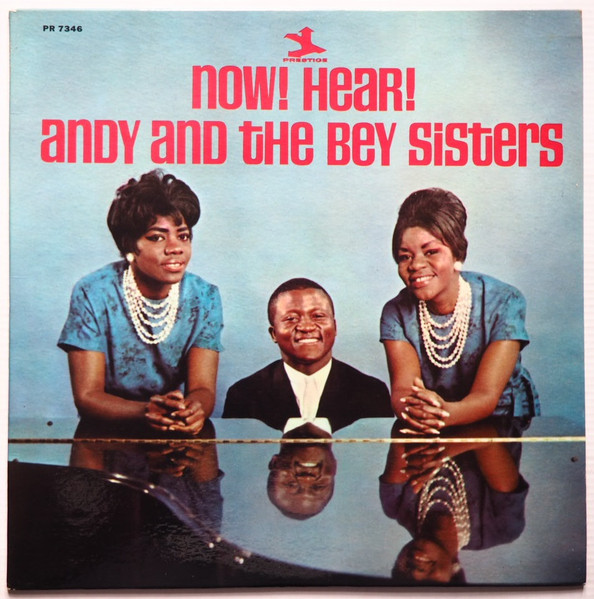

What became one album, Now! Hear!, was recorded in two sessions, three days apart, with Jerome Richardson the only musician to play both sessions. I don't know the reason for the change. Perhaps producer Cal Lampley, was dissatisfied with the first group (he needn't have been -- they are wonderful). Perhaps, new to Prestige, he decided he wanted a younger, hipper sound. All the musicians on the second date represent a different generation from the first group. Perhaps it was just a scheduling conflict. At any rate, it's not cause for complaints. Each group brings a distinctive and satisfying sound. And in any case, the focus is on the Beys, and their tight sound. In any musical field, from country to doo wop to jazz, there is something distinctive about a family harmony group. Andy recognized this from a vantage point of half a century, as he told Chris Slawecki in a 2020 interview for All About Jazz:

I was doing things with my sisters that I'm still doing somewhat, in terms of the tempo and in terms of the rhythmic attack we used to use. I used to sing the lower part, having the male voice. We have a family sound, we basically all sound the same. Like the Cole family, him and his brothers sound basically the same when they sang. They're not identical, but you can hear that family sound.

You can certainly hear that family sound on Buddy Johnson's "Since I Fell for You." The tune was written for his sister Ella, but the group harmony possibilities of it were quickly realized by a number of doowop groups, most notably the Harpton. Andy's Nat Cole-influenced piano anchors this one, with some wonderful guitar fills by Barry Galbraith.

"Willow Weep for Me" provides a good introduction to the second group, with particularly notable work by Richardson and drummer Osie Johnson, and again those family harmonies.

It's good that the Beys went their separate ways. Each of them had a distinctive and important career, contributing so much to American music. But it's also really good that they did this work, and recorded this work, together,

Prestige released two 45 RPM singles. each featuring one song from each session. "Willow Weep For Me" / "Quiet Nights Of Quiet Stars," and the second was "A Taste Of Honey" / "Besame Mucho."    


Tuesday, November 14, 2017

Listening to Prestige 284: Basie Reunion

You could say that Weinstock and co. are still marking time, but that would be wrong. Bringing a collection of some of Count Basie's greatest sidemen together, along with pianist Nat Pierce, who did Basie better than anyone except Basie, in a group led by Paul Quinichette, who did Lester better than anyone except Lester, and what you've got is a recipe for nothing less than a soufflé of great music.

And this is one soufflé that doesn't collapse as you're taking it out of the oven.

But...if you're offered a recording of Basie musicians paying Basie's tunes, why not just pass it up and buy a Basie record?

Well, for one thing, you can never have enough good music. And if the musicians are this good, it's always going to be different. Nat Pierce can be Basie the piano player, but he can't be Basie the bandleader, so that role seems to fall to Paul Quinichette, who may not have seniority as a Basie-ite, but who has Prestige seniority as an on-and-off regular. And it's all worth having, and it's all worth listening to, and I am a better, more fulfilled person for having listened to it.

And besides, while this may be a Basie dream band (or dream small group), it isn't the current Basie band, or even precisely any one Basie aggregation.

Jo Jones goes back the farthest. He was already with the band when Basie took it over on the death of Bennie Moten, and remained behind the drums until 1948. Jack Washington, not so well known as the others but with the reputation of a jazzman's jazzman on baritone sax, was with Basie from the beginning, and stayed till 1950. Freddie Green came along just a little later, in 1937, and never left. He anchored the Basie rhythm section for five decades.

Buck Clayton spent some great years with Basie, from 1936 until he was drafted into the army in 1943. Earlier in the 1930s, he had a rather remarkable expatriate career, not in France or Sweden, but in China, where he led a group called the Harlem Gentlemen, and mentored the Chinese composer Li Jinhui, who revolutionized Chinese music before the revolution. After the revolution, Li's music was banned in China as decadent and western, and he became an enemy of the people.

So none of these guys played with Eddie Jones, who joined in 1953 and was the only active Basie-ite when this session was cut, remaining with the band until 1962, after which he went to work for IBM, which means he probably overlapped with me at IBM, though not in the same city. As a Basie-ite, he overlapped with Quinichette (1952-56).

When they get together, latecomers, early-leavers and lifers alike, they all know what to do. As ex-Marines are fond of saying, you're never an ex-Marine, and it seems you're never really an ex-Basie man either. The tunes are Basie classics. With a smaller group, there's more room for soloists, especially compared to the late 1950s version of Basie's group, where the emphasis was more on arrangements and ensemble play. It's hardly necessary to say how good Buck Clayton and Paul Quinichette are. Nat Pierce has some very nice solo moments, where he does more than just play the Count note for note. He has a musical persona of his own. There's just a great drum solo by Papa Jo Jones on "John's Idea."

I'm not exactly sure what qualifies this is a Prestige All Stars session. More like a Prestige Guest Stars session. But they are all stars, and I'm glad to have them.

The album was released on Prestige as Basie Reunion, and was later rereleased on Swingville when Weinstock started branching out into those subsidiary labels that appealed to diverse specialized tastes.


Order Listening to Prestige Vol 2


Listening to Prestige Vol. 2, 1954-1956 is here! You can order your signed copy or copies through the link above.


Tad Richards will strike a nerve with all of us who were privileged to have lived thru the beginnings of bebop, and with those who have since fallen under the spell of this American phenomenon…a one-of-a-kind reference book, that will surely take its place in the history of this music.

                                                                                                                                                --Dave Grusin

An important reference book of all the Prestige recordings during the time period. Furthermore, Each song chosen is a brilliant representation of the artist which leaves the listener free to explore further. The stories behind the making of each track are incredibly informative and give a glimpse deeper into the artists at work.
                                                                                                                --Murali Coryell

Sunday, April 23, 2017

Listening to Prestige 256: Paul Quinichette

Some jazz labels are linked with a particular style. Blue Note, though it had a long life starting in the swing era and extending to the present day, is very much identified with hard bop. Pacific Jazz lived up to its name and became identified with the West Coast sound, or the birth of white cool. Windham Hill is so closely associated with New Age jazz that "Windham Hill" is virtually a synonym for New Age.

Prestige also recorded a lot of hard bop and bebop, but because it was so much a one-man operation, Bob Weinstock was able to indulge his enthusiasms across a wide spectrum. Paul Quinichette had come under the Prestige umbrella in 1957, recording bop albums with John Coltrane, with Webster Young (perhaps he misunderstood, and thought Weinstock was saying "Come in for a session with Webster and Young"), and even one under his own name with a group of boppers. That came out as Paul Quinichette's New Stars, and they were all newer than him, for sure. Like his mentor Lester Young, Quinichette was open to new sounds and new ideas, but he was a Basie-ite at heart, so why not record him in a Basie context? Prestige was a big tent.

The album is For Basie, the tunes are all from the Basie playbook, and the musicians are Basie veterans.

Shad Collins' ties to Basie go back to the 30s, and the Lester Young days. He also played with Cab Calloway (he replaced Dizzy Gillespie), Benny Carter, Don Redman, Jimmy Rushing, and Sam "The Man" Taylor, another jazz-to-rhythm and blues cat. He had an important reputation as an arranger and considerable success as a composer, including "Rock-a-Bye Basie." He also wrote Cozy Cole's Top Forty hit, "Topsy."

No musicians are more closely identified with Basie than Walter Page and Freddie Green, In fact, Basie was a member of Page's band, the Blue Devils, in Kansas City. Page is credited with being one of the first to shift the primary rhythmic responsibility in a band to the bass, thus freeing up the drummer and piano player to improvise more. When you hear a singer, like Lonette McKee in Round Midnight, talk about the importance of listening to the bass, she has Walter Page to thank for it. This may have been Page's last recording, as he died suddenly and unexpectedly in the winter of 1957.

Freddie Green joined Basie in 1937, and stayed with him for the next 50 years. Jo Jones joined Green and Page as integral figures in the creation of the Basie sound. He played with Basie until 1948, then freelanced with others, including Duke Ellington.

Nat Pierce is best known for his work with Woody Herman, but also for having an uncanny ability to recreate Basie's piano style, so during the late 50s he led a number of groups of Basie veterans.

No one can resist the sounds of Count Basie, and it's pretty damn hard to resist these guys, either.

So...a step backward? No. There's really no backward in jazz. Some may have still been talking about hipsters and moldy figs, but this was an era when Louis Armstrong and Kid Ory were still making music, when Benny Goodman and Lionel Hampton were still making music, Machito and Tito Puente, the Count and the Duke, Dizzy Gillespie and Miles Davis, John Coltrane and Ornette Coleman and Eric Dolphy. Probably no other art form has ever been so inclusive.