Tad Richards' odyssey through the catalog of Prestige Records:an unofficial and idiosyncratic history of jazz in the 50s and 60s. With occasional digressions.
"Jazzy" is a slang term that's fairly commonplace in our national discourse, and as it's generally used, it has nothing to do with jazz. If jazz musicians don't care for the word "jazz," as many of them don't (perhaps not so many as at one time), maybe it's not just because of its origin as a slang term for sexual intercourse. After all, there are a lot worse things than having your art form compared to sexual intercourse. Maybe it's the ancillary meanings that have grown up around it. The Jazz Age -- drinking bathtub gin and shallow partying. Don't give me any of that jazz - don't give me any of your insincere bullshit. He's studying Greek literature and all that jazz -- and a lot of other stuff that's not really important enough to talk about.
Let's jazz it up -- let's add some bells and whistles.
And "jazzy" means showy, glitzy, with lots of surface flash. If it's used in connection with music--well, it almost never is--it's not related to jazz. Will Smith's hip hop partner, when he was starting out, was Jazzy Jeff. If you watch movies on TV with closed captioning, which some of us older folks have to do, sometimes a caption will inform you that a "jazzy theme" is being played, and if your hearing ain't all that bad, you can tell that the background music for the scene has about as much relationship to jazz as...well, as the "noirish jazz" that also pops up on closed captions.
That being said, Jackie McLean's version of "Chasin' the Bird" is jazzy. It starts out with an odd dirgelike intro from Curtis Fuller, and the whole ensemble bursts into a lively, glitzy, spirited rendition of the head. Proving that something can be jazzy and real jazz at the same time. "Chasin' the Bird" is one of the many jazz compositions based on Gershwin's "I Got Rhythm," which is one of the products of the Jazz Age. And it's a joyous melody. We've heard it recently by Herbie Mann and Bobby Jaspar, and the joy comes through loud and clear in their version: chasin' a bird is a sunny, open pastime.
And "A Long Drink of the Blues" is bluesy. And long, And deeply satisfying: 20 minutes of jamming on the blues with a bunch of cats who know how to play the blues.
Gil Coggins is the newcomer on this session. He was raised in Harlem and Barbados by a mother
who played piano in church and encouraged him to play until he joined the army. Stationed in St. Louis, he received some encouragement from his tap-dancing sergeant, Honi Coles, but his real inspiration came when he met a jazz-loving 16-year-old kid who was playing trumpet with a local band in a bowling alley. Ten years later, he would reunite with that teenager in New York to record an album for Blue Note, the one called Miles Davis Volume 2.
Coggins was another one of those jazzmen, like Wendell Marshall, George Wallington and Teddy Charles, who gave himself a day job to fall back on. In 1954, he began selling real estate, and eventually he phased out of the music business and into real life, and realtor life. Like Wallington, he made a return to music later in life, recording his only two albums as a leader in 1990 and 2003. At the time of his death from an auto accident in 2004, he was playing regularly at an East Village club. His last album, Better Late Than Never, was released posthumously.
This is another one of those mix-and-match sessions. "What's New" was released first, on the Strange Blues" album. "Chasin' the Bird" and "Jackie's Ghost" both came out on a 1960 New Jazz release, Makin' the Changes, resulting in two dropped g's from the same session."A Long Drink of the Blues" waited until 1961 and the eponymous album, also on New Jazz. All three of these albums also included cuts from the earlier February 15 session.
This is around the time when Bob Weinstock stops being the hands-on guy in the studio (although his idea of hands-on was mostly hands off), and starts turning some sessions over to other producers. He's had Teddy Charles produce a few, but those were really Teddy Charles projects.
Here he gives over some of his regulars to a new guy, Don Schlitten. And this is, in fact, a session that makes up part of an album begun back in February, with Weinstock at the helm. Schlitten was a young guy -- at 24, four years younger than Weinstock, and at the beginning of a long career in jazz. Like Weinstock, he had started his own label at a young age,
but perhaps had not had the business acumen, or perhaps just hadn't found his focus yet. His label, Signal, which he formed with Ira Gitler, did some significant work, recording Duke Jordan, Gigi Gryce, Red Rodney, Cecil Payne, and a live tribute to Charlie Parker from the Five Spot. They also put out an interesting series called Jazz Laboratory, which was sort of similar to Music Minus One. It featured quartets led by pianists like Duke Jordan and Hall Overton, with one horn player. On the reverse side of the album, the horn player dropped out, and the remaining trio did the same songs.
After a couple of years, Schlitten sold the label to Savoy, and went into independent production. He would go on to form other labels, and make a major contribution to jazz.
He brings a few faces to this session in the rhythm section. Jon Mayer didn't make much of a name for himself in the 1950s (and the name he did make was not entirely his own, if this session is an indication), but that would change several decades later. He made one other album (with Coltrane), played on gigs with Ray Draper (who may have recommended him here, as he did earlier with Webster Young), Kenny Dorham, Tony Scott and others, and in the 60s he performed with the Thad Jones/Mel Lewis big band, and accompanied Dionne Warwick, Sarah Vaughan and the Manhattan Transfer. Then he dropped out of sight until the 1990s, when he made a series of highly regarded albums, including a couple with Mark Feldman's Reservoir Records, out of Kingston, NY. He is still active.
Bill Salter is probably best known for his years as bass player and musical director for Miriam Makeba, but he picked an odd route into jazz--his first professional job was with Pete Seeger. Salter sort of passed through jazz. It was only part of what he did. His folk music credentials included Harry Belafonte and John Prine as well as Seeger. He was in the pit for Broadway shows. He wrote hit songs for Shirley Bassey, Roberta Flack and Donny Hathaway, Grover Washington, Jr. and Rod Stewart. But as he passed through, he left a mark: recordings with Sabu, Herbie Mann,Yusef Lateef, David "Fathead" Newman, Rahsaan Roland Kirk. He currently plays traditional black vaudeville music with his own group, the Ebony Hillbillies.
Like Gil Melle and Larry Rivers, Larry Ritchie was torn between painting and music, and over time he drifted more into painting. He would be back in Hackensack one more time in 1957, recording with Ray Draper and John Coltrane.
Draper and Webster Young make up the rest of the sextet part of the session, and Draper contributed one tune, the oddly named "Disciples Love Affair." McLean pairs down to a quartet for the final number of the day. "Not So Strange Blues" is sort of a companion piece to "Strange Blues," from the earlier session, and it may not be strange, but it sure is the blues.
If Schlitten was looking for instant recognition from his first Prestige session, he was doomed to disappointment. Strange Blues, which included these three tracks, would not be released for another ten years. But Weinstock was satisfied enough to hand him more assignments. And this whole McLean project was pretty weird. The long February session, which included "Strange Blues," would be released in dribs and drabs on New Jazz starting in 1959.
There's no one who didn't, and doesn't love Billie Holiday, but few with the devotion of Webster Young. In fact, Billie Holiday may have saved his life. Don Alberts, in his book Diary of the underdogs: Jazz in the 1960s in San Francisco, described this episode:
Young trumpeter Webster Young loved Billie Holiday. He knew all her tunes and he could sing the lyrics. Once in Los Gatos at Lorraine Miller's house, Webster was invited into the peyote experience. He was curious and he accepted. The hallucinogenic qualities of peyote cactus are legendary and the comfort mode can go either way. With Webster it may have been disquieting and he became immediately silent, he said nothing to anyone. He listened to Billie's records over and over all that night without moving from a cocoon position in front of the stereo. Billie's voice seemed to gve him peace, help him hold onto reality.
This is an unusual glimpse into the life and psyche of Webster Young. It's surprising that he was out in San Francisco in the 60s, even more surprising that he took this walk on the wild side. One thinks of Young leaving the dangers of Manhattan jazz life behind him, going back to Washington. DC, and beginning his second career as an educator, which would occupy the rest of his life.
But maybe there was a detour. There's Alberts' story, which takes him out to San Francisco, and there's a 1961 three-volume live recording of a tribute to Miles Davis, about which not much is known, but it was made with St. Louis-based based musicians, so that may have been another stop for him.
Davis was his chief influence on the trumpet, but not his only one. As a boy, he corralled Louis Armstrong backstage at the Howard Theater in Washington and convinced the trumpet legend to give him an impromptu lesson. Hearing Dizzy Gillespie for the first time drew him toward bebop. But Miles was the one who took him under his wing in New York, and on For Lady he plays a cornet loaned to him by Miles.
For Lady is one composition by Young, dedicated to Lady Day, and five songs closely associated with her. Of course, the musician most closely associated with Holiday is Lester Young, and for this session, Webster Young does the next best thing and taps Paul Quinichette, the Vice Pres, as his partner. As Marc Myers notes in his JazzWax blog,
What's particularly interesting about this album is you get to hear what Miles Davis and Lester Young would have sounded like had they recorded together in the studio in the '50s. Webster Young's blowing here is often with a mute, and his pacing is distinctly in the manner of Davis. Joining
him on tenor sax was Paul Quinichette, whose playing was a traced sketch of Lester Young's laid back and languid blues-saturated style.
You don't necessarily associate the guitar with Lady, but Joe Puma fills out the sextet, and does some excellent work, particularly on "Good Morning Heartache." Mal Waldron, who had just started working with Holiday and would be her accompanist for the rest of her career, surrenders his composing duties to the songsmiths associated with her, including herself (with Arthur Herzog) for "God Bless the Child" and "Don't Explain." Ed Thigpen was a frequent occupant of the drum seat on Prestige recordings of this era. He was also working with Billy Taylor, and brought Taylor's bassist Earl May along for this session.
For Lady was Young's only studio session as a leader.
All of the Prestige All Stars sessions lived up to their all star billling, but this one really does, and not just because it has John Coltrane on it. Coltrane was to become a jazz deity, but he was already jazz royalty. But the rest of the group is extraordinary, and their playing on this date lives up to their name recognition.
Webster Young, the new kid on the block, was invited to play on this date shortly after his debut album with Ray Draper. He talks about it in Benjamin Franklin V's Jazz and Blues Musicians of South Carolina:
About two weeks later, Mal Waldron called me and said, "I have a record date. I asked him who was on it and he said himself, John Coltrane--my knees began to sink--Idrees Sulieman, Kenny Burrell, Paul Chambers and Arthur Taylor. These were heavyweights. Bobby Jaspar was there on tenor. I said, "OK."
On the morning of the date, I went over to see Miles, and he convinced me that I could do it...He showed me a few licks. He was living on Tenth Avenue, and I had to get to Prestige on 50th Street...
Me, Bobby Jaspar and Idrees Suleiman went out together. The other cats were already there...a Coltrane date had [already] been held there. Red Garland was there with his
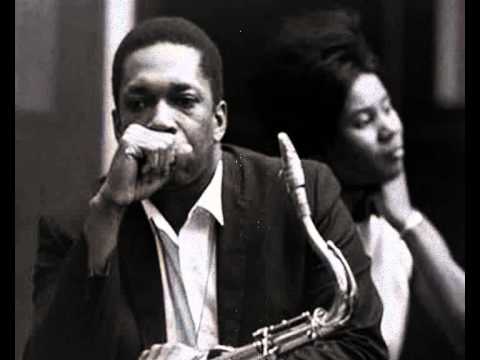
John and Naima Coltrane
wife. Trane was there with his wife, Naima. It was Mal's date. He had written four tunes: "Interplay," which was "I Got Rhythm;" "Anatomy," which was "All the Things That You Are;" "Light Blue," which was a blues, and the tune that made the album, "Soul Eyes." I was nervous as hell, but I was determined. Everything that we did was one take. Between Coltrane and Bobby Jaspar, that was something. Bobby Jaspar was a good player, very good. He was tight with Idrees; he was a nice cat. I liked him and Trane. It was a hell of a date.
A hell of a date is right. Young was focused on the horn players, and so left out Kenny Burrell, but he was another one of Prestige's rising all stars, and he contributes mightily as well. "Anatomy" goes straight from the head (which is a lot more than a riff: Waldron was a talented composer, and even if this is based on the ubiquitous chord changes, in this case "All the Things That You Are") to a guitar solo, to a bowed bass solo by Chambers, to a piano solo by Waldron, and they're all a lot more than interludes between the two trumpets and two saxophones.
The centerpiece here, Webster Young's "tune that made the album," is Waldron's classic "Soul Eyes." It's best known for the 1962 recording by Coltrane on Impulse, but it's become a standard, recorded by Stan Getz among others (and check out the recent vocal version by Kandace Springs). Coltrane's 1962 recording features his great quartet with McCoy Tyner, Jimmy Garrison and Elvin Jones, and distills the beauty of the composition into 5:27. This version lasts 17:29, one whole side of the LP, and gives ample opportunity for interplay between two trumpets, two tenors, a guitar and a rhythm section. If you know and love the Coltrane quartet version, listen to this one, too.
This is an amazing feat, when you think about it. Bob Weinstock, as we know, liked the impromptu feeling of a jam session. He's talked about the way he worked with Miles Davis--no regular group, just sit down and kick around ideas for a session. Who was in town, who Miles would like to play with. That resulted in some perspectives on Miles that we would not have had otherwise, and it's the same thing here with Coltrane, as you can tell if you listen to "Soul Eyes" with Coltrane's regular group, and with this pickup group, probably put together by Weinstock and Mal Waldron. Coltrane and Sulieman were veterans and most likely knew each other, but they had never recorded together. Nor had Coltrane and Waldron, although Waldron and Sulieman had done one previous session. Kenny Burrell was new in town. He'd worked with Paul Chambers, but that was about it. Bobby Jaspar was not only new in town, he was new to the country. Webster Young was still a kid whose knees started shaking when he heard he was to record with John Coltrane.
So you have these guys new to each other, playing charts they had almost certainly just received that day. Two of the melodies were based on chord changes they were familiar with, one was a blues. But the last one, the big one, was a new and subtle melody, and as they started playing the head, they must have known it was not going to be a three minute number for jukebox release (which it is, in the Kandace Springs recording), but they didn't necessarily know that it was going to go on for the better part of 20 minutes, and they'd have to keep improvising and keep on keeping it fresh. And, as we know from Webster Young's reminiscence, you were going to have to do it in one take.
And I don't know, but I'd guess if you were getting together with strangers on a 17 minute jam, it would be easier to sustain if you were playing something bouncy than a dreamy, subtle ballad. But that's what they do, and they do sustain it. I wouldn't subtract a minute.
If you're going to pull something like this off, it helps to have a musician of the caliber of John Coltrane at the center of it. And it helps to have the composer anchoring it, if that composer is Mal Waldron. It's always a special experience to hear Waldron soloing on one of this own compositions.
Listen to the way the musicians come in as the head gets restated at the end of the piece. It's unusual, maybe even haphazard. It wouldn't be that way if it had been rehearsed. And it's just about perfect. It's Prestige jazz.
The title of the album is Interplay for 2 Trumpets and 2 Tenors.
Don't ask me why Webster Young gets the special "introducing" credit in the session notes. New performers were introduced all the time, especially with Jackie McLean. Ray Draper had just made his debut a month earlier on a session with McLean and Bill Hardman, himself a McLean introducee. But that's what it says.
Draper's debut as a leader is noteworthy for a couple of reasons: (a) there aren't all that many jazz combos led by a tuba player, and (b) Draper was still only 16. But he had leadership qualities, and if he hadn't lost so many years to heroin addiction (it must have been tough to handle being 16 and being thrust into the cauldron of the New York jazz life), he could have done a lot more. As it is, he is credited with being the first musician (even before Miles) to form a jazz-rock fusion group
There are a bunch of faces new to Prestige here. Except for McLean and Mal Waldron, this is a new mix, which once again leads to the speculation on how a group is put together for a session. Sometimes musicians who grew up together will coalesce to make a record, like the various Detroiters, or Harlem high school pals Sonny Rollins, Kenny Drew, Jackie McLean and Art Taylor. But Ray Draper certainly wasn't calling on guys his age from the old neighborhood, because there weren't any other guys his age playing jazz on this level. Webster Young, Spanky DeBrest and Ben Dixon were all in their early twenties, but there's a big gap between that and 16.
But we know a certain amount about this session, from a reminiscence by Webster Young in Jazz and Blues Musicians of South Carolina, by Benjamin Franklin V. Young was living in Brooklyn and mostly playing with a bunch of guys in Brooklyn, although he would come in to Manhattan to informally apprentice with Miles Davis, and occasionally sit in with him on gigs. Miles, he said, would encourage him but keep him in check:
If you wanted to show off, Miles would say, "You got a Cadillac outside?" In other words, "What's wrong with you?" I dug it, I needed that.
Ray Draper would occasionally show up at the Brooklyn jam sessions.
He'd been playing at some sessions in New York and some competitions at Birdland...He was a nice cat [but] full of himself. I was a little bit older, and I helped him to be serious...Ray came up with a proposal. If he could play with us, he'd get us to the New York competitions. I said "No." And I didn't want a tuba player. But the other cats said if we did it, we'd be doing something. So I thought if we didn't do it, I'd lose the band. We let Ray play with us, and we had the competitions. Nat Hentoff...was one of the judges. We played three competitions. We won them all.
Young was invited to meet Jackie McLean and hang out during Draper's first recording session with McLean, and
...during intermission, Bob Weinstock came over to Ray and said he was going to record him and Webster. He didn't even know me.
So that's how Young got on the session. He was also the one who recommended drummer Ben Dixon, a fellow South Carolinian. The two had moved to Washington and then Brooklyn together, and Young had told Draper that "I'd make the date as long as we had Ben Dixon on drums."
Dixon would go on to a substantial career in New York, becoming a sought-after drummer especially for Blue Note's soul jazz recordings, working a lot with Lou Donaldson and Grant Green. Young played on several Prestige dates in 1957, and that was pretty much the end of his recording career, although he continued to be in demand as a working musician. He told Franklin that he had reservations about doing a lot of recording because he didn't want to be tied down to a day job, although he eventually did take a day job, becoming a respected educator.
Jackie McLean is the veteran here. Although only 25 himself, he was already considered a major jazz star, and one of the most recorded jazz musicians of his time. There were a couple of reasons for this. First, that he was really good and really versatile. Second, that his situation was almost exactly the opposite of Webster Young's: he was largely limited to day jobs. He battled heroin addiction throughout the '50s, and his arrest and conviction for heroin possession meant that he could not get a cabaret card to work in New York City clubs. As Young recalls in his taped reminiscence, Jackie "was the cat," but because of his ubiquitous exposure and his innate generosity, he gave much of the solo space to the younger musicians.
Draper and Young each contributed two songs to the set, each of them paying tribute to a mentor, Young with "House of Davis," and Draper with "Jackie's Dolly," dedicated to McLean's young daughter. And Webster paid tribute to another idol with his suggestion of "You're My Thrill," one of his favorite Billie Holiday recordings.
Mal Waldron's "Pivot" had previously been done on the Jimmy Raney / Kenny Burrell version of the Prestige All Stars, and here it shows Waldron's piano chops as well as his compositional skills.
Jazz instrumentalists were doing amazing things with unlikely instruments during this era. J. J Johnson and Kai Winding had shown that fast, complex bebop figures could be played on the trombone. The bass had become a flexible solo instrument in the hands of players like Paul Chambers and Oscar Pettiford, and Ray Draper was ready, at 16, to step out front and make the tuba a significant solo instrument. And to show just how much can be done in those lower registers, he played some exciting bass-tuba duets with Spanky DeBrest (best known for his work with Art Blakey and the Jazz Messengers).
The session was released as Tuba Sounds, with "introducing Webster Young" as part of the front cover text.


.jpeg)

:format(jpeg):mode_rgb():quality(90)/discogs-images/R-7069360-1432996141-6372.jpeg.jpg)
