Showing posts with label King Pleasure. Show all posts

Friday, July 03, 2015

Listening to Prestige Part 128: King Pleasure/Quincy Jones

Every King Pleasure session leaves me with more questions. How exactly did he fit into Prestige's world? How did he fit into anyone's? He has to have been one of Prestige's bestselling artists, but he seems to have been recorded as an afterthought, generally with a rhythm and blues band. This session is unusual in that he has a fantastic array of A-list musicians backing him up, but it also doesn't seem that it was exactly his session.

And we've seen this before, too. In 1952 there's a session by the Charlie Ferguson Quintet. Ferguson didn't exactly become a household word, even in jazz households, although he put together a fine group, including bassist Peck Morrison. And of the eight songs recorded that day, six of them instrumentals, Prestige only released four, and only two of them were Ferguson instrumentals. The other two that did get released featured a vocalist. Yes, it was King Pleasure, and yes, these two have become jazz classics: "Red Top" (also featuring Betty Carter) and "Jumpin' With Symphony Sid."

So here, again. That session is listed in the Prestige discography as "The Charlie Ferguson Quintet" with King Pleasure. For this one, at least Pleasure gets top billing: King Pleasure with Quincy Jones Band. But again, two cuts with vocals, two without.

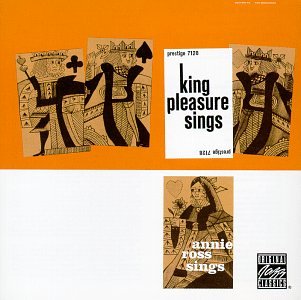
This is the fifth of five sessions Pleasure would do for Prestige. They'd be collected in the now-legendary King Pleasure Sings/Annie Ross Sings LP in 1957. By then Pleasure had gone on to record a couple of singles for Aladdin (including a remake of "Moody's Mood for Love"), then Jubilee, HiFi Jazz, and United Artists ("Moody's Mood" again). Then nothing. He died in 1981, pretty much forgotten. I was only able to find one obituary, on a blog called The People vs. Dr. Chilledair, a reprint of a piece the author had written in 1981 for the LA Jazz Dispatch, and it doesn't add much to what we know about his life, which is close to nothing. But he adds this:
Postscript: Years later, after writing this, I encountered the singer’s last drummer, John Gilbert, on the internet. Here is what he wrote on his website: “This picture of me was taken in 1965 by King Pleasure at a service club in North Carolina. He was traveling through that part of the country using local rhythm sections. [Singer] Earl Coleman recommended me to King Pleasure for the gig, and it turned out to be a lasting friendship. I came to California in 1969 and we played some in L.A. until his health failed badly (emphysema). Pleasure stayed with my wife and I for a while in Sherman Oaks, Ca. My son was an infant and he would serenade him to sleep. I was also associated with Earl Coleman at the time. King Pleasure was initially impressed with the fact that I knew all of the words to 'Moody's Mood For Love' and other tunes that he had recorded. He was a sweet man and very helpful to me. Pleasure related to me that the greatest moment in his musical career came in New England. He was at a low point in his life, sitting at the back of a bus when a group of school children boarded the bus and one was chirping out 'Moody's Mood' which was a hit at the time. They had no idea that the figure in the back of the bus was the man himself. He got a big kick out of this and often happily reflected on that moment in time.”
I had wondered if Pleasure was particularly difficult, and maybe no one could stand to have him around for more than two songs at a time. When one thinks about jazz musicians of this era, one can't help but be aware that addiction is a possibility, but I'll never assume that.

Another possibility: maybe he only had so much material. Vocalese isn't exactly like instrumental improvisation. You're basically not improvising at all. You're following someone else's improvisation, so it has to be learned, and it's a little more complicated than learning a couple of verses and a bridge to standard. Plus, you have to write lyrics to that complex and often labyrinthine musical structure. Which also means finding the solo that'll work, and exposure to too much bad vocalese over the years has certainly shown us all that that's not a guarantee. Annie Ross went home one night and came back in the morning with"Twisted," but it's not that easy. Pleasure was a great singer, but he got his start performing an Eddie Jefferson lyric, and maybe putting together a successful vocalese piece didn't come easy to him.

In this case, he had some pretty serious support-- one of the hottest arrangers in the business, and two backup vocalists who were the royal court of the kingdom of vocalese, in Eddie Jefferson and Jon Hendricks. More backing vocals were provided by the Three Riffs, who weren't a group that went on to  stardom, but they were very good (one of them, Joe Seneca, actually did go on to a distinguished career as an actor).

He also had a powerful group of musicians working under Quincy Jones's direction. J. J. and Kai were really hitting their stride as a trombone team. Lucky Thompson probably never quite the recognition he deserved. This may have been 19-year-old Paul Chambers's first recording session.

The resulting songs may never have quite gotten the recognition of Moody's or Parker's moods, but they should have. "Don't Get Scared" is a Stan Getz solo, from a recording made in Sweden with Bengt Halberg and Lars Gullin. The Getz solo is sung by pleasure, the Gullin solo sung (and written) by Jon Hendricks, whose clever vocalese lyrics once earned him the nickname "the James Joyce of Jive."

"I'm Gone" is a Quincy Jones original, and the lyrics are credited to making Pleasure, but the arranged vocal ensemble parts, to the repeated phrase "I'm gone, I'm gone I'm gone I'm gone" are as important as the solo part.

So maybe this was essentially a Quincy Jones session. Jones wasn't exactly a regular in the Prestige stable, though he had done a couple of other arrangements, and he was a rising star, and maybe he brought the vocalists in as part of it, but the vocal tracks weren't all he wanted to do.

Maybe...but the vocal tracks are the ones that are remembered from this session. King Pleasure really was that good, with the right material, and he didn't record all that much.

But the instrumental tracks are worthwhile too. There's some masterful writing and masterful playing. "Funk Junction," which is sort of a continuation of the ideas in "I'm Gone," shows what happens when this same ideas are given to a bunch of talented improvisers. Of particular note is a solo by young Paul Chambers.

"I'm Gone" came out on 78 b/w "You're Crying." "Don't Get Scared" had two different releases--on 78, b/w "Funk Junction," and on 45, b/w "Red Top."


Friday, April 10, 2015

Listening to Prestige Part 99: King Pleasure

King Pleasure's version of "Parker's Mood" is one of my favorite records of all time. I've let it be known that it's the song I want played at my memorial service, assuming anyone wants to organize one for me. It is so close to my heart that it's difficult to write about it.

And right up there alongside it is Charlie Parker's recording of his own mood. It's one of the few--perhaps the only one of Bird's original compositions that he only recorded once, so that one recording stands as the perfect, the Platonic ideal representation of this tune. And deservedly so.

Other musicians have recorded "Parker's Mood." There's an odd but enjoyable swing version by Jimmie Lunceford, a respectful tribute by Roy Hargrove and Christian McBride, a somewhat less respectful but eminently listenable version by James Moody on a 70th birthday live album. Supersax was a strange and fascinating Parker tribute band that played note-for-note replications of Parker's recordings with five saxophones and brass.

But the two recordings that count are Bird and King Pleasure. Bird emotionally searing, technically a wizard, and it is possible to accomplish both at the same time. Novelist John Barth said "“In art as in lovemaking, heartfelt ineptitude has its appeal and so does heartless skill, but what you want is passionate virtuosity.” And that's what you got, one recording after another, from Charlie Parker.

King Pleasure puts words to what needed no words, and it turns out that the words really do add something. His voice is smooth but passionate, his words familiar but memorable. He creates an elegy by pulling lyrics, magpie-like, from a variety of sources including "Going to Chicago Blues" and "Careless Love," adding words of his own, and leaving us with the unforgettable reminder that "through thick and thin / On up to the end / Parker's been your friend."

One artist played the same role on both of these recordings: John Lewis. Lewis headed a trio with beboppers par excellence Curley Russell and Max Roach on the 1948 Savoy recording with Parker, and led his MJQ-mates Percy Heath and Kenny Clarke in 1953 for Prestige. He's masterful in both, with his reflective little figure following the opening cadenza, his solo that fully captures Parker's and Pleasure's moods, and his laconic but heartfelt summing-up figure at the end.

"Parker's Mood" stayed with Lewis as it did for everyone else who's heard it and opened up to -- probably more so for the great pianist. Some five decades later, at age 80, he revisited again with his "One of Parker's Moods," as he faced his own mortality - he would go to his own Kansas City less than a year later.

Prestige released "Parker's Mood" and "What Can I Say Dear" on 78 and 45. I don't mean to give such short shrift to "What Can I Say Dear," which is a fine recording, but "Parker's Mood" is special. It came out on a second 45 b/w "Jumpin' With Symphony Sid," on the 10-inch LP, and on the great King Pleasure Sings/Annie Ross Sings 12-inch LP.


Tuesday, March 24, 2015

Listening to Prestige Records Part 93: King Pleasure

Does it seem that every time Bob Weinstock decides to make a record with King Pleasure, he gets it all wrong, and yet it comes out so right?

In earlier sessions, he seems to have thought of Pleasure as a rhythm and blues singer. He's tossed him into recording sessions with other R&B singers, and given him R&B musicians, and come up with one of the most enduring and beloved classics of jazz vocal music, in "Moody's Mood For Love."

The success of "Moody's Mood" didn't give him the idea that he should put Pleasure in with some of the A-list jazz musicians he'd been recording; he did a second session with a rhythm and blues band, on which his tracks were sort of a throw-in -- the session was mostly about Charlie Ferguson's band, but they did include two King Pleasure vocals. On one of them, just as they'd tossed in a chick singer to the "Moody's Mood" recording who happened to be Blossom Dearie, they tossed in another chick singer, a girl who was scuffling around New York after being fired by Lionel Hampton for insisting on singing bebop instead of swing. That was Betty Carter, and the tune was "Red Top." And the other throw-in on the Charlie Ferguson session was "Jumpin' With Symphony Sid."

So this time, he brings in the creme de la creme, the A-list of A-lists, three quarters of the Modern Jazz Quartet, but you can't really hear them -- they're not given any solo time. In fact, at least on "Sometimes I'm Happy," King Pleasure takes something of a back seat to the Dave Lambert Singers.

Dave Lambert, in 1953, was 36 years old and a veteran of the music business. He was a singer and vocal arranger who seemed more at home in a group setting, although he was a pioneer of the bebop scat style that King Pleasure, Eddie Jefferson, Jackie Paris and others were to bring to fruition as solo artists, and that Lambert was ultimately to find the best expression of when he teamed with John Hendricks and then Annie Ross. He had made what many consider the first bebop vocal recording with Gene Krupa's band, as a duet with Buddy Stewart.

In September of 1953, he was coming off what was generally acknowledged to be a failure: Charlie Parker with Voices. This was the followup to the successful and popular "Charlie Parker with Strings," and it featured an orchestra under Gil Evans' direction, and a 12-voice group of Dave Lambert Singers. Marc Myers interviewed Hal McCusick, who played on the session, about what went wrong:
The voice parts were way too complicated. Gil’s charts were beautiful and complex, as always. His arrangements always could push your buttons, musically. But Dave’s vocal charts were heavy, and by the time everyone realized this, it was too late. The recording session was already underway.

JW: Was Dave aware of that?
HM: I'm sure he was. But in all fairness to Dave, he was in over his head. First, there were too many singers.  Dave could have accomplished the same goal with better results if he had used four. All of us in the woodwind section knew it at the time. Second, Dave wasn’t skilled enough as an arranger to write for so many singers. What's more, the singers weren’t polished enough as a group to pull off what Dave had in mind and had written.
This may be a little rough on Lambert, and on the session. You can hear it on YouTube and decide for yourself, but you can understand what McKusick means. He goes on to say that
Dave was terrific when singing take-offs on jazz instrumentals and writing for small-group things. But to write structured charts for so many singers behind arrangements by a guy like Gil Evans requires enormous skill. When you're writing for 10 or 12 singers, you have no choice but to double up voicings. This means two or more vocalists need to sing the same notes. It’s the only way a vocal group can be heard clearly.

But doubling up parts means greater room for intonation error, since you’re more likely to hear somebody wavering off the written notes. When a voice wavers, it throws everyone else off, or the producer catches it and calls for another take. It’s like two people walking a tightrope out of synch. Someone’s more likely to fall. That happened quite a bit that day. The vocal charts were too hard to sing. The result was false starts and re-takes.
Lambert had cut down his ensemble by September. He hasn't found the magic he would capture with LHR -- his arrangements here are more reminiscent of a group like the Four Freshmen -- but he provides a nice group sound for Pleasure to wing it from.

This session didn't provide classics like "Moody's Mood" or "Symphony Sid" or the later "Parker's Mood," but they're still good, and I love Pleasure's solo on "Sometimes I'm Happy." I don't know whose instrumental solos he's basing these on.

And again, speaking of Weinstock's mistakes in recording King Pleasure that turned out to be not so mistaken, why only two songs per session? In 1951 and 1952, no one was thinking about LPs, but a recording session was still generally four songs, so you could put out two 78s. But by 1953, the 10-inch LPs and the 45 RPM EPs were common. The upshot of it was, when it came time to put his vocalese stars on a 12-inch LP, he had not enough songs from Pleasure and even fewer from Annie Ross, so he had to put them together on one disc. And the result? King Pleasure Sings/Annie Ross Sings is one of the absolute treasures of the LP era. You couldn't ask for better.

These two songs came out on both 78 and 45, on an EP with "Red Top," and on a 10-inch LP in 1954.


Friday, January 16, 2015

Listening to Prestige Records Part 72: King Pleasure

Strange, but this is the session that was. You'd have thought, perhaps, that after having a hit record off of the first King Pleasure session, Weinstock would have planned a whole recording session around him, and gotten him some serious A-list musicians, led by someone better than Teacho Wiltshire. But instead, he seems to have been a sort of afterthought on a session led by someone who wasn't as good as Teacho Wiltshire--although not bad.

The Charlie Ferguson Quintet recorded eight songs that day, six of them without King Pleasure. Of those six, only two ("When Day is Done" and "Stop Talkin', Start Walkin'" were ever released, although their version of "Christmas Song," with the Mello-Moods singing pretty good backup vocals to a sort of Earl Bostic-type sax solo by Ferguson, has showed up on YouTube. Prestige had Ferguson back a few months later to record six more songs, none of which were released.

So, let's start with the band. Ferguson had some solid rhythm and blues credentials, having played with Arnett Cobb and Jimmy Liggins. Most of his work in the 50s was in the house band for Apollo Records. But he couldn't make that breakthrough, and today he's probably best known, if at all, for the two King Pleasure songs. He's also, for what it's worth, the third Ferguson to record for Prestige in 1952. I don't know if he's related to either Rudy or H-Bomb. He has an extended solo at the end of "Jumpin' With Symphony Sid," which cooks.

Ed Lewis's credentials go back to Bennie Moten in Kansas City, who played for many years with Basie, although he never soloed, and was considered by Harry "Sweets" Edison to be, along with Snooky Young, one of the two greatest first trumpets he ever played with. Ed "Schubert" Swanston actually worked extensively with the Mello-Moods, which may have been what brought him to the gig. He also had gotten around the jazz world, playing with Louis Armstrong from 1943-45, and also with such as Gene Krupa, Andy Kirk, Oran "Hot Lips" Page, Lucky Millinder, Art Blakey, Erskine Hawkins and Jimmy Rushing.

Peck Morrison would have a few turns in the Prestige studios, with Zoot Sims, J.J. and Kai, and Willis "Gator Tail" Jackson. He also recorded with Horace Silver, Gigi Gryce, and Art Farmer, and played with pretty much everyone: Gerry Mulligan, Carmen McRae, Tiny Bradshaw, Eddie Jefferson, Duke Ellington, Lou Donaldson, Mal Waldron, Randy Weston, Red Garland...I know I'm going on about these guys, when the real news about this session is King Pleasure and Betty Carter, but that's part of my pleasure in doing this blog. Jazz rode on the backs of guys like Ed Lewis and Peck Morrison...and Herbie Lovell, for many years house drummer at the Savoy Ballroom, who started with Hot Lips Page, then worked with Hal Singer, Johnny Moore's Three Blazes, Earl Hines,  Lucky Thompson, Jimmy Rushing, Arnett Cobb and pianist Teddy Wilson. Which is a lot of versatility, but there's more. He also played drums on The Freewheelin' Bob Dylan, and on albums bv John Denver, B. B. King, and...the Monkees?


King Pleasure broke through with Eddie Jefferson's magnificent treatment of "Moody's Mood," and came back this time with his own vocalese versions -- of Gene Ammons's "Red Top" (a really good start) and Lester Young's "Jumpin' With Symphony Sid" (has become a classic).

Carmen MacRae once said, "There's really only one jazz singer – only one: Betty Carter." Carter's improvisational gifts are legendary, but here on her one cut ("Red Top") she's mostly singing harmony with Pleasure, although she does get to let loose on one chorus. And again, you have to wonder. "We can get Betty Carter for this date." "OK, we'll use her for one song on the Charlie Ferguson session."

And what can you say about King Pleasure? He should have recorded more. But we have what we have, and these two are right up there with his best. And maybe it wasn't so much an afterthought to the Ferguson session -- maybe these were the only two songs Pleasure had at that time. Annie Ross may have tossed off "Twisted" in one night, but this stuff really isn't easy to write.

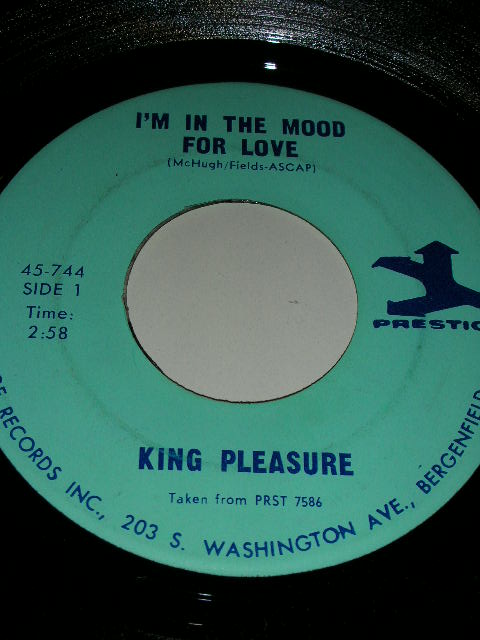
This may have been listed as a Charlie Ferguson session, but the records came out under King Pleasure's name (with Betty Carter given credit). "Red Top" was on three different Prestige 45 RPM releases, b/w "Don't Get Scared" (from a later session), "I'm in the Mood For Love" (from an earlier session) and "Jumpin' With Symphony Sid" (from this session). "Symphony Sid" also had a second 45 RPM release, b/w "Parker's Mood," Pleasure's masterpiece, about which more later, when we get to it.


Monday, January 12, 2015

Listening to Prestige Records Part 70: Forgotten Rhythm and Blues

Bob Weinstock may not have been all that deeply invested in rhythm and blues, but to the extent that he was, he didn't have the track record of betting winners the way he did in jazz. Maybe he didn't have the song plugger necessary to get a record out to black radio. But I suspect that he had pretty damn good taste. And to some extent this is speculation, because a lot of these R&B recordings deserved better than they got.

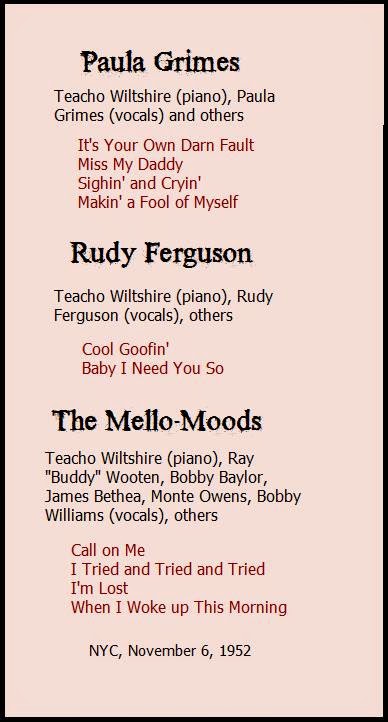
On November 6, he had Teacho Wiltshire (with unidentified musicians) in the studio with two singers -- one male, one female -- and a vocal group. The woman was Paula Grimes. She recorded four songs, and I can find none of them anywhere, but there is one 45 RPM record by her on YouTube -- You Move Me So / It's Happenin' Baby on Turf Records. It is great stuff -- Paula Grimes deserves to be much better known than she is. In the comments section for one of the YouTube cuts, someone pleads to have the Prestige sides posted, but the comment is four years old, so I guess that's not happening any time soon. I tried to find out more about the label, but when I Google "Turf Records" I get links to Secretariat and Seabiscuit.

Rudy Ferguson cut four songs, and only two of them were released -- Cool Goofin' / Baby, I Need You So. The titles of the other two may give some hint as to why they weren't released: Goofin' and Jivin' and Goofin' in a Goofball Way. Followups to Cool Goofin' if it became a hit, but it didn't.

It had some competition. In the week of its release, February 14, 1953, Billboard has it listed as number 5 in their pick rhythm and blues selections, behind records by Roy Brown, Amos Milburn, Fats Domino and Nat "King" Cole.

And it is on YouTube. And it's a really nice song...I like it a lot. It's in the jump blues/swing tradition that Lionel Hampton and Louis Jordan developed, and that Count Basie and Joe Williams were to bring to perfection. It has some of the King Pleasure/Eddie Jefferson feel to it, except that it's not following a jazz soloist -- except for one place in the middle, where he interpolates "There I go there I go there I go..."


The third act to be stuck in front of Teacho that day was a group of young teenagers singing the sort of music that had begun to be popularized by groups like Sonny Til and the Orioles, and would much, much later come to be known as doo-wop. I'm going to spend a little time on the Mello-Moods, because I love this kind of music, and because their story has an unexpected jazz connection.

A few years after the Mello-Moods, Frankie Lymon and the Teenagers would take the pop music world by storm, and they would dress in high school letter sweaters and sing about teenage love and not being a juvenile delinquent, but the Mello-Moods, led by Ray "Buddy" Wooten, were competing with the Orioles, the Cardinals, the Clovers -- the early harmony groups that were taking African-American harmony away from the smooth pop sound of the Ink Spots and the Mills Brothers, and more in the direction of rhythm and blues. The Mello-Moods had had a regional hit for Robin Records, one of the very few black-owned record labels, started by Harlem record store owner Bobby Robinson.

Doowop chronicler Marv Goldberg has a nice story about their early days:
They entered the Apollo amateur show. They were in the basement practicing, and a little guy came over to listen to them. After hearing them, he said that they were so good he wouldn't even bother to appear on the same show with them. However, he somehow got over his nervousness and went on to "tear the stage up" and win first prize that night. His name? Otis Blackwell. The Mello-Moods had to settle for second place.
They had a hit record for Bobby Robinson, one of their songs, How Could You, reaching the Rhythm and Blues top ten.

But, they were young. And they lived in a world that didn't worship youth. Marv Goldberg again:

With a hit record to their credit, you'd think that the Mello-Moods would have been swamped with personal appearances. However, remember that they were young and their parents watched them like hawks. School was the most important thing, and anything that stood in its way was to be squashed. Also, they couldn't appear at any place that sold alcohol. As James says, "Our parents wouldn't let us out of their sight. They fought tooth and nail with [manager] Joel Turnero and Bobby Robinson."
Good for the parents. Education matters. And very few of the doowoppers were able to make lifelong careers in music.

In the fall of 1952, they left Robinson and signed with Prestige, making this first recording with Teacho Wiltshire's band. There's a YouTube underground of doowop fanatics, so you can hear all of these songs there -- and also the one song that they did in a second session on December 12, which was never released -- a version of Mel Torme's The Christmas Song, can be found on YouTube.


Again, this shows a certain measure of disappointment. You don't have a group record a Christmas song unless you're expecting them to have a certain measure of popularity, and you don't not release it unless that popularity hasn't happened.

Or it could be that the recording was too late for Christmas 1952, and by Christmas 1953, the group had pretty much broken up. Marv Goldberg again:

 Says James [Bethea], "We had the feeling that Joel [Turnero] was trying to hold us back...None of us were happy with the music we were singing; we wanted real R&B. We enjoyed our singing, but there was a personality conflict. We were doing his tunes and we wanted to do other stuff. He was trying to make a Mills Brothers act out of us. Joel wouldn't release us. We realized that the group was going to break up; we had to stop singing in order to break the contract with Joel."

Also, the Christmas Song cut is not exactly a Mello-Moods song. They're on it, but basically they're just singing background vocals for an extended solo by sax player and session leader Charlie Ferguson (Rudy's brother? No information here).

We'll get to the December 12 Prestige session shortly, but one last mention of the Mello-Moods' role in it. Sadly, not even the doo-wop freaks of YouTube have been able to find these. They sang backup on early takes -- not the ones that were ultimately used -- of King Pleasure's "Red Top" and "Jumpin' With Symphony Sid."

Friday, December 19, 2014

Listening to Prestige Records Part 61: King Pleasure


Early in 1952, Bob Weinstock seems to have been stirring the pot a little, not entirely sure of what he was looking for. He recorded some of his old favorites, like Wardell Gray and Sonny Stitt. He did another Swedish session.

He tried some more blues and gospel. On January 3, he had Brownie McGhee back in the studio to record two songs, solo this time. "Heart in Sorrow" and "Operator Long Distance" became standards of McGhee's repertoire, and I'm not sure I can locate these particular versions, although they were released on Par Presentation. On January 23, he recorded 12 songs by two different gospel groups, and never released any of them.

So one has to wonder if he walked into his scheduled February 19 recording sessions with more of a desultory "What the hell, let's try this" approach. He hadn't recorded a lot of vocals. Looking back, I see The Cabineers, who weren't a huge success. Then nothing until the H-Bomb Ferguson/Ralph Willis/Brownie McGhee sessions of late 1951, and folk blues/rhythm and blues was not a direction he was much focused on.

So he put together a band of hard working studio musicians under hard working Teacho Wiltshire -- Leonard Gaskin and Cecil Payne the only ones to establish names for themselves in the jazz world -- and scheduled them to back up a couple of singers, doing two songs each.

One was Bobby Harris, about whom I can find nothing. There's a 1965 Atlantic Recording by a Bobby Harris on YouTube, but who knows if it's the same one? It's a common name. "Rub a ittle Boogie" is included on a compilation album called New York Blues 1945-1956, but a review in a blues magazine which goes into detail on all the other performers in the compilation, says nothing about Bobby Harris.

The other was King Pleasure.

And I wonder if Weinstock knew what he had, when he played back this one.

First off, it is one my favorite records of all time. The King Pleasure/Annie Ross LP was one of the first jazz records I ever bought, and I've never gotten tired of it.

Second, if he was looking for a jukebox hit, this was it. He'd had some chart success in 1951, with Gene Ammons's "Jug" making the rhythm and blues charts, but "Moody's Mood"was huge, making it to #2 on the R&B charts.

It remains one of the great jazz vocal recordings, and one of the most curiously underappreciated. Much of what's written about it tends to harp on the fact that King Pleasure didn't actually write it, although no one harps on the fact that Louis Armstrong didn't write "Sweethearts on Parade," and Frank Sinatra didn't write "I Could Write a Book." The melody is, of course, James Moody's improvised solo to "I'm In the Mood for Love," recorded in Sweden in 1949 -- actually Moody's solo and the brief solo by Swedish pianist Gosta Theselius, sung by Blossom Dearie in the 1952 recording -- and the lyrics were written to Moody's solo by Eddie Jefferson. Pleasure heard Eddie Jefferson sing it in a club, and asked if he could sing it as well. Then when Bob Weinstock signed up a couple of unknown singers for a quickie recording date with Teacho Wiltshire's band, this was one of the songs Pleasure brought with him. He must have also brought Blossom Dearie with him -- she was relatively new in New York, and had been working as a backup singer for Alvino Rey and Woody Herman.

Later in 1952, Dearie would move to Paris, where she would make her reputation. In her official bio -- another underappreciation, or perhaps it's just because she isn't credited on the record -- this recording is not mentioned.

And finally, this back of the hand from reviewer Alan Kurtz on the jazz.com website, "Singing with more gusto than skill, Pleasure put vocalese on the map and then, as online biographer Alex Henderson writes, '"faded into great obscurity.'" Kurtz has never heard "Parker's Mood"? "Don't Get Scared"? "Jumpin' with Symphony Sid"?

Eddie Jefferson created vocalese, and Pleasure, as Kurtz grudgingly admits, put it on the map. I think calling this form "vocalese" ultimately gave it a bad rap, because it came to have a reputation as a gimmick, when it was attempted by people who weren't as good as Eddie Jefferson, or King Pleasure, or Annie Ross or Dave Lambert. Or Job Hendricks, who has described the first time he heard King Pleasure's recording:

'It opened up a whole world for me...I was mesmerized. I'd been writing Rhythm and Blues songs, mostly for Louis Jordan. But I thought 'Moody's Mood For Love' was so hip. You didn't have to stop at 32 bars. You could keep going.'

There actually were a few recordings of singers reproducing an instrumental solo before Jefferson, and before anyone called them vocalese. Bee Palmer, better known as a dancer in the flapper age (called the "Shimmy Queen"), made a record of "Singin' the Blues" with Frankie Trumbauer, where she sang the Bix Beiderbecke trumpet part, and it's not very good, but it's not awful, either. Ethel Waters covered Louis Armstrong's classic "West End Blues," and she didn't exactly replicate Armstrong's trumpet part, but she did her own version of it, and it's very, very good.

Here's a note to my new friends in the Jazz Educators page of Facebook -- the vocalese version of
"Moody's Mood" -- and there are many covers, but I'd go with the Pleasure or Jefferson versions -- can, I think, be a great teaching tool to someone like me who loves music but is more knowledgeable about words. Jefferson's lyrics, which dance away from, and then back to, Jimmy McHugh's original lyrics, can be a wonderful lesson to a verbal person in how a jazzman improvises on a melody.

The other cut from this session is "Exclamation Blues," which is a not very good song, but a good rhythm and blues delivery by King Pleasure, and a terrific sax session break from Teacho Wiltshire's band. Hard not to wonder if Bob Weinstock wasn't thinking that "Exclamation Blues" might be his breakout jukebox hit. Or, for that matter, if it might be one of Bobby Harris's songs. In the music business, you never know.

Others on the session: Merrill Stepter, listed on a recording with Don Byas and Buck Clayton. Maybe also recorded with Big Bill Broonzy. Ray Abrams has a solid bio -- worked with Dizzy Gillespie, Andy Kirk,Don Redman, Slim Gaillard, Hot Lips Page, Roy Eldridge, and he is hot on this session.

Prestige issued "Moody's Mood" b/w "Exclamation Blues" on a 78, and later issued it again (as "I'm in the Mood for Love") b/w "Red Top" on a 45. "Moody's Mood" was included on the 7000-series King Pleasure Sings/Annie Ross Sings LP.

Both songs (neither of the Bobby Harris songs) are available on Spotify, but be careful. Pleasure re-recorded "Moody's Mood" some years later for United Artists, and while he still sounds great, the recording doesn't. The jazz group has been replaced by a string session, and Blossom Dearie has been replaced by a Blossom Dearie soundalike -- she actually sounds too much like Blossom to be Blossom, if that makes any sense. Too airy, too chirpy -- a Blossom Dearie imitator. And double-tracked, which is unnerving. Look for the version from King Pleasure Sings/Annie Ross Sings, not the version from Moody's Mood for Love.


Monday, June 04, 2007

I've been tagged by Jeff Newberry to list "Five Songs That Knock My Sox Off." Since I kinda shy away from "interesting stuff about my life" on this blog, I've tried to come up with five songs that not everyone who ventures in here will necessarily have listened to -- but everyone should. I've also kept it to songs with vocals, because otherwise it would just be too hard.

Parker's Mood
, by King Pleasure.

I want this one played at my funeral. It's evocative, yearning, and ultimately about that last journey alone. Bird probably did not want it played at his funeral. His waxing of lyrics set to one of Parker's most haunting melodies (and a tune that Parker only recorded once) came out in 1952, at a time when Bird was increasingly strung out and facing the bitter end of his own mortality. he did not want to hear what could have been his obituary blaring out of every jukebox.


Don't Drive Your Mama Away, by Shirley Caesar.

I heard this song once, on the radio of a cab in New Orleans, and could not rest until I had tracked it down. I haunted gospel music bulletin boards on Prodigy, describing the song as best I could, until someone was able to identify it for me.

Once heard, never forgotten. It sears, it soars, it has all the feeling that only the greatest gospel singers can put into a song, and a powergul story -- a variation on the Prodigal Son story, set in modern times, with a bittersweet twist. Composed by Shirley.


Lover Come Back, by Dinah Washington. "Parker's Mood" is a brilliant example of "vocalese," the technique of setting words to a jazz solo, but King Pleasure is still a vocalist. Dinah Washington, on this cut, is an instrument. Dinah jams, here, with Clifford Brown, Max Roach, Richie Powell, Clark Terry, Harold Land, and others. The session was recorded live in front of an audience that I would have given an arm and a leg to be part of. When people play the "what era would you like to have been born in?" game, for me it's always ten or fifteen years before I was actually born. And I would have liked to be born hipper than I actually was, so that I could have been on 52nd Street, and up at Minton's, to bear witness at the birth of bebop.

Voice as instrument -- I could have chosen Sarah Vaughan's Shulie a Bop just as easily...or anything by Louis Armstrong. The trouble with Armstrong is that there are so many great titles competing for one's attention, how can you choose one. But I'm happy to go with Dinah for this pick.


Banks of the Hudson
, by John Hall. I take enough pride in my own work that I'll choose one of my songs here -- lyrics by Tad Richards, music by John Hall, now The Honorable -- freshman Congressman from Dutchess County. Partially inspired (not the first time this has inspired me) by Thomas Cole's great "Voyage of Life" paintings, partly by love of my native soil, and the river that runs through it.

Ballad for Americans, by Paul Robeson. The greatest and most thrilling of American voices. I first heard "Ballad for Americans" as a child, and though some of the concepts of Americanism in it are a little dated, I wouldn't change one word of it, or one note of Robeson's magnificent voice. I interviewed Earl Robinson not long before he died, and he told me that he had deliberately written a melody simple enough that schoolchildren would sing it. I asked him if it was a surprise, then, to hear it sung by the greatest voice of his era. He said it was, and a pleasant one.


How could I leave out...? But I did. Had to leave out something. Anything by Ray Charles, I wouldn't know what to choose. Maybe "What'd I Say?" "Blue Suede Shoes" by Carl Perkins, which has much of a claim as anything I can think of to the title of The Great American Song. I hated to leave out doo-wop - maybe "When You Dance," by the Turbans, "Church Bells May Ring" by the Willows, "That's My Desire" by the Channels, "I Promise to Remember" by Frankie Lymon and the Teenagers. "Please Send Me Someone To Love," by Percy Mayfield, the Poet of the Blues. Specialty Records owner Art Rupe said of Percy that he suffered from a terrible self-image -- if he'd had the right encouragement, he could have been another Langston Hughes. I believe it.

I will tag someone new.