Tad Richards' odyssey through the catalog of Prestige Records:an unofficial and idiosyncratic history of jazz in the 50s and 60s. With occasional digressions.
This session, half of a Bluesville LP that has a 1960 session with Lightnin' Hopkins on the other side, is vintage Sonny Terry. Brownie McGhee backing him up on guitar, Sonny handling harmonica and vocals. Vocals on three of the cuts, the other two Sonny's trademarked harmonica-and-whoop. It's Sonny in his prime, but his prime lasted a very long time. From his 1938 appearance in John Hammond's Carnegie Hall "Spirituals to Swing" concert to his featured solo in the 1986 movie Crossroads, recorded not long before he died, he did what he did, and he was a master.
This would be his last Bluesville session, and it's a good one
Of tangential interest -- the liner notes were written for Bluesville by Leroi Jones. whose book Blues People would be released at around the same time as the album, the first major study of American musi by an African-American author. Jones, who would become Amiri Baraka, had this to say of Terry:
Sonny wheels and deals, just as he always does, coming quite close, sometimes, to convincing any interested listener that his blues is really a new kind of expression, unheard of before this album.
"Callin' Mama" has one of Sonny's virtuoso touches, hardly unheard of before this album but always a crowd pleaser. At Brownie's urging, the harmonica plaintively pleads: "I want my mama."
Kenneth S. Goldstein is credited as producer on the album cover, Goldstein and Ozzie Cadena on Wikipedia's page. The Bluesville LP, Sonny is King, has this session on one side and a 1960 session with Lightnin' Hopkins on the other side. The Brownie side was recorded at an unnamed New York City location, the Lightnin' side, also featuring a jazz bassist and drummer, at Van Gelder Studio. So if I had to guess, I'd put Lightnin' with Ozzie and Brownie with Kenny.
People tend to remember how the British invasion of the mid-1960s, starting with the Beatles in 1964, changed the face of popular music and put an end to the careers of a lot of American performers. But it's worth noting how it changed the perception of blues. Blues performers had been a part of the acoustic folk music revival that had put down roots in the 1940s with folk singers like Woody Guthrie and Cisco Houston, and had begun to blossom in the 1950s, with folk music coffee houses in northern cities and college towns, and folk festivals, the most significant of which was the 1959 debut of the Newport Folk Festival in Newport, RI, site of the already well-established Newport Jazz Festival. Amplified blues performers like
Muddy Waters or B. B. King were relegated to the "chitlin' circuit" of rhythm and blues and jazz acts whose audiences were primarily, often exclusively Black.
But if white audiences in America weren't listening to Black electric blues people, young British audiences, and especially young British musicians, certainly were, starting with Muddy Waters' first trip to England in 1958. When those electric blues-influenced British musicians started touring America, they were bringing it all back home, to borrow a phrase from another American folk musician turned electric. By the time of the first all-blues festival, in Ann Arbor, MI. in 1969, the electric acts were in the ascendant.
So performers like Sonny Terry and Brownie McGhee, who had once been supporting acts to performers like Pete Seeger, the Kingston Trio, Joan Baez and Bob Dylan (Sonny and Brownie were part of the 1959 Newport Folk Festival), became supporting acts to performers like Howlin' Wolf, B. B. King and the Paul Butterfield Blues Band.
But they always had their audience, and there are many recordings made by the duo over the years to
prove it. They also had the good sense, borne of hardship and working class values, to know not to break up a successful act, so they remained working together for many years, although they famously did not particularly get along with each other. They worked the folk festivals, and the blues festivals, and the college gigs, and...as in the case of this live recording...the coffee houses. The Second Fret was a fond favorite of Philadelphia folk music fans up through the early 1970s, and Sonny and Brownie were always welcome there.
The two singers' repertoire was extensive, with blues written themselves (Sonny's "Me and Huddie Ledbetter") or reworked to fit them ("Brownie's "Me and Sonny," reworked from Sonny's song), or remembered from childhood, or picked up along the way. Or learned from other recordings, as with Bessie Smith's "Backwater Blues," a song about refugees from a devastating flood. It has become associated with the great flood of the Mississippi Delta in 1927, and has been by blues singers who witnessed that flood, and blues singers who didn't--Terry was born in Georgia, McGhee in Tennessee. However, it was written and recorded by Bessie Smith two months before that disaster happened. It's believed to be describing an earlier flood of the Cumberland River near Nashville. Regardless, it is a devastating account of a natural disaster.
Brownie McGhee and Sonny Terry at the 2nd Fret was recorded live, Kenneth S. Goldstein producing the record. It was released on Bluesville.
Sonny Terry is sprung loose from his usual partnership with Brownie McGhee, and paired with a different blues guitar man. Lightnin' Hopkins was an altogether different proposition. From Texas, he was not at all of the Piedmont school of Blind Boy Fuller-influenced finger picking. He got something from serving as an on-and-off lead boy for Blind Lemon Jefferson on the streets of Houston, and by playing on the streets. He bounced back and forth between playing music, picking cotton, and working on the railroad, until in 1946 he was offered a recording contract by Aladdin Records in Los Angeles (one of his songs on that session was "Rocky Mountain Blues," which he would record again for Prestige). That began a long, strange recording Odyssey for
Hopkins, which made him, by the time he was finished, the most recorded blues musician of all time. Nobody knows how many records he made, or for how many labels? Eight hundred? A thousand? More? You pays your money and you takes your choice.
The first heyday of his recording career lasted from 1946 to 1956, the rhythm and blues years, and the small independent record label years. with a style that was loose, rough, not too overly concerned with time signatures or even staying in tune, but always powerful and authoritative. He was limited in developing a name for himself in that he didn't much like to travel and he didn't much like to leave Houston, but he left a remarkable legacy of recorded music. And he wasn't through yet.
In 1959, he was discovered by Samuel Charters, the first of the
white scholars to take a serious interest in the blues. Charters, who was married to literature professor and Beat Generation scholar Ann Charters, was particularly interested in the richness of blues lyrics. As he put it, "I really got bored with all those damn guitar solos. To me, they all sounded like B.B. King, and what I really wanted to hear was great text."
Hopkins was a perfect choice for Charters. At a time when the blues was going electric, and guitar solos were starting to dominate, Hopkins still played acoustic, and with all those recordings he made, often of the same songs over and over, he would find subtle and improvised variations on the lyrics. Filmmaker Les Blank recalls one such improvised lyric:
You make your bed hard, baby,
and calls it ease.
The blues is just a funny feelin’,
yet some folks calls it a mighty bad disease.
This line was composed late one night while I was filming what started out to be an ordinary interview. I had asked him to tell me what the blues meant to him. He picked up his guitar and started to sing about a woman named Mary who had left him. Earlier that evening his wife had left him after a nasty argument that caused her cousin to attempt to shoot Lightnin’. While the song was being sung, the cousin was lurking outside the apartment door with a loaded pistol. Lightnin’ also had a large loaded gun stuck down the front of his pants. Hardly a situation in which to delve into an academic and linear exploration of the nature of truth and the blues, but I came away feeling I knew a lot more about it than before, but I couldn’t exactly put it in words.
Charters was one of the first to ignite the new interest in the blues that would grow into the blues
explosion of the 1960s, with blues festivals and new recordings. His interest in Hopkins led to a second career for the old bluesman, one that Hopkins himself was reluctant to enter. He had played all his life for black audiences, and was almost completely unknown to whites (not completely--I had his 45 RPM recording of "Good Old Woman" on the Harlem label). But this was suddenly to change. His first appearance, on a bill with young white urban folkies to the Houston Folklore and Folk Music Society, was a huge success, and before long he was appearing in New York on a bill with Pete Seeger and Joan Baez. and recording for new record companies that made LPs and marketed them to white audiences.
Like Bluesville, where he was teamed up with Sonny Terry, a bluesman who had thrived for some years in New York, playing for whites, and put under the supervision of a white producer, Ozzie
Cadena. It was an odd pairing. Terry, no less authentic a bluesman, was technically more organized, and was used to playing with musicians like Brownie McGhee who were similarly more structured. An odd pairing, but not a bad one. Each knew enough to let the other do his thing, so although the same musicians--Terry, Hopkins, bassist Leonard Gaskin and drummer Belton Evans--were there for the whole date, it was really two separate sessions, with Terry front and center for the first one, and Hopkins taking center stage for the second.
There were similarities between the two, beyond a deep familiarity with the blues. While it's probable that no bluesman has ever been as prolifically recorded as Hopkins, Terry was no stranger to the recording studio. And he, too, had often recorded variations on the same material.
Terry begins his session with "One Monkey Don't Stop the Show," one of many songs to have been written under that title. The first recorded version was by Brownie's brother Sticks McGhee, with whom Terry had also recorded, including a Prestige session just two weeks previous. McGhee's "One Monkey Don't Stop No Show" bears no relation to Terry's. His is actually a reworking of a song he and Brownie McGhee performed regularly, and recorded more than once, called "Better Day." Both songs had the same verse-chorus structure, the same melody, and the same theme--things are bad, but that's all right, because they'll get better.
To the early blues musicians, authorship of lyrics was not that important, which is why there are so many "traveling lyrics," verses that pop up in one blues after another -- and part of the reason why their descendants in the 1950s were often a little too casual about nailing down lyricist credit for a song, leading to later lawsuits over the ownership of hits like "Earth Angel" and "Why Do Fools Fall in Love." Guitar styles were a different story. Charley Patton was way ahead of Jimi Hendrix with flamboyant tricks like tossing his guitar in the air, playing with his teeth, playing behind his back. Partly it was showmanship, partly it was so that no would would quite be able to figure out what he was doing. Something not dissimilar was done with Fats Domino's recordings, which were ever so slightly speeded up -- partly to make them faster and livelier for the rock 'n roll crowd, but also so that they were not quite in any key, and couldn't exactly be duplicated.
So both of these blues masters knew a million songs, which were inexhaustible variations on a hundred or so songs, and both of them bring their mastery to this session. And if they weren't exactly made for each other, it would be hard to prove it by either Sonny is King or Last Night Blues. They are two very different sessions, each of them rewarding in its own way.
One unusual cut that showcases both of them is "Lightnin's Stroke," from the Hopkins album, a mostly instrumental number that features guitar, harmonica, and a little lick from "When the Saints Go Marching In."
Sonny is King featured songs from this session and a later one, produced by folklorist Kenneth S. Goldstein. Last Night Blues had a couple of rereleases, as Gotta Move Your Baby on Bluesville and Got to Move Your Baby on Prestige. The Prestige 45, b/w "Sinner's Prayer" (not the Lowell Fulson song also covered by Ray Charles), was "Got to Move Your Baby," Other 45 RPM releases from this session, also combined with tracks from other sessions and released on Bluesville, were "The Walkin' Blues" / "Last Night Blues" and "Hard To Love A Woman" / "Back To New Orleans."
Listening to Prestige Vol. 2, 1955-56, and Vol. 3, 1957-58 now include, in the Kindle editions, links to all the "Listen to One" selections. All three volumes available from Amazon. The most interesting book of its kind that I have ever seen. If any of you real jazz lovers want to know about some of the classic records made by some of the legends of jazz, get this book. LOVED IT. – Terry Gibbs
Prestige Bluesville gave Sonny Terry solo billing on an album one week after they had done the same for his partner Brownie McGhee. Brownie is not present at all on this album, but his brother "Stick," best known for the 1947 Atlantic hit "Drinkin' Wine Spo-dee-o-dee," plays on a few tracks, as does Sonny's nephew, J. C. Burris. Burris is also a harmonica player, but augments the mouth harp with a percussion instrument, the African rhythm bones. The bones are two smooth sticks played like castanets. Percussion is also provided by Belton Evans. heard previously on Bluesville sessions with Sunnyland Slim and Roosevelt Sykes, and on jazz sessions with King Curtis and Al Casey.
The Piedmont blues of Sonny Terry and Brownie McGhee was an interesting phenomenon. The Great Migration of early and mid-20th Century had its own blues migration subdivisions. Bluesmen from Texas like T-Bone Walker tended to migrate to the West Coast. The Delta blues singers like Muddy Waters came north to Chicago and Detroit, where they created the urban blues style which was most widely disseminated by Chicago's Chess records, and which strongly influenced the British blues rockers. The east coast blues musicians tended to find their way to New York, which had its own music traditions, and they weren't necessarily about the blues. New York was a jazz town--it became the jazz town. For a while, when the entertainment world had not yet settled on a name for the kind of music that Charlie Parker and Dizzy Gillespie were making, that was being developed in the cauldrons of Harlem and the firepits of 52nd Street, it was called New York Music, and I half wish that name had stuck. It became a doo wop town. And was certainly a Latin music town, with Machito and Tito Puente and others making great music that is still undervalued by jazz audiences and jazz historians. But it never developed the kind of blues sound and blues audience that a town like Chicago did. Atlantic stepped into the void in its own way. When Jerry Wexler and Ahmet Ertegun scouted Ruth Brown singing in a jazz
club, and they went to talk to her afterwards, they told her they wanted her to sign with a new blues label they were starting. She said. "What do you want with me? I don't sing the blues. I hate the blues!" They assured her, this would be a new kind of blues. And it was. Ahmed and Nesuhi Ertegun, jazz lovers anxious to start a label that would be commercially viable, were among the pioneers of jazz with a beat--rhythm and blues.
So where did this leave the traditional blues players from what came to be known, for no discernible reason, as the Piedmont area-- the southern Atlantic coastal states? Their music was Finian's Rainbow.
finding a limited market, at best, with the sophisticated black audiences of New York, and blues-based music was as yet of not much interest to mainstream white audiences. Stick McGhee signed with Atlantic and had one big rhythm and blues hit (Brownie McGhee played on the recording, as did jazz bassist Gene Ramey). Other Piedmont musicians took different paths. Josh White smoothed his style, adjusted his diction to fit white audiences, and played supper clubs. Sonny Terry made his mark as a featured performer in a long-running Broadway musical that had race relations as a sub-theme,
Lead Belly had made a path for "old-fashioned" blues singers in New York. It wasn't a music that sophisticated black audiences were interested in, so Lead Belly and Alan Lomax created a new audience of white leftists who wanted to hear "the people's music." Terry often played and recorded with Lead Belly and Woody Guthrie for Folkways, a label that combined the field recordings of musicologists with the urban folk revivalists, and for Stinson, a label founded by American Communists originally to release recordings by the Red Army Chorus.
Lead Belly was a mentor to Terry. Brownie McGhee's song "Me and old Sonny....Sonny Terry is my best friend" (he wasn't) is taken from Terry's "Me and Huddie Ledbetter...." Terry's other mentor was Piedmont blues pioneer Blind Boy Fuller, who died in 1941. Those two mentorships come together on this album in the song "High Powered Women." The melody and the structure come from Fuller's "Step it Up and Go," which later, as essentially the same song, was Lead Belly's "Borrow Love and Go" (sometimes "Bottle Up and Go"). Lead Belly framed his song as a tribute to "the high powered women of today. You got women who can fly airplanes...you got radio women...they can do anything a man can do." Terry takes some of both for his version.
The 1960s blues revival may have centered around the Chicago blues musicians and their Delta forebears, but the Piedmont bluesmen, especially Sonny Terry and Brownie McGhee, did all right by themselves. They continued to work as a duo, playing blues festivals and college dates and European tours, until 1980, and Sonny kept on working until he died in 1986, one of his last gigs being a recording of his version of Robert Johnson's "Crossroads Blues" for the movie Crossroads.
Listening to Prestige Vol. 2, 1955-56, and Vol. 3, 1957-58 now include, in the Kindle editions, links to all the "Listen to One" selections. All three volumes available from Amazon. The most interesting book of its kind that I have ever seen. If any of you real jazz lovers want to know about some of the classic records made by some of the legends of jazz, get this book. LOVED IT.– Terry Gibbs
This is listed in Prestige's Bluesville catalog as a Brownie McGhee session, although longtime partner Sonny Terry is omnipresent, at least omnipresent on harmonica--all the vocals are Brownie's.
Prestige's Bluesville presentations of traditional blues performers are generally given that Prestige touch by the addition of jazz musicians. Shirley Scott accompanied Al Smith, and she was joined by Eddie "Lockjaw" Davis for Mildred Anderson's first album. King Curtis accompanied Smith on his second album, and Al Sears and Robert Banks on her second. They brought in Harold Ashby to play with Memphis Slim and Willie Dixon, Hal Singer to play with Lonnie Johnson (who already was as much jazzman as bluesman), and Jack McDuff and Bill Jennings to back up Shakey Jake,
Although Brownie McGhee had tried his hand at rhythm and blues in younger days, he was solidly established in the folk blues tradition, and producer Ozzie Cadena chose not to mess with that. He does bring aboard a third musician, but it's guitarist Bennie Foster, who appears to be from the same Piedmont school of blues as McGhee and Terry, and may just have an old friend Brownie brought along to the session. He's good, and he adds some fullness to the sound, but doesn't take it in a new direction. And I can find out no further information about him.
So this is a Brownie McGhee-Sonny Terry session, of which there were many, mostly for Folkways but a surprising number for Prestige Bluesville--and more surprisingly, one each for Roulette and World Pacific. You probably wouldn't need to own all of them, even if you were a hard core blues fan, but it's nice to know they're all there, and each one delivers satisfaction with solid professionalism and blues feeling.
Professionalism? Hell, yes. These were working class guys who depended on music to make a living and put food on the table. In fact, like many blues singers of their generation, they got into music because physical disabilities made it impossible for them to work in the fields. They were going to rehearse, to show up on time, to earn their paychecks.
This Bluesville release was entitled Brownie's Blues.
* * *
I wrote a lot about the Blue Bird Inn in Detroit when I was covering the mid-1950s, and the arrival in New York--and Prestige--of one Detroit jazz great after another. Nearly all of them had gotten their start at the Blue Bird. So it was wonderful to see, in a news story today, that the Blue Bird Inn, at 5021 Tireman Street in Detroit, abandoned since the bar's last owner passed away in 2003 (it had stopped presenting jazz much earlier), is being restored.
The Detroit Sound Conservancy, a nonprofit f ocused on music preservation in the city of Detroit, is restoring the building,which will eventually serve as a home to the nonprofit, a depository for its archives of Detroit music history, as well as a live music venue. This is a major piece of America's history, a cultural treasure, and it's great to see it being recognized.
This is part of an urban renaissance in this once-desolate city. As so often happens, artists paved the way. The city set up special low-cost housing for artists. Once they moved in and started creating, and galleries and cafes sprang up, the yuppies and hipsters followed. Now, of course, the artists can no longer afford to live there and they are being evicted.
Listening to Prestige Vol. 2, 1955-56, and Vol. 3, 1957-58 now include, in the Kindle editions, links to all the "Listen to One" selections. All three volumes available from Amazon. The most interesting book of its kind that I have ever seen. If any of you real jazz lovers want to know about some of the classic records made by some of the legends of jazz, get this book. LOVED IT. – Terry Gibbs
Brownie McGhee had recorded for Prestige once before, in 1951, predating the Bluesville label by nearly a decade, during an earlier and shorter-lived flirtation with folk blues by Bob Weinstock. I've pointed out that Weinstock's Bluesville anticipated the full-out blues craze that would come later in the 1960s, generally credited with dating from the 1961 Columbia release on LP of Robert Johnson: King of the Delta Blues Singers, which gathered together some of the recordings Johnson had made in the 1930s.
Terry and McGhee were contemporaries of Johnson's, but from a different region. Johnson was from the Mississippi Delta, as were the blues singers like Muddy Waters, Howlin' Wolf and Sonny Boy Williamson who migrated to the Midwest, mostly Chicago. Terry and McGhee were from the East Coast, the Piedmont plateau, which runs more or less parallel to the Appalachian mountain range across several southern states, and which gave its name to the Piedmont style of blues.
The most important progenitor of the Piedmont blues style was Blind Boy Fuller, both McGhee and Terry worked with him, Terry as his harmonica-playing sidekick, McGhee leading him and absorbing his guitar style. All three of them had become full time musicians, playing on the street or for local dances, because physical disabilities left them with no other career choices. Fuller and Terry were both blind; McGhee's legs were crippled by polio.
Fuller was, among other things, a master of the double entendre dirty blues, the composer of such classics as "Keep on Truckin', Mama" and "What's that Smells Like Fish?" Like Robert Johnson, he had been sought out by John Hammond to appear in his 1938 "From Spirituals to Swing" concert at Carnegie Hall (presumably to do cleaner material), and like Johnson, he didn't make it. In both cases, in true blues fashion, there was a woman involved. Johnson was dead, poisoned by a jealous husband; Fuller was in prison for shooting his wife in the leg. Terry took his place, and stayed in New York.
The two of them began their guitar-harmonica partnership in New York in the early 1940s. Later in the decade, they drifted apart. McGhee tried his hand at rhythm and blues, following the lead of his brother, Stick McGhee, who had a substantial R&B hit with "Drinkin' Wine Spo-Dee-O-Dee." Terry found himself on Broadway, in the cast of the musical Finian's Rainbow, about an Irish family (and leprechaun) in the segregated South.
In the 1950s, they resumed their professional partnership, which was to last over the next several decades. Like Lead Belly before them, they learned quickly that the audience for folk blues in New York was white leftists, and they adapted their style to that audience. Terry frequently collaborated with Woody Guthrie. They developed a repertoire of old songs adapted to their style, and songs of their own composing, that--unlike the electric blues that Southern transplants to Chicago and Detroit were developing--remained acoustic and fit in well with the folk music scene that was developing around Woody Guthrie, Pete Seeger and their ilk.
Terry wrote a song about Lead Belly -- "Me and Huddie Ledbetter, Huddie Ledbetter was my friend," which McGee adapted to "Me and old Sonny, Sonny Terry was my friend," but from many accounts, that was not strictly true. They did not get along. But unlike the rock groups that came
along in the late 20th century, that let personality and ego clashes break them up just when they were reaching their pinnacle of success, Terry and McGhee kept a successful business relationship going, and McGhee kept singing about how old Sonny was his best friend.
Their sessions for Bluesville mostly featured the same songs, and the same arrangements, that they recorded for Folkways and Stinson and whatever other folk-oriented labels wanted to pick them up. Roy Haynes joins them on a few tracks, but essentially they resisted the Prestige Bluesville treatment. And that's mostly good. I love the Bluesville albums that put traditional bluesmen together with jazz musicians from the Prestige orbit, but McGhee and Terry had a formula that worked, and went on entertaining people for a great many years, so why mess with it?
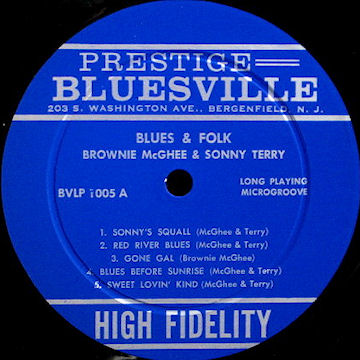
These sessions were released on a series of Bluesville albums: Down Home Blues (also on Prestige Folklore, a short-lived Prestige venture that did mostly re-releases in 1963-64), Blues And Folk, Blues All Round My Head, Blues In My Soul. There were some 45 RPM releases: "Let Me Be Your Little Dog" / "Stranger Here," "Too Nicey Mama" / "Pawn Shop," and "Beggin' And Cryin'" / "Freight Train."
Listening to Prestige Vol. 3, 1957-58 now includes, in its Kindle edition, links to all the "Listen to One" selections. Available from Amazon.