Showing posts with label 1950 recordings. Show all posts

Thursday, April 02, 2015

Listening to Prestige Part 20a: Eddie "Lockjaw" Davis

(Going back, from time to time, and finding sessions I had not been able to listen to before.)

If there's a missing link, this is it. This is bebop, and this is rhythm and blues, with Eddie "Lockjaw" Davis, a cat who could play both, and who didn't appear to see the need to make any distinction between the two. And I'm not sure anyone else much cared about the distinction, either. Bob Weinstock did make a few half-hearted attempts to establish a rhythm and blues label (half-hearted in the marketing: there was never anything half-hearted about the music). The thing was, in the 40s, everyone who played an instrument was influenced by Charlie Parker. You couldn't not be. He had changed music. And everyone who played the tenor sax was influenced by Lester Young. If you put a little more honk in the tenor and little more back in the beat, you called it rhythm and blues, and people got up to dance to it. If you took your solos a little farther off the beaten track, if as an improvisational soloist you were more than halfway to being a composer, you called it bebop and people sat and listened to it. Or maybe you didn't call it anything. You just showed up and played it, because it was your vocation and your life.

It was the intersection of some different musical lives on this session. Eddie "Lockjaw" Davis was 28 years old when he made these records. He had come to bebop as musicians of his generation did, through swing as it was played by African American bands on the chitlin circuit, the touring bands booked by TOBA, the Theater Owners' Booking Association, better known as Tough On Black Asses, best remembered by performers as low wages and flea-ridden dressing rooms, by lovers of American music as the breeding ground for some of the best. He'd played with Cootie Williams, Lucky Millinder, Andy Kirk. He would go on, in the 50s, to stints in both Louis Armstrong's and Count Basie's bands. But the first group he put together under his own name, in 1946, had a strong bebop tilt, with Fats Navarro, Gene Ramey, Al Haig and Denzil Best.

This 1950 group cut two sides with rhythm and blues shouter "Chicago" Carl Davis, not to be confused with another Chicagoan named Carl Davis, who became one of the great producers of the soul era. Davis was a rough, forceful singer, and on "If  the Motif is Right" he starts out with a mock gospel sermon on which he sounds like a cross between Screamin' Jay Hawkins and Lord Buckley.

But this group wasn't just gotten together to back up a singer. The two instrumental tracks are the strongest, with Lockjaw bringing his honker and bopper sides together, with a remarkable ensemble behind him. Covering a lot of jazz history.

Representing the future, 19-year-old Wynton Kelly. I'd wondered if this was Kelly's first session, but in fact he had recorded at 16, with tenor sax star Hal Singer, on Singer's chart-topping "Cornbread." So these were his formative years, the years of small-group jazz developing from the influences of Charlie Parker and Lester Young, branching into rhythm and blues and bebop, but cross-pollinating, with the mongrel strength and innovation and intensity that makes American music what it is.

Representing a previous generation, Al Casey. 35 years old when this record was made, he had started as young as Wynton Kelly, but his beginnings were with Fats Waller, and this session was a rare foray into bebop for him. He accompanied Billie Holiday and Chuck Berry, and played into his 80s with the Harlem Blues and Jazz Band.

Drummer Lee Abrams was either 25 or 30 when he made this date, depending on which birth certificate you believe, so he fit somewhere along this timeline, and he made a lot of gigs, including some important ones later on with Wynton Kelly, after he had graduated -- and this came pretty quickly -- to leading his own groups.

These were released on 78 on the short-lived Birdland label -- the collaboration between Bob Weinstock and Mo Levy -- with the two vocals on one disc, the two instrumentals on the other. The instrumental cuts were also released, under their alternate titles, on a Prestige 78.

Tuesday, September 30, 2014

Listening to Prestige Records Part 37: Wrapping up 1950

This winds up the second year of Prestige's prestigious history. Only 20 more to go, and I'm already starting to get the feeling they're going too fast -- that's the grandparent syndrome.


 The last two albums of the year are Sonny Stitt (December 17) with Junior Mance, Gene Wright and Art Blakey, and Jimmy McPartland (December 21) with a sextet including Vic Dickenson and Marian McPartland, so they closed out the year with a rising bebop star and a tip of the hat back to an older jazz style. The McPartland sides were issued on 78 as part of Prestige's 300 series, which appears to consist entirely of four 78 RPM records, all of them by Jimmy McPartland, one session in early 1949 and the other at the end of 1950 -- apparently Bob Weinstock's entire foray into trad jazz. Neither the Stitt nor the McPartland sessions can be found on Spotify, but you can get the Stitt session on Grooveshark --"Nevertheless" and "Jeepers Creepers here  and "Cherokee" here. "Nevertheless" is not exactly a bebop staple -- this is the only recording of it by a modern jazz group that I've found -- but listening to Stitt's version, one can't help but think that maybe it should be.

Prestige was certainly starting to make its mark in 1950. The scorecard: recording sessions with Stan Getz (2), Sonny Stitt and Gene Ammons (9), Eddie "Lockjaw" Davis,  Al Haig, Chubby Jackson, Lee Konitz,  Zoot Sims (4), Wardell Gray (2, one with Dexter Gordon), Leo Parker, Dizzy Gillespie, James Moody (recorded in France, released later as a 7000-series LP), and Jimmy McPartland. 


The major labels actually had the two most important jazz releases of 1950 -- one looking ahead, the other backward. Capitol put out eight songs from the Miles Davis Birth of the Cool sessions on 78. The LP wouldn't be released until 1957, although some songs from it came out on various Capitol 10 inch LPs. Nobody realized quite how important these sessions were at the time -- Miles wasn't able to make a commercial success of his nonet, and had to disband it. However, pretty much everyone knew how important the other recording was -- the recently rediscovered originals of the Benny Goodman 1938 Carnegie Hall concert, released by Columbia as a 12-inch LP -- in fact, their first double LP set.

Charlie Parker recorded with strings.

Fats Navarro died in 1950. Thelonious Monk was arrested on drug charges, lost his cabaret card, and couldn't play again in New York for six years.

Birdland, which actually opened its doors in late December of 1949, was in its first full year of operation.

On to 1951.

Monday, September 29, 2014

Listening to Prestige Records Part 36: Sonny Stitt - Gene Ammons

1950 seems to have been the year of Sonny and Jug, and no complaints here. We're fortunate to have so much from these two guys whose different styles melded so well. Ammons is taking his turn on the baritone in the first of these two sessions. On the second, it's two tenors on "Stringin' the Jug," parts 1 and 2, then Jug alone on the last two, "A Lover is Blue" and "When I Dream of You," both of them romantic ballads in the Earl Bostic mode of R&B-tinged pop, except a lot more musically original.

The session credited to Ammons is really an Ammons session. "Stringin' the Jug," with Stitt  and Junior Mance (his first professional gig was in Ammons's band, in 1947) providing magnificent support, is pure Jug -- Ammons proving you don't have to be from Texas to blow a Texas tenor.

The septet session, with Ammons taking his turn on the baritone, has four songs: "After You've Gone," "Our Very Own," "'S Wonderful" (not on Spotify) and "To Think You've Chosen Me." The last has a vocal by Larry Townsend, about whom I can find no information. Townsend, like so many of the vocalists chosen by beboppers in the late 40s (think Kenny "Pancho" Hagood on the Birth of the Cool sessions), was from the Billy Eckstine school, and that was style that was going to prove to fade from fashion very soon. The rich, mellifluous baritone gave way, as the voice of male sex appeal, to the soulful tenor, as epitomized by Sam Cooke. That's why you can find next to nothing (well, nothing, actually) about a middle-of-the-pack Mr. B like Larry Townsend, and relatively easy to find information on a middle-of-the-pack rhythm and blues singer like Larry Darnell.

But why reach out to singers like Townsend and Hagood? There were other vocalists around in the late 40s who were more attuned to the bebop idiom. Dave Lambert was one -- he was one of the pioneers in the development of a style of singing that used bebop chord changes and inversions. Sarah Vaughan was the quintessential bebop singer -- she had a contract with Columbia in 1950, and they were trying to turn her into a pop singer, so she probably wasn't available. Jackie and Roy were already starting to make a name for themselves in the late 40s. Jackie Paris had done some major work with Charlie Parker and others, and he continued to be committed to jazz, as opposed to pop singing, which is probably why he's now considered a cult figure rather than a major singer.

The Kenton singers -- June Christy, Chris Connor, and especially Anita O'Day -- were around. Blossom Dearie had not yet moved to Paris.Dinah Washington was singing both jazz and R&B in the 40s, and in 1954 she would make one of the greatest bebop vocal albums ever, "Dinah Jams," with a band led by Clifford Brown and Clark Terry.

King Pleasure, Eddie Jefferson and Annie Ross were creating their own kind of bebop vocals, but they were all working musicians, and certainly would have stepped in to record with musicians like Stitt and Ammons if asked.

So why did beboppers choose the vocalists they chose? Or why did their producers choose them? Here's a theory -- because Mr. B, in addition to still being hugely popular, was the guy who became a kind of godfather of bebop with his mid-40s band featuring Charlie Parker and Dizzy Gillespie, so although he was never really a bebop singer, he was still closely associated with the music.

A friend of mine who was there back in the day, told me why he stopped going to Amateur Night at the Apollo in the late 40's -- "All the girls were trying to sound like Sarah, and all the boys were trying to sound like Billy Eckstine."


Saturday, September 27, 2014

Listening to Prestige Records Part 35: Dizzy Gillespie Sextet


Another rough one to find. Nothing at all on Spotify, and only one track -- "She's Gone Again" -- is available on YouTube. You can find them on iTunes, on a collection called Dizzy Gillespie 1949-50, but there's something wrong with my iTunes connection, and I can't download them. Amazon doesn't have them at all. Grooveshark does. All of which means the wrong balance between digging for the music and digging the music.

And this must have been some kind of a session. No two tracks are remotely alike. Dizzy sings on two of them, and those two songs are not remotely alike."She's Gone Again"is a robust rhythm-and-bluesy vocal that without missing a beat sails into a series of burning bebop solos by some masters you know well (Dizzy, Milt Jackson, Jimmy Heath), and some masters you may never have heard of, at least I hadn't (Jimmy Oliver). The beboppers for some reason loved nursery rhymes, and here we have the complete "One, two, buckle my shoe" as part of the lyric. "She's Gone Again" made it to YouTube as part of a collection called "The Bebop Singers," but while the instrumental part is bebop of the highest order, the vocal isn't, particularly. I'm not sure the beboppers quite knew what to do with vocals, but I'll dwell on that more in my next blog entry. Stay tuned.

The second vocal track is "Too Much Weight," and it's a pure calypso number, although I haven't yet found a pure calypso version. In fact, the only other version of it that I have found is by Mickey and Sylvia, who give it a rhythm and blues touch. Presumably they recorded it in the late 50s, when Harry Belafonte had ushered in the calypso craze, and presumably they found in on this record of Dizzy's.

The Gillespie version is rhythmically amazing. Dizzy was, of course, a pioneer of Afro-Cuban jazz, and he had long been working with Latin rhythms. The star of this song is drummer Joe Harris, another artist I was unfamiliar with, but he did a lot of work with Dizzy in the 1940s, was the drummer for the house band at the Apollo, and worked steadily through the decades. YouTube has a live Sonny Rollins date from 1959 in Sweden. And as recently as last year, in his late 80s, he was still playing. Harris is also the subject of a play, Clean Drums, by Pittsburgh playwright Joe Penny, which was originally performed with Harris playing himself, and more recently revived with Dennis Garner (Errol's nephew) playing Joe.

I'm guessing that Harris has to make the "Played with Bird" list that Peter Jones and I put together, of living musicians who played with Charlie Parker.

Jimmy Oliver, who burns up "She's Gone Again," recorded very little. He was a Philadelphia resident, and he preferred to stay in Philly, where he played with nearly everyone, but he rarely made it to New York. For this session with Dizzy, he made an exception, subbing for a young friend from the Philly jazz scene (and a musician very much influenced by Oliver at the time), who had gotten sick and couldn't make the date. The younger musician's name was John Coltrane.

The two instrumental tracks also go off in different directions -- :"Nice Work If You Can Get It" boisterous, "Thinking of You" pensive,

Prestige put out "She's Gone Again" b/w "Nice Work if You Can Get It" on a 78, and "Thinking of You" on the flip side of a Sonny Stitt 78. All four cuts were on a New Jazz LP which also featured Miles Davis and Fats Navarro, and the same album was also reissued as a Prestige 16000 series, of which there were only a handful in the early 60s. The Gillespie session was also included on Prestige (J) SLP 47   Various Artists - Early Prestige Sessions 1949/50. I can't quite figure out when it was released.


Thursday, September 25, 2014

Listening to Prestige Records Part 34: Zoot Sims Quartet

We're coming to a bit of a dark night of my Prestige soul, where I'm starting not to be able to find things. The very next session listed on Jazzdisco.org's discography is Oscar Pettiford with his Cello and Quartet, featuring Duke Ellington, Billy Strayhorn, Lloyd Trotman and Jo Jones, so I guess that means Oscar Pettiford plus a quartet. It's one of those not-really-Prestige sessions, only released on their 24000 series reissues. But I listened to it anyway, because I'd be crazy not to.

The next real Prestige session is this one with Zoot Sims. Four tracks -- "My Silent Love," "Jane-O," "Dancing in the Dark" and "Memories of You." Only "Jane-O" is on Spotify, and that's because it was included on the soundtrack of a short film called Bottle Rocket. YouTube has both "Jane-O" and "Memories of You." They're both pure delight -- Zoot at his lyrical best.

Lewis was still two years away from forming the Modern Jazz Quartet, although he was already working a lot with Ray Brown and original MJQ drummer Kenny Clarke. He does some nice but limited soloing here.


Saturday, September 20, 2014

Listening to Prestige Records Part 33: Wardell Gray - Dexter Gordon


This one really shouldn't be hard to find. Who doesn't want to hear Dexter Gordon and Wardell Gray, one of the legendary tenor sax pairings of all time, in their natural element, Los Angeles, and with a great supporting cast? But they're nowhere to be found on Spotify, and only sparsely on YouTube.

Which means no quiet listening time in my car, which is part of the reason for the delay in getting this entry up. The other part is that I've been going through a fairly painful period of writer's block, during which the only thing I could really write was this blog. Now I've broken through, at least a little, so this is competing with the writing I actually have to do.

So this is a live album, which is perhaps a first for Prestige (not sure about all their European albums). Wardell Gray did a live recording in Detroit, but it seems never to have been released. Certainly the first West Coast recording -- who knows what Weinstock's deal was on this one? -- and unquestionably an all-star session. Dexter Gordon is on board for "Jazz on Sunset," not for "Kiddo."

Sonny Criss, and especially Clark Terry, are stars in the jazz firmament, although Criss arguably never got the recognition he deserved. Jazz Profiles has an excellent appreciation of him as an "overlooked giant," including this assessment from early cohort and R&B giant Big Jay McNeely:

 Sonny Criss and I played together quite a while until I went to study with Joseph Cadaly [a first chair saxophonist at RKO Studies who taught reeds, harmony and solfège]. That’s when Sonny and I split up. He continued into progressive Jazz, and I went and studied.

When we split, he started going all up and down the Coast playing and going to Europe. But I don't know, it just didn't happen. He'd get records. People said he was great. They played his stuff. But it just didn't happen for him, and I think that kind of disturbed him. Especially when you put your whole soul and your whole life and just wrap up everything into something and it doesn't happen.

He was pioneering and when you're pioneering, it's kind of more difficult to get recognition …. You have to suffer when you're a pioneer. So that's what hap­pened, really, I think, with Sonny. He was just early.

Criss stayed on the West Coast, and West Coast jazz
was not a scene he fit into. It had moved away from bebop to the explorations of Gerry Mulligan and Dave Brubeck, the orchestrations of Henry Mancini and Andre Previn. And it was mostly white.

At the peak of his creative genius in the mid-50s, he recorded three albums for Imperial. But Imperial was mostly a rock and roll label (Fats Domino, Ricky Nelson), and secondarily a country label(SLim Whitman), and it didn't have the expertise or the inclination to do any serious marketing of modern jazz.

He did record for Prestige again, so we'll meet him again -- but much later.

In 1977, suffering from stomach cancer, he killed himself.

Jimmy Bunn, who also played piano on the famous Dexter Gordon/Wardell Gray recording of "The Chase," was arrested on drug charges, served hard time in San Quentin (where he played in the prison jazz band with Art Pepper), and was never able to restart his career.

Billy Hadnott, I find from the great rhythm and blues blog Bebop Wino, was very active on the West Coast R&B scene, playing with T-Bone Walker and Lloyd Glenn.

Chuck Thompson played in Hampton Hawes' great trio in the mid-50s.

This is wonderful music, with three great soloists (four when Gordon is added) challenging each other in the way only live recording allows. They're all individual as hell, they all surprise the listener (and, one would guess, each other) and they come together.

"Jazz on Sunset" is a reworking of Denzil Best's "Move," and "Kiddo" a version of Charlie Parker's "Scrapple from the Apple," itself deriving from a mashup of "Honeysuckle Rose" and "I Got Rhythm."

The YouTube recordings are full of surface noise, but for those of us who collected vinyl -- and collected it to play, and play again, not as an investment -- this is not really a drawback.


Here's parts one and two of "Kiddo":


And here's parts three and four of "Jazz on Sunset":


Tuesday, September 16, 2014

Listening to Prestige Records Part 32: Leo Parker

On July 20, 1950, baritone saxophonist Leo Parker went into the Prestige studios with an all-star rhythm section of Al Haig, Oscar Pettiford and Max Roach. He recorded six tunes, and came away with almost nothing. The first, "Bewitched, Bothered and Bewildered," was never released. "Mona Lisa," "Who's Mad" and "Darn That Dream" only saw the light of day in the 1970s, as part of the Fantasy/Prestige 24000 series, which was theoretically all reissues, even though in this case the initial issue never happened. We aren't counting 24000-series releases in this history, but these were originally recorded for Prestige, so they'd count. "I'll Cross My Fingers" and "Mad Lad Returns" were released as a 78 RPM single, so they would definitely count, but for one small detail. None of them are available on Spotify or YouTube, or any of the other video sites, so I wasn't able to listen to them.
Leo Parker made his first recording in 1944, at age 18, with Coleman Hawkins, on alto. After that, it was baritone all the way. Some say he abandoned the alto when he joined the legendary Billy Eckstine big band, so as not to be confused with the better-known alto player named Parker in the same organization. More likely, Eckstine needed a baritone player, handed the instrument to Leo, and said "You're it."

If that was the way it was, Eckstine made a wise decision, but Parker was not able to build the career his talent merited. The heroin scourge of the Fifties claimed him. He did make a comeback in 1961, making two albums for Blue Note -- one of which, one again, went unissued until 1986. Parker died of a heart attack in 1963, at the age of 38.

Searching Spotify for the Prestige sides, I entered "Leo Parker Darn That Dream," and came up with something that deserves a side excursion, which I was more than willing to make: a road trip to the intersection of Bebop and Rhythm and Blues Avenues, one of the neighborhoods that interest me most.
Bill Jennings made a whole series of recordings for King Records in Cincinnati in the 1950s. King was one of the great indie labels of the Fifties, recording rhythm and blues (James Brown, Wynonie Harris), country (Grandpa Jones, Cowboy Copas), and rock and roll (The 5 Keys, the "5" Royales, even the Platters' first records). Very little jazz.

And not all that many people share my enthusiasm for this first fusion music, so Bill Jennings has languished in obscurity, but you have got to listen to this stuff. It's been collected in a 2-CD set called Bill Jennings - Architect of Soul Jazz 1951-57. His band includes Leo Parker, Bill Doggett and Willis "Gator Tail" Jackson.
You can also find "Mad Lad Returns" on Spotify and YouTube, but it's from the 1961 Blue Note, not 1950 Prestige session. It's worth a listen to--talk about rhythm and blues meets bebop...and beyond. Wow.

Here's Leo Parker with Bill Jennings:

 And here's the 1961 version of "Mad Lad Returns":


Saturday, September 13, 2014

Listening to Prestige Records, Part 31: Sonny Stitt -Gene Ammons

Sonny Stitt, Gene Ammons, three-piece rhythm section...a quartet? Is this one of those odd numerical quirks, like the great R&B/Doowop group the "5" Royales, who rarely had five guys in their lineup? No, as it turns out, the June 28 session was a quartet, though not always the same quartet -- Jug on two cuts, Sonny on the rest.

Stitt's tunes: "Count Every Star," "Nice Work if You Can Get It," "There Will Never Be Another You," and "Blazin'." Ammons had two: "I Wanna Be Loved" and "I Can't Give You Anything But Love," but only the latter is included on Spotify.

Why? Lost to history. Maybe they couldn't both show up at the same time. Maybe they weren't talking to each other that day. Maybe Weinstock was only paying for four musicians at a time. Maybe each of them wanted the full length solo space. Not unlikely, listening to the tunes. Each of them solos all the way through. Stitt barely gives Duke Jordan a vamp at the beginning -- no vamp at all on "Count Every Star."

And he's quite sufficient to satisfy. Generally the bebop paradigm is play the melody for one or two choruses, then take off on improvisatory flights. As Ronny Graham says in his comedy routine about a commencement address to a school for progressive jazz musicians, "When you cats came here, all you could play was the melody. Now you wouldn't know a melody if it hit you in the mouthpiece." But Stitt stays around the melody in his improv, especially on "Count Every Star

I would have thought of "I Can't Give You Anything But Love" as more of a 1920s vo-de-o-do kind of song, more suited for a raccoon coat and ukulele (or for Cary Grant and Katharine Hepburn to sing to a leopard) than a gutbucket, blues-based bebopper like Gene Ammons. In fact, it was written in 1928, by Jimmy McHugh and Dorothy Fields, for their Broadway hit musical Blackbirds of 1928. McHugh and Fields had already made their major contribution to Prestige Records history -- they wrote the original "I'm in the Mood for Love." At any rate, Ammons takes it over and does what he wants with it -- jaunty and rakish, but in the style of 52nd Street, not Broadway.
They gathered the septet again a week later for another session -- Bill Massey again on trumpet, this time Matthew Gee on trombone.

It's hard to find much about Bill Massey, who anchored all of these septet recordings. "Bill Massey Jazz" on Google mostly brings up references to the classic Jazz at Massey Hall album, but adding to the confusion, there's another jazz musician named Bill Massey,who gets the Google hits because he's more contemporary and has a website. 

Replacing Duke Jordan on piano is Charlie Bateman. There's not much on him, either, but a 2004 obituary from the Orlando Sentinel tells us that he played with Louis Armstrong at Carnegie Hall in 1947, moved to Orlando to play bridge, and moved there permanently after the World Trade Center bombing. More on Charlie here. He does get some solo space with the septet, and the cat can play.

Stitt is listed on baritone again for this session, but we're told that both Stitt and Ammons would double on baritone in larger ensemble settings, while the other was soloing, and I think that may be happening here.

There's another vocal -- on "Sweet Jennie Lou." On this one, there's a lead vocalist, uncredited, and I can only guess as to who it is, so I'll guess Gene Ammons. The rest of them sound not so much like drunken Irishmen as like drunken Irishmen trying to imitate the Modernaires. Actually, they sound a little like Dooley Wilson's band doing the call-and-response with him in "Knock on Wood" at Rick's Cafe Americain.

Their "Seven-Eleven" is not the same as Buddy Lucas' R&B classic "7-11," with the Gone All-Stars, but it rocks. Charlie Bateman is hot on this one, as is drummer Wes Landers (another two-generation drum family -- his son was jazz/soul drummer Wally "Gator" Watson).

They did "La Vie en Rose" on this session, and I'd love to hear it, but I can't find it on Spotify. A Google search for "Gene Ammons la Vie en Rose" says that it is on Spotify, but clicking through leads to a dead end.

Songs from all these Stitt/Ammons sessions were mixed and matched on various 78s, and on several different 10-inch LPs, Surprisingly, no 45s, though you'd have thought many of these cuts would have been naturals.

There's really no such thing as a representative track from these sessions, so I'll use "Count Every Star," because I love it.


Tuesday, September 09, 2014

Listening to Prestige Records, Part 3o: Zoot Sims

Zoot Sims continued his European swing with a recording session in Paris, this one kicked ahead by the drumming of Kenny Clarke, house drummer at Minton's during the original bebop days, and a longtime Paris expat, although in 1950 he was not yet a full-time resident -- he would be back in New York in 1952 to become the original drummer for the Modern Jazz Quartet. And here's something I didn't know -- he and Annie Ross had a child, Kenny Clarke, Jr., himself now a drummer.

Anyway, Zoot Sims in Paris -- a notable session, but one that's only tangentially related to Prestige. Certainly Bob Weinstock had close relationship between Vogue Records in Paris and Metronome Records in Stockholm (I've leapfrogged over a couple of all-Swedish sessions to get to Zoot), but he
seems for some unaccountable reason to have given this session short shrift. Nine songs were cut that day -- "Night and Day," "The Big Shot," "Slinging Hash," "I Understand," "Tenorly," "Don't Worry 'Bout Me," "Crystal's," "Zoot and Zoot," and "Toots Suite." Of those, none were released on 78, 45 single, 45 EP, or 10-inch LP. Only "Night and Day"(two takes), "Slingin' Hash" (two takes), "I Understand," "Tenorly" and "Don't Worry 'Bout Me" made it to a Prestige 7000-series reissue.

But...on a couple of occasions, Edgar Villchur, the genius behind the contemporary loudspeaker, reminded me of why he did what he did, and why he didn't spend a lot of time talking about it: "I'm not a technology lover...I'm a music lover." And in this blog, I'm using a historically accurate timeline (as far as I can) as a structure for listening to a lot of good music, which is the main goal, after all. And making up the rules as I go along. I didn't include the Charlie Parker 1949 session because that was only put out on the Prestige 24000 series, long after Prestige had been sold to Fantasy and had become purely a reissue label. The Zoot Sims Paris sessions are 7000-series, which is still the real Prestige.

It's not clear what Gerald Wiggins (Gerry Wiggins on this session) was doing in Paris in 1950. A graduate of New York's Music and Art High School with classical training, he was Los Angeles-based -- he is probably the only serious jazz musician to have worked with both Stepin Fetchit and Marilyn Monroe. He wasn't touring Europe with Sims -- this is their only recording together. Best guess -- he was there with Lena Horne. He was her accompanist in 1950-51, and she made a number of European tours.

Zoot Sims was probably the second most famous of the Four Brothers. He didn't achieve the superstardom of Stan Getz, and there's no signature song that's associated with him, but he had an outstanding career over four decades, recording swing, bebop, cool jazz, backing up singers (and Jack Kerouac!), playing with virtually everybody, recording prolifically as leader and co-leader with Al Cohn, and if he ever made a bad record, I haven't heard it.


Saturday, September 06, 2014

Listening to Prestige Records, part 29: Sonny Stitt/Gene Ammons Septet

Stitt and Ammons are back in the studio with a septet, with only a few changes. Bennie Green replaces Eph Greenlea (about whom I can find no information and no more discography), and Jo Jones is replaced by the younger and more boppish Art Blakey, who makes his presence felt immediately. The biggest change, though, is Sonny Stitt switching from tenor to baritone (he'd already, in his career, switched from alto to tenor).

I've mentioned that Gerry Mulligan, in 1950, was still better known as an arranger than an instrumentalist, and he had not yet established himself as the voice on the baritone sax. You don't hear anything in Stitt's playing to suggest he'd spent much time listening to Mulligan -- rather, that he wanted to show that he could play bebop on any saxophone. The baritone also adds a richness to the ensemble parts, and according to this jazzophile:
 He had small ensemble w/ Gene Ammons during this period where they switched on baritone-- Stitt would play bari in the section when Gene played and vice-versa.

This is an odd session. The songs are "Chabootie," "Who put the sleeping pills in Rip Van Winkle's Coffee?", "Gravy (Walkin')," and "Easy Glide." The first two are the odd ones -- the long ensemble intro in "Chabootie," longer than it probably needs to be, and the vocal, if you can call it that, on "Sleeping Pills," where it sounds as though the whole band is singing along, and they're making no attempts at harmonizing or jazz styling -- they sound like a bunch of Irishmen in a pub.

If this sounds negative, it is and it isn't. My guess is that these were aimed at jukeboxes -- the Basie-style ensemble piece and the novelty vocal. Prestige probably needed some jukebox play -- I doubt that they'd had a hit since "Moody's Mood," although they'd put out some great music.

George Benson, when he was criticized by jazz purists for his pop records, maintained he was still playing jazz -- he said that if he put strong, poppish hooks at the beginning and end, he could play anything he wanted in the middle. And that's true of both of these songs.

After the ensemble choruses on "Chabootle," Stitt enters with one of Charlie Parker's signature riffs, given a new timbre on the baritone sax, and they're off from there, with some absolutely lovely solo work, and some pepper from Blakey. The same is true on "Sleeping Pills" -- the solos on that number are definitely not the work of drunken Irishmen.

What was it with beboppers and Mrs. Murphy and her overalls? Harry "the Hipster" Gibson had a huge hit (and got himself in a lot of trouble) with "Who Put the Benzedrine in Mrs. Murphy's Ovaltine?"

OK, if these were meant for the jukebox crowd, and I'm betting they were, there was some serious bet-hedging on Bob Weinstock's part. "Chabootie" was put out on 78 and 45 on the flip side of Gene Ammons playing "Blue and Sentimental," "Sleeping Pills" on 78, on the flip side of "La Vie en Rose."

I can't find any of these cuts on YouTube or any of the other video sites, but you can get them all on Spotify.

Thursday, September 04, 2014

Listening to Prestige Records, part 28: Wardell Gray

Benny Goodman was right about Wardell Gray. He was wonderful. He gets better every time I listen to him, and this session, recorded in Detroit, is a treasure -- because of the music, and because of the story behind it. There is much to say about Wardell Gray, and I'll say more as he comes up again in the Prestige story, but the story is Detroit, and the rhythm section that backed Wardell on this session, and the Bluebird Inn, where they were the house band.

J. R. Monterose was born in Detroit. So was Pepper Adams, who said of those heady days when bebop was young,
In Detroit, the standards were so high that to compete for local gigs you had to really play awful goddamn good! If you were good enough to be competitive in Detroit, you were ahead of what the rest of the world’s standards were.
And there were more. Here's Wikipedia's list of jazz musicians from Detroit (perhaps incomplete -- I know that J. R. had been omitted, so I added him:  Elvin Jones, Hank Jones, Thad Jones, Howard McGhee, Tommy Flanagan, Lucky Thompson, Louis Hayes, Barry Harris, Paul Chambers, Yusef Lateef, Marcus Belgrave, Milt Jackson, Kenny Burrell, Ron Carter, Curtis Fuller, Julius Watkins, Hugh Lawson, Frank Foster, J. R. Monterose, Doug Watkins, Sir Roland Hanna, Donald Byrd, Kenn Cox, George "Sax" Benson, Sonny Stitt, Alice Coltrane, Dorothy Ashby, Roy Brooks, Phil Ranelin, Faruq Z. Bey, Jaribu Shahid, Hakim Jami, Pepper Adams, Tani Tabal, Charles McPherson, Frank Gant, Billy Mitchell, Kirk Lightsey, Lonnie Hillyer, James Carter, Geri Allen, Ralph Armstrong, Ali Jackson Jr., Rick Margitza, Kenny Garrett, Betty Carter, Sippie Wallace, Robert Hurst, Geri Allen, Rodney Whitaker, Clarence Penn, Karriem Riggins, Harold McKinney, Ray McKinney, and Carlos McKinney.

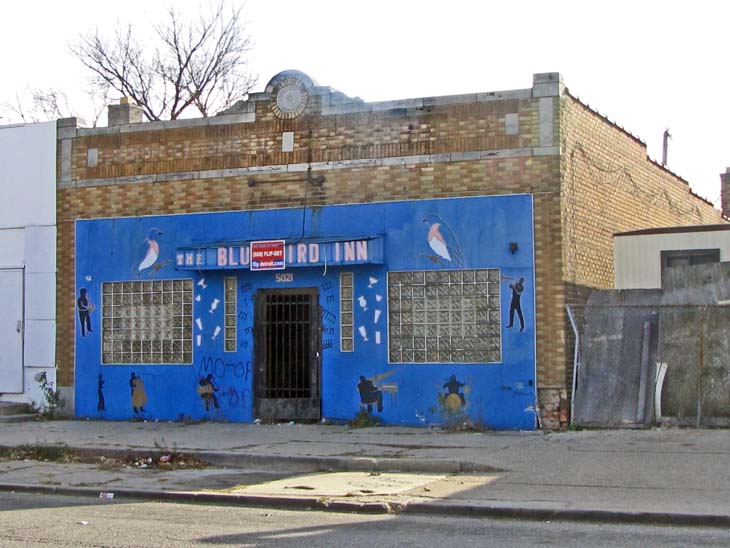
Jazz at the Blue Bird Inn in Detroit "started in 1948 when the Blue Bird hired pianist Phil Hill and told him to assemble a house band specializing in the newest thing from New York City - bebop." Here's the full story, from Lars Bjorn and Jim Gallert.

Here's a photo of the Blue Bird from 2010, with a history of the building, and a sad story at the end of it:
Use in 2010:  Vacant building ready for sale
City of Detroit Designated Historic District: Not listed
State of Michigan Registry of Historic Sites: Not listed
National Register of Historic Places: Not listed


The songs on this session are "A Sinner Kissed an Angel," "Blue-Gray," "Grayhound," and "Treadin' with Treadwell." "Treadin'" is Wardell's tribute to jazz DJ and historian Oscar Treadwell, also celebrated by Charlie Parker in "An Oscar for Treadwell" and Thelonious Monk in "Oska T."

Phil Hill is a jazz legend who seems to have almost never recorded. I can only find two listings -- this album. and a live session with Wardell Gray the previous year, which may never have been released. The bassist on the Prestige session is listed as John Richardson. On the unreleased live recording, it's James "Beans" Richardson, who has to be the Jimmy Richardson of the Blue Bird poster (subsequent house bands at the Blue Bird included Elvin Jones, Frank Foster and Yusef Lateef). I can't tell whether the John and Beans are the same person, but it seems likely -- a mistake on the Prestige session notes. In any event, here's a nice tribute to Beans by his niece. Art Mardigan played with Woody Herman, Pete Rugolo and Stan Getz after his Blue Bird days, ultimately returning to Detroit and the Detroit music scene.

Here's a nice tribute to the Blue Bird:


And here's Wardell Gray with his Detroit trio:


And this beautiful ballad:


Wednesday, September 03, 2014

Listening to Prestige Records, part 27: Zoot Sims


A few days off from Prestige blogging, mostly because no quiet solo driving time with my Jambox and my latest Prestige session. Just as well, in a way, because it gave me a little break between Stan Getz and Zoot Sims, two of the Five Brothers, and with brotherly similarities, although Getz is definitely moving farther away from the brother days.

And...back to Sweden. If it was at one time widely known that Sweden was a hotbed for bebop, that seems to have mostly faded into oblivion, but more than a couple of American musicians it became a home for several years, or even a permanent home. (And it's still happening -- my friend Billy Troianni is now a full time resident of Norway, with a Norwegian blues band.) And Prestige, through an association with the Swedish Metronome Records, reaped the benefits.

Zoot Sims made it over to Sweden in April of 1950, and did two sessions in two days, with two different groups. Spotify has four cuts from those sessions, and the Swedes and expats do a solid job of backing up Zoot.

Toots Thielemans is actually Belgian, and he was to become an important part of the American jazz scene. He didn't move to the States until 1952, but by then he had already established himself as an outstanding jazzman. His early Paris sessions included one with Charlie Parker, which means he gets added to the "Played with Bird" log that Peter Jones and I put together of still-living musicians who played with Parker. Toots is still very much with us. He announced his retirement earlier this year at age 91, but then came out of retirement again last month.

He joins Sims here for one cut, "All the Things You Are," and contributes some very neat stuff, both in playing together on the opening chorus, and later in a solo. Harmonica and tenor sax maybe shouldn't mesh, but here they do -- oddly, but they do.


 Sims also pays his homage to the master, Lester Young, with Young's composition "Tickle Toe." I went back and listened to the song by Lester and the Basie Band, and Zoot definitely takes it and makes it his own, putting it into a quartet session, and bringing it into the bebop era.


In my early days of jazz addiction, in the late Fifties, one of my first experiences of live jazz was Al Cohn and Zoot Sims with a quintet the Half Note, with my fellow Bard student Leonard Rosen, then my main man, and now back on my horizon after being AWOL for about forty years -- you'll remember this night, Lenny. Mose Allison was playing piano for Al and Zoot then, and the two of us had just fallen under the spell of Mose's first release, Back Country Suite.

Zoot knew how to play. He'd cut his teeth with the Woody Herman band, played on Stan Getz's Five Brothers session, and on Chubby Jackson's outstanding big band sessions, and this was his first outing as a leader. He had a long and impressive career ahead of him. He could swing, he could experiment, he could make you feel good about jazz.

Friday, August 29, 2014

Listening to Prestige Records, part 26: Stan Getz


You know how when you hear a word you've never heard before, suddenly everyone seems to be using it -- seems like everyone else except you knew it all the time? Jimmy Hatlo even devoted one of his "They'll Do It Every Time" cartoons to this theme, so thanx and a tip of the Hatlo hat, Jimmy, and it's happening to me with musicians instead of words. No sooner do I mention never having heard of Tony Aless than he shows up again, this time as part of a Stan Getz Quartet.

Perhaps  there's something to be said for the theory that a jazz recording session is quite likely to involve a group made up of whoever's around. Tony Aless and Don Lamond had both played on the Chubby Jackson session a month earlier and so were quite likely still kicking around 52nd Street. And Getz would have known them because they were both -- as were so many early Prestige artists -- Woody Herman veterans.

Percy Heath has a credit that I'd venture to guess no other jazzman has: he was a member of the Tuskegee Airmen, the famed African-American military aviators of World War II. He has impressive jazz credits, too, including being a member, with his brothers, of one of the first families of jazz.

One of the joys that the great balladeers like Stan Getz bring to jazz is their way with classic songs from what has come to be known as the Great American Songbook. These are vivid and memorable melodies, with chord changes and melodic structures that lend themselves to jazz interpretation and improvisation.

But they're more than that. They're songs, with the emotional and thematic power that only a song can deliver. Lester Young said that he always heard the words to a song in his head as he played it. The fictional Dale Turner, played by Dexter Gordon in the movie "Round Midnight," has a moment when he realizes he's losing his ability to produce the music he wants to, and says, "I forgot the words." I don't know if Stan Getz played the words in his head when he recorded a ballad, but he captures the feeling of each of these.

Of course, music is abstract. If you didn't know the story of Peter and the Wolf, you wouldn't just be able to conjure up ducks and wolves and hunters from the music itself. But if you know the songs, Getz brings something palpable to them.

In "You Stepped Out of a Dream," that rapt wonder that only the person you've suddenly, unreservedly fallen in love with can evoke. Written by Nacio Herb Brown and Gus Kahn, it was  originally sung by Tony Martin for the 1941 musical Ziegfeld Girl, to the visual of Lana Turner descending a staircase. Brown isn't quite on the Olympus of American songwriters, but he was good enough to dream, and good enough to write some melodies that are remembered.


"My Old Flame" is a song that was brilliantly subverted and destroyed by Spike Jones. It was written by Arthur Johnston and Sam Coslow, who also saw their other hit, "Cocktails for Two," similarly demolished by Spike Jones. So Getz is not going her for the A-list of American composers, but he's finding some fine melodies, and in this case, restoring the feeling that Johnston and Coslow must have meant it to have: sweet nostalgia, regret.

I didn't know "The Lady in Red," so I listened to the Mark Murphy version and the Louis Prima version. I missed the Bugs Bunny version, "The Rabbit in Red," so I guess this was an eminently wreckable song too -- and again by a good, but B-list composer, Allie Wrubel. And this one bright, vivacious, sparkling. All these not-quite-great songwriters taken over the top, into immortality, by a true great, Stan Getz.

"Wrap Your Troubles in Dreams," by songwriters I really hadn't heard of -  Harry Barris, Ted Koehler, Billy Moll. Getz captures the dreamy optimism that comes out sadness. You wouldn't have to wrap your troubles in dreams and dream your troubles away if you didn't have troubles.

All these songs are about loss, and about an at best evanescent reality. Losses that you have to dream away, but you never really can. The fading memory of an old flame. The girl who steps out of a dream -- she's Lana Turner, and you'll never have her. She'll never really detach from that dream. Even the vivacious, snazzy lady in red -- you'll never have her either.

Stan Getz was a poet of loss, right up to that girl walking across the beach, looking straight ahead, not at you.

Released on Prestige and New Jazz 78s and 10-inchers, Prestige EP, even a 45 (My Old Flame/The Lady in Red), and later on a 7000-series reissue, a 24000-series double LP, even on an New Jazz LP when that line was briefly restarted.


Wednesday, August 27, 2014

Listening to Prestige Records, part 25: Lee Konitz

Lee Konitz back in the Prestige studios again, April 7, 1950, seven months after the first session. still in the Tristano circle, this time without Warne Marsh or Denzil Best. In Best's place, Jeff Morton, about whom I can find no information whatsoever, which seems strange, given that he played on quite a number of sessions within the Tristano circle, and you had to be pretty advanced musically to play in that circle. Sal Mosca, in an interview, says that he was usually the drummer at Tristano's Saturday night jam sessions. His presence is felt here, especially on the uptempo numbers, and it's a strong one.

And on guitar, Billy Bauer. And he is a treat to listen to, whether playing the guitar like a percussion instrument, chording, or playing single-string runs.

The tunes today are two ballads, "Rebecca" and "You Go to My Head," and two uptempo numbers, "Ice Cream Konitz" and "Palo Alto." The ballads are demanding, but far from emotionally barren. The uptempo numbers are virtuoso performances from all concerned. "Ice Cream Konitz" is a good argument for why modern jazz players should maybe have retired the fad of punning on their own names; "Palo Alto" is a subtler pun, more befitting a Tristano acolyte. Either way, they swing both subtly and forcefully, and interplay between guitar, piano and alto is more than satisfying,
 
 I had a friend who took lessons from Bauer many years ago. He said that for the first half-hour, Bauer had him do nothing but play the same note on the same string, over and over, while he kept saying, "Swing...swing." "And when it was over," my friend said, "I was swinging!"

I linked above to an interview with Sal Mosca. Here are a couple of excerpts from it.


 At first, I did not like Charlie Parker. Lennie Tristano had me sing a solo of Parker’s. It was Scrapple From the Apple. It took me one and ½ years to learn to sing it, and another six months to play it on the piano. When I was able to play it, I began to love Charlie Parker and my love of his playing grew and continued after that.

[On classical pianists]  I prefer Horowitz. He is more romantic. He’s the closest to jazz of all the classical pianists. I heard a recording of Horowitz playing Mozart, it sounded like stride piano. Did you know that he went often to hear Tatum?


 These sessions were released on both Prestige and New Jazz 78s, on an EP called Lee Konitz with Billy Bauer, on a 10-inch called Stan Getz/Lee Konitz - The New Sounds, and on 7000-series LP called Lee Konitz With Tristano, Marsh And Bauer.

Monday, August 25, 2014

Listening to Prestige Records, part 24: Chubby Jackson

The most recent rerelease of this 1950 Prestige session is on an Original Jazz Classics CD (Concord's reissue label - they currently own the Prestige catalog) along with some of the classic Gerry Mulligan/Chet Baker quartet recordings. Most of the consumer reviews on Amazon praise the quartet sessions, understandably, but then they tend to say some variation of "oh, and there's also some stuff by a big band."

I wonder if it had been called the Gerry Mulligan Big Band, would that have earned it more respect? But this is a terrific band, a terrific group of songs.
Arranged by Mulligan? Probably. Maybe. There's no arranger credit for the session, but at this stage of his career Mulligan was better known as an arranger than as a saxophone player, and it's likely that if he was on the session, he'd also have been hired to arrange. Some of the tunes certainly sound like Mulligan arrangements, some not so much. We know that Al Cohn did some arranging for the 1949 version of the Chubby Jackson Big Band, and Tiny Kahn was its chief arranger, so one or both of them may have had a hand, although neither played on this date.
Big band bebop is almost an oxymoron. Bebop was a product of the breakup of the big bands, a style that favored listening over dancing, extended virtuoso solos over ensemble section play. But it was always part of the scene. The Billy Eckstine band hired Dizzy Gillespie and Charlie Parker; also a Miles Davis, Fats Navarro and Dexter Gordon. Gillespie had his own big band. The Woody Herman Herd, where Chubby Jackson got his start, wasn't exactly bebop, but it wasn't exactly the swing of the Thirties, either.
And this band of Jackson's is as good as a bebop big band gets. It has swinging but ambitious ensemble parts, lots of room for experimental solos.
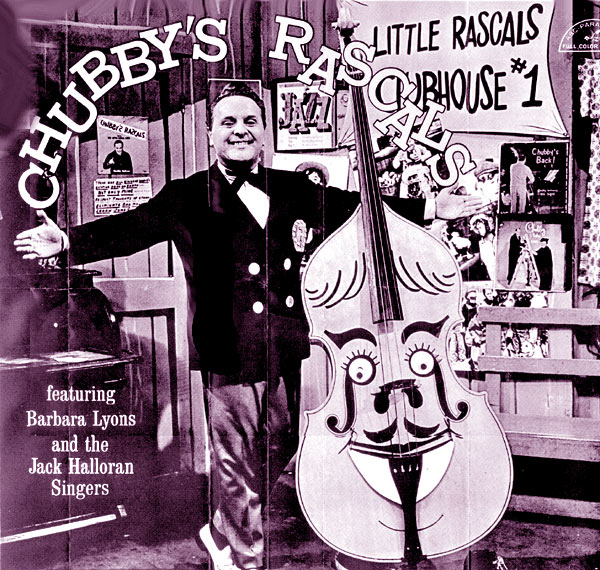
Chubby Jackson himself had a checkered career (note to self: when you make an accidental bad pun, for God's sake take it out in the second draft! Reply from self: What second draft?) -- anyone who has performed with both Louis Armstong and Lennie Tristano has run a fairly complete gamut, and let's not forget his twist album. And he's probably the only serious jazz musician who was also a TV kiddie show host (Chubby Jackson's Little Rascals).  
I listened to these sides a couple of times before I really looked at the lineup of musicians. I'd noticed that Mulligan and Zoot Sims were included, hadn't paid close attention to the others. So when I found myself particularly taken by the piano solos, I went back to see which of the bebop legends Jackson had recruited for this date, I was surprised to find a name I'd never heard: Tony Aless. But Aless did some impressive work, going back to Bunny Berrigan in the Thirties, and including sessions with Woody Herman, Stan Getz and Charlie Parker.
Peter Jones, who knows more about jazz than I do, was familiar with Aless, but asked, "who is Charlie Kennedy on alto-- he sounds a lot like Lee Konitz?"
So many great jazzmen who didn't break through to create major names for themselves. Charlie Kennedy started with Louis Prima, went on to become a soloist with Gene Krupa's big band. His last major gig was with Terry Gibbs' Dream Band, before he retired from music in the early 60s.

The rest of the band is a dream band, and they play like it.

"I May Be Wrong," which Mulligan was later to recreate as a cool, wryly romantic ballad with his quartet, is given as a joyous romp here - with Mulligan's fingerprints on it. "Sax Appeal" has some particularly appealing work between ensemble and soloists.

And what's this number called "So What"? It appears to be a Mulligan composition. Surely it's a Mulligan arrangement. The notes say it is not the composition of the same name by Miles Davis for the "Kind of Blue" album, and certainly there's a world of difference between the hip, cool modality of the Miles Davis number and this piece of beboppery. You could say that the Davis piece makes the Jackson band's piece sound old-fashioned, except it doesn't -- bebop still has the freshness and power to excite, and so does Mulligan at every phase of his career.

Here's "So What," from a new site to me, but it looks like a good one, called Jukebo. I can't seem to get their embed code to work, so I'm just providing a link. In this version, the song has a subtitle, "Hoo Hah," which I suspect is to differentiate it from the Davis number.

Prestige issued these as 78s on both Prestige and New Jazz, with records credited variously to Jackson, Mulligan and Zoot Sims, then on 45 RPM EPs and a 10-inch LP, and finally as part of a 7000-series LP called Chubby Jackson Sextet and Big Band -- nice of them to give the credit to Jackson, as Mulligan by then was by far the bigger star.