Showing posts with label Max Roach. Show all posts

Friday, July 22, 2016

Listening to Prestige 196: Sonny Rollins

Am I getting too much 1950s jazz? Is it all starting to sound alike?

No, and no.

Every album, every recording session, has been a unique and uniquely satisfying experience, and I continue to find this one of the most rewarding projects I have ever undertaken.

Obviously, I can't say that some sessions have been more uniquely satisfying than others, not if I have any respect for the English language. Each has been unique; each has given me something new and significant in my understanding and appreciation of jazz. But some have leapt out at me with particular force. Like the one before this, making me appreciate the richness of Tadd Dameron's compositions, made all the more special because he recorded so seldom.

On the other hand, I'm very familiar with Sonny Rollins's gifts as a composer and an improviser, and Lord knows his recording career has been prolific. But this one leapt out at me nonetheless. Why? Just because. Because his playing is so hot on this session: so creative, such high energy. Another reason could be that this is my farewell to Sonny on Prestige. He'll move on to a number of different labels: Blue Note and Riverside in New York, Contemporary on the West Coast. He'll record for RCA Victor for a while, and for various European labels. Then for Impulse, for Milestone, for lots of other folks. Anyway, I only found this out after I started reading background stuff, so it wasn't part of my immediate response.

The session contains three compositions by Sonny, and three songs by others. The Rollins compositions are the ones where the energy level really goes through the roof. "Ee-ah," in particular, combines the honking urgency of rhythm and blues with the creative daring of bop. I love it. 'B Quick" and "B Swift" are, if anything, taken at an even higher level of intensity, propelled by an unflagging and unforgiving Max Roach, over an incredible nine minutes for the first number. I like to imagine a spectator in the booth, drenched with sweat and exhausted just from listening to what these cats are doing, saying, "I betcha you can't do that again." "I betcha we can," Max retorts..."but maybe a little shorter this time." "B Swift is just as intense, but clocks in at five minutes."

And so to "Sonny Boy," which does what only jazz can do--it takes a familiar melody and turns into something entirely new. Screenwriter William Goldman, in his fascinating book, Adventures in the Screen Trade, discusses a screenplay he wrote for Gene Hackman, about a druggist who tries to break up an affair between his son and a married woman, but ends up having an affair with her himself. Goldman points out that the story is what it is because of a set of decisions that could as easily have gone in different directions. Instead of being a drama, it could have been a bedroom farce, which lovers hiding in closet s and under beds. If, instead of Gene Hackman, the producers had cast Faye Dunaway as the lead, it would have been story of a wife having to juggle not just one lover, but two, and then finding out that they were father and son. Or they could have cast John Travolta as a boy whose Oedipal problems take on a whole new twist. Or maybe they could cast Robert Duvall as the husband, a macho firefighter who loves his wife but has neglected her...

"Sonny Boy" was written by Tin Pan Alley stalwarts DaSylva, Brown and Henderson as a tearjerking vehicle for Al Jolson, and the emotional center of the song is the doting father. But in Sonny's version, we've changed the focus. Jolson as kindly, sentimental old father figure is no longer the star. Now it's Rollins as Sonny Boy, and he's not climbing up on anyone's knee. The song is completely transformed. It's macho, it swaggers...and it works. A number of jazz musicians, most notably Lester Young, have said that they always hear the words of a ballad when they play it. My guess is that Sonny pretty much tossed out the words when he did this one.

The two Earl Coleman cuts don't work quite as well, Coleman had cut loose from his Billy Eckstine roots in his last outing for Prestige, and was really beginning to develop as a contemporary jazz singer. Here, in spite of having Rollins, Drew and Roach to inspire him, he's back in the Mr. B. groove.

He's also working with not the best material. Every now and then, Prestige would give a contemporary hit ballad to one of its jazz acts, and they do that here with "Two Different Worlds," a 1956 chart hit for Don Rondo. The Great American Songbook had mostly closed by 1956, and a lot ballads from those years simply weren't that good. "Two Different Worlds," written by Al Frisch, known for not much besides this song (he did write "Broadway at Basin Street," an early Cannonball Adderley recording) and Sid Wayne, known for writing most of the really second rate songs that weighed down the Elvis movies, is one of those not very good ballads, and maybe a lush Mr. B-type approach is all you can do with it.

His second song is "My Ideal," written by Richard Whiting, one of the A-list tunesmiths. It's become a standard, and there have been some great jazz recordings, but for me the version that stands out is the one by Whiting's daughter Margaret, with the pure and lyrical innocence of a young girl yet to find her first love. That's not Mr. B., and it's not Earl Coleman.

Perhaps Bob Weinstock was looking for a cover record to Don Rondo's hit (Roger Williams / Jane Morgan and Nat "King" Cole also covered it), but if so, he must have changed his mind, because Coleman's numbers never were released on 45. "Ee-Ah" was, with "They Can't Take That Away from Me" from the Bird tribute album on the flip side. Let's hope that got some play on the rhythm and blues stations. It deserved to.

"Ee-Ah," the two "B" cuts, and the two Earl Coleman cuts were released in 1957 as Tour de Force. The same tracks plus "Sonny Boy" and minus Coleman came out as Sonny Boy" in 1961. Also on the latter album: "The House I Live In,"  written as a leftist anthem by Earl Robinson but co-opted as a patriotic ditty by Columbia and Frank Sinatra, and recorded earlier in 1956 by Rollins on the Bird session.


 Order Listening to Prestige, Vol. 1 here.

Friday, June 17, 2016

Listening to Prestige Part 189 - Sonny Rollins

Everything that every jazz musician plays is, at root, a tribute to Bird. Today, those tributes are most often paid by musicians who were not yet born when Bird died, but they're nonetheless sincere, and those younger musicians still feel that closeness to Bird. But this session was recorded in 1956, when Bird was only one year and a few months dead, and he was still very much a living presence to every jazz musician, and much more profoundly than the ubiquitous "Bird Lives" graffiti of those days (my favorite legend is the one that said at the moment of Bird's death, a single feather fell from the rafters of Carnegie Hall.

Sonny Rollins had played with Charlie Parker on the 1953 Miles Davis session which would ultimately be part of the Collector's Items  album, not to be released until December of 1956. He remembered Parker's powerful personal influence when interviewed by Art Taylor, for Taylor's powerful book Notes and Tones: Musician-to-Musician Interviews:
Bird was not only great to me as far as music goes; he also befriended me at a very important time in my life.  You know that Bird helped me get off drugs when I was younger. When I made Collector's Items...Bird found out that I had been indulging. He really didn't like it. I saw for the first time that he didn't dig my doing that. I realized I must be doing the wrong thing. Up until that time I had thought it was all fun and games and that it was okay to use drugs. I subsequently got myself off drugs, when he showed me that wasn't the way to go. Unfortunately, when I did get myself straight, I was anxious to let him see I had dug his message, but as life would have it, he passed away before I was able to meet him again,
Rollins entered the federal drug treatment center in Lexington, Kentucky in 1955. Charlie Parker died in March of 1955, probably while Rollins was still at Lexington, so one can only imagine the extent that Parker was still on his mind.

Max Roach played on a number of Parker sessions, including his first Savoy recordings in 1945, and the legendary Massey Hall concert. He would record his own Parker tribute album a year later, for EmArcy.

Kenny Dorham must have had Parker very much on his mind. He had played with Bird on the great altoist's last gig, on March 5, 1955, at Birdland. Bird would be dead only a week later.

George Morrow never recorded with Bird, but he did play with him, on a number of gigs during Bird's 1946 California sojourn. Morrow, who was 30 at the time of this session, had played with the Roach-Clifford Brown quintet on all their recordings.


Wade Legge, at 22, was the youngest musician to be tabbed for this session, and though he had never
played with Bird, he had gotten his start in Dizzy Gillespie's orchestra. Dizzy, recognizing his talent, originally hired him as a bassist, but then heard him suggesting some innovative changes to the piano player. The bebop great liked what he heard, and immediately installed Legge on piano, the instrument he would play for the rest of his short career. He was highly sought after in the late 1950s, appearing on more than 50 recording sessions, and making one album under his own name (for French Vogue, reissued on Blue Note). By 1959 he had retired back to his native Buffalo, probably for reasons of health. He died at 29 of a bleeding ulcer.

The Bird medley begins with the classic "Parker's Mood" opening riff, then goes into standards closely associated with Parker, and original Parker compositions. "I Remember You" (written by Victor Scherzinger as a vehicle for Dorothy Lamour) is from a 1948 Savoy recording (with Max Roach on drums) and features Rollins as chief soloist. The musicians take turns as leader in each part of the medley. Kenny Dorham is up next on "My Melancholy Baby," recorded in 1950 for the Clef album Bird and Diz, the last studio Parker/Gillespie collaboration, a recording which rescued the 1912 melody from the provenance of weepy drunks in late night piano bars.

"Melancholy Baby" has an odd story, which I'll digress to share. From Wikipedia:
Ernie Burnett, who composed the music, was wounded fighting in the First World War, and he lost his memory together with his identity dog-tags. While recuperating in hospital, a pianist entertained the patients with popular tunes including "Melancholy Baby". Burnett rose from his sickbed and exclaimed: "That's my song!" He had regained his memory.
"Old Folks" is sweetly sentimental, and it comes from the ill-fated Charlie Parker with Voices collaboration with Dave Lambert. The criticism of this session is not unfair, but Bird's solo has a lot of feeling, and it's not hard to see why the guys picked it to be part of this tribute. The medley is not so much an attempt to play like Bird as it is an expression of how musicians felt about Bird, and this one goes to Wade Legge, both horns sitting out. "They Can't Take That Away From Me" is the gorgeous Gershwin melody, recorded by Bird on the Charlie Parker with Strings album, controversial at the time, now pretty universally beloved. Rollins takes the lead. Dorham comes back for "Just Friends."

"My Little Suede Shoes" is one of the catchiest of Bird's original compositions, originally recorded with a Latin percussion, which would seem to make it a natural for Rollins, but Legge takes the lead, and listen to this if you want to appreciated just how good this largely forgotten pianist was. The whole ensemble comes in for the finale. "Star Eyes."

The rest of the album is less Bird-oriented. "Kids Know" is a Rollins original, and one might wonder if a title like "Kids Know" in 1956 was a suggestion that Sonny was going to try rock and roll, but no. Sonny did try rock and roll years later, with the Rolling Stones. When he played a concert at SUNY New Paltz one time, it was promoted as "Sonny Rollins (from the Rolling Stones' Tattoo You album)," so maybe kids don't know everything. My Fair Lady opened on Broadway in 1956, so Bird would never have heard "I've Grown Accustomed to Her Face." "The House I Live In" was written as a leftist anthem by Earl Robinson, became a patriotic anthem when recorded by Frank Sinatra, and here serves as a reminder of Rollins's far-ranging ears. It's one of those tunes you can't hear without having the lyrics run through your head, so you can take it as leftist or patriotic, or both.

"They Can't Take That Away From Me" was plucked out of the medley for release as one side of a 45.

Prestige is generally considered to lag behind Blue Note in the artistry of its album covers, but this is often unfair. The cover for Rollins Plays for Bird, by Reid Miles. is stunning. It's only fair to note, however, that Miles was a Blue Note artist.


Order Listening to Prestige Vol 1 here.

Friday, March 25, 2016

Listening to Prestige Part 175: Sonny Rollins

If Prestige records in general have been underserved by critics and historians, there are exceptions, and this album would have to be one of them. It was released under the title Saxophone Colossus, and if Rollins was still only on the verge of meriting that distinction, this recording cemented the deal. Saxophone Colossus he became, and saxophone colossus he remained, and remains to this day. It became the title of a 1986 documentary by Robert Mugge (half of it filmed at a concert at Opus 40).

The recording has remained to this day a favorite of jazz fans and of Rollins fans. Many consider it his best work, and it ranks high on virtually every list of top jazz albums of all time.

The one track that stands out even in this all-around stellar session is "St. Thomas," which has become virtually a signature song for Rollins. The tune is based on a Caribbean folk song which in tune was based on an old English folk song. It had previously been recorded in a jazz version as "Fire Down There" by Randy Weston, and was a staple of the repertoire of a young calypso singer called The Charmer, who would later become much better known as Louis Farrakhan.

The composer credit for "St. Thomas" is given to Rollins, although he has disavowed that, and has said that he would have preferred not to take composer credit, but the management of Prestige insisted.

Well, we know that composer credit in American popular music is a weird business. Performers added their names to songs that they recorded (Elvis Presley adding his name to Mae Axton and Tommy Durden's "Heartbreak Hotel"). Music industry professionals like Alan Freed and Mo Levy did it regularly, taking shared composer credit, and more importantly, publishing rights, in return for a record deal or the promise of radio promotion.

Jazz musicians wrote new melodies over existing chord progressions, and since chord progressions are not copyrightable, there was no plagiarism issue. Tunes or riffs brought into the studio for recording at a particular session were sometimes given the session leader's name for composer credit, no matter who had brought it in. Often that didn't much matter -- the finished product was a group effort, and the tune wasn't likely to be re-recorded anyway.

Sometimes it did. It seems pretty clear that Jackie McLean wrote "Dig" -- Miles Davis has even acknowledged this -- but Miles has the composer credit. McLean looked into bringing a lawsuit, but was told there wasn't enough money in it to make it worthwhile.

And "St. Thomas"? That is so completely a Sonny Rollins tune that it's hard to imagine giving credit to anyone else.

Latin rhythms have always been a part of jazz, going back to Jelly Roll Morton's assertion that all true jazz needed a Spanish tinge, through Artie Shaw doing the Carioca, through Charlie Parker with Machito and Dizzy Gillespie with Chico O'Farrill, through Joe Holiday's mambo jazz. through the girl from Ipanema and James Moody inviting "Tito Puente you can come on in and you can blow now if you want to." The island rhythms of calypso were getting to be a craze in the mid-50s, as Harry Belafonte's classic album became the first LP to sell a million copies. Rollins's parents came from the Virgin Islands, and he grew up with the infectious island rhythms that he would continue to explore in tunes like "Brown Skin Girl," "Hold em Joe" and "Don't Stop the Carnival." The challenge of "St. Thomas" was to sustain the joyous lilt of calypso with the sophisticated musical demands of bebop, and its enduring popularity shows how how successful he was.

Prestige captured both Rollins and John Coltrane at moment in time when both were becoming recognized as the preeminent tenor saxophonists of the day, and a time when both were getting ready to move on to new stages of their careers. They match up musically and stylistcally on "Tenor Madness;" in the next decade they would have found it difficult to play together.

Coltrane would go his own way. Rollins would stay closer to the mainstream, but still forge new musical paths, in clubs, on record, and under the Williamsburg Bridge, where he was to retreat a couple of years after this recording, dissatisfied with his music and wanting to rediscover himself before he recorded or played in public again.

The new Coltrane was probably not going to be playing "Traneing In" or "Blue Train" on the same set with "A Love Supreme." The new Rollins would still play "St. Thomas," but it would be metamorphosed into the new Rollins.

This is probably one of the advantages of being a jazz musician. The disadvantage, of course, is that you don't make the money a rock star does. But you're allowed to go on evolving. If you're someone like, say, Clarence "Frogman" Henry, then as long as you go on touring you're going to have to keep singing "Ain't Got No Home" every night, and make it sound exactly the way it did on the record. Rick Nelson said that if memories were all he sang, he'd rather drive a truck, but he never did go into truck driving, and his audiences went on wanting to hear "Hello Mary Lou."

Sonny Rollins could play "St. Thomas" differently every time he played it. A friend remembers hearing him with Jim Hall in the mid-60s, and the rhythm had become bossa nova. It could go on changing, reflecting his evolving musical understanding, and still remain a fan favorite.

But the version on Saxophone Colossus remains a jazz icon, preserved on record like Dorian Gray in reverse.

An important part of the reason for the iconic status of the tune, and the album, is the presence of Max Roach, at an amazing midpoint of his amazing career.

Roach was 32, compared to compared to Rollins's 26 (Tommy Flanagan was also 26; Doug Watkins was 22). Those six years encompassed a lot of experience, and a lot of jazz history. He had been one of the pioneers of bebop, playing on 52nd Street and at Minton's, recording (in the days when limitations in recording technique severely limited what a drummer could do) on many of the seminal sessions of modern jazz. With Clifford Brown, he had formed one of the most influential quintets of the early 50s. He had been the natural choice for "the greatest jazz concert ever," the one given at Massey Hall in Toronto in 1953, featuring Roach with Charlie Parker, Dizzy Gillespie, Bud Powell and Charles Mingus.

Rollins and Roach had become partners when Sonny joined the Brown-Roach ensemble, and they continued together after Clifford Brown's tragic death. They are certainly partners on this session, with Roach setting the tone as well as the tempo with his lead-in to "St. Thomas," and remaining a force throughout.

"You Don't Know What Love Is" has become a jazz standard, but it has an odd genesis for a ballad associated with the Great American Song Book. It was originally written (by Don Raye and Gene dePaul) for an Abbott and Costello movie, but was cut from it, and eventually saw daylight in an even less likely debut for a beautiful ballad, a movie featuring the Ritz Brothers. It's one of the other places where Rollins and Coltrane touch base with each other. Trane recorded it in 1961 on his first album for Impulse. Five years was a generation in the jazz of this era, and Trane, with McCoy Tyner, Elvin Jones and Jimmy Garrison, was already exploring new dimensions. This album, Ballads, was his first for Impulse, and he may have been taking a break from the avant-garde to give them something that might sell a few copies, but it still makes a striking contrast to Rollins in 1956.

"Strode Rode" is a riff-derived composition that's become something of a standard, and well-deserved. It's very nearly as catchy as "St. Thomas." Gary Bartz has recorded it, and so have a lot of contemporary jazz musicians, particularly Europeans. Rollins revisited it in 1990, with George Duke, Stanley Clarke and Al Foster.

I wonder if Rollins had known what a worldwide hit song "Moritat" was going to be, if he would have approached it differently. The first statement of the theme is reserved, as if someone had managed to reconfigure Miles Davis's Harmon mute for the tenor saxophone. By mid-improvisation, though, he's found the swagger that one expects from Mack the Knife.

"Blue Seven" has also been covered a number of times, which is interesting in that it doesn't really have a melody or main theme. It builds off a long bass intro by Doug Watkins, and has all kinds of good playing by everyone in the quartet. The title? Perhaps it was a long day in the studio, and they finished up with a seven o'clock blues.

Saxophone Colossus was the album. Two singles were released on 45: "St. Thomas" and "Moritat."


Tuesday, February 02, 2016

Listening to Prestige Part 167: Sonny Rollins/Clifford Brown

It's impossible to listen to this session without looking at the date. Three months later, Clifford Brown and Richie Powell would be killed in an automobile accident.

Clifford Brown's contribution to jazz cannot be overstated. As a trumpeter, he ranks among the very best to ever play the instrument.

As a role model, he may have been just as important. At a time when creativity and drug use were all too often linked in the minds of young jazz musicians. Brownie stood out as an example of the creative and innovative heights that a clean-living artist could attain.

Sonny Rollins is a living testament to that. Rollins stands today, by virtue of artistry and longevity, as one the greatest of all jazz musicians, but in 1955, he was putting the pieces of his life back together, and beset by self-doubt. He had kicked his heroin habit, but he had bought too deeply into the myth that heroin and creativity went together, and he had terrifying doubt about his ability to play and grow as a jazz musician, and because of that, he stayed away from New York for a while. He returned to play with Miles Davis, who had followed a similar pattern--addiction, withdrawal, self-imposed exile. But then later on that year, he became a member of the Brown/Roach group, and experienced his true epiphany: the example of a jazz musician who had always led a clean, drug-free life, and whose creativity was unbounded. Rollins later described Brown's effect on him as "profound."

Brown hit New York in 1953 and appeared on several Blue Note albums, then signed on for the Lionel Hampton European tour, where he recorded extensively with Art Farmer, Gigi Gryce and others of that contingent.

Returning stateside, he joined Art Blakey's quintet (they weren't the Jazz Messengers yet), and an engagement at Birdland yielded enough material on one night of live recording to make several albums for Blue Note (the recording notes list some tunes as being from the fifth set). Then he joined forces with Max Roach, to create one of jazz's most legendary quintets, and they made a series of classic albums for EmArcy. EmArcy also had some of the finest jazz singers around, and they had the good taste to back them with jazz greats instead of syrupy pop arrangements, so we have Brown with Dinah Washington, Sarah Vaughan and Helen Merrill. And -- not at all syrupy -- they made an album of standards with the Neal Hefti orchestra.

Brown did some work on the West Coast with different configurations, and in 1955...well, if you
could go back in time to the 1955 Newport Jazz Festival, just so you could catch the now-legendary Miles jam session / audition for George Avakian, you might have missed another remarkable jam session -- Brubeck and Desmond with Clifford Brown, Chet Baker and Gerry Mulligan. "Tea for Two" was captured from that session, and it's not the greatest recording quality, but still....

Rollins joined the quintet in 1955, replacing Harold Land, and they were able to record, in February and March, for both EmArcy and Prestige. The EmArcy recordings mixed standards and originals by Brown; this one has three standards and two Rollins originals.

Both of the two originals have become jazz standards, with "Valse Hot," in particular, now a favorite of a newer, 21st century generation of jazz musicians. There aren't all that many jazz waltzes--Bill Evans's "Waltz for Debbie" is one that springs to mind, and of course John Coltrane's reworking of "My Favorite Things."

"Pent-Up House" seems to have become a favorite of gypsies, with Stephane Grappelli and the gypsy jazz contemporaries, The Rosenberg Trio. Tito Puente has also recorded a version that burns down the house. But this pent-up house was certainly made for burning, as is made abundantly clear in this original version. Rollins and Brown trade blistering solos, and there's plenty of room for Richie Powell to stretch out as well -- and Max Roach, whose solos throughout the session are a reminder of how great jazz drumming can be, and also how far recording engineering has come.

Of the standards, "Count Your Blessings" is an interesting choice. It's an Irving Berlin song, from his latter years--written in 1954 for the movie White Christmas (the remake of Holiday Inn), it was a hit for Eddie Fisher, in a thoroughly schmaltzy version. Berlin was no stranger to sentimentality, and he pulls out most of the stops in this one.

But sentimentality gets a bad rap. James Joyce defined it as "unearned emotion," but why does emotion have to be earned, and what does one to to earn it, exactly? I had a girlfriend who had an absolute horror of sentimentality, and was constantly warning against unearned emotion, but she was a huge fan of country music, especially the songs of George Jones and Tammy Wynette, and she dealt with their sentimentality by denying there was anything sentimental about them.

The truth is, sentimentality is a tool like any other the artist has at his/her disposal, and it can be used well (as George Jones or Irving Berlin use it), or poorly (Eddie Fisher). The poet Richard Hugo has written,
[20th century] writers came to believe that the further from sentimentality we got, the truer the art. That was a mistake. As Bill Kittredge, my colleague who teaches fiction writing, has pointed out: if you are not risking sentimentality, you are not close to your inner self.
You'd think that modern jazz, with its hip, incisive intellectualism, would be at the opposite end of the spectrum from sentimentality, but some of its greatest performances have come from the sentimental melodies of composers like Victor Herbert and Sigmund Romberg. And a couple of pinnacles of the art form have come from jazz interpretations of valses more syrupy than hot: Coltrane's "My Favorite Things" and Miles Davis's "Someday My Prince Will Come" (or "Surrey With the Fringe on Top," not a waltz, but no less sentimental). And Rollins wasn't the first jazz artist to cover "Count Your Blessings" -- Gene Ammons did it in 1954, while the song was still riding the charts.

Rollins doesn't shy away from the tenderness of the melody, though he gives it a depth...no, let's say, finds depth. Irving Berlin may have been sentimental as all get-out, but he wasn't shallow. Richie Powell, in a beautiful solo, probably concerns himself less with exploring the emotional rewards of counting one's blessings, but Rollins brings us back to it.

Sonny Rollins + 4  -- not Sonny Rollins Quintet -- was released on a 12-inch LP.


Sunday, December 20, 2015

Listening to Prestige Part 159: Sonny Rollins

Nowadays, the recording of jazz drummers is a master craft, and if you're interested in trying it, the Internet has any number of sources that will tell you how. But it was not always so. Baby Dodds was one of the all-time great jazz drummers, but what he could do on record was severely limited. Recording in those days was done directly onto a wax master, and the crash of drumsticks on a drum head could make the needle jump out of the groove, so Dodds was limited to playing on a wooden block.

By the 1940s, recording techniques had made major advances, or where would Gene Krups's career be? By the time Bob Weinstock started recording jazz artists in 1949, a drummer was able to use a whole kit, but unless he was Krupa he still wasn't heard much. With one mike, the horns that would be doing the soloing were placed closest, the piano farther back, and bass and drums off to one side. The musicians heard them, the record buying public not so much.

That changed with Rudy Van Gelder, and other great jazz recording engineers who followed. But this is the first recording on Prestige, though not the first ever, to make the drum solo so central to the sound.

Max Roach had paired with Clifford Brown to form one of the most memorable quintets of the era, and his full partnership in solo space can be heard on their albums for EmArcy. A website called Twelve Great Moments in Modern Jazz Drumming highlights his contribution to their recording of Cherokee:
Max blurred barlines, interacted with soloists, and added deceptively complex ideas and polyrhythms to the bebop drummer s vocabulary -- and all with impeccable cleanliness. After years of landmark recordings and performances with Bird and Diz, Max's two-year partnership with Clifford Brown marked one of the essential collaborations in jazz. Max's drum solo on  "Cherokee"  brilliantly represents the idea of a melodically constructed drum solo with a beginning, middle and end.
One of the highlights of my jazz listening life came in 1977, when I heard Max Roach play in a club in New York, and I experienced, indelibly, a melodically constructed drum solo with a beginning, middle and end. It was right after the jazz world had heard the news of the death of Paul Desmond, and Max announced a tribute that he called "Five for Paul." It was his unaccompanied drum solo version of "Take Five." I still get goosebumps remembering.

Sonny Rollins had joined the Brown-Roach Quintet not long before this recording, and not long after his recovery from heroin addiction. Rollins credits the clean-living Brown as one of his inspirations:  "Clifford was a profound influence on my personal life. He showed me that it was possible to live a good, clean life and still be a good jazz musician." And this was something that Rollins had feared. Like so many other young musicians of his era, he had come to connect heroin use with creativity -- young people thinking they were imitating Charlie Parker, although Bird himself warned that there was no connection.

For this Prestige date under his own name, Rollins brought along not only Max Roach but also bassist George Morrow. Morrow had played with many of the important West Coast jazz musicians (including Charlie Parker during his coastal sojourn). He later accompanied Anita O'Day, and then, in the mid-1970s, tired of life on the road, he joined one of the house bands at Disney World. So the next time you're taking your grandkids on an Orlando vacation, and you hear a band playing "Hi Ho, Hi Ho, It's Off to Work We Go," or "I Wanna Be Like You," or "Happy," before you scoff, consider: there may be someone in that band who played with Sonny Rollins. Or Max. Or Bird.

I kept trying to pick a favorite drum solo from this session, and I can't. Every one I listen to becomes my favorite.

"There's No Business Like Show Business" announces its anthemic theme with a drum roll, but this is no ordinary drum roll. Its syncopation sets the tone: driving yet complex. Which is what Rollins delivers. He belts the melody in a manner worthy of Ethel Merman, preserving its anthemic qualities, but letting the listener know that this is the bebop business, and in the hands of Rollins, Roach and Ray Bryant, there really is no business like the bebop business. And Roach's extended solo does all of the above, including the melodic part.

"Raincheck" would be another choice. Building on an irresistible tune by Billy Strayhorn, Rollins and Roach trade off percussion and melody in a role-bending way that's also irresistible.

Or the way the delicate stickwork behind Ray Bryant on "It's All Right With Me" explodes into a call-and-response duet with Rollins.

In other words, all of it.

This session, which was Rollins's return to recording with his own group after the recovery from addiction, must have showed him--certainly showed the world--that Clifford Brown's lesson was the right one: you could be clean and sober, and have all the creative inspiration, plus a lot more energy. The album was released by Prestige as Worktime, and it was. Time to get back to work. It was later rereleased as Worktime! but the music itself is its own exclamation point.

Rollins would continue to play with the Brown-Roach quintet until the deaths of Brown and pianist Richie Powell, in a 1956 auto accident, put an end to it. He would continue to stay clean, and to produce, to this day, some of the best jazz ever made.


Wednesday, February 25, 2015

Listening to Prestige Records Part 87: George Wallington

George Wallington chose two of the staunchest beboppers to accompany him on this trio session, the most stripped-down of all jazz groupings, for what turned out to be something other than a classic bebop session. Wallngton has the drive and the instrumental virtuosity of the beboppers here, but he brings to it an unashamed romanticism, full of gorgeous tone and musical flourishes. It's a winning combination.

Prestige was famous for not doing too many takes, but they must have really breezed through these tunes, because they got seven done in one session. Perhaps it made a difference that they're mostly Wallington originals ("I Married an Angel" is Rodgers and Hart, "Ours" is Leonard Feather), so he was familiar with the material. And it was less complicated, perhaps, with only three instruments and basically only one soloist, but good jazz is never uncomplicated.
Still, the floor belongs to Wallington here, because that's the kind of music it is--a setting for Wallington's stylish piano. No real space for Max Roach to stretch out, and Curly Russell never soloed.

And I wonder if that's part of the reason Russell's star started to fade. He would play one more session with Wallington, and a few more sessions on other labels, but by the mid-50s he was mostly gone from the jazz scene and into rhythm and blues, and then he retired from music altogether. The role of the bass was changing. Charles Mingus, of course, was in a category all his own: leader, composer, soloist. But other virtuoso bass players like Paul Chambers and Ray Brown were also changing the role of the instrument, making it more melodic, taking solo space.


Was this partly because recording techniques were changing, and the bass could be picked up better? Could be. And the mechanisms for playing music were changing, too. The long playing record made longer cuts possible, with more room for a variety of solos. And sound reproduction was better. I remember when I got my first high-fi record player, and a set of good--not great--speakers. The first album I put on was Gerry Mulligan and Chet Baker, the famous Mulligan experiment with a pianoless quartet. And I was entranced. Wow...I could hear all the instruments! I could hear what Larry Bunker and Chico Hamilton were doing, all the way through.

In this session, you actually can hear what Curly Russell is doing. Max Roach less so, but you know he's there, providing the rhythmic propulsion and complexity for Wallington's virtuoso work.

These were released on a 10-inch LP, and then on much later reissues.


Monday, February 23, 2015

Listening to Prestige Records Part 86: Miles Davis

A ballad session with Miles Davis and a group of great musicians. What more is there to say? There's a quote from Miles somewhere, which I can't find, to the effect that what he loved most was playing ballads, and he would have been happy to spend his whole life playing them. Which, of course, is why he couldn't. Miles had a restless, searching genius which was never about being happy or comfortable. 

When I lived in New York in the late 70s, WKCR, the Columbia Univeraity station, did a week-long Miles Davis marathon, in which they played everything that Miles had ever recorded, in chronological order. I made it my business to stay home and listen to all of it, so you can see that this blog isn't the first crazy jazz-related thing I've ever done. I didn't totally succeed -- I'm not that crazy -- but my girl friend at the time, who'd been out of town, came back in the middle of the week and called me, and I told her she could come over if she wanted to, but that I was preoccupied.

So...I didn't listen to all of it, but I listened to enough that I got a real sense of Miles's progression. I felt like I could understand how bebop with Bird led to the Nonet sessions to the quintet to Kind of Blue to Filles de Kilimanjaro to On the Corner to Big Fun, and I could understand how he had to do all of it, even if I wasn't going to listen to Big Fun as often as I listened to Dig or Relaxin'.

And I could listen to this session many times, which of course I have, because that's how I'm doing this blog, immersing myself in each session, but I could listen to it many times more. Miles playing ballads, a Benny Carter tune and three originals, with a group of great musicians. "Tune Up" is credited to Miles, "Miles Ahead" to Miles and Gil Evans, "Smooch" to Miles and Charles Mingus. Mingus appears on "Smooch," replacing John Lewis on piano rather than Percy Heath on bass. Lewis is on the first three cuts, Heath and Max Roach on all four.

Bob Weinstock, in an interview, talked about those early Miles sessions: 
 So, our basic idea was just to make records with different people, to record with the best people around. That's what we did until the end, when he had the quintet with John Coltrane, Red Garland, Paul Chambers, and Philly Joe Jones. But everything up to that point developed from where we would sit down and talk about it. Miles would mention who was in town, who he would like to record with. I'd say who I'd like to hear him record with. 

Yes, I would have loved to be a fly on the wall for those cpnversations. Fly on the wall? Hell, I would have loved to be a part of the,. "Hey, Miles and Bob, why don't we get..."
These were released on singles, on an EP, and as part of a 10-inch LP. And of course, in many reissue packages.

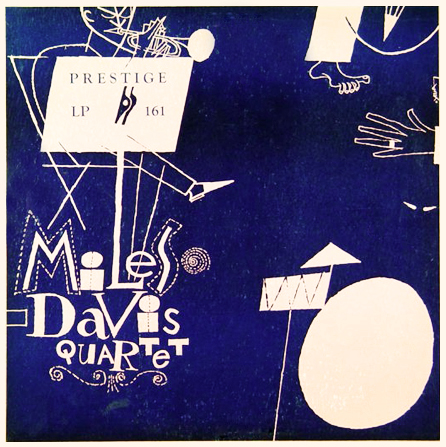
The LP cover is by David X. Young. 


Tuesday, February 17, 2015

Listening to Prestige Records Part 83: Joe Holiday


The big band era ended with World Wat II, and a combination of social and economic factors, and some aesthetic factors as well --people liked the supple acrobatics of the great bebop soloists in a small group setting -- a rhythm section and one or two -- at the most, three -- soloists. But there's still something about the texture, and the power,that can come out of a larger group of musicians, and there was always the temptation to try and recreate it. Dizzy Gillespie put together a big band. Others tried to capture theflavor of the big bands in different ways. Louis Jordan came from the Chick Webb orchestra, and his search for a way to capture the spirit of Chick Webb with a smaller group led to the sound that we now know as one of the cornerstones of rhythm and blues.

Others tried different approaches,and in the early '50s, in what was coming to be known as the poat-bebop era, perhaps the most influential sound of a group that was larger than a sextet was the Miles Davis nonet, which I know I keep coming back to, but you can't help it. And although there were several arrangers for the Birth of the Cool sessions, including John Lewis, who take his search for the new sound in a different direction, perhaps the most influential were two of the greatest arrangers jazz has ever produced: Gerry Mulligan and Gil Evans.


So it's hard to hear a group of this size without thinking of the nonet, and ruminating on what they took from that seminal sould. Joe Holiday, of course, had taken jazz in his own direction, back toward dance music, with his mambo jazz, but this was different. He was coming back toward the mainstream, and although the general public didn't know it yet, that mainstream was flowing from the Royal Roost in 1948, and the records that Ira Gitler described as "the sound heard 'round the world," that were still four years away from being released on an LP by Capitol. I loved the Joe Holiday mambo stuff, but it's easy to see why any jazz musician would want to try putting together this sort of small big band. I hear an Evans influence more than Mulligan in these arrangements.

An octet is an ambitious undertaking, the more so when you remember Bob Weinstock's prohibition on rehearsal time. You have to be be pretty good to hold it together, and Holiday proves himself pretty good, especially when you consider the disparate group of musicians he put together.

It helps to start with Max Roach, the consummate drummer of the era, and a mainstay of many a Prestige recording session. And one of the fathers of bebop.

John Acea was of Cuban ancestry, but not a mambo man. He was born in Philadelphia, and grew up in that city's musical scene. He was gifted on nearly every, but settled on piano after he got out of the army, and played on a wide range of sessions, behind vocalists from Dinah Washington to Patti Page, with jazz groups from Cootie Williams to Zoot Sims. He was one of those guys you're glad to get for a session.

I can't find much on Franklin Skeete, but he was on the scene. There's a Lester Young session with Horace Silver and Connie Kay, a session with Cecil Payne. They're earlier, and it could be that after this session he sort of faded out of the scene.

Payne played up and down the sax scale, but when he settled on baritone, he became one of the leading boppers on the instrument. He was essentially a child of the bebop era, getting his start with J. J. Johnson and Dizzy Gillespie, although he did play a stint with Roy Eldridge, and made some hot R&B sides (with Franklin Skeete) for Decca in 1949.

Idris Sulieman was one of the first jazz musician/Islam converts, with Art Blakey (Abdullah Ibn Buhaina) being the most famous. His early credits show the range in a jazzman's life: studied at the Boston Conservatory of Music, then got his first professional experience with the Carolina Cotton Pickers. Like Cecil Payne, he came up in the bebop era of the 40s, became an important figure in the hard bop era of the 50s. Like Payne, he is treasured by jazz enthusiasts, not really known to the casual listener.

Earle Warren (misspelled on the session list) was from a different source altogether. He was a longtime member of the Basie band, and played some rock and roll with Alan Freed.

So how indebted is Joe Holiday to the Birth of the Cool nonet? I think a lot, especially in the two ballad numbers, "And Now it is Love" and "My Funny Valentine," in their exploration of the tonal and textural possibilities of a medium sized band. I confess I was a little disappointed on first listening not to hear more mambo jazz, and I responded more to the uptempo numbers, "Cotton Candy" and "Martha's Harp." But on repeated listenings, the ballads grew on me, and the disappointment fled.

These came out on 78, 45, and 45/EP; not in album form till many years later, in the reissue days.


Sunday, January 04, 2015

Listening to Prestige Records Part 65: George Wallington

How hard is it to be a jazz musician? George Wallington was one of the original beboppers, one of the most respected and sought-after bebop piano players, and in 1960, worn down by the grind and the constant scuffling for money, he quit to go into the family's air conditioning business. And he was lucky to have a family business to go into. Who knows how many other great musicians of this era would have made the same choice, had they been able to? Who knows for how many heroin was an alternative to the family air conditioning business?

Wallington was retired from music for a quarter century, finally returning in 1984 to record three albums before he died in 1993.

In 1952, Wallington was 28 years old and a veteran of the jazz world. He had been a part of the first band that Dizzy Gillespie brought to 52nd Street, in 1944. And even then, at 19, he was a seasoned veteran. He had grown up in an Italian immigrant family (his birth name was Giacinto Figlia - "Wallington" was a schoolyard nickname because he dressed like a British swell). His father had introduced him to opera, and gotten him started on piano and solfeggia (sight singing); Lester Young (heard on the radio with Count Basie's band) inspired him to turn to jazz. By 16 he was playing in clubs in New York, including a spot called George's, where he accompanied Billie Holiday.

About that first bebop gig with Dizzy, at the Onyx Club, Wallington said:

Dizzy used to take me to his house and we'd play and he showed me his songs. Then he and Oscar Pettiford started the band at the Onyx. Charlie Parker was supposed to join us but he couldn't get a cabaret card. Anyway we had Don Byas, then Lester Young. Billie Holiday used to sing with us sometimes and Sarah Vaughan used to come in too.
I don't know if we thought of what we were doing at the Onyx as something historic, but we did know we were doing something new and that no one else could play it.
OK, this is why, when anyone asks me "If you could go back in time to another era, what would it be?" my answer is always the same. New York, 1940s. 52nd Street, Minton's, Monroe's.


Max Roach said of Wallington'a role in that first band at the Onyx that his great virtue was knowing how to stay out of the way.
We didn't need a piano player [like Bud Powell] to show us the way to go. Piano players up to that point played leading chords. We didn't do that because we were always evolving our own solo directions. We needed a piano player to stay outta the way. The one that stayed outta the way best was the best for us. That's why George Wallington fitted in so well with us, because he stayed outta the way, and when he played a solo, he'd fill it up; sounded just like Bud.
Leading his own group, Wallington didn't need to stay outta the way, and Roach was still propelling him on, and the sidemen on these two sessions give some idea of how much respect Wallington had garnered by this time -- even from Oscar Pettiford, whom Roach remembers as not being entirely won over by Wallington when the Onyx Club gig came together:

 Every now and then, George would miss a chord, and Oscar would jump all over him, "White muthafucka can't play -- shit!" I had to spend a lot of time protecting him from Oscar.
 "Sounded just like Bud" is something you hear a lot in discussions of George Wallington. They were two of the most important pianists in the development of bebop -- and, Wallington's ability to stay outta the way notwithstanding, two of the most accomplished and daring virtuosi. But there's a lot of difference, too. Wallington's early classical training shines through, and you can hear the sorts of romantic flourishes you'd associate with a Vladimir Horowitz. But when Wallington takes on an unabashedly romantic tune like "Laura" or "Tenderly," those same flourishes become dry, ironic, brilliantly anti-romantic.

Speaking of romanticism and "Tenderly," here's a story told to me by the great pop singer Margaret Whiting, who was a close friend when I lived in New York in the 70s. She and songwriter Walter Gross had been an item, but she'd had to break it off because of his drinking. But then one night he showed up at her house about two int he morning, drunkenly banging on her door and demanding to be let in. She had no choice - she opened the door before he could wake the whole neighborhood.

He confronted her: "You fucking bitch...you ruined my life, you fucking cunt. So I came by to tell you just what I thought of you, you fucking bitch." He staggered over to the piano. "I wrote this to show you what I think of you, you fucking bitch." And he played "Tenderly."

Margaret was a romantic, but also a realist. She got some coffee into him, and immediately called...who but a lyricist? Jack Lawrence came over, and they finished the song.

On the first of these sessions, Chuck Wayne joins the group on mandola, which is an unusual instrument -- slightly larger than a mandolin, it bears the same relation to a mandolin that the viola has to the violin. It's also an unusual instrument for a bebop ensemble in that it uses the same tuning as the tenor banjo, an instrument associated with the early Dixieland bands.

But Wayne was an unusual jazz guitarist -- for one thing, he may well have been the only jazz guitarist ever to play the banjo on bebop recordings.. Like Wallington, he was the son of immigrant parents (Czech, in his case -- he was born Charles Jagelka), and his musical start was playing the mandolin in a balalaika band.

He had switched to jazz, and to the guitar, by the time he met George Wallington. They were both playing in a Dixieland group led by Joe Marsala, and Wallington introduced him to bebop. They're a good pairing on these quartet sessions.

And tossing this in -- Wallington composed "Godchild," one of the tunes on Birth of the Cool.

The trio and quartet sessions were all released on 78, and all on the same 10-inch LP (as George Wallington Trio).


Wednesday, July 23, 2014

Listening to Prestige Records project - Part 8

Kenny Dorham and Max Roach must not have spent a lot of time in Paris, because here they are back in New York two weeks later, playing in a group put together by J. J. Johnson as J. J. Johnson's Boppers.

And what a group! Of the six of them, only bassist Leonard Gaskin did not go on to achieve legendary status, and he had a distinguished career, playing with all the major beboppers, including Charlie Parker and Dizzy Gillespie (he replaced Oscar Pettiford in Gillespie's band), then moving back to trad jazz in the 50s with the likes of Eddie Condon, Ruby Braff and Cootie Williams. Interesting to me -- he apparently spent at least some of the last part of his life in my home area. His Wikipedia bio says that in 2003 he worked with grade school kids at the Woodstock Elementary School in Woodstock, NY. He died in 2009.

Kenny Dorham died young, but not as young as I would have thought -- he died at 48, in 1972, of a kidney disease. His reputation is such an underground one (every serious jazz aficionado knows him, the casual listener maybe not. No albums with Dorham as leader make The New Yorker's list of 100 Essential Jazz Albums), that I had sort of assumed he'd died very young, maybe not long after his classic Round About Midnight at the Cafe Bohemia. As his Wikipedia entry puts it, "he never received the kind of attention or public recognition from the jazz establishment that many of his peers did. For this reason, writer Gary Giddins said that Dorham's name has become 'virtually synonymous with underrated.'" My old friend J. R. Monterose said that Dorham was the best leader he ever played with.

Max Roach, of course, along with Kenny Clarke (another expatriate), revolutionized the art of jazz drumming, creating the style that propelled bebop.

The other two players on this date: John Lewis on piano, Sonny Rollins on tenor.

J. J. Johnson was 25 when he led this all-star group, and he had already become not just the premiere jazz trombonist, but the guy who did what had been thought impossible -- made the slide trombone into a solo instrument in the lightning fast, rhythmically tricky form of bebop.

Johnson has been the subject of a book-length study, The Musical World of J. J. Johnson, by Joshua Barrett and Louis G. Bourgois III. I don't know if it sells too widely -- the hardcover is a hundred bucks, and even the Kindle edition is nearly fifty. But a review by Victor L. Schermer on the AllAboutJazz website notes that when Dizzy Gillespie first heard Johnson play, in 1946, he told him, "I've always known that the trombone could be played different, that somebody'd catch on one of
these days. Man, you're elected."

This is pure bebop, played by some of its noblest practitioners. Roach cuts loose with some solos he kept in check on his Paris date. Dorham and Johnson challenge each other, and respond to the challenge. Rollins can beep and bop with the best of them, and he already has the tone that he will perfect under the Williamsburg Bridge and ride into the 21st century, becoming universally acknowledged as one of the greatest of all time.

John Lewis is in the bebop world, but not of it. He contributes greatly to this session, but you can also hear where he's going. And, in a sense, where he's been, which was (like Dorham and Roach) Paris. He contributes the composition "Elysee" to the session, and for the followup session on October 17, his classic-to-be, "Afternoon in Paris."

Dorham, Gaskin and Rollins are gone, replaced by Sonny Stitt on alto, Nelson Boyd on bass. Still bebop. and still wonderful. Of all the nonsense syllables that have come to define art movements, from dada to hip-hop, none of them, for me, have the romance of "bebop." This listening project is to revisit old friends, pick up on music I missed. These two J. J. Johnson albums fall into the latter category. For each blog entry, I download whatever I can find from Spotify onto a Prestige playlist on my phone, and play it over my Jambox Mini while driving. This has been a wonderful couple of days.

The May session numbers were released on 78 by both New Jazz and Prestige, and reissued in 1952 when Weinstock began his 10-inch LP line, as PRLP 109, along with a Kai Winding session, although the classic J.J. and Kai pairing would not come about till 1954. In 1953, Prestige started releasing 45 RPM EPs, which meant another way to buy J. J. Johnson's boppers.
And yet another way -- the short-lived 16 2/3 RPM record, suited to
play on Chrysler's Highway Hi-Fi system (thanks to Bloggerhythms for this info), but not really so great for music. This time, Prestige tossed in Bennie Green and made it three
trombonists. The session with Sonny Stitt also came out in all three formats, the 100-series LP this time backed with a Bennie Green session. All later found their way to Prestige's great 7000 series.


All of these tracks can be found on Spotify.

Here's "Afternoon in Paris," from the October session, on YouTube. You have to dig a little for these -- I found this one by searching under "J. J. Johnson John Lewis."

Thursday, July 17, 2014

Listening to Prestige Records project - Part 7

We're still early in 1949, but at least we're in Paris in the Spring. Well, almost. There have always been expatriate jazz musicians. One of the first was Sidney Bechet, who originally came over to France as part of a revue with Josephine Baker. Baker stayed on to become one of France's mist celebrated entertainers, while Bechet went back and forth, and did not permanently settle in France until 1951. By that time, a postwar community of jazz expatriates was developing, and a French jazz label, Vogue, was formed.

Jazz musicians went to Europe for a variety of reasons. Jazz was waning as a popular music in the USA in the 1940s and 50s, while not yet being accepted as a serious art form. Europe offered both popular and artistic recognition. Stan Getz moved to Denmark to try to kick a drug habit. But a lot of black musicians chose Europe to get away from the racism which had not ameliorated after World War II.

James Moody was one of those. He lived in Europe for three years, and recorded there. His two
sessions in the spring of 1949 were April 30 in Lausanne, Switzerland, with a group of expatriates, and two weeks later on May 15 in Paris with an all-star group of beboppers led by Max Roach.

I can't find any tunes from the Roach session, either on YouTube or Spotify. Amazon has an album called Pleyel Jazz Concert 1948/Quintet 1949, the second part of which is the Roach session, but the tracks on it aren't available for download. The group, in addition to Roach and Moody, was Kenny Dorham (trumpet), Al Haig (piano), Tommy Potter (bass). Recorded for French Vogue, various cuts of it made their way to both Blue Note and Prestige. Prestige included one number on one of their first LPs,  PRLP 113, under Kenny Dorham's name.

The Lausanne session is easier to find, on Spotify as part of a collection called "James Moody 1948-49," and I found one cut on YouTub, but when I came back to link to it, couldn't find it again. His all-expatriate combo consisted of Art Simmons (piano) Alvin "Buddy" Banks (bass) Clarence Terry (drums) Al Edwards (vocals). None of them familiar names to me, probably because their careers were almost entirely expatriate. Art Simmons (who contributes some superb piano here, solo and comp), however, belongs to yet another thread on this blog. A few years ago Peter Jones and I decided to try to make a list of every living musician who had played with Charlie Parker. Many of them are gone now, of course, but here are the names we came up with.

One we missed was Art Simmons. Here, from Wikipedia:
Simmons played in a band while serving in the U.S. military in 1946. He remained in Germany after the war, studying music, and moved to Paris in 1949. There he studied at the Paris Conservatory and the Ecole Normale de Musique, playing with Charlie Parker and Kenny Clarke at the Paris Jazz Festival; he also played with Aaron Bridgers, Don Byas, Robert Mavounzy, and Nelson Williams. He led his own group at the Ringside Club in 1951. In the early 1950s he played with Dizzy Gillespie and Quincy Jones, and toured London with singers such as Bertice Reading. As resident pianist at the Mars Club, he worked with Michel Gaudry, Pierre Cullaz, and Elek Bacsik, and accompanied touring singers such as Carmen McRae and Billie Holiday (1958). In the early 1960s he played in a duo with Art Taylor.

Simmons also did arranging work for Barclay Records. In 1971 he played in Spain; following this he returned to the United States and retired.
So unless someone has newer information, Art Simmons is still alive. Is no one interviewing him, getting his life story?


Moody is solid on the session, and the trio of expatriates (Banks played regularly with Smmons; I couldn't find anything on Terry) provide solid backup, with Simmons (and Banks to a lesser extent) taking some nice solos. Moody does that bebopper's trick of interpolating well-known phrases ("Yankee Doodle") into the middle of a solo, and he plays a couple of figures that suggest ideas he'll develop later in the year, in "Moody's Mood."