Showing posts with label Birdland. Show all posts

Monday, March 19, 2018

Listening to Prestige 321: Red Garland

This was the first occasion of Prestige venturing out of the friendly confines of Rudy Van Gelder's studio to record a live album, and it proved to be an adventure worth daring. The sound is fine, and Red Garland and his club band -- Paul Chambers and Art Taylor had their own things going on -- put on a fine evening of entertainment.

Garland, Jimmy Rowser and "Specs" Wright gave Prestige enough material for three albums of Garland at his best, which were not exactly hurried into distribution or given enough fanfare, but are as good as it gets when it comes to piano jazz from this master, but even better yet would have been to have been at the Prelude that night and to have experienced the real thing.

And I could have been. 1959 was a year of living in New York, and discovering jazz in clubs, discovering that these were real people, on a bandstand so close you could almost reach out and touch them, listening to the music, and the music was jazz, it was improvised music, being created right in front of you. You held your breath at that moment when the soloist finished playing the head, the melody to "The Way You Look Tonight" or "There's a Small Hotel" or "Satin Doll" and started off into the unknown, with notes suggested by the original tune -- based on the chord changes, they said, but recognizing the chord changes was too sophisiticated for me, and it still is too sophisticated for me. The places they went were melodic and anti-melodic, insistent and suggestive, playing for each other, playing for the audience, making little inside musical jokes that you weren't going to get but you didn't have to, it was enough to feel that it was happening, right then and there.

My first time was Small's Paradise, 135th Street and 7th Avenue, Donald Byrd and Pepper Adams. No minimum and no cover. You could sit at the bar, order a bottle of beer for 75 cents, and nurse it for a long time. Drinking age was 18, so I was legal. Bandstand was over my right shoulder. Some of America's greatest musicians were up on it, playing the music I'd dreamed of hearing.

Later that night I walked down 7th Avenue and went into Count Basie's. A house band was playing -- not the Count, obviously. They were good. I wish I knew now what their names were. I didn't stay long. A white country boy in Harlem can only handle so much sensory input in one night.

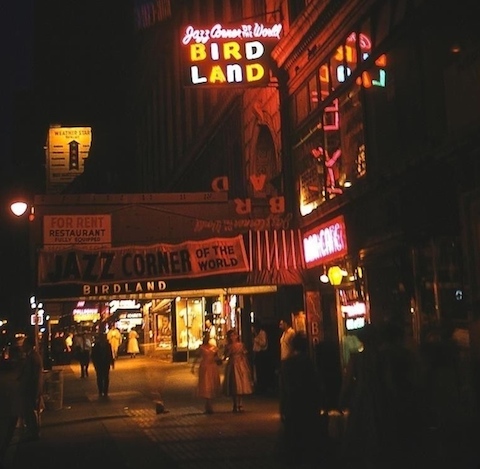
I did hear the Count Basie band, though, at Birdland, Broadway and 52nd St. This was the summer that Miles Davis was beaten by the cops just outside Birdland when he was on break from playing a set. If I remember right it had happened just a couple of weeks earlier, and the jazz community was scandalized and outraged. Was I part of the jazz community. Well, not hardly. But I was scandalized and outraged.

And, that night, I was hearing one of the world's legendary bands, in one of its legendary clubs. I remember white tablecloths. Whether or not that's an imagined memory I don't know, but the place seemed opulent to me, a palace of jazz. And the full-bodied music of the Basie band.

I seemed always to have been alone in my jazz forays that year, except for the Half Note, way downtown on Hudson Street, with my best friend Lenny (now Leonardo) Rosen. Al Cohn and Zoot Sims led a quintet, and we were particularly excited to discover that Mose Allison, the composer-singer-songwriter we loved from Back Country Suite and Local Color, was Al and Zoot's piano player.. The paths that cross in jazz have always been a part of the music's fascination, and the scene't fascination, and here it was happening as Lenny and I sat at a table and let the music thrill us.

Sometime in the 1990s, I was in the city, downtown around NYU, and I ran into an old friend who was getting his PhD, just coming from a seminar. We decided to go get a beer, and he said he knew of a place on Cooper Square. It was a thrash punk club, but it was way too early for the music, and it would be quiet.

The decor was thrashy and punky, with black painted cobwebs everywhere, but the layout was as familiar as if forty years had not passed. "I've been here before," I said. "The last time I was here, Ornette Coleman was on that bandstand."

The Five Spot was the last of my 1959 jazz clubs, and certainly not the least. I was under Ornette's spell, and I went back again and again to hear the music the New Yorker described as "the buzzing of angry bees."

But I didn't know about the Prelude, and I have to conjure up that evening from the music as captured and converted to vinyl by Prestige.

Well, the music is the thing, and this is Garland at his best, playing mostly standards with some originals--one of them. "Prelude Blues," probably composed on the spot. He starts out with a nod to Basie, the theme from M Squad, and salutes Basie again with "Li'l Darlin,'" Let Me See" and "One O'Clock Jump." A late (1971) release from the Prelude  tapes also includes a studio cut from the previous August, a Garland composition called "Little Bit of Basie."  Garland tips a hat to Duke Ellington, too, with "Satin Doll," "Just Squeeze Me" and Ellingtonian Juan Tizol's "Perdido."

Rowser and Wright know how to work with Garland, and know how to solo when called to step up. Wish I'd been there.

Red Garland Live!, on New Jazz, was the first release from this session, and that not until 1965. Edmond Edwards produced the recording, and he chose Irving Berlin's "Marie," Garland's "Bohemian Blues," "One O'Clock Jump," Gershwin's "A Foggy Day" and "Mr..Wonderful."

A budget release on Status was called Li'l Darlin' and had the title cut, "We Kiss in a Shadow" and "Blues in the Closet." It's hard to find release dates for Status product.

Red Garland at the Prelude was released on Prestige in 1971, with  "Satin Doll," "Perdido," "There Will Never Be Another You," "Bye Bye Blackbird,"  "Let Me See," "Prelude Blues," "Just Squeeze Me" and "One O'Clock Jump.""_Perdido" and "Just Squeeze Me" were also released on 45, with a catalog number low enough to suggest a release well before 1971, though that seems odd. Also in 1971 and also on the Prestige label, Satin Doll, with the alternate take of the title cut, the aforementioned Basie tribute, "The Man I Love," "It's a Blue World" and "M-Squad Theme." Orrin Keepnews produced this one.


Listening to Prestige Vol. 2, 1954-1956 is here! You can order your signed copy or copies through the link above.

Tad Richards will strike a nerve with all of us who were privileged to have
lived thru the beginnings of bebop, and with those who have since
fallen under the spell of this American phenomenon…a one-of-a-kind
reference book, that will surely take its place in the history of this
music.
                                                                                                                        
--Dave Grusin

An important reference book of all the Prestige recordings during the time
period. Furthermore, Each song chosen is a brilliant representation of
the artist which leaves the listener free to explore further. The
stories behind the making of each track are incredibly informative and
give a glimpse deeper into the artists at work.
                                                                                                                --Murali Coryell


Tuesday, January 27, 2015

Listening to Prestige Records Part 77: Wrapping up 1952

Prestige recorded a bunch of blues singers during the year. They don't seem to have kept the same meticulous records for their blues sessions, because there are no dates on any of them. Rudy Ferguson and Bobby Harris were both in for two more songs each. They were released on 78, but no trace of them now. No information on the session musicians. Piney Brown, who took his name from the legendary Kansas City speakeasy proprietor remembered in a classic Big Joe Turner blues, was a legend in his adopted home town of Dayton, Ohio, and was remembered fondly when he died in 2009.

Bob Kent was another bluesman who seems to have left little trace behind, and might have left even less, except that his session for Prestige actually did have one musician whose name was recorded on the session notes -- a young tenor sax player from Lionel Hampton's road band who had just just arrived in New York to try and make a living as a session musician. His name was King Curtis. So this one can be found on a compilation album called Wail, Man,Wail -- all of Curtis's recordings from the 1950s, from well-known tunes like those of the Coasters to obscure artists like Bob Kent to surprising choices like Waylon Jennings. Kent's "Korea, Korea" is one of many blues songs about that war, perhaps because it was the first to be fought since the armed services had been integrated. Good blues, good King Curtis.

What else? Rateyourmusic.com, an always interesting site for user-voted lists of this and that, has a number of jazz albums on their list of best albums of 1952. I can't exactly figure out how the ratings on rateyourmusic are calculated, and I can't begin to figure out who does the rating. They're jazz fans -- 21 of their top 50 records are jazz. But who else are they? The others are some classical, some ethnic folklore from Mexico, Africa, Europe and Haiti, Dylan Thomas, some folk blues (no rhythm and blues), and Charity Bailey singing for first graders. Nonetheless, it's an interesting reflection of jazz in the year, so here it is -- the jazz selections from their top 50.

3. Nat "King" Cole
Unforgettable 
Capitol

4. Milt Jackson
Wizard of the Vibes 
Blue Note

5. Billie Holiday
Billie Holiday Sings 
Mercury

8. Stan Kenton
City of Glass 
Capitol

12. Erroll Garner
Body & Soul 
Columbia

14. Gerry Mulligan and Allen Eager
The New Sounds 
Prestige


15. Milt Jackson Quartet 
Dee Gee

16. Charlie Parker
South of the Border 
Mercury

18. Nat "King" Cole
Penthouse Serenade: Nat 'King' Cole at the Piano 
Capitol
 
21. Louis Armstrong
Satchmo Serenades 
Decca

23. Miles Davis
The New Sounds 
Prestige


24. The Fabulous Sidney Bechet and His Hot Six
The Fabulous Sidney Bechet 
Blue Note

28. Norman Granz
Norman Granz' Jam Session #1 
Mercury

20. Stan Getz
Jazz at Storyville 
Roost

30.Lee Wiley
Sings Irving Berlin 
Columbia

31. Anita O'Day
The Lady Is a Tramp 
Verve

39. Peggy Lee
Rendezvous With Peggy Lee 
Capitol

42. Sidney Bechet & Mugsy Spanier
Duets 
Atlantic

44. Jeri Southern
You Better Go Now! 
Decca

45. Howard McGhee's All Stars
Howard McGhee 
Blue Note

47. Sidney Bechet
Ambiance Bechet 
Vogue

48. Anita O'Day
Singin' and Swingin' 
Coral

These, of course, are 1952 releases, and my list is of recording dates. I'm a little surprised that Prestige isn't represented more vigorously, but you can't really complain about what is there. Other artists further down on the list are Art Pepper, Art Hodes, Ralph Burns, George Wallington, Sonny Rollins, Wardell Gray, Oscar Peterson, Dave Brubeck, Barbara Carroll, Sonny Stitt, Dinah Washington and Johnny Hodges.

Billboard called 1952 the best year for jazz, economically, since the '30s, as evidenced by

the increasing number of jazz platter served up by the established and new diskeries, the great success of the jazz road packages, and the healthy grosses racked up by top jazz artists as night club attractions.
Billboard notes that new club, the Bandbox, has opened in midtown in competition with Birdland, that an Illinois Jacquet album, straddling jazz and rhythm and blues, has sold over 100,00 units, Benny Goodman's newest has sold over 75,000, and "the average 78 RPM jazz release of quality can now sell between 5,000 and 10,000 a year, a much better figure than a number of years ago."

So maybe the story of bebop killing jazz as a viable commercial form were a little exaggerated. Of course, the story of the decline of the big bands seems to carry more weight. From Billboard again:

What is most important here, to the record company on one side and the dealer on the
other, is that most jazz platters use a small group and the diskery can get off the nut quickly, and that jazz disks continue to sell for many years.
I miss that old show biz journalism. Where are the diskeries of yesteryear? Billboard notes the success of Norman Granz's Jazz at the Philharmonic and other package tours, and the advent of the LP record.

A second article heralds the arrival of the Bandbox as neighbor and rival to Birdland.The Band Box is featuring JATP stars Flip Phillips, Gene Krupa, Buddy Rich, Charlie Ventura, Oscar Peterson with Ray Brown and Barney Kessel, Charlie Shavers, Hank Jones and Teddy Napoleon. Or you could walk over to Birdland and catch the Lester Young Quintet, the Stan Getz Quintet and the Dave Brubeck Quartet...on the same bill. Think you could afford it? The Bandbox offered free admission and a $1.25 minimum. Birdland had a $1.25 admission and no minimum.

Bring on 1953.


Friday, January 16, 2015

Listening to Prestige Records Part 71: Billy Taylor

I've been using Spotify as my source for these recordings, and as a place to refer anyone who's actually following me along on this Odyssey. And I've been putting up YouTube links to at least one song from each session, for the same reason. No luck with Spotify on this one, so you're on your own, but I have downloaded it, and can report on it.

We tend to think of Dr. Billy Taylor (he got his doctorate from UMass Amherst in 1975, and has more honorary degrees than most of us have college credits), jazz ambassador and educator, founder of Jazzmobile, contributor to CBS Sunday Morning. But before he was Dr. Billy, he was a young college graduate (Virginia State College) who headed straight for 52nd Street, got his first gig playing with Ben Webster, learned from Art Tatum, and was the house pianist at Birdland.

He started his recording career as leader right away, too, doing his first trio session for Savoy in 1945. By the time Weinstock brought him in, he was already a veteran, but the series of trio recordings he did for Prestige, starting with this one, were a major showcase.

Not actually his first Prestige date, though. He appeared on one of those odd Prestige vocal group sessions that never quite made it, but have become sought-after collector's items in the doowop world -- The Cabineers, with Mercer Ellington.

Earl May, who would be Taylor's bassist for 12 years, joins him for the first time on these sessions (replacing Charles Mingus). There's an immediate rapport between them. Charlie Smith is probably best known for sessions with Bird and Diz, and although he's not one of the big names in the bebop world, he's much admired by other drummers.

These are standards -- "Accent on Youth" only barely qualifies as a standard because Duke Ellington recorded it, but it was a hit record in the 30s, and the theme from a movie. It was written by Tot Seymour and Vee Lawnhurst, noted for being the first successful all-girl songwriting team, and noted for having a string of hits all of which are forgotten today, but were recorded by a dizzying variety of performers -- Louis Prima, Rudy Vallee, Fats Waller, Ozzie Nelson and Billie Holiday among them. But I digress. "Accent on Youth" was chosen by Taylor in part because

This was the very first song I heard heard the flatted fifth used. I never noticed that device in a melody before I heard this tune. I didn't know what it was, but sat down and figured it out, liked it. Many years later, it was used extensively in bebop
 Also from Taylor's website, his comment on "Lover," from the same session:

The version of Lover that we played here was one of the swingingest things we did with the Trio. A number of years later, I was talking to Earl May about this, asking he remembered how we played this song. And he said, 'I never played that fast in my life."
These are great for listening. Taylor is boisterous and introspective in turn. He plays like a man who knows what he's doing.


Saturday, December 13, 2014

Listening to Prestige Records Part 59: Wrapping up 1951

A productive year for Bob Weinstock and Prestige, as the label could now lay claim to being as important as any in jazz. Among Weinstock's chief accomplishments -- getting Miles Davis back to New York and into the studio, making a commitment to LP records so that recordings could last more than three minutes.

Fifty recording sessions, almost all of them in New York - and that's leaving out the Swedish groups. That's an average of pretty near one a week. Sonny Stitt and Gene Ammons were the workhorses, with eight sessions -- three under Stitt's name, five under Ammons's. Sonny Rollins recorded two (one of them an afterthought to a Miles Davis session) -- these were his first recordings as leader. Miles Davis had two sessions -- the second, in October, being Prestige's first to take advantage of the new LP possibilities, And two sessions for Lee Konitz, both in the same week, one featuring Miles, the other a duet with Billy Bauer. Teddy Charles, Red Rodney, Bennie Green, Gerry Mulligan all one session each, It was also Mulligan's first session as a leader, so that makes two pretty impressive debuts.James Moody had five sessions, all on the same three days in January, all in Sweden.

Incredible records that took me by surprise -- Charlie Mariano, Joe Holiday. And nice to meet -- on Facebook -- Artie Schroeck, who played with Holiday,

Mildred Bailey, Jimmy Yancey and Big Sid Catlett died in 1951.

Some highlights of the year from All About Jazz:

  • The first American Jazz festival occurs in Wilkes-Barre, Pa. in the autumn. This festival precedes the first Newport Jazz Festival by almost three years. 
  • John Coltrane moves back to Philadelphia and enters the Granoff School of Music to study the saxophone and music theory with Dennis Sandole. 
  • Musicians such as trumpeter Chet Baker and saxophonist Gerry Mulligan form the "Cool School" in California, of course. 
  • Sidney Bechet moves to Paris. Sidney becomes one of the first black American musicians to do this. Many more (Bud Powell, etc.) will follow due to less racial tension. 
  • Thelonious Monk records the classic of modern music Straight, No Chaser. 
  • Thelonious Monk is sentenced for drugs and is banned from playing the NYC clubs for six years. Narcotics which were probably not his were found in Monk's car. Monk will not inform. Although he could not play in clubs, he could record. 
  • Ornette Coleman is working as a day laborer in L.A. He gets gigs when he can, but they are few. People think that he doesn't know how to play. He'll spend nine tough years this way. 
  • Roy Eldridge makes the claim that he can tell the difference between a black player and a white player merely by listening. Leonard Feather gives Roy a blindfold test. Roy fails. 
Atlantic was establishing itself as one of the greatest rhythm and blues labels, but the Ertegun brothers' first love was jazz, and they recorded some jazz greats in 1951: Jimmy and Mama Yancey (perhaps Jimmy's last recording? He would die before the year was out), Billy Taylor, Mary Lou Williams, Don Byas, Mabel Mercer, Meade Lux Lewis. 

Dial, once noted as Charlie Parker's label was pretty much finished (1951 was their last year) but they did release two French sessions, one by Roy Eldridge (duets with Claude Bolling), one by Sidney Bechet. Savoy, the other Parker label, was mostly into rhythm and blues now, and their R&B releases were great. but they still made room for Dizzy Gillespie, Red Norvo, Milt Jackson, Terry Gibbs and others.

Fantasy, which would eventually purchase Prestige,  had been started in 1949 when the owners of a San Francisco record pressing plant bought the masters of a Dave Brubeck trio session from a guy who'd wanted to start a record label but hadn't been able to pull it together, and decided that since they these recordings, they might as well start their own label. They were still tiny in 1951, but they did two sessions with Brubeck and Desmond, and two with Cal Tjader.

Capitol and Mercury were two major labels that I think of as having had a significant jazz presence in those days, but actually they were pretty light in 1951 Capitol had Stan Kenton, which was a very big deal at that time. Beyond that, not much. Although they did issue records by Art Tatum and Shorty Rogers. Mercury did better, with Dinah Washington, Roy Eldridge, Paul Quinichette, James Moody, Jay McShann, and Ben Webster.

Columbia was a giant then and now, and even though jazz was never their main interest, they still had plenty of it: a lot of Benny Goodman, plus Billie Holiday, Claude Thornhill, Jimmy Dorsey, Lee Wiley, Earl Hines, Errol Garner, George Wettling, Stan Freeman, Steve Allen.

Decca was still a major label, and they were well stocked. Louis Armstrong, Ella Fitzgerald, the Dorsey Brothers. RCA Victor I can't find.

 I think of Blue Note as running neck and neck with Prestige, but actually they only produced six sessions in 1951 -- about the same amount in jazz as Savoy, but Savoy was busy all year with R&B. Blue Note had Bud Powell, Sidney DeParis. Thelonious Monk, two by Wynton Kelly. and Sidney Bechet.

Verve was actually the other most prolific independent jazz label, recording Bud Powell, Lester Yung, Charlie Barnet, Slim Gaillard, Charlie Ventura, Flip Phillips, Roy Eldridge and Oscar Peterson, most of them multiple times. Most of these musicians had been part of Norman Granz's Jazz at the Philharmonic tours.

So the big labels had the big names -- and more power to them. But Savoy, Blue Note, Verve and especially Prestige were keeping bebop alive, and presenting the new talent like Sonny Rollins and Miles Davis.

Who could you see in the New Year with in New York? I continue to be frustrated that you can't get Down Beat's archives on line. So all I have is the New Yorker, and they still aren't covering modern jazz. Not that Eddie Condon and the other Dixielanders weren't great, but there was more than that going on. The Embers had Joe Bushkin, who was a trad kinda guy, backed up by some greats -- Jo Jones, Jonah Jones, and Milt Hinton. Birdland is still the only club hospitable to modern jazz that the New Yorker covers. Birdland's New Years Eve offering was Ella Fitzgerald, and the New Yorker once again uses her for a backhand swipe at bebop -- according to them, she "was singing bop before the amateurs got hold of it."

On to 1952.

Tuesday, September 30, 2014

Listening to Prestige Records Part 37: Wrapping up 1950

This winds up the second year of Prestige's prestigious history. Only 20 more to go, and I'm already starting to get the feeling they're going too fast -- that's the grandparent syndrome.


 The last two albums of the year are Sonny Stitt (December 17) with Junior Mance, Gene Wright and Art Blakey, and Jimmy McPartland (December 21) with a sextet including Vic Dickenson and Marian McPartland, so they closed out the year with a rising bebop star and a tip of the hat back to an older jazz style. The McPartland sides were issued on 78 as part of Prestige's 300 series, which appears to consist entirely of four 78 RPM records, all of them by Jimmy McPartland, one session in early 1949 and the other at the end of 1950 -- apparently Bob Weinstock's entire foray into trad jazz. Neither the Stitt nor the McPartland sessions can be found on Spotify, but you can get the Stitt session on Grooveshark --"Nevertheless" and "Jeepers Creepers here  and "Cherokee" here. "Nevertheless" is not exactly a bebop staple -- this is the only recording of it by a modern jazz group that I've found -- but listening to Stitt's version, one can't help but think that maybe it should be.

Prestige was certainly starting to make its mark in 1950. The scorecard: recording sessions with Stan Getz (2), Sonny Stitt and Gene Ammons (9), Eddie "Lockjaw" Davis,  Al Haig, Chubby Jackson, Lee Konitz,  Zoot Sims (4), Wardell Gray (2, one with Dexter Gordon), Leo Parker, Dizzy Gillespie, James Moody (recorded in France, released later as a 7000-series LP), and Jimmy McPartland. 


The major labels actually had the two most important jazz releases of 1950 -- one looking ahead, the other backward. Capitol put out eight songs from the Miles Davis Birth of the Cool sessions on 78. The LP wouldn't be released until 1957, although some songs from it came out on various Capitol 10 inch LPs. Nobody realized quite how important these sessions were at the time -- Miles wasn't able to make a commercial success of his nonet, and had to disband it. However, pretty much everyone knew how important the other recording was -- the recently rediscovered originals of the Benny Goodman 1938 Carnegie Hall concert, released by Columbia as a 12-inch LP -- in fact, their first double LP set.

Charlie Parker recorded with strings.

Fats Navarro died in 1950. Thelonious Monk was arrested on drug charges, lost his cabaret card, and couldn't play again in New York for six years.

Birdland, which actually opened its doors in late December of 1949, was in its first full year of operation.

On to 1951.