The first of these sessions, under Gullin's name, was on August 25, the others on a very busy September 15 and 16. Gullin led--I was going to say a mixed group of East and West Coast musicians, but actually most of the individual musicians are mixed groups in themselves. Conte Candoli is pretty solidly identified with the LA scene, and Konitz, through his close association with Lennie Tristano, surely represents New York. Don Bagley is also a through and through West Coaster. But Frank Rosolino was a Midwesterner from the jazz hotbed of Detroit before he found his way to 52nd Street, and from there to the LA jazz and studio world with which he is most closely associated, and Zoot Sims a native Californian whose jazz life was mostly in New York. I would have associated Stan Levey entirely with 52nd Street and the bebop scene, but actually within months of this session he had relocated to California. Perhaps Candoli and Rosolino bent his ear.
Peter Jones, who listened to this with me, through Spotify, from the hinterlands of northern Louisiana, aptly described this session as "sounds midway between Birth of the Cool and Oliver Nelson," which I thought captured it pretty well.
Most of these musicians had big band experience, and specifically, most of them had played with Stan Kenton, and I think a lot of them may have been on a European tour with Kenton in August of 1953. I know that the September sessions featured musicians from Lionel Hampton's touring band - Hampton didn't pay all that much, and his sidemen had to pick up extra work where they could. Checking further -- they all were on Kenton's tour.
So you have a bunch of musicians who've been playing Kenton arrangements, and they take a day off and go to dear old Stockholm -- well, they're probably in Stockholm already -- to make a record with a talented instrumentalist whose life had been changed in 1949 when he first heard the 78s of the nonet sessions and was so powerfully influenced by Gerry Mulligan that he took up the baritone saxophone, then changed again in 1951 by meeting Lee Konitz -- which is, in a way, more of the same change. So what would the Mulligan arrangements for Birth of the Cool sound like if they were played by the Kenton orchestra? And isn't that one of the things we love about jazz...about American music? It's so cross-pollinated. Musicians talk to each other, dance with each other, copulate with each other in combinations that would make a swingers' club pale with envy. And it keeps coming up new.

So all of the musicians from the August session were from the Kenton band. And were all of the September musicians from the Hampton orchestra? It turns out yes -- including Annie Ross. Who knew that she had toured with Hampton? Thanks to Mario Schneeburger, we have the complete personnel of the band, and its complete itinerary. I'll give an excerpt:
1953/09/05Yes, I know I have a tendency to go way, way off on tangents sometimes, but I wouldn't be doing this blog at all if I weren't a little too much in love with jazz history. Anyway, the tour continues. More
Arrival at Fornebu Airport after flight from NYC with SAS.
These musicians are willing to undertake the adventure of a tour across a foreign continent: Lionel Hampton(ld,vb,p,dr,vcl), Walter Williams(tp), Art Farmer(tp), Quincy Jones(tp), Clifford Brown(tp), Al Hayse(tb), Jimmy Cleveland(tb), George "Buster" Cooper(tb), Gigi Gryce(as), Anthony Ortega(as,fl), Clifford Solomon(ts), Clifford Scott(ts), Oscar Estelle(bs), George Wallington(p), Billy Mackel(g), Monk Montgomery(b), Alan Dawson(dr), Curley Hamner(dr,dancing,vcl), Annie Ross(vcl), Sonny Parker(vcl,dancing). Gladys Hampton, Lionel's wife and band manager, is with them.
New to the band are Clifford Brown replacing Eddie Mullens, Gigi Gryce replacing Bobby Plater, George Wallington replacing Elmer Gill, and Annie Ross.
All of them except for Annie Ross and George Wallington stay in the band until the end of the tour.
The tour is originally planned to last six weeks. Its success leads to a substantial expansion. Lionel Hampton recalls in 1954: "We went over in September for six weeks and we stayed 12."
...
1953/09/07 The band arrives in Stockholm "..directly after successful concert in Oslo", Orkester Journalen. At Stockholm main station the band is bid welcome by Simon Brehm's band. A press conference is held. A welcome party takes place at Hotel Malmen. Hampton and Wallington play a piano duet, Annie Ross sings "Twisted", band members and local musicians jam together. Later on they move to 'Bal Palais' where the party continues until dawn.
[From Sept 8-13: concerts in Helsinki, Finland, then in Sweden's Falun, Hofors, Uppsala,Västerås, Linköping, Norrköping, Örebro, Eskilstuna, so if anyone ever tries to sucker you into a bar bet that no jazz great has ever played Linköping and Norrköping on the same day, don't take it. And finally back to Stockholm, for a]
concert at Konserthuset, starting at 21:15. The concert is recorded and partly issued. The Tom Lord discography gives a wrong date: 1953/09/15. Most other sources give only vague dates such as fall, Sept., Oct. Some days earlier, between September 9 and 12, Lionel Hampton and George Wallington are interviewed at the Swedish radio. In the studio they play a fine How High The Moon at the piano with four hands. Hampton says twice to the radio reporter: "See you on Monday". Coming Monday is September 14. The radio obviously plans to record the concert of September 14 in Stockholm. Recording session in Sweden: Annie Ross and George Wallington (2 titles each).
1953/09/15, Gothenburg. Concert at the Concert Hall. After the concert a jam session takes place at Lorensberg restaurant. Among the participants are Anthony Ortega, Clifford Brown, George Wallington and Jimmy Cleveland with pianist Bengt Hallberg, drummers Kenneth Fagerlund and Arne Milefors among the "locals". "One night we had a recording session [in fact it was a jam session] after the concert in Gothenburg (Sweden). Brownie and Bengt Hallberg played 'Yesterdays' as if the tune would become, by some way, forbidden to be played anymore", remembers Art Farmer. Clifford Brown, Art Farmer and Quincy Jones find the time for a recording session in Stockholm with Bengt Hallberg and other Swedish musicians. This session probably takes place in the morning or early afternoon, before the band's departure from Stockholm to Gothenburg. Recording session in Stockholm on 1953/09/15: Clifford Brown-Art Farmer (4 titles with alternate takes)


concert at Palais des Beaux Arts. It is Annie Ross' last appearance with the band.Anyway, back to the Stockholm recording sessions. Annie does the Kern/Hammerstein standard (her version omitted from the Wiki discography for this song; I added it), and "Jackie," another from the Wardell Gray/Art Farmer sessions that yielded "Twisted" and "Farmer's Market," this one a Hampton Hawes composition that Annie turns into a history of bebop. Here's Billboard's review:
“Annie Ross is fired by Hamp in Brussels after a few unruly hecklers had booed her performance there”, says George Wallington. On the same day or thereafter George Wallington quits the band, either as a gesture of sympathy for Annie Ross, or because he is fired as well.
Jackie: The hip cats should flip for this cool item. The gal delivers a fast-talking story about a wild mouse on her blouse. It's fine for kicks.
The Song is You: Here Miss Ross, a hip singer, tackles the standard for a reading which the jazz collectors should go for to some extent. She's much better, tho, in handling the [unintelligible] stuff.The Billboard reviewer isn't entirely wrong. Annie is great on standards, but her vocalese is in a class by itself.
Ross appears with her soon-to-be-ex-bandmates from the Hampton orchestra; Wallington is with a group of Swedish musicians. It's a testament to the growing importance of both Quincy Jones and Gigi Gryce as arrangers that they're credited on these sessions. And although Jones was the one who went on to a megastar career, Gryce more than once arranges sessions on which Jones plays piano.
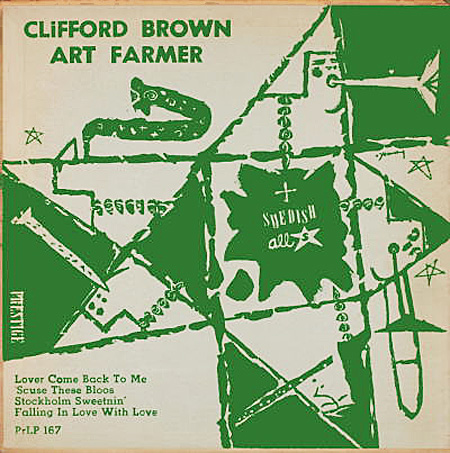
The piece de resistance, however, of this fine group of Swedish sessions, is the Clifford Brown/Art Farmer set. Both in amazing form, each spurring the other on.
All these were originally issued on the Swedish Metronome label; most also came out on the British Esquire label. Prestige put the Lars/American All-Stars on an EP, Americans in Sweden, as Zoot Sims/Lars Gullin/Kenton All-Stars, along with an earlier Zoot/Lars session from 1950.