Tad Richards' odyssey through the catalog of Prestige Records:an unofficial and idiosyncratic history of jazz in the 50s and 60s. With occasional digressions.
This is an odd little session -- odd in so many ways. First, each cut seems to have slightly different personnel, although that may not be the case. it may been the same group of musicians, billed differently for each cut. Second, with all the painstaking care taken to separately identify the musicians for each cut in the session log, no one seems to have jotted down the date of the session -- it's just "some time in early 1965." Third, they don't seem to have had any strong reason for calling this session, unless it was just that Benny Golson had paid the big band for one more day. Each of the three cuts from the sometime in early May session ended up on a different McDuff potpourri album, one released in 1967, the other two in 1969.
Since Prestige doesn't seem to have given a lot of time and attention to the session, I won't either. Lew Futterman, McDuff's manager/producer, was at the controls. McDuff's core group is solid, and Benny Golson was doing some very interesting work with this studio band of unidentified musicians, which is another oddity of the session. Golson, at least according to Lew Futterman, jumped at the chance to record with McDuff, and a second go-round, now that McDuff has faded into history and Golson receives the honors of esteemed elder, is good to have. I've discussed their previous collaboration here.
"Rockabye" was released on the 1967 album The Midnight Sun. Two years later, "English Country Gardens" came out on I Got a Woman and "Shortnin' Bread" on Steppin' Out.
July, 1964. was a busy time in dear old Stockholm. Jack McDuff, now solidly Brother Jack McDuff, was there too, recorded live in Stockholm's Golden Circle with his group, and then in the studio with a Swedish big band. I do wonder if Benny Golson was tempted, after his previous success with McDuff and a big band, to bring the organist and is group into his Stockholm project, but probably not. Golson was looking in a quite different direction. More likely, perhaps, McDuff got the idea of using a Swedish big band from dropping in on his old friend Benny's recording session. More likely yet is the theory that Lew Futterman, McDuff's manager/producer, who had also produced Golson's Stockholm session, was the organizing force behind all of this, and the one who, as before, brought Golson in to arrange the big band session.
LISTEN TO ONE: Au Privave
Soul jazz and the organ combo was still a relatively new sound to Scandinavia--indeed to most of Europe. Jimmy Smith had toured, but European audiences, having graduated from le jazz hot to bebop, were sufficiently skeptical that Futterman had a tough time booking McDuff's tour. As Futterman observes in his liner notes to The Concert McDuff:
Whether or not European jazz audiences, noted for their attraction to the cerebral, would take to McDuff was highly dubious.
But as Futterman goes on to note, at their first stop, the Jazz Festival on the Riviera,
McDuff and his group stole the show. According to Nice Matin, "McDuff a vaincu tout le monde." And in Sweden, the amazed proprietors of Stockholm's famous jazz club, the Golden Circle, saw their audiences dancing in the aisles.
There was enough musical depth in McDuff's music to satisfy the most cerebral of Europeans. And it seemes as though those intellectuals hadn't forgotten how to respond to le jazz hot.
From a historical perspective, it's tempting to focus on the development of young George Benson in McDuff's group, and certainly by the time of this live show at Gyllene Cirkeln (the Golden Circle), he could no longer be considered an apprentice. But while Benson went on to become an international superstar, still regarded to this day as a living legend, and Red Holloway is remembered, if at all, as one of a number of very good tenor saxophonists of the era, it would be a mistake to underestimate Holloway's contribution. His solo on "'Sokay," from the live album, may well be the highlight of that number.
The band that Golson put together for the McDuff/Stockholm studio session is labeled The Big Soul Band, which seems an odd choice for a bunch of Swedes, but it's not out of place. If anyone knew how to arrange a big band to back up Jack McDuff, it was Benny Golson, and the soul is provided by McDuff, Dukes, Benson and Holloway. It's an album very much worth listening to, if you can find it. It doesn't appear to be on Spotify or Amazon Music, and "'Sokay" is the only track I've found on YouTube, which is becoming more and more my source for hard-to-find jazz.
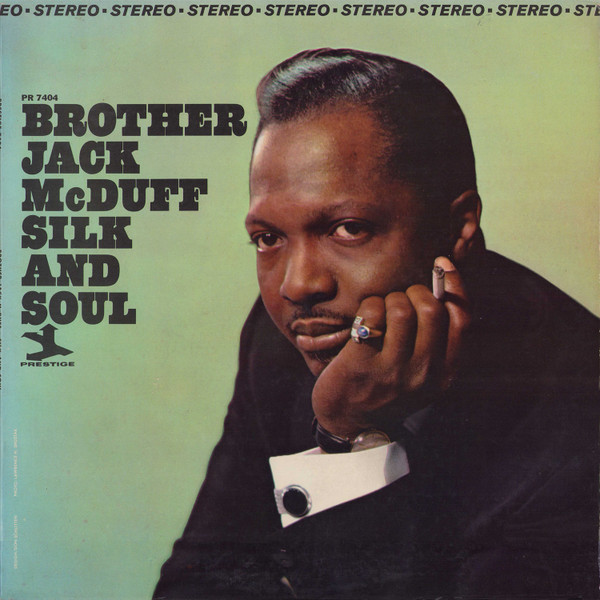
The live album is titled The Brother Jack McDuff Quartet Recorded Live! In Concert Around The World - The Concert McDuff, or more familiarly The Concert McDuff. The Big Soul Band numbers became part of an album called Silk and Soul, which incorporated tunes from two other sessions and was released in 1965. Lew Futterman produced all of the sessions.
July, 1964, was a busy time for Jack McDuff, in and out of Stockholm. During the same month (presumably on his return from Europe, though there are no precise dates for any of these sessions) he was back in New York for a hardworking session during which he recorded nine songs with his basic quartet. all of them in that groove that you can call soul jazz, or funk, or hard bop, or rhythm and blues. Or you can call it by a name that hadn't been invented yet, but which McDuff, Holloway, Benson and Dukes may have pioneered, as several of these cuts would later be collected in an anthology collection called Legends of Acid Jazz.
At the time of their recording, they weren't collected anywhere, exactly. McDuff would make a couple more albums for Prestige before moving over to Atlantic in 1966, so Bob Weinstock's label mixed and matched for a few more releases. "Scufflin'," the first tune off the session, had been added to Silk and Soul. "East of the Sun," "Au Privave" and "Hallelujah Time" made it to Hallelujah Time!, a 1967 album that threw it together with one cut from a 1963 session and a few from a later date. Another bits and pieces album, Midnight Sun, also issued in 1963, contained "Misconstrued," and yet another, 1968's Soul Circle, found room for "Lew's Piece" and Horace Silver's "Opus de Funk." Ray Charles's "I Got a Woman" is the title cut to a 1969 release, and again in 1969, Steppin' Out included "Our Miss Brooks."
The super-popularity of Brother Jack McDuff's quartet naturally meant Prestige wanted to get more product out there, and one way of doing it without overdoing it was to give each member of the quartet his own session. Well, there's nothing wrong with giving the people what they want, but this was more than just a marketing ploy: Jack McDuff was pretty serious about giving his bandmates a chance in the spotlight, and Bob Weinstock was happy to go along with it. Red Holloway was a seasoned professional who had already recorded one album as a leader for Prestige, separate from the McDuff orbit. George Benson was a budding superstar, about to take flight.
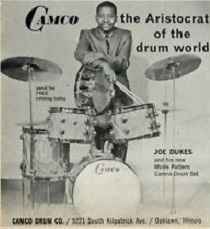
Joe Dukes was something else, practically Jack McDuff's other self. Though he was widely regarded in jazz circles as the quintessential soul jazz drummer, his career was almost entirely circumscribed by McDuff. He appeared on very few recordings that were not with McDuff, and when his tenure with McDuff was finished, he pretty much vanished from the scene. Wikipedia, which is pretty good on having at least something for many really obscure jazz musicians, has no entry for Joe Dukes. And this was the only session he ever recorded as leader.
But Dukes was one of the key ingredients in the huge success of the McDuff quartet, and he's a lot more than window dressing here. This session is built around showcasing him. Except for the Dizzy Gillespie/John Lewis standard "Two Bass Hit," all the compositions are credited to Dukes and McDuff, all prominently feature drum solos, and all are engineered to bring out the drum sound.
The result? You can tell why Dukes was so highly regarded by his peers.
Dukes worked on 26 sessions with McDuff for Prestige between 1961 and 1966. McDuff then recorded several sessions for Atlantic between 1966 and 1968. He used Dukes on two of them, but mostly worked with other configurations, and much of his work for Atlantic was never issued. He recorded for Cadet (no Dukes) and then for Blue Note, where he brought Dukes back on board for one 1969 album, recorded over several days.
Beyond that, he participated in a 1966 Hank Crawford session for Atlantic (one track on Crawford's Mr. Blues album), and two 1970 Lonnie Smith sessions for Blue Note. One of these resulted in the album Drives; the other, a live session. got stuck in Blue Note's vaults and would not be released until 1995.
After that, nothing. Dukes died in 1992, and the drummer once described by George Benson as "such a magnificent drummer that there were times I thought he was one of the greatest things that ever happened to mankind" was pretty much forgotten. The organ jazz phenomenon ran its course, but it still has its aficionados, and there are still younger fans, especially drummers, picking up a McDuff album and saying "My God -- who is this Joe Dukes?"
The album was entitled The Soulful Drums Of Joe Dukes With The Brother Jack McDuff Quartet, and yielded one 45 RPM single, "Moohah The D.J." / "Greasy Drums," in both cases considerably abridged from the album versions. As with all McDuff product, the session was produced by Lew Futterman.
In an interview many years later, sometime in the 1990s, George Benson begins a story by telling the interview that a long time ago, he played in a band led by a guy named Jack McDuff. The interview must have been with a non-jazz publication, as by that time Benson was a crossover star, since McDuff continued to tour and record into the 90s, and in fact Benson rejoined his old boss to play on two cuts of a McDuff album in 1992, recorded in Germany and released on Concord Jazz.
The story, as with all of Benson's stories about his days with McDuff, was about how much he had learned from the veteran organist. But it seems that Prestige was already recognizing, if not that student would outstrip the master, at least that the fledgling was ready to spread his wings and leave the nest. Benson would record a few more times with McDuff, and then go on to superstardom beyond Prestige.
In one of Benson's reminiscences about his early days with McDuff (others are referenced here), he says:
Due to the fact that I couldn’t play very well, he would only give me one or two choruses in any song. So whatever I could play, I had to cram it into a chorus or two—which made me learn to fire up very early in my solo. I said: “Well, this is gonna be short”, and I’d just rumble away at a lot of notes, and throw in funky things, pretty things, every kind of thing I could think of. And it was good for records, because when I got in the studio I could do that naturally.
McDuff himself had been mentored by Willis "Gator Tail" Jackson, who encouraged him to switch from the bass to the organ. Jackson was, by some accounts, a particularly hard man to get along with, but he had a way of discovering and shaping young talent, from McDuff and Bill Jennings in the 1950s to Pat Martino in the mid-1960s, and he seems to have passed the torch on to McDuff.
And young George Benson clearly learned a thing or two from playing those one or two choruses.
Red Holloway and McDuff join Benson here, but the rest of the rhythm section is different, and interesting. Bassist Ronnie Boykins was just in the process of branching out after having spent seven years with Sun Ra. Roger "Montego Joe" Sanders had played on Prestige sessions before, with Willis Jackson, Ted Curson, and Ahmed Abdul-Malik.
And another instrument is added to the mix on the first two cuts, "Shadow Dancers" and "The Sweet Alice Blues." McDuff's organ and piano are absent from these two cuts, and in their place is some very active work on the bongo drums--according to Chris Albertson's liner notes, "presumably...being played by McDuff."
McDuff stays on organ the rest of the way, with the exception of "Easy Living," where he switches to piano. Benson gives a lot of solo space to Holloway, but ultimately this is his album, and putting his name out front does make a difference. Listening to this music from the point of view of history, we're immediately aware of Benson from the first time his name appears on a Jack McDuff album, and we immediately start to track his development. But Albertson, who of course could have had no idea of the breakout future that awaited Benson, says in the liner notes:
It is highly probable that you are unfamiliar with the name of George Benson although it is very likely that you have heard hum play, either in person or on records, as a member of organist Jack McDuff's group.
And Albertson is not about to go out on a limb and say "A star is born!", either. He hedges that bet:
The Brother Jack McDuff quartet is a highly democratic one, allowing each member a chance to record under his own name, with leader McDuff taking on the role as sideman.
Neither is Benson about to dominate the session. Holloway has as much solo space as he does. But it is clearly an important step. He would appear on five more Prestige albums in 1964-65: Three of them under McDuff's name, one under Joe Dukes', one under Red Holloway's. The Holloway album was produced by Lew Futterman, but neither McDuff nor Dukes appear on it (the organ part is played by Lonnie Smith). Then he was on to Columbia, where they had a better star-making machine, and where he began singing as well as playing.
This album was entitled The New Boss Guitar Of George Benson With The Brother Jack McDuff Quartet. "Shadow Dancers" and "Just Another Sunday" were the 45 RPM single release. Lew Futterman produced.
Jack McDuff's manager Lew Futterman, in the liner notes for the next session, describes how he got Golson and McDuff together:
McDuff had opened [at Birdland], and I was down there to see him...Benny and I ended up at the same table. While I was well aware of his writing, playing and arranging, we had never before met. I asked him how he liked McDuff. He said, "Great!" Since he was unaware what my relationship was to Jack, I pushed him a little farther by telling him I didn't like Jack's playing. His response was immediate. "You're entitled to your opinion. But I've never heard a jazz organist play with the feeling this man has. He shows such a great emotional quality, such a sympathy for the music that I could listen to him all night."
...He proceeded to say what I had felt since first hearing Jack play but had never been able to verbalize so succinctly--namely, that Jack McDuff exhibits a rare intuitive understanding of jazz, and of music in general. Nothing he plays seems stiff or structured, moving instinctively from one musical idea to the next, with no apparent disparity between what he feels he wants to play and what he can play. The excitement he generates is organic, rather than forced, as if he were thinking with his fingers.
At that point, Futterman outed himself to Golson, and asked if he'd consider writing some arrangements for McDuff.
"Only if I can write what I want to." I started to give him a qualified "yes," but decided better of it. A man with Golson's talent...deserves a free hand.
It seems quite certain that Golson had a free hand, because how else explain Henry Mancini's "Pink Panther Theme" on a jazz album? Or such was my first thought, on hearing it. But "Pink Panther" was a huge hit in 1964, the year of the movie's release, and a few different jazz artists covered it. There was a rhythm and bluesy version by Earl Bostic, another organ interpretation by Jimmy McGriff, and another big band arrangement by Quincy Jones.
As it turns out, they're all worth a listen. As a composer, Henry Mancini may have been a master of the obvious, but the operative word there is "master." The tune may have been perky and ubiquitous to have even become the punch line of a joke (What did the Pink Panther say when he stepped on an ant? --Dead ant...dead ant...dead ant dead ant dead ant....), but it was brilliant in its own silly way, and it responded nicely to the big band treatment, and to McDuff's bravura organ work.
The album's cover, however, promotes another movie tie-in--the theme from The Carpetbaggers, which is odd, in that although The Carpetbaggers was a blockbuster movie, its score, by the redoubtable Elmer Bernstein, was not a breakout success. Secondhandsongs, the website that keeps track of cover versions of nearly everything, cannot find a single one for the Carpetbaggers theme. YouTube turns up one other, by Jimmy Smith. Still, it's Elmer Bernstein, which means it's bound to be a decent tune (if a little too reminiscent of Bernstein's more popular theme from The Man With the Golden Arm), and Golson and McDuff certainly make it worth listening to.
Golson takes two from the movies, two from Broadway. The Broadway tunes are both from musicals of the 1960s. "Once in a Lifetime," by Leslie Bricusse and Anthony Newley, was one of the breakout hits from the musical Stop the World--I Want to Get Off, the star vehicle for Newley which had opened in 1962 and was still running. "You Better Love Me" was from the just-opened High Spirits, composed by Hugh Martin (best known for the songs from Meet Me in St. Louis) and Timothy Gray. One has to figure that all of these not-exactly-standards were chosen by Golson for how they'd sound with Jack McDuff counterpointed against an orchestra, and the proof is in the pudding. Golson was right.
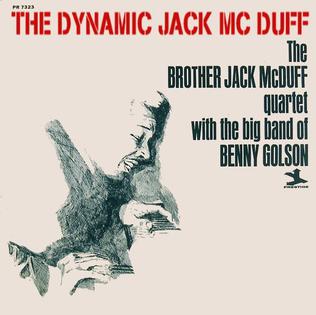
McDuff brings his regular group. Golson brings an orchestra, personnel unidentified. The four tunes were all they recorded, and the B side of the album comes from McDuff's earlier date on the West Coast. Lew Futterman produced both sessions. The album is entitled The Dynamic Jack McDuff. "Pink Panther" and "Carpetbaggers" were released on 45. The version I've linked to on "Listen to One" is the 45 RPM version. Weighing in at 3:20, as opposed to the album's 5:15, which means more theme and less improvisation, but hey, it's the Pink Panther! Dead ant...dead ant...."Once in a Lifetime" was also released on 45, as the flip side of "Rail Head," from the earlier session.
Red Holloway, Jack McDuff, Joe Dukes and George Benson found themselves in Los Angeles--they were one of the most popular touring jazz groups in the country at this point, and they could have been found almost anywhere on any given date. But they were in LA, along with Lew Futterman, McDuff's manager and producer, and with no shortage of recording studios in the city of angels, Futterman brought them in for two days of recording in various formats, and under various names.
LISTEN TO ONE: What's New
First came a session that would be released under Holloway's name, as it was largely a showcase for his gifts as a composer. It was the basic quartet, plus West Coast bassist Wilfred Middlebrooks, and it began with two ballads before moving on to Holloway's various variations on jazz funk.
"This Can't Be Love" was a familiar Rodgers and Hart standard from the 1930s. A ballad taken at a brisk tempo, it featured McDuff moving over to piano for the first time on record.
"Wives and Lovers," a recent hit by Burt Bacharach and Hal David, was on its way to becoming as popular as any ballad from the Great American Songbook. A 1963 release that would win crooner Jack Jones a 1964 Grammy, it would go on to become a favorite of lounge singers, and a wide assortment of instrumental aggregations, from Lawrence Welk and Jerry Murad's Harmonicats to Stan Getz and Thad Jones / Pepper Adams. It was a song in a sort of new genre, the "exploitation song." Wives and Lovers was a movie with Janet Leigh and Van Johnson, and Bacharach had been engaged to write a song, but not for the movie's soundtrack. The producers wanted--and got--a top 40 hit that would get the movie's title out there, and draw attention to it. Bacharach had done this once before, for movie that seemed an even more unlikely inspiration for a hit song, The Man Who Shot Liberty Valance.
Holloway demonstrated some nice versatility as a composer, keeping the blues a thematic base. His compositions took front and center for Prestige's two 45 RPM single releases from the album, "Denise / Wives and Lovers" and "No Tears" / "Shout Brother." Billing was "Red Holloway with the Jack McDuff Quartet," and the album was entitled Cookin' Together.
LISTEN TO ONE: Redwood City
The Holloway session is listed as having taken place on February 6 (a Thursday), the other two on February 6-7. Which seems odd. For the middle session, the quartet, they drop the bass player and go back to their regular quartet lineup. For the final session, a bass player returns, but a different one, and they add another horn. It seems unlikely that they would have done a little with the quartet and a little with the sextet on Thursday (after having done a seven-tune set with the quintet) then called it a day, then a little more with both lineups on Friday. In any event, all this music was made in two days. The last lineup, the sextet, recorded as the Nomos, which may well have meant "No mo' of this jive, we're getting back on the road."
The quartet sounds good, as always, with each member getting ample solo space, and young George Benson sounding better and better. The material is a standard, Bob Haggart and Johnny Burke's "What's New?" and two originals by McDuff.
It seems each soloist gets a session as composer. The Nomos do two tunes by Benson, "Redwood City," a long and a short version, and "Step Out and Get It." A third, "Long Distance," presumably also by the guitarist, was canned. The quartet is augmented by a bassist, Tommy Shelvin, and New Orleans native Alvin "Red"Tyler on baritone sax. Tyler was a veteran of Cosimo Matassa's studio in New Orleans, and had played on recordings by Little Richard and Fats Domino, and he adds a richness to the sound. Benson would record "Redwood City" again with his own group.
The quartet sessions would be added to a second session with Benny Golson and a full orchestra. "Rail Head" would be on a 45 RPM single, with one of the tunes from the Golson session on the flip side. The Nomos didn't get an album. The long version of "Redwood City" would be included on a 1970 release, Gene Ammons/Richard "Groove" Holmes/Eddie "Lockjaw" Davis With Shirley Scott/Willis Jackson/The Nomos/Brother Jack McDuff - The Soul/Jazz Giants (Previously Unissued Material). The short version, and "Step Out and Get It," became a 45 RPM single. Futterman handled the production for both days and all lineups.
A big band backing a soul jazz organ combo is a unique idea, but these are the guys to make it work.
I'm always interested in the guys who are part of the rich fabric of jazz, even though their names aren't in the forefront. Here's what I could find about the musicians Benny Golson gathered for this session. Jerry Kail we've seen before as a member of Oliver Nelson's orchestra for his 1961 recordings. Billy Byers was on the same session, and made an earlier Prestige date as a member of Hal McKusick's quintet in 1957. Danny Stiles was on TV with the Merv Griffin show's orchestra, and played in two of the best big bands, Woody Herman's and Gerry Mulligan's. He also stepped out of the sections to make one album as co-leader with Bill Watrous, for the Famous Door label.
Burt Collins was tabbed for inclusion--usually on trumpet-- by virtually everyone who ever put together a big band, including, surprisingly enough, Albert Ayler. In the 1970s, he formed a group with Joe Shepley, and one of their albums was a jazz tribute to Paul McCartney. He also cut albums for Music Minus One.
Tom McIntosh hardly belongs in this group of background figures. A distinguished composer as well as a trombonist, he was named and NEA Jazz Master in 2008.
Don Ashworth joined the Tonight show orchestra when Johnny Carson took over its helm in 1962 and, like Johnny, remained there for the next 30 years.
Bob Northern, after working as a session musician for many of the top names in jazz during the 1950s and 1960s, became interested in world music in the 1970s, went to Africa to study, and released several albums during that decade.
Marvin "Doc" Holliday can be heard playing and talking about his career in music on YouTube.
George Marge, on baritone sax here, played nearly every reed instrument and was in wide demand as s a session musician, not just with the jazz greats but also with pop stars like Paul Simon and John Denver.
Put them all together with McDuff's usual group, plus Mel Lewis joining Joe Dukes on drums, and Benny Golson leading the band, and one can only be surprised that no one thought of it before. Golson's arrangement and some serious professionalism from the musicians provide a rich and full-throated backing for McDuff, who is solidly equal to the task of fronting this aggregation. The classic big bands were about good time music, soul jazz is about good time music, and between them, they let the good times roll.
The session was produced by Lew Futterman and Peter Paul, who had previously given us Brother Jack live in San Francisco, and away from the friendly confines of Rudy Van Gelder's studio. The album was entitled Prelude, after the Benny Golson tune which was on the album, along with McDuff originals and standards. "Prelude" was also on one of the two 45 RPM singles, along with "Oh, Look at Me Now," composed by Joe Bushkin, made famous by Frank Sinatra. The other 45 was two McDuff tunes, "A Kettle of Fish" and "Carry Me Home."
Prestige Records, Ozzie Cadena and Rudy Van Gelder took a bit of a breather in the fall of 1963, between the September 17th date of Jack McDuff, without his group, joining Sonny Stitt for a session, and October 10, when McDuff regular Red Holloway recorded a date without Brother Jack.
But in the interim, one of Prestige's mainstays was recorded live out in San Francisco, and the results released on Prestige. The club was the Jazz Workshop, and the headliner none other than Brother Jack.
San Francisco, especially the North Beach area, was a hot epicenter for jazz in the 1960s, with such a cluster of clubs that Dizzy Gillespie, playing one night at the Jazz Workshop, could tuck his horn under his arm, walk across the street to a club where Carmen McRae was headlining, and accompany her on a swinging version of "I Left My Heart in San Francisco." The Workshop was particularly fertile ground. Barry Harris recorded a live album there in 1960, and he was followed by Charles Mingus, Cannonball Adderley, James Moody, Larry Coryell, and perhaps most famously, Thelonious Monk, whose 1964 appearance was recorded but unreleased. When it finally saw the light of day in 1983, it was hailed as one of Monk's finest efforts.
Jack McDuff hit Frisco with a big sound, including his two tenormen of the moment (usually he used one or the other), Harold Vick and Red Holloway, and his hot new guitar find, George Benson, and they all came ready to play to a responsive audience.
The date included four originals by McDuff, including "Grease Monkey," a staple of his live sets, and a tune previously recorded on an album with Kenny Burrell.
"Somewhere in the Night" was written by noted arranger Billy May as the theme music for the gritty New York-based police drama Naked City, and it had become a crowd pleaser for jazz ensembles.
"Passing Through" was from a young West Coast musician who was starting to make a name for himself as a sax player/composer/arranger with Chico Hamilton. Charles Lloyd would go on to become one of the biggest jazz stars of the rest of the century, and into the next millennium.
Finally, "Jive Samba" had recently been recorded by Cannonball Adderley, from the pen of his brother Nat. It had already become a hit in jazz circles, and has remained a staple of the jazz repertoire for major artists and school groups alike.
Jazz Workshop was a great place to play, and its knowledgeable and enthusiastic audiences drew the best out of the musicians that played there. This album, entitled Brother Jack at the Jazz Workshop--Live!, produced by Lew Futterman and Peter Paul, yielded two 45 RPM singles off the initial release, "Passing Through" / "Somewhere In The Night" and "Dink's Blues / Grease Monkey." A third single, "Rock Candy / Grease Monkey" was released in 1969. The group is identified as the Brother Jack McDuff Quartet, despite the presence of five musicians.
Red Holloway first came to Prestige as part of a large ensemble put together by Oliver Nelson for a Gene Ammons session, then appeared on a session with Brother Jack McDuff, with whom he was to remain for several years. But Bob Weinstock liked his stuff, both musically and commercially, enough that he was to bring out four albums with Holloway as leader over the next few years, with an emphasis on "jazz with a beat" -- the liner notes to this album emphasize, a touch melodramatically, that this music has a good beat and you can dance to it.
Although he was born in Arkansas, Holloway was a true musical son of Chicago, where his family moved when he was still in school. He attended DeSable High School, that cradle of jazz education, where one of his classmates was Johnny Griffin. He left Chicago for the army, but returned to
spend his formative years there, playing with a wide range of musicians. He was active in Chicago's blues and rhythm and blues scene, joining Roosevelt Sykes's band, and playing with Chuck Berry, Willie Dixon, Junior Parker, Lloyd Price, and Bobby Bland. He accompanied a range of visiting jazz stars, including Dexter Gordon, Yusef Lateef, Ben Webster, Sonny Rollins, Wardell Gray, and many more. He worked with vocalists -- Billie Holiday, Dakota Staton, Joe Williams, Aretha Franklin. He toured with Sonny Stitt, Memphis Slim, and Lionel Hampton.
And all of this -- the rhythm and blues, the modern jazz, the entertainers, the soul jazz -- can be heard in Holloway's own sound, making him a good fit for Jack McDuff, and a good bet for recordings under his own name. To quote the teenage record reviewers on Dick Clark's American Bandstand, Holloway's records had a good beat. You could dance to them.
Holloway first brought a group to Rudy Van Gelder's studio on August 27. It was a quiet time (for Prestige, not for Rudy, who rarely had down time) between the two Gildo Mahones sessions, but even so, they did not spend much time with Red. He recorded two tunes, one a standard "Moonlight in Vermont") and one an original ("Miss Judie May").
Some of the musicians on this date shared a Chicago connection. Thomas "Tiaz" Palmer worked with a number of Chicago doowop and rhythm and blues groups as well as jazz groups, and in the 1980s would reunite with another ex-Chicagoan, Amina Claudine Myers, for a recording. He also toured and recorded with the Coasters frequently. Trumpeter Hobart Dotson was a music veteran, having been a member of Billy Eckstine's big band in the 1940s. He had also been a stalwart on the Chicago jazz scene, recordint with a number of groups.
Bob Durham also had his start in doowop, working with the Orioles at 16, He went on to a long and distinguished jazz career, highlighted by an an association with Norman Granz that found him playing with many of Granz's artists, including Oscar Peterson, whose regular drummer he was through much of the 1960s.
But two sides were all that this group cut, and only one of them was used. "Miss Judie May" was shelved, to be recorded again when Holloway convened a completely different group on October 10.
This one was anchored by two Prestige mainstays, Leonard Gaskin on bass and Herbie Lovelle on drums. The other players were all new--and again, relying on his Chicago connections.
Paul Serrano made his mark on the Chicago music scene not only as a trumpeter but also as a recording engineer. After playing with Woody Herman, and appearing on hundreds of recordings for Chess and other Chicago-based record labels, Serrano opened his own South Side P. S. Recording Studios in 1966. In 1992, as he began to suffer from Parkinson's disease, he closed his studio and went to work for Delmark Records as their head engineer. Ramsey Lewis, who recorded frequently with Serrano, remembered that "being a musician, he knew what the instruments were supposed to sound like." Lewis also recalled Serrano's generosity with musicians who couldn't afford to pay.
Big John Patton, like many organists, started on piano, accompanying Lloyd Price as a teenager. Switching to organ in the 1960s, he cut two records with Lou Donaldson, then served an apprenticeship of sorts with Jimmy Smith, playing tambourine on an early session by the soulmaster. By the middle of the year he was fronting his own group for Blue Note. He became one of their soul jazz stalwarts throughout the decade, then had a resurgence of his career in the 1980s with avant-gardist John Zorn.
This is a very early session for guitarist Eric Gale (he had made his Prestige debut on a King Curtis session), who wouldn't really hit his stride until the 1970s, when he became one of the most sought-after session guitarists around. His recordings with supergroup Stuff are some of the best examples of 1970s jazz-funk.
The album was released on Prestige as The Burner. "Monkey Sho' Can Talk" and "Crib Theme" were the 45 RPM single, the latter a rare composition credit for Ozzie Cadena, who produced both sessions.
This is a big deal in the Brother Jack McDuff story and the Prestige story: the debut of a young man who will be one of the biggest jazz stars of the rest of the century, and on into the next millennium. George Benson would record several Prestige albums with McDuff, and one under his own leadership. before venturing on to stratospheric fame (there aren't many jazz players who have a star on the Hollywood Walk of Fame).
Benson started out as a child prodigy on the ukulele in his native Pittsburgh, taught by his father, although when he switched to guitar, his father let him go his own way--because, as Benson remembers it, his father thought the guitar began
and ended with Charlie Christian. It wasn't until years later that his father finally agreed to listen to him, and Dad had to agree that Charlie Christian had a rival.
Benson played mainly rhythm and blues in local clubs around Pittsburgh, though he did get nudged into more modern sounds when a certain musician used to come to town courting a woman. Stevie Wonder eventually married the girl, but on his trips to town, he would occasionally come and sit in with George. As Benson recalls it, his audiences refused to believe it was really Stevie Wonder, because what would he be doing in a dinky club in Pittsburgh sitting in with a kid guitarist?
It was another established musician who took him out of Pittsburgh, and brought his musicianship to another level. Benson was 19 when Jack McDuff brought him into his band, and he had a lot to learn. He recalled in an interview,
I had just started playing chord changes or jazz tunes, and I didn’t know very much about what was happening. He would have me play lines in unison or harmony with the saxophone player, and they would be at ridiculous tempos. And by the fact that the saxophone player did them, I didn’t question the fact that they could be done. I decided it was just my ability at fault; I’d go home and practise them, play them sideways, until I came up with a way to play these tunes that I didn’t even understand. And eventually I began to fit into his repertoire, and became a valuable member of the group;
It wasn't always easy. McDuff and his longtime drummer Joe Dukes were solid professionals, and very exacting. They would let him have it with both barrels if he didn't measure up, and with no shortage of obscenities.
Finally, after a particularly nasty rant, I snapped: "If y’all don’t lay off, I’m gonna take y’all outside and beat y’all old men up! I’m nineteen years old! Y’all can’t take me! We’re going out in the alley, right now!" McDuff and Dukes just stared at me for a second, then they both pulled out switchblades. But that didn’t stop me: “I don’t care! Y’all don’t scare me! Bring your switchblades into the alley! I’ll beat y’all up anyhow!” Fortunately, cooler heads prevailed: nobody went into the alley, and nobody got beaten up. But it got them off my back.
By the time they got to the Front Room in Newark in June of 1963, Benson had learned a thing or two.
This is one of those rarities--a Prestige live album. In engineering it, they play up the live aspect, with spoken introductions to the tunes, ad libs and a lot of crowd noise. It was a good choice for a live album, as it turned out, though Bob Weinstock and the Prestige team couldn't have predicted just how good at the time. The recording gives you that "present at the creation" feeling when Benson launches into his solo on "Rock Candy," the first tune of the set. There's even a false ending, as McDuff appears to wrap up the tune, followed by a moment of silence, followed by Benson ripping into it, and one can
even imagine oneself at the Front Room in Newark, suddenly looking up and saying "Who is this guy?"
"Rock Candy" would become a staple of McDuff's live sets. He would record it again in 1996 with Joey DiFrancesco, and Benson would record it with his own group in 2006.
The crowd at the Front Room got their money's worth on this night, as the group pulled out all the stops. Well, McDuff didn't pull out all the stops on Gershwin's "It Ain't Necessarily So," although he gives a bravura performance, restricting the organ to its percussive possibilities, while Benson and Holloway take care of the melodic parts.
McDuff never forgot he was a jazzman, but he also never forgot he was an entertainer--a good lesson for the young guitarist. He always included familiar songs with catchy melodies that people would like -- such as "Whistle While You Work," the dwarves' song from Walt Disney's Snow White, with drum work by Joe Dukes that makes one understand why Benson described him as "such a magnificent drummer that there were times I thought he was one of the greatest things that ever happened to mankind."
And "Undecided," a tune written by Charlie Shavers, who was torn between two poetic and evocative titles for his new composition, so he sent it off to his publishers marked "Undecided" -- title yet to come. They, however, misunderstood, thought that "Undecided" was the title, and sent it off to lyricist Sid Robin. The point of no return was reached for the song when Ella Fitzgerald recorded the lyric, and as "Undecided" it became a huge hit for the Ames Brothers in 1951.
McDuff's own compositions are always riff-based and accessible, and one of them, "Sanctified Samba," is an excellent object lesson in something else Brother Jack told the young guitarist:
I learned the blues from my former boss Brother Jack McDuff. He kept stressing, “Man, put some blues in that stuff, man.” I said, “Wait a minute, man, it’s not a blues song.” He said, “I don’t care! Put some blues in it.” I asked him why he liked the blues so much, and he told me that no matter where you are in the world – you could be in America or in China – if you play blues, they understand it.
So that’s why it’s so valuable to me. I’ve experimented with that philosophy over the years and have found that he’s correct. People like the blues no matter where you are all over the world. So it became something that I decided should be a part of everything I did. The blues is like street music. It’s like the language of the street.
This album is a riveting introduction to a budding superstar, but it's also a tight ensemble album, held together by the always masterful Dukes and featuring stellar playing by Red Holloway.
Production was handled by Lew Futterman, a recent Cornell graduate making his producing debut. He would go on to achieve success as an independent jazz producer, and greater success as a rock producer, and mega-success, ultimately, as a real estate developer, thus answering the question, "How can I make millions of dollars producing jazz?"
Brother Jack McDuff--Live! was the title of the Prestige album, with a few cuts not making it. The alternate version of "Undecided" was held off for 1967's Hallelujah Time!, and "Love Walked In" and "The Midnight Sun" appeared on The Midnight Sun, in the same year.The session threw off its share of 45 RPM singles -- first "A Real Good 'Un" / "Rock Candy," then "Sanctified Samba" / "Whistle While You Work." A few years later, in 1967, "Rock Candy" would be the A side of a 45, with "Grease Monkey," from a different session. The singles are one indication of McDuff's huge popularity at the time; the number of times Prestige brought him back into the studio is another. But, as the song says, fame if you win it comes and goes in a minute. In recent interviews, greying superstar George Benson has had to explain that Jack McDuff was an organist who gave him his first start.
As with Miles Davis and John Coltrane, Bob Weinstock seemed, as 1961 wound on, to be trying to get as much as possible out of Oliver Nelson before he moved on, and in as many combinations as possible. Here, four days apart, he goes from arranging strings and French horns for Etta Jones, to arranging a full jazz orchestra to support headliner Gene Ammons, Prestige's most prolific performer--this is his third session in 1961 alone. Ammons was a victim of the heroin plague, and this activity in 1961 was sandwiched between two prison sentences, one from 1958-60 and one from 1962-69.
We're hearing some musicians for the first time. Nelson was looking for a sound, not soloists, so he picked experienced section men: guys who could read music, who could follow a conductor's lead and get it right the first time, who would show up on time and ready to play.
Trumpeter Hobart Dotson had a lot of experience in big bands. He was in the dance bands of Gerald Wilson and Dan Belloc--and not all dance bands are alike. Wilson, who came up with Jimmy Lunceford (he replaced Sy Oliver), and played in the ensembles of Basie, Ellington, Dizzy Gillespie and Benny Carter, was in the tradition of black dance bands; Belloc, who owned and operated a ballroom in Chicago, and worked with some rock and roll groups (including the Buckinghams, later), catered essentially to white audiences. Dotson also worked with edgier jazz orchestras, including Charles Mingus, Slide Hampton, and (edgier still) Sun Ra.
Red Holloway would also find plenty of work for Prestige in the 1960s, particularly with Jack McDuff. Chicago was his home base for most of his career, where he worked with blues, rhythm and blues, rock and roll and jazz artists, recording with them and backing up touring artists.
Bob Ashton (baritone sax here; he also played tenor) made his Prestige debut in a 1960 recording of a big band led by Eddie "Lockjaw" Davis, which also marked Oliver Nelson's debut as an arranger. He would also find his way onto a number of Prestige sessions during the 1960s.
George Barrow is in the tenor sax section for this session, but he was better known for his work on the baritone sax, which he played on Nelson's arranging debut with Davis, and on The Blues and the Abstract Truth. With the ensemble of jazz superstars (Eric Dolphy, Freddie Hubbard, Bill Evans) that Nelson put together for that recording, he was to single out Barrow for praise: "His baritone parts were executed with such precision and devotion that I find it necessary to make special mention of his fine work." Barrow would become a fixture on a number of Prestige recordings over the next few years.
Ammons has always liked the well-loved standards, and he does his share of them here, in front of Nelson's arrangements, along with some surprises from outside of the Great American Songbook catalog, like Savannah Churchill's rhythm and blues hit, "I Want to Be Loved." It's always worthwhile to hear a good song get the Ammons treatment, and even more so in this context,
"Too Marvelous for Words" is a good example. Written by Richard A. Whiting and Johnny Mercer in the 1930s, it was always popular with both vocalists and instrumentalists, but reached a zenith in the late 1950s with Frank Sinatra's vocal and Nelson Riddle's arrangement. Ammons sings this one on his saxophone, with a lovely brief solo from Richard Wyands. Nelson's arrangement satisfies--it does all the things one wants from a big band supporting a soloist--and it also surprises.
Esmond Edwards produced. As with Coltrane, Prestige did not release all its Oliver Nelson product all at once, and this session in particular was sliced and diced, as they also had to parcel out Gene Ammons's recordings after he was sent back to prison.
"Love, I've Found You" (another rhythm and blues ballad written by Gwen and Harvey Fuqua) and "Too Marvelous for Words" were first to appear, on a 1963 compilation album, Soul Summit, Vol. 2, which also included tracks from an Etta Jones session with Ammons and two Jack McDuff sessions, one with Ammons and one without.
"Things Ain't What They Used to Be," "I Want to Be Loved," "Makin' Whoopee" and "Lullabye of the Leaves" were all on 1964's Late Hour Special.
Jerome Kern's "The Song is You" waited until later in 1964, and was released on Velvet Soul.
"I Want to Be Loved" and "Love, I've Found You" were released on 45 RPM, though it would be a stretch to think that the Ammons-Nelson versions could be aimed at the rhythm and blues market, especially since by 1964 there was no rhythm and blues market.
Listening to Prestige Vol 4, 1959-60, now available from Amazon! Also on Kindle! Volumes 1-3 are also available from Amazon. The most interesting book of its kind that I have ever seen. If any of you real jazz lovers want to know about some of the classic records made by some of the legends of jazz, get this book. LOVED IT. – Terry Gibbs