Tad Richards' odyssey through the catalog of Prestige Records:an unofficial and idiosyncratic history of jazz in the 50s and 60s. With occasional digressions.
Benny Golson and a full orchestra had backed Jimmy Witherspoon in Stockholm in 1964, and now in London in 1965, Golson was ready to round up a new orchestra and do it again. In fact, he was ready to recapitulate his entire Stockholm syndrome--he had done sessions with both Witherspoon and jazz singer Carol Ventura in Sweden, and so again in London. Golson, producer Lew Futterman and Prestige Records had something of a hit-and-miss record as predictors of popularity. The jazz chanteuse sank remarkably quickly into an undeserved oblivion; the blues, pop-blues, soul-blues crooner-shouter remains one
of the most popular representatives of his genre to this day.
Crafting hit records, and careers, is guesswork at best, as witness, on the one hand, Decca's decision to pass on the Beatles, and on the other, the mega-bucks and extravagant promotional campaigns devoted to Jobriath (who?) Making good music, on the other hand, is frequently as simple as getting some really good people together and giving them some creative freedom.
And such is the case here. Benny Golson clearly felt there was more to do with jazz singers and a full orchestra, and he was right. I spent an exhaustive amount of time and space on the previous Golson-Witherspoon collaboration, so I won't go into it all again, but this is a delighful album, the kind you'd put on again and again.
I don't know where they got the songs from. None of them are familiar to me, and few of the songwriters are even vaguely familiar to me. All of the titles sound vaguely like something you've probably heard before. None of them became standards, even though eight of them were released on 45 RPM singles. But they're good enough songs. and they fit Spoon's voice, and Golson's arrangements.
The singles were:
Make This Heart Of Mine Smile Again / Love Me Right
Oh How I Love You / One Last Chance
I Never Thought I'd See The Day / If There Wasn't Any You
Two Hearts Are Better Than One / Come On And Walk With Me
The album was titled Spoon in London. Lew Futterman produced. Baxking vocals were done by the Ladybirds, a British trio soon to become known for their work on the Benny Hill Show.
This is an odd little session -- odd in so many ways. First, each cut seems to have slightly different personnel, although that may not be the case. it may been the same group of musicians, billed differently for each cut. Second, with all the painstaking care taken to separately identify the musicians for each cut in the session log, no one seems to have jotted down the date of the session -- it's just "some time in early 1965." Third, they don't seem to have had any strong reason for calling this session, unless it was just that Benny Golson had paid the big band for one more day. Each of the three cuts from the sometime in early May session ended up on a different McDuff potpourri album, one released in 1967, the other two in 1969.
Since Prestige doesn't seem to have given a lot of time and attention to the session, I won't either. Lew Futterman, McDuff's manager/producer, was at the controls. McDuff's core group is solid, and Benny Golson was doing some very interesting work with this studio band of unidentified musicians, which is another oddity of the session. Golson, at least according to Lew Futterman, jumped at the chance to record with McDuff, and a second go-round, now that McDuff has faded into history and Golson receives the honors of esteemed elder, is good to have. I've discussed their previous collaboration here.
"Rockabye" was released on the 1967 album The Midnight Sun. Two years later, "English Country Gardens" came out on I Got a Woman and "Shortnin' Bread" on Steppin' Out.
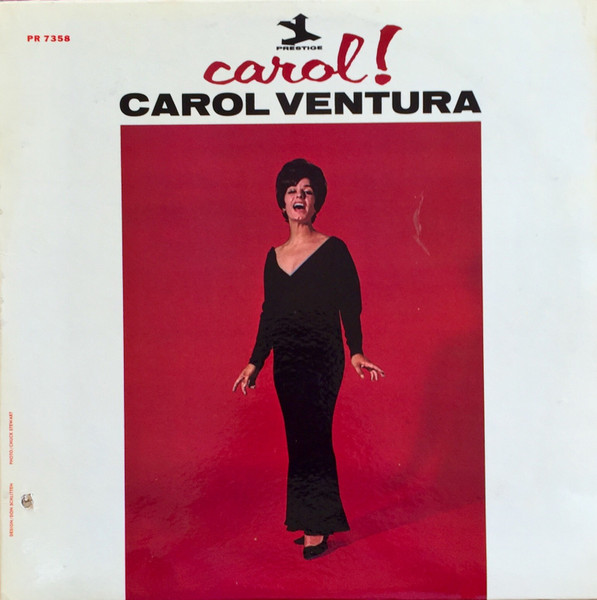
Carol Ventura didn't just fade into obscurity, she disappeared into oblivion. She made two albums for Prestige. and nothing else. But two albums for Prestige is not chopped liver, and you'd think she could have had some kind of a career after that--enough that there is very close to nothing about her on the Internet. She gets a brief mention on a web page called Obscure & Neglected Female Singers Of Jazz & Standards (1930s to 1960s), part of a site called Steve Hoffman Music Forums, and how Hoffman came up with even this much information is a bit of a miracle, although she lived long enough for someone to have found her. Much of her life, though, seems to have been terribly sad. According to Hoffman (my only biographical source)
If word of mouth is true, this New Jersey native wounded up living in the streets, due to mental illness. She allegedly needed to be medicated, and would take to a homeless life on those occasions in which she stopped using medication. She is said to have passed away at a senior home in 2010.
She came from a show business family, her father a vaudeville performer, her mother a singer, her brother a drummer. She sang with Charlie Spivak, and replaced Keely Smith in Louis Prima's Las Vegas act. Smith left Prima in 1961, so this would have been before her Prestige debut.
Probably as a result of her work with Capitol artist Prima, she got a record deal with that label, and this being 1962, the girl group era, that was the direction Capitol pushed her in, with a single called "Mr. Muscles." Jazz critic Gene Lees, who wrote the liner notes for her first Prestige album, was suitably horrified by this career choice:
This attempt to make a sow's ear out of a silk purse is comparable to the attempt of Russian commissars to turn the gypsies into hard-working dawn-to-dark farmers. Forget it, Charlie, nobody turned up. It would be impossible to infuse into Carol's singing the hostility, maladjustment, latent delinquency, bad tone, and general musical incompetence that it takes to be a successful rock and roller.
Lees's mock horror at the hobgoblin of rock and roll would perhaps have been more appropriate in 1958 than at the dawn of the Beatles era, but he's not entirely wrong. "Mr. Muscles" is not much of a record, and yes, it is on YouTube, so you can judge for yourself.
He's also not wrong about Ventura's genuine talent as a jazz singer, with a considerable vocal range, and an approach the encompasses humor, drama, and musicality, including a delightful interpolation of scatting into the traditional folk sone "Lonesome Road."
Hoffman, whose research into Ventura's life is extraordinary, seems to have looked less closely into her music. The one thing he doesn't know about her is her music. writing that this album was recorded "supposedly in Sweden (according to a YouTube poster; I don't know if it is true)."
It was recorded in Sweden. How Ventura arrived in Stockholm is lost to history, as is how she connected with Benny Golson. We can safely assume he didn't decided to work with her on the strength of "Mr. Muscles." Lew Futterman, who produced the other Golson sessions in Sweden at this time, apparently was aware of her strengths as a vocalist. Lees, in his liner notes, quotes Futterman as having first heard her in West Orange, NJ. Futterman had heard that there was a singer worth hearing in a local lounge, but:
When we arrived, the place turned out to be a bowling alley...We stood around in the roar of ten pins, trying to figure out what was going on. Then we heard what sounded like Barbra Streisand. As the song ended, the voice cracked ludicrously and we realized we'd been listening to a marvelous satire...The girl went into a hilarous impression of Ethel Merman...[and then] the most sensitive interpretation of "When the World Was Young" I'd ever heard.
Futterman's idea of putting her together with Golson's Swedish orchestra after Jimny Witherspoon (or before -- there's no precise date for this session) was an inspired one, as was what must have been his suggestion that they do "When the World Was Young," with its Johnny Mercer lyric to a melody by French composer Philippe-Gérard.
This is a wonderful album. The song selection is varied and unexpected. Another highlight is Bill Evans's beautiful "Waltz for Debbie," with lyrics by Lees. She does "Meditation" by Antonio Carlos Jobim, just starting to become well known in North America. She does Futterman's lyric to "Frere Jacques" (this may have been a mistake. She does a bravura version of "If Ever I Should Leave You" from Camelot, and a song by Stephen Sondheim. and lots more. This album is a forgotten masterpiece. And yes, it's all on YouTube.
Someone shoud have taken better care of Carol. But listen to this album. You won't regret it.
Ventura and Golson got together again in London, the following year, for a second Prestige session. The first album is titled Carol!, the second I Love to Sing. Prestige released on 45 RPM single from each session, "Night Song" / "Say No More" from the first, and "Please Somebody Help Me" / "No Man" from the second.
Nothing from I Love to Sing has been uploaded anywhere that I can find. although it is sometines possible to find copies of both albums on Amazon and eBay. As of this writing, eBay vendors are also offering a couple of 45s for sale, one on Roulette and the other no label listed. And even more obscure, a web page for a company called Heritage Auctions was offering, as of this writing, an acetate recording of eleven songs by Ventura, with the following information:
This double-sided acetate was recorded at Regent Sound Studios - by comparing the label to similar acetates from the studio, it appears that it was made in the mid-late 60s. The eleven-track disc was likely a demo made by Ventura to attract the interest of other record companies. Carol Ventura Sings (printed on the label) may have been the working title. The type-written track listings seem to be a collection of standards, which might have been easier to acquire/record than the more modern selections on her first two albums.
Ambitious and serious-minded Stockholm Sojourn may have been, but after he'd finished one day of it (he was to bring his International Jazz Orchestra back into the studio in August), Benny Golson wasn't above having a little fun with many of the same musicians and a visiting blues singer. July 14, a Tuesday. was Stockholm Sojourn day, and for the rest of the week he sojourned with Jimmy Witherspoon, some orchestral sounds, and eclectic selection of tunes.
Witherspoon was no stranger to eclecticism. An Arkansas native, he first achieved recognition in Calcutta, India, singing over Armed Forces Radio.
A return to the States gave him his first recording dates with the straight-ahead Kansas City swing of Jay McShann, but he would soon become known for for his mastery of a range of styles and material.
That range is on display here, and it also raises questions. Golson and Witherspoon hadn't worked together before, as far as I can tell, and certainly neither of them had worked with the Swedish musicians beyond the rehearsals for Stockholm Sojourn. So where did the songs for these sessions come from? You can't just tell a group of 15 people who are essentially strangers to you, "I'll just hum a few bars and you can fake it."
One theory, and it's probably as good as any: they decided to record whatever songs they were able to find the sheet music for by scrounging around Stockholm.
Here's what they came up with, and I'm spending more time than I ought to on this set list because of a fascination of the sort usually reserved for train wrecks--except that crawling from the wreckage comes a mostly very good album, thanks to the talents of Messrs. Golson and Witherspoon.
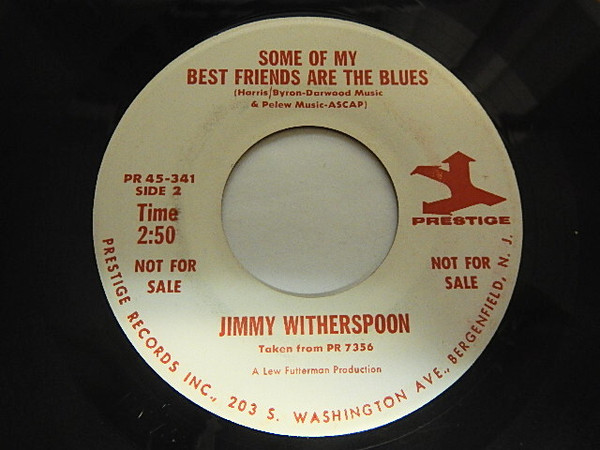
"Some of My Best Friends Are the Blues," with 'Spoon in his best seductive crooning mode, but never letting you forget he can belt out a blues with the best of them, and make it sound authentic even with the accompaniment of a brass and woodwind orchestra. And even with a somewhat manufactured song, written by Al Byron and Woody Harris. Byron is probably best known for writing one of the sappiest love songs ever recorded, Bobby Vinton's "Roses are Red." He also had one cut with Elvis, "Something Blue," a song very much in the vein of "Roses are Red." His partner Woody Harris worked extensively with Bobby Darin, in a peppier, more uptempo vein than Byron--their biggest success was "Queen of the Hop." Harris also had an Elvis cut, a song called "I Want You With Me,"first recorded by Darin. He was responsible for one of the worst examples of Tin Pan Alley's early, gingerly flirtation with rock 'n roll. "Rock-a-Billy," a sort of hit for Forties crooner Guy Mitchell, the sort of singer that the gingerly Tin Pan Alley tunesmiths were comfortable with. He also wrote a song called "Dix-a-Billy," which was probably even worse than "Rock-a-Billy," but it sounds a little better, because it was sung by LaVern Baker. And "Brand New House," originally written for Darin, became a solid blues in the hands of Otis Spann.the sort of singer that the gingerly Tin Pan Alley tunesmiths were comfortable with. He also wrote a song called "Dix-a-Billy," which was probably even worse than "Rock-a-Billy," but it sounds a little better,because it was sung by LaVern Baker. And "Brand New House," originally written for Darin, became a solid blues in the hands of Otis Spann.the sort of singer that the gingerly Tin Pan Alley tunesmiths were comfortable with. He also wrote a song called "Dix-a-Billy," which was probably even worse than "Rock-a-Billy," but it sounds a little better, because it was sung by LaVern Baker. And "Brand New House," originally written for Darin, became a solid blues in the hands of Otis Spann.but it sounds a little better, because it was sung by LaVern Baker. And "Brand New House," originally written for Darin, became a solid blues in the hands of Otis Spann.but it sounds a little better, because it was sung by LaVern Baker. And "Brand New House," originally written for Darin, became a solid blues in the hands of Otis Spann.
In spite of that, there's not much to suggest that either of these two guys would be capable of writing a real blues, much less collaborate on one. But this song waas recorded by Della Reese and Lena Horne -- both of them night club singers, but with real resources of soul--before Golson/Witherspoon.
Surely, though, this couldn't have been floating around Stockholm in sheet music form? Perhaps 'Spoon brought it with him, hoping he'd run into Golson or someone like him, or else just wanting to sing the song in some European clubs, and figuring he'd need the music for whoever he picked up to play with him.
"Every Time I Think About You" was written by Claude Demetrius--I guessed, from the name, a European, possibly even a Swede.
I guessed wrong. Claude Demetrius was that anomaly of anomalies, an African-American from Bath, Maine, whe escaped to New York at the age of 20, where he must have felt he'd found his real home, and he began writing for, and with, Louis Armstrong. In the '40s he wrote with, and for, Louis Jordan, including the hit "Ain't That Just Like a Woman." For bookkeeping reasons, or tax reasons, Jordan assigned writing credit for this and a number of his other songs to his then wife, Fleecie Moore. When they got divorced, Fleecie lived up to her name, and Jordan never did get the credit or royalties for those songs, and "Just Like a Woman" was widely covered, including by both Fats Domino and Chuck Berry. So Demetrius did well for himself until the mid-1950s. when he started doing very well indeed. His "I Was the One" was the flip side of Elvis Presley's mega-hit "Heartbreak Hotel," and it was just the beginning of his career writing for Elvis, a career that included "Mean Woman Blues" (also covered by Jerry Lee Lewis), and a mega-hit of his own, "Hard Headed Woman."
"Every Time I Think About You" is a terrific vehicle for 'Spoon, and one of Golson's best arrangements. It may well have been another tune that 'Spoon brought with him.
"I Never Will Marry" seems a little less likely to have been in his steamer trunk. A gentle folk song, probably of traditional origin but credited to A. P. Carter and first recorded by the Carter Family, it was a staple of hootenannies and campfires, and probably best known for its rendition by the Weavers--or maybe the sly sendup by the Smothers Brothers. Golson gives him a vocal chorus (uncredited) and strings (also uncredited). Golson is having some fun here, but Witherspoon plays it straight, gives the song a sensitive, folkie treatment.
"I Wanna Be Around" was a new song, a hit for Tony Bennett and destined to become a jazz standard, with a weird story all its own. Sadie Vimmerstedt, a grandmother from Youngstown, Ohio, was inspired by the movie magazine stories of the doomed romance of Frank Sinatra and Ava Gardner, to write a song. Well, not a whole song. Sadie wasn't exactly a songwriter, but she did come up with a first line: "I want to be around to pick up the pieces, when somebody breaks your heart." That was all she had, but she was a huge Johnny Mercer fan, so she put it in an envelope and addressed it to "Johnny Mercer, New York, NY." Somehow it got to Mercer, and it tickled his fancy enough that he wrote a song around it. And here's where the story really gets good--in an industry noted for unscrupulousness and thievery,Mercer gave full co-writing credit, and one third -- some say half -- of the royalties to Sadie. Mercer turned Sadie's one line into one of the great popular songs. Bennett did right by the song's two composers, both in 1962 and half a century later, in a duet with British rocker Bono. By that time, virtually every singer of note had recorded it. By 1964, it had already been covered by Julie London, Aretha Franklin, Dinah Washington, Frank Sinatra with Count Basie, and a host of others. Still, Witherspoon and Golson were among the early admirers, and surely the sheet music would have reached Sweden. 'Spoon can croon with the best of them, and he as he assimilates some of Tony Bennett in his rendition, he never lets you forget he's a blues singer. Golson captures a Basie feeling in his arrangement,and one third -- some say half -- of the royalties to Sadie. Mercer turned Sadie's one line into one of the great popular songs. Bennett did right by the song's two composers, both in 1962 and half a century later, in a duet with British rocker Bono. By that time, virtually every singer of note had recorded it. By 1964, it had already been covered by Julie London, Aretha Franklin, Dinah Washington, Frank Sinatra with Count Basie, and a host of others. Still, Witherspoon and Golson were among the early admirers, and surely the sheet music would have reached Sweden. 'Spoon can croon with the best of them, and he as he assimilates some of Tony Bennett in his rendition, he never lets you forget he's a blues singer. Golson captures a Basie feeling in his arrangement,and one third -- some say half -- of the royalties to Sadie.Mercer turned Sadie's one line into one of the great popular songs. Bennett did right by the song's two composers, both in 1962 and half a century later, in a duet with British rocker Bono. By that time, virtually every singer of note had recorded it. By 1964, it had already been covered by Julie London, Aretha Franklin, Dinah Washington, Frank Sinatra with Count Basie, and a host of others. Still, Witherspoon and Golson were among the early admirers, and surely the sheet music would have reached Sweden. 'Spoon can croon with the best of them, and he as he assimilates some of Tony Bennett in his rendition, he never lets you forget he's a blues singer. Golson captures a Basie feeling in his arrangement,Mercer turned Sadie's one line into one of the great popular songs. Bennett did right by the song's two composers,both in 1962 and half a century later, in a duet with British rocker Bono. By that time, virtually every singer of note had recorded it. By 1964, it had already been covered by Julie London, Aretha Franklin, Dinah Washington, Frank Sinatra with Count Basie, and a host of others. Still, Witherspoon and Golson were among the early admirers, and surely the sheet music would have reached Sweden. 'Spoon can croon with the best of them, and he as he assimilates some of Tony Bennett in his rendition, he never lets you forget he's a blues singer. Golson captures a Basie feeling in his arrangement,Mercer turned Sadie's one line into one of the great popular songs. Bennett did right by the song's two composers, both in 1962 and half a century later, in a duet with British rocker Bono. By that time,virtually every singer of note had recorded it. By 1964, it had already been covered by Julie London, Aretha Franklin, Dinah Washington, Frank Sinatra with Count Basie, and a host of others. Still, Witherspoon and Golson were among the early admirers, and surely the sheet music would have reached Sweden. 'Spoon can croon with the best of them, and he as he assimilates some of Tony Bennett in his rendition, he never lets you forget he's a blues singer. Golson captures a Basie feeling in his arrangement,both in 1962 and half a century later, in a duet with British rocker Bono. By that time, virtually every singer of note had recorded it. By 1964, it had already been covered by Julie London, Aretha Franklin, Dinah Washington, Frank Sinatra with Count Basie, and a host of others. Still, Witherspoon and Golson were among the early admirers,and surely the sheet music would have reached Sweden. 'Spoon can croon with the best of them, and he as he assimilates some of Tony Bennett in his rendition, he never lets you forget he's a blues singer. Golson captures a Basie feeling in his arrangement,both in 1962 and half a century later, in a duet with British rocker Bono. By that time, virtually every singer of note had recorded it. By 1964, it had already been covered by Julie London, Aretha Franklin, Dinah Washington, Frank Sinatra with Count Basie, and a host of others. Still, Witherspoon and Golson were among the early admirers, and surely the sheet music would have reached Sweden. 'Spoon can croon with the best of them, and he as he assimilates some of Tony Bennett in his rendition, he never lets you forget he's a blues singer.Golson captures a Basie feeling in his arrangement,Still, Witherspoon and Golson were among the early admirers, and surely the sheet music would have reached Sweden. 'Spoon can croon with the best of them, and he as he assimilates some of Tony Bennett in his rendition, he never lets you forget he's a blues singer. Golson captures a Basie feeling in his arrangement,Still, Witherspoon and Golson were among the early admirers, and surely the sheet music would have reached Sweden. 'Spoon can croon with the best of them, and he as he assimilates some of Tony Bennett in his rendition, he never lets you forget he's a blues singer. Golson captures a Basie feeling in his arrangement,Spoon can croon with the best of them, and he as he assimilates some of Tony Bennett in his rendition, he never lets you forget he's a blues singer. Golson captures a Basie feeling in his arrangement,Still, Witherspoon and Golson were among the early admirers, and surely the sheet music would have reached Sweden. 'Spoon can croon with the best of them, and he as he assimilates some of Tony Bennett in his rendition, he never lets you forget he's a blues singer. Golson captures a Basie feeling in his arrangement,Spoon can croon with the best of them, and he as he assimilates some of Tony Bennett in his rendition, he never lets you forget he's a blues singer. Golson captures a Basie feeling in his arrangement,Still, Witherspoon and Golson were among the early admirers, and surely the sheet music would have reached Sweden. 'Spoon can croon with the best of them, and he as he assimilates some of Tony Bennett in his rendition, he never lets you forget he's a blues singer. Golson captures a Basie feeling in his arrangement,and he as he assimilates some of Tony Bennett in his rendition, he never lets you forget he's a blues singer. Golson captures a Basie feeling in his arrangement,and he as he assimilates some of Tony Bennett in his rendition, he never lets you forget he's a blues singer. Golson captures a Basie feeling in his arrangement,
"Teardrops From My Eyes" was written by the great rhythm and blues songwriter Rudy Toombs, and was one of Ruth Brown's first hit records for Atlantic. Its early recording history is a tribute to the bizarre catholicism of the 1950s. Cover versions include solid R&B (Wynonie Harris with Lucky Millinder), schmaltzy pop (Fran Warren with Hugo Winterhalter), a pop-country hybrid (Jo Stafford with Gene Autry), deep country (Hawkshaw Hawkins), and jazz (Ella Fitzgerald). Everyone likes a good song. 'Spoon and Golson liked it too, and it shows.
"And the Angels Sing" is Mercer again, with a somewhat more expected collaborator, swing trumpeter and Benny Goodman sideman Ziggy Elman. Originally introduced by Goodman, who swung it, it became more of a heavily orchestrated ballad in later versions, and Golson gives it all of that, bring back the backup vocalists for an angelic choir.
This one has to have come from whatever sheet music they may have been able to scrounge up in Stockholm. "Who's Sorry Now?" was written in 1923 by composer Ted Snyder and the songwriting team of Bert Kalmar and Harry Ruby, and became, over the years, a mildly popular if undistinguished number. People kept recording it. It was waxed two dozen times from the '20s through the '40s, almost entirely by performers who are forgotten today (Glenn Miller, Harry James and Bing Crosby all made it the flip side of 78 RPM releases). Then in 1958 it finally got its moment in the sun, as Connie Francis, a struggling young singer who had released several flops and was about to give it up and go to med school, recorded the song at the urging of her father. Francis hated the song and was looking for more contemporary material,but her father kept nagging her, and finally she stuck it in at the end of a recording session. Dick Clark played it on American Bandstand, it got a positive response, he booked Francis for the premiere telecast of his new prime variety show, and suddenly Connie Francis was the hottest thing around, and the song was a million seller, and a nice piece of change in the retirement accounts of Snyder and Ruby (Kalmar was deceased by then). But it still wasn't a very good song. Witherspoon does what one is tempted to do with mediocre material -- pushes it too hard, over-enunciates every word, over-dramatizes it. It's not the musical highlight of this session.he booked Francis for the premiere telecast of his new prime variety show, and suddenly Connie Francis was the hottest thing around, and the song was a million seller, and a nice piece of change in the retirement accounts of Snyder and Ruby (Kalmar was deceased by then). But it still wasn't a very good song. Witherspoon does what one is tempted to do with mediocre material -- pushes it too hard, over-enunciates every word, over-dramatizes it. It's not the musical highlight of this session.he booked Francis for the premiere telecast of his new prime variety show, and suddenly Connie Francis was the hottest thing around, and the song was a million seller, and a nice piece of change in the retirement accounts of Snyder and Ruby (Kalmar was deceased by then). But it still wasn't a very good song. Witherspoon does what one is tempted to do with mediocre material -- pushes it too hard, over-enunciates every word, over-dramatizes it. It's not the musical highlight of this session.Witherspoon does what one is tempted to do with mediocre material -- pushes it too hard, over-enunciates every word, over-dramatizes it. It's not the musical highlight of this session.Witherspoon does what one is tempted to do with mediocre material -- pushes it too hard, over-enunciates every word, over-dramatizes it. It's not the musical highlight of this session.
"You're Next" is a pop song by Sid Tepper, who had a successful career in 1940s and '50s, and an even more successful career in '60s, although not exactly on the cutting edge of that decade's burgeoning musical creativity. He and his partner, Roy C. Bennett, wrote 43 songs that were sung by Elvis in his various movies. "You're Next" could well have been one of them, although it doesn't seem to have quite made the cut. Its sheet music may well have floated over to Stockholm, though. Don't forget this recording session with Benny Golson, and a bunch of Swedes who wouldn't have had all that many chances to play with an American jazz legend like Golson, lasted for almost a week, and by this time they must have been really scrounging for material. But it's fun -- more fun than "Who's Sorry Now?" -- and Witherspoon gives a little of that Elvis intonation.
"Happy Blues" has a piano, probably played by Witherspoon, since there's no piano listed in the session's credits. This has to be from 'Spoon's regular set list. He plays and sings it with gusto. Golson brings the choir back, and they complement him nicely.
"That's Why I'm Leaving" was written by Lockie Edwards Jr., who receives what may be my all-time favorite billing, on a CD of songs written by him and collaborator Larry Weiss -- "Forgotten Legendary Songwriters." The CD, a collection of 32 songs, is entitled "Unforgotten Yesterdays," but it doesn't live up to its title. Weiss and Edwards are more forgotten than legendary. They do have one more unforgettable credit -- among the genres this CD associates them with is "Belgian popcorn." "That's Why I'm Leaving" is not one of the 32 forgotten unforgottens, and it might have been forgotten had not Golson and Witherspoon needed to find one more song to fill out the record, but it's really not abad song at all.
Neither is Witherspoon's own "One Last Chance," which caps the session.
And I've had some fun with the song selection, but this is a very good record, an unusual, unlikely, and very satisfying collaboration between two actually unforgotten jazz legends, and I'm glad I listened to it.
The album was called Some of My Best Friends Are the Blues, released on Prestige (Bluesville was now defunct). Prestige also released three 45 RPM singles, "You're Next" / "Some Of My Best Friends Are The Blues," "Happy Blues" / "I Never Will Marry," and "Oh How I Love You" (not from the session) / "One Last Chance."
Benny Golson edidn't bring his instrument to this date, but virtually everyone else in Sweden did, including one American expat, Benny Bailey. Golson is composer of six cuts, some new compositions and his classic "I Remember Clifford," and arranger on compositions by Gordon Jenkins, Bill Evans and Victor Young. There are 32 pieces altogether (four of them added after the fact, two in Stockholm and two--Cecil Payne and Grachan Moncur III--in New York).
Golson was the composer of some of the best-loved jazz standards such as "I Remember Clifford" and "Killer Joe," and he includes "I Remember Clifford" here, along with several pieces composed for this session, and a few jazz standards by other composers. But the real news here is his orchestration and conducting of a truly ambitious orchestra.
It's an adventurous project, pushing the boundaries of jazz. Many were pushing them in those days, but not necessariy like this Can you make a large orchestra swing? Golson does, using well-timed juxtapositions of soloists (given some room for improvisation) with the orchestral parts.
I found the familiar pieces -- Bill Evans's "Wattz for Debbie," "My Foolish Heart," and his own "I Remember Clifford" particularly interesting for a new take on those classics, and I also warmed to the pieces like the concluding one, "The Call," that used more jazz soloists. But the balance of solos and full orchestra, Golson-style, is exhilarating.
Lew Futterman, who had brought Jack McDuff to Prestige, produced this session, showing his range as a producer. He was soon to extend that range even further and in a different direction, with a successful career in the rock business.
Jack McDuff's manager Lew Futterman, in the liner notes for the next session, describes how he got Golson and McDuff together:
McDuff had opened [at Birdland], and I was down there to see him...Benny and I ended up at the same table. While I was well aware of his writing, playing and arranging, we had never before met. I asked him how he liked McDuff. He said, "Great!" Since he was unaware what my relationship was to Jack, I pushed him a little farther by telling him I didn't like Jack's playing. His response was immediate. "You're entitled to your opinion. But I've never heard a jazz organist play with the feeling this man has. He shows such a great emotional quality, such a sympathy for the music that I could listen to him all night."
...He proceeded to say what I had felt since first hearing Jack play but had never been able to verbalize so succinctly--namely, that Jack McDuff exhibits a rare intuitive understanding of jazz, and of music in general. Nothing he plays seems stiff or structured, moving instinctively from one musical idea to the next, with no apparent disparity between what he feels he wants to play and what he can play. The excitement he generates is organic, rather than forced, as if he were thinking with his fingers.
At that point, Futterman outed himself to Golson, and asked if he'd consider writing some arrangements for McDuff.
"Only if I can write what I want to." I started to give him a qualified "yes," but decided better of it. A man with Golson's talent...deserves a free hand.
It seems quite certain that Golson had a free hand, because how else explain Henry Mancini's "Pink Panther Theme" on a jazz album? Or such was my first thought, on hearing it. But "Pink Panther" was a huge hit in 1964, the year of the movie's release, and a few different jazz artists covered it. There was a rhythm and bluesy version by Earl Bostic, another organ interpretation by Jimmy McGriff, and another big band arrangement by Quincy Jones.
As it turns out, they're all worth a listen. As a composer, Henry Mancini may have been a master of the obvious, but the operative word there is "master." The tune may have been perky and ubiquitous to have even become the punch line of a joke (What did the Pink Panther say when he stepped on an ant? --Dead ant...dead ant...dead ant dead ant dead ant....), but it was brilliant in its own silly way, and it responded nicely to the big band treatment, and to McDuff's bravura organ work.
The album's cover, however, promotes another movie tie-in--the theme from The Carpetbaggers, which is odd, in that although The Carpetbaggers was a blockbuster movie, its score, by the redoubtable Elmer Bernstein, was not a breakout success. Secondhandsongs, the website that keeps track of cover versions of nearly everything, cannot find a single one for the Carpetbaggers theme. YouTube turns up one other, by Jimmy Smith. Still, it's Elmer Bernstein, which means it's bound to be a decent tune (if a little too reminiscent of Bernstein's more popular theme from The Man With the Golden Arm), and Golson and McDuff certainly make it worth listening to.
Golson takes two from the movies, two from Broadway. The Broadway tunes are both from musicals of the 1960s. "Once in a Lifetime," by Leslie Bricusse and Anthony Newley, was one of the breakout hits from the musical Stop the World--I Want to Get Off, the star vehicle for Newley which had opened in 1962 and was still running. "You Better Love Me" was from the just-opened High Spirits, composed by Hugh Martin (best known for the songs from Meet Me in St. Louis) and Timothy Gray. One has to figure that all of these not-exactly-standards were chosen by Golson for how they'd sound with Jack McDuff counterpointed against an orchestra, and the proof is in the pudding. Golson was right.
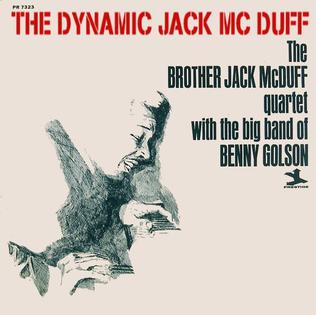
McDuff brings his regular group. Golson brings an orchestra, personnel unidentified. The four tunes were all they recorded, and the B side of the album comes from McDuff's earlier date on the West Coast. Lew Futterman produced both sessions. The album is entitled The Dynamic Jack McDuff. "Pink Panther" and "Carpetbaggers" were released on 45. The version I've linked to on "Listen to One" is the 45 RPM version. Weighing in at 3:20, as opposed to the album's 5:15, which means more theme and less improvisation, but hey, it's the Pink Panther! Dead ant...dead ant...."Once in a Lifetime" was also released on 45, as the flip side of "Rail Head," from the earlier session.
"April in Paris" was written in 1932 by Vernon Duke and E. Y. Harburg for a Broadway show called Walk a Little Faster. The show was not exactly a flop, not exactly a hit (118) performances, but the song was an instant classic, and it's never wanted for performers eager to take it on. It's had vocal interpretations from Sinatra to Ella and Louis to Shirley Basey, but the most successful, and still the definitive version was, amazingly enough, a jazz instrumental. Count Basie recorded it in 1955: bold, brassy, and so exuberant that it demanded not just "one more time" but "one more once" after that.
But a great tune is always going to find great artists with new approaches. In 1956 alone there were ten new jazz recordings, including piano versions by Errol Garner, Thelonious Monk and Nat "King" Cole, and a treatment by Thad Jones, who had contributed a memorable solo to the Basie recording.
In 1959, Benny Golson was ready to add his voice to the "April in Paris" story, and his was a very different approach from Basie's: moody and subdued. Paris in the springtime may be a time for lovers, but for every lover there's a broken heart, and a sad story to tell in a late night bistro. Golson has the thoughtful commiseration of Tommy Flanagan, but for the most part this is is his tone poem, and he plays it with deep understanding.
But he snaps out of the meditative mood with "Tippin' on Through." This is the composer of "Blues March," a hit for Art Blakey's Jazz Messengers, and "Tippin'" has some of that march feeling to it. It seems like an odd fit, but Golson has proved it can work, and in a way, jazz and march compositions have certain commonalities, They both have a predilection for riff-based melodies, at least as funneled through the musical imagination of Benny Golson.
Tommy Flanagan takes a world-weary approach to intro to the next number, as though baubles, bangles and beads, no matter how they jing-jing-aling, are still the stuff of vanity. Golson and Curtis Fuller soon set him straight, kicking off a celebration.
The blues take center stage for the rest of the session, with two Golson compositions, "Tom Hurd's Blues" and "Blue Streak." The blues really never do grow old.
Doug Watkins and Art Taylor rounded out the quintet. Watkins had spent much of the previous year in Europe with Donald Byrd. He would continue to be a mainstay sessions for Prestige and other labels until his untimely death in 1962, the result of an auto accident. Gettin' With It was produced by Esmond Edwards, released on New Jazz. We have two thirds of the Jazztet-to-be here, as on Golson's previous New Jazz recording--and as on a Savoy album cut during the fall, under Fuller's leadership, as the Curtis Fuller Jazztet: the first time that name was used, with Lee Morgan as the third Tet. The next time it would be used would be just six weeks away, in early February, on the Argo release Meet the Jazztet, with Art Farmer. Farmer, Golson and Fuller had first united as the Jazztet for club dates in November.
Listening to Prestige Vol. 2, 1954-1956 is here! You can order your signed copy or copies through the link above.
Tad Richards will strike a nerve with all of us who were privileged to have lived thru the beginnings of bebop, and with those who have since fallen under the spell of this American phenomenon…a one-of-a-kind reference book, that will surely take its place in the history of this music.
--Dave Grusin
An important reference book of all the Prestige recordings during the time period. Furthermore, Each song chosen is a brilliant representation of the artist which leaves the listener free to explore further. The stories behind the making of each track are incredibly informative and give a glimpse deeper into the artists at work.
The year 1959 was to yield Prestige one more major modern jazz talent, and his career was to be horribly short. That would be Lem Winchester, the vibes-playing cop from Wilmington, Delaware, who was introduced as a Leonard Feather discovery at Newport in 1958, made an album with Ramsey Lewis for Argo Records, and then settle with Prestige, for whom he would cut four sessions over the next two years, and then die of a self-inflicted gunshot wound in 1961--apparently an accident, although some rumors suggest Russian Roulette.
In 1957, Winchester was a young veteran police officer. He had a wife and family, and at his mother's insistence he had opted for job security and a steady salary rather than falling prey to the temptation to join his teenage friend Clifford Brown in decamping Wilimington for Philadelphia and the uncertain life of a jazz musician. But he had been gigging around his home town, and a local trio called John Chowning's Collegiates had dreams of glory, and of the Newport Jazz Festival. They decided to make a recording and sent it to Leonard Feather, and they figured they would have a better chance of being listened to if they added Winchester to their group.
They were partly right. Winchester made Feather sit up and take notice--but only of him, not the Collegiates. Feather put Winchester together with a somewhat more professional trio and presented him at Newport in 1958. This would also be Winchester's recording debut, as one side of a Feather-produced disk called New Faces at Newport (Randy Weston was the other new face). Winchester was backed by three fine musicians from Boston, Ray Santisi, John Neves and Jimmy Zitano. All three were stars of the vibrant Boston club scene, and had worked with major jazz stars like Charlie Parker and Stan Getz.
Winchester's group was billed on the album as the Patrolman Lem Winchester Quartet (he's in uniform on the album cover), and in fact he had not given up his day job. He still walked a beat in Wilimington, but now his moonlighting gigs ranged a little farther afield, including Chicago, where he made a record in 1958 with the Ramsey Lewis Trio. After that he signed with Prestige.
Pairing Benny Golson with Winchester was an excellent idea, although they don't avail themselves of Golson's compositional skills. The album is two Winchester originals (including "Down Fuzz," which has to be an allusion to his other profession), three standards, and one tune, the first recorded, by Len Foster, who seems to have no other credits as composer, musician or anything else. But it must have been a song both Golson and Winchester knew, leading me to guess that Foster must have been a part of the Philadelphia scene, because it's the tune they open their set with. Which means it's where we first hear Golson shape the sound of his tenor so that it becomes the perfect pairing with Winchester's vibes.
For the last tune of the day, Frank Loesser's "If I Were a Bell," Golson sits it out and lets Winchester show what he can do, which is a lot.
Signing up Lem Winchester must have been one of the highlights of what was already a banner tenth anniversary for Bob Weinstock. I bet he'd thought he'd be making records with him for years to come.
This is the second of three albums Benny Golson and Curtis Fuller made for Prestige, before they linked up with Art Farmer and went off to form the Jazztet. A tightly planned sextet had been on Golson’s mind for a while, and when he approached Farmer with it, Farmer shot back a note saying he’d been thinking along the same lines, and been on the point of contacting Golson.
This one features Golson playing more standards than originals. Which is actually the balance on Meet the Jazztet, too, though that album is mostly remembered for the great Golson original compositions, “I Remember Clifford,” “Blues March,” and especially “Killer Joe,” which was the new one. The originals for this album didn’t become classics, although “The Stroller” was originally written for Lou Donaldson, and has been recorded by Italian bandleader Giorgio Azzolini.
If "The Stroller" and "My Blues House" haven't become standards, hey certainly could have. They're in competition with some pretty high-level work in the Golson catalog, but as "lines... meant to be vehicles for blowing," in Golson's words, they fill the bill quite nicely.
"The Stroller" does anything but stroll, although its name doesn't come from its tempo, but from the practice of "strolling," playing a solo without piano backing. It's a high-octane thrill ride in bebop tempo, powered by Art Blakey, with exciting solo space for everyone, leading off with three minutes of nonstop strolling by Golson, an including Paul Chambers on his signature bowed bass. "My Blues House," same good stuff, more relaxed tempo.
It's a little unusual to see one of Blue Note's marquee performers moonlighting on a Prestige session, but Blakey is here in support of one of the mainstays of his great late 1950s version of the Jazz Messengers. In addition to playing and composing, Golson also mentored the Messengers' Bobby Timmons through writing "Moanin'."
"Drum Boogie" is the Roy Eldridge/Gene Krupa classic vehicle for Krupa, generally including a vocal, most famously Anita O'Day. It's so closely associated with Krupa that it's not all that often taken on by other artists, but we have heard it before on Prestige, from a Kenny Burrell-led group featuring Cecil Payne and Elvin Jones. Interestingly, even with the presence of Blakey on the one cut and Jones on the other, two of the most expressive and individual drum soloists in jazz, both groups treat it more as an ensemble piece, with a relatively short drum solo.
Golson's gone to two of the masters, Richard Rodgers and Jerome Kern, for the rest of the session.
Golson, in Ira Gitler's liner notes, discusses the musicians he chose for this session, starting with Curtis Fuller:
If I couldn't work with Curtis...I'd probably use another instrument for a two-horn grpup. We blend together so well, and he's always listening.
Fuller does a fair amount of listening here, as this is more of a Golson showcase than the later Jazztet albums will be, but when he does solo, you can absolutely hear what Golson means about how well they blend.
Of Ray Bryant: "His harmonics are great and he is so melodic too." Of Paul Chambers:
For his age, Paul seems to have attained maturity on his instrument that usually takes years to acquire. His melodic conception is uncanny. When you're strolling ... you can
lean on him without ever having to worry.
And about his old boss:
I consider it an asset having Art Blakey on any record date I make. He has made it very hard for me to play with most drummers because he swings so hard and so constant. He's a dynamo. And such a feeling for the drums--he can express himself like a horn player.
A note in passing. It's been often remarked that jazz became mainstreamed into American culture during this era with jazz themes for TV shows like Henry Mancini's "Peter Gunn" and Count Basie's "M Squad, jazz soundtracks for movies like John Lewis's Odds Against Tomorrow, Duke Ellington's Anatomy of a Murder, and Elmer Bernstein's Man with the Golden Arm. Perhaps even more indicative of the mainstreaming of jazz was the way that TV and movie producers, even when they weren't looking for a marquee name for a highly promotable soundtrack or theme, still looked to jazz musicians. Benny Golson composed and arranged soundtrack music for any number of movies and TV shows, including Mannix and Mission Impossible(main themes by Dizzy Gillespie alumnus Lalo Schifrin), Ironside, M*A*S*H, and even The Partridge Family.
Groovin' with Golson was released on New Jazz. Esmond Edwards produced.
Listening to Prestige Vol. 2, 1954-1956 is here! You can order your signed copy or copies through the link above.
Tad Richards will strike a nerve with all of us who were privileged to have
lived thru the beginnings of bebop, and with those who have since
fallen under the spell of this American phenomenon…a one-of-a-kind
reference book, that will surely take its place in the history of this
music.
--Dave Grusin
An important reference book of all the Prestige recordings during the time
period. Furthermore, Each song chosen is a brilliant representation of
the artist which leaves the listener free to explore further. The
stories behind the making of each track are incredibly informative and
give a glimpse deeper into the artists at work.
Benny Golson is a jazz legend for all sorts of excellent reasons: saxophone great, composer, and co-leader of a legendary if short-lived 1960s group, the Jazztet.
As a composer, he can lay as legitimate a claim as any to the title of Third Most Important Modern Jazz Composer--Thelonious Monk and Duke Ellington will always be one-two, although their order can be debated. Then there are Dave Brubeck and Dave Grusin, Tadd Dameron...and others, but Golson is in that group. Few can match him for the number of compositions that have become jazz standards-- the
tunes that every jazz musician can be expected to know if they're called at a jam session, and that virtually every jazz ensemble has recorded at one time or another. "Killer Joe" has been recorded over 50 times; "Stablemates," the tune that first drew attention to Golson as a composer, has over 70 versions, as does "Whisper Not;" musicians have gone into the studio with "I Remember Clifford" well over 100 times. And these are all jazz standards, not popular songs with lyrics which have also become favorites with instrumentalists.
"Stablemates" was first recorded by Miles Davis in 1955, when Golson was 26, but the story of how it got to Miles goes back to Golson's childhood in Philadelphia, a city that spawned a lot of young jazzmen (and women: don't forget Shirley Scott). Young Benny had studied piano until, at 15, he went to hear Lionel Hampton in concert, and when Arnett Cobb stepped out in front to play his solo, he knew that there was nothing else to do but play the saxophone. If he only had one. And if he knew which saxophone he wanted to play. He told his mother of his longing, and she asked which saxophone he wanted. "Oh...the one with the curve in the neck."
The Golsons were about as poor as you could get. Mrs. Golson took in washing, and one day young Benny found her crying because she didn't have five cents to buy soap to do her loads of wash. But she somehow put together the money to buy her son a saxophone with a curved neck.
He and his friends began practicing and playing together by the open window of his mother's apartment, to the bemusement of their long-suffering neighbors, but as Golson recalls it, they knew they were starting to get good when their neighbors started calling requests in through the window.
Benny went to Howard University and studied music theory, then started playing professionally with rhythm and blues bands: Tiny Grimes, Bull Moose Jackson, Earl Bostic. Jackson's band included Tadd Dameron on piano, and Dameron became his mentor and strongest influence as a composer. He was more and more drawn to writing music, and he began handing out lead sheets to every bandleader and musician he met. He didn't know if anyone actually looked at them until he gave one to his best friend from the open window days. John Coltrane had just been summoned from Philadephia, on the recommendation of fellow Philly cat Philly Joe Jones, to join Miles Davis' band, and he brought the lead sheet for "Stablemates" with him. When that record came out, musicians all over began digging through their piles of lead sheets and saying "Golson? Wasn't that the name of the kid who...?"
Tadd Dameron once said that the most important element to him in a composition was beauty, and that's a lesson that Golson learned. His work is simple, direct, melodic and beautiful. If a tune like "I Remember Clifford" weren't complex and capable of great musical exploration, it wouldn't have been recorded so many times, even by young musicians who don't remember Clifford. But the simplicity and beauty come first.
And although there aren't any greatest hits from Golson's pen on this album, those qualities are very much in evidence -- beauty, simplicity, melody.
"Stacatto Swing" is a play on one of his big ones, "Blues March," recorded the year before by Art Blakey's Jazz Messengers. "Blues March" was an unlikely combination. When Golson told Blakey he was writing it, Blakey advised him to forget it. No one wanted to hear a march, and nothing could be a march and the blues at the same time. But when they debuted it at Smalls Paradise, a club known for a listening, not a dancing audience, chairs were kicked back right and left as couples couldn't keep to their seats. "Stacatto Swing" is not as insistently stacatto as "Blues March" is with its smoky march beat, but it's a melody as lovely as any in Golson's better known songs.
Curtis Fuller is the other horn on the session, and he would stay with Golson in 1960 as they joined forces with Art Farmer to make the Jazztet. Ray Bryant is a continuing supportive presence, and here he brings his brother Tommy to take over the bass duties. Al Harewood makes his Prestige debut here. but he was an in-demand drummer, and had worked with Curtis Fuller on two other recent sessions, one of which--for Savoy--had also included Golson.
The session was produced by Esmond Edwards. The album appeared on New Jazz as Gone With Golson. Curtis Fuller's one contribution as composer, "A Bit of Heaven," was left off the album but included in a later CD rerelease.
Benny Golson continues to perform as of this writing.
Listening to Prestige Vol. 2, 1954-1956 is here! You can order your signed copy or copies through the link above.
Tad Richards will strike a nerve with all of us who were privileged to have
lived thru the beginnings of bebop, and with those who have since
fallen under the spell of this American phenomenon…a one-of-a-kind
reference book, that will surely take its place in the history of this
music.
--Dave Grusin
An important reference book of all the Prestige recordings during the time
period. Furthermore, Each song chosen is a brilliant representation of
the artist which leaves the listener free to explore further. The
stories behind the making of each track are incredibly informative and
give a glimpse deeper into the artists at work.








:format(jpeg):mode_rgb():quality(40)/discogs-images/R-3226774-1321308033.jpeg.jpg)