Showing posts with label Clifford Brown. Show all posts

Tuesday, February 02, 2016

Listening to Prestige Part 167: Sonny Rollins/Clifford Brown

It's impossible to listen to this session without looking at the date. Three months later, Clifford Brown and Richie Powell would be killed in an automobile accident.

Clifford Brown's contribution to jazz cannot be overstated. As a trumpeter, he ranks among the very best to ever play the instrument.

As a role model, he may have been just as important. At a time when creativity and drug use were all too often linked in the minds of young jazz musicians. Brownie stood out as an example of the creative and innovative heights that a clean-living artist could attain.

Sonny Rollins is a living testament to that. Rollins stands today, by virtue of artistry and longevity, as one the greatest of all jazz musicians, but in 1955, he was putting the pieces of his life back together, and beset by self-doubt. He had kicked his heroin habit, but he had bought too deeply into the myth that heroin and creativity went together, and he had terrifying doubt about his ability to play and grow as a jazz musician, and because of that, he stayed away from New York for a while. He returned to play with Miles Davis, who had followed a similar pattern--addiction, withdrawal, self-imposed exile. But then later on that year, he became a member of the Brown/Roach group, and experienced his true epiphany: the example of a jazz musician who had always led a clean, drug-free life, and whose creativity was unbounded. Rollins later described Brown's effect on him as "profound."

Brown hit New York in 1953 and appeared on several Blue Note albums, then signed on for the Lionel Hampton European tour, where he recorded extensively with Art Farmer, Gigi Gryce and others of that contingent.

Returning stateside, he joined Art Blakey's quintet (they weren't the Jazz Messengers yet), and an engagement at Birdland yielded enough material on one night of live recording to make several albums for Blue Note (the recording notes list some tunes as being from the fifth set). Then he joined forces with Max Roach, to create one of jazz's most legendary quintets, and they made a series of classic albums for EmArcy. EmArcy also had some of the finest jazz singers around, and they had the good taste to back them with jazz greats instead of syrupy pop arrangements, so we have Brown with Dinah Washington, Sarah Vaughan and Helen Merrill. And -- not at all syrupy -- they made an album of standards with the Neal Hefti orchestra.

Brown did some work on the West Coast with different configurations, and in 1955...well, if you
could go back in time to the 1955 Newport Jazz Festival, just so you could catch the now-legendary Miles jam session / audition for George Avakian, you might have missed another remarkable jam session -- Brubeck and Desmond with Clifford Brown, Chet Baker and Gerry Mulligan. "Tea for Two" was captured from that session, and it's not the greatest recording quality, but still....

Rollins joined the quintet in 1955, replacing Harold Land, and they were able to record, in February and March, for both EmArcy and Prestige. The EmArcy recordings mixed standards and originals by Brown; this one has three standards and two Rollins originals.

Both of the two originals have become jazz standards, with "Valse Hot," in particular, now a favorite of a newer, 21st century generation of jazz musicians. There aren't all that many jazz waltzes--Bill Evans's "Waltz for Debbie" is one that springs to mind, and of course John Coltrane's reworking of "My Favorite Things."

"Pent-Up House" seems to have become a favorite of gypsies, with Stephane Grappelli and the gypsy jazz contemporaries, The Rosenberg Trio. Tito Puente has also recorded a version that burns down the house. But this pent-up house was certainly made for burning, as is made abundantly clear in this original version. Rollins and Brown trade blistering solos, and there's plenty of room for Richie Powell to stretch out as well -- and Max Roach, whose solos throughout the session are a reminder of how great jazz drumming can be, and also how far recording engineering has come.

Of the standards, "Count Your Blessings" is an interesting choice. It's an Irving Berlin song, from his latter years--written in 1954 for the movie White Christmas (the remake of Holiday Inn), it was a hit for Eddie Fisher, in a thoroughly schmaltzy version. Berlin was no stranger to sentimentality, and he pulls out most of the stops in this one.

But sentimentality gets a bad rap. James Joyce defined it as "unearned emotion," but why does emotion have to be earned, and what does one to to earn it, exactly? I had a girlfriend who had an absolute horror of sentimentality, and was constantly warning against unearned emotion, but she was a huge fan of country music, especially the songs of George Jones and Tammy Wynette, and she dealt with their sentimentality by denying there was anything sentimental about them.

The truth is, sentimentality is a tool like any other the artist has at his/her disposal, and it can be used well (as George Jones or Irving Berlin use it), or poorly (Eddie Fisher). The poet Richard Hugo has written,
[20th century] writers came to believe that the further from sentimentality we got, the truer the art. That was a mistake. As Bill Kittredge, my colleague who teaches fiction writing, has pointed out: if you are not risking sentimentality, you are not close to your inner self.
You'd think that modern jazz, with its hip, incisive intellectualism, would be at the opposite end of the spectrum from sentimentality, but some of its greatest performances have come from the sentimental melodies of composers like Victor Herbert and Sigmund Romberg. And a couple of pinnacles of the art form have come from jazz interpretations of valses more syrupy than hot: Coltrane's "My Favorite Things" and Miles Davis's "Someday My Prince Will Come" (or "Surrey With the Fringe on Top," not a waltz, but no less sentimental). And Rollins wasn't the first jazz artist to cover "Count Your Blessings" -- Gene Ammons did it in 1954, while the song was still riding the charts.

Rollins doesn't shy away from the tenderness of the melody, though he gives it a depth...no, let's say, finds depth. Irving Berlin may have been sentimental as all get-out, but he wasn't shallow. Richie Powell, in a beautiful solo, probably concerns himself less with exploring the emotional rewards of counting one's blessings, but Rollins brings us back to it.

Sonny Rollins + 4  -- not Sonny Rollins Quintet -- was released on a 12-inch LP.


Sunday, December 20, 2015

Listening to Prestige Part 159: Sonny Rollins

Nowadays, the recording of jazz drummers is a master craft, and if you're interested in trying it, the Internet has any number of sources that will tell you how. But it was not always so. Baby Dodds was one of the all-time great jazz drummers, but what he could do on record was severely limited. Recording in those days was done directly onto a wax master, and the crash of drumsticks on a drum head could make the needle jump out of the groove, so Dodds was limited to playing on a wooden block.

By the 1940s, recording techniques had made major advances, or where would Gene Krups's career be? By the time Bob Weinstock started recording jazz artists in 1949, a drummer was able to use a whole kit, but unless he was Krupa he still wasn't heard much. With one mike, the horns that would be doing the soloing were placed closest, the piano farther back, and bass and drums off to one side. The musicians heard them, the record buying public not so much.

That changed with Rudy Van Gelder, and other great jazz recording engineers who followed. But this is the first recording on Prestige, though not the first ever, to make the drum solo so central to the sound.

Max Roach had paired with Clifford Brown to form one of the most memorable quintets of the era, and his full partnership in solo space can be heard on their albums for EmArcy. A website called Twelve Great Moments in Modern Jazz Drumming highlights his contribution to their recording of Cherokee:
Max blurred barlines, interacted with soloists, and added deceptively complex ideas and polyrhythms to the bebop drummer s vocabulary -- and all with impeccable cleanliness. After years of landmark recordings and performances with Bird and Diz, Max's two-year partnership with Clifford Brown marked one of the essential collaborations in jazz. Max's drum solo on  "Cherokee"  brilliantly represents the idea of a melodically constructed drum solo with a beginning, middle and end.
One of the highlights of my jazz listening life came in 1977, when I heard Max Roach play in a club in New York, and I experienced, indelibly, a melodically constructed drum solo with a beginning, middle and end. It was right after the jazz world had heard the news of the death of Paul Desmond, and Max announced a tribute that he called "Five for Paul." It was his unaccompanied drum solo version of "Take Five." I still get goosebumps remembering.

Sonny Rollins had joined the Brown-Roach Quintet not long before this recording, and not long after his recovery from heroin addiction. Rollins credits the clean-living Brown as one of his inspirations:  "Clifford was a profound influence on my personal life. He showed me that it was possible to live a good, clean life and still be a good jazz musician." And this was something that Rollins had feared. Like so many other young musicians of his era, he had come to connect heroin use with creativity -- young people thinking they were imitating Charlie Parker, although Bird himself warned that there was no connection.

For this Prestige date under his own name, Rollins brought along not only Max Roach but also bassist George Morrow. Morrow had played with many of the important West Coast jazz musicians (including Charlie Parker during his coastal sojourn). He later accompanied Anita O'Day, and then, in the mid-1970s, tired of life on the road, he joined one of the house bands at Disney World. So the next time you're taking your grandkids on an Orlando vacation, and you hear a band playing "Hi Ho, Hi Ho, It's Off to Work We Go," or "I Wanna Be Like You," or "Happy," before you scoff, consider: there may be someone in that band who played with Sonny Rollins. Or Max. Or Bird.

I kept trying to pick a favorite drum solo from this session, and I can't. Every one I listen to becomes my favorite.

"There's No Business Like Show Business" announces its anthemic theme with a drum roll, but this is no ordinary drum roll. Its syncopation sets the tone: driving yet complex. Which is what Rollins delivers. He belts the melody in a manner worthy of Ethel Merman, preserving its anthemic qualities, but letting the listener know that this is the bebop business, and in the hands of Rollins, Roach and Ray Bryant, there really is no business like the bebop business. And Roach's extended solo does all of the above, including the melodic part.

"Raincheck" would be another choice. Building on an irresistible tune by Billy Strayhorn, Rollins and Roach trade off percussion and melody in a role-bending way that's also irresistible.

Or the way the delicate stickwork behind Ray Bryant on "It's All Right With Me" explodes into a call-and-response duet with Rollins.

In other words, all of it.

This session, which was Rollins's return to recording with his own group after the recovery from addiction, must have showed him--certainly showed the world--that Clifford Brown's lesson was the right one: you could be clean and sober, and have all the creative inspiration, plus a lot more energy. The album was released by Prestige as Worktime, and it was. Time to get back to work. It was later rereleased as Worktime! but the music itself is its own exclamation point.

Rollins would continue to play with the Brown-Roach quintet until the deaths of Brown and pianist Richie Powell, in a 1956 auto accident, put an end to it. He would continue to stay clean, and to produce, to this day, some of the best jazz ever made.


Sunday, March 22, 2015

Listening to Prestige Records Part 93: Gigi Gryce

This is only on the very borderline of qualifying for this blog. Originally a French Vogue recording, it was first released in the US by Blue Note, and only came out on Prestige as one of their 7800 reissue releases in 1971. It was still Bob Weinstock's in 1971, but he was soon to sell to Fantasy, where it would become strictly a reissue label. I haven't been including any of the 7800 reissues, but I'm including this because...well, because by the time I read the small print and realized I shouldn't be including it, I'd already listened to it a couple of times through, and I was hooked.

This is the Hampton touring band, plus a few French musicians, and again it's Gigi Gryce and Quincy Jones taking center stage, as they continue to make their bones as the hot new, young arrangers. Jones is credited as arranger and Gryce as leader. I suspect that being leader, on this session, may have involved more than just standing in front of the bandstand with a baton. It sounds as though some full-scale conducting was needed. This sound is so full, so orchestral, so dynamic. He had begun his studies in classical composition in 1948, and while this is jazz, not some third stream music, it combines the power and sensitivity of classical music with...well, with the power and sensitivity of jazz.

Most of the rereleases, both European and American, have been under Clifford Brown's name, and Brownie is always an important addition to any session he's on, and he has some great solos, but it's Gryce and Jones who make this a singular experience. Shows what a couple of inspired and ambitious young composer/arranger/conductors can do when you give them their head and a 17-piece orchestra. And it's not what these guys were playing with Hampton. These recordings were made "against Hampton's wishes," according to Gryce's web page. There must have been a certain amount of unrest at this point in the tour. Annie Ross was fired, George Wallington either quit or was fired, and the rest of the band was making music that Hamp did not want them to make.

I love Lionel Hampton. I think that as revered as he is as a giant of jazz, he actually doesn't get enough credit for being the true giant he was. But I'm glad Gryce and Jones went against his wishes here.


Friday, March 20, 2015

Listening to Prestige Records Part 92: Americans in Sweden

Was anyone left in New York or LA in the summer of 1953. It seems as though a goodly portion of the talents of both cities had relocated to Sweden, and it also seems that they were all drawn there by Lars Gullin, the only musician all these sessions have in common. Gullin is one of the most highly regarded of European jazz musicians, and another musician whose career was cut short by heroin. Although he lived until 1976, he was almost completely finished as a musician by the end of the 50s.

The first of these sessions, under Gullin's name, was on August 25, the others on a very busy September 15 and 16. Gullin led--I was going to say a mixed group of East and West Coast musicians, but actually most of the individual musicians are mixed groups in themselves. Conte Candoli is pretty solidly identified with the LA scene, and Konitz, through his close association with Lennie Tristano, surely represents New York. Don Bagley is also a through and through West Coaster. But Frank Rosolino was a Midwesterner from the jazz hotbed of Detroit before he found his way to 52nd Street, and from there to the LA jazz and studio world with which he is most closely associated, and Zoot Sims a native Californian whose jazz life was mostly in New York. I would have associated Stan Levey entirely with 52nd Street and the bebop scene, but actually within months of this session he had relocated to California. Perhaps Candoli and Rosolino bent his ear.

Peter Jones, who listened to this with me, through Spotify, from the hinterlands of northern Louisiana, aptly described this session as "sounds midway between Birth of the Cool and Oliver Nelson," which I thought captured it pretty well.

Most of these musicians had big band experience, and specifically, most of them had played with Stan Kenton, and I think a lot of them may have been on a European tour with Kenton in August of 1953. I know that the September sessions featured musicians from Lionel Hampton's touring band - Hampton didn't pay all that much, and his sidemen had to pick up extra work where they could. Checking further -- they all were on Kenton's tour.

So you have a bunch of musicians who've been playing Kenton arrangements, and they take a day off and go to dear old Stockholm -- well, they're probably in Stockholm already -- to make a record with a talented instrumentalist whose life had been changed in 1949 when he first heard the 78s of the nonet sessions and was so powerfully influenced by Gerry Mulligan that he took up the baritone saxophone, then changed again in 1951 by meeting Lee Konitz -- which is, in a way, more of the same change. So what would the Mulligan arrangements for Birth of the Cool sound like if they were played by the Kenton orchestra? And isn't that one of the things we love about jazz...about American music? It's so cross-pollinated. Musicians talk to each other, dance with each other, copulate with each other in combinations that would make a swingers' club pale with envy. And it keeps coming up new.


So all of the musicians from the August session were from the Kenton band. And were all of the September musicians from the Hampton orchestra? It turns out yes -- including Annie Ross. Who knew that she had toured with Hampton? Thanks to Mario Schneeburger, we have the complete personnel of the band, and its complete itinerary. I'll give an excerpt:

    1953/09/05
    Arrival at Fornebu Airport after flight from NYC with SAS.
    These musicians are willing to undertake the adventure of a tour across a foreign continent: Lionel Hampton(ld,vb,p,dr,vcl), Walter Williams(tp), Art Farmer(tp), Quincy Jones(tp), Clifford Brown(tp), Al Hayse(tb), Jimmy Cleveland(tb), George "Buster" Cooper(tb), Gigi Gryce(as), Anthony Ortega(as,fl), Clifford Solomon(ts), Clifford Scott(ts), Oscar Estelle(bs), George Wallington(p), Billy Mackel(g), Monk Montgomery(b), Alan Dawson(dr), Curley Hamner(dr,dancing,vcl), Annie Ross(vcl), Sonny Parker(vcl,dancing). Gladys Hampton, Lionel's wife and band manager, is with them.
    New to the band are Clifford Brown replacing Eddie Mullens, Gigi Gryce replacing Bobby Plater, George Wallington replacing Elmer Gill, and Annie Ross.
    All of them except for Annie Ross and George Wallington stay in the band until the end of the tour.
    The tour is originally planned to last six weeks. Its success leads to a substantial expansion. Lionel Hampton recalls in 1954: "We went over in September for six weeks and we stayed 12."

...

1953/09/07 The band arrives in Stockholm "..directly after successful concert in Oslo", Orkester Journalen. At Stockholm main station the band is bid welcome by Simon Brehm's band. A press conference is held. A welcome party takes place at Hotel Malmen. Hampton and Wallington play a piano duet, Annie Ross sings "Twisted", band members and local musicians jam together. Later on they move to 'Bal Palais' where the party continues until dawn.


[From Sept 8-13: concerts in Helsinki, Finland, then in Sweden's Falun, Hofors, Uppsala,Västerås, Linköping, Norrköping, Örebro, Eskilstuna, so if anyone ever tries to sucker you into a bar bet that no jazz great has ever played Linköping and Norrköping on the same day, don't take it. And finally back to Stockholm, for a]

concert at Konserthuset, starting at 21:15. The concert is recorded and partly issued. The Tom Lord discography gives a wrong date: 1953/09/15. Most other sources give only vague dates such as fall, Sept., Oct. Some days earlier, between September 9 and 12, Lionel Hampton and George Wallington are interviewed at the Swedish radio. In the studio they play a fine How High The Moon at the piano with four hands. Hampton says twice to the radio reporter: "See you on Monday". Coming Monday is September 14. The radio obviously plans to record the concert of September 14 in Stockholm. Recording session in Sweden: Annie Ross and George Wallington (2 titles each).

1953/09/15,  Gothenburg. Concert at the Concert Hall. After the concert a jam session takes place at Lorensberg restaurant. Among the participants are Anthony Ortega, Clifford Brown, George Wallington and Jimmy Cleveland with pianist Bengt Hallberg, drummers Kenneth Fagerlund and Arne Milefors among the "locals". "One night we had a recording session [in fact it was a jam session] after the concert in Gothenburg (Sweden). Brownie and Bengt Hallberg played 'Yesterdays' as if the tune would become, by some way, forbidden to be played anymore", remembers Art Farmer. Clifford Brown, Art Farmer and Quincy Jones find the time for a recording session in Stockholm with Bengt Hallberg and other Swedish musicians. This session probably takes place in the morning or early afternoon, before the band's departure from Stockholm to Gothenburg. Recording session in Stockholm on 1953/09/15: Clifford Brown-Art Farmer (4 titles with alternate takes)
Yes, I know I have a tendency to go way, way off on tangents sometimes, but I wouldn't be doing this blog at all if I weren't a little too much in love with jazz history. Anyway, the tour continues. More
highlights include two concerts on the same evening in the Netherlands, fortunately a small country, the first one in Scheveningen at 8 pm, the second in Amsterdam, a "concert at Concertgebouw, starting at 24:00. Hampton is suffering from fever. Nevertheless '..Hampton began to dance with a girl in the audience, and the rest of the hall took up the dance till the whole Concertgebouw seemed to be jumping.'" And trouble the next day in Brussels,  at a
concert at Palais des Beaux Arts. It is Annie Ross' last appearance with the band.
“Annie  Ross  is  fired  by  Hamp  in  Brussels  after  a  few  unruly  hecklers  had  booed  her  performance  there”,  says George Wallington. On the same day or thereafter George Wallington quits the band, either as a gesture of sympathy for Annie Ross, or because he is fired as well.
 Anyway, back to the Stockholm recording sessions. Annie does the Kern/Hammerstein standard (her version omitted from the Wiki discography for this song; I added it), and "Jackie," another from the Wardell Gray/Art Farmer sessions that yielded "Twisted" and "Farmer's Market," this one a Hampton Hawes composition that Annie turns into a history of bebop. Here's Billboard's review:

Jackie: The hip cats should flip for this cool item. The gal delivers a fast-talking story about a wild mouse on her blouse. It's fine for kicks.
 The Song is You: Here Miss Ross, a hip singer, tackles the standard for a reading which the jazz collectors should go for to some extent. She's much better, tho, in handling the [unintelligible] stuff.
The Billboard reviewer isn't entirely wrong. Annie is great on standards, but her vocalese is in a class by itself.

Ross appears with her soon-to-be-ex-bandmates from the Hampton orchestra; Wallington is with a group of Swedish musicians. It's a testament to the growing importance of both Quincy Jones and Gigi Gryce as arrangers that they're credited on these sessions. And although Jones was the one who went on to a megastar career, Gryce more than once arranges sessions on which Jones plays piano.

The piece de resistance, however, of this fine group of Swedish sessions, is the Clifford Brown/Art Farmer set. Both in amazing form, each spurring the other on.

All these were originally issued on the Swedish Metronome label; most also came out on the British Esquire label. Prestige put the Lars/American All-Stars on an EP, Americans in Sweden, as Zoot Sims/Lars Gullin/Kenton All-Stars, along with an earlier Zoot/Lars session from 1950.

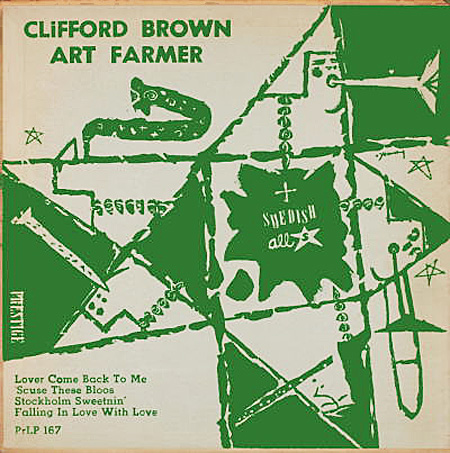
The two Annie Ross songs came out on a Prestige 78. The Wallington session was an EP, George Wallington And The Swedish All Stars. Clifford Brown and Art Farmer seem to have been on EP, were definitely on a 10-inch LP with cover art that's credited to David X. Young, although it doesn't look like his work. It's certainly not his best work.

Tuesday, March 03, 2015

Listening to Prestige Records Part 88: Tadd Dameron / Clifford Brown


Here we have a powerful ten-piece band, with an all-star amalgam of musicians, but two of them stand out for special mention: Tadd Dameron, who was one of the most influential composer-arrangers of the bebop and hard bop eras, and whose name is legend to other musicians, but who remains a cult figure to the general listening public; and Clifford Brown, whose star blazed brightly for a very short time, bookended by terrible auto accidents, the second of which took his life.

June of 1953 was the time when Brown  made his first powerful mark on the jazz recording scene. He had made a few records  the year before, some rhythm and blues in Chicago with a group led by Chris Powell (no relation to beboppers Bud and Richie Powell), and a session of bebop standards, including "A Night in Tunisia" and "Donna Lee," recorded live at a club in Philadelphia, where Brown spent some important early years. Because his career was so short, and his recorded output so much less than it might have been, all of his work, including these early sessions, has been reissued. You can find the R&B sides, which are striking, and the Philadelphia club tapes, which are amazing, on a Columbia reissue album called Clifford Brown: The Beginning and the End. Brown was 22 when he made these recordings, which is young, but his career had actually been held back by a debilitating injury suffered in an auto accident in 1950.

He hit the recording studios of New York in June of 1953, with a prodigious series of sessions. On June 9, he recorded with Lou Donaldson, Elmo Hope, Percy Heath and Philly Joe Jones for Blue Note, and two days later he was back in the studio with the Tadd Dameron group. Later in the month, he was back for another Blue Note session with J. J. Johnson, Jimmy Heath, John Lewis, Percy Heath and Kenny Clarke.
Tadd Dameron arranged for  arranged for Count Basie, Artie Shaw, Jimmie Lunceford, Dizzy Gillespie, Billy Eckstine, Milt Jackson and Sarah Vaughan, among others, and he composed some of bebop's most enduring standards. He did record several albums as a leader, but they haven't all survived. This one can't be found on Spotify or YouTube with a search under Dameron. Spotify has it as part of a collection called Clifford Brown Memorial.

And Clifford Brown deserves to be remembered as vividly as he is, for a blazing career that lasted only until 1956. But Tadd Dameron deserves to be remembered also, and this session shows why. He knew how to showcase Clifford Brown's amazing talent, but he knew how to write and arrange for a jazz orchestra, too, as well as anyone ever did. Count Basie, similarly, could make a great soloist like Lester Young simultaneously part of and separate from an ensemble.

Bebop was a soloist's art form. Gerry Mulligan was in demand as an arranger in jazz circles, but he didn't emerge as a star until he stepped out front as a soloist. Conversely, Count Basie almost never soloed, but he came from an era, and a musical genre, in which the bandleader was king. Dameron actually takes some solo space here, and he sounds great -- but not a lot.

All the compositions here are Dameron's. Of his composing style he has said (quoted by Ira Gitler in his liner notes), "When I write something it's with beauty in mind. It has to swing, sure, but it has to be beautiful."

These were released as a 10-inch LP entitled A Study in Dameronia (cover art by David X. Young), and on an EP as Clifford Brown with Tadd Dameron's Band. There was a later reissue called The Arranger's Touch that featured work by Dameron and Gil Evans, but mostly the reissues have been under Brown's name.


Wednesday, January 30, 2013

Birth of the Cool: Deception

Birth of the Cool, track 6. "Deception" was written by Miles, and the arrangement for the Birth of the Cool nonet was Gerry Mulligan's. You can hear the musicianship of both of them at their best here, working in counterpoint to each other, Mulligan's ensemble voicings making a nest for Miles to soar out of.

It came from the last recording session for the album, in March of 1950.


I didn't know if I was going to find another recording of deception, and when I did, it blew me away. Clifford Brown and Eric Dolphy? I would never have thought of them as contemporaneous. But Clifford died in 1956 -- if you'd asked me to guess, I would have said around 1952 -- and Dolphy was just starting out, playing with local bands in LA. His father -- talk about supportive! -- built him a studio in the back yard, and friends -- like Clifford Brown -- would come by and jam. This is from one of those sessions: