Tad Richards' odyssey through the catalog of Prestige Records:an unofficial and idiosyncratic history of jazz in the 50s and 60s. With occasional digressions.
Showing posts with label David X. Young. Show all posts
Tuesday, March 03, 2015
Listening to Prestige Records Part 88: Tadd Dameron / Clifford Brown
Here we have a powerful ten-piece band, with an all-star amalgam of musicians, but two of them stand out for special mention: Tadd Dameron, who was one of the most influential composer-arrangers of the bebop and hard bop eras, and whose name is legend to other musicians, but who remains a cult figure to the general listening public; and Clifford Brown, whose star blazed brightly for a very short time, bookended by terrible auto accidents, the second of which took his life.
June of 1953 was the time when Brown made his first powerful mark on the jazz recording scene. He had made a few records the year before, some rhythm and blues in Chicago with a group led by Chris Powell (no relation to beboppers Bud and Richie Powell), and a session of bebop standards, including "A Night in Tunisia" and "Donna Lee," recorded live at a club in Philadelphia, where Brown spent some important early years. Because his career was so short, and his recorded output so much less than it might have been, all of his work, including these early sessions, has been reissued. You can find the R&B sides, which are striking, and the Philadelphia club tapes, which are amazing, on a Columbia reissue album called Clifford Brown: The Beginning and the End. Brown was 22 when he made these recordings, which is young, but his career had actually been held back by a debilitating injury suffered in an auto accident in 1950.
He hit the recording studios of New York in June of 1953, with a prodigious series of sessions. On June 9, he recorded with Lou Donaldson, Elmo Hope, Percy Heath and Philly Joe Jones for Blue Note, and two days later he was back in the studio with the Tadd Dameron group. Later in the month, he was back for another Blue Note session with J. J. Johnson, Jimmy Heath, John Lewis, Percy Heath and Kenny Clarke.
Tadd Dameron arranged for arranged for Count Basie, Artie Shaw, Jimmie Lunceford, Dizzy Gillespie, Billy Eckstine, Milt Jackson and Sarah Vaughan, among others, and he composed some of bebop's most enduring standards. He did record several albums as a leader, but they haven't all survived. This one can't be found on Spotify or YouTube with a search under Dameron. Spotify has it as part of a collection called Clifford Brown Memorial.
And Clifford Brown deserves to be remembered as vividly as he is, for a blazing career that lasted only until 1956. But Tadd Dameron deserves to be remembered also, and this session shows why. He knew how to showcase Clifford Brown's amazing talent, but he knew how to write and arrange for a jazz orchestra, too, as well as anyone ever did. Count Basie, similarly, could make a great soloist like Lester Young simultaneously part of and separate from an ensemble.
Bebop was a soloist's art form. Gerry Mulligan was in demand as an arranger in jazz circles, but he didn't emerge as a star until he stepped out front as a soloist. Conversely, Count Basie almost never soloed, but he came from an era, and a musical genre, in which the bandleader was king. Dameron actually takes some solo space here, and he sounds great -- but not a lot.
All the compositions here are Dameron's. Of his composing style he has said (quoted by Ira Gitler in his liner notes), "When I write something it's with beauty in mind. It has to swing, sure, but it has to be beautiful."
These were released as a 10-inch LP entitled A Study in Dameronia (cover art by David X. Young), and on an EP as Clifford Brown with Tadd Dameron's Band. There was a later reissue called The Arranger's Touch that featured work by Dameron and Gil Evans, but mostly the reissues have been under Brown's name.
Monday, February 23, 2015
Listening to Prestige Records Part 86: Miles Davis
A ballad session with Miles Davis and a group of great musicians. What more is there to say? There's a quote from Miles somewhere, which I can't find, to the effect that what he loved most was playing ballads, and he would have been happy to spend his whole life playing them. Which, of course, is why he couldn't. Miles had a restless, searching genius which was never about being happy or comfortable.
When I lived in New York in the late 70s, WKCR, the Columbia Univeraity station, did a week-long Miles Davis marathon, in which they played everything that Miles had ever recorded, in chronological order. I made it my business to stay home and listen to all of it, so you can see that this blog isn't the first crazy jazz-related thing I've ever done. I didn't totally succeed -- I'm not that crazy -- but my girl friend at the time, who'd been out of town, came back in the middle of the week and called me, and I told her she could come over if she wanted to, but that I was preoccupied.
So...I didn't listen to all of it, but I listened to enough that I got a real sense of Miles's progression. I felt like I could understand how bebop with Bird led to the Nonet sessions to the quintet to Kind of Blue to Filles de Kilimanjaro to On the Corner to Big Fun, and I could understand how he had to do all of it, even if I wasn't going to listen to Big Fun as often as I listened to Dig or Relaxin'.
And I could listen to this session many times, which of course I have, because that's how I'm doing this blog, immersing myself in each session, but I could listen to it many times more. Miles playing ballads, a Benny Carter tune and three originals, with a group of great musicians. "Tune Up" is credited to Miles, "Miles Ahead" to Miles and Gil Evans, "Smooch" to Miles and Charles Mingus. Mingus appears on "Smooch," replacing John Lewis on piano rather than Percy Heath on bass. Lewis is on the first three cuts, Heath and Max Roach on all four.
Bob Weinstock, in an interview, talked about those early Miles sessions:
So, our basic idea was just to make records with different people, to record with the best people around. That's what we did until the end, when he had the quintet with John Coltrane, Red Garland, Paul Chambers, and Philly Joe Jones. But everything up to that point developed from where we would sit down and talk about it. Miles would mention who was in town, who he would like to record with. I'd say who I'd like to hear him record with.
Yes, I would have loved to be a fly on the wall for those cpnversations. Fly on the wall? Hell, I would have loved to be a part of the,. "Hey, Miles and Bob, why don't we get..."
These were released on singles, on an EP, and as part of a 10-inch LP. And of course, in many reissue packages.
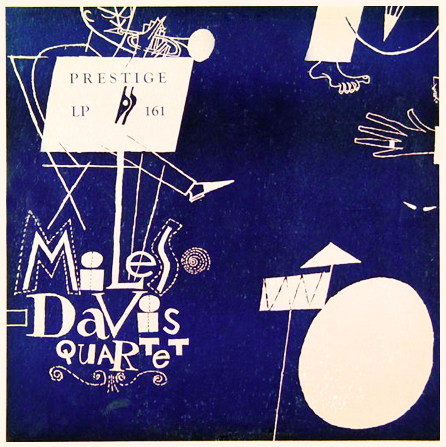
The LP cover is by David X. Young.
Friday, February 20, 2015
Listening to Prestige Records Part 84: Jimmy Raney / Stan Getz
Just as with Charlie Parker, an alias doesn't do much to hide the sound of Stan Getz. The aliases were necessary because the artists had exclusive deals with other record companies. This can't have fooled anyone. If it happened today, there'd be lawsuits, injunctions, records pulled from the shelves.
Hall Overton is back, with his other protege, Jimmy Raney, but a session with Stan Getz on it is going to be a Stan Getz session. Still, not quite like any other Stan Getz session. Do the avant-garde leanings of Raney and Overton pull Getz a little farther out into left field? I think so. He's lyrical as only he can be, but he's edgier, too.
This is an incredibly interesting session. It has the structure of a bebop blowing session, but a different dynamic. Or maybe that's not so. Maybe bebop had a lot more flexibility, a lot more nuance, a lot more room for growth than a lot of people gave it credit for. Maybe this wasn't the death throes of bebop that so many back then were predicting, and that so many since then have taken as an article of faith. Maybe this was bebop. Listen to Hall Overton's solo in "Lee." He's soloing in the bebop tradition, taking it to some strange but logical places, trading some great stuff with bassist Red Mitchell, then setting up Getz to take it out.
I've listened to this one a lot, and every time I listen, I appreciate more and more how these musicians worked with each other. Only in jazz, and maybe especially in the jazz of this era, do you find this kind of collective experimentation, and at this high level, and with this expectation of success. Putting Stan Getz together with Jimmy Raney and Hall Overton is more than just throwing a bunch of stuff at a wall and seeing what sticks. It's an inspiration.
The songs are "Round Midnight" and three Raney compositions. I had thought that "Lee" might have been a tribute to Konitz, but it's named after Raney's wife.
It's damned hard, even in the age of Google, to track down composer credits for jazz tunes, unless you happen to have the record in front of you. My ability to give credit has been, and will be, spotty at best.
New to Prestige, and perhaps new to recording -- I haven't found anything earlier -- are Red Mitchell and Frank Isola, although they had been playing and making significant names for themselves since the late forties.
Mitchell came to New York in 1948, just out of the army, and was to leave for the West Coast not long after this recording, where he made most of his career, and where he became an important innovator, tuning his bass in fifths -- the tuning used on a violin or cello -- instead of the conventional fourths. He would later join the expatriate jazz community in Stockholm.
There's a great chapter on Frank Isola, who came to New York around the same time as Mitchell, but didn't stay in the jazz world for long, in a book called Fifties Jazz Talk by Gordon Jack (Scarecrow Press). I would love to have a copy of it, but it costs 50 bucks, so it's on my gift list. Meanwhile, it is excerpted at Google Books, so we can get part of the story. We know Isola walked away from the jazz scene in 1957, after having established an important reputation as a modern jazz drummer. He worked a lot with Stan Getz, which may explain his presence on this session, and was involved in some important Prestige recordings, so we'll see him again.
In 1942, at age 17, he won the Detroit division of a national Gene Krupa drumming contest, and would have gone on to the finals in New York, if he hadn't been disqualified as an amateur for having joined the union. Had he gone, he would have given stiff competition to the eventual winner of the contest -- Louis Bellson.
He seems to have made a number of recordings that didn't quite happen, before the Prestige date. He was with a group including Don Lanphere and Teddy Kotick that backed up Babs Gonzalez on a demo for Capitol. Babs got the contract, but they didn't use the group. He made some sides with Lanphere and Herb Geller for a nascent label that never got off the ground. And in 1950, he acompanied Charlie Parker on a private session that was recorded, but I can't find a record of its having been released.
Just as he was getting ready to leave the music biz behind in the late 50s, he got a call from the Tommy Dorsey orchestra, wanting to hire him. His response: "No, thanks. Tell Tommy I'm not in a sentimental mood."
These sessions -- Raney's first as leader -- seem not to have been released as singles. Strange if true, given Stan Getz's popularity, but then his name wasn't on them. They came out on an album called Jimmy Raney Plays, with cover art by David X. Young of the Hall Overton / W. Eugene Smith jazz loft fame, one of the first Prestige albums to take cover art seriously.
Today, they're most available because of Getz, appearing on a reissue package called Early Stan.
Subscribe to:
Posts (Atom)