Showing posts with label John Ore. Show all posts

Sunday, November 29, 2015

Listening to Prestige part 154: Elmo Hope - Frank Foster

U
There probably isn't any time in the troubled life of Elmo Hope that can really be described as good, but these couple of years in the mid-50s, when he recorded first for Blue Note and then for Prestige, were at least productive.

Hope's youth included a brush with the law that rings a sadly familiar bell in the context of today's headlines: young black man shot in the back by the cops.

He was 17. He was treated for a bullet that narrowly missed his spine, and when he was released from the hospital six weeks later, he became the scapegoat of the incident, as he was arrested for assault, attempted robbery and violation of the Sullivan Law . He was charged with having participated in a mugging of three whites. Hope claimed in court that he had not been involved in any way with the mugging, but had been nearby, and, like others at the scene, had started running when the police started shooting. All charges were dismissed.

He served in the army in World War II, then returned to New York, where he was part of an emerging generation of bebop musicians. One was Johnny Griffin. who reminisced to Peter Watrous of the New York Times (quoted in Wikipedia):

We'd go to Monk's house in Harlem or to Elmo's house in the Bronx, we just did a lot of playing. I played piano a bit, too, so I could hear what they were all doing harmonically. But if something stumped me, I'd ask and Elmo would spell out harmonies. We'd play Dizzy's tunes or Charlie Parker's.

This was the second of three sessions for Prestige, and it's a strong showcase for Hope as pianist, leader and composer. His originals here are "Wail, Frank, Wail" and "Yaho." "Zarou" gets co-composer credit for Hope and Foster.

Freeman Lee plays on the first three tunes; the last two are a quartet.

Lee (also known as Charles Freeman Lee) had some good gigs during the bebop/hard bop era, playing with Snooky Young (on piano), with Sonny Stitt, Joe Holiday, James Moody and others on trumpet, and as a member of a vocal group backing up Babs Gonzalez. After his music career ended, he returned to the Midwest and joined his two schoolteacher sisters, teaching junior high school science. I hope is career as a teacher was as rewarding as his music career. It certainly was for his students. Here's a tribute from a student, at the Find a Grave website:

Mr. Lee was my Science teacher. He was a great educator. This was in the 70's in Michigan City Indiana, where his sister, Mrs Mary White, also lived and taught. He was a great and famous trumpeter and played with Duke Ellington. He used to tell us stories about his jazz days. He passed away in Ohio where his other sister, the famous educator Jane Lee Ball lived.
- donna shindler 
I got interested in the sister, and I discovered that she was an educator of some note: she had a thirty year career as a professor and chair of the humanities division at Wilberforce University in Ohio And from her 2011 obituary:
As much as she loved education, Mrs. Ball enjoyed fiction and non-fiction writing as well. Despite the demands of career and family, she found time to turn her lively imagination and teaching gifts into words on paper. She wrote more than 100 articles for Salem Press, which publishes award-winning reference works, and also published five books: Toole, Arrigo, A Flea in the Ear, After the Split and ­Glorious to View — the latter two being carefully researched histories of her beloved Wilberforce University. At the time of her death, she had put the finishing touches on her memoir, Ebony Sweet, or Growing Up Colored Before Black Got Beautiful.
This was a family that gave much to the world.

Elmo Hope's life was short and painful. I don't begin to know the reasons why people become addicted to heroin, but I'm sure that masking pain must be one of the main ones. So I can't help but be struck by how much joy there is in this music. With Foster (and Lee) the joy is boisterous and celebratory. In Hope's playing, it's very close to pure and unalloyed. especially on "Zarou," but really throughout.


Saturday, October 10, 2015

Listening to Prestige Part 149: Elmo Hope

We're on a run of piano players here, from the almost completely forgotten (Sanford Gold) to the Olympian (John Lewis) to somewhere in between.

Elmo Hope is an elusive creature in jazz lore, like the yeti, or like B. Traven. Or B. Traven in reverse -- no one knows who he was, but everyone has seen Treasure of the Sierra Madre. With Elmo Hope, the opposite. I'd certainly heard of him -- tortured soul, short life, heroin, underground reputation. WBGO, the nation's premier jazz station, remembers him on his birthday, and plays him one or two times a month, but he's not a part of their regular rotation to the degree that his contemporaries like Thelonious Monk or his lifelong friend Bud Powell are. And this is actually a good job by WBGO, keeping a flame flickering, but alive, that otherwise might be completely extinguished.

His Wikipedia entry theorizes that "he remains little known, despite, or because of, the individuality of his playing and composing, which were complex and stressed subtlety and variation rather than the virtuosity predominant in bebop." But that doesn't sound right. Hope had plenty of virtuosity, and neither Monk nor Powell was a stranger to subtlety and variation.

The jazz life is a hard one. I mentioned Mike Cuozzo in my last entry, on the MJQ, who left music to become a building contractor. Mark Myers of Jazzwax wrote glowingly of Cuozzo's abillity, and later received a letter from Michael Cuozzo, Jr., explaining that while his dad loved music, he loved his family more, and made the decision to provide for them.


John Ore, who played bass on this session, and who later spent three years as Thelonious Monk's bassist, was the subject of a 2004 profile by Reil Lazarus on the All About Jazz web page. Lazarus, reflecting on the musicians who created jazz in the 40s and 50s, noted that
today, those youngsters are aging men - gifted masters who have long since paid their dues - and many, especially those with failing health, find themselves victims of past exploitation and failure to plan....
 “I haven’t had much work,” says Ore. “In the last five or six years, I’ve had glaucoma, and that’s cut down on my ability to [find work].” This, paired with a dwindling number of venues currently catering to jazz, has made it more and more challenging for him to perform. 
“I don’t get out there to play very often,” Ore laments, “And that’s the main thing. Playing at home all by myself just isn’t the same. A musician should be playing at least two, three to four times a week with other musicians.” 
Add to this the absence of proper benefits and pensions plans for veteran musicians, and the road to a relaxed retirement appears muddier by the day. Organizations like the Jazz Foundation of America, whose monthly jam sessions Ore participates in, have worked ceaselessly to ease these unfortunate fiscal woes. Nevertheless, the lack of a substantial safety net for aging artists like Ore continues to be a major problem in jazz. 
And these are the guys who survived. Ore told Lazarus:
Not too long before Elmo Hope died, I saw him on Seventh Avenue. And he was walking in the rain with no hat on, someone else’s shoes, and he was sick. Now I don’t blame that on anyone, but there should be something, someone, somewhere we people can go.
The music remains, and this album is beautiful. I was awed by Hope's piano playing, but I was also struck by the way he uses the potential of all three instruments, bringing bass and drums to the fore in a way that not every piano session leader does. "I'm in the Mood for Love" is a little over four minutes long, and how do you do "I'm in the Mood for Love" after James Moody and King Pleasure/Eddie Jefferson have taken ownership of it? Hope does something completely unexpected. He gives the first two minutes to John Ore, who does a solo bass interpretation of "Moody's Mood." Then, with the bass still audible in the mix, and the echo of Ore's Mood still pulsing through, Hope creates his own solo, and makes the song his own.

In "Blue Mo," he brings Willie Jones to the front, with hard-edged stick work on the ride cymbal.

I was surprised to see "It's a Lovely Day Today" in the set list. It's a sprightly and hummable Irving Berlin tune, best known for a perky, optimistic rendition by Doris Day, but I wouldn't have thought of it as a bebop vehicle, and in fact I can't find any other instrumental jazz version, although Ella Fitzgerald, Astrud Gilberto and Jackie and Roy have all sung it. Hope takes it at a breakneck bebop tempo, and tears it up.

This became the fourth made-for-12-inch Prestige session, and was released as PRLP 7010 - Elmo Hope--Meditations.

PRLP 7008 and 7009 were the Wardell Gray memorial albums. Gray died on May 25, 1955, in Las Vegas. He was probably murdered, but the case was never investigated. No one cared what happened to a black man in 1950s Vegas.


Saturday, August 29, 2015

Listening to Prestige Part 140: Freddie Redd

One of the special joys of this blog is discovery. Someone I hadn't heard before...someone I didn't know enough about. And that's the case here. This is a treasure. This is music for real lovers of jazz. No pyrotechnics, no drama, just wonderful piano playing by a real artist. It's funky, it's melodic, it's inventive, it goes right into you.

Freddie Redd is probably best known for Jack Gelber's 1959 play about junkies waiting for their pusher Godot, The Connection. The play focused on a bunch of junkies sitting around a New York crash pad, waiting to get high. The cast includes four jazz musicians, most notably Redd and Jackie McLean. Gelber's original script had called for the musicians to just be sitting around noodling odd scraps of music, but Redd convinced the playwright to let him compose a real score. This was a good idea for all sorts of reasons. It was certainly stronger artistically. It was better for Freddie, because a composition meant steady...income, that is. Beyond what he was getting for acting, which in those days Off Broadway was not much. When you think about it, whatever the producers paid Freddie for the score, it was a good investment, because if the quartet had just had to sit around noodling night after night,,they would have been noodling something, and ASCAP would have been on them like a ton of bricks.

The Connection was made into a movie by Shirley Clarke, with Redd again featured, and an album of the music from the play was released on Blue Note, but none of this made Redd into a star of the jazz world. If you were to mention his name to someone from that era--like me, for instance--you'd probably get "Oh, yeah, The Connection. Did he ever do anything else?" And because in The Connection, he plays a heroin addict, the person you were talking to would probably assume he had died young.
The Connection

In fact, Redd is still with us, and as recently at 2013, according to his Facebook page, he was performing in Baltimore (his Facebook page only has 683 likes -- not enough).

But let's get back to this single session of four tunes for Prestige. His playing is simple and complex. straightforward and adventurous, bluesy and boppish. It engages the mind and goes straight to the heart. "Debut" is ornate in the manner of Bud Powell or even Art Tatum. In "Blues for Lady J" he plays the blues, elaborates on the blues, returns to the blues. "The Things We Did Last Summer" is a 1946 hit for Jo Stafford, by Sammy Cahn and Jule Styne, that's become a jazz standard. Redd gives it a beautiful, moody rendition that stays close to the melody but always offers something more. It comes in at just under six minutes, which gives Redd plenty of space to explore all its possibilities. "Ready Freddie" is taken at a faster tempo, and is a bravura piece for the pianist.

The trio is filled out by stellar musicians. John Ore worked with
several of the best piano players of his time, including Bud Powell, Elmo Hope, Earl Hines, and most significantly Thelonious Monk, from 1960-63. Ron Jefferson and Ore both played with Lester Young, and Jefferson also backed up Coleman Hawkins, Roy Eldridge and Oscar Pettiford, among others. He was one of the original members of Les McCann's trio.

Ore has some solo space on both "Things We Did Last Summer" and "Blues for Lady J," and he takes full advantage of it. He also does some wonderful duet work with Redd on "Ready Freddie."

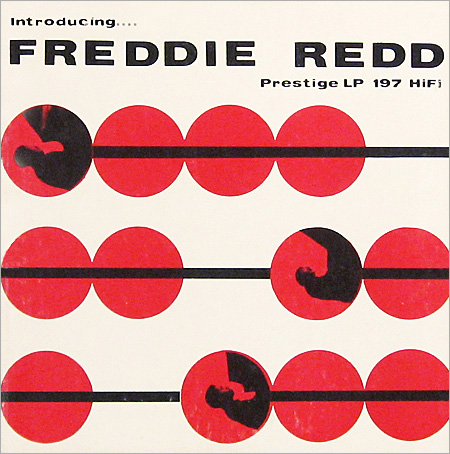
These tunes appear on a 10-inch LP, Introducing...Freddie Redd. There wasn't enough material for a 12-inch LP, so Prestige combined them with a Hampton Hawes session as Piano: East/West.

All can be heard on Spotify. I trust I don't need to tell you to listen. And if he gets booked at the Falcon, in my neck of the woods, I'm going.