Tad Richards' odyssey through the catalog of Prestige Records:an unofficial and idiosyncratic history of jazz in the 50s and 60s. With occasional digressions.
Showing posts with label 1959 recordings. Show all posts
Showing posts with label 1959 recordings. Show all posts
"April in Paris" was written in 1932 by Vernon Duke and E. Y. Harburg for a Broadway show called Walk a Little Faster. The show was not exactly a flop, not exactly a hit (118) performances, but the song was an instant classic, and it's never wanted for performers eager to take it on. It's had vocal interpretations from Sinatra to Ella and Louis to Shirley Basey, but the most successful, and still the definitive version was, amazingly enough, a jazz instrumental. Count Basie recorded it in 1955: bold, brassy, and so exuberant that it demanded not just "one more time" but "one more once" after that.
But a great tune is always going to find great artists with new approaches. In 1956 alone there were ten new jazz recordings, including piano versions by Errol Garner, Thelonious Monk and Nat "King" Cole, and a treatment by Thad Jones, who had contributed a memorable solo to the Basie recording.
In 1959, Benny Golson was ready to add his voice to the "April in Paris" story, and his was a very different approach from Basie's: moody and subdued. Paris in the springtime may be a time for lovers, but for every lover there's a broken heart, and a sad story to tell in a late night bistro. Golson has the thoughtful commiseration of Tommy Flanagan, but for the most part this is is his tone poem, and he plays it with deep understanding.
But he snaps out of the meditative mood with "Tippin' on Through." This is the composer of "Blues March," a hit for Art Blakey's Jazz Messengers, and "Tippin'" has some of that march feeling to it. It seems like an odd fit, but Golson has proved it can work, and in a way, jazz and march compositions have certain commonalities, They both have a predilection for riff-based melodies, at least as funneled through the musical imagination of Benny Golson.
Tommy Flanagan takes a world-weary approach to intro to the next number, as though baubles, bangles and beads, no matter how they jing-jing-aling, are still the stuff of vanity. Golson and Curtis Fuller soon set him straight, kicking off a celebration.
The blues take center stage for the rest of the session, with two Golson compositions, "Tom Hurd's Blues" and "Blue Streak." The blues really never do grow old.
Doug Watkins and Art Taylor rounded out the quintet. Watkins had spent much of the previous year in Europe with Donald Byrd. He would continue to be a mainstay sessions for Prestige and other labels until his untimely death in 1962, the result of an auto accident. Gettin' With It was produced by Esmond Edwards, released on New Jazz. We have two thirds of the Jazztet-to-be here, as on Golson's previous New Jazz recording--and as on a Savoy album cut during the fall, under Fuller's leadership, as the Curtis Fuller Jazztet: the first time that name was used, with Lee Morgan as the third Tet. The next time it would be used would be just six weeks away, in early February, on the Argo release Meet the Jazztet, with Art Farmer. Farmer, Golson and Fuller had first united as the Jazztet for club dates in November.
Listening to Prestige Vol. 2, 1954-1956 is here! You can order your signed copy or copies through the link above.
Tad Richards will strike a nerve with all of us who were privileged to have lived thru the beginnings of bebop, and with those who have since fallen under the spell of this American phenomenon…a one-of-a-kind reference book, that will surely take its place in the history of this music.
--Dave Grusin
An important reference book of all the Prestige recordings during the time period. Furthermore, Each song chosen is a brilliant representation of the artist which leaves the listener free to explore further. The stories behind the making of each track are incredibly informative and give a glimpse deeper into the artists at work.
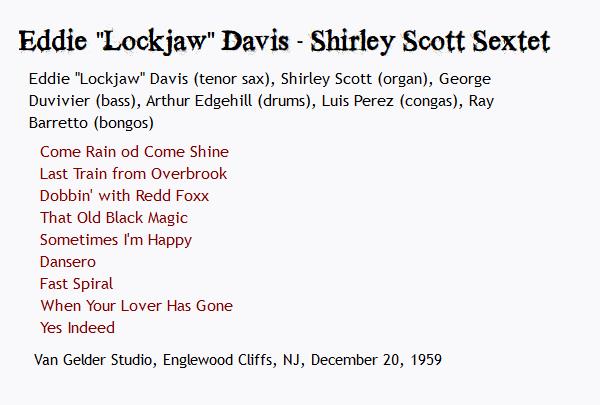
Ray Barretto makes a welcome return to the Van Gelder studio, this time bringing with him a fellow conguero, Luis Perez. Barretto moves over to bongos for the session.
The bongo drums were a kind of fad instrument in 1959, associated with the media stereotype of the Beat Generation. Comic beatnik Maynard G. Krebs of the Dobie Gillis TV show, a character who embodied every beatnik cliché, played the bongos. So did real-life Hollywood rebels James Dean and Marlon Brando. Brando was actually quite good, and not only that, he patented an electronic device for tuning the head of a bongo or conga drum. Bet you didn't
know that. Contemporary star Matthew McConaughey has gained some notoriety for playing the bongo drums naked, but that's getting too irrelevant.
Ray Barretto needed no electronic devices. He was as much a master of the bongos as he was of the conga, and adding a second Latino percussion instrument to the traditional small jazz group (by this time the organ-tenor sax combo was fast becoming traditional) made a huge difference.
The hand-played percussion instruments are not restricted to Latino music, not that that's a restriction. But Barretto, in particular, grew up playing both swing and Latin rhythms, and he was hugely influential in bringing swing rhythms to the traditionally Latin percussion instruments, as can be heard here. But there's always a special excitement that a great percussionist brings to any recording, and that goes double here.
It's interesting that Shirley Scott lays out much more than she does on other recordings. The intros to the tunes are mostly Barretto and Perez, and she generally stays outta the way when Davis is soloing. This has the effect of giving a powerful prominence to Barretto and Perez, not only when they're taking the lead, but when they're playing behind Davis.
This gives Scott a whole new role in the combo. When she solos, she's not stepping into the limelight, continuing and extending moods and ideas she's begun while comping for the tenor sax. Instead, she's making an entrance. It's dramatic, it's different. Of course, as new as the organ still was to jazz prominence, and as inventive as Scott was, everything she did in these recordings was different.
The session includes a nice complement of standards--"Sometimes I'm Happy" "That Old Black Magic," "Come Rain or Come Shine," "When Your Lover Has Gone." The Latin-tinged "Dansero" was originally a hit for its composer, Richard Hayman, in one of the decade's more unusual arrangements--harmonica and full symphony orchestra.
They turned to James Moody for two tunes. "Last Train From Overbrook" had been recorded by Moody as an instrumental for Argo in 1958, and also with Eddie Jefferson singing his own vocalese lyrics."Dobbin' with Redd Foxx" may have been something Davis heard Moody play on a package tour, because Moody himself had only just recorded it a couple of months earlier, again for Argo, and it surely had not been released yet. And if you're wondering what "dobbin'" is, don't ask Moody. When he recorded it. the title was the even more enigmatic "Darben the Redd Foxx." In any case, it's nice to see a 1959 tribute to Redd Foxx, when he was at his guttermouthed raunchy peak. Later on, with Sanford and Son, he was still a comic genius, but considerably reined in.
Davis is the composer of "Fast Spiral," and I am quite sure there was never a temptation to call it "Slow Spiral." This is an uptempo rampage.
The album was produced by Esmond Edwards. It was released on Prestige as Bacalao,
Listening to Prestige Vol. 2, 1954-1956 is here! You can order your signed copy or copies through the link above.
Tad Richards will strike a nerve with all of us who were privileged to have lived thru the beginnings of bebop, and with those who have since fallen under the spell of this American phenomenon…a one-of-a-kind reference book, that will surely take its place in the history of this music.
--Dave Grusin
An important reference book of all the Prestige recordings during the time period. Furthermore, Each song chosen is a brilliant representation of the artist which leaves the listener free to explore further. The stories behind the making of each track are incredibly informative and give a glimpse deeper into the artists at work.
Buddy Tate's first appearance on Prestige was with Shirley Scott and an all-star sax section: Coleman Hawkins, Eddie "Lockjaw" Davis, Arnett Cobb. Here he's back for Swingville, and with his own group.
Tate had a regular gig at the Celebrity Club in Harlem from the early 1950s through the mid-1970s, which says something about the enduring popularity of swing in general, and the musicianship of Tate and his band in particular. Tate had had a longtime gig as first tenor sax in the Count Basie orchestra, following Herschel Evans, and most of his musical associates are from that Basie orbit, including his band from the Celebrity Club, which is essentially the band he recorded with for this Prestige Swingville date. These are professional sidemen, guys who never
stepped out to lead their own bands, or at least never recorded as leaders, but who never lacked for work on the highest levels of jazz, because they could get the job done, and more--they could add their own touch to both solo and ensemble work.
Trumpeter Pat Jenkins joined Tate in 1951, when the saxophonist had secured the Celebrity Club gig, and stayed with him for the next 21 years, or the run of the gig. Before that, he had been best known for another long term gig: the Savoy Sultans, house band at the Savoy Ballroom. The Savoy booked the hottest bands in the nation, and the Sultans' job was to fill in the times when the headline band was on break, and keep people dancing with no letup. In the Savoy management's policy, no letup meant that the house band had to be good enough that when Chick Webb or Lucky Millinder or Count Basie stopped playing, the audience didn't feel a letdown, but it also meant no letup. According to terry Monaghan's obituary for Jenkins in The Guardian:
The Savoy's policy was to minimise breaks in the music, so bands were expected to pick up immediately from their predecessors. Masters of seguing, the Sultan's rhythm section would join in the last number of any "opposite" band which had struck a groove. When the latter band stopped, the Sultans would carry on. Pat recalled some bandleaders being amused by this tactic while others were angered at such blatant upstaging.
Eli Robinson, Tate's trombonist, has that kind of resume. McKinney's Cotton Pickers, Blanche Calloway, Willie Bryant's Apollo house band, Lucky Millinder, Roy Eldridge, Count Basie, and finally Buddy Tate. If you wanted music you could dance to, swing to, groove to, listen to, snap your fingers to, court the love of your life or score a hot date for Saturday night to, chances are Eli Robinson was in the band that was playing it.
On this session, he shows his composing chops, too, with "Me 'n You," "Blow Low," and "Miss Ruby Jones" to his credit.
Ben Richardson also passed through Blanche Calloway's ensemble, and was another of Tate's Celebrity Club regulars.
Sadik Hakim had more of a bebop background than did Tate's other regulars, having recorded with Charlie Parker, Dexter Gordon, and others. In the early 50s, before he joined Tate, he had been with James Moody. But he had worked the swing side of the street, too, with Ben Webster, Henry "Red" Allen, J. C. Higginbotham, Roy Eldridge, Stuff Smith.
An aside. I've always said if I could time travel, I would go back to being 20 years old at the time I was born, 1940, and I would head straight for 52nd Street, and uptown to Minton's. Here's just one example of why, from an interview with Sadik Hakim:
The rhythm section at the Onyx Club became Eddie Nicholson (drums), Gene Ramey (bass) and myself. Many times Roy Eldridge would play with us, or Stuff Smith, or Bob Dorsey, a great tenor player. Then it was Bird—always late. Mike Weston, the Onyx Club owner, would be frowning as Bird came in late, but after a couple of Bird’s choruses, he’d be smiling. One night Bird was very, very late. Bird came in while Ben Webster was drinking at the bar; the rest of us were trioing. Bird picked up Ben’s tenor and said I Cherokee. He played that tenor like he owned it, and Ben was shook. He just kept saying “Give me another double.” The thing about this was that nobody could get a sound out of Ben’s tenor but Ben himself, due to the thickness of the reed, etc. I saw many great tenor players try-Prez, Buddy Tate, Ike Quebec, no good!
Dicky Wells was another member of Tate's Celebrity Club ensemble. He didn't make this recording session in person, but he did by proxy, with two of his compositions: "Moon Dog" and "No Kiddin'." The remaining tune, "Idling," is Hakim's.
For Tate himself, here's a description of his style by The New Yorker's jazz critic Whitney Balliett:
Tate's solos do not depend simply on improvisation, or even on design,
but on burst after burst of emotion. These are shaped into long, falling
blue notes, crooning phrases that end in fluttering vibratos, and
cries that arch upon the upper register. Tate's emotions, which are
blue and sorrowing, have none of the self-pity and boohooing that
leak from the work of some contemporaries. He seems to say, Damn, my
heart aches; hear it. He has Herschel Evans' tone, fine rhythmic
agility, and a neat harmonic sense.
Listening to Prestige Vol. 2, 1954-1956 is here! You can order your signed copy or copies through the link above.
Tad Richards will strike a nerve with all of us who were privileged to have
lived thru the beginnings of bebop, and with those who have since
fallen under the spell of this American phenomenon…a one-of-a-kind
reference book, that will surely take its place in the history of this
music.
--Dave Grusin
An important reference book of all the Prestige recordings during the time
period. Furthermore, Each song chosen is a brilliant representation of
the artist which leaves the listener free to explore further. The
stories behind the making of each track are incredibly informative and
give a glimpse deeper into the artists at work.
This is first release in Prestige's third and most controversial subsidiary label, Moodsville. Moodsville wasn't, and still isn't, very controversial, but maybe a little. The purposes of Swingville and Bluesville were pretty clear, but what was Moodsville, exactly? Swing veterans like Coleman Hawkins played on the first, blues musicians like Willie Dixon on the second, but Moodsville's first recording was by mainstream Prestige regulars Red Garland and Eddie "Lockjaw" Davis, so what set it apart?
Jackie Gleason, beginning in 1953, had released a series of albums that more or less invented mood music. The first was called Jackie Gleason presents Music for Lovers Only.The album cover had two cigarettes, two wine glasses, and a lady's clutch purse. The music was syrupy and easy to listen to. It did feature jazz great Bobby Hackett, but beyond that it had nothing much to recommend it except that it set the all time record for most consecutive weeks in Billboard's top ten.
What accounted for its amazing popularity, and the popularity of the Gleason recordings that followed it? Gleason's name (which actually may have been all he gave to the project)? The romantic cover art? Or maybe Gleason had just tapped into a hitherto unrealized visceral human desire for...mood music?
Well, why not? As Gleason realized, if Clark Gable needed romantic background music to play a love scene in a movie, shouldn't some guy in Brooklyn need it even more?
Mood music became elevator music, became Easy Listening. Bobby Hackett or no, it was, in the slang of the day, strictly from Squaresville. So is Moodsville really a subdivision of Squaresville?
This question was debated on the Organissimo internet forum, an often interesting place for jazz discussion. Some said yes, sort of: "Generally, my perception is that the Moodsville albums are more sedate, simpler, and somewhat less 'jazz intensive." Scott Yanow, reviewing for Allmusic, tended to agree: "[Moodsville] was designed to provide mood music for courting couples... Due to the overly relaxed nature of much of this music and the lack of variety, this is not one of the more essential Red Garland sets."
But the Organissimo consensus, and a fairly informed consensus, was otherwise. Contributor Dan Gould, who had discussed the question with Weinstock, recalls:
One thing Bob told me is that the number of albums, and the creation of the subsidiary labels, were a direct result of cash flow. In order to avoid showing too much in profit and paying taxes on it, Bob wanted to put the money into production.
Which, from a vantage point of the jazz-starved new millennium, is a very nice thing to hear--that a small independent label fiercely devoted to modern jazz would have to worry about the problem of showing too much in profit. Chris Albertson, who produced a number of Prestige sessions, had this to say:
I really don't think there was any serious marketing decision involved in the creation of the Bluesville, Swingville, Moodsville, etc. series. Remember, these were not stand-alone subsidiary labels--it was always Prestige Moodsville, Prestige Swingville, etc. I don't recall if the pricing was different--if so, that may have been a factor. As a dj when these first came out, and later as a Prestige employee, I never thought of them as anything but Prestige albums with a series name.
Sometimes I think that consumers/collectors make more out of such details than the facts call for. When I produced a session, it was a Prestige session--whether it came out on Prestige, Prestige Bluesville or Prestige Swingville, made no difference.
I was never aware of there being any deliberate effort to alter the nature of a Moodsville album from that of, say, somebody's ballad album. If there ever was an instruction from Bob Weinstock to do so, it must have flown off my desk--a desk that saw its share of memos!
Albertson was not yet aboard when this session kicked off the Moodsville line. Esmond Edwards produced, and he didn't exactly have a reputation for pandering. And it's hard to imagine Red Garland, Sam Jones, Art Taylor or Eddie Davis deciding to dumb down their music.
So how does it sound? It sounds great. It's an afternoon devoted to ballads, which are lovely to listen to, but ballads have always been a part of jazz. They play the melody, and with beautiful melodies like this, why wouldn't you? But they use it as a springboard to improvisation, just like a real jazz session, and the improvisation is of the quality of a real jazz session, and what else do you need? If the Moodsville label let the prospective buyer know that he could probably safely play it for an evening at home with his girlfriend who'd stalk out the door if he put on Change of the Century, the names of the musicians should have let him know that he wouldn't be embarrassed playing it for his college roommate with the goatee and the sunglasses after dark.
Davis plays on three numbers, "We'll Be Together Again," "When Your Lover Has Gone," and Garland's own "Softly Baby," the last named a recording that did get a new life in the new millennium when it was featured on the TV show American Horror Story.
"We'll Be Together Again" is a particularly beautiful and haunting melody, written by Carl T. Fischer, who has the distinction of being one of the few Native Americans to have a significant career in jazz. Fischer was Frankie Laine's accompanist at the time he wrote the song, and Laine contributed the lyrics. Davis is sensitive to the melody, but at the same time puts his own spin on it. If this were on a jukebox at a place where I hung out, I'd play it a lot.
Davis also played on Garland's "Untitled Blues," which didn't make the Moodsville cut, but was included on later CD packages.
This is a great album if you're in the mood, but what music is that not true of? From Lefty Frizzell to Berlioz' Symphonie Fantastique, you'd pull out the album, slide out the vinyl, and place the needle on the first groove if you were in the mood to hear it.
The album cover emphasizes Moodsville. Other than that, the album is eponymously titled.
A new side of Shirley Scott here, as she really steps forward as a composer, and delivers some solid stuff.
I think composing on a organ must be an entirely different experience from composing on a piano--or anything else, for that matter. But piano is the preferred instrument of composers, unless you're composing for voice -- writing a song -- in which case a guitar will do just as well. But these pieces sound different, even when they're doing more or less the same thing, like the classic catchy riff end-punctuated by a two-note fanfare. Miles Davis' "So What," from Kind of Blue, is a familiar example. Scott uses the same pattern on "Duck and Rock," but it sounds different. It is different. It's not just the difference in hearing the two-note response played on the organ. She does that on Bobby Timmons' "Moanin'" (Every mornin' finds me moanin' -- oh,
yeah!) "Duck and Rock" is different. Different fanfare. Different way of getting there. Different places to go to from there.
It's altogether a fascinating listening experience, through four originals: "Duck and Rock," "Boss," "Plunk, Plunk, Plunk," and "Soul Searchin'." You wouldn't automatically assume from its title that "Plunk. Plunk, Plunk" is an organ tune. The title makes it sound more like a banjo tune, but Scott plunks away at that organ and comes up with something that's a lot more great organ jazz than it is plunkety plunk. "Boss" changes the pace by changing the tempo. You don't necessarily think of an organ, with its great capacity for sustained notes, as being the perfect vehicle for a wild uptempo number, but Scott, as we know, is a great believer in trying to discover everything an organ can do.
"Soul Searchin'" is the title cut, and it's anchored by the soulful bass of Wendell Marshall. "Soul" is gaining in popularity as a music-related word. Charles Mingus's Mingus Ah Um, released earlier in the year, had included "Better Git It in Your Soul." Ray Charles' Genius + Soul = Jazz was still just beyond the horizon, as was self-described original soul artist Solomon Burke. So put Scott up near the head of the line.
As for the tunes by other composers, it's hard to beat Bobby Timmons' "Moanin'" for soulfulness. Scott does flammable things with dynamics on it, and uses the whole keyboard, with sacrificing its simple tunefulness. She tears up Sy Oliver's "Yes Indeed," not so soulful when it was originally recorded in 1941 by Bing Crosby (although Connee brings some soul), much more so when it was revived by Ray Charles in 1958. Don Redman ("Gee, Baby, Ain't I Good to You") and Buddy Johnson ("You Won't Let Me Go") are both good sources in the search for soul.
They added a "g" for the album title: Soul Searchin'. "Duck and Rock" b/w "Ebb Tide" was the first single off the album, followed by "Gee, Baby, Ain't I Good to You?" / "Moanin'."
"Uh-Oh" and "Misty" are both on the set list for this session, but they were Scott-Eddie "Lockjaw" Davis collaborations, and he's not listed as being part of the mix. But the two made a 45, with "Misty" as the A side, under Davis's name, and "Misty" would be released again on 45 some years later, with "In the Kitchen" as the B side. Both would also appear on a later Davis-Scott album.
Listening to Prestige Vol. 2, 1954-1956 is here! You can order your signed copy or copies through the link above.
Tad Richards will strike a nerve with all of us who were privileged to have lived thru the beginnings of bebop, and with those who have since fallen under the spell of this American phenomenon…a one-of-a-kind reference book, that will surely take its place in the history of this music.
--Dave Grusin
An important reference book of all the Prestige recordings during the time period. Furthermore, Each song chosen is a brilliant representation of the artist which leaves the listener free to explore further. The stories behind the making of each track are incredibly informative and give a glimpse deeper into the artists at work.
Willie Dixon occupies a special place in the history of the blues. He is really the blues' first professional songwriter.
The early blues singers had no need for a songsmith. They were telling their own stories, and they were singing them essentially to audiences who lived like them, thought like them, felt like them, experienced life like them. Their
songs were so self-directed as to be almost solipsistic, and there are a lot of paradoxes involved with this, the deepest and most potent one being that this near-solipsistic music has become so universal, perhaps the most potent way of expressing pure emotion that any art form has ever devised.
The relationship between the blues singers and their audience was intimate. They might play dances for the white overseers, but essentially they were singing to their own people, or to the dusty intimacy of the street corner. As the blues and jazz merged, and singers became part of an ensemble and moved onto the stages of theaters or speakeasies, the songs were still personal, but a separation between performer and audience was an inevitable result. The blues singer was now a professional entertainer, and while audiences might still react viscerally to the emotional intensity of the songs, they viewed the emotional and biographical particulars as interested outsiders.
Starting in the 1930s, the blues began to move northward. When John and Alan Lomax brought Lead Belly to New York, they tried to introduce a traditional folk blues singer to a black audience that had little interest. They were listening to Jimmie Lunceford and Cab Calloway and Chick Webb and Ella Fitzgerald. So Lead Belly found himself performing for an audience primarily composed of white leftists, and now the audience was really the other. The subtext of the blues had always been hard realism. Life is hard, and it's going to win, You can't change it, and you can't beat it. The best you can do is celebrate small victories: women, getting drunk, killing someone, grabbing a train and riding. That's why racism was not a dominant theme in the early blues. It was just another fact of existence. But the subtext, indeed the manifesto of the white leftists was hope. We can change the world.
So the blues adapted to its audience. Leadbelly challenged racists as bourgeois men living in a bourgeois town. Big Bill Broonzy told his audiences that we could all get together and break up the old Jim Crow.
In the Midwest, in Chicago and Detroit, the new blues singers were still singing to black audiences, but that was different, too. The audiences weren't farmers and sharecropper's from the singer's home region. They were factory workers and shopowners, and they were from all over the South. The division between entertainer and audience was wider.
And this is the world that Willie Dixon, born in Vicksburg, Mississippi, entered. He had grown up with the blues, but when Leonard and Phil Chess, European immigrant merchants who had started a record label aimed at the colored market, hired him to supervise their recording sessions, he had moved some distance away from the blues. He was performing with a cocktail jazz trio modeled after Nat "King" Cole.
And he became the first great professional songwriter of the blues, blazing a trail that would be followed by Chuck Berry, by Jerry Leiber and Mike Stoller, by Curtis Mayfield. With Chess, Dixon wrote songs that were, rather than deeply personal expressions of self, carefully and powerfully crafted personae for others, most famously Muddy Waters and Howlin' Wolf: the good-hearted sensualist and the sexual predator. The natural born lover, the son of a gun who can make pretty women jump and shout. And the back door man, the one around whom you had better watch your happy home, who eats more chicken than any other man has ever seen. Or Koko Taylor, the sensual banshee who can play that wang dang doodle all night long.
With Willie Dixon, Bob Weinstock and Bluesville were really making a commitment to the blues, a commitment that they would keep: Bluesville was unquestionably a blues label. It was a commitment that was sort of slow in developing. Weinstock had recorded Al Smith in September. The Willie Dixon session came in December, but it would be held in the can for a while. It would become Bluesville's third release, following a Sonny Terry-Brownie McGhee session of the following August.
The session seems to have been organized on the fly--the liner notes say it was recorded in two hours at Rudy Van Gelder's studio, when Willie and Slim were between flights, on their way back to Chicago. How Weinstock and Esmond Edwards heard they were in town is anyone's guess, but they threw together a very decent session, and this became Willie Dixon's debut album, although he had put out a handful of 45s for the Chess subsidiary, Checker. Memphis Slim had been fairly widely recorded on 45 by a number of independent labels, often leading a jump blues band, and often with Dixon on bass.
Blues and especially rhythm and blues, which was considered the first cousin to rock and roll and therefore declasse, was slow to be recorded on LP. The audience for long playing records was seen to be the more sophisticated audience for classical music, jazz and original cast recordings of Broadway shows. Moses Asch of Folkways Records put folk music on LP, including some blues, but outside of Lead Belly most of his blues was on compilation discs designed to appeal to folklorists. Labels like Caedmon specialized in spoken word recordings, particularly the widely appealing poetry and mellifluous reading voice of Dylan Thomas. But the independent labels that specialized in rhythm and blues, rock and roll and country didn't release LPs, and the majors weren't really interested until 1956, when RCA Victor bought Elvis Presley's contract from Sun. So it's not really surprising that artists like Dixon and especially the popular Memphis Slim were late to the LP table, nor that they were first recorded on LP by a jazz label from New York,
Drummer Gus Johnson and tenorman Harold Ashby were both Midwesterners who worked out of Chicago a lot, so they may have been touring with Dixon and Slim. Johnson had gottten his start with Jay McShann. He would be back to New York over the next few years to play on some other Prestige sessions. Ashby was a protege of Ben Webster's. Webster would recommend him to Duke Ellington, and he worked off and on with Ellington for many years. Finally, starting in the late 1960s, he would become a mainstay of the Ellington orchestra.
Wally Richardson was probably a local pickup. He was new to the scene, having just made his recording debut on an Atlantic album with LaVern Baker, but he had an interesting career ahead of him. He became an in-demand studio guitarist for Prestige and numerous other labels, and it was on Prestige that he had his moment in the sun in the late 1960s, with what has been described as a psychedelic jazz funk album, Soul Guru.
\
The whole group is heard to particularly good account on the instrumental "Go Easy." The best known song to have come out of the session was certainly "Built for Comfort,: which became a hit for Howlin' Wolf and has been a staple for blues singers ever since.
The name of the album was Willie's Blues. Bluesville released one single -- not "Built for Comfort," but "Nervous" b/w "Sittin' and Cryin the Bluse."
Listening to Prestige Vol. 2, 1954-1956 is here! You can order your signed copy or copies through the link above.
Tad Richards will strike a nerve with all of us who were privileged to have lived thru the beginnings of bebop, and with those who have since fallen under the spell of this American phenomenon…a one-of-a-kind reference book, that will surely take its place in the history of this music.
--Dave Grusin
An important reference book of all the Prestige recordings during the time period. Furthermore, Each song chosen is a brilliant representation of the artist which leaves the listener free to explore further. The stories behind the making of each track are incredibly informative and give a glimpse deeper into the artists at work.
Willis Jackson, Jack McDuff and Bill Jennings are still together, bringing a world of experience to their partnership before ever arriving at Prestige. This means two things, both of them good. First, they're comfortable and relaxed and intuitive with each other. Second, they know each other well enough to feel good about taking chances and trying something new.
Three things, actually, all of them good. They've been playing for the people for a long time. So to Jackson, McDuff and Jennings, trying something new doesn't mean what it means to Coleman or Coltrane. It means finding new little surprises to wake up an audience. It means you'll be booed for a week if the audience knows what to expect from you, and you'll be held over for another week if you give them a little of the unexpected, too.
How about if you're at a dance hall, and the Gator announces that "Now we're gonna play an old favorite -- 'Sunny Side of the Street,' and your feet start tapping in anticipation, because you can feel the tempo already? And you're getting set to sing along: "Grab your coat and get your hat...Leave your worries on the doorstep..."
And then Jack McDuff starts that odd organ riff, teasing the melody and bumpety bumping away from it, and you're scratching your head for about 20 seconds before the Gator comes in with the melody, and now you're tapping your toes and saying, "Hey, that was some cool shit brother Jack put down."
This isn't music appreciation postgraduate level, it's Music Appreciation 101, and that's what makes a lot of folks happy.
This session was broken up and sold for parts. "Sunny Side of the Street" "Blue Strollin'" went to Cool "Gator," released in 1960, and rereleased as Keep on a-Blowin'. "East Breeze" was on Blue Gator, a later 1960 release. "When I Fall in Love" was held off for Cookin' Sherry, a 1961 release. "Glad a See Ya" came out in 1965, after McDuff had moved on to lead his own group, on an album entitled Willis Jackson and Jack McDuff--Together Again! and the medley saw daylight the following year on Together Again, Again! Esmond Edwards produced this session and the others that were mixed and matched on all those albums.
"On the Sunny Side of the Street" was the flip side of a 45 that featured "Come Back to Sorrento."
Johnny "Hammond" Smith and his Philadelphia cohorts go after some familiar standards here, and I do mean familiar. That gives him a more difficult task than you might imagine. These are super-familiar standards because people love them, so he's got to not alienate the multitudes who love them, while at the same time appealing to the esoterica-loving jazz hipsters who would rather run naked through Sam Goody's than listen to another rendition of "My Funny Valentine."
Or, especially, of "Autumn Leaves." This is 1959, and although there have already been several jazz interpretations (Jimmy Smith, Ahmad Jamal, Errol Garner), the one that's been inescapable since
1955 has been the recording by Roger Williams, with its arpeggios run amok through jukeboxes, radio stations both top forty and traditional, and your aunt's living room, where her 9-year-old won't stop sliding his fist from top to bottom of the keyboard, yelling out "Hey, I'm playin' 'Autumn Leaves!'"
So, does Mr. Smith, otherwise known as Mister Hammond, succeed in keeping it recognizable, while at the same time making it hip, at least a little sardonic, different, and ultimately musical? To these ears, yes.
I'm not saying that every listener to Lacy, or to Martin Block's Make Believe Ballroom, would have pricked up his ears, tapped his feet, and said "It's not Roger Williams...but I like it." But they should have. And I'm not saying that every jaded jazzer would offer a knowing smile and say "Hey, that's hip." But I did.
I like standards. I always cringe a little when a young jazz musician, especially a vocalist, announces that this set will be all originals, because not everyone is that good a composer. They call them standards because they set a standard, and it's a good standard to measure yourself against. Even the Beatles on their early albums, even Thelonious Monk -- and we're talking about composers on a level that you and I and the young jazz trumpet player in the next apartment can only dream about -- recorded their versions of standards (they're called "covers" in pop and rock; in jazz we call it playing music). The challenge Smith sets for himself--and he lays it right out there with "Autumn Leaves"--is not the
usual jazz player's challenge to seek out and reclaim neglected standards, but to go toe to toe with the Great American Songbook's Greatest Hits: "My Funny Valentine," "Bye Bye Blackbird," "I'll Remember April."
Well, now. "I'll Remember April." I was tempted to choose that as my "Listen to One," except it's not exactly reminiscent of anything except itself. This is an April that seems to have been remembered in a barnyard, with pigs and ducks and other farm animals doing the remembering, I love it. It's worth a trip to YouTube to check it out.
Charlie Parker's "Billie's Bounce" is a little different, Your task in playing a composition by Bird is not to find a new and hip way of interpreting it, but just to do it justice, and Smith comes through here, too.
Finally, balancing out the set, we have two Smith originals. The whole set has been about delivering that good feeling, and his own composition, "That Good Feelin'," is all about that--jaunty, bluesy and tuneful, and a good stretch on the Hammond. The other original, "Puddin'," also has a dropped "g," and also delivers in much the same way.
That Good Feelin' was the title of the New Jazz album. The 45 RPM single was "I'll Remember April," an interesting choice. Maybe not the one I would have picked if I were looking for maximum air and jukebox play, but refreshing. The flip side is "That Good Feelin'," which you can't argue with.
And...OK, I can't resist. Here's "I'll Remember April."
Listening to Prestige Vol. 2, 1954-1956 is here! You can order your signed copy or copies through the link above.
Tad Richards will strike a nerve with all of us who were privileged to have lived thru the beginnings of bebop, and with those who have since fallen under the spell of this American phenomenon…a one-of-a-kind reference book, that will surely take its place in the history of this music.
--Dave Grusin
An important reference book of all the Prestige recordings during the time period. Furthermore, Each song chosen is a brilliant representation of the artist which leaves the listener free to explore further. The stories behind the making of each track are incredibly informative and give a glimpse deeper into the artists at work.
There's a gap here. I can't find anything streaming online from Jerome Richardson's October 21 session, which produced the album Roamin' with Richardson. And I don't have it in my vinyl collection. So unless someone would like to digitize it and send it to me, it'll have to wait till I get a book contract and can afford to go back and buy the missing albums at whatever collector prices I can find.
Prestige presents the debut album of another major talent who would help to define the jazz of the 1960s, as a musician and even more as a composer--and whose life would be cut short. Not like Lem Winchester's, shorter than it should have been. He would die of a heart attack at age 43.
Nelson woke up to an awareness of music that was beyond what he had grown up with--a musical education that included an older brother who was in Cootie Williams's orchestra, and his own stint playing with Louis Jordan's Tympani Five--when he joined the Army during the Korean War, and found himself overseas in Japan and Korea. But it wasn't the music of Asia that turned his head. He had to go all the way to Japan to discover the music of the West: a Tokyo Philharmonic Orchestra performance of t he music of Ravel and Hindemith. Before that, he told Ebony reporter Phyl Garland, "I hadn't even known that Negroes were allowed to go to concerts."
He was still committed to jazz, but his way to it went through a classical education. After the Army, he enrolled at Washington University in St, Louis, where jazz was a word not even mentioned in the music department, but he studied with important composers like Elliot Carter and got a grounding in composition that would stand him in good stead later--for example, when the Eastman Orchestra of Rochester, New York, premiered one of his pieces, "and the reviewers didn’t know where it belongs. You can’t tell where the jazz stops and where the classical music begins" (from an interview with John Cobley). And in 1966, he would be asked to come back to St. Louis and start a jazz program at Washington U.
He continued his postgraduate education playing in the bands of Erskine Hawkins, Wild Bill Davis, and Louie Bellson, and honed his composer/arranger chops as the house arranger at the Apollo Theater, which must have been an interesting job.
For his first album as a leader, producer Esmond Edwards has given him some of Prestige's finest for a rhythm section, plus trumpeter Kenny Dorham, not quite a regular, but here making his eighth appearance on a Prestige recording. They've chosen four original Nelson compositions, plus one by Billy Strayhorn ("Passion Flower") and one by Bob Haggard ("What's New?") All of his own work has both immediacy and sublety, and shows a composer who will go on to become justly celebrated. I particularly liked "Jams and Jellies," which has a catchy blues melody, and opens itself up to terrific solos by Nelson, Ray Bryant and Kenny Dorham. And in this case, I sincerely believe it must be jelly, 'cause jam don't shake like that.
"Ostinato" is particularly interesting. "Ostinato" is an Italian word meaning obstinate or stubborn, and in music it describes a musical phrase that keeps repeating, that won't go away. Ravel's "Bolero" is frequently used as an example, but in the world of rock and roll, rhythm and blues and even jazz, it's pretty common. Think "Tequila," or Doc Pomus's "Lonely Avenue," best known in the recording by Ray Charles. Nelson's "Ostinato" is the work of composer seriously grounded in music theory, and of a guy who knows how to have fun.
Esmond Edwards produced. The New Jazz recording was called, appropriately, Meet Oliver Nelson.
Listening to Prestige Vol. 2, 1954-1956 is here! You can order your signed copy or copies through the link above.
Tad Richards will strike a nerve with all of us who were privileged to have lived thru the beginnings of bebop, and with those who have since fallen under the spell of this American phenomenon…a one-of-a-kind reference book, that will surely take its place in the history of this music.
--Dave Grusin
An important reference book of all the Prestige recordings during the time period. Furthermore, Each song chosen is a brilliant representation of the artist which leaves the listener free to explore further. The stories behind the making of each track are incredibly informative and give a glimpse deeper into the artists at work.

 But he snaps out of the meditative mood with "Tippin' on Through." This is the composer of "Blues March," a hit for Art Blakey's Jazz Messengers, and "Tippin'" has some of that march feeling to it. It seems like an odd fit, but Golson has proved it can work, and in a way, jazz and march compositions have certain commonalities, They both have a predilection for riff-based melodies, at least as funneled through the musical imagination of Benny Golson.




:format(jpeg):mode_rgb():quality(90)/discogs-images/R-1209577-1200909215.jpeg.jpg)

:format(jpeg):mode_rgb():quality(40)/discogs-images/R-992962-1181752689.jpeg.jpg)


:format(jpeg):mode_rgb():quality(40)/discogs-images/R-3772513-1344339328-9217.jpeg.jpg)


:format(jpeg):mode_rgb():quality(40)/discogs-images/R-3523798-1342226764-1749.jpeg.jpg)