Showing posts with label George Wallington. Show all posts

Tuesday, October 25, 2016

Listening to Prestige 212: George Wallington

Strange coincidence -- or are the gods trying to tell me something? The last three recording sessions I've listened to have featured musicians who left the jazz life behind for something more respectable and secure. By the early 1960s, Teddy Charles would hie himself to the Caribbean to become a charter boat skipper, where he took many vacationers on a three hour cruise, and never stranded any of them on a deserted island. Wendell Marshall would hold out a little longer, but by the end of the decade, he would be back in his home town of St. Louis, opening his own insurance agency.

George Wallington may already have had one foot out the door when he walked into the Van Gelders' living room to record these tracks. He was nearing the end of his time in smoky clubs (and exclusive prep schools--one of his final albums was Live at Hotchkiss). He would make two more albums altogether in 1957, the Hotchkiss album for Savoy and one for the tiny East-West label. Then he would adjourn to Florida, and take his place in his family's air conditioning business, where he would remain until making a comeback in the 1980s.

Wallington had paid his dues. He had been around since the early days of bebop, as had bassist Teddy Kotick. Wallington made his first records in 1949 (with a sextet that included Gerry Mulligan and Brew Moore), but he'd already been around for a while. He was with the first bebop group that Dizzy Gillespie brought to 52nd Street,. Max Roach was in that band, and he said of Wallington:
We needed a piano player to stay outta the way. The one that stayed outta the way best was the best for us. That's why George Wallington fitted in so well with us, because he stayed outta the way, and when he played a solo, he'd fill it up; sounded just like Bud.
 And he'd made a powerful impact as a composer. His "Godchild" was one of the tunes on the historic Miles Davis Birth of the Cool sessions (perhaps brought by Mulligan?).

Teddy Kotick, who played with Stan Getz and was one of Charlie Parker's favorite bassists, also knew how to stay outta the way--keep time, understand the subtleties and complexities of bebop, don't solo.

Whoever took the notes or transcribed the notes for this session had a bit of a communication problem. The first track is listed as "In Sarah," but that didn't seem right -- a little too risqué -- and besides, it seemed very familiar. It's probably been 30 years since I played the album I first heard it it on, but back when I first heard it -- good Lord, 50 years ago--I wore it out. The correct title is "In Salah," and the composer is a young piano player who was sort of a protege of Wallington's. Wallington used this tune on this album, and a few more on his next album. The young composer would shortly sign with Prestige, and release his own first album: Back Country Suite, by Mose Allison. Wallington, Byrd and Woods take it at a more boppish tempo than the bluesy, laid back Mose. But we'll be getting to him soon.

The confusion expands with the next tune, a Phil Woods original, or maybe Phil wrote it down and he had really bad handwriting. On the set list, it's "Up Children Reel." The correct title is "Up Tohickon Creek," and unless you were from Bucks County, Pennsylvania, having a hard time with that would be understandable.

"In Salah" is a piano piece for Allison, but Wallington gives Byrd and Woods plenty to do on it. He doesn't stay outta the way, though. He doesn't intrude on their solos, but he goes all out on his own. Different from Allison's, but I'll get to that when I get to Mose. "Up Tohickon Creek" is another uptempo piece, with a killer drum solo by Nick Stabulas.

"Graduation Day" was a current hit for the Four Freshmen, who were always billed as a jazz vocal group, and they sorta were (their Four Freshmen and Five Trombones is considered a classic), but not exactly in step with the bebop era, or the rock 'n roll era. On this version, Byrd and Woods stay outta the way, and Wallington does it as a trio piece. It's taken slowly and dreamily, and with a lot more depth of feeling than the pop version, but what do Freshmen know about graduation day?

"Indian Summer" is the Victor Herbert chestnut turned jazz standard that we've heard before from Stan Getz and Lee Konitz. Teddy Kotick has not exactly stayed outta the way throughout this session, but here he steps forth with a full fledged solo. He should have done more.

The set winds up with compositions by Byrd and Woods. All good stuff.

The album is called George Wallington -- The New York Scene, and it was released on New Jazz. It also had a release as part of an album on the almost totally forgotten 16 2/3 RPM format, under the title George Wallington / Phil Woods / Donald Byrd / Red Garland -- Modern Jazz Survey -- New York Jazz.

The New York Scene.  A cool and catchy title that could have been given to nearly every album in the Prestige catalog. And it's interesting for another reason.

Genres of music get labeled, and sometimes the people who play that music hate those labels. Many jazz musicians hate the term "jazz" -- in Art Taylor's book of interviews, Notes and Tones, written in the 1970, he asks many musicians how they feel about the word, and most of them don't like it. But nothing better has come along. "Swing" wasn't always called "swing," and musical styles like the blues, ragtime and stride piano existed way before they had names. Rhythm and blues was once called "race music," and disc jockey Alan Freed called the contemporary rhythm and blues records that he played "moondog music" until he moved from Cleveland to New York and discovered that a blind street singer already used the name "Moondog," so he started calling the music he played rock 'n roll. In Art Taylor's book, the music that today we call "free jazz" had a slightly different name: Taylor asks his interviewees what they think of "freedom music" (opinions are mixed; he also asks them what they think of the Beatles and that's mostly negative). The music that began its life as "rap," and is still called "rap" by some, mostly goes now by "hip-hop," the name preferred by its practitioners.

So what about bebop? Some suggest it came from the nonsense syllables sung by scat singers (much like doowop). As such, it was also sometimes called "rebop." But before "bebop" caught on, was taken up in public print, and became the standard nomenclature, this music -- developed in Harlem and on 52nd Street, then exported to the world, was called "New York music." Charlie Parker, Dizzy Gillespie, Bud Powell, and, yes, George Wallington - the New York scene.

New York music. Why not? We have New Orleans jazz. Kinda too bad it didn't stick.


 Order Listening to Prestige, Vol. 1 here.

Wednesday, January 13, 2016

Listening to Prestige part 163: George Wallington

The new name here is Donald Byrd, who was at the beginning of a major career in American music. He was 24, and had already recorded more than a lot of musicians ever do, beginning with a 1955 album laid down in his native Detroit, for Transition, a short-lived label run by Tom Wilson, who would later achieve considerable renown as Bob Dylan's producer, one of the reasons why Dylan's albums were so good musically.   Byrd Jazz featured fellow Detroiters Yusef Lateef and Barry Harris, and was the first of a bunch of albums he would make for Transition in 1955, the rest after his move to New York.

There's a lot more to say about Donald Byrd, and I'll save most of it, since he would be very active on Prestige before signing an exclusive deal with Blue Note in 1959. But I will mention the quintet he led with Pepper Adams, another Detroiter, from 1958-1961, because it had such a profound effect on me.  This would have been 1959, me living in New York for the first time, starting my own transition from scared kid to having an actual sense of myself as a person, with jazz playing a major part in that. And finding my way up to 135th Street, to Smalls Paradise (the picture is from a few years later, when Wilt Chamberlain had bought the club). The Byrd/Adams Quintet was playing there, and there was no minimum, and you could get a beer for 75 cents and nurse it all night. I was still mostly scared kid, and not at all sure I had a right to be there with the real hip cats, but the music drew me in, and I'll never forget it.

That quintet would make several albums, including one live at the Half Note. No live at Smalls, but always in my heart.

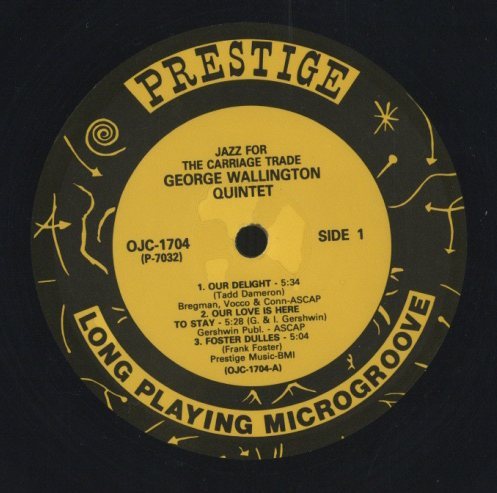
Listening to this album, with George Wallington as leader, is almost as much of a treat as being back at Smalls. It's that good. I'm listening, as always, to the tunes in order of set list for the recording session, not as they appear on the LP, starting with a couple by two important jazz composers. Tadd Dameron is one of the most important, and "Our Delight" is a delight, with some remarkable trade-offs between Woods and Byrd, and maybe even more remarkable piano solos by Wallington. Jazzdisco.com, probably going from the original set list, gives the drummer as Bill "Junior" Bradley, who had been working with the Woody Herman band and was working regularly with Wallington at that time. But the liner notes credit Art Taylor, who was doing a lot of drumming for Prestige in this days, so it's almost certainly him. Ira Gitler explains that although it's Bradley's picture on the album cover (I'll have to take Ira's word for this; I don't know what Bradley looked like, but the picture shows four white guys and Donald Byrd, so that would seem to be the case), he was out of town for the recording date--probably doing a gig with Herman.  In any event, the drum fills are very tasty indeed.

The second cut, "Foster Dulles," is not so much a tribute to Eisenhower's secretary of state as a play on the name of its composer, Frank Foster, and thank goodness boppers have not completely forsaken the art of punning on their names. Whoever picked the tunes for this session, Wallington or Weinstock -- and I have to guess it's Wallington, because it's such an eclectic mix -- did a great job.

Gershwin is next, with "Our Love is Here to Stay." It's fascinating to follow the range of composers, noted and obscure, from early 20th Century operetta to Fifties pop, who have caught the attention of modern jazz improvisers. But Gershwin remains the gold standard.

Two Phil Woods compositions suggest, from their titles and from the free-swinging good time music, that these are Rudy Van Gelder's "Five O'Clock Blues." "Together We Wail" is aptly titled, as Byrd and Woods wail together, separately, and closely conjoined., For that matter. so is "But George," which has more Byrd/Woods work, but also allows Wallington a large open space to make the most of.

"What's New" is a showcase ballad for a vocalist, with notable recordings by Linda Ronstadt and Frank Sinatra among others, and I hadn't realized it was written by dixieland bass player Bob Haggart. It makes a fine moody showcase for Wallingford.


Saturday, July 25, 2015

Listening to Prestige Part 65a: Zoot Sims

(Still filling in gaps from 1952. This incredible session just showed up on YouTube).


Al Cohn and Zoot Sims had played together a lot, starting with Woody Herman, and they would go on to be one of the most satisfying saxophone pairings in jazz history, but this was their first session together in a group led by one of them, and they hit the ground running. Having Kai Winding along doesn't hurt either.

"Tangerine" is a beautiful melody by movie composer Victor Schertzinger. It was given its most popular treatment in 1942 by Jimmy Dorsey, around the time that Zoot was joining the Benny Goodman orchestra as a teenager. It gets a swing to bop treatment here, starting with some amazing counterpointing by Cohn and Winding behind a Sims lead on the head, and then giving plenty of solo room to all three of them.

"Zootcase" begins with a complex lead-in by George Wallington to a simple but catchy unison riff by the three horns, terrific solo work by each of them, with the continued strong presence of Wallington, culminating in a piano solo, then a Blakey solo, after which the ensemble riffs it out.

"The Red Door" is a composition by Gerry Mulligan and Zoot Sims. As with "Tangerine," it starts with an intricate interplay between solo and ensemble, leading into a beautiful, lyrical solo by Zoot, followed by Kai and Al. One expects Al and Zoot to know just how to play together, and how to bring out the best in each other, but Kai adds one more piece of complete understanding to the mix.

"Morning Fun"  is an Al and Zoot composition, played by the quintet after Kai Winding had packed up for the day, and it's more of a blowing session, starting with vivid, uptempo cadenza leading into a two-horn riff, leading into lots more good stuff. George Wallington only takes a brief solo at the end, but his presence is felt throughout.

"Tangerine" and "Zootcase" were released on an eponymous EP. All four tunes came out on a ten-inch entitled Zoot Sims All Stars, and again packaged with a Stan Getz session (and continuing to trade on the Woody Herman classic) as The Brothers. Modern jazz did have a sense of humor--witness Dizzy Gillespie and Slim Gaillard, among others--but modern jazz packaging was not generally noted for much of a sense of humor, so it's interesting that Prestige had Don Martin as one of its album cover artists. Martin only did about a half dozen covers for them, and I don't know if the association ended because it turned out there was no room in jazz packaging for a sense of humor, or just because he went to work full time for Mad.


Friday, March 20, 2015

Listening to Prestige Records Part 92: Americans in Sweden

Was anyone left in New York or LA in the summer of 1953. It seems as though a goodly portion of the talents of both cities had relocated to Sweden, and it also seems that they were all drawn there by Lars Gullin, the only musician all these sessions have in common. Gullin is one of the most highly regarded of European jazz musicians, and another musician whose career was cut short by heroin. Although he lived until 1976, he was almost completely finished as a musician by the end of the 50s.

The first of these sessions, under Gullin's name, was on August 25, the others on a very busy September 15 and 16. Gullin led--I was going to say a mixed group of East and West Coast musicians, but actually most of the individual musicians are mixed groups in themselves. Conte Candoli is pretty solidly identified with the LA scene, and Konitz, through his close association with Lennie Tristano, surely represents New York. Don Bagley is also a through and through West Coaster. But Frank Rosolino was a Midwesterner from the jazz hotbed of Detroit before he found his way to 52nd Street, and from there to the LA jazz and studio world with which he is most closely associated, and Zoot Sims a native Californian whose jazz life was mostly in New York. I would have associated Stan Levey entirely with 52nd Street and the bebop scene, but actually within months of this session he had relocated to California. Perhaps Candoli and Rosolino bent his ear.

Peter Jones, who listened to this with me, through Spotify, from the hinterlands of northern Louisiana, aptly described this session as "sounds midway between Birth of the Cool and Oliver Nelson," which I thought captured it pretty well.

Most of these musicians had big band experience, and specifically, most of them had played with Stan Kenton, and I think a lot of them may have been on a European tour with Kenton in August of 1953. I know that the September sessions featured musicians from Lionel Hampton's touring band - Hampton didn't pay all that much, and his sidemen had to pick up extra work where they could. Checking further -- they all were on Kenton's tour.

So you have a bunch of musicians who've been playing Kenton arrangements, and they take a day off and go to dear old Stockholm -- well, they're probably in Stockholm already -- to make a record with a talented instrumentalist whose life had been changed in 1949 when he first heard the 78s of the nonet sessions and was so powerfully influenced by Gerry Mulligan that he took up the baritone saxophone, then changed again in 1951 by meeting Lee Konitz -- which is, in a way, more of the same change. So what would the Mulligan arrangements for Birth of the Cool sound like if they were played by the Kenton orchestra? And isn't that one of the things we love about jazz...about American music? It's so cross-pollinated. Musicians talk to each other, dance with each other, copulate with each other in combinations that would make a swingers' club pale with envy. And it keeps coming up new.


So all of the musicians from the August session were from the Kenton band. And were all of the September musicians from the Hampton orchestra? It turns out yes -- including Annie Ross. Who knew that she had toured with Hampton? Thanks to Mario Schneeburger, we have the complete personnel of the band, and its complete itinerary. I'll give an excerpt:

    1953/09/05
    Arrival at Fornebu Airport after flight from NYC with SAS.
    These musicians are willing to undertake the adventure of a tour across a foreign continent: Lionel Hampton(ld,vb,p,dr,vcl), Walter Williams(tp), Art Farmer(tp), Quincy Jones(tp), Clifford Brown(tp), Al Hayse(tb), Jimmy Cleveland(tb), George "Buster" Cooper(tb), Gigi Gryce(as), Anthony Ortega(as,fl), Clifford Solomon(ts), Clifford Scott(ts), Oscar Estelle(bs), George Wallington(p), Billy Mackel(g), Monk Montgomery(b), Alan Dawson(dr), Curley Hamner(dr,dancing,vcl), Annie Ross(vcl), Sonny Parker(vcl,dancing). Gladys Hampton, Lionel's wife and band manager, is with them.
    New to the band are Clifford Brown replacing Eddie Mullens, Gigi Gryce replacing Bobby Plater, George Wallington replacing Elmer Gill, and Annie Ross.
    All of them except for Annie Ross and George Wallington stay in the band until the end of the tour.
    The tour is originally planned to last six weeks. Its success leads to a substantial expansion. Lionel Hampton recalls in 1954: "We went over in September for six weeks and we stayed 12."

...

1953/09/07 The band arrives in Stockholm "..directly after successful concert in Oslo", Orkester Journalen. At Stockholm main station the band is bid welcome by Simon Brehm's band. A press conference is held. A welcome party takes place at Hotel Malmen. Hampton and Wallington play a piano duet, Annie Ross sings "Twisted", band members and local musicians jam together. Later on they move to 'Bal Palais' where the party continues until dawn.


[From Sept 8-13: concerts in Helsinki, Finland, then in Sweden's Falun, Hofors, Uppsala,Västerås, Linköping, Norrköping, Örebro, Eskilstuna, so if anyone ever tries to sucker you into a bar bet that no jazz great has ever played Linköping and Norrköping on the same day, don't take it. And finally back to Stockholm, for a]

concert at Konserthuset, starting at 21:15. The concert is recorded and partly issued. The Tom Lord discography gives a wrong date: 1953/09/15. Most other sources give only vague dates such as fall, Sept., Oct. Some days earlier, between September 9 and 12, Lionel Hampton and George Wallington are interviewed at the Swedish radio. In the studio they play a fine How High The Moon at the piano with four hands. Hampton says twice to the radio reporter: "See you on Monday". Coming Monday is September 14. The radio obviously plans to record the concert of September 14 in Stockholm. Recording session in Sweden: Annie Ross and George Wallington (2 titles each).

1953/09/15,  Gothenburg. Concert at the Concert Hall. After the concert a jam session takes place at Lorensberg restaurant. Among the participants are Anthony Ortega, Clifford Brown, George Wallington and Jimmy Cleveland with pianist Bengt Hallberg, drummers Kenneth Fagerlund and Arne Milefors among the "locals". "One night we had a recording session [in fact it was a jam session] after the concert in Gothenburg (Sweden). Brownie and Bengt Hallberg played 'Yesterdays' as if the tune would become, by some way, forbidden to be played anymore", remembers Art Farmer. Clifford Brown, Art Farmer and Quincy Jones find the time for a recording session in Stockholm with Bengt Hallberg and other Swedish musicians. This session probably takes place in the morning or early afternoon, before the band's departure from Stockholm to Gothenburg. Recording session in Stockholm on 1953/09/15: Clifford Brown-Art Farmer (4 titles with alternate takes)
Yes, I know I have a tendency to go way, way off on tangents sometimes, but I wouldn't be doing this blog at all if I weren't a little too much in love with jazz history. Anyway, the tour continues. More
highlights include two concerts on the same evening in the Netherlands, fortunately a small country, the first one in Scheveningen at 8 pm, the second in Amsterdam, a "concert at Concertgebouw, starting at 24:00. Hampton is suffering from fever. Nevertheless '..Hampton began to dance with a girl in the audience, and the rest of the hall took up the dance till the whole Concertgebouw seemed to be jumping.'" And trouble the next day in Brussels,  at a
concert at Palais des Beaux Arts. It is Annie Ross' last appearance with the band.
“Annie  Ross  is  fired  by  Hamp  in  Brussels  after  a  few  unruly  hecklers  had  booed  her  performance  there”,  says George Wallington. On the same day or thereafter George Wallington quits the band, either as a gesture of sympathy for Annie Ross, or because he is fired as well.
 Anyway, back to the Stockholm recording sessions. Annie does the Kern/Hammerstein standard (her version omitted from the Wiki discography for this song; I added it), and "Jackie," another from the Wardell Gray/Art Farmer sessions that yielded "Twisted" and "Farmer's Market," this one a Hampton Hawes composition that Annie turns into a history of bebop. Here's Billboard's review:

Jackie: The hip cats should flip for this cool item. The gal delivers a fast-talking story about a wild mouse on her blouse. It's fine for kicks.
 The Song is You: Here Miss Ross, a hip singer, tackles the standard for a reading which the jazz collectors should go for to some extent. She's much better, tho, in handling the [unintelligible] stuff.
The Billboard reviewer isn't entirely wrong. Annie is great on standards, but her vocalese is in a class by itself.

Ross appears with her soon-to-be-ex-bandmates from the Hampton orchestra; Wallington is with a group of Swedish musicians. It's a testament to the growing importance of both Quincy Jones and Gigi Gryce as arrangers that they're credited on these sessions. And although Jones was the one who went on to a megastar career, Gryce more than once arranges sessions on which Jones plays piano.

The piece de resistance, however, of this fine group of Swedish sessions, is the Clifford Brown/Art Farmer set. Both in amazing form, each spurring the other on.

All these were originally issued on the Swedish Metronome label; most also came out on the British Esquire label. Prestige put the Lars/American All-Stars on an EP, Americans in Sweden, as Zoot Sims/Lars Gullin/Kenton All-Stars, along with an earlier Zoot/Lars session from 1950.

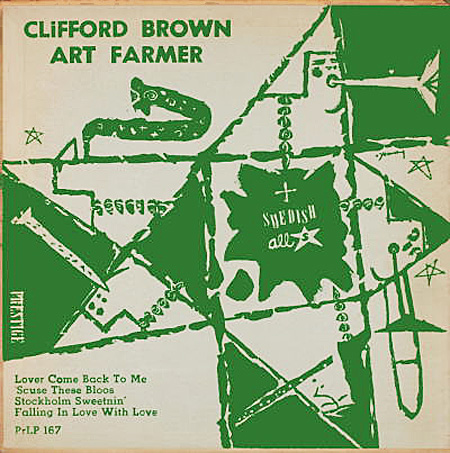
The two Annie Ross songs came out on a Prestige 78. The Wallington session was an EP, George Wallington And The Swedish All Stars. Clifford Brown and Art Farmer seem to have been on EP, were definitely on a 10-inch LP with cover art that's credited to David X. Young, although it doesn't look like his work. It's certainly not his best work.

Wednesday, February 25, 2015

Listening to Prestige Records Part 87: George Wallington

George Wallington chose two of the staunchest beboppers to accompany him on this trio session, the most stripped-down of all jazz groupings, for what turned out to be something other than a classic bebop session. Wallngton has the drive and the instrumental virtuosity of the beboppers here, but he brings to it an unashamed romanticism, full of gorgeous tone and musical flourishes. It's a winning combination.

Prestige was famous for not doing too many takes, but they must have really breezed through these tunes, because they got seven done in one session. Perhaps it made a difference that they're mostly Wallington originals ("I Married an Angel" is Rodgers and Hart, "Ours" is Leonard Feather), so he was familiar with the material. And it was less complicated, perhaps, with only three instruments and basically only one soloist, but good jazz is never uncomplicated.
Still, the floor belongs to Wallington here, because that's the kind of music it is--a setting for Wallington's stylish piano. No real space for Max Roach to stretch out, and Curly Russell never soloed.

And I wonder if that's part of the reason Russell's star started to fade. He would play one more session with Wallington, and a few more sessions on other labels, but by the mid-50s he was mostly gone from the jazz scene and into rhythm and blues, and then he retired from music altogether. The role of the bass was changing. Charles Mingus, of course, was in a category all his own: leader, composer, soloist. But other virtuoso bass players like Paul Chambers and Ray Brown were also changing the role of the instrument, making it more melodic, taking solo space.


Was this partly because recording techniques were changing, and the bass could be picked up better? Could be. And the mechanisms for playing music were changing, too. The long playing record made longer cuts possible, with more room for a variety of solos. And sound reproduction was better. I remember when I got my first high-fi record player, and a set of good--not great--speakers. The first album I put on was Gerry Mulligan and Chet Baker, the famous Mulligan experiment with a pianoless quartet. And I was entranced. Wow...I could hear all the instruments! I could hear what Larry Bunker and Chico Hamilton were doing, all the way through.

In this session, you actually can hear what Curly Russell is doing. Max Roach less so, but you know he's there, providing the rhythmic propulsion and complexity for Wallington's virtuoso work.

These were released on a 10-inch LP, and then on much later reissues.


Tuesday, January 06, 2015

Listening to Prestige Records Part 66: Annie Ross

There's so much to say about this session that I scarcely know where to start.
I decided to undertake this blog project -- well, on a whim, mostly, but because Prestige Records played such an important role in my learning about. and coming to appreciate, jazz. So many of the first records upon which I built my jazz collection were from Prestige. So I first thought that this would be a way to revisit some of my favorite sounds.
It's turned out to be three different experiences:
  • Revisiting sounds I've loved.
  • Discovering sounds I've never heard.
  • Discovering artists I've never heard of, or barely heard of.
In the third category, Joe Holiday and Chubby Jackson, for sure. George Wallington, up till now only a name I vaguely knew as a sideman. Charlie Mariano.

In the second category, so much. Early Stan Getz. Tristano recordings I hadn't heard. Miles Davis and Lee Konitz. Gene Ammons and Sonny Stitt. Mulligan before he decamped for the Left Coast. Zoot Sims (there's a Zoot session for Prestige on September 8 with George Wallington on piano. Also Al Cohn, Kai Winding, Percy Heath, Art Blakey. Spotify doesn't have it, and neither does YouTube, so I couldn't write about it, more's the pity).

In the first category -- I've talked before (and even earlier) about how important the King Pleasure/Annie Ross album was to me when I first started listening to jazz.

So let's talk about this session, starting with the incredibly fortuitous chance meeting between Annie Ross and Bob Weinstock.

Annie was a show business kid, and an early talent. She played Judy Garland's sister in a movie, and age 14, she won a songwriting contest judged by Dinah Shore and Johnny Mercer, and her winning entry, "Let's Fly," was recorded by Mercer and the Pied Pipers. You can find it on YouTube, and it's a pretty darn good song by any standards -- incredible, for a 14-year-old.

She has said in a recent Downbeat interview that what she looks for in a song is "good lyrics. I can’t sing stupid words." And even at 14, she was starting to find a way with lyrics.

Let's fly away to lands strange and unknown
Where love's free and there's no such thing as a mailman, doorbell, telephone

So...Bob Weinstock had his runaway jukebox hit with "Moody's Mood," and he was looking for something similar. In the same Downbeat interview, she describes it:

I was introduced to Bob Weinstock, head of Prestige Records. He asked me if I’d ever heard of King Pleasure. And he asked if I could do the same thing he was doing: write lyrics for solos. I was desperate, so I said, “Sure.” If he’d asked me if I could learn how to fly, I would have said “Sure.” He gave me some records and said, “Pick a tune and come back when you’re ready.” I was there the next morning with the lyrics to “Twisted.”
The thing about this session is -- every decision made, all along the line, was perfect, starting with Weinstock's decision to ask Ross if she could do it. Because this was brand new -- nobody had done it except Eddie Jefferson, and King Pleasure recording Jefferson's lyric. There was no way of knowing who could do it well and who couldn't -- or even what doing it well meant.

Then there was the decision of what records to give Ross to listen to. Obviously, he gave her a stack of Prestige 78s, because who wouldn't?  If I were a record label owner/producer, and I were becoming a midwife at the birth of a new jazz form, I'd be damn sure it was happening with artists and records from my label. I'm guessing he gave her some Gene Ammons and Sonny Stitt -- and King Pleasure was later to make a classic version of Ammons's recording of the Lionel Hampton tune, "Red Top." And he gave her the Wardell Gray/Art Farmer session.

And she picked it out -- another exactly right decision. "Twisted" is a great composition, a great solo by Wardell Gray, and a title that suggested...well, as Ross put it, "the title was infinite possibilities. You could marry anything to it." And she was in analysis at the time.

I'm guessing that one listen to Annie's version of "Twisted" and Weinstock set up a recording session as fast as he could -- giving her time to write one more song, again choosing from the same session, this time Art Farmer's "Farmer's Market."

What else for the session? An Annie Ross composition, "The Time Was Right," and a wordless scat ballad, "Annie's Lament" -- improvised by Annie right in the studio? Could be. I couldn't find any information on it.

Anyway, let's get to the session itself, and some more exactly right decisions. "Twisted" and "Farmer's Market" are recorded with a group led by Teacho Wiltshire, and that turns out to have been the right decision. "Twisted" has become such an iconic song, covered by singers from Bette Midler to Joni Mitchell to Amy Winehouse, that the song, the lyric, and Annie's vocal are indelibly stamped on our memories. But listen to the whole thing. Listen to the rhythm-and-bluesy riff from Teacho that opens the track, kicked and twisted by an amazing drum pattern from Blakey. Then Teacho wisely stays outta the way. Listen to how Blakey answers Annie's rhythmic swirls and tricks all the way through. And don't forget that Weinstock didn't rehearse his sessions, and didn't do a lot of takes. And don't forget that Ross wrote these lyrics to Wardell Gray's solo, but she's singing it as a jazz musician. She's making it her solo.

The same can be said of Percy Heath  -- and there is a bass solo here, right near the end, a powerful one. I'm assuming what we're hearing on Spotify is from the album, so it may have been remastered by Rudy Van Gelder to bring out the bass more vividly, but to be honest, I don't know how much you can remaster a monaural session with one mike. Anyway, you can hear the bass, and it's Percy Heath, and 'nuff said.

And who thought of adding Roger "Ram" Ramirez to this session? Ramirez was mostly a piano player who had just recently taken up organ. He had worked with female vocalists in the past, notably Helen Humes and Ella Fitzgerald, as a pianist. Again, a dead perfect decision. Listen to what Ramirez does at the beginning, at the end, and adding emphasis and coloration all the way through.

Listen to the incredibly fast part in the middle, between the fifth of vodka part and the double decker bus part. Listen to what Annie does, and what the rhythm section does. Hell, just put the song on
repeat and listen to it straight through about four or five times. It won't stop rewarding you.

I could say all the same things about "Farmer's Market." Wonderful stuff from Ram Ramirez. Teacho getting more space here, and doing it proud. How about listening to Annie's fast-paced rhymes, which would many hip-hop wordsmith sit up and take notice? And a nice shout-out to the guy who mentored Art Farmer, and pulled everything together on the "Farmer's Market" session, when the crew-cut kid with the crazy goatee goes out on tour with Wardell Gray.

OK, then what? We have these two tunes by Annie - not the same thing as this new sound that doesn't have a name yet but pretty soon everyone will be calling vocalese. Not the same thing at all. Maybe a rhythm and blues bandleader isn't quite the right guy for the job.

Hey, I know! We'll call George Wallington. He's been doing everything for us this summer, and he's still in town.

I like to think that's how it happened. A quick call to George, and he shows up just in time to take over on piano. In any event, another exactly right decision. Wallington doesn't get outta the way here, and he and Annie complement and inspire each other.

Why isn't "The Time is Right" one of the great pop music standards? I don't know of anyone else who's recorded it. Annie Ross wrote it, and brought it to the session with her. It is a beautiful song, worthy to be put alongside Johnny Mercer or anyone else you can name.

Was "Annie's Lament" written, or improvised in the studio? It's wordless, it's haunting, it's beautiful, and again it's Annie Ross and George Wallington.

Annie must have learned something from Bob Weinstock, because here she is, more than half a century later (same Downbeat interview), talking about her most recent album, a tribute to Billie Holiday, cut with Bucky and John Pizzarelli:

 How much pre-production did you do?

None! [laughs] They’re real musicians. I made a list of songs, we looked ’em over and then we recorded ’em. With real musicians, you don’t need to rehearse. That’s where the creativity comes in. We did one or two takes, no more than that. The level of trust between musicians and singer has got to be implicit, and it was with John and Bucky. The arrangements were done as we felt them, in the moment. It was pure joy; you know when you’ve got something good. 

Annie owed her first break in New York, in a way, to Billie Holiday:

I’d been working in France with James Moody and Kenny Clarke and I’d just come back to America. The morning after I signed with Joe Glaser—who was Billie Holiday’s agent—I got a call to get up to the Apollo. Joe asked me, “Do you have a piano player? Do you have a gown? Do you have music?” I said yes to all three and he told me to get up to the Apollo by 8:30. “You’re replacing Billie Holiday.” I was 20 or 21. It was my baptism by fire. She later became a good friend.

20 or 21 would make it 1950 or '51, a year or two before meeting Bob Weinstock and writing "Twisted" in one night.

"Annie's Lament" / "Twisted" came out on 78; "Farmer's Market" / "The Time Was Right" on both 78 and 45. All four songs were collected on a 45 RPM EP. And, of course, the 1957 release of the King Pleasure/Annie Ross LP.  The records won her DownBeat's New Star award for 1952.


Sunday, January 04, 2015

Listening to Prestige Records Part 65: George Wallington

How hard is it to be a jazz musician? George Wallington was one of the original beboppers, one of the most respected and sought-after bebop piano players, and in 1960, worn down by the grind and the constant scuffling for money, he quit to go into the family's air conditioning business. And he was lucky to have a family business to go into. Who knows how many other great musicians of this era would have made the same choice, had they been able to? Who knows for how many heroin was an alternative to the family air conditioning business?

Wallington was retired from music for a quarter century, finally returning in 1984 to record three albums before he died in 1993.

In 1952, Wallington was 28 years old and a veteran of the jazz world. He had been a part of the first band that Dizzy Gillespie brought to 52nd Street, in 1944. And even then, at 19, he was a seasoned veteran. He had grown up in an Italian immigrant family (his birth name was Giacinto Figlia - "Wallington" was a schoolyard nickname because he dressed like a British swell). His father had introduced him to opera, and gotten him started on piano and solfeggia (sight singing); Lester Young (heard on the radio with Count Basie's band) inspired him to turn to jazz. By 16 he was playing in clubs in New York, including a spot called George's, where he accompanied Billie Holiday.

About that first bebop gig with Dizzy, at the Onyx Club, Wallington said:

Dizzy used to take me to his house and we'd play and he showed me his songs. Then he and Oscar Pettiford started the band at the Onyx. Charlie Parker was supposed to join us but he couldn't get a cabaret card. Anyway we had Don Byas, then Lester Young. Billie Holiday used to sing with us sometimes and Sarah Vaughan used to come in too.
I don't know if we thought of what we were doing at the Onyx as something historic, but we did know we were doing something new and that no one else could play it.
OK, this is why, when anyone asks me "If you could go back in time to another era, what would it be?" my answer is always the same. New York, 1940s. 52nd Street, Minton's, Monroe's.


Max Roach said of Wallington'a role in that first band at the Onyx that his great virtue was knowing how to stay out of the way.
We didn't need a piano player [like Bud Powell] to show us the way to go. Piano players up to that point played leading chords. We didn't do that because we were always evolving our own solo directions. We needed a piano player to stay outta the way. The one that stayed outta the way best was the best for us. That's why George Wallington fitted in so well with us, because he stayed outta the way, and when he played a solo, he'd fill it up; sounded just like Bud.
Leading his own group, Wallington didn't need to stay outta the way, and Roach was still propelling him on, and the sidemen on these two sessions give some idea of how much respect Wallington had garnered by this time -- even from Oscar Pettiford, whom Roach remembers as not being entirely won over by Wallington when the Onyx Club gig came together:

 Every now and then, George would miss a chord, and Oscar would jump all over him, "White muthafucka can't play -- shit!" I had to spend a lot of time protecting him from Oscar.
 "Sounded just like Bud" is something you hear a lot in discussions of George Wallington. They were two of the most important pianists in the development of bebop -- and, Wallington's ability to stay outta the way notwithstanding, two of the most accomplished and daring virtuosi. But there's a lot of difference, too. Wallington's early classical training shines through, and you can hear the sorts of romantic flourishes you'd associate with a Vladimir Horowitz. But when Wallington takes on an unabashedly romantic tune like "Laura" or "Tenderly," those same flourishes become dry, ironic, brilliantly anti-romantic.

Speaking of romanticism and "Tenderly," here's a story told to me by the great pop singer Margaret Whiting, who was a close friend when I lived in New York in the 70s. She and songwriter Walter Gross had been an item, but she'd had to break it off because of his drinking. But then one night he showed up at her house about two int he morning, drunkenly banging on her door and demanding to be let in. She had no choice - she opened the door before he could wake the whole neighborhood.

He confronted her: "You fucking bitch...you ruined my life, you fucking cunt. So I came by to tell you just what I thought of you, you fucking bitch." He staggered over to the piano. "I wrote this to show you what I think of you, you fucking bitch." And he played "Tenderly."

Margaret was a romantic, but also a realist. She got some coffee into him, and immediately called...who but a lyricist? Jack Lawrence came over, and they finished the song.

On the first of these sessions, Chuck Wayne joins the group on mandola, which is an unusual instrument -- slightly larger than a mandolin, it bears the same relation to a mandolin that the viola has to the violin. It's also an unusual instrument for a bebop ensemble in that it uses the same tuning as the tenor banjo, an instrument associated with the early Dixieland bands.

But Wayne was an unusual jazz guitarist -- for one thing, he may well have been the only jazz guitarist ever to play the banjo on bebop recordings.. Like Wallington, he was the son of immigrant parents (Czech, in his case -- he was born Charles Jagelka), and his musical start was playing the mandolin in a balalaika band.

He had switched to jazz, and to the guitar, by the time he met George Wallington. They were both playing in a Dixieland group led by Joe Marsala, and Wallington introduced him to bebop. They're a good pairing on these quartet sessions.

And tossing this in -- Wallington composed "Godchild," one of the tunes on Birth of the Cool.

The trio and quartet sessions were all released on 78, and all on the same 10-inch LP (as George Wallington Trio).


Sunday, February 03, 2013

Birth of the Cool: Godchild

Birth of the Cool 7: Godchild. I'm doing this in the order they appear on the CD, not the order they appeared on the original album.The reason for this choice...actually it wasn't a choice. This happened to be the first track listing I ran across online, not having the album in front of me. If I were to start over, I'd use the original listing. Actually, "Godchild" is the third track on the album. The first four were "Jeru," "Move," "Godchild" and "Budo." They were the first four songs recorded, and the two singles released, someone at Capitol having decided they were the best melodies, and likely to be the catchiest. A good decision, I think -- it's really those first four melodies that hooked me in thinking about the album, and made me want to pursue this. Certinly "Godchild" is a wonderful melody. It was written by George Wallington, an outstanding bebop pianist, and it's probably been recorded in more different version that any other piece except possibly Budo/Hallucinations. In at least one YouTube uploading, the composition is credited to Gerry Mulligan, and certainly his arranger's hand is here, but it's Wallington's tune. Starting with the Birth of the Cool track:

Here's a beautiful version by Wallington with a trio, featuring Nick Stabulas on drums, and Teddy Kotick, who I had the pleasure to meet when he played at Opus 40 with J. R. Monterose, on bass.


AllMusic lists a version several of the Birth of the Cool tracks by Miles Davis and Charlie Parker, and I've dug deep, trying to find them, and have finally come to the conclusion that they don't exist. Apparently there's an LP of Charlie Parker - Miles Davis - Lee Konitz, but it's a teaser. Some of the tracks are by Bird, some by Miles and Konitz.


Here's a beautiful version by a Mulligan tentet featuring Art Farmer and Lee Konitz. Great ensemble work, wonderful opening statement of the melody by Mulligan, lots of room for solos, the Farmer and Mulligan solos neatly resolving in an ensemble restatement of the melody.


Versions you can find on Spotify but not YouTube -- Bill Charlap, Tal Farlow/Charles Mingus/Red Norvo, Howard Roberts. Here's one YouTube does have, from Kai Winding:


 And from the classic Mulligan-Chet Baker quartet:


And finally, Terry Gibbs with a big band: