Tad Richards' odyssey through the catalog of Prestige Records:an unofficial and idiosyncratic history of jazz in the 50s and 60s. With occasional digressions.
Bob Weinstock must have had a lot of confidence in his barely 17-year-old prodigy Ray Draper, giving him John Coltrane as a bandmate. It's tough enough playing bebop on a tuba, without being asked to play it off against one of the most advanced improvisers of the era. And to up the stakes a little more, either Weinstock or Draper decided not to go with their tried and true reliables in the rhythm section. Each of them had played on only one other Prestige session. Gil Coggins had played on a Jackie McLean session in August. Spanky DeBrest had appeared on Draper's debut as leader, though he was already an established figure with Art Blakey's Jazz Messengers. Larry Ritchie had also worked with Draper, on the July 12 Jackie McLean session.
All of this works. Coggins is a jagged, percussive piano player, and sets the tone that this is going to be a different kind of session. Draper and Coltrane work well together in the ensemble passages. Draper proves that he's a first rate composer on his originals, particularly "Clifford's Kappa," and he shines as a soloist.
And that's saying a lot, considering what he was up against. Everything from this session is good, better than good. But Coltrane was on fire. When he solos, everything else melts away. I've been following Coltrane's progression here, from the Miles sessions through the wide-ranging array of sideman gigs that Weinstock used him for, through his sessions as leader, looking for clues as to what he would burst forth into come the 1960s, and not really finding them. In each of his Prestige sessions, including this one, he is right there in the present moment, making the music he's brought in to make. And making all the right choices. And listening to his recording sessions in chronological order, all I can say is that he keeps getting better and better.
His solos here virtually stop time and space, and exist in their own dimension. But that doesn't mean he's ignoring what's around him. He's working with Draper and Coggins, building on what they're doing, and they're doing some very, very good stuff.
In spite of all that, it's hard to know what to do with a tuba player, and Weinstock was not going to do more. This is Draper's last session for Prestige, and it was released on New Jazz, which generally meant it was not going to get the promotional push that went behind a Prestige release. Draper would record only sporadically after that, succumbing to heroin addiction and drug-related prison time. He died in 1982, meeting an ironically grisly end for a musical prodigy: he was shot and killed by a hold-up gang led by a 13-year-old.
The original New Jazz release was called The Ray Draper Quintet featuring John Coltrane. A much later Prestige reissue was title The John Coltrane/Ray Draper Quintet.
This is around the time when Bob Weinstock stops being the hands-on guy in the studio (although his idea of hands-on was mostly hands off), and starts turning some sessions over to other producers. He's had Teddy Charles produce a few, but those were really Teddy Charles projects.
Here he gives over some of his regulars to a new guy, Don Schlitten. And this is, in fact, a session that makes up part of an album begun back in February, with Weinstock at the helm. Schlitten was a young guy -- at 24, four years younger than Weinstock, and at the beginning of a long career in jazz. Like Weinstock, he had started his own label at a young age,
but perhaps had not had the business acumen, or perhaps just hadn't found his focus yet. His label, Signal, which he formed with Ira Gitler, did some significant work, recording Duke Jordan, Gigi Gryce, Red Rodney, Cecil Payne, and a live tribute to Charlie Parker from the Five Spot. They also put out an interesting series called Jazz Laboratory, which was sort of similar to Music Minus One. It featured quartets led by pianists like Duke Jordan and Hall Overton, with one horn player. On the reverse side of the album, the horn player dropped out, and the remaining trio did the same songs.
After a couple of years, Schlitten sold the label to Savoy, and went into independent production. He would go on to form other labels, and make a major contribution to jazz.
He brings a few faces to this session in the rhythm section. Jon Mayer didn't make much of a name for himself in the 1950s (and the name he did make was not entirely his own, if this session is an indication), but that would change several decades later. He made one other album (with Coltrane), played on gigs with Ray Draper (who may have recommended him here, as he did earlier with Webster Young), Kenny Dorham, Tony Scott and others, and in the 60s he performed with the Thad Jones/Mel Lewis big band, and accompanied Dionne Warwick, Sarah Vaughan and the Manhattan Transfer. Then he dropped out of sight until the 1990s, when he made a series of highly regarded albums, including a couple with Mark Feldman's Reservoir Records, out of Kingston, NY. He is still active.
Bill Salter is probably best known for his years as bass player and musical director for Miriam Makeba, but he picked an odd route into jazz--his first professional job was with Pete Seeger. Salter sort of passed through jazz. It was only part of what he did. His folk music credentials included Harry Belafonte and John Prine as well as Seeger. He was in the pit for Broadway shows. He wrote hit songs for Shirley Bassey, Roberta Flack and Donny Hathaway, Grover Washington, Jr. and Rod Stewart. But as he passed through, he left a mark: recordings with Sabu, Herbie Mann,Yusef Lateef, David "Fathead" Newman, Rahsaan Roland Kirk. He currently plays traditional black vaudeville music with his own group, the Ebony Hillbillies.
Like Gil Melle and Larry Rivers, Larry Ritchie was torn between painting and music, and over time he drifted more into painting. He would be back in Hackensack one more time in 1957, recording with Ray Draper and John Coltrane.
Draper and Webster Young make up the rest of the sextet part of the session, and Draper contributed one tune, the oddly named "Disciples Love Affair." McLean pairs down to a quartet for the final number of the day. "Not So Strange Blues" is sort of a companion piece to "Strange Blues," from the earlier session, and it may not be strange, but it sure is the blues.
If Schlitten was looking for instant recognition from his first Prestige session, he was doomed to disappointment. Strange Blues, which included these three tracks, would not be released for another ten years. But Weinstock was satisfied enough to hand him more assignments. And this whole McLean project was pretty weird. The long February session, which included "Strange Blues," would be released in dribs and drabs on New Jazz starting in 1959.
Don't ask me why Webster Young gets the special "introducing" credit in the session notes. New performers were introduced all the time, especially with Jackie McLean. Ray Draper had just made his debut a month earlier on a session with McLean and Bill Hardman, himself a McLean introducee. But that's what it says.
Draper's debut as a leader is noteworthy for a couple of reasons: (a) there aren't all that many jazz combos led by a tuba player, and (b) Draper was still only 16. But he had leadership qualities, and if he hadn't lost so many years to heroin addiction (it must have been tough to handle being 16 and being thrust into the cauldron of the New York jazz life), he could have done a lot more. As it is, he is credited with being the first musician (even before Miles) to form a jazz-rock fusion group
There are a bunch of faces new to Prestige here. Except for McLean and Mal Waldron, this is a new mix, which once again leads to the speculation on how a group is put together for a session. Sometimes musicians who grew up together will coalesce to make a record, like the various Detroiters, or Harlem high school pals Sonny Rollins, Kenny Drew, Jackie McLean and Art Taylor. But Ray Draper certainly wasn't calling on guys his age from the old neighborhood, because there weren't any other guys his age playing jazz on this level. Webster Young, Spanky DeBrest and Ben Dixon were all in their early twenties, but there's a big gap between that and 16.
But we know a certain amount about this session, from a reminiscence by Webster Young in Jazz and Blues Musicians of South Carolina, by Benjamin Franklin V. Young was living in Brooklyn and mostly playing with a bunch of guys in Brooklyn, although he would come in to Manhattan to informally apprentice with Miles Davis, and occasionally sit in with him on gigs. Miles, he said, would encourage him but keep him in check:
If you wanted to show off, Miles would say, "You got a Cadillac outside?" In other words, "What's wrong with you?" I dug it, I needed that.
Ray Draper would occasionally show up at the Brooklyn jam sessions.
He'd been playing at some sessions in New York and some competitions at Birdland...He was a nice cat [but] full of himself. I was a little bit older, and I helped him to be serious...Ray came up with a proposal. If he could play with us, he'd get us to the New York competitions. I said "No." And I didn't want a tuba player. But the other cats said if we did it, we'd be doing something. So I thought if we didn't do it, I'd lose the band. We let Ray play with us, and we had the competitions. Nat Hentoff...was one of the judges. We played three competitions. We won them all.
Young was invited to meet Jackie McLean and hang out during Draper's first recording session with McLean, and
...during intermission, Bob Weinstock came over to Ray and said he was going to record him and Webster. He didn't even know me.
So that's how Young got on the session. He was also the one who recommended drummer Ben Dixon, a fellow South Carolinian. The two had moved to Washington and then Brooklyn together, and Young had told Draper that "I'd make the date as long as we had Ben Dixon on drums."
Dixon would go on to a substantial career in New York, becoming a sought-after drummer especially for Blue Note's soul jazz recordings, working a lot with Lou Donaldson and Grant Green. Young played on several Prestige dates in 1957, and that was pretty much the end of his recording career, although he continued to be in demand as a working musician. He told Franklin that he had reservations about doing a lot of recording because he didn't want to be tied down to a day job, although he eventually did take a day job, becoming a respected educator.
Jackie McLean is the veteran here. Although only 25 himself, he was already considered a major jazz star, and one of the most recorded jazz musicians of his time. There were a couple of reasons for this. First, that he was really good and really versatile. Second, that his situation was almost exactly the opposite of Webster Young's: he was largely limited to day jobs. He battled heroin addiction throughout the '50s, and his arrest and conviction for heroin possession meant that he could not get a cabaret card to work in New York City clubs. As Young recalls in his taped reminiscence, Jackie "was the cat," but because of his ubiquitous exposure and his innate generosity, he gave much of the solo space to the younger musicians.
Draper and Young each contributed two songs to the set, each of them paying tribute to a mentor, Young with "House of Davis," and Draper with "Jackie's Dolly," dedicated to McLean's young daughter. And Webster paid tribute to another idol with his suggestion of "You're My Thrill," one of his favorite Billie Holiday recordings.
Mal Waldron's "Pivot" had previously been done on the Jimmy Raney / Kenny Burrell version of the Prestige All Stars, and here it shows Waldron's piano chops as well as his compositional skills.
Jazz instrumentalists were doing amazing things with unlikely instruments during this era. J. J Johnson and Kai Winding had shown that fast, complex bebop figures could be played on the trombone. The bass had become a flexible solo instrument in the hands of players like Paul Chambers and Oscar Pettiford, and Ray Draper was ready, at 16, to step out front and make the tuba a significant solo instrument. And to show just how much can be done in those lower registers, he played some exciting bass-tuba duets with Spanky DeBrest (best known for his work with Art Blakey and the Jazz Messengers).
The session was released as Tuba Sounds, with "introducing Webster Young" as part of the front cover text.
Just a little digression at first to vent a bit. Jazz writing is full of cliches, and I'm sure I've used more than my share of them. But sometimes you get a little irked. I hate to draw a bead on one other writer for what is really a cumulative irkedness, but an article on Miles Davis in a recent New York Review of Books starts off with the oft used observation that "the notes he chose not to play were almost as meaningful as those he did."
What does that mean, anyway? I know that heard melodies are sweet, but those unheard are sweeter. I know that one of the myriad reasons why the novel, The Mambo Kings Play Songs of Love, is better than the movie is that you can imagine the unbearable sweetness of "Beautiful Maria of My Soul," whereas in the movie there's an actual song, composed by Robert Kraft, who's a perfectly good composer, but it's just another song, not the worst you've ever heard but not the best either.
But none of that is about the notes you don't play. When I first heard In a Silent Way, I was stunned by Miles's restraint--how much he held back from playing, and how powerful the parts that he did play. But I can't tell you anything about the notes he chose not to play, because I didn't hear them. And I'm not sure I believe that there were any notes that he chose not to play. There were times that he held back from playing, but that doesn't mean there were sequences of notes that he heard in his head and chose not to play.
And Miles didn't exactly invent not playing. Max Roach, talking about how effective George Wallington was as a piano player in the early bebop groups, said
We needed a piano player to stay outta the way. The one that stayed outta the way best was the best for us. That's why George Wallington fitted in so well with us, because he stayed outta the way, and when he played a solo, he'd fill it up; sounded just like Bud.
And Miles, famously, told Monk to lay out while Miles was playing his solos. Monk, significantly, let Miles know that while he was laying out, he was just staying outta the way, he was not carefully choosing meaningful unplayed notes."
I used to tell my creative writing students "know everything, and write ten percent of what you know," which I either borrowed from Hemingway or pretended I had. But if you're doing that, what ultimately counts is the ten percent that you write, not the ninety percent you leave out.
The NYRB article goes on to say that
Davis shed styles as soon as they risked settling into formula. When “cool” lost its edge in the hands of white West Coast musicians, he pioneered hard bop, a simplified, funkier style of bop that reasserted jazz’s roots. When hard bop hardened into its own set of sweaty clichés, he gravitated to “modal” jazz, which used scales rather than chord changes as a harmonic frame.
Miles had a restless muse, and it made him what he was, and some of his experiments were more successful than others, but a genre of music doesn't automatically become worthless just because Miles Davis stops playing it. "Cool" didn't simply lose its edge because Gerry Mulligan (who was in with Miles at the creation) went out to the West Coast and kept playing it, and when Jackie McLean's pal Bill Hardman led a hard bop group (with Junior Cook) into the early 1980s, he was playing exciting music, not sweaty clichés.
We are still relatively early in the hard bop era, an era defined by having no particular starting point and no particular ending point, and having no particular defining characteristics. It was jazz, or as Miles insists on calling it in the recent Don Cheadle movie (music direction brilliantly handled by my pal Ed Gerrard), "social music." The society of the men and woman who made this social music was eclectic and original and committed to musical exploration wherever it took them.
And there's an interesting bit of exploration here, right at the start of this set. We just recently listened to the Mal Waldron composition, "Flicker" (or "Flickers" -- it seems to go by both names) as played by a Prestige All Stars group augmented by Kenny Burrell and Jerome Richardson, and here we have it again by Prestige stars Jackie and his pal, the All Star Waldron-Watkins-Taylor rhythm section, this time augmented by tuba virtuoso Ray Draper. In the first version, the head is played as almost a fanfare, which then gives way to the nimble dexterity of Burrell's guitar and Richardson's flute.
In Jackie's version, the fanfare is still there, but he takes a more melodic approach. And where Burrell went into the air with a flute, McLean comes down to the ground with a tuba, providing an earthy cushion right from the start. He also takes a solo, between Bill Hardman and Mal Waldron, and all three of these solos add something new. It's fitting that Waldron, the composer, takes the last one, giving a special insight into the melody.
Draper is on two cuts: this one, and his own composition, "Minor Dreams." This is an impressive recording debut for a young musician, made all the more impressive when you consider how young: Draper was 16.
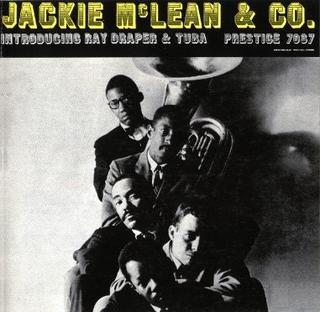
Jackie McLean, who knew something about how hard it is to break through in the music business, seems to have made a commitment, not only to introducing new talented musicians, but to making sure they got fulll recognition (Jackie certainly knew something about getting less than full recognition). We've seen how he introduced his pal, Bill Hardman, on Hardman's recording debut. The full title of this album is Jackie McLean and Co., Introducing Ray Draper and Tuba. The "introducing" part was left off when the album was rereleased on New Jazz, but by that time Draper had introduced himself on his own Prestige album.


:format(jpeg):mode_rgb():quality(90)/discogs-images/R-7069360-1432996141-6372.jpeg.jpg)