As I go back over my earlier entries, thinking about preparing them for a book, I run across a few sessions that I wasn't able to find and listen to at the time, but have since been able to rectify that problem. Moody worked with a lot of Swedish musicians during this period, and most of them were pretty good -- certainly all must have benefitted from playing with him, and the other Americans who made Sweden a second home during this period. Dave Liebman, in an article on European jazz, says "the typical Swedish jazz musician is the best overall equipped craftsman around." By 1953 Prestige would have released 11 albums made in Sweden and featuring Swedish musicians, either with or without an American star such as Moody or Stan Getz or Lee Konitz, and in 1954 Lars Gullin, who I don't believe ever toured the US, won the Down Beat award as best new talent. And the Swedish musicians brought a lot of Swedish folk music into jazz, most notably the tune originally known as "Ack Värmeland, du sköna"/"Värmlandsvisan," perhaps better known by the title Stan Getz, Miles Davis, John Coltrane and others recorded it under: "Dear Old Stockholm."
James Moody, after a three-year apprenticeship in Dizzy Gillespie's big band, went to Europe in 1949. New York, the road, and the jazz life of the late 40s had put him in harm's way, and his mother was worried about his drug use. She had an uncle in Paris, and she asked him if he would take young James in and get him away from bad influences. He stayed in Paris until September of 1949, then decamped for Sweden, then Switzerland, then Paris again, and then Sweden again in the fall of 1951 before returning to the United States. He did a lot of recording in Europe. These were his first sessions as a leader, and a powerful period of growth and maturity for him, from age 23 to 25. Sweden wasn't necessarily the best place to escape drugs -- Lars Gullin had a lifetime heroin, and then methadone, addiction, which ultimately led to his death from a heart attack at age 48.
But people find different ways to their creative voices, and Moody found his among blond-haired Vikings. His most famous recording, the one that came to be known as "Moody's Mood for Love," was cut on his first visit to dear old Stockholm.
This session, or rapid-fire series of sessions, came in January of 1951, shortly before he returned to the States. He was into the studio for three days, with a virtual revolving door of Swedish musicians (well, what else was there to do in Sweden in January?) , including a string section. Charlie Parker With Strings had first been released in 1950, and records didn't travel as easily back then as mp3s do today, but the idea of playing modern jazz with a classical string section certainly started with Bird, and if Moody hadn't heard the records, certainly he must at least have heard of them. There are some who question Parker's decision to record with strings, though not too many by now. And if there were more people to hear Moody's two cuts (they're pretty hard to find), there might be those who'd question them too, but actually it's hard to see how. He does some of his strongest soloing and improvising on "Cherokee." And the interplay between Moody and the string section on "Pennies From Heaven" is inspired -- witty, imaginative, musical. There's also a wonderful piano solo from Rolf Larsson, a musician whose reputation never traveled far beyond Sweden.
All of these were originally released on Sweden's Metronome label, but all of them were picked up pretty quickly by Prestige and issued on 78 and 10-inch LP -- a plucky call on a young and relatively unknown expatriate. Although by 1951, he wasn't quite so unknown, was he? Not after the jukebox success of "I'm in the Mood for Love."
Tad Richards' odyssey through the catalog of Prestige Records:an unofficial and idiosyncratic history of jazz in the 50s and 60s. With occasional digressions.
Showing posts with label 1951 recordings. Show all posts
Friday, April 17, 2015
Saturday, December 13, 2014
Listening to Prestige Records Part 59: Wrapping up 1951
A productive year for Bob Weinstock and Prestige, as the label could now lay claim to being as important as any in jazz. Among Weinstock's chief accomplishments -- getting Miles Davis back to New York and into the studio, making a commitment to LP records so that recordings could last more than three minutes.
Fifty recording sessions, almost all of them in New York - and that's leaving out the Swedish groups. That's an average of pretty near one a week. Sonny Stitt and Gene Ammons were the workhorses, with eight sessions -- three under Stitt's name, five under Ammons's. Sonny Rollins recorded two (one of them an afterthought to a Miles Davis session) -- these were his first recordings as leader. Miles Davis had two sessions -- the second, in October, being Prestige's first to take advantage of the new LP possibilities, And two sessions for Lee Konitz, both in the same week, one featuring Miles, the other a duet with Billy Bauer. Teddy Charles, Red Rodney, Bennie Green, Gerry Mulligan all one session each, It was also Mulligan's first session as a leader, so that makes two pretty impressive debuts.James Moody had five sessions, all on the same three days in January, all in Sweden.
Incredible records that took me by surprise -- Charlie Mariano, Joe Holiday. And nice to meet -- on Facebook -- Artie Schroeck, who played with Holiday,
Mildred Bailey, Jimmy Yancey and Big Sid Catlett died in 1951.
Some highlights of the year from All About Jazz:
- The first American Jazz festival occurs in Wilkes-Barre, Pa. in the autumn. This festival precedes the first Newport Jazz Festival by almost three years.
- John Coltrane moves back to Philadelphia and enters the Granoff School of Music to study the saxophone and music theory with Dennis Sandole.
- Musicians such as trumpeter Chet Baker and saxophonist Gerry Mulligan form the "Cool School" in California, of course.
- Sidney Bechet moves to Paris. Sidney becomes one of the first black American musicians to do this. Many more (Bud Powell, etc.) will follow due to less racial tension.
- Thelonious Monk records the classic of modern music Straight, No Chaser.
- Thelonious Monk is sentenced for drugs and is banned from playing the NYC clubs for six years. Narcotics which were probably not his were found in Monk's car. Monk will not inform. Although he could not play in clubs, he could record.
- Ornette Coleman is working as a day laborer in L.A. He gets gigs when he can, but they are few. People think that he doesn't know how to play. He'll spend nine tough years this way.
- Roy Eldridge makes the claim that he can tell the difference between a black player and a white player merely by listening. Leonard Feather gives Roy a blindfold test. Roy fails.
Atlantic was establishing itself as one of the greatest rhythm and blues labels, but the Ertegun brothers' first love was jazz, and they recorded some jazz greats in 1951: Jimmy and Mama Yancey (perhaps Jimmy's last recording? He would die before the year was out), Billy Taylor, Mary Lou Williams, Don Byas, Mabel Mercer, Meade Lux Lewis.
Dial, once noted as Charlie Parker's label was pretty much finished (1951 was their last year) but they did release two French sessions, one by Roy Eldridge (duets with Claude Bolling), one by Sidney Bechet. Savoy, the other Parker label, was mostly into rhythm and blues now, and their R&B releases were great. but they still made room for Dizzy Gillespie, Red Norvo, Milt Jackson, Terry Gibbs and others.
Fantasy, which would eventually purchase Prestige, had been started in 1949 when the owners of a San Francisco record pressing plant bought the masters of a Dave Brubeck trio session from a guy who'd wanted to start a record label but hadn't been able to pull it together, and decided that since they these recordings, they might as well start their own label. They were still tiny in 1951, but they did two sessions with Brubeck and Desmond, and two with Cal Tjader.
Capitol and Mercury were two major labels that I think of as having had a significant jazz presence in those days, but actually they were pretty light in 1951 Capitol had Stan Kenton, which was a very big deal at that time. Beyond that, not much. Although they did issue records by Art Tatum and Shorty Rogers. Mercury did better, with Dinah Washington, Roy Eldridge, Paul Quinichette, James Moody, Jay McShann, and Ben Webster.
Columbia was a giant then and now, and even though jazz was never their main interest, they still had plenty of it: a lot of Benny Goodman, plus Billie Holiday, Claude Thornhill, Jimmy Dorsey, Lee Wiley, Earl Hines, Errol Garner, George Wettling, Stan Freeman, Steve Allen.
Decca was still a major label, and they were well stocked. Louis Armstrong, Ella Fitzgerald, the Dorsey Brothers. RCA Victor I can't find.
I think of Blue Note as running neck and neck with Prestige, but actually they only produced six sessions in 1951 -- about the same amount in jazz as Savoy, but Savoy was busy all year with R&B. Blue Note had Bud Powell, Sidney DeParis. Thelonious Monk, two by Wynton Kelly. and Sidney Bechet.
Verve was actually the other most prolific independent jazz label, recording Bud Powell, Lester Yung, Charlie Barnet, Slim Gaillard, Charlie Ventura, Flip Phillips, Roy Eldridge and Oscar Peterson, most of them multiple times. Most of these musicians had been part of Norman Granz's Jazz at the Philharmonic tours.
So the big labels had the big names -- and more power to them. But Savoy, Blue Note, Verve and especially Prestige were keeping bebop alive, and presenting the new talent like Sonny Rollins and Miles Davis.
Who could you see in the New Year with in New York? I continue to be frustrated that you can't get Down Beat's archives on line. So all I have is the New Yorker, and they still aren't covering modern jazz. Not that Eddie Condon and the other Dixielanders weren't great, but there was more than that going on. The Embers had Joe Bushkin, who was a trad kinda guy, backed up by some greats -- Jo Jones, Jonah Jones, and Milt Hinton. Birdland is still the only club hospitable to modern jazz that the New Yorker covers. Birdland's New Years Eve offering was Ella Fitzgerald, and the New Yorker once again uses her for a backhand swipe at bebop -- according to them, she "was singing bop before the amateurs got hold of it."
On to 1952.
I think of Blue Note as running neck and neck with Prestige, but actually they only produced six sessions in 1951 -- about the same amount in jazz as Savoy, but Savoy was busy all year with R&B. Blue Note had Bud Powell, Sidney DeParis. Thelonious Monk, two by Wynton Kelly. and Sidney Bechet.
Verve was actually the other most prolific independent jazz label, recording Bud Powell, Lester Yung, Charlie Barnet, Slim Gaillard, Charlie Ventura, Flip Phillips, Roy Eldridge and Oscar Peterson, most of them multiple times. Most of these musicians had been part of Norman Granz's Jazz at the Philharmonic tours.
So the big labels had the big names -- and more power to them. But Savoy, Blue Note, Verve and especially Prestige were keeping bebop alive, and presenting the new talent like Sonny Rollins and Miles Davis.
Who could you see in the New Year with in New York? I continue to be frustrated that you can't get Down Beat's archives on line. So all I have is the New Yorker, and they still aren't covering modern jazz. Not that Eddie Condon and the other Dixielanders weren't great, but there was more than that going on. The Embers had Joe Bushkin, who was a trad kinda guy, backed up by some greats -- Jo Jones, Jonah Jones, and Milt Hinton. Birdland is still the only club hospitable to modern jazz that the New Yorker covers. Birdland's New Years Eve offering was Ella Fitzgerald, and the New Yorker once again uses her for a backhand swipe at bebop -- according to them, she "was singing bop before the amateurs got hold of it."
On to 1952.
Tuesday, December 09, 2014
Listening to Prestige Records Part 58: Charlie Mariano Boston All-Stars
Another undated December session, perhaps because they didn't keep detailed records in Boston -- but they did remember to get the names of the musicians and the tunes, which is what we really need. Charlie Mariano was a Boston native, and still primarily based in that city in 1951, In 1953 he would get out onto the national stage with the Kenton orchestra, and he'd remain a major for the next four decades, playing with, among others, Sheley Manne and Charles Mingus--and with Toshiko Akiyoshi, his wife from 1960-65. By the late 1960s -- back in Boston, teaching at the Berklee School of Music -- he had moved into jazz fusion, and by the early 1970s, he had moved to Europe, where he was to open up to a wide variety of musical experiments, including Asian music.
This, one of his earliest recording sessions, featured Boston musicians. some of who would also go on to larger stages. Trumpeter Joe Gordon played with Lionel Hampton, Art Blakey, Dizzy Gillespie, Horace Silver and others, before dying young in a house fire in 1963. Perhaps his most famous date was one that remained undiscovered until 1996 -- a radio broadcast from Boston, featuring Charlie Parker and a group either brought with him or picked up in Boston: Gordon, Dick Twardzik, Charles Mingus and Roy Haynes,
Dick Twardzik's radio gig with Charlie Parker led a discovery that the two of them shared a passion for Bartok, and to an intense and legendary collaboration with Bird -- legendary because almost none of it was ever recorded. Twardzik unfortunately had, as mentors, two of the leading heroin addicts of that time. On a European tour with Chet Baker, he died of an overdose in 1955.
Sonny Truitt is mostly known as a Boston musician, but he did some impressive work with Miles Davis, among others,
Anyway, this is an impressive group of musicians, and a wonderful album. The arrangements carry the liveliness of big band swing and the freshness of bebop, and the ensemble parts provide an excellent springboard for the solos. Almost all of the solo space is Mariano, and that's a good thing. As good as the other musicians (particularly Gordon) are, it's Mariano who really shines. There is a beautiful piano solo (Twartdzik?) on "Autumn in New York."
Maybe not Twardzik. Another website devoted specifically to Charlie Mariano only lists Frazee on piano (and gives the drummer's name as Gene Glennon, which a little more research confirms as correct), but the onine Encyclopedia of Jazz Musicians unequivocally states that Twardzik played on the date.
The original compositions are strong, particularly "Boston Uncommon," though it's "The Wizard"
(b/w "Autumn in New York") that was released as the single. Not at all a bad choice. But "Tzoris" is an irresistible number, beginning with an almost jarringly sprightly couple of choruses of a traditional song that traditionally has nothing to with tzoris -- suggesting, instead, that you pack it up in your old kit bag. And from there, Mariano takes off on an improv that would make anyone forget his or her tzoris.
One single off the album, released on both Prestige and New Jazz. A ten-inch LP covered the whole session, and then nothing till a much later reissue on Original Jazz Classics.
This, one of his earliest recording sessions, featured Boston musicians. some of who would also go on to larger stages. Trumpeter Joe Gordon played with Lionel Hampton, Art Blakey, Dizzy Gillespie, Horace Silver and others, before dying young in a house fire in 1963. Perhaps his most famous date was one that remained undiscovered until 1996 -- a radio broadcast from Boston, featuring Charlie Parker and a group either brought with him or picked up in Boston: Gordon, Dick Twardzik, Charles Mingus and Roy Haynes,
Dick Twardzik's radio gig with Charlie Parker led a discovery that the two of them shared a passion for Bartok, and to an intense and legendary collaboration with Bird -- legendary because almost none of it was ever recorded. Twardzik unfortunately had, as mentors, two of the leading heroin addicts of that time. On a European tour with Chet Baker, he died of an overdose in 1955.
Sonny Truitt is mostly known as a Boston musician, but he did some impressive work with Miles Davis, among others,
Anyway, this is an impressive group of musicians, and a wonderful album. The arrangements carry the liveliness of big band swing and the freshness of bebop, and the ensemble parts provide an excellent springboard for the solos. Almost all of the solo space is Mariano, and that's a good thing. As good as the other musicians (particularly Gordon) are, it's Mariano who really shines. There is a beautiful piano solo (Twartdzik?) on "Autumn in New York."
Maybe not Twardzik. Another website devoted specifically to Charlie Mariano only lists Frazee on piano (and gives the drummer's name as Gene Glennon, which a little more research confirms as correct), but the onine Encyclopedia of Jazz Musicians unequivocally states that Twardzik played on the date.
The original compositions are strong, particularly "Boston Uncommon," though it's "The Wizard"
(b/w "Autumn in New York") that was released as the single. Not at all a bad choice. But "Tzoris" is an irresistible number, beginning with an almost jarringly sprightly couple of choruses of a traditional song that traditionally has nothing to with tzoris -- suggesting, instead, that you pack it up in your old kit bag. And from there, Mariano takes off on an improv that would make anyone forget his or her tzoris.
One single off the album, released on both Prestige and New Jazz. A ten-inch LP covered the whole session, and then nothing till a much later reissue on Original Jazz Classics.
Monday, December 08, 2014
Listening to Prestige Records Part 57: Blues
Sometime in late 1951 (no exact dates are given) Prestige recorded a few blues singers. Much, much later, in 1959, Bob Weinstock would launch a separate Bluesville imprint, but in this early postwar era there wasn't much of a blues scene in New York. The Great Migration, which started after World War I, brought many blues singers north, but mostly not to New York. Bluesmen from the Delta tended to go straight north, to Chicago and Detroit; from Texas and Oklahoma, they mostly gravitated toward the West Coast, most often to Los Angeles. Many New Orleans jazzmen, inspired by King Oliver, went to Chicago, and from there some -- most notably Louis Armstrong -- came to New York. But jazz was a different species.
The postwar blues scene in Chicago coalesced around Chess Records, mostly. In California a lot of blues singers recorded for the Bihari brothers' Modern/RPM labels. In New York, in 1948, the Ertegun brothers and Jerry Wexler went to Washington, DC, to try to sign Ruth Brown to a new blues label they were starting. Brown was a jazz singer, whose repertoire was mostly standards. "Why me?" She is said to have asked. "I don't sing the blues. I hate the blues."
"Don't worry," they said. "We're going to be doing a whole new kind of blues."
And they did sign her, and they did create a new kind of blues, and she was as good as they thought she'd be, and Atlantic became known as "the House that Ruth built."
Wexler and the Erteguns and Cliffie Stone and the other folks who crafted the Atlantic sound had to create a new kind of blues, because they didn't have a native sound to build on, the way the Chess brothers did in Chicago, bringing the music of the streets and the small clubs into their studio. New York was a jazz town. It became a doowop town, as that style came up from the streets. But blues, not so much.
The blues singers who came to New York, like Brownie McGhee and Sonny Terry, like Lead Belly, were mostly presented as folk singers, not blues singers, which meant that their main audiences were white leftists, and also that they were frequently recorded with white folk singers like Woody Guthrie. One of Sonny Terry's first gigs in New York was in the Broadway musical "Finian's Rainbow." When Leadbelly appeared at the Apollo, audiences didn't like him much. This made for an interesting dynamic. The blues is a music of hard realism -- its message is essentially that life is tough and it's going to stay that way. Urban white leftists tended to believe, and wanted their music to reflect it, that the world could be made a better place. The job of a professional musician is basically to give the public what it wants, so blues singers started writing songs --and they were great songs -- about Washington being a bourgeois town, and how we need to get together and break up the old Jim Crow.
So when Bob Weinstock ventured outside of the jazz realm he knew best to record blues and R&B, it was a little bit of a hit-or-miss proposition. In jazz he had the finest musicians in the world to choose from; in blues, things were a little less clear-cut. Which is not to say the choices weren't good ones, because they were very good.
H-Bomb Ferguson came out of a tradition that was essentially Midwestern, urban blues but not the Chicago urban blues of electric guitars and harmonicas. This was the jazz-based urban blues that was built on piano and horns, preeminently the tenor sax, and went back to Bessie Smith and the so-called classic blues singers. More specifically, it had its roots in the Kansas City of Big Joe Turner (who was soon to record for Atlantic) and Jimmy Rushing, and was carried on into the rhythm and blues era by performers like Wynonie Harris and Amos Miburn.
Ferguson came to New York with Joe Liggins' Honeydrippers (West Coast R&B). He stayed for a while, was a protege of Nipsey Russell, then the MC at the Baby Grand, a legendary Harlem jazz club. He stayed long enough to make this one record for Prestige, and a few for Savoy, another jazz label that was dipping a toe into rhythm and blues, though Savoy would dip much more than a toe, becoming one of the important R&B labels. He didn't stay in New York, building most of his career in the Midwest. He never had the career of Harris or Milburn, but he made some good records, and this is one of them.
They generally didn't give a complete band list for blues and R&B records, and this one is no exception. The band was led by Jack "the Bear" Parker, a jazz drummer and R& bandleader, about whom I couldn't get much in the way of biographical info, although he was a solid player and got a lot of work.
They recorded ten tunes for Prestige that day, but only released two of them -- too bad, but I guess they'd decided they were t going to get behind Ferguson - and in fact in the same week that Prestige released its H-Bomb Ferguson single, Billboard's R&B page had another Ferguson release, on Atlas, as one of its picks.
Eleven songs were recorded, of which four were released under McGhee's name, four under Willis's name, and three never released. Today on Spotify, all can be found by searching under Ralph Willis.
These are the folk blues of acoustic instruments--guitar and harmonica, like the Chess bluesmen, but we know, from the famous reception given to Bob Dylan at Newport, what East Coast folkies thought of electric amplification.
Brownie McGhee and Ralph Willis both were practitioners of what came to be known as Piedmont
blues, a style pioneered by Blind Boy Fuller. McGhee and Sonny Terry actually tried their hand at rhythm and blues when they first came to New York -- and McGhee's brother, Stick, made an R&B classic for Atlantic, "Drinkin' Wine Spo-de-o-dee"-- but the folk blues were where the market was. Later, in the 60s, when rural blues were rediscovered, it was the Delta blues of Charley Patton, Robert Johnson and Son House that drew the attention, and except for McGhee and Terry, who had attained legendary status, other Piedmont blues singers like Willis and Alec Seward (Stewart) saw their reputations eclipsed.
All four of the Willis sides were released on two 78s. McGhee cut seven altogether, three of which went unreleased. Of the others, "Cold Chills" and "Amen" came out on Prestige, "It's Too Late" and "I'll Never Love Again" on the short-lived Par Presentation label.
Brownie McGhee and Ralph Willis both were practitioners of what came to be known as Piedmont
blues, a style pioneered by Blind Boy Fuller. McGhee and Sonny Terry actually tried their hand at rhythm and blues when they first came to New York -- and McGhee's brother, Stick, made an R&B classic for Atlantic, "Drinkin' Wine Spo-de-o-dee"-- but the folk blues were where the market was. Later, in the 60s, when rural blues were rediscovered, it was the Delta blues of Charley Patton, Robert Johnson and Son House that drew the attention, and except for McGhee and Terry, who had attained legendary status, other Piedmont blues singers like Willis and Alec Seward (Stewart) saw their reputations eclipsed.
All four of the Willis sides were released on two 78s. McGhee cut seven altogether, three of which went unreleased. Of the others, "Cold Chills" and "Amen" came out on Prestige, "It's Too Late" and "I'll Never Love Again" on the short-lived Par Presentation label.
Tuesday, December 02, 2014
Listening to Prestige Records Part 56: Teacho Wiltshire sessions
Weinstock tossed in a lot of sessions in mid and late December, trying a bit of everything. On December 18, he cut two sides with Dr. Alvin A. Childs (preaching) and his congregation (singing). Can't find them anywhere, nor any indication that Dr. Childs ever recorded anything else, but he did found a church in Harlem: Childs' Memorial Temple. Also in December (no specific date given) two other gospel groups, Silver Trumpets and Rev. Felix Johnson,
On December 20, he seems to have scheduled a number of performers, with Teacho Wiltshire's band backing them up.
I wish I could tell you more about Teacho Witlshire. He seems to have been incredibly prolific as a studio arranger and bandleader, mostly for rhythm and blues sessions -- but also including King Pleasure's "Moody's Mood" session -- but I can't find any biographical material at all, which is a little strange, considering how ubiquitous he was on the New York music scene. The only soloist credited here is Lem Davis, who also recorded two songs that day under his own name, which were released on a Prestige 78, but I can't find them.
The Cabineers' two songs were released on 78 and 45, under Prestige's Rhythm and Blue Series, but
they aren't really rhythm and blues -- they're more descendants of the Mills Brothers and the jazz vocal quartets of the swing era; Marv Goldberg, who knows pretty much everything about every doo-wop group, regrets that he doesn't know more about the Cabineers. They were around for a while, with several personnel changes, and these are the last two songs that they recorded. They're very good, but they're a jazz producer's idea of doowop. The genre was still pretty new in 1951, but several groups -- the Orioles, the Clovers, the Ravens, the Dominoes -- had already established a template. They can't be found on Spotify, but they're well represented on YouTube.
Next up was John Bennings -- again, nothing, He made a few records for Savoy, and this one for Prestige, but I can't find any of them. Then the Dixieaires, cutting six gospel songs, only two of which were released. The Dixieaires were a prolific group -- their name says "gospel," but they cut a lot of R&B, too. You can find them on YouTube, but not their Prestige recordings.
On December 20, he seems to have scheduled a number of performers, with Teacho Wiltshire's band backing them up.
I wish I could tell you more about Teacho Witlshire. He seems to have been incredibly prolific as a studio arranger and bandleader, mostly for rhythm and blues sessions -- but also including King Pleasure's "Moody's Mood" session -- but I can't find any biographical material at all, which is a little strange, considering how ubiquitous he was on the New York music scene. The only soloist credited here is Lem Davis, who also recorded two songs that day under his own name, which were released on a Prestige 78, but I can't find them.
The Cabineers' two songs were released on 78 and 45, under Prestige's Rhythm and Blue Series, but
they aren't really rhythm and blues -- they're more descendants of the Mills Brothers and the jazz vocal quartets of the swing era; Marv Goldberg, who knows pretty much everything about every doo-wop group, regrets that he doesn't know more about the Cabineers. They were around for a while, with several personnel changes, and these are the last two songs that they recorded. They're very good, but they're a jazz producer's idea of doowop. The genre was still pretty new in 1951, but several groups -- the Orioles, the Clovers, the Ravens, the Dominoes -- had already established a template. They can't be found on Spotify, but they're well represented on YouTube.
Next up was John Bennings -- again, nothing, He made a few records for Savoy, and this one for Prestige, but I can't find any of them. Then the Dixieaires, cutting six gospel songs, only two of which were released. The Dixieaires were a prolific group -- their name says "gospel," but they cut a lot of R&B, too. You can find them on YouTube, but not their Prestige recordings.
Monday, December 01, 2014
Listening to Prestige Records Part 55: Sonny Rollins
The good thing about this Prestige blogging project is that I always have some new and exciting recording session to look forward to. The only bad thing is leaving a session behind when you really want to keep listening to it, whether it's a new discovery like Joe Holiday or a full fledged legend like Sonny Rollins, who I've been listening to for the last two days. But I have twenty years of music ahead of me, so best to keep going.
A last note on Joe Holiday, though -- from Artie Shroeck on the Be Bop Fans Facebook page: "I knew Jordin as Jordin Fordia, he was a wonderful jazz composer. I played with Joe Holiday at Sugar Hill in Newark NJ opposite Jordin. His band included Lou Donaldson."
Artie is a fine jazzman himself -- piano, vibes, vocals. Check him out on YouTube.
Bob Weinstock packed a lot of recording sessions into the month of December, 1951. This session was booked only four days after the Joe Holiday session, and it was 21-year-old Rollins's first real session as leader -- he had been the nominal leader for one song on the Miles Davis January 17 session, when Miles gave up,the leader role he'd had for the rest of the session, and sat in on piano for a Rollins quartet session.
For Rollins' real debut as leader, he chose Kenny Drew for piano -- a reunion of sorts: the two had
first played together in a high school band. Drew was just 23, and had made his recording debut two years earlier with Howard McGhee, but since then he had been in nearly constant demand. In 1950, he recorded with Sonny Stitt, Lester Young (multiple sessions), Charlie Parker. In 1951 Oscar Pettiford, Miles Davis and Paul Quinichette, before the Rollins session. Art Blakey was already a veteran, and had become, along with Max Roach and Kenny Clarke, one of the real drum innovators of the bebop movement-- and of the most prolific drummers of his time. This would be his 9th session for Prestige. Both Blakey and Percy Heath would, of course, become associated with two of the most legendary groups of this golden age of jazz -- Blakey's own Jazz Messengers and the Modern Jazz Quartet. Drew would leave the United States in 1961 and settle in Denmark, removing himself from the mainstream of the jazz world, but continuing to make great music.
It was a tough time for Rollins. After impressing the jazz community, including Charlie Parker, with his musicianship, he fell into the trap that claimed too many admirers of Parker in those years: heroin addiction. In 1951, as he made his way back into the recording studios, he had just been released from serving 10 months of a three year prison sentence for armed robbery, to support his habit.
So, let's look at the session -- the first of many great recording sessions for Prestige and other labels. He opens with a ballad -- one of four standards on this session, and each one of them a beauty -- inventive and lyrical. "Time on My Hands" is the one tune on this session where Sonny stays out front the whole time, and we really get to hear him develop an idea fully. Then -- did the mambo craze come home to Prestige in time for Christmas? Sonny gives his own twist to the Latin rhythm, with some significant assistance from Kenny Drew, who would continue to figure prominently throughout the session. Here we have Sonny showing the instinct for drawing on unexpected rhythmic and melodic sources that would continue through the calypso masterpieces of his later career.
And he keeps it going with "Shadrack," which is kind of a corny pop tune pastiche of a gospel number, although it's been recorded by a number of jazz masters, including Louis Armstrong (and a number of gospel groups) and turns it into a virtual bebop anthem. It would be hard to pick a favorite cut from this album, but certainly this one could be it.
He finishes with two originals, "Scoops" and "Newk's Fadeaway," both of which feature short but powerful solos by Art Blakey. Blakey had the chops and the flamboyance to dominate any session he chose to, but here he doesn't hold back on flamboyance, but the solos flow organically out of each piece as a whole.
Note -- you'll see these two songs -- and others from this session -- often attributed to Sonny Rollins and the Modern Jazz Quartet, but that's because they were part of a reissue called, misleadingly, Sonny Rollins and the Modern Jazz Quartet, but actually packaging a few different Prestige sessions together, including the one with the MJQ.
"Newk's Fadeaway" takes it's title from the nickname given to Sonny because of his resemblance to the Brooklyn Dodger pitcher Don Newcombe -- they both had the same prominent nose. It's worth mentioning because while history reminds of what an incredible role Jackie Robinson played in baseball and American society as a whole, the players who came right after him -- Larry Dobyfor the Cleveland Indians, Newcombe and Roy Campanella and Dan Bankhead for the Dodgers -- were trailblazers too, and to be linked with Don Newcombe was no small thing. Robinson was hailed in song -- Count Basie recorded "Did You See Jackie Robinson Hit That Ball?", and Chuck Berry played tribute to the brown-eyed handsome man who won the game with a high fly into the stands. Newcombe gets a nod here, though an odd one -- Big Newk was famous for his high hard one, not his fadeaway, and Sonny scarcely fades away here.
"Mambo Bounce" and "Shadrack" both became the A sides of singles -- looks like just 78 RPM, I don't find them on 45. The session was released as a 10 inch LP and on a few different 7000-series reissues.
Note -- you'll see these two songs -- and others from this session -- often attributed to Sonny Rollins and the Modern Jazz Quartet, but that's because they were part of a reissue called, misleadingly, Sonny Rollins and the Modern Jazz Quartet, but actually packaging a few different Prestige sessions together, including the one with the MJQ.
"Newk's Fadeaway" takes it's title from the nickname given to Sonny because of his resemblance to the Brooklyn Dodger pitcher Don Newcombe -- they both had the same prominent nose. It's worth mentioning because while history reminds of what an incredible role Jackie Robinson played in baseball and American society as a whole, the players who came right after him -- Larry Dobyfor the Cleveland Indians, Newcombe and Roy Campanella and Dan Bankhead for the Dodgers -- were trailblazers too, and to be linked with Don Newcombe was no small thing. Robinson was hailed in song -- Count Basie recorded "Did You See Jackie Robinson Hit That Ball?", and Chuck Berry played tribute to the brown-eyed handsome man who won the game with a high fly into the stands. Newcombe gets a nod here, though an odd one -- Big Newk was famous for his high hard one, not his fadeaway, and Sonny scarcely fades away here.
"Mambo Bounce" and "Shadrack" both became the A sides of singles -- looks like just 78 RPM, I don't find them on 45. The session was released as a 10 inch LP and on a few different 7000-series reissues.
Thursday, November 27, 2014
Listening to Prestige Records Part 54 - Joe Holiday
Another unexpected delight -- another musician I had not heard of at all, and clearly it was my loss. Holiday made a few albums for Prestige, and then pretty much nothing else. This one was with otherwise unknown musicians (I did find out that Clarence Johnson played bass on Lloyd Price's recording of "Stagger Lee"), and although he did record later with some of the big names in jazz, this session is a solid introduction.
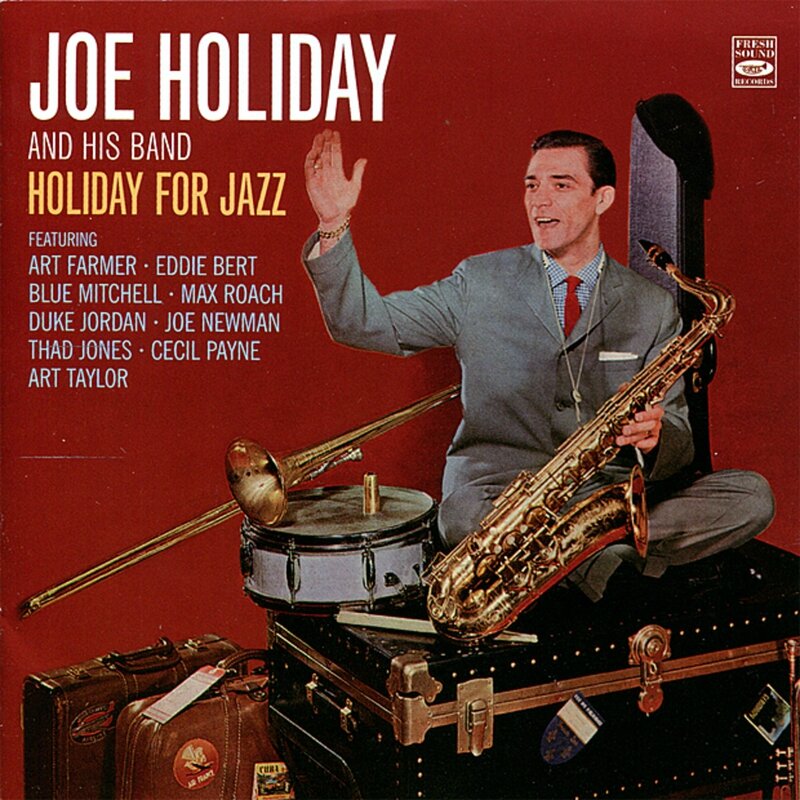
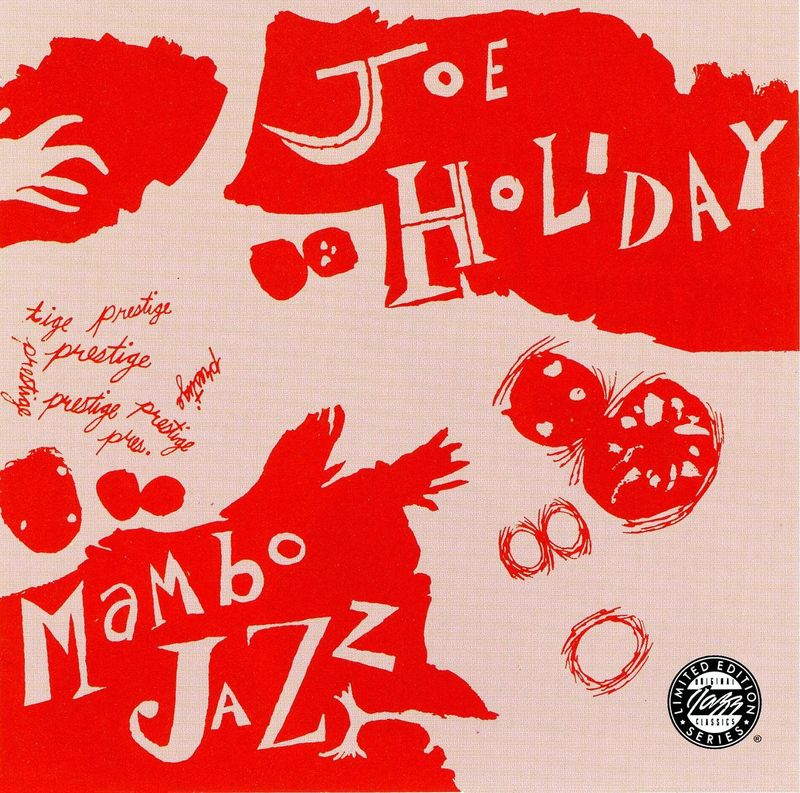
A word of advice on finding him -- I did a Spotify search on "Joe Holiday" and found nothing except a country singer named Joey Holiday. Looked on YouTube, found a few things, but none from this session (ultimately I did, so it's linked to here). Continuing to research Holiday, I discovered that he'd had a hit in 1951 with "This is Happiness," so I went back to Spotify, searched on "This is Happiness," and found the whole session and more. A lot of Holiday's work was reissued on Original Jazz Classics, one of the Prestige reissue labels, and Spotify has that, with album cover art that looks
like the art for mambo album of the 50s, for which I give them credit. Actually, looking a little farther, I find a second cover, also with the OJC logo, that must certainly be from the early 50s.
On this session, Holiday plays some bebop, some rhythm and blues riffs, some ballads -- eveything that adds up to what we now call straight-ahead jazz. And he plays some mambos, the musical form with which he came to be associated, which is why he achieved a measure of popularity in the 50s, and probably why he was mostly overlooked afterwards.
Latin jazz has never gotten its full due -- if you don't believe me, look at anybody's list of the greatest jazz trumpeters ever, and see if you find Mario Bauza's name. You won't. and he was the equal of anyone you will find on those lists. Or look at anyone's list of the best jazz albums of the 1980s and '90s, and see if you find anything by Tito Puente. And his jazz recordings during that period were better than anything else being recorded.
The mambo craze hit New York in 1951 -- I would have guessed later, but that's because I grew up as a white kid in the sticks, and although I was able to find my way to blues and rhythm and blues, I was totally ignorant of Latin popular music, so all I knew of the mambo were the mid-50s pop tunes by people like Perry Como and Vaughan Monroe -- and Perez Prado's 1955 hit, "Cherry Pink and Apple Blossom White," which by some reckonings was the most popular record of the decade.
But it was Prado who actually brought the mambo to New York in 1951, with "Mambo Jambo" and "Mambo #5," the latter of which would become a huge hit again in 1999. And Joe Holiday was one of the few jazzmen who embraced the genre -- which, as I say, marginalized him a jazz musician.
And shouldn't have. Holiday proves his bebop credentials with "Hello to You" and "Nice and Easy," but he really comes into his own with his jazz mambos -- "This is Happiness," which was his hit on the Latin charts, and especially "Mambo Holiday," an extended piece at just over five minutes, which made it a two-sided single, on both 78 and 45, and which, yeah, you have to listen to.
Joe Holiday is still around. From Wikipedia:
like the art for mambo album of the 50s, for which I give them credit. Actually, looking a little farther, I find a second cover, also with the OJC logo, that must certainly be from the early 50s.
On this session, Holiday plays some bebop, some rhythm and blues riffs, some ballads -- eveything that adds up to what we now call straight-ahead jazz. And he plays some mambos, the musical form with which he came to be associated, which is why he achieved a measure of popularity in the 50s, and probably why he was mostly overlooked afterwards.
Latin jazz has never gotten its full due -- if you don't believe me, look at anybody's list of the greatest jazz trumpeters ever, and see if you find Mario Bauza's name. You won't. and he was the equal of anyone you will find on those lists. Or look at anyone's list of the best jazz albums of the 1980s and '90s, and see if you find anything by Tito Puente. And his jazz recordings during that period were better than anything else being recorded.
The mambo craze hit New York in 1951 -- I would have guessed later, but that's because I grew up as a white kid in the sticks, and although I was able to find my way to blues and rhythm and blues, I was totally ignorant of Latin popular music, so all I knew of the mambo were the mid-50s pop tunes by people like Perry Como and Vaughan Monroe -- and Perez Prado's 1955 hit, "Cherry Pink and Apple Blossom White," which by some reckonings was the most popular record of the decade.
But it was Prado who actually brought the mambo to New York in 1951, with "Mambo Jambo" and "Mambo #5," the latter of which would become a huge hit again in 1999. And Joe Holiday was one of the few jazzmen who embraced the genre -- which, as I say, marginalized him a jazz musician.
And shouldn't have. Holiday proves his bebop credentials with "Hello to You" and "Nice and Easy," but he really comes into his own with his jazz mambos -- "This is Happiness," which was his hit on the Latin charts, and especially "Mambo Holiday," an extended piece at just over five minutes, which made it a two-sided single, on both 78 and 45, and which, yeah, you have to listen to.
Joe Holiday is still around. From Wikipedia:
Holiday also does abstract painting. Joe and his wife, Kelly Holiday are president and vice-president, respectively, of the St. Lucie Professional Arts League based in Port St. Lucie, FL, where he has presented annual "Art & All That Jazz" events, which have included Linda Cole, Jazz singing daughter of Nat King Cole; Miami musicians Ira Sullivan, violinist Nicola Yearling and pianist Lenore Raphael.
Tuesday, November 25, 2014
Listening to Prestige Records Part 53 - Gene Ammons
There were two other autumn sessions for Prestige that seem to have sunk without a trace. On October 16, alto player Lem Davis, a swing specialist, led a quartet that resulted in three 78s. Also in October, pianist Al Vega made some trio recordings in Boston. Vega spent his career in Boston, where he played with many of the greats as they passed through town, and also coached Little League. The trio recorded ten songs that day, of which four were released, on two 78s.
I probably don't have a lot more to say about the Sonny Stitt - Gene Ammons Septet, except that they made a lot of really good music, and I'm always glad to come back to them. But at least one of the song selections is interesting. "Undecided" has a jazz history -- a New York jazz history, a 52nd Street history. It was co-written by Charlie Shavers, and originally recorded in 1938 by John Kirby and the Onyx Club Boys, a group that presumably coalesced at The Street's Onyx Club, and included Shavers, Buster Bailey, Billy Kyle and Russell Procope (there was also a group of Onyx Club Boys that recorded with Stuff Smith, with Buster Bailey the only member of both groups). Chick Webb and Ella Fitzgerald also made a record of it in 1939, and then it lay mostly dormant until 1951, when the Ames Brothers had a huge hit with it, riding the charts for 20 weeks. It was certainly not unusual back in those days for cover recordings of hit songs to crop up, but maybe not that many beboppers covering current pop hits.
We can assume it went out to the jukeboxes -- these four tunes were released on two 78s, and on a 10-inch LP. -- then not again until the Fantasy reissue days.
I probably don't have a lot more to say about the Sonny Stitt - Gene Ammons Septet, except that they made a lot of really good music, and I'm always glad to come back to them. But at least one of the song selections is interesting. "Undecided" has a jazz history -- a New York jazz history, a 52nd Street history. It was co-written by Charlie Shavers, and originally recorded in 1938 by John Kirby and the Onyx Club Boys, a group that presumably coalesced at The Street's Onyx Club, and included Shavers, Buster Bailey, Billy Kyle and Russell Procope (there was also a group of Onyx Club Boys that recorded with Stuff Smith, with Buster Bailey the only member of both groups). Chick Webb and Ella Fitzgerald also made a record of it in 1939, and then it lay mostly dormant until 1951, when the Ames Brothers had a huge hit with it, riding the charts for 20 weeks. It was certainly not unusual back in those days for cover recordings of hit songs to crop up, but maybe not that many beboppers covering current pop hits.
We can assume it went out to the jukeboxes -- these four tunes were released on two 78s, and on a 10-inch LP. -- then not again until the Fantasy reissue days.
Friday, November 21, 2014
Listening to Prestige Records Part 52: Teddy Charles
Perhaps he went into the studio a Teddy Cohen and came out as Teddy Charles? Anyway, this is how jazzdisco credits the album, although certainly all later issues have him as Teddy Charles, and 1951 was the year that the gentleman changed his name.
I wasn't familiar with Teddy Charles's music -- I may have heard it, but never really sat down and listened to it, so this was an opportunity to get acquainted with someone I'd overlooked, and the acquaintanceship proves to be well worth it.
He's working here with a trio, featuring two other unfamiliar names. I can't find any information on Don Roberts, and the only other credit I've found for Kenny O'Brien is a Jackie and Roy album. But with only three instruments, and none of them a piano, they're all able to get close to the mike, so although O'Brien may not have been one of the biggest names in modern jazz, he becomes the first bassist to take extended solos on a Prestige album.
The album is fascinating. Charles shows his avant garde credentials on "This is New," but then he plays an odd selection of material for an avant-gardist -- mostly standards. And while some of them, like "the Lady is a Tramp" and "I'll Remember April" are the kind of tunes one would expect to hear a bebopper improvising on, others, like "Old Man River" and especially "Basin Street Blues" seem to belong to a whole different musical sensibility. And Charles, while he always moves toward the inventive and experimental, is very respectful of all these melodies.
Teddy Charles left music in the 1960s to become a charter boat captain in the Caribbean, and according to one source Charles observed that there was plenty in common between the uncompromising demands of seafaring and the spontaneous challenges of jazz." He came back to music late in life, and continued playing and recording until his death in 2012, at age 84.
A couple of tunes from this session -- "I Got it Bad" and "Liza" -- were never released. The rest came out on a 10-inch LP, and two sides -- "I'll Remember April" and "The Lady is a Tramp," which are, as it happens, the ones I picked out as most bebop-friendly -- were released on a New Jazz 78, with the leader being identified as Teddy Cohen, though he's Teddy Charles on the LP. All the selections are short enough to fit on 78, but at this point Weinstock appears to be edging away from that format. There's a good representation of Teddy Charles on YouTube, but nothing from this album. Spotify has the whole thing,
I wasn't familiar with Teddy Charles's music -- I may have heard it, but never really sat down and listened to it, so this was an opportunity to get acquainted with someone I'd overlooked, and the acquaintanceship proves to be well worth it.
The album is fascinating. Charles shows his avant garde credentials on "This is New," but then he plays an odd selection of material for an avant-gardist -- mostly standards. And while some of them, like "the Lady is a Tramp" and "I'll Remember April" are the kind of tunes one would expect to hear a bebopper improvising on, others, like "Old Man River" and especially "Basin Street Blues" seem to belong to a whole different musical sensibility. And Charles, while he always moves toward the inventive and experimental, is very respectful of all these melodies.
A couple of tunes from this session -- "I Got it Bad" and "Liza" -- were never released. The rest came out on a 10-inch LP, and two sides -- "I'll Remember April" and "The Lady is a Tramp," which are, as it happens, the ones I picked out as most bebop-friendly -- were released on a New Jazz 78, with the leader being identified as Teddy Cohen, though he's Teddy Charles on the LP. All the selections are short enough to fit on 78, but at this point Weinstock appears to be edging away from that format. There's a good representation of Teddy Charles on YouTube, but nothing from this album. Spotify has the whole thing,
Sunday, November 16, 2014
Listening to Prestige Records Part 51: Miles Davis Sextet
I keep finding myself drawn back to the nonet and the 1948-49 Birth of the Cool sessions, because they were so important, and because no one seemed to know it at the time. Certainly no one one in New York. The engagement at the Royal Roost had been a flop, in good part, perhaps, because Count Basie was headliner, and Basie's audience might not have been the most receptive to the cool sound. And hardly anyone had listened to, or cared much about, the 78 RPM records that came out of the studio sessions for Capitol. Gerry Mulligan took the sound as far away from New York as he could, to California, where he developed it and adapted it for smaller groups, and created West Coast jazz -- or, as many said, gave birth to a new, cool jazz sound. Gil Evans seems to have gone fairly quiet-- we do know that he was always in touch with Miles.
That being said, "Dig" is a hell of a tune -- draws you in right away. But in spite of that, McLean's lawyer was probably right about the returns not justifying the cost of pursuing it. I haven't been able to find any other recordings.
And yes, it's 7 1/2 minutes long. In fact, all the tunes from this session are more than five minutes -- "My Old Flame" and "Out of the Blue" came out on 78s, each split up into Part 1 and Part 2. "Only a Paper Moon" and "Dig" the same, but also on 45. "Bluing" was too long even for that, so Parts 1 and 2 were on one 78, and Part 3 on the flip side of "Conception," which at 4:02 must have been just short enough to squeeze onto a disc.They were also all released on 45 RPM EPs. and "Dig" / "It's Only a Paper Moon" also came out as Prestige 45-321, which must also have been an EP, although not labeled as such, and also must have been much later. The 300 series of 45s includes later-generation jazzers like Yusef Lateef, and even rockers like Manfred Mann, as well as a lot of blues artists like Eddie Kirkland.
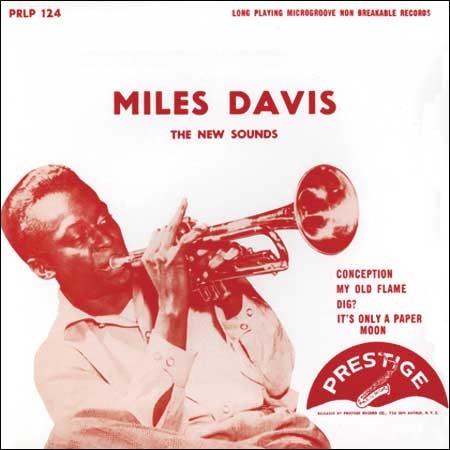
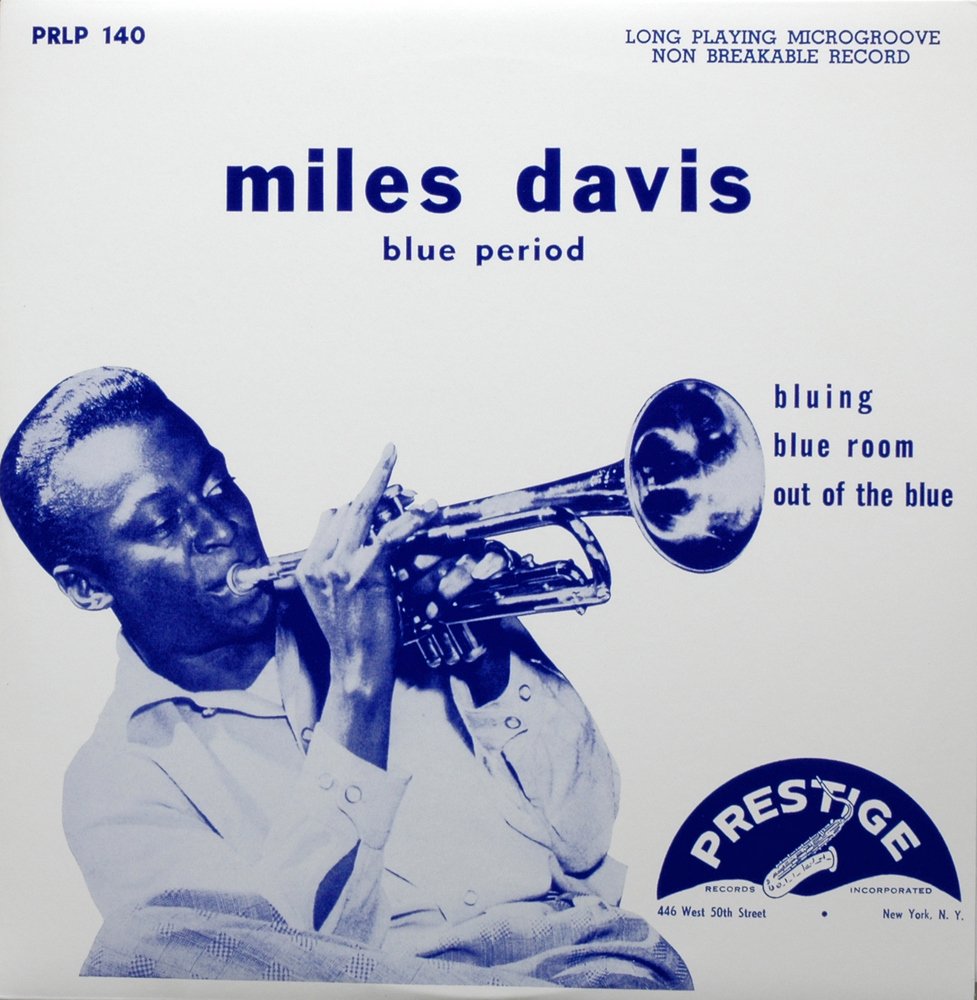
But this may have been the first Prestige session directly aimed at the LP format, and it was released in a few different formats -- as PRLP 124 - Miles Davis: The New Sounds (Conception/Dig/My Old Flame/It's Only a Paper Moon) and PRLP 140 - The Blue Period ("Bluing" and "Out of the Blue," along with the alternate take of "Blue Room" from the previous session). Ira Gitler was writing the album cover notes by that time, and here's what he had to say (liner notes thanks to the Plosin website, very complete on Miles).
and
But the major release of this one came in 1956, remastered by recording genius Rudy Van Gelder, and issued as a 12-inch LP as Dig. This, with the moody, dark cover image of Miles in shadow, and the terse title, was one of the benchmarks of hip in my young life.
And here's Gitler on the reissue:
More credit to Jackie McLean for those chord changes (even if they are the chord changes to "Sweet Georgia Brown") that lend themselves to long melodic lines. And more credit given to McLean by Gitler, who had said on the previous liner note that he only appeared on "Dig."
And by the way, a busy day for Art Blakey. He played on the Bennie Green session as well.
Miles is thought to have completely turned his back on the experimental sound of the Nonet, bitter and disillusioned by the failure of the Jazz public and critics to appreciate what he had done for them, and that's mostly true, but not completely. He did make that one very experimental recording session with Lee Konitz. And, like Mulligan, he went as far away from New York as possible, but in the other direction, to Paris.
I knew Miles had been embittered by the nonet's reception, but I didn't realize how much. He stayed away from New York -- first Paris, then the Midwest, where the answer to how you gonna keep them down on the farm, after they've seen Paree? seemed to be, in part, a lot of heroin, but another was just that...staying out on the farm. Plenty of first class musicians came through Chicago, and we've already talked about the Detroit scene.
Bob Weinstock, in an interview, recalls tracking him down.
Miles had vanished after he did those Capitol sides with the (Birth of the Cool) Nonet. Nobody knew where he was. Somebody had said that he may be at home in East St. Louis, so while I was in Chicago on business I tracked him down. His father was a dentist, so I knew that his number would be in the phone book. I had met Miles at a Dial session where he recorded with Bird, but he didn't remember me. Anyway, he said if I'd send him money to get to New York, he'd be happy to record. I said that I was interested in doing a series of recordings, and that I wanted to sign him to a contract. He said alright, just get him to New York and we'd talk about it then. So, our basic idea was just to make records with different people, to record with the best people around. That's what we did until the end, when he had the quintet with John Coltrane, Red Garland, Paul Chambers, and Philly Joe Jones. But everything up to that point developed from where we would sit down and talk about it. Miles would mention who was in town, who he would like to record with. I'd say who I'd like to hear him record with. We'd kick ideas around.
His first studio album for Prestige was the January session with Bennie Green, Sonny Rollins and John Lewis.
This time it was Sonny Rollins, who, like Miles, was just hitting his stride as a major jazz figure, and who, like Miles, would become a colossus of American music. Tommy Potter and Art Blakey were veterans of bebop and of Prestige recording session. Walter Bishop, Jr., had made a couple of records, and had played at Minton's for a variety of people, idolizing Charlie Parker, learning from Bud Powell.
His bio in Allmusic.com says that he was "a valuable utility pianist on many a modern jazz session during the bebop era," which means what, exactly? A valuable utility infielder in baseball is someone who's not quite good enough to make the starting lineup, but can fill in at any position if the regular guy can't play that day. Doesn't seem to fit Bishop too well.
This time it was Sonny Rollins, who, like Miles, was just hitting his stride as a major jazz figure, and who, like Miles, would become a colossus of American music. Tommy Potter and Art Blakey were veterans of bebop and of Prestige recording session. Walter Bishop, Jr., had made a couple of records, and had played at Minton's for a variety of people, idolizing Charlie Parker, learning from Bud Powell.
His bio in Allmusic.com says that he was "a valuable utility pianist on many a modern jazz session during the bebop era," which means what, exactly? A valuable utility infielder in baseball is someone who's not quite good enough to make the starting lineup, but can fill in at any position if the regular guy can't play that day. Doesn't seem to fit Bishop too well.
Jackie McLean was making his first record. He was in some impressive company--and it's said that he was more than a little nervous, because Charlie Parker was hanging out in the studio that day. So was Charles Mingus.and though he's not credited, it's generally accepted that Mingus played bass on "Conception."McLean definitely made a good impression, and not just with his alto sax playing. It's believed by many that he wrote "Dig."
Jazz blogger Peter Spitzer asked McLean about it.
I asked him about “Dig.” He said that he had brought that tune to a recording session with Miles, in 1951. Sonny Rollins was there too, and had brought a tune called “Out of the Blue.” When the album came out, Miles was listed as the composer of both tunes. Jackie was willing to consider it an error by the recording engineer. He later talked to a lawyer about getting proper credit, but was told that the returns would not justify the cost of pursuing it, so he just let it go.
Spitzer mentions several other tunes credited to Miles that were probably written by other artists, and then he says,
Some people have pointed out that in those years, it was not unusual for leaders to take credit for the work of their sidemen.
Now, I'm not here to defend Miles, who (a) doesn't need my defense, and (b) is guilty anyway, but I did wonder about that last statement, because it makes a certain amount of sense, because what exactly is jazz composition? Contemporary jazzman Steve Coleman has this to say about Charlie Parker:
Bird was noted for "spontaneous composition" -- that is, his improvised solos were actually original compositions, created on the spot. And what is a jazz composition, exactly? It's a tune, or a riff, or a series of riffs, that's played for one or two choruses at the beginning of a performance, and then played again at the end. In the interim, the musicians -- that's Davis, Rollins, McLean himself, Bishop, even Blakey -- are improvising, leaving the melody behind and creating their own musical units, in a piece that lasts for 7 1/2 minutes. The improvised solos are based on the chord structure of the opening chorus (at least until Ornette Coleman came along), and while they do follow that chord structure, it is, in many jazz compositions, the chord structure of an existing song. In the case of "Dig," it's "Sweet Georgia Brown." This is based on research -- I can't listen to "Dig" and say, "Oh, yeah, that's 'Sweet Georgia Brown.'" So maybe it's not so far-fetched for the leader to take composition credit. Or maybe it is.I view Parker as a major composer, albeit primarily a spontaneous composer. His written compositions, similar to many other very strong spontaneous composers, were mainly jumping-off points for his spontaneous discussions.
That being said, "Dig" is a hell of a tune -- draws you in right away. But in spite of that, McLean's lawyer was probably right about the returns not justifying the cost of pursuing it. I haven't been able to find any other recordings.
And yes, it's 7 1/2 minutes long. In fact, all the tunes from this session are more than five minutes -- "My Old Flame" and "Out of the Blue" came out on 78s, each split up into Part 1 and Part 2. "Only a Paper Moon" and "Dig" the same, but also on 45. "Bluing" was too long even for that, so Parts 1 and 2 were on one 78, and Part 3 on the flip side of "Conception," which at 4:02 must have been just short enough to squeeze onto a disc.They were also all released on 45 RPM EPs. and "Dig" / "It's Only a Paper Moon" also came out as Prestige 45-321, which must also have been an EP, although not labeled as such, and also must have been much later. The 300 series of 45s includes later-generation jazzers like Yusef Lateef, and even rockers like Manfred Mann, as well as a lot of blues artists like Eddie Kirkland.
But this may have been the first Prestige session directly aimed at the LP format, and it was released in a few different formats -- as PRLP 124 - Miles Davis: The New Sounds (Conception/Dig/My Old Flame/It's Only a Paper Moon) and PRLP 140 - The Blue Period ("Bluing" and "Out of the Blue," along with the alternate take of "Blue Room" from the previous session). Ira Gitler was writing the album cover notes by that time, and here's what he had to say (liner notes thanks to the Plosin website, very complete on Miles).
THE NEW SOUNDS
When an artist is simultaneously recognized, by critics, fellow artists, and the public analogous to his art, as the foremost in his particular field, the work of the artist invariably substantiates the status given him by this audience. Such is the position of Miles Davis as the most important creative trumpeter today. Acknowledged first by musicians, Miles, soon drew the ears of discerning critics into appreciative attentiveness and finally the jazz public accorded him their appreciation in the Metronome and
Downbeat polls.
Of course, Miles is to be appreciated for bringing a new sound and conception to the trumpet but what really gives him his greatness are the intangibles he possesses, which enable him to transmit sweeping joy with his "wailing" solos and reflective beauty in the delicacy of his ballads.
This album gives Miles more freedom than he has ever had on record for time limits were not strictly enforced. There is opportunity to build ideas into a definite cumulative effect. These ideas sound much more like air-shots than studio recordings.
Upon the wonderful rhythmic foundation of Art Blakey's drums, Tommy Potter's bass, and Walter Bishop's piano, tenorman Sonny Rollins and altoman Jackie McLean are able to enjoy some of the unlimited time for their solo efforts. Rollins demonstrates the impact of the intangibles, again, with his solo on "Paper Moon". The way in which the solo is constructed and the feeling and time with which it is played, overshadow the marring reed trouble. McLean, still in his teens, is heard only on "Dig". He need not apologize for his youth after his work here. Walter Bishop appears in solo for a brief moment on "Conception" which gives only an inkling of his marvelous playing.
Here are New Sounds at greater length. Listen to them at great length.
and
MILES DAVIS - BLUE PERIOD
An album by Miles Davis represents modern jazz at its best. In this album as in Miles' PRESTIGE LP 124, the length of time for each selection is not restricted to the usual limits except in the case of BLUE ROOM, which was cut at a more conventional session. BLUING, the high spot of this set, is over nine minutes of freedom of expression on
modern blues chord changes. At the very end, Art Blakey continues playing after everyone else has stopped. If you listen closely, you will hear Miles say something like, "You know that ending man, let's do it again", but why do it again when you've captured the feeling in the solos of Walter Bishop, Miles, Sonny Rollins, Jack McLean, and the inventive drumming of Art Blakey. The advantage given by LP, of not having to make a "product" for the juke bokes, allowed us to keep this take. OUT OF THE BLUE (Miles' plea to get happy) was done at the same session and although not as lengthy as BLUING, still provided ample time for relaxed improvisation.
This album is a must to those who appreciate our modern jazzmen. I know that people who have missed hearing these musicians in person, will be especially gratified, because this is what they have been missing.
But the major release of this one came in 1956, remastered by recording genius Rudy Van Gelder, and issued as a 12-inch LP as Dig. This, with the moody, dark cover image of Miles in shadow, and the terse title, was one of the benchmarks of hip in my young life.
And here's Gitler on the reissue:
These are some of the first "longer playing" recordings made possible by the advent of the LP. Recorded on October 5, 1951, this entire session has been remastered by top engineer Rudy Van Gelder. (The two remaining selections from this date, Conception and My Old Flame, are included in CONCEPTION, PRLP 7013)
Miles Davis and Sonny Rollins form one of the most empathetic and powerfully moving duos in jazz. Although they had recorded together before (Morpheus, Down, Whispering, Blue Room) this was their first chance to "stretch out" together on records.
These recordings have much warmth. The emotions jut out of all the solos. On Paper
Moon and Bluing this is especially true, but it is in evidence on the upper tempos too. Dig is fluid. The chord changes lend themselves to the long melodic lines that the soloists employ. There is also a continuity of feeling from one soloist to another which points up the aforementioned empathy.
The group is made a sextet by altoman Jackie McLean on all numbers but Paper Moon. Jackie, in his teens when these recordings were made, was then a disciple of Charlie Parker. The Bird influence is still with him but the light of it is partly directed through the prism of Sonny Rollins.
Incidentally, Bird was present for part of this record sort of visiting with his children: Miles who gained his greatest experience and had his largest pleasures playing with him; Jackie, the young disciple; and Sonny, the reed voice who has become the foremost standard bearer and advancer of the Parker tradition.
The swinging rhythm here features the explosive drive of Art Blakey, the subtle power of Tommy Potter and the sensitive accompaniment and solos of the unduly underrated Walter Bishop.
More credit to Jackie McLean for those chord changes (even if they are the chord changes to "Sweet Georgia Brown") that lend themselves to long melodic lines. And more credit given to McLean by Gitler, who had said on the previous liner note that he only appeared on "Dig."
And by the way, a busy day for Art Blakey. He played on the Bennie Green session as well.
Saturday, November 08, 2014
Listening to Prestige Records Part 50: Bennie Greene
Bennie Green could play anything, and he pretty much proves it on this set of six songs (Prestige didn't release "Jumpin' Journey").
Green got his start with traditional jazz master Earl Hines, worked with moderns like Miles Davis and Dizzy Gillespie, and avant-gardists like Randy Weston, and he could play rhythm and blues. For this session, he teamed up with sidemen who were as versatile as he was in Davis and Nicholas, and they proceeded to prove it by putting together a set in which they never played the same thing twice.
""Green Junction" is big band swing (or it's rooted there -- nothing on this session quite fits any pigeonhole). "Flowing River" sounds more like something that might have been recorded by George Winston on Windham Hill than like the gutbucket blues it is, with the dirty blues sound that only a trombone can deliver. "Whirl-a-Licks" is supercharged bebop, with some R&B honking thrown in for good measure. "Bennie's Pennies" is a standard, the only one of the day, with a bebop treatment. "Tenor Sax Shuffle"is a honk-a-thon with two classic honkers, and "Sugar Syrup" could be rhythm and blues if the rhythm section were a little more predictable, but it's not. What else could you possibly want?
Teddy Brannon is the new name here for me, and his blues lick sets the tone for "Flowing River." He played up and down 52nd Street, recorded with a number of jazz greats, accompanied Dinah Washington, Ruth Brown, Billie Holiday, and his cousin Babs Gonzales,and played on a lot of doowop records. My kinda guy.
What else is happening on the jazz scene in October of 1951? We haven't checked in with the New Yorker in a while, and they've added a couple more trad jazz clubs to Condon's and Jimmy Ryan's in their "Mostly for Music" listings, while still mostly ignoring the modern clubs. Birdland, in a somewhat rare move, is featuring Bird -- Charlie Parker, trading off with Terry Gibbs. And they list The Embers, where "some of the best music on the North American continent is being turned loose by the prankish Red Norvo Trio, which has Tal Farlow on guitar." Bud Freeman is scheduled to follow Norvo, and then Erroll Garner's trio with Shadow Wilson.
I'm wondering if this session was set up with an eye toward different markets. I'm guessing not -- Weinstock doesn't seem to have been that commercially focused. But the 78s seem to be put together with a sense of what goes with what -- "Tenor Sax Shuffle" and "Sugar Syrup" on one 78, the two beboppers, "Whirl-a-Licks" and "Bennie's Pennies" on another, the two more traditional sounds on a third. The EP leaves off "Tenor Sax Shuffle" and "Sugar Syrup." and the same grouping goes onto the 10-inch LP Modern Jazz Trombones, Vol. 2, with cuts by Green and J. J. Johnson.
Green got his start with traditional jazz master Earl Hines, worked with moderns like Miles Davis and Dizzy Gillespie, and avant-gardists like Randy Weston, and he could play rhythm and blues. For this session, he teamed up with sidemen who were as versatile as he was in Davis and Nicholas, and they proceeded to prove it by putting together a set in which they never played the same thing twice.
""Green Junction" is big band swing (or it's rooted there -- nothing on this session quite fits any pigeonhole). "Flowing River" sounds more like something that might have been recorded by George Winston on Windham Hill than like the gutbucket blues it is, with the dirty blues sound that only a trombone can deliver. "Whirl-a-Licks" is supercharged bebop, with some R&B honking thrown in for good measure. "Bennie's Pennies" is a standard, the only one of the day, with a bebop treatment. "Tenor Sax Shuffle"is a honk-a-thon with two classic honkers, and "Sugar Syrup" could be rhythm and blues if the rhythm section were a little more predictable, but it's not. What else could you possibly want?
Teddy Brannon is the new name here for me, and his blues lick sets the tone for "Flowing River." He played up and down 52nd Street, recorded with a number of jazz greats, accompanied Dinah Washington, Ruth Brown, Billie Holiday, and his cousin Babs Gonzales,and played on a lot of doowop records. My kinda guy.
What else is happening on the jazz scene in October of 1951? We haven't checked in with the New Yorker in a while, and they've added a couple more trad jazz clubs to Condon's and Jimmy Ryan's in their "Mostly for Music" listings, while still mostly ignoring the modern clubs. Birdland, in a somewhat rare move, is featuring Bird -- Charlie Parker, trading off with Terry Gibbs. And they list The Embers, where "some of the best music on the North American continent is being turned loose by the prankish Red Norvo Trio, which has Tal Farlow on guitar." Bud Freeman is scheduled to follow Norvo, and then Erroll Garner's trio with Shadow Wilson.
I'm wondering if this session was set up with an eye toward different markets. I'm guessing not -- Weinstock doesn't seem to have been that commercially focused. But the 78s seem to be put together with a sense of what goes with what -- "Tenor Sax Shuffle" and "Sugar Syrup" on one 78, the two beboppers, "Whirl-a-Licks" and "Bennie's Pennies" on another, the two more traditional sounds on a third. The EP leaves off "Tenor Sax Shuffle" and "Sugar Syrup." and the same grouping goes onto the 10-inch LP Modern Jazz Trombones, Vol. 2, with cuts by Green and J. J. Johnson.
Friday, November 07, 2014
Listening to Prestige Records Part 49: Ralph Willis
A few strikeouts as summer of 1951 turns into fall. Weinstock recorded Johnny Green "and others" on September 3. Four songs were recorded, only two released, on the Par Presentation label, which was mostly blues. I can't find anything on Johnny Green, nor on Gene Harris (piano and vocals), recorded on September 24. Harris cut a bunch of standards, including couple of jazz standards -- "Flying Home" and "Jumping With Symphony Sid," and a tune called "Dedication to Albert Ammons," which suggests that boogie-woogie was his metier. None of them were released, except for two cuts, "Make Believe" and "Late Hour Boogie," on a Prestige 78. I found a note in a December issue of Billboard identifying it as a new rhythm and blues release on Prestige, but can't find the songs, or any other mention of Gene Harris.
Next a more surprising omission -- a session by Red Rodney. in which eight songs were recorded and six were released, first on 78, then on a 24000-series reissue when Prestige was owned by Fantasy, and on a Fantasy reissue. But none of them to be found on Spotify or YouTube. The sessions featured Charlie Parker sound-alike Jummy Ford on alto and vocals, and it seems to have been pretty good -- Eugene Chadbourne on Allmusic says A few years later some of the best recorded documentation of this saxophonist was created when trumpeter Red Rodney, a young protégé from Parker's later groups, convened a small group for tracks originally issued as Prestige and Fantasy 78s. Which proves that Allmusic isn't infallible -- Fantasy didn't put out 78s -- but is good info anyway. But no luck hearing the tracks.
Which brings us to October 3, and another blues session, this one by Ralph Willis. Nine songs cut, two of them issued on a 78. Available on Spotify. Very nice Piedmont blues. Willis didn't get the sort of recognition that Blind Boy Fuller or Brownie McGhee got, but he had a pretty good recording career -- all of which is on Spotify.
Next a more surprising omission -- a session by Red Rodney. in which eight songs were recorded and six were released, first on 78, then on a 24000-series reissue when Prestige was owned by Fantasy, and on a Fantasy reissue. But none of them to be found on Spotify or YouTube. The sessions featured Charlie Parker sound-alike Jummy Ford on alto and vocals, and it seems to have been pretty good -- Eugene Chadbourne on Allmusic says A few years later some of the best recorded documentation of this saxophonist was created when trumpeter Red Rodney, a young protégé from Parker's later groups, convened a small group for tracks originally issued as Prestige and Fantasy 78s. Which proves that Allmusic isn't infallible -- Fantasy didn't put out 78s -- but is good info anyway. But no luck hearing the tracks.
Which brings us to October 3, and another blues session, this one by Ralph Willis. Nine songs cut, two of them issued on a 78. Available on Spotify. Very nice Piedmont blues. Willis didn't get the sort of recognition that Blind Boy Fuller or Brownie McGhee got, but he had a pretty good recording career -- all of which is on Spotify.
Thursday, November 06, 2014
Listening to Prestige Records Part 48: Gerry Mulligan New Stars
What do you do when it's 1951, and you've already made the most important record of the decade, but no one knows it yet, and in fact you made it last decade with a group that's since been disbanded, and no one paid it much attention at the time?
For some of the key members of the Birth of the Cool nonet, it seems to have meant taking a step backward, and that's not meant as a criticism.
An important part of the impetus to forming the nonet was a dissatisfaction, especially on the part of Gil Evans and Gerry Mulligan, to the overemphasis on the flamboyant virtuoso soloist that was bebop. They came from big bands, particularly the Claude Thornhill band, which played dance music but encouraged some experimentation, and brought from some important jazz musicians...and arrangers.
And in fact the Miles Davis nonet, in its historic Royal Roost engagement, included its arrangers on the marquee -- Gil Evans, Gerry Mulligan, John Lewis. Mulligan and Lewis were also featured musicians, but giving marquee prominence to Evans may have been a first -- and was certainly deserved.
So what do you do? Lewis would move in a new direction with the Modern Jazz Quartet, but not for a couple of years. During this period, he continued to work as a sideman with boppers. Davis was to retrench, sort of, in his Prestige and Columbia albums of the 50s, playing bebop with a difference, creating the style called hard bop that became the most significant jazz style of the 50s. Konitz stayed out in left field, but then he really had no mainstream to go back to -- he'd come from left field, with Tristano.
Mulligan, in this session for Prestige, goes a certain way toward the bebop mainstream -- there are some powerful improvisatory and virtuoso solos -- but his retrenchment is more in a Thornhill direction, with some big band arrangements and full sound that touches back to swing in the way Thornhill and Herman did, while still staying decidedly modern.
Mulligan's New Stars didn't quite manage to become stars. Allan Eager and George Wallington are the only two whose names have remained with some resonance in jazz history.
I found this mention of two of Mulligan's men in an online essay called "Names of the Forgotten":
Nick Travis, according to this essay, played on 350 jazz recording sessions, so if he never quite broke through to serious name recognition, he clearly made a name as a guy you could count on. Here's Hal McKusick on Travis:
There's less on Ollie Wilson and Mac McElroy. Wilson was in Woody Herman's Second Herd, and highly regarded. Mulligan used McElroy on at least one other recording.
I found this on Gail Madden, from a reminiscence by Bill Crow in a book called Fifties Jazz Talk: An Oral Retrospective by Jack Gordon.
So this was Mulligan's first session as a leader. One other interesting thing about this recording
session, The first six songs are standard song length, about three minutes, and all of them were released on 78 and 45 -- "Mullenium" is pushing it at 4:05, but they managed to get it onto one side of a single. "Mulligan's Too" is over 17 and a half minutes long -- who recorded anything that long in those days? And it's Mulligan's first session as a leader, but he was able to talk Weinstock into it. It became a 10-inch LP, which you can now buy on eBay for $250.
For some of the key members of the Birth of the Cool nonet, it seems to have meant taking a step backward, and that's not meant as a criticism.
An important part of the impetus to forming the nonet was a dissatisfaction, especially on the part of Gil Evans and Gerry Mulligan, to the overemphasis on the flamboyant virtuoso soloist that was bebop. They came from big bands, particularly the Claude Thornhill band, which played dance music but encouraged some experimentation, and brought from some important jazz musicians...and arrangers.
And in fact the Miles Davis nonet, in its historic Royal Roost engagement, included its arrangers on the marquee -- Gil Evans, Gerry Mulligan, John Lewis. Mulligan and Lewis were also featured musicians, but giving marquee prominence to Evans may have been a first -- and was certainly deserved.
So what do you do? Lewis would move in a new direction with the Modern Jazz Quartet, but not for a couple of years. During this period, he continued to work as a sideman with boppers. Davis was to retrench, sort of, in his Prestige and Columbia albums of the 50s, playing bebop with a difference, creating the style called hard bop that became the most significant jazz style of the 50s. Konitz stayed out in left field, but then he really had no mainstream to go back to -- he'd come from left field, with Tristano.
Mulligan, in this session for Prestige, goes a certain way toward the bebop mainstream -- there are some powerful improvisatory and virtuoso solos -- but his retrenchment is more in a Thornhill direction, with some big band arrangements and full sound that touches back to swing in the way Thornhill and Herman did, while still staying decidedly modern.
Mulligan's New Stars didn't quite manage to become stars. Allan Eager and George Wallington are the only two whose names have remained with some resonance in jazz history.
I found this mention of two of Mulligan's men in an online essay called "Names of the Forgotten":
Where are Jerry' Lloyd, George Syran, and Phil Raphael and Phil Leshin? Jerry Lloyd was around in the 1940s and 1950s and recorded with Gerry Mulligan, Zoot Sims, and George Wallington, though he never became well-known and worked as a cab-driver even when he was featured on records with such artists... [Phil Leshin] worked with Red Rodney in 1951, but what else?
Nick Travis, according to this essay, played on 350 jazz recording sessions, so if he never quite broke through to serious name recognition, he clearly made a name as a guy you could count on. Here's Hal McKusick on Travis:
"Nick was a great player and a great guy. He was so busy in the 1950s. He'd get done with work at 2 a.m., head off to his home in New Jersey and be back the next day in a New York studio at 8 a.m. Zoot told me a funny story. Nick was so tired one day that he slept in. His phone rang early that morning. Nick sleepily answered: "Hello?" "Hi Nick, it's Zoot." Nick paused and said, groggily, "Zoot who?"
"I remember Nick as being quiet and intelligent. He spent a lot of time with his instrument. When you’re working the way we did, you didn't have a lot of time to practice, so work was practice. He was a great lead horn player and quite a soloist. Nick was always there on a date in every way. Efficient, on time and he never hit a bad note.
"Ultimately, Nick probably had too much work. We all did. Nick was in such great demand by so many different orchestrators and contractors at the time that he probably had a hard time handling the stress internally. He kept a lot of it bottled up, I guess. I didn't realize he had passed from ulcer troubles.
"As sounds go, Nick's was down the middle. You'd hear his horn and if you didn't know who was playing you'd say, 'Wow, who is that? That sure sounds good.' He caught your attention. Nick also was a wonderful reader, which was why he was in such demand. Nick played caringly."
There's less on Ollie Wilson and Mac McElroy. Wilson was in Woody Herman's Second Herd, and highly regarded. Mulligan used McElroy on at least one other recording.
I found this on Gail Madden, from a reminiscence by Bill Crow in a book called Fifties Jazz Talk: An Oral Retrospective by Jack Gordon.
I began by asking him if he knew a lady named Gail Madden, who had been a pianist and a model in California before becoming active in New York jazz circles in the early fifties. She appeared on Mulligan’s first album as a leader in September 1951, playing maracas on some numbers, and Gerry has credited her with suggesting the idea of a pianoless rhythm section to him before they left New York for California later that year. When they arrived in Los Angeles, it was thanks to Gail and her previous relationship with Bob Graettinger that Mulligan was introduced to Stan Kenton, who very soon bought some of Gerry’s arrangements. She also suggested hiring Chico Hamilton for Mulligan’s first quartet, so Gail Madden was clearly a significant, if unseen, influence on his early career.
"I met Gail before I knew Gerry very well, thanks to a drummer friend of mine by the name of Buzzy Bridgford. He introduced us at an apartment in Greenwich Village owned by a lady named Margo, who was apparently a $100 a night hooker and was bankrolling Gail, who wanted to be a therapist and save all the junky jazz musicians in New York. Charlie Parker had agreed to go along with all this and was first on her list. Gail’s plan was that, with Margo’s money, she would buy a brownstone and start a clinic and all the guys would come and live there so she could straighten them out and get them off junk. Buzzy, who knew all the inside jazz gossip, claimed that Joe Albany, Serge Chaloff, J. J. Johnson, Stan Levey, and Gerry were also going to be involved, but unfortunately for Gail, she had an argument with Margo over money and the whole idea collapsed. Soon after, she and Gerry became a “couple,” so we figured that if she couldn’t save everyone on her list, she would concentrate on him. She started turning up on his gigs out at Queens, playing maracas, and I remember her being there when Gerry was rehearsing a band in Central Park on the shore of the 72nd Street lake. Around that time they both disappeared from the New York scene, and the next thing we heard was that they were on the road, hitching to California, and we all laughed because that was exactly the sort of wild thing they would do. They made it, all right, and then those wonderful records that Gerry made with Chet Baker started coming out."
So this was Mulligan's first session as a leader. One other interesting thing about this recording
session, The first six songs are standard song length, about three minutes, and all of them were released on 78 and 45 -- "Mullenium" is pushing it at 4:05, but they managed to get it onto one side of a single. "Mulligan's Too" is over 17 and a half minutes long -- who recorded anything that long in those days? And it's Mulligan's first session as a leader, but he was able to talk Weinstock into it. It became a 10-inch LP, which you can now buy on eBay for $250.
Subscribe to:
Posts (Atom)


Te