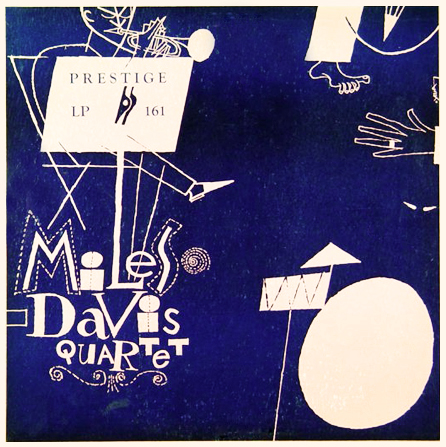
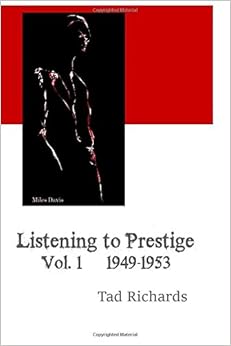
Tad Richards' odyssey through the catalog of Prestige Records:an unofficial and idiosyncratic history of jazz in the 50s and 60s. With occasional digressions.
This is the last round of the Contractual Marathon: twelve tunes, one afternoon, and Miles is out the door. And what more is there to say about what was...well, one can't say one of the most fruitful periods of Miles's career, because they were all fruitful, but probably one of the most beloved?
What's not to love? Miles with one of jazz's storied quintets, playing timeless tunes. "I'll play it and tell you what is after," Miles says at the beginning of the session, but there's scarcely any need. We always know what it is. Classic tunes from the Great American Songbook. Jazz standards from Monk and Rollins and Miles himself.
So rather than think a lot about it, I just listened to them. A lot. In the car, in the house. In a box, with a fox. And I did like them, Sam-I-Am.
Music that has been orchestrated into the sound track of your life, that you first heard when jazz was becoming as necessary to you as a pulse, can become one with that pulse over time and resolve itself into background music, but not in a bad way. It's never going to be elevator music. But it has the warm familiarity of a thirty year marriage. And then, suddenly, it will surprise you in a new, unexpected and challenging way, like...well, like a thirty year marriage.
So goodbye, Prince of Darkness. Like Tristano, and Getz, and Monk, and the MJQ, you're moving on from Prestige, although your bandmates will still be here for a while, Kind of Blue lies ahead of you, and Sketches of Spain, and In a Silent Way, and Bitches Brew, and Big Fun, and Jack Johnson, and the Fillmore. Thanks for the memories and the music.
After the last of the Contractual Marathon sessions had been recorded, Miles was free to pursue his career with Columbia. Her didn't have to wait for the records to be released, and in fact, their release dates were spread out.
"My Funny Valentine," "Blues by Five" (by Red Garland), "Airegin" (by Sonny Rollins, first
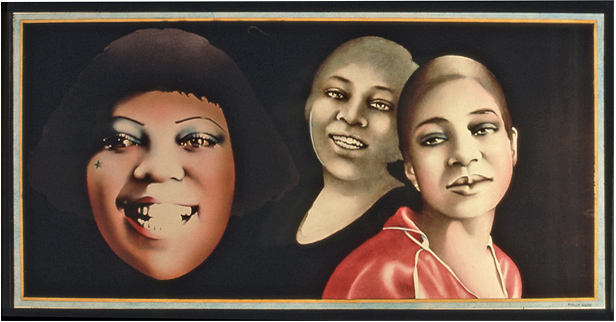
recorded by Miles in 1954 and already on its way to becoming a jazz standard), "Tune Up/When Lights Are Low" (presented as a medley, the first a Miles original and the second by Benny Carter and Spencer Williams) made up Cookin' with the Miles Davis Quintet, released in July 1957 as the first album in this series. The cover art was by Phil Hays, who, like Miles, would move on to Columbia, where he became noted for his album cover portraits of Bessie Smith and others.
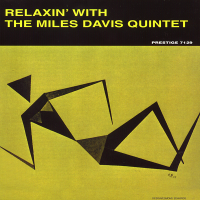
Standards "If I Were a Bell," "You're My Everything" and "I Could Write a Book," along with Rollins's "Oleo," were on the second album, Relaxin', released in February, 1958. "Half Nelson" saw daylight two years later, on Workin', February, 1960. "Well, You Needn't" was on Steamin', not released until August, 1961.
Prestige also got several 45 RPM releases from this session: "If I Were A Bell," Part 1&2, "Airegin / 'Round Midnight," "Tune Up / Oleo," and "My Funny Valentine / Smooch," the last one perhaps a Valentine's Day special.
I was asked by Gerry Pallor to interview photographer Glen Craig at the opening, at Soho's Morrison Hotel Gallery, of Craig's exhibit entitled "A Day in the Life of Miles Davis." The day, we discovered in talking to Craig, actually lasted several months, as he explains in the interview.
I've been deep into Miles in my Listening to Prestige odyssey, as he wrapped up his contractual obligations to the label with a series of marathon sessions in 1956, so this was a rare treat for me. I got to talk to Glen and to Nell Mulderry, project director for Sony's release of the Miles at the Fillmore sessions, and--a particularly pleasant surprise--to reconnect with old friend Peter Knobler, who originally commissioned the Craig photo essay.
Miles's extended day in the life came well after his Prestige era, when began his campaign to win over the counterculture and the rock audience with his historic Fillmore appearances.
Now we're entering the Miles Davis Contractual Marathon in earnest. His November session was only six songs. This one has thirteen--fourteen if you count the two versions of "The Theme." By way of comparison, three separate recording sessions for Columbia at around the same time period yielded seven tunes.
What's now known as the First Quintet jelled in the fall of 1955, when John Coltrane replaced Sonny Rollins, They appeared on the Steve Allen show in October, did their first studio session for Columbia a week later, and made their first recording for Prestige in November.
So by the time they got together for their first Contractual Marathon, they'd been working together for half a year. How long does it take a group of brilliant jazz musicians to coalesce? Well, we've just listened to the Elmo Hope session with Coltrane, Hank Mobley and Donald Byrd, so we know the answer is that you can just all wander into Rudy's parents' living room on a nice spring day and start playing seamlessly intuitive jazz right off the bat. Of course it helps if you have a great rhythm section, and one was there that day: Elmo Hope, Paul Chambers and Philly Joe Jones.
How much does it help? Jack Maher, in the liner notes to one of the LPs to come out of this session, recalls a club date where Miles and Coltrane were hopelessly out of sync, and the music was almost unlistenable. Maher recalls that, sitting with Teddy Charles, he commented on it. Charles's response:
"Watch the rhythm section. This is the best rhythm section in jazz the hardest swinging rhythm section, watch out when they loosen up."
At this point Miles and Coltrane abruptly walked off the stand. This was the usual cue for Red Garland to his featured number-trio style. Miles did this regularly when he was bored, felt he needed a break or a beer. I don't remember what tune it was exactly, something like "Ahmad's Blues" in this album, if I'm not mistaken, a medium tempo that more or less plays itself.
From the beginning the three men relaxed. Alone on the stand Red, Paul and Philly Joe relaxed and fell into a smooth spirited swing. The trio drew more applause for that one tune than the whole group had for the entire evening. When Miles and Coltrane returned to the bandstand the atmosphere in the club had changed. Somehow the tension had gone, and, on the next tune, "It Never Entered My Mind", which is also performed in this album, Miles played one of the most beautiful choruses I've ever heard him play.
If it doesn't take long for a bunch of great jazz musicians to find a groove, it takes a little longer to simply know this many tunes in common. And that's where six months of club dates starts to matter. Most, if not all of the songs played on this and the following marathon session were ones that the group had played on the road, in clubs. A bunch of them were pieces that Miles had recorded before, including the one they started the session with, "In Your Own Sweet Way," which he had just done two months earlier in an abbreviated session with a quintet featuring Sonny Rollins. This version is maybe better -- starting right off with Miles and his Harmon mute, setting a tone for the whole session.
I don't think he'd ever recorded "Diane" before. It wasn't exactly a jazz standard, and hasn't exactly become one, although Pete and Conte Candoli did a West Coast version a few years later. It was composed by Erno Rapee, primarily a symphonic composer. Its best known recording was by Mario Lanza, and it's not one of Lanza's best numbers. In fact, although it's been widely recorded by vocalists as far-ranging as country singer Jim Reeves, it really doesn't seem like a very good song. Until Miles gets hold of it. And Coltrane, who'd had a lovely solo on the first cut, really steps out and wails here, as he does on "Trane's Blues," which sort of makes its recorded debut here--that is, first recording under this title. It was called "Vierd Blues" when Miles and the same rhythm section, plus Sonny Rollins, recorded it in March, and composer credit was given to Miles. And also in March, it was recorded for a West Coast label by a group under Chambers' name, featuring Coltrane, Jones and Kenny Drew, as "John Paul Jones," for reasons that should be self-explanatory.
Going back and listening to both versions of "In Your Own Sweet Way" again, something occurs to me. Rollins is capable of as much romanticism as Davis is. So is Tommy Flanagan, actually. And Miles holds back a little. In the quintet version, he's matched with John Coltrane, who is following his own muse, which will take him, as we know, into remarkable places. But even here, he's into his own explorations, and this gives Miles license to completely open up to the romantic side of his nature. Listen to the way Miles comes back in at the end "In Your Own Sweet Way," after Coltrane's solo, simplifying, finding all the sweetness in the melody.
And I think this is one of the reasons why the albums that came out of these sessions were so popular at the time, and remain so popular. We've listened to the Davis/Charlie Parker recording session of 1953, where they ran out of studio time, and had to record "Round Midnight" in fifteen minutes. I said of that recording, "No time to be clever, no time to intellectualize it. Just go with the emotions closest to the surface, and for Parker pain was never far below."
Miles doesn't have a lot of time here, and maybe he's taking the most direct route. He's doing what Chuck Berry says modern jazzers don't do: trust the beauty of the melody.
But maybe he's doing it because he knows he can. He's been playing with Coltrane, Garland, Chambers and Jones for six months now, and he trusts them to provide a framework. Maybe that's one of the reasons why he chose so many ballads for this session.
"Something I Dreamed Last Night" is the first of these. It's a Sammy Fain melody that's been done
often by vocalists, starting with Marlene Dietrich, who is never simply romantic. There's always the subtext that she knows more about life than you'll ever know. Sarah Vaughan is surrounded by strings for her version, which makes for romance, but Sarah always has an edge, too. She always sings the song, and does it justice--more than justice--but she's also always singing the music, making a statement about it. Miles does that too, of course, but somehow he stays closer to the emotional purity. Johnny Mathis is all about beauty and emotion, but Mathis, as good as he is, is a bit of a one-trick pony -- beauty and emotion is what he's always going for. For Miles, it's a choice. And that brings a special kind of intensity.
There's probably no one who's never recorded "It Could Happen to You," starting with Dorothy Lamour in a 1944 movie. There's probably no way to sentimentalize a song more than Lamour does, even though she sings it to Fred MacMurray, and Miles finds a drier, more emotionally ambiguous approach, as he does with "Surrey With the Fringe on Top," the Rodgers and Hammerstein paean from Oklahoma to a bucolic life that Miles never knew nor wanted to know. In both of these, he sets up Coltrane for adventurous and bopworthy solos.
He gets back to the achingly beautiful with "It Never Entered My Mind," a song from the other side of the Richard Rodgers songbook, the dark side that Lorenz Hart explored, as opposed to Oscar Hammerstein's sunny side. Hart's lyrics capture the devastating loss of love to a guy who maybe deserved it, but that doesn't make the loss any less painful, especially since he knows he deserves it. Miles gives us the loss, in its purest form. He lets Red Garland explore other emotions, and then he brings it back to the melody, and the simple emotion. "When I Fall in Love," written by Victor Young for a forgettable 1952 movie, is nowhere near as good a song, but Miles finds the pathos in it, and makes the melody better than it perhaps has a right to be. There'll be more ballads in the next and final chapter of the Contractual Marathon, and they'll be beautiful too.
Then there are bebop classics (Dizzy Gillespie's "Woody'n You" and "Salt Peanuts," Miles's "Four"). They're treated like old friends, and they give all the satisfaction of hanging out with old friends...who have something new to say. Philly Joe Jones takes over "Salt Peanuts" and leaves you breathless. There's no chanted "Salt Peanuts! Salt Peanuts!" but Miles's horn gives a pretty good approximation.
Garland, Chambers and Jones are given the spotlight on "Ahmad's Blues," including a gorgeous bowed bass solo by Chambers. They demonstrate what Teddy Charles was talking about, and they demonstrated it to Bob Weinstock too -- he signed them as a trio.
Miles was a huge fan of Ahmad Jamal, and a lot of jazz critics thought Miles was crazy. Jamal played a lot of gigs in Chicago, which automatically put him the Second City second rank, and he mostly played with a trio in cocktail lounge settings, which made it easy to dismiss him as cocktail pianist. It should come as no surprise to find out that Miles was right.
The contractual sessions were cut up and released on four different albums over the next few years. "Woody'n You" and "It Could Happen to You" were on the March 1958 release, Relaxin' with the Miles Davis Quintet (the first release, Cookin' in 1957, was all tunes from the later session).
"In Your Own Sweet Way," "Trane's Blues," "Ahmad's Blues," "It Never Entered My Mind," "Four" and the two versions of "The Theme" came out on the 1959 release, Workin' with the Miles Davis Quintet.
"Diane," "Something I Dreamed Last Night,""Surrey with the Fringe on Top," "When I Fall in Love" and "Salt Peanuts" were all held off until 1961 and the final LP from the 1956 sessions, Steamin' with the Miles Davis Quintet.
A number of these tunes also eventually found their way to 45 RPM singles, as Prestige really entered that game in the 1960s. "It Never Entered My Mind" came out in early 1960, divided onto two sides of a 45, and July of 1960 saw "When I Fall in Love"/"I Could Write a Book." The marketing folks at Prestige had apparently decided that two songs were a better sell than Parts 1 and 2, which meant that These long form LP improvisations were released in edited versions. "When I Fall in Love," at 4:21, could easily have been split in half, but instead it was cut down to 2:25. Same with "I Could Write a Book," which went from 5:11 t0 3:37.
"Surrey with the Fringe on Top"/"Diane" was released in April or May of 1963, as Prestige continued to space out the contractual sessions as far as they could. Both of these were in severely edited versions -- the originals had been 9:05 and 7:49 respectively. For that matter, on "Surrey With the Fringe on Top," they edited the "e" out of "Surrey."
This was part of the Contractual Miles period, but not one of the marathon sessions, and not one of the new quintet sessions, which is interesting, because Miles was pretty well committed to the new quintet at that point. They played on the late 1955 session and the marathon sessions of later this year.
Also interesting was the brevity of this session. Only three songs, but it turned out that was all they needed to make up one of the albums that Miles owed Bob Weinstock. They had an unreleased session from 1953, and they put it together with this session to make the album called Collector's Items.
This sent me back to the 1953 session. Miles, in his autobiography*, paints that session as something of a disaster. Miles himself was heading into the depths of his heroin addiction. Bird was drunk. He polished off a quart of vodka at the rehearsal, according to this account, but since Bob Weinstock didn't do rehearsals, this was probably at the session itself. At some point he fell asleep, and Davis recalls being so mad he played poorly, or at least that was his opinion, and session producer Ira Gitler's, and this is probably why the session wasn't released at the time. In the liner notes to Collector's Items, Gitler says that the session was shelved because it was too short, and that may be part of it. But Prestige was releasing 45 RPM EPs at the time, and it could have been brought out that way.
Probably a good part of the reason the session was so short was that given the condition of the participants. Sonny Rollins was also addicted at this time, as were Walter Bishop and Philly Joe Jones.
So was the session good enough to be released in Contractual Year 1956?
It was good enough to be released any time.
Don't forget there's another joker in the contractual deck. Miles has already cut his first album for Columbia, due to be released after the Contractual Completion. That album, when it comes out in early 1957, will be called Round About Midnight, and will feature the quintet's version of the Monk classic. Did Weinstock know this, and was he trying to steal a march on George Avakian and the Columbia marketing division?
The first Columbia album, Round About Midnight, came out in 1957, and was not all that well reviewed. Critics found it wanting in comparison to the Prestige albums, though this judgment was to change over time, and Round About Midnight would become a classic and beloved jewel in the Davis crown. But the first response to it was tepid, and this strikes me as interesting.
...what really interests me here is the possibility that the passing of time may have led to a changing of tastes. Today, there's a lot more awareness of the evils of conglomerates and mega-corporations than there was in the 50s, and an indie label, or no label at all, might get a more sympathetic ear from critics, especially indie critics. But back then, I don't think this would have been an important issue.
...Today some critics, perhaps many of them born and raised in the in the era of studio perfection, are a little snarky in assessing the Prestige catalog. Ragged, they say. Bob Weinstock preferred quantity to quality, rushed his sessions, didn't allow his musicians to rehearse, never did more than a couple of takes. But maybe back then, that ragged edge was more appealing, more authentic. Maybe the critics of 1957 were put off a little by the studio-perfected sound.
Maybe. And the 1953 "Charlie Chan" session provides an even greater contrast: a finely honed, rehearsed session vs. a total mess. And out of that whole chaotic fiasco, "Round Midnight" was probably the most chaotic. As Gitler describes it euphemistically, "for various reasons the date had not jelled to expectations," and by six o'clock, when the engineer (not Van Gelder) was scheduled to go off duty, and had announced that there'd be no overtime, they only had three tunes in the sack. Actually, only two, but for Collector's Items they use two different versions of "The Serpent's Tooth." They were planning to finish off the day with Monk's "Well, You Needn't," but they couldn't get it together. With 15 of studio time left, they somehow managed to pull it off.
Which is better, the once-maligned, now treasured Columbia version, or the once-shelved, now mostly overlooked collector's item?
Dumb question, of course. They're both magnificent, and no one should be expected to choose one. But, God help me, I like the earlier one. Gitler, in his liner notes, says that Bird's opening solo "is full of the pain and disappointment he knew too well. That borders on the pathetic fallacy, assigning such specific emotions to an abstraction like a piece of music.
But Gitler is right. The pain is nearly palpable. One can't help but be moved.
So, on to the new session, with only Paul Chambers from the quintet, with Miles in full possession of his Harmon-muted voice, And with another unexpected collaboration-of-sorts, between the two jazz mega-stars of their era: Miles and Dave Brubeck. The session starts with a beautiful Brubeck composition, "In Your Own Sweet Way." There are some--not many-- who have reservations about Brubeck as a pianist, but I don't think anyone can question his brilliance as a composer. Miles would record "In Your Own Sweet Way" again with the quartet, and it has become a kind of touchstone for trumpeters, with versions by Chet Baker, Woody Shaw and Art Farmer.
"Vierd Blues" is a Miles composition that has become a standard, often for pianists (Bill Evans, George Shearing, Oscar Peterson), but also for unlikely artists such as German avant-gardist Albert Mangelsdorff. It has a striking piano solo here by Tommy Flanagan, who had just arrived in New York from Detroit (where he had been house pianist at the Blue Bird Inn) with a reputation that preceded him: in one week in March, he broke into the recorded jazz canon with sessions with Thad Jones, Kenny Burrell, Jones again, and this session with Miles.
This is a session without much or a history. It was released in 1956, and then again in a 1971 compilation-of-this-and-that reissue. But like everything else Miles did in his Contractual Farewell Tour, it has immediacy and urgency.
I woke up this morning thinking "The one thing that this blog/book series is going to be judged on is whether I got Miles Davis right."
Well, you think a lot of strange things when you're waking up, but there's no overestimating how important Miles was in the history of American music.
We're at a crucial juncture in the Miles Davis/Prestige Records story: that is, the end of the story. Miles jumps to Columbia, has to finish his obligation to Prestige, does it in two marathon sessions that maybe should have sounded rushed and perfunctory but instead produced some of Miles's best-loved albums.
I had somehow thought that this was done all at once--two days, two marathon sessions, in and out, so long Bob. But actually, it was a little more spread out than that. One session in the summer of 1956, one in the fall. And this one, near the end of 1955.
Why am I suddenly so self-conscious about writing about the Prince of Darkness? It's not as though I haven't covered him before. And it's not as though Miles is the central figure in this fragmented narrative. I'm just as interested, if not more so, in learning about Lawrence Wheatley, who made a passionate commitment to live jazz, and chose never to record again. Or Freeman Lee, who left the road to become a beloved junior high school science teacher. I'm just as interested in trying to find out if the Junior Parker who recorded with Stan Getz is the same one who made "Mystery Train." Or finding out that Teddy Charles' professor at Juilliard later taught Steve Reich, and wondering if the inventive jazz musician influenced the celebrated modern composer.
I suppose it's because so much has been written about Miles, and so may people have read it. And I mostly haven't. There are biographies. There's an autobiography, There are even specialized books, like the one on the making of Birth of the Cool. I actually have read that one. I have so much better chance of being found wrong, in writing about Miles.
So I woke up this morning thinking maybe I ought to read a biography of Miles before going on. And I probably will, before I finish up with him in 1956. But not just yet. Now I want to stay in my head, and float a few hypotheses, wrong though they may be.
Miles's transition to Columbia was far from overnight. By the fall of 1955, he had signed with Columbia, and he had even made his first Columbia recording, though it wouldn't be released right away. That was the deal--he could record for Columbia, but the records could not be released until after he had completed his obligation to Prestige.
And altogether, the Prestige obligation was completed in three sessions: the two marathons in 1956 and this one mini-marathon from November, 1955.
So the Columbia date in October was actually the first recording session for what came to be known as the First Quintet: Miles, John Coltrane, Red Garland, Paul Chambers, Philly Joe Jones. They did four songs, and the rhythm section did a fifth.
The Prestige session of November was long but not quite as grueling as the later ones. The group recorded six songs, which were released as Miles in April of 1956.
The first Columbia album, Round About Midnight, came out in 1957, and was not all that well reviewed. Critics found it wanting in comparison to the Prestige albums, though this judgment was to change over time, and Round About Midnight would become a classic and beloved jewel in the Davis crown. But the first response to it was tepid, and this strikes me as interesting.
First off, had I been George Avakian, and had I had the benefit of my own hindsight, I would have told Miles not to record his long Prestige swan song with the quintet. "Come on, Miles, do what you've always done with Bob. Put together a pickup group with whoever' around. You can use that piano player, Lawrence Yardley. He just played on an Ammons session and I bet he'd love to get more recording work. Maybe get Ammons, too, or how about James Moody? Throw in a vocal -- Prestige has that guy King Pleasure, and they're not using him much. Save the quintet for the big Columbia unveiling."
But what really interests me here is the possibility that the passing of time may have led to a changing of tastes. Today, there's a lot more awareness of the evils of conglomerates and mega-corporations than there was in the 50s, and an indie label, or no label at all, might get a more sympathetic ear from critics, especially indie critics. But back then, I don't think this would have been an important issue. The 50s were marked by the advent of Rudy Van Gelder and a new era in jazz music recording. But
recording equipment continued to evolve, and big studios were able to constantly upgrade to the newest state of the art. Tape made editing simpler. So did multitracking and, eventually, digital recording. Today we have AutoTune, and you can virtually make the Singing Dogs sound like Pavarotti.
Even in 1956 at Columbia, they were starting to push the possibilities of studio recording. "Two Bass Hit" took six takes, and the finished version splices the beginning of take two to the end of take five. Artists (including Miles) would come to take it for granted that if they missed a high note, they could come back into the studio and hit just that one note, and have it spliced in.
Today some critics, perhaps many of them born and raised in the in the era of studio perfection, are a little snarky in assessing the Prestige catalog. Ragged, they say. Bob Weinstock preferred quantity to quality, rushed his sessions, didn't allow his musicians to rehearse, never did more than a couple of takes. But maybe back then, that ragged edge was more appealing, more authentic. Maybe the critics of 1957 were put off a little by the studio-perfected sound. Miles was the LP from this session, and it came out in April of 1956. "Sposin'" and "Just Squeeze Me" were released on 45.,
Does Miles already have one foot out the door? Certainly he's thinking about it. He must at least have a couple of toes out. It's just a couple of weeks since the Newport Jazz Festival jam session after which he was approached by George Avakian, wooing him for Columbia Records.
Avakian wanted Miles to put together a group that he'd work with consistently. Today, using one of the words I've grown to loathe, this would be called a brand. It was opposite from the approach Bob Weinstock had taken, having Miles record with different musicians in different combinations.
So if Miles had those couple of toes out the door, he had to have been at least to some degree auditioning young musicians. He obviously wasn't going to recruit Milt Jackson or Percy Heath, but the others were all possibilities.
Miles had kicked his heroin habit by this time, and he was understandably impatient with young musicians who had not. That meant young Jackie McLean, then 24, would not make the cut. Miles said of him later,
Jackie was so high at this session that he was always scared he could not play anymore. I don't know what's the shit was all about, but I have never hired Jackie after this session.
McLean only appears on two cuts "Dr. Jackle" and "Minor March." Miles would have the same problem with the saxophonist he did choose, John Coltrane, and they went through some rough patches, with Miles at one point firing Trane and disbanding the quintet, then putting it back together.
Art Taylor, at 26, was beginning a long association, not with Miles, but with Prestige. He may have been the drummer on a 1954 session with Art Farmer (this is up in the air), but he was definitely on this session. He would work off and on again with Miles over the years. but we would become known as the "house drummer" for Prestige, working on many sessions. Unlike Miles, he would also record again with Jackie McLean--and he had worked with him before. The two of them, and Sonny Rollins, had grown up in the same Harlem neighborhood, and had played music together as teenagers.
For 24-year-old Ray Bryant, 1955 was his breakout year, but he had actually first recorded at age 14.
This was in his native Philadelphia, in a band that included John Coltrane (on alto) and Benny Golson. And continuing my policy of never meeting a digression I didn't like, especially when it involves the twisting careers of working jazz musicians. the band was led by drummer Jimmy Johnson, who must have kept working and getting his name known in jazz circles, because 15 years later he was hired by Duke Ellington.
Trombonist Gino Murray later worked with Gene Ammons and Sonny Stitt, but doesn't seem to have recorded with them,
Bassist Tommy Bryant didn't quite achieve the renown of his younger (by one year) brother, but he had a solid career, playing and recording with both his brother and Benny Golson from the 1944 session, and also with Dizzy Gillespie, Jo Jones, Roy Eldridge, and may others.
But the really interesting career out of this aggregation belongs to trumpeter Henry Glover. In the mid-1940s, that burgeoning time for independent jazz and rhythm and blues labels, he was touring with Lucky Millinder, and met Syd Nathan, who had recently started King Records as a country label, but was discovering that there was a market for the sort of jazz that bands like Millinder's played, which was soon to be called rhythm and blues.
Nathan hired Glover to build a rhythm and blues presence on his label, and, incidentally, to build him a studio. But Glover ended up doing more than that. Originally from Arkansas, Glover had grown up listening to country music on the radio, and -- like his contemporaries Ray Charles, Chuck Berry and Fats Domino-- loving it. So Glover found himself producing country artists like Cowboy Copas, Hawkshaw Hawkins (those two would die int he plane crash that killed country legend Patsy Cline), Grandpa Jones, and the Delmore Brothers, with whom he co-wrote "Blues, Stay Away From Me," which became their signature song and a country music standard. Glover was almost certainly the first successful African American producer in the country field.
He had his first rhythm and blues hit with Bull Moose Jackson, and went on to record Lucky Millinder, Tiny Bradshaw, Wynonie Harris, Bill Doggett, Hank Ballard and the Midnighters, Little Willie John, and Jame Brown. Later moving to Roulette, he came back into the jazz fold, producing records for Sarah Vaughan, Dinah Washington and Sonny Stitt, as well as creating a rock 'n roll presence on Roulette with the k\likes of Ronnie Hawkins. He became close to Ronnie Hawkins' backup band, later to become The Band, and in the 1970s moved to Woodstock where he helped Levon Helm found his own independent label. As a songwriter, he wrote "Drown in My Own Tears," a hit for Ray Charles, and one of the biggest hits of the 60s, "Peppermint Twist."
The record that Glover, Bryant and the gang made was never released, and the personnel list for the session comes from the memory of Benny Golson.
Bryant would go another four years before getting a record date, this time with Tiny Grimes' Rockin' Highlanders. Grimes was another one of those cats who made music at the intersection of jazz and R&B. I know that tenor sax great Red Prysock, who was on this session, quit Grimes shortly thereafter because of the bandleader's insistence that his band members all wear kilts. So...Ray Bryant in a kilt? Or Philly Joe Jones?
Then nothing till 1955, Bryant's breakout year. Before the Davis session, he had recorded with Toots Theilemans on Columbia, with Betty Carter on Columbia subsidiary Epic (the label for which he would record most often, and then with the same trio (Wendell Marshall, Jo Jones) under his own name. He would record again for Prestige in December, with Sonny Rollins.
Miles and Milt Jackson had played together before, on the notorious Miles/Monk session, They play off each other beautifully here, and so does Jackie McLean. Although he's only on two tracks. "Dr. Jackle" and "Minor March." He gets composer credit on both, and fairly extensive solo space. "Bitty Ditty" is a Thad Jones composition that's been widely recorded; "Blues Changes," also known simply as "Changes," is Ray Bryant's. All the cuts are extended--from 6 1/2 to 9 minutes long -- giving plenty of room for improvisational experimentation.
Again, we have to grateful to Weinstock and Prestige for giving Miles this kind of exposure, in different settings and with different musicians. And, as in the case of this session, with different musicians bringing different material.
The session was planned for a 12-inch LP, with just over 15 minutes on each side, but the album wasn't released right away, for whatever reason. It came out as Prestige PRLP 7034, and is variously known as a Miles Davis or Miles Davis/Milt Jackson album (see the typefaces on the album cover.
The cover art is that muted color photo reproduction which would appear on a lot of Prestige covers; the photo is by Bob Weinstock.
This is an interesting period in Miles's career. This session was recorded in June of 1955, and he was still working with Bob Weinstock's philosophy:
So, our basic idea was just to make records with different people, to record with the best people around...we would sit down and talk about it. Miles would mention who was in town, who he would like to record with. I'd say who I'd like to hear him record with.
That was about to change. Miles was healthy by this time, free from heroin addiction, working out regularly. Although he did not mix it up with Thelonious Monk during their session of the previous December, as was rumored at the time, he was working out in the gym regularly, including sessions on the light punching bag.
In July, he played the Newport Jazz Festival with an all-star group, including Thelonious Monk, although they would never record together after the December dustup. The rest of the group was Gerry Mulligan, Zoot Sims, Percy Heath and Connie Kay, who had just joined the Modern Jazz Quartet to replace expatriate-to-be Kenny Clarke. Miles doesn't appear to have been a part of the official festival lineup, but Columbia producer George Avakian heard him and his group jamming on Monk's "Round Midnight," and immediately recruited him for Columbia. Avakian had exactly the opposite to Weinstock's philosophy. He wanted Miles to put together a regular and recognizable group. Avakian's idea turned out to be the stroke of genius that put Miles over the top, but we can only be grateful, as well, for Weinstock's "jam with Miles" sessions.
It appears that, without necessarily planning it that way, Miles was already assembling that regular group. Oscar Pettiford wouldn't remain--reportedly his personality clashed with Miles's--but Red Garland and Philly Joe Jones would.
Jones had only recorded once before with Miles, but the two had spent time on the road together during Miles's self-imposed exile from New York. Garland had played on various dates with Billy Eckstine, Roy Eldridge, Coleman Hawkins, Charlie Parker, Lester Young and Eddie "Cleanhead" Vinson (John Coltrane was also in Vinson's band), but he was pretty much unknown when Miles tapped him. They had boxing in common as well as music--Garland, as a welterweight, had actually fought Sugar Ray Robinson.
Ira Gitler, in preparing the liner notes for the Prestige album from this session, talked to Miles about musicians he admired. This must have been after Newport, so Miles must already have been thinking about who he wanted in the group he'd be forming.
I asked Miles who his current favorites were. On his own instrument he quickly named Art Farmer and Clifford Brown as the new stars and Kenny Dorham as one who has come into his own. Then he spoke lovingly of Dizzy Gillespie. "Diz is it, whenever I want to learn something I go and listen to Diz." In the piano department two Philadelphia boys, Red Garland (heard to good advantage in this LP) and Ray Bryant were mentioned along with Horace Silver, Hank Jones, and Carl Perkins, "a cat on the Coast who ploys bass notes with his elbow'. The talk shifted to saxophone and to Sonny Rollins and Hank Mobley who are carrying on the tradition of Charlie Parker. This naturally started us talking about Bird. Miles credited his most wonderful experiences in jazz to his years with Bird. He stared slowly ahead *Like Max said, New York isn't New York anymore without Bird." Max's name being mentioned directed the conversation to drummers. "Art Blakey and Philly Joe Jones; Max For brushes." Miles is very conscious of drummers. Many times he will sit down between the drummer and bass player and just listen to what the drummer is doing.
Miles did actually play with Kenny Dorham once, in a 1949 all-star big band in Paris, Le Festival International de Jazz All-Stars.
He recorded a few times with Dizzy Gillespie, first on a 1945 session with Charlie Parker, but Diz mostly played piano on that session. He was supposed to strictly play piano, but the youthful Miles was so nervous about playing with his idols that he broke down completely on "Ko-Ko," and Dizzy had to step in. He played in a trumpet session with Dizzy and Fats Navarro in 1949. Fats was gone, of course, by the 1955 conversation with Gitler. This was the 1949 edition of the Metronome Allstars, a group of Metronome Magazine's poll-winners that was gathered for a recording annually throughout most of the Forties and well into the 50s. Metronome would gather together as many of the poll winners as they could, and fill in the rest with runners-up. 1949's group was more than a little impressive: Miles Davis, Dizzy Gillespie, Fats Navarro (trumpet); J.J. Johnson, Kai Winding (trombone); Buddy DeFranco (clarinet); Charlie Parker (alto saxophone); Charlie Ventura (tenor saxophone); Ernie Caceres (baritone saxophone); Lennie Tristano (piano); Billy Bauer (guitar); Eddie Safranski (bass); Shelly Manne (drums). There was another session with Bird in 1953, and then nothing until 1989, where they appeared as the trumpet session on a very strange Quincy Jones recording that features vocals by Ella Fitzgerald, Sarah Vaughan, and rappers Big Daddy Kane and Kool Moe Dee. I'm not certain it's an entirely successful experiment, but I'm sure as hell not certain it isn't.
But he wasn't looking for another trumpet player to round out his new quintet. He was looking for a tenor sax, and actually, Sonny Rollins was his first choice. Rollins played with the new quintet in July, right after Newport, but the arrangement wasn't to last. Sonny had his own heroin habit to kick. John Coltrane was not yet on Miles's radar. Hank Mobley would play with the quintet, but not until years later.
Miles would use Ray Bryant on piano a month later, in another one of his Prestige pickup groups, but
Red Garland was to be his man. At the time of this recording, and this interview, Garland was the least-known of the piano men that Miles admired--even including Carl Perkins, who would die too young to establish much more of a reputation, and who really did play bass notes with his elbow, his left arm having been crippled by polio. But Miles clearly had his eye on Garland already.
When you think of answer songs, you're more likely going to think of country ("It Wasn't God Who Made Honky Tonk Angels") or rock ("Sweet Home Alabama" answering Neil Young's "Southern Man," and then Warren Zevon's "Play it All Night Long" answering Lynyrd Skynyrd), or even blues (Rufus Thomas's "You Ain't Nothin' But a Bearcat"). But here's one turning up in jazz: Miles's "I Didn't" as an answer to Monk's "Well You Needn't" (a tune that Miles also recorded). "I Didn't" is sharp, crisp and sardonic. You have to be awfully good to take on the premier composer of his generation, but Miles is up to the task.
"A Night in Tunisia" is one of the most famous of all bebop standards, and "Green Haze" a Davis original that showcases Garland, his new piano discovery. The others are all odd choices that Miles puts his indelible stamp on. "Will You Still Be Mine" was written by pop singer and swing era tunesmith Matt Dennis. The other two are by composer Arthur Schwartz, and were both songs that one would not have chosen to be present at the birth of the cool, or even at its confirmation. "I See Your Face Before Me" was best known in versions by Guy Lombardo and Glen Gray. Coltrane and Brubeck would both record it later.
"I've Got a Gal in Calico," written by Schwartz and Leo Robin for a movie musical, is one of those completely cornball, white-bread numbers, like "Surrey With the Fringe on Top," that no one could consider as the basis for a hipster jazz improvisation. But Miles worked the same magic with "Surrey With the Fringe on Top," didn't he?
Both "Green Haze" and "A Night in Tunisia" were released as two-sided 45s. The Musings of Miles became Davis's first 12-inch LP, Prestige PRLP 7007. Before it were two reissues, PRLP 7004, Lee Konitz With Tristano, Marsh And Bauer, from four sessions (1/11/49, 6/28/49, 9/27/49, 4/7/50) in 1949-50; and PRLP 7006, Mulligan Plays Mulligan (original session 8/27/51). In between was an MJQ session recorded after Miles, but released before.
This is an all-star's all-star session, and one might wonder why they didn't do it more often, but the wonder seems to be, instead, how
they got through it at all. In terms of personality clash, it's one of
the great disasters in jazz history. In terms of music, it's
magnificent.
The big story that came out of the session was Miles and Monk almost coming to blows. Or so some say. Miles says no. Actually, everyone says no, as far as actual blows being landed.
Monk says no: "Miles'd got killed if he it me."
Miles agrees: Monk "was too big and strong for me to even be thinking about fighting."
But there was an argument. You can hear part of it on take one of "The Man I Love," at which point Miles may have been a little fed up with Monk. Monk can be heard asking when he should start playing, and Miles breaks in, telling Rudy Van Gelder, "Hey Rudy, put this on the record, man – all of it!"
So all of it is there.
If Monk's question seems a little odd, it's because Miles had told him, earlier in the session, to lay out -- to stop playing during Miles's solo -- and Monk had not taken kindly to the suggestion.
But no fisticuffs. Ira Gitler, who was there for part of the session but did not produce it, writes,
things were not serene when I left towards the dinner hour (the session had started somewhere between two and three in the afternoon). Later that night, at Minton's, I saw Kenny Clarke who answered my "How did it go?" with "Miles sure is a beautiful cat," which was his way of saying that despite the obstacles Miles had seen it through and produced something extraordinary and lasting.
One of those obstacles is described by drummer Charli Persip in a video
interview. Persip had been invited to the session by his mentor, Kenny
Clarke, and as he tells it,
I'm sitting there in heaven. Here I am in the same room with Thelonious Monk and Miles Davis. And Monk...there's one spot on one tune where Monk's solo -- he started playing ding-da-ding-ding-ding-ding, ding-ding-ding, ding-da-ding-ding-ding -- what happened was, he had a beer, and he knocked it over on the floor, and he was trying to get that beer up
before Rudy Van Gelder would see it, because he knew there'd be hell to pay, so he's fumbling around down there trying to get the bottle to stop it from leaking on the rug, and at the same time he was still playing the solo! And after, to keep Rudy off of him -- Rudy came in with a rag, and he was fussing and carrying on, but he wasn't really too upset, because it wasn't his equipment, it was just the rug. But Monk wanted to impose his will on [Persip says "Rudy" here, but I'm sure he means Miles], so every time [Miles] would start playing, he'd stand up and look stupid, just look off into space...Everybody broke up, every time he did it."
And the story gets a little mumbly here, but basically Miles told him to cut it out, which is probably why, by the time they got to "The Man I Love," Miles told Rudy to leave everything in.
And once again, one has to tip one's hat in gratitude to Mr. and Mrs. Van Gelder, who no doubt had to deal with the beer stains on their living room rug.
The session itself...what more can you say than that it's great? And, fortunately, take one of "Bags' Groove" was preserved, so we hear Monk's beer solo. And one could say, with Ernie Bushmiller's Nancy, that this shows you could get away with anything in bebop...but it's actually a wonderful solo. A little strange, but musical. And reaching up from the floor, scrambling around for his beer, Monk still swings. And appropriately enough, Bags finds the groove and adds some appropriate fills.
At any event, this is the only studio album Miles and Monk ever made together, and it may help to explain why the Columbia album Miles and Monk at Newport actually features the two cats leading two different groups, in two different years.
The ready-for-prime time version of "Bags' Groove" made it onto a 10-inch, Miles Davis All-Stars, along with "Swing Spring," a Davis original. Monk's "Bemsha Swing" and the approved version of "The Man I Love" are on a second 10-inch, Miles Davis All-Stars Vol 2. Miles Davis and the Modern Jazz Giants, on the short lived 16 2/3 format, had the whole session, along with an earlier 1954 session. All except for the two versions of "Bags' Groove" also appeared on the standard 33 1/3 RPM 12-inch LP of the same title, released in 1959. The two versions of "Bags' Groove" were on an LP of the same name, released in 1957.
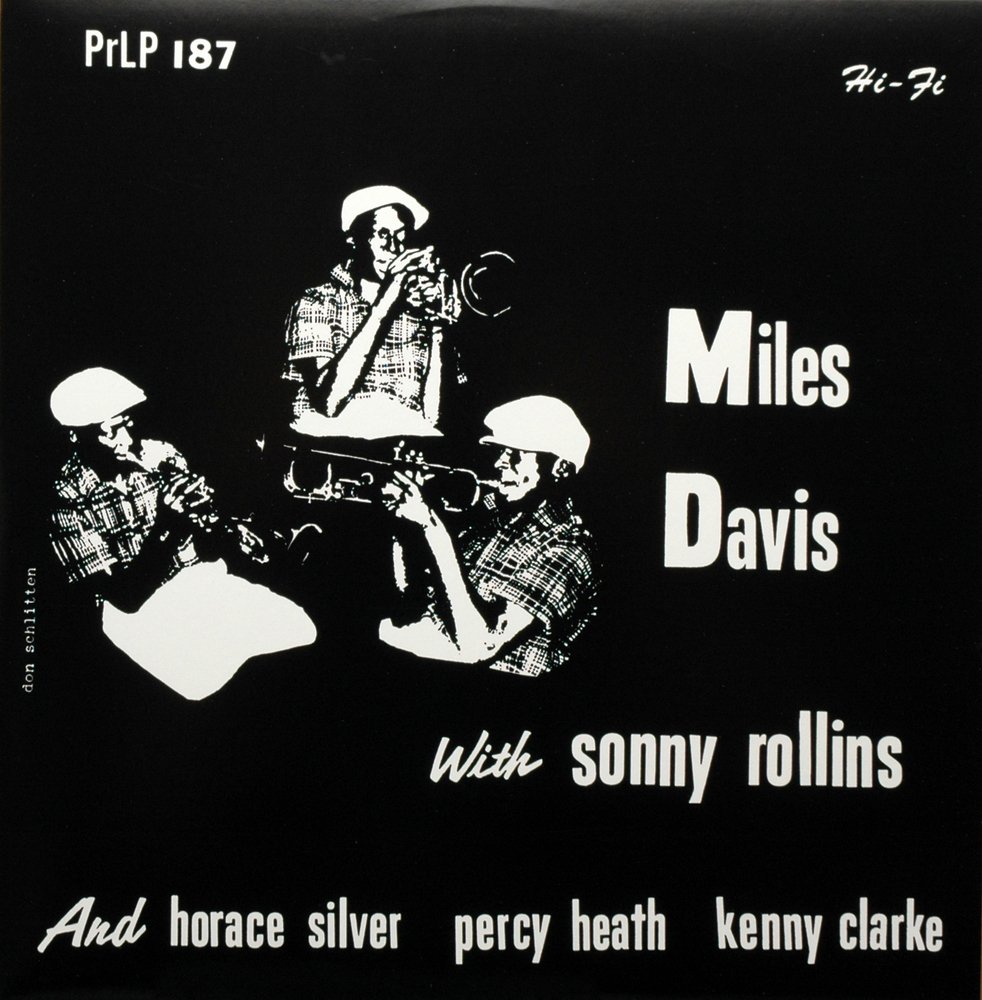
The most interesting thing about this session from a listener's standpoint is easy: the music. Miles Davis, Sonny Rollins. Horace Silver, Percy Heath, Kenny Clarke (after the confusion as to who was drumming on the June 4 Art Farmer, date, I triple-checked, and it is Kenny Clarke). Three originals and a Gershwin standard. Great tunes, great playing. Rollins is back in the studio for a third Prestige session with Miles, and it's always a welcome pairing. And it was a busy month in Rudy Van Gelder's parents' living room. This will have been the third time they've had to have dinner out, or stay in the kitchen.
From a blogger's standpoint, there are a couple of things of note. First, all three of the originals are Rollins compositions, and they've become jazz standards.
"Airegin" falls into the category of backwards-spelled words as titles, which was becoming nearly as popular as puns on "bop" had been a few years earlier. Miles would record it again with John Coltrane, and it's been waxed by Tito Puente, Stan Getz and Chet Baker, Wes Montgomery, Maynard Ferguson, among others. The jazz greats who've recorded "Oleo" include George Benson, Grant Green and Lee Konitz. Dexter Gordon, John Coltrane, Shelly Manne, Cal Tjader, Branford Marsalis and John McLaughlin have all done "Doxy." Phil Woods used it as his theme.
Second, this session is of historical interest in that it's the first time Miles recorded with a Harmon mute (on "Oleo"). This isn't as earth-shaking as it might seem. Miles had already found his mature tone, and the Harmon mute may have refined it, but didn't fundamentally change it. If you listened to all five of the cuts from this session (including the two takes of "But Not For Me"), and you were a trumpet player, you'd be able to pick out the Harmon mute instantly. The less sophisticated listener (like me), maybe not.
"But Not For Me" was released as a two-sider on both 78 and 45. Prestige was nearing the end of its 78 RPM days, but not quite ready
to pull the plug yet. The whole session (only one version of "But Not For Me" was on a 10-inch, and all five tunes were on the Bags Groove 7000-series LP.
1956 was the big Miles Davis marathon, in which Miles finished up his obligation to Prestige in a blaze of glory, one session after another, so that he could move on to Columbia. But he was almost as busy in 1954. His March quartet session at Beltone was followed by two in April at the Van Gelder studios, and there'd be more before the end of the year.
Each of these sessions featured a different front line (well, the first one was just Miles, which may not exactly make a line), but mostly the same rhythm section. Horace Silver, Percy Heath and Kenny Clarke had come together for the Art Farmer session. Miles had used Art Blakey for the March quartet session, but Clarke was on drums for these two.
The quintet for the April 3 session included Davey Schildkraut on alto. Schildkraut was a veteran at
29, having gotten his first major professional gig at 16, with Louis Prima. He had early on heard the siren song of bebop, and mastered it to the point that when Charles Mingus was given "I'll remember April" on a Leonard Feather blindfold test, he identified the alto player as Charlie Parker.
Actually, Parker and Schildkraut overlapped a few times in the early 50s. There's a live recording of Bird with Stan Kenton -- I had never known they played together -- from a couple of months before the Miles session, with a Kenton reed section that includes Schildkraut. And there's a session from 1953, released on the Roost Jazz label in 1990 as More Unissued, Vol 2. That is, more unissued Charlie Parker sessions. But the alto player on that date has since been authoritatively confirmed as Davey Schildkraut.
Bill Holman, who was Kenton's arranger while Schildkraut was with the band, sees no similarity between the two. In an interview with Schildkraut student Rob Derke, Holman said:
Dave had a completely introspective way of playing...and played according to how he felt at any particular time. A lot of guys take the easy way out and say ‘Oh, another bebop alto player so we’ll compare him to Bird.’ I never heard [Schildkraut] using Bird’s or anyone else’s licks, it was all completely original and I really enjoyed hearing his playing for that reason.
"Solar" is based on the chord changes for "How High the Moon," and as I've stated before, I never know quite what to make of "based on the chord changes." Pretty much every blues, country and rock and roll song is based on the same three chords. I looked up "How High the Moon chords" on Google, and the chords to the Les Paul version, which is the most familiar one, are a little different from the chords in another jazz standards fake book. Anyway, I don't always hear the melody in a bebop "based on the chords" version of a standard, but I can hear "How High the Moon" in "Solar." The same chord changes were used by Chuck Wayne in a composition called "Sonny," recorded in 1946 and unissued (and uncopyrighted). Wayne claimed that Miles had ripped off his melody, and maybe he did. The general consensus is yes. I don't know the difference between ripping off a melody and basing a melody on chord changes. Anyway, here's a bit of the Chuck Wayne tune on a scratchy acetate, if you're interested. "Solar" became a jazz standard, although Miles never recorded it again.
"Love Me or Leave Me," based on the chord changes to "Love Me or Leave Me," is so firmly ensconced in the public consciousness as a pop song, thanks to great pop renditions by Doris Day and Sammy Davis, Jr. (I'm too young to remember Ruth Etting), that I had never really thought of it as a jazz standard until I heard the Miles Davis version. After that, I spent a little time seeking it out, and found jazz vocal versions by Nina Simone, Billie Holiday, Anita O'Day and others; instrumental versions by Benny Goodman, Lester Young, Gerry Mulligan--and, in a more modern setting, Tuba Skinny. I've always loved the Sammy Davis, Jr., version, with its rapid-fire faux scatting, ending with the exhortation, "Blow, Sam!" I always thought he was cheering himself on, but recently it's occurred to me that it must be Sam Butera coming in with the sax solo.
But ever since I first heard the Miles recording, it's been the definitive version for me, and I was glad to spend some serious time listening to it and absorbing it in preparing this blog entry.
Miles is best known, for most of his career, for playing with a Harmon mute, but he experimented with different mutes before settling on the Harmon. On this session he used a cup mute, and it suits "Love Me or Leave Me" perfectly. The tune is taken at an uptempo bebop pace, and yet it still maintains a plaintive, bluesy tone. There are two ways of approaching "Love Me or Leave Me."
There's the torchy, moody Doris Day/Billie Holiday way, the lost lover who'd rather be lonely than happy with someone else, or the slap-happy Sammy way, you can love me, you can leave me, what do I care? I'm here for the rhythm and the chord changes and the chance to wail out, and "blow, Sam!" Miles manages to do both.
The sextet session came at the end of the month, with the same rhythm section and a new front line.It became immediately, and remains, one of the most potent sessions in the Davis canon. New Yorker jazz critic Whitney Balliett called it "some of the best jazz improvisations set down in the past decade." Both cuts are amazing, but "Walkin'" will send nonstop chills up and down your spine.
Davis bolted Prestige for Columbia for a number of reasons. One of them was money. One was that Columbia had...well, more prestige than Prestige. But one was that Columbia wanted him to put together a regular group, while Bob Weinstock had wanted him to play with a variety of musicians:
So our basic idea was just to make records with different people, to record
with the best people around. That's what we did until the end, when he
had the quintet with John Coltrane, Red Garland, Paul Chambers, and
Philly Joe Jones. But everything up to that point developed from where
we would sit down and talk about it. Miles would mention who was in
town, who he would like to record with. I'd say who I'd like to hear him
record with. We'd kick ideas around.
If I sound like a cheerleader for this entire era of music, and for everything that Bob Weinstock, Ira Gitler, Rudy Van Gelder and the Prestige record company did, I'm OK with that. These are a fan's notes, and this era, this label, stands as one of the great gifts to American culture and the American Century in music. So I'll say it. The Miles Davis quintets and sextets were inspired, and the source of great art. But we are just as lucky to have these records with different people, with the best people around, with the ideas that were kicked around. One suspects, from what one knows about Miles, that after a while he didn't want to kick ideas around with anyone, except maybe Gil Evans.
But we have these records. This rhythm section, with Horace Silver really starting to come into his own. And different front lines for Miles to jam with--and jamming was what it was. Jamming was the Bob Weinstock philosophy,
J. J. Johnson was one of the true beboppers, there from the beginning.
I knew very little about Lucky Thompson. I have his Tricotism album, so I knew he was good. I knew that he'd played the expatriate game for a spell. Allmusic.com has an excellent bio by Jason Ankeny, which I recommend.
I discovered that Thompson was called "Lucky" because "of a jersey, given him by his father, with the word "lucky" stitched across the chest," not because he ever had any luck in his life. His mother died when he was five, and from that early age, he became responsible for taking care of his younger siblings. He always loved music, and always wanted a saxophone, with such passion and dedication that he "carved imitation lines and keys into a broom handle, teaching himself
to read music years before he ever played an actual sax. According to
legend, Thompson finally received his own saxophone by accident -- a delivery company
mistakenly dropped one off at his home along with some furniture."
Thompson was one of those guys who moved from swing to bop -- he played with Erskine Hawkins and Lionel Hampton before arriving on 52nd Street, where he was asked to fill in for Ben Webster at the Three Deuces, and "Webster, Coleman Hawkins, Lester Young, and Art Tatum were all in attendance at Thompson's debut gig, and while he deemed the performance a disaster (a notorious perfectionist, he was rarely if ever pleased with his work), he nevertheless quickly earned the respect of his peers and became a club fixture."
Ankeny describes Thompson's sound as "never fit[ting] squarely within the movement's paradigm -- his playing boasted an elegance and formal power all his own, with an emotional depth rare among the tenor greats of his generation."
It was battles with the jazz establishment, particularly record label owners, more than racism that drove Thompson to Paris, and that would drive him in and out of the music business.
"You Don't Know What Love Is" was the flip side of "Old Devil Moon" on a 45, and "Walkin'," split in two, made both sides of a 45. These would be the first Prestige singles to come out on 45 and not 78. The sextet sessions were also released on 45 RPM EPs and a 10-inch LP. The quintet sessions also had a 10-inch, and the two sessions were combined on the 12-inch Walkin'.
Horace Silver and Percy Heath packed up from their session with one of the noblest peers of the trumpet realm and moved on to the Dark Prince himself, this time with Art Blakey on drums.
You look back at these years and you can see how often a small label like Pre stige or Blue Note, or Dial or Roost, was able to get Art Blakey or Kenny Clarke or Max Roach to anchor a session. No wonder jazz was so great back then.
Miles didn't seem to care for the Prestige studio. His early recordings tended to be somewhere else, often the WOR radio studios, but he had used Beltone, located at 1650 Broadway, across the street from the Brill Building and nearly as legendary in the music business, before. No Rudy Van Gelder, and I had imagined this whole scenario when Silver and Heath showed up for the gig.
"Say, man, you gotta check out this cat's pad in Hackensack."
"Oh, yeah? What's in Hackensack?"
"This cat. He built a recording studio in his folks' living room."
"Huh."
"No shit, Miles, this dude got a sweet little setup. He made Art Farmer sound better than you."
"No motherfucker sounds better than me. What'd you say this cat's name was?"
Nice bit of fancy. And it could have happened that way, except for one thing. Miles had recorded at the Van Gelder studio the previous week. So why not for this session? Who knows? Maybe Blue Note had already booked the space, or maybe the senior Van Gelders were having folks over for dinner, or maybe Rudy had optometry patients scheduled for that day (he still made his living as an optometrist, getting amazing quality of sound for the legends of jazz not exactly paying the bills).
This is an important session because of course it's an important session. It's Miles Davis. It's still the period of experimentation -- Bob Weinstock recording Miles in different settings, before the quintet. It's the first recording of "Four," which was to become a staple of the Davis repertoire.
"Old Devil Moon" is a lovely, moody ballad by Burton Lane and E. Y. Harburg which has been recorded by nearly every jazz singer (including, a little surprisingly, Mose Allison), and by some of the best ballad interpreters in jazz, including Sonny Rollins, Stan Getz and Chet Baker. Miles, working in a quartet setting, has ample space to explore its smoky beauty.
"Blue Haze" is another Miles composition, and while it didn't become the staple that "Four" did, it's an equally beautiful tune, and it's a showcase for the other members of the quarter, particularly Percy Heath, who opens the piece with an extended solo.
Prestige, in 1954, was still wedded to the 78 for single release. "Blue Haze" came out on one 78 as parts I and II. The 78 of "Four" was b/w "Old Devil Moon," unaccountably retitled "That Old Devil Called Love." "Old Devil Moon" also made it to 45 RPM, under its real name, b/w "You Don't Know What Love Is" from a later session. The EP continues to be the 45 format of choice, though, and the whole session did come out on an EP, and on a 10-inch LP, as well as various reissues, including Miles Davis Plays for Lovers.
A ballad session with Miles Davis and a group of great musicians. What more is there to say? There's a quote from Miles somewhere, which I can't find, to the effect that what he loved most was playing ballads, and he would have been happy to spend his whole life playing them. Which, of course, is why he couldn't. Miles had a restless, searching genius which was never about being happy or comfortable.
When I lived in New York in the late 70s, WKCR, the Columbia Univeraity station, did a week-long Miles Davis marathon, in which they played everything that Miles had ever recorded, in chronological order. I made it my business to stay home and listen to all of it, so you can see that this blog isn't the first crazy jazz-related thing I've ever done. I didn't totally succeed -- I'm not that crazy -- but my girl friend at the time, who'd been out of town, came back in the middle of the week and called me, and I told her she could come over if she wanted to, but that I was preoccupied.
So...I didn't listen to all of it, but I listened to enough that I got a real sense of Miles's progression. I felt like I could understand how bebop with Bird led to the Nonet sessions to the quintet to Kind of Blue to Filles de Kilimanjaro to On the Corner to Big Fun, and I could understand how he had to do all of it, even if I wasn't going to listen to Big Fun as often as I listened to Dig or Relaxin'.
And I could listen to this session many times, which of course I have, because that's how I'm doing this blog, immersing myself in each session, but I could listen to it many times more. Miles playing ballads, a Benny Carter tune and three originals, with a group of great musicians. "Tune Up" is credited to Miles, "Miles Ahead" to Miles and Gil Evans, "Smooch" to Miles and Charles Mingus. Mingus appears on "Smooch," replacing John Lewis on piano rather than Percy Heath on bass. Lewis is on the first three cuts, Heath and Max Roach on all four.
Bob Weinstock, in an interview, talked about those early Miles sessions:
So, our basic idea was just to make records with different people, to record with the best people around. That's what we did until the end, when he had the quintet with John Coltrane, Red Garland, Paul Chambers, and Philly Joe Jones. But everything up to that point developed from where we would sit down and talk about it. Miles would mention who was in town, who he would like to record with. I'd say who I'd like to hear him record with.
Yes, I would have loved to be a fly on the wall for those cpnversations. Fly on the wall? Hell, I would have loved to be a part of the,. "Hey, Miles and Bob, why don't we get..."
These were released on singles, on an EP, and as part of a 10-inch LP. And of course, in many reissue packages.


:format(jpeg):mode_rgb():quality(90)/discogs-images/R-2273503-1393390308-4239.jpeg.jpg)




:format(jpeg):mode_rgb():quality(96)/discogs-images/R-4395456-1446070960-7324.jpeg.jpg)


:format(jpeg):mode_rgb():quality(96)/discogs-images/R-4076578-1354790180-3149.jpeg.jpg)




:format(jpeg):mode_rgb()/discogs-images/R-3845422-1346750128-1039.jpeg.jpg)


:format(jpeg):mode_rgb()/discogs-images/R-3556904-1340579941-5969.jpeg.jpg)