Showing posts with label Al Smith. Show all posts

Thursday, March 07, 2019

Listening to Prestige 383: Al Smith

Al Smith never managed to make a name for himself, perhaps in part because "Al Smith" was a hard name to make. Too much competition. Smith was never likely to be confused with New York governor Al Smith, the "Happy Warrior" who ran for president in 1928, or Al Smith the cartoonist who drew Mutt and Jeff for 50 years, or any of the professional athletes named Al Smith, but there were also two other Al Smiths playing and singing the blues. The best known was the Midwestern blues and jazz bandleader and bass player who may have inspired the old joke about the bass player sitting on the edge of the bandstand, crying his heart out. "What's the matter?" the bandleader asks solicitously. "The guitar player untuned one of my strings!" "Well, that's very childish of him, but I don't see why it's something to cry about." "He won't tell me which one!"

That Al Smith was a successful bandleader because he could always hustle up gigs and he paid his musicians on time, but he didn't know how to tune his own bass, and always had someone in the group tune it for him.

Another Al Smith sang with Jack ("Open the Door, Richard") McVea on the West Coast.

Prestige's Al Smith was a terrific singer who never emerged from the pack. He doesn't get an entry in Wikipedia, and AllMusic has a listing for him but no bio. The listing is a bit of a mess. His genre is described as Blues, Comedy/Spoken Word, and I'm not sure who they're confusing him with. His discography is correct--the two Prestige/Bluesville albums--but his list of song credits seems to encompass songs by all three Al Smiths, and maybe even a couple by the governor. His birth stats are given as Bolivar City, MS in 1923, which is the correct information for the untuned bass player (this Al Smith was born in 1936 in Columbus, Ohio).

Anyway, what you need to know about Al Smith is that he was a terrific blues singer. He could shout the blues, old style. He could croon the blues in a manner that suggested something of both of the premiere rhythm and blues stylists of the day, Sam Cooke and Jackie Wilson.

He is given a different set of musicians this time around, headed by King Curtis, who had recently begun recording for Prestige. Maybe Bob Weinstock was looking to capture some of the rhythm and blues success of Atlantic Records, for which label Curtis contributed some memorable solos. But maybe not. Curtis is not really the dominant instrumental voice here. He has some terrific solos, particularly on "Don't Worry 'Bout Me" and "Ride On Midnight Special," as does guitarist Jimmie Lee Robinson, but the main instrumental voice is that of organist Robert Banks. Which makes a certain amount of sense. The rhythm and blues style of King Curtis is associated with 1950s hits like those of the Coasters, and the organ sound was very much in vogue in 1960.

Banks and Robinson are both new to Prestige. Banks would do a few more sessions for Prestige/Bluesville, and go on to have his greatest success as keyboardist for Solomon Burke. He has a discography note I've never seen before: a couple of songs that were released only on 8-track cartridge.

Robinson was a well-regarded session man around Chicago in the 1950s-60s, so actually he could have played with the other Al Smith, though there's no record of it. He did play with Little Walter, Howlin' Wolf, Magic Sam and Buddy Guy, and mentored Freddie King, who called Robinson his most important influence. He had a career renaissance in the 1980s.

The musicianship and arrangements on the session are first rate, as is the singing. In addition to the album, which was titled Midnight Special, Bluesville released two singles, "You're A Sweetheart" / "Ride On Midnight Special" and "Don't Worry 'Bout Me" / "Goin' To Alabama." None of it made a dent, and Smith would not record again.

Maybe he should have changed his name to something distinctive, like Brenton Wood. It worked for Brenton Wood, who had a couple of big soul hits in the 1960s, and who had in fact changed his name. From Al Smith.


Tuesday, March 13, 2018

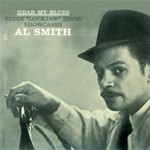
Listening to Prestige 319: Al Smith

Bob Weinstock's early experiments with blues and R&B singers were marked by two near-constants. Joe "Bebop" Carroll,They were (a) very good, and (b) commercially unsuccessful. As with jazz, Bob Weinstock had the ear. But he didn't seem to have the marketing touch that he had with jazz.


Remember The Cabineers, Ralph Willis, John Bennings,  H-Bomb Ferguson, Bobby Harris, Paula Grimes, Rudy Ferguson, The Mello-Moods, Joe "Bebop" Carroll, Bob Kent,Piney Brown, Billy Valentine,  James "Deacon" Ware? If you're a pretty serious blues collector, you might remember  H-Bomb Ferguson, Joe "Bebop" Carroll or Piney Brown. You might actually remember the wrong Piney Brown--the more famous one was the Kansas City saloonkeeper who inspired Big Joe Turner's "Piney Brown Blues."  Anyway, those three had decent recording careers, if not comparable to Big Joe Turner or Sonny Boy Williamson or Wynonie Harris or Larry Darnell or Varetta Dillard, to name a few contemporaries.

Prestige did record a couple of well-known blues singers like Brownie McGhee, but they weren't known for their work on Prestige. And if you want to count King Pleasure as a blues singer, there's one unqualified success. 

But most of the other Prestige blues singers have disappeared into almost total obscurity, for mostly no good reason. You can find a couple of cuts by Paula Grimes on YouTube, maybe, and she's wonderful, but she never quite made it.

Weinstock briefly had a blues subsidiary, Par Presentation Records, in the early 1950s, but it only put out a few unsuccessful titles and was quickly shuttered.

But this was 1959, the tenth anniversary year of what was by now a very successful independent record label, run by a guy who had learned more than a few tricks about successful marketing. Weinstock had staked his claim to the jazz nostalgia niche with Swingville, and he was about to do the same for the blues market with Bluesville.

And still, at least with his first attempt, he couldn't bring it off. Al Smith is almost totally forgotten today, his two albums for Prestige/Bluesville the only record of his ever having existed. He's easier to find and listen to, in today's streaming wonderland, than Paula Grimes, but I'd guess that very few still have a copy of the vinyl record, although you can actually buy it from collectors' sites.

And if there's ever a record that deserves to have been heard, and to become a classic, it's this one. Smith is a remarkable singer. How remarkable? Well, take his cover of a Ray Charles tune.

Ray Charles was a wonderful songwriter, and his songs have been widely covered: "I Got a Woman," "This Little Girl of Mine," "What'd I Say?" But nobody else that I've been able to find has covered "Night Time is the Right Time," and with good reason: the distinctive raw, pleading response vocals of Margie Hendrix make it virtually uncoverable.

But Smith makes it work. His gospel-tinged blues singing is sufficiently different from Charles's to make his approach unique--and while it's equally different, it has enough of Hendrix's fervor to power his singing of both parts.

He also Eddie "Lockjaw" Davis's tenor sax solo adding yet another gospel-tinged declamation to the mix.

Davis stands out on "Night Time," but Shirley Scott's understated but impassioned organ work, on every cut, really pulls the album together. It makes you wish she'd done a lot more work with singers (she and Davis did back up Mildred Anderson on another Bluesville release).

Smith does two other covers, both associated with Johnny Ace: "Never Let Me Go," written by prolific tunesmith Joe Scott, and Ace's mega-hit, "Pledging My Love," credited to Ferdinand Washington and Don Robey, although the flamboyant label-owner Robey was better at putting his name on songs than actually writing them. His version of "Pledging my Love," with Scott's sensitive organ, is one of the best covers of this song.

His originals are all good songs. I'm not sure any of them has "hit" emblazoned on it the way "Pledging My Love" does, but they're good. Two of them, "Tears in My Eyes" and "Come On Pretty Baby" became the first 45 RPM single off the album. The two covers, "Night Time is the Right Time" and "Pledging My Love" were a second single."Tears in My Eyes"/"Come on Pretty Baby" was the first 45 RPM release on Bluesville, and Hear My Blues was the first Bluesville album. While it may have made only a faint dent at most, Bluesville would go on to achieve some success.


Listening to Prestige Vol. 2, 1954-1956 is here! You can order your signed copy or copies through the link above.

Tad Richards will strike a nerve with all of us who were privileged to have
lived thru the beginnings of bebop, and with those who have since
fallen under the spell of this American phenomenon…a one-of-a-kind
reference book, that will surely take its place in the history of this
music.
                                                                                                                          
--Dave Grusin

An important reference book of all the Prestige recordings during the time
period. Furthermore, Each song chosen is a brilliant representation of
the artist which leaves the listener free to explore further. The
stories behind the making of each track are incredibly informative and
give a glimpse deeper into the artists at work.
                                                                                                                --Murali Coryell