Tad Richards' odyssey through the catalog of Prestige Records:an unofficial and idiosyncratic history of jazz in the 50s and 60s. With occasional digressions.
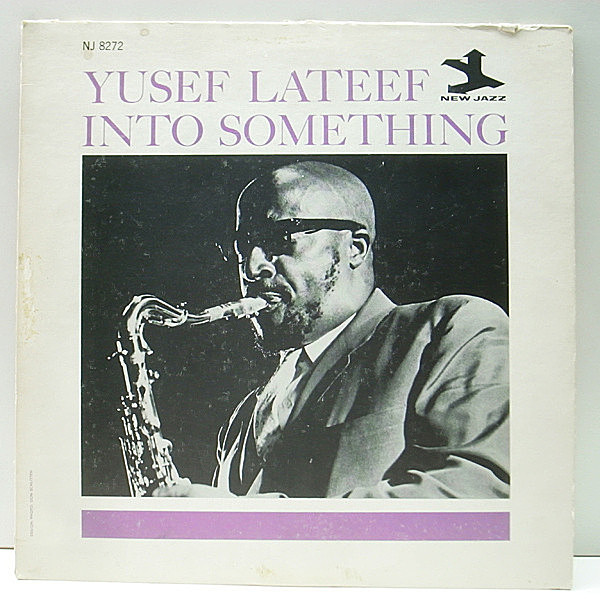
Into Something consists of three trio and four quartet tracks, the latter featuring Barry Harris on piano. On the album, these are intermingled, starting with the quartet piece “Rasheed,” and it’s a good place to start, with some of everything that made Lateef unique — the unusual lead instrument (in this case, oboe), the Middle Eastern influence, the blues roots. But actually the recording session started with the three trio pieces, so perhaps Harris was a little late for the gig, and they had to start without him. We know that Bob Weinstock didn’t believe in rehearsals, and valued spontaneity, so why not go with what have? Barry’ll be here soon enough, what works without him? Lateef had brought along three standards to go with his four originals—tunes he chose, he told Nat Hentoff who wrote the liner notes, because he particularly liked them, for various reasons.
The one he started the session with, “When You’re Smiling,” was a favorite of his father, who used to sing it often. It was a good memory, and he liked the message of the song. Do modern jazz musicians, whose improvisatory lines wander way outside the melody, think of the yrics of a song as they play it? Some do, some don’t. Bill Evans has said that he never did. Lateef, by his account to Hentoff, was thinking of the lyrics to “When You’re Smiling,” and thinking of them in a context.
Written in 1928, the first recording of the song (by Seger Ellis) featured a lead-in verse, almost universally ignored in later versions, about a blind man and a legless man who take care of each other, and go through life smiling. Louis Armstrong cut what is still the classic version in 1929, and his version is illuminated by the famous Armstrong style.
Jazz musicians have recorded it: Dave Brubeck, Errol Garner and Dick Hyman, Urbie Green and Sonny Stitt, all with a lilt. Lee Konitz recorded it, and even with Billy Bauer and a quartet of Tristano acolytes, he sounds positively jaunty. Who knows if they were thinking of the words? It's hard to believe that Konitz wasn't.
But Lateef apparently was thinking of the lyrics, but maybe not so much singing or reciting the lyrics in his head as he played. He may have been thinking more about his father's voice, because his version is gentle and pensive as he states the melody, then becomes fragmented and searching.
Lateef's original tunes express the range of his passions. "Koko's Tune," as the title suggests, is in the bebop vein, though gentled down somewhat from the lightning tempo of Charlie Parker's "Ko-Ko." But if the tempo is gentled, the intonation certainly isn't, going seamlessly from gutbucket blues growls to hard-edged modernity, spurred on by the driving complexity of Elvin Jones's drumming (Jones, Harris, and bassist Herman Wright make up the all-Detroit rhythm section).
"Water Pistol" is in much the same vein, with Jones demonstrating that he really is the new face of jazz drumming. He had been working steadily and had recorded widely since his 1955 arrival in New York. He had recorded as a leader on albums for Atlantic and Riverside, and he had already joined John Coltrane's great quartet, with whom he had worked on several sessions, including the ones that made up his My Favorite Things.
"P. Bouk" shows more of the Middle Eastern influence, and also includes an effective solo by Wright. And "Rasheed," with Lateef on oboe, shows him at full fusion strength, blending blues, bop, and the Middle East.
Also blending Middle Eastern voicing with classic Western melody is his flute-led "I'll Remember April," the Gene dePaul-composed jazz standard that made its debut in an Abbott and Costello film. It was the 45 RPM single from the session, with "Blues for the Orient" on the flip side.
It's hard to choose a "Listen to One" from this superior session, in which every song has something particular to reommend it, from Lateef's command of the blues to blistering solos by Jones, but I'll go with "Rasheed," as perhaps being the most distinctively Lateefesque.
Esmond Edwards produced. The album was released on both New Jazz and Prestige, with "I'll Remember April" / "Blues for the Orient" as a Prestige single.
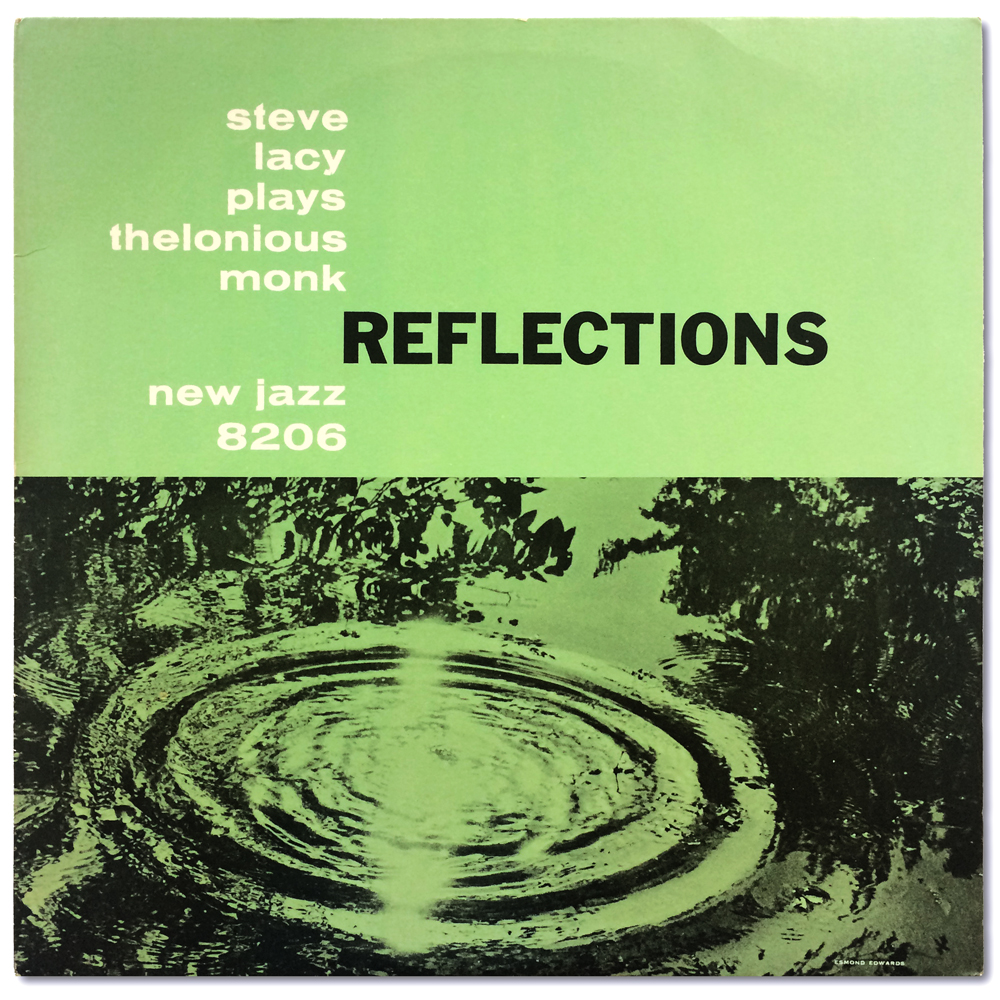
This is Steve Lacy's second album as leader, both for Prestige. As long and productive as Lacy's career would go on to be, he's not immediately thought of as a Prestige artist, but Weinstock's label is where he got his start, first with Gil Evans and then under his own name.
This one is particularly noteworthy for two things. First, his quartet personnel has changed. Buell Neidlinger returns as bassist, Elvin Jones is the new drummer. Most significantly, he is put together with the Prestige "house pianist," Mal Waldron, a pairing that was to be of great significance to both men when they reconnected years later in Europe.
Second, the entire album is devoted to the compositions of Thelonious Monk. Lacy was an admirer and champion of Monk's work, and tried to include at least one Monk composition on every recording he made, but this is the first time an entire album has been devoted to this great composer's work.
It's an article of faith among many, myself included, that Thelonious Monk and Duke Ellington are good candidates for the two most important 20th Century American composers, but that awareness has been slower in coming than you might think. Sure, "Round Midnight" became an instant classic, and so did several of his other works, but Lacy dug deeper into the catalog, and found pieces for which recognition came much slower, if at all.
Secondhandsongs.com is a fascinating website which tracks the cover versions of songs. It doesn't list every song ever composed, though they keep adding to it, and there's no guarantee they're going to catch every cover, but they are a wonderful resource. Here's what they have on the tunes from this album:
Hornin' In: Recorded for Blue Note in 1952 and released in 1956. After Lacy's version, no one paid attention to this tune for 40 years, until Sonny Fortune in 1994. Since then, very little. Sphere, the group founded after Monk's death and devoted to his music, recorded it, as did two European jazz groups, and that's it, except for an unusual interpretation by rockers Terry Adams and NRBQ in 2015. YouTube offers a couple more recent live versions, and there is no reason why this wonderful piece of music should not be a jazz standard except that it's in competition with so many other classics from this composer.
Skippy was recorded by Monk in 1952 for Blue Note, and seems to have only been released on a 78 RPM single. It's complex, stirring, uptempo. Lacy's version features a terrific solo by Mal Waldron, among other delights. Lacy recorded it once more two decades later with a different quartet (Roswell Rudd, Henry Grimes, Dennis Charles), and then it lay fallow until 1988, when Buell Neidlinger recorded his own version, and Anthony Braxton covered it. In 1994 it was picked up by Paul Motian among others, and this millennium it's been rediscovered by a number of young jazz esnembles, both European and American, to the point where it can legitimately be called a standard. But 'twas not always thus. Monk's own version features Kenny Dorham, Lou Donaldson and Lucky Thompson, from the same session that produced "Hornin' In."
Reflections is Steve Lacy's title cut. It is an absolutely beautiful melody, from an early Prestige trio session. It captures both Lacy and Waldron at their most lyrical. Monk was an important influence on Waldron, but not an early influence. Certainly this session with Lacy must have affected him deeply.
"Reflections" is certainly a standard, covered four times as often as Holland-Dozier-Holland's same-titled song for the Supremes.. J. J. and Kai (Savoy) and Sonny Rollins (Blue Note) both recorded it before Lacy. But then it also was pretty much forgotten until 1982, when Chick Corea, Miroslav Vitous and Roy Haynes did it. Since then, it's become ubiquitous, with secondhandsongs listing 66 versions. But a tune this important in the monk canon went a long time ignored.
Monk's version of Four in One (Sahib Shihab, Milt Jackson, Al McKibbon, Max Roach) was
released by Blue Note in 1952 on 78 and on the Genius of Modern Music, Vol. 2 album. Lacy's version features some driving Elvin Jones work along with the solos by Lacy and Waldron. Then again, a long period of neglect. Monk's death in 1982 brought about a renewed interest in his music, and one of the first stirrings of this was a very odd album in 1984, That's the Way I Feel Now, a tribute to Monk by an eclectic bunch of musicians, most of them rockers. "Four in One" was covered by Gary Windo, a British avant-gardist who played his own brand of music, more often lending it to rock than jazz performers, and Todd Rundgren. Windo played alto sax, Rundgren supplied synthesizers and drum machines, for a performance that's manic, chaotic, geared to a rock-steady beat, and still recognizable as Monk. Since then, it too has entered the Monk mainstream, with 33 versions listed by secondhandsongs.
Bye-Ya is one of the pieces that Monk and Coltrane performed on their 1957 Carnegie Hall concert, a recording of which was only recently rediscovered and released. It's such a familiar tune that it seems impossible that it, too, could have languished throughout the 1960s and 1970s, but it did. This started to make me curious, and I checked secondhandsongs for some of Monk's best-known compositions, starting, of course, with "Round Midnight." Composed in 1940, first recorded by Cootie Williams (who took co-composer credit), it became an instant classic when Blue Note released Genius of Modern Music, Volume 1 in 1951. Since 1955, scarcely a year has gone by without several recorded renditions of it. "Blue Monk," first released on Prestige in 1954, has proved nearly as popular, with "Straight No Chaser" and "Ruby, My Dear" not far behind. So at least Monk was getting royalties from some of his classics during his lifetime. "Bye-Ya" has five lifetime, 48 posthumous, and secondhandsongs has somehow missed the Carnegie Hall concert.
Ask Me Now has had a similar fate. Steve Lacy, PeeWee Russell and Ronnie Mathews during Monk's lifetime, 91 posthumous versions.
Secondhandsongs doesn't have information on "Let's Call This."
Listening to Prestige Vol. 2, 1954-1956 is here! You can order your signed copy or copies through the link above.
Tad Richards will strike a nerve with all of us who were privileged to have lived thru the beginnings of bebop, and with those who have since fallen under the spell of this American phenomenon…a one-of-a-kind reference book, that will surely take its place in the history of this music.
--Dave Grusin
An important reference book of all the Prestige recordings during the time period. Furthermore, Each song chosen is a brilliant representation of the artist which leaves the listener free to explore further. The stories behind the making of each track are incredibly informative and give a glimpse deeper into the artists at work.
It's hard to say how many compositions came from the imagination of Mal Waldron, but they certainly numbered in the hundreds. Any session that hired Waldron as pianist was more than likely to want one or more original compositions from him, and he wrote most of the material on the albums he recorded as leader. If you're that prolific, one of two things is likely to happen. You're going to start repeating yourself -- not necessarily bad thing, if you're finding new ways to do things you've done before. Or you're going to keep finding new ground.
Waldron wasn't one to stay still. He had a wide range of passions and influences. He was still part of that generation, slipping away as the 50s played themselves out, that got its start in rhythm and blues. He was a lover of classical music, and recorded several pieces by classical and modernist composers. He worked with beboppers and the avant garde, and he was Billie Holiday's accompanist during the last two years of her life. And he brought all of that experience, and his own restless genius, to bear on his work as a composer.
When one starts to categorize music, one immediately runs into the futility of categorizing music. A jazz recording session in 1957-58: is it bop? Hard bop? Cool? Neo-swing? Third stream? The lion lies down with lamb, Mulligan meets Monk, and Dizzy Gillespie plays a duet with Louis Armstrong. And that's just jazz. What do we call that other music that was composed earlier in the 20th century by Charles Ives and Aaron Copland, later on by John Cage and Philip Glass and LaMonte Young? Contemporary classical music? That's not only moronic, it's oxymoronic. What else? Composed music? Duke Ellington composed his music, and so did film scorers from Korngold to Elmer Bernstein, not to mention Leonard Bernstein. Cage and Glass were avant garde, but so was Ives in his day, and nobody stays avant garde. So we're probably stuck with contemporary classical music.
And how is that different from what Mal Waldron is doing in this early 1958 session? It must be jazz,
because it's got that swing without which, the Duke tells us, it don't mean a thing? Elvin Jones, on drums, had that swing, and Waldron was already teamed up with Billie Holiday, who out of the era for which Swing was the name, not just a characteristic. But listen to the beginning of "Tension." The number will move into jazz improvisation, with great solos by Art Farmer and Eric Dixon, but the opening section -- I'm not even sure you'd call it a head -- has a lot of the tonality and feeling that we associate with what we call classical, oxy and moronic though we may be, and not just in what Waldron and Farmer and Dixon are doing -- Jones is very much a part of that stance.
"Ollie's Caravan" has a head that's very much in the bop tradition--and an arresting melody--but then it goes different places. Putting a caravan in the title can't help but make one think of Duke Ellington and Juan Tizol, but while Eric Dixon's flute solos have an Eastern tinge, they make one think of Yusef Lateef's experiments more than "Caravan." And all the above ingredients come together again in "The Cattin' Toddler" -- a striking drum intro by Jones, a catchy riff head, Eastern-tinged flute by Dixon, plus a wonderful extended solo by Farmer and the kind of work one expects of Waldron in improvising off one of his own compositions--which is to say, something completely unexpected.
"Portrait of a Young Mother" provides a space for a wordless vocal by Waldron's wife Elaine, although the piece is by no means a song, or even primarily a vehicle for voice. At ten minutes long, it gives room for solos by everyone, including a wonderful pizzicato cello by Caio Scott. This and "The Cattin' Toddler" suggest a devotion to family life that Waldron, sadly, was not able to entirely sustain. In 1963, a heroin overdose led to a major breakdown that finally responded to shock treatments and a spinal tap. His marriage to Elaine did not last. But perhaps there was a happy ending after all, for which I am very glad. These folks give so much to us, it's good to know when they get some happiness back. Mal and Elaine had two children. He had five more with his second wife, and in 1995, to celebrate his 70th birthday, he took both wives, all seven children, and two grandchildren with him on a three week tour of Japan.
These were released on New Jazz as Mal/3 -- Sounds.
Listening to Prestige Vol. 2, 1954-1956 is very close to release. Order your advance copy from tad@tadrichards.com
Tommy Flanagan went a long way to record this one: Sweden, which if it wasn't quite the Mecca for American jazz musicians that it had been a few years earlier, was still one of the great jazz centers of Europe. Stockholm was a long way from New York, where Flanagan, Wilbur Little and Elvin Jones had been playing in J. J. Johnson's group, and had joined Johnson's European tour. It was even farther from Detroit, where both Flanagan and Jones had gotten their start.
I've written a lot about Detroit in this blog, because it keeps coming up. Detroiters made such a contribution to Prestige Records, and to modern jazz as a whole. As Pepper Adams said, when he joined the army, he was thrown in with older and more experienced musicians, and he looked forward to learning from them, but he discovered that because of his apprenticeship in Detroit, he was more advanced than they were.
A history of jazz in Detroit was waiting to be written, and it waited a long time. It wasn't until 2001 that a book-length history of Detroit jazz was published, and it was worth the wait. The book is Before Motown, by University of Michigan-Dearborn professor Lars Bjorn, with assistance from Jim Gallert, jazz DJ and journalist. I, of course, have been focused on the musicians (like Flanagan and Jones) who emigrated from Detroit to New York in the 1950s, but the book goes back to the 1920s--the society bands that morphed into jazz bands, and the contributions to music that the Motor City was making even then: Jean Goldkette's bands that were the first to feature Bix Beiderbecke and Frankie Trumbauer, McKinney's Cotton Pickers with their great arranger Don Redman. The book is both scholarly and readable, Highly recommended.
J. J. Johnson's European tour may not have produced the number of splinter group recordings that Lionel Hampton's 1953 tour did, but this session makes up for it quality. It is the first recording by Tommy Flanagan as a leader, but certainly not the last. In a career spanning four decades, he became one of the most celebrated and critically acclaimed musicians of his time.
Most of the cuts here are Flanagan originals, the exceptions being "Willow Weep for Me," by Gershwin protégé Ann Ronell, "Chelsea Bridge" by Billy Strayhorn, and "Relaxin' at Camarillo" by Charlie Parker. Playing a Bird composition means that you still have at least one foot planted firmly in bebop, and if you're a piano player and have that planted foot, you've done a lot of listening to Bud Powell. Flanagan has named as his chief early influences Art Tatum and Teddy Wilson, two masters of the piano, and Powell, the pianist who steered him to bebop.
I went back and listened to Bud Powell's version of "Relaxin' at Camarillo," and then to Flanagan's again. Both feature great piano, and certainly no one wrote springboards for improvisation like Charlie Parker, but the big difference between the two is Elvin Jones. Powell's "Relaxin'" was recorded at almost exactly the same time as Flanagan's, in late 1957, and with Art Taylor on drums, but Jones, who had been restrained on previous Prestige sessions, really breaks out here,
I went back and listened to some of Powell's earlier recordings, from the 40s, with Max Roach on drums. Roach was certainly one of the most important drummers in his day, one of the pioneers of modern bebop drumming, and in a club, in a trio setting, he must have been wonderful to hear, but on record, you can hear very little of him. And that makes you realize what a difference arriving on the scene in the era of advanced recording techniques pioneered by Rudy Van Gelder and others, when the bass and drums could be miked so as to show the full range of the players.
But the other difference in Jones's playing on this session is Tommy Flanagan, who brings him to the forefront, and provides a framework for him to show himself at best advantage. Flanagan was one of the great accompanists in jazz, working with Ella Fitzgerald for many years, and of course a vocalist like Ella is going to be able to find and hire the best accompanist, but it turns out that Flanagan is also a great accompanist to a drummer, which is a little more unusual.
Just listen to "Beat's Up," a Flanagan composition which is a showcase for Jones, and listen to the piano, the way Flanagan provides melodic and rhythmic prods that move Jones into new directions and new innovations.
You can tell this was recorded outside of Bob Weinstock's purview because there are alternate takes. It was released as Tommy Flanagan Trio on the Swedish Metronome label, then licensed to Prestige, where it became Overseas.
Some new additions to the All Star roster, and some new combinations of familiar faces, and I'll start with them, because one of the highlight of this session is a showcase of two of the best composers of this era. "Touche" and "Potpourri" were written by Mal Waldron. "Blues Without Woe," "Dakar" and "Hello Frisco" are all by Teddy Charles, who also produced the session.
I wondered if Thad Jones and Frank Wess were brought in by Charles because of past association, but such was not the case. Neither had ever recorded with Charles before, and it's unlikely that they'd ever done much, if any, playing with him. Both were regulars, all through this period, of the Count Basie orchestra. Jones did have a connection to this ensemble, but it wasn't Teddy Charles -- it was his own younger brother Elvin, making his third appearance on the label.
Charles was never a man to stand still, but for him, movement in a new direction could mean almost anything. When he moved to the West Coast to produce the new evolving West Coast sound for Bob Weinstock in 1953, his first move was to decide not to produce the new evolving West Coast sound. As he put it,
When I got out on the West Coast, I didn’t want to do the West Coast cool jazz thing that was so popular then. Frankly I didn’t care for the West Coast style of playing. The music was too laid back and didn’t have the sound.
Instead, he put together a solid mainstream group featuring one of the finest swing-to-boppers, Wardell Gray, and a young Charlie Parker acolyte, Frank Morgan. After that, he made a second recording with Shorty Rogers, who would become identified with the West Coast sound, but was, at this point in his career, a dedicated avant-gardist.
Charles would continue move farther out, recording with experimentalists like Hall Overton and Gil Melle, And he'd hit the mainstream hard, with gritty soloists like J. R. Monterose.
And here, he goes even closer to the bone of mainstream jazz, bringing in two stalwarts from the Basie band. Avant garde music in general, and avant garde jazz in particular, is noted for all kinds of experimental approaches: experiments with tonality, with stretching the limits of harmony, with unusual or shifting time signatures, with textures of sound. But not necessarily with the rollicking swing of an ensemble like the Count Basie Orchestra.
So what would this session be? Avant garde, or Basie-esque swing?
Well, it's a Teddy Charles sesssion, which means none of the above. Or all of the above. It swings, but the ensemble sections have a tonality that nods to the avant garde, and the solos by Jones and Wess are not solos that they would have been likely to play in a Basie arrangement.
What they are, is amazing. If you were asked to pick the top ten Prestige albums, you'd likely start with something from the Miles Davis Contractual Marathon, or the MJQ's Django album, or Sonny and Trane's tenor duet, or King Pleasure / Annie Ross, or any one of a number of great albums we haven't gotten to yet. Probably not this one. Because unless you're really steeped in jazz lore, you might never have heard it. I'm moderately steeped in jazz lore, and I never had. Thad Jones is best known for his legendary Thad Jones - Mel Lewis big band; Frank Wess made a number of albums as leader, and won several Down Beat polls in the flute category, but is still probably most associated with Basie. Teddy Charles is a special talent who's probably known to a niche audience today, as well as to aficionados of charter sailing boats in the Caribbean. You won't find it in anyone's 100 essential jazz albums list, because the folks who make them gravitate, not unreasonably, to the top names. But I'd nominate it right now.
The flute was just beginning to come to the forefront as a jazz instrument, and Wess's solos,
particularly on the Mal Waldron compositions, are a powerful argument for the instrument. But if I were to pick one cut from this session, it would be the Charles tune "Blues Without Woe," on which Wess moves to tenor.
Without woe these blues may be, but they're certainly without "Whoa!" This track never lets up; it's one burning solo after another. In my entry on Kenny Burrell's "Drum Boogie," I commented that Elvin Jones seemed to have held back from the blistering solo one might have expected in a modern version of Gene Krupa's classic. Any such reticence is gone here, and he comes through with that powerhouse drumming that we've come to expect, but which must have been something of a revelation to a 1957 listener.
The album was released as a Prestige All Stars session, titled Olio. You'd expect the album title to be drawn from one of the cuts, but such is not the case here. Still, it's apt. What do get when you mix together a 50s avant-gardist, a soon-to-be 60s avant-gardist of the Coltrane school, two Basie-ites and two solid boppers. You get an admixture of heterogenous elements. An olio. Or a potpourri. Maybe it is drawn from one of the cuts after all. On the British Esquire release, Olio plays a tiny second fiddle to the musicians' names, and the cover is a very nice piece of work in the David Stone Martin tradition, though I don't think it is Martin, and it doesn't quite have room for Doug Watkins.
You'd have to call this a Teddy Charles session, but Charles, always generous, gives Jones and Wess room to shine, so the album is often credited to Thad Jones as leader.A later re-release credits Jones and Wess as co-leaders, and another, part of a double album (Olio / After Hours) is listed as by Thad Jones and the Prestige All Stars.
Jazz writer Ted Gioia, in a recent article called "Does the Music Business Need Musicianship?" quoted a veteran producer as saying "Does anyone under 25 play an instrument any more?" Somewhere else, I read that the guitar has virtually disappeared from rock and roll. No more Chuck Berrys, no more Hendrixes, no more George Harrisons or Eddie Van Halens.
So a world and a time in which musicians did pick up instruments, and do the very hard work involved in learning to play them, has maybe more of an appeal that one would think. And interestingly, the genre of today's music that many would think did more than any other to destroy musicianship -- hip hop -- is the genre that's turning more and more to jazz.
Jackie McLean once said,
When I was coming up it was mandatory to know something about music and play an instrument. In order to do this it required hours and years of dedicated study and practice. Today if you can just rhyme and talk and have a talent for matching words and rhythms together you pretty much are on your way; it wasn’t quite that easy when I was coming along.
Well, it ain't necessarily all that easy to match words and rhymes together, which is why us poets make the big bucks. But of course McLean has a point.
Now, however, his grandson, Rene McLean, is a hip hop producer, as are the sons of Quincy Jones, Ornette Coleman, Roy Haynes, Horace Silver, to name just a few. And hip hop, more than any other recent popular music form, has embraced jazz, with many rappers sampling the work of jazz musicians.
Still, there's something about those hours and years of dedicated study and practice that delivers to the audience in a way that no one else can. The impossibly fast tempi of Bird and Diz, or the impossibly weird tempi of Brubeck and Desmond. The strange and beautiful melodies of Thelonious Monk or Tadd Dameron.
Of course, the knowledge that someone has mastered incredibly difficult technical skills is not enough to make us love something. What makes an art like jazz, or like dance, elicit such love from its fans? It's knowing that it's mind-bogglingly difficult, but feeling it as something else. We feel that our better selves, in a parallel universe, could play a drum solo like Gene Krupa or execute eleven perfect pirouettes like Mikhail Baryshnikov in White Nights. They express our yearnings to be our best selves.
Which brings us, more or less, to Kenny Burrell. It's now February 1, and this is already his fifth session for Prestige: one with Gene Ammons, three with the Prestige All Stars, and now this one under his own name. So maybe that's why all the All Stars album credits -- so they wouldn't be putting "Kenny Burrell" on the cover of every album they put out.
There's a reason -- well, there are all sorts of reasons -- for this much excitement about Kenny Burrell. Mostly, that he was really that good. He was a new sound, a breath of fresh air. And in a way, a great guitarist brings us one step closer to those better selves in those parallel universes. A lot more of us have picked up a guitar and played a stumbling version of "This Land is Your Land" than have picked up a saxophone and tried to stumble through "Now's the Time."
This is a beautiful album, and an interesting lineup for Prestige. Doug Watkins represents the regulars. Tommy Flanagan was never quite a regular, but he did do several Prestige sessions. Cecil Payne had been on three Prestige recordings, the sort of sessions you would expect to find a baritone sax on -- octets with Joe Holiday, Gene Ammons and Tadd Dameron. Unless you're Gerry Mulligan, it's relatively rare for a baritone man to be the only horn on a date. The drummer was Elvin Jones, who was really starting to come into his own. He had been on a few important dates over the past couple of years, including an Art Farmer session on Prestige, and one with Miles Davis for Charles Mingus's short-lived Debut Records.
Payne appears on four of the five cuts, which means that the fifth -- Cole Porter's "All of You" -- is essentially a guitar-piano duet between Burrell and Flanagan, which you really don't hear all that often. The two instruments are so similar -- both percussive, both melodic, both played with single notes and with chords. And yet so different. They make a wonderful balance on this duet.
Having a baritone sax as your only horn on a session brings a certain gravitas, perhaps at the cost of a loss of flexibility? Not if the baritone is in the hands of Cecil Payne. Don't forget that the tenor saxophone was once relegated to the oom-pah section of marching brass bands, until Coleman Hawkins showed what could be done with it. Payne got his start playing in swing ensembles with J. J. Johnson and Roy Eldridge, then was introduced to bebop when he joined Dizzy Gillespie's band. His work in the late 40s and early 50s gives some idea of his range: bebop with Tadd Dameron, R&B/swing with Illinois Jacquet, and the adventurous African-influenced music of Randy Weston, with whom he was closely associated.
He gets a chance to show that range with Burrell's tune selections for the session. There is one of his own compositions, "Perception," which starts off with a gently swinging, Mulliganesque solo by Payne, and then gets edgier as it goes along.
From there, the selections get seriously eclectic. "Drum Boogie" reaches into the swing era. Composed by Roy Eldridge and Gene Krupa, it became a hit, and a classic, when recorded by Krupa and Anita O'Day, and reached Hollywood when Barbara Stanwyck lip-synched it to Martha Tilton's swinging vocal. Interestingly, they are the only composers credited. No lyricist, so Eldridge or Krupa must have handled the lyrics.
No lyrics here, and somewhat more surprising, no drum solo, especially since Elvin Jones is the modern player who could well be voted Most Likely to Take On Gene Krupa. Jones was still something of a new kid on the block, but not that new. He'd been in New York longer than Kenny Burrell, and had recorded with Miles Davis, Thad Jones, J. J. Johnson and Art Farmer. And like Burrell, Flanagan and Watkins, he was from the jazz cauldron of Detroit. But for whatever reason, this could more appropriately have been called "Bass Boogie." Doug Watkins has a longer solo than Jones, and provides the main rhythmic propulsion.
"Don't Cry Baby" reaches even farther back. Co-written by stride piano legend James P. Johnson, it was first recorded by Bessie Smith in the 1920s, and it opens with a bluesy vamp from Tommy Flanagan that Bessie would have appreciated. Johnson's co-writers were Saul Bernie and Stella Unger. Unger had a pretty decent career in music, including writing the book and lyrics for a Broadway musical, Seventh Heaven, but I could find absolutely no biographical material about her. Such is fame.
Then we move forward to the bebop era, and one of its finest composers. "Strictly Confidential" is a bebop standard by Bud Powell, and Flanagan is given room to solo on it
Who could not like this album? The range of musical voices that go into the tunes that were chosen, the close-knit Detroit camaraderie among the players, the chance to hear Cecil Payne stand out as a solo voice. And Kenny Burrell, already a giant in the jazz world.
It was originally released as Kenny Burrell, then rereleased as Blue Moods, a title that had been given to an earlier Miles Davis album that Elvin Jones also appeared on.
This album was recorded in late November of 1956, but it appears not to have been released until 1959, not unlike some of Farmer's other early Prestige sessions, which languished on the back shelves even longer, which may have been one of the reasons why Farmer would soon leave the label.
Farmer was very active for Prestige during this period. Like many of the young artists who had toured Europe with Lionel Hampton in 1953, he had returned with a burnished reputation and a number of closely forged musical relationships, two of the foremost being Quincy Jones and Gigi Gryce--his first session as leader, in 1953, was released as Art Farmer Plays the Arrangements and Compositions of Quincy Jones and Gigi Gryce, An early 1954 session featuring Sonny Rollins and Horace Silver wasn't actually released until 1962, and it's hard to figure out why (a quartet session from 1955 was also shelved until this release, as Early Art). Next he was reunited with Gigi Gryce for the album titled When Farmer Met Gryce, although this was scarcely a first meeting.
In 1955 he recorded with a septet, an augmented small group (or truncated big band) situation that Farmer thrived in, then with Gryce again, and with Donald Byrd (released as 2 Trumpets). He would also record as a sideman --with Gene Ammons a couple of times, backing up singer Earl Coleman (Gryce was on that session too), with Bennie Green, and with Gil Melle, and if that's not range, I don't know what is.
This session is part quintet (with Hank Mobley), and part quartet. Gigi Gryce is present again, but only as composer: the beautiful "Reminiscing," one of the quartet pieces, which affords Farmer the space for some marvelously lyrical ballad work, and does the same for Kenny Drew.
Drew is also represented with two originals on the session, which is pretty much a showcase for some of the best young composers of the era, as Farmer also weighs in with a tune--in his case, one that was already on its way to becoming a classic: "Farmer's Market." This is a very different treatment than the one Farmer gave it with Wardell Gray in his recording debut, and while it features some outstanding work by Farmer and Hank Mobley (who also contributed an original), Drew takes the first solo, and he's the one you walk away remembering most vividly.
Elvin Jones was just beginning to make his mark. He had recorded once in 1948, as part of the legendary Blue Bird Inn house band in Detroit, but his first New York recording had been in 1955, on a Miles Davis session for Charles Mingus's Debut label. He would make several contributions to Prestige and New Jazz over the next couple of years, before taking his music in a different direction and becoming one of the most important drummers of the 1960s and 70s.
In spite of the fact that one of Drew's compositions is "With Prestige," this turns out not quite to have been with Prestige. The label had come into existence, a decade earlier, as New Jazz, and in 1958, Bob Weinstock decided to revive the New Jazz label as a subsidiary (there would be a handful of other subsidiaries launched around the same time). Farmer's Market would be the third New Jazz release, following a Mal Waldron album and a Prestige All-Stars session which Farmer was not a part of. It's hard to exactly make sense of New Jazz. Maybe Weinstock was recording artists faster than he could release them? The Waldron album (Mal-3) seems to have been released fairly promptly, and may have been recorded with this new imprint in mind, but the next several were sessions that had been on the shelf for a couple of years. Anyway, the good news is, they did see the light of day, and we have this music now.





:format(jpeg):mode_rgb():quality(40)/discogs-images/R-3972144-1353176906-6836.jpeg.jpg)


:format(jpeg):mode_rgb():quality(90)/discogs-images/R-2151078-1266777872.jpeg.jpg)


