Showing posts with label Jerome Richardson. Show all posts

Thursday, July 06, 2023

Listening to Prestige 694: Andy and the Bey Sisters


LISTEN TO ONE: Since I Fell for You

 Andy Bey's work with his sisters occupies a very small part of a long and legendary career (which is not over yet). It covers three albums, one with RCA Victor in 1961 and two with Prestige, and some television appearances, so we have some live work by the trio available on video. But it's an important part of his legacy--and that of Salome and Geraldine Bey, who also went on to have distinguished, if very different, careers.

We'll start with the sisters. Salome, born and raised in Newark, moved to Canada shortly after the trio broke up, and made a life and a career there. She came to be known as "Canada's First Lady of the Blues," and she was all that and more. She appeared on Broadway in Your Arms too Short to Box with God and received a Grammy nomination for the


original cast album; and her own show, Indigo, a celebration of the history of black music, won a Dora Mavor Moore Award, honouring theatre, dance and opera productions in Toronto. Her appearances at the Montreux Jazz Festival were captured in a live album and on video--check out this stirring performance at Montreux of Billy Taylor's "I Wish I Knew How it Would Feel to be Free." After her death in 2020, she was honored on a Canadian postage stamp.

I've written about Geraldine Bey de Haas and her husband before, but I'm going to quote it here again, because it's such a significant story in the history of jazz'

if you are from Chicago, and a jazz fan, you quite likely have heard of the deHaases, for the music and civic involvement that they gave to the City of the Big Shoulders. When they retired in 2103, because of health problems, to go and live with family in New Jersey, here's a part of the tribute columnist Howard Reich of the Chicago Tribune gave to "two artists who have been central to jazz here for nearly half a century":

It was Geraldine de Haas, after all, who led many like-minded spirits in creating the first Duke Ellington celebration concert in Grant Park, in 1974, just after the master's death. The event proved so successful that it became an annual soiree, paving the way for the emergence of the Chicago Jazz Festival in 1979 and setting the stage for all the other city-sponsored music fests that followed.

When de Haas launched her campaign to stage the aforementioned Ellington tribute in Grant Park, she faced widespread resistance, even from fellow jazz musicians.

"The South Side musicians were talking about doing (the Ellington homage) on the South Side of Chicago" in Washington Park, recalls de Haas. "My suggestion was: 'Why don't you do it in the main park (downtown)? Duke Ellington was so important to all of us.'"

"(But) the black musicians were conditioned to think one way, and the white musicians were conditioned another away. They never thought about getting everyone to participate. … I was emphatic about that.

 "They said: 'If you can get it, good luck.'"

Geraldine got it, in spite of resistance from the city parks commissioners, whom one has to assume were white. They told her there had been riots the last time they tried to hold a jazz concert. Riots? Jazz? It turned out they were talking about Sly and the Family Stone.

But if Geraldine wanted to give jazz to the whole city, "bringing jazz to a major downtown setting – and therefore bringing black, white and others together in a dramatic way that reflected both the cross-racial appeal of the music and the unifying characteristics of Ellington's art," she didn't forget the South Side either, creating a new and successful festival, "Jazz Comes Home," in 1981. In her words, again quoted by Reich,

"It was time to expose the music to the young people" where they lived, says de Haas. "The legacy left by a lot of African-American musicians – they needed to know about it. That was one of my missions in Chicago."

Andy Bey is still performing, into his eighties. After a meteoric career as a young man, with and then without his sisters, he slipped into obscurity, never stopped performing, was rediscovered, and is now a living legend, widely considered to be among the first rank of jazz singers. He and his sisters made two LP records for Prestige, so I'll have more to say about him next time. But let's get on to the music.
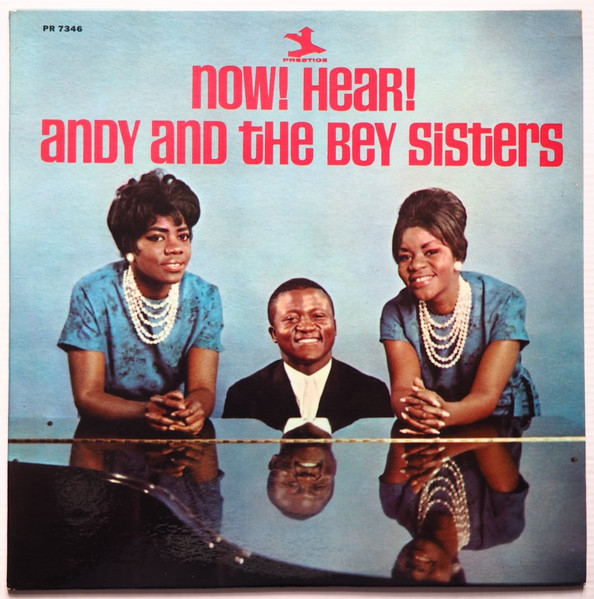

What became one album, Now! Hear!, was recorded in two sessions, three days apart, with Jerome Richardson the only musician to play both sessions. I don't know the reason for the change. Perhaps producer Cal Lampley, was dissatisfied with the first group (he needn't have been -- they are wonderful). Perhaps, new to Prestige, he decided he wanted a younger, hipper sound. All the musicians on the second date represent a different generation from the first group. Perhaps it was just a scheduling conflict. At any rate, it's not cause for complaints. Each group brings a distinctive and satisfying sound. And in any case, the focus is on the Beys, and their tight sound. In any musical field, from country to doo wop to jazz, there is something distinctive about a family harmony group. Andy recognized this from a vantage point of half a century, as he told Chris Slawecki in a 2020 interview for All About Jazz:

I was doing things with my sisters that I'm still doing somewhat, in terms of the tempo and in terms of the rhythmic attack we used to use. I used to sing the lower part, having the male voice. We have a family sound, we basically all sound the same. Like the Cole family, him and his brothers sound basically the same when they sang. They're not identical, but you can hear that family sound.

You can certainly hear that family sound on Buddy Johnson's "Since I Fell for You." The tune was written for his sister Ella, but the group harmony possibilities of it were quickly realized by a number of doowop groups, most notably the Harpton. Andy's Nat Cole-influenced piano anchors this one, with some wonderful guitar fills by Barry Galbraith.

"Willow Weep for Me" provides a good introduction to the second group, with particularly notable work by Richardson and drummer Osie Johnson, and again those family harmonies.

It's good that the Beys went their separate ways. Each of them had a distinctive and important career, contributing so much to American music. But it's also really good that they did this work, and recorded this work, together,

Prestige released two 45 RPM singles. each featuring one song from each session. "Willow Weep For Me" / "Quiet Nights Of Quiet Stars," and the second was "A Taste Of Honey" / "Besame Mucho."    


Sunday, May 30, 2021

Listening to Prestige 575: Etta Jones


LISTEN TO ONE: If I Loved You

 A short session for Miss Jones--one song to fill out Hollar!, being readied for release, and three for a future project. She would be back in the studio in early 1963, and the three sessions together would make her last recording sessions for Prestige, to be issued as Love Shout, which was actually released before Hollar! Why these titles for these two albums is anyone's guess, as Jones was a singer, not a shouter. But then, a lot of the marketing decisions over the course of her long career may not have been the best ones, as her reputation has always seemed to lag behind her talent.


This is an interesting session in terms of song selection, leaning toward songs on the sweet end of the spectrum, not necessarily the first choices for most jazz singers--although other songs from not exactly hipster sources, like Sigmund Romberg and Rudolf Friml, have become jazz standards.

The session begins with Rodgers and Hammerstein's "If I Loved You," from Carousel, a much-loved standard for pop singers, bel canto and even operatic voices, not so many jazz singers. Doo wop singers of the 1950s breathed new life into a lot of standards and show tunes, but not this one--perhaps it was too resistant to a rhythm and blues spin. Dinah Washington recorded it twice, and Sarah Vaughan once. Dinah's first in 1950 with an orchestra led by drummer Teddy Stewart, and some melodramatic, almost coloratura, belting. the second a decade later with Quincy Jones. Both featured lush strings and an orchestral mood, as did Sarah's--I don't know the arranger or orchestra leader.

It goes without saying that both Dinah and Sarah can do no wrong with a song. Etta may not quite have the vocal chops of those two ladies, because no one has (except Ella, of course), but I do believe that Etta has the definitive jazz interpretation. She swings it, with a killer assist from Jerome Richardson on flute. Etta has always had the unique ability to channel other jazz singers without sacrificing her own individuality, and she does that here, starting out the way Dinah might have if she'd had Richardson, Kenny Burrell and Bucky Pizzarelli swinging her along, but then taking it to places that are pure Jones. For jazz, she owns this tune.

 "Hi Lili, Hi Lo" was written for the Leslie Caron / Mel Ferrer movie Lili by composer Bronislau Kaper  and Helen Deutsch, the film's screenwriter and not otherwise a lyricist. It was a 1952 hit for Dinah Shore before the movie came out, then everlastingly associated with  the character of the sweet, innocent orphan who talked to puppets. It became a standard, mostly for girl singers with sweet, innocent voices, like the Lennon Sisters, the Chordettes, or Teresa Brewer--although Jimmy Durante also sang it (a weird masterpiece), as did the Everly Brothers (mistake), Manfred Mann (mistake), and Gene Vincent (oddly enough, not so bad). But jazz singing is mostly not about sweetness and innocence, although one of the great jazz vocals of all time is pure sweetness and innocence--Ella's "A-Tisket, a-Tasket," which works so well because there's no knowing wink behind it.

Jones respects the sweetness of "Hi Lili, Hi Lo." There's no knowing wink behind her rendition. But there's musical sophistication in the guitar parts especially, and if she doesn't swing it the way she does "If I Loved You," she gives it a nice bluesy touch. 

Nat "King" Cole was never an innocent orphan who talked to puppets, for all his silky voice, and his


"Nature Boy" was a song about an innocent, not a song of innocence. It's a prodigiously recorded song -- nearly 600 versions, with lyrics translated into a bunch of languages including French, Italian, Portuguese, and three different Finnish translations, and yet it remains always Nat "King" Cole's. Etta Jones won't change your mind about that, but her knowing, smoky version, shorter than any of the other songs on this session, has its own very real words, not the least of them being Jerome Richardson's sax solo.

There's no question about the jazz credentials of "A Gal From Joe's" -- it was written by Duke Ellington, and his original 1938 recording features a memorable Johnny Hodges solo. And it's a good tune, but one that never caught on the way so many Ellington songs have -- in fact, Jones's 1962 recording was the first to feature a vocal. Nina Simone would record it a couple of years later, and her version is the best known. Contemporary singer Deborah J. Carter has recorded it, and that's about it. The lyric, credited to Ellington's manager Irving Mills, is odd -- is the gal leaving Joe's because she's dying? Because she's been arrested for murder? Or just because she's tired of Joe? Anyway, Jones does a fine version of a tune that deserves more attention than it's gotten, with wonderful solo and ensemble work from the musicians.

Also on this gig -- Sam Bruno, playing both organ and piano, although he's probably better known as a bassist; Ernest Hayes on bass (can't find any other credits for him, unless he's Ernie Hayes the piano player--he's certainly not Ernest Hayes the bass fisherman); and Bobby Donaldson, who's made several Prestige sessions, including a few backing up vocalists, and who brings a lot to this date.

Three of the four songs made it onto 45 RPM releases. "Nature Boy" and "Hi Lili, Hi Lo" were one entry. "A Gal from Joe's" was paired with "Some Day My Prince Will Come," from one of the later sessions. Esmond Edwards had brought Jones to Prestige, but Ozzie Cadena produced this and the later Love Shout sessions. 

Thursday, May 14, 2020

Listening to Prestige 485a: Etta Jones

Esmond Edwards and Oliver Nelson put Etta Jones together with a string section over three recording sessions. The first one had been back on June 9. This one was followed by another three days later.The string sections were anonymous; the other players, except for George Duvivier on the bass, are all new from the June session. A reed section is added, and the two French horn players from June are cut down to one.

This French horn belongs to Ray Alonge, mostly a classical musician (he was first chair in the Indianapolis symphony while still in high school), but with some impressive jazz credentials too: Louis Armstrong, Miles Davis, Quincy Jones, Dizzy Gillespie, Milt Hinton. And going farther afield, he played on recordings by Elvis Presley, the Beatles and the Rolling Stones.

Female singers with strings became a thing after Billie Holiday did it, and it generally wasn't a bad thing, if not necessarily a good thing. In this case, with Oliver Nelson arranging and conducting, the results are good. Jones veers toward the Billie Holiday side of her personality, which is probably understandable, since Holiday more or less set the template for jazz singers with strings.

One song from the July 25th session, "You Better Go Now," is associated with Holiday, and Jones would record again in 2001, on her last studio album, A Tribute to Lady Day. Interestingly, the 1961 version owes a lot more to Lady Day than the later version. She also recorded it in 1994 with Benny Green, the pianist--not to be confused with Bennie Green, the great trombonist, or Benny Green, the British saxophonist. The song had originally been performed in 1936 as part of the Broadway revue New Faces of 1936 (the only new faces of note were Imogene Coca and Van Johnson), but it had not broken out as a hit, and was never recorded again until Holiday found it in 1947.

"And This is My Beloved" is another interesting choice, perhaps dictated by the orchestral instrumentation. From the Broadway show Kismet, it never achieved quite the breakout status of "Stranger in Paradise" or "Baubles, Bangles and Beads," but it's had quite a life as a vehicle for pop singers with operatic ambitions like Jim Nabors or Jackie Wilson (granted, quite a range of styles there) or opera singers with pop ambitions like Richard Tucker, but one thing hasn't particularly beem is a vehicle for jazz singers. or jazz instrumentalists (with one odd exception--Sun Ra). Jones basically sticks to the melody, but she has some nice jazz-tinged phrasing, and it makes for a satisfactory outing,

"Unchained Melody," from the July 28 session, is another unusual choice, although not so unusual when you consider how popular a choice it was, and has become, From the soundtrack of a 1955 grade B movie, it attracted twelve different reco

Dating from 1955, it is one of the most popular songs of all time,, with over 450 versions (and if you think that the mid-1950s were so rock 'n roll dominated that a ballad didn't have a chance, think again. "Unchained Melody" isn't even the most-recorded ballad of 1955; "Cry Me a River" beats it out). It's been recorded by pop singers, rockers, country singers, almost everyone except jazz singers, although one of the biggest hit versions was by Al Hibbler. Even in the hands of an Al Hibbler or an Etta Jones it's not exactly a jazz tune, but Oliver Nelson's string arrangement is one of his most interesting, and Jones works with it in inventive and creative ways. There may not be a whole lot you can do with improvisation on "Unchained Melody" with strings, although Jones makes some interesting choices, but there's a lot you can do with dynamics, and there she comes through.

"Unchained Melody" was the 45 RPM single. On the other side was "Hurry Home," written by Buddy Bernier, Bob Emmerich and Joseph Meyer, not a well-known tune (I'd never heard it before), but a good one. It had been a hit for Kate Smith in 1938, and Ella Fitzgerald recorded it on Verve in 1957. Jones and Nelson give this one a jazz reading, and a good one--I like her version better than Ella's. The album was called So Warm.


Listening to Prestige Vol 4, 1959-60, now available from Amazon! Also on Kindle!Volumes 1-3 are also available from Amazon.The most interesting book of its kind that I have ever seen. If any of you real jazz lovers want to know about some of the classic records made by some of the legends of jazz, get this book. LOVED IT.– Terry Gibbs


Monday, January 01, 2018

Listening to Prestige 298: The Prestige Blues-Swingers

This is mostly a new edition of the Prestige Blues-Swingers from the previous August. Jerome Richardson, Pepper Adams and Ray Bryant are back, and perhaps most importantly arranger Jerry Valentine, the central figure behind both dates. This time, Valentine is given Coleman Hawkins to work with, which has to be a good thing.

One would think Hawkins would be most closely associated with the 1920s, when he changed jazz irrevocably by making the tenor saxophone a jazz instrument, or the 1930s when he changed improvisation irrevocably with his 1939 recording of “Body and Soul.”

But then you’d have to take into account the 1940s, when a new revolution swept jazz, leaving earlier innovators like Hawkins in its wake, except that it didn’t. Hawk led a group on 52nd Street with Monk, Miles Davis, Oscar Pettiford and Max Roach, and led a group with Dizzy Gillespie in what many consider to be the first bebop recording, in 1944.

But Hawk never slowed down, and the 1950s were probably his most prolific recording decade. It’s hard to keep track, but in 1958 and 1959 alone he appeared on close to twenty albums as leader, and several more as sideman. Everyone wanted to play with Hawkins. And a couple of lesser known names are getting their chance here.

The LA Times obituary for Walter Bolden, who died in 2002, was entitled “Drummer Played With Jazz Greats,” and there are certainly worse ways to be remembered.

Here’s how that started. Sometimes a touring musician will go it on his own, generally for economic reasons, and work a date with local musicians. That was the case in 1950 when Stan Getz played a club date in Hartford, which was home to the Hartt School of Music, so Getz could count on getting some competent guys. But if Getz was planning on saving money by not hiring a band, economy gave way to the chance to snatch up some very good players. He left town with a drummer, Walter Bolden, and a piano player, Horace Silver. When he got back to New York, he used them on a couple of recording sessions for Roost.

Bolden may not have gone on to have the impact that Horace Silver did, but he stayed in New York and became a solid go-to drummer, recording with Gerry Mulligan, J. J. Johnson, Junior Mande, Howard McGhee and others. He toured with Lambert, Hendricks and Ross, and ultimately returned home, where he took a place on the faculty of the University of Hartford.

23-year-old Roy Gaines’s is strangely omitted from the session log as posted on the always-reliable jazzdisco web page. But there's definitely a guitar on the session, and it's definitely Gaines. He's listed on a couple of other sources. And a German reissue of the album gives leader credit to Hawkins-Bryant-Gaines.

Gaines had been playing professionally since his mid-teens, When admiration for T-Bone Walker had led him to leave Texas for the West Coast, where he found work in the touring bands of Roy Milton and Chuck Willis, and some gigs with his idol, Walker. He probably played on Willis's 1952 recording of "Loud Mouth Lucy," because he would cover the song on his own in 1956.

The thirty years between the early 1950s and the early 1980s are the history of the unsung working musician, which is to say no history at all, but he apparently did spend some time up and down the East Coast. "Loud Mouth Lucy" was recorded for Miami-based Chart Records, and 1958 seems to have found him in New York recording for "Skippy is a Sissy" for RCA Victor, which had some minor success. His later blues albums are terrific, but so are the 50s R&B records, and must have played a gig somewhere to catch the ear of Jerry Valentine, who was certainly looking for a blues sound for this session. In 1982 the one-nighters and smoky rooms finally paid off for him, as he got a recording contract for a traditional blues album, and he went on to record several more through the end of the millennium and into the next, winning a W. C. Handy Award and the Living Blues Comeback of the Year Award. One of his albums, fittingly, was a tribute to T-Bone Walker.


Valentine has chosen an interesting group of tunes for the session. There are two of his own, “Stasch” and “Skrouk.”

There are three blues tunes, each generally associated a vocalist, and three very different sorts of vocalists. Well, “Since I Fell For You,” with its sweet, bluesy, romantic melody, has proved a natural for almost every kind of vocalist. Originally written by bandleader Buddy Johnson for his sister Ella, it’s been recorded by jazz singers (Nina Simone, Dinah Washington, Morgana King, Arthur Prysock, Shirley Horn), pop singers (Doris Day, Jack Jones, Eydie Gorme), doowoppers (the Harptones, the Spaniels, the Dells), rhythm and blues singers (Lloyd Price, Wilbert Harrison), soul singers (the Righteous Brothers, Fontella Bass, Barbara Lewis, Barbara George, Aaron Neville), country singers (Ketty Lester, Con Hunley, Willie Nelson). It’s been recorded over 200 times.

“Roll ‘em Pete” and “My Babe” are each associated with only one version: The former with Big Joe Turner’s vocal over Pete Johnson's boogie woogie piano, and the latter Little Walter's harmonica-and-vocal treatment of a song by Willie Dixon, one of the great blues songwriters, for Chess Records.

Hawkins gives the crooner treatment to “Since I Fell For You,” and it’s beautiful. Valentine gives a little more bite to the ensemble sections, and there are brief solos by all concerned. They’re all good, and all can’t help but remind one that in a really important sense, all modern improvisation comes from Coleman Hawkins and “Body and Soul.” This is still true in 1959, and will be until the free boys take over, which they're starting to.

Nobody is going to do what Big Joe Turner did with “Roll ‘em Pete,” but Jerry Valentine takes it back to Kansas City. Hawkins knows how to do that: he was there. And Valentine was close: his first important arranging gig was with Earl Hines. The Hawk shows everything he learned back then, and everything he’s learned since. And we can stop to appreciate what a perfect choice Ray Bryant is for this session. He can play anything, including an updated but pulsing take on Pete Johnson’s riffs.

Roy Gaines’s web page concentrates on his post-1980s work, and this session isn’t mentioned. You’d think he’d be prouder of it, but probably his web page was built by young guys. At any rate, he delivers a solo on “Roll ‘em Pete” that should, yet again one more once, clinch the argument as to whether rhythm and blues is jazz.

And Gaines’s solo on “Roll ‘em Pete” is his strongest and most personal, although you’d think that “My Babe,” from the guitar-dominated Chess Records library, might have been the one. But Valentine writes a real big band arrangement for “My Babe,” and Gaines plays a Charlie Christian-influenced solo.

 Valentine’s own two tunes are big band swing, as well. If you name your compositions “Stasch” and “Skrouk,”you’re probably not expecting them to have a long shelf life, but they’re good tunes.

"Trust  in Me," the one tune from the standards repertoire, was written by Jean Schwartz, already a veteran ("Trust in Me" would be one of his last) and Ned Wever. It was originally recorded in 1937 by Wayne King, the Waltz King (although a fox trot), and almost immediately covered by Mildred Bailey, setting up a schmaltz-hip dichotomy that would endure, with the likes of Eddie Fisher in one camp, and Louis Jordan, Clyde McPhatter and Thelonious Monk in the other, not to mention Beyoncé and Rolling Stone Bill Wyman.

Wever was better known as an actor than a composer, starring on radio as Dick Tracy and Bulldog Drummond. Jerome Richardson walks right down that street like Bulldog Drummond in thie recording, and so does Ray Bryant.

Bob Weinstock was gearing up to start his Moodsville and Swingville subsidiary labels by the end of the year, and Stasch, credited to the Prestige Blues Swingers featuring Coleman Hawkins, was one of their first Swingville releases, in 1960. It would later be released as part of a Prestige CD package (Prestige as a subsidiary of Concord) called Coleman Hawkins--Bean and the Boys.


Order Listening to Prestige Vol 2 


Listening to Prestige Vol. 2, 1954-1956 is here! You can order your signed copy or copies through the link above.


Tad Richards will strike a nerve with all of us who were privileged to have lived thru the beginnings of bebop, and with those who have since fallen under the spell of this American phenomenon…a one-of-a-kind reference book, that will surely take its place in the history of this music.

                                                                                                                                                --Dave Grusin

An important reference book of all the Prestige recordings during the time period. Furthermore, Each song chosen is a brilliant representation of the artist which leaves the listener free to explore further. The stories behind the making of each track are incredibly informative and give a glimpse deeper into the artists at work.
                                                                                                                --Murali Coryell

Friday, November 24, 2017

Listening to Prestige 288: Jerome Richardson

The fullness and power of orchestral music, with its sections and soloists, is undeniable, as is the energy and vitality of big band music. But there's something uniquely entrancing about music made by a small ensemble, where each instrument has its own kind of clarity, and the melds are shifting and subtle. This is true of chamber music, but it's perhaps especially true of small group jazz, for all kinds of reasons, some of them obvious, some less so.

I've talked before about getting my first hi-fi, and suddenly realizing that there was more going on than just Gerry Mulligan and Chet Baker. I could suddenly hear Larry Bunker, and especially Chico Hamilton, and I suddenly had a whole new appreciation of the complexity of the music I was starting to love.

In a jazz ensemble, the instruments are so different from each other, and they have so many ways of interacting. Improvisation opens up the possibilities exponentially, and because the different members of the group are given space to improvise, the time it takes to play a given piece is variable, as Miles Davis found out when John Coltrane started playing his extended solos. This makes it strikingly different from a composed piece. Terry Riley's In C plays with that boundary. It is entirely composed. There are 53 separate musical phrases, and each instrument--it's written for an indeterminate number of instruments--is instructed to play each figure, in order, from beginning to end, but they don't have to start together, and each one can repeat each figure as many times as he or she chooses before going on to the next one. Still, duration is not much of a variable in most composed pieces. Even John Cage's 4'33", which involves silence, is written to last four minutes and 33 seconds.

So I'm in the car alone, my favorite way of listening to Prestige, and I've lined up the Jerome Richardson session, and "Caravan" comes on, the Duke Ellington-Juan Tizol warhorse, which has been recorded over 350 times, not always by jazz groups--sometimes just for its exotic melody. That makes it, like "Taboo" which we've recently heard recorded by both Yusef Lateef and Dorothy Ashby, just a little bit suspect: will it fall into the clichés of exotica? Which makes me particularly interested in listening to it. And this being the car, with me driving, I can't refer to the session notes, and I haven't really looked at them. I know that Richardson has Jimmy Cleveland on trombone, since brass always comes first in the personnel listing, but that's all.

It starts with a faint, exotic but not at all clichéd rhythm on the ride cymbal, but then the bass enters with the first strong voice, and it's a repeated but unnerving figure, no less unnerving when the piano joins in. Richardson enters, playing the melody, but he's distant, behind the bass and piano. So the first all-out solo goes to Jimmy Cleveland, improvising, and then it's Richardson again, out front this time, playing the melody again, sort of haunting, sort of mocking, sort of appreciative, and then they're off into uncharted territory, with Richardson beginning an extended solo, and now we're about three minutes into the piece, and we're just getting started, so this will be, yes, of indeterminate length, and the melody will be left in the desert dust. A lengthy Cleveland solo is next, followed by...what's this? Kenny Burrell? He's on this session too?

Well, yeah, since this is the Jerome Richardson Sextet, I should have remembered that there would be a third front line instrument. So we have flute, trombone guitar. not your everyday lineup, which brings me back to what I was saying about the different permutations of sound in a small jazz ensemble. The standard Bird-and-Diz quintet lineup of trumpet and saxophone is endlessly varied enough in the hands of jazz masters, but this group is very hip, and it's an instrumental lineup you don't hear that often--and it's varied even more when Richardson switches to tenor sax.. Which brings me back to duration as a unique function of jazz's uniqueness, especially in the LP era. With room for six different soloists to stretch out and create their own take on not only the melody and chord structure, but also the solos that have come before them, this version runs close to eleven minutes. A 1950s rock and roll version by steel guitar duo Santo and Johnny basically plays the melody, and clocks in and two and a half minutes. A pop instrumental by Gordon Jenkins, strictly playing the melody, is even shorter.

The rest of the group is Hank Jones on piano, Joe Benjamin on bass, and Charlie Persip on drums. Benjamin, never very far from the front, comes back after Kenny Burrell, and then there's an extended drum solo that captures the exotica of...well, of exotica, the complexity of bebop, and the excitement of a great drummer doing an extended drum solo.

We've heard Jimmy Cleveland before, with  Art Farmer septets a couple of times, and as part of Gil Evans' tentet. Here he gets a more featured role, which is all to the good, particularly on "Way In Blues." Which reminds me to give a tip of the hat to another Prestige alumnus, Bennie Green, a great trombone bluesman, who would record through the 1960s on various labels, then settle in Las Vegas and hotel bands. Cleveland was one of those guys who could play with everyone, from blues (Ruth Brown) to soul (James Brown) to soul jazz (Cannonball Adderley) to big bands to bop.

Hank Jones accompanied vocalist Earl Coleman on a couple of Prestige albums, and played with Curtis Fuller on another. He'd be back for several more appearances on the label, but that was a tiny part of his prodigious output as leader and sideman over seven decades, with multiple honors including the National Medal of Arts two years before his death in 2010. He also has a unique credit for a jazzman: he accompanied Marilyn Monroe on her legendary performance of "Happy Birthday, Mr. President."

Joe Benjamin makes his Prestige debut, but his name is forever imprinted on my brain because he's one of the musicians Sarah Vaughan introduces in her live recording of "Shulie-a-Bop," arguably the greatest bebop vocal ever, made for Mercury Records in 1954, the same year that Mercury had her record "Make Yourself Comfortable," with a syrupy orchestra led by Hugo Peretti. This was the beginning of Mercury's project to make Vaughan into a commercial success by recording insipid pop songs with insipid arrangements. "Make Yourself Comfortable" is a clever song, and she sings it wonderfully, but come on. Is this really the best way to utilize Sarah Vaughan? It worked, for what they were trying to do. "Broken Hearted Melody," in 1959, which Vaughan regarded as the worst record she had ever made, was her biggest seller.

Fortunately, they did also let her record for EmArcy, their jazz subsidiary, where she did the great Clifford Brown sessions, and the ones with Joe Benjamin. But I digress.

This is actually the second member of Sarah's trio to appear on a Prestige session in the fall  of 1958. Roy (drumroll) Haynes (drumroll) had been on the Dorothy Ashby date just three weeks earlier. I wonder when John Malachi will show up? But I continue to digress.

Artie Shaw's "Lyric" joins Ellington's "Caravan," and the other three tunes are Richardson originals. I've commented before that I miss the bad puns and other plays on words in the early bebop recordings, like "Ice Cream Konitz" and "Flight of the Bopple Bee." Richardson brings the word play back with rather more sophistication on "Minorally" and "Delirious Trimmings," which I hope is not a reference to anything that anyone in the band is going through.

The album was released on New Jazz as Midnight Oil.


Order Listening to Prestige Vol 2


Listening to Prestige Vol. 2, 1954-1956 is here! You can order your signed copy or copies through the link above.


Tad Richards will strike a nerve with all of us who were privileged to have lived thru the beginnings of bebop, and with those who have since fallen under the spell of this American phenomenon…a one-of-a-kind reference book, that will surely take its place in the history of this music.

                                                                                                                                                --Dave Grusin

An important reference book of all the Prestige recordings during the time period. Furthermore, Each song chosen is a brilliant representation of the artist which leaves the listener free to explore further. The stories behind the making of each track are incredibly informative and give a glimpse deeper into the artists at work.
                                                                                                                --Murali Coryell