Showing posts with label Norman Edge. Show all posts

Sunday, January 14, 2024

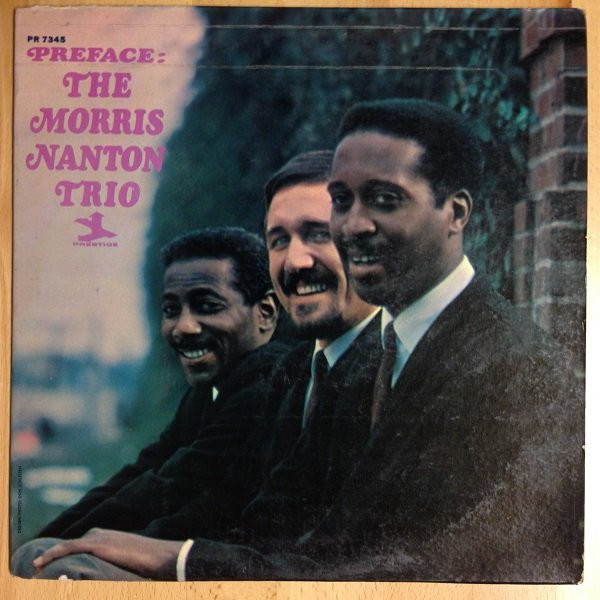
Listening to Prestige 714: Morris Nanton


LISTEN TO ONE: Something We've Got

 Next up in the Prestige chronology we have the debut album by a pianist-composer who has fashioned one of the more impressive careers in American music, who has recorded over 250 albums, worked with "everyone from Ellington to Elvis, Joni Mitchell to Barbra Streisand, and Quincy Jones to Yo-Yo Ma" (from the bio on his web page), garnered a Grammy and an Oscar nomination, who has written the scores for 20 movies including the Streisand remake of A Star is Born; and a mid-career album (fourth out of a total of six) by a performer whose career is mostly bounded by the town of Perth Amboy, New Jersey,


where he and his trio were local favorites for over five decades, including a 22-year stint at one local club. The former's debut album was not long ago rereleased on CD; none of the albums by the latter seem to have been rereleased.

Unfortunately, I was only able to locate and listen to one of these albums on a streaming service--and it wasn't the guy with the truckloadfull of credentials. The Roger Kellaway Trio was actually Kellaway's second album, but the first was done for a tiny local label, so this was his debut on the national stage, produced by Jack McDuff's guiding hand Lew Futterman. I can't give you a first-hand response to the music by this "lean, bearded, intent young jazz musician" of 26 (from the liner notes; I was able to find them, but no music), but I wish I could have. It sounds fascinating, from "one of the good tunes penned by Beatles John Lennon and Paul McCartney" to a four-note melody written for "prepared piano," the adaptation of a traditional piano pioneered by John Cage. 

No jazz musicians were recording Lennon-McCartney tunes in 1965--in Arthur Taylor's seminal interviews with his peers a few years later, collected as Notes and Tones, the interview subjects are unanimous in dismissing the musical value of the two Beatles' compositions. And certainly none were experimenting with Cage's prepared piano, although Dave Brubeck did record one tune with a modestly prepared instrument, laying copper strips across the strings. Bizarrely, the easy listening piano duo of Ferrante and Teicher did try a number of these experiments during the course of their careers.

Kellaway prepared his piano by "fastening objects to the strings, including washers, nuts, bolts, and wooden pegs. 'The choice of which notes to prepare was purely individual,' Kellaway noted. 'Besides the melody notes I prepared mostly the lower level of the piano.'"

But for now, for me, these experiments remain tantalizingly out of reach. So I turn my attention, instead, to the May and June sessions which comprised Morris Nanton's second of three Prestige albums. and which I was able to listen to.

First, I can't resist quoting a little from Jack McKinney's album cover notes, starting with the "many forces" which shape the identity of the trio: "It is music that evolves from Art Tatum through Oscar Peterson; it has ties to the 'space movement' of Ahmad Jamal ('freedom within form'); in its more reflective moments it becomes an extension of Bill Evans' introspective analysis." But where McKinney really gets going is his of all the things the Nanton trio is not: "These are not cocktail sounds for lifeless zombies pouring more Manhattans into bored executives. They are not forays into obscurity in which erudition becomes an end and confusion a means. They are not essays on the psychotic by the introvert who is playing to magnify his egomania."

Well, thank goodness for that, I guess. The May 13 session consisted of four songs, two of which did not survive the cutting room. Of the two that did, the first is "Mood Indigo," a 6:34 treatment that doesn't exactly follow the melody line or the arrangement suggested by Duke Ellington and Barney Bigard, but which, as it extends further in time and further into its own improvisational world, paradoxically starts to feel more and more Ellingtonian. 

"Mood Indigo" is one of the lovelier jazz melodies, and "Taboo" one of the cornier, but Nanton and his guys defy expectations again by giving us a good deal more of melody of "Taboo," also stretched out to six and a half minutes. To what end? It's hard to say. They're certainly not playing to its cocktail-exotica strengths, although there's some of that. They're not hipster-satirizing it either, although there's humor in their version. On one of their Perth Amboy club dates, this would have been a delight--having some fun with a tune you're perhaps a little embarrassed to admit that you recognize so readily, and at the same time giving some real musical depth of exploration to it. On an album--and it's the last tune on side B--it's still a delight.


The June 16 session begins with a blues, "Something We've Got," the only Nanton original, the longest track of the two sessions, the title cut and the leadoff cut for side A of the album. What to say about a blues? One could go with McKinney, once again, and say what it's not: "a listless and hopeless essay on futility." Well, thank goodness for that, I guess. It is a pleasure all the way through, a workout in different moods and tempi by musicians attuned to each other. 

Three shorter pieces finish out the session, and the album. "Any Number Can Win" is a moody number by French film composer Michel Magne for the Jean Gabin/Alain Delon gangster flick of the same name. Jimmy Smith had also recorded it. Two songs from the 1930s, Allie Wrubel's "The Masquerade is Over" and George Gershwin's "My Man's Gone Now" (from Porgy and Bess) are also of an appropriate length for a 45 RPM single, but that honor went--and appropriately--to "Something We've Got," split into a part one and part two.

Cal Lampley produced both sessions. The rest of the trio is Norman Edge (bass), who was Nanton's musical partner for over 50 years, and Al Beldini, drummer and vocalist (not here) probably best known for his work with Don Elliott.




Wednesday, July 05, 2023

Listening to Prestige 693: Morris Nanton


LISTEN TO ONE: Theme from "Lawrence of Arabia"

 Some jazz musicians never quite get the recognition they deserve. Often it's because they flame out too quickly. Drugs put an end to their career. Or they move to Europe, and whatever reputation they build there doesn't travel across the Atlantic, and while Europe and Japan may have the real dedicated jazz fans, the USA has the tastemakers and the important labels and the reputation builders. Or maybe they just don't click. Their first album fails to sell, and their rccord label decides to move on. And after a while, it's time to get a real job with a paycheck and a retirement package. 


None of those things were true of Morris Nanton. This was his first record for Prestige, but he had made two previous for Warner Brothers, and he would make two more for Prestige, giving him a quite decent catalog of five LPs. He didn't flame out or die young. And he didn't move to Europe. In fact, he lived his whole life in his hometown of Perth Amboy, New Jersey, and he continued to play, and receive the love and approbation of audiences, in New Jersey clubs for six decades, including a 22-year stint with long-time partner Norman Edge at The Cove in Roselle, NJ, where -- according to his obituary in the Newark Star-Ledger, "such jazz greats as Rashan Roland Kirk, Don Elliott, Sal Nistico, Babs Gonzalez, and Joe Morello shared the spotlight with the group." And Nanton didn't need to have Kirk or Elliot on the bill to draw a crowd. A 2004 profile on the All About Jazz website describes a Thursday night at Shanghai Jazz in Madison, NJ, a Chinese restaurant/jazz club:

On this particular second Thursday, the Northeast was swept by record wind-storms. Inside the safe haven of Shanghai Jazz, several regulars blamed the weather for what they considered a poor turnout. While only a handful of seats remained empty, they were used to sitting shoulder to shoulder when the Morris Nanton Trio hits. Most clubs in Manhattan would be delighted with that level of turnout, even on a more hospitable night.

The CD explosion that began in the 1980s, and continued through the early years of the 21st century, gave a career boost to a number of musicians, as labels started repackaging and reissuing for CD much of their catalogs, even recordings that had sat on the shelf for a couple of decades. And here's where Morris Nanton's story really gets depressing. According to that same All About Jazz article, 

Currently, if you want to hear Nanton and Edge, you will have to attend one of their live shows, or spend hours searching used records stores, because none of the five sessions they recorded together is available on CD...Sadly, it is unlikely any of these sessions will be reissued on CD anytime soon. Fantasy Records, owners of the Prestige catalog, has rebuffed Nanton's reissue inquiries and has turned down his offer to buy the session masters. 

Nanton died in 2009, without ever seeing any of his LP recordings released on CD. 

We can't feel too sorry for Nanton. He had a pretty good life in many ways. He had an unusually good rapport with his bass player and musical partner, fellow Garden Stater Norman Edge, whom he met shortly after mustering out of the army (he was a Korean war vet), and with whom he would work throughout his career (Edge had one previous Prestige date, with Gene Ammons).  They easily transcended the racial divide (Nanton was African American, Edge was white), to the extent that, as Edge said, Morris was like a second son to his mom, and he was like a second son to Mrs. Nanton.  They recorded with different drummers (Prestige veteran Oliver Jackson on this session), but throughout most of their careet in the New Jersey club scene, their drummer was Jeff Brillinger, who also played with Stan Geta, Hod O'Brien, and Woody Herman.

And althoigh the CD explosion psssed him by, Roberta, one of his Warner Brothers albums, can be found on Spotify and Apple Music, and various albums, including this Prestige debut, are represented on YouTube.


So what's the music like? It is seriously worth a listen. Nanton was slotted by Warner Brothers for a role that was popular at the time -- jazz interpretations of Broadway shows and movie themes -- and he brings some of that to this session, with the themes from Lawrence of Arabia and Black Orpheus.

Nanton takes a bold, percussive approach to the piano, and while he's respectful of the show tunes that were his bread and butter, he's not afraid to put his personal stamp on them either. "Lawrence of Arabia" is known for the lush orchestral arrangement of Maurice Jarre, and that's something you're not going to duplicate with a piano trio, so a whole different approach is called for. Nanton's version begins with a driving drum intro by Oliver Jackson, and then the piano comes in with an approach that is so percussive I had to check the session log to make sure he hadn't switched in a set of vibes. 

The "jazz versions of well known movie themes" fad wasn't always a rewarding one, but Nanton makes it awfully good listening here.

Two 45 RPM singles came out of these sessions. First was "Theme from 'A Boy Ten Feet Tall'" / "Ja Da," the second side of which became Nanton's closest bid for a hit. Second was  "The Sweetest Sounds" / "The Theme From 'Black Orpheus.'"    

Cal Lampley produced the session. He had been a producer for Columbia for a number of years, and had recently begun branching out to work for other labels. His arrangement/production of "Misty," recorded by Richard "Groove" Holmes, would become Prestige's biggest selling single of all time, reaching #44 on the Billboard charts.

Nanton's album was title Preface. Would that it had been the preface to more of a recording career, and more national acclaim. But Morris and Norman did all right, and I'm glad that Listening to Prestige gave me a chance to hear them.


Saturday, May 08, 2021

Listening to Prestige 566: Gene Ammons


LISTEN TO ONE: Cae, Cae

Gene Ammons jumps on the bossa nova bandwagon, which may sound like a putdown but is not, because any wagon Ammons jumps on is a cause for celebration, especially if you're following the progression of Prestige recordings and putting yourself back into 1962, in which case, you've been listening with the dark foreboding awareness that each session is drawing him closer to cruel incarceration for drug possession, and seven years in prison for a sickness, not a crime. And we have now reached that point. This would be his final recording session for seven years.


And if you're starting to feel that Ammons' swan song was a gimmicky commercial album, don't. The bossa nova is not a bad bandwagon to be on. The Brazilian samba provides a great framework for jazz improvisation, and no one went into Rudy Van Gelder's studio, with one of Prestige's producers, to make anything less than a real jazz album.

Don't forget, also, that secret to Ammons' enduring critical and popular success was twofold: the serious jazz community loved him because he was a real musician's musician, and the public loved him because he played music that people loved to listen to. So if the public wanted the bossa nova, Ammons would have had no problem giving them--in the company of some stellar musicians--the bossa nova.

This is pretty much a new crowd. Hank Jones and Oliver Jackson, no strangers to Prestige, are matched with Ammons for the first time. Kenny Burrell, even less of a stranger, made one Ammons session back in 1957. 


Bucky Pizzarelli is new to Prestige with this session, and he would hang around for a few more during the decade. At the time of this recording he was a still relatively obscure, though respected, session guitarist, often called upon for recordings across a range of genres. When you move away from jazz, musicians on a session are frequently uncredited, so it's impossible to even come close to listing his credits. He worked with Benny Goodman, and was part of Johnny Carson's Tonight show orchestra. In 1972, when Carson left for the west coast, Pizzarelli elected to stay behind, and his reputation blossomed. Performing solo or duet in New York clubs, he started garnering rave reviews, and began to be in even more demand. Around 1980, he started playing regular duets with his son John.

The session was produced by Ozzie Cadena, who had just taken over for the departing Esmond Edwards as head of A&R for Prestige, having filled the same role at Savoy. Between Cadena and Ammons, they came up with an interesting selection of tunes for the bossa nova treatment--I'd guess mostly Cadena, because Ammons, severely heroin-addicted, overworked to pay for his habit, and headed for a lengthy prison sentence, was not likely to be reaching so far out of the jazzman's standard repertoire. 

The result is a very different route from Dave Pike's exploration of the work of one contemporary composer. There's one Ammons original ("Molto Mato Grosso"), but the rest are a curious and


fascinating collection--and with the Ammons touch, they all fit together.

"Pagan Love Song" was written in 1929 by Hollywood tunesmiths Nacio Herb Brown and Arthur Freed for a silent film, The Pagan, starring Ramon Navarro. It later became the title song for a 1950 film with Esther Williams and Howard Keel. It became something of a staple for pop singers and exotic ethnic bands (The Hawaiian Islanders), but did not much make it over to the jazz repertoire.

Anna was a 1951 Italian film starring Silvana Mangano. Its title song, also known as "El Negro Zumbon," was written by Armando Trovajoli, a well-known composer, under the pseudonym R. Vatro. The movie was released in the US in 1953, and the song--although written by an Italian, with lyrics in Spanish by another Italian, Francisco Giordano-- is credited by some as igniting the first spark of interest in Brazilian rhythms. It was covered by Tito Puente with Abbe Lane, and by Xavier Cugat. It may have been brought to this session by Pizzarelli, as it had been recorded a year earlier by his frequent guitar partner George Barnes.

"Ca' Purange (Jungle Soul)" was composed by Natalicio Moreira Lima. He and his brother, performing as a duo, had been popular in Latin America since the early 1940s. As Los Indios Tabarajos, they would finally find success in the US and worldwide in the mid-1960s, with a gold record for 1963's "Maria Elena."

"Cae, Cae" was probably known to Cadena from Carmen Miranda's rendition of it in 1941's That Night in Rio, but the song had already been a hit in Brazil. Its composer, Roberto Martins, was (according to biographer Alvaro Neder on the Allmusic web site), "the composer of several classics of the Golden Age of the Brazilian song, recorded by many of the best interpreters of the period"--the period being the 1930s. "Cae, Cae," written for the 1940 carnival in Rio, "having been included in 12 foreign films, [became] an all-time carnival classic, even if it only achieved third place in the annual municipal contest of that year." It hasn't really caught on with recording artists, which is surprising, since it's hard to imagine a catchier tune.

"Yellow Bird" is of an earlier vintage altogether--a 19th-century poem, "Choucoune," by Haitian Oswald Durand, set to music in 18923 by Haitian composer by Michel Mauléart Monton. Katharine Dunham recorded it in 1946, and folk trio The Tarriers (featuring Alan Arkin) sang it in a 1957 movie, Calypso Heat Wave. They sang the original French lyric, but in the same year, Hollywood songwriters Alan and Marilyn Bergman put English lyrics to the melody. As "Yellow Bird," and rebranded as a calypso, it would have a new life, most successfully for Arthur Lyman on the newly invented Billboard Easy Listening charts in 1961. Ammons and co. make it something more than Easy Listening.

Bad! Bossa Nova was a Prestige release. It would be rereleased as Jungle Soul! and later as Jungle Soul, without the exclamation point. There were four 45 RPM singles. "Pagan Love Song" and "Anna" were on one of them. The others were all two-sided: "Ca' Purange" Parts 1 and 2, "Molto Mato Grosso" Parts 1 and 2, and "Jungle Soul" (which was, of course,  deja vu all over again on "Ca' Purange") Parts 1 and 2.

And after this, silence for seven years. That wound is still raw.