Tad Richards' odyssey through the catalog of Prestige Records:an unofficial and idiosyncratic history of jazz in the 50s and 60s. With occasional digressions.
By this time Shirley Scott and Stanley Turrentine are as blissfully united musically as we hope they are in their marriage life, though their marriage was destined not to last beyond 1971. But hey, you never know with marriages, and the music they recorded together remains an enduring testament to the best days of their relationship.
But just because they're perfectly attuned to each other, that doesn't mean they're slipping into too-familiar grooves. They're playing soul jazz to appeal to anyone with a pulse, but the way they play off each other gives each of them the opportunity for creativity and new discoveries. Scott, in particular, is always going to find new ways of approaching, and taking off from, a solid swinging musical idea.
Bob Cranshaw makes his Prestige debut here. He's best known for his five-decade association with Sonny Rollins, beginning in 1959, but he was always in demand for other sessions, including a number for Prestige throughout the decade with a variety of artists. One of his first recording gigs had been with Scott on a 1959 album for Impulse!, and although this is only Prestige session with her, he played with her on other albums for Impulse! and Atlantic.
"Flamingo" was first recorded by Duke Ellington in 1941, and taken to the top of the rhythm and blues charts in 1951. It became a crowd pleaser for club dates, and in fact was part of the Willis Jackson night that Prestige recorded live. "A Night at the Five Spot," a tribute to the great New York jazz club, was written by Benny Golson and recorded by Curtis Fuller and Art Farmer separately, and then by Golson, Farmer and Fuller together as the Jazztet in 1961. Scott and Turrentine made the next recording of it three years later, and after that it entered into the jazz standard repertoire. Bob Cranshaw may have brought along Sonny Rollins's "Grand Street."
The other tunes are by Scott, and they do an excellent job of showcasing the great organist and her talented husband. I particularly liked "The Funky Fox" -- perhaps a self-reference?
The album was released by Prestige as Blue Flames. Ozzie Cadena produced.
Prestige puts two of its most creative talents of the 1960s together, and the results are as beautiful, as creative, and as unique as you might have predicted. The two of them challenge each other, complement each other. They put together a good selection of tunes, and they make music that's a joy to listen to. They're joined by bassist Eddie Khan, heard once before on Prestige with Ronnie Mathews and Freddie Hubbard, and drummer Otis "Candy" Finch, borrowed by Scott from husband Stanley Turrentine's group. Finch, from Detroit, was the son of Otis Finch Sr., tenor saxophone player with John Lee Hooker.
"Trav'lin Light" was written by Jimmy Mundy and Trummy Young, and brought by Young to a 1942 session Paul Whiteman was doing for the newly formed Capitol Records. Young had also brought along his then girlfriend, Billie Holiday, and not wanting to miss an opportunity, Capitol's co-founder Johnny Mercer took Young's tune, wrote a lyric to it, and put Holiday in front of a microphone with the new song. She was under contract to Columbia, so she was "Lady Day" for the recording.
"Solar" is the famous Miles Davis composition, now a jazz standard, over 200 versions of it recorded, the first few bars of the melody engraved on Miles' tombstone...and almost certainly written by Chuck Wayne, not Miles. Be that as it may, it's a great romp for jazz musicians, Burrell playing it mainstream and wholly satisfying, Scott using the tune for one of her excursions to test the possibilities of the Hammond. They bring it off together, with some nice soloing by Eddie Khan.
"Nice 'n Easy" was a recent hit, written by Hollywood songwriters Alan and Marilyn Bergman for Frank Sinatra, and an instant standard, equally popular with crooners, swingsters, and jazz groups (Willis Jackson had brought the tune out to Englewood Cliffs just a month before Scott and Burrell). It's a catchy tune, and they catch hold of something, and swing it to life.
T-Bone Walker's "They Call it Stormy Monday" is a blues you can sink your teeth into. Blues singers love it, but jazz musicians have largely left it alone. Before Scott and Burrell, only Woody Herman had recorded it. Burrell actually had done it on record before, with Junior Mance, but that was backing up a blues singer, Billie Poole. Very few instrumental jazz renditions of it have been done since, and if Scott and Burrell (and Eddie Khan) are any guide, this is a mistake. This is the highlight of the album, a terrific blues--not soul jazz, the real blues.
"Baby, It's Cold Outside" has become a controversial song in recent years, with many decrying its lyric, but it's hard to find anything wrong with the sassy, tuneful Frank Loesser melody, and whatever you may think of the various male-female vocal duets, there's nothing at all wrong with the Scott-Burrell duet. It's delicious.
And speaking of songs that aren't normally done by jazz groups. this is probably the only jazz rendition you'll ever hear of the traditional Irish "Kerry Dance." It, too, is a delight, with some fancy stick work by "Candy" Finch.
What would you have released as your 45 RPM single? I think I would have gone with "Stormy Monday" and "Baby, It's Cold Outside," but Bob Weinstock and the marketing boys at Prestige chose "Travelin' Light" and "Kerry Dance." I can't complain. Anything from this album that I ever saw on a jukebox would get my nickel. Travelin' Light also became the album's title. Ozzie Cadena produced.
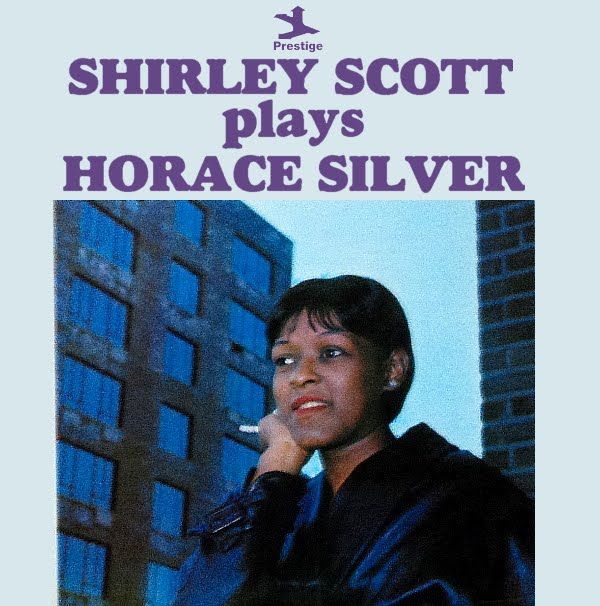
No sooner do I get done praising the uniqueness of Steve Lacy's commitment to the music of Thelonious Monk, devoting one full album and the greater part of another to Monk's compositions, when what should come along but an album by Shirley Scott devoted to the music of a different jazz composer?
And while Horace Silver, as a composer, may not have had the depth of a Monk or an Ellington, he certainly knew how to write some catchy tunes, and an album devoted to them, especially as played by Scott, is going to be great for listening, for finger snapping, for toe tapping.
And one wonders if there was a marketing consideration here. Both Prestige and Blue Note were going after the new and burgeoning soul jazz market, with Blue Note having the inside track, largely because of Horace Silver. Prestige wasn't going to get Silver, but they could get his name on an album cover.
One way or another, there can't be anything wrong with hearing tunes like "Doodlin'," "Senor Blues" and "The Preacher" played by someone as inventive as Scott, combining a popular touch with a gift for musical exploration.
Scott was joined on this day by Otis "Candy" Finch, a drummer who worked with Scott, with her husband Stanley Turrentine, with Herbie Hancock and Dizzy Gillespie and others, before leaving New York for Seattle, where would teach and play music away from the limelight.
Bassist Henry Grimes, in his only appearance on Prestige. Grimes was shortly to launch into a career as one of the favored bassists of the avant garde, working with Albert Ayler, Don Cherry, Cecil Taylor and Pharaoh Saunders. But in 1961, he had already established himself a significant, figure, first in rhythm and blues (playing with Willis “Gator Tail” Jackson, Arnett Cobb, “Bullmoose” Jackson, Little Willie John and others), and then with a variety of mainstream jazz artists. His reputation as one of the most versatile bassists around was cemented in one weekend--the 1958 Newport Jazz Festival, the one captured in the documentary Jazz on a Summer's Day. He appeared with Benny Goodman, Lee Konitz, Thelonious Monk, Gerry Mulligan, Sonny Rollins, and Tony Scott.
Grimes would go on to bring a whole new level of creativity to the bass throughout the 1970s, and then suddenly disappear from the scene, so completely that he was presumed to be dead. Free jazz didn't necessarily translate into a living, even for someone as respected as Grimes, and after his bass was damaged on a West Coast trip (strapped to the roof his friend's car, it was baked by the sun through three days of driving through the desert), he had to sell the instrument.
He described what happened next in an interview with Jon Liebman of the For Bass Players Only website:
HG: I worked as a janitor and maintenance man and day laborer. I also spent many hours in the library, studying literature and writing poetry, short stories and metaphysical ideas. I have around ninety notebooks at home with my writings from those times. I still continue to write today.
He lived like this for 35 years, until a social worker and jazz enthusiast named Marshall Marotte tracked him down. A younger jazz bassist, William Parker (also a free jazz player and also a poet) donated a bass to him, and he was able to resume his career.
FBPO: Did you ever really give up on music, or did you believe, deep down, that one day you would be back?
HG: I never gave up on music, not for a minute. You could say I was absent for a long time, but I always believed I would be back one day. I just couldn’t see the way to get there, but I knew it would happen.
In the same interview, Grimes gave the best, perhaps the only reasonable answer to the question, "What would you be doing if you weren't a bass player?
This question doesn’t have any meaning to me. I am a bass player and violin player and poet. If I weren’t those things, I wouldn’t be Henry Grimes. I wouldn’t be… at all.
Grimes married, continued to create and teach and write, and lived a fulfilled life until finally felled in April of this year by the Covid virus.
Scott's second session of the day marked the start of a new association, both musical and personal. She had certainly been one of the most important figures in establishing the soul jazz organ/saxophone sound through her work with Eddie "Lockjaw" Davis; now she was to continue to mine that vein with a new saxophonist, Stanley Turrentine, who was also her new husband. Turrentine was signed to Blue Note, so as the two continued to record together throughout the 1960s, they would be billed under her name for Prestige albums, under his for Blue Note sessions. I'll have more to say about him, and their partnership, in chronicling subsequent sessions.
Esmond Edwards produced. The trio album was called Shirley Scott Plays Horace Silver, the quartet album with Turrentine Hip Twist. Both were released on Prestige. There were 45 RPM singles released from both sessions: "Sister Sadie, parts 1 and 2," and "Hip Twist, parts 1 and 2."