Tad Richards' odyssey through the catalog of Prestige Records:an unofficial and idiosyncratic history of jazz in the 50s and 60s. With occasional digressions.
"Jazzy" is a slang term that's fairly commonplace in our national discourse, and as it's generally used, it has nothing to do with jazz. If jazz musicians don't care for the word "jazz," as many of them don't (perhaps not so many as at one time), maybe it's not just because of its origin as a slang term for sexual intercourse. After all, there are a lot worse things than having your art form compared to sexual intercourse. Maybe it's the ancillary meanings that have grown up around it. The Jazz Age -- drinking bathtub gin and shallow partying. Don't give me any of that jazz - don't give me any of your insincere bullshit. He's studying Greek literature and all that jazz -- and a lot of other stuff that's not really important enough to talk about.
Let's jazz it up -- let's add some bells and whistles.
And "jazzy" means showy, glitzy, with lots of surface flash. If it's used in connection with music--well, it almost never is--it's not related to jazz. Will Smith's hip hop partner, when he was starting out, was Jazzy Jeff. If you watch movies on TV with closed captioning, which some of us older folks have to do, sometimes a caption will inform you that a "jazzy theme" is being played, and if your hearing ain't all that bad, you can tell that the background music for the scene has about as much relationship to jazz as...well, as the "noirish jazz" that also pops up on closed captions.
That being said, Jackie McLean's version of "Chasin' the Bird" is jazzy. It starts out with an odd dirgelike intro from Curtis Fuller, and the whole ensemble bursts into a lively, glitzy, spirited rendition of the head. Proving that something can be jazzy and real jazz at the same time. "Chasin' the Bird" is one of the many jazz compositions based on Gershwin's "I Got Rhythm," which is one of the products of the Jazz Age. And it's a joyous melody. We've heard it recently by Herbie Mann and Bobby Jaspar, and the joy comes through loud and clear in their version: chasin' a bird is a sunny, open pastime.
And "A Long Drink of the Blues" is bluesy. And long, And deeply satisfying: 20 minutes of jamming on the blues with a bunch of cats who know how to play the blues.
Gil Coggins is the newcomer on this session. He was raised in Harlem and Barbados by a mother
who played piano in church and encouraged him to play until he joined the army. Stationed in St. Louis, he received some encouragement from his tap-dancing sergeant, Honi Coles, but his real inspiration came when he met a jazz-loving 16-year-old kid who was playing trumpet with a local band in a bowling alley. Ten years later, he would reunite with that teenager in New York to record an album for Blue Note, the one called Miles Davis Volume 2.
Coggins was another one of those jazzmen, like Wendell Marshall, George Wallington and Teddy Charles, who gave himself a day job to fall back on. In 1954, he began selling real estate, and eventually he phased out of the music business and into real life, and realtor life. Like Wallington, he made a return to music later in life, recording his only two albums as a leader in 1990 and 2003. At the time of his death from an auto accident in 2004, he was playing regularly at an East Village club. His last album, Better Late Than Never, was released posthumously.
This is another one of those mix-and-match sessions. "What's New" was released first, on the Strange Blues" album. "Chasin' the Bird" and "Jackie's Ghost" both came out on a 1960 New Jazz release, Makin' the Changes, resulting in two dropped g's from the same session."A Long Drink of the Blues" waited until 1961 and the eponymous album, also on New Jazz. All three of these albums also included cuts from the earlier February 15 session.
This is around the time when Bob Weinstock stops being the hands-on guy in the studio (although his idea of hands-on was mostly hands off), and starts turning some sessions over to other producers. He's had Teddy Charles produce a few, but those were really Teddy Charles projects.
Here he gives over some of his regulars to a new guy, Don Schlitten. And this is, in fact, a session that makes up part of an album begun back in February, with Weinstock at the helm. Schlitten was a young guy -- at 24, four years younger than Weinstock, and at the beginning of a long career in jazz. Like Weinstock, he had started his own label at a young age,
but perhaps had not had the business acumen, or perhaps just hadn't found his focus yet. His label, Signal, which he formed with Ira Gitler, did some significant work, recording Duke Jordan, Gigi Gryce, Red Rodney, Cecil Payne, and a live tribute to Charlie Parker from the Five Spot. They also put out an interesting series called Jazz Laboratory, which was sort of similar to Music Minus One. It featured quartets led by pianists like Duke Jordan and Hall Overton, with one horn player. On the reverse side of the album, the horn player dropped out, and the remaining trio did the same songs.
After a couple of years, Schlitten sold the label to Savoy, and went into independent production. He would go on to form other labels, and make a major contribution to jazz.
He brings a few faces to this session in the rhythm section. Jon Mayer didn't make much of a name for himself in the 1950s (and the name he did make was not entirely his own, if this session is an indication), but that would change several decades later. He made one other album (with Coltrane), played on gigs with Ray Draper (who may have recommended him here, as he did earlier with Webster Young), Kenny Dorham, Tony Scott and others, and in the 60s he performed with the Thad Jones/Mel Lewis big band, and accompanied Dionne Warwick, Sarah Vaughan and the Manhattan Transfer. Then he dropped out of sight until the 1990s, when he made a series of highly regarded albums, including a couple with Mark Feldman's Reservoir Records, out of Kingston, NY. He is still active.
Bill Salter is probably best known for his years as bass player and musical director for Miriam Makeba, but he picked an odd route into jazz--his first professional job was with Pete Seeger. Salter sort of passed through jazz. It was only part of what he did. His folk music credentials included Harry Belafonte and John Prine as well as Seeger. He was in the pit for Broadway shows. He wrote hit songs for Shirley Bassey, Roberta Flack and Donny Hathaway, Grover Washington, Jr. and Rod Stewart. But as he passed through, he left a mark: recordings with Sabu, Herbie Mann,Yusef Lateef, David "Fathead" Newman, Rahsaan Roland Kirk. He currently plays traditional black vaudeville music with his own group, the Ebony Hillbillies.
Like Gil Melle and Larry Rivers, Larry Ritchie was torn between painting and music, and over time he drifted more into painting. He would be back in Hackensack one more time in 1957, recording with Ray Draper and John Coltrane.
Draper and Webster Young make up the rest of the sextet part of the session, and Draper contributed one tune, the oddly named "Disciples Love Affair." McLean pairs down to a quartet for the final number of the day. "Not So Strange Blues" is sort of a companion piece to "Strange Blues," from the earlier session, and it may not be strange, but it sure is the blues.
If Schlitten was looking for instant recognition from his first Prestige session, he was doomed to disappointment. Strange Blues, which included these three tracks, would not be released for another ten years. But Weinstock was satisfied enough to hand him more assignments. And this whole McLean project was pretty weird. The long February session, which included "Strange Blues," would be released in dribs and drabs on New Jazz starting in 1959.
Jackie McLean was known, especially early in his career, as Bird's foremost acolyte, and starting off the session with a Parker tune shows that he's not quite ready to shake off that mantle. "Bird Feathers," as it turns out, did not make the cut for the album that emanated from this session (though it did eventually see vinyl), but it does set the tone.
On this session, McLean is paired with another Bird acolyte, John Jenkins, and two altos, plus LP technology (hardly a new development at this point) mean that they can do something that Bird was not able to do on his original waxing of this tune, and that's go on twice as long. More, actually. The original Parker/Miles Davis cut came in at under three minutes, 78 RPM dimensions, and McLean and Jenkins take it to nearly ten minutes. In fact, all the cuts from this session are extended, which is why they weren't able to fit them all on one album.
Even in Bird's late recordings, he didn't go much beyond five minutes, the exception being the live Jazz at Massey Hall. So length is one of the interesting features of this session. Not to say this gives us an insight into what Bird would have done with ten minutes or more to develop an individual piece in the recording studio, since no one can tell what Bird might have done with anything had he lived long enough to develop his genius further. And it goes without saying, not to say it gives us an insight into what if there had been two Charlie Parkers. Still, it's interesting.
The session shapes up much like a Parker session too, with one original ("Bird Feathers") and two standards, one ballad tempo ("Easy Living") and one uptempo ("The Lady is a Tramp"). The other two cuts are both John Jenkins originals, and he brings something of value to the party. In fact, his "Windy City" is probably my favorite cut. Art Taylor contributes a blazing drum solo to "Windy City," and Wade Legge is equally powerful.
We've heard Legge once before--on another Charlie Parker tribute session, that one led by Sonny Rollins. Legge himself was too young ever to have played with Bird, but he did tour and record extensively with Dizzy Gillespie. This session and two with Charles Mingus were his last on record. He would shortly return to his native Buffalo, and die a few years later at the age of 29, perhaps by his own hand.
Alto Madness was the title of this album, and "Bird Feathers" became the title cut of the New Jazz compilation album it eventually found its way to, with cuts from the March Phil Woods/Gene Quill session, and a later date with Hal McCusick and Billy Byers--which was not, oddly enough, devoted to Parker compositions.
We're really getting into the Coltrane era at Prestige now. As with Miles, Bob Weinstock seems to have wanted to present Trane in a variety of settings, which is good. Unlike the Miles recordings, however, the Trane sessions did not necessarily present him as the heavy hitter of whatever group had been gathered.
Here's a quick rundown of his post-Miles oeuvre with Prestige, up to this current session.
Elmo Hope All Star Sextet, May 7, 1956. This was actually issued two different ways, at the same time and with the same catalog number, but with two different covers and two different billings: as Elmo Hope - Informal Jazz and as Hank Mobley/John Coltrane - Two Tenors. He would finally get top billing in a 1969 re-release: John Coltrane - 2 Tenors With Hank Mobley. Wikipedia's entry on the 1969 release comments: "As Coltrane's fame grew during the 1960s long after he had stopped recording for the label, Prestige assembled varied recordings, often those where Coltrane had been merely a sideman, and reissued them as a new album with Coltrane's name prominently displayed." But "merely a sideman" only describes the billing on the album cover. In a quintet or sextet album of jazz masters, there's no merely. Everyone contributes.
Sonny Rollins Quartet With John Coltrane, May 24, 1956. Trane gets featured billing on the session notes, not on the album cover. There it's Sonny Rollins - Tenor Madness, and on the reissue, Sonny Rollins - Taking Care of Business. But there's a reason for this. The title cut, "Tenor Madness," is an epic duet -- the only one between these two tenor legends. But it's also Coltrane's only cut on the session.
The Prestige All Stars, September 7, 1956. I don't think any of the Prestige All Stars sessions were actually packaged as "Prestige All Stars." Generally, the album cover had the whole cast, sometimes omitting the rhythm section, with each musician getting equal billing. Such was the case here. This was two of the original Four Brothers, Al Cohn and Zoot Sims, with two new brothers, Coltrane and Hank Mobley. The album was titled Tenor Conclave, and listed the brothers (Mobley - Cohn - Coltrane - Sims) on the cover. The order isn't alphabetical, and it isn't by seniority. Maybe they just flipped a coin. Two later reissues were under Coltrane's name, the first keeping Tenor Conclave and the second including a Tadd Dameron session and titled On a Misty Night.
Tadd Dameron Quartet, November 30, 1956. Booked as a Dameron session. there was co-billing on the album cover: Tadd Dameron/John Coltrane - Mating Call. It would be rereleased as On a Misty Night, under Trane's name alone, and the "On a Misty Night" track would also be put on another Trane repackage, John Coltrane Plays For Lovers --misnamed, if you ask Tom Cruise. In Jerry Maguire, Cruise's friend gives him a Miles Davis and John Coltrane tape to play during lovemaking, but when the moment comes, Cruise listens to a few bars, says "What is this shit?" and throws it out.
The Prestige All Stars, March 22, 1957. Released as Interplay For 2 Trumpets And 2 Tenors, with the usual equal billing for all musicians. The two trumpets were Idrees Sulieman and Webster Young, the two tenors were Trane and Bobby Jaspar. This was reissued as Jazz Interplay, but never got a reisssue under Coltrane's name.
Art Taylor's All Stars. March 22, 1957. One cut, from the same date, this one a quartet with Taylor, Coltrane, Red Garland and Paul Chambers, for inclusion on a different Taylor session that didn't quite fill out an album.
The Prestige All Stars, April, 1957. Just the day before the current session, and released as Tommy Flanagan / John Coltrane / Kenny Burrell.
Up to this point, no sessions with Coltrane as leader, although that will come, and a marvelous potpourri of musicians.
I basically approve of the democratic approach to billing on the All Stars sessions, and as stated above, I take issue with the Wiki writer's "merely a sideman." None of the were merely anything. And I suspect this is an echo of the condescension contemporary writers show toward Prestige -- in a addition to sloppy and unrehearsed, Weinstock's label is also put down for the frequency of its repackagings. You know how I feel about all of these criticisms. The hell with them.
And speaking of marvelous potpourris, the tune that Mal Waldron wrote for an earlier session with Thad Jones, Frank Wess and Teddy Charles makes its reappearance here.
"Potpourri" is pure bebop, and surely one of the reasons why bebop retains its vitality well into the 1950s is the emergence of composers like Waldron,
The other Waldron originals: "J. M.'s Dream Doll," and that must have been some dream, or some doll. Some great solos here, but Waldron's is really outstanding. And "Blue Calypso." Remember the
mambo bebop craze of a couple of years back, with Joe Holiday and Billy Taylor as its champions, but also contributions from James Moody, Sonny Rollins, Sonny Stitt, Kenny Graham (mambo bebop from England!). Well, it turns out you can do it with calypso, too. Sonnny Rollins, from island-born parents, would make calypso his own, but here in 1957, with Harry Belafonte topping the charts with one of the most popular albums of all time, Waldron, Coltrane et al. show how its rhythms can be assimilated into the language of bop.
"Don't Explain" was written by Billie Holiday and her frequent collaborator Arthur Herzog, Jr., and covering a song associated with Billie inevitably means finding a correlative to the intensity of feeling that she put into everything. "Falling in Love with Love" is by Rodgers and Hart, and nothing Lorenz Hart wrote was entirely sentimental, but this song is often given a sentimental treatment by crooners. Not here.
"Potpourri," "J. M.'s Dream Doll" and "Don't Explain became part of Waldron's Mal-2 album, Mal-2, released in 1957. "Blue Calypso" and "Falling in Love With Love" had something of an odder fate. In spite of whatever sales potential a calypso may have had in 1957, both were left off and not released until 1964--and then only on the short-lived Prestige subsidiary Status, which was definitely a budget label, pressed on cheaper quality vinyl and marketed straight to the budget bins. That album, which put together outtakes from two Waldron sessions, was called The Dealers. The session was ultimately released under Coltrane's name in a much later CD box called Side Steps, a title which suggests "like Giant Steps but less important." Well, maybe so. Very few things touch Giant Steps. But great stuff nonetheless.
Don't ask me why Webster Young gets the special "introducing" credit in the session notes. New performers were introduced all the time, especially with Jackie McLean. Ray Draper had just made his debut a month earlier on a session with McLean and Bill Hardman, himself a McLean introducee. But that's what it says.
Draper's debut as a leader is noteworthy for a couple of reasons: (a) there aren't all that many jazz combos led by a tuba player, and (b) Draper was still only 16. But he had leadership qualities, and if he hadn't lost so many years to heroin addiction (it must have been tough to handle being 16 and being thrust into the cauldron of the New York jazz life), he could have done a lot more. As it is, he is credited with being the first musician (even before Miles) to form a jazz-rock fusion group
There are a bunch of faces new to Prestige here. Except for McLean and Mal Waldron, this is a new mix, which once again leads to the speculation on how a group is put together for a session. Sometimes musicians who grew up together will coalesce to make a record, like the various Detroiters, or Harlem high school pals Sonny Rollins, Kenny Drew, Jackie McLean and Art Taylor. But Ray Draper certainly wasn't calling on guys his age from the old neighborhood, because there weren't any other guys his age playing jazz on this level. Webster Young, Spanky DeBrest and Ben Dixon were all in their early twenties, but there's a big gap between that and 16.
But we know a certain amount about this session, from a reminiscence by Webster Young in Jazz and Blues Musicians of South Carolina, by Benjamin Franklin V. Young was living in Brooklyn and mostly playing with a bunch of guys in Brooklyn, although he would come in to Manhattan to informally apprentice with Miles Davis, and occasionally sit in with him on gigs. Miles, he said, would encourage him but keep him in check:
If you wanted to show off, Miles would say, "You got a Cadillac outside?" In other words, "What's wrong with you?" I dug it, I needed that.
Ray Draper would occasionally show up at the Brooklyn jam sessions.
He'd been playing at some sessions in New York and some competitions at Birdland...He was a nice cat [but] full of himself. I was a little bit older, and I helped him to be serious...Ray came up with a proposal. If he could play with us, he'd get us to the New York competitions. I said "No." And I didn't want a tuba player. But the other cats said if we did it, we'd be doing something. So I thought if we didn't do it, I'd lose the band. We let Ray play with us, and we had the competitions. Nat Hentoff...was one of the judges. We played three competitions. We won them all.
Young was invited to meet Jackie McLean and hang out during Draper's first recording session with McLean, and
...during intermission, Bob Weinstock came over to Ray and said he was going to record him and Webster. He didn't even know me.
So that's how Young got on the session. He was also the one who recommended drummer Ben Dixon, a fellow South Carolinian. The two had moved to Washington and then Brooklyn together, and Young had told Draper that "I'd make the date as long as we had Ben Dixon on drums."
Dixon would go on to a substantial career in New York, becoming a sought-after drummer especially for Blue Note's soul jazz recordings, working a lot with Lou Donaldson and Grant Green. Young played on several Prestige dates in 1957, and that was pretty much the end of his recording career, although he continued to be in demand as a working musician. He told Franklin that he had reservations about doing a lot of recording because he didn't want to be tied down to a day job, although he eventually did take a day job, becoming a respected educator.
Jackie McLean is the veteran here. Although only 25 himself, he was already considered a major jazz star, and one of the most recorded jazz musicians of his time. There were a couple of reasons for this. First, that he was really good and really versatile. Second, that his situation was almost exactly the opposite of Webster Young's: he was largely limited to day jobs. He battled heroin addiction throughout the '50s, and his arrest and conviction for heroin possession meant that he could not get a cabaret card to work in New York City clubs. As Young recalls in his taped reminiscence, Jackie "was the cat," but because of his ubiquitous exposure and his innate generosity, he gave much of the solo space to the younger musicians.
Draper and Young each contributed two songs to the set, each of them paying tribute to a mentor, Young with "House of Davis," and Draper with "Jackie's Dolly," dedicated to McLean's young daughter. And Webster paid tribute to another idol with his suggestion of "You're My Thrill," one of his favorite Billie Holiday recordings.
Mal Waldron's "Pivot" had previously been done on the Jimmy Raney / Kenny Burrell version of the Prestige All Stars, and here it shows Waldron's piano chops as well as his compositional skills.
Jazz instrumentalists were doing amazing things with unlikely instruments during this era. J. J Johnson and Kai Winding had shown that fast, complex bebop figures could be played on the trombone. The bass had become a flexible solo instrument in the hands of players like Paul Chambers and Oscar Pettiford, and Ray Draper was ready, at 16, to step out front and make the tuba a significant solo instrument. And to show just how much can be done in those lower registers, he played some exciting bass-tuba duets with Spanky DeBrest (best known for his work with Art Blakey and the Jazz Messengers).
The session was released as Tuba Sounds, with "introducing Webster Young" as part of the front cover text.
This was booked as a Prestige All Star session, but clearly the center of attention is the two guitars, one of them the label's newest star, the other a veteran of the early days of Prestige, who had been away from the label for a couple of years, and would be back for just this session. Kenny Burrell and Jimmy Raney mesh beautifully here, but what's even more interesting is how well all the instruments-- two guitars and two horns--all come together, so seamlessly that you almost don't register the difference between horns and strings as they play the heads together, and one solo follows another. And since several of the pieces are by Mal Waldron ("Blue Duke," "Dead Heat" and "Pivot") you can add that to the mix too. Waldron is always a great soloist, but never better than on his own compositions.
The outliers here are the one cut each where one guitarist takes center stage, and the other sits out. For Burrell, this is "Close Your Eyes," a song that had recently been popular in a version by Tony Bennett, and I had always thought of it as a passable but not very interesting example of 50s pop, but it has a much longer history. It was written by Bernice Petkere, who broke into the boy's club of songwriting in the 1930s and made enough of an impression that Irving Berlin dubbed her "the queen of Tin Pan Alley." "Close Your Eyes" was first recorded in 1933 by Ruth Etting, and it's stuck around, with other jazz versions by Humphrey Lyttleton and Oscar Peterson, and jazz vocal versions by Ella Fitzgerald, Peggy Lee, Betty Carter, Nancy Wilson, and another queen -- Ms. Latifah. Here the spotlight is given to Burrell, and he takes off with it, bypassing the melody almost altogether (perhaps why both Spotify and YouTube have it listed as "I'll Close my Eyes") for some breathtaking improvisational flights.
He then sits out and gives Jimmy Raney a turn on "Out of Nowhere," another 1930s chestnut that became a jazz standard. most famously in a 1937 version by Coleman Hawkins, with a solo described as "so intimidating that no tenor saxophone player tried the tune until eight years later." It had a pretty intimidating guitar solo, by Django Reinhardt, but Raney's version is entirely satisfying.
And one should also mention "Little Melonae," another outlier of sorts. It features the full ensemble, but with special attention to Jackie McLean, who wrote the tune.
This is another of those Prestige All Stars albums where some All Stars are more All Star than others. All the musicians get billed in the same font, but only Kenny Burrell and Jimmy Raney get their first names, and the album is called 2 Guitars.
This is not in any particular way noticeably different from a Prestige All Stars session. And it features Donald Byrd and Jackie McLean, both of whom have been leaders on previous Prestige recordings. So why is it Art Taylor's All Stars? Taylor ha been on a bunch of Prestige sessions -- a couple of dozen in all, led by such as Jackie McLean, Gene Ammons, Red Garland, Hank Mobley not to mention the various Prestige All Stars sessions.
So what makes this an Art Taylor session? More drum solos? There are some terrific ones.
Does it have a unique sound, something Taylor heard in his head and wanted to bring to fruition in a session that he directed? To these amateur ears, maybe yes. There's a quality...what's the opposite of strident? Mellow? It's anything but that. It has the urgency of the best jazz, especially given that it's propelled by Taylor's drumming. But there's a fullness and rightness to the sound. The fullness of course is helped by having three horns, but it's there in the solos, too.
Charlie Rouse is not entirely new to Prestige--he had done a couple of Bennie Green sessions and one with Gene Ammons. He was still a couple of years away from his most famous collaboration, the one with Thelonious Monk. He is one of relatively few jazz musicians to have an asteroid named after him (asteroid 10426 was officially named Charlierouse by American astronomer Joe Montani of Spacewatch, who discovered it in 1999) He is, however, not the only one --- Montani also named an asteroid after Monk. And Montani's cultural/astronomical reach is even more eclectic. He has named asteroids after Allen Ginsberg and Erik Satie.
Wendell Marshall had only one previous session on Prestige, backing up Earl Coleman, but he did not lack for work. After leaving Duke Ellington in 1955, he was featured on over 150 sessions up until about 1963, when he opted for steady employment as a Broadway pit musician--and eventually an even steadier life, as he returned to his native St. Louis and ran his own insurance business. If he had any business acumen, he probably didn't insure a lot of jazz musicians.
Ray Bryant was a good choice for a session led by a drummer. His rhythmic style was grounded in the blues and gospel and traditional jazz, opened up by bebop, and nourished by his continued exploration of all styles. During this period, he would often sit in with the trad guys at the Metropole in the afternoon, then go down to the Five Spot at night to play with Benny Golson and Curtis Fuller. A musical stretch? Bryant didn't think so: "A C chord is a C chord no matter where you find it. I never made a conscious effort to play differently with anyone."
And that rhythmic sureness and brilliance, combined with that sound for all seasons, translated into some hit records, including his own version of "Cubano Chant," "Little Susie," and his biggest hit, "Madison Time."
Taylor called upon the work of a couple of the finest composers in jazz for this session. There are two compositions by Gigi Gryce (as Lee Sears) and two by Monk. But if I were planning on issuing a single from this album, looking for a jukebox hit, I would definitely have gone with Bryant's "Cubano Chant." It's a great tune, catchy and meaty. And it's been recorded by artists as disparate as Harry James and Art Blakey, not to mention such Latin greats as Gato Barbieri, Mongo Santamaria and Cal Tjader (the only Swedish Latin bandleader). And a more contemporary version by Steely Dan. Here it has the great hooks that characterize the melody, some powerful solo work, and Taylor all the way through it, pushing and shaping it.
There were no singles from the album, which was released as Taylor's Wailers, including everything from this session and one cut from a later session with John Coltrane.
We've heard a lot of Jackie McLean through 1956 and early 1957, sometimes with Gene Ammons, sometimes with his own group, or with the ubiquitous and amorphous Prestige All Stars, always in an ensemble. There are a couple of quintet sessions, but more often he's favored a sextet or septet. Here is our first chance to hear him carrying a whole session, and he is more than capable. His set list is mostly standards, mostly on the brooding end of the spectrum, and he has the sensitivity to make them cut through to the heart.
Reflections on a couple of the cuts: "These Foolish Things" has always been a favorite of mine. It turns out the Beatles weren't the first musical British Invasion -- Londoner Jack Strachey made a minor sortie into the Great American Songbook with this tune and a couple of others, including the closer to home-themed "A Nightingale Sang in Barclay Square." McLean gives it a sensitive rendition that stays close to the melody and the words, but it's definitely an instrumentalist's reading, not a line that a vocalist would take. It's very much his own--his and Mal Waldron's. Waldron contributes a solo with commentary by bassist Arthur Phipps, and McLean answers him with a concluding solo that's even more beautiful than what's gone before.
"Old Folks" has become a jazz standard, ever since it was recorded by Bird. That was on his ill-fated album Charlie Parker with Voices, but nothing done by Bird is ever totally ill-fated, and many others have been attracted to its haunting melody, including Miles Davis, Sonny Stitt, Kenny Dorham, Dexter Gordon, Pat Metheny--and Sonny Rollins, for his Prestige album Rollins Plays for Bird. The melody is by Willard Robison, and as a composer he was drawn to the melancholy--"A Cottage for Sale," "Don't Smoke in Bed." Lyrics to the tune were written by Dedette Lee Hill, and they capture the poignance of the melody, but the song hasn't been as widely recorded by vocalists. Carmen MacRae has a lovely version; so does Etta Jones. Hill was a professional songwriter, and racked up a lot of credits, but this is her only really memorable effort. Her husband, Billy Hill, was somewhat more successful, and he had his own rather different vein of melancholy: one of his hits was "I'm Headin' for the Last Roundup."
Arthur Phipps is the newcomer to Prestige here, though not unknown to McLean--they were both from the same Harlem neighborhood He had a solid career, and a varied one: in addition to the cream of the boppers, he also played with David Amram.
Jackie and his men cut eleven tunes on this session, but there was no Contractual Marathon about it. They just must have hit a groove, felt good, and kept going, Its release history, however, was more speed bumps than grooves. It ended up, like a corporation taken over by Carl Icahn, being carved up and distributed in pieces. "Strange Blues" was the first to make it to vinyl, and actually the only cut to to be released on the Prestige Label -- all the rest bore the New Jazz imprimatur. It became the title cut of an album cut on three different dates and released in late 1957. McLean's Scene combined "Our Love is Here to Stay," "Old Folks" and "Outburst" with three cuts from the second session with pal Bill Hardman, and it came out from New Jazz in 1959. 1960 saw the New Jazz release of Makin' the Changes, which conflated tunes from this and an August '57 session, and included "Bean and the Boys," "What's New," "I Never Knew" and "I Hear a Rhapsody." I also learned a new word from this bit of research. A tune based on the chord changes of another tune is called a contrafact, as in "Bean and the Boys" is Coleman Hawkins's contrafact of "Lover Come Back." Finally, A Long Drink of the Blues, using the same two sessions as the previous album, with Embraceable You." "I Cover the Waterfront" and "These Foolish Things" from the February session, was released from New Jazz in 1961.
Just a little digression at first to vent a bit. Jazz writing is full of cliches, and I'm sure I've used more than my share of them. But sometimes you get a little irked. I hate to draw a bead on one other writer for what is really a cumulative irkedness, but an article on Miles Davis in a recent New York Review of Books starts off with the oft used observation that "the notes he chose not to play were almost as meaningful as those he did."
What does that mean, anyway? I know that heard melodies are sweet, but those unheard are sweeter. I know that one of the myriad reasons why the novel, The Mambo Kings Play Songs of Love, is better than the movie is that you can imagine the unbearable sweetness of "Beautiful Maria of My Soul," whereas in the movie there's an actual song, composed by Robert Kraft, who's a perfectly good composer, but it's just another song, not the worst you've ever heard but not the best either.
But none of that is about the notes you don't play. When I first heard In a Silent Way, I was stunned by Miles's restraint--how much he held back from playing, and how powerful the parts that he did play. But I can't tell you anything about the notes he chose not to play, because I didn't hear them. And I'm not sure I believe that there were any notes that he chose not to play. There were times that he held back from playing, but that doesn't mean there were sequences of notes that he heard in his head and chose not to play.
And Miles didn't exactly invent not playing. Max Roach, talking about how effective George Wallington was as a piano player in the early bebop groups, said
We needed a piano player to stay outta the way. The one that stayed outta the way best was the best for us. That's why George Wallington fitted in so well with us, because he stayed outta the way, and when he played a solo, he'd fill it up; sounded just like Bud.
And Miles, famously, told Monk to lay out while Miles was playing his solos. Monk, significantly, let Miles know that while he was laying out, he was just staying outta the way, he was not carefully choosing meaningful unplayed notes."
I used to tell my creative writing students "know everything, and write ten percent of what you know," which I either borrowed from Hemingway or pretended I had. But if you're doing that, what ultimately counts is the ten percent that you write, not the ninety percent you leave out.
The NYRB article goes on to say that
Davis shed styles as soon as they risked settling into formula. When “cool” lost its edge in the hands of white West Coast musicians, he pioneered hard bop, a simplified, funkier style of bop that reasserted jazz’s roots. When hard bop hardened into its own set of sweaty clichés, he gravitated to “modal” jazz, which used scales rather than chord changes as a harmonic frame.
Miles had a restless muse, and it made him what he was, and some of his experiments were more successful than others, but a genre of music doesn't automatically become worthless just because Miles Davis stops playing it. "Cool" didn't simply lose its edge because Gerry Mulligan (who was in with Miles at the creation) went out to the West Coast and kept playing it, and when Jackie McLean's pal Bill Hardman led a hard bop group (with Junior Cook) into the early 1980s, he was playing exciting music, not sweaty clichés.
We are still relatively early in the hard bop era, an era defined by having no particular starting point and no particular ending point, and having no particular defining characteristics. It was jazz, or as Miles insists on calling it in the recent Don Cheadle movie (music direction brilliantly handled by my pal Ed Gerrard), "social music." The society of the men and woman who made this social music was eclectic and original and committed to musical exploration wherever it took them.
And there's an interesting bit of exploration here, right at the start of this set. We just recently listened to the Mal Waldron composition, "Flicker" (or "Flickers" -- it seems to go by both names) as played by a Prestige All Stars group augmented by Kenny Burrell and Jerome Richardson, and here we have it again by Prestige stars Jackie and his pal, the All Star Waldron-Watkins-Taylor rhythm section, this time augmented by tuba virtuoso Ray Draper. In the first version, the head is played as almost a fanfare, which then gives way to the nimble dexterity of Burrell's guitar and Richardson's flute.
In Jackie's version, the fanfare is still there, but he takes a more melodic approach. And where Burrell went into the air with a flute, McLean comes down to the ground with a tuba, providing an earthy cushion right from the start. He also takes a solo, between Bill Hardman and Mal Waldron, and all three of these solos add something new. It's fitting that Waldron, the composer, takes the last one, giving a special insight into the melody.
Draper is on two cuts: this one, and his own composition, "Minor Dreams." This is an impressive recording debut for a young musician, made all the more impressive when you consider how young: Draper was 16.
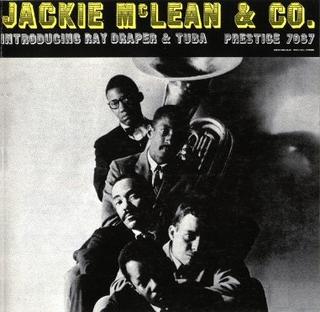
Jackie McLean, who knew something about how hard it is to break through in the music business, seems to have made a commitment, not only to introducing new talented musicians, but to making sure they got fulll recognition (Jackie certainly knew something about getting less than full recognition). We've seen how he introduced his pal, Bill Hardman, on Hardman's recording debut. The full title of this album is Jackie McLean and Co., Introducing Ray Draper and Tuba. The "introducing" part was left off when the album was rereleased on New Jazz, but by that time Draper had introduced himself on his own Prestige album.
1957 began as a year of Fridays with Rudy, and a year of all stars. The Prestige All Stars had kicked off the new year's celebration, and before 1957 was out, there would be 15 albums by one configuration or another of All Stars, two by the Art Taylor All Stars, and three more by the Prestige Jazz 4. If that sounds like a rather static year, it was anything but. As we know, the All Stars were never exactly the same aggregation, and as we also know, Prestige was capturing a core group of musicians who were evolving and growing over one of the great decades in jazz, as noted for innovation as it was for pleasure. And on top of that, there were to be plenty of new names, new sounds, new surprises.
This Gene Ammons album, although not labeled as such, was certainly an all star outing, and would later be repackaged as the Gene Ammons All Stars. Art Farmer, Jackie McLean and Kenny Burrell would make anyone's list of most important musicians of their era; Gene Ammons is probably more remembered as one of the good guys who made a contribution.
But Ammons made music that people liked to hear. This would be his 18th session for Prestige, either as leader, co-leader with Sonny Stitt, or sideman with Stitt. He would go on to record 45 more, and to be the only artist to continue to make new music for Prestige after the label's 1972 sale to Fantasy. So he must have been doing something right, and he was.
I don't completely understand why "Prestige All Stars" became what today would be called a brand in 1956-57. Was Weinstock trying out a theory that the label's name would sell more records than the individual artists? If so, Gene Ammons certainly would seem to be the exception.
Weinstock certainly knew what he had in Kenny Burrell, both as player and composer. He's responsible for the title cut on this album, "Funky." Funk would loom larger and larger as a musical concept in the next couple of decades, but it had always been around.
Ammons generally had his own ideas of what to play. The tunes for a session were worked out between leader and producer, and Ammons quite likely chose "Stella by Starlight," probably with very little discussion. He loved standards, and Prestige artists did record a lot of standards. He may have caught Weinstock a little more by surprise with his other two selections. Record company owners in those days were very much aware of the value of publishing rights, which is why so many rock 'n roll and rhythm and blues artists got screwed. So here are two songs, "Pint Size" and "King Size," that have neither the name viability of a standard nor publishing rights in the family. They were written by Jimmy Mundy, a swing era veteran best known for his work as an arranger for Benny Goodman and Count Basie--and most recently as the composer of the score for a 1955 Broadway musical,The Vamp, which starred Carol Channing and ran for only 60 performances, but 60 performances on Broadway isn't nothing. Anyway, Ammons liked the tunes, and they sound good--although the phone book would sound good if these guys played it.
I have a test for music called the Shopping List Test, which is, if you're driving a long listening to an album and thinking about what you need to pick up at Sam's Club, what suddenly seizes you out of your reverie and says "You've got to listen to this part right now!" This is not a test that particularly proves anything, because with music of this caliber it could be almost anything, but for me, yesterday afternoon, it was Mal Waldron on "Funky" and Art Farmer on "Stella." This is, of course, a meaningless test, because on the drive home it could be something completely different, but it makes me feel good.
Jackie McLean was by now a veteran of Prestige sessions, but not quite as much of a veteran as you'd think. Yes, he goes back to the early days--1951, and the notorious Miles Davis "Dig" session (notorious for Miles having appropriated the composition as his own). But after that, a long hiatus, not just from Prestige, but from recording altogether. There was a live recording of a couple of nights at Birdland, and session a few days later for Blue Note, all in 1952 but not, I believe, released till much later. Then nothing at all until 1955, and it's hard to say why not. He was battling addiction, but lots of musicians were fighting this fight at the time, and many of them still recorded. When Jackie did come back into the studio in 1955, with Miles again, he was only used on two tunes of a four-tune session, and Miles said later that Jackie was so high, he could barely play. Miles never used him again.
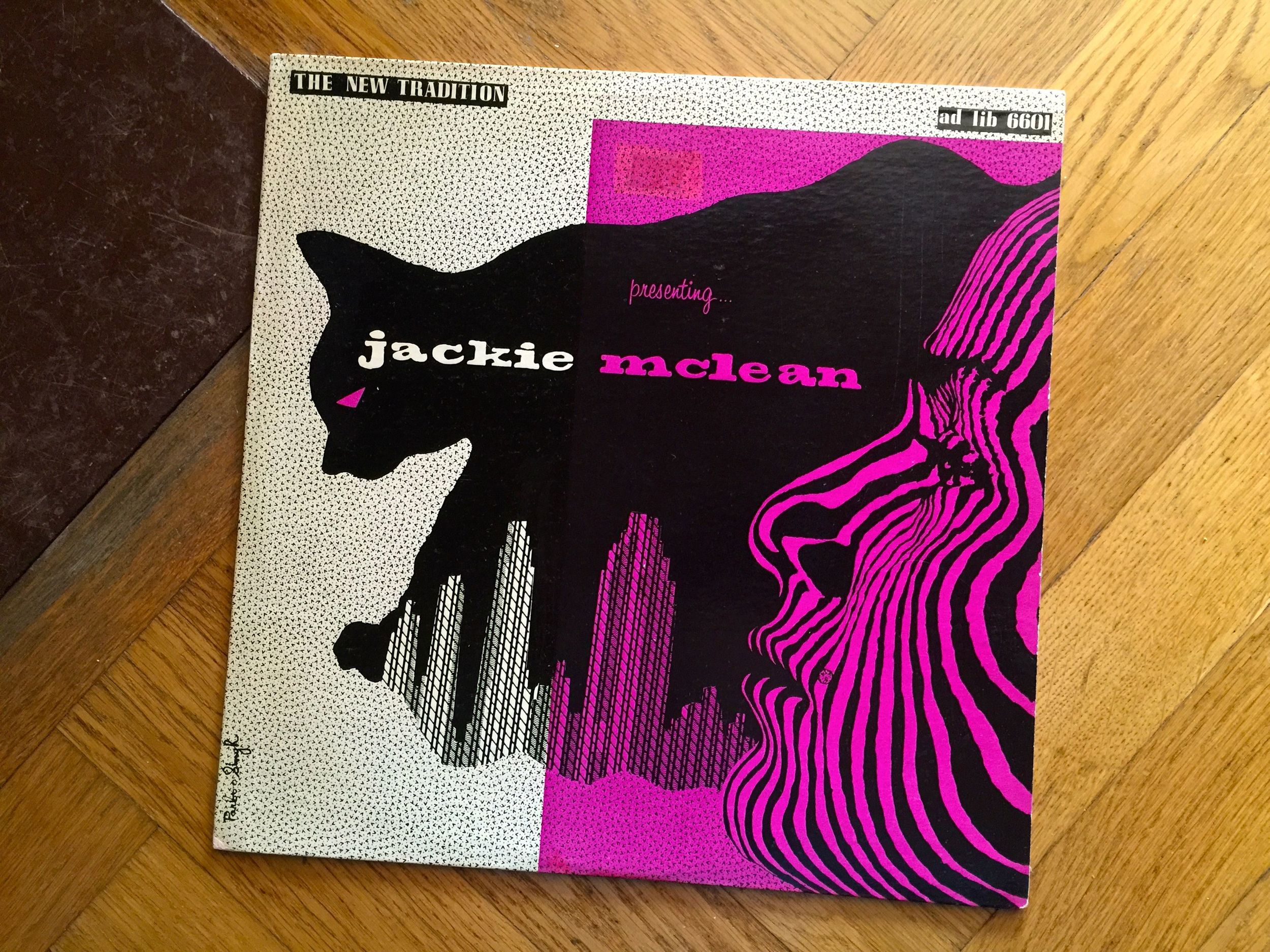
He played on a couple more sessions in '55--one with George Wallington, the other under his own leadership, Both were released on tiny labels: the Wallington live album on Progressive, the McLean Sextet album on Ad Lib. This one, according to the Rare Vinyl Jazz Collector (and aren't you glad such people exist), is "possibly the rarest of all the jazz collectibles out there." So since, like the ivory-billed woodpecker, it may never actually be seen in the wild, here's a picture of the album cover. I don't know who did the art, but it's a gem.
So, veteran or no, 1956 was really his debut year as a jazz force. He recorded for Prestige, Atlantic (with Mingus) and Columbia (with Blakey). By August, he was considered enough of a star that Bill Hardman was introduced on his first recording session as ""Jackie's Pal."
Jackie's pal is back with him for this abbreviated session, along with Red Garland, Paul Chambers and Art Taylor, who would take center stage as a trio for the rest of the afternoon. They do two standards and an original.
It's wonderful listening. The interplay between the two pals is intricate and yet straightforward, especially on "McLean's Scene." And this rhythm section continues to reward, every time out. Some great solos by Red Garland and Art Taylor, but it's Paul Chambers who takes your breath away. You expect a bass solo to come somewhere in the middle of a quintet piece, but on "Gone With the Wind" Chambers is the penultimate solo, right before McLean and and the restatement of the head.
You expect a piano vamp to begin a jazz quartet or quintet number--sometimes an extended vamp that becomes the head and an improvised solo. On "Mean to Me," though the first notes one hears are Garland's, Paul Chambers steps in and takes over that job. Cool.
Because this was an abbreviated session, it had to wait for LP release. It was combined with a 1957 McLean session with a different lineup, and released in 1959 on New Jazz.
Bill Hardman was a youthful 23 when Jackie McLean presented him as his pal/protégé, which was actually two years older than Paul Chambers, who was already a veteran...but Chambers started mighty young. Hardman did too, even though this is is first jazz recording. Even in high school, he was playing with Tadd Dameron's orchestra. After graduating, he joined Tiny Bradshaw's rhythm and blues ensemble, and he can be heard on some of Bradshaw's recordings, although not as a soloist.
He was with Bradshaw from 1953-55, and after that, he was hired by Charles Mingus for a short time -- long enough to become friends with fellow Mingus bandman Jackie McLean (Mal Waldron was also in that group). He would make two more albums with McLean for Prestige, and shortly after this first session, both pals were grabbed up by Art Blakey, who had signed with Columbia, for the second version of his Jazz Messengers.
Hardman would do three different tours with Blakey. And he would endure. Long after bebop and hard bop had gone out of fashion, Hardman kept the flame alive, forming a bop quintet with tenor sax player Junior Cook that was still getting gigs, and appreciative audicnces, through the 70s and 80s.
Hardman died in Paris in 1990, and the headline of his obituary in the New York Times read,
curiously, "Bill Hardman, 57, Trumpeter Known For Improvisations." What did they think jazz musicians did?
Peter Watrous, who does know what jazz musicians do, wrote the obit, and what he actually said was "A fiery but lyrical improviser, Mr. Hardman was one of the last surviving major trumpeters to come out of the 1950's. " This was Watrous's third sentence, and I guess the headline writer didn't feel he needed to read any further.
The composition credits are democratically spread around the group (Jackie was no Miles Davis). "Sweet Doll" is McLean's, "Just for Marty" and "Sublues" are by Hardman, and Mal Waldron brings in "Dee's Dilemma," making for a nice mix and a nice consistency at the same time.
The session is rounded out by Charlie Parker's "Steeplechase" and the standard "It Could Happen To You," which had also recently been recorded by Miles in one of his Contractual Marathon sessions. Listening to both versions back to back is more enjoyable than instructive. The only thing I learned was that when you give a great melody to great improvisers, the results are going to be different. Miles's group takes it at a brisker tempo, even though the tempo-setters on bass and drums are the same for both sessions.
By this time Paul Chambers was established as the bassist in one of the most recognizable ensembles in the history of jazz, and although at this time jazz history was being made, not considered in hindsight, people already knew how important this quintet was.
What people don't always remember is how short-lived it was. Miles formed it in late 1955, recorded pretty heavily with it in 1956, and disbanded it in 1957, not getting it back together until 1958, and then as a sextet. Its rhythm section recorded independently, together or separately, and continued to grow as musicians -- one of the big differences between the Miles and the Jackie versions of "It Could Happen to You" is Paul Chambers' solo. Chambers is developing, and asserting himself.
The album was first released as Jackie's Pal: Introducing Bill Hardman, which is a little odd. New guys make album debuts all the time. But generous of Jackie. It was later rereleased on New Jazz as Steeplechase, a title that looked back to Bird rather than forward to the burgeoning career of young Hardman.
On the session index, this is listed as the Prestige All Stars, the first but not the last time this designation would be used. Presumably, a bunch of contract players were rounded up for the Fridays at Rudy's session, but none of them were specifically signed on as leader, so they let the producer (can't find out who produced this session) select the tunes and organize the session.
Not sure how this differs from other sessions. Did they tell Hank Mobley, "Hey, we want you to put together a combo for a recording session this week -- oh, but you'll be using Watkins and Taylor"? Or maybe these were all basically Prestige All Stars sessions, but only now did they decide to call it that. Presumably the leader would bring in the tunes, or most of them. In this nominally leaderless session, they included a tune that was composed by a contemporary jazzer who's not on the session: Kenny Drew's "Contour." Probably Jackie McLean brought it in--he had an affinity for the tune, had played it just recently on one of his 4, 5 and 6 dates (Donald Byrd was on that session, too). In any event, it's a fine tune, and more people should record it, and actually, several have.
Certainly, McLean must have brought "Dig" to the session, given that it's his composition, even though Miles grabbed the composer credit for it, and whatever royalties it accrued, but this is jazz, so there probably weren't many, as McLean was told when he looked into suing Miles -- it wouldn't be worth it.
"The Third" is a Donald Byrd composition, so one figures he brought it in. He probably also brought "'Round Midnight," since he's the only horn on that track. Art Farmer takes "When Your Lover Has Gone" on his own, so it's likely his choice.
"Dig" is the centerpiece of the album, at nearly 15 minutes. I was interested to see how it compared to the version that was laid down the day Jackie first brought it into the studio to record with Miles and Sonny Rollins. The Davis-Rollins-McLean version is more melodic, the Prestige All Stars more intense--and at this length, that intensity has to be sustained, and it is. All the soloists are powerful. I started to try to name a favorite, but I can't.
However far afield an improvisation goes, if there's going to be enough meat to sustain it for 15 minutes, it's got to be a very good tune to start with, and "Dig" is. I'm surprised it hasn't been covered more often.
When the album was actually pressed and given a cover and released, it was called 2 Trumpets and credited to Farmer and Byrd. A rerelease was again Farmer and Byrd, and called Trumpets All Out, and a much much later rerelease just had Byrd's name above the title, which was House of Byrd.